Equity and Equality

This week the debate over the minimum wage continued in the Senate, on C-Span, other news outlets and social media. The Wall St. Journal presented the minimum wage in Big Mac terms. In 1968, it took 18 minutes of minimum wage to buy that iconic hamburger. Today, it takes 30 minutes of minimum wage. Using that as a guideline, the minimum wage should be at least $12.

Why don’t Democrat politicians propose a minimum wage that varies according to each region’s cost of living (COL)? According to survey data, Colorado’s COL is 73% of California’s COL (MERIC, 2021). Using that as a guideline, Colorado’s minimum wage would be about $11, the same as the current minimum. Missouri’s minimum would be $8.35, which is LESS than the state’s current minimum of $8.60. Many states have implemented a $15 COL-adjusted minimum wage.  

Advocates for a uniform minimum wage argue that they want to erase some of the disparity between urban areas and low paid rural regions, many of which are black or Hispanic. Those in rural areas worry that small businesses will lay off workers, driving the unemployment rate higher than it already is. Others worry that businesses will raise their prices, making it more difficult for those on fixed incomes. In that case, the minimum wage would benefit some at the expense of others.

Twenty years ago, an analysis of minimum wage increases and employment data found only one statistically significant correlation: increases had a minimal effect on teenage employment (Burkhauser, Couch, & Wittenburg, 2000). Other studies have found no effect on employment in the fast-food industry. A recent study examined minimum wage increases in the states and found that increases greater than a $1 had a negative impact of 1% on low-skill employment (Clemens & Strain, 2018). Smaller increases had either no effect or a positive impact. How can we have an informed debate if history does not provide a clear lesson?

Since Plato’s time 2500 years ago, we have wrestled with equality, equity, and justice. Equity measures by outcome, varying the inputs until the outcomes are about the same. Equality measures by inputs; if everyone gets the same chance, the same inputs, then equality is satisfied. Plato argued that justice was an individual functioning well within community. Some of his companions in The Republic argued for alternate versions of justice: that it was the interests of the stronger, that it was helping friends and harming enemies, or telling the truth and paying your debts.

John Maeda posted a Tony Ruth graphic that depicts these concepts of inequality, equality, equity, and justice (2019). Two kids stand on opposite sides under a leaning apple tree so that one kid below the overhang gets most of the apples that fall. That is inequality. They are both given a ladder of equal height; since they each have the equal tools, that is equality. The kid below the overhang is given a shorter ladder to compensate for his better opportunity at picking apples; that is equity. Justice is the equalization of opportunity and tools; using braces and ropes, the tree is straightened, and each kid is given the same size ladder. Justice is both equity and equality.

As a society we often can’t straighten the tree; if we could, who pays for the labor, braces, and ropes? Who owns the ladders? Writing 500 years ago, Machiavelli said that a republic is the best form of government because the two main political classes of society constantly wrestle with these issues. The two groups may be labeled nobles and common people, or Republicans and Democrats, but they are essentially a tug of war between these notions of equity and equality. One group champions equity over equality; the other fights for equality as a priority above equity.

As we listen to debates in Congress, the workplace, and our households, we can identify those two elements. The argument then evolves into the particulars of process, and this is used to justify either side of the equity / equality debate. Machiavelli wrote that people make fewer mistakes when they focus on the particulars. In working out the details we uncover the broad issues that we tussle over. The road of history is curved; to keep from running off the road, we adjust the steering wheel left and right, repeatedly correcting our previous course corrections. This is a time for correction.

//////////////

Photo by Splint on Unsplash

Burkhauser, R. V., Couch, K. A., & Wittenburg, D. C. (2000). A reassessment of the New economics of the minimum Wage literature with monthly data from the current population survey. Journal of Labor Economics, 18(4), 653-680. doi:10.1086/209972

Clemens, J., & Strain, M. R. (2018). The short-run employment effects of recent minimum wage changes: Evidence from the American community survey. Contemporary Economic Policy, 36(4), 711-722. doi:10.1111/coep.12279

Maeda, J. (2019, March 11). Design in Tech Report 2019 | Section 6 | Addressing Imbalance. Retrieved March 06, 2021, from https://designintech.report/2019/03/11/%F0%9F%93%B1design-in-tech-report-2019-section-6-addressing-imbalance/

MERIC. (2021). Cost of living data series. Retrieved March 06, 2021, from https://meric.mo.gov/data/cost-living-data-series

A Nation of Storytellers

February 28, 2021

by Steve Stofka

In our national narrative, the sheriff comes to town and the virtuous town folk walk without fear. Four years ago, President Trump promised to be that sheriff, routing out the miscreants that lived in the Washington swamp. When he was the unlikely winner of the 2016 election, religious romantics attributed his victory to God, not the arcane rules of the Electoral College. When he lost the 2020 election, God was nowhere to be found. He had been chased off by cheaters who had stolen the election from their candidate. Hollywood could only have been invented in America. We are storytellers.

On January 6th, a group of self-dubbed patriots attacked the Capitol building in Washington. In their eyes, the lawmakers in that building were illegitimate, and the vigilantes assumed their Constitutional duty to unseat those lawmakers. They were the Tea Party attacking the British in Boston Harbor more than two hundred years ago. Through social media they had amplified their role in the American myth, taking center stage in a fight for freedom.

America is a game of Prisoner’s Dilemma, the game theory scenario where two prisoners, each in a separate interrogation room, must decide whether to confess to a crime. If neither confesses (they cooperate), they get off with a light sentence. If one confesses and the other doesn’t, one goes scot free and the other is given a harsh sentence. If they both confess, they are both given a medium-term sentence. The players have a choice to cooperate (neither confesses) or defect (confess). If the game is played once, it is better for each prisoner to defect. If the game is played multiple times and there is a memory between games, the prisoners should cooperate.

American politics is not a cooperative game. Within a decade after the ratification of the Constitution, the founders realized, to their dismay, that they had created a vicious party system. In 1800, the founders themselves were engaged in an electoral battle, ready to smear each other’s reputations and the honor of their families to gain the power of the Presidency.

In the halls of Congress, the prisoners meet in committee rooms. They confess to the crime of representing their constituents. They confess to the sin of defending their principles. They handcuff themselves together with rules of order, then come out fighting. They play this game every day, each party unable to cooperate with each other, but telling themselves a story that they are cooperating with the rules. Outside the halls of Congress, their constituents are fighting without rules. The breach of the Capitol building brought the fight inside.

We are storytellers. After World War 2, many Americans lost their jobs and careers on suspicion that they were Communist sympathizers. Today a common phrase is “if you see something, say something.” The campaign began as a response to the 9-11 attack but has been extended to mean any suspicious activity. The “see something, say something” campaign means to promote predator awareness – those who would victimize children and women. Trayvon Martin and Ahmaud Arbery were two men who looked suspicious and were gunned down by white vigilantes who interpreted the Constitution to give them the right to defend their community against suspicious people.

Hong Kong is an island off mainland China that was formerly under British rule and prized its independence from Communist rule on the mainland. They are telling a different kind of story – turning on each other. As part of a campaign by the mainland Communist Party to repress street protests in Hong Kong, the government set up a hotline to report suspected violators of new security laws aimed to restrict criticism of the government in the media. 40,000 virtuous and vigilant residents have squealed on their neighbors.

Myths connect people but our stories are tearing us apart. Our media is saturated with a mixtape of opinion, lies and carefully filtered facts to present some Americans as the “other.” The Chinese government encourages Hong Kong residents to turn on each other. In our country, the media does the same job. We are proud of those freedoms even if they destroy our civility and our cohesiveness as a society.

///////////////

Photo by Patrick Tomasso on Unsplash

A Policy Pivot?

February 21, 2021

by Steve Stofka

Climate change induces more erratic weather patterns. More dry and wet; colder and hotter. California has been hit by persistent drought. Texas and other southern states got walloped this week. Several dozen Texans lost their lives when electricity generation failed for several days this week. For two decades, Texas has adopted a relaxed regulatory policy that does not incentivize or require power generators to prepare for unusual events like this week’s cold snap. Texas legislators argued that these policies reduced costs and lowered bills for Texans. Other states with more stringent regulations weathered the cold snap because power operators beef up their generation system to withstand extremes.

Natural gas supplies 46% of Texas’ electricity generation. The valves and regulators on those lines froze because of a lack of heating equipment. Wind turbines supply 23% of Texans electricity but had no heaters installed as they do in other states. Because Texas has its own electricity grid, it has no power balancing arrangements with other states. Texans pride themselves on their self-reliance to the point of arrogance. They are the Lone Star State, Texans first, Americans second.

Through district gerrymandering a minority of Republican voters in Texas control policy. The state has a constitutionally weak governor with little power. The legislature promotes someone to the post who will be agreeable. Politics is heavily influenced by the oil and gas industry whose rights are senior to property owners. If a gas company wants to run a pipeline through someone’s property, an owner has a difficult fight.

Because Texas was part of Mexico until the 1840s, its laws and culture are influenced by the hacienda system set up by Spain in Latin and South America during the 17th century. In that colonial period, the Spanish monarchy took control away from parliament, imposed a uniform religion and a rigid centralized bureaucracy. Land in the Americas was parceled out in large tracts called haciendas to those who were loyal to the crown. This promoted a system of personal relations among landowners, people over principle, and a lack of growth and technological improvement. Like cuttings on a plant, the culture of white settlers in Texas were grafted onto this system. Texans adopted the “good old boy club” that has plagued politics in Latin America for centuries and made it their own.

Northern states were initially settled by colonists from England. In the 17th century, the English Parliament took power from the monarchy, a power shift opposite that in Spain. Religious and political diversity carried over from the motherland to the colonies and became institutionalized. Property rights, and the products of property could be conveyed to others. This encouraged a system of principle over person, a more impersonal exchange that fostered technological development.

Texas culture relies on tradition more than innovation, but the state provides a fertile and friendly atmosphere for innovative businesses from other states. Business growth relies on a flourishing human capital. Texas’ K-12 schools rank in the middle of the 50 states and above California, both with large immigrant populations and low English fluency (McCann, 2020). However, a state that cannot manage its power grid is not an attractive environment for business.

Will this crisis spark a shift in policy? Texas has long been captured by special interests, who are antagonistic to change. The past few years Texas politicians have stood proud, calling to California businesses, “Come here and get away from those regulations.” That cheery welcome has been tarnished this week. Business executives might wonder if Texas has other infrastructure problems. Texans hope that the fast-moving news cycle will turn its attention elsewhere.

//////////////////////

Photo by Alexander Schimmeck on Unsplash

McCann, A. (2020, July 27). States with the best & worst school systems. Retrieved February 20, 2021, from https://wallethub.com/edu/e/states-with-the-best-schools/5335

Alt Belief

December 6, 2020

by Steve Stofka

Cognitive dissonance controls our political sensibilities. We speak in cryptic code and listen only to those whose code we understand. Our understanding is the standard by which we judge all other versions of reality. There is a dedicated band of people determined to preserve out of fashion ideas and explanations. Life would be easier if the people who disagreed with us would change their minds.

Listening to Washington Journal on C-Span this past week, I realized why my sensibilities lie with the Democratic Party. I can argue with their ideas, some of which I do not agree with. A Republican Congressman said that the government has no right to dictate the personal behavior of people, even though that behavior might kill people. On the other hand, the government does have the right to dictate the personal behavior of women on the chance that they might kill their fetus. My head exploded and I moved on to something else.

Several decades ago, Republican voices used to make more sense. Either the party has changed, or I have. Is this any way to discover my political allegiances? American politics is driven more by disaffection. The enemy of my enemy is not my friend, but more like my foxhole companion on the political battlefield. Both sides of the political aisle would benefit more if they cooperated, but it pays to compete, or to defect as it is known in Game Theory. If the other side says 2+2=4, then our side will claim the answer is 5. Rally ’round the flag, boys. In this prisoner’s game, the American public is forced to play along.

The American people and the members of Congress, but especially the Senate, live in different realities. Many families cannot pay their rent; the lines at food pantries stretch for many blocks; 20% of retail businesses have closed their doors; depression, drugs and suicide are increasing. Lounging in their Roman baths, our Republican Senators argue the ontological points of another aide package. Republican led states, dependent on energy or tourism, are begging their party for help. Senate Majority Leader McConnell wraps his white tunic about him, bids his slaves to draw his bath, and refuses to budge.

It’s always the other fella who is living in an alternate reality. When Einstein first noticed that, he built himself a theory. Some people thought he was living in an alternative reality, but after a century, most agree that his explanation was a good one. E=mc2 is as well-known as the 2600-year-old Pythagorean theorem a2 + b2 = c2.

Many alternate realities die as people come to agree on things. There are a few people who won’t let an explanation die. The earth is still flat. The moon landing was a hoax. So is Covid. Massive voter fraud gave Joe Biden a 7 million vote victory over Donald Trump. I used to think that ideas changed one death at a time. Now I’m not so sure. Some ideas are stubborn.

People and mules have much in common. We respond better to carrots in front of us instead of whips behind us. Why then do people on each side of the political aisle whip each other with words? Did we all run out of carrots?

People fix their minds on something and never change. That’s a conservative. Facts will not budge them from their ideological foxholes. The economist John Maynard Keynes said that he changed his mind when presented with new facts. That’s a liberal. They respond to the whip of facts and the carrot of something better.

We begin life with no fixed ideas. Our parents and the people around us put their ideas in our heads. Some of them grow, some fall out. People get mad at us when the ideas they planted don’t take hold in our minds. As adults, we learn that lesson at the Thanksgiving dinner table.

We are more comfortable when we are with those who share a common perspective. Perhaps we think God controls every detail of our lives, or that [insert name here] is part of a conspiracy that controls every detail of our lives.

No matter how different political and religious institutions are, they want us to believe what they believe. That is the problem: getting others to believe what we believe. We believe that what we believe is not a belief, but reality. Your belief is a belief. You see that, don’t you?  

/////////////////

Photo by K. Mitch Hodge on Unsplash

Heathens and Wizards

During negotiations over raising the debt ceiling from July 26th to August 8th, 2011 the S&P500 fell 16%.  The index fell only 1% in the first week of negotiations as it looked like President Obama and Republican Majority Leader John Boehner might strike a deal.  Then the bottom fell out.

In the week of trading since budget talks intensified on Dec. 20th, 2012 the S&P500 has lost 2%. 

Investors are worried but hopeful that Congress and the President can come to some resolution before tax increases and spending cuts automatically take effect on January 1st.  Housing and automobile sales are showing renewed strength; the yearly increase in Christmas shopping was a disappointment but the underlying fundamentals of the economy give reason for cautious optimism.

The rapid decline in last year’s stock market should serve as an example to investors in today’s market.  For the long term investor, a further decline of 5 – 15% will present some buying opportunities – time to make that IRA contribution or to put some sidelined cash to work.

The volatility index, or VIX, measures the relative uncertainty of the broader market using a formula that analyzes the bid -ask spreads of option contracts, which are promises to buy or sell stocks in the future.  When the markets are fairly calm, the VIX index is under 18 – 20.  As markets melted down in October 2008, the VIX rose to 80.  So, 16 is pretty good; 80 is real bad. In the last week of July 2011, this index jumped 20%, then skyrocketed to 48 in the first week of August.

This past week, the VIX went up from the calm range of 18 to 23, indicating the underlying worry.

Last week I wrote about the debate over which inflation measure to use, the CPI or deflator.  If you hear about “chained dollars” or “chained CPI”, it is the deflator that they are referring to.  The difference between the two yardsticks is $3 – $5 per month in a $1000 Social Security check.  This afternoon, Senate Majority Leader Harry Reid walked away from negotiations over this issue.  As I write this in the afternoon of Sunday, Dec. 30th, Senator John McCain has announced that Republican Senators have just taken this issue off of the table.  We can expect that the issue will come up again in the coming negotiations over the raising of the debt ceiling.

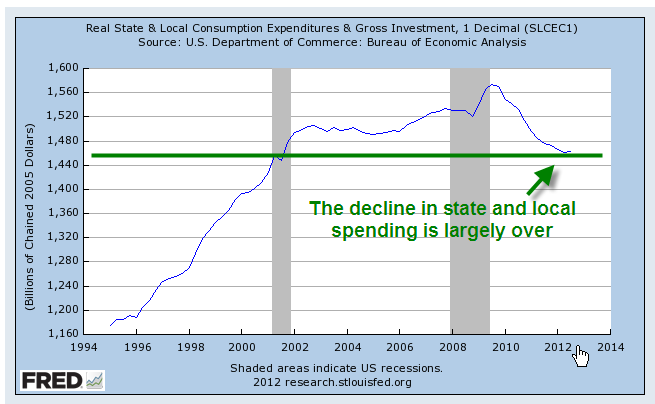
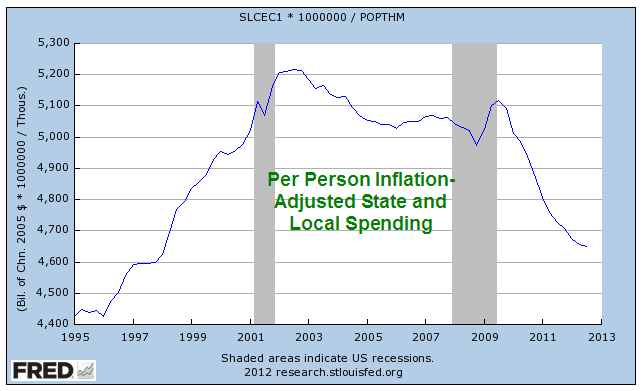
For the past several years, Republicans both in Congress and at the state level have targeted the growth in state and local spending.  This campaign of austerity, as Democrats call it, or fiscal common sense, as some Republicans call it, has won Republicans the governerships of thirty states.  Most of that spending growth has been curbed.

On a per person basis, inflation adjusted spending is at the same level as the mid 1990s.

For states, this return to mid 1990s spending levels has meant cuts in services to their residents.  Medicaid spending takes an increasingly larger portion of state budgets; because states can not run budget deficits, reductions have to be targeted toward education and infrastructure spending.  In 2011, Medicaid spending averaged 25% of state budgets, more than the 20% spent on education (Reuter’s source)

While Republicans dominated the Congress and Presidency in the early 2000s, they showed little concern for the growth in what they call entitlements, programs like Medicare and Social Security.  Instead, they increased entitlement programs, adding a Medicare drug benefit program.  Since they lost their Congressional dominance in 2006,  Republicans have become more cost conscious – and the next targets are entitlements.  Most seniors who have paid into Medicare and Social Security all their lives do not consider these programs as “entitlements.”  It is a dog whistle word that Republican politicians use to call out to their pack.

Democrats look and look and look but simply can not find any cuts that they can make to the social safety net.  Under the rubric of compassion, the Democratic strategy consists primarily of buying votes with ever more social welfare programs.  In the Democrat view, a government and its citizens are in a partnership.  Republicans rightly point out the dangers in any partnership where one partner, the government, holds all the power.  Despite all the rhetoric about limited government, Republicans are advocates of a different kind of partnership between government and corporations whose political contributions are essentially kickbacks for contracts with the federal government and a more relaxed regulatory environment.

Supposedly vigilant Republicans get out their spending cleavers but can not find any cuts they can make in current defense spending.   The operative word here is “current.”  The Defense Dept lives in a budget bubble that most of us would envy because it has little economic responsibility for soldiers once they leave the service.  Most rehabilitation, medical, housing, retraining and other services that the soldier is entitled to or need are no longer born by the defense department. Congress “dumps” these costs on the Human Services department, routinely targeted by Republicans for spending reductions.  In inflation adjusted dollars, we are currently spending 30% more on defense that we spent during the Vietnam War years, 25% more than during the military buildup of the Reagan years.

At the beginning of this century, we have two parties whose allegiances prevent them from coming to any meaningful compromise.  Tax policy is riddled with temporary tax cuts to promote various social causes. Special interest groups and wealthy taxpayers nibble away at tax legislators, creating a swiss cheese of fairness. Budget planning is a legerdemain practiced by a small coterie of heathens and wizards in budget committees; under current budget rules, there are few reductions in spending, only reductions in projected increases in spending.  Imagine that your family budgets for a 3% yearly increase in your utility bills.  One year, the utility company has no rate increase.  Your family claims that they have cut spending on utilities.

The Defense Dept has no long term accountability for the care of their soldiers.  The Human Resources Departments have no accountability for increases in health care spending; they are on automatic pilot.  Congress has no accountability for passing a budget; they have not done so for six years yet continue to get paid.  Bankers risk huge amounts of money that threaten the savings of millions; the company pays a relatively small fine and the individuals responsible suffer no criminal prosecution because of the difficulty and expense of such trials. The public senses that the political party system is morally bankrupt; that the leaders and representatives of this country are unable to break out of the cycle of partisan brinkmanship; that many representatives are bought and paid for; that most of the public has been left out of the deal. 

The public will either find a way to reclaim their authority over the political process of governing or be left standing helplessly on the sidelines while the two parties scrimmage at midfield, both parties having lost sight of either the goal or the audience.  Political advantage has become their goal.  Party leaders enforce a rigid heirarchy of committee assignments, rewarding those in the party who comply while shrugging off those who might compromise.  Gerrymandered districts ensure that many representatives are accountable only to the more rigid ideologies of their district;  their sole challenge comes from extremists in their own party. 

Maybe this time is different.  Maybe not.  Slowly and finally, the social, economic and political order cracks; the public votes in the most extreme elements who promise to restore order and principle or their version of fairness.  What they bring is despotism.

But that could be many years in the future.  For now, we salute the New Year!