Fish and Bones Investing

January 14, 2024

by Stephen Stofka

This week’s letter is about our portfolios and the return we earn for the risks we take. Flounder is tasty but be careful of the bones. January is a good time to review savings and assets and start making plans for 2024. Did I make any contributions to my IRA in 2023? After the gains in the stock market last year, how has my portfolio allocation changed? I thought I would take a wee bit of time to review the performance and key indicators of some model portfolios over the past sixteen years. We have endured a great recession, a financial panic, a slow recovery during the 2010s and a pandemic in 2020. Despite all those setbacks the SP500 index has more than tripled since December 2007. Huh?! Before I begin, I will remind readers that none of what I am about to say should be considered financial advice.

Allocation

A portfolio can be separated into three broad categories: stocks, bonds, and cash. Stocks are a purchase of equity or ownership in a company;  bonds are a purchase of public and private debt; cash is an insurance policy. Each of these can be subdivided further but I will stick with these broad categories. An allocation is a weighting of these types of assets. A benchmark allocation is 60/40, meaning 60% stocks and 40% bonds and cash. The percentage of stocks in a portfolio indicates an investor’s appetite or tolerance for risk. In this review I will discuss three allocations: 50/50, 60/40 and 70/30. A 70/30 allocation is considered more aggressive than a 50/50 allocation.

Investment Cohorts

The 50/50 portfolio was invested equally in the SP500 (SPY) and the total bond market (AGG) at the start of each 8-year period, beginning with the period that began in 2007. I will refer to these 8-year periods as cohorts, just like age cohorts. The 2007 cohort was “born” on January 1, 2007, and “died” on December 31, 2014. The second cohort was born on January 1, 2008, and died on December 31, 2015. There was no rebalancing done throughout each period to test the effect of a severe financial shock during the life of the investment.

Presidential Administrations

I picked an 8-year period because it aligns with two Presidential terms. A change in administration alters the political climate and presumably has some effect on a portfolio’s returns. The data, however, did not confirm that hypothesis. Presidential candidates try to persuade voters that their candidacy and their party will make people better off. To the millions of people trying to build a retirement nest egg, a change in administrations during the past 16 years had little effect. The market responds to forces much broader than the policies of any administration.

Specific Cohorts and their Returns

Let’s look at a few cohorts. Despite the severe downturn during 2007-2009, the slow recovery and the pandemic shock, the more aggressive 70/30 allocation delivered consistently higher returns than the two safer allocations. Obama’s two term Presidency began in 2009 at a decades low in the stock market, an opportune time to invest. However, that 8-year return had only the second highest return in this analysis. The highest return was the 2013-2020 cohort that consisted of Obama’s second term and Trump’s only term (so far).

Risk vs. Return

In 2008 a 50/50 portfolio cushioned the 37% loss in the U.S. stock market but over an 8-year period, the advantage of a safer allocation largely disappeared. In the period that began in 2008 all three portfolios delivered less than a 6% annualized return. During a severe downturn, a safer portfolio can mitigate an investor’s fears but the best tonic is a long term perspective. Generally the difference in returns is about 1% per year so the 50/50 portfolio earned 1% less than the 60/40 which earned less than the 70/30 portfolio. However the 70/30 investor absorbed more risk than the other two portfolios. In the chart below is the standard deviation (SD) of each portfolio, a measure of the risk or variation in a portfolio.

Performance Metrics

Recall that the 2013 cohort (green dotted line) had a return above 12%. The risk was almost 11%, a nearly one-to-one ratio of return to risk. Financial analysts have developed several measures of the tradeoff between risk and return. The Sharpe ratio is a measure of return that adjusts for risk by subtracting the return on a really safe investment from the return on the portfolio. The benchmark for a risk free investment is a short term Treasury bill (The interest rate on a money market account would be a close substitute).

Let’s use some rounded figures from the 2013 cohort as an example. The 70/30 portfolio earned 12% and a safe investment earned just 1%, a difference of 11%. That is the numerator in the Sharpe ratio. The denominator is the level of risk which is the standard deviation (SD) mentioned above. The SD was almost 11%, giving a ratio of 1. In the chart below is the Sharpe ratio for each cohort and shows that the actual ratio of 1.1 was close to the approximation above. Notice that the safer 50/50 portfolio often had the higher risk adjusted return.

From Peak to Valley

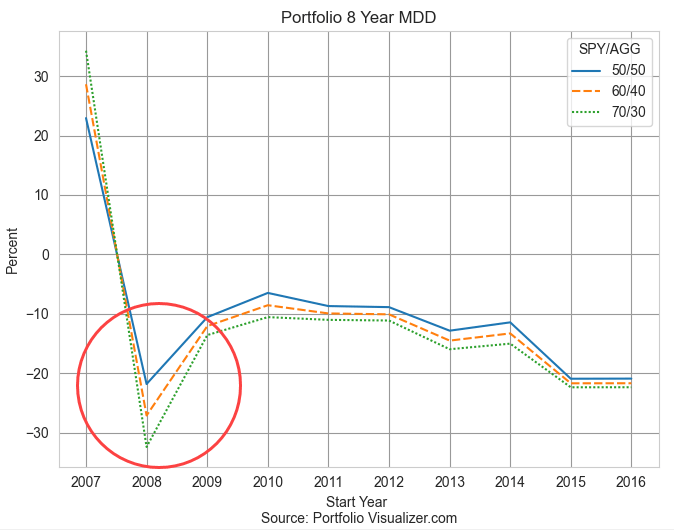
Investors may ask themselves “how much in return can I earn” when the more appropriate question is “how much risk can I tolerate?” The MDD, or maximum drawdown, is the greatest change in the value of a portfolio, regardless of the beginning and ending of a year. A portfolio might have gained 20% by October of 2007, then lost 60% in the next six months. The MDD would be 60%. It can be a gauge of your comfort level. Notice in the chart below that the MDD only varies under great stress like the financial crisis when the difference between the safer 50/50 allocation and the 70/30 portfolio was about 10%.
The Impact of Loss

We feel losses more than we do gains, even if the losses are only on paper. A portfolio that gains 20% only has to lose 16% to return to even. Regardless of our math abilities in a classroom, our instincts can be quite good at percentages. At higher gains, the percentages are painful. A portfolio that gains 50% then loses 50% nets a 25% net loss from our starting position (see notes at end). An MDD is a good indicator of “will this loss of value cause me to sell the investment?” In the early part of 2009 after the market had been battered, some clients could not handle the anxiety and sold some or all of their stocks, despite the advice from their advisors that this was the worst time to sell.

No Two Crises are Alike

Since December 2019, a few months before the pandemic restrictions began, the stock market gained 20% after adjusting for inflation (details at end). During and after the financial crisis, stocks lost 12% during the four years from December 2007 through December 2011 (details at end). The better response of asset prices during the pandemic era can be attributed to two phenomenon: technological advances and high government support of households and small business. During the financial crisis the majority of government support strengthened the foundations of financial institutions at the expense of households and small businesses. During the pandemic, many people could be productive from home. Students were in a virtual classroom with 15-30 other students. Had the pandemic happened in 2007, there was not enough bandwidth to support that kind of access, nor had the software been developed that could run that network capacity.

Takeaways

Households vary by income, by age, by health, circumstances and family characteristics. Each of these factors is a component of a risk exposure that a household faces. A younger couple might have time on their side but family obligations reduces their risk tolerance. Those obligations might include caring for an elderly parent or supporting a child’s educational goals. These models cannot replicate actual portfolios or individual circumstances but they do illustrate the smoothing effect of time even under the worst shocks. Risk tolerance is a matter of time tolerance.

//////////

Photo by Ch P on Unsplash

Keywords: portfolio allocation, standard deviation, risk, return, Sharpe ratio

A portfolio of $100 that gains 50% is then worth $150. If it loses 50%, the result is a value of $75, a net loss of $25 or 25%.

According to multpl.com, the inflation-adjusted value of the SP500 was 4708 in December 2023. This was a 20.6% gain above an index of 3902 in December 2019. The index stood at 2005 in December 2007, the first month of the Great Recession that would become the financial crisis in 2008. In December 2011, the index stood at 1762, an inflation-adjusted loss of 12%.

Marginal Losses

April 23, 2023

by Stephen Stofka

Today’s letter is about marginal loss and marginal value. We are going to take a rollercoaster ride from Einstein to relationships to the Bible to the marginalist revolution in late 19th century economics. Buckle in.

Einstein’s formula equating mass and energy confused me for a time. With all the mass in the universe, it seemed that it would blow itself up. At some point I read that the m in E = mc2 represented the mass lost and a light bulb turned on in my young head. A grain of sugar lost from a sugar cube weighed almost nothing but when multiplied by c2well, no wonder the atom bomb was so powerful.

We understand the value of a partner when we lose them. The worst part of breaking up with someone is thinking that they experience the loss far less than we do. We think back and wonder if we valued them more than they valued us throughout the relationship. The pain of loss becomes the yardstick that we measure the parts of the relationship. After the death of a dog, we remember them licking us awake in the morning with far more fondness than we actually felt when we just wanted a few more minutes of sleep rather than a walk in the cold morning air.

In the Parable of the Workers in the Vineyard, the workers hired early in the day get the same daily pay as those hired later in the day. Those who worked least, i.e. the last workers hired in the day, became the standard by which all the workers’ pay was evaluated. That became their standard of value. By this measure, the landowner had cheated the workers hired earlier in the day. In the landowners valuation, the workers were indistinguishable. To each worker, they distinguished themselves by the amount of time spent working and discomfort endured.

In a market stall in a developing country, the produce sold by each vendor may be largely indistinguishable. The value of what each vendor sells is mostly determined by what would happen if they weren’t there, not by the amount of effort they put into growing and harvesting what they offer for sale. Is that fair?

John Bates Clark was a leading economist of the late 19th and early 20th century who asked that very question. In Chapter 7 of The Distribution of Wealth he noted that the price of all the wheat grown by farmers in the northwest United States was determined by the price of whatever surplus wheat there might be when all the wheat reached the marketplace. This price was fixed on a London exchange thousands of miles away. Why should the marginal surplus determine the price of an entire crop?

A pound of ground beef might sell for $5. Add 10 cents worth of spices, 20 cents of packaging, 50 cents of labor and that same product now sells for $8 as Italian meatballs. Why do the marginal ingredients determine the price of the entire pound of ground beef?

In Chapter 8, Clark noted that a worker’s value to an employer is not their marginal product – not directly. It’s the loss to the employer if a worker left, or the marginal loss. Clark called it a zone of indifference. Within that zone are the expendable workers. Should those expendable workers become the standard of value just as in the parable of the vineyard? These are uncomfortable conversations. Workers have families. They contribute more to the community than their marginal worth to an employer. They take their kids to soccer games and coach Little League games. They volunteer at food banks, animal shelters and museums. How should society pay for that worth?

Clark published his book The Distribution of Wealth in 1899 when employers provided few benefits or protections for workers and factories were crowded with child workers. There was no income tax. In the U.S. today, employers are required to pay some part of society’s share of a worker’s worth to the community. The employer then includes those societal costs in the price of their product and the burden is shared among the employer’s customers (note below).

This is an indirect or hidden tax, a more politically feasible type of taxation. We judge our taxes at the margin – the amount that we have to give to the government on the last dollar we earn. The press cites marginal tax rates, the rate on the last dollar, and not the effective tax rate, the total amount of tax divided by our total income. We might be in the “25% tax bracket” when our effective rate is only 11%. We are guided by marginal loss thinking.

Repeated experiments have demonstrated that we assign a greater value to marginal losses than we do marginal gains. Consider this, a variation of Einstein’s thought experiment with moving trains. Consider two observers – John is on a moving train and Mary is an omniscient observer on a train platform. In this case, the moving train is time. John has a $100, which becomes his standard of value. Then some event happens before the next stop and John has $105, which becomes his new standard of value. Like the rest of us, John forms expectations of the future based on his current motion. He expects a gain of about $5 before the subsequent stop. But something happens and John loses $5. From Mary’s point of view, John has the same amount of money he started with. But John feels like he has lost $10, the initial gain and the expected gain that he did not receive.

No one has to teach us marginal loss thinking. It seems to be instinctual because we live at the margin, breathing in and out every minute of our lives. The very act of breathing creates a loss of pressure in our lungs. Sometimes marginal thinking is appropriate and sometimes thinking at the average is more appropriate. As investors, not traders, we must think at the average, not the margin, to survive.

/////////////////

Photo by Roman Fox on Unsplash

*These societal costs are not the Marginal Social Costs (MSC) referred to in Environmental Economics texts. Those are costs that an employer imposes on society.

Investing, Not Gambling

January 22, 2023

by Stephen Stofka

This week’s post is about expectations, investing and gambling. After last year’s slump in asset prices, investors may be disappointed in the recent performance of their portfolio. A 60/30/10 (U.S. stocks/bonds/cash) had a 3-year return* of 3.65%. A 5-year return was 5.53%, according to Portfolio Visualizer (2023).  Investors tend to weight losses more than they do gains. Following portfolio losses during the financial crisis, many investors turned to more conservative assets, selling their beaten down stocks at a low. Following this past year’s selloff in both bonds and stocks, investors might be tempted to shed both. Let’s take a look at the averages.

Only three years out of the past fifteen has a balanced portfolio had a negative return. When a stock fund loses 35% in a year, investors can feel the loss so deeply that they liken stock investing to gambling. A gamble is a win or lose event with a high return and a low probability of winning, a probability so low that it outpaces any winnings I might get. For example, if I could bet a $1 and win a million, that is a 1,000,000 to 1 leverage. But my chances of winning might be 1 out of 300,000,000. Take that probability and turn it upside to get its inverse of 300,000,000 to 1. Compare that to the leverage and the ratio is 300 to 1. The gambler is at a distinct disadvantage. That’s how lotteries raise money for parks and common areas and how casinos stay profitable.

A prudent portfolio is not a win or lose bet but a series of erratic steps, the familiar model of the random walk. In any year, our expectations should be guided by historical averages, not the last erratic step. In the fifteen years since the year of the financial crisis, the average of the annual returns of a 60/30/10 portfolio, rebalanced annually, was almost 7.2%. (Note: this is slightly higher than the annualized growth rate). A more conservative 50/40/10 asset mix averaged 5.6%. Last year’s portfolio loss of 15.55% was unusual and not likely to be repeated. Investors who were spooked by market losses last year risk losing positive gains in the following years if they let one year’s return dictate their allocation targets.

Losses in both the stock and bond markets last year made rebalancing counterintuitive. In a simplified model, bonds go up when stocks go down. To rebalance, an investor sells some bonds and buys stocks, selling high and buying low. Likewise, when stocks climb, bonds show a negative return. For twenty years, Callan (2023) has charted seven asset classes and their returns, demonstrating the wisdom of asset diversification. In 2021, a mix of large and small cap stocks returned about 21% while a mix of domestic and foreign bonds fell 3-4%, depending on the mix. Rebalancing toward a target allocation, an investor would have sold some stocks and bought bonds. In 2022, both stocks and bonds had approximately similar negative returns. An investor may have found that their allocation changed little except that the cash portion of their portfolio might have grown a bit.

An unusual year like 2022 can distract or confuse an investor’s strategy. A casino or lottery wants to draw our attention to the unusual event – the win – and away from the average – the loss. If gamblers were to focus on the averages, few would play. Investing is the opposite of gambling and our focus should be trained on the averages.

//////////////////////

Photo by Kaysha on Unsplash

*CAGR – compound annual growth rate

Callan. (2023, January 16). Periodic table. Callan. Retrieved January 21, 2023, from https://www.callan.com/periodic-table/ Note: this chart ranks the annual returns of seven asset classes for the past twenty years. Go to the web site, then click the PDF link for the free chart.

Portfolio Visualizer. (2023). Backtest portfolio asset class allocation. Portfolio Visualizer. Retrieved January 20, 2023, from https://www.portfoliovisualizer.com/backtest-asset-class-allocation

Bray and Begone

January 1, 2023

by Stephen Stofka

This week’s letter is about an unusual year and the lessons we can and can’t learn from it. As I wrote last week, we must carefully sift through the unique circumstances in a time series to learn any lessons that we can carry into the future. Sometimes we bray at the passing of an unusual year and continue on our course. Other times, like 9-11 and the 2008 financial crisis, we sort through the debris of an unusual year to understand how we can avoid a repeat occurrence.

What made this year so unusual was the bond market’s loss of almost 13% in addition to the stock market’s loss of 18%. Normally, bonds zig when stocks zag but not this year. This year’s loss in the bond market was the steepest drop ever. This year has been a good test of an investor’s allocation but a long term perspective is encouraging.

During our working years we accumulate assets. In retirement we distribute the price appreciation and income from those assets. In a down market like this past year, a younger investor must balance the opportunity to buy assets at lower prices with the probability they will need liquidity, i.e. cash for living expenses. A basic recommendation is to have six month’s income in cash for emergencies and loss of job. Someone in an executive position might store up to two years of cash or highly liquid investments in anticipation of a much longer job search to find a comparable position.

This past year has tested retired investors who have relied on the historical stability of bond prices. An aggregate bond mix lost 12.8%, surprising investors who may have used bond funds as a substitute for cash funds that paid little interest in the previous years. A bit of historical perspective – in 1994, after five years of relatively low rates, the Fed began raising rates. An intermediate term bond fund lost 4.2%, while an average treasury bond lost 8% that year. The Fed has kept rates far lower and far longer than that five year period and the market reaction has been greater as well. A 60-40 portfolio (60% stocks, 40% bonds) has moderate risk and good long term returns, making it a choice of many money managers. That typical portfolio weighting lost 16.5% this year.

An asset’s ultimate value is measured in the goods and services that they can buy. Today’ retiree might live 20 – 25 years or more, tapping their assets for their income needs. A few months ago, Gupta et al (2022), researchers at McKinsey & Company, found that the SP500 index has returned about 9% since 1994, including the dot-com frenzy of the late 1990s. To measure the purchasing power of the SP500 index over a 23 year period, I adjusted the index by the CPI index in January 2000, near the height of the dot-com bubble. In that span of time, we have endured a dot-com meltdown, the Great Financial Crisis and its slow recovery, followed by a once-in-a-century pandemic and a disruption of the global supply chain. The wide adoption of the internet in commerce has prompted a fundamental shift in jobs and revenue. Despite those disruptions, the purchasing power of stocks has increased 1.8% above annual inflation since 2000. Including an average dividend return of 2.02%, the broad stock market has grown in purchasing power almost 4% every year.

The SP500 index is a compilation of companies that have survived tough economic conditions. Companies that fail the adversity test are discarded from the index and replaced by another company. It is like a game of “King of the Hill” that we played as kids but the stakes and price volatility are far  higher. A broad index of bonds usually offsets that volatility, sacrificing a little return for a big reduction in the value of a portfolio. In the past 23 years, a 500 index fund had a standard deviation – or wag of the tail – of more than 15%. According to Portfolio Visualizer (2022), a simple 60-40 portfolio had less than 10% deviation. That lack of volatility cost .25% per year in return, about the same as the annual cost to insure a house. Investors with a 6-30-10 portfolio, setting aside 10% in cash, paid an additional .25% less return in exchange for a slight reduction in price volatility.

For the first time since records began, bonds did not offset the volatility of stock prices this past year. Depending on their age, health, location and available resources, some investors have a greater tolerance for risk than others. Investors with exactly the same circumstances may perceive their risk differently and comparisons between individuals are difficult and ill-advised. Some investors feel more fragile, giving greater weight to unique outcomes like this past year. Others give more weight to average trends, taking comfort in the probability that this year was an anomaly.

////////////////////////////

Photo by Mary Farrell on Unsplash

Backtest portfolio asset allocation. Portfolio Visualizer. (2022). Retrieved December 31, 2022, from https://www.portfoliovisualizer.com/backtest-portfolio#analysisResults. Stocks: an SP500 index fund. Bond: an intermediate term broad bond fund. Cash: money market.

Gupta , V., Kohn, D., Koller, T., & Rehm, W. (2022, August 4). Markets will be markets: An analysis of long-term returns from the S&P 500. McKinsey & Company. Retrieved December 31, 2022, from https://www.mckinsey.com/capabilities/strategy-and-corporate-finance/our-insights/prime-numbers/markets-will-be-markets-an-analysis-of-long-term-returns-from-the-s-and-p-500

A Good Decade

January 23, 2022

by Stephen Stofka

As a year-end review I’ll compare risk and returns of the past ten years with the decade before. I submitted several standard portfolios to Portfolio Visualizer. These portfolio metrics are based on broad indexes with a yearly rebalancing. These are broad benchmarks and the performance metrics don’t include fees, taxes and transactions costs that would reduce an investor’s actual returns.

The CAGR is the compounded annual return. Worst Year measures the worry level that an investor might face. The first portfolio might be termed aggressive but would be typical for a person who is more than ten years from retirement. The 60/30/10 is a moderate portfolio allocation and the 50/40/10 is a balanced weighting, more appropriate for those who might need to draw funds from the portfolio.

2012-2021                                           2002-2011                            

Stocks/Bonds/CashCAGRWorst YearCAGRWorst Year
70/25/512.2%-3.6%4.6%-24.6%
60/30/1010.7%-3.0%4.7%-20.6%
50/40/109.4%-2.5%4.9%-16.3%

The last decade stands in stark contrast to its predecessor, which included the great financial crisis of 2008-2009. The 7.5% difference in annual returns between the two decades was worth $106K extra return on a $100K portfolio. The more aggressive 70/25/5 portfolio gained an additional 1.5% during the past “good” decade but had only a .1% lower return during the previous “bad” decade. During that bad decade, however, the aggressive portfolio lost 25% of its value in one year. A 20% drop in value is considered a bear market. For investors with no need to sell any of their portfolio, those were “paper” losses. Some investors needed to tap their portfolio for living expenses in retirement or to recover from job loss. During the recovery from the financial crisis, some older investors continued to work past retirement age to replenish their portfolio. Many of them left the labor force when the pandemic struck. The number of workers over 55 is still 1.2 million less than it was at the onset of the pandemic (FRED Series LNS12024230).

The government learned valuable lessons from its response to the financial crisis in 2008-9. Both the fiscal and monetary response had been too moderate and that prolonged the recovery over many years. When the pandemic struck in March 2020, Congress and the Federal Reserve enacted strong relief measures that protected many families and some businesses from the economic fallout of pandemic restrictions. Occasionally, Congress can come together on a bipartisan basis and accomplish something.

It is unlikely that the 2020s will have the same high returns as the last decade. A younger investor can take a more aggressive stance and rely on the law of averages. Time is on their side. An investor who may need funds from their portfolio in the coming years might check their allocation and rebalance to a more appropriate level of risk.

////////////////

Photo by Markus Winkler on Unsplash

The Old Normal

January 2, 2022

by Stephen Stofka

“We wish you a Merry Christmas and a Normal New Year” could be this year’s chorus. We left normal about 13 years ago when the global financial crisis erupted. Twenty schoolchildren were massacred at Sandy Hook Elementary in 2012. When Congress could not agree on any weapon restrictions, we knew we had veered onto the land of abnormal. In 2016, 60 million people voted for a candidate with no political experience. They had stopped believing in the normal and now embraced the abnormal. When the pandemic emerged in 2020, we stepped off the gangplank into the dark waters of the unnormal. That year a record number of people voted for a candidate who had spent most of his adult life in politics. They voted for normal.

On January 6th, 2021, the abnormals stormed the halls of Congress. They wore American flags and big bull horns and painted their bodies red and blue. They believed in a vast conspiracy. They had convinced themselves they were heroes. American cable and social media had created a funhouse of distorted reality and values. In that palace of crazy where everyone looked warped and bent, the warped and twisted looked like everyone else. Acting irrational became a strategy.

What is normal? In the past ten years, the SP500 has nearly quadrupled. Investors know the momentum can’t last but when will it end? Abnormal returns don’t return to normal. They pause then lurch in a different direction. The latest craze has been ESG funds, which grew by another $120B this year, according to Bloomberg. As the dot-com craze and the housing boom showed, investment flows can be fickle.

The flow of goods and services in the economy is more stable but the pandemic upset that dynamic balance. As we avoided close contact with others we diverted our purchasing power from services to goods. In April 2020, orders for durable goods fell 36% from the previous year’s level, comparable to the decline during the 2008-2009 recession (FRED, 2022). Production of gasoline fell 25%. National refineries did not return to their former level of production until April 2021(EIA, 2022). Durable goods boomed back in the spring of 2021. Federal relief supported many families but helped fuel inflation in a distorted economy. When and if the pandemic eases and people resume their habits, the economy may discover a more familiar equilibrium. That will help relieve price pressures.

What will relieve the erratic sentiments that drive investment flows? Casual investors who are young can afford to follow an investment theme. Older investors must protect their savings and avoid chasing the latest passion. A portfolio can protect us only if we protect it.

////////////////

Photo by Christophe Hautier on Unsplash

EIA. (2022). Weekly petroleum status report – U.S. energy information administration (EIA). Retrieved January 1, 2022, from https://www.eia.gov/petroleum/supply/weekly/. Table 3.

FRED (Federal Reserve). (2020, November 4). Manufacturers’ New Orders: Durable Goods (DGORDER). Retrieved January 1, 2022, from https://fred.stlouisfed.org/series/DGORDER#0

President Mayor?

March 1st, 2020

by Steve Stofka

Among the Democratic candidates for President are two mayors. Mike Bloomberg was mayor of New York City for the twelve years following 9-11. Pete Buttigieg just completed an eight year stint as mayor of South Bend, Indiana. Americans have never elected a recent mayor to the presidency (Badger, 2019). Will this year be different?

Mayors are responsible for everything that happens in their city – from policing practices to snow removal. John Lindsay, a former mayor of New York City, almost lost his job because of a snowstorm (Marton, 2019). Too many homeless people in Los Angeles? Mayor Eric Garcetti takes full responsibility (City News Service, 2019). Few residents write to the mayor to say that they are so happy that their streetlights are working. The lack of complaints tells a mayor that he or she is doing a good job. Mayors are a tough bunch with strong shoulders.

Do we take the same responsibility for our savings portfolios? If interest rates are too low, do we keep all the money in a savings account and blame the system? When the market goes down, do we rethink our risk appetite, or do we blame those invisible market forces?

 At nearly 11 years, this bull market is the longest running in the past one hundred years. The 400% gain since the March 2009 low beats both the gains of the 1920s and 1990s bull markets. Just a month ago, the investment firm Goldman Sachs estimated that there was still room for more price appreciation this year (Winck, 2020).

This week’s downturn was made sharper by several practical factors. In any abrupt downturn that last a few days or longer, margin calls prompt more selling. What is a margin call? Let’s say I borrow $50 from my broker to buy a $100 stock. If the price goes down to $90, my broker wants me to pony up another $5. If I don’t have the cash, the broker will sell some of my holdings to raise the cash.

The Coronavirus prompted investors to reassess projected earnings for this year and to assign a greater risk to their stock exposure. A lot of investors bought bonds with the proceeds from their stock sales. Worst time to buy long term bonds? Probably. An ETF of 30-year Treasury bonds (TLT) hit its highest price ever this week.

President Trump regards stock market performance as an important indicator of his success. What will he do if market prices decline another 10%? Will he attack Fed chairman Jerome Powell as he did in 2018? Has Mr. Trump become the most wearisome President in modern history?

Joe Biden took almost half the votes in the S. Carolina primary this week, but Bernie Sanders is still leading the roster of candidates with 54 delegates (Leatherby and Almukhtar, 2020). It’s a long road to the goal of 1991 delegates to secure the nomination. The delegates captured in the first four primaries are dwarfed by the 1344 delegates in play this week on Super Tuesday. 643 of those delegates are in California and Texas. It’s a reminder of the power of a few states in the selection of a President.

What about the mayors in the race? Pete Buttigieg is 3rd in delegate count. Because Mike Bloomberg entered the race late, he set his sights on Super Tuesday and currently has 0 delegates. Elizabeth Warren and Amy Klobuchar have both worked long and hard, have enthusiastic supporters but have earned few delegates. Running for the top office is a hard job.

Will this week bring more downturns in the market? There was a big surge of investors willing to buy late Friday afternoon. It’s a good sign when large investors are willing to take a position before the weekend.  

///////////////////////

Notes:

Badger, E. (2019, November 18). Pete Buttigieg Tests 230 Years of History: Why Can’t a Mayor Be President? N.Y. Times. Retrieved from https://www.nytimes.com/2019/11/18/upshot/Buttigieg-2020-race-mayors.html

City News Service. (2019, August 26). Mayor of LA Promises More Help to Solve Homelessness Problem. Retrieved from https://www.nbclosangeles.com/news/local/streets-of-shame/mayor-garcetti-homeless-los-angeles-crisis-response/129407/

Leatherby, L., & Almukhtar, S. (2020, February 3). Democratic Primary Election Results 2020. Retrieved from https://www.nytimes.com/interactive/2020/us/elections/delegate-count-primary-results.html

Marton, J. (2019, January 28). Today in NYC History: John Lindsay’s No Good, Very Bad Snowstorm of 1969. Retrieved from https://untappedcities.com/2015/02/09/today-in-nyc-history-john-lindsays-no-good-very-bad-snowstorm-of-1969/

Photo by Mateus Campos Felipe on Unsplash

Winck, B. (2020, January 23). GOLDMAN SACHS: Lagging fund inflows can drive the stock market even higher | Markets Insider. Retrieved from https://markets.businessinsider.com/news/stocks/stock-market-higher-forecast-inflows-safe-asset-crowding-goldman-sachs-2020-1-1028840905

Price Plateaus

October 20, 2019

by Steve Stofka

Occasionally the stock market plateaus for six to nine months. The competing market sentiments – positive and negative – that cause a price plateau usually turn in one direction or another. Rarely does this leveling period last for twelve months or more. When those indecisive conditions don’t resolve for a year, what happens next?

Let’s begin by looking at shorter duration plateaus which occur more frequently. The market gets a bit too exuberant or conflicting economic signals make it more difficult to predict the future. Some investors read the data and reach for risk; others read the same tea leaves and opt for safety.

In 1999, near the peak of the dot-com fever, prices plateaued for seven months before going onto new highs in 2000 . Again, the market paused for much of the year.  It was the end of the huge bull market of the 1990s.

In the beginning of 2004, investor indecision caused a leveling of price action after market sentiment had turned positive in 2003. The dot-com bust, the 2001 recession, the 9-11 tragedy, and the Enron and accounting scandals had combined to cut stock values in half by the spring of 2003. Investor optimism following the tax cut package of 2003 suffered when employment gains in late 2003 turned erratic. Investors were wary. Would this be a double-dip recession like the early 1980s? 

A relaxation of financial regulations helped spur more residential investment and the market continued upward. The erratic gains in employment were attributed to seasonal volatility in the construction industry. Many factors contributed to the complex international financial environment that spurred a boom in housing. In 2007, investors began to question market evaluations and prices plateaued for six months.

Two recent price stalls lasting more than twelve months seem to buck the trend of shorter-term plateaus. That there have been two in less than five years is concerning. In mid-2014, oil prices began a steep decline. Lower commodity input prices helped the profits of the broad market but by early 2015, investors grew worried that this decline was a reaction to a broad economic downturn. For 18 months, prices leveled. As voters went to the polls in early November 2016, prices were the same as in February 2015. Some voters chose an inexperienced Donald Trump as an alternative to Clinton 3.0 or Obama 3.0.

Shortly after the passage of tax reform in December 2017, investor optimism hit a peak and it has barely surpassed that high since then. The optimism of this year’s gains has only balanced the pessimism and losses of last year’s final quarter. What will happen after this? I don’t know. Investors need to think like fighters who stay balanced on their feet because they don’t know where the next punch is coming from.


Portfolio Performance & Presidents

October 6, 2019

by Steve Stofka

The employment report released Friday was a Goldilocks gain of 136,000 jobs for the month of September. Why Goldilocks? Not as weak as some feared following news this week that manufacturing was getting hit hard in the trade war with China (Note #1). Not so strong that it ruled out the possibility of another rate cut from the Fed this year. Just weak enough to speculate on another rate cut by year’s end. After several days of big losses, the market rallied on Friday.

Although manufacturing has been contracting, a report on the rest of the economy was more encouraging, although a bit lackluster (Note #2). Service businesses are continuing to hire but the pace has slowed. New export orders have accelerated but new orders in total slowed significantly from August. Something to like, something not to like.

Billions of dollars around the world are traded as soon as the employment report is released each month. During Mr. Obama’s tenure private citizen Donald Trump accused Obama of fudging the employment numbers. Larry Kudlow, now Mr. Trump’s economic advisor, took him to task for that. Mr. Kudlow worked in the Reagan administration and knew well how sacrosanct the employment numbers were. The BLS is an independent agency working in the Department of Labor and its 2400 employees try to collect and publish the most accurate data it can accomplish. The agency’s Commissioner is the only political appointee in the BLS and once confirmed by the Senate, serves four years, the same as the head of the Federal Reserve (Note #3). According to Mr. Kudlow, the White House gets the number the night before only to prepare a press release when the report is released.

Mr. Trump’s reckless behavior helped him take out 16 other Republican presidential candidates in the 2016 election. He acts quickly and aggressively. That lack of caution has led to several bankruptcies, and because of that, no bank in the world will loan him money (Note #4). What if, on an impulse, Mr. Trump tweeted out the employment number shortly before its official release time? Some traders pay a lot of money so that the news will hit their trading desk a split second faster than a conventional news release. It’s that important. An early leak of the employment numbers would cost a lot of influential people big money around the world and would prompt a national if not a global crisis. Forget about the phone calls to foreign leaders to discredit Joe Biden. That would be an act of treason for sure – against the global financial community. Can’t happen? Won’t happen?

Mr. Trump knows no rules. His father protected him when his rash behavior got him into trouble as a child. The elder Trump sheltered Donald from his own mistakes in the real estate industry and his foolish foray into the Atlantic City gambling business. Now that Mr. Trump’s father is no longer there, he depends on others to protect him. He has enlisted a long line of people in that effort. They have come in the revolving door to the White House and left. The list is longer than I imagined (Note #5). John Bolton, the third National Security Advisor under Mr. Trump’s tenure, was the last high-profile team member to leave.

Mr. Trump has said that Americans would get tired of winning so much while he was President. To use a baseball analogy, when he takes the mound, the team doesn’t win very often. People who lose a lot either give up or blame everyone and everything else for their losses. They need to have an ideal environment or get lucky to win. Mr. Trump berates the independent Fed because he wants them to protect him. He needs every crutch he can get. He couldn’t succeed in a war or in the financial crisis because he is not disciplined or organized.

What does this mean for the average investor? Take a cautious approach and keep a balanced portfolio. Betting that Mr. Trump will pitch a good game is a poor bet.

Or is it? At an event on Friday, he claimed that the stock market has gone up 50% since he was elected. Not quite but it is up 42% since the day after he was elected (Note #6). It’s been about 35 months. That’s pretty good. A 60-40 stock-bond portfolio has gone up 30% in that time. Under Obama’s tenure the market only went up 27%. A balanced portfolio went up almost 40% and he had to deal with the worst recession since the Great Depression. The budget battles with Republicans put a big dampener on investor enthusiasm during Obama’s first term.

35 months after the Supreme Court awarded the presidency to George Bush, the market was down 25% but a balanced portfolio was up 21%. Even Mr. Clinton could not best Mr. Trump, although he comes close. 35 months after the 1992 election the market was up 38%. A balanced portfolio was up 40%. The winner? A balanced portfolio.

What might an investor expect? At today’s low interest rates and inflation, a break-even return might be 5% a year, for a total gain of 22% in four years. Will Mr. Trump’s first four years be one of his few wins? Check back in a year. It’s bound to be a tumultuous year.

/////////////////////////////

Notes:

  1. Institute for Supply Management (ISM). (2019, October 3). September 2019 Manufacturing ISM Report on Business. [Web page]. Retrieved from https://www.instituteforsupplymanagement.org/ISMReport/MfgROB.cfm
  2. Institute for Supply Management (ISM). (2019, October 3). September 2019 Non-Manufacturing ISM Report on Business. [Web page]. Retrieved from https://www.instituteforsupplymanagement.org/ISMReport/NonMfgROB.cfm?navItemNumber=28857&SSO=1
  3. Bureau of Labor Statistics. (n.d.). About the U.S. Bureau of Labor Statistics. [Web page]. Retrieved from https://www.bls.gov/bls/infohome.htm
  4. Business Insider. (2019, August 28). The world is talking about Trump’s relationship with Deutsche Bank. [Web page]. Retrieved from https://markets.businessinsider.com/news/stocks/trump-tax-returns-deutsche-bank-relationship-drawing-intense-scrutiny-2019-8-1028482268#why-it-matters2
  5. Wikipedia. (n.d.). List of Trump administration dismissals and resignations. [Web page]. Retrieved from https://en.wikipedia.org/wiki/List_of_Trump_administration_dismissals_and_resignations
  6. Prices are SPY, the leading ETF that tracks the SP500. Clinton: 42 to 58 (approximately) – up 38%. Bush: 138 to 103 – down 25%. Obama: 91 to 116 – up 27%. Trump: 208 to 295 – up 42%. Balanced portfolio returns from Portfolio Visualizer calculated using a mix of 60% U.S. stock market, and 40% of an evenly balanced mix of intermediate term government and corporate bonds. Dividends were reinvested and the portfolio re-balanced annually.

Follow the Leaders

January 27, 2019

by Steve Stofka

This week the investment community mourned the death of John Bogle, the founder of Vanguard, the mutual fund giant. He had the crazy idea that mom-and-pop investors should buy a basket of stocks and not attempt to beat the market (Note #1). In 1976, he launched the first SP500 index fund, VFINX, a low-cost “no-brainer” or passive fund. Because people did not want to invest in the idea of earning just average stock returns, the initial launch raised very little money. “Bogle’s folly” now has more than fifty imitators (Note #2).

Vanguard has over $5 trillion under management. Let’s turn to them to answer the age-old question – what percent of my retirement portfolio should be invested in bonds? Bond prices are much less volatile than stocks and stabilize a portfolio’s value. Several decades ago, people retired at 65 and expected to live ten years in retirement. An old rule was that the percentage of bonds and cash should match your age. A 50-year old, for example, should have 50% of their portfolio in bonds and cash. Few advisors today would be so conservative. Many 65-year-olds can expect to live another twenty years or more.

Vanguard, Schwab, Fidelity and Blackrock offer various life cycle funds that have target dates. The most common dates are retirement; i.e. Target 2020, or 2030 or 2040. These funds are composed of shifting portions of stock and bond index funds offered by each investment company. The funds adjust their stock and bond allocations based on those dates. For example, if a 55-year old person bought the Vanguard Retirement Target Date 2020 Fund VTWNX in 2005, it might have been invested 75% stocks and 25% bonds when she bought it. As the date 2020 nears, the stock allocation has decreased to 53% and the bond portion increased to 47%. The greater portion of bonds helps stabilize the value of the portfolio.

In the chart below, I’ve compared the stock and bond allocations of various retirement funds offered by Vanguard (Note #3). Notice that the stock portion of each fund increases as the dates get further away from the present.

vantargetfundscomp

A 46-year old who intends to retire in 2040 when they are 67 might buy a Target 2040 fund which is 84% invested in stocks. The bond allocation is only 16%. Using the old rule, the bond portion would have been 46%.

What happens after that target date is met? The fund continues to adjust its stock/bond allocation towards safety. Over five years, Vanguard adjusts its mix to that of an income portfolio – 30% stocks and 70% bonds (Note #4).

These strategies can guide our own portfolio allocation. I have not checked the allocations of Schwab, Fidelity and others in the industry but I would guess that they have similar allocations for their life cycle funds.

///////////////////////
Notes:

1. History of Vanguard Group
2. More than fifty funds invest in the SP500 index according to Consumer Reports
3. Vanguard’s Target 2020 fund VTWNX , 2025 Fund VTTVX , 2030 Fund VTHRX, 2035 Fund VTTHX, and 2040 Fund VFORX
4. Vanguard’s Income Portfolio VTINX