August 10, 2025
By Stephen Stofka
Sunday morning and another breakfast with the boys. This week Abel and Cain try to separate facts from evidence and restore trust among the American people. The conversations are voiced by Abel, a Wilsonian with a faith that government can ameliorate social and economic injustices to improve society’s welfare, and Cain, who believes that individual autonomy, the free market and the price system promote the greatest good.
Abel laid his napkin on his lap. “A recent survey by Pew Research found that 80% of people thought that voters in both political parties can’t agree on basic facts (Source). No wonder there is so much distrust in this country. It got me to wondering what is the distinction between facts and evidence?”
Cain stirred his coffee. “Good question. We often treat the two words as synonyms. Evidence supports facts. I think of a fact as something that is verified by evidence.”
Abel interrupted, “Yeah, but eyewitness testimony is evidence and that is often unreliable (Source).”
Cain smiled. “The witness, though, regards their testimony as fact. Raises the question, if evidence is not reliable, how truthful are facts? If I am inclined to accept something as fact, I don’t need much evidence. If I am skeptical, then no amount of evidence is enough to convince me of a fact.”
Abel looked at his phone. “On that point, here’s Dirk Nies, a director of a research institute in Virginia who wrote into the British Medical Journal a few years back. He made an interesting distinction between facts and evidence. He said, ‘Facts have no purpose or agenda associated with them. Evidence always does.’ And further on he says that we select evidence as a subset of available facts (Source).”
Cain raised his eyebrows. “But politics is all about agenda. If you use that distinction, then there are few facts. Everything is just evidence.”
Abel argued, “Well, not really. ‘Donald Trump is president right now.’ That’s a fact with no agenda. It’s just a statement. ‘It’s hotter than average this summer.’ Another fact.”
Cain nodded. “Right, but if I use the fact that it’s hotter than normal to support a claim that climate change is real, then that fact is evidence to support my claim. The distinction between facts and evidence is not so clear. No wonder we use those two words interchangeably.”
Abel sighed. “The worst fear I have is another civil war.”
Cain raised his eyebrows. “You’re that worried? I guess it wouldn’t be unusual. Then whoever wins the war writes the history (Source).”
Abel said, “If I present a piece of evidence to support my claim, you might disregard it. Let’s say I claim that Trump is making inflation worse, the exact opposite of what he campaigned on. For instance, the average price of eggs was $2.60 in the first half of last year. I picked up a dozen brown eggs this week and it was $5.29. Those are facts.”
Cain shook his head. “Is last year’s average price a fact or evidence? How were those prices gathered? Lawyers try to discredit evidence or witnesses that hurts their client’s case. A Trump supporter might question the data.”
Abel interrupted, “Like tobacco companies who tried every trick in the book to discredit research showing smoking was dangerous.”
Cain nodded. “Good point. A tobacco company is trying to protect its profits. What is a political partisan trying to protect? Their beliefs, preference and opinions. That can lead people to question anything that challenges those beliefs. So, who figured up last year’s average price of eggs? Was their methodology valid? Was there some political agenda?”
Abel sighed. “It was the BLS, the same agency that produced the employment figures that Trump didn’t like so he fired the head of the agency. An agency, I might add, that Republicans have praised for its objectivity and methodology until a week ago when Trump didn’t like their figures.”
Cain shrugged. “Look, I agree with you. I’m just saying that we all become lawyers when we get into political discussions with people who don’t agree with us. We try to filter out or discredit evidence that attacks our beliefs and opinions. They are like our clients or children. We are protecting them from attack.”
Abel laughed. “So how do we manage to have these discussions? We keep it reasonable, I think.”
Cain smiled. “We’ve known each other a long time. We agree to disagree. I was listening to the Hasan Minhaj podcast a few weeks ago and he was having a conversation with Neil DeGrasse Tyson (Source). He asked Neil, ‘Is the glass half empty or half full?’ Neil answered that if you are filling up the glass, then it is half full. If you are emptying the glass, it’s half empty.”
Abel asked, “Yeah, but what if an observer comes along on a glass that has water up to the halfway mark? There is no one else around. Half empty or half full?”
Cain smiled. “Good point. Neil assumed that we know the process, but we don’t. If Democrats are in power, Democrats see the glass as half full because they think they are filling the glass. Republicans, however, see the Democrats as making things less so they see the glass as half empty. It’s the same phenomenon when Republicans are in power.”
Abel nodded. “So the process is the context. Nies, that guy we discussed earlier, said that relevance is a characteristic of evidence, not facts.”
Cain looked hesitant. “Yeah, but we can only understand things in context. Einstein’s thought experiment of the man in a closed elevator who doesn’t know whether the elevator is resting on earth or accelerating out in the depths of space (Source).”
Abel shook his head. “But imagine we’re all in the elevator together and arguing over which is true. If we all decide we’re on earth, there’s a hope that someone may come and open the elevator door. If we’re in space, we’re doomed. We may begin tearing each other apart.”
Cain frowned. “Reminds me of William Golding’s novel Lord of the Flies. I hope they still assign that book in high school.”
Abel laughed. “I don’t know. There’s a cool interview with Golding and how the novel got rescued from the reject pile (Source). Anyway, last week, I was proposing that the Democratic Party choose a presidential candidate from each of four regions in the country. The winning candidate for each party would be chosen at a national convention. I thought it might attract more moderate candidates and a consensus within the party.”
Cain replied, “I thought it was a good idea. Grouping people by regions has its problems but its as good a way to divide up various interests as any. Better than the identity politics that has taken over the Democratic Party. How did those four regions vote in the last election? Last week, you said the southern states were all red and the western states voted blue. What about the other regions?”
Abel replied, “Southern states voted all red except for Virginia. Northeastern states were mostly blue except for Pennsylvania. The midwestern states were mostly red except for Illinois and Minnesota (Source). The four states with the most electoral votes are fairly predictable. California and New York are 82 electoral votes for Democrats. That’s almost a third of the votes needed to win the presidency. Texas and Florida are 70 votes for the Republicans, more than a quarter of the votes needed. It’s the states like Arizona, Pennsylvania and Nevada that decide these elections. They went for Biden in 2020, then Trump in 2024. Arizona and Pennsylvania went for Trump in 2016.”
Cain grunted with displeasure. “That’s what I don’t like. A relatively small number of people in a few key states decide a presidential election. The results depend on people who usually only vote in presidential elections. We’ve got to figure out a better system.”
Abel was puzzled. “You just said that you liked that regional system.”
Cain replied, “I liked that but your suggestion was within a political party. You know, a way that the party would choose a national candidate. I’m thinking of a change in the way that we elect presidents. I don’t like the way that each party has essentially captured the electoral votes in each state. They override the will of the people, the whole purpose of voting. Each House district should be able to have their vote counted for president. One vote per house district and senate seat.”
Abel argued, “But we would still need an Electoral College or else we would need to amend the Constitution. I was surprised to learn that the Electoral College has been consistently unpopular over the past 200 years. The public doesn’t like it and Congress has submitted over 700 proposals to amend or abolish the Electoral College (Source). I don’t think we can devise a representative system without an amendment.”
Cain shook his head. “Maybe there’s a way. Currently, the legislature in each state decides how the electoral votes for the state will be awarded (Source). In most states, electoral votes are awarded on a ‘winner-take-all’ basis. Whichever candidate gets the most votes, gets all the electoral votes. I think Maine and Nebraska are the exceptions.”
Abel frowned. “So you are proposing that if the voters of District 1 in Iowa choose a presidential candidate, then the elector for that district would cast their vote for that candidate. The problem is that the Constitution gives each state control of their electoral process.”
Cain interrupted, “Right but with exceptions for practices that discriminate against voters.”
Abel sighed. “Your system would involve all 50 states changing their election laws. Forget about that. The only alternative is a Constitutional amendment.”
Cain squinted. “Maybe not. If the Supreme Court ruled that the current practice of choosing electors was discriminatory in some way, then there would be no amendment needed.”
Abel rolled his eyes. “Congress might just pass an amendment to overrule that decision to preserve party power under the current system.”
Cain shook his head. “I don’t think so. I think voters would prefer that their district has a direct say in choosing the president. As it is now, voters in a rural district in a blue state like Colorado have no voice. The electoral vote that represents their district goes to a party and a candidate that they don’t like. Likewise, big city voters who vote blue in a red state suffer the same abuse. It’s perverse. It’s discriminatory.”
Abel nodded. “Ok, let’s say that electoral votes are cast according to the votes for House and Senate. There’s even more incentive for state legislatures to gerrymander house districts and that further marginalizes the minority.”
Cain winced. “Yeah, you might be right. The party system is so corrupt. I hate the idea of party elites having a voice in choosing a party’s presidential candidate. In 2016, ‘superdelegates’ represented 15% of the Democratic Party’s delegates at their nominating convention (Source). Republicans have about half that percentage and they have less discretion in how they vote but it’s still a problem (Source). Gives me a bad taste in my mouth.”
Abel argued, “Any alternative has to appear neutral to the two dominant parties. It’s hard to do. There would have to be an amendment that restricts gerrymandering. A computer could do the redistricting every decade that the Constitution requires. A simple rule like each district should have the smallest perimeter that encloses the representative population.”
Cain sighed. “Ok, let’s say that were to happen. Each party would propose a candidate chosen from each of the four regions in the country. A nominating convention for each party would choose a candidate. Electoral votes are cast by the House and Senate members who are elected.”
Abel asked, “So no more popular vote for President?”
Cain nodded. “Not directly. What’s the point? Yale University analyzed 2020 election data and found that less than 2% of voters split their ticket (Source).”
Abel asked, “So most Republican voters rarely vote for a Democratic president?”
Cain nodded. “And vice-versa. And this system I’m thinking of is not a radical change. A Republican candidate would have been elected in 2024 anyway because Republicans won more House and Senate seats. Democrats would have won in 2020 and Republicans in 2016 (Source). Nothing would have changed.”
Abel asked, “What’s the point?”
Cain replied, “More moderate candidates under the regional system you proposed. Then, using the new system for electing the president, voters in each district would have their vote counted. It’s transparent. No more guessing voters’ choices like what happened in Florida in the 2000 election.”
Abel smirked. “Yeah, one person on the Supreme Court cast the deciding vote for George Bush.”
Cain looked into the distance over Abel’s shoulder. “Whether you favored Bush or Gore, the Supreme Court should not get to decide the President. That decision was like a blot on this country’s soul, like a skin necrosis that grows until it eventually destroys a person.”
Abel’s eyes widened. “That’s a bit Shakespearian, don’t you think?”
Cain nodded. “Maybe a bit dramatic but what is happening to the people of this country is dramatic. Since that election, people don’t trust each other. Then the lies that got us into the Iraq war. Then the financial crisis and the elites in Washington bailed out the banks while hardworking homeowners lost their houses. Social media came along and amplified that distrust. Then the pandemic. The distrust is gnawing at our public spirit. We’ve got to have more transparency. I’m not saying that will fix things but it’s a step in that direction.”
Abel frowned as he pushed his chair back and laid his napkin on the table.. “One more thought. In every election, there are always several undecided House seats. The results of a presidential election could hinge on those.”
Cain shrugged. “Throw the undecided races out. In 2024, the deadline was December 11th (Source). If a House or Senate race is undecided by then, it doesn’t count for either party.”
Abel stood up. “Let me think about that. I agree with you. We’ve got to do something to restore the public trust. Look, I’ll see you next week.”
Cain smiled. “See you then.”
//////////////////
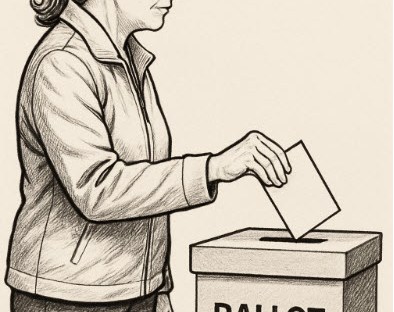
Image by ChatGPT5
Note: here is the text of the 12th Amendment (Source) and the history and interpretation of the 12th at the Constitution Center (Source).











 Innocent Investor