A Tug of War

June 7, 2020

by Steve Stofka

Is grandma your enemy? An uncomfortable thought. Different generations have different concerns. Funding a solution to one generation’s problem may take resources from other generations. Grandma wants to protect her Social Security and Medicare. Grandma votes her interests.

The introduction of Social Security eighty years ago marked an extraordinary shift in federal policy. For the first time in the history of this country the government took money from one set of people – those who were younger and working – and gave it to other people. This transfer was not a reward for military service – an old soldier pension – but a reward for getting old.  

During the Great Depression thousands of banks failed and millions of people lost their savings. That crisis called for a solution. Instead of addressing the problem, FDR and a super-majority of congressional Democrats created a permanent program that transferred money from people raising families to retired people. No military or community service required. The combined tax contribution to fund the program was 2%. It is now more than six times that.

In 1965, Democrats again enjoyed a super-majority in Congress and a Democratic President. Never waste a super-majority. There are no checks and balances. They passed the Medicare program, funded by a tax on working families who were ineligible for benefits under the program. In every election, old people vote to keep their benefits, and are the largest demographic of voters (Census Bureau, 2019). 

Younger voters change addresses more often. In dense urban areas with multiple voting districts, they are more likely to have out of date voter registration. Voters in rural districts remain in the same voting district when they move a few miles. Rural voters are predominantly older, white and conservative. In the first half of the 20th Century, rural populations migrated from the farm to the city. Rural voters controlled political power in many states because one rural vote counted far more than one urban vote. In two decisions in the 1960s, the Supreme Court interpreted the Constitution to mean one person, one vote (Mosvick, 2020).

As the children of farmers continued to move away in the last half of the century, rural voters adopted other strategies to control electoral power. Less funding for polling places in urban areas, claims of voter fraud, lifetime restrictions against voting by convicted felons, and locating prisons in rural areas where the prisoners are included in the county’s population, but the prisoners cannot vote. Groups like Judicial Watch initiate hundreds of lawsuits in Democratic leaning counties to invalidate the registrations of many voters (Lacy, 2020).

In 1965, a year after passage of the Civil Rights Act, President Johnson hoped that the newly instituted Medicare program would help stem the defection of Southern voters from the Democratic Party. It didn’t. The Party had successfully stifled the voting power of black people in the south for a century. The 13th, 14th and 15th Amendments which gave black people voting power and citizenship status had been forced on the Southern states after their defeat in the Civil War. Feeling that President Johnson and the party had betrayed them, voters sought a champion who could protect white voting power. 

Richard Nixon became their champion by default. In the 1968 race, the Republican candidate employed a “ southern strategy” that spoke to white voters worried that the recently passed Civil Rights Act would give blacks too much electoral power. In the spring, riots and demonstrations broke out after Martin Luther King’s assassination. At the Democratic Convention that summer, bloody conflicts broke out between Chicago police and anti-Vietnam War demonstrators. Nixon promised to be a law and order President, protecting the “old order,” older Americans and the white rural domination that had been the calling card of the Democratic Party in the South. When leading Democratic candidate Robert Kennedy was assassinated that summer, the party was too disorganized to mount a challenge to Nixon. He won by a convincing margin in the electoral college, but bested Hubert Humphrey by only ½% of the popular vote (Wikipedia, 2020). 9 million voters chose Independent Party candidate George Wallace, who appealed to disaffected conservative Democratic voters in the South (PBS, n.d.).

Some of us have supremacist attitudes, some of us condemn those attitudes. Some of us feel threatened at the sight of a black man and call the police. Some of us understand Black Lives Matter; others don’t. We all understand our point of view a lot better than our neighbor’s. We all want to be believed more than believe.

We grant police the sanctioned use of force but we require temperance in their use of it. Clearly, there are many officers who do not have a tempered behavior. The lie is that it is a few bad apples. Smart phones have become common only in the past decade and there are hundreds of videos of officers acting without restraint. In another ten years, there will be thousands.

 One person, one vote. This country has been engaged in a tug of war since its founding. Regional and generational interests pitted against each other. Rural against urban. Businesses vs workers. City governments vs. workers. States vs. citizens. Decide which end of the rope you are on and pull. Grandma grabs the rope. In every election, a lot of money and effort is spent to prevent people from voting. If you don’t vote you are doing those on the other end of the rope a favor and they thank you.

////////////////////////////

Notes:

Photo by Arnaud Jaegers on Unsplash

Census Bureau. (2019, July 16). Behind the 2018 U.S. Midterm Election Turnout. Retrieved from https://www.census.gov/library/stories/2019/04/behind-2018-united-states-midterm-election-turnout.html

Lacy, A. (2020, May 28). Right-Wing Groups Aims to Purge 800,000 Voters in Pennsylvania. Retrieved from https://theintercept.com/2020/05/28/pennsylvania-voter-rolls-purge-judicial-watch/

Mosvick, N. (2020, March 26). On this day, Supreme Court reviews redistricting. Retrieved from https://constitutioncenter.org/interactive-constitution/blog/on-this-day-supreme-court-reviews-redistricting.  Also, see Stahl, 2015.

PBS. (n.d.). Thematic Window: The Election of 1968. Retrieved from https://www.pbs.org/johngardner/chapters/5a.html

 Stahl, J. (2015, December 7). Baker v. Carr: The Supreme Court gets involved in redistricting. Retrieved from https://constitutioncenter.org/blog/baker-v-carr-the-supreme-court-gets-involved-in-redistricting

Wikipedia. (2020, June 06). 1968 United States presidential election. Retrieved from https://en.wikipedia.org/wiki/1968_United_States_presidential_election
Revival

March 8, 2020

by Steve Stofka

A heartfelt endorsement by veteran S. Carolina Congressman Jim Clyburn ignited a outpouring of voter support for Joe Biden in that state’s primary a week ago. Mr. Biden rode that momentum into Super Tuesday a few days later and the campaign that was on life support became the leading candidate in the Democratic race.

The following day the stock market rallied a whopping 4%. Big investors know that Mr. Biden will not make life difficult for them. He is old school. He knows that there are two sets of rules and the rich write the rules. Mr. Sanders makes Wall St. uncomfortable because he also knows that there are two sets of rules. He wants to write a new rule book where the rich don’t write the rules. That’s bad for rich people. Here’s why.

Bernie Sanders is often branded as a socialist. He brands himself with the qualifier Democratic Socialist. As the Wall St. Journal’s Richard Rubin pointed out this week, Mr. Sanders is not proposing a European model of socialism (Rubin, 2020). Those progressive systems are funded by a regressive sales tax called a VAT (Wallop, 2010). This tax burden falls mostly on middle class and working families. Mr. Sander’s plan funds progressive programs with progressive taxes falling mostly on the wealthy. That ain’t socialism. We need a naming contest for a system where the wealthy do extra to help the community. Four syllables or less. I’d suggest Neighborism based on the movie “It’s a Wonderful Life,” with Jimmy Stewart. What’s your suggestion?

Last month President Trump launched a political tweet missile at the Supreme Court (Baker, 2020). This past week Senate Minority Leader Chuck Schumer hand carried his warning to the steps of the Supreme Court. He was part of a protest regarding a current course case that tests the court’s earlier decisions beginning with Roe v. Wade almost fifty years ago. Chief Justice John Roberts has admonished President Trump, Mr. Schumer and others that they should not threaten the Supreme Court. Mr. Schumer says he regrets his remarks (Pecorin, 2020). President Trump last apologized for his remarks when he was in the first grade.

The high court’s Bush v. Gore decision chose the outcome of the 2000 Presidential election and tarnished the court’s reputation as an objective body. Since the beginning of his tenure as Chief Justice in 2005, Mr. Roberts has tried to resuscitate the court’s reputation. In this age, tarnished reputations stay tarnished.

Was the court ever impartial? Over a hundred years ago, Albert Einstein sparked a revolution in physics with a set of mathematical equations which showed that impartiality was impossible. Our observations and conclusions are based on our frame of reference. In the past century an overwhelming body of evidence has substantiated Einstein’s claims.

A central proposition in physics has spread to the humanities. Is this a “hey man, everything is relative” moment? No. Understanding an argument’s frame of reference takes time and research. Most of us are too pressed for time and tend to discard arguments that we don’t instinctively like. Chief Justice Roberts maintains that the members of the high court are not prone to this common human fallibility. Do they cast aside the ideological framing they have formed during their life and career and reach a deliberative decision that fully balances all the considerations of a case before the court? No, of course not. Mr. Roberts is still living in a Newtonian world of imagined impartial justice. Perhaps he should remove his robe while shaving and see the man reflected in his mirror.

A long time ago, my sales manager said to me, “Either you believe in your own b.s. or someone else’s b.s. Wouldn’t you rather own it?” This week Mr. Biden looked like a man who owns someone else’s b.s. – that of Jim Clyburn and the folks in S. Carolina who gave Mr. Biden a sense of confidence. His walk up the stairs to a stage platform has grown more vigorous since Super Tuesday. His voice projects with a confidence and assuredness that I didn’t hear just two weeks ago. He no longer sounds like a frail man. I’m still not convinced he owns his b.s., but he may get there in the next few months.

Mr. Sanders, on the other hand, is a man who has owned what he says for decades. As an Independent, he has played a minor role in the Democratic political hierarchy despite his many years in the Senate. Will voters choose the man of measured manner, Mr. Biden, or put their money on the impassioned and principled Mr. Sanders?

I wish my teachers had told me that I needed to be 70+ to run for President. We have too many old people in Congress. I thought so when I was young. I think so today. Yes, old people have experience, sagacity and some have a more measured temperament. The age of the people we send to represent us in Washington does not reflect us.

The Congressional Research Service recently computed the average age of the House at nearly 58 years; of the Senate, 62 years (Manning, 2018). According to the Census Bureau, the U.S. population – including children – has a median age of 38 (2019). If we take out the 25% of the population under 18, a reasonable estimate of the median age of adults might be an age of 50, ten years younger than the current average age of the members of Congress.

Patrick Leahy, the other Senator from Vermont, has held his seat for almost half a century. They come to Washington and die in Washington. They believe that they have earned an objective wisdom through their long service in their seats. To paraphrase Socrates, the man who thinks he is wise is a danger to himself and others. Step aside. Let the young blood walk the halls and make a different set of mistakes than the ones you once made. Let go. Our country will be better for it.

//////////////////

Baker, P. (2020, February 25). Trump, in India, Demands Two Liberal Justices Recuse Themselves From His Cases. Retrieved from https://www.nytimes.com/2020/02/25/us/politics/trump-supreme-court.html

Manning, J. (CRS). (2018, December 20). Membership of the 115th Congress: A Profile. Congressional Research Service. Retrieved from https://www.senate.gov/CRSpubs/b8f6293e-c235-40fd-b895-6474d0f8e809.pdf

Pecorin, A., et al. (2020, March 5). Schumer says he regrets comments Chief Justice Roberts called ‘dangerous’ threats. ABC News. Retrieved from https://abcnews.go.com/Politics/chief-justice-john-roberts-calls-sen-chuck-schumer/story?id=69396928

Photo by Louis Velazquez on Unsplash

Rubin, R. (2020, March 6). Bernie Sanders’s Tax Plan Would Be Biggest Expansion of Taxation Since World War II. Wall St. Journal. Retrieved from https://www.wsj.com/articles/sanders-plan-would-hoist-taxes-11583449105 (paywall).

U.S. Census Bureau. (2019, July 16). Median Age Doesn’t Tell the Whole Story. Retrieved from https://www.census.gov/library/stories/2019/06/median-age-does-not-tell-the-whole-story.html

Wallop, H. (2010, April 13). General Election 2010: a brief history of the Value Added Tax. The Telegraph. Retrieved from https://www.telegraph.co.uk/news/election-2010/7582869/VAT-a-brief-history.html

President Mayor?

March 1st, 2020

by Steve Stofka

Among the Democratic candidates for President are two mayors. Mike Bloomberg was mayor of New York City for the twelve years following 9-11. Pete Buttigieg just completed an eight year stint as mayor of South Bend, Indiana. Americans have never elected a recent mayor to the presidency (Badger, 2019). Will this year be different?

Mayors are responsible for everything that happens in their city – from policing practices to snow removal. John Lindsay, a former mayor of New York City, almost lost his job because of a snowstorm (Marton, 2019). Too many homeless people in Los Angeles? Mayor Eric Garcetti takes full responsibility (City News Service, 2019). Few residents write to the mayor to say that they are so happy that their streetlights are working. The lack of complaints tells a mayor that he or she is doing a good job. Mayors are a tough bunch with strong shoulders.

Do we take the same responsibility for our savings portfolios? If interest rates are too low, do we keep all the money in a savings account and blame the system? When the market goes down, do we rethink our risk appetite, or do we blame those invisible market forces?

 At nearly 11 years, this bull market is the longest running in the past one hundred years. The 400% gain since the March 2009 low beats both the gains of the 1920s and 1990s bull markets. Just a month ago, the investment firm Goldman Sachs estimated that there was still room for more price appreciation this year (Winck, 2020).

This week’s downturn was made sharper by several practical factors. In any abrupt downturn that last a few days or longer, margin calls prompt more selling. What is a margin call? Let’s say I borrow $50 from my broker to buy a $100 stock. If the price goes down to $90, my broker wants me to pony up another $5. If I don’t have the cash, the broker will sell some of my holdings to raise the cash.

The Coronavirus prompted investors to reassess projected earnings for this year and to assign a greater risk to their stock exposure. A lot of investors bought bonds with the proceeds from their stock sales. Worst time to buy long term bonds? Probably. An ETF of 30-year Treasury bonds (TLT) hit its highest price ever this week.

President Trump regards stock market performance as an important indicator of his success. What will he do if market prices decline another 10%? Will he attack Fed chairman Jerome Powell as he did in 2018? Has Mr. Trump become the most wearisome President in modern history?

Joe Biden took almost half the votes in the S. Carolina primary this week, but Bernie Sanders is still leading the roster of candidates with 54 delegates (Leatherby and Almukhtar, 2020). It’s a long road to the goal of 1991 delegates to secure the nomination. The delegates captured in the first four primaries are dwarfed by the 1344 delegates in play this week on Super Tuesday. 643 of those delegates are in California and Texas. It’s a reminder of the power of a few states in the selection of a President.

What about the mayors in the race? Pete Buttigieg is 3rd in delegate count. Because Mike Bloomberg entered the race late, he set his sights on Super Tuesday and currently has 0 delegates. Elizabeth Warren and Amy Klobuchar have both worked long and hard, have enthusiastic supporters but have earned few delegates. Running for the top office is a hard job.

Will this week bring more downturns in the market? There was a big surge of investors willing to buy late Friday afternoon. It’s a good sign when large investors are willing to take a position before the weekend.  

///////////////////////

Notes:

Badger, E. (2019, November 18). Pete Buttigieg Tests 230 Years of History: Why Can’t a Mayor Be President? N.Y. Times. Retrieved from https://www.nytimes.com/2019/11/18/upshot/Buttigieg-2020-race-mayors.html

City News Service. (2019, August 26). Mayor of LA Promises More Help to Solve Homelessness Problem. Retrieved from https://www.nbclosangeles.com/news/local/streets-of-shame/mayor-garcetti-homeless-los-angeles-crisis-response/129407/

Leatherby, L., & Almukhtar, S. (2020, February 3). Democratic Primary Election Results 2020. Retrieved from https://www.nytimes.com/interactive/2020/us/elections/delegate-count-primary-results.html

Marton, J. (2019, January 28). Today in NYC History: John Lindsay’s No Good, Very Bad Snowstorm of 1969. Retrieved from https://untappedcities.com/2015/02/09/today-in-nyc-history-john-lindsays-no-good-very-bad-snowstorm-of-1969/

Photo by Mateus Campos Felipe on Unsplash

Winck, B. (2020, January 23). GOLDMAN SACHS: Lagging fund inflows can drive the stock market even higher | Markets Insider. Retrieved from https://markets.businessinsider.com/news/stocks/stock-market-higher-forecast-inflows-safe-asset-crowding-goldman-sachs-2020-1-1028840905

Branders vs Builders

February 23, 2020

by Steve Stofka

At the National Press Club this week, Army secretary Ryan McCarthy spoke about people resisting change “because they focus on what they are going to lose instead of what they are going to gain” (C-Span, 2020). True? Not true?

In 2016, almost half of voters voted for change. In 2008, former President Obama ran on a platform of change. In his candidacy for the 2020 Democratic Presidential nomination, Bernie Sanders is touting big policy changes. He is leading in early caucus primaries and early caucus results place him as this weekend’s winner in Nevada.

Americans have been able to embrace change because our political institutions resist change. Unlike Britain, we have a written Constitution that proscribes or sets boundaries for change. In the U.S., minority interests are given more power to play an obstructionist role and this is particularly true in the Senate. When Harry Reid was the Democratic Majority Leader, he accused Republicans of obstructionism (C-Span, 2011). When the Republican Minority Leader, Mitch McConnell, became the Majority Leader in 2015, he made the same accusations against Democrats (C-Span, 2017). The parties trade scripts.

Tired of listening to the same script, a lot of voters chose an off-script candidate, Donald Trump, in 2016. For most of his term, the White House has been run on an informal basis, changing policy with the political weather in Washington. President Trump is a brander, not a builder.

Presidents who want to enact a large part of their agenda must be both branders and builders. It is an unusual combination of traits. In the 20th century, only FDR and Ronald Reagan were both. Perhaps Teddy Roosevelt. This is a subjective call. What are your candidates for the title of both brander and builder?

When a President is capable of both roles, the other party reacts strongly to what they build and their brand. This is certainly true of both FDR and Reagan. Republicans continue to tear away at the federal bureaucracy first erected by FDR. President Reagan was and is the champion of that movement among mainstream Republicans.

Responding to the worst recession since the Great Depression, Democrats elected a leader they hoped could emulate the substantial change in direction that FDR brought about. President Obama was neither a brander nor a builder. His “no drama” demeanor could not build coalitions in an age when people wanted a “fire in the belly” leader like Mr. Trump.

Bernie Sanders is such a “fire in the belly” candidate, but can he build the coalitions needed to pass direction changing legislation? He has not done so during his thirty years in the House and Senate, according to NYU historian Timothy Naftali (Stein, 2020). His campaign slogan is “Not me, us!” He is asking voters to play a vital role in melding political coalitions.

Mr. Bloomberg’s anemic first performance on the debate stage this week was hardly encouraging. Yet, Mr. Bloomberg appeals to practical Democratic and Independent voters, as well as establishment Republicans like Clint Eastwood who have tired of watching President Trump playing in his White House sandbox. This weekend Mr. Eastwood gave Mr. Bloomberg a thumbs up (Berley, 2020). Why would Republicans vote for a Democratic candidate? If the Senate remains in Republican hands, they will act as a check on a Democratic President and House. If other notable Republicans signal an approval of Mr. Bloomberg, that might persuade pragmatic Democratic voters to choose him as well. The road to the White House is a maze of planning, circumstance, and shifting voter and donor alliances.

////////////////

Notes:

Berley, M. (2020, February 22). Clint Eastwood Endorses Bloomberg, Citing ‘Ornery’ Politics. [Web page]. Retrieved from https://www.bloomberg.com/news/articles/2020-02-22/clint-eastwood-endorses-bloomberg-citing-ornery-politics

C-Span. (2011, September 6). Opening Remarks from Senators Reid and McConnell. [Video, Web page]. Retrieved from https://www.c-span.org/video/?301374-4/opening-remarks-senators-reid-mcconnell (01:11).

C-Span. (2017, July 11). Senators McConnell and Thune on Health Care. [Video, Web page]. Retrieved from https://www.c-span.org/video/?431157-2/senators-mcconnell-thune-health-care (13:24).

C-Span. (2020, February 14). Army Secretary Ryan McCarthy at the National Press Club. [Video, Web page]. Retrieved from https://www.c-span.org/video/?469279-1/army-secretary-ryan-mccarthy-national-press-club. (8:14)

Photo by Alfred Kenneally on Unsplash

Stein, J. (2020, February 12). As Bernie Sanders ascends, his potential White House approach to the economy comes into focus. Washington Post. [Web page]. Retrieved from https://www.washingtonpost.com/business/2020/02/12/bernie-sanders-ascends-potential-white-house-approach-obstacles-come-into-focus/

The Billionaire Ballot

February 16, 2020

by Steve Stofka

“Dad, can I get a new bike?”

“What do you think money grows on trees?”

“No. If it grew on trees, I wouldn’t ask you for a new bike. I’d ask for a ladder so I could pick my own money.” A great comeback that I never said. No new bike. I could still dream of being President someday.

My dad was born before the Great Depression, a time when money lived in the ground. In 1849, people went crazy when they learned that there was gold in the dirt of California (PBS, n.d.). It’s God’s will, some said. In 1876, eight years after the Federal government signed a treaty with the Sioux Indians, gold was discovered in the Black Hills of North Dakota. Sorry, Sioux Indians, but you’ll have to move (NPS, n.d.). 

It took labor and money to dig up money when it lived in the ground. Now it lives in the digital “cloud.” Are we inherently distrustful of money that can be created with the push of a finger on a computer terminal? Seems too easy. We are 50 years into a system that is untethered from any practical restraint. The Federal Reserve guides their monetary policy according to goals set by a law passed at the height of inflation in the 1970s. They do not have to dig up dirt to get more money. They don’t have to keep gold or silver reserves. It seems like the same magical thinking of a kid who dreams about becoming President.

Presidential candidates must work hard to generate enthusiasm and donations of time and money to fuel their campaigns. A successful candidate for the Presidency usually finds a phrase that resonates with supporters.  In 2008, former President Obama used “Yes, we can” and various combinations of “Change” (List of U.S. presidential campaign slogans, 2020). President Trump used “Make America Great Again” during his 2016 campaign. His current slogan is “Keep America Great.” I heard Presidential candidate Sen. Elizabeth Warren sound out “Fighting Back” at a Virginia rally this past Thursday (C-Span, 2020). Mike Bloomberg has blanketed media with the phrase “Mike will get it done” (Mike Bloomberg, 2020).

In 2016, Marco Rubio and other Republican candidates complained that the inexperienced Donald Trump could buy the party’s nomination with his vast resources. Mr. Trump had promised to spend $100 million of his own money and spent $65 million in the final accounting (Peters & Storey, 2016). This was only half of the $121 million in inflation adjusted dollars that Ross Perot spent on his Presidential campaign in 1992 (Boaz, 2019).

Enter Mike Bloomberg. In the few months since he announced his candidacy, his campaign has spent $400 million (Burns & Kulish, 2020). His political spending is dwarfed by his charitable giving. In 2019, Mr. Bloomberg’s foundation donated more than $3 billion to charity. Unlike President Trump, Mr. Bloomberg has demonstrated his business acumen and has past political experience in the mud pit of New York City politics. He is used to the tough bargaining and political alliances that consume Washington. Mr. Trump knows only intimidation, not bargaining. He is the Twitter version of Venezuela’s former President, Hugo Chavez, who used radio to attack his political enemies.

What entices these billionaires to want a high stress job in Washington? What lies in the ground in Washington is not gold, but great power and reputation. Under FDR in 1932, the Democrats first began to consolidate political power in Washington. World War 2 and the Cold War helped grow that power base. So did the Federal programs of social support – Social Security, Medicare, Medicaid and countless others. Beginning in the 1960s, Congress began to grant the President more executive power to conduct war and administer the growing array of Federal agencies.

As the power of the Presidency grew, each Presidential campaign attracted more money. Through a series of campaign reform bills, Congress attempted to regulate the flow of money into politics. In the past decade, two recent Supreme Court decisions have undone many campaign regulations (Ballotpedia, n.d).

The discovery of gold in California and South Dakota attracted many prospectors who worked hard to grab the prize. Like today’s Presidential candidates, many miners did not have the resources necessary to capitalize on the opportunity. Well-funded companies like Homestake Mining proved successful. This is the era we are in now. Little Johnny or Mary can put away their dreams of being President. Is that good for the country?

////////////////

Notes:

Ballotpedia. (n.d.). Bipartisan Campaign Reform Act. Retrieved from https://ballotpedia.org/Bipartisan_Campaign_Reform_Act

Boaz, D. (2019, July 9). RIP Ross Perot, the Billionaire Who Ran for President. Retrieved from https://www.cato.org/blog/rip-ross-perot-billionaire-who-ran-president. Mr. Perot spent $65 million, or about $121 million in current dollars.

Burns, A., & Kulish, N. (2020, February 15). Bloomberg’s Billions: How the Candidate Built an Empire of Influence. Retrieved from https://www.nytimes.com/interactive/2020/02/15/us/politics/michael-bloomberg-spending.html

C-Span. (2020, February 14). Senator Elizabeth Warren Campaigns in Arlington, Virginia. Retrieved from https://www.c-span.org/video/?469313-1/senator-elizabeth-warren-campaigns-arlington-virginia (43:08).

List of U.S. presidential campaign slogans. (2020, February 14). Retrieved from https://en.wikipedia.org/wiki/List_of_U.S._presidential_campaign_slogans

Mike Bloomberg 2020. (2020). Mike Bloomberg for President: Official 2020 Campaign Website. Retrieved February 14, 2020, from https://www.mikebloomberg.com/

Peters, J. W., & Shorey, R. (2016, December 9). Trump Spent Far Less Than Clinton, but Paid His Companies Well. Retrieved from https://www.nytimes.com/2016/12/09/us/politics/campaign-spending-donald-trump-hillary-clinton.html

Photo by annie bolin on Unsplash

Look Back, Look Forward

December 29, 2019

By Steve Stofka

In this last week of 2019, I’ll look way back for a bit of perspective heading into the coming election year. In 1932, voters elected FDR to the Presidency. More significantly, they elected an overwhelming majority of Democrats to the Congress to enable FDR to make big changes. Voters wanted an activist government to fix things.

$2.8 trillion is a lot of money, about 2/3rds of what the federal government spent in 2018 (CBO, 2019). That’s how much inflation-adjusted money depositors lost in bank failures during the Great Depression (Investopedia, n.d.). Imagine if ¾ of all the cash and money in checking accounts just vanished. That’s $2.8 trillion.

The Federal Deposit Insurance Corporation was created in 1933 to protect bank depositors from the loss of their life savings. During the 2008 Great Financial Crisis, Washington Mutual had losses of $307 billion. Depositors lost nothing. That’s activist government.

Republican advocate for a reactive rather than a proactive government – one that has a light regulatory hand. Too often this type of government ignores signs of trouble until a full-blown crisis develops like the 9-11 terrorist attacks or the Great Financial Crisis.

Voters will be asked to decide on which government role they prefer. Advocates for an activist government believe in grand communal solutions, many of which are poorly executed but are better than nothing. Cars, phones, computers and the social media that dominates our public policy discussions were all privately developed solutions that have adapted quickly to user demands. Government solutions are clunky contraptions of conceited ambitions that are slow to evolve as effective solutions. When they finally achieve some efficiency, the problem has changed. Examples include rent control, Social Security, Medicare, and the federal student loan program.

Advocates for a reactive government wait until the situation is near crisis levels, see that no one has created a solution yet and propose a public private partnership (PPP). These programs are not well designed to solve the problem but serve the purpose of funneling public tax dollars into private coffers while policy makers pontificate about free market solutions.  Examples are prisons, toll roads, and university student housing.

Presidents are usually elected for a second term. President H.W. Bush lost his bid for a second term in 1992 because of the lingering effects of a recession.  In 1980, President Jimmy Carter lost his bid for economic reasons as well. Divisions in the Democratic Party over the Vietnam War convinced an unpopular President Lyndon Johnson that he should not run for a second term in 1968. It’s unlikely that we will have a recession next year and that will increase the likelihood that Mr. Trump will be re-elected. Will that influence your financial decisions in any way?

The SP500 has gained 41% since President Trump took office in January 2017. Most of that gain has come in the past year. A record amount of money flowed into equity ETFs in December (Bell, 2019). Are investors chasing the high? Now is a good time for older investors to evaluate the risk-reward profile of their portfolio. An unpleasant task is to imagine what choices you might need to make if the value of your equity holdings were cut in half. That’s what happened in 2001-2002 and again in 2007-2009.  

97% of the U.S. is classified as rural but only 20% of the population lives there (Census Bureau, 2016). The map of the country may be colored a political shade of red, but there are relatively few voters per county. An ever-increasing portion of the people live in the scattered blue and politically purple areas. For decades the children who grew up in rural communities have left and not returned. The political fight for the direction of the country is not between rural and urban populations but between voters in smaller metro areas and suburban communities (Marema, 2019).

///////////////

Notes:

Bell, H. (2019, December 20). ETFs See Record $52B Inflows. [Web page]. Retrieved from https://www.etf.com/sections/weekly-etf-flows/weekly-etf-flows-2019-12-19-2019-12-13

Census Bureau. (2016, December 8). New Census Data Show Differences Between Urban and Rural Populations. [Web page]. Retrieved from https://www.census.gov/newsroom/press-releases/2016/cb16-210.html

Congressional Budget Office. (2019, June 18). The Federal Budget in 2018: An Infographic. [Web page]. Retrieved from https://www.cbo.gov/publication/55342

Investopedia. (n.d.). Bank Failures. [Web page]. Retrieved from https://www.investopedia.com/terms/b/bank-failure.asp

Marema, T. (2019, March 14). Contrary to What You Hear, the Rural-Urban Gap Didn’t Grow in 2018 Election. The Daily Yonder. [Web page]. Retrieved from https://www.dailyyonder.com/contrary-hear-rural-urban-gap-didnt-grow-2018-election/2019/03/14/

Majksner, Nikola. (n.d.). The Battle of Sutjeska Memorial Monument Complex in the Valley of Heroes, Tjentiste, Bosnia and Herzegovina. [Photo]. Retrieved from https://unsplash.com/photos/as_pS7EkK-Y

Mandates

November 10, 2019

by Steve Stofka

All states require that automobiles be insured. Would you support a state law that stipulated that you had to provide proof of insurance in order to start your car? It might be a card reader or a fingerprint reader that interfaces with an electronic interlock system. An insurance card might be a small chip on a key ring. Insert the chip, the car verifies the insurance and is ready to start.

 Some states already mandate such interlock systems called IIDs for drivers convicted of DUI and DWI offenses (McCurley, n.d.). In their implementation just laws can become unjust. A New York Times investigation recently revealed that the breathalyzers used by police are unreliable (Cowley, Silver-Greenberg, 2019). Thousands of cases have been thrown out because the machines were not calibrated and gave high readings. Some states have ignored or tried to cover up the inaccuracy of their tests.

The federal government has mandatory Social Security payments that we must pay when we work. States have mandatory sales taxes that must be paid when buying many goods and some services. Mandates are part of our everyday lives and yet people vociferously protested the Obamacare mandate to buy health insurance. Why? Working and buying things are activities that have some voluntary component. Obamacare’s mandate was on the activity of breathing, on being alive.

Some people resent jury duty for the same reason. People are called every few years where I live. For those who are unemployed, the reimbursement is small (NCSC, n.d.). In some states, jurors are paid about the same as convict labor. However, there is some choice. I can choose to move out of the district and avoid the frequency of being called. On the other hand, how do I avoid an Obamacare mandate on simply being alive?

Should young people be subject to mandatory national service of some kind? When I hear that suggestion, it usually comes from an older person. Younger people, who don’t make as much money earlier in their careers, will vote for mandates that older people making more money should pay higher taxes so that the government will be able to afford more services for younger people.

Retired people want mandates for those who are working to pay more money into the Social Security system so that retirees can be assured of getting their full pension checks. It is part of the human condition that we like mandates imposed on other people more than we like them imposed on us. We want more prisons but not in my neighborhood because that might drive property values down. We want more housing for the homeless but not in my neighborhood. I want to be charitable, but I have an obligation to protect my property values more than the homeless. We want more money for the poor and unfortunate but don’t want to pay higher taxes because we’re already taxed enough. Can’t the government get the taxes from the rich guys and leave me alone? Elizabeth Warren thinks so.

This year’s election was held last Tuesday and now we have a year of election festivities before the Presidential election in 2020. Among the Democratic contenders, Ms. Warren speaks with greater ease and confidence on the stage. She has policies and plans to pay for those policies and it’s the rich guys who are going to pay. I like that. I pay enough already. Ms. Warren fights for middle class families but she fights just as hard for the idea of big beneficial government, a variation of the philosopher king who rules his people with temperance, strength and charity.

President Trump is now the spokesman and leader of the Radical Right. Mr. Trump believes he is the philosopher king, immune from all laws while he is president. So his lawyer argued last week to a dumbfounded courtroom. Republicans believe in a philosopher king of another sort – the free market. This king rules with the wisdom of crowds, the temperance of competing interests and the strength of competition. That’s the idea at least. In practice the free market is not free. Politicians pass legislation to protect market interests from competition both domestic and foreign.

This coming election will feature candidates who have captured the extremes of either party yet claim that they represent the center. It is the other side that is radical. That’s the rhetoric we have been hearing from a radical Republican, leader Kevin McCarthy. “We’re normal. They’re crazy.” Welcome to the crazy ward at Congress, whose job approval ratings are in the low 20s (Real Clear Politics, n.d.). Why is that? Well, it’s because those crazy Democrats are trying to impeach our President and not getting anything else done. That’s one sentiment. However, Congressional approval ratings have improved since the Republicans held the House last year.

Every time I hear a politician say the phrase “the American people,” I know that I am about to hear utter nonsense following that phrase. They often profess to know and speak the will of the American people but few of them have the slightest clue or their job approval ratings wouldn’t be so low.

230 years ago, a large multinational company like the East India Company needed a powerful government like England to protect its interests and profits. This country fought a war against England to check the dominance of the East India Company. Today, Republicans openly support corporate interests over much else. Democrats say they are for the little guy, but they supported large financial institutions, big corporations and big unions during the financial crisis. They believe in big government; they need the support of big corporations to enact their big plans with their big government. The Senate minority leader, Chuck Schumer, hails from New York City and helped soften laws and regulations designed to curb Wall Street’s abuses.

The Radical Republicans believe in a form of anarchy that they call small government. Small, however, does not include military spending or subsidies to their friends and constituents. When Republicans spend big, it’s small government. When Democrats spend big, it’s socialism. We’ll get plenty of this nonsense in the coming year.

 The Radical Democrats keep insisting that this country is a democracy. No, it’s not. Look it up. The country was specifically founded on the principle that this was not a democracy. It was a republic. Shortly after the Constitution was written, the French Revolution vindicated the founders’ antipathy toward democracy. Democracies lead to either pandemonium or paralysis. In a democracy, the majority rule and inevitably enslave the minority. James Madison pointed to the institution of slavery to prove his case (Feldman, 2017). A republic of competing sectional interests would provide a better balance between warring factions within the new nation.

The Radical Republicans run against wind and solar subsidies because they are serving the interests of the oil and gas industries who have received direct and indirect subsidies for more than a hundred years. Businesses which dominate market share in an industry generously support their friends in Congress. There was no free market 200 years ago, there is no free market today and there won’t be one 150 years in the future.

Adam Smith published the Wealth of Nations the same year as the signing of the Declaration of Independence. The free market was an ideal that Adam Smith proposed after detailing the corruption that people and governments bring to any market. He didn’t like the idea of a free market but saw no better alternative. In his day, mercantilism dominated the economic and political system. Governments competed to protect the industries in their country against competitive pressures from those same industries in other countries.

These are our choices for next election: two philosopher kings. The big benefits of a strong, wise and caring government vs a market that can be efficient, just and cruel, that rewards effort and innovation but leaves many of the unprotected in despair. Those who don’t like mandates will vote for the market because they reason that markets can’t pass laws and mandates. Not directly, that’s true. However, dominant businesses try to get government to pass mandates which protect their profits. In either case, we are going to get mandates.

/////////////////////

Works Cited:

Cowley, S. and Silver-Greenberg, J. (2019, November 3). These Machines Can Put You in Jail. Don’t Trust Them. N.Y. Times. Retrieved from http://www.nytimes.com

Feldman, N. (2017). Three Lives of James Madison: genius, partisan, president. [Print]. New York: Random House.

McCurley, J. (n.d.). Ignition Interlock Devices: Costs and Requirements. [Web page]. Retrieved from https://dui.drivinglaws.org/interlock.php

National Center for State Courts (NCSC). (n.d.). Jury Management: State Links. [Web page]. Retrieved from https://www.ncsc.org/Topics/Jury/Jury-Management/State-Links.aspx?cat=Juror%20Pay

Photo by Willian B. on Unsplash

Real Clear Politics. (n.d.). Congressional Job Approval. [Web page]. Retrieved from https://www.realclearpolitics.com/epolls/other/congressional_job_approval-903.html

Minority Control

October 13, 2019

by Steve Stofka

On September 15, 2008 the trading firm Lehman Brothers declared bankruptcy. A small number of outstanding shares traded on the stock market that day. The SP500 lost almost 5% of its value. New Yorkers gathered in Times Square to watch the ticker tape display. A small number of people controlled the direction of the market and constructed a reality that they sold to the rest of us.

In politics, a few key people control the direction and fate of legislation. In the Senate, the Majority Leader decides whether to bring legislation up for a vote. Even if a bill makes it out of a Senate committee, the Majority Leader can stop it from reaching the full Senate.  Unlike the Majority Leader in the House, his position is practically impregnable. Legislation vetoed by the President can be overridden by Congress. There is no recourse to a veto by the Senate Majority Leader.

The current holder of the position is Sen. Mitch McConnell from Kentucky. He is up again for re-election next year. When Democrats held the Senate, Sen. Harry Reid ruled with a similar disregard for others in his own party as well as the minority.

In 2014, 800,000 voters chose McConnell. In effect, less than 1% of the country’s voters control the course of legislation in the U.S. Did the founders of this country intend that one person should control Congress? James Madison, the chief crafter of the Constitution, worried that a majority would overwhelm and take advantage of a minority (Feldman, 2017). Accordingly, the Constitution is structured so that a minority controls power. However, one person is a very small minority. What would the founders think of the current arrangement in Congress? If Americans wanted a king with veto-proof power, America would still be a colony of Britain.

Our method of electing a President is a 230-year-old compromise between republicanism and democracy. An electoral college composed of men not subject to the passions of the crowd would elect the leader of the country. It was an Enlightenment model of dispassionate rationality.

Even if they had Fox News and CNN on Election night at the time of the founding, all the thirteen states were in the same Eastern time zone. At a recent symposium on our election, former RNC chair Michael Steele pointed out the west coast states are mostly taken out of the Presidential election (C-Span.org, 2019). By 5 P.M. Pacific time, they are discouraged from voting because much of the action has already been called. The founders did not design a system for four time zones.

We have 50 states but the election for President takes place in eight to twelve battleground states. Most polling is done at the national level, not in the battleground states. Many polls do not accurately survey the sentiments of the critical minority of voters in the states that will decide the election.

A minority of people own and control much of the wealth of the world. They now pay a lower percentage of their income than the bottom 50%. That includes federal, state and local taxes. In the Triumph of Injustice, due to be released next week, authors Saez and Zucman (2019) tally up the tax bills for the rich and ultra-rich. The book is #1 bestseller at Amazon and it hasn’t been published yet.

In 1980, the top 1% paid 47% of their income in total taxes at all levels. Now they are down to 23% and below the rate paid by the bottom half of incomes. Two sets of rules – one set for the peasants and one for the castle royalty. The Constitution prohibits the granting of titles so the rich granted themselves the titles. This book is sure to get a lot of media attention. Like we need more controversy.

Notes:

Feldman, N. (2017). Three Lives of James Madison: genius, partisan, president. [Print]. New York: Random House.

C-Span.org. (2019, October 7). National Popular Vote Election, Part 2. [Video]. Retrieved from https://www.c-span.org/video/?464997-2/national-popular-vote-election-part-2

Saez, E. & Zucman, G. (2019) Triumph of Injustice: How the Rich Dodge Taxes and How to Make Them Pay. [Print]. Available for pre-order at https://www.amazon.com/Triumph-Injustice-Rich-Dodge-Taxes/dp/1324002727

Effective tax rates: If you make $100,000 and you pay $25,000 in federal, social security, state, sales and property tax, then your total effective tax rate is 25%.

Photo: WyrdLight.com [CC BY-SA 3.0 (https://creativecommons.org/licenses/by-sa/3.0)%5D Page URL: https://commons.wikimedia.org/wiki/File:Bodiam-castle-10My8-1197.jpg

Jobs Affect Elections

September 15, 2019

By Steve Stofka

“It’s the economy, stupid,” James Carville posted in the headquarters of Bill Clinton’s 1992 Presidential campaign. The campaign stayed focused on the concerns of middle and working- class people who were still recovering from the 1990 recession. Jobs can make or break a Presidential campaign.

Each month the BLS reports the net gain or loss in jobs and the unemployment rate for the previous month. These numbers are widely reported. Weeks later the BLS releases the JOLTS report for that same month – a survey of job openings available and the number of employees voluntarily quitting their jobs. When there are a lot of openings, employees have more confidence in finding another job and are more likely to quit one job for another. When job openings are down, employees stick with their jobs and quits go down as well.

President Bush began and ended his eight-year tenure with a loss in job openings. Throughout his two terms, he never achieved the levels during the Clinton years. Here’s a chart of the annual percent gains and losses in job openings.

As job losses mounted in 2007, voter affections turned away from the Republican hands-off style of government. They elected Democrats to the House in the 2006 election, then gave the party all the reins of power after the financial crisis.

As the 2012 election approached, the year-over-year increase in job openings slowed to almost zero and the Obama administration was concerned that a downturn would hurt his chances for re-election. As a former head of the investment firm Bain Capital, Republican candidate Mitt Romney promised to bring his experience, business sense and structure to help a fumbling economic recovery. The Obama team did not diminish Romney’s experience; they used it against him, claiming that Romney’s success had come at the expense of workers. The story line went like this: Bain Capital destroyed other people’s lives by buying companies, laying off a lot of hard-working people and turning all the profits over to Bain’s fat cat clients. The implication was that a Romney presidency would follow the same pattern. Perception matters.

In the nine months before the 2016 election, the number of job openings began to decline. That put additional economic pressure on families whose finances had still not recovered following the financial crisis and eight years of an Obama presidency. Surely that led some working-class voters in Michigan, Wisconsin and Pennsylvania to question whether another eight years of a Democratic presidency was good for them. What about this wealthy, inexperienced loudmouth Trump? He didn’t sound like a Republican or Democrat. Yeah, why not? Maybe it will shake things up a bit.  Enough voters pulled the lever in the voting booth and that swung the victory to Trump.

In the past months the growth in job openings has declined. Having gained a victory based partially on economic dissatisfaction, Trump is alert to changes that will affect his support among this disaffected group. As a long-time commentator on CNBC, Trump’s economic advisor, Larry Kudlow, is aware that the JOLTS data reveals the underlying mood of the job market. Job openings matter.

Unable to get action from a divided Congress, Trump wants Fed chairman to lower interest rates. There have been few recessions that began in an election year because they are political dynamite. The recession that began in 1948 almost cost Truman the election. The 1960 recession certainly hurt Vice-President Nixon’s bid for the White House in a close race with the back-bench senator from Massachusetts, John F. Kennedy.

In his bid to unseat President Carter in 1980, Ronald Reagan famously asked whether voters were better off than they were four years earlier. The recession that began that year helped voters decide in favor of Reagan.

Although the 2001 recession started a few months after the election, the implosion of the dot-com boom during 2000 certainly did not help Vice-President Al Gore’s run for the White House. It took a Supreme Court decision and a few hundred votes in Florida to put Bush in the White House.

As I noted earlier, George Bush began and ended his eight years in the White House with significant job losses. Those in 2008 were so large that it convinced voters that Democrats needed a clear mandate to fix the country’s economic problems. After the dust settled, the Dems had retained the house, won a filibuster-proof majority in the Senate and captured the Presidency. Jobs matter.

The 2020 race will mark the 19th Presidential election after World War 2. Recessions have marked only four elections – call it five, if we include the 2000 election.  An election occurs every four years, so it is not surprising that recessions occurred in only 25% of the past twenty elections, right? It’s not just the occurrence of a recession; it’s the start of one that matters.

Presidents and their parties act to fend off economic downturns with fiscal policy or pressure the Fed to enact favorable monetary policy that will delay downturns during an election. Trump’s method of persuasion is not to cajole, but to criticize and denigrate anyone who doesn’t give him what he wants, including the Fed chairman. To Trump, life is a tag-team wrestling match. Chairman Powell can expect more vitriolic tweets in the months to come. Trump will issue more executive orders to give an impression that his administration is doing something. The stock market will probably go up. It usually does in a Presidential election year.

Electoral College

November 20, 2016

Did you know that the U.S. has the highest Presidential voting record in the world?  100%.  No other country comes close.  How do we achieve this extraordinary participation rate?  The Electoral College (EC).

What the heck is the Electoral College and why doesn’t any other democracy use this system?  Firstly, the U.S. is not strictly a Democracy, in which people vote directly for their leader.  It is a democratic (small ‘d’) republic.  Within this republic, the states are semi-autonomous regions in a Federal alliance.  It is the states, not the people, who elect the President.

Each Prez election is a survey conducted by the state asking its citizens: who do you want the state to vote for in the Presidential race?  The survey is voluntary.  Each state has its own rules for participation in the survey.  Federal election law specifies a set of common rules that each state has to follow in conducting their survey.

Each state gets a certain number of Electoral College votes based on population.  The survey in each state simply tells the state what the wishes of the people are for President. There is no requirement in the Constitution that a state must follow the survey results, but each state has, over time, passed state laws that promise to abide by the will of the people in that state.

In 2000 and again in 2016, the Democratic candidate won the popular vote of all the states but lost the state by state vote in the Electoral College.  Some people in dense urban areas who vote Democratic would like to abolish the Electoral College.  If there were no college, Presidential  candidates could concentrate their campaign resources and promises to win the vote in the urban areas and largely leave the less populous areas of the country alone.

In the current system, a candidate must mount a campaign that involves and employs people in each state, a difficult if not impossible task.  The appeal and focus of the campaign must be broader than just urban or rural areas.  Resources and time are limited so a candidate must make critical choices regarding the deployment of those limited tools.

A candidate must surround him or herself with smart people who can:

1) organize and  deploy human and media resources within each state,
2)  organize the outreach for financial support,
3)  search for and identify undercurrents of sentiment and concern in each state,
4)  compact a message that will resonate with those sentiments and concerns,
5)  sample and analyze the ongoing responses to a candidate’s message.

There is an algorithmic strategy used in many fields called “win-stay, lose-shift.” The problem is commonly called the multi-handled bandit.  In a casino with many one-armed bandits what is the best strategy to maximize profits and minimize losses?  Mathematically, the problem may be insoluble but a reliable quasi-solution exists that is better than chance.  Stay with a particular bandit as long as it wins, then shift when it loses and start again.

Donald is a casino owner so he may be familiar with the strategy and used it quite successfully to conduct an unusual campaign.  A campaign has a number of characteristics – a saying or slogan (“Si se puede” or “Build the wall”), a policy (foreign trade or national security), an issue (abortion or honesty), or an attitude (impassioned, combative, or calm and reassuring).  A candidate feeds people’s sentiments into each of these characteristics like one would feed coins into a slot machine.  Now pull the handle.  If that theme pays off the majority of the time, then stick with it.  If it doesn’t, then shift.

Now here’s the brilliant part that Donald played whether he was conscious of it or not.  Every political bandit that was a loser for Donald Trump was not only abandoned but moved over to Hillary’s casino.  In many cases, she couldn’t win at them either.

Honesty?  Donald had a problem.  Load up the honesty bandit and move it over to Hillary’s casino. Let her feed people’s sentiments into that bandit and see if it pays off.  The woman issue?  Another non-paying bandit for Donald.  Again, move it over to Hillary’s side and let her see if she can win with the machine.  In both cases, she pulled the handles over and over again with only modest success.

Each Presidential campaign seems to bring some new innovation.  Successes are often incorporated into later campaigns.  Obama’s campaign was noted for its ability to raise money online with many small donations.  The campaign carefully tested the appearance of different web pages, measuring even the appearance of one click button over another.  Obama outraised his opponents in the 2008 and 2012 campaigns.   In the 2016 race, Hillary Clinton and her superPACS outraised Donald Trump almost 2:1, yet he won. (Bloomberg)

We should all wish that a President has a successful term.  Unsuccessful terms are usually accompanied by economic and military events that are not good for ourselves, our families, and our communities.  Whether Donald Trump has a successful term or not, he has certainly made a long lasting impact on future campaigns for President.  Who can be out with the first book?  Already CNN is advertising a comprehensive look at the election. As we put a bit more distance in the hindsight mirror, expect a number of books on the election.  Masters’ theses and doctoral dissertations will explore the many aspects of the campaign.

//////////////////////////////////

Election Autopsy 

After each Presidential election, those in the campaign business do an autopsy of both the losing and winning campaigns.  What worked?  What didn’t?  Dems need to ask themselves if they neglected the needs of everyday working Americans. In 2008, Obama promised that the needs, values and perspective of his grandparents, who raised him, would guide his decisions. Then he and his party started bailing out the banks, car companies and solar industry as many ordinary people struggled and suffered with job loss, home loss and bankruptcy. With majorities in both Houses, he fiddled with decades old Democratic dreams like healthcare and climate change while working class Americans felt discarded.

Some attribute the heavy Demcratic losses in 2010 to Obamacare but that was only a symbol for the larger betrayal that many Obama voters felt. Having control of both the Presidency and Congress is a mandate that a party can abuse.  It is given to that party to get something done fairly quickly.  When a political party uses it for pet projects, people turn away or vote the other way.  Many turned away in the 2010 election.  Six years later, Republicans control the majority of state legistatures, the governerships, the House and Senate.

As Majority House Leader, Nancy Pelosi certainly had a hand in the growing disaffection with the Party yet she insists that she should continue in her role as Minority Leader.  Her strength as a formidable fund-raiser may prove to be the winning card that trumps her past errors.

/////////////////////////////////

Vaccines

A familiar meme on social media is that there is a vaccine conspiracy between pharmaceutical companies and the government who force parents to vaccinate their children and pad the pockets of Big Pharma.  The U.S. has a policy of giving infants and children more vaccines than any other developed country.  Do pharmaceutical companies make millions off vaccines? You be the judge.

The PVC13 vaccine given to older people costs the provider $16 per dose (CDC Price List). In March 2016, the discounted price from Kaiser was $313 for the vaccine alone. The labor to give the vaccine was a separate line item. That is a 2000% markup on the vaccine itself by Kaiser, not the manufacturer.

It is the providers who administer the vaccines who make the money.  Investors who own the stocks of a pharmaceutical company often pressure the company to get out of the vaccine business because most vaccines are low margin products and yet carry partial liability.

If the pharma companies don’t want to bother making many vaccines, should the government simply build their own vaccine manufacturing labs?  Patents and other intellectual property could be a hurdle but Congress could arrange to purchase them or use eminent domain to set a price and seize the intellectual property.

//////////////////////////

Retail Sales

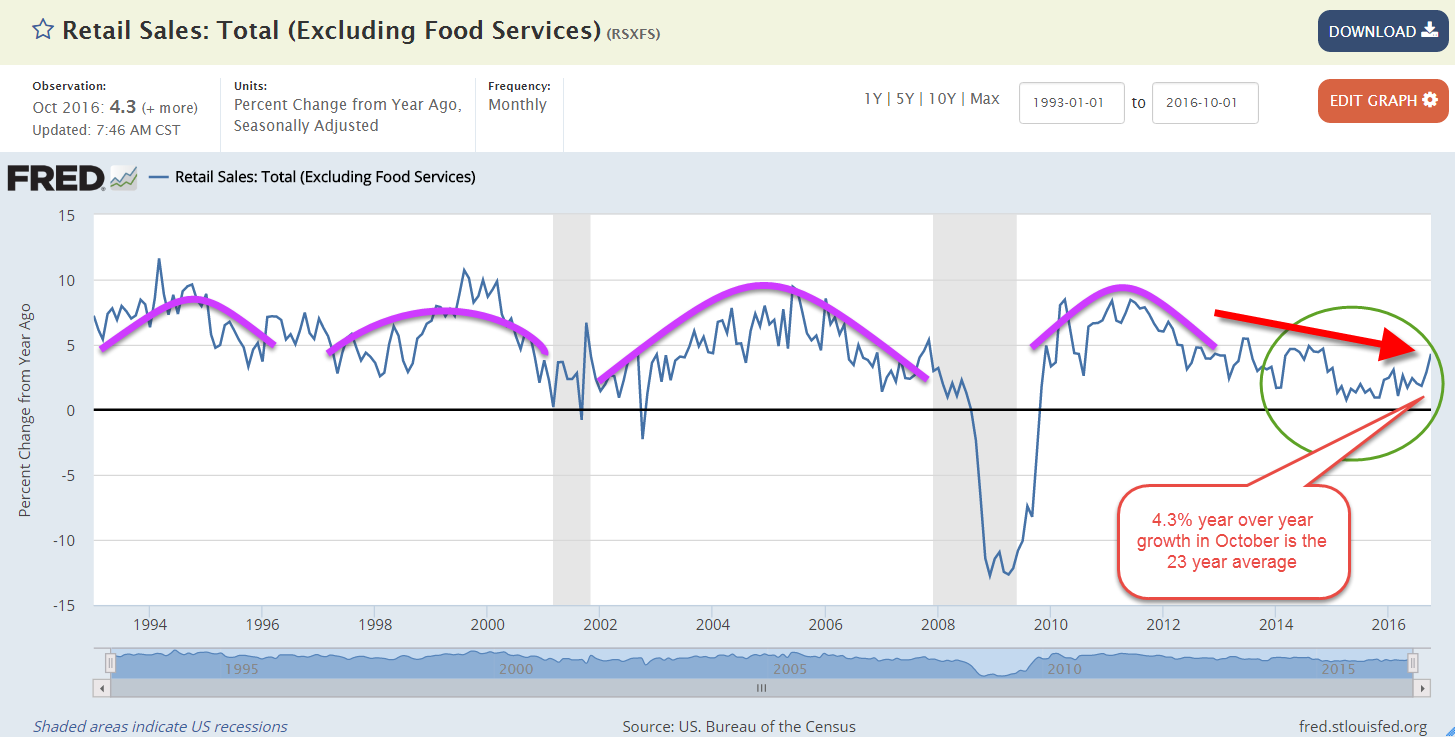
Average = Strong.  When growth is rather anemic, a return to average seems strong.  In October, retail sales rose 4.3% above October sales in 2015, a welcome bump up from the lackluster growth of the past two years.  Last month I showed that recent sales growth less population and inflation growth has been negative or close to 0.

The stock and bond markets have been shifting money around in anticipation of fiscal stimulus and more relaxed regulation from a Republican Party in control of the levers of government.  Small business stocks (VBR) are up more than 10% and financial companies (XLF, VFH) have shot up about 12%.  Consumer discretionary stocks (XLY, VCR) are up about 4% while the more defensive consumer staples stocks (XLP, VDC) are down 2%. Oil stocks (XLE, VDE) are up about 3%.

Will consumers put aside their cautions and spend more?  Active stock managers are certainly hoping so.

/////////////////////////

Ideas for IRA contributions

Emerging market stocks are still up 8% YTD after falling more than 6% in November.  Much of that decline has come on the heels of Trump’s election win.

A broad bond index has fallen almost 4% in the past few months.