Price Connections

March 13, 2022

by Stephen Stofka

As I was waiting for the car to drink its fill at the gas station, I got to thinking about prices. Their role is to convey information about resource availability but prices are not a conversant sort. They grunt monosyllabic phrases, relaying only the information that something has changed. A person who paid not the slightest attention to the news would wonder what happened when they filled up their car.

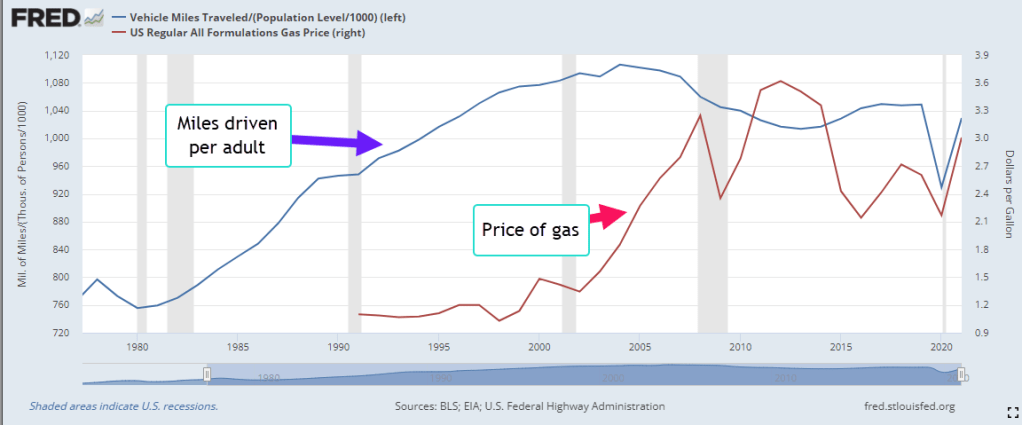
When prices decrease, do we buy more of a good or service? Sometimes. We usually pay attention to prices when they increase. In response, we substitute a cheaper good if we can, smoothing out the price changes. Most of us don’t drive more when gas prices decrease. Annual miles driven per adult have fallen as the large Boomer generation has aged (FRED Series TRFVOLUSM227NFWA/CNP16OV). The oldest of the Boomers passed 55 in the mid-2000s when per capita miles peaked.
Prices may not change as quickly as global conditions. When there is a poor coffee harvest in Brazil, the price of coffee in the grocery store may take several months to respond. Not so with gasoline, a global commodity so vital to the global economic engine that gas prices respond quickly to geopolitical events.

Many countries subsidize or control the price of some goods but too much control and prices no longer relay information between producers and consumers. The U.S. government subsidizes the farmers who grow corn to make the ethanol blended into gasoline. It subsidizes dairy, peanut and cotton farmers. Countries with state owned industries may keep a lid on prices to gain and keep political power. This year Kazakhstan lifted price caps on liquified petroleum gas which most people use to fuel their vehicles. Thousands of citizens protested (Neuman, 2022). In 18th century France, people rioted over the price of bread. Gasoline is today’s bread.

The ancient Greek philosopher Protagoras said that man was the measure of all things. In past centuries, essential food commodities that kept people alive were a yardstick of value. Anyone who has to drive to work or drives for a living feels that way about the price of gasoline. Larger firms that depend on predictable prices use the futures market to smooth gas prices but an independent Uber driver bears the full impact of rising gas prices. Should the U.S. subsidize gas prices for those who depend on the fuel? Those policies, politically popular in countries like Venezuela and Kazakhstan, foster political corruption and weaken the economic system. Why? One group of taxpayers subsidizes another group of taxpayers. The price of gasoline is closely linked with the price of power.

Competitive pricing is a hallmark of capitalism but such pricing minimizes profits. Large companies prefer to set a price which maximizes their profits within a competitive environment where other large firms use the same strategy. The result is an entire aisle in a grocery store filled with breakfast cereals that are priced at 10 times their cost. With the milk subsidies, the cereal becomes more affordable. Developed countries have learned to tame the prices of essential items without keeping those prices in a cage. We want our prices to communicate essential resource allocation information but we want well-behaved prices.

In our modern global economy we have many more goods and services available to us. Multiple sources of food products help lower prices but we are subject to the geopolitical risks of a global economy. The Covid pandemic and the war in Ukraine has reminded us that risks accompany benefits. The Russian people are beginning to experience the isolation of being cut off from the international system of trade, money and assets. Like prices, it is better when we are connected to each other.

////////////

Photo by Clint Adair on Unsplash

Neuman, S. (2022, January 8). There’s chaos in Kazakhstan. here’s what you need to know. NPR. Retrieved March 12, 2022, from https://www.npr.org/2022/01/08/1071198056/theres-chaos-in-kazakhstan-heres-what-you-need-to-know

A Lack of Giddyup

May 3, 2015

The first estimate of GDP growth in the January to March quarter was almost flat.  Not a big surprise given the severe winter in the eastern part of the U.S. but an annual rate of just .2% growth was lower than most estimates.  It would be a mistake to attribute all of the slow down to the weather.  Lower gas prices have delayed new drilling projects and idled more costly operations.  Some economists have not fully appreciated the positive influence that shale oil drilling has had on a tepid economic recovery.

Growth has not only slowed. It has shifted lower.  The Shiller P/E ratio, or CAPE, uses a 10 year period as a base.  A common measure of inflation expectations is the 10 year Treasury bond.  Let’s look at the change in real per capita GDP over rolling ten year periods starting in 1970.  Below I’ve graphed the logarithm, or log, of current GDP using the GDP 10 years ago as a base.  We can see a fairly consistent trend over forty years until 2008.

Some economists build models – partial derivatives – in which quantity of output fluctuates as a function of price, or F(p).  The thinking goes that price changes are part of a self-reinforcing mechanism. The problem is that price is a reaction to events, not a cause of them.  Prices distribute the effects of changes in supply, demand, and expectations in an economy or market.

The Fed believes that the economy has too much inventory – of savings, of caution.  Just as any store merchant would do, the Fed has lowered the price of savings, the interest rate, in the hopes that  customers will come in and borrow some of that savings.  Blue light special in Housing, Aisle 3!  The sale has been going on for almost seven years but demand in some sectors, particularly housing, is still very low.   The total of outstanding mortgage debt remains subdued no matter how much the price, or interest rate, is lowered.

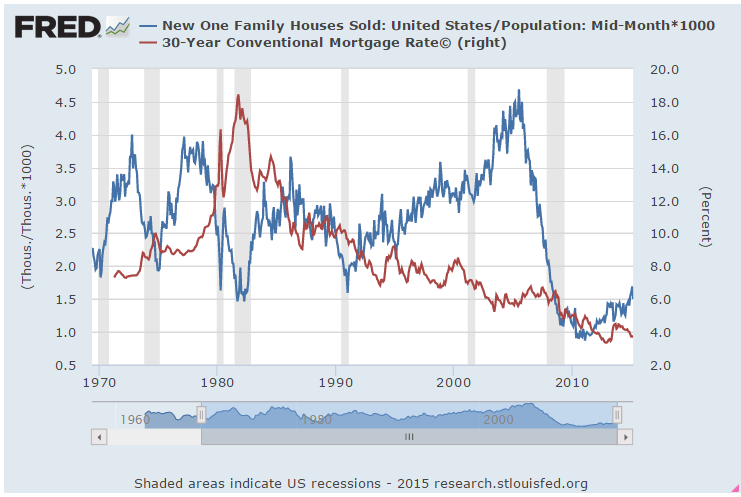
Last week I showed a chart of new home sales per 1000 people.  I’ll overlay the thirty year mortgage rate over it.

Higher mortgage rates reduce the demand for new homes.  The exceptionally low rates of the past few years should accelerate the demand for new homes.  Let’s do a quick and dirty adjustment by multiplying new home sales by 1 + the interest rate.  This will have a greater effect on sales when interest rates are higher, helping offset the lowered demand.  The actual amounts are not relevant- it’s the comparison.  This chart shows the exceptionally low demand of the past several years.

The total of loans and leases has been growing about 2% annually on average since the end of 2008, from $7.2 trillion to $8.1 trillion, a total of a little over 12% during the period.  To put that in perspective, that total grew by 75% in the previous 6 year period 2003 through 2008, rocketing up from $4.1 trillion to $7.2 trillion.  Since 1995, our economy has shifted and has been running on borrowed money more than in past decades.  These loan totals don’t include the huge, no strike that, call it prodigious, government borrowing that has propped up GDP growth in the past dozen years.

The Fed finished its April meeting this week and decided to keep the fire sale going. “The Committee currently anticipates that, even after employment and inflation are near mandate-consistent levels, economic conditions may, for some time, warrant keeping the target federal funds rate below levels the Committee views as normal in the longer run.” Fed statement 

Even if conditions do meet labor market and inflation targets, the Fed wants to make sure they can stay stable at those targets for a few months before taking action on interest rates.  The sale has been going on for so long now that the anxiety over the end of the sale has acted as a counter balancing force to the sale price.  Models of thinking as well as patterns of behavior are habit forming. One of the greatest scientists of all time, Isaac Newton, continued to believe in the principles of alchemy until he died.  Like other central banks, the Fed believes in the alchemy of interest rates, the price of money – that they can turn a leaden economy into gold.