Good Times

January 28, 2018

by Steve Stofka

Since the passage of the tax bill about a month ago, the stock market has risen 8%. Some people are convinced that only those at the top own stocks. Any market gains go only to the rich, they say. In the most recent of an annual Gallup survey, 54% of households reported that they directly owned stocks and stock mutual funds (Gallup).  Before the financial crisis, 65% reported direct ownership of stocks.

Private and public pension plans, as well as variable annuity life insurance plans, invest a great deal in stocks. When indirect ownership is added to the mix, a whopping 80% of the stock market is owned by households (Business Insider ). The fortunes of the stock market affect most people, even those on the margins of our economy.

A quarter of companies in the SP500 have reported earnings this month. Annual earnings growth is 12% (FactSet ). In response to the new tax law, companies are bringing home their overseas cash profits and paying Federal taxes on the repatriated profits. Most are predicting strong profit growth for the coming year. Home Depot announced that they are paying bonuses to all their employees.

Since the tax law was signed, the dollar has dropped 5% against the euro. This will make U.S. exports cheaper and more attractive to overseas markets. A euro of profit earned in the Eurozone market was worth $1.07 a year ago when Donald Trump took the oath of office. That same euro is now worth $1.24. Half of the profits of SP500 companies come from overseas, and investors are betting that the dollar will not strengthen substantially in the coming year, despite Trump’s insistence that he likes a strong dollar.

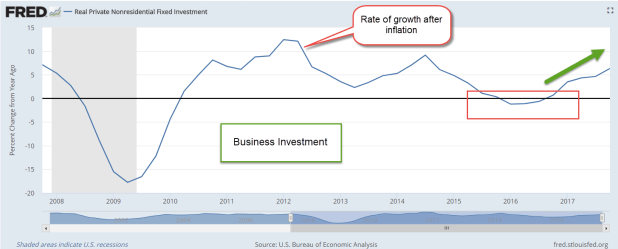
The first estimate of GDP growth, announced Friday, was 2.6%, down from the above 3% performance of the 2nd and 3rd quarters but much better than the 2% and lower rate of growth during 2015 and 2016. The growth of business investment has accelerated over the past four quarters and is nearing 7%.
NonResInvest

Consumer spending grew by 3.8% in the final quarter of 2017, and confidence is near twenty-year highs. Accelerating business investment and a rising stock market help those on the margins of the economy. Unemployment is low. As companies struggle to find employees, they turn to those that they might have turned away a few years ago.

My checker at Target last week had a slight speech defect.  A few years earlier, Target management might have put this person on some duty that did not have such frequent contact with the public, if they hired such a person at all.  Unless there is a specific outreach program, many companies are reluctant to hire those with impediments when there are many able-bodied candidates to choose from.  I was glad to see this twenty-something man employed.

At my local Home Depot a few weeks ago, a guy in a motorized wheelchair helped me locate an item. I got my question answered. Good for him, good for me, good for Home Depot.

A rising tide lifts all boats.  Every day the ever-upward stock market convinces scores of people that they are really smart investors. Many who buy “on the dip” are rewarded as they take advantage of a short term price decline. Some who timidly stayed in cash become convinced that they were too conservative.  They may listen to the market gains enjoyed by their co-workers, family and friends, and feel left out.  How to catch up?  They could take out a home equity loan and use the cash to buy stocks, some leveraged ETFs, or maybe some bitcoin.  Some of those have been on a tear lately.  Hmmmm…

Here’s the thing about a rising tide. A lot of ideas make sense while riding a good tide.


Investment Flows

October 18, 2015

When economists tally up the output or Gross Domestic Product (GDP) of a country, they use an agreed upon accounting identity: GDP = C + I + G + NX where C = Consumption Spending, I = Investment or Savings, G = net government spending, and NX is Net Exports, which is sometimes shown as X-M for eXports less iMports. {Lecture on calculating output}

In past blogs I have looked at the private domestic spending part of the equation – the C.  Let’s look at the G, government spending, in the equation.  Let’s construct a simple model based more on money flows into and out of the private sector.  Let’s regard “the government” as a foreign country to see what we can learn.  In this sense, the federal, state and local governments are foreign, or outside, the private sector.

The private sector exchanges goods and services with the government sector in the form of money, either as taxes (out) or money (in).  Taxes paid to a government are a cost for goods and services received from the government. Services can be ethereal, as in a sense of justice and order, a right to a trial, or a promise of a Social Security pension.  Transfer payments and taxes are not included in the calculation of GDP but we will include them here.  These include Social Security, Medicare, Medicaid, food stamps and other social programs.  If the private sector receives more from the government than the government takes in the form of taxes, that’s a good thing in this simplified money flow model. There are two types of spending in this model: inside (private sector) and outside (all else) spending.

Let’s turn to investment, the “I” in the GDP equation.  In the simplified money flow model, an investment in a new business is treated the same as a consumption purchase like buying  a new car.  Investment and larger ticket purchase decisions like an automobile depend heavily on a person’s confidence in the future.  If I think the stock market is way overpriced or I am worried about the economy, I am less likely to invest in an index fund.  If I am worried about my job, I am much less likely to buy a new car.  In its simplicity this model may capture the “animal spirits” that Depression era economist John Maynard Keynes wrote about.

We like to think that an investment is a well informed gamble on the future.  Well informed it can not be because we don’t know what the future brings.  We can only extrapolate from the present and much of what is happening in the present is not available to us, or is fuzzy.  While an investment decision may not be as “chanciful” as the roll of a dice an investment decision is truly a gamble.

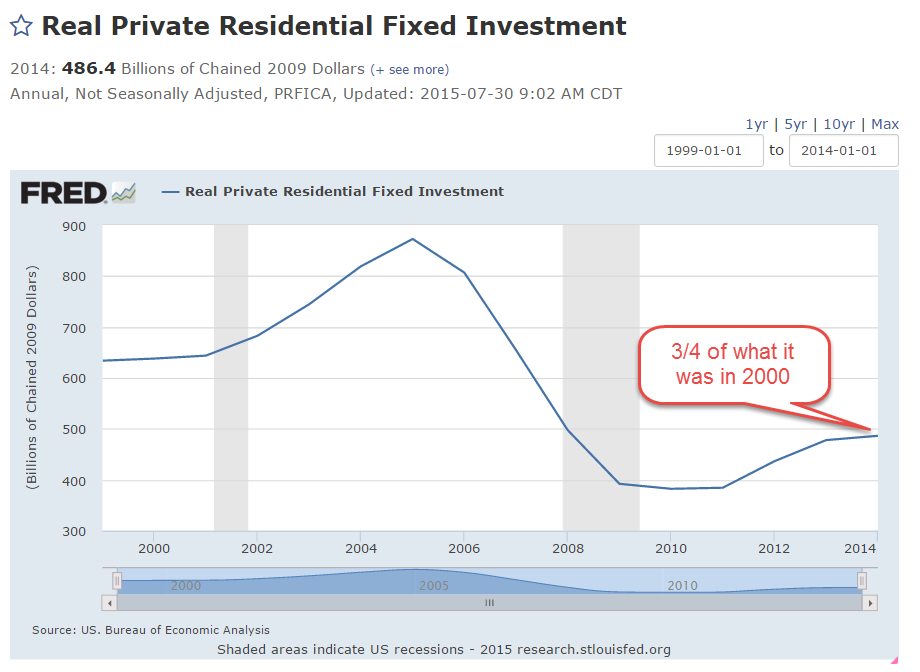
Remember, in the GDP equation GDP = C + I + G + NX, investment (the I in the equation) is a component of GDP and includes investments in residential housing. In the first decade of this century, people invested way too much in residential housing.

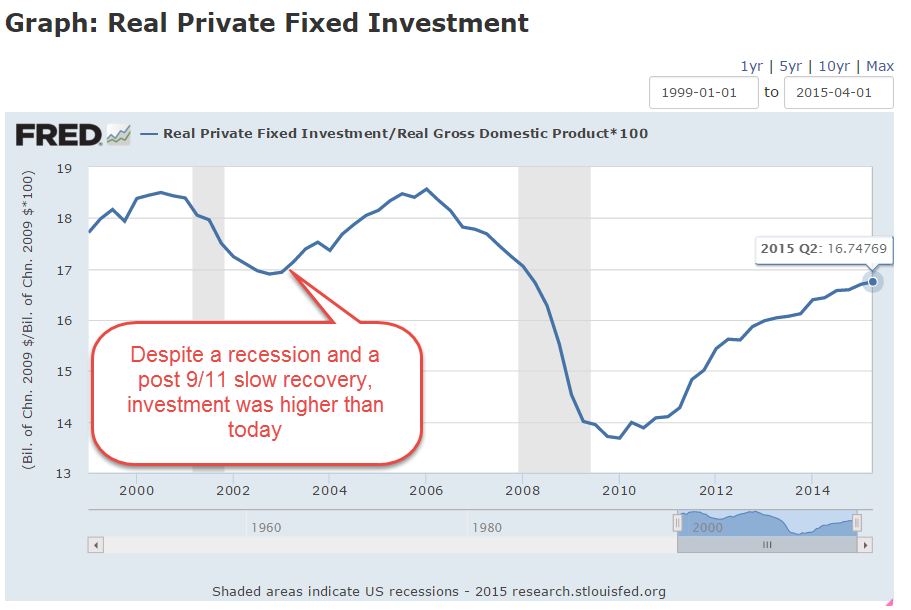
In the recession following the dot-com bust and the slow recovery that followed the 9-11 tragedy, private investment was a higher percentage of GDP than it is today, six years after the last recession’s end.  Much of this swell was due to the inflow of capital into residental housing.

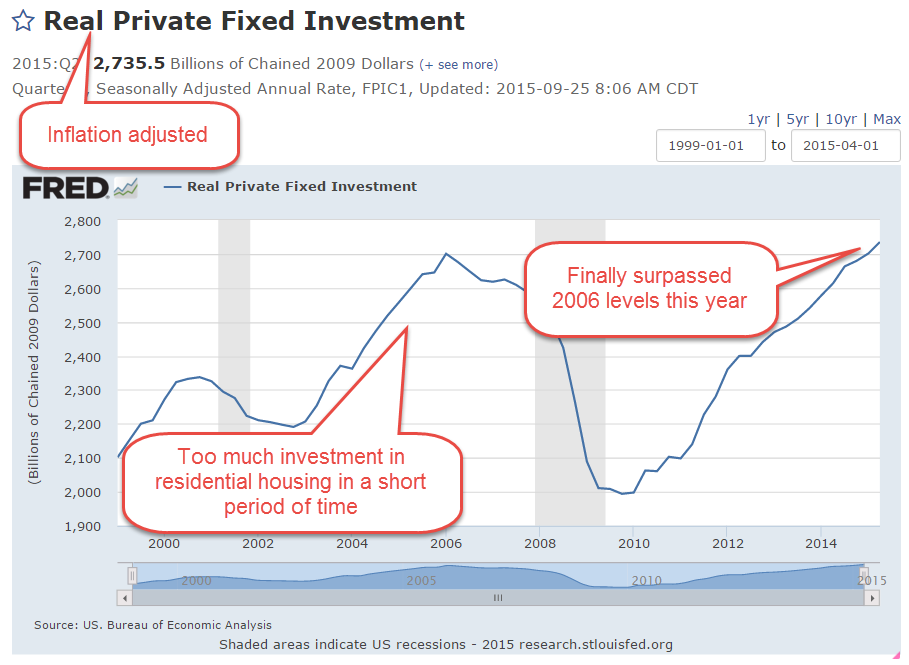
The inflation-adjusted swell of dollars is clearly visible in the chart below.  It is only in the second quarter of this year that we have surpassed the peak of investment in 2006, when housing prices were at their peak.

Investment spending is like a game of whack-a-mole.  Investment dollars flow in trends, bubbling up in one area, or hole, before popping or receding, then emerging in another area.  Where have investment dollars gone since the housing bust?  An investment in a stock or bond index is not counted as investment, the “I” in the equation, when calculating GDP.  The price of a stock or bond index can give us an indirect reading of the investment flow into these financial products.  An investment in the stock market index SP500 has tripled since the low in the spring of 2009 {Portfolio Visualizer includes reinvestment of dividends}

Now, just suppose that some banks and pension funds were to move more of those stock and bond investments back into residential housing or into another area?