The Free Market Myth

November 19, 2023

by Stephen Stofka

In this week’s letter I will continue to look at subsidies. Subsidies are created by legislation or agency interpretation that dispenses benefits to people, businesses and institutions. There are two forms of subsidy: a monetary credit of some sort, and an ownership credit, i.e., the granting of a property right. The monetary form includes tax credits and tax expenditures that can be calculated or estimated in dollar amounts. Last week, I noted that some of the biggest tax expenditures were the non-taxability of employer paid health insurance premiums and pension plans. The ownership form includes water rights and land use rights. Unlike the right to vote, these are rights related to the ownership of a physical property or the benefits of a property.

An ownership subsidy can be indirect. A century ago, the western states divvied up water rights to the Colorado River according to the doctrine of prior appropriation which mandates that if one party does not use their share, it is available to the other parties. Water is a scarce resource in this arid region of the country so this principle makes sense. In the wetter eastern states, water rights are based on a common law riparian system where ownership of the right is not coupled with use. Federal water rights are based on this common law system so there is an inevitable conflict whenever the western states cannot resolve their allocation treaties. Today, Colorado does not use all of its allotment while California uses more than its allotment. California does not send the state of Colorado a check every year for the water they use and is a form of indirect subsidy.

Monetary subsidies include agricultural subsidies that I discussed last week. Others include tax credits for buyers of electric cars and homeowners who install solar panels. The oil and gas industry as well as renewable energy producers receive many tax credits. Spending on public transportation includes subways, buses and light rail as well as the roads and highways that motorists use to get to work. Subsidies that support social welfare include public and private schools as well as the school vouchers doled out to parents of schoolchildren. Support programs include subsidies for housing, food and health expenses that involve many tangled cross subsidies. A large retail company can offer discounted merchandise by paying their employees lower wages and the reduced income makes those employees eligible for social assistance programs.

In this jungle of subsidies, it is difficult to compute a net subsidy benefit or deficit. Two-thirds of a homeowner’s property tax might support public schools in their district but they have no kids. Is that fair? They shop at a discount retailer and save hundreds of dollars annually because the retailer can pay its employees lower wages. When this homeowner buys gas, they provide a small subsidy to fossil fuel producers and the farmers who grow corn for ethanol. They buy milk at a lower price because of a government milk support program that is paid for by all taxpayers, even those who do not drink milk. If they eat hamburger, they benefit from grazing subsidies on federal land. The homeowner does not use bus or light rail but they live in a district that includes a sales tax for those systems. Why can’t we just have a free market with no government interference?

The concept of the free market is a useful abstraction but a dangerous idea when politicians and economists advocate for that reality. A “free market” and a “fair market” are oxymorons. A market cannot be free of government influence because all three branches of government are adjudicators, instrumental in awarding and enforcing property claims and the rules of exchange. Whatever the form of money used in a market, governments regulate it. To be fair, a rule giver would treat everyone equally but the world is composed of discrete goods and services that are not infinitesimally divisible. We live in a “clumpy” world and there is no universal standard of fairness to divide the clumps. Some people advocate for equality of opportunity. Others argue for equality of outcome. These abstractions help us analyze the world but we cannot build a society with either and retain a dynamic flow of both opportunity and outcome.

Governments award monopolies for the public good. Companies secure monopolies and market restrictions from government to reduce competition. The government is part of the market as a buyer of goods and services. Some authority must regulate the exchange of ownership that accompanies the exchange of goods and services. The protection of person and property in a market requires either a police presence or an impromptu coalition of people who enforce rules with force if necessary. Some authority must certify weights and measures or a “free market” becomes a “market of force,” a melee of arguments and fights.

We live our lives in a storm of electromagnetic waves, unaware of most of them but dependent on many of them. We rarely make a transaction without the involvement of some subsidy yet many of us live with the illusion of independence. Some pay more in income tax or property tax. Some help coach the school soccer team. As nodes in a social web we cannot calculate the cost of our contribution to the strength of that web. At any point in time some of us contribute more, some less. Over a lifetime our contribution varies from less to more and less again. Our society flourishes when we spend less energy keeping score.

///////////

[20231119Market.png]

Photo by Jezael Melgoza on Unsplash

Keywords: monopoly, public goods, property rights, water rights

Public Goods and Private Values

April 16, 2023

by Stephen Stofka

This week’s letter is about the funding for public goods. More than sixty years ago economist Charles Tiebout predicted that we would splinter into different communities based on our use of and desire for public goods like schools, highways, public transportation and other facilities. Let’s dig in!

In his 1948 textbook Economics: An Introductory Analysis, Paul Samuelson introduced the definition of a public good as non-rival and non-excludable. Non-rival means that one person’s consumption of a good does not lessen another’s consumption. National defense is an example. It is difficult to exclude people from a public park or a radio broadcast so these are considered public goods. Samuelson introduced these two characteristics to distinguish public goods from common or pooled goods like a public lake. When there is a plentiful stock of fish, no one notices that when one person catches a fish, someone else cannot catch that particular fish. Overfishing results when people catch fish faster than they can replenish their stocks.

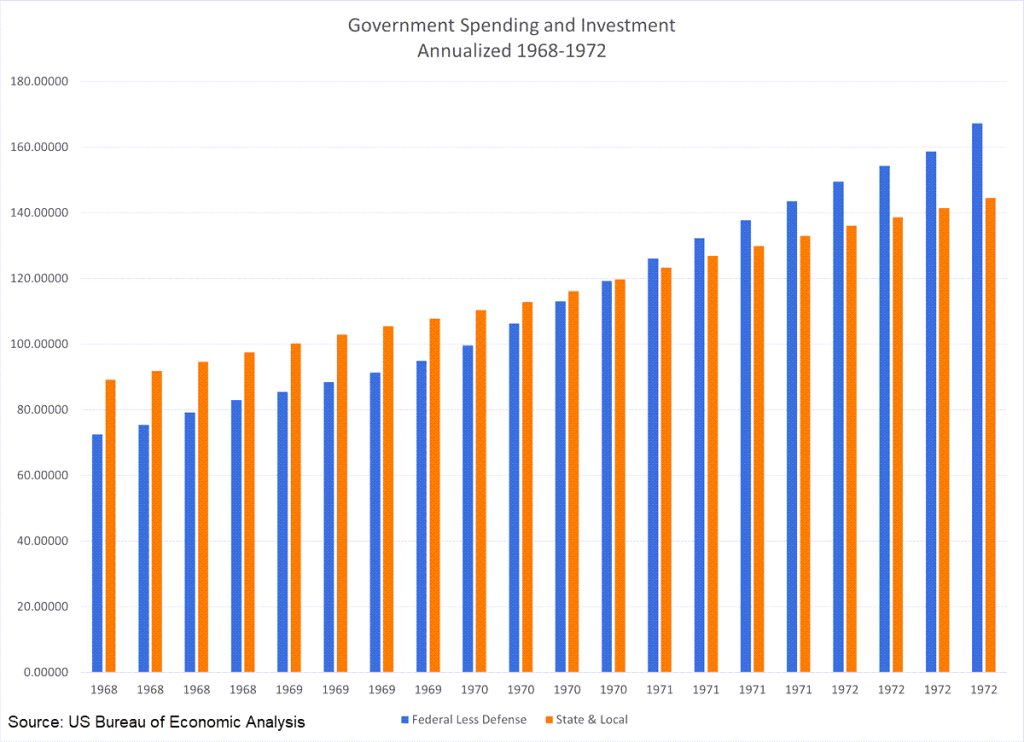
In his eager efforts to systematize and mathematize economic concepts, Samuelson sometimes introduced provocative simplifications. In two separate articles published in 1955, economists Stephen Enke and Julius Margolis gave examples of public goods that were rivalrous. A crowded public highway or school does lessen other people’s consumption. Charles Tiebout (1956) pointed out that one of Samuelson’s simplifying assumptions was that public goods were provided by one source, the federal government.  In 1954, state and local spending was actually twice that of federal spending, excluding national defense. In the chart below, the orange bars are state and local spending, which does include police protection. While it is a public expenditure, a police response to one incident means that they are not available for another call so the police are rivalrous.

A few years after the Johnson administration ushered in the social reforms collectively termed the Great Society in 1964-65, federal spending overtook state and local spending. These programs included Medicare, Medicaid and what were called Food Stamps and Welfare at the time. Today the spending roles are reversed. Without including spending on national defense, federal government spending and investment is almost twice that of state and local.

Samuelson pointed out that there is no market mechanism to price public goods. What is the appropriate price for defense, highways, schools and other public goods? Charles Tiebout (1956) argued that the price for these goods is determined in the voting booth by a public that desires to keep its taxes low. Voters will support those public goods which they consider valuable and will use. Tiebout predicted that voters would migrate to communities where they were among taxpayers who shared similar preferences for a particular set of public goods. If a couple had young children, they would vote for more school funding. Their children would get the benefit while the community as a whole bore the expense. People who liked to golf would favor communities with a like-minded interest who would vote for a public golf course. Tiebout wrote, “The greater the number of communities and the greater the variance among them, the closer the consumer will come to fully realizing his preference position.”

Writing in 1956, Tiebout’s prediction ran counter to the predominant social theory of the American melting pot – that people were becoming gradually harmonized into a single American monoculture. In 2008, Bill Bishop’s book The Big Sort confirmed Tiebout’s prediction. For decades, Americans had been sorting themselves into communities of like-minded preferences and values. Today, few would argue that we live in an increasingly differentiated society of insular interests and values. On social media, we establish community by voicing outrage at those others – what one of them said or did. We form interest clubs with a unique vocabulary, inside references, remarks and jokes that those outside the club don’t get because they don’t understand the context.

In spite of this cacophony of interests and values, there is a clamor for more public goods. More health care, more schools, more public spaces. How are we ever going to agree on the funding for these public goods? The successful ballot initiatives supporting public goods have a common characteristic. They spread the cost evenly by exacting a very small increase in a sales tax rate. People will vote for a public good if it will cost all households a small amount like $20 extra sales tax. This tax, known as a Tiebout equilibrium, acts more like a user fee than a tax.

Each year federal spending less national defense grows a bit more than state and local spending. If local voters cannot agree on spending priorities, this divide will get larger, throwing more of the spending burden on the federal purse and increasing the federal debt. Officials in local districts, frustrated by a lack of voter consensus, will increasingly look to Washington for school funding, children’s lunch programs, health care, public transportation, support of libraries and museums. Where does this end?

////////////////

As an aside, defense spending has a unique characteristic. Most government services increase as the population increases. It may not be in proportion but that is the general case. Increases in defense expenditures respond more to the perception of outside threats, not the size of the population. Here is a chart of per capita spending in nominal dollars, spending that has not been adjusted for inflation.

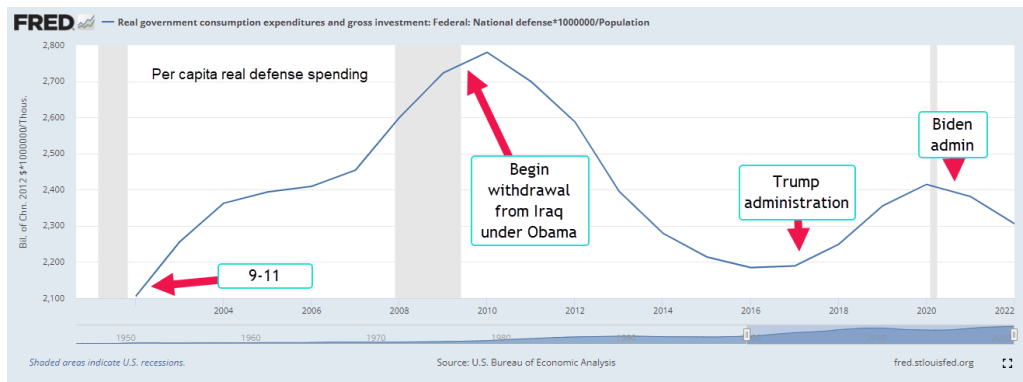
When spending is adjusted for inflation, it is clear that defense spending responds primarily to  perceived threats, not population growth.

After 9-11, real per capita spending on national defense increased by 33%, from $2100 to $2800 per person. In June 2009, President Obama began withdrawing troops to meet a campaign pledge. By the end of his second term in 2016, real per capita defense spending had returned to a level that existed before 9-11. Despite his isolationist rhetoric the Trump administration increased defense spending. This was largely due to pressure from a Republican Senate and House. In the less populous areas of the south, central and mountain west, more defense spending means more government jobs that promise stability and benefits. Republicans may preach small government but the communities they represent value government jobs and the economic benefits that ripples through local communities from military spending.

//////////// 

Photo by Amy-Leigh Barnard on Unsplash

Tiebout, C. M. (1956). A pure theory of local expenditures. Journal of Political Economy, 64(5), 416–424. https://doi.org/10.1086/257839