Our Perception of Risk

May 12, 2024

by Stephen Stofka

This week’s letter is about our perception of investment risk, and the subjective and objective aspects of risk evaluation. Our journey will take us several hundred years in the past and several decades into the future. The triennial survey of consumer finances indicated that less than half of people nearing retirement have $100,000 in liquid financial assets like savings accounts, stocks and bonds. Half of all working households have no savings, leaving them vulnerable to specific circumstances or a general economic shock. In our 20s, retirement looks remote with many years of work ahead of us. As we near retirement, we look in the other direction, to the past, and wish we had saved more. We confront the reality that we feel today’s needs more urgently than tomorrow’s possibilities. A $100 saving has a $100 impact on our current consumption but is only a faint light compared to the many thousands of dollars we will need in the future. We may not understand the underlying mechanism of saving.

We rely on what is visible to our senses to develop a flow of causality. We press on our car’s gas pedal and go faster, convinced that our action is adding more fuel to the engine. What the pedal controls is not fuel, but the air flow leading into the combustion chambers of the engine. The increased flow of fuel occurs in response to the change in air pressure. Prior to the 1980s cars used carburetors and mechanically employed this process called the Bernoulli principle, the idea that faster moving air induces a lower air pressure, a vacuum effect that sucks fuel toward the engine. Today’s fuel injection systems use air flow sensors that direct a computer to adjust the fuel flow. So, what does this have to do with risk?

Bernoulli’s principle is named after Daniel Bernoulli, the son of a noted Swiss mathematician and the nephew of Jacob Bernoulli, a 17th century mathematician who developed foundational concepts in probability like the Law of Large Numbers. Jacob maintained that people perceived risk in two ways. The first was an objective measure, an estimate of the probability of some event. The second was a subjective measure that depended on each person’s wealth, an inverse relationship. The first is visible, like the pressing of a gas pedal. The second is less visible, like the change in air pressure. Imagine that two people agree to flip a fair coin for a $100 bet. Person A has $1000 in her pocket; person B has $200. The loss or gain of $100 represents only 10% of A’s wealth, but 50% of B’s wealth. Even though the chance of winning or losing is the same for each person, they perceive the outcome differently. Peter Bernstein (1998) presents an engaging narrative of Jacob’s ideas in his book Against the Gods. His trilogy of books on the history of investing, risk and gold will inform and entertain interested lay readers.

Jacob may have identified one subjective element in each person’s evaluation of risk, but a person’s stock of wealth is not the only basis for a subjective estimate of risk. There are retired folks with accumulated savings of a million dollars who keep their money in savings accounts or CDs because they perceive the stock and bond markets as risky. A $10,000 loss in the stock market is only 1% of a million-dollar wealth yet some people perceive that loss in absolute dollars, magnifying the effect of a $10,000 loss. They regard the stock and bond markets as different versions of a casino. That same person might give $10,000 to a grandchild for college or to help buy a car, reasoning that there is an exchange of something that a person values for the $10,000. A person has no sense of receiving anything when their stock portfolio shows a $10,000 decrease. The stock market should have to pay an investor for using her investment, not the other way around. Such perceptions are confirmed during crises when the stock market loses 50% of its value.

Is an investment in the stock market like putting a quarter in a slot machine? Another perspective: an investor is like an investment company selling insurance to the stock market. A century of data shows that the probability of a loss in the stock market in any specific year is about 25%, according to an article in Forbes. In 70 years, the SP500 has doubled every seven years on average. An insurance company relies on Jacob Bernoulli’s Law of Large Numbers and diversification to manage risk. An investor, like any insurance company, will experience losses in some years. In last week’s letter (see note below) I wrote about surplus as a key dynamic factor in market transactions. In most years, an investor with a surplus of funds can “sell” those funds to the market and reap a gain.

Like risk, values in the stock market are based on both objective and subjective components. Sales, profits, dividends and efficiency help anchor a stock’s price movements as objective measures of value. Price responds to changes in these variables. Objective measures also include the variation in a company’s stock as a precise measure of uncertainty. There are various less precise but objective measures of economic and financial risk. Subjective measures include an investor’s need for liquidity, the ability to turn an investment into cash without impacting the price. An investor’s wealth can act as a cushion against fear of loss, a subjective measure discussed earlier.

Index funds have grown in popularity because they take advantage of Jacob Bernoulli’s Law of Large Numbers. By owning partial shares in many companies, an investor reduces the risk exposure to the variation in the fortunes of one company. The SEC might open an investigation into the ABC company, or the company loses an important overseas market, or the company reveals that the profit margins on some of its popular products are decreasing. To an index fund investor, a 10% decrease in that company’s stock price may be barely noticeable. The investor still has a risk of a change in general conditions, like a pandemic, but has dramatically reduced the risk of local conditions specific to one company.

Investors in Bitcoin do not act as an insurance fund for Bitcoin companies who mine Bitcoin. The miners have the surplus and are the sellers of Bitcoin. In the secondary market, the sellers of access to the digital currency market are the two dozen or so ETFs that allow investors to buy interest in a fund that owns bitcoin. Price movement is like a tailless kite flying in a breeze, responding mostly to price forecasts, a characteristic of some derivatives markets. The only objective measure of value and risk is the number of Bitcoin in circulation and the reward for mining new Bitcoin. Bitcoin’s price movement has a high volatility greater than 50% because there is little economic activity that anchors the variation in Bitcoin’s price. Despite the high volatility, an asset manager at an ETF fund makes the case for investing a few percent of a portfolio in a bitcoin ETF. As in our earlier example, the loss or gain depends on the current state of one’s savings.

Understanding the two aspects of risk perception, the objective and subjective, can help us manage our personal risk profile. Through research or the advice of a financial consultant we can understand the objective measures of portfolio risk but there are subjective elements unique to our personal history and disposition. The fear of having to be in a long-term care facility may influence our yearning for safety, regardless of our current health. A parent or relative may have had a similar experience and our primary concern is the protection of our portfolio value. We may feel fragile after the loss of our entire savings in a business venture. We can only become comfortable with our apprehensions by becoming familiar with them.

Next week I will look at our perceptions of other significant factors in our lives, particularly inflation.

/////////////

Photo by 𝓴𝓘𝓡𝓚 𝕝𝔸𝕀 on Unsplash

Keywords: stocks, bonds, risk, investment

Bernstein, P. L. (1998). Against the Gods: the Remarkable Story of Risk. John Wiley & Sons.

In last week’s letter I wrote about surplus as a key dynamic factor in market transactions. A seller of a good or service has a surplus which it values less than the buyer. However, the seller’s cost, including opportunity cost, is more than the cost to the buyer. These two ratios of benefit and cost find an equilibrium in the market that depends on the type of good or service and general conditions.

https://etfdb.com/themes/bitcoin-etfs/

https://www.vaneck.com/us/en/blogs/digital-assets/the-investment-case-for-bitcoin/

Fish and Bones Investing

January 14, 2024

by Stephen Stofka

This week’s letter is about our portfolios and the return we earn for the risks we take. Flounder is tasty but be careful of the bones. January is a good time to review savings and assets and start making plans for 2024. Did I make any contributions to my IRA in 2023? After the gains in the stock market last year, how has my portfolio allocation changed? I thought I would take a wee bit of time to review the performance and key indicators of some model portfolios over the past sixteen years. We have endured a great recession, a financial panic, a slow recovery during the 2010s and a pandemic in 2020. Despite all those setbacks the SP500 index has more than tripled since December 2007. Huh?! Before I begin, I will remind readers that none of what I am about to say should be considered financial advice.

Allocation

A portfolio can be separated into three broad categories: stocks, bonds, and cash. Stocks are a purchase of equity or ownership in a company;  bonds are a purchase of public and private debt; cash is an insurance policy. Each of these can be subdivided further but I will stick with these broad categories. An allocation is a weighting of these types of assets. A benchmark allocation is 60/40, meaning 60% stocks and 40% bonds and cash. The percentage of stocks in a portfolio indicates an investor’s appetite or tolerance for risk. In this review I will discuss three allocations: 50/50, 60/40 and 70/30. A 70/30 allocation is considered more aggressive than a 50/50 allocation.

Investment Cohorts

The 50/50 portfolio was invested equally in the SP500 (SPY) and the total bond market (AGG) at the start of each 8-year period, beginning with the period that began in 2007. I will refer to these 8-year periods as cohorts, just like age cohorts. The 2007 cohort was “born” on January 1, 2007, and “died” on December 31, 2014. The second cohort was born on January 1, 2008, and died on December 31, 2015. There was no rebalancing done throughout each period to test the effect of a severe financial shock during the life of the investment.

Presidential Administrations

I picked an 8-year period because it aligns with two Presidential terms. A change in administration alters the political climate and presumably has some effect on a portfolio’s returns. The data, however, did not confirm that hypothesis. Presidential candidates try to persuade voters that their candidacy and their party will make people better off. To the millions of people trying to build a retirement nest egg, a change in administrations during the past 16 years had little effect. The market responds to forces much broader than the policies of any administration.

Specific Cohorts and their Returns

Let’s look at a few cohorts. Despite the severe downturn during 2007-2009, the slow recovery and the pandemic shock, the more aggressive 70/30 allocation delivered consistently higher returns than the two safer allocations. Obama’s two term Presidency began in 2009 at a decades low in the stock market, an opportune time to invest. However, that 8-year return had only the second highest return in this analysis. The highest return was the 2013-2020 cohort that consisted of Obama’s second term and Trump’s only term (so far).

Risk vs. Return

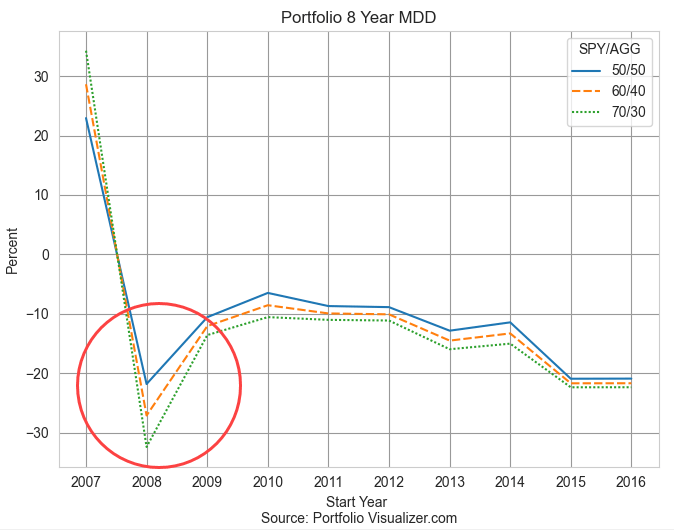
In 2008 a 50/50 portfolio cushioned the 37% loss in the U.S. stock market but over an 8-year period, the advantage of a safer allocation largely disappeared. In the period that began in 2008 all three portfolios delivered less than a 6% annualized return. During a severe downturn, a safer portfolio can mitigate an investor’s fears but the best tonic is a long term perspective. Generally the difference in returns is about 1% per year so the 50/50 portfolio earned 1% less than the 60/40 which earned less than the 70/30 portfolio. However the 70/30 investor absorbed more risk than the other two portfolios. In the chart below is the standard deviation (SD) of each portfolio, a measure of the risk or variation in a portfolio.

Performance Metrics

Recall that the 2013 cohort (green dotted line) had a return above 12%. The risk was almost 11%, a nearly one-to-one ratio of return to risk. Financial analysts have developed several measures of the tradeoff between risk and return. The Sharpe ratio is a measure of return that adjusts for risk by subtracting the return on a really safe investment from the return on the portfolio. The benchmark for a risk free investment is a short term Treasury bill (The interest rate on a money market account would be a close substitute).

Let’s use some rounded figures from the 2013 cohort as an example. The 70/30 portfolio earned 12% and a safe investment earned just 1%, a difference of 11%. That is the numerator in the Sharpe ratio. The denominator is the level of risk which is the standard deviation (SD) mentioned above. The SD was almost 11%, giving a ratio of 1. In the chart below is the Sharpe ratio for each cohort and shows that the actual ratio of 1.1 was close to the approximation above. Notice that the safer 50/50 portfolio often had the higher risk adjusted return.

From Peak to Valley

Investors may ask themselves “how much in return can I earn” when the more appropriate question is “how much risk can I tolerate?” The MDD, or maximum drawdown, is the greatest change in the value of a portfolio, regardless of the beginning and ending of a year. A portfolio might have gained 20% by October of 2007, then lost 60% in the next six months. The MDD would be 60%. It can be a gauge of your comfort level. Notice in the chart below that the MDD only varies under great stress like the financial crisis when the difference between the safer 50/50 allocation and the 70/30 portfolio was about 10%.

The Impact of Loss

We feel losses more than we do gains, even if the losses are only on paper. A portfolio that gains 20% only has to lose 16% to return to even. Regardless of our math abilities in a classroom, our instincts can be quite good at percentages. At higher gains, the percentages are painful. A portfolio that gains 50% then loses 50% nets a 25% net loss from our starting position (see notes at end). An MDD is a good indicator of “will this loss of value cause me to sell the investment?” In the early part of 2009 after the market had been battered, some clients could not handle the anxiety and sold some or all of their stocks, despite the advice from their advisors that this was the worst time to sell.

No Two Crises are Alike

Since December 2019, a few months before the pandemic restrictions began, the stock market gained 20% after adjusting for inflation (details at end). During and after the financial crisis, stocks lost 12% during the four years from December 2007 through December 2011 (details at end). The better response of asset prices during the pandemic era can be attributed to two phenomenon: technological advances and high government support of households and small business. During the financial crisis the majority of government support strengthened the foundations of financial institutions at the expense of households and small businesses. During the pandemic, many people could be productive from home. Students were in a virtual classroom with 15-30 other students. Had the pandemic happened in 2007, there was not enough bandwidth to support that kind of access, nor had the software been developed that could run that network capacity.

Takeaways

Households vary by income, by age, by health, circumstances and family characteristics. Each of these factors is a component of a risk exposure that a household faces. A younger couple might have time on their side but family obligations reduces their risk tolerance. Those obligations might include caring for an elderly parent or supporting a child’s educational goals. These models cannot replicate actual portfolios or individual circumstances but they do illustrate the smoothing effect of time even under the worst shocks. Risk tolerance is a matter of time tolerance.

//////////

Photo by Ch P on Unsplash

Keywords: portfolio allocation, standard deviation, risk, return, Sharpe ratio

A portfolio of $100 that gains 50% is then worth $150. If it loses 50%, the result is a value of $75, a net loss of $25 or 25%.

According to multpl.com, the inflation-adjusted value of the SP500 was 4708 in December 2023. This was a 20.6% gain above an index of 3902 in December 2019. The index stood at 2005 in December 2007, the first month of the Great Recession that would become the financial crisis in 2008. In December 2011, the index stood at 1762, an inflation-adjusted loss of 12%.

House of Money

June 12, 2022

By Stephen Stofka

Economics students learn that money is a complex function, a multi-tool that plays three roles in our lives. Lawyers study the role of money in contracts. Psychologists study how our beliefs and personal history shape our distinct attitude to money. Our use of money embodies our expectations of the future and our perceptions of risk. The financial crisis demonstrated that money connects us and separates us. The struggle between cooperation and distrust is the foundation of our experiment in democracy.

Money is the Swiss army knife of most societies. As a medium of exchange, it saves us the cost of matching our needs. We can store our labor in a unit of money, then trade it for the things we want. The law regards an exchange of money as a “consideration” that distinguishes a contract from a gift. Current Supreme Court precedent has held that money is speech. Because we use money to store purchasing power, we want it to be a reliable container that doesn’t leak value. Money’s role as a unit of account requires legal institutions to administer the rules of that accounting.

We buy insurance to mitigate risk but to do so we are herded into risk pools based on age, sex or occupation. Those under age 25 pay higher car insurance premiums but lower health insurance premiums. Because they make less money as a group, they have a higher loan default rate and must pay higher borrowing costs. Roofers pay higher workmen’s compensation premiums than police. Heights are more dangerous than criminals. Before Obamacare, health insurance companies charged women of childbearing age higher premiums for individual policies (Pear, 2008). The premiums reflected the higher expected costs of pregnancy regardless of whether a woman had any intention of getting pregnant. We are Borg.

Companies may classify our risk profile but we have a unique relationship with money, a composite of personal experience and inclination. “Me” and “my” are appropriately contained in the word “money” because our attitude toward money is as unique as our fingerprints. In 1984, British psychologist Adrian Furman (1984) led a study to assess people’s attitudes toward money. The questionnaire included 150 questions grouped into five areas that probed the subjects’ beliefs, their political attitudes and affiliations, their sense of autonomy and personal power. An argument about money can be as complex as that questionnaire.

Many political debates involve money. Each party tries to gain control of the public purse to fund its priorities. After 9-11, the debate over money intensified. The hijackers had attacked a money center as a symbol of American hegemony. While Americans debated the justification for an invasion of Iraq, the budget surplus of the late Clinton years evaporated. For some voters, the choice was a stark one – spend money to blow up people in a foreign land or spend it to strengthen American communities. To calm his critics, Mr. Bush promised that Iraq would repay American war expenses with its oil revenues. This was one of several follies that turned voter sentiment toward Democrats in 2008.

The financial crisis showed us the complex nature of money and tested the values that we attach to money. In the last months of a flailing Bush Presidency, the crisis exposed the corruption, greed and stupidity of the country’s largest financial institutions. Billions of taxpayer money had created and fed a thicket of regulatory agencies that were either corrupt or incompetent. The crisis ignited a strong moral outrage that intensified when Democrats fought to pass Obamacare.

The debate may have ebbed during the decade that followed but the Republican tax cuts of 2017 reignited public disdain and distrust. While many American families struggled to recover from the crisis, the politicians and their rich patrons fattened their fortunes.

Money is the heart of the American experience. The American confederacy of colonies that had won independence from Britain could not pay its debts or borrow money. The writing of the Constitution was sparked by the urgent desire to resolve that crisis or risk becoming subjects again of a colonial power. To reach consensus, the colonies had to overcome their distrust of a central government with the power to levy taxes. The colonies distrusted each other and the regional coalitions that might take the reins of that central government. The founders built their distrust into the Constitution and its governing institutions. In grade school we learn them as “checks and balances,” a euphemistic phrase for distrust.

On social media we argue about the many aspects of money. Our experiment in democracy will be over when Americans stop having spirited discussions about money.

////////////////

Photo by Kostiantyn Li on Unsplash

Furnham, A. (1984). Many sides of the coin: The psychology of money usage. Personality and Individual Differences, 5(5), 501–509. https://doi.org/10.1016/0191-8869(84)90025-4

Pear, R. (2008, October 30). Women buying health policies pay a penalty. The New York Times. Retrieved June 7, 2022, from https://www.nytimes.com/2008/10/30/us/30insure.html

Good Hands Government

January 20, 2022

by Stephen Stofka

Socialist policymaking is founded on an aspirational principle of equal outcomes. Central to that approach is an expanded role for government as an insurance company, the insurer of last resort. Should government be the insurer of first resort? Some would prefer that but others are uncomfortable with the lack of privacy that entails. A characteristic of insurance is what economists call asymmetry of information. The insured knows more about their situation and risks than the insurer. Do we want to give government an incentive to pry into our private lives? Can government protection create a moral hazard? Will people be less careful or less industrious because they trust that government has their back? Student loan debt brings a pointed focus to some of these issues.

According to 39 state Attorney Generals, Navient was a predatory servicer of high-interest loans for students attending for-profit colleges (Settlement Administrator, 2022). In the mid-2010s, the Obama administration put its foot down with many  for-profits – if they could not meet minimum graduation rates, they would be cut off from federal funds. Many folded. Recently, 39 states  reached a settlement with Navient that gave relief to many thousands of student borrowers. Who was given no relief? Students who had been paying their loans on time.

In many areas of our lives, we disagree about who is responsible for the risks of unwelcome outcomes. A person who gets an education assumes a certain risk that higher lifetime earnings will be greater than the cost of an education. Such a risk cannot be quantified or insurance companies would sell policies to college students. However, the federal government provides some guarantee for federal student loans. Colleges, including for-profit schools, are usually accredited. That accreditation provides some assurance – but not insurance – to a student that a school’s curriculum has sufficient quality to earn the accreditation. However, conventional non-profit colleges are supervised by regional accrediting organizations that have higher standards than the accrediting bodies of for-profit colleges (The Best Schools, 2022). Without the regional accreditation, for-profit students often discover that they cannot transfer their credits to a 2-year or 4-year college. Employers may doubt the worth of their educational credentials.

Is this a case of buyer beware? How is a college education different than starting a small business? Students have a wealth of research available to them before they enroll in a for-profit college. Should taxpayers pick up the tab for students who may not have done adequate research before committing to a student loan?  Every year hundreds of thousands of small businesses go out of business for the same reason. They did not research the market. They didn’t have adequate management experience. Many people may be stuck with 2nd mortgages used to fund the business. Should taxpayers bail out small business owners? 

Financial and medical risks can be substantial and we may vehemently disagree about government’s responsibility for absorbing these risks. Government now insures us against loss of income due to injury (workmen’s compensation) or permanent inability to work (disability insurance), old age (Social Security), protects our pension funds (ERISA), insures our homes against flooding (Flood Insurance Program). It pays our medical bills if we are poor (Medicaid) and when we are old (Medicare).

Should government have a minimal or expanded role in our lives? If we want government to have our back, what is the limit? What are the boundaries between government and our lives? What is the extent of our personal responsibility? How much risk must we shoulder? There are many strong opinions on the subject.

////////////////

Photo by Lina Trochez on Unsplash

Settlement Administrator. (2022, January 13). 39 State Attorneys General Announce $1.85 Billion Settlement with Student Loan Servicer Navient. Home. Retrieved February 20, 2022, from https://navientagsettlement.com/Home/portalid/0

The Best Schools. (2022, January 6). Guide to for-profit colleges: What you need to know. TheBestSchools.org. Retrieved February 19, 2022, from https://thebestschools.org/resources/for-profit-colleges/

Obligate Growth

This week Goldman Sachs announced that they were raising the starting salaries for entry level analysts to $110,000 from $85,000. When I heard that on the radio, I remembered the bailout of Goldman Sachs a dozen years ago. I thought of the many hospital workers who have risked their lives during the Covid crisis. Most were not making that kind of money. Under capitalism, market transactions direct resources but do they signal a society’s values?

In Sustainable Capitalism, John Ikerd (2005, 4) calls for a balance of our self-interest with our common-interests, citing the classical economists like Adam Smith who recognized that a market system must work within the ethical bounds of society (2005, 4). There is no point to capitalism if the wealth that the system can generate does not improve the general well-being of a society. Capitalism directs resources but only for goods where two parties can agree on a value. It’s hard to find common agreement on the value of many public or common goods. The infrastructure bill being negotiated in Congress this year bears witness to that reality. What is the value of a well-lit street, improved cable systems, safer electrical generation and the many public goods that we take for granted?

Capitalism evolved to assemble and deploy investment for shipping ventures, and to diffuse the extreme risk of shipping goods across oceans. In the 18th century as many as half of all ships returning to England laden with goods from India were lost at sea. Most ventures were launched without insurance. In the 17th century, insurers often went insolvent and could not cover a great loss (Johns 1958, 126). Many did not know how to price risk. In 1720, Lloyds of London and the Royal Exchange were formed to spread the risk. During the American Revolution the British government contracted out the shipping of armaments and British troops to the colonies. In 1780, a series of sea battles between the British, Spanish and French fleets severely damaged the West Indian fleet and caused great losses to underwriters (Johns 1958, 126). Loss is a good teacher of better risk management.

The underlying principle of capitalism is constant growth. In these early centuries the destruction of capital provided a natural constraint. In the 19th century, inflation from government money printing was another natural constraint (Formaini, n.d.). The capital grew but it bought less. The growth of most populations hits the bounds of their environment. Rabbits run out of food and the population periodically crashes. In the last century following World War 2, economists thought that countries who adopted democracy and capitalism would develop into thriving markets for capital. After key losses, capital managers became reluctant to deploy investment into poor countries without infrastructure, institutions and respect for private property.

Decades later, economists and political scientists now question that growth hypothesis. According to that theory, India and some former African colonies should be thriving. They are not. Given the global constraints of growth, the competition between capitals produces a concentration of capital in fewer multi-national corporations. Countries become segregated into two groups: those whose people are still very much engaged in agriculture and those whose people are engaged in services and to a lesser degree industrialization.

Agriculture is an economic trap because it is seasonal. Farmers harvest a particular crop at the same time and their competition drives the prices down. That is good for everyone except the farmers. Weather events can affect an entire region whose economy is dependent on crop production. As more farmers give up or lose their farms, large corporations take over the land. Their size and dispersal across several regions diffuses risk just as the insurance pools brokered through Lloyds of London in the 18th century.

As capital flows become more concentrated, the pool of those who benefit becomes smaller and smaller. Adam Smith’s “invisible hand” no longer spreads a general sense of well-being to the greater community. A few industries, like finance, prosper while many struggle and scrabble for the remains.

Those on Wall Street make a lot of money, but it is highly competitive and stressful. When Goldman Sachs did an internal survey of entry-level analysts at their firm, those analysts reported working an average of 95 hours a week to meet the upswell of client demand as the Covid vaccine led to a lifting of restrictions (McCaffrey 2021). Many reported physical side-effects from the long hours and stress. That $110,000 a year works out to $23 an hour. The median pay for a plumber is $28 an hour. Those entry level analysts suddenly don’t look like titans of industry. Many have student debt. They live in New York City with its high cost of living. Many probably thought that, if they could hang on for a year or two, their load would lighten and all their study and hard work would pay off. They are on capitalism’s hamster wheel. How long can the wheel keep turning?

///////////////

Photo by dylan nolte on Unsplash

Bureau of Labor Statistics (2021). U.S. Department of Labor, Occupational Outlook Handbook, Plumbers, Pipefitters, and Steamfitters. Available from https://www.bls.gov/ooh/construction-and-extraction/plumbers-pipefitters-and-steamfitters.htm (visited July 17, 2021).

Formaini, R. L. (n.d.). David Ricardo Theory of Free International Trade (2nd ed., Vol. 9) (Federal Reserve Bank of Dallas). Dallas, TX: Federal Reserve.

Ikerd, J. (2005). Sustainable Capitalism [Scholarly project]. In University of Missouri. Retrieved August 06, 2021, from https://faculty.missouri.edu/ikerdj/papers/WIMadisonSustainCapitalism.pdf

John, A. H. (1958). The London Assurance company and the marine insurance market of the eighteenth century. Economica, 25(98), 126. doi:10.2307/2551021

McCaffrey, O. (2021, August 02). Goldman Sachs Is Giving Entry-Level Bankers a Nearly 30% Raise. Retrieved August 07, 2021, from https://www.wsj.com/articles/goldman-sachs-is-giving-entry-level-bankers-a-nearly-30-raise-11627930285

President Mayor?

March 1st, 2020

by Steve Stofka

Among the Democratic candidates for President are two mayors. Mike Bloomberg was mayor of New York City for the twelve years following 9-11. Pete Buttigieg just completed an eight year stint as mayor of South Bend, Indiana. Americans have never elected a recent mayor to the presidency (Badger, 2019). Will this year be different?

Mayors are responsible for everything that happens in their city – from policing practices to snow removal. John Lindsay, a former mayor of New York City, almost lost his job because of a snowstorm (Marton, 2019). Too many homeless people in Los Angeles? Mayor Eric Garcetti takes full responsibility (City News Service, 2019). Few residents write to the mayor to say that they are so happy that their streetlights are working. The lack of complaints tells a mayor that he or she is doing a good job. Mayors are a tough bunch with strong shoulders.

Do we take the same responsibility for our savings portfolios? If interest rates are too low, do we keep all the money in a savings account and blame the system? When the market goes down, do we rethink our risk appetite, or do we blame those invisible market forces?

 At nearly 11 years, this bull market is the longest running in the past one hundred years. The 400% gain since the March 2009 low beats both the gains of the 1920s and 1990s bull markets. Just a month ago, the investment firm Goldman Sachs estimated that there was still room for more price appreciation this year (Winck, 2020).

This week’s downturn was made sharper by several practical factors. In any abrupt downturn that last a few days or longer, margin calls prompt more selling. What is a margin call? Let’s say I borrow $50 from my broker to buy a $100 stock. If the price goes down to $90, my broker wants me to pony up another $5. If I don’t have the cash, the broker will sell some of my holdings to raise the cash.

The Coronavirus prompted investors to reassess projected earnings for this year and to assign a greater risk to their stock exposure. A lot of investors bought bonds with the proceeds from their stock sales. Worst time to buy long term bonds? Probably. An ETF of 30-year Treasury bonds (TLT) hit its highest price ever this week.

President Trump regards stock market performance as an important indicator of his success. What will he do if market prices decline another 10%? Will he attack Fed chairman Jerome Powell as he did in 2018? Has Mr. Trump become the most wearisome President in modern history?

Joe Biden took almost half the votes in the S. Carolina primary this week, but Bernie Sanders is still leading the roster of candidates with 54 delegates (Leatherby and Almukhtar, 2020). It’s a long road to the goal of 1991 delegates to secure the nomination. The delegates captured in the first four primaries are dwarfed by the 1344 delegates in play this week on Super Tuesday. 643 of those delegates are in California and Texas. It’s a reminder of the power of a few states in the selection of a President.

What about the mayors in the race? Pete Buttigieg is 3rd in delegate count. Because Mike Bloomberg entered the race late, he set his sights on Super Tuesday and currently has 0 delegates. Elizabeth Warren and Amy Klobuchar have both worked long and hard, have enthusiastic supporters but have earned few delegates. Running for the top office is a hard job.

Will this week bring more downturns in the market? There was a big surge of investors willing to buy late Friday afternoon. It’s a good sign when large investors are willing to take a position before the weekend.  

///////////////////////

Notes:

Badger, E. (2019, November 18). Pete Buttigieg Tests 230 Years of History: Why Can’t a Mayor Be President? N.Y. Times. Retrieved from https://www.nytimes.com/2019/11/18/upshot/Buttigieg-2020-race-mayors.html

City News Service. (2019, August 26). Mayor of LA Promises More Help to Solve Homelessness Problem. Retrieved from https://www.nbclosangeles.com/news/local/streets-of-shame/mayor-garcetti-homeless-los-angeles-crisis-response/129407/

Leatherby, L., & Almukhtar, S. (2020, February 3). Democratic Primary Election Results 2020. Retrieved from https://www.nytimes.com/interactive/2020/us/elections/delegate-count-primary-results.html

Marton, J. (2019, January 28). Today in NYC History: John Lindsay’s No Good, Very Bad Snowstorm of 1969. Retrieved from https://untappedcities.com/2015/02/09/today-in-nyc-history-john-lindsays-no-good-very-bad-snowstorm-of-1969/

Photo by Mateus Campos Felipe on Unsplash

Winck, B. (2020, January 23). GOLDMAN SACHS: Lagging fund inflows can drive the stock market even higher | Markets Insider. Retrieved from https://markets.businessinsider.com/news/stocks/stock-market-higher-forecast-inflows-safe-asset-crowding-goldman-sachs-2020-1-1028840905

What Hides Below

November 3, 2019

by Steve Stofka

Think the days of packaging subprime loans together is gone? Nope. They are called asset-backed securities, or ABS. The 60-day delinquency rate on subprime loans is now higher than it was during the financial crisis (Richter, 2019). The dollar amount of 90-day delinquencies has grown more than 60% above the high delinquencies during the financial crisis. Recently Santander U.S.A. was called out for the poor underwriting practices of its subprime loans. In this case, Santander must buy back loans that go into early default because of fraud and poor standards.

Credit card delinquencies issued by small banks have more than doubled since Mr. Trump took office (Boston, Rembert, 2019). Did a more relaxed regulatory environment encourage these banks to take on more risk to boost profits?

In the last century, geologists have developed new measuring and analytical tools to better understand the structure of the Earth. GPS technology can now detect movements of the earth’s crust as little as ¼” (USGS, n.d.). The same can’t be said for human foolishness. During the past half-century, financial analysts and academics have developed an amazing array of statistical and analytical tools to understand and measure risk. Despite that sophistication, the Federal Reserve has mismanaged interest rate policy (Hartcher, 2006). Government regulators have misunderstood risks in the banking and securities markets.

Earthquake threats happen deep underground. I suspect that the same is true about financial risks. To gain a competitive advantage, companies try to hide their strategies and the details of their financial products. On the last pages of quarterly and annual reports, we find a lot of mysterious details in the notes. After the Arthur Anderson accounting scandal in 2002, the Sarbanes-Oxley Act was passed to bring greater transparency and accountability to financial reporting. Six years later, the financial crisis demonstrated that there was a lot of risk still hiding in dark corners.

The financial crisis exposed a lot of malfeasance and foolishness. Some folks think that investors are now more alert. After the crisis, corporate board members and regulators are more active and aware of risk exposures. Are those risks behind us? I doubt it. Believing in the power of their risk models, underwriters, bankers and traders become victims of their own overconfidence (Lewis, 2015).

Each decade California experiences a quake that is more than 6.0 on the Richter scale. Following the quake come the warnings that California will split away from the North American continent. Still waiting. The recession was due to arrive eight years ago. We did experience a mini-recession in 2015-16, but it wasn’t labeled a recession. The slowdown wasn’t slow enough and long enough. Eventually we will have a recession, and all those people who predicted a recession in 2011 and subsequent years will claim they were right. In many areas of life, being right is all about timing. Few of us are that kind of right.

The data demonstrates the difficulty of financial fortune telling. The Callan Periodic Table of Investment Returns shows the returns and rank of ten asset classes over the past two decades (Callan, 2019). An asset class that does well one year doesn’t fare as well the following year. An investor who can read the past doesn’t need to read the future. Does an investor need to diversify among all ten asset classes?  Many investors can achieve some reasonable balance between risk and reward with four to six index funds and leave their ouija boards in the closet.

///////////////////////

Notes:

Boston, C. and Rembert, E. (2019, October 28). Consumer Cracks Emerge as Banks Say Everything Looks Fine. Bloomberg. [Web page]. Retrieved from https://www.bloomberg.com/news/articles/2019-10-28/consumer-cracks-emerge-as-banks-say-everything-looks-fine

Callan. (2019). Periodic Table of Investment Returns. [Web page]. Retrieved from https://www.callan.com/periodic-table/

Hartcher, P. (2006). Bubble man: Alan Greenspan & the missing 7 trillion dollars. New York: W.W. Norton & Co.

Lewis, M. (2015). The Big Short. New York: Penguin Books.

Richter, W. (2019, October 25, 2019). Subprime auto loans blow up. [Web page]. Retrieved from https://wolfstreet.com/2019/10/25/subprime-auto-loans-blow-up-60-day-delinquencies-shoot-past-financial-crisis-peak

Szeglat, M. (n.d.) Photo of lava flow at Kalapana, HI, U.S. [Photo]. Retrieved from https://unsplash.com/photos/NysO5Rdn7Mc

USGS. (n.d.). About GPS. [Web page]. Retrieved from https://earthquake.usgs.gov/monitoring/gps/about.php

The Price of Mispricing

June 11, 2017

In an April 2016 Gallup poll  52% of Americans said that they had some stocks in their portfolio. In this annual survey, the two decade high occurred in 2007 when 65% of those surveyed said stocks were a part of their savings. Asked what they thought was the safest long term investment, surveyed respondents answered: stocks/mutual funds. The stock market hit a high in the fall that year.

Turn the dial to April 2008. The market had declined 10% from its October 2007 high but there was still five months to go till the onset of the financial crisis in September. Americans surveyed by Gallup said that savings and CDs were the safest (Poll ). At that time, a 5 year CD was paying 3.7% according to Bankrate . What happened to turn sentiment from rather risky stocks to safe cash and CDs? The decline in the SP500 might have been responsible. A more likely cause was the recent headlines concerning the failure of the investment firm Bear Stearns. The Fed provided a temporary bailout, then arranged a sale of the firm to JPMorgan Chase.

When real estate prices were rising in the early 2000s, people thought real estate was the safest long term investment. Each of us should ask ourselves an honest question. Do I treat relatively short term shifts in asset pricing as though they were long term trends?

Here’s another thought. Do we mentally treat changes in asset pricing as though it were cash income? If I see that the value of my stock portfolio has gone up $10,000 since my last quarterly statement, do I think of that as kind of a dividend reward for my willingness to take a bit of a risk? The statement confirms that I’m a prudent investor. Do I mentally “pocket”  that $10,000 as though someone had sent me a check?

On the other hand, if my statement shows a decrease in value, I have not only lost money but now I may question my prudence. Am I taking too much risk? I might even think that “the market” is wrong. Can I trust a market that could be wrong? What if there’s another financial crisis? Should I sell my stocks and put the money in CDs? A 5 year CD is only paying a little bit above 2% but at least I won’t lose any money.

Let’s crawl out of our heads and into the pages of history. In the early 1950s, two people published ideas that have come to dominate the investment industry.

In 1951, John Bogle wrote his Princeton college thesis “The Economic Role of the Investment Company.” The paper was an in-depth analysis of mutual funds, a product that was less than 30 years old. (Excerpts). At that time, only 8% of individual investors owned stocks.

Two decades later, Mr. Bogle would go on to found Vanguard, the giant of index mutual funds.  Contrary to the founding principle of Vanguard, Bogle’s 1951 paper did not champion indexing.  In Chapter 1, he objected to the portrayal of a mutual fund as settling for the average returns of an index of stocks.  Bogle touted the active management that a mutual fund provided to an investor.  In a quarter century after he wrote the paper, Mr. Bogle’s conviction in the superiority of active management shifted toward passive indexing. Indexing is the averaging of the decisions of all the buyers and sellers in a particular marketplace.

When Bogle wrote his paper, two types of funds competed for an investor’s attention. The earliest funds were closed end (CEF) and date back to the middle of the 19th century. The Adams Diversified Equity Fund was founded in 1854 and continues to trade today under the symbol ADX. After the initial offering a CEF is closed to new investors. The shares continue to trade on the market like a company stock but investors can no longer buy or redeem shares with the company that manages the fund.

A mutual fund is an open end product, meaning that the fund is open to new investors and investors can redeem their shares at any time. The early mutual funds touted this feature but it was not statutory until the enactment of the Investment Act of 1940.

When Bogle wrote his thesis, the market was still in what is called a secular bear market. The beginning of this period was marked by the brutal crash of 1929 and would not end till 1953, when the price of the SP500 finally rose above the highs set in 1929. The 1920s had been a decade of rapid growth in the new radio industry and manufacturing. The automobile and stock markets were fueled by easy credit. In response to this short era of explosive growth, investors elevated their long term expectations. From 1926 to 1929 the stock market doubled in price, a rapid mispricing that finally corrected in the October crash of 1929.

In 1951, Bogle summarized the previous two decades:
“The depression and the great capital losses to investors which resulted from it caused a greater desire for safety of principal, but gradually confidence in stocks (and especially in a diversified group of them) returned, and during the same period bond rates fell. The combination of high income and safe principal thus shifted in favor of the common stock element. In spite of the fact that many funds urge that part of the investor’s capital should be devoted to bonds, after he has cash reserves and insurance needs filled, it seems doubtful that this advice has been widely followed. “[my emphasis]

In his analysis, Bogle identified several metrics that gave open-end mutual funds superiority over closed-end funds: prudent management to keep the fund attractive to new investors, diversification, liquidity, and income.

Bogle concluded his thesis with a caution that is timeless: “That the market will fluctuate is certain, and merely because it has experienced a general upward trend in the decade of the investment company’s greatest growth may have made many investors fail to realize that the share value, like the market, is liable to decline.”

He looked toward the future of mutual funds, and expressed what would become the business plan of Vanguard: “perhaps [the mutual fund industry’s] future growth can be maximized by concentration on a reduction of sales loads and management fees.”

In the past 15 years, only 15% of active large cap managers have beat the returns of the SP500 index.  The performance is even weaker for small cap stock managers.  Only 11% beat their index.  Individual investors have withdrawn money from actively managed funds and put that money to work in their passive counterparts.  As more money flows to index funds, the danger is that those funds will be averaging the decisions of a smaller pool of active managers. That objection is raised by advocates for active management but it seems unlikely that the pool of active managers will diminish to the point that a few remaining managers will essentially control the direction of the market.  Although recent flows of money have favored passive indexing, actively managed mutual funds and ETFs still control two-thirds of all assets (Morningstar).

In the following year, Harry Markowitz, a graduate student at the University of Chicago, wrote a paper titled “Portfolio Selection” which proposed a systemic approach to diversification called Modern Portfolio Theory. Bogle had noted the prudent rule of thumb that an investor should devote some capital to bonds as well as stocks to stabilize a portfolio. Markowitz mathematized this rule of thumb. The key to portfolio stability was a strategy of asset selection that minimized risk in the face of uncertainty. Any two assets, not just stocks and bonds, that were normally non-correlated would provide stability. When one asset zigged in value, the other asset zagged. Both assets could be risky but if one asset responded opposite the other, then the net effect of owning both assets was to lower the risk.

The key word in any talk of historical correlation is “normal.” There is no theory which can explain investor trauma, a total lack of confidence in most assets. In October 2008, every asset but one fell. Both stocks and gold fell 16%, commodities sank 25% and REITs fell a whopping 32%. Even bonds, a safe haven in times of uncertainty, fell 3%. In a world where every asset class was losing value, investors bought short term Treasuries, which rose 1%, but avoided long term Treasuries, which declined 2%. There was no safety to be found outside of the U.S. Emerging markets fell 26%, European stocks sank 23% and international real estate nose dived 32%.

But the correlation in normally non-correlated assets could not last. During the following two months, bonds rose 9%, and gold shot up 20%. Stable or defensive stocks like health care continued to lose value but at a slower pace. Some investors stepped in to pick up quality stocks at bargain prices. The stock market continued to stagger to a bottom until the passage of the American Recovery and Reinvestment Act in February 2009, soon after the inauguration of Barack Obama.

50% market repricings are relatively infrequent. That we experienced two such events in less than a decade in the 2000s caused millions of investors to abandon risky assets entirely. The SP500 index did not recover the ground lost till January 2013, more than five years after the high set in October 2007. The recovery after the dot-com bubble burst in 2000 lasted a similar time, 5-1/2 years.

When was the last time we had back to back severe downturns? We need to turn the dial back to the fall of 1968 when the market began a 1-1/2 year decline of 33%. After a few years of recovery, stocks fell again. Provoked by the Arab-Israeli war, the oil embargo and high inflation, the market began a repricing in 1973. The recovery lasted almost seven years.

In 1975, Bogle founded Vanguard, what some called “Bogle’s Folly.”  Four years later, the SP500 was barely above its high in 1968. Investors had so little confidence in stocks as a long term investment that, in August 1979, Business Week declared that stocks were dead. Since that declaration, the price of the SP500 has gained about 8-1/2% annually.  Add in 2 – 3% in dividends and the total return exceeds 10% annually.

Bogle and Markowitz have had a profound influence on the investment industry by developing two deceptively simple ideas for investors who can’t know the future.  Bogle’s thought: don’t bet on which chicken can lay the most eggs.  The complimentary idea from Markowitz: don’t put all your eggs in one basket.

Next week – what’s so special about market averages?  They’re not your average average.

Surprises

May 14, 2017

Surprises, the good, the bad and the ugly. When we are in retirement, we are less resilient when the bad or ugly surprises happen. There are event surprises and process surprises. An event surprise might be the damage and loss from a weather related event. A process surprise can be even more deadly because it happens over time.

Misestimates and unrealistic expectations are two types of process surprises. Let’s look at the first type – misestimates. In a recent survey, Boomers were asked to estimate the percentage of income they would have to spend on healthcare. The average estimate was a bit less than 25%. The actual average is a third of retirement income. Let’s say a couple gets $4000 in monthly income from Social Security, interest and dividends. If they had budgeted $1000 (25%) of that for healthcare costs, then discover that they are spending over $1300 a month, that extra cost will slowly eat at their savings base.

A good rule of thumb is to estimate that, in the first few years of retirement, we will spend as much if not more than we spent before we retired. If we are wrong and we spend less, that’s a good surprise. In those first years we may find that we are spending more in one area of our lives and less in another.

The second type of process surprise – unrealistic expectations. Let’s say I expect to make 8% per year on my savings with a small amount of risk. People with a lifetime of experience in managing money struggle mightily to accomplish this and all but a few fail. Either they must take on more risk or lower their expectations of return.

Vanguard and other financial companies provide the expected risk and returns of several different allocations over many decades. Here‘s a chart at Vanguard that does not include a cash allocation in its calculation.  These long term calculators have another drawback: they include rather unusual times in history – the 1930s Depression era and World War 2.

We could use the last twenty years of actual returns to guide our expectations for the next twenty years. In past articles, I have linked to the free tools available at Porfolio Visualizer and there is a permanent link on the Tools page.

I select 1997 for the starting year and 2016 for the ending year. I leave the default settings at the top of the screen alone for now. If I input 40% into the U.S. Stock Market, 40% into the Total U.S. Bond Market, and 20% into Cash, I have chosen a conservative allocation – 40/40/20. I click the Analyze Portfolios button and see that the return was a bit over 6% in the CAGR (Compound Annual Growth Rate) column. How likely am I to achieve 8% over the next 20 years? Not very likely.

I’ll input a moderate allocation of 60% stocks, 30% bonds and 10% cash. The result is an almost 7% annual return so I am getting close to my 8% but there was a nasty time when I lost 1/3 of the value of my portfolio. If I am 70 years old, how comfortable would I be if I watched my portfolio sink almost 33%? I think I would have some restless nights worrying whether I would have to go back to work. How up to date are my skills? Would my prospective employer allow me to take a short nap in the afternoon? I feel so rested and ready to rock and roll after a nap. Well maybe not.

Wait a minute, I tell myself. The past 20 years included the busting of a tech bubble, 9-11 and the 2008 financial crisis. Two of those were rather extraordinary events. So I pick a different 20 year time period, 1987 – 2006. That still includes some serious shocks like the tech bubble and its pop, as well as 9-11. My conservative allocation of 40/40/20 made 8-1/2% CAGR and the moderate allocation of 60/30/10 made 9-2/3%.

But I’m not happy with the risk. I could even decrease my risk and make my 8% return by choosing a very conservative allocation of 30% stocks, 50% bonds and 20% cash. My portfolio lost less than 10% in its worst year ever – the maximum drawdown. If I go to Vanguard’s risk return chart they estimate a 7.2% average return over 90 years, which included a horrible depression that lasted a decade and a world war. It’s to be expected that my 20 year period 1987 – 2006 would do a bit better than the 90 year average because the catastrophic shocks are not included.  I think my 20 year period is more representative of the risks I will face in the next 20 years.

I could have picked the 20 years from 1981-2000 and that would have been unrealistic. The conservative allocation earned more than 10% and the annual return on the moderate allocation was almost 12%.

So I have now set what I think is a realistic 20 year time frame that gave me the historical risk and reward that met my expectations. But that’s not realistic. Not yet. I am going to be taking money from this portfolio to supplement my retirement income. So now I go back up to the top of the screen where the defaults are and under “Periodic Adjustments” I select the “Withdraw fixed percentage” option and under that I input 4.0%. This is supposed to be the safe withdrawal percentage. The next row is the “Withdrawal frequency.” I’ll select Annual.

Since I am now taking cash out this portfolio, I will turn to the IRR column of the results because the Internal Rate of Return calculation considers cash flows. My very conservative allocation of 30/50/20 has an IRR of almost 8.5% with a drawdown of less than 15%. The column that says “Final balance” shows that I have more than double the money I started out with and I have been able to withdraw 4% per year. I would have liked to get the drawdown below 10% but I think I can live with 13-1/2%. I’ll be worried but I don’t think I will lose sleep over it. So now I have made what I think is a reasonable expectation of risk and reward based on historical returns.

There’s one last thing I need to do. I know that the 20 year period from 1929 to 1948 was bad but I can’t check that in Portfolio Visualizer because the year selection only goes back to 1972. So I select a really bad ten year period, 2000 – 2009. This was from the heights of the dot.com boom to a short time after the financial crisis. After taking 4% per year, the IRR on my very conservative allocation was 4% and I still had the money I started out with at the beginning of the ten year period. I could probably withstand a 20 year period like this as long as I stay true to my allocation.  But, the maximum drawdown (see here) was 21%, something that I am not comfortable with.

I am left with some hard choices.   In the case of another bad ten year period, I can lower my withdrawal percentage a bit or I can learn to have faith in the allocation process and accept the drawdown.  I have done this with a free tool. I could pay for more sophisticated tools that gradually transition from one allocation to another allocation over a 20 year period.  That would be more realistic still since I will probably get more risk averse as I get older. At least this gets me started.

We often can’t avoid the suprise events. Some surprises are both event and process like the diagnosis of a  life-threatening illness. We can understand and be alert to the process surprises that we may inflict on ourselves. Understanding involves some frank self-assessment and difficult questions. Am I prone to wishful thinking? Do I overestimate my tolerance for risk? How well do I live with the consequences of my decisions?

/////////////////////

CAPE

A few weeks ago I mentioned that I might calculate a 20 year CAPE ratio. The CAPE that Robert Shiller uses is a ten year period. As of the end of 2016 the 20 year CAPE was 31 vs the 70 year average of 21. Whichever calculation we use, the market is priced a good deal above average. The 20 year CAPE first crossed above the average in the late summer of 2009.

//////////////////

California

Over the past 5 years California’s economy has grown faster than any other developed country except for China. Bloomberg article

The Long Game

April 16, 2017

Happy Easter!

Successful investing requires a far sighted vision. At the end of each year Vanguard sends its customers their long term outlook. This last one contained a few caveats: “the investment environment for the next five years may prove more challenging than the previous five, underscoring the need for discipline, reasonable expectations, and low-cost strategies.”

Vanguard’s ten year estimate of annualized returns is about 8% for non-US equities, 6.5 – 7% for the US stock market, 5% for REITs (real estate) and commodities, and 2% for bonds.

Vanguard’s team projects that a diversified portfolio of 60% stocks/ 40% bonds will return 5.6% annually over the next ten years. An agressive 80/20 mix they estimate at a 6.6% return, and a very conservative 20/80 mix at about 3.3%. Insurance companies typically adopt this safe approach. (Source)

/////////////////////////

ANNUITIES vs. MANAGED PAYOUT?

Investors near or in retirement must often turn to their investments for supplemental income. Annuities are sold as a safe “set it and forget it” solution, but they come with upfront fees and currently pay low interest.

In early 2008, before the fianncial crisis, a 65 year old man could get an average annuity (the average of a 10 year and life) for 5.5% a year. That provided a guaranteed income that was more than the classic 4% “safe” withdrawal rate for retirees. That 4% withdrawal rule would normally ensure that a retiree did not run out of money before they died.

The average annuity rate for that same age is now half that interest rate (Source). For an investment of $100K, a 67 year old male living in Colorado can get a lifetime annuity of $7212 per year (CNN Annuity Calculator) For 14 years, the insurance company providing the annuity is essentially returning the investor’s money to them. If that male investor lived for 20 years till age 87, they would receive a total of $144K, an annual return of only 1.84%. If the retiree lived to 97, their annualized return would increase to 2.5% over the thirty year period. Clearly, an investor is paying for safety.

Wade Pfau is a CFP whom I have cited in previous blogs. Here he compares the advantages and disadvantages of investments vs. insurance. He makes an argument that an annuity that covers one’s essential needs allows a person to take more risk with the rest of their portfolio. The potentially higher return from the investment side of the portfolio can thus make up for the lower returns of the annuity, an insurance product. He does caution, however, that most annuities do not protect against inflatiion. A investor who needed $1000 extra dollars in monthly income in 2017, would need more than $2000 in 30 years at a 2.5% inflation rate.

Managed Payout?

One alternative is a managed payout fund. The Vanguard Managed Payout Fund VPGDX lists the fund’s holdings as 60% stocks with an almost 20% allocation to alternative strategies. Alternatives vary in volatility depending on the intent of the investment but let’s treat them as though they were mostly a stock, giving the fund a simple effective allocation of 75% stock, 25% bonds. This fund lost 43% from April 2008 through March 2009, less than the 50% loss of the SP500 index but not by much. A broad composite of bonds (BND) actually gained 3% in price during that time. Here is some info from the investing giant Black Rock on alternative investments.

The return of the fund since its inception in April 2008 is 4.28%. Vanguard’s broad bond composite fund VBMFX, with far less risk, had a ten year return of 4.12% and gained value during the financial crisis. Although some mutual funds have trade restrictions, the prospectus on this fund lists no such restrictions, so that one could set up a monthly withdrawal from the fund.

A Vanguard target date 2030 fund (VTHRX), which has an allocation of 70% stocks, 30% bonds, had a ten year return of 5.31%. That fund lost 45% during the eleven month downturn in 2008-2009, slightly more than the Managed Payout Fund.  The additional 1% annual return is the reward for that slightly greater drawdown. A 1/4 of that additional 1% return can be attributed to lower fees.

The advantage of a Managed Payout Fund – simplicity and regularity of income flows – does not outweigh the disadvantages of volatility and some tax inefficiency. An investor could conveniently set up a monthly withdrawal from a broad based bond fund and enjoy the same return with much greater safety of principal, lower fees, and control over the withdrawal amount, if needed.

When it comes to retirement income, most investors would prefer the simple arithmetic of our grade school years.  Both Social Security and traditional defined benefit pension programs use that kind of math.  Each year, a retiree gets ‘X’ amount that is adjusted for inflation.  No choices needed.  However, most employees today have defined contribution, not benefit, plans. A retiree owns their savings, the capital base used to generate that monthly income, and it is up to the retiree to  navigate the winding channel between risk and return.