Changing the Rules

February 18, 2024

by Stephen Stofka

This week’s letter continues to take a historical look at survey data. Every July the polling organization Gallup publishes a mid-year assessment of sentiment toward political institutions like Congress and the President, and the civic institutions that help bind our society together. These include our schools, the medical system and organized religion. Institutions are a set of rules and relationships, of rights and responsibilities. The company provides historical tables of these surveys that show a declining trust in our institutions.

Graphing the positive responses against a background of seminal events like 9-11 and the start of the Iraq war reveals the volatility of the public’s confidence in the president. Over 50% of respondents to Gallup’s survey  expressed a “great deal” or “quite a lot” of confidence in George Bush before and after 9-11.  His ratings fell  sharply after the invasion of Iraq. The justification for the war collapsed when the public learned that there were no WMD, or weapons of mass destruction, in Iraq. By the end of 2006, positive sentiment was just 25%, less than half the results at the start of the Iraq war. In 2007, the Bush administration committed troops to ensure security in the capital city of Baghdad and this helped turn the momentum of the war. The success of this strategy called the surge helped lift confidence in the president. Notice that confidence in Biden’s presidency is about the same as the confidence in the Bush presidency in 2006.

According to Ballotpedia, 94% of Congressional members are re-elected yet survey respondents have a low confidence in Congress as an institution. On a bipartisan vote 22 years ago, Congress authorized the Iraq war. Within a year, confidence ratings sank and have never recovered. Today positive sentiment is less than 10%. The rules of both the House and Senate are designed to let a few key people in either body control the flow of legislation to the floor of each chamber. Party leaders are more concerned about their own power and reputation than the voices of the people who elected the members of the House and Senate. Almost 250 years after fighting the British over taxation without representation we have lots of taxation and little effective representation.

Medical

The Affordable Care Act (ACA) was supposed to restore public confidence in our very expensive and bloated medical system. Judging by the responses to this Gallup survey question, the creation of this bureaucracy in 2010 has had little effect on the public’s confidence in the system as a whole. Many of the provisions in the act known as Obamacare rolled out slowly and the marketplace for insurance did not open until the beginning of 2014. When the online public exchange opened, its inability to handle the surge of applicants was a humiliation for the Obama administration. Despite the improving functionality of the public exchange and the greater access to health insurance, there was little effect on public confidence. In the initial months after the Covid-19 shutdown, confidence spiked but fell again to its former level the following year.  

Schools

Gallup’s 2020 survey of confidence in schools also saw of surge of support that declined to a pre-pandemic average the following year. The decline in confidence began after the onset of the Iraq war and continues to this day. At 26%, positive sentiment is only two-thirds of the level at the start of the Iraq war and matches a low set during Obama’s second term.

Banks

At the height of the housing bubble in 2006, almost 50% of survey respondents expressed strong confidence in banks. In the following two years, confidence plummeted and has barely recovered in the 15 years since.  This lack of confidence may explain the growing support for a digital currency alternative like Bitcoin.

What is the takeaway? A declining confidence in institutions can spark a revolution just as it did in the Progressive era a century ago. As people become discontent with the rules that govern their daily lives, they look to change the institutions that embody those rules. The people within those institutions are regarded as corrupt. Groups turn to violence in an attempt to restore the integrity of those institutions as they perceive it. In the years leading up to World War I, there were hundreds of bombings of prominent buildings and frequent riots to protest working conditions for adults and children, as well as living conditions within America’s growing cities. People were beaten and jailed for wanting freedoms that we now take for granted. Sixty years ago Bob Dylan wrote The Times They Are A-Changin’, heralding an era of protest and reform in the 1960s. This may be another seminal moment when people will demand a change in the rules because the old rules are serving so few.

/////////////////

Photo by Sean Pollock on Unsplash

Keywords: Congress, President, schools, banks, medical, healthcare

Public Goods and Private Values

April 16, 2023

by Stephen Stofka

This week’s letter is about the funding for public goods. More than sixty years ago economist Charles Tiebout predicted that we would splinter into different communities based on our use of and desire for public goods like schools, highways, public transportation and other facilities. Let’s dig in!

In his 1948 textbook Economics: An Introductory Analysis, Paul Samuelson introduced the definition of a public good as non-rival and non-excludable. Non-rival means that one person’s consumption of a good does not lessen another’s consumption. National defense is an example. It is difficult to exclude people from a public park or a radio broadcast so these are considered public goods. Samuelson introduced these two characteristics to distinguish public goods from common or pooled goods like a public lake. When there is a plentiful stock of fish, no one notices that when one person catches a fish, someone else cannot catch that particular fish. Overfishing results when people catch fish faster than they can replenish their stocks.

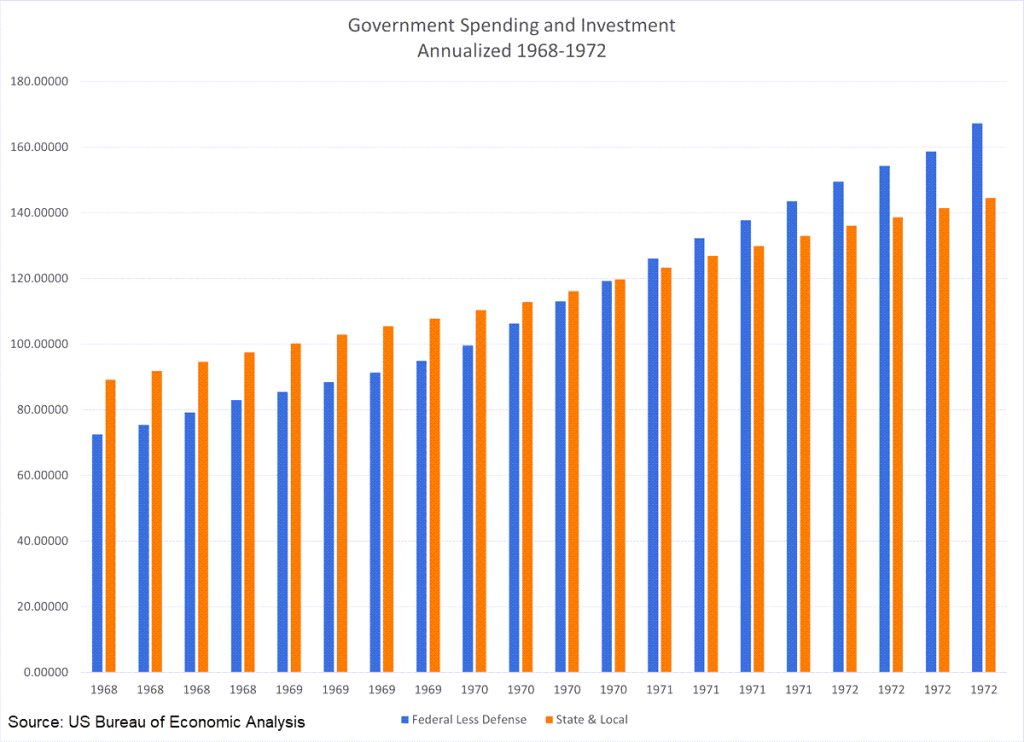
In his eager efforts to systematize and mathematize economic concepts, Samuelson sometimes introduced provocative simplifications. In two separate articles published in 1955, economists Stephen Enke and Julius Margolis gave examples of public goods that were rivalrous. A crowded public highway or school does lessen other people’s consumption. Charles Tiebout (1956) pointed out that one of Samuelson’s simplifying assumptions was that public goods were provided by one source, the federal government.  In 1954, state and local spending was actually twice that of federal spending, excluding national defense. In the chart below, the orange bars are state and local spending, which does include police protection. While it is a public expenditure, a police response to one incident means that they are not available for another call so the police are rivalrous.

A few years after the Johnson administration ushered in the social reforms collectively termed the Great Society in 1964-65, federal spending overtook state and local spending. These programs included Medicare, Medicaid and what were called Food Stamps and Welfare at the time. Today the spending roles are reversed. Without including spending on national defense, federal government spending and investment is almost twice that of state and local.

Samuelson pointed out that there is no market mechanism to price public goods. What is the appropriate price for defense, highways, schools and other public goods? Charles Tiebout (1956) argued that the price for these goods is determined in the voting booth by a public that desires to keep its taxes low. Voters will support those public goods which they consider valuable and will use. Tiebout predicted that voters would migrate to communities where they were among taxpayers who shared similar preferences for a particular set of public goods. If a couple had young children, they would vote for more school funding. Their children would get the benefit while the community as a whole bore the expense. People who liked to golf would favor communities with a like-minded interest who would vote for a public golf course. Tiebout wrote, “The greater the number of communities and the greater the variance among them, the closer the consumer will come to fully realizing his preference position.”

Writing in 1956, Tiebout’s prediction ran counter to the predominant social theory of the American melting pot – that people were becoming gradually harmonized into a single American monoculture. In 2008, Bill Bishop’s book The Big Sort confirmed Tiebout’s prediction. For decades, Americans had been sorting themselves into communities of like-minded preferences and values. Today, few would argue that we live in an increasingly differentiated society of insular interests and values. On social media, we establish community by voicing outrage at those others – what one of them said or did. We form interest clubs with a unique vocabulary, inside references, remarks and jokes that those outside the club don’t get because they don’t understand the context.

In spite of this cacophony of interests and values, there is a clamor for more public goods. More health care, more schools, more public spaces. How are we ever going to agree on the funding for these public goods? The successful ballot initiatives supporting public goods have a common characteristic. They spread the cost evenly by exacting a very small increase in a sales tax rate. People will vote for a public good if it will cost all households a small amount like $20 extra sales tax. This tax, known as a Tiebout equilibrium, acts more like a user fee than a tax.

Each year federal spending less national defense grows a bit more than state and local spending. If local voters cannot agree on spending priorities, this divide will get larger, throwing more of the spending burden on the federal purse and increasing the federal debt. Officials in local districts, frustrated by a lack of voter consensus, will increasingly look to Washington for school funding, children’s lunch programs, health care, public transportation, support of libraries and museums. Where does this end?

////////////////

As an aside, defense spending has a unique characteristic. Most government services increase as the population increases. It may not be in proportion but that is the general case. Increases in defense expenditures respond more to the perception of outside threats, not the size of the population. Here is a chart of per capita spending in nominal dollars, spending that has not been adjusted for inflation.

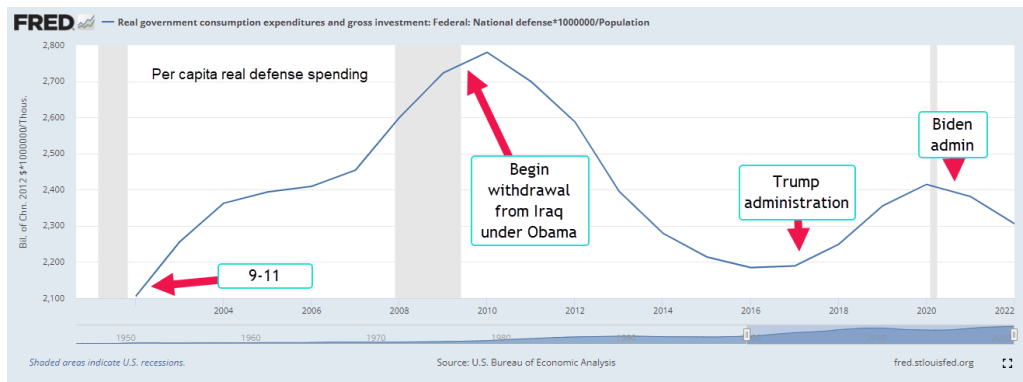
When spending is adjusted for inflation, it is clear that defense spending responds primarily to  perceived threats, not population growth.

After 9-11, real per capita spending on national defense increased by 33%, from $2100 to $2800 per person. In June 2009, President Obama began withdrawing troops to meet a campaign pledge. By the end of his second term in 2016, real per capita defense spending had returned to a level that existed before 9-11. Despite his isolationist rhetoric the Trump administration increased defense spending. This was largely due to pressure from a Republican Senate and House. In the less populous areas of the south, central and mountain west, more defense spending means more government jobs that promise stability and benefits. Republicans may preach small government but the communities they represent value government jobs and the economic benefits that ripples through local communities from military spending.

//////////// 

Photo by Amy-Leigh Barnard on Unsplash

Tiebout, C. M. (1956). A pure theory of local expenditures. Journal of Political Economy, 64(5), 416–424. https://doi.org/10.1086/257839