Holiday Snacks

November 24, 2019

by Steve Stofka

I’ll keep it short this holiday week and pass on a few things that caught my attention. The comedian John Oliver called it “whataboutism.” When accused of something, point to someone else and say, “What about them?” I thought the term was new, but Wikipedia says it goes back to 1960s Russia (Wikipedia, n.d.). I did it when I was a kid. My kids did it. In Russia, the practice is a national pastime.

In the impeachment hearings this week, several Republicans repeatedly defended their President of crimes by raising up the Steele dossier. Not familiar? There’s a book out by the two former Wall St. Journal reporters who formed Fusion GPS (NPR, 2019).  It’s the same argument Republicans gave to accusations regarding wiretapping at the Watergate complex.

Until the Supreme Court decided the 2000 election in Bush v. Gore, I thought the judiciary was above this. They were not. The decision was a rare one for the Supreme Court and it was careful to note that the decision set no precedents (Oyez, n.d.). A few months later, the stock market began its hard fall from the dot com boom, China was admitted into the World Trade Organization and later that year, the tragedy of 9-11. That election and the year 2001 marked the end of American innocence. By the time President Bush stumbled into the Iraq war, we were wearing the masks of our own folly.

Now Russia’s Putin smiles wryly as he watches the Americans behaving like Russians. When accused of something, point to someone else and say, “What about them?” Every week comes another revelation of secret visits to Ukraine by someone on the Trump squad. Devin Nunes, the ranking member on the House Intelligence Committee, has just been fingered by Lev Parnas, one of Mayor Giuliani’s indicted Ukrainian fixers. In a crowd of crooks, who knows what the truth is? Putin sees the arrogant Americans pointing fingers at each other and smiles.

Let’s move on to other news. County by county surveys reveal that half of single person senior households have trouble meeting basic expenses each month (Elder Index, 2019). Ouch. A quarter of two-person senior households have the same problem. I was even more surprised to learn that seniors can now live less expensively in Los Angeles than in Denver. Whether renting or having no mortgage payment, costs were higher in Denver. Another ouch. Denver has California-itis. Interested readers can check the web site in the notes below and compare counties of their choosing.

There’s got to be some good news in this week’s blog! Sales of existing homes climbed 4.6% in October. Hooray. On the other hand, less than a third of those sales were to first time buyers, who are getting left out of the market.

Ok. I’ll stop. Next week, I promise I’ll have some cheerier news.

/////////////////////////

Notes:

Elder Index. (2019). The Elder Index™ [Public Dataset]. Boston, MA: Gerontology Institute, University of Massachusetts Boston. Retrieved from ElderIndex.org

Haddad, T. (2019, November 23). After Giuliani ‘Fixer’ Alleges Nunes Met with Ukrainian Officials to Seek Biden Dirt, Congressman Threatens to Sue Media. Newsweek. [Web page]. Retrieved from https://www.newsweek.com/parnas-lawyers-nunes-ukraine-officials-meeting-lawsuit-1473679

NPR. (2019, November 22). Book Reviews: In ‘Crime In Progress,’ Fusion GPS Chiefs Tell The Inside Story Of The Steele Dossier. [Web page]. Retrieved from https://www.npr.org/2019/11/22/781589327/bosses-of-fusion-gps-tell-the-inside-story-of-the-steele-dossier

Oyez. (n.d.). Bush v. Gore. [Web page]. Retrieved from https://www.oyez.org/cases/2000/00-949

Photo by Steve Stofka

Wikipedia. (n.d.). Whataboutism. [Web page]. Retrieved from https://en.wikipedia.org/wiki/Whataboutism#Soviet_and_Russian_leaders_usage
Grandpa’s Index

May 26th, 2013

Last week I wrote about the various benefits, particularly Social Security, that are based on the Consumer Price Index and the discussions about alternative measures of increases in the cost of living.  The term “CPI” is a general term for a specific index, the CPI-U, a widely used index of prices for urban (hence, the “U”) consumers that the Bureau of Labor Statistics compiles.

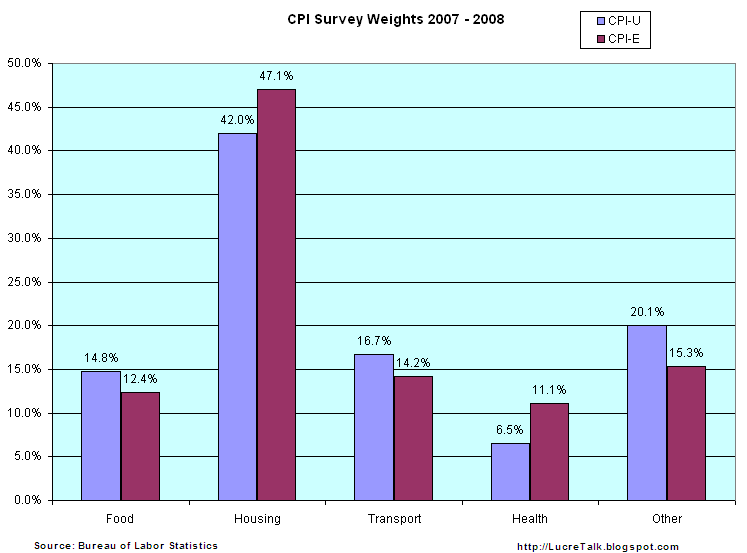
Today I’ll look at an alternative measure, the CPI-E, or Elderly index, which weights the expenditures of elderly consumers differently.  Since the sample size of this population is relatively small, the BLS warns that it is more prone to sampling error, i.e. that the sample may not accurately reflect the characteristics of the entire elderly population.  For the past decade or so, seniors have argued for cost of living increases in Social Security payments to be based on such an alternative measure.  Using the latest BLS survey comparison data, I constructed a chart to show the differences in weighting of the larger components of the CPI-U, the commonly used index, and the CPI-E, the Elderly index.

Housing and medical expenses are weighted significantly higher in the Elderly index.  A survey by the Employee Benefit Research Institute (EBRI) found that over 80% of 65 year olds own their own home.  The mortgage component of total housing costs stays relatively steady for the younger group of elderly, yet the CPI-E that the BLS compiles shows a 4% increase in this component.  The EBRI survey found that homeownership declines rapidly after 75, and it is this older group of the Elderly for whom housing costs rise.  The question is whether the CPI-E can be properly sampled and compiled to show a more accurate picture of costs for the elderly.

The medical component of the elderly index is almost twice that of the general urban population.  Although seniors have access to the subsidized Medicare program, the premiums for Medicare and costs not covered by Medicare are now borne by the elderly, rather than being fully or partially supplied as part of an employee benefit package.  In addition, people access more medical care as they age.  The combination of these two factors make it feasible that medical costs would be significantly higher for seniors.

Inaccuracies in measuring the housing component of the elderly index will be brushed aside by seniors receiving SS benefits.  Whatever measure increases benefits – well, that’s the most accurate one, of course.

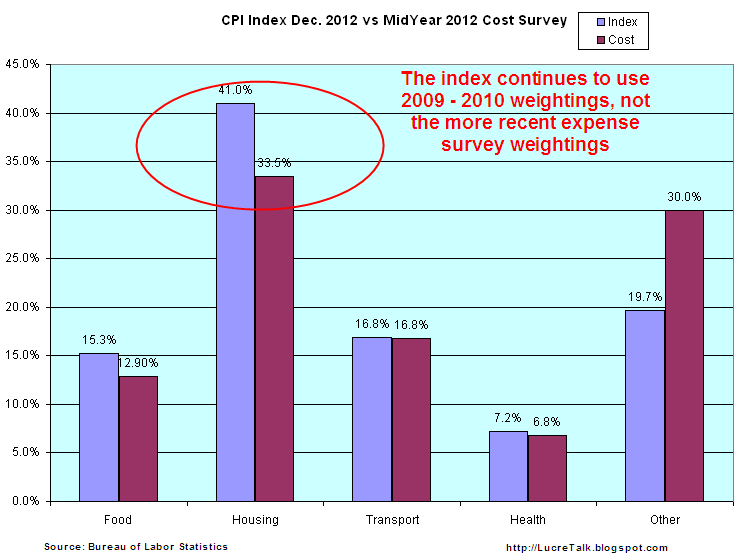
An interesting note is the change in recent years of housing costs as surveyed by the BLS.  In 2007-2008, housing was 42% of total expenses.  After the housing and financial crises, that component had dropped to about a third of total expenses. (Source)

But the December 2012 CPI-U index does not reflect the results of more recent findings of BLS personal expense surveys because they are using 2009 -2010 weightings. (Data)

The largest part of the discrepancy between the actual changes in cost of living expenses and the published index is probably the “Owners Equivalent Rent” portion of housing costs which don’t reflect actual costs at all.  Instead they are a calculation of what a home owner would have to pay herself to rent her own home from herself.  No doubt, BLS economists would defend this phantom calculation as accurate but this calculation was never designed to allow for the precipitous drop in housing prices that we have experienced in the past few years.

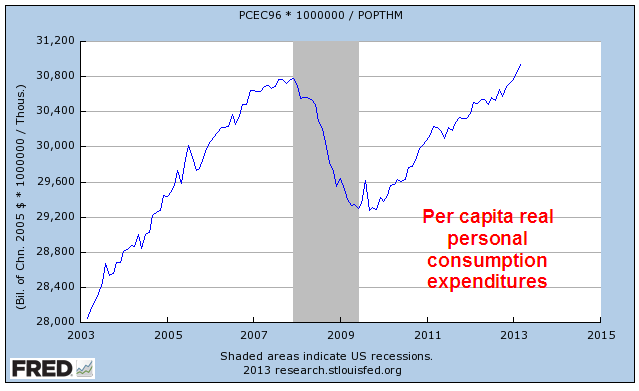
Based on BLS surveys of actual, not the adjusted, cost of housing changes, there is a good case to be made that the economy is experiencing a continuing mild deflation, not mild inflation. Deflation has become an ugly word. Social Security payments, labor contracts and a host of benefits are tied to the CPI and rely on the cost of living to increase, not decrease.  Lawmakers in Washington have, in fact, mandated that Social Security payments can not decline if the CPI turns negative.  Deflation is reviled almost as much as too much inflation.  The Federal Reserve has a target of 2% inflation, meaning that it should start pulling money out of the economy if inflation rises above 2%.  On the other hand, the Federal Reserve should be pumping money like there’s a five alarm fire if inflation has turned negative.  Has the Fed been pumping money?  Yes.  Ben Bernanke, Chairman of the Fed, prefers to look at Real Personal Consumption Expenditures.  Per capita expenditures have just now risen above 2007 levels.

While some inflation watchers are shouting “The sky is falling” as the Fed continues to pump money into the economy, Mr. Bernanke is looking at the big picture and its tepid.  Tepid means fragile.  Here’s the big pic of the last 15 years or so.

Growth has moderated.  Bernanke has to be worried that low interest rates and continued purchases of mortgage securities by the Fed is helping inflate a stock bubble but he is equally concerned at the slower growth of the economy.  Despite the headline CPI numbers of below 2% inflation, the reality is that it may be closer to 0% than the headline index indicates.

What’s behind that slower growth of spending?  Look no further than something I write about each month, the lack of growth in the core work force, those aged 25 – 54.  These are the people who buy stuff and if a smaller percentage of them are working, then they buy less stuff.  Less stuff buying reduces inflationary pressures.

Mortgage Mirage

In a 4/14/09 WSJ article, Ellen Schultz recounts several heartbreaking tales of seniors losing their homes. Many lived on meager fixed incomes. Some had paid off their mortgages before unscrupulous mortgage brokers presented them with a “solution” to cope with higher medical expenses, taxes and other living expenses.

The American Bar Association puts out a free booklet of legal advice for families. In Chapter 9
they present some sage cautions regarding contracts:
“Fill in all the blanks! A contract with your original signature but containing blank spaces can be like a blank check if altered unscrupulously.” Some homeowners in the above article were bitten by this scam.

A homeowner taking out a mortgage whose payments escalate at a later date may not examine the contract closely after signing it, when the payments are affordable. A closer scrutiny at a later date may be too late.

“A contract produced by fraud is not automatically void. People who are victimized by fraud have the option of asking a court to declare that contract void, or to reform (rewrite) it. On the other hand, if they went along with the contract for a substantial period of time, they could lose their right to get out of it. This is called ratification, and is based on the idea that they have, by their actions, made it clear that they are able to live with the terms.”

“A contract can be canceled by a court because of fraud when one person knowingly made a material misrepresentation that the other person reasonably relied on and that disadvantaged that other person. A material misrepresentation is an important untruth. In many states, it doesn’t have to be made on purpose to make the contract voidable.”

Even if you know you were lied to, can you prove fraud? “Fraud requires an outright lie, or a substantial failure to state a material fact about an important part of the contract.” “Actual fraud that will invalidate a contract is a lot less common than people think.”

A well worn phrase may be more than just a rule of thumb but a legal precedent. “‘Caveat emptor’–‘let the buyer beware’–is a strict rule placing the risk in a transaction with the buyer.”

If all else fails, you may still have a chance of some legal remedy. “Courts have a powerful weapon called unconscionability . . at their disposal. Unconscionability means that the bargaining process or the contract’s provisions ‘shock the conscience of the court.'” However, “the courts are reluctant to use this weapon, but consumers have a better chance with it than anyone else.”

In handling my elderly parents’ affairs the past two years, I was surprised at the amount of mail solicitation they received that was targeted specifically to retired people. These included a variety of fixed income solutions from annuities to reverse mortgages. Some were legitimate, some smelled fishy. There were investment opportunities of many forms – in real estate, in stocks and bonds, in gold and other commodities. There were many offers for supplemental medical insurance.

The majority played on two real fears that older people have: what if I run out of money, and what if something bad happens? The marketing departments at companies large and small know these fears and cast their mail campaigns like large trawler nets. It’s up to us to be smart little fishies.