Spending and Revenue

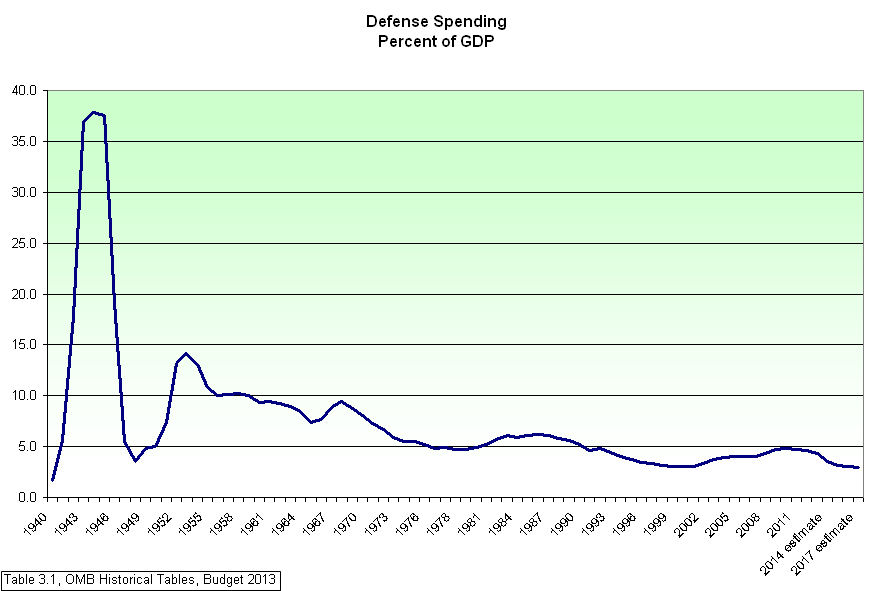
This Labor Day weekend is the eye in the storm of the Republican and Democratic conventions.  As we listen to all the rhetoric and half-truths (at best) coming out of both conventions, it might be best to take a long term view of government spending.  The two biggest components of federal spending are defense and what is called human resource spending, which includes federal Education and Training Programs, Medicare, Medicaid, Social Security, various social safety net programs and veterans’s benefits (functions 500 – 700 described here ).  Data is from the Office of Management and Budget (Source), Table 3.1, Outlays by Function and Super-function.

The 70 year average (1940 – 2011) of total government spending is 20.6% of GDP.  The 30 year average from 1981 to 2011 is 21.2%.  During the Obama administration, spending has increased to 24.1% of GDP.  Each 1% of GDP is about $150 billion at current levels of GDP. (Click to enlarge in separate tab)

Defense spending has doubled in the past decade.

This spending figure includes only active defense spending.  Outlays for Veterans benefits, education and job training for vets are included under the Human Resources superfunction.  Housing benefits for veterans are included under another superfunction, Physical Resources.  The total outlay is estimated at over a trillion dollars and that figure has been acknowledged by Senator John McCain, a long time supporter of strong defense spending.

As a percent of GDP, however, active defense spending has remained below 5%. Putting this increase in spending in historical perspective puts the lie to the contention by some liberals that our budget problems are mostly due to defense spending.
Human Resource spending includes Social Security payments, which comes out of current taxes and a trust fund surplus of $2.7 trillion (Source).  Since most Social Security payments come out of a tax that has been dedicated to those payments, I have deducted them from total Human Resource spending to get a more accurate picture of the trend in spending on the social safety net. 

When financial conservatives on both sides of the aisle warn of this upward trend, this is what they are talking about.

What too many Republicans won’t acknowledge is that we have had and continue to have a severe revenue problem.
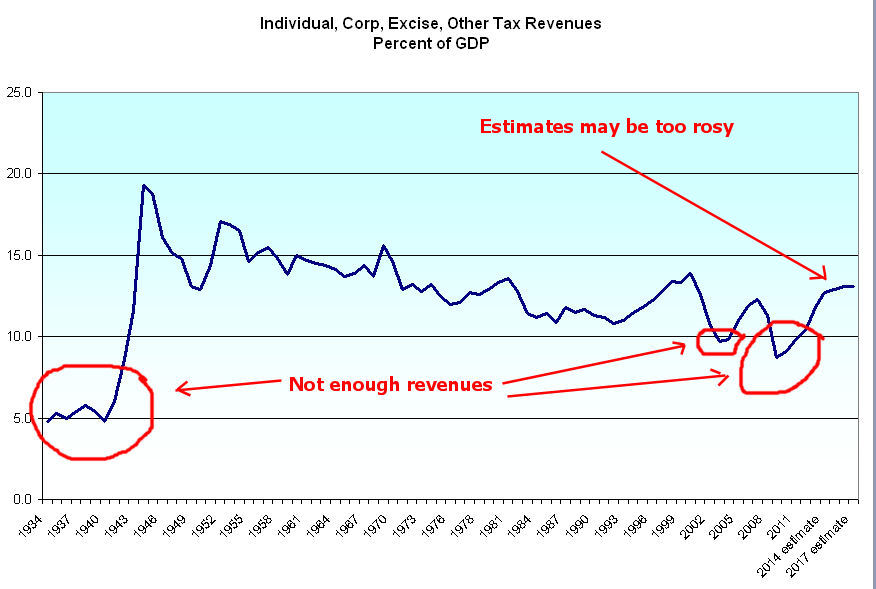
Since I listen to and read a lot of “conservative” media each day, I repeatedly hear the mantra that Reagan lowered tax rates and revenues increased.  This is the justification for pushing for continued tax cuts. Reagan and a Democratic Congress lowered tax rates.  The president signs bills that are passed by the Congress.  This is not a one man show.  Total revenues, including Social Security and Medicare taxes, did increase because Social Security taxes were increased 12% during the Reagan years (Source).  When we look at tax revenues without Social Security taxes, revenues as a percent of GDP fell, just as anyone would expect when tax rates are reduced.  Since WW2, tax rates have been gradually reduced, and, as expected, tax revenues as a percentage of the economy have fallen.  There is no magic formula here.  Lower tax rates = lower revenue.

In this ongoing battle of ideologies, there are three real issues.  Should we spend more than 5% of GDP on active defense spending?  Should we spend more than 10% of GDP on social safety programs (excluding Social Security)?  Can we expect to ever live within our means if we collect only 10% of GDP in income and excise taxes?  We can not do all three.
Social Security COLA

Many seniors receiving Social Security pay attention to the Consumer Price Index (CPI) once a year in November when the Social Security Administration (SSA) sends its annual notice of the cost of living adjustment (COLA) for the next calendar year. Although Social Security payments are set for a calendar year, the adjustment is based on the change in the CPI during the Federal Government’s fiscal year, which runs from October thru September.  On October 19th, the Bureau of Labor Statistics (BLS) will announce their monthly CPI figure for September, effectively giving Federal agencies their annual COLA figure.

Following this announcement from the BLS, the SSA will start drafting their notices, which they will send out in November.  Based on previous CPI data from the BLS and a seat of the pants estimate for September, I would guess that the COLA adjustment will be about 4.1%, an increase of $50 a month for the someone who receives an average monthly benefit of $1200.

What is good for seniors is not so good for Federal budget makers.  In August of this year, SSA paid out almost $60 billion in Social Security benefits to 55 million beneficiaries.  Multiply that monthly figure by 12 to get an annual payout of about $720 billion, or about 20% of the total amount of money the Federal government will pay out this year.  Now add a 4.1% COLA, which is about $30 billion extra that will need to be paid out next year.  Social Security taxes collected will just about cover the payments, leaving nothing extra for the Federal government to “borrow” from the Social Security trust funds.

Defense spending, including benefits, medical care and job training for retired vets totals more than a $1 trillion, or almost a third of the total federal budget, far more than the 25% spent during the years of the Reagan administration.  In a speech this past week at the Citadel, a military academy,  Mitt Romney, the leading Republican presidential contender, announced that, if elected in 2012, he would expand military spending even more than current levels.  How will he pay for this further build up?  If there is a Republican congress, there won’t be any tax increases.  That leaves only two alternatives:  drastically increase the federal debt more than Bush and Obama have already done, or get the money where he and the Republican congress can get it from – Social Security beneficiaries.  The bond market won’t let Romney run up too much more debt so that leaves only one alternative – reduce benefits to seniors.  Unlike younger people, seniors vote so the plan will be along the lines that Eric Cantor, the House Majority Leader, proposed this past year: keep benefits the same for those already retired and soon to retire and reduce future benefits for those 55 and younger.  That will be the starting place.  Next will come an adjustment to the calculation of the COLA.  As you can see above, a reduction in the annual Social Security COLA may be the weekly food cost for a thrifty retiree but means billions of dollars in money to the Federal government – billions that Romney can spend with defense companies.

Voters have two choices:  Get angry before the politicians screw us when we have some chance to change the outcome, or get angry after they screw us. 

Tidbits

This week is a “tidbit dump” of information that I thought was interesting.

– Local governments, municipal and county, employ 14.2M people, about 10% of the workforce.  Local government employs more people than the entire manufacturing sector does.  Less than half of the population of the U.S. works.

– The National Ass’n of Realtors offers assessments of local real estate markets, including employment, occupation mix, mortgage defaults.  Current reports are available by subscription but recent reports are free.

Federal and state governments have large pension and employee costs that are tied to the CPI or inflation rate.  Social Security payments rise with the CPI.  Federal, State and local government employees receive annual cost of living adjustments (COLA) to their pay that is based on the CPI.  The amounts of money involved are staggering.  Retirement benefits will total about $500B this year.  A 1% increase in the CPI is an additional $5B paid under this program alone.

– Doug Short is a retired IT consultant whose web site contains various commentaries on markets and personal economics.  Here is a historical overview and explanation of the Consumer Price Index.  It includes a decade long chart of the percentage rise of the various components of the CPI.  The rather steady rise of the food component over the past 10 years contradicts the Federal Reserve’s assertion that food is a volatile component.  The Fed leaves this supposedly volatile component out of it’s calculation of “core CPI” to get what the Fed considers a more accurate assessment of inflation pressures.  This methodology understates inflation, in my opinion, and contributes to the poor monetary policy that the Fed has adopted in the past 15 years.

– In an interview with former President Bill Clinton after the shooting of Congressperson Gabrielle Giffords :
These words[political invective] fall on the serious and delirious alike, they fall on both those who are connected and unhinged.

– Each year U.S. national parks receive as many visitors as the population of the U.S.

– Should a person nearing retirement take an early Social Security payout or wait? Steve Vernon with CBS Money Watch examines the pros and cons in this article.  The reader comments are as interesting as the article.

Pensions

The Adam Smith Institute Blog at the Christian Science Monitor carried a financial story about pensions in Hungary that had several misconceptions.  The Christian Science Monitor, while noted for its reporting in other areas, is not a financial publication.  The Washington Examiner then linked to this blog and it went around the internet as a case of “European countries taking private pensions”.  If this were the case, I knew I would find the story as a prominent feature in the Financial Times, the leading source of financial news in Europe, or in the Wall St. Journal, the leading source of financial news on this side of the Atlantic.  If this were true, then this is pretty big news to the bond market. 

At a Wall St. Journal blog, a reporter gave a more complete description of the transition which Hungary is planning.  Here is an excerpt. Emphasis added by me.

Hungarians will have until Jan. 31, 2011, to decide whether they opt to return fully to the state’s pay-as-you-go pension regime. Only the private pension fund members who wish to remain in their respective pension funds will need to express their wish. Those who don’t do that will automatically return to the state scheme.

“They have two options: they either stay or decide to return, [and] both decisions have their consequences,” [Economy Minister Gyorgy] Matolcsy said at a press conference in parliament after a government meeting.

The assets of those who decide to return to the state scheme will be kept in individual accounts and will remain inheritable by the spouse, Mr. Matolcsy said.

Hungary has a hybrid social security scheme similar to what George Bush proposed about 6 years ago.  Designed to encourage people to save for retirement, some of each person’s social security taxes could be invested in private pension funds.  The private pension fund is supposed to generate a return that will provide 30% of a retirees pension payment (Social Security check, in the U.S.) and Hungary supplies 70% of the pension payment.  Here’s the kernel of this story:  Hungary had promised to make up or “top off” a retiree’s pension, i.e. pay more than 70%, if the retirees private plan had not made the returns necessary to supply 30% of the full scheduled monthly pension payment the retiree was due.  Hungary can no longer promise to “top up” pension payments above the 70%.  What happened? 

Hungary has a large debt load.  It can borrow private pension money that a retiree chooses to turn over to the state at a net effective rate that is less than the bond market charges for Hungary’s debt.  The U.S. government borrows Social Security money at about 3 – 4%, a rate less than what the bond market usually (except for the past few years) charges the U.S. for its medium to long term debt.

Secondly, people close to or in retirement in Hungary took on more risk than they should have.  Many private pension funds lost value during the past two years and could not meet the 30% portion of the scheduled pension payment.  In a difficult economic environment, Hungary found itself “topping up” more and more private pensions. 

According to the Financial Times, France and Ireland are shifting state pension assets away from stocks and into government debt and cash.  Estonia, a prudently managed nation with no debt, has even considered reducing state contributions to private pension plans.

The question for developed countries with hybrid pension, or Social Security, schemes is how to design a system that encourages people to save for retirement but encourages prudent financial management.  If I were a Hungarian citizen and my government said they would make up any shortfall in the returns of my private pension funds, I would have rolled the dice and invested in riskier stocks that would hopefully generate big returns for me.  How could I lose when the government has promised they would make up the difference?  Then, whoops, the financial crisis hit and Hungary found that their hybrid pension system had inadvertently rewarded risky behavior. 

If I were a Hungarian citizen nearing or in retirement, I would be angry, of course.  The government had promised me that I could have my cake and eat it too and I like fairy tales and vote for the politicians who tell those tall tales.

Social Security Myths

Previously, I took a closer look at the conservative “myth” that reducing tax rates raises tax revenue. This week I’ll look at a fiction frequently trotted out by those on the left: the rich get off easy on their contributions to Social Security.

A recent example is a Senate hearing (32 minutes into the tape) in which Tom Harkin, the Democratic Senator from Iowa, states that, because of the $106K cap on earnings subject to the Social Security tax, people making $400K paying Social Security tax on 25c out of every dollar while most people in this country pay Social Security tax on every dollar they make. This is true. But what Senator Harkin neglects to mention is that Social Security benefits are also capped.

Let’s look at 3 examples: Joe, making the median annual earnings of $40K; Sally, earning $100K and in the top 5% of earners; and Marilyn, making $150K. Each of them was born in 1950 and will retire at their full retirement age in 2016.

Using the Social Security Administration’s (SSA) benefits calculator , Joe will get a full retirement monthly benefit of $1184 when he retires. Using the default growth rates of income, the SSA estimates Joe’s lifetime income at $848K. Sally will get a monthly benefit of $2100 on estimated lifetime earnings of $2,119K. Sally has contributed 250% more than Joe but will receive less than double the benefit. Marilyn will receive a monthly benefit of $2434 based on a lifetime earnings estimate of $2,623K, triple Joe’s earnings.  Because of the social security contributions cap (currently about $106K), Marilyn has not contributed three times what Joe has contributed, but she has still contributed more than 2.5 times what Joe has contributed.  However, Marilyn gets only double the benefit that Joe receives.

In short, Social Security is both a safety net and an income redistribution scheme. An American Institute of CPAs (AICPA) report notes that Social Security was originally designed as a prepaid pension plan so that benefits received were dependent on contributions made by each person. That original design was amended a few years later to turn Social Security into a “pay-as-you-go” system where retiree benefits were paid for by the taxes of current workers. Although benefits were indexed to contributions, those who earned less received far more benefits in proportion to their contributions. Social Security thus became a hybrid income redistribution scheme for retirees. You can read a colorful history of pensions at the SSA web site.

Few conservative or liberal politicians readily acknowledge the income redistribution aspect of Social Security. The program has been “sold” to taxpayers as though it was an insurance product, similar to an annuity policy that anyone can buy from an insurance company. The only difference is that the federal government is the insurance company. Regardless of what one feels about the income redistribution part of Social Security, it has reduced “the poverty rate among the elderly from 35% in 1959 to 10% in 2003, the lowest of any adult group.” (Source) A recent report by the Census Bureau shows that poverty rates for seniors are 2/3 to 3/4 that of adults in general. Have we gone a bit too far in helping seniors? Poverty rates for children are at a shocking 20% plus, but few politicans dare to propose reducing benefits for the elderly to help children. Seniors vote. Children don’t. Because seniors have been convinced that Social Security is like an annuity insurance program, many seniors balk at any reduction in benefits. They are convinced that they paid in full measure for the benefits they receive.

As the examples above show, both Marilyn and Sally pay a portion of Joe’s benefits. Yet Joe probably thinks that he has earned every penny of his benefits because he “paid into the system.” This misconception is likely to make changes to Social Security benefits extremely difficult. Those who are well off know that they contribute far more into the system than they receive. Those who are less well off will prefer to “soak the rich” even more rather than give up benefit increases.

For those of you who like wrestling, you may be able to see in coming years the (cue up the loud music) “Social Security Smackdown” on a cable channel.

Social Security Returns

Here’s a toast to all the suckers out there, you and me.  Our government “borrows” the social security payments we make during a lifetime and promises to pay the money back with interest.  A thirty year old loans the government money for 30+ years at an average interest rate of 3%, at which time the government starts paying the money back in the form of monthly Social Security checks.

Here’s the sucker part.  The U.S. Treasury also sells 30 year bonds to banks, other governments and financial institutions.  The historical data for the 30 year bond shows that while interest rates are extremely low now, since 1977 the Treasury has paid an average of 7.54% to borrow money using these bonds.  For the slightly younger set, the average has been 5.93% since 1990. Social Security has become a way for our government to cheaply borrow money from us at interest rates far below market.

Advocates for the current system of Social Security cite the 2008 financial crisis and stock market drop as a rallying cry against any privatization of Social Security.  “Can you imagine what would have happened to our retirement funds if we had privatized Social Security?”, they ask.  For those nearing retirement, the 3% we have been earning on our Social Security taxes is 40% of what our government has paid out to banks and other governments to borrow money for this long a period.  As you can see, we have already taken a 60% hit to our retirement funds because it is built into the Social Security system.  If our government borrowed money from us at market rates, monthly social security checks would be more than double what they are now.  Hey sucker, this is why most high schools only offer a semester or two in economics.  Keep the suckers stupid. 

Revenue Sources

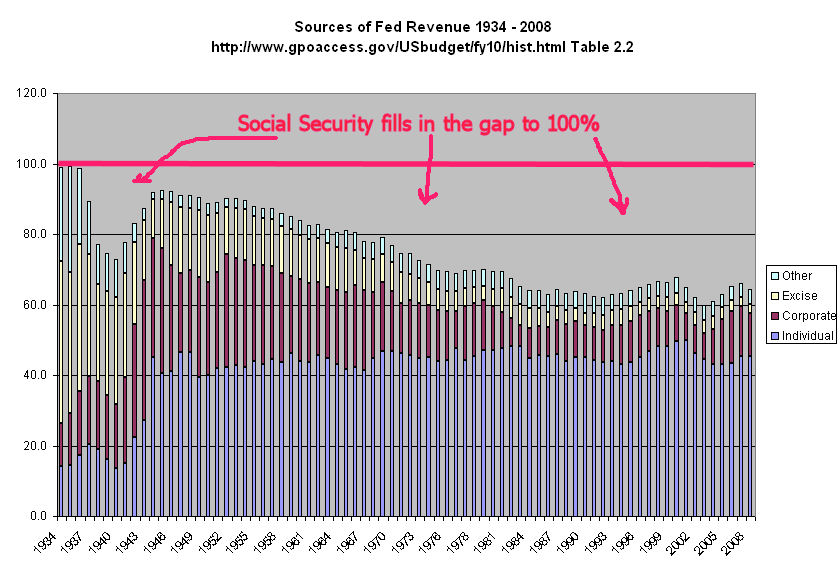
Continuing my study of the shell game that our elected representatives are playing, today we’ll look at the revenue sources of the federal government minus Social Security taxes. (Click image to enlarge)

During the Nixon era in the late sixties and early seventies, excise and other taxes decreased.  As inflation ran rampant during the seventies, taxes on individuals made an increasing contribution to the federal pot.  As a share of the pot, corporate taxes decreased so that in the last three decades, individual taxes and Social Security and Medicare taxes on individuals made up about 3/4 of federal revenue.

As I have noted before, this country practically invites imports.  We have the lowest import duties of any developed country yet we scratch our heads and wonder why our trade balance is so far in the red, why we have a deficit, and where have the jobs gone?

Some will say that government needs to get leaner but most large organizations, both private and public, do not run lean.  Any of us who have worked for a large corporation can attest to that fact.  We can continue to campaign for leaner government but the fact is that the federal government is not raising enough money.  Like a giant Ponzi scheme, our elected representatives have been collecting Social Security taxes and treating the excess taxes as “income”.

In this coming decade, the boomers will start asking for their Social Security pensions.  The largest influx of retirees won’t occur for another 10 years and the demand for Social Security pensions will overwhelm the receipts collected sometime in the middle of the 2020s.

Just as Bernie Madoff swindled most of his investors by not investing the money entrusted to him,  politicians will be in the uncomfortable position of admitting that they spent rather than invested the Social Security excess taxes and there aren’t enough new taxpayers to get the money from.

It’s going to be a bloody battle then – not as bloody as a battle scene in the movie “Braveheart” but you get the idea.  Retired people get the majority of their income from Social Security.  Inevitably, politicians will have to find some way to tell boomers that their pension payments are going to be reduced.  The coming furor will make a Tea Party rally look rather sedate.

Social Security Privatization

Slowly, very slowly, I am going through a file box with articles that I clipped from ten years ago.  As the debate renews – or continues – about the privatization of Social Security, we can learn from the past. 

In 1998, there was a loud call for the privatization of Social Security, whose return on the contributions we make is about 3%.  In 1998 the stock market was continuing its historic rise due to increases in productivity, output, and employment.  The dot com and financing boom of the “New Economy” was growing in strength and returns in the stock market were above 17% per year.  Comparing that 17% return to the paltry 3% return on Social Security contributions – well, there was no comparison.

Twelve years and a “lost decade” of stock market returns later, the safe 3% return on SS contributions doesn’t look as bad as it did in the heyday of the late nineties.  In 1998, Dean Baker wrote an Atlantic Monthly article examining the myths about Social Security and the arguments for privatization.  The article is online and it’s worth a revisit.

Tidbits

A few tidbits of info sitting around on my desk:

WSJ tidbit 12/31/09 – Families USA reports that Cobra family coverage averages 83% of the average unemployment insurance check, up from 61% in 2001. The stimulus bill provides a subsidy to unemployed individuals averaging $325 a month, $715 for families.

According to a Congressional Research report – after dropping dramatically from 1950 to 1980, death from diabetes has increased to above the levels of 1950, a 33% increase from mortality rates in 1980. Unintentional injuries, including automobile accidents, has dropped by half from 1950. Cancer rates are about the same as 1950. Death from heart disease are at 40% of 1950 levels. (pg 4)

Many of us do not like government interference and mandates, yet we see the results of several decades of seat belt and product safety laws.
Despite all the money invested in cancer research over the past fifty years, the rates have not improved. Of course, more people are living longer, naturally driving up the cancer incidence rate, which disproportionately afflicts older people.
Despite the dislike that some people have for “Big Pharma”, it is thanks to the pharmaceutical industry that heart disease has become a manageable problem for many older Americans.
While many like to blame the soft drink and fast food industry for the increase in diabetes, no one is forcing anyone to drink and eat sugar laden foods. Of course, it is easier to blame the big food companies than take personal responsibility for one’s food choices.

On Oct. 16, 2009, the Bureau of Labor Statistics reported that the median (not average) weekly earnings of the nation’s 100.1 million full-time wage and salary workers was $738 in the third quarter of 2009. This was 2.5 percent higher than a year earlier. The Consumer Price Index for All Urban Consumers (CPI-U) fell by 1.6 percent over the same period.

Social Security income accounts for about 40% of retirement income.

A retired person spends, on average, about 80% of what they spent before retirement.

WSJ tidbit 12/28/09 – The Institute for Justice cites that 50 years ago, 3% of American workers were regulated or licensed by government agencies. It is 35% today.

Food, energy, housing and health care consume the same share of American spending today (55%) that they did in 1960 (53%).

Revolving credit, primarily credit cards, declined at a steep 18.5% annual rate last year.

Smaller businesses are a dying breed in the U.S. Companies with less than 250 workers comprise 70% of the private-sector work force in the European Union, compared with 49% in the U.S., according to EU figures.

In 2009, 804 companies cut dividends, up sharply from 110 two years earlier and the highest level since S&P started to collect such data in 1955. Conversely, the number of dividend increases dropped 36.4% to a record low.

More than 6% of commercial-mortgage borrowers in the U.S. have fallen behind in their payments, a sign of potential troubles ahead as nearly $40 billion of commercial-mortgage-backed bonds come due this year. Moody’s reported a 4.9% actual delinquency rate. It is projected to go above 8% by the end of 2010.

The Mortgage Bankers Association reported that almost 6.2% of mortgages in Arizona and 9.4% of mortgages in Nevada were in foreclosure by the end of the third quarter of 2009. In California, 5.8% of mortgages are in foreclosure and personal bankruptcy filings rose almost 60% last year.

Future Fun Facts

In 1950, life expectancy at birth was about 67 years. In 2003, it was 80 years. That dramatic increase in life expectancy over a span of 50 years is less dramatic when we look at a comparison of life expectancy for a 65 year old. During that same 50 years, it had gone up only 3 years, from almost 78 years of age to 81 years of age.

Although less impressive in years, those three extra years of life equals 36 additional months of collecting Social Security and that’s one problem: old people getting older and continuing to collect Social Security.

The way to fix that problem is to have more workers contributing to Social Security. That’s the second problem. Not enough young people and we can blame parents for that. People are just having fewer kids, leaving fewer workers to pay for the old people continuing to collect Social Security.

How to fix that problem? Immigration. Relaxed immigration standards will allow more workers to come into the country and contribute to Social Security. That’s the third problem. Immigrants may require more social services than what they contribute in taxes and Social Security and eventually those immigrants will get old and start collecting Social Security themselves.

A 2006 Congressional Research Service (CRS) report projected that, by 2075, an average life expectancy for a 65 year old to be about 86.5 years of age. That’s an additional 66 months of Social Security payments.

The solutions to the relentless march of these demographic numbers are politically unpalatable so we can expect that our elected representatives will do everything else before finally adopting them.

First, expect retirement ages to increase. Older workers will not like that. Second, expect the Social Security contribution rate to increase. Workers of all ages will not like that. To avoid their anger, politicians will “soak the rich” by increasing the amount of income that is subject to Social Security tax. Those in the upper income brackets get far less in return for what they contribute and they can expect to pay more and get less. Third, expect Social Security payments to decrease or to increase at a slower rate. Retired people vote and they will not like that.

These are the fun facts of the future. Maybe the “Future Fairy” will take away these problems and leave us a quarter.