A Debate on Vulnerability

This is eighth in a series of debates on various issues. The debates are voiced by Abel, a Wilsonian with a faith that government can ameliorate social and economic injustices to improve society’s  welfare, and Cain, who believes that individual autonomy, the free market and the price system promote the greatest good.

Hope everyone enjoyed their holidays.

Abel began the conversation. “Last week neither of us were happy with the present structure of our government. I thought we could discuss a more fundamental issue, the duty of a government and the duties of its citizens.”

Cain nodded. “At  the Constitutional Convention in 1787, the founding fathers fought bitterly about the duties of a federal government. Over two hundred years later, I don’t think we have come any closer to an agreement on this point.”

Abel said, “The scope of the federal government’s duties have expanded since Roosevelt and the Great Depression.”

Cain argued, “For decades, our group has been fighting that expansion. We have compassion for the vulnerable but caring for them is a proper function of state governments.”

Abel shook his head. “The Jim Crow era and the Depression taught us that state governments may be unwilling or unable to help the vulnerable. During the hundred years after the Civil War, southern states lacked any compassion for their black residents. During the Depression, the ranks of the vulnerable increased beyond the capacity of state governments. FDR and the Democrats recognized that and instituted job and relief programs to lessen the suffering and reassert some moral order.”

Cain replied, “It is still not clear that most of those programs did much good. The economy continued to flounder until this country entered World War 2. The federal government may be able to borrow the resources for relief programs, but Congress and the President try to design a one-size-fits-all solution. Only the states can design programs that are suited to the population, resources and economy of each state. Texas and New York have entirely different resources, cultures and economy.”

Abel argued, “But that variety produces a fragmented policy response. State representatives are easily influenced by well-funded interest groups and dominant voting constituencies that want to bend the rules in their favor. Minority populations can become severely disadvantaged.”

Cain argued, “Because of that fragmentation, it can be costly for interest groups and lobbyists to fund a campaign that encompasses more than a few states. Instead, they consolidate their resources in Washington where they hope to effect a centralized policy. Centralized policymaking promotes more lobbying. As the saying goes, ‘The road to ruin is paved with good intentions.’”

Abel insisted, “Your group prefers a more federalist, splintered approach to policymaking. Historically, that has led to unequal treatment of the citizens who live in a state. That abuse violates the 14th Amendment as well as the principles of equality established in the Declaration of Independence.”

Cain nodded grudgingly. “Yes, there have been instances of abuse. Your group has used that unfortunate history to promote your vision of the federal government as the protector-in-chief of people’s welfare, animals, plants, the air and water. Social welfare programs embody the sentiment ‘From each according to his ability, to each according to his needs.’”

Abel shook his head. “That overstates our group’s position. We value compassion for the vulnerable, many of whom are victims of circumstance, heritage, and the bad luck of being a minority, a historically disfavored group to policymakers.”

Cain argued, “You absolve them of all responsibility for their choices.”

Abel insisted, “Their history as political pariahs and poor economic circumstances influence those choices. Our society bears a heavy burden there. Our group recognizes that.”

Cain said, “You want people to pay for policy mistakes a century or more old. You believe that white people are born with an original sin, guilty of the racist policies of bygone generations. Our group rejects that belief.”

Abel’s tone was more forceful. “Evidence illegally obtained is inadmissible in court. Evidence derived from that evidence is also inadmissible. That is the Fruit of the Poisonous Tree legal doctrine. Riches and advantages derived from property illegally obtained is tainted, yet many of us blithely reject responsibility. How many white people say, ‘Well, I did not steal my advantages or property. I was not yet born when some of these abuses were done. I bear no burden because I belong to a dominant racial, ethnic or cultural group.’”

Cain paused. “Ok, let me ask you. When is the debt paid? If there is a debt, it is finite, so when will it be paid? How much will have to be paid? Who will be assessed for that debt? If a person is 2% white, are they 2% responsible for the debt? Some racist policies were based on that same kind of thinking. A person of ‘mixed blood’ was treated as black and denied a loan or was excluded from buying a house in a certain area. We don’t want to repeat the sins of our fathers, so to speak, in making restitution for the sins of our fathers. The past is past. Let’s move forward.”

Abel argued. “It is not a debt. It is a duty to help the vulnerable, and those who have been wronged. Don’t you see? Some people move forward more slowly because they are weighed down by the policy sins of past generations.”

Cain scoffed, “We may recognize a moral, but not legal, duty to help the vulnerable. The parable of the Good Samaritan comes to mind. Should we legalize that duty and have the government enforce a charitable spirit on everyone? No. As to the abuses of the past, should the federal government give American Indians a lot of land back? Shall we have the National Guard evict a lot of American homeowners? No! The past is past. The Age of Conquest is over. We move forward.”

Abel said, “We can preserve areas like Bears Ears National Monument that is sacred land to an Indian tribe. We can enjoy it in its pristine beauty instead of drilling holes in the ground and installing bobbing black oil pumps.”

Cain shook his head. “Bears Ears is an example of a President overstepping his Constitutional bounds. Resources contained within a state are managed by the state unless Congress mandates otherwise. Congress, not the President. Congress passed a law that designated Yellowstone a National Park. President Grant signed the law that Congress passed.”

Abel argued, “In 1906, Congress passed the Antiquities Act, giving itself and the President the legal authority to designate national parks and monuments. Grand Canyon National Park was created under the authority of that act. Presidents are entirely within the bounds of their designated authority when they dedicate a section of land as a national monument.”

Cain smiled ruefully. “The focus of our argument is wandering. We began by discussing vulnerability and now we are discussing the scope of federal and Presidential authority.”

Abel returned the smile. “Vulnerable lands and artifacts on those lands, vulnerable Indian tribes, their cultures and beliefs. We are still talking about vulnerability.”

Cain replied, “Your group wants to take from those that have and give it to those who have not. Those policies do not raise the overall utility or the flourishing of a society.”

Abel said, “We want to improve the conditions of the least among us. Imagine two kids who have to decide how to divide some chocolate milk. The fairest solution is to have one child pour the milk into each glass, then let the other child get first pick of which glass they want. The child doing the pouring will try to make each quantity as equal as possible. A few decades ago, the philosopher John Rawls argued a similar proposition he called the original position. If we could choose the type of society we wanted to be born into without knowing what our place in that society would be, we would choose a society with a fairly even distribution of resources.”

Cain argued, “To implement those kinds of policies means that society has to take property from some individuals and give it to others. In trying to achieve one form of justice, society commits an injustice, a violation of the rights of private property.”

Abel replied, “Even though there is a violation of private property rights, governments can still attain a more just society. That is the principle behind a progressive income tax system. Take a higher percentage from those who have more and use those funds to help the least among us.”

Cain shook his head. “Not only are such policies a violation of property rights, but they are also a violation of individual privacy. To implement such policies, governments collect a lot of data on their citizens. That kind of personal intrusion is typical of totalitarian governments. George Orwell fictionalized such a government in his book 1984. When governments enact distributive policies, they commit many injustices in the pursuit of justice. The net gain is negative.”

Abel argued, “The U.S. is not the government portrayed in Orwell’s book. You are overstating the case. States and local governments collect much of the information on an individual. Why? So they can tax them. Water boards charge homeowners for the impervious area of their home. City governments regularly assess the value of one’s property for property tax.”

Cain held up his hand in a stop motion. “That’s information on property, not the individual. The amount of information gathered by the IRS is intrusive. Every aspect of a person’s life, including their work and family. It is  typical of totalitarian governments. If there was any doubt that we are living under a totalitarian regime, all we need to do is look at the Covid lockdowns during the pandemic.”

Abel said, “Well, the country needed a unified response to a rapidly spreading pathogen. And yes, I agree that the information gathered is a bit excessive. Taxes are an unfortunate component of the social contract.”

Cain said, “A person’s work shouldn’t be taxed at any rate. It’s immoral.”

Abel shrugged. “Whether it is immoral is a matter of opinion. It’s the law, an amendment that is part of the Constitution. Killing people is immoral. When political leaders perceive a threat to the country’s security, they authorize killing. As this country’s population expanded in the late 19th century, policymakers thought that the inadequacy of revenue from tariffs was weakening the government’s finances to the point where it could become a security threat. An income tax was ruled unconstitutional by the Supreme Court in 1895. Eventually, the states amended the Constitution.”

Cain returned to the totalitarian theme. “Lockdown policies during the pandemic scared a lot of people. They demonstrated the authoritarian reach of this government. Grandparents unable to visit with or care for their grandchildren. Scare tactics like ‘Little Johnny will spread the disease and kill Grandma.’ It was reminiscent of the Red Scare, the fear that left wing ideas would infect people’s minds.”

Abel nodded. “That’s a whole other discussion. Every year the Supreme Court hears cases that test the extent of the police power of the federal and state governments. We’ve wandered off topic again.”

Cain shook his head. “Many of these issues are interwoven or joined together like the threads in a spider’s web. What is fairness? How much control should a government exercise to protect the vulnerable? What should be the extent of the government’s role in the social contract?”

Abel smiled. “I like the spider web image. We pull on one thread and that affects the tension on the other connections in the web. Well, maybe next week we can look at the police power of government.”

Cain replied, “Or tax policy.”

Abel laughed. “I wished we could find something simple to talk about.”

With mock skepticism Cain said, “Like whether the toilet seat should be left up or down.”

Abel smiled. “See you next week.”

Cain waved goodbye.

///////////////

Photo by Ross Sneddon on Unsplash

In March 2009, in the depths of the financial crisis, historian Allan Winkler testified before the U.S. Senate Committee on Banking, Housing, and Urban Affairs on the effect of New Deal policies during the Depression. “The NRA alienated business, and never did encourage private expansion or investment. It may have halted the deflationary spiral, but it failed to create new jobs.” https://www.banking.senate.gov/imo/media/doc/WinklerTestimony33109TheNewDealSenateTestimony.pdf#page=5

In 2016, Barack Obama designated the Bears Ears National Monument in Southern Utah a national monument. Here is a video of some of the landscape from the Patagonia Company. You can read more about the controversy and legal skirmishes here https://www.npr.org/2022/08/24/1119310929/utah-sues-to-stop-restoration-of-boundaries-at-bears-ears-grand-staircase-monument

Exploitation as well as preservation were key motivations behind the passage of the Yellowstone National Park Preservation Act in 1872. https://www.nps.gov/articles/000/president-grant-and-the-yellowstone-national-park-protection-act.htm 

A list of national monuments. https://geojango.com/pages/list-of-national-monuments

In his 1971 book, A Theory of Justice, the philosopher John Rawls argued for a more equal distribution of resources in society. https://en.wikipedia.org/wiki/A_Theory_of_Justice

The precedent underlying the Supreme Court’s 1895 decision that an income tax was unconstitutional. https://taxfoundation.org/blog/today-history-income-tax-ruled-unconstitutional-pollock-v-farmers-loan-trust-co/

More on the Red Scare and McCarthyism. https://millercenter.org/the-presidency/educational-resources/age-of-eisenhower/mcarthyism-red-scare

More on the Fruit of the Poisonous Tree doctrine https://www.law.cornell.edu/wex/fruit_of_the_poisonous_tree

The Interest Payment Load

November 26, 2023

by Stephen Stofka

This week’s letter is about the federal interest paid on the country’s debt. Why does the U.S. pay more on its debt than other advanced economies? In the second quarter of this year, federal government paid 20% of its revenue in interest, almost three times the average 7.34% percentage of similar countries. High interest payments crowd out spending in other areas. They spark even more debates about the debt itself which is now 120% of GDP. This added interest expense exacerbates animosities in a country that is already fractured by divided perspectives and priorities.

In the second quarter of 2022, before the Fed began to raise rates, the federal government paid 13.6% of its revenues in interest (I/R) to service the debt. That was 6% less than the percentage in 2023 and represented $280 billion, more than twice the $128 billion spent in 2022 for the SNAP (food stamp) program. The higher interest payments, however, were about the same as the 50-year average I/R of 19% (median = 17.8%). In 2021, the 27 countries of the Euro area reported to the World Bank that they paid 3.11% of their revenues in interest (see note below).

Over the past fifty years, the federal government has collected about 20% of GDP in taxes. In the chart below, I have added both averages to the chart of federal interest payments as a percentage of revenue. The average revenue is almost identical to the median so this average is representative of a variety of economic conditions and policy responses over the long term.

As an approximation, the interest expense is 20% of revenue and revenue is 20% of GDP so interest expense has averaged 4% of GDP. However, neither the public nor policymakers are accustomed to average. For two decades, the Fed has kept interest rates low to accommodate economic recovery after the dot-com bust, 9-11, the financial crisis, the slow recovery from that crisis and the Covid-19 pandemic.

The pandemic simulated several critical conditions of a large scale war and the inflation that followed was typical of those inflationary periods following wars. I will cover that in next week’s letter. To curb an accelerating inflation, the Fed began to systematically raise rates from zero in the spring of 2022. In six months it raised rates by 2%, a rapid change that was six times faster than the period from late 2015 to early 2019 when the Fed gradually raised rates by the same 2%. By early 2023, the Fed raised rates an additional 2% within six months.

As a consequence of the higher rates, the government has paid higher interest rates on its debt. (The reasons for that are complex). We have become so accustomed to “easy money” and lower interest rates that the sudden increase in interest payments has caught the attention of both the public and policymakers. Will this further fracture political sentiment ahead of the 2024 elections?

At the beginning of this letter I mentioned divided perspectives and priorities. What are they?  Some give priority to the social programs that promote individual citizen welfare as essential to a general welfare. Their opposition may deride them as socialists but they are more properly called institutionalists because they champion a lot of control and planning by a central government to achieve that welfare. Those who oppose institutionalist policies also care about individual welfare but think that well-intentioned bureaucrats in government can cause more damage to the general welfare than they repair. These might properly be called marketists who believe that the price system distributes resources in an efficient and sustainable manner.  They respond that a centrally planned economy creates moral hazard, rewarding individual needs instead of personal hard work, planning and integrity.

Institutionalists label marketists as capitalists or plutocrats and accuse them of being mean-spirited and driven only by profit and self-interest. Vulnerable communities do not have the resources to help themselves, the institutionalists argue. Marginalized communities need to draw from a central funding pool. They must overcome decades of legal policies that disenfranchised them to benefit other groups. Marketists respond that profits reward people for taking risks. The willingness to accept risk is a key component of technological innovation that benefits all of society.

Interest payments have nudged aside defense spending to become the third largest percentage of federal receipts. The top category is health insurance like Medicare, Medicaid, CHIP and payments under the ACA which take up 30% of federal receipts (see note below). Social Security comes in second. Cuts to either of these programs have been a “hot rail” for conservative politicians. Everyone in Congress talks about cuts to defense spending but not in their district because it supports the local economy. The issue of rising interest payments and the federal debt is a safe one for politicians of both parties to run on in the upcoming election. According to Open Secrets, $14.4 billion was spent on the 2020 election, double the spending of the 2016 election. As candidates complain about excess spending, voters might consider why the major parties will spend about $100 for each of the votes in this coming election (notes below). I would call that excess spending.

//////////////

Photo by Joshua Woroniecki on Unsplash

Keywords: health care, ACA, Social Security, Medicare, defense spending, interest payments

Health Care Note: The health care programs are 24% of the federal budget including deficits, according to an analysis by the Center on Budget and Policy Priorities.

Election Spending: $14,400 million / 160 million voters ≈ $86 per voter in the 2020 election.

World Bank data: https://data.worldbank.org/indicator/GC.XPN.INTP.RV.ZS?end=2021&start=1972&view=chart. You can download an Excel file at https://api.worldbank.org/v2/en/indicator/GC.XPN.INTP.RV.ZS?downloadformat=excel to view interest payments for countries and regions dating back several decades.

The Individual, Common and General Welfare

August 29, 2021

by Stephen Stofka

In the short version of Monopoly, the property deeds are shuffled and dealt out to the players. Some think that God does the same with our talents and circumstances and that it our duty to play with what we are given. They argue that the proper role of government is to provide for the common welfare, like defense, police, schools and infrastructure. Some take a more secular view, arguing that the hands dealt are largely the result of past policies and practices, the good, bad and quite ugly. Given this history, government has a duty to correct these inequities. They argue that government should take an active role in improving individual welfare to raise the general welfare. Moderates argue that a mixture of individual and common welfare programs will best improve the general welfare but they disagree on priorities.

According to the Bureau of Economic Analysis, federal assistance for education, welfare and housing has increased 3 times since 1960 as a percent of GDP. During that period, health care spending at the federal level has increased 9 times; at the state and local level it has increased 3 times. To help offset these increases, federal spending on defense has declined by 67%. What distinguishes all these increases in spending is that they are targeted toward individual welfare in the hopes that an improvement in individual welfare will raise the level of general welfare.

State spending on the common welfare like education and transportation have both declined 25%. After several decades of this shift in strategy, our schools, roads, water and sewer systems are in bad repair because state revenues as a percent of GDP have changed little in the past fifty years while spending on individual welfare has increased. The $3.5 trillion infrastructure bill being debated in Washington targets that neglected common infrastructure.

The spending mix of families has changed as well. In 1964, 33 cents of every family’s expenses was spent on food. Today, it is only 13 cents, a drop of 67%. Despite that decrease in food spending, 1 out of 12 families relies on food stamps, the SNAP program, to help feed their families. Why is that? In the past four decades housing costs as a percent of GDP have gone up 30% (CRS, 2021). Since housing is the largest monthly expense for most families, this sizeable increase has significantly lowered individual welfare. Government programs help alleviate that stress.

During the Depression, a shared suffering prompted a shift in the role of government from public projects, the common welfare, to individual welfare. Many New Deal programs incorporated both elements in their design. Electric generating projects like the Hoover Dam and Tennessee Valley Authority (TVA) were built by men who sent part of their government paychecks to their families to help with food and housing expenses. A contribution to the common welfare helped relieve individual suffering. During that era, the Roosevelt administration and Democratic Congress initiated the Social Security program, requiring working Americans to contribute to a common fund which would be used to pay benefits to contributors when they retired. Those payroll tax contributions were the price of admission to the benefits of the program.

At that time, only states, local communities and private charities administered welfare programs. These were benefits paid to families based on their need, not an admission fee of contributions to the program. In the 1960s, the Johnson administration and Democratic Congress ushered in the Great Society programs that firmly established a precedent that raising individual welfare increased the general welfare. In the late 1970s, Democratic President Jimmy Carter fought this expansive role of government but his sentiments were countered by the liberal wing of his party, particularly the powerful House Speaker Tip O’Neill, a strong believer in the government’s power to correct social problems (Cuomo, 2021).

Conservatives argue that federal programs designed to increase individual welfare exceed the boundaries set out in Article 1, Section 8. Such programs may weaken the supports provided by family, church and local community (O’Neil, 2021, 106). They do not incentivize people to change their behavior. The programs encourage people to cast their vote for those politicians who promise more benefits, making the voting process a transaction, not a civic endorsement of a voter’s values. At a fundraiser in the closing weeks of the 2012 Presidential Election, Republican candidate Mitt Romney commented that the 47% of Americans who paid no income tax were the base constituency of the Democratic Party (Moorhead, 2012). His implication that half of Americans were moochers was a blow to his campaign.

Liberals argue that the “general welfare” clause of the Constitution implies a government duty to improve individual welfare. They counter that many people in poor communities do not have informal support networks to lean on. Many people did not choose their circumstances and their decisions, whether prudent or ill-advised, are not based on gaining access to a government program. Farmers, business owners and executives also vote for government programs like subsidies, lower taxes, and less regulation. All voters are motivated in part by their self-interest.

How do individual, common and general welfares interact? What is meant by the general welfare? What does it consist of? Shortly after the Constitution was presented to the states for ratification, anti-Federalists argued that “providing for the … general welfare” imposed few constraints on the federal government’s ability to tax the people to fund that general welfare (Debates). Americans continue to argue the merits of these programs and the role of government in their lives.

////////////////

Notes:

Photo by Camylla Battani on Unsplash

Congressional Research Service (CRS). (2021, May 3). Introduction to U.S. Economy: Housing market. Retrieved August 28, 2021, from https://sgp.fas.org/crs/misc/IF11327.pdf

Cuomo, M. M. (2001, March 11). The Last Liberal. Retrieved August 28, 2021, from https://archive.nytimes.com/www.nytimes.com/books/01/03/11/reviews/010311.11cuomot.html

Debates. “Centinel,” the pen name of Samuel Bryan, and “Brutus” were among several anti-Federalists who protested the insertion of the “general welfare” clause in the Constitution.  See Centinel I and Brutus V editorials.

Moorhead, M. (2012, September 18). PolitiFact – Mitt Romney says 47 percent of Americans pay no income tax. Retrieved August 28, 2021, from https://www.politifact.com/factchecks/2012/sep/18/mitt-romney/romney-says-47-percent-americans-pay-no-income-tax/

Grandma’s Kids

May 27, 2018

by Steve Stofka

The birth rate has touched a 30-year low, repeating a cycle of generational boom and bust since World War 2. The first boom was the Boomer generation born in the years 1946-1964 (approx). They were followed by the baby bust Generation X, born 1964-1982. The Millennials, sometimes called Generation Y and born 1982 – 2001, surpassed even the Boomers in numbers. Based on the latest census data, Generation Z, born 2002- 2020, will be another low birth rate cohort.

These numbers matter. They form the population tide that keeps the entitlement system afloat. Social Security and Medicare are “pay as you go” systems. Older generations who receive the benefits depend on taxes from younger generations for those benefits. As the population surge of Boomers draws benefits, the surge of Millennials is entering their peak earning years.

To maintain a steady population level, each woman needs to average 2.1 births. During the Great Recession, the birth rate for native-born Hispanic and Black women fell below that replacement level. White and Asian women fell below that level during the recession following the dot-com boom in the early 2000s. Foreign born Hispanic and Black women are averaging a bit more than 2-1/2 births. The average of foreign born White and Asian women is just about replacement rate.

Around the world, birth rates are falling. Social welfare programs depend on inter-generational transfers of income. When a smaller and younger generation must pay for a larger and older cohort, there is an inevitable stress.

I will distinguish between social welfare programs and socialist welfare programs with one rule: the former require that a person pay into the program before being entitled to the benefits from the program. In this regard, they are like insurance programs except that private insurance policies are funded by asset reserves held by an insurance company. Government “insurance” programs are “pay as you go” systems. Current taxes pay for current benefits. The Social Security “reserve” is an accounting fiction that the Federal government uses to track how much it has borrowed from itself.

Examples of social welfare programs that require the previous payment of dues are: Social Security, Medicare, Unemployment and Workmen’s Compensation Insurance. Although the latter two are paid directly by employers, they are effectively taken out of an employee’s pay by reducing the wage or salary that the employer pays the employee. Employers who fail to understand this go out of business early in the life of the business. I have known some.

Examples of socialist welfare programs that are based on income, or need: Medicaid, TANF (Welfare), WIC, Food Stamps, Housing and Education Subsidies. There is no requirement that a person pays “dues” into a specific program before receiving benefits.

Health care in America is primarily a social welfare program with socialist elements. The Federal government does subsidize all employer provided health insurance and most private insurance through the tax system or the Affordable Care Act. However, most beneficiaries must pay some kind of insurance to access benefits. Under the 1986 EMTALA act, emergency rooms are notable exceptions to this policy. They are required to treat, or medically stabilize, all patients insured or not.

As Grandma begins to draw benefits from Social Security and Medicare, she relies on the earnings of her kids who form the core work force aged 25 – 54. Grandma has paid a lifetime of dues into the social welfare programs and wants her benefits. Grandma votes.

Her grandkids want government subsidies for educational needs and job training. They depend on socialist welfare programs with no dues. The grandkids don’t vote.

The kids are caught in a generational squeeze.  Their taxes are paying for both their parent’s benefits and their kid’s benefits.

/////////////////////////

Housing Trends

In the spring of 2008, there was an eleven month supply of existing homes on the market.
2010 – 8-1/2 months
2012 – 6-1/2 months
2014 – 5-1/2 months
2016 – 4-1/2 months
2018 – 4 months

In some cities, a median priced home stays on the market less than 24 hours.

Here is another generational shift.  Grandma and Grandpa now own 40% percent of home equity, up from 24% in 2006. Their kids, the age cohort 45 – 60, own 45%. Those under 45 have only 14% of home equity, down from 24% in 2006.

//////////////////////

Brave New World

E-Commerce is now 9.5% of all retail sales, almost triple the percentage ten years ago. (Fed Reserve series ECOMPCTSA). In 2000, the percentage was less than 1%.

October Surprise

October 11, 2015

A good week for stocks (SPY), up over 3%.  Emerging markets (VWO) were up over 5%, but are still down 18% from spring highs and are on sale, so to speak, at February 2014 prices.

On news that domestic crude oil production had fallen 120,000 barrels per day, about 15%, in September, an oil commodity ETF (USO) rose up 8% this week.  On fears, and confirmations of fears, of an economic slowdown in much of the world, commodities have taken a beating in the past year, falling 50% or more.  A broad basket of commodities (DBC) was up 4% this week but are still at ten year lows.  An August 2010 Market Watch commentary recounted the evils of commodity ETFs as a place where the pros take the suckers’ money.  Not for the casual investor.

The Telegraph carried a brief summary of the latest IMF assessment of credit conditions around the world.  There is an informative graphic of the four stages of the macro credit cycle and which countries are at what stage in the cycle.

**************************

Social welfare

Some people say they dislike redistribution schemes on moral grounds.  The government takes money from some people based on their ability and gives it to other people based on their need, a central tenet of Communism.

In a 2014 paper IMF researchers have found that redistribution is a hallmark of developed economies.  Why?  Because advanced economies have the most income inequality.  Why?  Developed economies have greater income opportunity and opportunity breeds inequality.  A sense of human decency prompts the voters in these developed countries to even the playing field a bit.

In countries with greater equality, living standards and median income are lower.  There is less income to redistribute.  In the real world where the choices are higher income and redistribution vs an equality of poverty, I’ll take the more advanced economies.

****************************

CWPI

Since the beginning of this year the manufacturing component of the Purchasing Managers’ Index has continued to expand.  The strong dollar has made U.S. products more expensive around the world and this has hurt domestic manufacturers.  Growth has slowed from the strong expansion of the last half of 2013 and all of 2014.  September’s survey of manufacturers is right at the edge between expansion and contraction.  The CWPI weights the new orders and employment portions of each index more heavily.  Using this methodology, the manufacturing side of the equation looks stronger than the headline index indicates.

The services sector, most of the economy, is still enjoying robust growth and this strength elevates the combined CWPI.

How much will the substandard growth in the rest of the world affect the U.S. economy?  Industrial production in Germany declined last month.  China’s growth is slowing.  GDP growth in the Eurozone is barely positive.  Emerging markets are struggling with capital outflows.  Developed economies that are dependent on natural resources – Canada and Australia – are struggling.  The GDP growth rate of both countries is very slightly negative. The U.S. is probably the one economic ray of hope.  September’s lackluster labor report and the Fed’s decision to delay a rate increase has attracted capital back into the stock market. This past Monday, volatility in the market (VIX – 17) dropped down below its long term historical average of 20 but is a tiny bit above its 200 day average.  I’d like to see another calm week before I was convinced that the underlying nervousness in the market has abated.  Third quarter earnings season is here and estimates by Fact Set  are for a 5% decline in earnings, the second consecutive quarter of declines since 2009.

Income and Poverty

September 21, 2014

A steadily rising market supports our theory that we are astute investors.  Fed Chairwoman Janet Yellen reassured investors that the Fed intends to keep interest rates near zero till at least the middle of 2015. The stock market closed out the week at a new high, edging out the high set two weeks ago.  In an economy fueled largely by consumer spending, median household income is down 8% since 2007.  The Japanese yen broke below $90 this week, a seven year low.  At this week’s meeting in Australia, the financial heads of the G-20 countries are seeing increasing economic strains around the globe but particularly in Europe and Asia. (Bloomberg)  Housing starts and building permits are getting erratic, jumping up one month only to fall precipitously the next.  Using either idle cash or borrowing at historically low interest rates, companies are buying back their own stock at a steady clip to juice per share profits for stockholders.

In a candid moment, many researchers will admit the difficulty of overcoming their own biases.  Investors are subject to the same myopia that afflicts politics and compromises research.  Our biases lead us to ignore or discount some facts.  The most damaging bias most of us have is thinking we have made the right decision.  The justifications for our investment decisions are sound and logical – until later events reveal the folly underlying those decisions.  In the late 1990s, some envisioned the internet marketplace much like a chessboard.  The companies who dominated the center of the board, regardless of the cost, reaped hefty stock evaluations.  It made sense – until it didn’t. Costs matter.  Profits matter.

Soros Fund Management, founded in 1969 by George Soros, has a long track record of generating consistently high returns.  The secret to Soros’ success as an investor is not that he is right most of the time because he isn’t.  Several years ago, his firm estimated that his success ratio was only 53%.  George Soros’ success comes from the fact that he knows he is wrong about half of the time, recognizes when he is wrong, abandons his position and minimizes his losses.  While most of us are not active traders like Soros, we can pay a bit more attention to the balance in our portfolios.  Quarter ending statements will arrive in our mailbox or email inbox in the next few weeks.  It would be a good time to assess portfolio allocations and targets.  A composite bond index (BND as a proxy) is down a few percent since April 2013 while the stock market has risen 33%.  Have we adjusted the balances in our portfolios or is that one of the things that has been on the to-do list for several months?

********************

Census Report

The Census Bureau just released their annual estimate of household income and poverty in the U.S.  Measurements of household income must be taken with a grain of salt, so to speak.  Say that a married couple with $70K in household income split up.  The total income remains the same but the number of households is now two and household income is $35K.

Given those caveats, there are some real bummer stats in the report as well as some surprises.  Real or inflation adjusted median household income was little changed in 2013 and is 8% lower than in 2007.  Median income of white households was $58K in 2013 but for black households, the annual figure was $34K.  The ratio of incomes between these two groups has changed little over the past five decades.  Since the mid 1980s, the income of white households has lost ground when compared to Asian households. Since the mid-90s, the ratio of Hispanic to white household income has risen.

One of the strengths of American society has been the income mobility that our economy generates. The Census Bureau groups incomes by quintiles, like steps on a ladder.  Each step is in 20% increments so that households are ranked in the bottom 20%, top 20% or in between. From 2009 – 2011, 30% of those who were on the lowest rung of the income ladder moved up the ladder.  During that same period, 32% of those at the top of the ladder moved down the ladder.

The poverty rate declined slightly but one in seven households, about 45 million people, is below the poverty threshold.  A continuing complaint about the methodology used in computing the poverty level is that non-cash benefits like subsidized housing, medical care, child care and food stamps are not included in the calculations.  In the early 60s, before the introduction of social welfare programs, almost one in five households were below the threshold.   Remember, the 60s were a boom decade. Various estimates of those who were chronically poor at that time ranged from 10% to 16% of households. In 1969,  several years after the introduction of the Great Society programs, the poverty rate was close to 14% (Source), about the same as it now.

Conservative commentators will make the case that, over the past fifty years, the U.S. has spent some $22 trillion (2013 dollars) on social welfare programs with little progress in alleviating poverty. During the three year period from 2009 – 2011, years of severe economic stress and political games of “chicken,” the Census Bureau reports that almost 32% of households had a spell of poverty lasting two months or more.

The Census Bureau also reports that only 3.5% of households were chronically poor, living under the poverty threshold during the entire three year period.  The low percentage of chronically poor is often ignored by those who are antipathetic to social welfare programs.  In the aftermath of this past recession, one of the most severe economic downturns of the past century, social welfare programs have provided a temporary helping hand up, a shelter against the economic storm, and cut the long term poverty rate to a quarter of what it was during the booming 60s.

Liberals will ignore this success, of course.  Instead they will point to the higher figure of temporary poverty to make the case for more welfare spending. More programs and more spending is the liberal brand.  Conservative pundits should point at the rather low 3.5% figure of the chronically poor and make the point that we don’t need more welfare spending.   But they won’t.  Opposed to income transfers as a matter of principle, conservatives don’t want to acknowledge the success of social welfare programs.

For those readers who don’t have the time to read the full report, a NY Times article provides a summary.

***************************

Lasting longer

When the Social Security system was enacted in the mid thirties, life expectancy for a 60 year old worker was 72.  (Bureau of Labor Statistics Monthly Labor Review, pg. 4)  Many of us don’t realize that the largest gains in life expectancy came in the first decades of 20th century with safer sanitation, drinking water and public health facilities. In 2006, the Census Bureau estimated life expectancy for a 60 year old at 82, an additional ten years of life – and retirement benefits and expenses. A 75 year old male today can expect to live to about 87.

In their 2014 survey of the costs of elderly care, Genworth Financial found that a home health aide in Colorado averages about $50K. A private room in a nursing home costs $92K per year.  At a 4% growth rate, that same private room could cost more than $130K in 2025, when the first cohort of baby boomers reaches 75.  How many seniors will be able to afford such an expense?  Many will push for ever more programs to subsidize the costs of living longer.  Seniors vote so politicians listen.  In Japan, the elderly segment of the population has grown from 5% of the population in the 1950s to 25% of the population. (Wikipedia)  This aging cohort commands an ever larger share of the nation’s resources, contributing to the stagnation in the Japanese economy for the past 20 years.

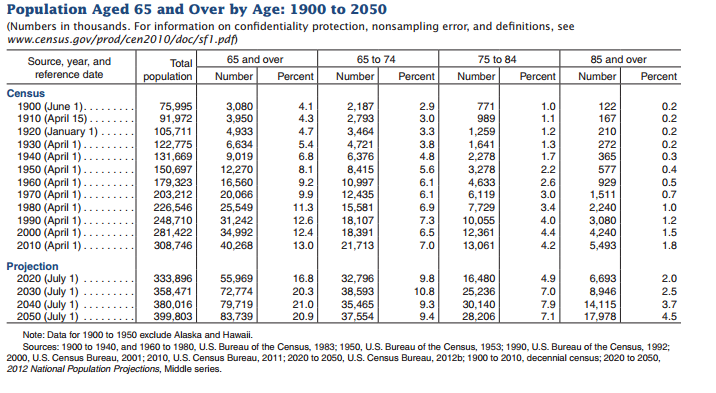
In the U.S. the growth of the elderly population has been less dramatic.  At 9% of the population in 1960, the elderly are expected to almost double to 17% of the population by 2020 (Census Bureau )

****************************
Takeaways

Pay attention to portfolio allocations.  Save money.  You’ll need it one of these days.

Heathens and Wizards

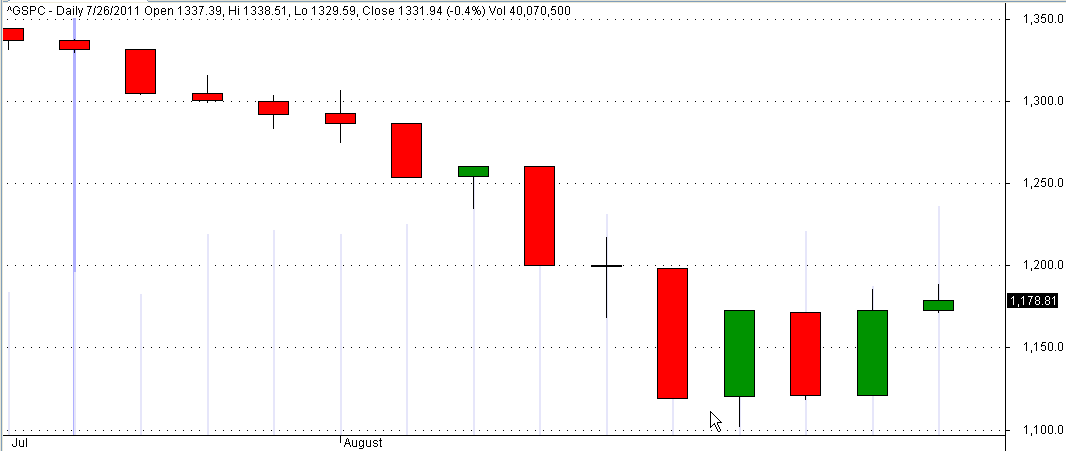
During negotiations over raising the debt ceiling from July 26th to August 8th, 2011 the S&P500 fell 16%.  The index fell only 1% in the first week of negotiations as it looked like President Obama and Republican Majority Leader John Boehner might strike a deal.  Then the bottom fell out.

In the week of trading since budget talks intensified on Dec. 20th, 2012 the S&P500 has lost 2%. 

Investors are worried but hopeful that Congress and the President can come to some resolution before tax increases and spending cuts automatically take effect on January 1st.  Housing and automobile sales are showing renewed strength; the yearly increase in Christmas shopping was a disappointment but the underlying fundamentals of the economy give reason for cautious optimism.

The rapid decline in last year’s stock market should serve as an example to investors in today’s market.  For the long term investor, a further decline of 5 – 15% will present some buying opportunities – time to make that IRA contribution or to put some sidelined cash to work.

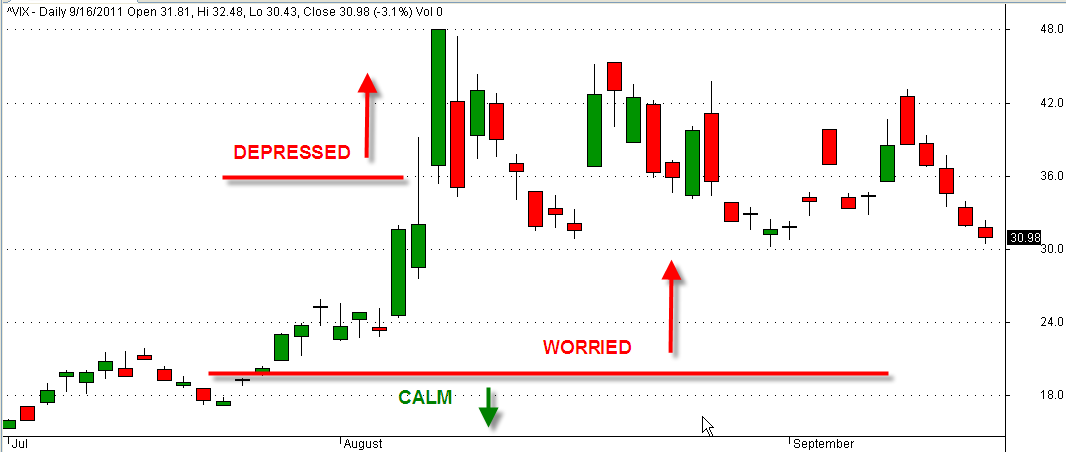
The volatility index, or VIX, measures the relative uncertainty of the broader market using a formula that analyzes the bid -ask spreads of option contracts, which are promises to buy or sell stocks in the future.  When the markets are fairly calm, the VIX index is under 18 – 20.  As markets melted down in October 2008, the VIX rose to 80.  So, 16 is pretty good; 80 is real bad. In the last week of July 2011, this index jumped 20%, then skyrocketed to 48 in the first week of August.

This past week, the VIX went up from the calm range of 18 to 23, indicating the underlying worry.

Last week I wrote about the debate over which inflation measure to use, the CPI or deflator.  If you hear about “chained dollars” or “chained CPI”, it is the deflator that they are referring to.  The difference between the two yardsticks is $3 – $5 per month in a $1000 Social Security check.  This afternoon, Senate Majority Leader Harry Reid walked away from negotiations over this issue.  As I write this in the afternoon of Sunday, Dec. 30th, Senator John McCain has announced that Republican Senators have just taken this issue off of the table.  We can expect that the issue will come up again in the coming negotiations over the raising of the debt ceiling.

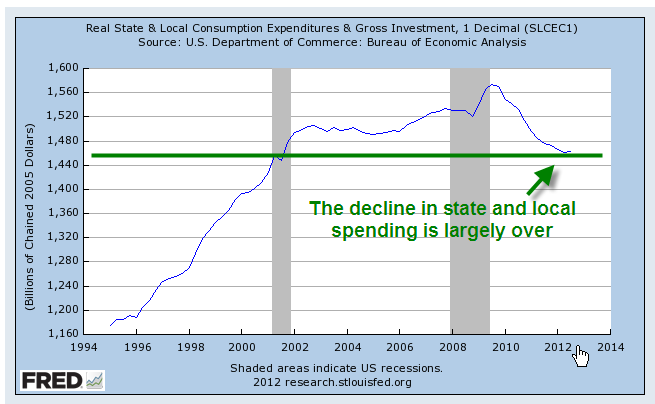
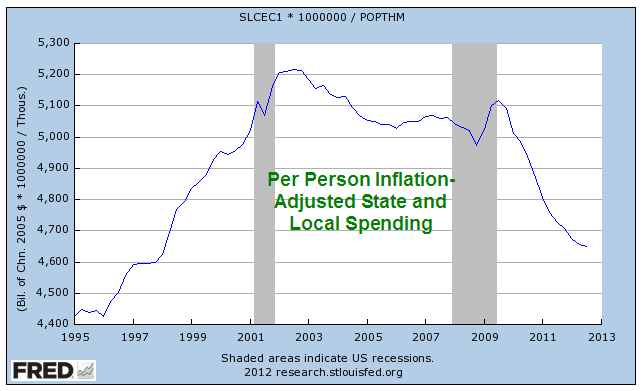
For the past several years, Republicans both in Congress and at the state level have targeted the growth in state and local spending.  This campaign of austerity, as Democrats call it, or fiscal common sense, as some Republicans call it, has won Republicans the governerships of thirty states.  Most of that spending growth has been curbed.

On a per person basis, inflation adjusted spending is at the same level as the mid 1990s.

For states, this return to mid 1990s spending levels has meant cuts in services to their residents.  Medicaid spending takes an increasingly larger portion of state budgets; because states can not run budget deficits, reductions have to be targeted toward education and infrastructure spending.  In 2011, Medicaid spending averaged 25% of state budgets, more than the 20% spent on education (Reuter’s source)

While Republicans dominated the Congress and Presidency in the early 2000s, they showed little concern for the growth in what they call entitlements, programs like Medicare and Social Security.  Instead, they increased entitlement programs, adding a Medicare drug benefit program.  Since they lost their Congressional dominance in 2006,  Republicans have become more cost conscious – and the next targets are entitlements.  Most seniors who have paid into Medicare and Social Security all their lives do not consider these programs as “entitlements.”  It is a dog whistle word that Republican politicians use to call out to their pack.

Democrats look and look and look but simply can not find any cuts that they can make to the social safety net.  Under the rubric of compassion, the Democratic strategy consists primarily of buying votes with ever more social welfare programs.  In the Democrat view, a government and its citizens are in a partnership.  Republicans rightly point out the dangers in any partnership where one partner, the government, holds all the power.  Despite all the rhetoric about limited government, Republicans are advocates of a different kind of partnership between government and corporations whose political contributions are essentially kickbacks for contracts with the federal government and a more relaxed regulatory environment.

Supposedly vigilant Republicans get out their spending cleavers but can not find any cuts they can make in current defense spending.   The operative word here is “current.”  The Defense Dept lives in a budget bubble that most of us would envy because it has little economic responsibility for soldiers once they leave the service.  Most rehabilitation, medical, housing, retraining and other services that the soldier is entitled to or need are no longer born by the defense department. Congress “dumps” these costs on the Human Services department, routinely targeted by Republicans for spending reductions.  In inflation adjusted dollars, we are currently spending 30% more on defense that we spent during the Vietnam War years, 25% more than during the military buildup of the Reagan years.

At the beginning of this century, we have two parties whose allegiances prevent them from coming to any meaningful compromise.  Tax policy is riddled with temporary tax cuts to promote various social causes. Special interest groups and wealthy taxpayers nibble away at tax legislators, creating a swiss cheese of fairness. Budget planning is a legerdemain practiced by a small coterie of heathens and wizards in budget committees; under current budget rules, there are few reductions in spending, only reductions in projected increases in spending.  Imagine that your family budgets for a 3% yearly increase in your utility bills.  One year, the utility company has no rate increase.  Your family claims that they have cut spending on utilities.

The Defense Dept has no long term accountability for the care of their soldiers.  The Human Resources Departments have no accountability for increases in health care spending; they are on automatic pilot.  Congress has no accountability for passing a budget; they have not done so for six years yet continue to get paid.  Bankers risk huge amounts of money that threaten the savings of millions; the company pays a relatively small fine and the individuals responsible suffer no criminal prosecution because of the difficulty and expense of such trials. The public senses that the political party system is morally bankrupt; that the leaders and representatives of this country are unable to break out of the cycle of partisan brinkmanship; that many representatives are bought and paid for; that most of the public has been left out of the deal. 

The public will either find a way to reclaim their authority over the political process of governing or be left standing helplessly on the sidelines while the two parties scrimmage at midfield, both parties having lost sight of either the goal or the audience.  Political advantage has become their goal.  Party leaders enforce a rigid heirarchy of committee assignments, rewarding those in the party who comply while shrugging off those who might compromise.  Gerrymandered districts ensure that many representatives are accountable only to the more rigid ideologies of their district;  their sole challenge comes from extremists in their own party. 

Maybe this time is different.  Maybe not.  Slowly and finally, the social, economic and political order cracks; the public votes in the most extreme elements who promise to restore order and principle or their version of fairness.  What they bring is despotism.

But that could be many years in the future.  For now, we salute the New Year!

Poverty

This past week the Census Bureau released their annual estimate of median income and poverty.  For 2009, the poverty level increased from 13.2% to 14.3%.  Economists and policy makers have been debating the definition and calculation of poverty since the introduction of the social welfare programs of the Great Society  in the 1960s.  Since the mid-nineties, many have called for a revision of the calculations that gives weight to cost of living variances in the country.  To most people, that makes sense.  Because it makes sense, it is a political hot potato.  The thresholds of poverty are used to determine eligibility for a number of federal programs.  Adjusting  those thresholds would qualify many more people for assistance in some areas, particularly larger metropolitan areas, while disqualifying some in rural areas where the cost of living is less.

How does the Census Bureau measure poverty?  They include all cash income but non-cash items like Medicaid, food stamps and housing subsidies, like Section 8, don’t count as income. (Source)  To qualify for housing assistance, the family’s income may not exceed 50% of the median income for the county or metropolitan area in which the family chooses to live.  The rent subsidy is generally the lesser of the payment standard minus 30% of the family’s monthly adjusted income or the gross rent for the unit minus 30% of monthly adjusted income.

Let’s look at two “traditional” families of four in Denver, Colorado, where wages and cost of living are only slightly above the national average. (Source)

In Family A, Dad works a regular job as a laborer for $12 an hour for 35 hours a week, slightly more than the median hours worked per week, earning about $22000 per year.  Family A’s income is at the poverty level, qualifying them for housing assistance, Medicaid, food stamps and other assistance programs for meeting their monthly bills.  Family A’s adjusted income per HUD standards is gross income less about $500 per dependent, or $20K.  They would pay 30% of that for rent, $6000, for an apt renting for about $9600 annually, receiving about $3600 in tax free income.  In addition, they would get about $325 in food stamps  per month, or another $4000 in untaxed income.  In addition, Dad would get $34 per week in Earned Income Credits, paid by his employer, for an annual total of about $1800.  Since they qualify for Medicaid, this family would have no or minimal health insurance premiums. This family would pay no federal or state income taxes but they would be subject to the FICA payroll tax of about $1650 per year. This family’s net effective income is about $30K.

In Family B, Dad works for $22 per hour for 35 hours a week, earning an annual gross of $40,000, about 16% – 18% less than the median household income for Denver but about equal to the median wage.  This family’s income is in the 40th percentile of Denver area income, slightly above that percentile for the country as a whole.  This family does not qualify for either  housing assistance, Medicaid, food stamps, the energy assistance program LIHEAP or the Earned Income Credit. Dad pays 50% of a $1200 HMO family medical plan which his employer offers, an annual cost of $7200.   This family pays about $120 per year in federal and state income taxes and $2500 in FICA taxes.  This family’s net effective income is also $30K.

Two families – one at the poverty level of income, one slightly below the median income level – have approximately the same level of disposable income.  Either there are a number of families classified as poor who really aren’t poor or about 40% of the households in this country are effectively at or below the poverty level.