Alliances of Reasoning

July 14, 2024

by Stephen Stofka

This week’s letter is about expectations and alliances of judicial reasoning and power. I will begin with some background on the judiciary, then follow up next week with a closer look at the rationales that various schools of judicial reasoning employ to reach their desired conclusion.

The legislature has 535 individual opinions of what is fair and just, as many interpretations of statutory and Constitutional text, and many prescriptions of what should be done to address a problem. Party leaders must collapse those many dimensions into a singularity, a sheet of paper that becomes law. As laws emerge from the halls of Congress, they become a multi-faceted work of collaborative reasoning. Businesses hire lawyers to reinterpret a piece of legislation in their favor, or to defend against regulatory action. The executive agency responsible for administering or enforcing the law has its own opinions of what the law says and how it should be executed. Judges in federal district courts weigh in with their opinions as they rule on cases and controversies brought before them.

Those opinions may be challenged in federal appellate courts then submitted to the Supreme Court asking them to take the case for review, a petition  called a “writ of certiorari.” Of the many cases submitted, the Court accepts only a small number – 62 in the 2023-24 session, according to Ballotpedia. Lawyers for the plaintiff and respondent argue their opinions to the Court, which reviews those arguments as well as amicus briefs submitted by advocate groups on either side of an issue. Again, many opinions collapse into a judgment won by a majority of the Court’s justices. In some cases, they simply refer the case back to a lower court with a clarifying interpretation of a legal area that the lower court should include in its consideration of the case.

The Constitution contains three articles that establish the Legislature, Executive and Judiciary. Article 3 authorizing the Judiciary is only 373 words, less than the word count required of a fourth-grade essay. Article 2 establishing the Executive branch is three times longer. Article 1 instituted the Legislative branch and is almost eight times as long. The principle of judicial review, that the courts can decide whether portions of laws passed by the legislature conflict with the Constitution, is not cited in Article 3. How did the Judiciary assume that plenary power?

The ruling in an 1803 case titled Marbury v. Madison decided that Marbury, the plaintiff, did not have standing to sue Madison, the Secretary of State under Thomas Jefferson. The decision was less noteworthy than the reasoning supporting the decision. The Court, headed by Chief Justice John Marshall, ruled that a portion of the Judicial Act passed in 1789 conflicted with Article 3, Section 2 of the Constitution. In that decision, Marshall assumed the right of the Court to have the final word on the meaning of statute and Constitutional text. A strict textualist interpretation of the Constitution would argue that the Marshall court had found a clever way to amend the Constitution. In recent decades textualist interpretations of the law have gained popularity among conservative justices. This branch of analysis emerged as a reaction to the purpose-oriented jurisprudence typical of the Court’s opinions in the sixties and seventies.

After WW2, voters gave Democrats an average 81 seat advantage in the House (Kraft & Furlong, 2021, p. 345), an effective mandate. In the current House, Republicans have only a 7-seat advantage. Many House members were World War 2 veterans, determined that the sacrifice of their military brothers in the fight for freedom would not be subjugated to racial practices that suppressed the freedoms of Black people, including those soldiers who had fought in the war. In 1962, Rachel Carson’s book Silent Spring focused popular attention on the sewage and dangerous chemicals that contaminated the nation’s air and water. As veterans gained seniority in Congress, they were able to pass civil and environmental reforms. In a surge of anti-Republican sentiment following the Watergate scandal, voters in the 1976 election handed Democrats a 150-seat advantage in the House.

A Constitution should thwart the human inclination to shape laws to suit to one’s advantage. The Supreme Court, headed by Chief Justice Earl Warren, established, or re-established depending on one’s perspective, several Constitutional principles of equality that upset relationships of power at the state and local levels. Shortly after President Eisenhower appointed Warren to head the Court, it issued its Brown v. Board of Education decision that established the principle that segregated schools in southern states were not equal. George Wallace, the Governor of Alabama, defied federal efforts to desegregate the state’s schools. In his campaign for President a decade later, he rallied his followers with the cry “segregation today…segregation tomorrow…segregation forever.”

The Court’s reliance on the equal protections of the 14th Amendment provided the rationale for other reforms, including Reynolds v. Sims (164), the “one person, one vote” decision. In several states, a dwindling population of rural voters maintained control of the state legislature through imaginative schemes. In Kentucky, districts were apportioned according to the mileage of the roads in the county, not the number of voters. In Tennessee, the legislature had not changed district apportionment since 1901, a move that disadvantaged the growing urban population of that state. In Vermont, 49 people in one district had equal representation with 33,000 in another state district. Other individual protections included the Miranda warning upon arrest, the protection from search and seizure by state and local officials without a warrant,  and the freedom to buy contraceptives in the Griswold ruling.

Some considered these rulings an intrusion on state and local autonomy and antithetical to the conservative principle of limited government. In the final year of the Warren Court and the close of the 1960s decade, Nixon encouraged a “silent majority” of traditionalists to reject the reforms and societal upheavals of the past decade. Nixon sought to wake the sense of grievance in a coalition of conservative minorities. In 1973, a volatile combination of events – the Watergate hearings, an oil embargo touched off by America’s role in the Arab-Israeli war, an 8.8% inflation rate, and the Court’s Roe v Wade decision – stirred up a backlash of traditionalist fervor that would gain momentum over the next two decades. Next week I will examine those alliances of power.

///////////////////

Photo by Wesley Tingey on Unsplash

Keywords: silent majority, Watergate, Roe v. Wade, segregation, Supreme Court

Kraft, Michael E., and Scott R. Furlong. 2021. Public Policy: Politics, Analysis, and Alternatives. Thousand Oaks, CA: CQ Press.

America 4.0

September 11, 2022

by Stephen Stofka

I hope that those in the UK can find some common ground in their grief over the Queen’s death this week. Britain was still recovering from World War 2 when the crown was laid on her young head in 1952. Seventy years later, the political culture has fractured over Brexit and the repercussions of leaving the EU. There is much needed investment in a nation that has barely managed 2% growth in the past decade. In three years, three Prime Ministers have led the Parliament. The long reach of the Queen’s lifetime can help us lift our heads and take a longer view of events. When we mark history in lifetimes, not years, the beginning of our nation was about three lifetimes ago.

For most of mankind’s history, production harnessed human or animal energy, the thermal energy stored in wood and coal, and the kinetic energy of falling water turning a mill. In a world with only gradual change, there was little need for rapid communications technology. The men – yes, all men of property and standing – who crafted and voted on the U.S. Constitution lived in a world limited by crude animal and chemical power for energy, transportation and communication. John Adams, one of the Constitution’s signers, spent weeks traveling from his wife, family and farm in Braintree, Massachusetts to Philadelphia, Pennsylvania. Today, a person on a bicycle can make the journey in three 10-hour days.

The discovery and refinement of oil as an energy source changed our society and our politics. The 13th, 14th and 15th amendments of the Reconstruction Era were ratified at the dawn of a new age of energy and communications. The telegraph had only just come into use just prior to the Civil War. Edwin Drake drilled the first oil well in Pennsylvania in 1859, two years before the start of the Civil War. Those who passed the initial ten amendments and made the amendment process so difficult lived in an era where transformations of society occurred over decades or centuries. The amendments meant to protect people from the yoke of a regal government now shackle us to a historical reality that no longer exists.

America was built on a lack of consensus between regions, between a newly emerging urban population in the north and a rural population harnessed to the land in the south. In 1776, the colonies had first cohered as a mutual defense pact against the  British and the encroachment of the Spanish and French on colonial territory. The seven year war of Independence liberated the colonies from British rule in 1783 but left the colonies with a large debt. Their mutual defense pact gave a lot of autonomy to each of the thirteen states but the central government had little power or authority to tax the individual states. By 1787, that confederacy was on the brink of failure, unable to pay its debts and largely isolated from international capital markets. Under those dire circumstances, the colonies ed anew, drafting an entirely different pact that initiated America 2.0.

The American Constitution embodied the divisions of regional interests and the differing ideological principles of its founders. The proceedings were so combative that the deliberations were sealed from the press for fear that exposing the rancor between delegates would doom the  process. Three lifetimes later, we exhibit the same level of discord as our founders. Our Senate has become an insipid institution, crippled by parliamentary rules that make any Senator the ruler of his own nation, the King of Negation that stops most legislation from reaching a vote in the chamber. For 25 years, the House has passed Continuing Resolutions (CR) because they cannot pass a budget on time (Wezerek, 2018). Some years the budget is never passed and the government operates under a year-long CR.

On this 21st anniversary of 9-11, we still live in its shadow. The precautions at the airport, the fastidious matching of our names, letter for letter, hyphen for hyphen in our identification. Our nation grieved together, our Congress stood together and passed the Patriot Act. That was the end of togetherness. A common grieving does not knit a nation for long. Our media speaks a common language but the discourse – the assumptions and values that form the bedrock of our perceptions – are so different. Why? Because our Constitution has died.

Distrustful of each other, the Constitutional delegates forged a pact that was difficult to amend. They bound it so tightly that it could not expand and breathe. It is like a dead Pharoah mummified in tightly wrapped cloth and buried deep within a pyramid of time. Each year, the justices of the Supreme Court venture into the tomb to ask questions of the dead Pharoah. When they emerge into the sunlight, the people gather round to hear what the dead Pharoah has revealed. The justices speak in tongues – discourses that are intelligible to some people and babble to others. The Civil War was America 3.0. Let us grieve that our Constitution has died and adopt a new pact to celebrate America 4.0.

/////////////////////

Photo by Jeremy Bezanger on Unsplash

Wezerek, G. (2018, February 7). 20 years of Congress’s budget procrastination, in one chart. FiveThirtyEight. Retrieved September 9, 2022, from https://fivethirtyeight.com/features/20-years-of-congresss-budget-procrastination-in-one-chart/

A Court of Many Opinions

June 26, 2022

by Stephen Stofka

In the past two decades the Roberts’ court has overturned several long standing court precedents and laws. In Heller and Citizens United, the court has favored the greatest degree of individual freedom in their reading of the 1st and 2nd Amendment. In this week’s 5-4 decision to overturn Roe, the court has chosen the least amount of individual freedom in their interpretation of the 14th Amendment. In his concurring opinion, Justice Clarence Thomas stated a desire to overturn other court precedents based on the 14th Amendment. In 2013, the court’s Shelby decision overthrew portion of the Voting Rights Act based on the 14th Amendment.

Before overturning the “separate but equal” doctrine that had been in place for five decades, newly appointed Chief Justice Earl Warren delayed the Brown v. Board of Education decision by six months to try and convince two of the justices to change their vote and make the decision unanimous. Warren demonstrated a respect for the principle of stare decisis that the Roberts court does not have. This week’s decision overturned five decades of legal precedent on a 5-4 vote. At Scotusblog, Amy Howe (2022) notes the disagreement among the justices as to what their decision means going forward.

The six conservative members of the Supreme Court are members of the Federalist Society. Each working day of the session they gather in a candle lit chamber in the basement of the Supreme Court Building and kneel down before the Grand Jurist of the Federalist Society.

“Do you believe in the sanctity of the text?” they are asked and each affirms their belief.
“Do you swear to only write opinions and never write law?” the Grand Jurist asks and they each swear an oath.

Around each neck, an acolyte drapes a necklace adorned with eyes of newt, the claw of an eagle, the eye of a falcon. Each jurist will deftly weave through the jungle of legal texts like a newt. Each jurist will grasp the text’s relevant truth like an eagle. Each jurist will have the wide vision but narrow focus of a falcon.

Each jurist puts their thumbs and forefingers together to form the letter “O.” “Do you swear to observe the commandments of Originalism?” the Grand Jurist asks and each affirms obedience. Each justice stands and is wrapped in the black robe of objective jurisprudence based on the meaning of the original text as the lawmakers understood it. They bow to the Grand Jurist and are escorted to their individual chambers.

Their law clerks bring each justice the finger bones of dead lawmakers and jurists – the 18th century jurist Blackstone, the forefingers of Jefferson, Adams, the signers of the Constitution and the Amendments. Into a bowl go the bony digits and the justice gives the bowl three shakes, and no more. Two law clerks tie the dark bandana of Originalism around the justice’s eyes. In a ritual called “throwing the bones,” the justice withdraws a bone from the bowl, and lays it at a random spot on the unfurled scroll of sacred text. Twice more the ritual is performed, then the bowl is put aside and the bandana untied.

Jefferson’s finger may point to the “privileges and immunities” clause in the 14th Amendment and a clerk solemnly records the historical precedent. The thumb of John Bingham, the author of the first section of the 14th Amendment, may point to the “life, liberty, or property” phrase in that same Amendment. The pinky digit of Thurgood Marshall might point to the “due process” phrase in the 5th Amendment. These will be the foundations of the justice’s opinion. The bones are returned to their vessels, the scrolls rolled up and secured. The bones and their placement are different for each justice.

The clerks begin a scan of the databases containing all the sacred texts, searching for the occurrence of each phrase and an indication of how the lawmaker or previous justice understood those phrases. In the course of several months, each justice assembles these perspectives into an opinion which they hand first to the Grand Jurist of the Federalist Society. The Grand Jurist selects that opinion that most faithfully follows the principles of Originalism, secures that opinion with a wax seal, then imprints the wax seal with his ring. An acolyte then delivers the opinion to the Chief Justice, John Roberts and the opinion is made public.

The Grand Jurist was 22 and in law school when Roe v. Wade was decided fifty years ago. He never liked that decision. This Friday, the Grand Jurist smiled as he closed the heavy door to the underground chamber below the Supreme Court.

//////////////

Photo by Danika Perkinson on Unsplash

Howe, A. (2022, June 24). Supreme Court overturns constitutional right to abortion. SCOTUSblog. Retrieved June 24, 2022, from https://www.scotusblog.com/2022/06/supreme-court-overturns-constitutional-right-to-abortion/

A Call for Free Market Justice

September 5, 2021

by Stephen Stofka

In a 5-4 decision this week, the Supreme Court decided to let stay the Texas law against abortion that went into effect this week. The court is a democracy whose majority opinion, no matter how slim the majority, becomes the winning opinion. Despite the black robes and pretense of objectivity, the court “elects” its opinions. In 1776, America declared independence from the tyranny of one person rule yet we often stand here today subject to the rule of one person on the court. Should we change our procedure so that the court operates more like a free market?

Writing in the independent court commentary Scotusblog, Amy Howe (2021) summarized the history of the case, the unsigned majority decision and the signed objections of the four dissenting justices including the Chief Justice, John Roberts. Under the law, anyone assisting a woman terminating a pregnancy after 6 weeks can be sued by a third party in Texas civil court. Most women do not know they are pregnant until at least six weeks so this is an effective ban on most abortions. The law effectively deputizes private citizens as vigilante enforcement, paying them up to $10,000 for each successful case and absolving the state of legal responsibility.

The court’s majority opinion was largely founded on procedural grounds that there was no way to know if the person named in the suit would bring a case against an abortion provider under the new law. U.S. and Japanese courts have concrete judicial review as opposed to the abstract review of the European system. Under concrete review, courts act only on cases brought before them. The crafting of this law was designed to take advantage of that aspect of our court system.

The Federalist Society was founded in 1982 to push a libertarian ideology as a counteracting force to the perceived dominance of a liberal interpretation of the Constitution. The Society champions a judicial interpretation of the law “founded on the principles that the state exists to preserve freedom [and] that the separation of governmental powers is central to our Constitution” (Federalist Society, 2021). Without clear jurisdiction granted to the federal government by the Constitution, state law should be given deference. Six of the nine members of the Supreme Court are members of the Society and lean toward that libertarian interpretation of the Constitution.

Libertarians champion the dynamics of the free market because it is not a democracy ruled by a majority. There are multiple brands competing for our loyalty. In metropolitan areas, local governments do compete with each other for residents but governments generally act like the water and electric utilities they regulate as public monopolies. A government provides a public monopoly on force and on rule-making. In our Federalist system, 50 states have 50 different sets of laws, 50 separate court systems and 50 interpretations of the Federal constitution and federal law.

We already have a free market in our judicial system. Why should we let a slim majority vote in the Supreme Court contaminate that free market? The justices base their decisions on what they consider sound jurisprudence consistent with past historical principle. Legal briefs present competing opinions that are a distillation of many opinions, a winnowing process that is characteristic of a free market. In choosing between those few dominant legal interpretations, the justices try to establish a positive reasoning to a normative opinion of what is the “best” interpretation. The free market is at work until that final moment when free market principles are upended by a majority vote of one opinion to rule them all.

Let the last step in the process be one that preserves free market principles. If there is a close vote, let each justice vote on the two most dominant opinions whether they agree with those opinions or not. From those votes, let two choices emerge and each choice be assigned a 1 or 0. A roll of nine dice will decide the winning choice. Each six-sided dice will have 1 spot on three faces and no spot on three faces.  The majority rule of the dice, not human beings, would decide the final choice of the winning opinion.

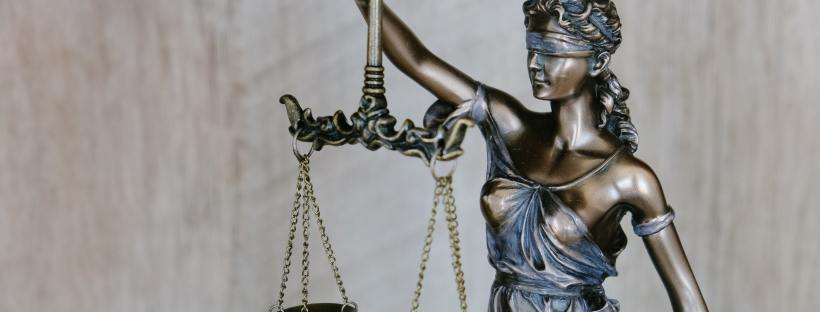
This method will preserve historical precedent, an important feature of the common law foundation of American jurisprudence. In current practice, contesting and concerned parties submit merit and amicus curiae briefs that cite both past majority and dissenting opinions. Adopting this suggested method would continue to support that practice. We would place our most cherished jurisprudence before the whims of fortune, not the tyranny of one person’s vote. Let Lady Justice be truly blindfolded as each opinion is put on the scale.

///////////

Notes:

Photo by Tingey Injury Law Firm on Unsplash

Federalist Society. (2021). About us. Retrieved September 04, 2021, from https://fedsoc.org/about-us

Howe, A. (2021, September 02). Supreme court Leaves Texas abortion ban in place. Retrieved September 04, 2021, from https://www.scotusblog.com/2021/09/supreme-court-leaves-texas-abortion-ban-in-place/

A Light Passes

September 20, 2020

by Steve Stofka

Have we had enough yet? Almost 200,000 Americans have died from Covid, millions of Americans are out of jobs, hundreds of thousands of small family businesses have closed, millions of families are about to lose their homes, thousands of acres in western lands on fire, thousands more left homeless by Hurricane Sally and now Justice Ruth Bader Ginsburg has died. The nation wishes her two children and four grandchildren their condolences for her passing. At least half of the nation grieves for the political battle that is to come.

The day before Justice Ginsburg died, the National Constitution Center awarded her the 2020 Liberty Medal. Jeffrey Rosen, the host, spoke with two lawyers who have argued cases before the court and clerked for RBG. https://constitutioncenter.org/debate/podcasts

She was a pioneer in legal justice for human beings, regardless of the roles that society assigned them based on their sex. She helped to steer the Supreme Court to prejudicial practices against women by first encouraging her male colleagues to review practices that put men at a disadvantage.

She often wrote the opinion for the liberal justices on the court but had the respect of one of the court’s most conservative justices, the late Justice Antonin Scalia. Her reasoning was sound; her principles were consistent; her loyalty to fair treatment under the law steered her through many an argument to a clear conclusion.

I have no doubt that the conservative Federalist Society already has a waiting list of Supreme Court replacements for Senate Majority Leader Mitch McConnell and President Trump to consider. Will they delay this appointment in the hopes that it will bring out more Republican voters? If Trump loses the election, McConnell can bring the appointment of a new Justice before the Senate in December or January. If Republicans lose the majority in the Senate, he will have to make the appointment in December because the new Senators take their seats on January 3rd, 2021.

As I write this on Friday night, McConnell has just announced that he will seek a quick nomination. The gloves are off. It’s about to get bloody. In further updates, Republican Senators Susan Collins and Mitt Romney have said that they don’t think a nomination is appropriate just before an election. Whether McConnell has enough votes to proceed with the nomination, some Republican Senators may want the vote anyway to show their allegiance to Trump just before the election.

///////////////////////////

Photo by Juskteez Vu on Unsplash

Revival

March 8, 2020

by Steve Stofka

A heartfelt endorsement by veteran S. Carolina Congressman Jim Clyburn ignited a outpouring of voter support for Joe Biden in that state’s primary a week ago. Mr. Biden rode that momentum into Super Tuesday a few days later and the campaign that was on life support became the leading candidate in the Democratic race.

The following day the stock market rallied a whopping 4%. Big investors know that Mr. Biden will not make life difficult for them. He is old school. He knows that there are two sets of rules and the rich write the rules. Mr. Sanders makes Wall St. uncomfortable because he also knows that there are two sets of rules. He wants to write a new rule book where the rich don’t write the rules. That’s bad for rich people. Here’s why.

Bernie Sanders is often branded as a socialist. He brands himself with the qualifier Democratic Socialist. As the Wall St. Journal’s Richard Rubin pointed out this week, Mr. Sanders is not proposing a European model of socialism (Rubin, 2020). Those progressive systems are funded by a regressive sales tax called a VAT (Wallop, 2010). This tax burden falls mostly on middle class and working families. Mr. Sander’s plan funds progressive programs with progressive taxes falling mostly on the wealthy. That ain’t socialism. We need a naming contest for a system where the wealthy do extra to help the community. Four syllables or less. I’d suggest Neighborism based on the movie “It’s a Wonderful Life,” with Jimmy Stewart. What’s your suggestion?

Last month President Trump launched a political tweet missile at the Supreme Court (Baker, 2020). This past week Senate Minority Leader Chuck Schumer hand carried his warning to the steps of the Supreme Court. He was part of a protest regarding a current course case that tests the court’s earlier decisions beginning with Roe v. Wade almost fifty years ago. Chief Justice John Roberts has admonished President Trump, Mr. Schumer and others that they should not threaten the Supreme Court. Mr. Schumer says he regrets his remarks (Pecorin, 2020). President Trump last apologized for his remarks when he was in the first grade.

The high court’s Bush v. Gore decision chose the outcome of the 2000 Presidential election and tarnished the court’s reputation as an objective body. Since the beginning of his tenure as Chief Justice in 2005, Mr. Roberts has tried to resuscitate the court’s reputation. In this age, tarnished reputations stay tarnished.

Was the court ever impartial? Over a hundred years ago, Albert Einstein sparked a revolution in physics with a set of mathematical equations which showed that impartiality was impossible. Our observations and conclusions are based on our frame of reference. In the past century an overwhelming body of evidence has substantiated Einstein’s claims.

A central proposition in physics has spread to the humanities. Is this a “hey man, everything is relative” moment? No. Understanding an argument’s frame of reference takes time and research. Most of us are too pressed for time and tend to discard arguments that we don’t instinctively like. Chief Justice Roberts maintains that the members of the high court are not prone to this common human fallibility. Do they cast aside the ideological framing they have formed during their life and career and reach a deliberative decision that fully balances all the considerations of a case before the court? No, of course not. Mr. Roberts is still living in a Newtonian world of imagined impartial justice. Perhaps he should remove his robe while shaving and see the man reflected in his mirror.

A long time ago, my sales manager said to me, “Either you believe in your own b.s. or someone else’s b.s. Wouldn’t you rather own it?” This week Mr. Biden looked like a man who owns someone else’s b.s. – that of Jim Clyburn and the folks in S. Carolina who gave Mr. Biden a sense of confidence. His walk up the stairs to a stage platform has grown more vigorous since Super Tuesday. His voice projects with a confidence and assuredness that I didn’t hear just two weeks ago. He no longer sounds like a frail man. I’m still not convinced he owns his b.s., but he may get there in the next few months.

Mr. Sanders, on the other hand, is a man who has owned what he says for decades. As an Independent, he has played a minor role in the Democratic political hierarchy despite his many years in the Senate. Will voters choose the man of measured manner, Mr. Biden, or put their money on the impassioned and principled Mr. Sanders?

I wish my teachers had told me that I needed to be 70+ to run for President. We have too many old people in Congress. I thought so when I was young. I think so today. Yes, old people have experience, sagacity and some have a more measured temperament. The age of the people we send to represent us in Washington does not reflect us.

The Congressional Research Service recently computed the average age of the House at nearly 58 years; of the Senate, 62 years (Manning, 2018). According to the Census Bureau, the U.S. population – including children – has a median age of 38 (2019). If we take out the 25% of the population under 18, a reasonable estimate of the median age of adults might be an age of 50, ten years younger than the current average age of the members of Congress.

Patrick Leahy, the other Senator from Vermont, has held his seat for almost half a century. They come to Washington and die in Washington. They believe that they have earned an objective wisdom through their long service in their seats. To paraphrase Socrates, the man who thinks he is wise is a danger to himself and others. Step aside. Let the young blood walk the halls and make a different set of mistakes than the ones you once made. Let go. Our country will be better for it.

//////////////////

Baker, P. (2020, February 25). Trump, in India, Demands Two Liberal Justices Recuse Themselves From His Cases. Retrieved from https://www.nytimes.com/2020/02/25/us/politics/trump-supreme-court.html

Manning, J. (CRS). (2018, December 20). Membership of the 115th Congress: A Profile. Congressional Research Service. Retrieved from https://www.senate.gov/CRSpubs/b8f6293e-c235-40fd-b895-6474d0f8e809.pdf

Pecorin, A., et al. (2020, March 5). Schumer says he regrets comments Chief Justice Roberts called ‘dangerous’ threats. ABC News. Retrieved from https://abcnews.go.com/Politics/chief-justice-john-roberts-calls-sen-chuck-schumer/story?id=69396928

Photo by Louis Velazquez on Unsplash

Rubin, R. (2020, March 6). Bernie Sanders’s Tax Plan Would Be Biggest Expansion of Taxation Since World War II. Wall St. Journal. Retrieved from https://www.wsj.com/articles/sanders-plan-would-hoist-taxes-11583449105 (paywall).

U.S. Census Bureau. (2019, July 16). Median Age Doesn’t Tell the Whole Story. Retrieved from https://www.census.gov/library/stories/2019/06/median-age-does-not-tell-the-whole-story.html

Wallop, H. (2010, April 13). General Election 2010: a brief history of the Value Added Tax. The Telegraph. Retrieved from https://www.telegraph.co.uk/news/election-2010/7582869/VAT-a-brief-history.html

Election Reflections

August 28, 2016

Let’s pay a visit to an earnest voter…

The Labor Day weekend was a week away and the election campaigns would swing into full gear following the holiday. He had a hard time deciding what to do with his vote in November.  His mom used to make it easy, voting the party ticket no matter what. He heard someone say that they would write in Reagan’s name this election. He told himself that he was more conscientious than that so he reviewed some of the issues.

Climate Change

He thought that climate change was at least partially caused by human activity, so he decided he should probably vote Democratic this election. Republicans were climate deniers, weren’t they?  Hell, some Republicans denied evolution.  Michele Bachmann had announced that she wasn’t running for re-election for her House seat. He thought that she should be put out to pasture where she could do the least harm.  He had read a climate scientist writing that it didn’t matter much anymore, that human activity had already flipped the switch.  Sure, we might be able to make a few small improvements, some amelioration of the damage, but it wasn’t worth arguing with others who preferred to think that climate change was as real as Santa Claus.  What was that song by Chris Rea?  The Road To Hell

White House Short-timers

Obama had a few months left in his second term.  Was he hoping that Iran didn’t do something crazy in the meantime?  Former White House Press Secretary Robert Gibbs said (Interview with David Axelrod) that the worst day in an election campaign is the best day working in the White House. Everyday some part of everything that happens in the world came into the White House so the stream of problems was constant.

September was coming up.  Did Obama say a little prayer that there would be no financial crisis like the one that beset former Prez Bush in September 2008?  Bush’s body language in those last few months of his second term screamed out that he wanted to be gone from the flood of problems coming across his desk.  Bush had turned out to be a big government Republican with dramatic big government solutions to the financial crisis.  He had flooded Iraq with lots of cash in 2003.  Then he had wanted $700 billion from Congress.  His Treasury Secretary, Hank Paulson, had famously handed the Congress a scrap of paper, the most concise emergency bailout plan ever devised.  Hank could have written it on a piece of toilet paper in the men’s room.  $700B!

Rock-em-sock-em big government robot fights for justice

Democrats had been proposing big government solutions to society’s problems for as long as he could remember.  Solutions that cost a lot of money and produced meager or mixed results.  Was it bad execution of a good solution or was it the wrong solution?   The Dems were good at blaming someone or something else when their programs didn’t work very well.  Human greed, Republicans, selfishness, and poverty were the usual suspects.

Republicans blamed most problems on government regulators, Democrats, high taxes, and a loss of Christian values.  Republicans believed that a progressive income tax, the taking of money from one person and giving it to another, was a violation of a person’s property rights.  He agreed with that so maybe he should vote Republican.  But then most Republicans wanted to take away a woman’s right to choose what happened inside of her own body.  That was also a violation of a woman’s property rights, a God given right to privacy. So which property rights should he hope to protect with his vote?  Neither party cared much for the Constitution, that was for sure.

Social mores

At heart he was a classic liberal, or what is now called a moderate Libertarian. Gay marriage, fine.  If transgender people wanted to use the sex of bathroom that they identified with, fine.  His granddaughter had said she didn’t care if some transgender boy wanted to use the bathroom. The stalls had doors.  Dems seemed more libertarian on social issues, but very autocratic on economic issues.  Why couldn’t the Dems or Republicans be libertarian on both social and economic issues?  Because then one of them would be the Libertarian Party, he thought ruefully.  The anti-government anarchists had taken over the Libertarian Party several decades earlier.  Maybe it was time for the moderates to take it back?

Taxes

He didn’t think that politicians in Washington should be using the tax code to correct what they perceived as inequities in society.  It was the Republicans in 2003 who had stopped the practice of penalizing married couples through the tax code.  A Democratic House and Senate had put that one into place in 1971 (1998 article) but it was Nixon, a Republican, who signed the legislation.  Democrats could justify any tax.

The Hammer of God

He didn’t think Bible thumping politicians should be telling us how to live our lives. He was with the Dems on this one.  No, God wasn’t dead.  He was kept alive by politicians who used Him as a rhetorical weapon against the other party. Running for his first term in Congress, Abraham Lincoln, a Whig, had endured accusations that he was not a religious man (Sandburg’s Lincoln bio).  The Whigs had morphed into the Republican Party during the 1850s and now it was the Republicans who used religion as a cudgel against Democrats.  (Obama warning in 2012 race)  Apparently, only Republicans knew God’s will and how to implement it here on earth.  How could he vote for a party that was so conceited and arrogant?

Obamacare

But he also thought that the Federal government had no constitutional right to be telling people that they had to buy health insurance.  Each party wanted to take away people’s rights and freedoms.  As a small employer for several decades, he had often wished that health insurance wasn’t tied to employment. Bigger companies could offer more favorable benefits to good employee prospects, and it was tough to compete with that. Despite his preference for private solutions to societal problems, he wished that there was a program like Medicare for all or no tax write offs for health care benefits.  One or the other.  A public option had been a part of Obama’s 2008 platform (Politifact) but he had not been a particularly strong leader on this one and had encountered resistance from the members of his own party.  The result was Obamacare, a rough draft legislative hodge-podge that was more typical of a preliminary committee product, not a final piece of law.  Democrats just sucked at crafting economic legislation yet, in an ironic twist, they tended to see most of society’s problems as economic ones.  Obama had got his health care legislation passed only to see it used against the Democratic Party in the important census election of 2010, when the Dems lost a large lead and control of the House. Bill Clinton had tried to pass a health care bill in 1993 and lost Democratic control of the Congress to the Republicans in the 1994 election.  The Dems had apparently not learned their lesson.

Security

He couldn’t decide who was going to best keep the country safe.  Republicans seemed to think that Mexicans threatened each American family somehow.  Not all Mexicans, he understood, just illegal Mexicans.  For years, hundreds of thousands of students and visitors had come to the U.S., then overstayed their visas and remained in the U.S. illegally.  According to Republicans, all those other illegals weren’t a problem. Just Mexicans.   The Donald would build a wall.  In 2006, a Republican Congress had approved funds for Homeland Security to build more fences along the southern border.  Neither Democrat or Republican Congresses had been able to move the fence building further along toward actual construction.  Having once solved the problem of building a skating rink in Central Park, the Donald thought that he – and only he – could get this fence thing going.  He wished the Donald good luck in herding 535 fat cats in Congress toward any one project.  As the top Fat Cat, maybe the Donald could make it work.

Crazy vs Experience

Nah, he thought, the Donald was too crazy and inexperienced. Most Presidents were either one or the other, but not both, except for Bill Clinton.  Clinton had been crazy enough to have sex with an intern in the Oval Office and inexperienced enough to propose a universal health care plan.  He had won the Presidency with the lowest popular vote in the country’s history yet Clinton had thought he had some clear mandate. Even strong Democratic control of both the House and Senate could not help him and within two years, Clinton certainly contributed to the loss of  both the House and Senate to the Republicans.

Split the vote

Several decades ago a co-worker had shared his personal voting system.  “Split your ticket in the hope that the government stays split,” the guy had said.  That way the politicians could do the least harm.  Maybe that’s what he would do this election.  His congressional vote didn’t matter.  Few Congressional districts were contested in the general election and his district had voted Democratic for more than forty years.  Republicans would likely keep the House anyway.  Democrats might just take the Senate so he should vote Democratic to make it more likely.  That would help split the Congress.  That still left his vote for President.

Supreme Court

Over and over again he had heard that this Presidential election was a vote for the direction of the Supreme Court for the next decade or more.  His secret hope was that the Court would remain at eight members. If there was no clear majority on the Court then there should be no precedence set in Constitutional law.

Libertarian?

Maybe he should vote for the Libertarian Candidate, Gary Johnson?  Johnson seemed neither inexperienced or crazy other than the fact that anyone who runs as a third party candidate in this country must be crazy.  If the Dems took the Senate, they could simply block any nominee to the court and keep the Court at 8 members.  He could tell himself that a Libertarian vote was a combined nod to both the Democrat and Republican parties.  It would not be first time that he had split his vote but it had been quite some time since it did it in the hopes of a split government.

Baseball

Having resolved all those election issues, he turned his attention to the World Series schedule.  If the series went to seven games, the last game would be played on November 4th, at the height of pre-election coverage and just a few days before the election. (Schedule) If the Cubs were in the World Series for the first time since 1945, the attention of many voters might easily be diverted to the historic match up.  Let’s say the Cubs won the series for the first time since 1908 and let’s imagine that the series went to seven games, with the final game played on Friday, the 4th. KC Royals’ fans had celebrated their 2015 series extra inning win over the Mets just two days after the final game.  He could imagine that millions of Chicago residents and former residents would be there to celebrate the event on Sunday perhaps and the festivities rolling into Monday.  Although Illinois was usually a solid vote for the Democratic Presidential contender, he imagined the possibility that thousands of Illinois voters, distracted by the post-Series events, didn’t vote in Tuesday’s election.  Like Florida in 2000, the results turned on the votes of a few in Illinois and Donald Trump won the Presidency because the Cubs won the series.  Nah, he thought, sounds too much like a bad movie script.

Next week: a troubling long term trend that will hurt many investors

Charitable Giving

This is the time of year when many people reach out to their favorite charities.  Consider a charity that is helping with disaster relief after SuperStorm Sandy, provides meals for families and seniors, provides housing assistance for those in need, and so much more.  No, it is not the Red Cross, the Meals on Wheels program or Habitat for Humanity.  The charity is the U.S. government.  They are desperately in need of funds.  As they help clean up after Sandy, they have not even finished paying for damages from hurricane Katrina that battered Louisiana, Mississippi and Alabama in 2005.  Anyone can donate online at the U.S. Treasury.  As with other charities, you can use a credit card.

During and since the drafting of the U.S. Constitution over two hundred years ago, we have argued over the wording of the “general welfare” clause of the Constitution (Article 1, Section 8).  James Madison, a Federalist and chief drafter of the Constitution, said that the phrase was a limited power conferred on the federal government; that “general welfare” meant that welfare which applied to all the people.  You can read Federalist Paper No. 41 for his more lengthy explanation of this controversial phrase.

The anti-Federalists, always suspicious of the powers given to a large and powerful central government, replied that “general welfare” could mean anything.  What, they argued, was to prevent this newly formed Federal Government from becoming a charity?

Madison scoffed, arguing that the taxing power was restricted to only those taxes which were uniform throughout the country.  The taxing power is specified in the same sentence as the “general welfare” clause, separated only by a semicolon.  Therefore, it was preposterous that anyone could argue that “general welfare” could mean anything.

Alexander Hamilton, also a Federalist and an advocate of a strong Federal Government, argued that the “general welfare” clause was essentially a plenary power given to Congress, in line with its power to spend.  To the anti-Federalists, this violated the spirit of the Constitution which was designed to enumerate, or limit, the powers of central government.

In short, Madison says general welfare is limited by the taxing power that immediately follows.  Hamilton says it is not limited because Congress’ power to spend is not limited. 

United States vs. Butler in 1936 and Helvering vs. Davis in 1937 were two Supreme Court decisions that sided with Hamilton.  What the anti-Federalists had warned about was about to come true.  The U.S. Government was on its way to becoming – over the next 75 years – the largest charity in the world.

Some think that charity should be part of a government’s role; although some of those would argue that charity should not be the chief role of a government, as it is now.  Some argue that charity should not be in the hands of government.

Many of us will receive appeals from many charities during this season of giving.  The Treasury does not mail appeals for money despite the fact that it is performing the same helpful acts as other charities.  Charity Navigator, a charity watch dog organization, does not rate the U.S. Treasury for its management of the funds it receives.  But the Treasury really does need the money as it helps to feed, cloth and house millions of people each month.  

Health Care and the Supremes, Part 1

Sorry, no pictures or graphs this week 😉

A few weeks ago, the Supreme Court ruled on the constitutionality of the health care act.  26 states brought suit against the government, asserting that the Government had no constitutional authority to impose a penalty on people for not buying health insurance.  Regardless of the arguments for and against, many of us have a gut level aversion to the Federal Government, or a State Government, for that matter, forcing us to do something.  While living in Brooklyn in the early 70s, I knew two people who had left good jobs to take sporadic cash only jobs because they did not want to be forced to have their taxes pay for the Vietnam War, a war they – and many others – believed was immoral.  In my state, Colorado, there have been many who think that the state government has no right to force drivers to wear seat belts.  For those of you in the more crowded coastal states with better public transportation systems, driving in the western states is as much a necessity of living as eating. 

The Government argued that Congress had the power to impose an individual mandate to buy health insurance under the following authorities: 1) the power to regulate Commerce as found in Article 1, Section 8, Clause 3 of the Constitution; 2) the Necessary and Proper Clause (clause 18 of the same section); and 3) the taxing power in the Constitution.

Writing for a 5-4 majority, Chief Justice Roberts rejected the first argument, writing “Congress has never attempted to rely on that power [the constitutional power to regulate Commerce] to compel individuals not engaged in commerce to purchase an unwanted product.” (pg. 18 majority opinion) He asserts that the Constitutional grant of power to the Congress to regulate Commerce does not imply that the Congress can create Commerce.  On page 20, he writes “The individual mandate … does not regulate existing commercial activity.”  On pg. 24, Roberts writes “The Framers [of the Constitution] gave Congress the power to regulate commerce, not to compel it, and for over 200 years both our decisions and Congress’s actions have reflected this understanding.”  In short, “regulate” does not mean “create” nor does it mean “compel.”

During oral arguments, Justices Roberts and Kennedy had repeatedly asked the government advocate for a limiting principle to Congress’ authority to regulate Commerce.  On page 21, Roberts makes an important distinction in the Wickard v Filburn case regarding a 1942 law that had the effect of regulating a farmer, Roscoe Filburn, growing wheat for his own consumption.  The Wickard decision, Roberts summarized,  upheld Congress’ authority to regulate the production of something, not the consumption of a product.  The individual mandate regulates the consumption of a product.  “Accepting the Government’s theory would give Congress the same license to regulate what we do not do, fundamentally changing the relation between the citizen and the Federal Government.” (pg. 23) 

On page 25, Roberts rejects the Government’s oft repeated argument that individuals are inherently “active in the market for health care,” writing that any inactivity can be said to be participating in some arbitrary market; without any limiting distinction, the phrase has no constitutional significance. He writes “Our precedents recognize Congress’s power to regulate ‘class[es] of activities’…not classes of individuals, apart from any activity in which they are engaged.”  He finds that the individual mandate breaks precedent: “The individual mandate’s regulation of the uninsured as a class is, in fact, particularly divorced from any link to existing commercial activity.”  Who can regulate individuals?  The states alone have that power: “Any police power to regulate individuals as such, as opposed to their activities, remains vested in the States.”

Roberts rejected the government’s second argument that Congress has the authority to impose the individual mandate under the Necessary and Proper Clause as a regulatory mechanism associated with the existing economic activity of healthcare.  The Government argued that the mandate is an “integral part of a comprehensive scheme of economic regulation.”  Roberts reasserts previous precedents that the intention of this clause of the Constitution is to unequivocally grant Congress power which is incidental or instrumental in enacting the powers enumerated in the previous clauses of that section of the Constitution.  It does not give Congress new powers or enable Congress the ability to expand its power.

The Government’s third argument, a fallback position, was that the mandate was not “ordering individuals to buy insurance, but rather as imposing a tax on those who do not buy that product.”  Roberts cites previous precedents that “if a statute has two possible meanings, one of which violates the Constitution, courts should adopt the means that does not do so.”  On page 31, Roberts writes that “The most straightforward reading of the mandate is that it commands individuals to purchase insurance.”  However, he acknowledges the merits of the Government’s contention that the mandate “can be regarded as establishing a condition – not owning health insurance – that triggers a tax” and that the mandate “makes going without insurance just another thing the Government taxes, like buying gasoline or earning income.” (pg. 32) Roberts acknowledges that this interpretation of the mandate is not the most natural one, but cites previous precedent that “The question is not whether that is the most natural interpretation of the mandate, but only whether it is a ‘fairly possible’ one.”

For the purposes of the Constitution, is the individual mandate a tax or an “assessable penalty?”  Roberts cites several previous laws in which Congress has shown that it regards a tax and a penalty as two separate entities. He quotes a previous decision, that of Drexel Furniture, which ruled that what distinguishes a penalty from a tax is whether an exaction or payment is punitive.  If so, then it is a penalty.  The tax imposed by the individual mandate is less than what it would cost someone to buy a policy, indicating that Congress had no intent to impose a punitive penalty. The individual mandate does not have a scienter requirement typically associated with a penalty; that an individual must have intent or knowledge that their action or inaction is against the law.  In addition, there is no criminal prosecution if someone does not pay the tax, another indication of Congress’ intention that the mandate is a tax.  In the law, there is no requirement to buy an insurance policy; there is only the imposition of a tax if you don’t buy a policy.  Roberts also cites an older precedent regarding the child labor law tax.  Even though the law called it a tax, the court held that, because it was very punitive, it was a penalty, regardless of what Congress called it.  Roberts is continuing to build on previous court decisions to reinforce the court’s policy that, although the court should regard the use of a particular word by Congress as intentional, Congress can not obfuscate the stated intentions of the entirety of a law by attaching a label to a piece of it.  On page 12 of the majority opinion, he writes “Congress cannot change whether an exaction is a tax or a penalty for constitutional purposes by describing it as one or the other.”

Did the Supreme Court even have the authority to hear this case at this time?  Did the 1867 Anti-Injunction Act prevent the court from hearing the case till someone actually paid the tax?  In finding that the individual mandate can be construed as a tax, Roberts distinguishes between a present tax and a future tax, justifying the Court’s authority to hear the case at this time. The Anti-Injunction Act was designed to prevent a state or any party from “restraining the assessment or collection of tax” (pg. 12 of majority opinion).  The tax will not go into effect for two years and no one will actually pay the tax for three years.  The suit that the 26 states have brought before the Supreme Court is not intended to delay the collection of this tax; therefore, Roberts rules that the Supreme Court can hear the case.

Although Justice Ginsburg was in the majority, she strongly dissented with Roberts arguments that the individual mandate was unconstitutional under the Commerce clause.  Hopefully, I’ll get some time to go into Ginsburg’s arguments as well as the dissenting opinions of Justices Scalia, Kennedy, Thomas and Alito.

Health Care Republican Style

This week the Supreme Court is scheduled to give their verdict on the constitutionality of 1) the individual mandate; 2) whether the Supreme Court can make a ruling at this time (are the penalties a tax or not a tax?); 3) if they rule against the individual mandate, is the mandate “separable” from the health care bill and can the Court let the rest of the bill stand; and 4) are changes to Medicaid eligibility rules an imposition on the states that effectively forces the states to accept the new rules or lose funding for their entire Medicaid program.

Jerry sent me a link to a 2009 set of Republican proposals  for health care reform.  here was my response:

Jer,

This is a Republican position paper from June 2009.  At that time Republicans were chiefly concerned about proposals for a single payer system.  If you read the paper, you will see that many of the Republican reforms were incorporated in the final health care bill.  So why the Republican push back against the health care law?

Dick Armey is a former Texas Congressman who was (and still is?) chairman of Freedom Works, which provided the financial and organizational resources for the formation of the Tea Party.  Armey fought against the individual mandate in 1993 under “Hilarycare” and prodded Tea Party members to protest against the individual mandate in “Obamacare” (why isn’t Medicare called “JohnsonCare”?).  While not a staunch conservative, he felt that the Republican Party had drifted too much to the left.  Armey retired after staunch conservatives continued to challenge him for his seat so he is not one of the wacko conservatives, despite what some Democratic pundits say.

The protest against Obamacare was a wedge issue used by Karl Rove and other Republican strategists as a way to take back the House in 2010 and it worked.

Republican reforms incorporated into the bill may not have been done exactly as Republicans wanted but they were included:

Affordable and accessible health care of all Americans with no refusal for pre-existing conditions.

Enable people to keep the current health care plan they have with their employer.

Give people a choice of health plans and allow small businesses access to affordable health plans (state insurance exchanges)

Prevention, wellness and disease management programs – emphasis on primary care (Bernie Sanders’ amendment that funded Community Health Clinics)

Tax fairness – credits for those buying individual plans so that they have the same tax benefits as people who have employer sponsored plans. (Republican Dan Issa’s committee now finds that this would help too many poor people)

Republican proposals that were not included in the health care bill:

Tort reform that some say causes doctors to order additional tests just to cover their liability.  Estimates of the savings under tort reform run from 1% – 10%.  My own personal experience with my parents’ doctors is that they order additional tests to confirm their diagnosis before starting a definitive treatment program.  The general idea of tort reform is good but the devil is in the details.  If your epileptic child becomes a vegetable after your doctor treats her for the epilepsy, do you want there to be a $100K cap on damages that you can get from the doctor?  Probably not.

Expansion of health savings accounts

I don’t know if these were included:

Additional oversight and authority to Medicare and Medicaid to stop waste and fraud.  One proposal was that Medicare should change its policy of paying bills received within 30 days.  Fraudulent clinics bill Medicare, take the money and have closed up shop by the time Medicare investigators discover the fraud (featured on 60 Minutes program).  The problem with this proposal is that this would also make it difficult for smaller clinics and individual physicians to manage their cash flows.

Financial help for family members who provide in-home care for a relative.

Republicans have successfully used the emotional issue of the individual mandate to decry the entire health care bill.  Should Republicans “repeal and replace”, many of the elements that are in the current health care bill will also be in the Republican bill.  But Republicans will claim that it is theirs and it is substantively different than the current bill.  That is how a party wins elections.  The health care debate is not primarily about health care – it is about elections and power.