Politics and Principles

July 13, 2025

by Stephen Stofka

Sunday morning and another breakfast with the boys as they discuss world events and persistent problems. The conversations are voiced by Abel, a Wilsonian with a faith that government can ameliorate social and economic injustices to improve society’s welfare, and Cain, who believes that individual autonomy, the free market and the price system promote the greatest good.

Abel sat back in his seat as the busser poured some coffee. “I wonder how much Trump’s tariffs on Brazil will raise coffee prices.”

Cain waited a moment until the busser left. “I wish Senate Republicans would challenge him on that. I mean, we export more to Brazil than we import. Congress just cowers in the corner while Trump engages in all these petty political vendettas.”

As soon as the busser left, the waitress arrived to take their orders. Abel tucked his table napkin into his belt. “A few weeks ago, we were talking about inequality before and after taxes. Last week, Paul Krugman wrote about the growing inequality since  the 1980s. He mentioned a paper where the authors recommended a 73% top marginal income tax rate, more like the rates this country had in the period after World War 2 (Source). There was more equality, and we paid down the war debt.”

Cain tilted his head slightly. “An accountant will tell you that it’s the effective tax rate that counts more than the marginal rate. That’s the bottom line. So, in the 1950s and 1960s, there were high marginal tax rates, but the rich had so many tax write-offs available to them that it reduced their effective tax rate to about 30 – 35% (Source).”

Abel argued, “Well, that’s still higher than the current effective rate, about 25% (Source). I mean, back in 1980, the top 1% got about 10% of all the income in the country. Now, they get like 20% (Source, Slide 11).”

Cain raised his eyebrows. “And how much has their share of taxes gone up? The Tax Foundation analyzed income tax data from the IRS for 2022. The top 1% had 22% of adjusted gross income but paid 40% of income taxes. The bottom 50% had 10% of the income but paid only 3% of the tax (Source). So, the top half are paying almost all of the income tax burden but liberals like AOC and Bernie Sanders don’t think they are paying their ‘fair share.’”

Abel argued, “Well, the earned income tax is a refund of taxes to those families in the bottom 10%. That distorts the figure for the lower half of incomes. I’ll bet if the earned income tax credit were excluded the bottom half pay a lot more than 3%.”

Cain shook his head. “The credit is about 2% of income taxes collected (Source). That will make only a slight difference in the percentages. The fact remains that the top half are carrying all of the burden already. And another thing. The federal government collected 20% of GDP in 2022. That’s already more than 10% above the long-term average. The government is already taking a big chunk of taxpayer money and still running up big deficits. The problem is spending, not taxes.”

Abel rolled his eyes. “The problem is inequality. Higher taxes help tackle that problem.”

Cain shook his head. “Economic growth and higher productivity helps tackle the problem. Hey, change of subject. I wanted to ask you about the abortion decision by the Wisconsin Supreme Court a few weeks ago. Did you have a chance to dig into that?”

Abel looked into the distance as he tried to recall. “Oh, yeah. That state’s Supreme Court held that an 1849 law banning abortion had been implicitly repealed by subsequent laws. I had never heard of ‘implied repeal’ of a law. It’s when a legislature doesn’t expressly repeal a law but passes a number of laws afterward that can only be valid if the first law is assumed to be void. Therefore, an implicit repeal.”

Cain smirked. “Declaring a law void seems to me like the judiciary was overstepping its bounds.”

Abel nodded. “It was a 4-3 decision and boy, the dissent from the conservative minority made that point very passionately. The majority used a 1941 decision from that same court and, wait, I’ve got it here. Back in 1941, the court said that it had a duty to treat conflicts in separate laws as though both were operative, ‘if possible.’ Note the ‘if possible’ part. So that court stressed that implied repeals should only be recognized, another quote, ‘when the intent of the legislature clearly appears’ (Source).”

Cain sighed. “Let me guess. The conservatives didn’t think that the subsequent laws demonstrated the clear intent of the legislature.”

Abel shrugged. “Right. Those subsequent laws were passed after Roe v Wade. So, of course, the legislature treated the 1849 law as moot because the Roe decision said those abortion laws were unconstitutional. Would those laws have been passed if the Roe decision had not been handed down? Like so many things in this life, it’s not so clear.”

Cain frowned. “The Roe decision sparked a resistance movement among conservatives. A decade later, John Leo founded the Federalist Society (Source). To the conservative justices on the Wisconsin Supreme Court, the Dobbs decision to overturn Roe basically invalidated, or lessened the significance of those laws passed after Roe.”

Abel said, “The majority quoted a Pro Publica article that sepsis cases were up 50% since Texas outlawed abortion after Dobbs. Maternal deaths were up by a third (Source). So the majority was also considering the consequences of their decision. A few weeks ago, I was talking about Justice Breyer’s book Reading the Constitution. He wrote about the struggle in judicial interpretation. Rules or values. Breyer chose values. Conservatives prefer rules. Breyer would consider whether the consequences of a decision undermined the values a law protected. Conservatives preferred rules with less regard for consequences. Breyer and Scalia would often debate in public on these types of interpretation.”

Cain smirked. “In last year’s presidential immunity cases, the conservatives were all about consequences. In oral arguments, Gorsuch said he was looking past the actions of Trump because the court was writing ‘a rule for the ages’ (Source). What pomposity. Like they were handing down the Ten Commandments.”

Abel rolled his eyes. “Yes, but only conservative decisions are rules for the ages. Apparently not the Roe or Casey decisions that validated a right to have an abortion. Not guns laws or campaign finance laws. These conservative justices demonstrate such a lack of consistency and clarity in their decisions. Anyway, I wanted to get your feedback on the Big Bogus Bill, as you call it.”

 Cain replied, “Well, I hate this kind of legislation no matter which party pushes it through. Reconciliation bills are a grab bag of legislative candy. Who invented the reconciliation process? Democrats, of course. My biggest objection is that the bill increases the deficit when the economy is good.”

Abel interrupted, “The federal debt gets larger every year, the rich buy that debt, and the federal government pays those rich people interest on the money it didn’t tax them. It’s a reverse tax, like an unearned income tax credit for rich people.”

Cain smiled. “That’s one way of looking at it. But remember that, when Trump left office in 2020, the interest on the debt was 15 cents for every dollar the federal government collected. When Biden left in 2024, it was 22 cents of every dollar (Source).”

Abel argued, “Well, the interest on the debt was relatively a lot worse under Reagan, Bush and most of Clinton’s term. What’s happened since then? Twenty years ago, Republicans started giving away tax cuts to rich people.”

Cain replied, “Whoa, there, pardner. All the entitlement programs that liberals passed have been the main contributor to the debt, if you ask me. We talked about this last week. Medicaid spending is up to a trillion by now. That’s more than 3% of the country’s GDP. In 1990, we spent five times as much on defense as on Medicaid. Now they are almost equal (Source). This country needs to have a conversation about our priorities.”

Abel sighed. “Health care is an implied right. Life, liberty and the pursuit of happiness is not possible without health care.”

Cain argued, “Defense is an explicit right. The founders stated that in the first sentence of the Constitution (Source).”

Abel interrupted, “And the general welfare was in that same sentence. Health care is a key component of the general welfare.”

Cain shook his head. “They meant the common welfare, the welfare common to everyone.”

Abel showed exasperation. “We argued about this last week and how many times before that? What does ‘general welfare’ mean? So, didn’t you like about the bill?”

Cain replied, “I thought it was dumb that they are cutting back on incentives for wind and solar energy. I’m an ‘all of the above’ guy when it comes to energy. So is Texas, a red state.”

Abel rolled his eyes. “The White House says that they are reducing energy costs by expanding fossil fuel production (Source).”

Cain smirked. “Fine, but why hobble wind and solar production? It’s stupid. It’s just vindictive politics. I’m sick of this childish shit from people who are supposed to be the leaders of this country. This is the kind of stuff kids in middle school do.”

Abel replied, “Seniors get an extra tax break. An older couple can deduct almost $48,000 (Source). According to the Census Bureau’s Supplemental Poverty Measure, 14% of seniors were poor, so this might help reduce that. Help them pay for medical expenses (Source).”

Cain shook his head. “I liked the simpler deduction in the 2017 so I’m glad they kept that. The extra deduction for seniors won’t help poorer seniors much. This deduction basically eliminates income taxes for seniors in the bottom 50% who barely pay income taxes as it is (Source). Poor seniors won’t get a refund if their taxable income is negative. It’s seniors in the top half who will benefit most from the extra deduction. This government already gives plenty to seniors. Too much, if you ask me.”

Abel asked, “Did you see anything you liked?”

Cain replied, “I like the ability to fully expense short-term capital investment. Better allowances for depreciation which is pretty high in tech industries. The Tax Foundation has an article and video explaining some of the good, bad and ugly in the bill (Source).”

Abel asked, “What about the work requirement? Like half the people who are aged 50-64 and on Medicaid are disabled (Source). Ok, maybe some can work. Can they work 20 hours a week to stay on the program? Who knows?”

Cain nodded. “I liked the discipline of it, but they went overboard. Do the states have the resources to monitor all these requirements? No. Does the law give the states some flexibility or specific funding to carry out the law? No. This is another one of those unfunded federal mandates. It’s sad to see Republicans using the Democrats’ playbook.”

Abel said, “I wish Murkowski had not buckled to pressure and just voted no on that bill. She said she didn’t like the bill but hoped that the House would change some provisions. What kind of spineless response is that? The Tax Foundation estimated that continuing these tax cuts will add $4.5 trillion to the debt over a ten-year window (Source). A bunch of old people in Congress passing laws that benefit the rich and the old, then sticking our kids with the bill.”

Cain smiled as he glanced at his watch. “That reminds me. I can’t remember whose turn it is. I got to go help my daughter with something.”

Abel replied, “Yours. Hey, I hear people like the new Superman movie. A story about someone who acts on principle rather than political expediency.”

Cain laughed as he slid out of his seat. “Most of us try to live up to our principles. Yet we have leaders who pay more attention to political expediency than principles.”

Abel looked up at Cain. “The saying goes, ‘you can’t govern if you don’t win.’ Unfortunately, our political system and news cycle focuses on the contest, the winning, rather than the principles.”

Cain nodded as he turned to leave. “Hmmm, something to think about. I’ll see you next week.”

//////////////

Image by ChatGPT

A Carousel of Surprises

April 6, 2025

by Stephen Stofka

This is part of a series on centralized power. The debates are voiced by Abel, a Wilsonian with a faith that government can ameliorate social and economic injustices to improve society’s welfare, and Cain, who believes that individual autonomy, the free market and the price system promote the greatest good.

Abel set his water glass on the table. “I’ve been looking forward to our breakfast this week. I want to hear how  you are going to normalize the tariffs that Trump enacted this week.”

Cain shook his head. “Sorry to disappoint you. It’s hard to make sense of the layers of tariffs. 10% base tariff in addition to some previous tariffs except where excluded blah-blah-blah. A company that does international compliance had a table and explanation that helped (Source).”

Abel frowned. “We are on a carousel of weekly announcements and executive orders from the White House. A lot of uncertainty. J.P. Morgan estimates the probability of a global recession at 60% (Source). A few days ago, before the tariff rates were announced, the bank was putting the probability at 40% (Source). That’s quite a jump. Shows how surprised even the analysts at the bank were when the actual tariffs were announced.”

Cain stirred his coffee thoughtfully. “Did you see Trump’s press conference Wednesday? The one where he announced the tariffs? He had a chart, I’ll call it the tariff chart, showing the tariffs that other countries impose on U.S. goods, and I realized that someone in his administration had pulled those numbers out of their ass.”

Abel laughed. “Well, the U.S. Trade Representative has an explainer of how they calculated the rates (Source). Basically, they think that the U.S. should have a net trade balance of zero for each of its trading partners. Anything other than that means that country has enacted trade barriers and/or is engaged in some kind of currency manipulation. It’s nuts.”

Cain nodded. “Good point. International trade is not a zero-sum game. Anyway, the U.S. has the third-lowest tariffs in the world, just behind Japan and Switzerland. As of 2023, it was 2.2% (Source). The EU has an average of less than 3%. Trump’s chart showed that the EU has a 39% tariff rate. Trump exaggerates a lot, but this was excessive even for him.”

Abel wiped syrup off his finger with a napkin. “Well, there probably is some currency manipulation, don’t you think?”

Cain swallowed hurriedly before replying, “Some, but not to the extent shown on that chart. The Congressional Research Service just did a report, a one-pager, answering some of the concerns of House members about currency manipulation (Source). Only Switzerland, Taiwan and Vietnam met the 2015 criteria for currency manipulation.”

Abel asked, “What’s the criteria?”

Cain replied, “First is that the country has a trade surplus greater than $20 billion.”

Abel interrupted, “They sold us $20 billion more than we sold them.”

Cain replied, “Right. The second was that their current account surplus…”

Abel interrupted again, “That’s mostly the trade surplus.”

Cain replied, “Yeah. That’s shouldn’t be more than 2% of that country’s GDP. The third and last criteria is if that country buys dollars in the FX, or foreign exchange, market that is more than 2% of their GDP (Source). That shows their intention to drive up the price of dollars relative to their own currency.”

Abel made a soft clapping sound. “You’ve done your homework.”

Cain laughed. “I’ll bet there are a lot of people trying to understand or refresh their limited understanding of international trade. It’s a WTF moment like when the Twin Towers collapsed on 9-11.”

Abel interrupted, “Except there is even more misinformation now than there was 25 years ago.”

Cain continued, “So, look past the hocus-pocus on the tariff chart and look at the movement in exchange rates between countries. China’s yuan is trading at 86 cents today, the same as it was in 2011 (Source). Is China actively suppressing the value of the yuan? Probably. How much? 20%? 40%?”

Abel asked, “Yeah, but that’s not a tariff.”

Cain nodded. “But it’s an advantage for China’s exporters and a disadvantage for U.S. exporters.”

Abel replied, “So Trump equates ‘advantage’ with ‘tariff.’”

Cain sighed. “I think so.”

Abel argued, “But the advantage for China’s exporters is also an advantage for American consumers who get lower prices. I mean, I bought a cordless pruner, like for cutting tree limbs. It was made in China, well built and cost me less than $100. It’s a good deal.”

Cain frowned. “Yeah, a good deal for you but a bad deal for any American company that might want to make a cordless pruner. At least that’s the way Trump thinks. An American made tool employs an American worker who pays income taxes, Social Security taxes and local taxes. The more that American workers are employed, the less dependent they are on government.”

Abel replied, “So, let’s say that an American-made pruner had cost me $150. That’s a 50% tax on my income.”

Cain interrupted, “And now that pruner will cost you $150 because Trump is charging a 54% tariff on Chinese goods (Source).”

Abel frowned. “So, I would be paying more for an American-made pruner, but another American is less dependent on government welfare because they have a job. Is that what Trump is thinking?”

Cain nodded. “I can’t look inside his head but I’m guessing that is the reasoning underlying the direction of these policies. The problem is that it will take years to build a factory that makes a cordless pruner at a competitive price and the supply chain that supplies the parts for that pruner. A piston in an American-made car starts off in Tennessee as raw aluminum powder, goes to Pennsylvania, then to Canada, then to Mexico and finally to Detroit (Source). The 21st century supply chain is no longer confined to one region or one country. Trump will be out of office by the time a new supply chain is built.”

Abel had a faraway look in his eyes. “When I was a kid, I heard on a talk show that telephone customers who lived in urban areas had a fee tacked onto their monthly bill to support the customers in rural areas. I told mother that I didn’t think that was fair. She explained that it cost more to provide telephone service in a rural area where she grew up. She had lived in both worlds, rural and urban. Because costs were shared, telephone service was more affordable in rural areas, and she could talk to her family. She had that sense of a broad community. Maybe we have lost that. We live in our siloed worlds, absorbed in a perspective that we agree on and share with others.”

Cain replied, “It’s like what happened to music when FM radio started in the 60s and 70s. Large AM radio stations like WABC used to play a variety of music to appeal to a broad consumer base so they could sell advertising. As FM stations proliferated, each station’s choice of music narrowed to a particular taste. In fact, I think it was called ‘narrowcasting,’ not ‘broadcasting’ (Source). A hard rock fan could listen to only hard rock, not soft or pop rock. A country music fan who preferred traditional Nashville style music over Bluegrass could listen to a station that catered to their tastes.”

Abel laughed. “Specialization, the secret to progress, according to Adam Smith. Now we have specialized perspectives and opinions.”

Cain interrupted, “And tailor-made facts, carefully selected to support our opinions. That’s how those tariff rates wound up on Trump’s chart.”

Abel replied, “There’s no consensus.”

Cain nodded. “Divide and conquer. It’s a winning strategy in politics.”

Abel asked, “You’ve studied this recently. Why do you think they chose 10% as a base tariff rate?”

Cain replied, “Exchange rates, I think. Like we discussed before, a strong dollar helps the American consumer buy foreign-made goods at a discount.”

Abel interrupted, “And buy more local services with the money they saved.”

Cain replied, “Right. That’s what Trump’s team doesn’t get. It’s goods and services, not just goods. I can’t buy a haircut from China. Last year, a Federal Reserve study estimated that private services added 72% of economic value in the U.S. (Source). That $50 you saved on the cordless pruner might have been spent at a restaurant or some other service business. That business hires workers who pay federal and local taxes. The business itself supports the local economy with sales, use and property taxes.”

Abel sighed. “Now the $50 will be a tariff charge that goes to the federal government directly. That will hurt service businesses, service workers and local governments.”

Cain shook his head. “More likely is that you decide not to buy the cordless pruner for $150. There is less economic activity. You trim your trees and bushes by hand and save the money. Now someone on Trump’s team might say that the money you saved will be invested in the American economy, but investors are less willing to invest those savings because there is less economic activity. Interest rates go down because there is less demand for loans. The money you saved earns less interest. Consumer or saver, you’re getting screwed.”

Abel nodded. “It’s an endless carousel of cause and effect. Trump wants to return to some imagined idyllic age maybe in the 1950s when he was growing up. That world is out of reach and Trump will destroy this world in his effort to get back to that world.”

Cain shrugged. “Destroy might be an exaggeration. But he will definitely hurt this economy in his pursuit of that dream, I think.”

Abel asked, “Back to the 10% base tariff. Where do you think they came up with that?”

Cain nodded. “Oh yeah. So, if I am going to take a vacation in Europe, I can look up the euro-to-dollar exchange rate to see how many euros my money will buy. Then there’s several indexes that construct a type of average of several currencies against the dollar. There’s a traditional dollar index called DXY that’s often cited in financial markets, but it’s heavily weighted toward the Euro and doesn’t include the Chinese yuan. China is our third largest trading partner (Source) so the Federal Reserve maintains a broad trade-weighted index that includes the Chinese yuan. It is up 20% in the past decade (Source).”

Abel asked, “So that could be used to justify even a 20% base tariff rate?”

Cain sighed. “Like Trump said, the U.S. was being wonderful not charging more.”

Abel asked, “So, we’ve been talking about broad movements of money and goods but most of us stay focused on the prices we pay each week for gas, groceries and other necessities. Next week, we are going to encounter these tariff rates when we go to the grocery store. We get a lot of produce from Mexico and other Central American countries.”

Cain argued, “There are no additional tariffs on those imports from Mexico that were included under the USMCA that Trump negotiated in 2017 (Source).”

Abel replied, “Yeah, but that doesn’t include bananas from Guatemala, for example. During the winter, we get fruits and veggies from Australia and South America. Kennedy wants us to eat healthier, but the tariffs will make healthy foods more expensive.”

Cain nodded. “In the next few weeks, I’m guessing that consumers are going to get very angry. People who were thinking of buying a new car with their tax refund will be heartbroken when they see the increase in prices at the dealership.”

Abel replied, “I heard that some people were trying to lock in deals before the tariffs took hold.”

Cain nodded. “There’s that rush to buy phenomenon but we really notice persistently higher prices in the goods we buy regularly. Members of Congress are going to see their phones blow up with complaints.”

Abel argued, “The Congress has been pretty passive. You think public sentiment will have much effect?”

Cain sighed. “Who knows? Trump has gone rogue.”

Abel asked, “Not what his supporters expected? His poll numbers have declined, and his approval rating is below the average of U.S. Presidents (Source).

Cain replied, “He’s a lame duck president. I don’t know if he cares. Like I said, I think he’s gone rogue.”

Abel stood up. “A rogue president. Unsettling. Look, I’ll see you next week when prices are up on everything. I wonder how much the restaurant will charge for our meal next week? I think I’ll keep a copy of our tab to compare.”

Cain waved. “See you later.”

////////////////////

Image by ChatGPT in response to the prompt “draw an image of a carousel with people sitting on the animals”

Notes: 1) In the U.S. Trade Representative’s explainer of the tariff calculations there is an in-text citation to Cavallo et al. without a corresponding reference. The reference is:
Cavallo, Alberto, Gita Gopinath, Brent Neiman, and Jenny Tang. “Tariff Passthrough at the Border and at the Store: Evidence from U.S. Trade Policy.” (pdf) American Economic Review: Insights 3, no. 1 (March 2021). See the lead author’s page.
2) The title of the first reference is incorrect. The title should read: The long and short (run) of trade elasticities.
3) Because of the values assigned to epsilon and phi in the denominator of the formula, the calculation of the tariff change is essentially (exports – imports) / -imports. A more appropriate measure would be a difference-sum ratio, as in (exports – imports) / (exports + imports).

A Debate on Tariffs

by Stephen Stofka

This is 12th in a series of debates on various issues. The debates are voiced by Abel, a Wilsonian with a faith that government can ameliorate social and economic injustices to improve society’s welfare, and Cain, who believes that individual autonomy, the free market and the price system promote the greatest good.

This week, Abel began the conversation. “Toward the end of our conversation last week, you mentioned the shift of voter sentiment toward the right.”

Cain nodded, “Yes, the New York Times analyzed the change in election results from the 2020 election and it showed a shift toward the Republican Party in most counties (Source – NY Times).”

Abel interrupted, “Voters shifted left in the 2020 election. For the past twenty years, sentiment seesaws left and right with each election. Voters are so evenly divided that a slight shift can have a dramatic effect on party control of government.”

Cain argued, “This time is different. The voters want change. The neoliberal wing of the Republican Party has been discredited and driven out after two failed wars and a permissive trade policy that boosted China’s economy at the expense of American jobs. Gary Gerstle (2022, pg. 2) writes that it was the financial crisis that triggered the fall of the neoliberal order. President Trump is trying to undo the mistakes of that neoliberal ideology.”

Abel frowned. “I’ve read that book. Gerstle also noted that neoliberal policies were responsible for a lowering of the barriers to free trade (pg. 5). Tariffs and borders, for example. Trump is on a mission to rebuild those barriers. That will only hurt trade and weaken American business and consumers.”

Cain shook his head. “Open borders allowed for the smuggling of drugs and people across our southern and northern borders. The costs of open borders outweigh the benefits.”

Abel sighed. “25% tariffs on imports from Mexico and Canada are going to fuel inflation and hurt consumers. Both countries have said they will retaliate. We export a lot of grains to Canada. That will hurt our farmers.”

Cain argued, “In 2002, President Bush raised tariffs on steel and aluminum imports to as much as 30%. A year later, after complaints to the WTO, Bush ended the tariffs. Trump is made of stronger stuff. These countries are not doing enough to curb drug and people smuggling. It may not be an explicit violation of trade rules, but it violates the spirit of those rules.”

Abel replied, “Bush did that to save jobs in the steel industry. Instead of stemming the flow of jobs to other countries, the tariffs caused the loss of 200,000 manufacturing jobs (Source). Trump’s tariffs are going to raise unemployment and cost consumers.”

Cain rolled his eyes. “We’re not going to agree on this. We have got to restore our nation’s manufacturing capacity and the supply chains that support production that is vital to our security. China controls a lot of essential minerals used in the production of electronics. They are actively pursuing alliances with African countries to lock up essential mineral resources. This is economic warfare, and we have to take measures to defend ourselves.”

Abel frowned. “Tariffs lead to trade wars. Trump is acting like he has a mandate. He won with the lowest margin of the popular vote in the past four decades – just 1.5%. He didn’t even get a majority of the votes (Source). In 2016, he got fewer votes than Hillary Clinton. Contrast that with Obama, who had a 7.2% margin of victory in 2008, and Biden who won by 4.5% in 2020. Voters for Trump are going to wake up and find that they have been screwed.”

Cain argued, “Democrats always use the popular vote as a measure of voter approval. States with a less concentrated population provide the resources that are vital to the economy and security of this country. Those states supply the food, the beef, the fuel that people in urban areas rely on. It’s an economic symbiosis. The producers and workers in rural areas should not be put at a disadvantage simply because their production requires more land. The Electoral College balances the inequities that result from a popular vote.”

Abel scratched his chin. “Tariffs are going to hurt the rural producers and workers that voted for Trump. Those red rural states already depend on the coastal blue states for federal benefits like farm and oil subsidies, Medicaid and welfare and they resent it. They imagine that Trump will revitalize rural economies so that they are more like it was in the 1950s when relative wages were higher. It was the unions who bargained for those higher wages and benefits. Without unions in the private sector, wages in rural counties will remain low.”

Cain raised an eyebrow. “Unions abused their power and companies became less competitive. Unions sometimes enforced rules among their members with violence or intimidation in the workplace (Source). They invite free riding. ‘Shirkers’ are paid at the same rate as productive employees. It’s bad for morale and makes workers less productive as a whole. An employee in a union has two bosses – the shop steward and the employer. The employer wants the employee to work at their best. The shop steward might want an employee to slow down so as not to raise the employer’s expectations.”

Abel cocked his head slightly. “Free riding is a collective action problem that is not unique to labor unions. They empowered workers in negotiations with large companies who wielded extraordinary power in the labor market. In some counties, a company was a monopsony, the main source of employment for everyone in that region.”

Cain argued, “The government is the largest employer in the country employing over 23 million at various levels (Source). Walmart, the largest private employer, has just over 2 million workers (Source). Unions have taken over the public sector.”

Abel interrupted. “Let me stop you there. The BLS just released their annual survey of union membership. It’s less than a third in the public sector (Source).”

Cain nodded. “OK, perhaps I overstated the percentage. Still, public sector membership is five times what it is in the private sector. Unions may give workers more bargaining power, higher wages and more benefits. Who pays for all that? Taxpayers. Our public schools are not teaching essential reading and math skills. Fewer police officers on the street. Potholes go unfilled. What are taxpayers getting for their money? Screwed.”

Abel scoffed. “Elementary school teachers generally make less than the average wage in their local economy. In Denver, an elementary school teacher averages almost $54,000 (Source). The average in private industry is more than $80,000 (Source).”

Cain argued, “Ok, so maybe elementary school teachers in Denver are underpaid. Their main funding source is local property taxes. In the whole metro area though, federal government employees make $2128 a week (Source). That’s far above the average weekly wage of $1721 in the private sector (Source).”

Abel shrugged a shoulder. “Look, Denver is a regional hub. There is a higher proportion of tech employees in the federal workforce in Denver than the private sector. State government employees make just $2 more than the average (Source).”

Cain frowned. “If the mix of jobs and talent was similar to the private sector, then their union is not very effective at negotiating pay.”

Abel showed some impatience. “Your group doesn’t like unions. I get that. Incorporation is a collaboration of capital for investor profits. A union is a collaboration of workers for better pay and working conditions. Capitalism has been so successful because it turns the free riding problem into an advantage.”

Cain laughed. “You’re saying something good about capitalism? Go on.”

Abel smiled. “Small investors, holders of common stock in a company, enjoy the same return on their capital as the giant hedge fund who may own a substantial stake in the company. Because they have so much at stake, large investors take an active role in monitoring or directing management decisions. The small investors freeride on those efforts.”

Cain nodded. “That’s an interesting perspective. I still don’t think that unions are needed to negotiate for workers. Worker productivity and demand will support higher wages.”

Abel sighed. “In theory. This is the real world, not a freshman class in economics. If capital can collaborate to gain bargaining power, workers must collaborate to match that power.”

Cain motioned his impatience. “We started out talking about tariffs and now we’re talking about unions.”

Abel laughed. “We are exploring different perspectives. We will never come to an agreement unless we try to understand each other’s positions on these issues.”

Cain nodded. “See you next week then.”   

///////////////////

Image by ChatGPT

Gerstle, G. (2022). The rise and fall of the neoliberal order America and the world in the free market era. Oxford University Press.

The American Federation of Government Employees represents 800,000 of two million federal employees (Source). The American Federation of State, County and Municipal Employees represents more than 1.3 million workers (Source).

Lots of Changes

March 25, 2018

by Steve Stofka

What a week it was. A glance at the headlines would lead someone to believe that it was all about tariffs and an impending trade war between the U.S. and China. On Thursday and Friday, the Dow Jones Industrial Average lost more than 1000 points, or almost 5%. Was that all about tariffs? Hardly.

As expected, the Federal Reserve raised interest rates ¼% on Wednesday.  This put the Fed rate at 1.5% – 1.75%. Half of the members of the interest setting committee (FOMC) indicated that it might be necessary to raise interest rates four times this year. The market has been pricing in three interest rate increases for 2018. Until Thursday, a fourth increase had not been fully priced in.

Further, the Fed is projecting an unemployment rate below 4% by late 2018 and early 2019. The current rate is 4.1%. Many industries are already struggling to find qualified workers. Rarely does the unemployment rate dip below 4%, and each time, inflation has risen and the stock market has fallen – sometimes substantially.

CPIUnemploy

The downturn following the Korean War was short and shallow, but the other two periods of low unemployment were followed by steep corrections in the market.

On Thursday night, the White House tweety bird announced another change in the roster. Out with the old National Security Adviser, General H. R. McMaster. In with the new adviser, John Bolton, an old school war hawk who avoided military service in Vietnam by joining the National Guard. Bolton’s first instinct is war and regime change as a solution to global disputes. In choosing Mike Pompeo as his new Secretary of State and John Bolton as his new National Security Advisor, Trump has assembled a war cabinet. The market has still not priced in the heightened chances of conflict with North Korea or Iran. Nor has it recognized a greater likelihood of armed conflict with China in the South China Sea. That might come in the next few weeks.

On Thursday, Trump enacted tariffs on imported steel and aluminum from China as promised. Stronger action against China’s trade policies are overdue, as it has long violated the spirit, if not the letter, of the WTO global agreements. Car manufacturers wanting to set up a plant in China must have a Chinese business partner with a 25% stake and – surprise – access to industrial trade secrets. The national government heavily subsidizes key industries so that they can support their own industries and workers. They avoid labor and environmental regulations, and when caught, pledge to do better. They issue a national change in regulation, but the change is only published and enforced in a few local areas.

The theft of intellectual property is a hallmark of most developing nations like China. In the 18th and 19th century, the U.S. was notorious for copying products made by companies in England and France. Article 1, Section 8 of the Constitution added some promise of patent and copyright protection, but the laws instituted protected only U.S. citizens. A half century later, Charles Dickens was “one of the chief victims of American literary piracy” (Source). A foreign inventor had to establish citizenship or residency in the U.S. for two years to gain any patent protection. In 1887, the U.S. joined a 19th century version of the WTO called the Paris Convention. As China does today, the U.S. skirted international agreements for at least a decade (Patent history).

Older Chinese citizens may have watched patrolling U.S. naval ships from the shores of the Yangtze River. The nation remembers the century of U.S. gunboat diplomacy (Wikipedia article). Despite American free market rhetoric, Chinese leaders understand that mercantilism still retains a strong political influence in the trading policies of many developed countries, including the U.S.

When NAFTA was signed in the early 1990s, subsidies of American corn farmers enabled them to sell cheap corn to Mexico. Unable to compete, many farmers in northern Mexico went out of business. As farming jobs decreased in Mexico, many laborers journeyed north to the U.S. to pick crops so that they could support their families. The U.S. is partially responsible for creating the very environment that led to so much illegal immigration from Mexico.

Around the world, developed countries cry foul when another country subsidizes goods that are exported at a lower cost into their countries. Since 1963, the U.S. has imposed a protectionist tariff of 25% on imported light duty trucks, the so called “chicken tax”. Protected for over fifty years by this tariff, domestic truck manufacturers like Ford and Chevy had made few substantial changes to their work vans in the past few decades. In 2015, Ford finally made a substantial change to its F-150 pickup. Notice those Mercedes tall work vans on the road? They are built in Germany, disassembled to avoid the tariff, shipped to the U.S. and reassembled by U.S. workers. Ford uses the same process with its Transit Connect van.

Boeing imports parts from all over the world to build its Dreamliners. Chinese companies use southeast Asia as a manufacturing supply, then assemble and ship thousands of products to the U.S. and around the world. In the truly global manufacturing economy, a trade war is a threat to the profits of many large businesses. They have tuned their operations to the contradictory rules of international trade.

Business leaders understand the political strut of free trade. Each business wants free trade when it wants to compete in someone else’s market. Each business lobbies for more regulations, tariffs and barriers to protect its competitive position within its own market. Yes, it’s all lies, so it’s important that the rules underlying this game not change too much. Trade wars change the rules and that’s bad for business.

Labor Languishes

March 4, 2018

by Steve Stofka

Next week, the White House intends to impose tariffs on imported steel and aluminum. China subsidizes their core building industries. When global demand for China’s products wanes and inventories build, Chinese industries can sell at reduced costs, a practice known as “dumping.” Although the Commerce Dept. has warned China about dumping, the lower prices do benefit a range of U.S. industries but hurt U.S. steel manufacturers, who have endured both lower demand and unfair pricing competition from China.

Following the announcement, the Dow fell back 3%, wiping out Thursday morning’s gains. The prospect of tariff wars sent global stocks down later that night and the following morning. China’s stock index fell 6.5% for the week and Japan was down more than 4%. On Friday, the U.S. market experienced wide swings but settled nearly flat for the day and down 3% for the week.  Opinions vary on the long term consequences.

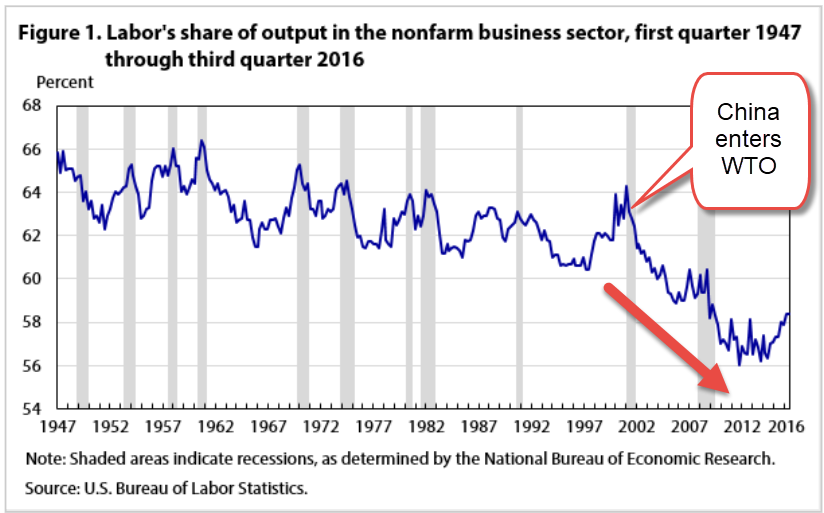
Let’s turn to a trend that has developed since China was admitted to the World Trade Organization (WTO) in 2001. A year ago two BLS economists presented a historical estimate of labor’s share of yearly GDP since World War 2. If GDP is $100, how much went to the people who produced that output?

The authors describe it: “The labor share is the percentage of economic output that accrues to workers in the form of compensation. It is calculated by dividing the compensation earned during a certain period by the economic output produced over the same period.” The paper is intended for an academic audience, but I will extract some disturbing highlights. First of all, the graph.

LaborShareOfGDP

Note the sharp decline after China was admitted into the World Trade Organization (WTO) in 2001. Some economists have concluded that half of the decline can be attributed to the mobility of computerized capital. Firms can produce a $100 of output with less labor and more of this mobile capital.

Labor in the U.S. is gradually being converted into capital. A business owner may be able to cut his labor costs by buying a machine. A rule of thumb in some industries is a two-year payback period for an investment of this type. Let’s say an owner can save $50,000 per year in labor costs with a machine. Using the two-year rule of thumb, they would not want to pay more than $100K for that machine.

During the past two decades, Asian factories have greatly improved their manufacture of such production machinery and the lower labor costs in Asian makes the machines cheaper. Quality up, costs down. It makes economic sense for more American business owners to replace some of their workers with machines. Before replacement: $100 output by the firm took $65 of labor and $20 of capital and included a profit of $15. After buying the machine, the figures might look like this initially: $100 of output by the firm costs $60 of labor, $25 capital, $15 profit. The $5 that used to go to an American worker now goes to a company in Japan and a bank in America that financed the purchase of the machine.

That laid off American worker bought stuff in their local community. Their sales and property taxes supported the services provided by the community. Although the machine may need maintenance and repairs, it doesn’t spend money regularly in the community, nor require community services like schools, police and medical care.

Donald Trump was elected President based on his claim that his administration would reverse this two decade trend.  The tariffs announced this week will have a small beneficial effect on workers in those industries because steel and aluminum manufacturing have become much more automated in the past twenty years.  The aluminum tariff will add about 1 penny to the cost of a can of beer. The tariffs are a symbolic nod to a campaign pledge that Trump made to those in the rust belt.

I applaud Trump for remembering his campaign pledges.  Professional politicians have long understood that campaign pledges are rhetoric that must fall to conflicting political alliances. Six months after taking office, most pledges have been broken or quietly slipped to the rear of an administration’s porfolio.  Trump has not forgotten the voters who put him in office, but he does have trouble maintaining a consistent stance on gun policy or immigration.  Keep those seat belts buckled.

Free Trade

March 20, 2016

This week’s blog will be about free trade.  Donald Trump first made it one of two signature Presidential campaign issues, then Bernie Sanders joined the chorus and now Hillary Clinton has made it part of her campaign speech. Have trade agreements with other countries put Americans at a disadvantage?

Most economists will not even entertain the idea.  The benefits of free trade are ultimately based on the benefits of specialization, the idea that everyone benefits when the most efficient producers supply a good or service.  Each producer achieves a comparative advantage (CA) in that specialization.   First formalized by economist David Ricardo in the 19th century, CA has long been a bedrock of micro-economic theory and introductory economics textbooks.

Greg Mankiw’s Prinicples of Economics cites the example of a rancher and farmer, who both benefit when they specialize.  The rancher concentrates on raising beef, the farmer raises potatoes and they produce more beef and potatoes at a lower cost than if the rancher and farmer did both. (Chapter 3)

A key concept to understanding CA is another bedrock economic principle:  opportunity cost, or what someone has to give up (the cost) to get some good or service (opportunity).  Each person, each country wants to minimize the cost to take advantage of the opportunity.

The same principle can be extended to international trade.  If a Mexican company can produce a good at a more efficient cost than an American company, then Americans will benefit if they buy the good from Mexico and sell something to Mexico which an American company can produce at a cheaper cost.  The ill effects in a particular part of the country are balanced by the good effects in another part of the country or economy, and lower prices benefit all Americans.

When countries impose tariffs on imports, those goods become more expensive for consumers. Economists talk about the “deadweight loss” from tariffs. Here is a graph of the negative effects of tariffs and more discussion on the topic.

The matter would seem settled then, as economist Paul Krugman noted in a 1987 paper : “the underlying commonality among conventional trade models is such that until a few years ago international trade theory was one of the most unified fields in economics.”

As early as the 1960s, economists questioned some aspects of conventional trade models, leading to the development of new models. Krugman notes, “The new view of international trade holds that trade is to an important degree driven by economies of scale rather than comparative advantage, and that international markets are typically imperfectly competitive.” [my emphasis]

Economies of scale. What’s that? This idea, also called increasing return, is when a producer gets a greater growth in outputs than the growth in inputs.  Increasing returns become a force separate from comparative advantage that leads to a “geographical concentration of production of each good,” or regional oligopolies.  We see this phenomenon in southeast Asia, Indonesia and Australia, where a complex web of materials and components production dominates the global electronics market.

“The view that free trade is the best of all possible policies is part of the general case for laissez-faire in a market economy, and rests on the proposition that markets are efficient. If increasing returns and imperfect competition are necessary parts of the explanation of international trade, however, we are living in a second-best world where government intervention can in principle improve on market outcomes.” [my emphasis]  The new idea in trade models is that strategic trade policy by a government “can tilt the terms of oligopolistic competition to shift excess returns from foreign to domestic firms.”  On the campaign stump, Trump makes the same case, although a bit less elegantly; that the U.S. government should make trade deals that shift the benefits of trade back to American workers and producers.  Is Trump channeling Paul Krugman?

Not quite.  Krugman notes three sometimes vociferous criticisms of government intervention. 1) The difficulty in measuring, understanding and modeling imperfect markets makes it impossible to formulate just the right policy.  2) If the government is going to intervene, companies will devote some resources to compete for favors from government, a process called “rent-seeking.” 3) Markets will make adjustments to offset intervention.  Other governments will initiate policies to counter the effects of a government’s intervention.

Krugman concludes “This is not the old argument that free trade is optimal because markets are efficient. Instead, it is a sadder but wiser argument for free trade as a rule of thumb in a world whose politics are as imperfect as its markets.”  This is the argument that Adam Smith made for laissez-faire capitalism, finding it undesireable but better than the alternatives.  Smith spent considerable effort in his book The Wealth of Nations to recount the degree of political corruption that distorted economies and society, that poisoned the human character.

That Krugman disregards those cautions when he favors government intervention within domestic markets confirms the fact that economists are human.

Economist Ian Fletcher presents far more arguments against free trade than Krugman. I would add an additional consideration.  When economists compute the costs of free trade policies, they use a model which does not include the economic benefits provided to workers displaced by free trade policies.  The costs are presumed to be offset by higher taxes from those areas of the country which benefit from free trade.  Admittably, these costs and additional tax revenues attributable to free trade policies are difficult to measure.  However, I do think that the effort should be made.  I suspect that the benefits paid to dislocated workers and the total negative effect, the multiplier, of the lost economic activity have not been fully accounted for and that free trade is much more costly than conventional models portray.

Even if we can measure and agree on the facts, we can not agree on what those facts mean.  Whatever the facts, we prefer our familiar and favorite idea.  They not only reassure us but are also well integrated into our values, and our philosophical sense of life.

Global Trade Recovery

The Bureau of Economic Policy Analysis, based in the Netherlands, recently reported that their index of global trade rose 3.5% in July. Although trade is 16% below the level of spring 2008, the 3 month average has shown an increase of .5%, it’s first rise in a year. The July ending 3 month average of industrial production increased by 3.2% but production was still 1.9% down in the U.S. Japan and Asia are leaking the pack in the production rebound.

Annual trade volume, though, was down more than 11% and far below the growth rate of 2006. A month ago, the U.S. imposed trade tariffs of 35% on tires from China. Last week, the European Union slapped tariffs of 40% on steel pipe from China. Contending with high unemployment during a global recession, governments come under pressure from their domestic industries and unions to preserve market share and jobs. During the depression of the 1930s, the U.S. unilaterally imposed a number of high tariffs, which led to retaliatory tariffs from other countries. The stifling of trade during that decade had a drastic impact on the economies of many nations. Hopefully, leaders in the G-20 nations will have learned from the lessons of the 1930s.