Landlord and Tenant

April 14, 2024

by Stephen Stofka

This week I will continue my look at housing, focusing on the dual role of homeowners. There are several advantages to owning a home, one of which is a type of self-imposed rent control. Our mortgage payments are fixed for the term of the mortgage, so we do not have to worry about a 10% rent increase from our landlord. We are the landlord, and we are our favorite tenant. While the mortgage payments remain stable, the maintenance costs for the home do not. The house may need a new furnace, hot water heater, updated plumbing or a new sewer line, major expenses that remind us that we are the owners of an investment property.

In this dual role, a  homeowner takes money out of her right tenant’s pocket each month and puts it in her left landlord’s pocket. As landlord, a homeowner does not report that income nor does she report the mortgage payments and expenses necessary to maintain the property. The Census Bureau estimates that homeowners with a mortgage spend $1900 a month. Those without a mortgage spend about $600.

The federal government calls the difference between this implied income and expenses a net imputed rental income and estimated (pdf link) that the tax exclusion saved homeowners $135 billion in 2023 (p. 22).

What is the average yearly tax saving for a homeowner? The Census Bureau estimated that there are 143 million households with an owner-occupancy rate of almost 65%. That results in 93 million owner-occupied homes, making the tax exclusion worth almost $1500 yearly to a homeowner that is not available to a renter. The tax exclusion is worth much more than average to those with higher incomes and more expensive homes.

When we sell the home, we hope to realize a capital gain from the home in addition to the cash flows we received while we were living in the home. After Congress changed the law in 1997, most homeowners do not have to pay tax on the capital gains from their home, an exclusion estimated at $45 billion in 2023. Real estate property is treated differently than other assets under the tax code, an implicit recognition that property ownership has a value to the community where the property is situated. A house attached to the land by a foundation is immoveable and taxed differently than a moveable asset like a car. In fact, a mobile home is taxed similarly to cars while the land the mobile home sits on is taxed like real estate (Investopedia bulletin).

Some assets provide a series of cash flows while we own them; some do not. In the case of a house, an owner’s implied cash flows start as soon as we take possession of the house. The house provides us with a housing service while we live in it. In the Consumer Price Index (CPI) published each month, the Bureau of Labor Statistics (BLS)  includes a calculation of what it calls owner equivalent rent, OER. This is an estimate of what a homeowner would rent out their home to a stranger. The estimate is based on rental prices for similar units in the area, but the calculation uses survey data that is slightly out of date. Some analysts do not think this implied income should be 25% of the CPI calculation, and the Eurozone countries do not include it in their CPI estimates. Below is a chart comparing the EU method, what is called the Harmonized CPI (FRED Series HICP), and the headline CPI (CPIAUCSL) produced by the BLS each month.

Notice the divergence between the two series starting in 2014. During the financial crisis, homebuilders started  the fewest number of multi-family units per capita in modern history. This laid the foundation for the next crisis, and the pandemic sparked a remote work trend that disrupted the customary supply and demand for housing. In the chart below I have charted the number of multifamily units per capita and highlighted the fallout from the S&L Crisis and the financial crisis.

We can see that the rent of a primary residence and the estimate of OER track each other pretty closely. In the following graph I compare the survey of actual rents to the OER estimate and index it to the beginning of 2014 to illustrate the trends more closely. In 2014, rents (redline) began to grow faster than OER, indicating the pricing power migrating to landlords several years after the financial crisis. In the decade that followed, housing costs grew 50%, an annual growth rate of 4%, higher than the 75-year average of 3.6% or the 30-year average of 3.7% (see notes). Most of the above average growth has been in the three-year recovery from the pandemic.

The cost of housing rises faster than the overall price level and faster than incomes. Homeownership limits the actual impact of rising housing costs on an owner’s budget. A homeowner plays the dual role of landlord and tenant and receives favorable tax treatment of imputed income and capital gains. Given these long-term averages, can a buyer calculate the price they would be willing to pay for a home from its future cash flows? I will look at that next week.

///////////////////

Photo by krakenimages on Unsplash

Hui Shan (2011) has written a brief history of the tax treatment of housing capital gains and measured the effect of the 1997 tax law on home sales in the Boston area.

Owner’s Equivalent Rent of primary residence in U.S. City Average is FRED Series CUSR0000SEHC01. Rent of primary residence in U.S. City Average is CUUR0000SEHA.

Annual growth rates: Average annual growth rates are calculated over a rolling 10-year period.

Subsidies and Deficits

November 12, 2023

by Stephen Stofka

Note: at the end is a correction to last week’s letter.

This week’s letter continues to investigate the subsidies, both direct and indirect, that secure re-election for politicians but make deficits inevitable. This week there was weak market demand for $24 billion of newly issued 30-year Treasury bonds, forcing primary dealers like J.P. Morgan to absorb 24% of the debt, more than twice their usual participation rate. Treasury bonds carry little if any credit risk because the U.S. can always pay its debts by issuing more debt. However, long term debt exposes traders to market risk that they must offset by demanding a higher rate of interest for purchasing the debt. Higher interest payments narrow the budget space for subsidies and benefit programs that politicians dole out to gain constituent support. The long term outlook is that our arguments over fairness will cause greater fractures in our society.

As social animals we begin at an early age to form a sense of fairness that can test parents’ patience. An older sibling gets to stay up later at night and that is unfair. The level of chocolate milk is lower in one glass than in a sibling’s glass and that is unfair. We sympathize with animals who suffer the loss of their parents, their herd, or their environment. While we may have an instinctive ability to recognize unfairness, we must be taught how to construct rules that are based on fairness. These involve conflicts over sharing toys, a playroom, or a TV game console. Through experience and temperament, we build a framework of fairness that is unique. As we grow older we glue these values together with justifications and associate with others who share similar values. We form interest groups that compete for federal, state and local benefits, reasoning that our welfare is the general welfare.

We have been taught since childhood that public laws and public monies should be spent on the public good. We may not recognize property arrangements that advantage one group by disadvantaging another group, or at the expense of the general public. The exchange of goods and services take place in a web of property rights whose density obscures the dependencies between parties. Those rights are instituted and enforced by a network of government institutions – a legislature or council, an executive agency, the courts and a police force. Those rights favor a majority according to some characteristic, or an effective interest group that directs public money and property to their cause.

At the heart of most contentious Supreme Court decisions is the reality that one group of people in this country are going to indirectly subsidize others. One group of people will have to give up something – call it rights, power or a sense of safety – for other people to enjoy rights, power or greater security. More than 200 years ago, Adam Smith wrote that a well governed society with a respect for private property could produce a greater prosperity for everyone in the society. His was a long term vision. In the short term empowerment is a zero sum game and that is why so many issues in our society are contentious.

When a subsidy benefits a relatively small group of people, they fight hard to protect that subsidy. When the costs for the subsidy are spread over a large group, there is little opposition to the subsidy. An interest group becomes part of an Iron Triangle to protect the subsidy. This triangle consists of the interest group, a legislative subcommittee and an executive agency. An example is the ethanol subsidy. Department of Energy data shows that, in 2022, 35% of the corn crop in America was devoted to the manufacture of ethanol. Over its life cycle, ethanol added to gasoline reduces greenhouse gas emissions (GHG) by 40%, according to several studies. Farmers receive a maximum subsidy of $20 per dry ton of corn or other feedstock that they sell to biofuel plants. Biofuel producers receive a tax credit of 46 cents per gallon of ethanol. The consumer’s cost for the 10% addition of ethanol is small. The benefits to the ethanol blenders and farmers is large. A senator or representative in a farm state like Iowa is expected to protect that subsidy.

As I noted last week, just six tax expenditures reduced tax revenue to Treasury by almost $700 billion last year, more than half the total deficit. The largest expenditures were the exclusion of employer paid pension contributions and health insurance premiums. How many of us will agree to give up their tax exclusion in the interest of making tax rules uniform? Homeowners can enjoy 30-year mortgages at low rates because the federal government effectively underwrites those mortgages. In Britain, homeowners do not enjoy the protection of decades-long mortgages. According to a recent article in Forbes, 800,000 fixed rate mortgages in Britain were due in 2023, and 1.6 million will be due in 2024. Homeowners will have to remortgage at higher rates.

The slim Republican majority in the House cannot agree within their own caucus to bring a bill before the House for a vote. Lawmakers prefer to complain about spending because that is a popular stance with their constituents. A lawmaker’s abiding concern is getting re-elected by their constituents. Few will complain about raising tax revenues if the revenues are to come from a broad group of taxpayers. Democratic politicians argue for higher taxes on a small group of the rich for fear of antagonizing the majority of their voters. Reducing revenue by subsidies and tax exclusions is as much a policy choice as spending appropriations. Without a continuing resolution in the next week, the federal government will begin to shut down non-essential facilities. The House has not been able to produce a budget on time in thirty years because lawmakers have limited choices. Taxpayers, favored industries and social welfare interest groups will oppose a lawmaker who advocates the elimination of a tax exclusion, a subsidy reduction for producers or households.

We are a nation competing for space at the public trough. For at least a generation, our federal government will be unwilling to collect enough revenue to meet spending commitments. Buyers of U.S. debt will realize the inevitability of deficits rising faster than economic growth and reduce their holdings of long term bonds.

//////////////////

[Photo by Anna Samoylova on Unsplash

Keywords: ethanol, subsidy, tax expenditures, deficit

Correction: In last week’s letter I wrote twice last year’s deficit of $118 billion.” The link was to the average monthly deficit. That should have read “twice last year’s average monthly deficit of $118 billion,” not the deficit for the entire year. The total deficit for last year was $1.375 trillion.

Subsidies and Fairness

November 5, 2023

by Stephen Stofka

This week’s letter is about subsidies and fairness. The culture of Western civilization emphasizes individual effort and achievement while downplaying our reliance on others. In the past two weeks, I have questioned an economic assumption that workers are paid the value of their marginal product. This week I will extend that analysis toward other commodities in our lives. Our society is a network of cross-subsidies; we often don’t pay the marginal cost of what we buy or pay our fair share of taxes into the public pot because of tax subsidies we receive. We judge the fairness of a subsidy by the recipient of the subsidy and we tend to favor ourselves as deserving of the subsidies we receive.

This month oil refiners are selling unleaded gasoline near a breakeven cost to wholesalers at $2.20 per gallon, reported the Wall St. Journal. A week ago, the spot price of WTI crude was about $83.00, making the per gallon cost almost $2 per gallon (see oil notes at end). The public uses less gasoline during the winter months so the slack demand reduces pricing power at the wholesale and retail level. A 20 cent profit on a gallon of gasoline does not allow oil refiners to meet their “hurdle rate,” the expected return on investment. The users of diesel and jet fuel, business customer whose demand is less seasonal, make up the difference in profits. The heaviest users of these products are trucking companies, power plants and the airlines. The users of diesel and jet fuel are effectively subsidizing the lower gasoline prices for consumers.

Is it fair that women should spent double the amount of time caring for children that men do, according to the American Time Use Survey. Is it fair that tax revenues from some states are used to subsidize the incomes of people in other states? Vermont, W. Virginia and Alaska rely on federal grants for more than a third of their budget, according to a recent report from the Office of Management and Budget and the Census Bureau. Less than a sixth of Colorado’s budget relies on federal aid.

Many subsidies are indirectly awarded through the tax system. Three of the biggest items are employer contributions to pension plans, employer-paid health insurance premiums and imputed rental income, or owner’s equivalent rent. Employers write off their contribution to an employee’s pension plan but the employee does not report the income. The U.S. Treasury estimated the tax subsidy of the various types of pension plans and IRAs was $228 billion in 2022, a sixth of last year’s deficit of $1,378 billion. Employers write off health insurance premiums they pay for their employees but that expense is not included in personal income. In 2022, the tax loss was estimated at $221 billion. Homeowners make a capital investment in their homes but do not report the annual rental income – termed an imputed rental income – they receive from that investment. In 2022, the Treasury estimated that tax subsidy at $131 billion. We may complain about the deficit but no one lobbies to reduce these subsidies.

Long-term capital gains from investments are taxed at lower rates than ordinary income. That tax exclusion favors the top half of taxpayers and had an estimated cost of $108 billion in foregone tax revenue in 2022. Tax law allows beneficiaries to inherit stocks and other investments at current valuations so that heirs are not responsible for the capital gains accrued during the lifetime of the deceased. That method of valuation is called a step-up and cost the government an estimated $44 billion in 2022. Certain service providers like lawyers and accountants enjoy a 20% deduction on their business income. This pass-through income exclusion had an estimated cost of $56 billion in 2022, about the same amount as the deduction for charitable contributions. In contrast, federal agricultural subsidies were only $15 billion, about ¼% of total federal spending. Like foreign aid, people often overestimate how much the U.S. government subsidizes farmers.

Libertarians devoted to methodological individualism or an 18th century ideal of the yeoman farmer reject the notion of an income tax subsidy. The income belongs to the individual, not the government, and the government cannot rightfully extract a tax without the consent of the individual. A person can avoid or reduce the burden of a sales or excise tax by not buying something or buying a lower cost item. An income tax is levied on someone’s effort. Religious conservatives might reject the legitimacy of an income tax for that very reason. They argue that it was God who commanded that we work after ejecting Adam and Eve from the Garden of Eden. A tax on our effort then is an affront to God’s own commandment.

Some discredit the legitimacy of any tax if they don’t like how the tax money is spent. In 1964, the singer Joan Baez refused to pay 60% of her income tax because the government was using the money for the war in Vietnam. In 1967, writers and editors protested the “Vietnam war tax,” a 10% surcharge on telephone service each month. In response to Bush’s War on Terror, the Code Pink campaign and other tax protesters refused to pay a portion of their taxes. Some were jailed and others had their bank accounts and wages seized by the IRS.

We can’t always stipulate why we think something is fair or unfair but we know it when we see it. Each of us builds a personal framework of justifications for our beliefs and opinions, then finds others with similar frameworks. Our opinions of fairness don’t matter unless we can join with others who have the same criteria we do. Finding others who share our fairness preference validates our sense of justice and raises our personal preference closer to that of a universal law. The more people who share our outrage at an injustice confirms our convictions. However, our assessments of fairness are not universal or eternal. They can change with our circumstances – our age or income, our access to resources. This idea – that justice is a communal agreement about what is fair – disturbs those who prefer to believe that there are universal truths. There may be universal facts like gravity but there is only one universal truth – on average, people give greater consideration to whatever is closer to them.

////////////////////

Photo by Andrew Moca on Unsplash

Keywords: oil, subsidy, sales tax, income tax, tax protest, tax expenditures

Oil notes: A barrel of oil is 42 gallons is different than a drum, which typically has a 55 gallon capacity. The price of a barrel of oil divided by 42 is the spot price of a gallon of oil. WTI crude closed slightly lower at the end of this week at $80.51.

Avoidable Taxes

April 19, 2015

Taxes

Some call them loopholes, tax breaks, or giveaways but the official name for them are tax expenditures.  In August of last year, the Joint (House and Senate) Committee on Taxation detailed  the many gimmes in the tax code.  The Pew Research Center graphed out the largest expenditures including the big banana, tax free employer paid health insurance premiums. (They forgot to include the $38 billion in Sec. 125 cafeteria plans.) That program started during World War 2 when wage increases were frozen by law.  That war ended 70 years ago but the “temporary” tax break goes on and on.

The list of giveaways runs for 12 pages. Those with incomes above $100,000 get 80% of the mortgage interest deduction (page 37), 90% of real estate tax write-offs (page 38),  60% of the child care credits (page 39), and claim 86% of the charitable contributions (page 38).  Reduced rates on dividends and capital gains cost almost $100 billion in 2014.

28 million low income families qualify for the earned income tax credit but the $68 billion cost for that is less than half the cost of tax free health insurance premiums.  Almost 37 million families claim a child tax credit for $57 billion dollars (page 41).

Seniors get $60 billion of gimmes in tax free Medicare benefits (page 32).  In 2015, tax breaks for all types of medical spending will total almost 1/4 trillion dollars in foregone tax revenue.   As spring arrives, let’s lobby for tax deductions for gardening expenses.  Gardening is therapeutic, a genuine medical expense.

*************************

CWPI

As expected, the composite Purchasing Managers Index (PMI) in the manufacturing and service sectors declined further but remains strong. We may see a slight decline for one more month before the cycle upwards starts again.

New orders and employment in the service sectors is strong and growing, offsetting some weakness in the manufacturing sector.

March’s retail sales gain of almost 1% was a bit heartening after the winter slump.  Excluding auto sales, year over year gains have dropped sharply since November and the trend continued in March as the yearly gain was only 1/4%.

************************

Labor Market Conditions Index

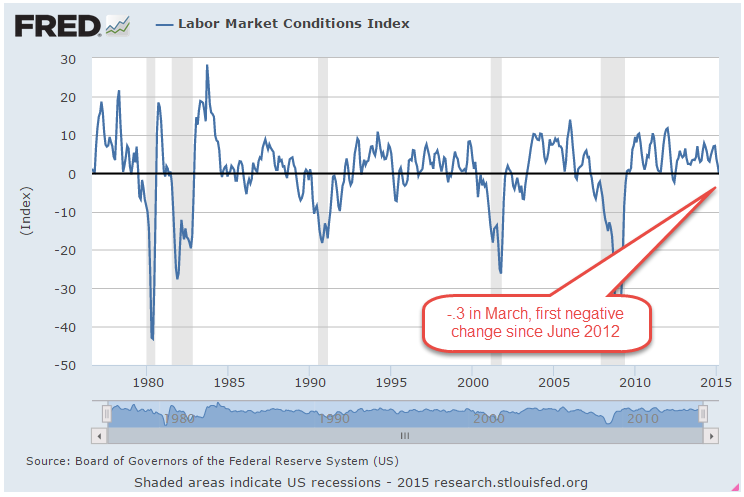
The Federal Reserve takes about a week after the release of the monthly labor report to compile their Labor Market Conditions Index (LMCI), a comprehensive snapshot of the many facets of the labor market.  For the first time in three years, the index turned negative in March.  It barely crossed below 0 but is sure to give some pause, a watch and wait when the FOMC meets at the end of this month.  While some of the FOMC members have been making a more aggressive case for raising interest rates, chair Janet Yellen is sure to point out that the economy is below target in both employment and inflation.

************************

Mortgage Banking

In an April 8th article, the Wall St. Journal reported that loans backed by bank deposits fell from 44% in 1980 to 20% in 2008.  Since 2012, the big banks have fled the mortgage business and now account for only a third of new federally guaranteed mortgages.  Small finance companies, which avoid much of the oversight and regulation in Dodd-Frank, now account for more than half of new mortgages.

************************