Politics and Principles

July 13, 2025

by Stephen Stofka

Sunday morning and another breakfast with the boys as they discuss world events and persistent problems. The conversations are voiced by Abel, a Wilsonian with a faith that government can ameliorate social and economic injustices to improve society’s welfare, and Cain, who believes that individual autonomy, the free market and the price system promote the greatest good.

Abel sat back in his seat as the busser poured some coffee. “I wonder how much Trump’s tariffs on Brazil will raise coffee prices.”

Cain waited a moment until the busser left. “I wish Senate Republicans would challenge him on that. I mean, we export more to Brazil than we import. Congress just cowers in the corner while Trump engages in all these petty political vendettas.”

As soon as the busser left, the waitress arrived to take their orders. Abel tucked his table napkin into his belt. “A few weeks ago, we were talking about inequality before and after taxes. Last week, Paul Krugman wrote about the growing inequality since  the 1980s. He mentioned a paper where the authors recommended a 73% top marginal income tax rate, more like the rates this country had in the period after World War 2 (Source). There was more equality, and we paid down the war debt.”

Cain tilted his head slightly. “An accountant will tell you that it’s the effective tax rate that counts more than the marginal rate. That’s the bottom line. So, in the 1950s and 1960s, there were high marginal tax rates, but the rich had so many tax write-offs available to them that it reduced their effective tax rate to about 30 – 35% (Source).”

Abel argued, “Well, that’s still higher than the current effective rate, about 25% (Source). I mean, back in 1980, the top 1% got about 10% of all the income in the country. Now, they get like 20% (Source, Slide 11).”

Cain raised his eyebrows. “And how much has their share of taxes gone up? The Tax Foundation analyzed income tax data from the IRS for 2022. The top 1% had 22% of adjusted gross income but paid 40% of income taxes. The bottom 50% had 10% of the income but paid only 3% of the tax (Source). So, the top half are paying almost all of the income tax burden but liberals like AOC and Bernie Sanders don’t think they are paying their ‘fair share.’”

Abel argued, “Well, the earned income tax is a refund of taxes to those families in the bottom 10%. That distorts the figure for the lower half of incomes. I’ll bet if the earned income tax credit were excluded the bottom half pay a lot more than 3%.”

Cain shook his head. “The credit is about 2% of income taxes collected (Source). That will make only a slight difference in the percentages. The fact remains that the top half are carrying all of the burden already. And another thing. The federal government collected 20% of GDP in 2022. That’s already more than 10% above the long-term average. The government is already taking a big chunk of taxpayer money and still running up big deficits. The problem is spending, not taxes.”

Abel rolled his eyes. “The problem is inequality. Higher taxes help tackle that problem.”

Cain shook his head. “Economic growth and higher productivity helps tackle the problem. Hey, change of subject. I wanted to ask you about the abortion decision by the Wisconsin Supreme Court a few weeks ago. Did you have a chance to dig into that?”

Abel looked into the distance as he tried to recall. “Oh, yeah. That state’s Supreme Court held that an 1849 law banning abortion had been implicitly repealed by subsequent laws. I had never heard of ‘implied repeal’ of a law. It’s when a legislature doesn’t expressly repeal a law but passes a number of laws afterward that can only be valid if the first law is assumed to be void. Therefore, an implicit repeal.”

Cain smirked. “Declaring a law void seems to me like the judiciary was overstepping its bounds.”

Abel nodded. “It was a 4-3 decision and boy, the dissent from the conservative minority made that point very passionately. The majority used a 1941 decision from that same court and, wait, I’ve got it here. Back in 1941, the court said that it had a duty to treat conflicts in separate laws as though both were operative, ‘if possible.’ Note the ‘if possible’ part. So that court stressed that implied repeals should only be recognized, another quote, ‘when the intent of the legislature clearly appears’ (Source).”

Cain sighed. “Let me guess. The conservatives didn’t think that the subsequent laws demonstrated the clear intent of the legislature.”

Abel shrugged. “Right. Those subsequent laws were passed after Roe v Wade. So, of course, the legislature treated the 1849 law as moot because the Roe decision said those abortion laws were unconstitutional. Would those laws have been passed if the Roe decision had not been handed down? Like so many things in this life, it’s not so clear.”

Cain frowned. “The Roe decision sparked a resistance movement among conservatives. A decade later, John Leo founded the Federalist Society (Source). To the conservative justices on the Wisconsin Supreme Court, the Dobbs decision to overturn Roe basically invalidated, or lessened the significance of those laws passed after Roe.”

Abel said, “The majority quoted a Pro Publica article that sepsis cases were up 50% since Texas outlawed abortion after Dobbs. Maternal deaths were up by a third (Source). So the majority was also considering the consequences of their decision. A few weeks ago, I was talking about Justice Breyer’s book Reading the Constitution. He wrote about the struggle in judicial interpretation. Rules or values. Breyer chose values. Conservatives prefer rules. Breyer would consider whether the consequences of a decision undermined the values a law protected. Conservatives preferred rules with less regard for consequences. Breyer and Scalia would often debate in public on these types of interpretation.”

Cain smirked. “In last year’s presidential immunity cases, the conservatives were all about consequences. In oral arguments, Gorsuch said he was looking past the actions of Trump because the court was writing ‘a rule for the ages’ (Source). What pomposity. Like they were handing down the Ten Commandments.”

Abel rolled his eyes. “Yes, but only conservative decisions are rules for the ages. Apparently not the Roe or Casey decisions that validated a right to have an abortion. Not guns laws or campaign finance laws. These conservative justices demonstrate such a lack of consistency and clarity in their decisions. Anyway, I wanted to get your feedback on the Big Bogus Bill, as you call it.”

 Cain replied, “Well, I hate this kind of legislation no matter which party pushes it through. Reconciliation bills are a grab bag of legislative candy. Who invented the reconciliation process? Democrats, of course. My biggest objection is that the bill increases the deficit when the economy is good.”

Abel interrupted, “The federal debt gets larger every year, the rich buy that debt, and the federal government pays those rich people interest on the money it didn’t tax them. It’s a reverse tax, like an unearned income tax credit for rich people.”

Cain smiled. “That’s one way of looking at it. But remember that, when Trump left office in 2020, the interest on the debt was 15 cents for every dollar the federal government collected. When Biden left in 2024, it was 22 cents of every dollar (Source).”

Abel argued, “Well, the interest on the debt was relatively a lot worse under Reagan, Bush and most of Clinton’s term. What’s happened since then? Twenty years ago, Republicans started giving away tax cuts to rich people.”

Cain replied, “Whoa, there, pardner. All the entitlement programs that liberals passed have been the main contributor to the debt, if you ask me. We talked about this last week. Medicaid spending is up to a trillion by now. That’s more than 3% of the country’s GDP. In 1990, we spent five times as much on defense as on Medicaid. Now they are almost equal (Source). This country needs to have a conversation about our priorities.”

Abel sighed. “Health care is an implied right. Life, liberty and the pursuit of happiness is not possible without health care.”

Cain argued, “Defense is an explicit right. The founders stated that in the first sentence of the Constitution (Source).”

Abel interrupted, “And the general welfare was in that same sentence. Health care is a key component of the general welfare.”

Cain shook his head. “They meant the common welfare, the welfare common to everyone.”

Abel showed exasperation. “We argued about this last week and how many times before that? What does ‘general welfare’ mean? So, didn’t you like about the bill?”

Cain replied, “I thought it was dumb that they are cutting back on incentives for wind and solar energy. I’m an ‘all of the above’ guy when it comes to energy. So is Texas, a red state.”

Abel rolled his eyes. “The White House says that they are reducing energy costs by expanding fossil fuel production (Source).”

Cain smirked. “Fine, but why hobble wind and solar production? It’s stupid. It’s just vindictive politics. I’m sick of this childish shit from people who are supposed to be the leaders of this country. This is the kind of stuff kids in middle school do.”

Abel replied, “Seniors get an extra tax break. An older couple can deduct almost $48,000 (Source). According to the Census Bureau’s Supplemental Poverty Measure, 14% of seniors were poor, so this might help reduce that. Help them pay for medical expenses (Source).”

Cain shook his head. “I liked the simpler deduction in the 2017 so I’m glad they kept that. The extra deduction for seniors won’t help poorer seniors much. This deduction basically eliminates income taxes for seniors in the bottom 50% who barely pay income taxes as it is (Source). Poor seniors won’t get a refund if their taxable income is negative. It’s seniors in the top half who will benefit most from the extra deduction. This government already gives plenty to seniors. Too much, if you ask me.”

Abel asked, “Did you see anything you liked?”

Cain replied, “I like the ability to fully expense short-term capital investment. Better allowances for depreciation which is pretty high in tech industries. The Tax Foundation has an article and video explaining some of the good, bad and ugly in the bill (Source).”

Abel asked, “What about the work requirement? Like half the people who are aged 50-64 and on Medicaid are disabled (Source). Ok, maybe some can work. Can they work 20 hours a week to stay on the program? Who knows?”

Cain nodded. “I liked the discipline of it, but they went overboard. Do the states have the resources to monitor all these requirements? No. Does the law give the states some flexibility or specific funding to carry out the law? No. This is another one of those unfunded federal mandates. It’s sad to see Republicans using the Democrats’ playbook.”

Abel said, “I wish Murkowski had not buckled to pressure and just voted no on that bill. She said she didn’t like the bill but hoped that the House would change some provisions. What kind of spineless response is that? The Tax Foundation estimated that continuing these tax cuts will add $4.5 trillion to the debt over a ten-year window (Source). A bunch of old people in Congress passing laws that benefit the rich and the old, then sticking our kids with the bill.”

Cain smiled as he glanced at his watch. “That reminds me. I can’t remember whose turn it is. I got to go help my daughter with something.”

Abel replied, “Yours. Hey, I hear people like the new Superman movie. A story about someone who acts on principle rather than political expediency.”

Cain laughed as he slid out of his seat. “Most of us try to live up to our principles. Yet we have leaders who pay more attention to political expediency than principles.”

Abel looked up at Cain. “The saying goes, ‘you can’t govern if you don’t win.’ Unfortunately, our political system and news cycle focuses on the contest, the winning, rather than the principles.”

Cain nodded as he turned to leave. “Hmmm, something to think about. I’ll see you next week.”

//////////////

Image by ChatGPT

Homeless

April 20, 2025

By Stephen Stofka

This is part of a series on persistent problems. The conversations are voiced by Abel, a Wilsonian with a faith that government can ameliorate social and economic injustices to improve society’s welfare, and Cain, who believes that individual autonomy, the free market and the price system promote the greatest good.

Abel waited until the waiter had finished pouring the coffee, then said, “This week, Trump is threatening to take away Harvard’s tax-exempt status. This country is becoming a banana republic where those in power use the state to go after their political rivals.”

Cain dribbled a small amount of sugar into his coffee then set the sugar packet on the table. “In his first administration, Trump put an excise tax on the biggest universities (Source). Certainly, there are a lot of religious conservatives who resent the denial of tax-exempt status to religious universities like Bob Jones University.”

Abel argued, “That was a long time ago and the issue was whether Bob Jones was a non-profit institution, not that it was religious. Colorado Christian University in Denver is tax-exempt, for example (Source).”

Cain replied, “Last week you talked about Make America Fair Again. One group of people perceive something as unfair, and that grievance helps bind them together. Another group of people faults the first group for being unreasonable, and the first group circles their wagons, convinced that they are being picked on. Remember when a lot of Tea Party groups were denied tax-exempt status?”

Abel nodded. “The IRS didn’t deny their applications, but put them on hold. Any applications with the words Tea Party or patriots in the name (Source). The agency was overwhelmed with 501(c)(4) applications for the 2010 midterms. One of the reasons they were overwhelmed was that Republicans had cut funding to the agency while they were in power.”

Cain set his cup down. “Perfectly rational explanations. Or a conspiracy? Rebutting a grievance with logical arguments is fruitless, yet we continue to do it. Expressing a grievance is a form of signaling to others. Political parties are built on shared grievances as well as shared principles, perspectives and values.”

Abel smiled. “Good point. This country was founded on shared grievances. ‘Abuses and usurpations’ the Declaration of Independence called them, and most of that declaration is filled with grievances, not the noble sentiments about life, liberty and the pursuit of happiness (Source).

Cain waited as the waiter set the food on the table, then said, “So we were going to talk about collective action problems, something other than the latest abuse by the mad king.”

Abel laughed. “That describes him well. His niece, Mary Trump, warned us in Too Much and Never Enough, the book she wrote about her Uncle Donald.”

Cain sighed. “In his second administration, we are discovering how rash he can be. He’s worse than any Democratic president I can recall for his interference in the economy and the market.”

Abel asked, “Worse than a President Bernie Sanders?”

Cain nodded. “Sure. Bernie has some respect for institutional rules. Trump couldn’t care less. Hey, we were going to talk about something other than Trump this week.”

Abel replied, “Right. I’ve been thinking about homelessness. You are always championing the role of incentives. I thought of a policy that would align incentives to allow more permissive zoning.”

Cain reached for his back pocket. “Let me hold onto my wallet.”

Abel laughed. “There are several characteristics of collective action problems and dealing with the homeless has several of those. People resist multi-family development for fear that it will lower the value of their home. Zoning that permits only single-family housing reduces the opportunities for developers to build more housing. A shortage of housing causes home prices and rents to rise, increasing homelessness.”

Cain interrupted, “Less supply, higher housing costs. Classic supply demand response. But rising home prices are a good thing for an existing homeowner. Naturally, they want policies that preserve the value of their asset.”

Abel nodded. “That’s my point. What’s good for each individual homeowner may not be good for society as a whole. Individual benefit, group loss. Garret Hardin pointed that out in his essay Tragedy of the Commons (Source). Each herder has an incentive to graze their animals on common land, land that no one owns. Together, they overgraze the area and there is no grass for anyone.”

Cain frowned. “Residential land is privately owned.”

Abel argued, “But the zoning is like a common resource. Also, homeowners in single-family zoning are contributing to the homeless problem but paying nothing for the extra city resources needed to deal with the problem. So, they are free riding in a sense, another characteristic of collective action problems.”

Cain finished chewing. Wait. Homeless people are the biggest free riders, but you chose to focus on the hard-working homeowners.”

Abel shook his head. “I’m just pointing out the free-riding aspect of the zoning problem.”

Cain argued, “I hate when liberals say the homeless problem is a zoning problem. Zoning is a relatively small part of the problem.”

Abel replied, “Well, let me finish. Third, there’s the public goods aspect. Presumably, everyone in the city benefits from less homelessness and no one can be excluded from those benefits. Less communicable disease. What else? A sense of pride in the city? And fourth, the homeless detract from people’s enjoyment of public parks, so there’s that aspect of the collective action problem.”

Cain put down his fork. “That’s a nice analysis. Let me come at it from a different angle. Incentives. Look at the incentives to be homeless.”

Abel scoffed, “What? Like free rent?”

Cain argued, “Why do homeless people gather in cities? They like the anonymity. It gives them a sense of independence. They rely on medical services far more than the general population (Source). There are outreach programs available to supply them with food, shelter and clothing. In some cases, inexpensive tents (Source). All of that charity makes homelessness at least more tolerable. One part of the solution is to make it less tolerable.”

Abel interrupted, “What? Put them in jail? Refuse them medical service and let them die? Last week, you said that we should build policies around price incentives. This week, you’re saying let’s build policy on a framework of cruelty?”

Cain smirked. “Give me a break. Last week I said that the price system is thousands of experiments in opportunity costs. Give up this to get that.”

Abel nodded. “The trade-offs act as a counterbalancing mechanism. Homeless people are often beyond the bargaining of trade-offs. In the case of addiction, they’ve already traded their family, their job, their stability for the hamster cage of drug addiction. Those with mental health issues may not be capable of recognizing the choices involved in a trade-off. They may hear voices and imagine conspiracies. Then there are those who are working but are too poor to afford rent in an expensive area. They didn’t voluntarily make a choice to become homeless. Circumstances boxed them in.”

Cain shook his head. “Or there own choices boxed them in.”

Abel argued, “So you’re going to punish them for making bad choices? Isn’t homelessness punishment enough?”

Cain frowned. “Why do homeless people tend to congregate in one area? The police allow it. It attracts more advocates for the homeless who bring food and clothes, the support system that enables their homelessness. The city should prevent such encampments. Why doesn’t it? Policy decisions from liberal politicians who follow Marx’s rule of distributing stuff according to need, not ability. They sacrifice the well-being of their hard-working citizens to tolerate homelessness.”

Abel shook his head. “How many cops want to get involved in restraining and removing people who are not right in the head or on some kind of drug? Cops are likely to quit one police force and join one in a neighboring district where the homeless problem is less acute. It’s a complex problem.”

Cain asked, “So what’s your policy solution?”

Abel shrugged. “Not a solution, but something that would address the zoning aspect of the problem. What if there were a property tax charge for every subdistrict in a city that had single-family zoning? People would then be paying annually for a zoning regulation that they think preserves the value of their property. I would call it an equity insurance fee rather than a tax.”

Cain replied, “I live in a neighborhood that is zoned for single-family homes only. So, I would see a separate charge on my property tax bill for that zoning?”

Abel nodded. “Yes. Connecting the annual cost to the benefit you receive from the zoning.”

Cain raised his eyebrows. “How I would react would depend on the percentage change in my property taxes. If it was another $100 a year, I might not object. But you want to make it cost enough that it would encourage homeowners in a single-family zone to lower their resistance to multi-family development.”

Abel nodded. “That’s the point. I don’t know what percentage increase would do that.”

Cain replied, “Essentially, single-family zoning would become a privilege that only those with higher incomes could afford to pay. Last week, you talked about Make America Fair Again. How fair is that policy to homeowners in older, more established neighborhoods? They are more likely to be retired and on fixed incomes. Already, they resent the increase in their property taxes from higher assessed valuations. Now the city is going to impose yet another fee on them.”

Abel sat back in his seat. “No policy can be fair to everyone.”

Cain objected, “What if there is no visible sign of homelessness in a neighborhood? Homeowners may not see the necessity of such a policy. They will be motivated to vote against it. I like the analysis, though. Shows the complexity of these problems. A viable solution would address all four of those aspects.”

Abel agreed, “You always emphasize the relation between prices and incentives. Homeowners are not incentivized to adopt policies that will increase the supply of housing if it will make the value of their property decline.”

Cain replied, “Exactly. Any policy you put in place will act against that natural tendency. You call it an insurance fee, but since it applies to all homeowners in a district, it acts like a tax. Unlike a price, a tax does not obey the natural forces of supply and demand.”

Abel argued, “A tax raises the price and higher prices reduce demand.”

Cain shook his head. “Yeah, but prices react to something real. They react.”

Abel shrugged. “Can’t see the difference. A tax reacts to something real. In this case, it’s homelessness.”

Cain argued, “The tax you are proposing is an incentive, not a reaction. It is a stimulus you hope will get homeowners to adopt a more lenient attitude toward permissive zoning. Take this, for comparison. A city does not impose a sales tax because they hope it will dissuade people from buying goods. The tax is a reaction to city’s need for revenue to fund the services it provides.”

Abel replied, “So called sin taxes are meant as incentives to get people to buy less.”

Cain laughed. “Don’t try to sell your insurance fee as a sin tax. Owning a home isn’t a sin in anyone’s playbook.”

Abel moved his plate aside. “So, Trump’s tariffs are meant as incentives or punishments and they distort the market.”

Cain nodded. “Before the 16th Amendment, tariffs were the chief source of revenue for the federal government. They served other purposes, yes, but they generated much needed revenue. Today, any tariff revenue would be a drop in the bucket. Trump’s tariffs act as carrots and sticks. That may be the extent of all of Trump’s policies. Carrots and sticks.”

Abel frowned. “There are a lot of carrots and sticks in the income tax code. Tax deductions for college expenses, health insurance, retirement contributions. These are all attempts to get people to do more of something that they would naturally. So how can saving for retirement or going to college distort the market?”

Cain replied, “Tax-advantaged plans were introduced in the 1970s (Source). The financial sector manages trillions of dollars in retirement accounts. That gives it more market share and political power.”

Abel asked, “I take it you’re opposed to any tax whose primary purpose is to influence behavior, not collect revenue?”

Cain drew a deep breath. “I do, but I’m a realist. People get into politics because they want to exert their values, their sense of justice on other people. Now we’ve got someone in the White House who takes that to the limit. I worry for the free market system. I worry for democracy.”

Abel raised an eyebrow. “You weren’t worried last November?”

Cain smirked. “You are more of an institutionalist, but I think I trusted in the institutions that have kept this country together for more than two hundred years. The institutional rules as well as the laws. Seeing long-standing practices fall so quickly has made me question the strength of those institutions. In a political sense, I feel homeless.”

Abel asked, “You think there was insider trading going on while Trump flip-flopped on tariff policy?”

Cain nodded. “Sure. The SEC is not going to investigate. It seems like most of the government is being run by acting commissioners without Senate confirmation. Those of us who complained about the complexity of government are getting a chance to see what it is like when a bunch of loyalists run the government.”

Abel stood up. “I am afraid that we are losing the world’s confidence in American institutions, particularly its currency. I’ll see you next week.”

Cain seemed lost in thought for a minute. “Yeah, next week.”

///////////////

Image by ChatGPT in response to the prompt, “draw an image of a tent with a disheveled person poking his head out of the opening of the tent.”

The Magical Beast

February 23, 2025

by Stephen Stofka

This is second in a series on centralized power. I decided to use a more conventional narrative rather than the debate format of previous posts. Research on this topic upset my “apple cart” of preconceptions regarding spending, taxes, and Republican support for some social programs. I survived.

Proponents of smaller government aim to restrain the growth of government spending by reducing tax revenue. In a 1981 Address to the Nation shortly after taking office, President Ronald Reagan first proposed the idea. If Congress would not cut back spending, then reducing tax revenues would force them to cut spending. As many political leaders did, Reagan assumed that the public would not tolerate the nation running large fiscal deficits. For most of the eight years he was in office, government spending stayed fairly constant at about 22% of GDP and the federal deficit remained at the same percent of GDP as during Jimmy Carter’s term. After 9-11, the public’s tolerance for deficits grew. The feckless Bush administration promised that Iraqi oil production would pay for the costs of invading the country. In 2003, the Republican Congress passed tax cuts and Bush won reelection despite the many failures of the Iraqi invasion. This time, he did so without the help of the conservative justices on the Supreme Court. It was the last time a Republican would win the popular vote until the election of Donald Trump in 2024.

A 2006 analysis by Christina and David Romer found little support for the Starve the Beast hypothesis and suggested that lowering taxes may, in fact, increase spending. In a 2006 paper, William Niskanen, former head of the Cato Institute, found that spending and tax revenues moved in opposite directions. One of the pathways for this phenomenon may be that taxpayers come to disconnect the two forces, taxes and spending, and don’t hold politicians responsible. For a politician, cutting taxes is a popular brand but they keep their seats by “bringing home the bacon” for their constituents. A farming community does not want to see decreases in crop subsidies or favorable tax breaks. Voters magnify the burden of spending cuts, feeling as though they are shouldering more of the burden than other voter groups.

In his second term, Donald Trump has adopted a different approach – kill the beast. Readers of William Golding’s Lord of the Flies will remember the scene where a mob mentality overtakes a group of shipwrecked boys and they start a feverish chant after a hunt, “Kill the pig, spill its blood.” The cuts that Musk and his DOGE team are making on the federal work force resemble less the precision of a surgeon and more the frantic swinging of a knife in the dark. They have targeted recent hires with few job protections and paid little attention to what those workers do. In their zeal to kill or wound the bloated government – the beast – they have laid off nuclear safety and food safety workers,  infectious disease specialists and IRS workers near the height of tax filing season. Both Musk and Trump are among the wealthy elite. Neither is dependent on a tax refund.

In his recently published book Why Nothing Works: Who Killed Progress—and How to Bring It Back, Marc J. Dunkelman recounts the expansion of the federal government, starting with the Progressive movement that began under Theodore Roosevelt’s administration over a hundred years ago. The movement embodies two instincts that are in constant tension, a “progressive schism” whose roots began when the nation was founded (pg. 22). Alexander Hamilton favored a strong central government whose institutions could facilitate the commerce and defense of the new American republic. Thomas Jefferson believed that the integrity and character of the new nation depended on the yeoman farmer, who must be protected from the power of government. Jefferson was horrified by the abuses of a strong British government headed by a monarch.

Progressives want to expand the reach of government – the Hamiltonian instinct – but are fearful of the power of government – the Jeffersonian instinct. The struggle between these two sentiments frustrates the aims of the Progressive movement. Progressives’ “cultural aversion to power renders government incompetent, and incompetent government undermines progressivism’s political appeal” (pg. 15).

For more than a century conservatives in both political parties have tried to check the ambitions of the progressives and the expansion of the federal government. For almost a century following the civil war, southern Democrats fought to preserve their political dominance and cultural institutions from the imposition of reformist norms by “northern elites.” There is still a strong antipathy to federal power but most of us have adapted to and enjoy federal institutions created by progressive legislation. Millions of Americans enjoy our national parks and monuments but over a century ago, local groups protested federal interference in the management of lands within state boundaries like Yellowstone Park, Glacier National Park and Grand Canyon National Park.

We no longer argue over child labor laws introduced by progressives in the early 20th century. Though popular today, conservative groups fought against the Social Security program when it was first introduced in the 1930s. Congressional Republicans, however, were largely unopposed, according to this 1966 interview with George Bigge. Opposition to “socialized medicine” stymied proponents of a Medicare type system first proposed in 1942. In the 1950s, President Eisenhower initially supported a health plan financed through the Social Security system but dropped his endorsement over objections that the program was a slippery slope to socialized medicine (Source). Wilbur Mills, the powerful Chairman of the House Ways and Means Committee, overcame Republican opposition to the Medicare program by introducing a Part B system for physician payments that would be voluntary. Many of us make an uneasy truce with federal power when those policies produce a net gain for our well-being, or there are limits to federal mandates.

This week, Donald Trump completed the first month of his second presidential term with a whirlwind of federal job cuts and controversial remarks. The first ninety days of a presidential term are said to be the honeymoon period when public opinion is still forming but recent polls by Quinnipiac University and CNN indicate that initial favorable sentiment has soured. More respondents disapprove of Trump’s policies than approve. Trump has promised to downsize both spending and taxes but preserve the Social Security and Medicare programs. Both programs are popular, as many voters feel that people have earned the benefits after a lifetime of paying taxes. The taxes, or dues, come first; the benefits come later.

There are no dues for the Medicaid program which provides health care insurance for low-income households. The federal government and states share the costs of this program in varying degrees, with the federal government picking up the majority of the costs. The Republican majority in the House has proposed $880 billion in cuts to the Medicaid program and Trump has expressed support for the cuts, surprising some Republican lawmakers and Trump’s own staff.

Trump acts with the impulsiveness of a 14-year-old boy. In an earlier age, the public wanted a stable hand in control of a vast nuclear arsenal. Thirty years after the end of the Cold War, voters seemed less concerned with Trump’s erratic behavior. Some excuse it as a negotiating ploy; others see it as a tactical maneuver. In Washington, where everyone has a “loaded weapon,” so to speak, Trump presents a moving target. Others see the policy moves as sheer incompetence. Over a thousand employees at the National Park Service were laid off and seasonal hiring was frozen (Source). Oops. Seasonal employees fight forest fires and clean bathrooms at National Parks. The Trump administration did an about face and promised to hire even more seasonal employees than the Biden administration did (Source). The daily two-step is a boon for news organizations and pundits. Lots of copy. Not a dull moment in the 24-hour news cycle.

Advocates may clamor for the death of the beast – the government – but many of the functions that the beast provides are popular. In 1963, the folk group Peter, Paul and Mary released the song Puff, the Magic Dragon. Although Puff was an eternal creature, his friend Jackie Paper eventually lost interest in Puff as he grew up. After his friend abandoned him, Puff lost all his vigor and retreated into his cave by the sea. Some wish that the federal government would do the same. Lobbyist Grover Norquist wished that government would become so small that “we can drown it in a bathtub” (Source). Unlike Jackie Paper, the majority of the public has not outgrown its affection for government programs or its belief in the magic of government power.

//////////////////

Image by ChatGPT at the suggestion “draw a picture of a multi-colored dragon on the shore of the ocean with a cliff behind him.”

A Debate on Vulnerability

This is eighth in a series of debates on various issues. The debates are voiced by Abel, a Wilsonian with a faith that government can ameliorate social and economic injustices to improve society’s  welfare, and Cain, who believes that individual autonomy, the free market and the price system promote the greatest good.

Hope everyone enjoyed their holidays.

Abel began the conversation. “Last week neither of us were happy with the present structure of our government. I thought we could discuss a more fundamental issue, the duty of a government and the duties of its citizens.”

Cain nodded. “At  the Constitutional Convention in 1787, the founding fathers fought bitterly about the duties of a federal government. Over two hundred years later, I don’t think we have come any closer to an agreement on this point.”

Abel said, “The scope of the federal government’s duties have expanded since Roosevelt and the Great Depression.”

Cain argued, “For decades, our group has been fighting that expansion. We have compassion for the vulnerable but caring for them is a proper function of state governments.”

Abel shook his head. “The Jim Crow era and the Depression taught us that state governments may be unwilling or unable to help the vulnerable. During the hundred years after the Civil War, southern states lacked any compassion for their black residents. During the Depression, the ranks of the vulnerable increased beyond the capacity of state governments. FDR and the Democrats recognized that and instituted job and relief programs to lessen the suffering and reassert some moral order.”

Cain replied, “It is still not clear that most of those programs did much good. The economy continued to flounder until this country entered World War 2. The federal government may be able to borrow the resources for relief programs, but Congress and the President try to design a one-size-fits-all solution. Only the states can design programs that are suited to the population, resources and economy of each state. Texas and New York have entirely different resources, cultures and economy.”

Abel argued, “But that variety produces a fragmented policy response. State representatives are easily influenced by well-funded interest groups and dominant voting constituencies that want to bend the rules in their favor. Minority populations can become severely disadvantaged.”

Cain argued, “Because of that fragmentation, it can be costly for interest groups and lobbyists to fund a campaign that encompasses more than a few states. Instead, they consolidate their resources in Washington where they hope to effect a centralized policy. Centralized policymaking promotes more lobbying. As the saying goes, ‘The road to ruin is paved with good intentions.’”

Abel insisted, “Your group prefers a more federalist, splintered approach to policymaking. Historically, that has led to unequal treatment of the citizens who live in a state. That abuse violates the 14th Amendment as well as the principles of equality established in the Declaration of Independence.”

Cain nodded grudgingly. “Yes, there have been instances of abuse. Your group has used that unfortunate history to promote your vision of the federal government as the protector-in-chief of people’s welfare, animals, plants, the air and water. Social welfare programs embody the sentiment ‘From each according to his ability, to each according to his needs.’”

Abel shook his head. “That overstates our group’s position. We value compassion for the vulnerable, many of whom are victims of circumstance, heritage, and the bad luck of being a minority, a historically disfavored group to policymakers.”

Cain argued, “You absolve them of all responsibility for their choices.”

Abel insisted, “Their history as political pariahs and poor economic circumstances influence those choices. Our society bears a heavy burden there. Our group recognizes that.”

Cain said, “You want people to pay for policy mistakes a century or more old. You believe that white people are born with an original sin, guilty of the racist policies of bygone generations. Our group rejects that belief.”

Abel’s tone was more forceful. “Evidence illegally obtained is inadmissible in court. Evidence derived from that evidence is also inadmissible. That is the Fruit of the Poisonous Tree legal doctrine. Riches and advantages derived from property illegally obtained is tainted, yet many of us blithely reject responsibility. How many white people say, ‘Well, I did not steal my advantages or property. I was not yet born when some of these abuses were done. I bear no burden because I belong to a dominant racial, ethnic or cultural group.’”

Cain paused. “Ok, let me ask you. When is the debt paid? If there is a debt, it is finite, so when will it be paid? How much will have to be paid? Who will be assessed for that debt? If a person is 2% white, are they 2% responsible for the debt? Some racist policies were based on that same kind of thinking. A person of ‘mixed blood’ was treated as black and denied a loan or was excluded from buying a house in a certain area. We don’t want to repeat the sins of our fathers, so to speak, in making restitution for the sins of our fathers. The past is past. Let’s move forward.”

Abel argued. “It is not a debt. It is a duty to help the vulnerable, and those who have been wronged. Don’t you see? Some people move forward more slowly because they are weighed down by the policy sins of past generations.”

Cain scoffed, “We may recognize a moral, but not legal, duty to help the vulnerable. The parable of the Good Samaritan comes to mind. Should we legalize that duty and have the government enforce a charitable spirit on everyone? No. As to the abuses of the past, should the federal government give American Indians a lot of land back? Shall we have the National Guard evict a lot of American homeowners? No! The past is past. The Age of Conquest is over. We move forward.”

Abel said, “We can preserve areas like Bears Ears National Monument that is sacred land to an Indian tribe. We can enjoy it in its pristine beauty instead of drilling holes in the ground and installing bobbing black oil pumps.”

Cain shook his head. “Bears Ears is an example of a President overstepping his Constitutional bounds. Resources contained within a state are managed by the state unless Congress mandates otherwise. Congress, not the President. Congress passed a law that designated Yellowstone a National Park. President Grant signed the law that Congress passed.”

Abel argued, “In 1906, Congress passed the Antiquities Act, giving itself and the President the legal authority to designate national parks and monuments. Grand Canyon National Park was created under the authority of that act. Presidents are entirely within the bounds of their designated authority when they dedicate a section of land as a national monument.”

Cain smiled ruefully. “The focus of our argument is wandering. We began by discussing vulnerability and now we are discussing the scope of federal and Presidential authority.”

Abel returned the smile. “Vulnerable lands and artifacts on those lands, vulnerable Indian tribes, their cultures and beliefs. We are still talking about vulnerability.”

Cain replied, “Your group wants to take from those that have and give it to those who have not. Those policies do not raise the overall utility or the flourishing of a society.”

Abel said, “We want to improve the conditions of the least among us. Imagine two kids who have to decide how to divide some chocolate milk. The fairest solution is to have one child pour the milk into each glass, then let the other child get first pick of which glass they want. The child doing the pouring will try to make each quantity as equal as possible. A few decades ago, the philosopher John Rawls argued a similar proposition he called the original position. If we could choose the type of society we wanted to be born into without knowing what our place in that society would be, we would choose a society with a fairly even distribution of resources.”

Cain argued, “To implement those kinds of policies means that society has to take property from some individuals and give it to others. In trying to achieve one form of justice, society commits an injustice, a violation of the rights of private property.”

Abel replied, “Even though there is a violation of private property rights, governments can still attain a more just society. That is the principle behind a progressive income tax system. Take a higher percentage from those who have more and use those funds to help the least among us.”

Cain shook his head. “Not only are such policies a violation of property rights, but they are also a violation of individual privacy. To implement such policies, governments collect a lot of data on their citizens. That kind of personal intrusion is typical of totalitarian governments. George Orwell fictionalized such a government in his book 1984. When governments enact distributive policies, they commit many injustices in the pursuit of justice. The net gain is negative.”

Abel argued, “The U.S. is not the government portrayed in Orwell’s book. You are overstating the case. States and local governments collect much of the information on an individual. Why? So they can tax them. Water boards charge homeowners for the impervious area of their home. City governments regularly assess the value of one’s property for property tax.”

Cain held up his hand in a stop motion. “That’s information on property, not the individual. The amount of information gathered by the IRS is intrusive. Every aspect of a person’s life, including their work and family. It is  typical of totalitarian governments. If there was any doubt that we are living under a totalitarian regime, all we need to do is look at the Covid lockdowns during the pandemic.”

Abel said, “Well, the country needed a unified response to a rapidly spreading pathogen. And yes, I agree that the information gathered is a bit excessive. Taxes are an unfortunate component of the social contract.”

Cain said, “A person’s work shouldn’t be taxed at any rate. It’s immoral.”

Abel shrugged. “Whether it is immoral is a matter of opinion. It’s the law, an amendment that is part of the Constitution. Killing people is immoral. When political leaders perceive a threat to the country’s security, they authorize killing. As this country’s population expanded in the late 19th century, policymakers thought that the inadequacy of revenue from tariffs was weakening the government’s finances to the point where it could become a security threat. An income tax was ruled unconstitutional by the Supreme Court in 1895. Eventually, the states amended the Constitution.”

Cain returned to the totalitarian theme. “Lockdown policies during the pandemic scared a lot of people. They demonstrated the authoritarian reach of this government. Grandparents unable to visit with or care for their grandchildren. Scare tactics like ‘Little Johnny will spread the disease and kill Grandma.’ It was reminiscent of the Red Scare, the fear that left wing ideas would infect people’s minds.”

Abel nodded. “That’s a whole other discussion. Every year the Supreme Court hears cases that test the extent of the police power of the federal and state governments. We’ve wandered off topic again.”

Cain shook his head. “Many of these issues are interwoven or joined together like the threads in a spider’s web. What is fairness? How much control should a government exercise to protect the vulnerable? What should be the extent of the government’s role in the social contract?”

Abel smiled. “I like the spider web image. We pull on one thread and that affects the tension on the other connections in the web. Well, maybe next week we can look at the police power of government.”

Cain replied, “Or tax policy.”

Abel laughed. “I wished we could find something simple to talk about.”

With mock skepticism Cain said, “Like whether the toilet seat should be left up or down.”

Abel smiled. “See you next week.”

Cain waved goodbye.

///////////////

Photo by Ross Sneddon on Unsplash

In March 2009, in the depths of the financial crisis, historian Allan Winkler testified before the U.S. Senate Committee on Banking, Housing, and Urban Affairs on the effect of New Deal policies during the Depression. “The NRA alienated business, and never did encourage private expansion or investment. It may have halted the deflationary spiral, but it failed to create new jobs.” https://www.banking.senate.gov/imo/media/doc/WinklerTestimony33109TheNewDealSenateTestimony.pdf#page=5

In 2016, Barack Obama designated the Bears Ears National Monument in Southern Utah a national monument. Here is a video of some of the landscape from the Patagonia Company. You can read more about the controversy and legal skirmishes here https://www.npr.org/2022/08/24/1119310929/utah-sues-to-stop-restoration-of-boundaries-at-bears-ears-grand-staircase-monument

Exploitation as well as preservation were key motivations behind the passage of the Yellowstone National Park Preservation Act in 1872. https://www.nps.gov/articles/000/president-grant-and-the-yellowstone-national-park-protection-act.htm 

A list of national monuments. https://geojango.com/pages/list-of-national-monuments

In his 1971 book, A Theory of Justice, the philosopher John Rawls argued for a more equal distribution of resources in society. https://en.wikipedia.org/wiki/A_Theory_of_Justice

The precedent underlying the Supreme Court’s 1895 decision that an income tax was unconstitutional. https://taxfoundation.org/blog/today-history-income-tax-ruled-unconstitutional-pollock-v-farmers-loan-trust-co/

More on the Red Scare and McCarthyism. https://millercenter.org/the-presidency/educational-resources/age-of-eisenhower/mcarthyism-red-scare

More on the Fruit of the Poisonous Tree doctrine https://www.law.cornell.edu/wex/fruit_of_the_poisonous_tree

Stimulus and Response

August 25, 2024

by Stephen Stofka

This week’s letter continues my look at the dance of our responses to events. In a newsletter a few years ago, Kyla Scanlon coined the term vibecession to describe a general consumer sentiment that is contrary to positive economic data on unemployment, wages, and GDP. Why are consumers ignoring positive data and a rising stock market to direct their focus on rising inflation, interest rates and home prices? Analysts have identified a tangled string of factors that contributed to this negative consumer mood, but identifying a primary cause is difficult.

We assign importance weights to events as we experience them or learn of them. Adam Smith wrote how we can mourn the loss of a tip of our finger more than the deaths of a million Chinese people in an earthquake. Our reaction to even a small tax hike can be out of all proportion to the quantitative change in the tax. State legislators are reluctant to increase a gasoline tax by a few pennies a gallon because they fear the voter backlash. On a ten gallon fill up, the extra tax might be only thirty cents, an amount someone might leave in a tip jar at a coffee shop. To many consumers, that thirty cents is insult added to insult, an example of government sticking its greedy hands into consumer pockets.

The frequency of an event like a sales tax may lead us to consider the entirety, the sum of events, as we react to any one event. Within this perspective, an inappropriate response to a particular event may look entirely appropriate. This can help explain why a person of a minority group reacts in a particular manner in their encounters with police. Their reaction is not to the encounter itself, but a lifetime of more than average encounters because of their skin color.

Sometimes the response is entirely proportional. In Colorado, the growth of property taxes was held in check by a law called the Gallagher Amendment, which taxpayers repealed in 2020. In the past five years, property taxes in Denver have more than doubled. An analysis by the Common Sense Institute determined that many property owners saw an average increase of 27% in their 2023 property taxes. Responding to voter anger, the legislature passed a law in May 2024 that enacted tiny decrease in taxes, from 6.765% to 6.7%. Many voters perceived the paltry tax relief as an insult and have shown strong support for a ballot initiative this November that will curtail the growth of property taxes. Scared that voters will again take more control of state and local revenue growth, the governor has called for a special session this summer, hoping that legislators can craft a measure that will provide substantial tax relief and deflect voter anger this coming November.

Having insurance can lower our reaction to a damaging event like a car accident or a hail storm. By diversifying our portfolio, we act as our own insurance company. However, it is not practical to own multiple homes to diversify the risk of hail damage, so we reduce the impact of such an event by buying a policy from an insurance company. The insurance companies insulate themselves from the impact of large losses, particularly weather-related events, by buying insurance themselves from global reinsurance companies. Because reinsurance companies have a global portfolio, they are able to distribute the risk of local weather phenomenon across all regions.

Unlike animals, most of us monitor and modify our reaction to daily events. Here again, the frequency of an event helps us manage our reaction because we are better able to predict the effect of a particular event. When we first learn to drive, the flow of traffic on a city street can be disconcerting and confusing. Over time we learn to anticipate the movement of the vehicles around us and this expectation reduces our confusion. This reaction management can become a multi-level cognitive process where we modify our management of our reactions. Commercial drivers required to take defensive driving classes are taught not to over-anticipate the actions of others. “Lights do not stop cars. People stop cars.”  “Some drivers use their foot to drive. A safe driver uses their brain.” Per mile of city street, there are many drivers of machines capable of great damage but few lights and signs. We get where we are going because people follow rules both written and unwritten. We pay attention to signs posted and unposted.

In human affairs, event and reaction are not separable like the Newtonian model we are taught in grade school. They may be the two heads of that peculiar animal called a pushmi-pullyu in The Story of Dr. Doolittle by Hugh Lofting. Because of that symbiosis, there may be backward causation. Did x cause y or did y cause x? There may be a factor z that affects both x and y. Event and reaction are a symbiosis that we manage through expectations, diversification and informal rules. Institutions like insurance and laws help us coordinate our individual responses. Somehow we survive in this world of complex causality.

/////////////////

Photo by Kris-Mikael Krister on Unsplash

Keywords: taxes, event, reaction, quantitative, qualitative.

Taxes and Investment

March 17, 2024

by Stephen Stofka

This week’s letter is about the effect of tax revenues on government, on the economy and the role that taxes play in our lives. Tax revenues are the income of a government at all levels – federal, municipal and state. Those revenues fund the courts and prisons, the police, the roads and cultural institutions that connect people together, yet no one wants to pay them. The essence of a tax is a private payment for a public benefit. Few object to the opposite, a public payment for a private benefit when they are on the receiving end of such a subsidy.

Regardless of the amount that people pay in taxes, they feel that they have a right to complain about any good or service that a government provides. It’s in the Constitution. First Amendment – freedom of speech. For those who work in a democratic government, the unpopularity of taxes presents an existential conflict. Paul Samuelson (1947) pointed out the difficulty of designing a purely lump-sum tax or subsidy. A lump-sum tax is like a head tax, a fixed amount of tax regardless of a person’s circumstances. Under such a system, the wealthiest and poorest person pay the same amount of tax. This violates a sense of proportionality that is a guiding ethical principle.

A fixed single rate of tax answers concerns of proportionality. As an example, many districts enact a set rate for residential real estate. However, states have been reluctant to adopt a single or flat rate of income tax. In 1987, Colorado was the first state to adopt a single tax rate, according to the Tax Foundation. Other states were slow to follow Colorado’s lead and less than a quarter of the states have adopted a flat tax rate. Revenue and proportionality are not the only concerns. By its nature, a democratic government is not fair. People elect representatives who will maximize their benefits and minimize their taxes. Politicians naturally want to lighten the tax load of regular voters. In a flat tax system like the one in Colorado, politicians have amended the definition of taxable income to benefit some taxpayer groups at the expense of other groups. Pension income like Social Security and state retirement plans is not subject to state income tax.

The federal government and the majority of the states enact a graduated income tax that penalizes effort at the margin. An employee who works an occasional day of overtime may be surprised by the additional taxes taken out of that additional pay. Payroll software treats that extra amount as though the employee worked overtime every week, increasing the annual income used to calculate the tax rate on that additional income.

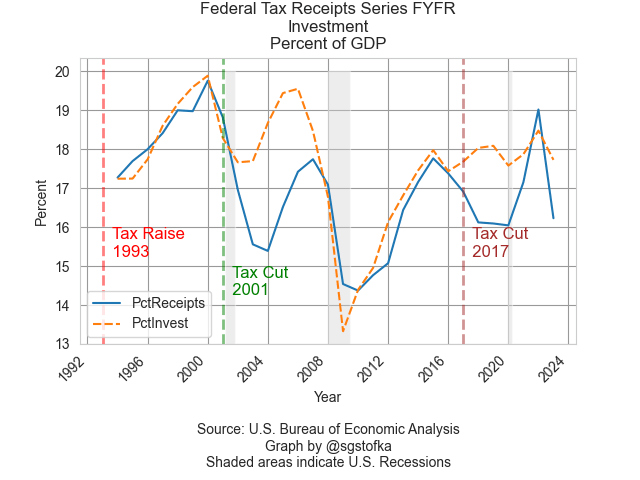
Republican politicians routinely champion their principle of low taxes. The justification for the tax cuts in the 1980s was based on an idea put forth in 1974 by the economist Arthur Laffer who drew an inverted curve on a napkin to illustrate the idea that higher tax rates might lead to lower tax revenues. Despite repeated evidence that lower tax rates lead to lower tax revenues, Republicans have clung to the idea. In the graph below, I have charted federal tax revenues as a percent of GDP. They do not include Social Security taxes.

According to the theory behind the Laffer Curve, lower taxes should spur more investment, more output, higher incomes and higher tax revenues. As we see in the graph above, tax raises led to higher revenues soon after they were enacted. Tax cuts did not. Believers in the theory claim that the cuts can take several years to work but this makes it hard to identify causality. In the graph below, I have added in investment as a percent of GDP.

The Bush tax cuts in 2001 certainly helped arrest the decline in investment following the “dot-com bust.” However, too much of that investment went into residential housing and led to the housing boom that preceded the financial crisis. Those tax cuts expired in 2010 and both investment and tax revenues improved. That raises the question: did higher taxes in 1993 and 2010 produce more investment? On principle, it seems unlikely. Following the 2017 tax cuts known by their acronym TCJA, investment again reversed a decline but had little effect on tax revenues. The rise in revenues as a percent of GDP was due to the fall in output as a result of the pandemic.

According to the neoclassical economist’s narrative, savings provide the source of investment. Taxes reduce savings and therefore reduce investment. Italian economist Pietro Sraffa (1932) reiterated a point made by Sir Dennis Robertson that savings were an inducement to more investment as well as a source of investment. Investment occurs in the period before consumption. People have money to save for two reasons. The first is that their incomes increase from new investment in production. Secondly, there are not enough goods in the marketplace to induce them to spend that extra income. The mismatch in supply and demand gives companies pricing power. Investors rush in to take advantage of the additional demand and the flow of new savings gives banks the confidence to make more loans.

For the past thirty years, federal revenues excluding social security taxes have averaged 17% of GDP. For that same period, the government spent 18.6% of GDP. The deficits have been persistent because the federal government consistently spends more than it taxes, an analysis confirmed by the Congressional Budget Office in a recent report. Republican lawmakers try to choke tax revenues to “Starve the Beast” – the beast being the size and reach of the federal government. To Democratic policymakers, our society needs constant remodeling, so they always have a plan for extra tax revenue. Neither party seems willing to resolve this political push-me-pull-you and the public has become used to deficits. There is always one more war to fight, one more wrong to right.

/////////////////

Photo by Kelly Sikkema on Unsplash

Keywords: tax cuts, investment, taxes

Samuelson, Paul Anthony. (1947). Foundations of Economic Analysis. Harvard University Press.

Sraffa, P. (1932). Dr. Hayek on money and Capital. The Economic Journal, 42(165), 42. https://doi.org/10.2307/2223735

The Conflict in Policy

March 10, 2024

by Stephen Stofka

This week’s letter continues my analysis of the many roles of the federal government, comparing spending, tax revenues and the federal debt that has accumulated since 9-11. Governments accumulate debt by spending more than they collect in tax revenues. Farmers, businesses and households appreciate the subsidies and support from government but resist paying the taxes to fund those programs. The private marketplace depends on government funding of nascent technologies that may take decades to commercialize. Examples include the internet, the development of semiconductors, lithium batteries and the funding of pharmaceutical research. Investment in military readiness has spurred advancements in aerospace and satellite technology, the GPS that connects our phones and the Kevlar clothing that protects our soldiers and police officers. Critics may ridicule a government investment in solar manufacturer Solyndra, but it was also heavy government funding that provided the cash flow for SpaceX and Tesla.

In last week’s letter I showed that private investment and government spending and investment both averaged about 18% of GDP over the past three decades. A closer look at those two series shows how they complement and compete with each other. In the graph below, private investment dipped from 19% of GDP in 2006 to below 14% in 2009. As a percent of GDP, government spending and investment took up some of the slack.

As many people lost their jobs, they became eligible for Medicaid or food stamps. Both of these programs are included in government spending because the programs directly or indirectly provide people with goods or services. The graph above does not include increased unemployment insurance payments during the recession. These are included in government transfers since this is money, not services, transferred from the government to individuals. Policymakers refer to this combination of support programs as automatic stabilizers, providing assistance to households during hard economic times.

A recent analysis by the Congressional Budget Office (CBO) found that these automatic stabilizers were not “key drivers of debt over the long-term.” The federal debt was growing because government spending was increasing at a faster pace than revenues. The chart below shows spending and revenues for the past thirty years in a natural log form to portray the trends of change more clearly.

For most of the past three decades, revenue growth, the orange dashed line in the graph above, lagged government spending, the blue line. Note that this revenue series (FRED Series FYFR) does not include Social Security taxes. The growth in government spending showed some moderation only during Obama’s term and that was the worst time to slow the growth of government spending and investment. The Great Recession of 2007-2009 was the worst economic downturn since the 1930s Depression, surpassing the pain of the back-to-back recessions of the early 1980s.

Biden was vice-President during that recovery and was determined not to repeat that mistake in the aftermath of the Covid-19 pandemic. Although the Democratic majorities in the House and Senate were slim, unified government helped the effort to pass the Inflation Reduction Act and the CHIPS Act. Both pieces of legislation committed government funds to support investment in clean energy development and semiconductor manufacturing. Such commitment spurred private investment in the energy industry. In 2023 field production of crude oil surpassed 2019 levels, according to the Energy Information Administration (EIA). They report that natural gas output was up 2% in the first year of Biden’s term, then accelerated to 5% growth in 2022 and 2023 following Russia’s attack on Ukraine.

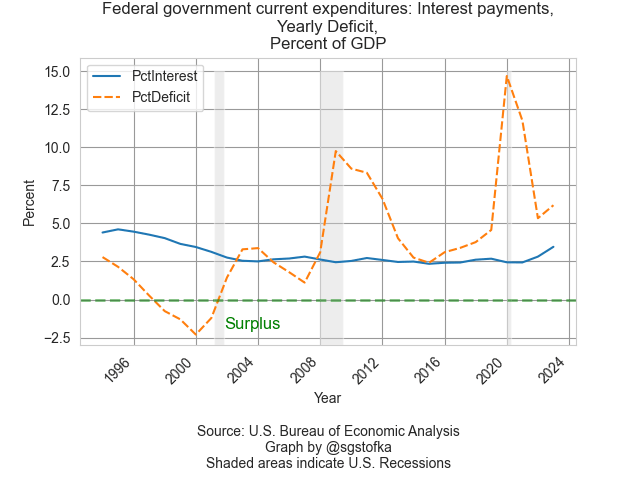
Despite big increases in the deficit after 9-11, and an accumulated debt of $22 trillion held by the public, the interest share of GDP has remained below the levels of the 1990s. In 2001, China was admitted into the World Trade Organization. As imports from China increased, we paid for them with U.S. Treasury debt, helping to keep interest rates low for most of the past two decades.

Unlike individuals and corporations, governments can buy their own debt. Unless a majority of that debt is sold in the private marketplace, there is no independent evaluation of the creditworthiness of that debt. At the end of last year, 65% of the total Federal debt was privately held, the highest percentage since 1997 (see notes). Including the Treasuries held by independent Federal Reserve banks, the percentage is close to 80%. A recent report from the Center for Strategic and International Studies (CSIS) calculates the percentage of debt held by two of our largest trading partners, China and Japan, at 5.8%. The wide ownership of U.S. debt validates it as a low-risk financial instrument.

The global financial system depends on tradeable sound securities. When the financial crisis undermined confidence in mortgage securities, private investment declined sharply, and it would do so again if investors doubted the soundness of Treasury securities. The recent CBO report points out a weakness in public policy that the Congress must resolve or risk damaging the credit of U.S. securities. 1997 was the last year when Congress submitted a budget by the deadline, according to the Congressional Research Service. When is the moment when the private debt market loses hope that Congress can match its spending and revenues? No one can forecast a stampede to safety but in hindsight many will claim to have seen the exit signs.

///////////

Photo by Manki Kim on Unsplash

Keywords: investment, debt, interest, Treasuries, government spending, taxes, automatic stabilizers

According the March 2024 Treasury bulletin, total Federal debt was $34 trillion. $21.7 trillion was privately held – about 65%. See Table OFS-2 of the March bulletin. Privately held debt plus $5.2 trillion of Treasuries held by independent Federal Reserve banks constitute Federal Debt Held by the Public (FRED Series FYGFDPUN) and is close to 80% of total federal debt. For a thirty-year series of the public’s portion of total debt, see https://fred.stlouisfed.org/graph/?g=1hYFV. Until the 2008 financial crisis Federal Reserve banks held less than 10% of total debt. During the pandemic, that share rose to 21%. At the end of 2023, the share was 15.4%.

The Free Market Myth

November 19, 2023

by Stephen Stofka

In this week’s letter I will continue to look at subsidies. Subsidies are created by legislation or agency interpretation that dispenses benefits to people, businesses and institutions. There are two forms of subsidy: a monetary credit of some sort, and an ownership credit, i.e., the granting of a property right. The monetary form includes tax credits and tax expenditures that can be calculated or estimated in dollar amounts. Last week, I noted that some of the biggest tax expenditures were the non-taxability of employer paid health insurance premiums and pension plans. The ownership form includes water rights and land use rights. Unlike the right to vote, these are rights related to the ownership of a physical property or the benefits of a property.

An ownership subsidy can be indirect. A century ago, the western states divvied up water rights to the Colorado River according to the doctrine of prior appropriation which mandates that if one party does not use their share, it is available to the other parties. Water is a scarce resource in this arid region of the country so this principle makes sense. In the wetter eastern states, water rights are based on a common law riparian system where ownership of the right is not coupled with use. Federal water rights are based on this common law system so there is an inevitable conflict whenever the western states cannot resolve their allocation treaties. Today, Colorado does not use all of its allotment while California uses more than its allotment. California does not send the state of Colorado a check every year for the water they use and is a form of indirect subsidy.

Monetary subsidies include agricultural subsidies that I discussed last week. Others include tax credits for buyers of electric cars and homeowners who install solar panels. The oil and gas industry as well as renewable energy producers receive many tax credits. Spending on public transportation includes subways, buses and light rail as well as the roads and highways that motorists use to get to work. Subsidies that support social welfare include public and private schools as well as the school vouchers doled out to parents of schoolchildren. Support programs include subsidies for housing, food and health expenses that involve many tangled cross subsidies. A large retail company can offer discounted merchandise by paying their employees lower wages and the reduced income makes those employees eligible for social assistance programs.

In this jungle of subsidies, it is difficult to compute a net subsidy benefit or deficit. Two-thirds of a homeowner’s property tax might support public schools in their district but they have no kids. Is that fair? They shop at a discount retailer and save hundreds of dollars annually because the retailer can pay its employees lower wages. When this homeowner buys gas, they provide a small subsidy to fossil fuel producers and the farmers who grow corn for ethanol. They buy milk at a lower price because of a government milk support program that is paid for by all taxpayers, even those who do not drink milk. If they eat hamburger, they benefit from grazing subsidies on federal land. The homeowner does not use bus or light rail but they live in a district that includes a sales tax for those systems. Why can’t we just have a free market with no government interference?

The concept of the free market is a useful abstraction but a dangerous idea when politicians and economists advocate for that reality. A “free market” and a “fair market” are oxymorons. A market cannot be free of government influence because all three branches of government are adjudicators, instrumental in awarding and enforcing property claims and the rules of exchange. Whatever the form of money used in a market, governments regulate it. To be fair, a rule giver would treat everyone equally but the world is composed of discrete goods and services that are not infinitesimally divisible. We live in a “clumpy” world and there is no universal standard of fairness to divide the clumps. Some people advocate for equality of opportunity. Others argue for equality of outcome. These abstractions help us analyze the world but we cannot build a society with either and retain a dynamic flow of both opportunity and outcome.

Governments award monopolies for the public good. Companies secure monopolies and market restrictions from government to reduce competition. The government is part of the market as a buyer of goods and services. Some authority must regulate the exchange of ownership that accompanies the exchange of goods and services. The protection of person and property in a market requires either a police presence or an impromptu coalition of people who enforce rules with force if necessary. Some authority must certify weights and measures or a “free market” becomes a “market of force,” a melee of arguments and fights.

We live our lives in a storm of electromagnetic waves, unaware of most of them but dependent on many of them. We rarely make a transaction without the involvement of some subsidy yet many of us live with the illusion of independence. Some pay more in income tax or property tax. Some help coach the school soccer team. As nodes in a social web we cannot calculate the cost of our contribution to the strength of that web. At any point in time some of us contribute more, some less. Over a lifetime our contribution varies from less to more and less again. Our society flourishes when we spend less energy keeping score.

///////////

[20231119Market.png]

Photo by Jezael Melgoza on Unsplash

Keywords: monopoly, public goods, property rights, water rights

Historic Employment Boom

September 10, 2023

by Stephen Stofka

This week’s letter is about the mix of full-time and part-time workers and what it tells us about the economy. Although unemployment remains below 4%, it rose slightly, according to the most recent unemployment report. This was a good sign, however, because much of that increase was due to formerly discouraged people returning to the labor force and looking for a job. This economy is producing historic employment numbers. Let’s dig in.

I’ll be looking at ratios of workers to the working age population so I’ll discuss that briefly before heading into the data. The Bureau of Labor Statistics now defines the working age population as someone 16 years and older. According to that definition, a 90 year old person is working age. The U.S. is part of the OECD group of developed countries, which uses a more traditional definition of the working age population as 15 to 64.  I am going to use the OECD definition to make historic comparisons more accurate. Two-thirds of this working age population is employed full or part time.

The percent of working age people who are employed full time – the red line in the chart below – is about 64%, a historic high that has eclipsed the economic boom of the late 1990s.

Only 2% of working age people are working part time.

The ratio of full-time workers to part-time workers reveals the strength of the economy. When it is high, employers have the confidence to commit resources to full-time workers, including better benefit packages. Workers have more bargaining power. The chart below shows the peaks in that ratio since the 1960s. A rise in investment accompanied each period. Defense spending led the surge in the 1960s. Investment in technology was a major driver of emploment growth in the 1990s. Spending on infrastructure has been a key driver of growth since the pandemic.

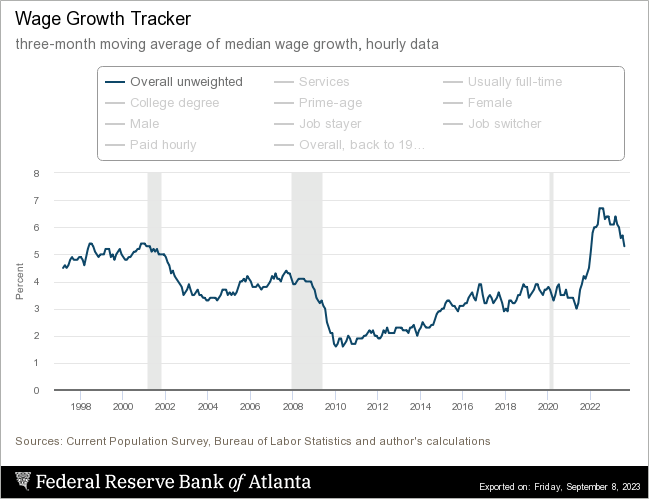
In the post-pandemic recovery, employers have sharply increased wages to fill positions, as shown below by the Atlanta Fed’s wage growth tracker. The decrease in wage growth during the past year is more typical of recessions but without a recession. In the chart below, note that today’s wage growth is one percent higher than the peak during the strong labor market of the late 1990s.   

The greater the number of full-time workers, the more the federal government receives in FICA taxes, reducing the yearly deficit in the Social Security Trust Funds. Since the early 1980s, income tax rates have been indexed to inflation but social security taxes have not. Only the earnings subject to social security, the earnings cap, is indexed. According to the latest Trustees report, the drain on the trust fund last year was $22 billion, less than 1% of the $2.8 trillion fund, but a drain, nevertheless. The first of the historically large Boomer generation were eligible for retirement almost a decade ago. The last of that generation will be eligible for retirement in eight years. The era of annual surpluses in the trust funds is over. During the past decade, outlays increased at a 4.5% annual pace while tax collections increased at a 5.3% rate. This was a welcome change of pace from the previous decade 2003 through 2012 when social security tax collections grew at only 3.6% annually, while outlays grew at a 5.4% rate.

The financial crisis had a deep negative impact on the trust funds and the current estimate is that the trust funds will be depleted in 2034. After that date, retirees will not receive full benefits without some legislation to provide additional funding. In 1990, the trustees estimated a depletion date of 2043, almost nine years later than today’s estimate. These long-range forecasts necessitate many assumptions about economic growth and benefits and such forecasts cannot anticipate outlier events like the financial crisis. There is a lot of catching up to do. We need all the boom we can get.

/////////////////

Photo by bruce mars on Unsplash

Keywords: social security, taxes, employment, wages

Note: In the past twenty years, the number of working Americans who are older than 65 has jumped from four million to 11 million, or 6.5% of the labor force.

Public Goods and Private Values

April 16, 2023

by Stephen Stofka

This week’s letter is about the funding for public goods. More than sixty years ago economist Charles Tiebout predicted that we would splinter into different communities based on our use of and desire for public goods like schools, highways, public transportation and other facilities. Let’s dig in!

In his 1948 textbook Economics: An Introductory Analysis, Paul Samuelson introduced the definition of a public good as non-rival and non-excludable. Non-rival means that one person’s consumption of a good does not lessen another’s consumption. National defense is an example. It is difficult to exclude people from a public park or a radio broadcast so these are considered public goods. Samuelson introduced these two characteristics to distinguish public goods from common or pooled goods like a public lake. When there is a plentiful stock of fish, no one notices that when one person catches a fish, someone else cannot catch that particular fish. Overfishing results when people catch fish faster than they can replenish their stocks.

In his eager efforts to systematize and mathematize economic concepts, Samuelson sometimes introduced provocative simplifications. In two separate articles published in 1955, economists Stephen Enke and Julius Margolis gave examples of public goods that were rivalrous. A crowded public highway or school does lessen other people’s consumption. Charles Tiebout (1956) pointed out that one of Samuelson’s simplifying assumptions was that public goods were provided by one source, the federal government.  In 1954, state and local spending was actually twice that of federal spending, excluding national defense. In the chart below, the orange bars are state and local spending, which does include police protection. While it is a public expenditure, a police response to one incident means that they are not available for another call so the police are rivalrous.

A few years after the Johnson administration ushered in the social reforms collectively termed the Great Society in 1964-65, federal spending overtook state and local spending. These programs included Medicare, Medicaid and what were called Food Stamps and Welfare at the time. Today the spending roles are reversed. Without including spending on national defense, federal government spending and investment is almost twice that of state and local.

Samuelson pointed out that there is no market mechanism to price public goods. What is the appropriate price for defense, highways, schools and other public goods? Charles Tiebout (1956) argued that the price for these goods is determined in the voting booth by a public that desires to keep its taxes low. Voters will support those public goods which they consider valuable and will use. Tiebout predicted that voters would migrate to communities where they were among taxpayers who shared similar preferences for a particular set of public goods. If a couple had young children, they would vote for more school funding. Their children would get the benefit while the community as a whole bore the expense. People who liked to golf would favor communities with a like-minded interest who would vote for a public golf course. Tiebout wrote, “The greater the number of communities and the greater the variance among them, the closer the consumer will come to fully realizing his preference position.”

Writing in 1956, Tiebout’s prediction ran counter to the predominant social theory of the American melting pot – that people were becoming gradually harmonized into a single American monoculture. In 2008, Bill Bishop’s book The Big Sort confirmed Tiebout’s prediction. For decades, Americans had been sorting themselves into communities of like-minded preferences and values. Today, few would argue that we live in an increasingly differentiated society of insular interests and values. On social media, we establish community by voicing outrage at those others – what one of them said or did. We form interest clubs with a unique vocabulary, inside references, remarks and jokes that those outside the club don’t get because they don’t understand the context.

In spite of this cacophony of interests and values, there is a clamor for more public goods. More health care, more schools, more public spaces. How are we ever going to agree on the funding for these public goods? The successful ballot initiatives supporting public goods have a common characteristic. They spread the cost evenly by exacting a very small increase in a sales tax rate. People will vote for a public good if it will cost all households a small amount like $20 extra sales tax. This tax, known as a Tiebout equilibrium, acts more like a user fee than a tax.

Each year federal spending less national defense grows a bit more than state and local spending. If local voters cannot agree on spending priorities, this divide will get larger, throwing more of the spending burden on the federal purse and increasing the federal debt. Officials in local districts, frustrated by a lack of voter consensus, will increasingly look to Washington for school funding, children’s lunch programs, health care, public transportation, support of libraries and museums. Where does this end?

////////////////

As an aside, defense spending has a unique characteristic. Most government services increase as the population increases. It may not be in proportion but that is the general case. Increases in defense expenditures respond more to the perception of outside threats, not the size of the population. Here is a chart of per capita spending in nominal dollars, spending that has not been adjusted for inflation.

When spending is adjusted for inflation, it is clear that defense spending responds primarily to  perceived threats, not population growth.

After 9-11, real per capita spending on national defense increased by 33%, from $2100 to $2800 per person. In June 2009, President Obama began withdrawing troops to meet a campaign pledge. By the end of his second term in 2016, real per capita defense spending had returned to a level that existed before 9-11. Despite his isolationist rhetoric the Trump administration increased defense spending. This was largely due to pressure from a Republican Senate and House. In the less populous areas of the south, central and mountain west, more defense spending means more government jobs that promise stability and benefits. Republicans may preach small government but the communities they represent value government jobs and the economic benefits that ripples through local communities from military spending.

//////////// 

Photo by Amy-Leigh Barnard on Unsplash

Tiebout, C. M. (1956). A pure theory of local expenditures. Journal of Political Economy, 64(5), 416–424. https://doi.org/10.1086/257839