Investment Flows

October 18, 2015

When economists tally up the output or Gross Domestic Product (GDP) of a country, they use an agreed upon accounting identity: GDP = C + I + G + NX where C = Consumption Spending, I = Investment or Savings, G = net government spending, and NX is Net Exports, which is sometimes shown as X-M for eXports less iMports. {Lecture on calculating output}

In past blogs I have looked at the private domestic spending part of the equation – the C.  Let’s look at the G, government spending, in the equation.  Let’s construct a simple model based more on money flows into and out of the private sector.  Let’s regard “the government” as a foreign country to see what we can learn.  In this sense, the federal, state and local governments are foreign, or outside, the private sector.

The private sector exchanges goods and services with the government sector in the form of money, either as taxes (out) or money (in).  Taxes paid to a government are a cost for goods and services received from the government. Services can be ethereal, as in a sense of justice and order, a right to a trial, or a promise of a Social Security pension.  Transfer payments and taxes are not included in the calculation of GDP but we will include them here.  These include Social Security, Medicare, Medicaid, food stamps and other social programs.  If the private sector receives more from the government than the government takes in the form of taxes, that’s a good thing in this simplified money flow model. There are two types of spending in this model: inside (private sector) and outside (all else) spending.

Let’s turn to investment, the “I” in the GDP equation.  In the simplified money flow model, an investment in a new business is treated the same as a consumption purchase like buying  a new car.  Investment and larger ticket purchase decisions like an automobile depend heavily on a person’s confidence in the future.  If I think the stock market is way overpriced or I am worried about the economy, I am less likely to invest in an index fund.  If I am worried about my job, I am much less likely to buy a new car.  In its simplicity this model may capture the “animal spirits” that Depression era economist John Maynard Keynes wrote about.

We like to think that an investment is a well informed gamble on the future.  Well informed it can not be because we don’t know what the future brings.  We can only extrapolate from the present and much of what is happening in the present is not available to us, or is fuzzy.  While an investment decision may not be as “chanciful” as the roll of a dice an investment decision is truly a gamble.

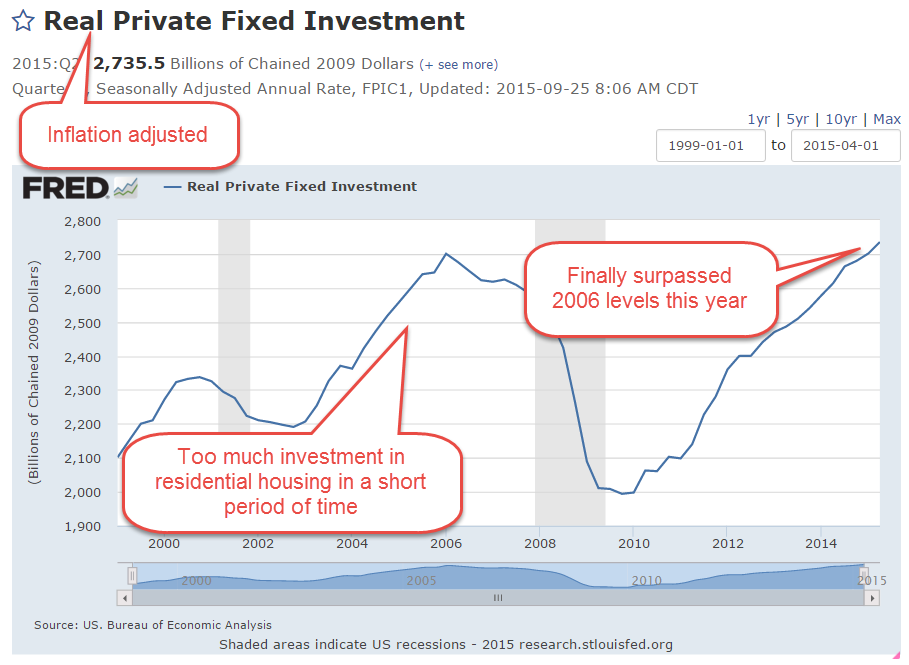
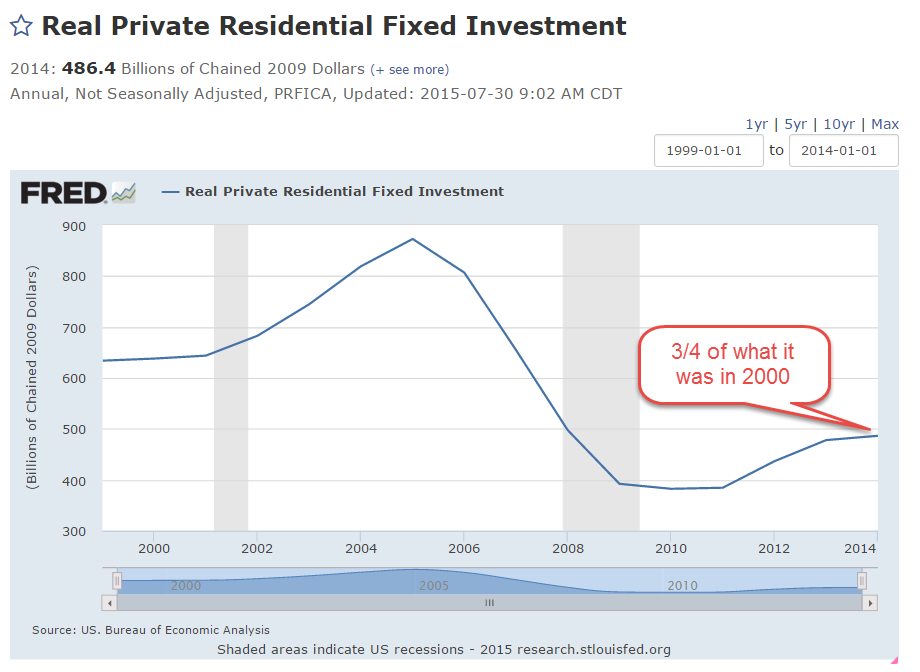
Remember, in the GDP equation GDP = C + I + G + NX, investment (the I in the equation) is a component of GDP and includes investments in residential housing. In the first decade of this century, people invested way too much in residential housing.

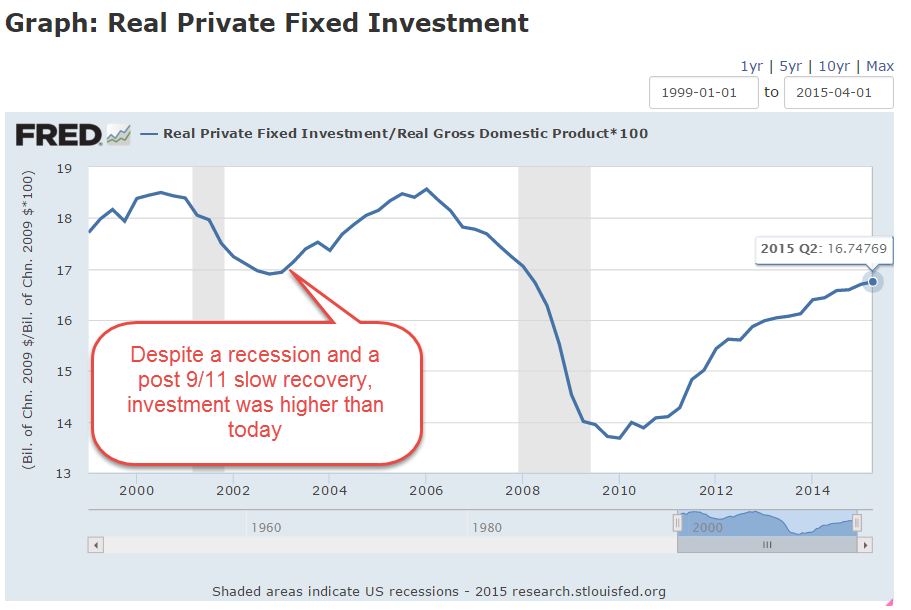
In the recession following the dot-com bust and the slow recovery that followed the 9-11 tragedy, private investment was a higher percentage of GDP than it is today, six years after the last recession’s end.  Much of this swell was due to the inflow of capital into residental housing.

The inflation-adjusted swell of dollars is clearly visible in the chart below.  It is only in the second quarter of this year that we have surpassed the peak of investment in 2006, when housing prices were at their peak.

Investment spending is like a game of whack-a-mole.  Investment dollars flow in trends, bubbling up in one area, or hole, before popping or receding, then emerging in another area.  Where have investment dollars gone since the housing bust?  An investment in a stock or bond index is not counted as investment, the “I” in the equation, when calculating GDP.  The price of a stock or bond index can give us an indirect reading of the investment flow into these financial products.  An investment in the stock market index SP500 has tripled since the low in the spring of 2009 {Portfolio Visualizer includes reinvestment of dividends}

Now, just suppose that some banks and pension funds were to move more of those stock and bond investments back into residential housing or into another area?

Transfer Payments

February 16th, 2014

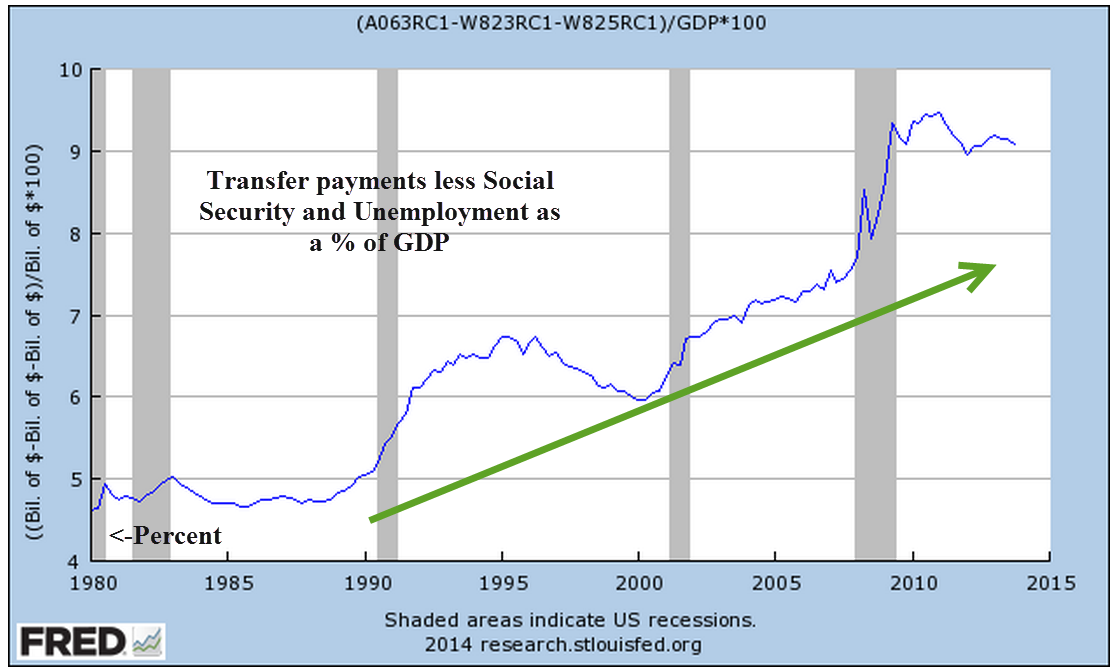
In this election year, as in 2012, the subject of transfer payments will rear its ugly head with greater frequency.  In the mouths and minds of some politicians, “transfer payments” is synonymous with “welfare.”  Don’t be confused – it is not.  As this aspect of the economy grows, politicians in Washington and the states get an increasing say in who wins and who loses.  Below is a graph of transfer payments as a percent of the economy.  I have excluded Social Security and Unemployment because both of those programs have specific taxes that are supposed to fund the programs.
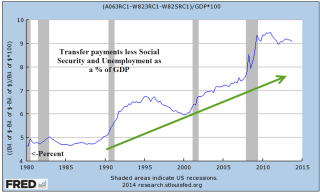
Transfer payments, as treated in the National Income and Product Accounts (see here for a succinct 2 page overview), are an accounting device that the Bureau of Economic Analysis (BEA) uses to separate transfers of money this year for which no goods or services were purchased this year.  The BEA does this because they want to aggregate the income and production of the current year. Because that category includes unemployment compensation, housing and food subsidies, some people mistakenly believe that the category includes only welfare programs.   Here’s a list of payments that the BEA includes:

Current transfer receipts from government, which are called government social benefits in the NIPAs, primarily consist of payments that are received by households from social insurance funds and government programs. These funds and programs include social security, hospital insurance, unemployment insurance, railroad retirement, work­ers’ compensation, food stamps, medical care, family assistance, and education assistance. Current transfer receipts from business consist of liability payments for personal injury that are received by households, net in­surance settlements that are received by households, and charitable contributions that are received by NPISHs.

That settlement you received from your neighbor’s insurance company when his tree fell on your house is a transfer payment.  Didn’t know you were on welfare, did you?  Some politicians then cite data produced by the BEA to make an argument the government needs to curtail welfare programs.  Receiving a Social Security check after paying Social Security taxes for forty plus years?  You’re on welfare.  A payment to a farmer to not grow a bushel of wheat – an agricultural subsidy – is not a transfer payment.  A payment to a worker to not produce an hour of labor – unemployment insurance – is a transfer payment.  Got that?  While there are valid accounting reasons to treat a farmer’s subsidy check and a worker’s unemployment check differently, some politicians prey on the ignorance of that accounting difference to push an ideological agenda.

That agenda is based on a valid question: should a government be in the business of providing selective welfare; that is, to only a small subset of the population?  Some say yes, some say no.  If the answer is no, does that include relief for the victims of Hurricane Katrina, for example?  Even those who do say no would agree that emergencies of that nature warrant an exception to a policy of no directed subsidies or welfare payments.  It was in the middle of a national emergency, the Great Depression, that Social Security and unemployment compensation were enacted.  Government subsidies for banks began at this time as well.  Agricultural subsidies began in response to an earlier emergency – a sharp depression a few years after the end of World War 1.  Health care subsidies were enacted during the emergency of World War 2.  The pattern repeats; a subsidy starts as a response to an immediate and ongoing emergency but soon becomes a permanent fixture of government policy.

Tea Party purists think that the Constitutional role of the federal government is to tax and distribute taxes equally among the citizens.  Before the 16th Amendment was passed a hundred years ago, the taxing authority of the Federal Government was narrowly restricted.  However, the Federal Government has always been selective in distributing  the resources at its disposal.  Land, forests, mining and water rights were either given or sold for pennies on the dollar to a select few businesses or individuals. (American Canopy is an entertaining and informative read of the distribution and use of resources in the U.S.) By 1913, the Federal Government had dispensed with so much land, trees and water that it had little to parlay with – except money, which it didn’t have enough of.  Solution: the income tax.

In principle, I agree with the Tea Party, that the government at the Federal and state level should not play God.  How likely is it that the voters of this country will overturn two centuries of precedent and end transfers?  When I was in eighth grade, I imagined that adults would have more rational and informed discussions.  Sadly, our political conversation is stuck at an eighth grade level on too many issues.

****************************

While most of us pay attention to the unemployment rate, there is another statistic – the separation rate – that measures how many people are unemployed at any one time.  The unemployment can be voluntary or involuntary, and last for a week, a month or a year.  Not surprisingly, younger workers change jobs more frequently and thus have a higher separation rate than older workers.  In the past decade, almost 4% of younger male workers 16 – 24 become unemployed in any one month.  Put another way, in a two year period, all workers in this age group will change jobs.  For prime age workers 25 – 54, the percentage was 1.5%.  In a 2012 publication, Shigeru Fujita, Senior Economist at the Philadelphia Federal Reserve Bank, examined historical demographic trends in the separation rate.

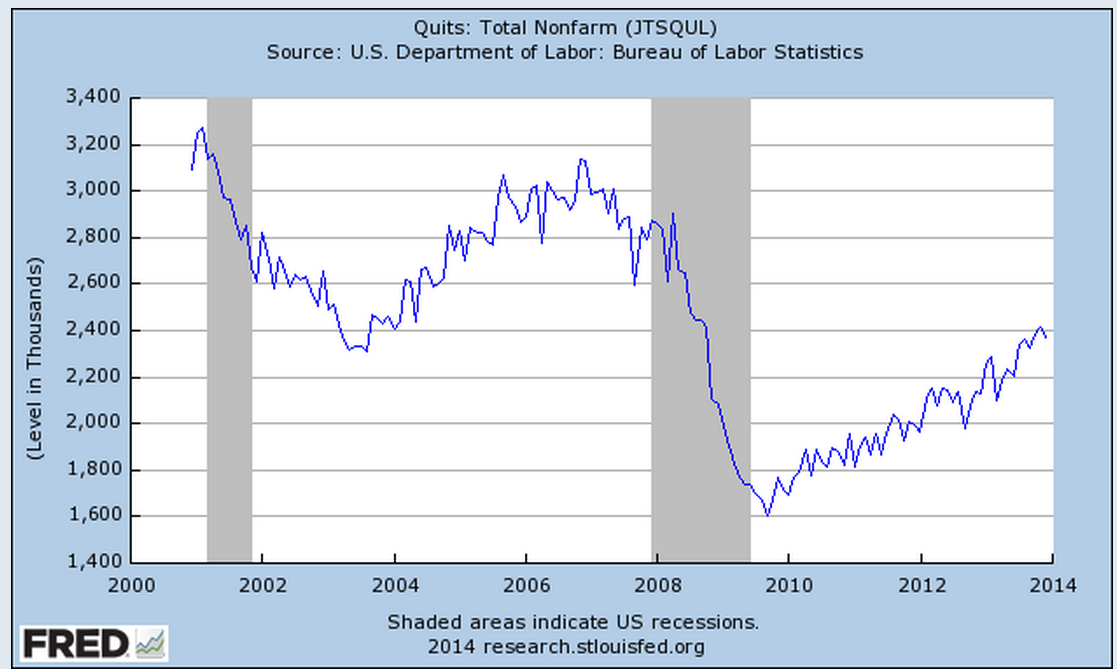
On page five of this paper, Mr. Fujita presents what is called a “labor-matching” model that attempts to explain changes in unemployment and wages, primarily from the employer’s point of view. Central elements of this model, familiar to many business owners, include uncertainty of future demand and the costs of finding and training a new worker.  Mr. Fujita examines an aspect that is not included in this model – the degree of uncertainty that the worker, not the employer, faces.  In the JOLTS report, the BLS attempts to measure the number of employees who voluntarily leave their jobs.  These Quits indicate the confidence among workers in finding another job.  The JOLTS report released this week shows an increasing level of confidence but one which has only recently surpassed the lows of the recession in the early 2000s.

**************************

Labor Participation
In a more recent paper, Mr. Fujita examines the causes of the decline in the labor participation rate, or the number of people working or looking for work as a percentage of the people who are old enough to work.  As people get older, fewer of them work; the aging of the labor force has long been thought to be the main cause of the decline.  That’s the easy part.  The question is how much does demographics contribute to the decline? What Mr. Fujita has done is the hard work – mining the micro data in the Census Bureau’s Current Population Survey.  He found that 65% of the decline of the past twelve years was due to retirement and disability.  More importantly, he discovered that in the past two years, all of the decline is due to retirement.  The first members of the Boomer generation turned 65 in 2011 so this might come as no surprise.  The surprise is the degree of the effect;  this largest  generational segment of the population dominates the labor force characteristics. During the past two years, discouraged workers and disability claims contributed little or nothing to the decline in the participation rate.  Another significant finding is that relatively few people who retire return to the work force.

In this election year, we will be bombarded with political BS: Obamacare or Obama’s policies are to blame for the weak labor market; the anti-worker attitude of Republicans in Congress are responsible.  Politicians play a shell game with facts, using the same techniques that cons employ to pluck a few dollars from the pockets of tourists in New York City’s Times Square.  Few politicians will state the facts because there is no credit to be taken, no opposing party to blame.  Workers are simply getting older.

In 2011, MIT economist David Autor published a study on the growth of disabiliity claims during the past two decades and the accelerating growth of these claims during this Great Recession.  Mr. Fujita’s analysis reveals an ironic twist – at the same time that Mr. Autor published this study, the growth in disability claims flattened.  The ghost of Rod Serling, the creator and host of the Twilight Zone TV series, may be ready to come on camera and deliver his ironic prologue.

*******************************

Lower automobile sales accounted for January’s .4% decline in retail sales. Given the continuing severity of the weather in the eastern half of the U.S., it is remarkable that retail sales excluding autos did not decline.  In the fifth report to come in below even the lowest of estimates, industrial production posted negative growth in January.  By the time the Federal Reserve meets in mid-March, the clarity of the economy’s strength will be less obscured by the severe winter weather.

*******************************

A reader sent me a link to short article on the national debt.  For those of you who need a refresher, the author includes a number of links to common topics and maintains a fairly neutral stance.  I still hear Congresspeople misusing the words “debt,” the accumulation of the deficits of past years, and “deficit,” the current year’s shortfall or the difference between revenues collected and money spent.  Could we have a competency test for all people who wish to serve in Congress?

*******************************

The House and Senate both passed legislation to raise the debt ceiling this week.  The stock market continued to climb from the valley it fell into two weeks ago and has regained all of the ground it lost since the third week of January.

Jobs, Spending and Income

October 27th, 2013

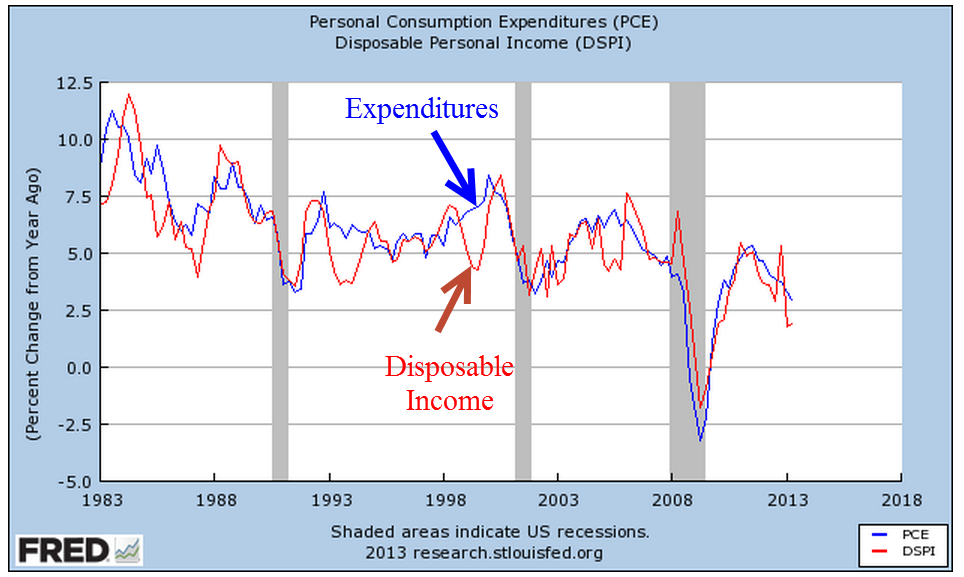
Before I take a short look at the delayed release of the employment report this week, let’s look at the growth in personal income and spending, which move in tandem.  This is the y-o-y percent change in nominal after tax income and spending.

Income growth can be a bit more erratic than spending, bouncing around the more stable trend of spending.

The anemic growth in both income and spending has dampened hopes of a strong rebound of consumer spending.  The ratio of an ETF composite of retail stocks versus the overall SP500 market index shows the recent doubt.  Retail stocks have not participated in the larger market rebound.

A wholesale clothing sales rep I spoke with a week ago has noticed the caution in her buyers since mid-August.  In September, some in the industry laid the blame at the prospect of a government showdown.  For those of us in private business, the political shenanigans only muddy the water and make it difficult to read the consumer mood.  Reports of sales at major retail centers – about 10% of retail sales – showed strength this week after a month of lackluster growth.  Maybe it was the government shutdown.

However, the U. of Michigan Consumer Sentiment Index released this past Friday showed a sizeable drop in sentiment.

Was this decline in confidence due primarily to the shutdown or is this a forewarning of less than cheery holiday shopping season?  The knuckleheads in Washington are like people who stand up at a concert, blocking the view of those seated behind them.  The business community in general must plan around the politicians on both sides of the aisle in Washington who relentlessly pursue an anti-job agenda.  Politicians can puff and posture on their principles – like so many in government service, they are not subject to the constraints and discipline of profit and loss.  Sure, there are some whose intentions are good, who give their best effort but, unlike private business, their efforts and intentions are voluntary – a sense of personal virtue.  Most will not lose their jobs because of a lack of performance.  There are few incentives to improve efficiency.  In fact, it is the reverse.  The incentives are to promote more regulations, more layers of bureaucracy, as a program of job security and job growth in Washington at the expense of the rest of the country. Many of us in the private sector have the same sense of personal virtue but we also have that profit and loss whip.

Since the temporary resolution of the government shutdown and the raising of the debt ceiling, the market has shot up over 6% in twelve trading days.  The late release of September’s labor report showed less than expected net job gains of 148,000, which dashed any further fears that the Fed might ease their bond buying program this year.  The trends of employment growth have been fairly stable, with a few exceptions – health care, for one.

After six months of little growth, employment in construction rose by 20,000 this past month.

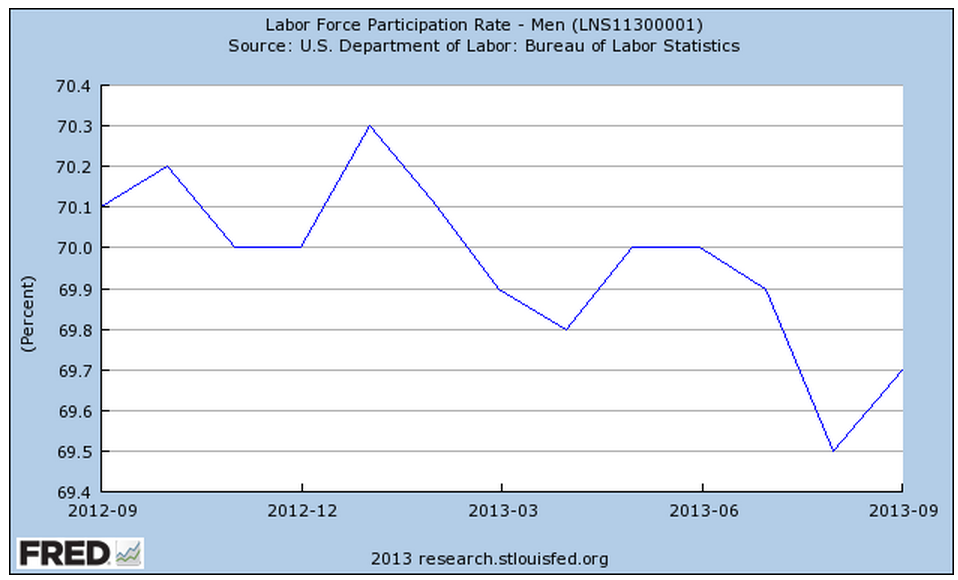
The rise in construction jobs helped the labor force participation rate for men, reversing a decline.

But the participation rate for the core labor force, those aged 25 – 54, shows no signs of reversing the decline of the past four years.

Demographic changes, combined with persistent job weakness among younger workers, is silently eroding the foundations of the Social Security system.  The older half of the population, particularly the Woodstock generation, are growing faster than the younger population, as this table from the Census Bureau shows.

From the Census Bureau report: “the population aged 65 and over also grew at a faster rate (15.1 percent) than the population under age 45.”  At the end of 2012, the Federal Government owed the Social Security trust fund $2.7 trillion (SSA Source)

The number of workers in the core labor force has declined by 5 – 6 million.

Let’s do some math.  [5 million fewer workers paying into Social Security each year] x [$8000 guesstimated combined annual contribution] = $45 billion per year not  collected.  This is just the Social Security taxes, not including the income taxes, on a portion of the population that represents two thirds of the work force.  That $45 billion represents the benefits paid to over 3 million people in 2012. (SSA Source) To put that figure in perspective, Congress is arguing over the medical device tax clause of Obamacare which is projected to raise just $29 billion over the next ten years.

It will take five to ten years for the crisis of funding to develop.  In the meantime, the budget debates will grow more contentious, politicians will pontificate at their podiums with more frequency and the clouds of these dusty debates will make it more difficult for business people to plan ahead.

Heathens and Wizards

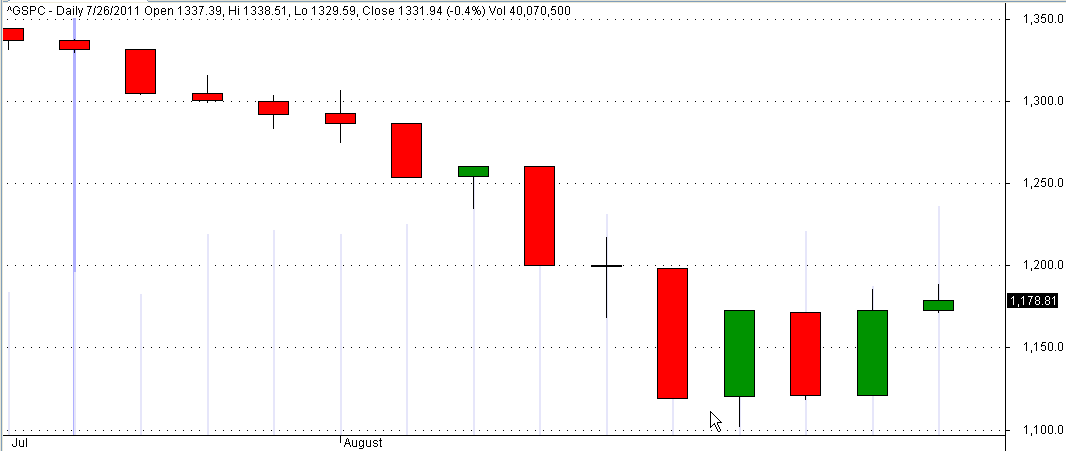
During negotiations over raising the debt ceiling from July 26th to August 8th, 2011 the S&P500 fell 16%.  The index fell only 1% in the first week of negotiations as it looked like President Obama and Republican Majority Leader John Boehner might strike a deal.  Then the bottom fell out.

In the week of trading since budget talks intensified on Dec. 20th, 2012 the S&P500 has lost 2%. 

Investors are worried but hopeful that Congress and the President can come to some resolution before tax increases and spending cuts automatically take effect on January 1st.  Housing and automobile sales are showing renewed strength; the yearly increase in Christmas shopping was a disappointment but the underlying fundamentals of the economy give reason for cautious optimism.

The rapid decline in last year’s stock market should serve as an example to investors in today’s market.  For the long term investor, a further decline of 5 – 15% will present some buying opportunities – time to make that IRA contribution or to put some sidelined cash to work.

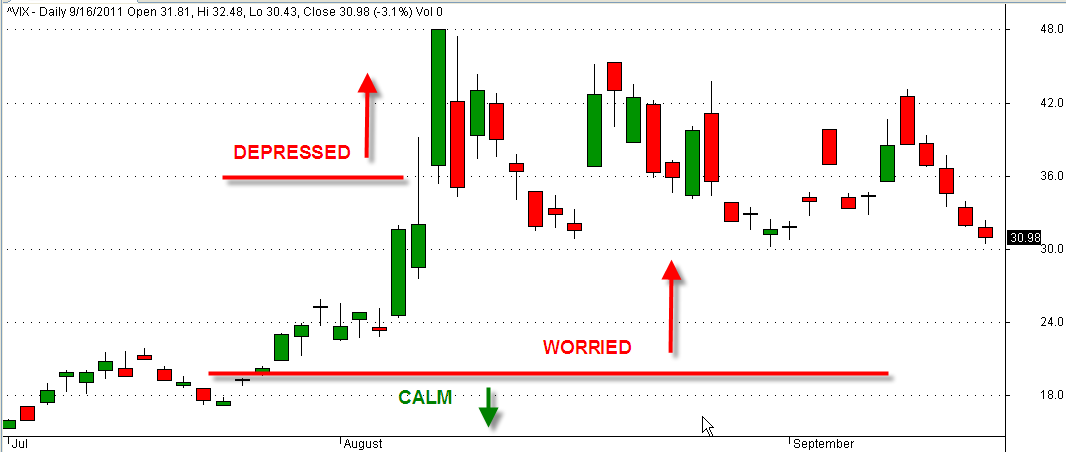
The volatility index, or VIX, measures the relative uncertainty of the broader market using a formula that analyzes the bid -ask spreads of option contracts, which are promises to buy or sell stocks in the future.  When the markets are fairly calm, the VIX index is under 18 – 20.  As markets melted down in October 2008, the VIX rose to 80.  So, 16 is pretty good; 80 is real bad. In the last week of July 2011, this index jumped 20%, then skyrocketed to 48 in the first week of August.

This past week, the VIX went up from the calm range of 18 to 23, indicating the underlying worry.

Last week I wrote about the debate over which inflation measure to use, the CPI or deflator.  If you hear about “chained dollars” or “chained CPI”, it is the deflator that they are referring to.  The difference between the two yardsticks is $3 – $5 per month in a $1000 Social Security check.  This afternoon, Senate Majority Leader Harry Reid walked away from negotiations over this issue.  As I write this in the afternoon of Sunday, Dec. 30th, Senator John McCain has announced that Republican Senators have just taken this issue off of the table.  We can expect that the issue will come up again in the coming negotiations over the raising of the debt ceiling.

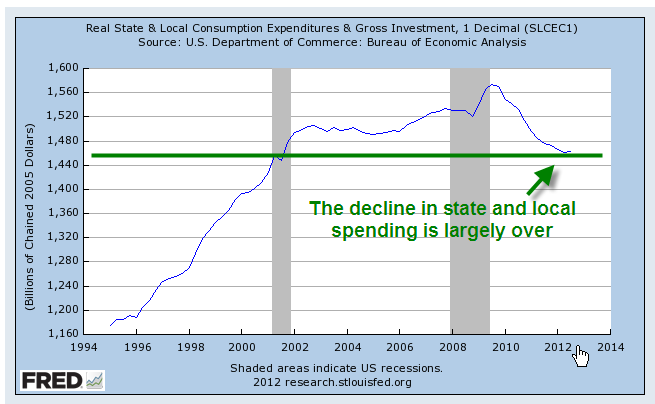
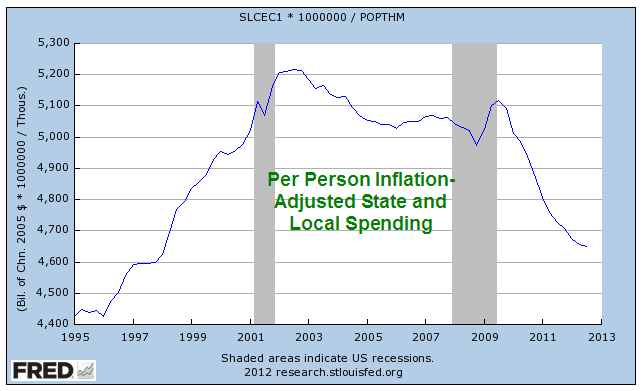
For the past several years, Republicans both in Congress and at the state level have targeted the growth in state and local spending.  This campaign of austerity, as Democrats call it, or fiscal common sense, as some Republicans call it, has won Republicans the governerships of thirty states.  Most of that spending growth has been curbed.

On a per person basis, inflation adjusted spending is at the same level as the mid 1990s.

For states, this return to mid 1990s spending levels has meant cuts in services to their residents.  Medicaid spending takes an increasingly larger portion of state budgets; because states can not run budget deficits, reductions have to be targeted toward education and infrastructure spending.  In 2011, Medicaid spending averaged 25% of state budgets, more than the 20% spent on education (Reuter’s source)

While Republicans dominated the Congress and Presidency in the early 2000s, they showed little concern for the growth in what they call entitlements, programs like Medicare and Social Security.  Instead, they increased entitlement programs, adding a Medicare drug benefit program.  Since they lost their Congressional dominance in 2006,  Republicans have become more cost conscious – and the next targets are entitlements.  Most seniors who have paid into Medicare and Social Security all their lives do not consider these programs as “entitlements.”  It is a dog whistle word that Republican politicians use to call out to their pack.

Democrats look and look and look but simply can not find any cuts that they can make to the social safety net.  Under the rubric of compassion, the Democratic strategy consists primarily of buying votes with ever more social welfare programs.  In the Democrat view, a government and its citizens are in a partnership.  Republicans rightly point out the dangers in any partnership where one partner, the government, holds all the power.  Despite all the rhetoric about limited government, Republicans are advocates of a different kind of partnership between government and corporations whose political contributions are essentially kickbacks for contracts with the federal government and a more relaxed regulatory environment.

Supposedly vigilant Republicans get out their spending cleavers but can not find any cuts they can make in current defense spending.   The operative word here is “current.”  The Defense Dept lives in a budget bubble that most of us would envy because it has little economic responsibility for soldiers once they leave the service.  Most rehabilitation, medical, housing, retraining and other services that the soldier is entitled to or need are no longer born by the defense department. Congress “dumps” these costs on the Human Services department, routinely targeted by Republicans for spending reductions.  In inflation adjusted dollars, we are currently spending 30% more on defense that we spent during the Vietnam War years, 25% more than during the military buildup of the Reagan years.

At the beginning of this century, we have two parties whose allegiances prevent them from coming to any meaningful compromise.  Tax policy is riddled with temporary tax cuts to promote various social causes. Special interest groups and wealthy taxpayers nibble away at tax legislators, creating a swiss cheese of fairness. Budget planning is a legerdemain practiced by a small coterie of heathens and wizards in budget committees; under current budget rules, there are few reductions in spending, only reductions in projected increases in spending.  Imagine that your family budgets for a 3% yearly increase in your utility bills.  One year, the utility company has no rate increase.  Your family claims that they have cut spending on utilities.

The Defense Dept has no long term accountability for the care of their soldiers.  The Human Resources Departments have no accountability for increases in health care spending; they are on automatic pilot.  Congress has no accountability for passing a budget; they have not done so for six years yet continue to get paid.  Bankers risk huge amounts of money that threaten the savings of millions; the company pays a relatively small fine and the individuals responsible suffer no criminal prosecution because of the difficulty and expense of such trials. The public senses that the political party system is morally bankrupt; that the leaders and representatives of this country are unable to break out of the cycle of partisan brinkmanship; that many representatives are bought and paid for; that most of the public has been left out of the deal. 

The public will either find a way to reclaim their authority over the political process of governing or be left standing helplessly on the sidelines while the two parties scrimmage at midfield, both parties having lost sight of either the goal or the audience.  Political advantage has become their goal.  Party leaders enforce a rigid heirarchy of committee assignments, rewarding those in the party who comply while shrugging off those who might compromise.  Gerrymandered districts ensure that many representatives are accountable only to the more rigid ideologies of their district;  their sole challenge comes from extremists in their own party. 

Maybe this time is different.  Maybe not.  Slowly and finally, the social, economic and political order cracks; the public votes in the most extreme elements who promise to restore order and principle or their version of fairness.  What they bring is despotism.

But that could be many years in the future.  For now, we salute the New Year!

Tax Tinkering

Negotiations over a resolution to the fiscal cliff  met an impasse in the past week.  Republicans, mainly from states with low state and local taxes, would prefer to cap tax deductions for higher income taxpayers than raise the top marginal tax rate.  Democrats are strongest in those states with high state and local taxes; the higher income taxpayers in those states would really feel the tax bite if deductions for these taxes were capped at the federal level.  Both parties have become proxies for upper income earners yet neither will admit it because it doesn’t play well in middle America.  Democrats profess that their sole concern is the middle class; Republicans cite their allegiance to small business owners as the reason for their resistance to higher tax rates.

On the spending side, Democrats have not put forward any specific modifications to entitlement programs like Social Security, Medicare, Medicaid that they would consider – only that they would consider them.   Mostly they talk about preserving these programs even though no one has suggested getting rid of them.  Most of us sit in the back of this bus with a sinking feeling in our guts;  we see posturing and positioning from the Congress and the President in the front seats but the bus is not moving.
 
Some voices are calling for comprehensive tax reform as a final solution; others rightly scoff at the idea that a lame duck Congress can enact even a small bit of tax reform.   The task of tax reform is monumental – almost Sisyphean.  I have been reading a book about the last comprehensive tax reform that took place in 1986, “Showdown at Gucci Gulch”, by Jeffrey Birnbaum and Alan Murray.  The authors tell a detailed and well informed narrative of the dastardly dueling and dealing that occurs in any democracy when competing interests collide and collude in crafting a compromise.

Venture investors want low capital gains rates.  Companies whose revenues and profit depend on investments in equipment and materials want to protect tax breaks for their costs.  Unions want fringe benefits for their members to remain tax free.  Oil and gas companies want to shield their oil depletion allowances that permit them to exclude some of the taxable income they earn each year.  Insurance companies lobby to retain the tax free status of the cash build up on the life insurance policies they sell.  Realtors and home builders want to preserve the mortgage interest deduction; the Tax Policy Center reports that over 50% of the total of this deduction goes to the top 1/10th of 1% of income earners.  Charitable organizations and places of worship lobby for the preservation of the charitable deduction.

70% of taxpayers do not itemize and the vast majority of taxpayers who do itemize claim about $10 – $15K.  The top 1% of taxpayers claim on average about $120K in deductions.

Voters want results; the say they want compromise and some resolution to the political standoff that has been the status quo in Washington for the past two years.  Given the issues, interests and costs involved, finding a middle ground will be difficult.  The 1986 Tax Reform law was almost two years in the making, and soon after it was passed, Congress began to tinker with it.
 
535 elves, the members of Congress, tinker away in the workshop of the Federal Government, making thousands of tax toys for the citizens and businesses of this country; everyone wants  a toy, not a lump of coal.  It is unlikely that Congress can put together  a comprehensive tax package before January 1st.

Cliff Diving

November 18th, 2012

This past week, President Obama gave a post-election news conference, answering a number of questions about the fiscal cliff due to take effect on January 1st if the lame duck Congress and the President can not come to an agreeement on some budget bandaging.  The stock market has had the jitters since the first week of October, falling 9% since then; about half of that decline came after the election.  At almost the same hour that it became apparent that the balance of power in Washington would remain the same came the unwelcome forecast of no growth for the Eurozone in 2013.  When in doubt, get out.

For the past two years, there have been few “Kumbaya” moments in the halls of Congress or the White House.  The market has had a good run this year; capital gains taxes could increase next year; many decided to take their profits and run.  A I wrote a month ago, the drop in new orders for durable goods was troublesome.  Three weeks ago, the newest durable goods report showed further declines yet consumer confidence was up, creating a tug of war and I waved the yellow flag, saying that the “prudent investor might exercise some caution.”

For the long term investor who makes annual investments in their IRA, this drop in the stock market is an opportunity to make some of that contribution for this year.  If the wrangling over revenue and spending cuts continues over the next few weeks, the market could drop another 10 – 15%. When budget negotiations collapsed in July – August 2011, the market declined almost to bear market territory – about 19%.  All too often, some of us wait till the last minute in April to make our annual IRA contribution. 

The “cliff” terminology was spoken by Fed Chairman Ben Bernanke at a hearing in February.  He probably wished he had chosen less colorful language but he was probably trying to wake up some of the senators at the hearing.  How bad is this cliff?

The total measured economic output of the U.S., its GDP, is estimated by the BEA (Bureau of Economic Analysis) at around $16 trillion – $15.85 trillion, to be exact, based on this year’s estimated growth of about 2.2% and next year’s average 2.75% estimate of growth.  What’s a trillion dollars?  About $9000 for every household in the country.

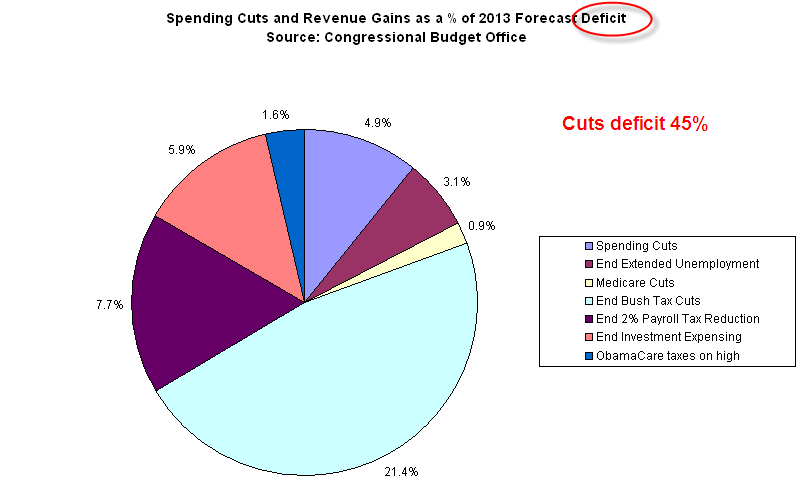
The non-partisan Congressional Budget Office (CBO) estimated some of the economic impacts if we did go over the cliff; in other words, if the spending cuts and revenue increases occurred next year.  Below is a chart of the percentages of GDP that each component of spending cuts and revenue were to occur.

The total of these is 3.2% of the economy.  Well, that’s not Armageddon, you might think and you would be right. As I mentioned earlier, forecast growth is only about 2.75% for next year so that means that GDP would contract slightly next year.  On the other hand, the cliff sure helps the deficit for next year, cutting it by almost half.  The deficit is projected at about $1.1 trillion before spending cuts and revenue increases.  In more manageable numbers, the country is going to go further into debt next year to the tune of almost $10,000 for every household.

Politicians in front of a microphone are prone to hyperbole.  So are news anchors.  Politicians try to sell their version of the story; news anchors try to keep our attention.  Small numbers like 3.2% of GDP might not get our attention so we could hear more dramatic numbers.  News anchors may say “Spending cuts of $100 billion” because $100 billion sounds important.  But without a total or a percentage, we have no context to evaluate the amount of money.  Is $100 billion a little or a lot?  $100 billion in spending cuts is .6% of the entire economy, or 2.6% of the budget for this coming year.  We may hear “Revenue increases of $400 billion,” which sounds gigantic.  It is 2.5% of the economy, or an additional 13.8% of the projected federal revenue.  Remember, even with the revenue increases, should they take effect, the country’s budget will still be “in the red” an estimated $600 billion dollars, or $5400 per household.

This country needs more revenue and it needs to cut expenses.  Each side of the aisle will fight to protect the “job creators” (interpretation: people with money) or the “working poor” (interpretation: people who are barely making it week to week) or the “middle class” (interpretation: the rest of us).  Tax the other guy, not me.  Cut the other guy’s deductions, not mine.  Cut subsidies, but not mine.  Cut expenses but not in my industry or area of the country. This is the same kind of behavior that 5 – 8 year old kids exhibited in an experiment featured on CBS’ 60 Minutes tonight.  Maybe, just maybe, we need to grow up.

Adults Wanted

The end of another month ending involving billing customers, paying taxes, balancing the bank accounts and closing the books.  Each month it becomes apparent that one of the reasons why there is not more robust job creation is the “invisible” employee costs, both in dollars and in the business owner’s liability.  By invisible, I mean that these costs are typically out of sight and out of mind to most employees.  These costs are quite visible to the owner who, failing to account for them in their business pricing, soon goes out of business.

These costs were designed to be invisible to employees because if most employees knew all the costs, some politicians might lose their jobs.  A paycheck with a gross amount of $1000 might have $200 or more taken out for taxes and health care premiums.  The net amount of the paycheck is $800, which is what we get to spend on bills, rent/mortgage, food, transportation and a movie. We grouse about the $200 in taxes but that $200 pales in comparison to the invisible costs that don’t show on that paycheck stub.  Most of these costs are mandated by either Federal or State law and include Workmen’s Compensation insurance, Unemployment Insurance, Liability Insurance, and Social Security and Medicare taxes (employer’s half).  The cost of these mandates goes into neither your pocket or the employer’s pocket. Benefit costs include health insurance, retirement contributions, education reimbursements, vacation and sick pay.  Mandated costs and benefits can easily add $500 to $1000 in cost to that $1000 gross paycheck amount.  In addition, there are indirect costs which include office and production equipment, rent, utilities, and transportation, as well as the internal costs of accounting, supervision, and training.  After those costs, that $1000 gross paycheck can have a final cost of $2500 or more. 

The indirect costs are simply a part of any business; they are the costs of producing a dollar of revenue to the business.  My chief concern is the invisible insurance and tax mandates whose costs are hidden from employees.  By making the employer, not the employee, responsible for the payment of these costs, politicians could more easily sweep them under the rug.  Some people strongly object to the health insurance mandate but how many protest or are even aware of the Unemployment Insurance mandate or the Workmen’s Compensation Insurance mandate?  Many are not aware simply because the cost is paid by the employer.  While the employer may write the check, the employer “deducts” the cost from the employee by lowering the gross amount that they can pay to an employee.

I am not making a case against these insurances and taxes that add a safety net for workers.  What I do object to is the surreptitious way that lawmakers have enacted them in order to hide the magnitude of the costs of these safety programs.  Because these mandates are structured as a payment from the business and not the employee, Workmen’s Comp, Liability, and Unemployment Insurance are rated based on the company’s industry classification and claims history.  An employee who has worked twenty years without an accident is charged the same amount of money as his/her co-worker who does not pay attention to safety regulations and common sense.  The same holds true for liability insurance; a thoughtful employee and a careless employee pay the same amount.  In some construction industries, Workmen’s Comp and Liability insurance can be 20% or more of gross pay – not a trivial amount.  Should a careless driver and an accident-free driver pay the same amount in auto insurance?  Of course not.  Yet that is how Workmen’s Comp, Liability and Unemployment Insurance are rated.  Since there is no individual worker history, no individual experience rating, there is no direct cost tied to a worker’s actions.  An employee can become naturally divorced from the consequences of their actions.  Often an employer will not add another employee if they are not sure whether he/she will be able to keep them on six months from now.  The reason is that many, if not all, states will increase the unemployment insurance rate for that business when the employee is let go in six months and files for unemployment insurance.  It can be more cost efficient for an employer to pay some overtime to existing employees to make up the extra work till the employer is sure that business volume is on the increase. 

Unlike the other insurance mandates, the health care mandate at least makes individuals personally responsible for their own insurance.  With no direct responsibility for their own Workmen’s Comp, Liability and Unemployment insurance, employees are effectively treated, in the eyes of lawmakers, like teenage children.  A host of state and federal employment regulations only confirms that status.  In the eyes of our laws,  employees are not quite adults.  Employers are treated by state employment agencies as though they were the parents of not quite fully responsible teenagers and the burden of proof is on the employer to show that the employer complied fully with regulations.

How did we get here?  During the second World War, the Federal Government was running up extremely large war costs and experiencing severe cash flow problems.  One problem the government had was that tax payments were not due till March 15th of each year (in 1954 the date was changed to the current April 15th), which meant the government had to borrow a lot of money each month.  Many people were not paying all of their taxes, either income or the Social Security tax enacted several years prior.  The problem of collecting delinquent taxes presented yet another costly headache for the government.  A noted economist of the time, John Kenneth Galbraith, suggested a solution last used eighty years earlier during the Civil War:  make employers withdraw the taxes before they paid their employees.  This would both solve the problem of timely collection of taxes and curb much of the delinquency.  It would be much easier for the government to go after the far fewer businesses in the country than millions of individual taxpayers.  Thus the withholding system was born again. (A history of taxes)

Once the mechanism of withholding was in place, politicians realized what a boon this was.  Taxpayers dislike taxes and the politicians who enact them. Politicians could now increase existing insurance costs and mandate new ones without the taxpayers – the voters – constantly being reminded of these now invisible costs.  Politicians simply had to change the law, then notify a relatively small number of businesses to pay more.  That created a new problem for business owners.  Politicians had effectively deflected the disapproval of voters onto employers.  When an insurance cost goes up, it is difficult for an employer to say to an existing employee that the employer will have to reduce an employee’s hourly wage or salary to make up for this increased cost.  For subsequent hires, an employer can reduce the hourly wage or salary that they will offer to a new employee.  The employer has two alternatives:  raise the price it sells its product or service; or eat the increased cost.  Employers complain about this state of affairs long and loud. They form trade groups and lobby their state legislatures.  The politicians get the better of a bad situation:  listen to loud protests from a lot of voters and possibly get thrown out of office or have to listen to a relatively few employer lobbyists.

I am not advocating the abandonment of the withholding system, which does solve the problem of timely tax payments.  I am advocating for a system that directly charges those who are going to benefit from the safety net that exists – the employees.  This is no longer the paper and pencil age of World War 2.  Digitized records would enable most state and federal agencies to assign individual ratings to employees based on their history.  A new or existing employee presents their individual rating for various types of insurance to the employer and the employer deducts the amounts and sends to the appropriate agency, just as they do now.  The difference is that the employee gets to see what he/she is being charged for and might in some cases be able to control some of those costs.  Instead of being paid $20 an hour, an employee might be paid $34 an hour.  The cost to the employer is the same.  For many of these mandated costs, the tax write offs to the employer are the same; it is a cost of producing business income.

What can we do about it?  Press your elected representatives for individual ratings for these insurances.  An employee who has never filed for unemployment insurance pays the same as a person who has collected six months of unemployment insurance last year.  Does that seem fair?  Why have an employee half and an employer half of the Social Security and Medicare tax?  It all comes out of the employee’s pocket in the long run.  Why the game of hiding the costs?

Imagine a world where an employer can have a bit more sales volume, hire an employee and let them go if sales subsequently fall off.  An employee who is let go would then make the choice of whether to collect unemployment.  They might absolutely need the unemployment insurance and that would affect their individual unemployment rating the same as it does when we file an auto insurance claim.  They might try harder to get another job or switch to a different job in order to keep their individual unemployment rating pristine.  It would be the employee’s choice.

Imagine a world where the employee controls what they put away for retirement.  If you want to put away $6,000 a year tax free into a 401K retirement plan, why shouldn’t you?  Why have the charade of the employer matching your contribution by some percentage?  How did we get to the point where employee compensation is a haunted house of smoke and mirrors?  

Imagine a world where an employee is not bound to an employer for insurances and benefits and tax benefits.  Imagine a world where the employee has choices.  Imagine a world where the employer pays the total of the employee cost to the  employee and the employee then sees the true scope of deductions.  In fact, we do have that world now.  Employers are increasingly using subcontractors and temporary agencies as a way to sidestep the burdens of employment.  From the BLS July Labor Report: “Temporary help services has recovered 98 percent of the jobs lost during the most recent downturn.” (Source).  Tell your state and federal representatives that you would like a different world – one in which you are treated like an adult.