
Pocketbook Ratios

January 21, 2024

by Stephen Stofka

Thanks to an alert reader I corrected an error in the example given in the notes at the end.

This week’s letter is about the cost of necessities, particularly shelter, in terms of personal income. Biden’s term has been one of historic job growth and low unemployment. Inflation-adjusted income per capita has risen a total of 6.1% since December 2019, far more than the four-year gain of 2.9% during the years of the financial crisis. Yet there is a persistent gloom on both mainstream and social media and Biden’s approval rating of 41% is the same as Trump’s average during his four-year term. Even though there are fewer economic facts to support this dour sentiment, a number of voters are focusing on the negatives rather than the positives.

I will look at three key ratios of spending to income – shelter, food and transportation – to see if they give any clues to an incumbent President’s re-election success (a link to these series and an example is in the notes). Despite an unpopular war in Iraq, George Bush won re-election in 2004 when those ratios were either falling, a good sign, or stable. Obama won re-election in 2012 when the shelter ratio was at a historic low. However, the food and transportation ratios were uncomfortably near historic highs. These ratios cannot be used as stand-alone predictors of an election but perhaps they can give us a glimpse into voter sentiments as we count down toward the election in November.

A mid-year 2023 Gallup poll found that almost half of Democrats were becoming more hopeful about their personal finances. Republicans and self-identified Independents expressed little confidence at that time. As inflation eased in the second half of 2023, December’s monthly survey of consumer sentiment conducted by the U. of Michigan indicated an improving sentiment among Republicans. The surprise is that there was little change in the expectations of Independents, who now comprise 41% of voters, according to Gallup. There is a stark 30 point difference in consumer sentiment between Democrats and the other two groups. A recent paper presents  evidence that the economic expectations of voters shift according to their political affiliations. A Republican might have low expectations when a Democrat is in office, then quickly do an about face as soon as a Republican President comes into office.

Shelter is the largest expense in a household budget. Prudential money management uses personal income as a yardstick. According to the National Foundation for Credit Counseling, the cost of shelter should be no more than 30% of your gross income. Shelter costs include utilities, property taxes or fees like parking or HOA charges. Let’s look at an example in the Denver metro area where the median monthly rate for a 2BR apartment is $1900. Using the 30% guideline, a household would need to gross $76,000 a year. In 2022 the median household income in Denver was $84,000, above the national average of $75,000. At least in Denver, median incomes are outpacing the rising cost of shelter. What about the rest of the country?

The Bureau of Labor Statistics (BLS) calculates an Employment Cost Index that includes wages, taxes, pension plan contributions and health care insurance associated with employment. I will use that as a yardstick of income. The BLS also builds an index of shelter costs. Comparing the change in the ratio of shelter costs to income can help us understand why households might feel pinched despite a softening of general inflation in 2023. In the graph below, a rise of .02 or 2% might mean a “pinch” of $40 a month to a median household, as I show in the notes.

Biden and Trump began their terms with similar ratios, although Biden’s was slightly higher. Until the pandemic in early 2020, housing costs outpaced income growth. Throughout Biden’s first year, the ratio stalled. Some states froze rent increases and most states did not lift their eviction bans until the end of July 2021. In 2022, rent, mortgage payments and utility costs increased at a far faster pace than incomes. Look at the jump in the graph below.

An economy is broader than any presidential administration yet voters hold a president accountable for changes in key economic areas of their lives. Food is the third highest category of spending and those costs rose sharply in relation to income.

Transportation costs represent the second highest category of spending. These costs have risen far less than income but what people notice are changes in price, particularly if those changes happen over a short period of time. In the first months of the pandemic during the Trump administration, refineries around the world shut down or reduced production. A surge in demand in 2021 caused gas prices to rise. Despite the rise, transportation costs are still less of a burden than they were during the Bush or Obama presidencies.
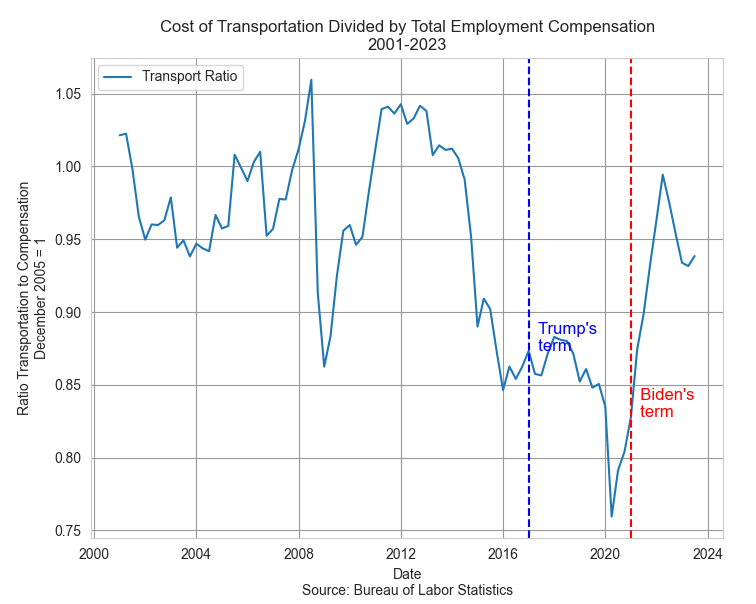
Neither Biden nor Trump were responsible for increased fuel costs but it happened on Biden’s “watch” and voters tend to hold their leaders responsible for the price of housing, gas and food. In the quest for votes, a presidential candidate will often imply that they can control the price of a global commodity like oil. The opening of national monument land in Utah to oil drilling has a negligible effect on the price of oil but a president can claim to be doing something. Our political system has survived because it encourages political posturing but requires compromise and cooperation to get anything done. This limits the damage that can be done by 535 overconfident politicians in Congress.

Voters have such a low trust of Congress that they naturally pin their hopes and fears on a president. Some are single-issue voters for whom economic indicators have little influence. For some voters party affiliation is integrated with their personal identity and they will ignore economic indicators that don’t confirm their identity. Some voters are less dogmatic and more pragmatic, but respond only to a worsening in their economic circumstances. Such voters will reject an incumbent or party in the hope that a change of regime will improve circumstances. Even though economic indicators are not direct predictors of re-election success they do indicate voter enthusiasm for and against an incumbent. They can help explain voter turnout in an election year. A decrease in these ratios in the next three quarters will mean an increase in the economic well-being of Biden supporters and give them a reason to come out in November.

///////////

Photo by Money Knack on Unsplash

Keywords: food, transportation, housing, shelter, income, election

You can view all three ratios here at the Federal Reserve’s database
https://fred.stlouisfed.org/graph/?g=1ejaY

Example: A household grosses $80,000 income including employer taxes and insurance. They pay $24,000 in rent, or 30% of their total gross compensation. Over a short period of time, their income goes up 8% and their rent goes up 10%. The ratio of the shelter index to the income index has gone up from 1 to 1.0185 (1.10 / 1.08). The increase in income has been $6400; the increase in annual rent has been $2400. $2400 / $6400 = 37.5% of the increase in income is now being spent on rent, up from the 30% before the increase. Had the rent and income increased the same 8%, the rent increase would have been only $1920 annually, not the $2400 in our example. That extra $480 in annual rent is $40 a month that a family has to squeeze from somewhere. They feel the pinch.    

Bridge the Gap?

Photo by Ragnar Vorel on Unsplash

September 6, 2020

by Steve Stofka

What issues are your priorities this election? For more than thirty years Pew Research has surveyed people about their priorities. For the first time in 2019 a majority of 765 respondents answered that there is a “great deal” of difference in where each party stands, up from 25% in 1987 (Pew Research, 2020). I’ve included the full list at the end.

In January 2019, soon after the midterm elections Pew surveyed 1500 adults (Jones, 2020). I don’t know why the abortion/free choice debate is not on the issue list since that single issue may decide some voters. I’m particularly interested in the large gaps in those priorities among those who lean Democrat or Republican. I’ll start with gaps of 25%. For instance, terrorism is a concern for 80% of Republicans but only 55% of Democrats. Other Republican priorities are Immigration, the Military and Crime.

As you can see, these are fear issues. Should a person in a town of 2000 be more concerned about terrorism than a resident of NYC? Of course not, but it is what it is. People vote out of fear and hope, but fear probably wins the wrestling match, especially among Republican voters who are not hopey, changey voters, as former VP candidate Sarah Palin noted (Gonyea, 2010).

The issue of crime illustrates the conflicting complexities of these issues. It is a 60% priority for Republicans, who are in suburban and rural areas where there is less crime, and a 40% priority for Democrats, who are in dense urban areas where there is a higher incidence of crime. Because crime is much lower than in past decades, this issue has slipped as a priority for Democrats (FBI, n.d.).  

Two of the highest Democrat priorites – Cimate Change and the Environment – have a huge gap of 50% with Republican voters. Democrat politicians have not been able to make these two fear issues personal for Republicans. If they could, they would draw more voters to their side on this issue. 25% gaps exist on issues of the Poor and Needy, Health Care, Education and Race Relations. Rural Republican voters are more likely to be poor and needy, but this is not a fear issue for them (USDA, n.d.).

What strategy would a politician or political consultant advise? Run toward the base? If so, one would emphasize these issues where there are large gaps between the two primary factions in this country. The President has largely adopted this strategy. Republican voters are more inclined to fall in line and the President is relying on this party loyalty even if they don’t like him personally.

Some issues where there is a smaller gap between factions are the economy, the budget deficit, jobs, global trade, drug addiction, transportation, Social Security and Medicare.

A politician reaching out to voters on the fence in this election would focus on these issues. Joe Biden hits the jobs theme, the budget deficit, and protecting Social Security and Medicare to appeal to voters who have had their fill of the President’s divisiveness.

In the coming two months, candidates may adjust their strategies. In the 2016 election, Hillary Clinton may not have addressed these shared concerns as well and it cost her the election.  Governing comes after winning an election. In politics, winning is packaging the concerns and identities of voters into an appealing, if not attractive, box that will get them to come out and vote.

What are your priorities this election season? Are you a multi-issue voter, a single issue voter, a party voter regardless of the issues? Here’s the Pew survey list of 18 issues: terrorism, immigration, military, crime, climate change, environment, poor and needy, race relations, health care, education, economy, Social Security, Medicare, jobs, drug addiction, transportation, global trade, and the budget deficit.

///////////////

Notes:

FBI. (n.d.). Crime rates in the United States, 2008 – 2018. Retrieved September 05, 2020, from https://crime-data-explorer.fr.cloud.gov/explorer/national/united-states/crime

Gonyea, D. (2010, February 07). ‘How’s That Hopey, Changey Stuff?’ Palin Asks. Retrieved September 05, 2020, from https://www.npr.org/templates/story/story.php?storyId=123462728

Jones, B. (2020, August 26). Republicans and Democrats have grown further apart on what the nation’s top priorities should be. Retrieved September 05, 2020, from https://www.pewresearch.org/fact-tank/2019/02/05/republicans-and-democrats-have-grown-further-apart-on-what-the-nations-top-priorities-should-be/

Pew Research Center. (2020, August 21). Public’s 2019 Priorities: Economy, Health Care, Education and Security All Near Top of List. Retrieved September 05, 2020, from https://www.pewresearch.org/politics/2019/01/24/publics-2019-priorities-economy-health-care-education-and-security-all-near-top-of-list/

U.S.D.A. (n.d.). Rural Poverty & Well-Being. Retrieved September 05, 2020, from https://www.ers.usda.gov/topics/rural-economy-population/rural-poverty-well-being/

Budget Perspective

June 2, 2019

by Steve Stofka

How does your spending compare with others in your age group? Working age readers may compare their budgets with widely published averages that are misleading because they include seniors as well as those who are still living at home with their parents or are going to college. Let’s look at spending patterns classified by working age consumers 25-65 and seniors whose spending patterns change once they retire.

The Bureau of Labor Statistics collects data on consumer behavior by conducting regular surveys of household spending (Note #1). These surveys provide the underlying data for the computation of the CPI, the Consumer Price Index. Social Security checks and some labor contracts are indexed to this measure of inflation.

The BLS also provides an analysis of consumer purchasing by household characteristics, including age, race, education, type of family, and location (Note #2). Spending and income patterns by age contained some surprises (Note #3). The average income of 130,000 people surveyed in 2017 was $73K. Seniors averaged $25K in Social Security income. Younger workers aged 25-34, the mid-to-late Millennials, earned $69K, near the average of all who were surveyed. Following the Great Financial Crisis, this age group – what were then the early Millennials in 2010 – earned only $58K, so the growing economy has lifted incomes for this age group by 20% in seven years.

Home ownership is around 62% for the whole population, but far above that average for older consumers. 78-80% of people 55 and older own their own homes. More than 50% of those have no mortgage but too many seniors do not have enough savings. In many states, property taxes are the chief source of K-12 education funding and older consumers have the fewest children in school. Older consumers on fixed budgets resist higher property taxes to fund local schools and they vote in local elections at much higher rates than younger people. Since 2000, per pupil spending has grown more than 20% but most of that gain came in the 2000s.  In the past twelve years, real per pupil spending has barely increased (Note #4). Below is a chart from the Dept. of Education showing per pupil inflation adjusted spending.

Graph link: https://nces.ed.gov/fastfacts/display.asp?id=66

Saving is an expense and working age consumers aged 25-65 are saving 9-12% of their after-tax income, twice as much as the 5.6% average. Wait – isn’t saving the process of not spending money? How can it be an expense?  Call it the imaginary expense, as fundamental to our life cycle as i, the imaginary square root of -1, is to the mathematics of cyclic phenomena. Let’s compare today’s savings percentage with the panic years of 2009-10 just after the financial crisis. Workers in the 25-34 age group – who should have been spending money on furniture and cars and eating out – were saving 20% of their after-tax income (Note #5). That age group will probably carry the lessons – and caution – learned as they began their working career after the financial crisis.

Workers 25-65 spend 28-32% of their after-tax income on housing. Until they are 65, people spend a consistent 12% of their income on food, both at and away from home. Seniors spend less on food but most of that change is because they spend less money eating out at restaurants. Working age consumers spend more on transportation than they do on food – a consistent 15% of after-tax income.

People 65 and older are entitled to Medicare but they spend more on health insurance than working people and the dollar amount of their spending on health care rises by 50%. As a percent of after-tax income, seniors spend 15% while people of working age spend about 6%. Ouch. I’m sure many seniors are not prepared for those additional expenses.

Those of working age should compare their budget averages to other workers, not to the national averages, which include older people and those under 25. Summing up the major expense categories: workers are averaging 30% for housing, 15% for transportation, 12% for food, 11% for personal insurance, pensions and Social Security contributions, 10% for savings and 6% for healthcare.

As Joey on the hit TV show Friends would often say, “So how you doin’?”

///////////////////

Notes:

  1. Explanation of Consumer Expenditure Survey
  2. Consumption patterns – list Table 1300
  3. The most recent detailed analyses available are for 2017.
  4. Dept of Ed data
  5. Spending and income levels for those aged 25-34 2009-2010.

Not Easy Being Green

February 24, 2019

by Steve Stofka

Newly elected Democratic Rep Alexandria Ocasia-Cortez has introduced a House resolution that details a broad basket of long-term infrastructure and humanitarian goals titled a Green New Deal. Connecticut Senator Ed Markey has introduced the resolution in the Senate. Whether it makes it to the floor of either chamber for a vote is uncertain. Some of the attacks on the resolution have been on points that were rejected from the resolution but were raised in a Q&A passed around to some House members in the building of a political consensus (Note #1).

The aspirations behind these improvements echo the infrastructure dreams of a post-World War 2 America. Politifact recently summarized the various points (Note #2). The key characteristics of the infrastructure goals are “safe,” “efficient” and “clean.” Those characteristics are embedded already in thousands of laws and regulations – but with practical limitations. A flexible approach is key to achieving these goals.

This week, I’ll focus on the infrastructure goals, starting locally at the granular level. “Upgrading all existing buildings in the United States and building new buildings to achieve maximum energy efficiency, water efficiency, safety, affordability, comfort, and durability, including through electrification.”
Someone clumsily attached those last three words, but they are critical. The words may be read to include an electrical upgrade of all buildings. They may be understood to include all buildings which could be improved with new electrical service. The language may be interpreted as a call for building retrofits for solar power.

These are expensive retrofits, so it is important that this clumsy language be sold as an aspirational guide, not the model language of a law or an agency rule. Local building regulations often “grandfather” older buildings so that they do not have to meet more recent building guidelines if they passed existing codes when they were built or remodeled. Anything other than a gradual approach in this area will be doomed.

“Universal access to clean water.”
Shortly after WW2, the Federal government took an increasing role in regulating local water supplies and sanitation, while helping to fund improvements (Note #3). This Green resolution is a reaffirmation of those goals. After seventy years, many existing water systems need massive and costly improvements. A contaminated water supply forced the residents of Flint, Michigan to use bottled water for more than three years.

The key word in this goal is “universal” and how that word is read. An exodus of residents and industry from poorer rural communities have crippled their budgets and resources. Who will pay to rebuild the aging plumbing systems of these hollowed out communities? Within many thriving metro areas are rural communities who do not have a central water system or sanitation. Homeowners and commercial buildings rely on private wells and are responsible for the maintenance of their wells and septic systems. Poorer residents may not have the means to service their systems properly. Will proposed legislation subsidize those residents? Since the Clean Water Act was passed fifty years ago, state and local governments have been fighting a legal battle with the Federal government over improvements to the water supply. Without a deft approach, legislation would continue to keep the lawyers busy.

Smart grids, a more efficient electrical delivery system, is a regional goal that is a restatement of the EISA law created in 2007 (Note #4). Our existing grids are more than fifty years old and need upgrading to a system that senses and adjusts to the changes in the system load. It would enable more clean power alternatives. Federal legislation which mandates upgrades to existing buildings to implement this vision will be met with impassioned resistance. Shall all power lines and power stations throughout the country be upgraded to meet new standards?

In conjunction with a transition to smart grids, this Green resolution restates an earlier vision: “eliminating pollution and greenhouse gas emissions as much as technologically feasible.” In the years after WW2, there was talk that the country would transition to nuclear power plants, a source of clean, cheap energy. The accident at the Three Mile Island nuclear plant in 1979 disrupted that vision (Note #5).

“Clean, affordable, and accessible public transit, and high-speed rail.”
This was a 20th century goal whose implementation stumbled. In 1960, my family traveled by train from Chicago to Dallas. We enjoyed the passing countryside from the upper deck of an observation car on the train. When Amtrak was created in 1971 (Note #6), there was going to be a highly efficient and affordable rail network built throughout the country. We are still waiting. After 9-11, let’s face it – plane travel sucks. The U.S. has the finest rail transport for goods in the world. Why are we so bad at moving people by rail?

There are many reasons. Following WW2, America invested more in highways than railroads. Families fell in love with the individual freedom of their automobile. The public is more resistant to the Federal government’s exercise of eminent domain. When the Civil War Republican Congress passed the Railway Act in 1862, the Federal government took what land it needed, and gave vast tracts to railroad companies who became rich selling off the land after laying the rails (Note #7). The Federal government played a key role in creating the corporate America that now wields an extraordinary amount of political and economic control of our daily lives. The public is weary and wary of large Federal projects.

Sweeping Federal legislation to achieve these goals must overcome the constitutional design of the country which gives those in rural areas a greater say in policy than their numbers warrant. This design was a 19th century compromise between agricultural and industrial states. Until a Supreme Court decision in 1964, many rural states did not redraw their state electoral maps after each census. In some states, one rural vote counted the same as forty urban votes (Note #8). Fifty years later, the structure of many state houses is designed to weaken the power of urban voters within the state.

The infrastructure goals contained in this resolution are essentially Infrastructure 2.0, an update of 20th century dreams. As in the past, economic and political realities will present formidable obstacles. Next week, I’ll look at the humanitarian goals contained in the resolution.

////////////////
Notes:
1. Green New Deal article at the Hill
2. Green New Deal article at Politifact
3. Water and sanitation regulation after WW2
4. Smart grid
5. Three Mile Island 
6. Amtrak history
7. Pacific Railroad Acts 
8. Reynolds v. Sims reinforced the idea of one person, one vote


All Aboard!

July 17, 2016

I have changed the blogger template to make it easier to read on a mobile phone. On my Android phone, the dynamic template defaulted to classic view without all the widgets on the side and was easier to read. The graphs are easier to see in landscape mode, when the long part of the phone is horizontal to the ground. Perhaps some readers can give me some feedback if there are problems viewing on an Apple phone.  Now on to this week’s business!

As I noted last week, things can get a bit ugly when both stocks and Treasuries surge upward at the same time, as they have in the past few weeks following the sharp downward response to the Brexit vote in the U.K.  The buying of stocks signals that investors have more of an appetite for risk.  The buying of Treasuries and gold signal a desire for safety.  At the beginning of the week the world woke up to the news that the Japanese central bank was going to provide a lot of stimulus to goose economic growth.  This gave a boost to Asian stocks and the rally in equities was on.  By the end of the week, the Japanese stock market had risen 8% during the week and it’s currency, the yen, had fallen the most since 1999.

Economist Paul Krugman has called on Japanese policy makers to set higher inflation targets and provide even more stimulus to spur an economy now lethargic for two decades.  According to Krugman’s own textbook, the roles of an economist are 1) to describe the economic and market mechanisms; and 2) form predictions of how the economy and market would react if certain policy actions were adopted.

However, Krugman has a lot of visibility as an op-ed writer in the NY Times.  In this role, he often offers prescriptive solutions, and this week’s call is yet another prescription from Dr. Krugman.  Japan has been basing their policies on Krugman’s predictions for a decade with mixed or muted results. More stimulus seems to be the eternal cry from Krugman, a smart man who seems to have but one or two solutions for the majority of social and economic problems.

Most economists are rather circumspect, arguing among themselves the mechanisms and validation of varied predictions.  But there are a few stand outs who reach out to the general public, ready and willing to engage in the political debate.  The subfield of economics called macroeconomics forms a beautiful mud pit for the struggle of political policies, for politicians often cite macroeconomic rationale when championing a set of policies.  For thirty years, Nobel winner Milton Friedman espoused a more conservative and monetary model of the economy, emphasizing montetary, not fiscal, policy by the central bank as the chief intervention in the market economy.  Search YouTube and you will find many of his talks and lectures and they are both informative and entertaining.

Krugman is one of the more vocal macroeconomists who diagnose economic maladies, build a predictive model based on policy or monetary fixes, then diagnose their model when their predictions are in error.  The patient didn’t take enough of the medicine or there is some response lag or the full extent of the problem was not known or was disguised by something or other.  The descriptive aspect of macroeconomics doesn’t seem to help develop a predictive model.  Perhaps the study of economic phenomenon on a national and international scale is just too difficult to have much predictive ability. Let’s hope not.  For the past decade, so many really smart people have been wrong.

Once again this week, central bankers signalled that they were ready to adopt what are called accommodative policies to reassure markets.  If stock markets were an athlete with a knee injury, central bankers would be the good doctor who drains the knee then injects a bit of pain medication and cortisone into the joint before sending the athlete back onto the field.

////////////////////

Retail Sales

Wildlife scientists may study herds of grazing animals to gain insight into both the seasonal behaviors of the herd and its response to conditions that alter the animals’ environment.  These include drought, war, or the burning of forests for farmland.  Economists follow a different kind of herd – people.

Macroeconomists focus on the behavior of the entire herd; microeconomists analyze the behavior of individuals acting within the herd.   Two telltale signs of human behavior are paycheck stubs and sales receipts, which act in tandem like entangled particles in a quantum dance.  In this consumerist economy, retail sales are fueled by the earnings of 140 million workers; the monthly reports on each activity guide the analysis of economists.

Each month a sample of paycheck stubs is gathered and reported by the Bureau of Labor Statistics.  The Census Bureau produces an estimate of retail sales based on a survey of almost 5000 companies.  (For those interested in the methodology.) Year-over-year growth in real, or inflation adjusted, sales fell below 1% in March this year and spurred some concern that consumption power was being eroded by slow income growth. Following the extraordinary labor report a week ago, the monthly retail sales report, released this past Friday, was stronger than the consensus.  Inflation adjusted sales rose 1.67% over last year, rising up a 1/2% from May’s year-over-year reading.  2% real growth would be ideal but anything over 1.5% is a sign of a growing economy. Why the 1.52% threshold?  1% of each year’s growth can be discounted as simply population growth.
 
On a sobering note, the year-over-year growth in retail sales is gradually declining as we can see in the graph below.

What negative signs should an ordinary investor watch for?  Where is the herd going?  Investors should get cautious when year-over-year growth in real retail sales consistently falls below 1.5%.  After December 2006, growth remained below this threshold and did not cross back above it till March 2010 – a period of 3-1/4 years that darkened the lives and hopes of many Americans.  During that period January 2007 through March 2010, the SP500 index fell from about 1440 to 1170, a decline of 19%.  We are part of the herd but with some observant caution we may be able to move some of our savings to the fringes of the herd movement and avoid getting trampled.

///////////////////////

MyRA

Earlier this year the U.S. Treasury introduced a Roth IRA tool called myRA for employees who work at a company that does not offer a retirement savings account.  This is a fully guaranteed account similar to a savings account that grows tax free.  The maximum one can save in this kind of account is $15,000 and part of the contribution amount is entitled to a tax credit.  This can be a good way to get started with retirement savings.  The Federal Reserve has an article on the subject here.

///////////////////

Amtrak Train Trance

On vacation in California recently, I rode Amtrak’s Pacific Surfliner several times on day trips from Los Angeles.  Unlike the east-west Amtrak routes, these north south routes along the coast are more frequent, running several times a day sometimes only two hours apart. Part of the route is along the beach, part along a highway, and part travels the urban backcountry – the backyards of businesses, farms and homes that most of us do not see from a car.  The experience was a sightseeing delight, a meditative trance of motion.

Most of Amtrak’s lines do not make money and rely on government subsidies.  Like so much of our transportation infrastructure in this country, railroad infrastructure needs upgrade and repair.  Opponents of government subsidies often don’t realize how much of what they personally use is subsidized.  Here is a link to a Business Insider article on Amtrak’s operations and the political debate over federal subsidies for Amtrak.  The debate crosses party lines because rural politicians of both parties tend to support subsidies for Amtrak when the rail service crosses through their geographic region.

Air travel, the most frequent mode of long distance transporation, is heavily subsidized by the federal government.  Here is a USA Today article on that subject and the $2 billion in subsidy for one airport alone, LaGuardia airport in New York City.  Likewise are the massive amount of indirect subsidies for automobile transporation, which rely on roads maintained by federal, state and local tax dollars.  These repairs are only partially paid for with dedicated gasoline tax dollars; state and local taxes must make up the difference.  Let us also include the multi-billion dollar bailouts of the industry that arise every few decades because of poor planning by industry executives in response to market demand or foreign competition.

Amtrak subsidies look miniscule in comparison. The railroad suffers from a chicken and egg problem of investment and revenue.  Which comes first?  Without more investment the railroad can only offer once a day service on east-west routes, which does not attract strong ridership.  Without a show of rider demand, there is little incentive to provide investment. The California Zephyr leaves a major city like Denver enroute to the west coast at 8 A.M. only once a day.

Boarding times in a particular region may be inconvenient.  Barstow, CA is a city of 23,000 north of Los Angeles that is serviced by the southern east-west Amtrak route called the Southwest Chief.  Like the Zephyr, this train starts in Chicago but heads southwest through Kansas, Colorado and New Mexico before heading west through northern Arizona to the west coast.  The Barstow railroad station, if it can be called that, consists of a bench and a slight overhang typical of urban bus stops.  There is no bathroom or other facilities.  The 4-1/2 hour trip to Union Station in Los Angeles arrives and departs once a day in Barstow at 3:40 AM, a unwelcoming time for a train jaunt into the big city.  The large city of San Bernadino, CA has a slightly more hospitable departure time of 5:30 AM.

In the early 19th century, before the refinement of petroleum deposits into gasoline, railroads were developed and built in Britain, then spread to Europe.  Early investment in rail transportation both for goods and people embedded the concept and the technology in European politics, its economies and cultures.

Many decades ago, this country chose to subsidize the movement of people by car, reserving the rails for the transportation of goods.  The land was big, and population centers west of the Mississippi were distant.  Steam locomotives run on wood,  a precious commodity west of the 100th meridian (central Nebraska), where there was not enough rainfall for trees to grow on the vast plains.  Oil deposits were plentiful in several regions within the country and gasoline is portable and a rich source of energy, packing a lot of BTUs per volume.

We love our cars, the hum of tires on blacktop as we run down the highway. But a train has another quality that is difficult to get in a car – a reduced sense of movement, a trance like floating through space while staring out the picture window of a rail car at a movie in motion.  If you have a few days and you are not in a rush, take a seat and let the landscape unroll before you.