Cause and Effect

May 26, 2024

by Stephen Stofka

This week’s letter is about the causes of inflation. Inflation can be easily described as a mismatch between supply and demand but that is a tautology that does not explain how the mismatch occurred. For hundreds of years, scholars and academics have identified various components of inflation’s causal web but identifying a primary cause has inspired enthusiastic debate. In the past century, economists have built sophisticated mathematical models which failed to predict a subsequent episode of inflation or predicted an inflation that did not occur. Economic models predicted that large government support during the financial crisis fifteen years ago would lead to higher inflation. It did not. Some economists were surprised at the extent and strength of the inflationary surge following the pandemic. In hindsight, turning off the world’s economic supply engine for even a short time was likely to have a strong effect on prices.

In The Power of Gold, Peter Bernstein (2000) recounts the causes that sixteenth century scholars gave for the persistent inflation in Europe during the 1500s. Those factors included “the decline of agriculture, ruinous taxation, depopulation, market manipulation, high labor costs, vagrancy, luxury and the machination of businessmen” (p. 191). Five hundred years later, most factors are relevant today in an altered form. With more sophisticated analytical tools, economists have developed a better understanding of these causal influences but that understanding has not led to better inflation forecasting. These factors can be grouped into those that affect supply or demand. Missing from that list was war, a common cause of inflation that distorts both supply and demand.

Prior to the severe cooling of the Little Ice Age in the 1600s, England and northwest Europe experienced a cooler climate that affected harvests. In an economy that relied mostly on agriculture, a poor harvest, or decline in agriculture was a supply constraint that pushed up prices. The demand / supply relationship is a fraction that helps explain a change in price. A lower supply, the denominator in that fraction, equals a higher price. Repeated waves of the plague and other general pandemics led to a depopulation that reduced the work force and pushed up the subsistence wages paid to workers. Employment in the U.K. has still not recovered from pre-pandemic levels, contributing to slightly higher inflation in the U.K. compared to the U.S.

High labor costs are the essence of a cost-push theory of inflation. When there is not enough supply of labor, workers are able to command higher wages. In many businesses, labor is an employer’s highest cost. Because employers markup all production costs, that markup increases the rise in prices. If employees get an extra $1 wage and the employer marks it up 50% to cover operating expenses, required taxes, fixed investment and profit, then the price will rise $1.50. The additional wage income will increase demand, resulting in a wage-price spiral that further exacerbates inflation. Any policy that reduces the supply of labor can be included in a cost-push theory of inflation.

Vagrancy, or homelessness, was a new phenomenon in the 16th century as Europe emerged from the feudal system in which workers were bound to the properties they cultivated. Policies that tolerated idleness of any sort reduced the work force and gave workers more bargaining power. Scholars of that century would be puzzled by modern day unemployment insurance which “rewards” workers for idleness. The mathematics of probability and risk that makes any insurance program feasible was barely in its infancy. By the late 17th century, Blaise Pascal and Pierre de Fermat had developed probability analysis, giving pools of underwriters gathered in coffee houses near London’s Royal Exchange the mathematical tools to sell insurance policies on many risky events (Bernstein, 1996, 63, 90).

Ruinous taxation consisted of import taxes and the debasement of hard metal currencies by the sovereign as a substitute for taxation. Import taxes on necessary commodities increased production costs, creating a cost-push effect. To repay debts incurred during war campaigns, rulers debased the currency by mixing base metals with gold or silver. In the 4th century B.C., Dionysius of Syracuse in Sicily had all the coins in his kingdom restamped to double their value so he could pay his debts (Bernstein, 2000, 48). Monetarists claim that an excess supply of money is the root cause of inflation. The economist Milton Friedman, never one to equivocate, stated flatly that inflation was “always and everywhere a monetary phenomenon.” In the Wealth of Nations, Smith (1776; 2009) noted that gold discoveries in the Americas had driven prices higher in England. A higher supply of money of any form will increase demand so this root cause is a subset of demand-pull theories of inflation.

Popular and scholarly opinion often points an accusing finger at the business class, whose conspiratorial machinations are thought to be responsible for rising prices. Historian Barbara Tuchman (1978, 163-165) described the power that merchants had acquired as the Third Estate under feudalism in 14th century France. Because many merchants were free citizens of a town and not subject to the rule of a noble, they enjoyed wealth and privileges like that of nobles, and at the expense of the workers who regarded them with scorn and envy. In Part 1, Chapter 10 of the Wealth of Nations, Smith wrote “People of the same trade seldom meet together, even for merriment and diversion, but the conversation ends in a conspiracy against the public, or in some contrivance to raise prices.” Responding to the global inflation following the Covid-19 pandemic, some op-ed writers and Twitter threads were convinced that collusion by business interests was the primary cause of the inflation.

The reasoning and analysis by thinkers of centuries past did not include the role of expectations in fostering and feeding inflation. Expectations are a key part of some prominent models because supply and demand operate on different time scales. The companies that make up the supply chain must anticipate the level of demand for a product or service before the demand manifests. Each year, the risk of being wrong increases in an economy marked by technological change and rapidly evolving tastes. Inflationary expectations needs a bit more space and will have to wait until next week. Have a good holiday weekend!

//////////////////

Photo by Elias Kauerhof on Unsplash

Keywords: expectations, money, taxation, unemployment, supply, demand, cost-push, demand-pull

Bernstein, P. L. (1998). Against the Gods, the Remarkable Story of Risk. John Wiley & Sons.

Smith, A. (2009). Wealth of Nations. Classic House Books.

Tuchman, B. W. (1978). A Distant Mirror: The calamitous 14th Century. Alfred A. Knopf.

The Role of a Rule

December 31, 2023

by Stephen Stofka

This week’s letter is about the role of a monetary rule and the guiding points that help the Fed steer its policymaking. Since the 2008-9 financial crisis, the Fed has purchased a lot of assets, increasing its balance sheet from less than one trillion dollars at the end of 2007 to almost $8 trillion this month. It has kept the federal funds rate that anchors all other interest rates near zero for ten of the last 15 years. The members on its board of governors serve 14 year terms, affording them an autonomy resistant to political influence. From those board members the President and Senate choose and confirm the Chair and Vice-Chair of the board. The governance structure allows them to set and follow a plan of steady guidance but their actions have resembled those of sailors steering against unpredictable winds. What are the guiding lights?

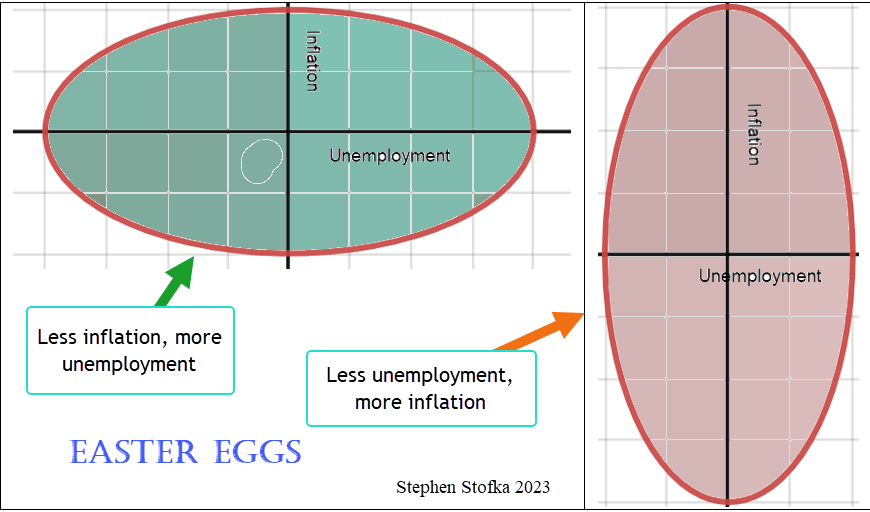
In the late 1950s, economists and policymakers enthusiastically endorsed the concept of the Phillips Curve. Picture an ellipse, a circle that has been stretched along one axis so that it appears like an egg.

Think of unemployment along the x-axis and inflation along the y-axis. More unemployment stretched the circle, shrinking inflation. More inflation stretched the circle in the y-direction, lessening unemployment. Policymakers could tweak monetary policy to keep these two opposing forces in check. In the 1970s, both inflation and unemployment grew, shattering economic models. Nevertheless, Congress passed legislation in 1978 that essentially handed the economic egg to the Fed. While the central banks of other countries can choose a single policy goal or priority – usually inflation – Congress gave the Fed a twin mandate. It was to conduct monetary policy that kept inflation steady and unemployment low – to squeeze the egg but not break it.

Mindful of its twin mission, the Fed later recognized – rather than adopted – a monetary policy rule, often called a Taylor rule after John B. Taylor (1993), an economist who proposed the interest setting rule as an alternative to discretion. The Fed would use several economic indicators as anchors in policymaking. The Atlanta Fed provides a utility that charts the actual federal funds rate against several alternate versions of a Taylor rule. I’ve included a simple alternative below and the actual funds rate set by the Fed. When the rule calls for a negative interest rate, the Fed is limited by the zero lower bound. Since the onset of the pandemic in March 2020, the Fed’s monetary policy has varied greatly from the rule. Only in the past few months has the actual rate approached the rule.

In a recent Jackson Hole speech, Chairman Powell said, “as is often the case, we are navigating by the stars under cloudy skies.” What are these guiding points that should anchor the Fed’s monetary policy? I’ll start with r-star, represented symbolically as r*, which serves as the foundation, or intercept, of the rule. Tim Sablick at the Richmond Fed defined it as “the natural rate of interest, or the real interest rate that would prevail when the economy is operating at its potential and is in some form of an equilibrium.” Note that this is the real interest rate after subtracting the inflation rate. The market, including the biggest banks, consider it approximately 2% (see note at end). This is also the Fed’s target rate of inflation, or pi-star, represented as π*. The market knows that the Fed is going to conduct monetary policy to meet its target inflation rate of 2%.

Why does the Fed set a target inflation rate of 2% instead of 0%? The Fed officially set that target rate in 1996. The 2% is a margin of error that was supposed to give the Fed some maneuvering room in setting policy. There was also some evidence that inflation measures did not capture the utility enhancements of product innovation. Thirdly, if the public expects a small amount of inflation, it adjusts its behavior so that the cost is so small that the benefit is greater than the cost (Walsh 2010, 276). Today, most central banks set their target rate at 2%.

The definition of r-star above is anchored on an economy “in some form of equilibrium.” How does the Fed gauge that? One measure is the unemployment rate and here we have another star, U-star, often represented as un, meaning the natural rate of employment. In 1986 Ellen Rissman at the Chicago Fed described it (links to PDF) as “the rate of unemployment that is compatible with a steady inflation rate.” So now we have both unemployment and the interest rate anchored by the inflation rate.

Another part of that r-star definition is an economy “operating at potential.” Included in the Fed’s interest rate decisions is an estimate of the output gap that is produced by economists at the Congressional Budget Office (CBO). The estimate includes many factors: “the natural rate of unemployment …, various measures of the labor supply, capital services, and productivity.” The CBO builds a baseline projection (links to PDF) of the economy in order to forecast the federal budget outlook and the long term financial health of programs like Social Security. Each of these factors does contribute to price movement but the analysis is complex. A more transparent gauge of an output gap could help steer public expectations of the Fed’s policy responses.

In a paper presented at the Fed’s annual Jackson Hole conference in Wyoming, Ed Leamer (2007, 3) suggested that the Fed substitute “housing starts and the change in housing starts” for the output gap in constructing a monetary policy rule. At that time in August 2007, housing starts had declined 40% from their high in January 2006. Being interest rate sensitive, homebuilders had responded strongly to a 4% increase in the Fed’s key federal funds rate. Despite that reaction, the Fed kept interest rates at a 5% plateau until September 2007. By the time, the Fed “got the message” and began lowering rates, the damage had been done. Six months after Leamer delivered this paper, the investment firm Bear Sterns went bankrupt. The Fed engineered a rescue by absorbing the firm’s toxic mortgage assets and selling the rest to JP Morgan Chase. Six months later, Lehman Brothers collapsed and the domino effect of their derivative positions sparked the global financial crisis.

I have suggested using the All-Transactions House Price Index as a substitute for the output gap. A long-term average of annual changes in this index is about 4.5%. The index is a summation of economic expectations by mortgage companies who base their loan amounts on home appraisals, banks who underwrite HELOC loans to homeowners and loans to homebuilders. The index indirectly captures employment trends among homeowners and their expectations of their own finances. Any change that is more than a chosen long-term average would indicate the need for a tightening monetary policy. Anything less would call for a more accommodative policy. Either of these housing indicators would be a transparent gauge that would help guide the public’s expectations of monetary policy.

Although the Fed considers the Taylor rule in setting its key interest rate, the rate setting committee uses discretion. Why have a rule only to abandon it in times of political or economic stress? The rule may not operate well under severe conditions like the pandemic. A rule may be impractical to implement. A Taylor rule variation called for a federal funds rate of 8% in 2021. This would have required a severe tightening that forced the interest rate up 7% in less than a year. The Fed did that in 1979-80 and again in 1980-81. Both times it caused a recession. The second recession was the worst since the 1930s Depression. An economy as large as the U.S. cannot adjust to such a rapid rate increase.

How strictly should a rule be followed? Some of us want rule making to be as rigid as lawmaking. A rule should apply in all circumstances regardless of consequences. Many Republican lawmakers felt that way when they voted against a bailout package in September 2008. Some of us regard a rule as an advisory, not a straitjacket constraint of policy options. Each of us has a slightly different preference for adherence to rules.

See you all in the New Year!

/////////////

Photo by Mark Duffel on Unsplash

Keywords: housing starts, house price index, stars, output gap, unemployment, interest rate, inflation

All-Transactions House Price Index is FRED Series USSTHPI. The annual change is near the long-term average of 4.5%, down from a high of 20% in 2022.

Housing starts are FRED Series HOUST. The output gap is a combination of two series, real GDP GDPC1, and real potential GDP, GDPPOT.

A gauge of long-term inflation expectations is the 10-year breakeven rate, FRED Series T10YIE. The 20-year average is 2.08%. The series code is T=Treasury, 10Y = 10 year, IE = Inflation Expectations. The T5YIE is a 5-year breakeven rate.

Leamer, E. (2007). Housing Is the Business Cycle. https://doi.org/10.3386/w13428

Taylor, J. B. (1993). Discretion versus policy rules in practice. Carnegie-Rochester Conference Series on Public Policy, 39, 195–214. https://doi.org/10.1016/0167-2231(93)90009-l

Walsh, C. E. (2010). Monetary theory and policy. MIT press.

Employment Curves

January 15, 2023

by Stephen Stofka

For millennia people have claimed a power of divination by various methods, including the casting of bird bones on the ground, the magic of numbers or certain word incantations. As the New Year begins, there is no shortage of predictions for 2023. Will the Fed taper its rate increases now that inflation has moderated? Will the U.S. go into a recession? Will falling home prices invite a financial crisis like the one in 2007-9? Will bond prices recover this year? Other animals see only a few moments into the future. We have developed forecasting tools that try to time-travel weeks and months into the future, but we should not judge a tool’s accuracy by its sophistication.

Statistics is a series of methods that constructs a formula explaining a relationship between variables. Each data point requires a calculation, a tedious task for human beings but a quick operation by a computer. Before the introduction of the computer in the mid-20th century, investors used simpler tools like the comparison of two moving averages of a time series like stock prices. These simple tools are still in use today. An example is the MACD(12,26) trend that compares the 12-day and 26-day moving averages, noting those points where the short 12-day average crosses the long 26-day average (Stockcharts.com, 2023). We can apply a similar technique to the unemployment rate.

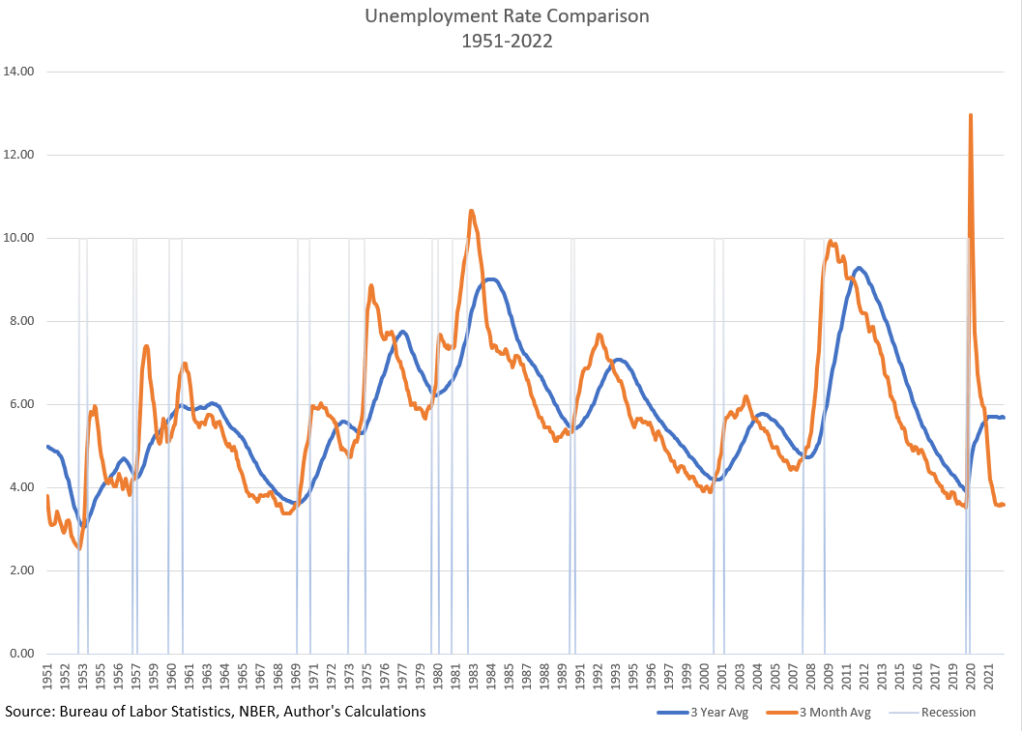
In the chart below I have graphed the 3-month and 3-year moving averages of the headline U-3 unemployment rate. The left side of each column faintly marked in gray marks the beginning of a recession has noted by the NBER (2023). These beginnings roughly coincide with the crossing of the 3-month (orange) above the 3-year (blue) average. With the exception of the 1990 recession, the end of the recessions is near the peak of the 3-month orange line, after which unemployment declines. Today’s 3-month average is well below the 3-year trend, making a recession less likely. However, except for the pandemic surge of unemployment, the 3-month average is quite low and has been below the 3-year average for the longest period in history.

I did not do any laborious trial and error of various averages to find a fit. I chose these periods because they fit my story, something I wrote about last week. A 3-year average should provide a stable long term trend line of unemployment. A 3-month average should reflect current conditions with some of the data noise removed. The crossing should capture an inflection point in the data.

The low unemployment rate implies that workers have more wage bargaining power but wage increases have lagged inflation, robbing workers of purchasing power. If inflation continues to decline in 2023, some economists predict that wage increases may finally “catch up” and surpass the inflation rate.

There are two trends that have weakened the wage bargaining power of workers. Since World War 2, an economy dominated by manufacturing has transitioned to a service economy with lower average wages. In that time, the percent of workers employed in agriculture fell from 14% to less than 2% as production and harvesting became more mechanized. The labor market has undergone structural changes that may invalidate or weaken the lessons of earlier decades.

Since WW2, self-employment has declined. Half of those employed now work for large companies with 500 or more employees (Poschke 2019, 2). Few are unionized and able to bargain collectively for wages. According to the Trade Union Dataset (2023), most European countries enjoy much higher trade union participation than in the U.S. where only 10% of workers belong to a union. Large American companies enjoy a wage-setting power that smaller companies do not have and this enables them to resist wage demands. American workers do not have enough wage bargaining power to make a significant contribution to rising prices. Stock owners, able to move money at the stroke of a computer key, hold more bargaining power.

To keep their stock prices competitive, publicly traded companies must maintain a profit margin appropriate to their industry. Investors will punish those companies who do not meet consensus expectations. Company executives rarely take responsibility for falling profit margins. Instead, they blame rising wages or material costs, shifting consumer tastes or government regulations. Interest groups like the U.S. Chamber of Commerce, a private lobbying organization funded by the largest companies in America, champion a narrative that inflation is the result of rising wages, not rising profit margins. Like any interest group, their job is to assign responsibility for a problem to someone else, to convince lawmakers to act favorably to their cause or industry. The Chamber has far better funding than advocates for labor and it uses those funds to block policies that might favor workers.

There are economists and policymakers who still believe in the Phillips Curve, a hypothetical inverse relationship between unemployment and inflation. High unemployment should coincide with low inflation and high inflation with low unemployment. Shortly after Bill Phillips published his data and hypothetical curve, Guy Routh (1959), a British economist, published a critique in the same journal Economica, pointing out the flaws in Phillips’ methodology. The chief flaw was Phillips’ lack of knowledge about the labor market itself. Despite that, American economists like Paul Samuelson, who favored an activist fiscal policy, liked the implications of a Phillips Curve. Policy makers could fine tune an economy the way a car mechanic tuned a carburetor.

In the past year, some economists and policymakers have advocated policies to drive unemployment higher and wring inflation out of the economy. Despite rising interest rates, the labor market has been strong and resilient. In January 2020, Kristie Engemann (2020), a coordinator at the St. Louis Fed, explored the debate about whether this relationship exists or not. For the past five decades, the “curve” has been flat, a statistical indication that there is no relationship between inflation and unemployment. Policymakers will continue to cite the Phillips Curve because it serves an ideological and political purpose.

We don’t need statistical software to debunk the Phillips curve. In the chart I posted earlier, there were several points where the 3-month average unemployment rate was near or below 4%. These were in the late 1960s, the late 1990s, and the late 2010s. The inflation rate was 3%, 2.5%, and 1.4% respectively. If the Phillips Curve relationship existed, inflation would have been much higher.

As our analytical tools become more sophisticated we risk being fooled by their power. With a few lines of code, researchers can turn the knobs of their statistical software machines until they reach a result that is publishable. We should be able to approximate if not confirm our hypothesis with simpler tools.  

///////////////////

Photo by Augustine Wong on Unsplash

Engemann, K. M. (2020, January 14). What is the Phillips curve (and why has it flattened)? Saint Louis Fed Eagle. Retrieved January 13, 2023, from https://www.stlouisfed.org/open-vault/2020/january/what-is-phillips-curve-why-flattened

National Bureau of Economic Research. (2022). Business cycle dating. NBER. Retrieved January 13, 2023, from https://www.nber.org/research/business-cycle-dating

Poschke, M. (2019). Wage employment, unemployment and self-employment across countries. SSRN Electronic Journal, (IZA No. 12367). https://doi.org/10.2139/ssrn.3401135

Routh, G. (1959). The relation between unemployment and the rate of change of money wage rates: A comment. Economica, 26(104), 299–315. https://doi.org/10.2307/2550867

Stockcharts.com. (2023). Spy – SPDR S&P 500 ETF. StockCharts.com. Retrieved January 13, 2023, from https://stockcharts.com/h-sc/ui?s=spy  Below the price chart is the MACD indicator pane.

Trade Union Dataset. OECD.Stat. (2023, January 13). Retrieved January 13, 2023, from https://stats.oecd.org/Index.aspx?DataSetCode=TUD

U.S. Bureau of Labor Statistics, Employment Level [CE16OV], retrieved from FRED, Federal Reserve Bank of St. Louis; https://fred.stlouisfed.org/series/CE16OV, January 11, 2023.

U.S. Bureau of Labor Statistics, Employment Level – Agriculture and Related Industries [LNS12034560], retrieved from FRED, Federal Reserve Bank of St. Louis; https://fred.stlouisfed.org/series/LNS12034560, January 11, 2023.

////////////////////

The Misery Index

December 18, 2022

By Stephen Stofka

This week’s letter is about a measure of economic discomfort that economist Arthur Okun developed in the 1960s. In the early 1980s President Reagan renamed it the “misery index.” Weather forecasters calculate a misery index of temperature and humidity. Okun’s measure of discomfort added the inflation rate and the unemployment rate. How reliable is this weathervane of human misery? Let’s focus on those points where the index touched a medium term low.

We can begin in the mid-60s as society began to rupture. Young people protested the restrictive norms of the post-war society when employers regarded a man whose hair was longer than “collar length” as unkempt. Polite women wore white gloves to church and formal affairs. In northern cities black people rioted over the prejudice that prevented them from access to business loans in their own neighborhoods. By law, federal home loans were not available to people who lived in “redlined” majority black neighborhoods. The courts and Indian agencies disregarded the property and civil rights of Native American families. There was a lot of misery that was not measured by the misery index.

The late 1990s – another relative low in the misery index – were a heady time. The internet and Windows 95 was but a few years old and investors were exuberant about the “new internet economy.” Fed chairman Alan Greenspan warned of “irrational exuberance” and economist Robert Shiller (2015) wrote a book of that same name, introducing his cyclically adjusted price earnings, or CAPE, ratio. Investors based their valuations on revenues, not profits. In a rush to dominate a market space, companies spent more to acquire a new customer than the revenue the customer brought in. Investors rejected “old economy” manufacturing companies like Ford and GE and turned to the new economy stocks like  Microsoft, Sun Microsystems, CompuServe, AOL and Netscape, companies that connected computers and people. Neither Google nor Facebook existed. Amazon was a company that sold books online. Pets.com raised $83 million at its IPO on the promise of convenient pet food delivery. In the summer of 2000, the air started leaking from the “dot-com” bubble. By the spring of 2003, the SP500 was down 42% from its high. None of that investor misery was captured by the misery index.

The index touched another low in early 2007, a year before the beginning of the 2007-09 recession and the Great Financial Crisis. This time investors were exuberant over both housing and stocks. The top bond ratings companies, like Moody’s and S&P, dependent on the fees they collected from Wall Street firms, slapped Grade AAA stickers on the subprime mortgage backed securities their customers wanted to underwrite. Financial companies played regulatory agencies against each other, choosing the one with the most relaxed standards and supervision. Whiz kids in the back rooms of major financial firms developed trading models that blew up within a few years. Some of the largest companies in the world, champions of the free market who consistently fought regulations, ran to the government with their hands out, pleading for bailouts.  In the 3rd quarter of 2008, Lehman Brothers collapsed and threatened to take down the rest of the financial system. The misery index rose to 11.25%, slightly below our current reading of 11.88%. If the misery index were a tape measure, a carpenter would throw it in the garbage as an unreliable tool.

The collapse of oil prices in 2014 shifted the misery index to another low in 2015. After a decade of near zero interest rates, housing and stock prices had again reached nosebleed levels and the index dropped to another low in late 2019. Was that a harbinger of a coming financial crisis? We never did find out. Within six months, the pandemic crisis struck.  

The misery index is an unreliable measure of discomfort but a good measure of investor exuberance. Medium term lows are an indicator that investor optimism and asset valuations are too high. Relative index highs like the current 12% mark a period of excess investor pessimism. Sometimes a lousy tape measure can be useful after all.

///////////////////////////

Photo by patricia serna on Unsplash

Shiller, R. J. (2015). Irrational Exuberance: Revised and Expanded Third Edition. Princeton University Press.

//////////////////////////

The Economic Valley

July 3, 2022

by Stephen Stofka

The Atlanta branch of the Federal Reserve maintains a running estimate of current output and other economic indicators updated sometimes daily as reports are released. The app is called EconomyNow and includes GDP, unemployment (UE), retail sales, and inflation. Recent data has caused them to revise their forecast for GDP growth in the 2nd quarter to a -2.1% annualized rate from 0% earlier in the week. Just a month ago, the model was forecasting 2% growth. If there was actually negative growth in the 2nd quarter, that would be two consecutive quarters of negative growth, increasing the likelihood that the Bureau of Economic Analysis (BEA) would call this a recession. However, the BEA does not rely on a single number to call a recession. Let’s look a bit deeper at past recessions.

Out of the many economic reports released each month, the unemployment (UE), inflation and retail sales reports have been reliable predictors of recession. The inflation report is used to adjust retail sales for inflation and produce what are called real retail sales. The combination of positive growth in UE and negative growth in real retail sales is a clear indicator of a weakening economy. The UE report for June will be released this coming Friday, the inflation report on July 13th and retail sales on July 15th.

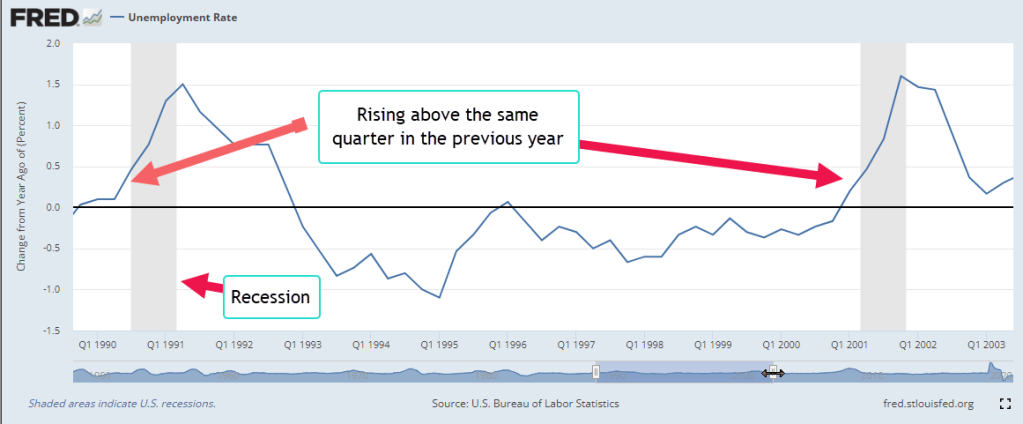
Before each recession, the quarterly average of the unemployment rate rises above that of the previous year. Because the same quarter is compared in both years, the seasonal adjustments and economic flows are similar, an “apples-to-apples” comparison. Look at the rise in UE just before the 1990 and 2001 recessions, shaded gray in the graph below. (I will leave the series identifiers in the footnotes at the end of this post). Notice the hint of a recession in the first quarter of 1996. The Fed had raised interest rates by 3% in the previous year to curb growing inflation, then began lowering them at the end of 1995, averting what might have been a shallow recession.

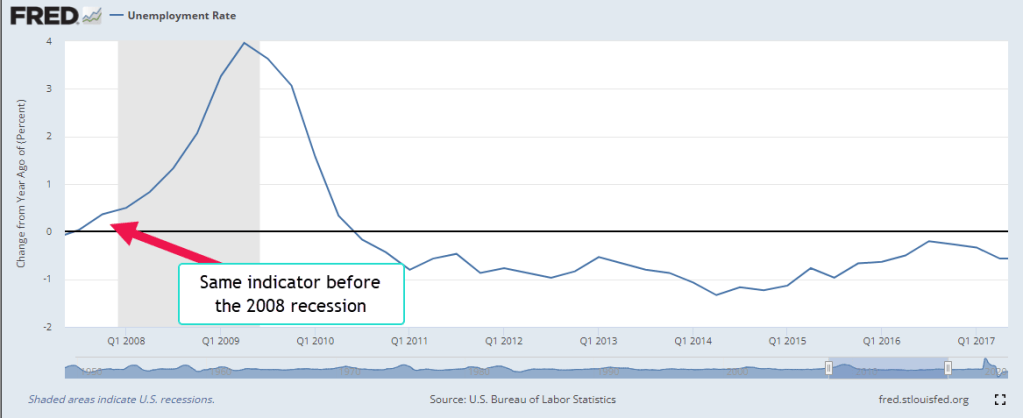
Before the 2007-2009 recession, the growth of UE turned positive.

At the start of 2020, the UE was about the same as it was the previous year, an indication that the economy was susceptible to a shock. The pandemic was the shock of the century.

Let’s add in another indicator, real retail sales, and revisit these periods. When UE growth is positive, state unemployment benefits are rising while income tax revenues are falling. If retail sales are falling, then sales tax revenues are falling as well, putting additional budget pressures on states and localities. 1996:Q1 UE growth had barely turned positive but the growth in real retail sales was still positive and did not confirm the weakness in UE. In 2001, UE growth was positive and real retail growth was negative, confirming the economy’s weakness as investors became disillusioned with the heady promises of the new internet economy.

Before the 2008 recession, UE growth turned positive as real retail sales growth turned negative.

Let’s turn from that historical perspective to our current situation. In the 1st quarter of 2020, these two indicators turned positive and negative because of the pandemic, not in advance of it. At the end of 2019, UE growth was at zero, indicating a weakening economy. However, real retail sales growth was 1.6%.

There is a lot of talk about recession but these two indicators are not confirming that prediction. Growth in real retail sales is still positive and UE growth is negative. The reports in the next two weeks will give us a better picture of recession probabilities. The retail report comes out on July 15th, which is a Friday. The market will react to this report as it does most months. I will update the graph to include both of these indicators in my blog post for July 17th. Have a good 4th celebration and be careful if you live in a western state where it has been dry this year.

//////////////

Photo by Hans Luiggi on Unsplash

U.S. Bureau of Labor Statistics, Unemployment Rate [UNRATE], retrieved from FRED, Federal Reserve Bank of St. Louis; https://fred.stlouisfed.org/series/UNRATE, July 2, 2022.

Federal Reserve Bank of St. Louis, Advance Real Retail and Food Services Sales [RRSFS], retrieved from FRED, Federal Reserve Bank of St. Louis; https://fred.stlouisfed.org/series/RRSFS, July 2, 2022.

Groundhog Day

April 24, 2022

by Stephen Stofka

As the press announces the latest inflation numbers, we hear that this is the highest inflation number in four decades. These two periods share few similarities. In 1982, the economy was in a deep recession, the worst since the Great Depression. A clerical position or warehouse job would draw forty in-person applicants. Inflation had been sporadic and persistent for a decade. Two oil supply shocks and a surge of young Boomers into the workforce led to high unemployment and high inflation, a phenomenon termed “stagflation.” Since that time, economists have struggled to understand the peculiarities of that era.

Human behavior produces what economists call simultaneous causality, a recursive loop where event A causes event B which feeds back into event A. Just the anticipation of a policy causes people to act differently before the policy is implemented. This week Fed Chairman Powell strongly hinted that the Fed would raise interest rates by ½% at their May 3-4 meeting (FOMC, 2022). Anticipating that the rate increase could be as high as ¾% and more rate hikes than the market had already priced in, the market sold off on Friday. When in doubt, run, the survival strategy of squirrels and their large cousins, groundhogs.

Uncertainty joins all decades. Policymakers and investors must make forecasts and decisions with less than complete information. The more unusual the circumstances the more likely the flaws. In 1977, Congress enshrined the Fed’s independence in law and gave it a twin mandate of full employment and stable prices (Fed, 2011). A year later, Congress passed the Full Employment and Balanced Growth Act. The text of this act demonstrates how several years of stagflation had confused the direction of causality. The Act reads:

 High unemployment may contribute to inflation by diminishing labor training and skills, underutilizing capital resources, reducing the rate of productivity advance, increasing unit labor costs, and reducing the general supply of goods and services.

(U.S. Congress, 1978)

High unemployment accompanies or is coincident with diminished labor skills, resource utilization and productivity. Unemployed people lowers demand and that contributes to lower prices, not inflation. In 1979, a year after this act was passed, the Iranian Revolution overthrew the Shah and strikes in the oil fields cut global oil production by 6-7% (Gross, 2022). U.S. refineries were slow to switch production to alternative sources. Typical of that time, the Congress and U.S. agencies overmanaged prices, supply and demand in key industries. This regulation contributed to long lines at gas stations and a 250% increase in gas prices.

Today, much of the supply line has been affected by the pandemic and the effects linger. China has again shut down some tech manufacturing regions. The prices of building materials have been erratic. The ratio of home prices to median household income has now exceeded the heights during the housing crisis (Frank, 2022). Millennials have endured the dot-com crash, 9/11, the housing crisis, and the pandemic. Now a housing affordability crisis. The Fed’s survey of household finance reports that the median amount of household savings is $5300 (Wolfson, 2022).

War in Ukraine, crazies in Congress and little accountability. Since the end of 2019, inflation-adjusted wages have not improved (FRED Wages). Low unemployment should have driven wages far higher. Profit margins shrank or turned negative during the pandemic. Supply constraints have presented businesses with an opportunity to raise prices and make up for profits lost during the pandemic. As prices climb, policymakers and economists engage in a round of finger pointing.

Now comes the bit about a recession. Casual readers may have heard of a yield inversion. Time has value. Risk has value. A debt that is due five years from now should return or yield more than a debt due one year from now. There is more that can go wrong in five years. When shorter term debt has a greater yield than longer term debt, that is called a yield inversion. The yield curve is a composite of interest rates over different periods. A common measure is the difference between the 10 year Treasury note and the 2 year Treasury. When that spread turns negative over a period of 3 months, investors show their lack of confidence in the near future. A recession has occurred within 18 months.

Why should this be? As I noted at the beginning, we are a feedback machine. Our anticipation of events contributes to the likelihood that they will occur. The weekly version of the graph above did turn negative a few months before the pandemic struck in the spring of 2020. However, the weekly chart may give false forecasts. The quarterly chart captures sustained investor sentiment.

At the right side of the chart, we see how negative the sentiment has turned. The Fed knows that rising interest rates will drive that sentiment further down. By law – that 1977 law I mentioned earlier – they can’t ignore the force of rising prices. Employment, their other mandate, is strong enough to withstand some rate hikes. What worries the Fed now is a different type of unemployment – idle capital. Worried investors and business owners are less likely to begin new projects. That lack of confidence becomes self-fulfilling, creating an economic environment of pessimism. To Millennials, it feels like Groundhog Day all over again.

////////////////

Photo by Pascal Mauerhofer on Unsplash

Fed. (2011). The Federal Reserve’s “Dual Mandate”: The Evolution of an Idea. Federal Reserve Bank of Richmond. Retrieved April 23, 2022, from https://www.richmondfed.org/publications/research/economic_brief/2011/eb_11-12

FOMC. (2022). Meetings Calendars, Statements and Minutes (2017-2022). Board of governors of the Federal Reserve System. Retrieved April 23, 2022, from https://www.federalreserve.gov/monetarypolicy/fomccalendars.htm

Frank, S. (2022). Home price to income ratio (US & UK). Longtermtrends. Retrieved April 23, 2022, from https://www.longtermtrends.net/home-price-median-annual-income-ratio/

FRED Real Wages, Series LES1252881600Q. Index level 362 in 2019:Q4. Index level 362 in 2021:Q4.

Gross, S. (2022, March 9). What Iran’s 1979 revolution meant for US and Global Oil Markets. Brookings. Retrieved April 23, 2022, from https://www.brookings.edu/blog/order-from-chaos/2019/03/05/what-irans-1979-revolution-meant-for-us-and-global-oil-markets/

U.S. Congress. (1978). Public law 95-254 95th Congress an act. Congress.gov. Retrieved April 23, 2022, from https://www.congress.gov/95/statute/STATUTE-92/STATUTE-92-Pg187.pdf

Wolfson, A. (2022, March 2). Here’s exactly how much money is in the average savings account in America. MarketWatch. Retrieved April 23, 2022, from https://www.marketwatch.com/picks/heres-exactly-how-much-money-is-in-the-average-savings-account-in-america-and-psst-you-might-feel-inadequate-in-comparison-01646168736

Presidential Predictabilities

March 27, 2022

by Stephen Stofka

The 2024 presidential election is still far away but a 75 year political trend is surprisingly predictive of election results. Add in one economic indicator and the results are even more predictable. An incumbent president won re-election 8 out of 12 times, or 67%. Those who lost failed to jump the hurdle of unemployment. When there is not an incumbent president, voters have changed parties in 6 out of 7 elections. America spends billions of dollars on election campaigning but voters have busy lives full of many choices. As with many decisions, we follow a few simple guidelines. Here’s a guide to winning the next election.  

American voters like change but they usually play fair. When the annual (year-over-year) change in unemployment is falling (UNRATE note below), incumbent presidents are assured of a second term. I’ll refer to that change as ΔU. If that change is falling, then employment is improving and voters don’t kick someone out of office. Let’s look at some recent history to understand the trend and those few times when political issues overshadowed economic trends. At the end of this article is an earlier history for Boomers and political history buffs.

In 1992, the ΔU did not favor incumbent Republican President H.W. Bush in the long stuttering recovery after the 1990 recession. In the 18 months after the end of the first Gulf War ended in early 1991, his approval numbers sank from very high levels. A third party candidate Independent Ross Perot focused on economic issues and diverted a lot of moderate and conservative votes away from Bush, helping to put Democratic candidate Bill Clinton in the White House with only 43% of the popular vote. Unemployment numbers favored Clinton in his 1996 re-election bid and voters awarded him a second term.

By 2000, the great internet bull market was wheezing. Unemployment was rising and did not favor Democratic VP Al Gore as he sought to succeed Clinton. A few hundred votes in Florida separated Gore and his opponent, former Texas Governor George Bush. A partisan Supreme Court made a radical decision to overrule the Florida Supreme Court and award the election to Bush, switching party choice yet again. If the employment numbers had been more favorable to Gore, voters might have been inclined to keep him at the tiller.

Bush’s approval soared after the 9-11 attack but controversy erupted when he decided to attack Iraqi leader Saddam Hussein on the pretext that the country had weapons of mass destruction. When no weapons were found, his ratings sank. The economy had stumbled after the short recession of 2001 but tax cuts in 2003 helped employment numbers recover. Bush avoided the fate of his father and won re-election.

As the housing crisis grew in the spring of 2008, the unemployment numbers turned ugly. Again voters changed parties and elected the Democratic candidate Barack Obama. Despite Obama’s unpopularity over health care reform, the unemployment numbers helped Obama to a second term over challenger Mitt Romney. After two terms of a Democratic president and knowing voters like change, a gambler would put their money on a Republican candidate in the 2016 election. The employment numbers favored the Democratic candidate Hillary Clinton, who won the popular vote. A few thousand votes in key states turned the tide in Donald Trump’s favor. Again, we learned the lesson that employment numbers assure victory for an incumbent president but not the incumbent political party.

In 2020, the pandemic drove the change in unemployment to stratospheric levels, rising 9.3% from 2019 levels. Both parties responded with legislation to stem the shock and economic pain to American households. Despite those historically unfavorable unemployment numbers, Trump increased the Republican vote count but could not overcome a larger surge in Democratic votes. The unemployment numbers in the quarters before the pandemic favored Trump. Had the pandemic not struck, it is likely that he would have won re-election.

Memo to incumbent presidents: If unemployment is rising you won’t win re-election.

Given that history, an incumbent Party should enact fiscal policy that keeps or lowers unemployment in an election year. An opposition party should try to block any such legislation. After the 2008 election, the country was suffering the worst recession since the Great Depression and Senate Minority Leader Mitch McConnell said that his goal was to make newly elected Democratic candidate Barack Obama a one-term president. McConnell was vilified for his partisan remark during a time of crisis but he stated the political reality that elections are a zero sum game. At the time of the August 2011 budget crisis between Republicans and the White House, the ΔU was a solid ½% negative. Falling unemployment hurts the election chances of the opposition party. The realities of democratic elections are uglier than many voters can stomach but we are carried along on those currents.

If unemployment is rising toward the end of 2023, look for Democrats to enact fiscal spending that will put people to work. To improve their own chances, watch for Republican strategies that will block any such measures.

////////////

Photo by Gene Devine on Unsplash

UNRATE Note: Unemployment is the headline number, averaged over each quarter. The year-over-year change is taken in the 2nd quarter of an election year (April – June) before each political party conducts its convention to choose their candidate.

/////////////

For interested Boomers and history buffs:

Near the end of WW2, 4-term Democratic President Roosevelt died and his VP Harry Truman assumed the Presidency. In 1948, the unemployment numbers looked grim as the economy tried to absorb millions of soldiers returning from war. Pre-election polls had favored Truman’s opponent, Thomas Dewey, and one newspaper printed out a headline on election night that Dewey had won but that announcement was premature. Truman’s victory is the only time an incumbent has won re-election when unemployment numbers were unfavorable. When the final results were announced, Truman famously pointed to the newspaper’s false headline. Perhaps that is the first time when a politician called out “fake news.”

In the spring of 1952, incumbent Democrat President Truman’s ratings were falling. The ΔU was neutral but the trend was against Truman. When he lost the New Hampshire primary to another Democratic candidate, he retired to his home in Missouri. Republican Dwight Eisenhower won the election. In 1956, the unemployment numbers favored “Ike” and voters gave him another term. In 1960, the ΔU had turned against Ike’s aspiring successor, VP Richard Nixon. Voters switched parties, choosing JFK, a Democrat, in a close and contentious election.

After Kennedy’s assassination in 1963, the unemployment numbers were strongly in favor of President and former VP Lyndon Johnson, who rode the wave of favorable sentiment to the White House. In the spring of 1968, the ΔU still favored Johnson but voter sentiment was more focused on the Vietnam War and Johnson decided not to run for re-election just as Truman had chosen 16 years earlier. Richard Nixon’s political fortunes resurrected on his promise to end the war with dignity and voters changed parties.

In 1972, unemployment favored Nixon who regained the White House, only to leave a few years later to avoid impeachment and ejection from office. In 1976, unemployment numbers looked good for Gerald Ford, who had assumed the presidency. However, he could not overcome voter hostility after he pardoned Nixon for the crimes revealed during the Watergate hearings. Incumbency and favorable employment numbers are powerful persuaders but there are a few times when voters concentrate on political matters more than economic considerations.  

Jimmy Carter, a Democrat, took the White House but couldn’t keep it as both unemployment and inflation were rising in 1980. Republican winner Ronald Reagan had often asked “Are you better off today than you were four years ago?” In 1984, unemployment was still high but falling by 2.7% and Reagan won in a landslide. 1988 is the only election in which the voters did not change parties after two terms. Unemployment was falling and voters turned to VP H.W. Bush for his turn in the top job. Unemployment is a decisive factor in re-electing an incumbent but not enough to overcome the American inclination to political change every decade.

The history continues in the main part of the article.

All Together Now

April 5, 2020

by Steve Stofka

We’re all in this together. Andrew Cuomo, the governor of New York State, tells us that in his daily conference. N.Y. State reported its first case of Coronavirus on March 1. In a month, the emergency rooms of some hospitals in New York City look like a war zone. President Trump says those photos are fake news. Deaths in red states are real. Deaths in blue states are not?

We’re all in this together proclaims Phil Murphy, the governor of the neighboring state of New Jersey. The zombies are already in his state but, as he looks across the Hudson River at NYC, he knows that vast hordes of zombies are coming. They are microscopic and invisible. They are not the Kaiju of Pacific Rim or the burrowing monsters of Tremors. They are the invisible demons of Poltergeist. Patients come into New York hospitals frantically gasping for air (NBC New York, 2020).

During this pandemic, we are discovering who is in this together. The maintenance man at the local school has just discovered that he is not essential now that the school has closed for the semester. This is the week when lawn maintenance companies begin mowing grass in much of the U.S. That maintenance man could be weeding and mowing grass, but the school district gave that job away to an outside lawn maintenance contractor to save money on employee pension and health benefits. Public private partnerships reduce the burden of local government on taxpayers.

He could be doing a hundred different fixups around the school now that it is empty. Patching and touch up painting, plumbing, the loose stalls in the bathroom, reglue those cove base tile that he hasn’t had time to get to during the school year. Upgrade those light bulbs. Something he’s been meaning to get to. Empty hallways is a good time for that. The school district says that he is not essential. Preventive maintenance is not essential. Someone at headquarters decided to wait until it’s broke. Then it’s essential.

The people who are essential are the policymakers and their minions who spend hours crafting memos that explain to employees why they are not essential.  Explaining the loss of health and pension benefits to employees is a delicate topic and requires a lot of training. We’re in this together but we’re not in this together. You do understand, don’t you?

Many teachers have discovered that they are not essential. Knowing their students well would be an asset in redesigning classes for an online format. But that job is done by instructional designers who have little experience in a classroom. They are experts in the design of education content. They are essential. Teachers are not.

Nurses are essential. Well, now they are. There is a shortage of nurses across the country because nursing schools have not been expanded to meet the needs of the population (Moore, 2019). Nurses have demonstrated for better patient care, for more investment in nursing, and in a safer patient nurse ratio (Lardieri, 2019). Sorry, nurses. Put down your signs. You’re not essential. Well, that was last year and the year before that and the year before that. This year is different.

Here, we have protective clothing for you, our essential workers. Here’s a 39-gallon lawn and leaf garbage bag. Yep, they’re the big ones with lots of room. One size fits all! Take these scissors and cut out a hole for your head in the bottom of the bag, then cut out armholes in each side. See, isn’t that good? It comes almost to your knees. Yes, it is a little bit hot because garbage bags don’t breathe very well. But it will keep you protected from nasty Covid-19 air thingees.

What about face masks? Oh sure, they are coming. President Trump told us so a few weeks ago. Here, just spray some bleach on the face mask you are wearing, then take a hair dryer and dry it out. See, good as new! I told you. We are all in this together.

//////////////////

Notes:

Photo by Ani Kolleshi on Unsplash

Lardieri, A. (2019, September 20). Thousands of Nurses Strike for More Staffing, Better Patient Ratios. U.S. News & World Report. [Web page]. Retrieved from https://www.usnews.com/news/health-news/articles/2019-09-20/thousands-of-nurses-strike-for-more-staffing-better-patient-ratios

Moore, D. (2019, March 29). A rush for nurses strains colleges and hospitals as health care booms in Pittsburgh. [Web page]. Retrieved from https://www.post-gazette.com/business/career-workplace/2019/04/22/Nurses-hospitals-Allegheny-Health-Network-UPMC-Pittsburgh-jobs/stories/201903110158

NBC New York. (2020, March 30). ‘Yes It’s Real’: Doctors Describe ‘Eerie’ Way COVID-19 Sickens Random People. [Web page]. Retrieved from https://www.nbcnewyork.com/news/local/yes-its-real-doctors-describe-eerie-way-covid-19-sickens-random-people/2350645/

The Sense and Cents of a College Education

October 21, 2018

by Steve Stofka

Should a young person invest money in a college education? Let’s look at the question from a financial perspective. Building a higher educational degree is as much an asset as building a house. Let me begin with the hard numbers.

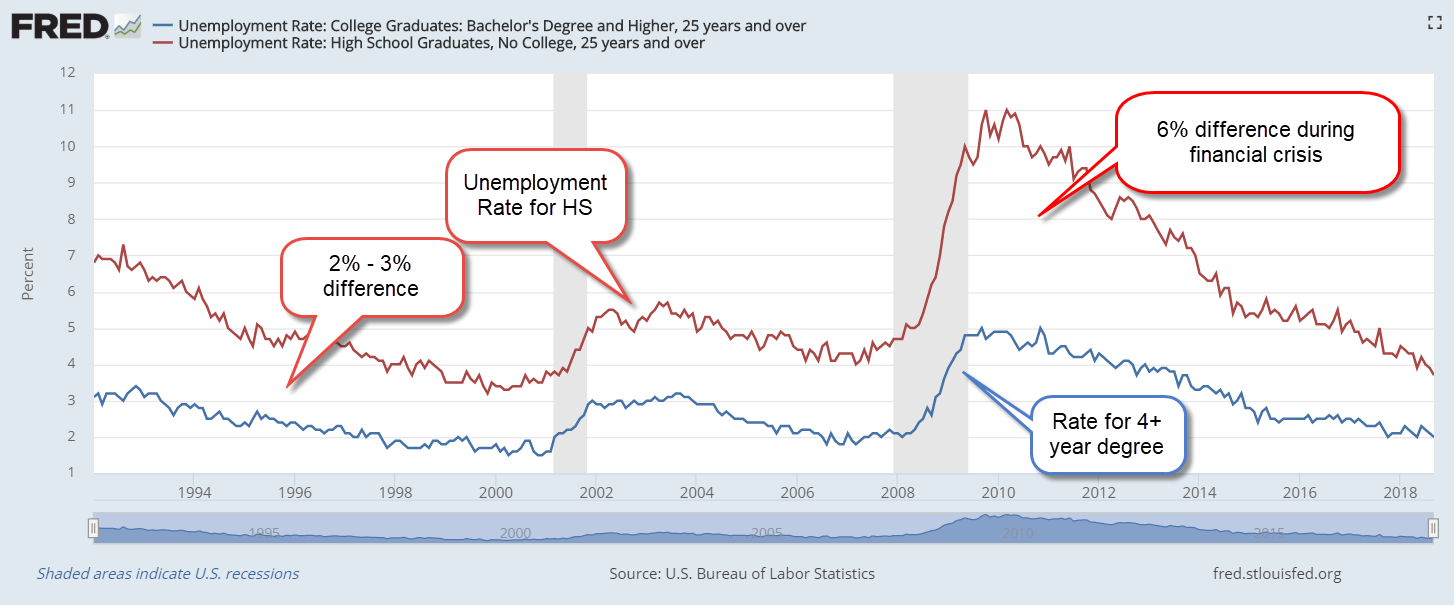
Employment: A person is more likely to be employed. Here is a comparison of those with a four-year degree or higher and those with a high school diploma. The difference in rates is 2% – 3% during good times and as much as 6% during bad times.

UnemployRateCollVsHS

Is the unemployment rate enough to justify an investment of $50K or more in a four-year degree? Maybe not. During the worst part of the financial crisis, ninety percent of HS graduates were working. Why should a diligent person with good work skills spend time in college? Most college students take six years to complete a four-year degree. They must spend four to six years of study in addition to the loss of work experience and earnings in those years. The unemployment rate is not a decision closer.

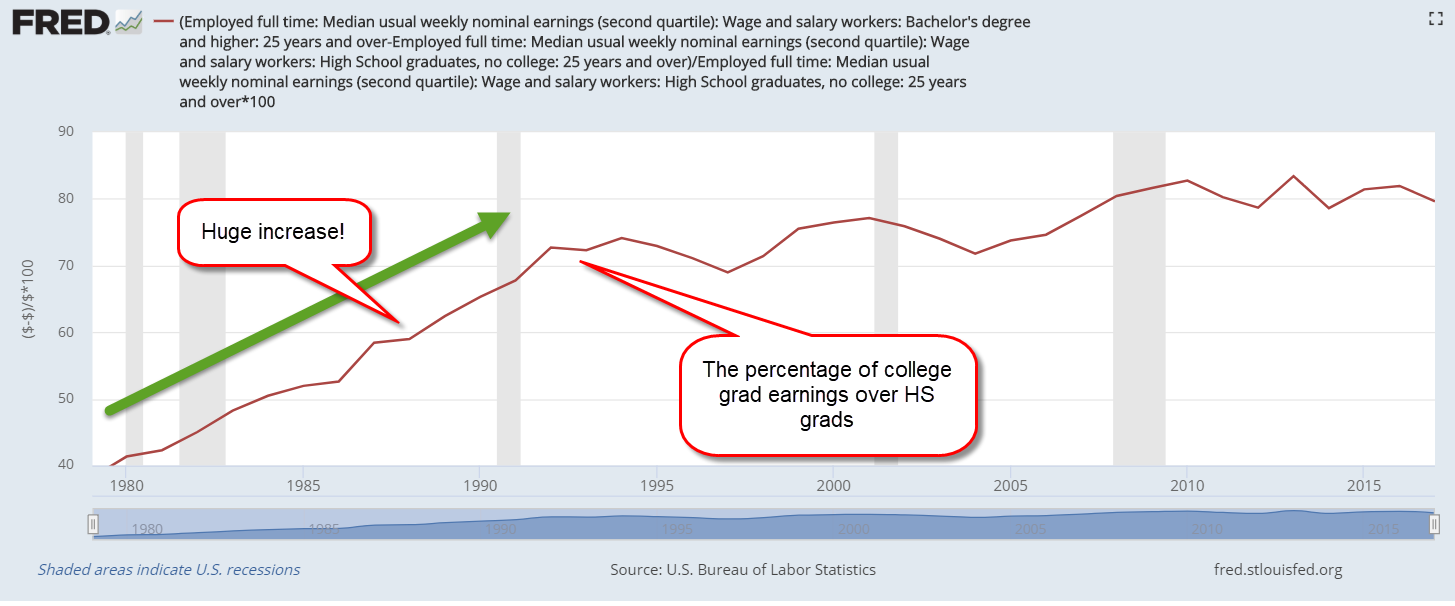
Earnings: In 1980, when those of the Boomer generation were taking their place in the workforce, college grads earned 41% more than HS grads. Today, college grads earn 80% more. That gap of $567 per week totals almost $30,000 in a year and is less than the monthly payment on a $50,000 loan (Note #1). Can a person expect to earn that much additional when they first graduate? No, and that’s why many students struggle with their loan payments in the decade after they graduate.

MedWklyEarnCollVsHS

Maybe that earnings difference is a temporary trend. The debt is permanent. Should a young person take on a lot of debt only to find out the earnings difference between college and high school graduates was temporary? Unfortunately, that’s not the case. The big shift came in the 1980s when the gap in earnings grew from 41% to 72% in twelve years.

EarnDiffPctCollVsHS

There were several reasons for the explosive growth in that earnuings gap. Many Boomers had gone to college to avoid the Vietnam War draft. As they crowded into the workforce in the late 1970s and 1980s, they wanted more money for that education.

During the 1980s, the composition of jobs changed. Steel manufacturing went overseas to smaller and more nimble plants which could adjust their outputs more economically than the behemoth steel plants that dominated the U.S.

Automobile companies in Michigan closed their old plants. Chrysler needed a government bailout. The manufacturing capacity of Asia and Europe that had been crippled by World War 2 took several decades to recover. The U.S. began to import these cheaper products from overseas. As high-paying blue-collar jobs diminished, the advantage of white-collar workers grew.

As more companies turned to computers and the processing of information, they wanted a more educated workforce that could understand and execute the growing complexity of information. Manufacturing today relies on computer programs that require a set of skills that are more technical than the manufacturing jobs of the past.

A oft-repeated story is that the signing of NAFTA in 1993 and the admittance of China into the World Trade Organization were chiefly responsible for the growing gap between white collar and blue collar workers. I have told that story as well, but it is incorrect and incomplete. As the graph above shows, that gap has grown modestly in the past twenty-five years. The big shift happened in the 1980s when the first of today’s Millennials were in diapers and grade school.

When we adjust weekly earnings for inflation, we can better understand the evolution of this earnings gap. In the past forty years, high school graduates have seen no change in median weekly earnings. From 1980 to 2000, their earnings declined. The 25% growth in the earnings of college graduates came in two spurts: in the mid to late 1980s, and during the dot-com boom of the late 1990s.

EarnInflAdjCollVsHS

Since this trend has been in place for decades, college students can assume that it will likely stay in place for the following few decades. Like the mortgage on a home, the balance on a student loan doesn’t increase every year with inflation, but the earnings from that education do and they have increased more than inflation. The payoff to a four-year degree is the difference in earnings. That is the decision closer.

Notes:

  1. Using $50,000 loan for ten years at 6% interest rate at Bank Rate.

Building A Peak

June 3, 2018

by Steve Stofka

First I will look at May’s employment report before expanding the scope to include some decades long trends that are great and potentially destructive at the same time. In the plains states of Texas, Oklahoma, Kansas, and Nebraska, summer rain clouds are a welcome sign of needed moisture for crops. That’s the good. As those clouds get heavy and dark and temperatures peak, that’s bad. Destruction is near.

May’s employment survey was better than expected. The average of the BLS and ADP employment surveys was 203K job gains. The headline unemployment rate fell to an 18 year low. African-American unemployment is the lowest recorded since the BLS started including that metric in their surveys more than thirty years ago. As a percent of employment, new unemployment claims were near a 50-year low when Obama left office and are now setting records each month.

During Obama’s tenure, Mr. Trump routinely called the headline unemployment rate “fake.” It’s one of many rates, each with its own methodology. Now that Mr. Trump is President, he takes credit for the very statistic that he formerly called fake. The contradiction, so typical of a veteran politician, shows that Mr. Trump has innate political instincts. A President has little influence on the economy but the public likes to keep things simple, and pins the praise or blame on the President’s head.

The wider U-6 unemployment rate includes discouraged and other marginally attached workers who are not included in the headline unemployment rate. Included also are involuntary part-time workers who would like a full-time job but can’t find one. Mr. Trump can be proud that this rate is now better than at the height of the housing boom. Only the 2000 peak of the dot com boom had a better rate.

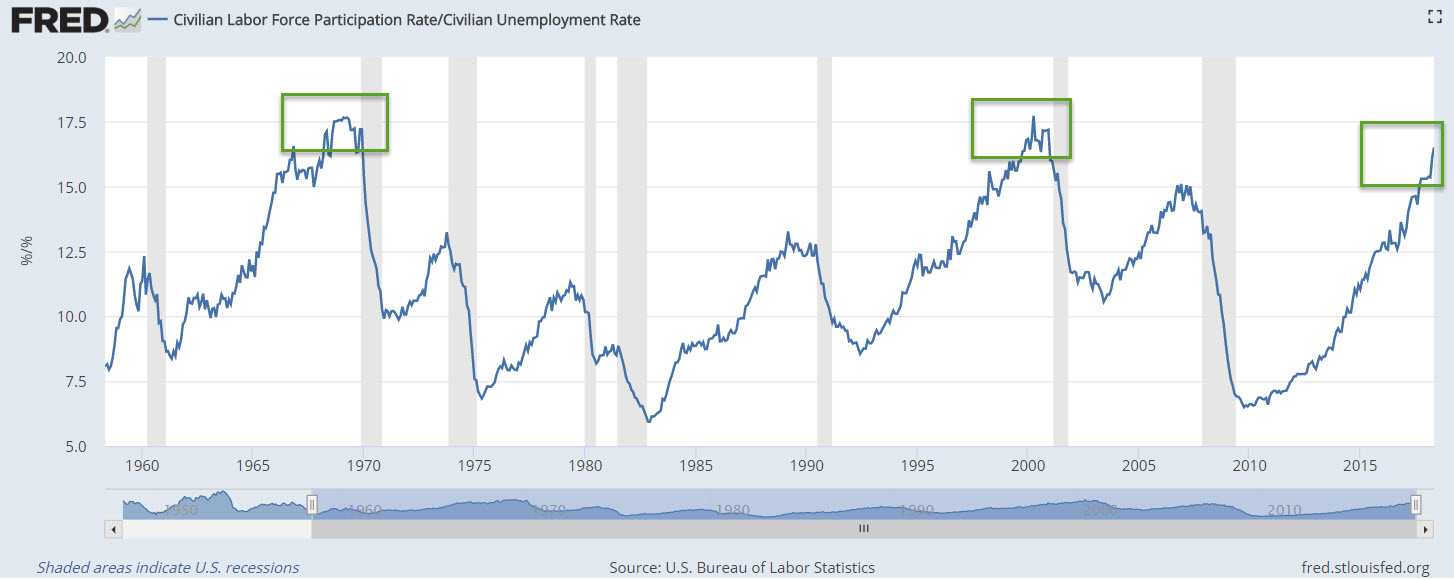
Let’s look at a key ratio whose current value is both terrific and portentous, like a summer’s rain clouds. First, some terms. The Civilian Labor Force includes those who are working and those who are actively seeking work. The adult Civilian Population are those that can legally work. This would include an 89-year old retiree and a 17-year old high school student. Both could work if they wanted and could find a job, so they are part of the Civilian Population, but are not counted in the Labor Force because they are not actively seeking a job. The Civilian Labor Force Participation Rate is the ratio of the Civilian Labor Force to the Civilian Population. Out of every 100 people in this country, almost 63 are in the Labor Force.

While that is often regarded as a key ratio, I’m looking at a ratio of two rates mentioned above: the Labor Force Participation Rate divided by the U-3, or headline, Unemployment Rate. That ratio is the 3rd highest since the Korean War more, ranking with the peak years of 1969 and 2000. That is terrific. Let’s look at the chart of this ratio to understand the portentous part.

CLFUIRatio
Whenever this ratio gets this high, the labor economy is very imbalanced. Let’s look at some previous peaks. After the 1969 peak, the stock market endured what is called a secular bear market for 13 years. The price finally crossed above its 1969 beginning peak in 1982. In inflation-adjusted prices, the bear market lasted till 1992 (SP500 prices). Imagine retiring at 65 in 1969 and the purchasing power of your stock funds never recovers for the rest of your life. Let’s think more pleasant thoughts!

For those in the accumulation phase of their lives, who are saving for retirement, a secular bear market of steadily lower  asset prices is a boon. Unfortunately, bear markets are accompanied by higher unemployment rates. The loss of a job may force some savers to cash in part of their retirement funds to support themselves and their families. Boy, I’m just full of cheery thoughts this week!

After the 2000 peak, stock market prices recovered in 2007, thanks to low interest rates, mortgage and securities fraud. Just as soon as the price rose to the 2000 peak, it fell precipitously during the 2008 Financial Crisis. Finally, in the first months of 2013, stock market prices broke out of the 13-year bear market.

We have seen two peaks, followed by two secular bear markets that lasted thirteen years. The economy is still in the process of building a third peak. Will history repeat itself? Let’s hope not.

May’s annual growth of wages was 2.7%, strengthening but still below the desirable rate of 3%. The work force, and the economy, is only as strong as the core work force aged 25-54. This age group raises families, starts companies, and buys homes. For most of 2017, annual employment growth of the core fell below 1%. It crossed above that level in November 2017 and continues to stay above that benchmark.

Overall, this was a strong report with job gains spread broadly across most sectors of the economy. Mr. Trump, go ahead and take your bow, but put your MAGA hat on first so you don’t mess up your hair.

///////////////////////////////

Executive Clemency

This week President Trump pardoned the filmmaker Dinesh D’Souza, serving a five-year probation after a 2014 conviction for breaking election finance laws. He helped fund a friend’s 2012 Senate campaign by using “straw” contributions. D’Souza complains that he was targeted by then President Obama and General Attorney Holder for being critical of the administration. A judge found no evidence for the claim but if he didn’t see the conspiracy against D’Souza, then he was part of the conspiracy, no doubt. I reviewed the 2016 movie in which D’Souza unveiled the perfidious history of the Democratic Party and its high priestess, Hillary Clinton.