An Urgent Situation

March 1, 2026

By Stephen Stofka

This Friday marked the 93rd anniversary of the burning of the Reichstag building in Berlin, the home of Germany’s Weimar Parliament. A month earlier, Adolph Hitler had been elected Chancellor, the Chief Executive in Germany’s Parliamentary system. In the aftermath of the fire, police found a communist sympathizer who was accused of starting the fire. The following day, Hitler urged President von Hindenburg to issue an emergency decree granting Hitler extraordinary powers to prevent a communist takeover of the German government. The decree suspended Constitutional liberties like freedom of speech and assembly, guarantees of private communications and protections from arrest. Within weeks, political opponents were arrested, press freedoms were crushed, and the constitutional order hollowed out (Source). The “emergency” ended twelve years later after the utter destruction of Germany and the deaths of as many as 8.8 million German soldiers and civilians (Source). This week I want to explore the many meanings of emergency.

A hospital emergency room treats conditions with many degrees of urgency. The Latin word emergere refers to anything that comes up suddenly. When they are busy, emergency room doctors perform triage, an assessment of the urgency of a condition or illness. Many years ago, I slipped on the ice and dislocated my shoulder. Urgent? The nurse glanced at my eyes, then held up two fingers. How many? Two, I said. What day is today? Friday, I answered. No concussion. Have a seat. I waited in pain for over three hours in an emergency room in the Bronx, while doctors treated knife stabbings, gun shot wounds, heart attacks, and other conditions deemed more urgent than a dislocated shoulder. I was surprised to learn that neither the degree of my pain nor the short time it would take to fix the problem was a consideration to the doctors and nurses that night. Learning lesson: do not get hurt.

In 1787, a Constitutional Convention met in Philadelphia to resolve a financial crisis. The country could not pay its bills, or make payments on the war debt it had sustained through the eight year war for independence from Britain. Foreign investment had slowed to a trickle. Because each state issued its own currency, foreign investors were subject to currency risk and volatile exchange rates. The federal government had no power to directly tax businesses or people and states often neglected to meet their share of payment for war debts, weakening the credit of the colonies. Congress had no power to regulate commerce so the states fought among themselves for control of interstate waterways. In 1786, several months before the convention, four thousand people rose up to protest Massachusetts’ tax laws. This uprising, known as Shay’s Rebellion, demonstrated the need for a new compact among the states (Source). The acronym SNAFU was invented during World War 2, but the term aptly describes post-independence America. Despite these crisis conditions, the Constitution does not contain any reference to emergency, crisis or exigency (Source).

Hitler’s seizure of power in Weimar Germany raises issues of constitutional design. How does a country respond to a genuine crisis without empowering political leaders with the power to destroy constitutional order? In Federalist No. 70, Alexander Hamilton argued for a unitary executive, a President who could swiftly marshal resources in case of an attack from a foreign power. In response to insurrections like Shay’s Rebellion, Hamilton wanted a President who could restore domestic civil order (Source).

Carl Schmitt (1888 – 1985), a German conservative judge, argued in his 1922 book Political Theology that emergencies reveal the political structure underlying the ordinary norms in a country. He wrote that, in actuality, the sovereign is the person that decides when the rules can be broken (Source). Robert Bork (1927 – 2012) was a strong proponent of what is called the unitary executive, a President who has supreme power in the executive branch. According to Bork, Congress has no constitutional power to limit the President’s executive powers (Source).

The conservative justices on the Supreme Court have decided several recent cases that support this expanded power, rejecting the idea that Congress can impose limits on a President’s ability to hire and fire officers in the executive branch. This year the court will decide whether to overturn the court’s 1936 precedent set in Humphrey’s Executor and allow President Trump to fire the head of the Federal Trade Commission (Source). What is the limit of that executive power? Can a President fire the head of the Federal Reserve and install someone who supports the President’s political agenda? Can a President declare an emergency and invoke extraordinary powers? What is the limit of executive authority?

In France’s Constitution, Article 16 allows the President of France to assume exceptional powers when the normal functioning of government is interrupted. Should the U.S. amend its Constitution to give some clarity to what an emergency is? If there were such an amendment,  could the President suspend habeus corpus and other liberties when the Federal Government has a shutdown because of a budget fight in Congress? He could claim that the government is not functioning normally and take control. The U.S. relies on a political tension between the three branches of government rather than an explicit constitutional clarification of what constitutes an emergency.

During the Civil War, Abraham Lincoln suspended habeas corpus, arguing that the rebellion by the southern states made such a violation of individual liberty a necessity. Shortly after his inauguration in 1933, Franklin D. Roosevelt declared a national emergency and temporarily closed banks. Did Roosevelt have such a statutory power? Three days later, a Democratic Congress passed the Emergency Banking Act, effectively ratifying Roosevelt’s emergency decree. In 1952, in the midst of the Korean War, President Truman responded to a steelworker’s strike by declaring an emergency in which he nationalized the steel industry. Within two months, the Supreme Court ruled that he had exceeded his authority (Source).

In 1976, Congress passed the National Emergencies Act to check a President’s discretion to declare open-ended emergencies. According to the Act, the President must specify which statutory power they invoked during an emergency. Secondly, either house of Congress could unilaterally vote to end the emergency. Seven years later, in INS v. Chadha, the Supreme Court invalidated that unilateral power as unconstitutional (Source). After that decision, Congress had to pass a joint resolution subject to Presidential veto and a two-thirds majority to override that veto. With little effective oversight from Congress, any president could declare an emergency. Checks and balances be damned.

After the attacks of September 11, 2001, President George W. Bush declared a national emergency and claimed certain statutory powers under the National Emergencies Act. In April 2025, President Trump declared an emergency, not in response to a terrorist attack, but to persistent trade imbalances. What was the emergency? The need for Trump to exercise a discretionary power over other countries as he had done with contestants on the reality show The Apprentice. This month, the Supreme Court decided that Trump had exceeded his authority.

Emergency powers rarely disappear on their own. Once activated, they tend to be normalized. The extraordinary becomes routine. Surveillance powers expand. Administrative discretion widens. Political rhetoric justifies urgency. Democratic societies must be on guard against the temptations of power and the possibility of abuse. They must question whether the policy response is proportional to the danger and how long the response should last.

Constitutional safeguards cannot rely solely on the good faith of leaders. There must be effective institutional boundaries to check the desire for power. An executive can act with decisiveness in a true emergency but decisiveness has to be balanced with restraint or a country descends into autocracy. We want to tame rather than eliminate emergency power. I hope to see you next week.

////////////////

Photo by Aconitum on Unsplash

A Debate on Presidential Power

February 16, 2025

by Stephen Stofka

This is part of a series on centralized power. This week’s debate is about the power of the President relative to the other branches of the federal government. The debates are voiced by Abel, a Wilsonian with a faith that government can ameliorate social and economic injustices to improve society’s welfare, and Cain, who believes that individual autonomy, the free market and the price system promote the greatest good.

Abel began the conversation. “Our country is founded on the principle of federalism, a sharing of power between the states and a centralized government in Washington. In that central authority are three branches that balance and check each other’s ambitions for power. It looks like Trump is challenging those restraints.”

Cain shrugged. “The Speaker of the House doesn’t seem worried. The Congress hasn’t been able to get anything done. It’s been almost thirty years since Congress completed a full budget (Source – pdf). The executive branch is stuck with the burden of implementing years of legislative compromises. It is entirely appropriate that the President clean up the mess.”

Abel shook his head in disbelief. “Trump is taking control of the purse, a power given to Congress by the Constitution. Doesn’t it worry you that a Democratic president could simply undo any laws passed by a Republican legislature?”

Cain looked puzzled. “If the President gets out of line, the Constitution gives Congress the power to impeach the President.”

Abel laughed. “Trump has already been impeached twice. Never in the history of this country has the Senate convicted a President. Impeachment is an empty threat. After the Supreme Court’s decision to grant the President immunity from criminal prosecution, the President can act like a king.”

Cain frowned. “FDR expanded the scope of the executive when he took office in 1933. Did your group sound the alarm then? Did you cry ‘Constitutional crisis’ when Roosevelt threatened to pack the Supreme Court to get his way? No, your group stood by silently as Roosevelt upended 150 years of tradition. This President is trying to undo that shameful legacy, to return this country to its founding roots.”

Abel showed his disdain. “He is undoing a century of building government institutions that help people, that protect people from the power of large corporations. This is not the America of the 18th century.”

Cain argued, “They are inefficient government institutions that swear allegiance not to the people they serve but Washington lobbyists and their own internal processes. We have a spending crisis. The Constitution gives the President the executive power. Alexander Hamilton argued for a strong executive and President Trump embodies Hamilton’s vision.”

Abel sighed. “You’re talking about the unitary executive theory. Advocates for that theory take Hamilton out of context. He wanted to convince those in the state legislatures that the strong executive in the proposed Constitution was preferred to the weak plural executive that had been defined in the Articles of Confederation. Hamilton was not advocating for a President with all the powers of a king. The country had fought seven bloody years to rid themselves of a king.”

Cain shook his head. “Look, Washington and Jefferson set the example. They were strong Presidents who sat at the top of the executive hierarchy. They didn’t ask Congress for permission. They defined their role as the chief executive of the laws.”

Abel interrupted. “Ok, but the executive branch was small in the early 19th century. Employees worked at the whim of the President. As the country grew, there needed to be more stability in the executive work force. Congress wanted more control or supervision of the various departments. After all, it is Congress who writes the laws. Congress represents the people. The President is the people’s agent, executing the laws that the representatives of the people have passed.”

Cain held up his hand. “Look, you’re describing a clerk, not the leader of a country. Hamilton was arguing for a leader with enough power to meet threats from other countries led by monarchs with absolute power.”

Abel argued, “That was another century when even the mightiest rulers had relatively little firepower at their command. We have invented weapons that are too destructive to put at any person’s command. There have to be checks and balances within the executive just as there are within the legislative and judicial branches.”

Cain shook his head. “The more destructive the weapons, the more we need a strong leader with the authority and power to act decisively to answer any threats from other countries.”

Abel frowned. “There has to be checks and balances within each branch. That’s especially true for the executive. All previous empires have fallen because one person gained too much power. Rome, Persia, Egypt, and Byzantium come to mind. There are too many temptations. A President with control of the Bureau of Labor Statistics would be able to adjust the monthly unemployment numbers or inflation report to make his administration look good. Argentina did this for seven years (Source). China, Venezuela and Hungary do it. He could disallow the counting of some of the population by the Census Bureau to reduce some grant funding for states who did not vote for him.

Cain scoffed. “There are checks and balances between Congress and the Executive. If a President were to ‘cook the books,’ that information would be leaked. The Congress could impeach the President.”

Abel’s expression was stern. “When the founders wrote the impeachment rules, they envisioned a system without political parties. In a party system, the President is the leader of the party. Impeachment is not a check. If the House is the same party as the President, they dare not bring their leader up on impeachment charges. A Democratic-led House would not impeach Andrew Jackson in 1833. All the anti-Jacksonian majority in the Senate could do was censure Jackson.”

 Cain argued, “In 1868, the Republican-led House impeached Andrew Johnson.”

Abel shook his head. “Johnson was a Democrat who ran with Lincoln on a third-party ticket called the Union Party (Source).”

Cain’s tone of voice was conceding. “Ok, maybe impeachment is not the ideal check on a President. But they pay attention to popular opinion. If the public is outraged, they will complain to their representatives. Presidents care about public opinion.”

Abel showed a wry smile. “George Bush’s poll numbers fell as low as 25% (Source). What did that accomplish? There is an entire phalanx of advisors who shield the President from disheartening news. A President lives in an information bubble designed to protect his self-confidence.”

Cain argued, “Well, there are no checks on the Supreme Court. They have lifetime tenure and the last one to be impeached was in 1805 (Source). They control their own agenda. The House and Senate make up their own rules (Source) and have no internal Constitutional checks. In the Senate, the Majority Leader controls all the floor time. If he doesn’t want some legislation brought to the floor, it isn’t considered. The President should have the same authority over officials in the executive branch. He should be able to direct them on how he wants the law executed. His decisions should not be subject to review by a court.”

Abel frowned. “You’re describing the unitary executive theory again. It grants the President most of the powers of a king. We know that Hamilton, Jefferson, Madison and the other founders did not want a king. This country rejected rule by the whim of one person, the king. We are a nation of laws, not whims. Trump and Musk are two rich crackpots who dance to the music of their own whims. The wolves in Russia and China are licking their chops. By the time Trump is done, this country will be weaker.”

Cain scoffed. “This country was already weak. That’s what the President is trying to fix. The country has $36 trillion dollars in debt. We’re spending more on interest than we do on defense. We play mister nice guy, letting other countries take advantage of our charity, then vote against our interests in the U.N. DOGE is going to trim the discretionary items in the budget then look to implement fraud controls in mandatory spending programs like Medicare and Medicaid. Trump has shown he’s a tough negotiator.”

Abel laughed. “Trump changes his mind from day to day, from week to week. It’s a sign of weakness that Putin and Xi will take advantage of.”

Cain shook his head. “The President dances like Muhammed Ali in the ring. That’s what we need. A fighter who keeps other countries hesitant to make any aggressive moves. That’s the road to a cautious peace.”

Abel sighed. “It’s only a few weeks since Trump took office. He will leave a trail of chaos and carnage and half of the people in this country won’t hold him responsible.”

Cain laughed. “And the other half of the country thinks he’s the devil. That says more about all of us than it does President Trump. We’ll talk next week.”

//////////////////

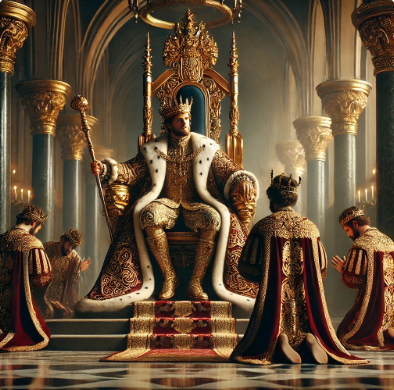
Image by ChatGPT

The scene is set in a grand hall with tall columns, chandeliers, and intricate tapestries. A majestic king is seated on a grand throne, dressed in luxurious royal robes adorned with gold and jewels. Several people kneel before him in deep reverence, wearing medieval-style clothing.