A Debate on a VAT tax

January 26, 2025

by Stephen Stofka

This is 11th in a series of debates on various issues. The debates are voiced by Abel, a Wilsonian with a faith that government can ameliorate social and economic injustices to improve society’s welfare, and Cain, who believes that individual autonomy, the free market and the price system promote the greatest good.

The notes at the end give more context to the arguments.

Cain began this week’s conversation. “We left off last week discussing alternatives to the income tax. Before we entertain alternatives, can we agree that the income tax should be abolished at the same time the country adopts a new scheme of taxation?”

Abel cleared his throat. “I’m not so sure about that. Can an alternative tax scheme raise the same amount of revenue?”

Cain raised an eyebrow. “If it didn’t, that would be more money for private consumption and investment.”

Abel grimaced. “That’s playing with fire. The country is already running persistent deficits. If there was a significant difference in revenue, it could seriously weaken the dollar.”

Cain said, “Our group favors a consumption tax to replace the income tax. They were the main source of federal revenue until the passage of the 16th Amendment in 1913.”

Abel shook his head. “Consumption taxes didn’t raise enough money to pay off Civil War debts and the pensions promised to veterans and their families. In the early 20th century, society was becoming more complex. There was a greater role for government. The greatest improvements in health and life span came in those decades. Public sanitation measures and vaccines reduced water borne illnesses and contagious diseases.”

Cain argued, “I agree that there was a greater role for government. It’s just gone too far. Particularly the role of the federal government in our lives. A consumption tax broadens the tax base. Gives voters a stake in the government’s spending.”

Abel nodded. “There are several types of consumption tax. Many developed countries use a VAT or value added tax, but it is a supplemental to an income tax.”

Cain’s displeasure was obvious. “Our group would not support another tax. Also, with a VAT, politicians are tempted to fiddle with the type of items subject to the tax. It invites interest groups to lobby for exclusions from the tax. That’s what goes on in Britain and many European countries. We advocate a tax that reduces favoritism.”

Abel argued, “Any tax scheme invites favoritism. For instance, Colorado has a flat income tax but many exclusions from income that are not included in federal income. Pensions, social security and charitable contributions are just a few examples.”

Cain shook his head. “A credible alternative would have to make alteration as difficult as possible for Congress – just like the Constitution is.”

Abel sighed. “Specific language makes compromise difficult. The law is full of words that are open to interpretation like ‘reasonable’ and ‘appropriate.’ Section 8 of Article 1 of the Constitution stipulates that the Congress provide for the ‘common Defence and general Welfare.’ What does the word ‘general’ mean in that context? It’s clearly not the common welfare or the founders would not have agreed on the insertion of the word ‘general.’ To this day, our two groups have been arguing about the scope of powers authorized  by those two words.”

Cain tilted his head slightly. “Ok, granted it’s not easy. We are not striving for perfection, only clearly defined terms and transparency. No more backroom deals in Washington.”

Abel frowned. “Look, people and the institutions they create are too complicated for simple solutions. The only reason that the Constitution exists in a difficult to alter form is the small number of people who had a hand in its creation.”

Cain scoffed. “Each state had to ratify the Constitution and the Bill of Rights. In 1787, the Virginia legislature had 168 Senators and delegates. Today Virginia has only 140 members to represent a population that is sixteen times as large. Believe me, there was plenty of vociferous debate. The Constitution is a series of compromises hammered out in Philadelphia but reflecting the sentiments of those in the individual states.”

Abel interrupted, “The few who could vote. Men with property. The sentiments of the Declaration of Independence were noble and democratic, but this country’s Constitution was founded on governance by an aristocracy. After a bitterly fought Civil War, the passage of the 14th Amendment expressed the democratic sentiments that the founders could not embody in the original Constitution.”

Cain laughed. “Once again, we are getting off the topic. Our group wants specific, not broad, taxation powers that limit Congress and the President. It’s a principal-agent problem. We have to keep our elected representatives, our agents, on a short leash, or they will satisfy their own interests more than they do the people they represent. The text of the 16th Amendment was too broad and invited the corruption and complexity the tax code has become after more than a hundred years.”

Abel looked puzzled. “Your group wants an amendment with specific language?”

Cain nodded. “Yes, an amendment revoking the 16th Amendment and installing a consumption tax of some sort.”

Abel asked, “What about new home sales? They are included in GDP, but the consumption happens over years. The Bureau of Labor Statistics calculates an ‘imputed rent’ that a homeowner pays and collects each month. It’s based on market rents in that area.”

Cain shook his head. “It can be simple. The language of the amendment would target the revenue as a percentage of GDP. The means to get to that target would be left up to Congress.”

Abel looked interested. “Go on, tell me more about that.”

Cain continued, “Our group supports a national sales tax or VAT to replace the income tax. In 2023, the federal government collected $2.56 trillion in individual income taxes on a GDP of $27.2 trillion. That’s 9.2% of GDP. Let’s say a thirty-year average is 10% to make the math easy. A VAT or some other consumption tax rate could be adjusted each year based on quarterly GDP estimates that the government already does. That would not be cumbersome wording.”

Abel showed concern. “Your group strives for simplicity like it was the Holy Grail. In 2018, the Congressional Budget Office estimated the revenues from a VAT over a ten-year period. They noted that a broad tax base includes only 66% of personal consumption expenditures and those account for only 67% of GDP. Multiply those together and the tax base is only 44% of GDP. To collect the same revenue as individual income taxes, the tax rate would have to be 21% or so, not 10%.”

Cain counted on his fingers. “One, it would broaden the base so that more voters have skin in the game. Two, it would protect everyone’s privacy. Three, it would set clear and transparent limits on politicians in Washington. It’s well worth the price.”

Abel shook his head. “To abolish all tracking of income, all of the states would have to agree to a VAT to collect their taxes. What about Social Security taxes collected? For the past 15 years, those tax revenues have been 6.5% of GDP. The tax rate would have to be 36% to account for Social Security taxes. Add in state income taxes and the tax rate would be over 40%. Adding in state and local sales tax could bring the total tax bite to 50%.”

Cain argued, “Look at Britain. It has an income tax rate that starts at 20% and a VAT rate of 20%. A middle-income person could pay 60% total tax. The average effective tax rate in the U.S. is 15%. Add in 15% for the employer and employee contributions to FICA taxes. State and local taxes can add up to eight or ten percent. The total tax bite under our current system is close to 40%.”

Abel frowned. “An analysis of 2021 IRS data showed that the bottom 50% of taxpayers paid an average of only 3.3% of gross income, not 15%. Voters will not go for a tax scheme that will place a huge burden on most taxpayers to reduce the tax burden on Elon Musk and the other 1%.”

Cain interrupted. “That’s one of the problems. Half of the voters have so little skin in the game that they let politicians get away with anything. That’s how the budget became so bloated with ‘gimmes.’”

Abel replied, “Well, that’s a discussion for another day. I just don’t think a VAT is a practical alternative as a complete replacement for the individual income tax. Sure, we all like simple but the burden of common costs and the distribution of benefits is too complex for simple policies.”

Cain pursed his lip. “The more complex the policy, the less transparent. In a democracy, transparency is crucial.”

Abel raised an eyebrow. “I agree but I don’t think your group can sell a tax policy that would  increase the tax bite for the lower half of income earners by at least ten to fifteen percent. It might throw the economy into a recession within a year.”

Cain objected, “I think voters can be convinced. This last election has shown that voters are tired of progressive policies.”

Abel smirked. “Trump won the popular vote by 1.6%. The House has a slim majority. The Senate has a 53-seat majority only because Democrats had almost twice as many Senators up for re-election as Republicans. It’s the luck of the draw. It’s certainly not a mandate as Republicans are claiming.”

Cain shook his head. “A lot of traditionally Democratic voters went for Trump. Voter sentiment is shifting.”

Abel smiled. “That’s a discussion for another time.”

Cain turned to go. “See you next week.”

////////////////////

Photo by Mary Farrell on Unsplash

The Tax Foundation explains the difference between a value-added-tax (VAT) and a national sales tax. https://taxfoundation.org/taxedu/glossary/value-added-tax-vat/  The European Union has a quick explainer on how a VAT works https://taxation-customs.ec.europa.eu/taxation/vat/how-does-vat-work_en

This Investopedia article explains several types of consumption tax. https://www.investopedia.com/terms/c/consumption-tax.asp

Abel brought up Colorado’s exclusions from income as an example of the favoritism that exists even in simple flat tax schemes. https://tax.colorado.gov/individual-income-tax-guidance-publications.

The effective tax rate is the tax divided by the adjusted gross income. On form 1040, it is line 24 divided by line 11. Popular tax software programs usually note the effective tax rate on their summary page.

Cain stressed the many legislative debates that ensued during the ratification process. This is a two-book set that contains the Federalist papers and arguments in several state legislatures. https://www.amazon.com/Debate-Constitution-Federalist-Anti-Federalist-Ratification/dp/1598534114/ref=sr_1_1

In response to Abel’s argument that the Constitution was a product of elite sentiments, Cain noted that there was far more representation of each district within a state than there is today. In 1787, the population of Virginia was 420,000 with the caveat that Negro slaves were counted as 3/5ths of a person. The actual population was about 532,000. Today the population is 8.7 million, sixteen times larger, yet the legislature is smaller. Counting Negroes as 3/5 of a person in the Constitution was a compromise about the amount of tax each state had to pay for the nation’s common expenses. Northern states wanted to share common expenses according to the population of each state. Southern states insisted that Negro slaves were property and should not be counted. Counting Negroes as 3/5 of a person was a compromise about money and the burden of taxation. https://csac.history.wisc.edu/2022/08/01/population-and-constitution-making-1774-1792/

Abel argued that a 21% VAT would be needed to replace individual income tax revenue. In 2023, individuals paid $2.56 trillion in income taxes. The CBO estimated that a VAT on a broad base of items would tax only two-thirds of personal consumption expenditures (FRED Series PCE) which was $18.8 trillion in 2023. 66% of $18.8 trillion equals a $12.4 trillion tax base. $2.56 trillion collected divided by a $12.4 trillion tax base equals a 20.6% tax rate. Here is a link to the CBO’s summary https://www.cbo.gov/budget-options/54820  

Taxes collected on Social Security is FRED Series https://fred.stlouisfed.org/seriesBeta/W780RC1Q027SBEA.

Cain compared a 50% tax bite with combined income tax rates and VAT rates in Britain. Income tax rates in Britain start at 20%. https://www.taxesforexpats.com/country-guides/uk/uk-vs-us-taxes.html#part1 The VAT rate is 20% https://taxfoundation.org/data/all/eu/value-added-tax-2024-vat-rates-europe/
Border Adjustment Tax

March 5, 2017

Gary Cohn,  President Trump’s Chief Economic Advisor, says that the Border Adjustment Tax (BAT) is off the table. This is a key revenue raiser, a hidden tax, in the Republican scheme to lower corporate taxes. We will continue to hear about BAT as the fight over tax reform heats up. What is it and how will it affect American families?

First, a bit of context. Most other developed countries have a VAT, or Value Added Tax, on purchased goods and services. In the EU most VAT taxes range from 20-25%. In America, we have state and local sales taxes that might add as much as 8 – 10% to the cost of a good. A VAT is like a Federal sales tax of 20%.

Unlike a VAT tax that affects most goods and services, the BAT will affect only imported goods. Here’s an example of the BAT tax using Big-Box as an example of a large merchandiser similar to Wal-Mart.

Big-Box imports a DVD Player for $80 (Cost of Goods Sold) and sells it for $100, making $20 gross profit. It has $5 other costs which are deducted from gross profit to reach a taxable profit of $15. Let’s say that Big-Box’s effective Federal tax rate is 30% (27.1% per Congressional Research Service). $15 taxable profit x 30% = $5 (rounded) Federal Tax.  Big-Box has a net after-tax profit of $10, or 10% of the retail price.  Remember that.  Current law = 10%.

Under the BAT proposal, Big-Box could not deduct the $80 it paid for the good because it is an import. Big-Box’s gross profit is now $100. Subtracting the $5 other costs, the taxable profit is $95. Multiply that by a lower 20% corporate tax rate and the Federal tax is now  about $19, far more than the $5 using the current tax system. Big-Box paid $80 cost + $19 in tax = $99, leaving them a gain of $1, or 1%.  Current law = 10% profit.  Proposed law = 1% profit.

For Big-Box to make the $10 after-tax profit it has under the current tax system, it would  need to raise the price of the DVD player about $15.  After paying a 20% tax ($3) on the additional revenue, it will net an additional $12. So the customer now pays $115 for a DVD player that used to be $100.  No change in quality.  Just an extra $15 out of the consumer’s pocket for an imported CD player.

What if Big-Box buys the DVD player from an American supplier for $100?  Under BAT, the $100 direct cost of the DVD player would be deducted from the sale amount, giving Big-Box a tax CREDIT of $20 ($20%).  The after-tax cost of the player is now $80 direct and the same $5 indirect cost = $85. To make a $12 net profit as under the current system, Big-Box could sell the DVD player for $97 and undercut another vendor selling the same DVD player for $115.

In theory, customers would rush to the vendor selling American DVD players. BUT, there is only one DVD manufacturer in the U.S. (Ayre Acoustics) and we don’t know how many parts of their product are imported.  The transition could take years and consumers will pay more for many household goods during that time.

Some products can only be imported.  Most of the lumber used to build homes is imported from Canada.  This hidden tax will be added onto the prices of homes and remodels.  Most diamonds are imported and will bear this hidden tax.  Businesses will lobby to have their product excluded where there is no alternative to an import.  This will be a boon for lobbying firms.

Businesses, particularly durable goods manufacturers, anticipate a complexity in this new tax. Planes, cars, boats, sporting goods and appliances are made with parts from a variety of countries, including the United States. Assessing the component value of imports and exports may require a judgment call by the company, and that is subject to dispute with the IRS. This is sure to become a headache.

Should the BAT become law, customers who have benefitted from the lower prices of imported goods are sure to complain loudly at the higher prices. Retailers have opposed the scheme. Republicans are promising tax cuts for middle class households but the tax reduction won’t offset the extra cost of many household goods.

Republicans have long resisted tax increases in their effort to shrink the size of the government yoke on American families. Many have signed a pledge not to raise taxes. To avoid any appearance of raising taxes, Republican lawmakers had to hide the tax and this was the best they could do.

Side Note: Why not just add the extra $20 as an import tax, or duty? Import taxes are paid to the government by the importing company of record when the goods are received in the country. Even if an item sits in a warehouse as inventory, the import duty has been paid, creating a cash flow problem for companies. With both VAT and BAT taxes, the tax is not charged until the good or service is sold.

//////////////////////////

IRA Contributions

Did you put off making your IRA contribution for 2016? In May 2011, I compared several “timing” scenarios of investing in an IRA for the years 1993-2009.The choices were making a contribution on:
1) July 1st, the middle of the tax year;
2) January 31st following the tax year;
3) April 15th following the tax year

The 1st option had a 2.5% advantage over the 2nd option because of the longer time frame invested. An even greater advantage was an option not on this list. Contributing an equal amount every month produced a 4% greater gain over the first option.

//////////////////////////

Stand up or Sit Down

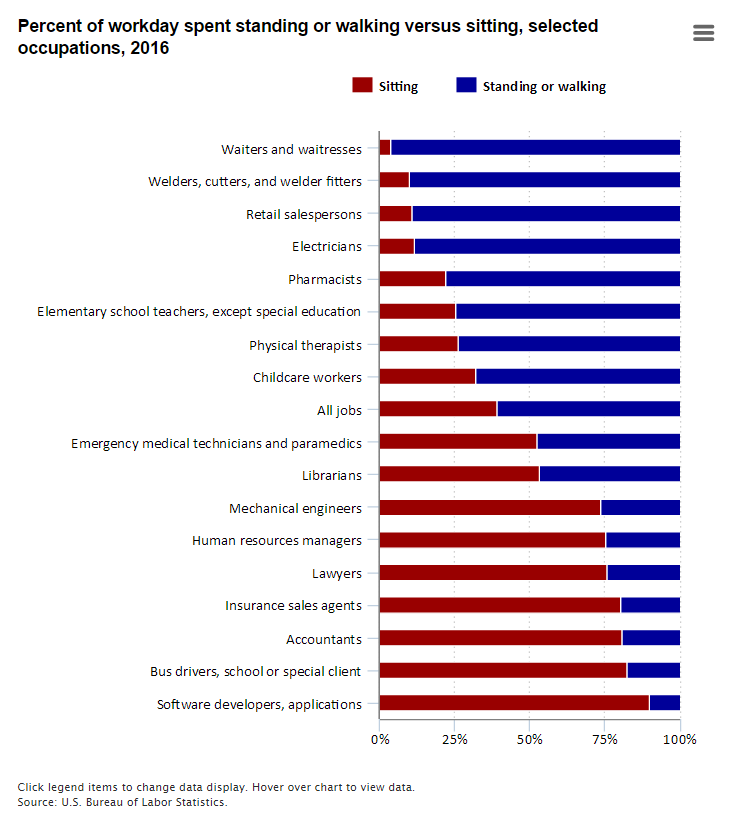
The Bureau of Labor Statistics published a study  of  the time workers spend standing/walking or sitting. The average worker spends 3/5th of their time standing or walking.

timestudy
//////////////////////////

Education in the 21st Century

“Education technology is like teenage sex: everyone talks about it, nobody really knows how to do it, everyone thinks everyone else is doing it, so everyone claims they are doing it…”

That’s just one quote from this TechCrunch article on the investments needed in K-12 and higher education. The author feels that the appointment of Betsy DeVos as Secretary of Education will break up a coalition of interests that has stymied the adoption of technology in classrooms.

Readers who do not support Ms. DeVos may still find themselves in agreement with the author’s comment that “in both K-12 and higher education, technology remains supplemental to chalk-and-talk practices as old as the hills, and not much more effective from a pedagogical standpoint.”

Those who are sympathetic to teacher’s unions will bristle at this comment: “In K-12, the most promising applications of technology have been found most consistently in private and charter schools — freed from the strictures of teachers unions.”

The author discusses a new “10/90” proposal to give higher education institutions some “skin in the game.” Under an Income Share Agreement (ISA), higher education schools would contribute 10% of the amount of every federal loan. After graduation, students would make loan payments based on a fixed percentage of their income for a fixed number of years, with a clear cap on the total amount paid. The schools would recap their money ONLY if students graduated and would thus be more invested in the future of their students.

An Interest-ing Debt

February 12, 2017

Republicans used to talk about the country’s debt load but such talk is so inconvenient now that they control the House, Senate and Presidency. Perhaps it was never more than a political ploy, a rhetorical fencing. Now there is talk of tax cuts and more defense spending, and a $1 trillion dollar infrastructure spending bill. 48 states have submitted a list of over 900 “shovel-ready” projects.

House Speaker Paul Ryan used to be concerned about the country’s debt. Perhaps he has been reading that deficits don’t matter in Paul Krugman’s N.Y. Times op-ed column. For those of us burdened with common sense, debts of all kinds – even those of a strong sovereign government like the U.S. – do matter. The publicly held debt of the U.S. is now more than the country’s GDP.

debt2016q3

In 2016, the Federal interest expense on the $20 trillion publicly held debt was $432 billion, an imputed interest rate of 2.1%. Central banks in the developed world have kept interest rates low, but even that artificially low amount represents 11% of total federal spending. (Treasury)  It represents almost all the money spent on Medicaid, and more than 6 times the cost of the food stamp program. (SNAP)

The latest projection from the CBO estimates that the interest expense will double in eight years, an annual increase of about 9%. The “cut spending” crowd in Washington will face off against the “raise taxes” faction at a time when a growing number of seniors are retiring and wanting the Social Security checks they have paid toward during their working years.

In the past twenty years the big shifts in federal spending as a percent of GDP are Social Security and the health care programs Medicare and Medicaid. These are not projections but historical data; a shift that the CBO anticipates will accelerate as the Boomer generation enters their senior years. Ten years ago, 6700 (see end of section)  people were reaching 65 each day. This year, over 9800 (originally 11,000, which is a projection for the year 2026) per day will cross that age threshold.

cbospendcomp1996-2016
CBO Source

A graph of annual deficits and federal revenue shows the parallel paths that each take. The trend of the past two years is down, promising to accelerate the accumulation of debt.

fedreceiptsdeficit1998-2016

More borrowing and higher interest expense each year will crowd out discretionary spending programs or force the scaling back of benefits under mandatory programs like Social Security, Medicare and Medicaid. President Trump can promise but it is up to Congress to do the hard shoveling.  They will have to bury the bodies of some special interests in order to get some reform done.

[And now for a bit of cheer.  Insert kitten video here.]

We already collect the 4th highest revenue in income taxes as a percent of GDP. Canada and Italy head the list at 14.5%.
South Africa 13.9%,
U.S. 12.0%,
Germany 11.3,
and France 10.9 all collect more than 10%. (WSJ) Those who already pay a high percentage in income taxes will lobby for a VAT tax to increase revenues. Income taxes are progressive and impact higher income households to a greater degree. Poorer households are more affected by a VAT tax.  Cue up more debate on what is a  “fair share.” Many European countries have a VAT tax and the list of exclusions to the tax are bitterly debated.

Adding even more social and financial pressure is the lower than projected returns earned by major pension funds like CALPERS. For decades, the funds assumed an 8% annual return to pay retirees benefits in the future. In the past ten years many have made 6% or less. Several years ago, CALPERS lowered the expected return to 7.5% and has recently announced that they will be gradually lowering that figure to 7%.

Each percentage point lower return equals more money that must be taken from state and local taxes and put into the pension fund to make up the difference. Afraid to call for higher taxes and lose their jobs, local politicians employ some creative accounting to avoid the expense of properly funding the pension obligations. In a 2010 report, Pew Charitable Trust analyzed the underfunding of many public pension funds like CALPERS and found a $1 trillion gap as of 2008. (Pew Report) The slow but steady recovery since then may have helped annual returns but the inevitable crisis is coming.

In December 2009, I first noted a Financial Times Future of Finance article which quoted Raymond Baer, chairman of Swiss private bank Julius Baer. He warned: “The world is creating the final big bubble. In five years’ time, we will pay the true price of this crisis.”
That warning is two years overdue. Sure hope he’s wrong but … here’s the global government debt clock. The total is approaching $70 trillion, $20 trillion of which belongs to the U.S.  We have less than 5% of the world’s population and almost 30% of the world’s government debt.  As Homer Simpson would exclaim, “Doh!”

Correction:  Posted figure for 10 years ago was originally 9000.  Current figure was originally posted at 11,000.  Projected for the year 2026 is 11,000.)

///////////////////////

Market Valuation

Comments by President Trump indicating a “sooner than later” schedule for tax cuts helped lift the stock market by 1% for the week. The Shiller CAPE ratio currently stands at 28.7, just shy of the 30 reading on Black Tuesday 1929. (Graph) Since the average of this ratio is about 16, earnings have some catching up to do. Today’s reading is still a bargain compared to the 44 ratio at the height of the dot com boom. Still, the current ratio is the third highest valuation in the past century.

The Shiller Cyclically Adjusted Price Earnings (CAPE) ratio
1) averages the past ten years of inflation adjusted earnings, then
2) divides that figure into the current price of the SP500 to
3) get a P/E ratio that is a broader time sample than the conventional P/E ratio based on the last 12 months of earnings.

The prices of long-dated Treasury bonds usually move opposite to the SP500.  In the month after the election, stocks rose and bond prices went lower.  Since mid-December an ETF composite of long-dated Treasury bonds (TLT) has risen slightly.  A number of investors are wary of the expectations that underlie current stock valuations.

The casual investor might be tempted to chase those expectations.  The more prudent course is to stick with an allocation of various investments that manages the risk appropriate for one’s circumstances and goals.


VAT Tax

In a 6/4/09 WSJ op-ed, Daniel Mitchell, a senior fellow at the Cato Institute, makes a well reasoned argument that the U.S. should not adopt a VAT tax.

This tax, prevalent in the EU, is like a national sales tax, a consumption tax. The more cautious proponents of its adoption in the U.S. wisely advocate the repeal of the 16th Amendment, which gave the Federal government the power to tax incomes. With the repeal, a VAT tax would replace the income tax. Without that repeal, a VAT tax would become just another revenue source for politicians to spend in addition to the income tax, a point that Mitchell makes as well.

For those who advocate a VAT tax as a protection for American goods producing businesses, Mitchell concludes that a VAT tax will not accomplish their goals.

Mitchell’s use of OECD data to compare government spending in the US and the EU suffers a flaw common to other op-ed writers, as I pointed out in in a previous blog. The EU includes 75% of its health care spending as a government expense. Although the US spends more as a percentage of GDP than any country in the world, it reports only 45% of that expense as government spending.

Mitchell writes that in 2007, “government spending now consumes 47.1% of GDP in the EU-15, significantly higher than the 35.3% burden of government in the U.S.” Let’s look at a 2005 (the latest available) comparison (On left side of screen, click Health, then Health Statistics, then OECD Health Data 2008, then Health Expenditures) of health care costs from the OECD.

In that year, the US spent over 15% of GDP on health care and reported that 45% of that expense was public tax dollars. Whether it is called a government expenditure or a private expenditure, the majority of us carry the burden of health insurance. To properly compare burdens between the US and EU, we can add in 5% of US GDP that would be public expenditure if US workers paid their insurance premiums to the Federal government instead of a private insurance company. Add that to the 35.3% that the US reports and a more accurate comparison of government spending burden is about 40%, still lower than the EU’s 47.1%.

What is your vote? Should the US 1) leave the income tax system in place; 2) replace it with a flat tax; 3) replace it with a VAT tax; 4) replace it with a savings transaction tax. Each system has plenty to be said for and against it.