A Debate on Vulnerability

This is eighth in a series of debates on various issues. The debates are voiced by Abel, a Wilsonian with a faith that government can ameliorate social and economic injustices to improve society’s  welfare, and Cain, who believes that individual autonomy, the free market and the price system promote the greatest good.

Hope everyone enjoyed their holidays.

Abel began the conversation. “Last week neither of us were happy with the present structure of our government. I thought we could discuss a more fundamental issue, the duty of a government and the duties of its citizens.”

Cain nodded. “At  the Constitutional Convention in 1787, the founding fathers fought bitterly about the duties of a federal government. Over two hundred years later, I don’t think we have come any closer to an agreement on this point.”

Abel said, “The scope of the federal government’s duties have expanded since Roosevelt and the Great Depression.”

Cain argued, “For decades, our group has been fighting that expansion. We have compassion for the vulnerable but caring for them is a proper function of state governments.”

Abel shook his head. “The Jim Crow era and the Depression taught us that state governments may be unwilling or unable to help the vulnerable. During the hundred years after the Civil War, southern states lacked any compassion for their black residents. During the Depression, the ranks of the vulnerable increased beyond the capacity of state governments. FDR and the Democrats recognized that and instituted job and relief programs to lessen the suffering and reassert some moral order.”

Cain replied, “It is still not clear that most of those programs did much good. The economy continued to flounder until this country entered World War 2. The federal government may be able to borrow the resources for relief programs, but Congress and the President try to design a one-size-fits-all solution. Only the states can design programs that are suited to the population, resources and economy of each state. Texas and New York have entirely different resources, cultures and economy.”

Abel argued, “But that variety produces a fragmented policy response. State representatives are easily influenced by well-funded interest groups and dominant voting constituencies that want to bend the rules in their favor. Minority populations can become severely disadvantaged.”

Cain argued, “Because of that fragmentation, it can be costly for interest groups and lobbyists to fund a campaign that encompasses more than a few states. Instead, they consolidate their resources in Washington where they hope to effect a centralized policy. Centralized policymaking promotes more lobbying. As the saying goes, ‘The road to ruin is paved with good intentions.’”

Abel insisted, “Your group prefers a more federalist, splintered approach to policymaking. Historically, that has led to unequal treatment of the citizens who live in a state. That abuse violates the 14th Amendment as well as the principles of equality established in the Declaration of Independence.”

Cain nodded grudgingly. “Yes, there have been instances of abuse. Your group has used that unfortunate history to promote your vision of the federal government as the protector-in-chief of people’s welfare, animals, plants, the air and water. Social welfare programs embody the sentiment ‘From each according to his ability, to each according to his needs.’”

Abel shook his head. “That overstates our group’s position. We value compassion for the vulnerable, many of whom are victims of circumstance, heritage, and the bad luck of being a minority, a historically disfavored group to policymakers.”

Cain argued, “You absolve them of all responsibility for their choices.”

Abel insisted, “Their history as political pariahs and poor economic circumstances influence those choices. Our society bears a heavy burden there. Our group recognizes that.”

Cain said, “You want people to pay for policy mistakes a century or more old. You believe that white people are born with an original sin, guilty of the racist policies of bygone generations. Our group rejects that belief.”

Abel’s tone was more forceful. “Evidence illegally obtained is inadmissible in court. Evidence derived from that evidence is also inadmissible. That is the Fruit of the Poisonous Tree legal doctrine. Riches and advantages derived from property illegally obtained is tainted, yet many of us blithely reject responsibility. How many white people say, ‘Well, I did not steal my advantages or property. I was not yet born when some of these abuses were done. I bear no burden because I belong to a dominant racial, ethnic or cultural group.’”

Cain paused. “Ok, let me ask you. When is the debt paid? If there is a debt, it is finite, so when will it be paid? How much will have to be paid? Who will be assessed for that debt? If a person is 2% white, are they 2% responsible for the debt? Some racist policies were based on that same kind of thinking. A person of ‘mixed blood’ was treated as black and denied a loan or was excluded from buying a house in a certain area. We don’t want to repeat the sins of our fathers, so to speak, in making restitution for the sins of our fathers. The past is past. Let’s move forward.”

Abel argued. “It is not a debt. It is a duty to help the vulnerable, and those who have been wronged. Don’t you see? Some people move forward more slowly because they are weighed down by the policy sins of past generations.”

Cain scoffed, “We may recognize a moral, but not legal, duty to help the vulnerable. The parable of the Good Samaritan comes to mind. Should we legalize that duty and have the government enforce a charitable spirit on everyone? No. As to the abuses of the past, should the federal government give American Indians a lot of land back? Shall we have the National Guard evict a lot of American homeowners? No! The past is past. The Age of Conquest is over. We move forward.”

Abel said, “We can preserve areas like Bears Ears National Monument that is sacred land to an Indian tribe. We can enjoy it in its pristine beauty instead of drilling holes in the ground and installing bobbing black oil pumps.”

Cain shook his head. “Bears Ears is an example of a President overstepping his Constitutional bounds. Resources contained within a state are managed by the state unless Congress mandates otherwise. Congress, not the President. Congress passed a law that designated Yellowstone a National Park. President Grant signed the law that Congress passed.”

Abel argued, “In 1906, Congress passed the Antiquities Act, giving itself and the President the legal authority to designate national parks and monuments. Grand Canyon National Park was created under the authority of that act. Presidents are entirely within the bounds of their designated authority when they dedicate a section of land as a national monument.”

Cain smiled ruefully. “The focus of our argument is wandering. We began by discussing vulnerability and now we are discussing the scope of federal and Presidential authority.”

Abel returned the smile. “Vulnerable lands and artifacts on those lands, vulnerable Indian tribes, their cultures and beliefs. We are still talking about vulnerability.”

Cain replied, “Your group wants to take from those that have and give it to those who have not. Those policies do not raise the overall utility or the flourishing of a society.”

Abel said, “We want to improve the conditions of the least among us. Imagine two kids who have to decide how to divide some chocolate milk. The fairest solution is to have one child pour the milk into each glass, then let the other child get first pick of which glass they want. The child doing the pouring will try to make each quantity as equal as possible. A few decades ago, the philosopher John Rawls argued a similar proposition he called the original position. If we could choose the type of society we wanted to be born into without knowing what our place in that society would be, we would choose a society with a fairly even distribution of resources.”

Cain argued, “To implement those kinds of policies means that society has to take property from some individuals and give it to others. In trying to achieve one form of justice, society commits an injustice, a violation of the rights of private property.”

Abel replied, “Even though there is a violation of private property rights, governments can still attain a more just society. That is the principle behind a progressive income tax system. Take a higher percentage from those who have more and use those funds to help the least among us.”

Cain shook his head. “Not only are such policies a violation of property rights, but they are also a violation of individual privacy. To implement such policies, governments collect a lot of data on their citizens. That kind of personal intrusion is typical of totalitarian governments. George Orwell fictionalized such a government in his book 1984. When governments enact distributive policies, they commit many injustices in the pursuit of justice. The net gain is negative.”

Abel argued, “The U.S. is not the government portrayed in Orwell’s book. You are overstating the case. States and local governments collect much of the information on an individual. Why? So they can tax them. Water boards charge homeowners for the impervious area of their home. City governments regularly assess the value of one’s property for property tax.”

Cain held up his hand in a stop motion. “That’s information on property, not the individual. The amount of information gathered by the IRS is intrusive. Every aspect of a person’s life, including their work and family. It is  typical of totalitarian governments. If there was any doubt that we are living under a totalitarian regime, all we need to do is look at the Covid lockdowns during the pandemic.”

Abel said, “Well, the country needed a unified response to a rapidly spreading pathogen. And yes, I agree that the information gathered is a bit excessive. Taxes are an unfortunate component of the social contract.”

Cain said, “A person’s work shouldn’t be taxed at any rate. It’s immoral.”

Abel shrugged. “Whether it is immoral is a matter of opinion. It’s the law, an amendment that is part of the Constitution. Killing people is immoral. When political leaders perceive a threat to the country’s security, they authorize killing. As this country’s population expanded in the late 19th century, policymakers thought that the inadequacy of revenue from tariffs was weakening the government’s finances to the point where it could become a security threat. An income tax was ruled unconstitutional by the Supreme Court in 1895. Eventually, the states amended the Constitution.”

Cain returned to the totalitarian theme. “Lockdown policies during the pandemic scared a lot of people. They demonstrated the authoritarian reach of this government. Grandparents unable to visit with or care for their grandchildren. Scare tactics like ‘Little Johnny will spread the disease and kill Grandma.’ It was reminiscent of the Red Scare, the fear that left wing ideas would infect people’s minds.”

Abel nodded. “That’s a whole other discussion. Every year the Supreme Court hears cases that test the extent of the police power of the federal and state governments. We’ve wandered off topic again.”

Cain shook his head. “Many of these issues are interwoven or joined together like the threads in a spider’s web. What is fairness? How much control should a government exercise to protect the vulnerable? What should be the extent of the government’s role in the social contract?”

Abel smiled. “I like the spider web image. We pull on one thread and that affects the tension on the other connections in the web. Well, maybe next week we can look at the police power of government.”

Cain replied, “Or tax policy.”

Abel laughed. “I wished we could find something simple to talk about.”

With mock skepticism Cain said, “Like whether the toilet seat should be left up or down.”

Abel smiled. “See you next week.”

Cain waved goodbye.

///////////////

Photo by Ross Sneddon on Unsplash

In March 2009, in the depths of the financial crisis, historian Allan Winkler testified before the U.S. Senate Committee on Banking, Housing, and Urban Affairs on the effect of New Deal policies during the Depression. “The NRA alienated business, and never did encourage private expansion or investment. It may have halted the deflationary spiral, but it failed to create new jobs.” https://www.banking.senate.gov/imo/media/doc/WinklerTestimony33109TheNewDealSenateTestimony.pdf#page=5

In 2016, Barack Obama designated the Bears Ears National Monument in Southern Utah a national monument. Here is a video of some of the landscape from the Patagonia Company. You can read more about the controversy and legal skirmishes here https://www.npr.org/2022/08/24/1119310929/utah-sues-to-stop-restoration-of-boundaries-at-bears-ears-grand-staircase-monument

Exploitation as well as preservation were key motivations behind the passage of the Yellowstone National Park Preservation Act in 1872. https://www.nps.gov/articles/000/president-grant-and-the-yellowstone-national-park-protection-act.htm 

A list of national monuments. https://geojango.com/pages/list-of-national-monuments

In his 1971 book, A Theory of Justice, the philosopher John Rawls argued for a more equal distribution of resources in society. https://en.wikipedia.org/wiki/A_Theory_of_Justice

The precedent underlying the Supreme Court’s 1895 decision that an income tax was unconstitutional. https://taxfoundation.org/blog/today-history-income-tax-ruled-unconstitutional-pollock-v-farmers-loan-trust-co/

More on the Red Scare and McCarthyism. https://millercenter.org/the-presidency/educational-resources/age-of-eisenhower/mcarthyism-red-scare

More on the Fruit of the Poisonous Tree doctrine https://www.law.cornell.edu/wex/fruit_of_the_poisonous_tree

The Individual, Common and General Welfare

August 29, 2021

by Stephen Stofka

In the short version of Monopoly, the property deeds are shuffled and dealt out to the players. Some think that God does the same with our talents and circumstances and that it our duty to play with what we are given. They argue that the proper role of government is to provide for the common welfare, like defense, police, schools and infrastructure. Some take a more secular view, arguing that the hands dealt are largely the result of past policies and practices, the good, bad and quite ugly. Given this history, government has a duty to correct these inequities. They argue that government should take an active role in improving individual welfare to raise the general welfare. Moderates argue that a mixture of individual and common welfare programs will best improve the general welfare but they disagree on priorities.

According to the Bureau of Economic Analysis, federal assistance for education, welfare and housing has increased 3 times since 1960 as a percent of GDP. During that period, health care spending at the federal level has increased 9 times; at the state and local level it has increased 3 times. To help offset these increases, federal spending on defense has declined by 67%. What distinguishes all these increases in spending is that they are targeted toward individual welfare in the hopes that an improvement in individual welfare will raise the level of general welfare.

State spending on the common welfare like education and transportation have both declined 25%. After several decades of this shift in strategy, our schools, roads, water and sewer systems are in bad repair because state revenues as a percent of GDP have changed little in the past fifty years while spending on individual welfare has increased. The $3.5 trillion infrastructure bill being debated in Washington targets that neglected common infrastructure.

The spending mix of families has changed as well. In 1964, 33 cents of every family’s expenses was spent on food. Today, it is only 13 cents, a drop of 67%. Despite that decrease in food spending, 1 out of 12 families relies on food stamps, the SNAP program, to help feed their families. Why is that? In the past four decades housing costs as a percent of GDP have gone up 30% (CRS, 2021). Since housing is the largest monthly expense for most families, this sizeable increase has significantly lowered individual welfare. Government programs help alleviate that stress.

During the Depression, a shared suffering prompted a shift in the role of government from public projects, the common welfare, to individual welfare. Many New Deal programs incorporated both elements in their design. Electric generating projects like the Hoover Dam and Tennessee Valley Authority (TVA) were built by men who sent part of their government paychecks to their families to help with food and housing expenses. A contribution to the common welfare helped relieve individual suffering. During that era, the Roosevelt administration and Democratic Congress initiated the Social Security program, requiring working Americans to contribute to a common fund which would be used to pay benefits to contributors when they retired. Those payroll tax contributions were the price of admission to the benefits of the program.

At that time, only states, local communities and private charities administered welfare programs. These were benefits paid to families based on their need, not an admission fee of contributions to the program. In the 1960s, the Johnson administration and Democratic Congress ushered in the Great Society programs that firmly established a precedent that raising individual welfare increased the general welfare. In the late 1970s, Democratic President Jimmy Carter fought this expansive role of government but his sentiments were countered by the liberal wing of his party, particularly the powerful House Speaker Tip O’Neill, a strong believer in the government’s power to correct social problems (Cuomo, 2021).

Conservatives argue that federal programs designed to increase individual welfare exceed the boundaries set out in Article 1, Section 8. Such programs may weaken the supports provided by family, church and local community (O’Neil, 2021, 106). They do not incentivize people to change their behavior. The programs encourage people to cast their vote for those politicians who promise more benefits, making the voting process a transaction, not a civic endorsement of a voter’s values. At a fundraiser in the closing weeks of the 2012 Presidential Election, Republican candidate Mitt Romney commented that the 47% of Americans who paid no income tax were the base constituency of the Democratic Party (Moorhead, 2012). His implication that half of Americans were moochers was a blow to his campaign.

Liberals argue that the “general welfare” clause of the Constitution implies a government duty to improve individual welfare. They counter that many people in poor communities do not have informal support networks to lean on. Many people did not choose their circumstances and their decisions, whether prudent or ill-advised, are not based on gaining access to a government program. Farmers, business owners and executives also vote for government programs like subsidies, lower taxes, and less regulation. All voters are motivated in part by their self-interest.

How do individual, common and general welfares interact? What is meant by the general welfare? What does it consist of? Shortly after the Constitution was presented to the states for ratification, anti-Federalists argued that “providing for the … general welfare” imposed few constraints on the federal government’s ability to tax the people to fund that general welfare (Debates). Americans continue to argue the merits of these programs and the role of government in their lives.

////////////////

Notes:

Photo by Camylla Battani on Unsplash

Congressional Research Service (CRS). (2021, May 3). Introduction to U.S. Economy: Housing market. Retrieved August 28, 2021, from https://sgp.fas.org/crs/misc/IF11327.pdf

Cuomo, M. M. (2001, March 11). The Last Liberal. Retrieved August 28, 2021, from https://archive.nytimes.com/www.nytimes.com/books/01/03/11/reviews/010311.11cuomot.html

Debates. “Centinel,” the pen name of Samuel Bryan, and “Brutus” were among several anti-Federalists who protested the insertion of the “general welfare” clause in the Constitution.  See Centinel I and Brutus V editorials.

Moorhead, M. (2012, September 18). PolitiFact – Mitt Romney says 47 percent of Americans pay no income tax. Retrieved August 28, 2021, from https://www.politifact.com/factchecks/2012/sep/18/mitt-romney/romney-says-47-percent-americans-pay-no-income-tax/

Merry Christmas

December 21, 2014

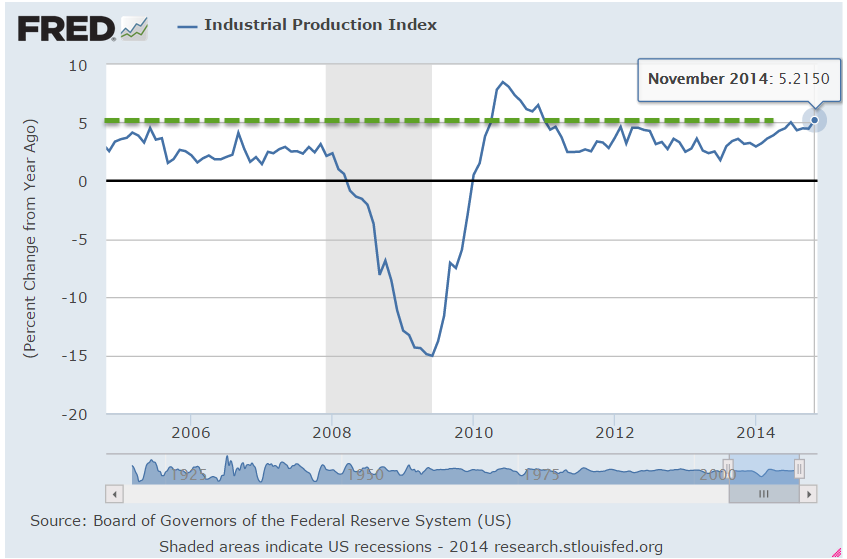
In preparation for today’s solstice, the market partied on in a week long saturnalia.  The week started off on a positive note.  Industrial production increased 1.3% in November, gaining more than 5% over November of 2013.

Capacity utilization of factories broke above 80%, a sign of strong production.  Production takes energy.  I’ll come to the energy part in a bit.

The Housing Market Index remained strong at 57, indicating that builders remain confident.  Tuesday’s report of Housing Starts was a bit of a head scratcher.  After a strong October, single family starts fell almost 6%.  Multi-family starts fell almost 10% in October, then rebounded almost 7% in November.  Combined housing starts fell 7% from November 2013.

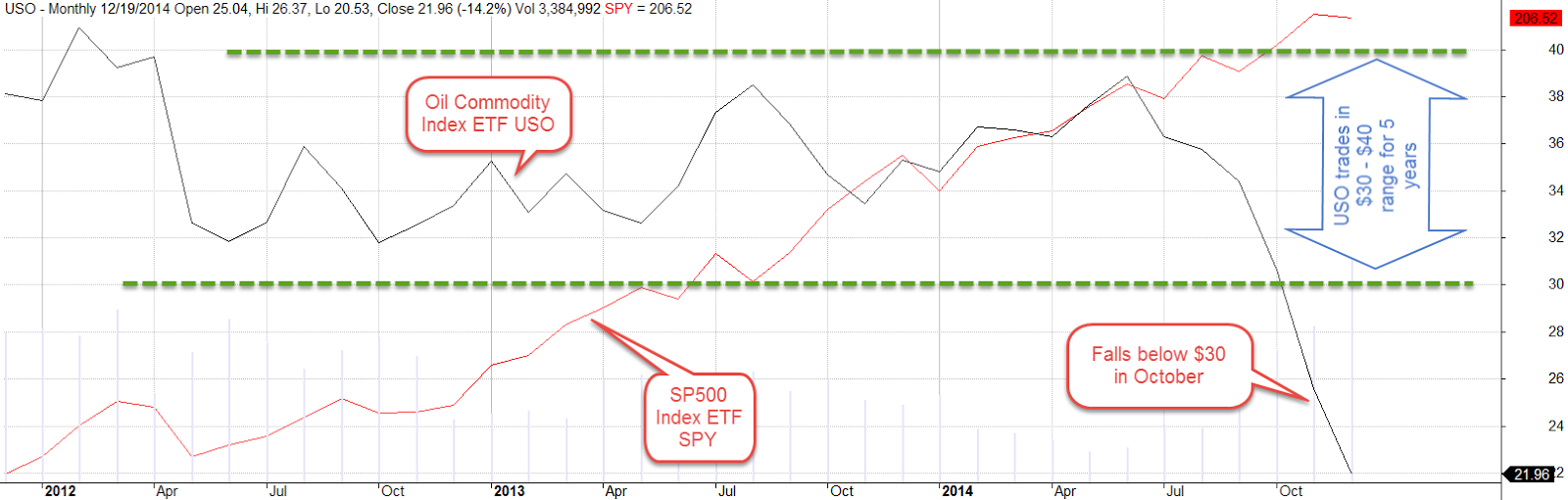
The market continued to react to the change in oil prices.  For the big picture, let’s go back a few years and compare the SP500 (SPY) to an oil commodity index (USO).  For the past five years, USO has traded in a range of $30 to $40, a cyclical pattern typical of a commodity.  In October, the oil index broke below the lower point of that trading range.

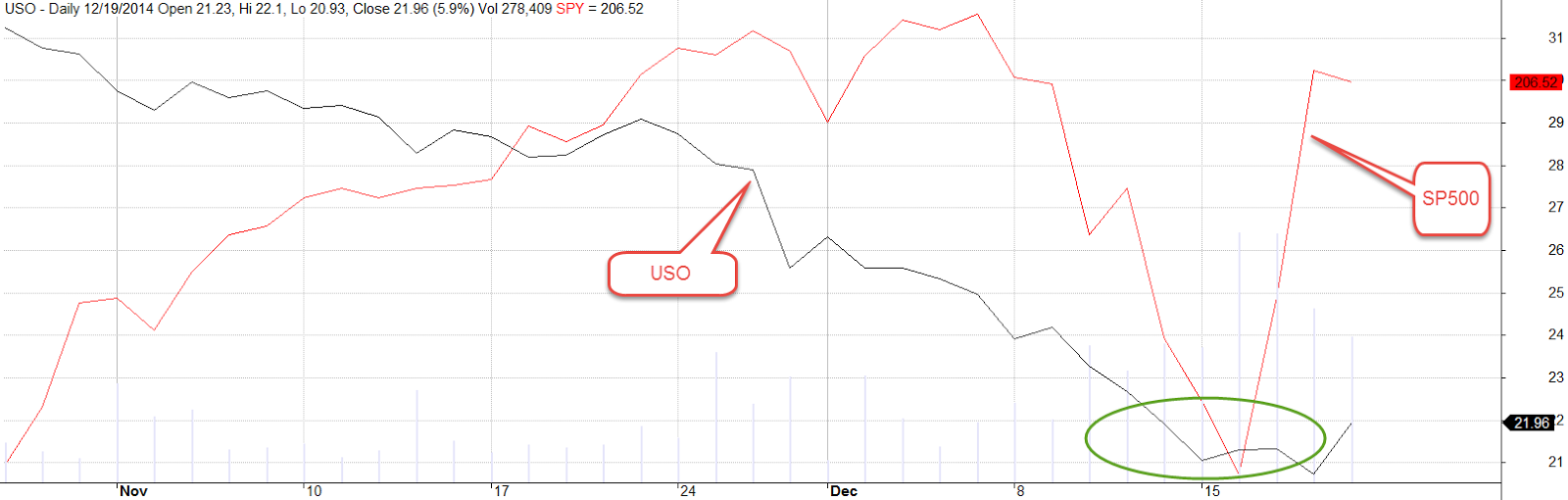
On Tuesday, oil seemed to have found a bottom in the high $50 range.  USO found a floor at $21, about a third below its five year trading range.  Beaten down for the past three weeks, energy stocks began to show some life (see note below).

Encouraging economic news helped lift investor sentiment on Tuesday morning. Some bearish investors who had shorted the market went long to close out their short positions. Growth in China was slowing down, Japan was in recession, much of Europe was at stall speed if not recession and the continued strength of the U.S. dollar was making emerging markets more frail.  While the rest of the world was going to hell in a hand basket, the U.S. economy was getting stronger.  Thee Open Market Committee at the Federal Reserve, FOMC, began its two day meeting and traders began to worry that the committee might react to the strengthening U.S. economy with the hint at an interest rate increase in the spring of 2015.  This helped sent the market down about 2% by Tuesday’s close.

Wednesday’s report on the Consumer Price Index (CPI) was heartening.  Falling gas prices were responsible for a .3% fall in the index in November, lowering inflation pressures on the Fed’s decision making about the timing of interest rate hikes.  The core CPI, which excludes the more volatile energy and food prices, had risen 1.7% over the past year, slightly below the Fed’s 2% target inflation rate.  Traders piled back into the market on Wednesday ahead of the Fed announcement Wednesday afternoon.  Back and forth, up and down, is the typical behavior when investors are uncertain about the short term direction of both interest rates and economic growth.

The Fed’s announcement that they would almost certainly leave interest rates alone till mid-2015 gave a further 1% boost upwards on Wednesday afternoon.  Twelve hours later, the German market opened  up at 3 A.M. New York time.  Early Thursday morning, the price of SP500 futures began to climb, indicating that European investors were reacting to the Fed’s decision by putting their money in the U.S. stock market.  Those of you living in the mountain and pacific time zones of the U.S. might have caught the news on Bloomberg TV before going to bed.  Maybe you got your buy orders in before brushing your teeth and putting your nightgown on. Very difficult for an individual to compete in a global market on a 24 hour time frame.  On Thursday, the market rose up as high as 5% above Wednesday’s close, before falling back to a 2.5% gain.

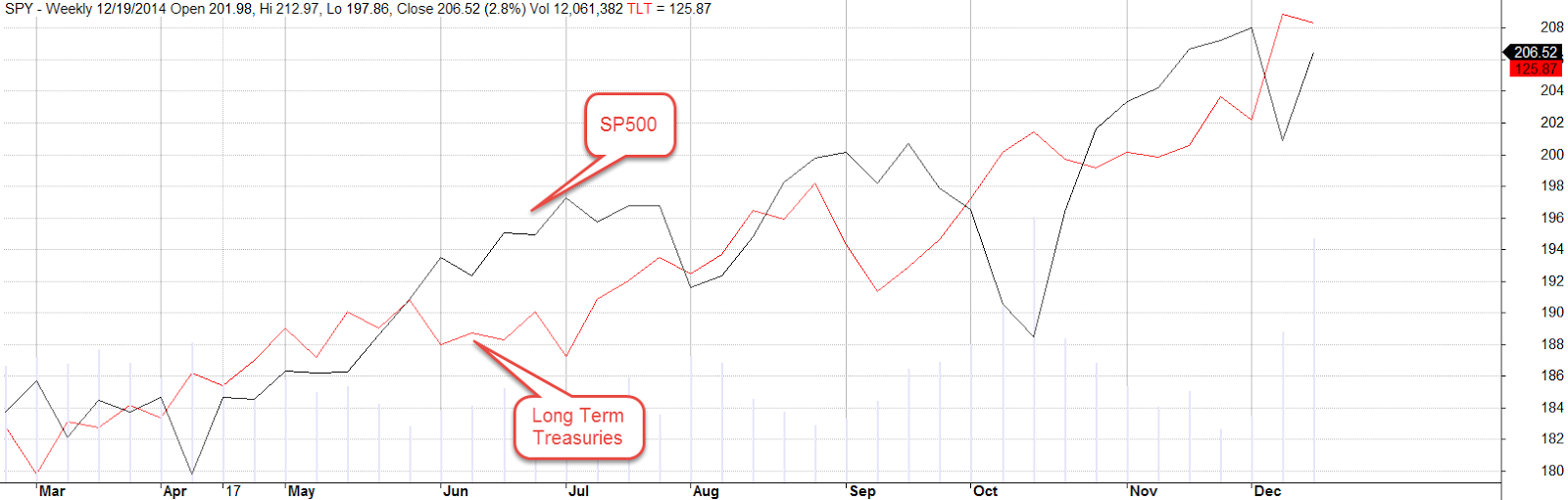
Still, a word of caution.  Both long term Treasuries, TLT, and the SP500, SPY, have been rising since October 2013.

As long as inflation remains low and the Fed continues its zero interest rate policy (ZIRP), long term Treasuries and stocks will remain attractive.   Something has to break eventually.  ZIRP  helps recovery from the aftermath of the last crisis but helps create the next crisis.  Abnormally low interest rates over an extended period are bad for the long term stability of both the markets and the economy.

**********************
Sale – Energy Stocks – Limited Time Only

(Note: this was sent out to a reader this past Tuesday.  Energy stocks popped up 4 – 5% the following day, a bit more of rebound than I expected. The week’s gain was almost 9% and the ETF closed above its 200 week average.)

As oil continues its downward slide, the prices of energy stocks sink.  XLE, a widely traded ETF that tracks energy stocks,  has dropped below the 200 week (four years!) average.  (A Vanguard ETF equivalent is VDE).  Historically, this has been a good buying opportunity. In the market meltdown of October 2008, this ETF crashed through the 200 week average.  A year later, the stock was up 38% and paid an additional 2% dividend to boot.  Let’s go further back in time to highlight the uncertainty in any strategy. The 2000 – 2003 downturn in the market was particularly notable because it took almost three years for the market to hit bottom before rising up again.  The 2007 – 2009 decline was more severe but took only 18 months. In June 2002, XLE sank below its 200 week average.  A year later, the stock had neither gained nor lost value. While this is not a sure fire strategy – nothing is – an investor  is more likely to enjoy some gains by buying at these lows.

****************************

Emerging Markets Stocks

Also selling below the 200 week average are emerging market (EM) stocks.  These include the BRICs (Brazil, Russia, India, China) as well as other countries like Mexico, Vietnam, Turkey, Indonesia and the Philipines. When a basket of stocks is trading below its four year average, there are usually a number of good reasons. Several money managers note the negatives  for EM.   Also included are a few voices of cautious optimism.  Sometimes the best time to buy is when everyone is pretty sure that this is not the right time to buy.  Another blog author recounts two strategies for emerging markets: a long term ten year horizon and a short term watchful stance.  The long term investor would take advantage of the low price and the prospect for higher growth rates in emerging economies.  The short term investor should be cognizant of the fickleness of capital flows into and out of these countries and be ready to pull the sell trigger if those flows reverse in the coming months.

******************************

Welfare

What are the characteristics of TANF families?  When the traditional welfare program was revised in the 1990s, lawmakers coined a new name, Temporary Assistance to Needy Families, to more accurately describe the program.  The old term carried a lot of negative connotations as well. Two years ago Health and Human Services (HHS) published their analysis of a sample of 300,000 recipients of TANF income in 2010.  Although the recession had officially ended in 2009, the unemployment rate in 2010 was still very high, above 9%.  It is less than 6% today.

There were 4.3 million recipients, three-quarters of them children, about 1.4% of the population. By household, the percentage was also the same 1.4% (1.8 million families out of 132 million households).  In 2013, the number of recipients had dropped to 4.0 million, the number of families to 1.7 million (Congressional Research Service)

In 2010, average non-TANF income was $720 per month, or about $170 a week.  To put this in perspective, this was about the average daily wage at that time The average monthly income from TANF averaged $392. Recipients were split evenly across race or ethnic background: 32% were white, 32% black, and 30% Hispanic. For adult recipients only, 37% were white, 33% black, and 24% Hispanic.

Rather surprising was how concentrated the recipients were. 31% of all TANF recipients in 2010 lived in California.  43.3% of all recipients lived in either New York, California or Ohio.  The three states have 22% of the U.S. population and almost 44% of TANF cases.

HHS data refutes the notion that welfare families are big.  50% of TANF families had only one child.  Less than 8% of TANF families had more than 3 children.  82% of TANF families also receive SNAP benefits averaging $378 per month.

In 2014, Federal and State spending on the TANF program was less than $30 billion, about 1/2% of the $6 trillion dollars in total government spending.  The Federal government spends a greater percentage on foreign aid (1%) than the TANF program. Yet people consistently overestimate the percentage of spending on both programs (Washington Post article).  The average estimate for foreign aid? A whopping 28%.  Cynical politicians take advantage of these public misperceptions.

**********************

Omnibus

Aiming to overhaul the health care insurance programs throughout the country, the Affordable Care Act (ACA) was a big bill.  No, it wasn’t 2700 pages as often quoted by those who didn’t like it.  The final, or Reconciled, version of the bill was “only” 900 pages.  The House and Senate versions were also about 900 pages each; hence, the 2700 pages.

At 1600 pages in its final form, the recently passed Omnibus Spending bill makes the ACA look like a pamphlet.  As  specified in the Constitution, all spending bills originate in the House.  Past procedure has been to pass a series of 12 spending bills.  Majority leader John Boehner has found it difficult to get his fractious members to agree on anything in this Congress so all 12 bills were crammed into this behemoth bill just in time to avoid a government shutdown.  Just as with the ACA, most members of the House and Senate did not have adequate time to digest the details of the bill.  The bill is sure to hold many surprises for those who signed it and we, the people, who must live under the farcical law-making of this Congress.  Here is a primer on the budget and spending process.

**********************

Home Appraisals

They’re back!  A review of 200,000 mortgages between 2011 and 2014 showed that 14% of homes had “generous” appraisals, inflating the value of the home by 20% or more.  Loan officers and real estate agents are putting increasing pressure on appraisers to adjust values upwards.

**********************

Personal Income

You may have read that household income has been rather stagnant for the past ten years or more.  In the past fifty years household formation has increased 78%, far more than the 50% increase in population.  The nation’s total income is thus divided by more households, skewing the per household figure lower.  During the past thirty years, per person income has actually grown 1.7% above inflation each year.  Inflation adjusted income is now 66% higher than what it was in 1985.

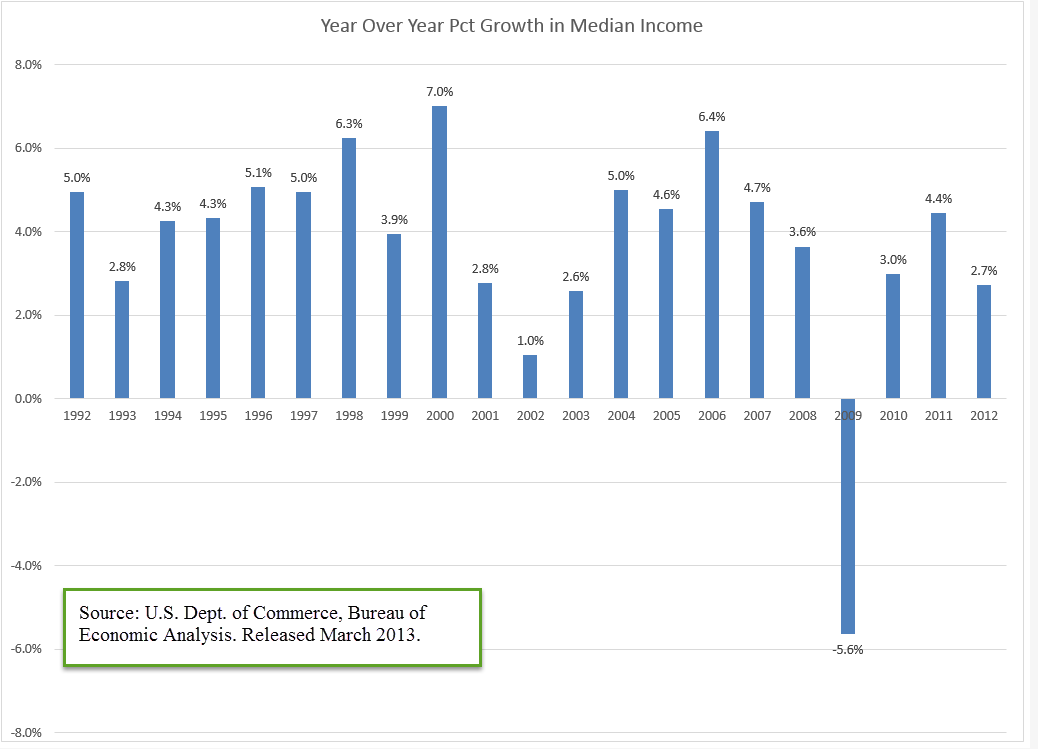
In 2013, the Bureau of Economic Analysis released median income data for the past two decades. Median is the middle; half were higher; half were lower.  This is the actual dollars not adjusted for inflation.  Except for the recession around the time of 9-11 and the great recession of 2008 – 2009, incomes have risen steadily.

The 3.7% yearly growth in median incomes has outpaced inflation by almost 25%.

Why then does household income get more attention?  A superficial review of household data paints a negative picture of the American economy. Negative news in general tugs at our eyeballs, gets our attention.  The majority of the evening news is devoted to negative news for a reason. News providers sell advertising in some form or another.  They are in the business of capturing our attention, not providing a balanced summary of the news.  In addition, a story of stagnating incomes helps promote the agenda of some political groups.

***********************

Merry Christmas and Happy Chanukah!

California Welfare

In a report to Congress published in June 2009, the Office of Financial Assistance (OFA) tallied the September 2008 welfare caseload in each state. The program, Temporary Assistance to Needy Families, is known by its acronym TANF and was created in 1996 to reform the previous welfare program and emphasize getting people back to work.

The dramatic increase in the caseload since 2006 is a testimony to the economic downturn. In September 2006, only California, Tennessee and Rhode Island had a greater than 1% of their population on this welfare to work program. California ranked first with 1.32% of the population on welfare.

Fast forward two years to September 2008 and the data shows that 24 states had greater than 1% of their population on this program.

In 2006, California had almost 1/2 million cases, almost twice as many welfare cases per 1000 people as New York and New Mexico, two other states with large immigrant populations. Texas and Florida, populous states with large immigrant populations, had far, far less cases per 1000 people than California.

In the two years from 2006 to 2008, New York’s caseload per 1000 population increased 60%. New Mexico’s caseload percentage doubled. As bad as the auto industry has been, Michigan had 1.72% of its population on the TANF program, the same as New Mexico.

New York has been hit hard by the financial crisis, Michigan by the auto crisis. California’s economy has a diverse base including agriculture, technology, tourism and the movie industry. In any downturn, diversity is a strength. So why does California continue to claim the top spot among states in welfare caseloads per 1000 population? At 3.25% of the population, this is a 250% increase in welfare caseloads in two years.

As high as California’s caseload is, it has declined 45% since the TANF program went into effect in 1996. California Budget Bites reports “The number of families receiving CalWORKs [California’s welfare to work program] dropped by more than 400,000 between March 1995 and March 2009. Yes, the CalWORKs caseload has gone up since July of 2007 – not surprising, given the economic downturn – but the overall trend in California slopes downward.”

Judging by the above data, we can conclude that as bad as California’s welfare program is, it is not as bad as it used to be. One wonders if this welfare expense might be contributing to California’s budget woes.

Cal Budget Bites notes that “Total spending on welfare fell by nearly one-third (32 percent) between 1996-97 and 2008-09, after adjusting for inflation.” Another factoid: “Welfare spending in California made up about 7 percent of the state budget in 1996-97. Today, it makes up about 3 percent.”

Why do California’s caseloads continue to be two and three times what many other states are? As noted above, a large immigrant population is not the reason. A lack of economic diversity is not the reason. New York, New Jersey, and Connecticut have high housing costs but they don’t have the high caseloads. Could it possibly be a badly structured and poorly managed program? Hmmm, something to think about there.

In 2006, California had 12% of the U.S. population and 25% of the welfare caseloads. In Sept 2008, California still had 12% of total population but 31.5% of caseloads in the U.S.