The Money Information Network

June 25, 2023

by Stephen Stofka

This week’s letter is about money, both conventional and digital, prompted by the news that Argentina’s yearly inflation just passed 100%, 25 times the U.S. rate of inflation reported a week ago. Let’s not confuse money and the banking system. Money exists within a banking system. The regimes, or set of rules, that govern that system are fluid but the institutions that manage that regime have evolved over centuries. The pillars of international institutions rarely crumble suddenly.

On Monday June 19, Bitcoin’s 24 hour volume was $10B, almost 2% of its $513B market cap. M1, the measure of transactional money like cash and checking accounts, was $18.6 trillion, about 36 times the market cap of bitcoin. Bitcoin’s algorithm changed the nature of money hoping that the adoption of Bitcoin would bypass the hegemony and inequities in the global banking system.

Satoshi Nakamoto, the pseudonym of the developer of the Bitcoin algorithm, understood the informational nature of money. Let’s explore that informational model. Economics students learn the three roles that money plays: a unit of account, a medium of exchange, and a store of value. The banking system manages a network of information databases. That’s the store of value function. That information is denominated in various currencies, the unit of account function. As a medium of exchange, access to that information is mostly guarded by a banking system that manages permissions. Our credit or debit card number is a password into that exchange.

Within this database model, cash is a permission-less and anonymous public information source that can be exchanged freely and (usually) confers a property right with that exchange. However, the availability and flow of cash is managed by central banks.  Satoshi designed Bitcoin to take advantage of those two characteristics of cash and avoid the negative aspects of central management, including the risk of inflation. To avoid a central gatekeeper, Bitcoin’s algorithm introduced a lot of nodes as gatekeepers. Those nodes formed a path of past exchanges which verified the existence of the funding source for an exchange.

Some entity had to keep a digital record of those exchanges, however. That has become a vulnerability in digital currencies because the exchange is also a broker, facilitating trades within its own exchange. Conventional securities are traded in an environment where the exchange, like the New York Stock Exchange, and the broker, like Vanguard, are entirely separate. Not so with digital currencies and that presents an opportunity for mismanagement and fraud. The implosion of the FTX exchange owned by Sam Bankman-Fried is a recent example. Until digital currencies can separate their broker and exchange functions, they are vulnerable to these shenanigans. Yes, the banking system is subject to mismanagement and fraud but the gatekeeper, the government, provides some recourse.   

Bitcoin is like a set of Christmas lights with many bulbs. If one goes out, a circuit may not complete and a transaction between two parties be recognized on both ends of the exchange. The banking system is like a network of traffic lights in a city. Traffic lights are permissions. Should one go out, a policeman will likely show up to manage those permissions and direct traffic. There is no recourse when a node in a digital currency block goes out or an exchange produces tokens to cover its trading losses.

Nations are their own banks and their security and welfare depend on that status. Wikipedia lists more than 150 central banks among the 195 countries in the world. The adopters of bitcoin and other digital currencies dreamed big but cannot overcome the political advantages of such a system. The dream of one-world currency may be destined for the same graveyard where the one-world government envisioned in the 1990s went to die. The hope that digital currency embodies will live on.    

////////////////

[20230625Lights.png]

Photo by Aedrian on Unsplash

Keywords: bitcoin, money, banking

Great But Not Perfect

June 18, 2023

by Stephen Stofka

This week’s letter is about the political movement to remove books from schools and libraries that reveal the uglier parts of American history. Any society makes mistakes, historical debts that never be paid and the succeeding generations are reluctant to shoulder the burden of those mistakes. A truly great people acknowledge those flaws and adopt policies that ameliorate some of the suffering caused by those mistakes. Some who shout the loudest that America is great are more concerned that America appears great than contributing to America’s greatness.

For some groups in America, the nation was never great. Some laws kept people out of restaurants, bathrooms, schools and other public places. American customs and federal policy kept some Americans from living in certain neighborhoods – the process of redlining in real estate. Some customs kept some Americans from jobs and credit because of their religion or skin color. These restrictive laws have been repealed or found unconstitutional but the customs and sentiments live on.

In 1705, Bernard Mandeville (1795) published The Fable of the Bees: or Private Vices, Public Benefits, an eleven page poem and commentary about a thriving beehive. When some bees complain about the many vices of their neighbors in the colony, the god Jove grants their wish and makes everyone virtuous. Bars are closed for lack of business, prices fall to an honest level, debtors pay their debts, and most lawyers are put out of business. Criminals are either hanged or set free and the jails closed. The jailers and attendants are put out of work. Many locksmiths and blacksmiths are idled because no one needs security locks or bars. Without vanity, the now contented bees no longer want clothes and other accoutrements that signify their civic stature, and this causes much industry to be idled. As the bees leave the hive, it collapses.

A prosperous society emerges from both the virtues and the vices, Mandeville claimed. Preachers assailed Mandeville’s criticism of good Christian virtues. That a good could come from vice was a heresy at the time of the book’s publication in the early 18th century. Mandeville described an emergent vitality and wisdom in the interplay between vice and virtue, contradicting the Christian teaching that wisdom was received from God’s or from reading the ancients.

Mandeville’s thoughts inspired David Hume, a giant of 18th century philosophy, and Adam Smith, the founder of the study of economics. Both were keen observers of human behavior, empiricists who believed that a variety of perspectives promoted vitality in a society. In time Adam Smith would develop the concept of the division of labor, that greater specialization improved productivity and promoted economic growth. Specialized trades can only develop and flourish in areas with large populations. Competition and diversity were the key to this outlook.

In another camp of political philosophy were Rousseau, Kant, Hegel and Marx, idealists who believed that a uniformity of rules and circumstances was the key to social improvement. A rigid adherence to norms that curbed people’s greed and self-centeredness was the key to a flourishing society. Policy proposals that ban books and public behaviors fall into this camp.

The Declaration of Independence and the U.S. Constitution embody this conflict between the idealists and empiricists. The Declaration of Independence espoused an idealistic uniformity like “All men are created equal.” Governments were allies to the individual’s pursuit of happiness. In contrast, the U.S. Constitution was an act of pragmatic bargaining to form a more powerful alliance between diverse colonies. In the text (Article 1, Section 2) of that bargain, slaves were to be counted as three-fifths of a person and the Congress could not regulate the importation of slaves for twenty years (Article 1, Section 9). Article 4, Section 2 preserved a universal right of ownership of a human being regardless of which state that human being was located. Governments promoted the happiness of some at the expense of others.

If we are a great nation and a great people, we teach our children about the good, bad and ugly truths that formed the backbone of this nation. There is a lot of each. Teach it all. A great people stand up in the daylight of truth. They pick up their legal tools and their steel tools and they get to work fixing the ugly, not burying it. They don’t drape themselves in flags and blather slogans. They put on their work clothes because building strong institutions and repairing ugly is hard work.

/////////////

Photo by Tom Hermans on Unsplash

Keywords: Constitution, Declaration of Independence, history, book bans

Mandeville, B. (1795). The fable of the bees: Or, private vices, public benefits. Printed for C. Bathurst and others. Available free from https://books.google.com/books/about/The_Fable_of_the_Bees.html?id=I7JlAAAAMAAJ&printsec=frontcover&source=kp_read_button#v=onepage&q&f=false

Bank Money and Hard Money

June 11, 2023

by Stephen Stofka

This week’s post is about money and Adam Smith (2009), the author of the Wealth of Nations, a book that authors sometimes refer to by its acronym – WON. In 2026, it will be the 250 year anniversary of the publication of that work and Smith remains the most cited author in economics literature, according to Avner Offer and Gabriel Söderberg (2019), authors of The Nobel Factor. Smith lived in an age of a metallic or hard currency standard, but one with an active trade in paper or “bank” money. In Part 1, Chapter 4 of WON he attributed the debasement of hard currencies to the “avarice and injustice of princes and sovereign states.” We will see why he thought so.

Smith noted the chief flaw of hard currencies, particularly in an era of increasing industry. The supply of those metals depends on the success of mining operations and the fortunes of ships carrying the metals across the seas. There is either not enough hard currency to support the number of transactions in a country of increasing industry, or there is too much of the metal currency during economic downturns. Paper or bank money acted as a substitute for hard currency. In Part 2, Chapter 2, Smith notes that the exchange of bank money was mostly between wholesalers, not between dealers and consumers. In an age when the revenue of a country depended largely on excise taxes on particular goods and property taxes on landowners, the flow of taxes was mostly between the wealthy and the state.

Like most substitute goods the value of bank money rose when there was a shortage of hard currency, falling again when there was an adequate supply of gold or silver coin. A prince or state stabilized the value of paper money by allowing or stipulating the payment of taxes in paper money. Smith admired the resilience of the working class, a sentiment not shared by others in the higher social classes. When the American colonies drafted their Constitution, only those of means were allowed to vote because they were the primary source of direct government funding. The founders paid little recognition to those on the lower rungs of the socioeconomic ladder who paid few taxes directly to a government.

The working class paid taxes in three indirect forms: 1) higher prices on goods, 2) lower compensation for their labor, and 3) inflation. In an open letter written about 1780, American founder Benjamin Franklin remarked (https://founders.archives.gov/documents/Franklin/01-34-02-0156) that the printing of vast quantities of paper money to fund the American war against Great Britain had caused an explosive hyperinflation. In less than five years, 60 dollars of American paper currency had become equivalent to one dollar in gold. As Smith noted, a country abandons a hard currency standard as soon as it goes to war so that it can fund the war without increasing taxes.   

The developed countries of the world have realized Smith’s vision. Diverse economies with a lot of specialization promote growth. Less developed countries share a common characteristic – the economy is very reliant on agriculture. The growth of the retail trade in developed countries necessitates the increasing use of bank money. Hard currency is neither reliable nor convenient. Smith might attribute the persistent inflation of bank money not to an oversupply of paper money but to a shortage of hard currency. In growing economies, that shortage promotes deflation, benefitting those who have at the expense of those who have not. That is the injustice of hard money.

////////////////

Photo by Zlaťáky.cz on Unsplash

Keywords: Adam Smith ,gold coin, silver coin, hard currency, bank money

Malthus, T. R. (1989). An essay on the principle of population. Cambridge: Cambridge Univ. Pr.

Offer, A., & Söderberg, G. (2019). The nobel factor: The prize in economics, social democracy, and the market turn. Princeton University Press.

Smith, A. (2009). Wealth of Nations. New York: Classic House Books.

Fiscal Cliffs

June 4, 2023

by Stephen Stofka

This week’s letter is about household debt and income. First I’ll touch on the latest news in the debt ceiling debacle. In a late Thursday session, the Senate passed a debt ceiling bill 63-36 and the President is expected to sign it before Monday, the day when Treasury Secretary Janet Yellen said the country would start delaying or defaulting on payments. There were few significant cuts to social and military spending, the biggest contributors to the nation’s rising debt. The CBO’s recent outlook estimates that the debt will rise by almost 50% in the next decade.

Although the issue is laid to rest until 2025, neither side is willing to pass a law that voids the 105 year old debt ceiling law. Since the passage of the 17th Amendment in 1913, only the Democratic Party has ever held a filibuster proof 60 vote majority in the Senate. For Republicans, the debt ceiling is a critical bargaining chip to undo Democratic spending priorities. When Democrats had a filibuster proof majority in 2009-2010, they could have undone the debt ceiling law but chose other priorities like Obamacare and banking reform. In 2021, ten Republicans joined Senate Democrats to bypass the 60 vote filibuster threshold and permit a vote to raise the debt ceiling, the Hill reported. Last year, Janet Yellen asked Democrats to lift the debt ceiling while they held majorities in both chambers of Congress but Chuck Schumer probably didn’t have the votes in a narrowly divided Senate.

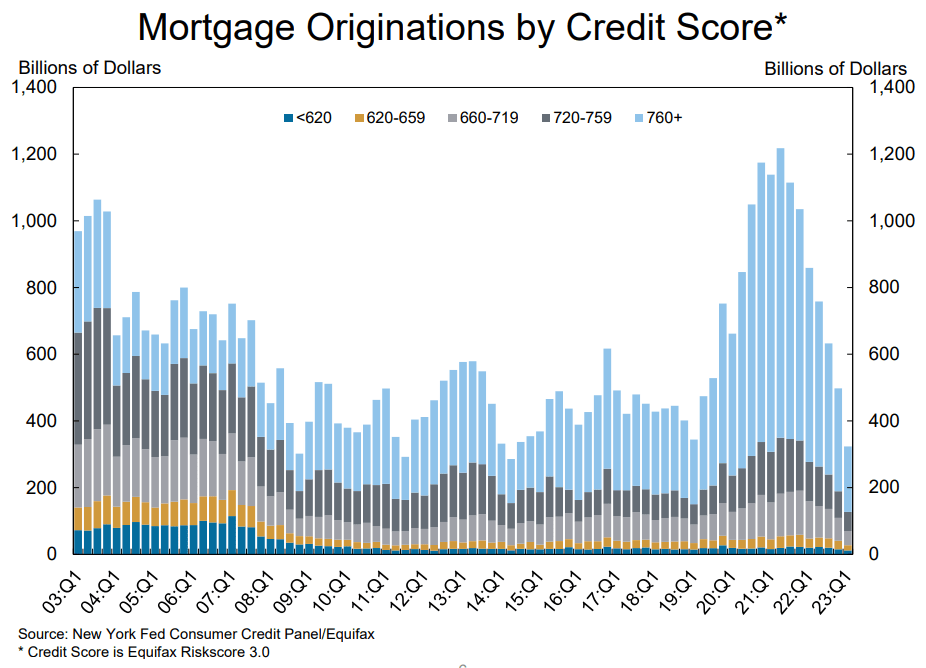
The latest report on household debt from the New York Federal Reserve (2023) reveals some interesting trends in mortgage debt. During the pandemic, the surge in mortgage originations was particularly strong among those with the best credit scores of 760 and above.

Those with the greatest house buying power are now “locked” into historically low interest mortgages below 4%. How low is 4%? The 50 year average of the 30-year fixed mortgage rate is 7.74%, according to Trading Economics. An entire generation was accustomed to very low rates after the financial crisis. Those low mortgages will create a resistance to sell that will likely dampen the housing market for a decade to come. A $400,000 mortgage at 4% costs $1900 per month. At a 6.5% rate that same monthly payment covers only a $300,000 mortgage. How many people will be willing to downsize into a more affordable mortgage?

In the past 15 years, Americans have reduced their debt load to a level less than their disposable income but how long can that continue? For the past 20 years, real disposable personal income per household has grown at only 1% annually, half of the rate of growth from 1982-2002. (Disposable income is what remains after taxes). In the graph below, that is the blue line. That same income series per job, not household, has grown at 1.25% annually (red line), down from 1.5% annual growth in the previous 20 year period. I’ve charted the two series on a log scale to demonstrate the different growth rates. The difference indicates that those with higher paying jobs have enjoyed higher growth of after tax income for the past two decades. The two series show the cumulative effect of favorable tax policies for those with higher incomes.   

Because the growth of household income is tepid, families are more likely to increase their debt burden. In a decade this could provoke a credit crisis similar to the great recession 15 years ago. Republicans are fiercely resistant to higher taxes on the top income earners and equally resistant to any reductions in military spending or agricultural supports. Democrats continue to promote social programs without the additional tax revenues to support that spending. A higher federal debt level will reduce the federal government’s capacity to support families when the next crisis arrives.   

//////////////////

Photo by Leio McLaren on Unsplash

Keywords: fiscal cliff, public debt, household debt, mortgage, disposable income

Federal Reserve Bank of New York. (2023, May). Quarterly report on household debt and credit. https://www.newyorkfed.org/medialibrary/interactives/householdcredit/data/pdf/HHDC_2023Q1

U.S. Bureau of Economic Analysis, Real Disposable Personal Income [DSPIC96], retrieved from FRED, Federal Reserve Bank of St. Louis; https://fred.stlouisfed.org/series/DSPIC96, June 2, 2023. Other series shown are Total Nonfarm Payroll (PAYEMS), the Census Bureau’s estimate of  households (TTLHHM156N)

The Crack in Our Windshield

May 28, 2023

by Stephen Stofka

This week’s letter is about debt, both public and household. Since 9-11, the public federal debt  has grown five times. The causes include costly wars in Iraq and Afghanistan, a global financial crisis followed by a slow recovery, tax cuts passed under the Trump administration and a once-in-a-century pandemic. Ten percent of the $32 trillion debt was added during the first three months of the pandemic. As the deadline approaches when the government will not be able to make timely payments to vendors and bondholders, we ask why do we have this thing called a debt limit?

Denmark is the only other country in the world to require an approval of a debt limit after the spending has been approved. Their legislators raised the limit so high that it might be a century before the issue comes up again. That leaves only the U.S. in the world where a debt limit debate is a threat. Neither party wants to repeal this century old law because it has the potential to be a powerful negotiating tool. It allows one party to negate or modify the funding priorities that the other party passed in the last legislative session. This is a game of chicken played for high stakes.

Some have criticized the Biden administration for not starting negotiations sooner. However, the House did not put anything on the negotiating table until they passed a bill on April 26th, just a month ago. Given the fractured Republican caucus, it was not clear that Speaker McCarthy could get a bill passed in the House. French Hill, R-Ark., told Roll Call “The whole purpose of this is to compel the president to negotiate — and to demonstrate to Washington, D.C., that Kevin McCarthy has the votes to raise the debt ceiling.” Four House members defected and the vote barely squeaked by at 217-215. Although George Santos, R-NY, is facing prosecution for fraud, money laundering and theft of public funds, McCarthy has allowed him to keep his seat at a time when every vote is crucial.

In 2011, the Republican House balked at raising the limit but the only legislation they could pass was an affirmation that they would not raise the limit without some unspecified spending cuts. Republicans were unable to agree on terms that they could pass in the House. Despite that, President Obama made the mistake of negotiating with Speaker John Boehner, and the two struck a so called Grand Bargain. Lacking anything in written legislation from the House, a bipartisan committee in the Senate came up with a different proposal and Obama tried to negotiate a compromise between the two versions with Boehner. Boehner could not get any changes past the most conservative members in his caucus. According to Politico reporter Tim Alberta (2017), the staff of Jim Jordan, R-OH, had been working secretly with outside groups to sway enough House members to vote against Boehner’s bargain. Jordan apologized but the incident exacerbated tensions between the warring factions within the Republican House. As Vice-President at the time, Biden would have learned a valuable lesson. Get something in writing before starting negotiations.

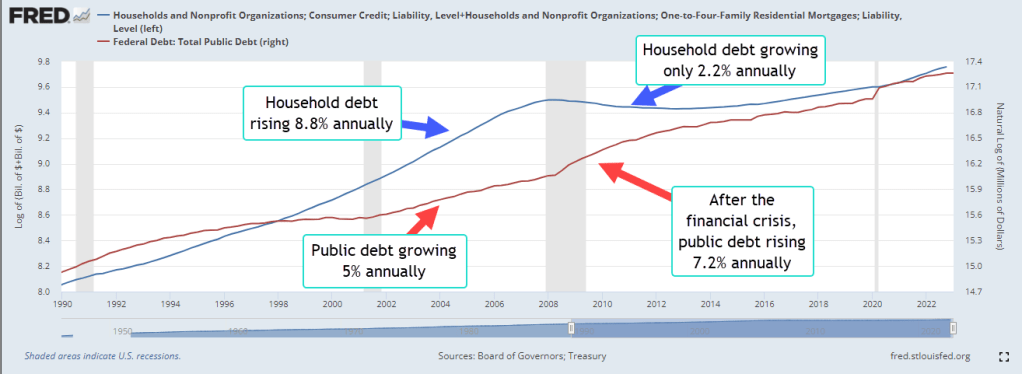
In contrast to the growth of the public debt, the growth in household debt has decreased since the financial crisis and the housing bust. The chart below compares the two types of debt, public and household, in two 13 year periods before and after the financial crisis.  

From 1994-2007, the public debt (GFDEBTN) grew 5% per year while household debt rose 8.7% annually. As a percent of disposable income, household debt jumped from 78% at the end of 1994 to 124% at the end of 2007. Chiefly responsible was the doubling of mortgage debt (HHMSDODNS) during the first seven years of the 2000s. Lax underwriting standards allowed families with poor credit scores of less than 620 to secure mortgages. Millions lost their homes during the housing bust, banks tightened lending standards and Americans were forced to go on a credit diet.

Since the financial crisis, American household balance sheets have improved. Household debt has grown by only 2.2% per year, about half the growth rate of personal income (DSPI). As a result, debt as a percent of disposable income had fallen to 91% at the end of 2022. The public finances have not fared as well. Although federal tax receipts, including FICA taxes, have increased 8% annually, expenditures and social benefit payments have outpaced tax receipts, resulting in a 7.2% annual increase in the public debt since the end of 2009.  

This week David Leonhardt (2023) with the New York Times presented a graph of voter policy preferences derived from recent polls. The fiscal liberals in both parties outweigh the fiscal conservatives, a trend sure to promote the growth of the public debt. In the 2011 debt limit duel, Republican leaders like Paul Ryan championed privatization of Social Security and cutting back on benefit programs. In the decade since, neither of those proposals are popular with the party’s base. Instead McCarthy will appeal to the social conservatives in the party and insist on work requirements for benefit programs. As Leonhardt notes, the fight for Democrat and Republican swing voters is taking place in the quadrant of voters who are socially conservative but fiscally liberal, nicknamed the “Scaffles.”

The government’s spending becomes household income in some form or another, an accounting identity that joins the growth in public and household debt. Our economy, laws and regulatory framework promote financial crises and exacerbate social problems. Policymakers, economists and social scientists can debate the causes, extent and severity of the problems but acknowledge the reality.  We may discover that our experiment in governance does not scale as our population grows and congregates in cities, as our technology advances and we become accustomed to greater energy use. The spread of mass communication and social media since World War 2 has exacerbated rather than resolved our ideological and cultural differences. The growth of our public debt indicates that we expect more from our government than our economy or political framework is able and willing to pay for. Like a crack in our windshield, it will continue to grow.

////////////////////

Photo by Ivan Vranić on Unsplash

Keywords: public debt, household debt, mortgage debt, debt limit

Alberta, Tim. 2017. “John Boehner Unchained.” POLITICO Magazine. https://www.politico.com/magazine/story/2017/10/29/john-boehner-trump-house-republican-party-retirement-profile-feature-215741/ (September 27, 2022).

Federal Reserve Bank of New York. (2023, May). Quarterly report on household debt and credit. https://www.newyorkfed.org/medialibrary/interactives/householdcredit/data/pdf/HHDC_2023Q1

The various FRED data series used in this post were HHMSDODNS Mortgage Debt, HCCSDODNS Consumer Credit Debt, GFDEBTN Public Debt, DSPI Disposable Personal Income.

Leonhardt, D. (2023, May 25). Ron DeSantis and the “scaffle” vote. The New York Times. https://www.nytimes.com/2023/05/25/briefing/ron-desantis.html

Assumptions

May 21, 2023

by Stephen Stofka

This week’s letter is about the role of assumptions in our lives. They play an important part in the claims we make to others so they are implicated in our self-esteem and personal relationships. They become integrated in our decision making process, affecting choices that have a lasting influence in our lives.

An assumption is an unspoken part of claims and assertions. The technical term in the study of rhetoric is an enthymeme. An example of an enthymeme is that people should be encouraged to vote because democracy depends on the full participation of citizens. The unspoken assumption or premise is that democratic government is good for citizens. A syllogism makes a claim based on two clearly stated premises. The enthymeme leaves out one of those premises and it is this mutual understanding of the unspoken premise that binds people together. However, if both parties do not accept this unspoken premise, the issue cannot be resolved. This lack of agreement in an unspoken premise is a key aspect of religious and political debates. Our decision making often consists of enthymemes containing vague assumptions. This rhetorical tactic explains how we can fool ourselves into thinking we are above average investors.

Researchers construct an assumption that becomes a hypothesis when they design an experiment to test that assumption. Most of us don’t follow such a formal process. Our assumptions are tested by our observations, by the natural experiments of unfolding events. All too often, we fool ourselves by paying particular attention to those events which confirm our assumptions. We form a growing conviction that our assumptions are confirmed by the reality we observe around us. We make predictions of the future by converting our assumption into a conviction and we are shocked when events upset that conviction.

An example is the recent bankruptcy of Silicon Valley Bank (SVB). Depositors assumed that Gregory Becker, the company’s CEO and member of the board of directors at the Federal Reserve’s San Francisco branch, would be a prudent manager of depositor funds. They were stunned when they learned that Becker and Daniel Beck, the company’s CFO, did not hedge the bank’s interest rate risk, a management practice finance majors learn in school. Both men resigned but benefitted handsomely from their employment at the bank. At a Senate hearing this week Becker rejected responsibility for the fiasco, blaming regulators and customers for the bank’s downfall. His financial survival depends on minimizing his role in the whole affair and defending himself against accusations of fraud.

Economists assume that people are rational, that they are capable of making choices that will maximize their welfare. They make a further simplifying assumption that each person is both principal and agent, making the decision and realizing the benefits and costs of that decision. In a principal-agent relationship, however, the agent and principal are separate. They have different motivations because the benefits and costs are not the same. As a society becomes more complex, the principal-agent problem grows geometrically. The voices we hear most are those of the agents – Becker, the Senators, the regulators – whose actions must satisfy their own welfare while they serve the principals – teh citizens and depositors.

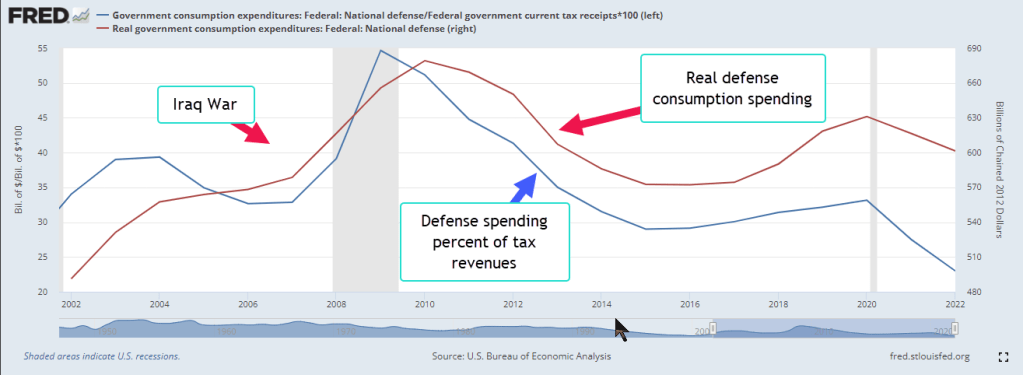
Objections to raising the U.S. debt limit go like this: the country is spending more than it receives in taxes. Like any household, we must cut our spending and live within our budget. The unspoken assumption is that the government’s budget is a scaled up version of a household’s budget. Politicians often court this fallacy of composition because they know that people yearn for simple explanations of complex issues. The U.S. currently spends over 20% of its income on defense, as the chart below shows. This would be equivalent of a family making $80,000 a year and spending $16,000 on a security system.

According to the Treasury Department (n.d.), 38% of tax collections are FICA taxes used to fund Social Security and Medicare. Imagine if a family sent 38% of their income to their parents or grandparents. These are just two examples that might lead us to reject the assumption that a family’s finances are like those of a government. In political debates like these, one side clings to the unspoken assumption because it is the linchpin of their argument.

Investors are cautioned not to put all their eggs in one basket. Diversification spreads the risk among asset classes. When we buy our first house, the down payment may take all of our savings, making us vulnerable to economic changes that impacts our income. We may make this gamble based on the assumption that in a worse-case scenario, we can sell the house for at least the same price we paid for it. During the financial crisis, homeowners were shocked to learn that their home values had declined. Many assumed that rising home prices were a natural law like steam that rises from a pot of boiling water. Ten million families that had gambled their savings on this assumption were wiped out during the crisis.

February’s reading of the 20-City Case-Shiller home price index showed no change in home prices in the past year. Home prices have fallen in some western cities where prices increased strongly in the past five years. From June 2022 to February 2023, Denver’s home prices have declined 6%. While the change in inflation has moderated, there is disagreement within the Fed’s interest setting committee whether to pause interest rate hikes. Continued rate increases could exacerbate price declines in some western states. Home owners may have to reevaluate their assumption that home prices only go up.

///////////////

Photo by israel palacio on Unsplash

Keywords: Defense spending, tax revenue, budget, household debt, debt

S&P Dow Jones Indices LLC, S&P/Case-Shiller 20-City Composite Home Price Index [SPCS20RSA], retrieved from FRED, Federal Reserve Bank of St. Louis; https://fred.stlouisfed.org/series/SPCS20RSA, May 18, 2023

U.S. Bureau of Economic Analysis, Federal government current tax receipts [W006RC1Q027SBEA], retrieved from FRED, Federal Reserve Bank of St. Louis; https://fred.stlouisfed.org/series/W006RC1Q027SBEA, May 18, 2023.

U.S. Bureau of Economic Analysis, Government consumption expenditures: Federal: National defense [A997RC1A027NBEA], retrieved from FRED, Federal Reserve Bank of St. Louis; https://fred.stlouisfed.org/series/A997RC1A027NBEA, May 18, 2023.

U.S. Bureau of Economic Analysis, Real government consumption expenditures: Federal: National defense [A997RX1A020NBEA], retrieved from FRED, Federal Reserve Bank of St. Louis; https://fred.stlouisfed.org/series/A997RX1A020NBEA, May 18, 2023.

U.S. Treasury. (n.d.). Fiscal Data explains federal revenue. Government Revenue | U.S. Treasury Fiscal Data. https://fiscaldata.treasury.gov/americas-finance-guide/government-revenue/#:~:text=So%20far%20in%20FY%202023,U.S.%20Department%20of%20the%20Interior.

Asylum and A.I.

May 14, 2023

by Stephen Stofka

Asylum and AI

This week’s letter is about immigration from a historical perspective. This past Thursday marked the end of Title 42, the Covid-era policy that allowed border officials to quickly deport many immigrants who crossed into the U.S. at places other than official checkpoints. This generation of Americans is unlikely to come to a final resolution of the immigration issue that has plagued our politics for 150 years. The debate over asylum is more than 80 years old, first sparked by an incident just before the outbreak of World War 2. Can recent advances in machine intelligence help us resolve the bottlenecks created by our own Congress?

Most of us are familiar with Ellis Island, the immigrant processing center in New York Harbor. According to The Statue of Liberty – Ellis Island Foundation (2022), officials at the center processed 12 million immigrants during its 62 year history. The center was mostly active for just thirty years during that time. Most of those immigrants came in the years 1892 – 1924, when Congress passed an immigration law that limited admittance to people from mostly northern European states with family members already in the U.S. Across the river from Ellis Island was an earlier era in U.S. immigration – Castle Gardens at Battery Park in lower Manhattan. From 1855 – 1890, that center processed eight million people, mostly from those same northern European countries.

Like the immigrants appearing at our southern border today, most of those early immigrants came here for better economic opportunities. In countries across northern Europe, promoters of land offered farmland for sale in Nebraska and other Midwest states, recounted by Richard White (2017) in his The Republic For Which It Stands, a thorough history of the Reconstruction and Gilded Age periods of the 19th century. The harvests of wheat in the Midwest states helped drive down prices for wheat in Europe. Lower prices made farming less profitable in those countries and helped drive immigrants to the U.S.

Pundits like cartoonist Thomas Nast ridiculed the ethics employed by the U.S. government. It had pushed the Indians off their homeland, then sold that land to railroads at gift prices. Once the track had been built, the railroads marketed their surplus land to their future customers, immigrant farmers who would rely on the railroads to get their crops to market. Despite the American myth of the Midwest farmer, most immigrants became wage workers. When gold was discovered on Indian territory in South Dakota’s Black Hills, many European immigrants rushed toward the promise of riches and ignored the property rights of the Indians.

In California, voters had rejected ratification of the 14th Amendment on a slippery slope premise. If Negro men were given suffrage, American Indians, immigrants from China and southern Europe would soon be granted the right to vote and the country would be overrun with the mongrel races. Advocates for immigration reform attracted voter support based on these longstanding prejudices.

Following World War 1, two incidents prepared fertile ground for a coalition of immigration reformers to help pass restrictive immigration legislation. According to the U.S. Citizenship and Immigration Services (2023), the Quota Acts of 1921 and 1924 mostly excluded immigrants who were not from northern European countries. The first was the “Spanish” flu which originated in Kansas, not Spain. News of the disease’s spread was first published in Spain because other countries, including the U.S., suppressed publication. The belief that the disease had originated in southern Europe justified the prejudice against southern Europeans as being unclean (White, 2017).

The second incident was the severe 18 month depression of 1920-21. According to the Social Security Administration (n.d.), unemployment in various industries ranged from 14% in transportation to 27% in construction and 38% in mining. Immigrants competed with wage workers particularly in lower skilled jobs. Restricting immigration reduced those economic pressures.

The U.S. did not have an asylum policy until after World War 2. The precipitating incident came in 1939, when a ship loaded with almost a thousand Jewish refugees left from Germany for Havana, Cuba. Many passengers planned to wait in Cuba while their U.S. visa applications were approved, according to the United States Holocaust Museum (n.d.). However, Cuba backed out of an agreement to receive them. Although the ship sailed close to the Florida shore, U.S. officials did not allow the passengers to disembark and they returned to Germany. Canada and some other countries accepted some refugees but a third were detained and died in the Nazi concentration camps.

The incident tarnished America’s image. After the end of the war with Japan in August 1945, President Truman issued a directive that admitted some displaced persons to the U.S. (USCIS, 2023). It took Congress two more years to formalize an asylum arrangement with the passage of the Displaced Persons Act in 1948. Reflecting long held prejudices among Americans, Congress kept its quota system in place. In 1965, the Congress passed amendments to the 1952 Immigration and Nationality Act that finally abolished the quota system for refugees.

Today, the queue for refugee applications is several years long and many migrants claiming asylum wait in the U.S. until their case is resolved by an immigration judge. According to the USCIS (2023), two Congressional amendments in 1990 and 2004 reduced the burden of proof that migrant applicants must show to substantiate their claims of being political refugees. Those within and without the system admit that it is broken but an evenly divided Congress has not been able to resolve differences.

The development of ChatGPT has sparked a great deal of public interest in the capabilities of interactive Artificial Intelligence (AI) machines. Authorities at the border and in the courts are overwhelmed with migrants claiming asylum status. Most claims will be denied but the applicants get to work and stay in the U.S. while they wait. Might it be possible to use AI machines to process these claims? Some may object to the idea of machines controlling the destiny of vulnerable migrants. If machine intelligence is not adequate to safely navigate a car down a highway, can we trust them to make complex decisions regarding human safety and respect? For successful applicants, a quick decision would give migrants certainty and enable them to access job opportunities and government services that might otherwise not be available under the current system.

The machines could discover as much information as is possible in other countries to assess a migrant’s claims of political or criminal persecution. The machines could sort through the volumes of legal precedent that bog down our human decision-making. They could cite the relevant information and precedent that supported or did not support a claim of asylum. Applicants who were denied by an AI machine could appeal their claim but outside the country. It is not a perfect system but one that might be acceptable to advocacy groups on both sides of the issue.

////////////////

Photo by Mr Xerty on Unsplash

Keywords: immigration, asylum, AI, ChatGPT

Social Security Administration. (n.d.). Estimates of Unemployment in the United States. Social Security History. https://www.ssa.gov/history/reports/ces/cesbookc3.html

The Statue of Liberty – Ellis Island Foundation. (2022, November 1). Ellis Island. Statue of Liberty & Ellis Island. https://www.statueofliberty.org/ellis-island/overview-history/

U.S. Citizenship and Immigration Services. (2023, February 7). Refugee timeline. USCIS. https://www.uscis.gov/about-us/our-history/history-office-and-library/featured-stories-from-the-uscis-history-office-and-library/refugee-timeline

United States Holocaust Memorial Museum. (n.d.). Voyage of the St. Louis. United States holocaust memorial museum. https://encyclopedia.ushmm.org/content/en/article/voyage-of-the-st-louis

White, R. (2017). The Republic for which it stands: The United States during reconstruction and the gilded age, 1865-1896. Oxford University Press.

The Formation of Expectations

May 7, 2023

by Stephen Stofka

This week’s letter is about expectations – how we form them and why they are essential to our survival. This is a broad topic that encompasses several disciplines, from psychology to neuroscience and economics. Each field of study informs those in associated fields so the debate in economics is enriched by discoveries and theories in these other fields. I can only touch on a few aspects as I introduce yet another complication that might resolve some of the contradictions between theory and data.

We gain the ability to form expectations at an early age. Infants less than one year old learn what is called object persistence. If a toy falls out of their crib, they look over the edge to the floor below to see where the toy went. But object persistence is a primitive form of expectation. True expectation is a weighting of possibilities based on some criteria.

Instinctual responses often involve a primary measure of threat or satisfaction. We see this if we walk by a squirrel near a tree. If we are across the street, the squirrel may pause, poised to flee. If we draw nearer, the squirrel runs to the safety of the trunk as we approach. How far up the tree the squirrel goes depends on the distance we are from the squirrel. It would like to keep us in sight but if we get uncomfortably close, the squirrel must choose. It can hide on the side of the trunk opposite to our approach but it loses sight of us. It can go further up the tree, keeping us in sight and staying out of reach. That is a short term expectation formed in response to an immediate threat or stimulus. It is an instinctual rather than a rational expectation, the kind that economists consider.

Rational expectations are formed about the environments that produce events, or data samples, more so than the events themselves. For more than sixty years economists have been debating whether consumers have enough data and patience to construct a rational expectation. Richard Curtin (2022) reviewed the history of this debate as he argued for a theory that embraces both reason and passion as inseparable components of human decision making. In 1959, Herbert Simon protested that inadequate data does not invalidate the idea that consumers are trying to make decisions that improve their satisfaction – that’s the rational part – within the bounds of the data available to them. Simon called this bounded rationality. A few decades later Daniel Kahneman and Amos Tversky explored the biases in our decision making and their work became the foundation of behavioral economics.

Survey data reveals that consumers’ expectations of inflation overestimate actual inflation, according to Henry et al. (2023), economists at the Richmond branch of the Federal Reserve. The basis for that assertion is the University of Michigan (2023) survey of inflation expectations. The inaccuracy is fairly consistent and persistent, meaning that consumers are slow to correct their expectations as new data is released. Richard Curtin (2022) notes that as many as 40% of consumers are not aware of recent government data releases on the inflation rate, the unemployment rate and the growth rate of GDP.

Consumers cannot survive if they consistently and persistently form inaccurate expectations. There is an alternative explanation: economists and consumers are measuring two different things. Economists form their inflation expectations by measuring changes in the prices of goods and services. Consumers form their expectations in part by estimating their loss of purchasing power, their ability to satisfy their wants and needs. If consumers feel that their income gains are not keeping up with the change in prices, they may raise their estimate of future inflation.   

The prices of frequently purchased items like food and energy guide our expectations of changes to our purchasing power. Our purchases of food and energy don’t respond quickly to changes in our income. In economist speak, these items are price inelastic. We still need to drive to work and eat. Secondly, we buy food and gas frequently so our expectations of future prices depends on an averaging of the most recent prices and the last purchase we made. It is unlikely that we will form an expectation of next year’s gas prices based on a ten year average of gas prices. Thirdly, energy prices are quite volatile. I might buy gas as frequently as I go to the movies if I like movies but the price of a movie ticket does not vary as much as the price of gas. To summarize, our expectations of inflation are guided by frequency, recency and volatility.

Energy prices are particularly volatile. In this 2004 article the Federal Reserve graphed the annual changes in energy prices (red) and the broad CPI price index (blue). The difference is startling.

The wild swings in energy prices are noise. Because of that volatility, the Bureau of Labor Statistics excludes food and energy items when it computes an index of core inflation.  Core inflation is the inflation signal that economists use to predict next year’s prices.  

Consumer expectations of inflation include estimates of changes to their personal utility. As Richard Curtin (2022) has noted, it is not practical or possible to measure inflation at such a personalized level so economists average consumer expectations across the entire country. They collect price data at a broad metro area, or MSA. These urban areas can vary a lot from national inflation averages. In the chart below is a comparison of inflation in the Denver metro area and the nation as a whole. Rarely do the two series move together. When economists compile such a variety of consumer expectations into one national average, that average is less likely to accurately reflect individual or sub-regional expectations.

So economists are measuring changes in prices and consumers are estimating the change in their purchasing power. In his General Theory Keynes referred to the marginal efficiency of capital and the animal spirits of investor expectations of that efficiency that could be measured by the direction of market prices. Using that as a template, consumers’ purchasing power would be the marginal efficiency of income. We can gauge the animal spirits of consumers by the direction of total consumer purchases, which are continuing to outpace inflation. That is the best indicator of purchasing power expectations.   

/////////////////////

Photo by Rodion Kutsaiev on Unsplash

Curtin, R. T. (2022, September 5). A new theory of expectations – Journal of Business Cycle Research. SpringerLink. Retrieved May 5, 2023, from https://link.springer.com/article/10.1007/s41549-022-00074-w

Henry, E., Mulloy, C., & Sarte, P.-D. G. (2023, January). What survey measures of inflation Expectations Tell us. Federal Reserve Bank of Richmond. Retrieved May 5, 2023, from https://www.richmondfed.org/publications/research/economic_brief/2023/eb_23-03#:~:text=Conclusion,inflation%20every%20month%20since%202012  

University of Michigan, University of Michigan: Inflation Expectation [MICH], retrieved from FRED, Federal Reserve Bank of St. Louis; https://fred.stlouisfed.org/series/MICH, May 4, 2023.

Socioeconomic Engineering

April 30, 2023

by Stephen Stofka

Last week’s letter was about marginal loss and marginal value. This week I’ll continue exploring another topic in marginal thinking – the marginal disutility of labor. I will touch on the influence of John Stuart Mill, Karl Marx and Thorstein Veblen and revisit John Bates Clark from last week. I will finish up with Keynes, a seminal figure who voiced disapproval of some earlier economic ideas but incorporated portions of that thought into his General Theory.

What is the marginal disutility of labor? Disutility is a synonym for harm. There are two choices in each period of time: work and leisure. Leisure should be understood as non-work, not an activity like resting in a lounge chair on the beach. If the next period of work causes harm we will choose leisure, a rest from work. This idea became popular in the late 19th century as neoclassical economists adopted utilitarian ideas contained in John Stuart Mill’s Principles of Political Economics. Mill claimed that values were subjective, based on scarcity and the costs of production (Heilbroner, 1997). Mill rejected the claim by classical economists like Ricardo and Smith that there was some natural law of distribution of the gains from production. Mill wrote that distribution of gains was based on customs and morals peculiar to each society.

That was a bit too arbitrary and subjective for some neoclassical economists like Jevons and Menger. The neoclassical economists wanted to divorce politics from economics, to cut out the “Political” in the title of Mills book. They developed the concept of a marginal productivity of labor idea to accompany the marginal disutility of labor. Under this schema, every worker was paid their marginal product, their contribution to production. Neoclassical economists became preoccupied with equilibrium in a static world.

I wrote about John Bates Clark last week and I will mention him again. A neoclassical economist himself, his book The Distribution of Wealth reminded readers that most neoclassical ideas only made sense in a fictional world where labor and capital were free to go wherever they would earn the most return. It is a world without friction or gravity like Newton’s mechanical world of motion. The simplification helped Newton identify the interplay of forces on an object in motion.

Clark went down the rabbit hole himself and he defined and reconciled two sets of laws, the static and dynamic. In his theory, there were static laws of equilibrium between scarcity and wants. This was a system seeking rest like the swing of a pendulum as it gradually comes to rest at the lowest point of an arc. He identified five forces that disrupted the static laws. These were population, capital, technological improvements, the types of businesses and the wants of consumers. Each of these were increasing, a dynamism that interfered with any resolution.

At this point in the story, I will return to The Worldly Philosophers by Robert Heilbroner (1997).  One of Clark’s pupils was Thorstein Veblen, a Norwegian who would become one of the leading voices of what is called American Institutionalism. That school of economists proposed a class of socio-economic engineers who would optimize the institutions that dictated the distribution of property to make production more efficient. Marx had also insisted that production and distribution could not be separated. Veblen’s ideas were a rational system implemented by a trained intellectual elite. Marx envisioned a reactionary movement like the upheavals that swept Europe in the 1840s. Despite the stark differences between Veblen and Marx, the neoclassicals depicted Veblen as another Marxist philosopher and marginalized that school of thought.

John Maynard Keynes rejected the notion of the marginal disutility of labor because it failed to explain how millions of workers were idle regardless of their asking wage. Employers were not hiring because the expectation of sales was so low. Sales remained low because workers were not employed, a problem that Henry Ford had solved two decades earlier. Ford needed more people to buy his cars but even his own workers could not afford the cars. So he paid them more money. That solution was more difficult to deploy throughout an entire economy, however. Only a government had enough fiscal power to put a large number of people back to work, to increase what Keynes called effective demand.

In his General Theory Keynes introduced the same idea of the economist engineer but did not mention Veblen. Heilbroner thought it was because the neoclassicals had successfully stereotyped Veblen as a Marxist, a socialist without respect for private property. Keynes was essentially a conservative in the camp of Edmund Burke, someone who wanted to preserve the capitalist system based on private property. Despite the difference in intentions, Keynes introduced top down economic engineering at a time when people were desperate for solutions that would preserve existing institutions.

Our society today is based on these ideas and the institutional norms those ideas spawned. As the debate over raising the debt nears a critical standoff sometime this June, we will be able to see the clash of ideas tangled with the posturing and struggle for political dominance.     

/////////////////

Photo by Mykola Makhlai on Unsplash

Heilbroner, R. L. (1997). Teachings from the worldly philosophy. New York, NY: Norton & Company.

///////////////

Marginal Losses

April 23, 2023

by Stephen Stofka

Today’s letter is about marginal loss and marginal value. We are going to take a rollercoaster ride from Einstein to relationships to the Bible to the marginalist revolution in late 19th century economics. Buckle in.

Einstein’s formula equating mass and energy confused me for a time. With all the mass in the universe, it seemed that it would blow itself up. At some point I read that the m in E = mc2 represented the mass lost and a light bulb turned on in my young head. A grain of sugar lost from a sugar cube weighed almost nothing but when multiplied by c2well, no wonder the atom bomb was so powerful.

We understand the value of a partner when we lose them. The worst part of breaking up with someone is thinking that they experience the loss far less than we do. We think back and wonder if we valued them more than they valued us throughout the relationship. The pain of loss becomes the yardstick that we measure the parts of the relationship. After the death of a dog, we remember them licking us awake in the morning with far more fondness than we actually felt when we just wanted a few more minutes of sleep rather than a walk in the cold morning air.

In the Parable of the Workers in the Vineyard, the workers hired early in the day get the same daily pay as those hired later in the day. Those who worked least, i.e. the last workers hired in the day, became the standard by which all the workers’ pay was evaluated. That became their standard of value. By this measure, the landowner had cheated the workers hired earlier in the day. In the landowners valuation, the workers were indistinguishable. To each worker, they distinguished themselves by the amount of time spent working and discomfort endured.

In a market stall in a developing country, the produce sold by each vendor may be largely indistinguishable. The value of what each vendor sells is mostly determined by what would happen if they weren’t there, not by the amount of effort they put into growing and harvesting what they offer for sale. Is that fair?

John Bates Clark was a leading economist of the late 19th and early 20th century who asked that very question. In Chapter 7 of The Distribution of Wealth he noted that the price of all the wheat grown by farmers in the northwest United States was determined by the price of whatever surplus wheat there might be when all the wheat reached the marketplace. This price was fixed on a London exchange thousands of miles away. Why should the marginal surplus determine the price of an entire crop?

A pound of ground beef might sell for $5. Add 10 cents worth of spices, 20 cents of packaging, 50 cents of labor and that same product now sells for $8 as Italian meatballs. Why do the marginal ingredients determine the price of the entire pound of ground beef?

In Chapter 8, Clark noted that a worker’s value to an employer is not their marginal product – not directly. It’s the loss to the employer if a worker left, or the marginal loss. Clark called it a zone of indifference. Within that zone are the expendable workers. Should those expendable workers become the standard of value just as in the parable of the vineyard? These are uncomfortable conversations. Workers have families. They contribute more to the community than their marginal worth to an employer. They take their kids to soccer games and coach Little League games. They volunteer at food banks, animal shelters and museums. How should society pay for that worth?

Clark published his book The Distribution of Wealth in 1899 when employers provided few benefits or protections for workers and factories were crowded with child workers. There was no income tax. In the U.S. today, employers are required to pay some part of society’s share of a worker’s worth to the community. The employer then includes those societal costs in the price of their product and the burden is shared among the employer’s customers (note below).

This is an indirect or hidden tax, a more politically feasible type of taxation. We judge our taxes at the margin – the amount that we have to give to the government on the last dollar we earn. The press cites marginal tax rates, the rate on the last dollar, and not the effective tax rate, the total amount of tax divided by our total income. We might be in the “25% tax bracket” when our effective rate is only 11%. We are guided by marginal loss thinking.

Repeated experiments have demonstrated that we assign a greater value to marginal losses than we do marginal gains. Consider this, a variation of Einstein’s thought experiment with moving trains. Consider two observers – John is on a moving train and Mary is an omniscient observer on a train platform. In this case, the moving train is time. John has a $100, which becomes his standard of value. Then some event happens before the next stop and John has $105, which becomes his new standard of value. Like the rest of us, John forms expectations of the future based on his current motion. He expects a gain of about $5 before the subsequent stop. But something happens and John loses $5. From Mary’s point of view, John has the same amount of money he started with. But John feels like he has lost $10, the initial gain and the expected gain that he did not receive.

No one has to teach us marginal loss thinking. It seems to be instinctual because we live at the margin, breathing in and out every minute of our lives. The very act of breathing creates a loss of pressure in our lungs. Sometimes marginal thinking is appropriate and sometimes thinking at the average is more appropriate. As investors, not traders, we must think at the average, not the margin, to survive.

/////////////////

Photo by Roman Fox on Unsplash

*These societal costs are not the Marginal Social Costs (MSC) referred to in Environmental Economics texts. Those are costs that an employer imposes on society.