Inflation and Profit Flow

September 18, 2022

by Stephen Stofka

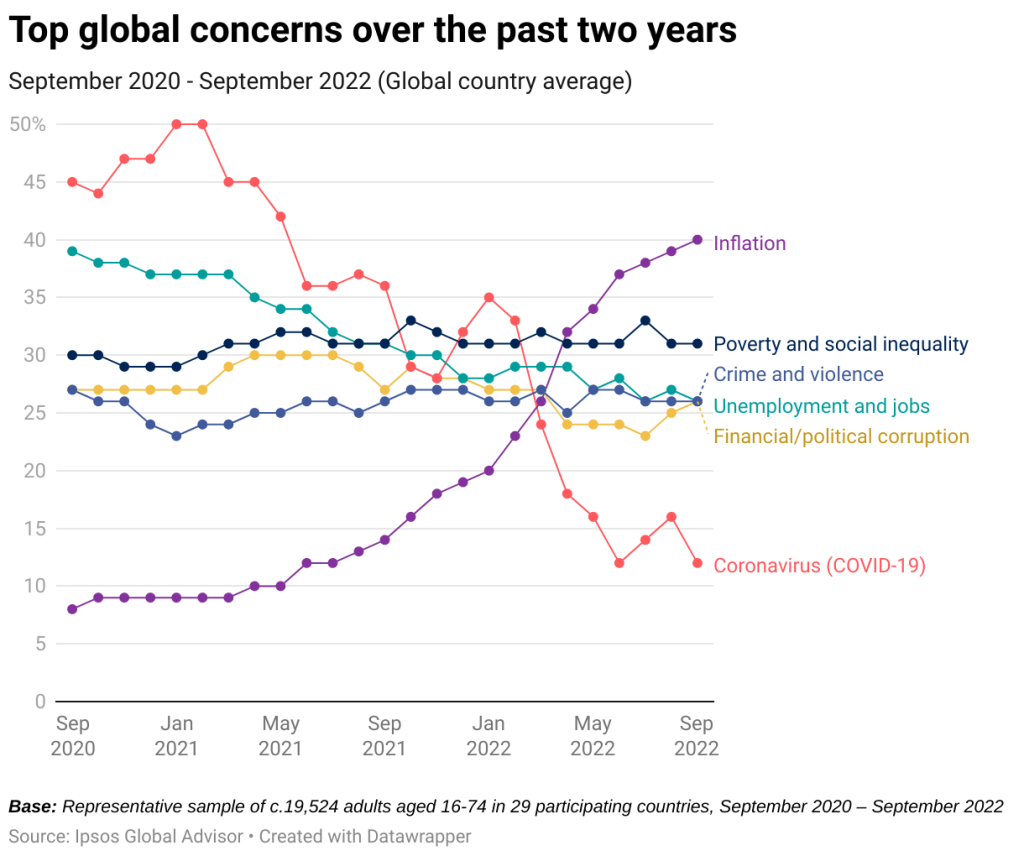
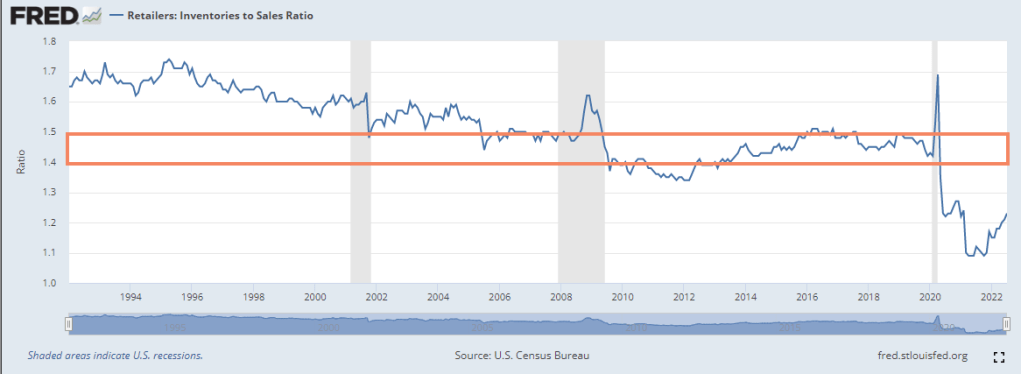
Price records circumstances, not value or utility. Our buying power is like a bar of soap. As water shrinks soap, high inflation shrinks our buying power. Economists offer several explanations for the persistent inflation but the one that I buy is that constrained supply and fairly steady demand are driving prices higher. Rising prices are a symptom of a shortage of goods – a quantity issue. Retailers inventory to sales ratio has increased slightly from the historic low in May 2021 but the ratio is still far below the range of 1.4 – 1.5 that was the benchmark before the pandemic.

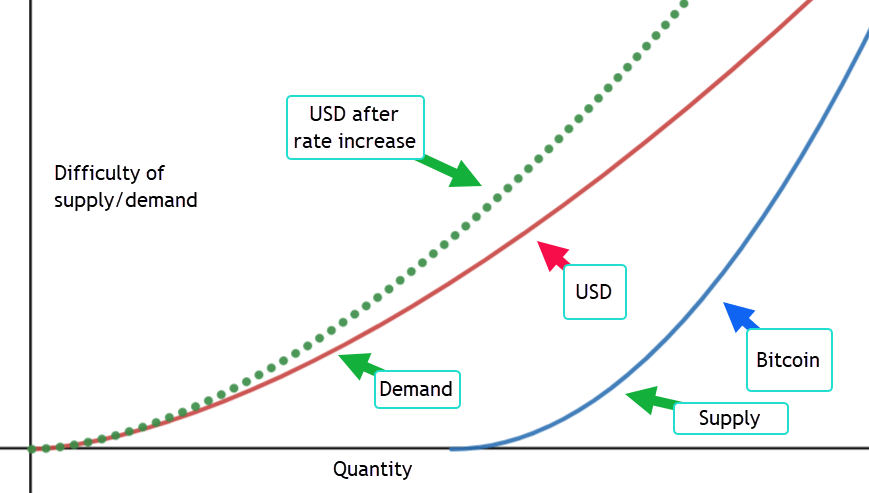
This past Thursday, I picked up three jars of my favorite crunchy peanut butter. Some stores have been out of stock on the crunchy variety so I bought extra to be sure. I was not concerned about rising prices. I was responding to a quantity shortage, or the fear of a shortage. The difference is important. In Econ 101, students are shown the standard supply and demand diagram.

Left out of this stylized relationship is that supply is on a slower time scale than demand. It takes time, planning, investment and risk to produce all that supply. To cope with that reality, businesses must keep an inventory on hand to meet changes in demand which happen on a shorter time scale. Shift the red supply line to the left and the intersection of supply and demand occurs at a higher price. The Fed and the market thought that the supply constraints would fully resolve by this year but they have not. As stores and restaurants reopened, customers put away the electric panini sandwich makers, bread machines and gym equipment they had bought during the pandemic. They began purchasing consumables and were willing to pay higher prices for clothes, airline and movie tickets, and restaurant meals. In the face of ongoing supply constraints, the Fed has had to keep raising interest rates to try to curb demand, shifting the blue demand line to the left as well.

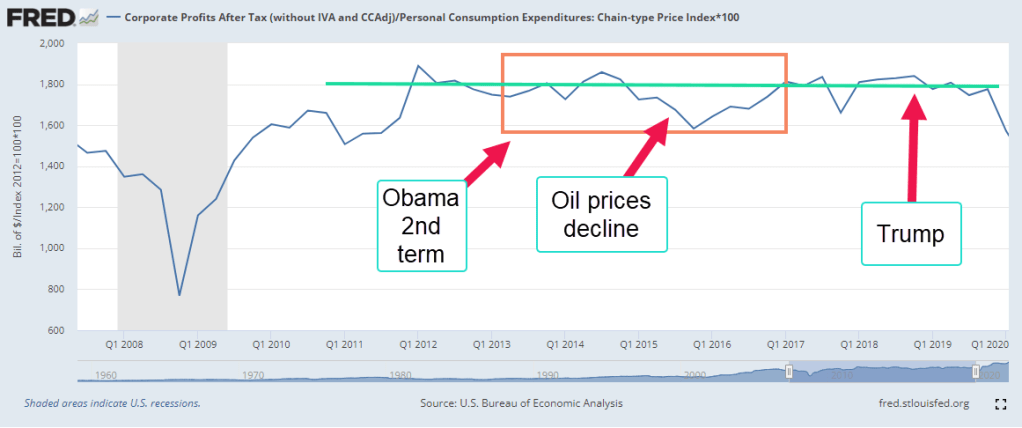
The higher prices helped businesses recover profits lost during the pandemic. Businesses have taken advantage of the supply disruptions to juice their profits by 33% (BEA, 2022).

When the Republicans took control of both chambers of Congress and the Presidency, they lowered corporate taxes. Those on the left often blame the economic elite for society’s problems and wasted no opportunity in criticizing Republicans for gifting the corporate elite. Mr. Trump boasted on his business prowess, promising to get the economy revving up again. Despite his rhetoric, corporate profits remained at the same level as during Mr. Obama’s second term.

A Presidential veto can block legislation but it is Congress that passes the laws that affect the economy. As I wrote last week Congress sometimes buys voter approval, creating bubbles that finally implode. The State Historical Society of Iowa (2019) has an image of a 1928 campaign ad for Herbert Hoover. It is a resume of economic progress under total Republican control during the 1920s. The Congress had won the public’s approval with easy credit and lax regulation. The following year the onset of the Great Depression brought down the house of cards. 25% of workers lost their jobs. Many lost their homes and farms.

Corporations exist to turn money flows into profits. Whatever money Congress spends winds up in corporate coffers. After 9-11, the federal public debt rose by $3 trillion (U.S. Treasury Dept, 2019) while corporate profits more than doubled, all thanks to Congress. Democrats and Republicans supported higher military spending and a building boom supported by easy credit policies.

In response to the pandemic, a bipartisan effort in Congress passed relief packages of more than $3 trillion. Today the public debt is $7 trillion above the pre-pandemic level. Much of that money became corporate profit because that’s what good companies do – turn cash flows into profits. Some of those profits were then used to buy the Treasury bills generated when the government increased their debt. This completed the cycle of debt and profits.

On average voters re-elect 90% of House members and 80% of Senate members. Midterm elections are less than two months away. Both parties take advantage of the public’s tendency to pin responsibility – good or bad – on the President, both the current and the past President, Mr. Trump. “Inflation is Biden’s fault,” Republicans will say and hope it sticks with some voters. Democrats hope that Trump will announce a 2024 run for President before the coming midterm election. They hope that independent voters, particularly suburban women, will vote for Democrats to voice their disaffection with Mr. Trump.

The election spending will juice the profits of media companies who depend on the craziness of our democratic politics. People in western European countries look in dismay at our frenzied politics that makes us vulnerable to a populist like Trump. Some Americans long for authoritarian measures that might curb the craziness of our politics and promote more cooperation. They are tired of the demolition derby of American democracy and wish they could go to sleep for a few months until it is over.

////////////////////

Photo by Anvesh Uppunuthula on Unsplash

State Historical Society of Iowa. (2019, January 14). “A chicken for every pot” political ad, October 30, 1928. IDCA. Retrieved September 16, 2022, from https://iowaculture.gov/history/education/educator-resources/primary-source-sets/great-depression-and-herbert-hoover/chicken If you have a moment, do check this out!

BEA: U.S. Bureau of Economic Analysis, Corporate Profits After Tax (without IVA and CCAdj) [CP], retrieved from FRED, Federal Reserve Bank of St. Louis; https://fred.stlouisfed.org/series/CP, September 16, 2022.

U.S. Department of the Treasury. Fiscal Service, Federal Debt: Total Public Debt [GFDEBTN], retrieved from FRED, Federal Reserve Bank of St. Louis; https://fred.stlouisfed.org/series/GFDEBTN, September 16, 2022.

America 4.0

September 11, 2022

by Stephen Stofka

I hope that those in the UK can find some common ground in their grief over the Queen’s death this week. Britain was still recovering from World War 2 when the crown was laid on her young head in 1952. Seventy years later, the political culture has fractured over Brexit and the repercussions of leaving the EU. There is much needed investment in a nation that has barely managed 2% growth in the past decade. In three years, three Prime Ministers have led the Parliament. The long reach of the Queen’s lifetime can help us lift our heads and take a longer view of events. When we mark history in lifetimes, not years, the beginning of our nation was about three lifetimes ago.

For most of mankind’s history, production harnessed human or animal energy, the thermal energy stored in wood and coal, and the kinetic energy of falling water turning a mill. In a world with only gradual change, there was little need for rapid communications technology. The men – yes, all men of property and standing – who crafted and voted on the U.S. Constitution lived in a world limited by crude animal and chemical power for energy, transportation and communication. John Adams, one of the Constitution’s signers, spent weeks traveling from his wife, family and farm in Braintree, Massachusetts to Philadelphia, Pennsylvania. Today, a person on a bicycle can make the journey in three 10-hour days.

The discovery and refinement of oil as an energy source changed our society and our politics. The 13th, 14th and 15th amendments of the Reconstruction Era were ratified at the dawn of a new age of energy and communications. The telegraph had only just come into use just prior to the Civil War. Edwin Drake drilled the first oil well in Pennsylvania in 1859, two years before the start of the Civil War. Those who passed the initial ten amendments and made the amendment process so difficult lived in an era where transformations of society occurred over decades or centuries. The amendments meant to protect people from the yoke of a regal government now shackle us to a historical reality that no longer exists.

America was built on a lack of consensus between regions, between a newly emerging urban population in the north and a rural population harnessed to the land in the south. In 1776, the colonies had first cohered as a mutual defense pact against the  British and the encroachment of the Spanish and French on colonial territory. The seven year war of Independence liberated the colonies from British rule in 1783 but left the colonies with a large debt. Their mutual defense pact gave a lot of autonomy to each of the thirteen states but the central government had little power or authority to tax the individual states. By 1787, that confederacy was on the brink of failure, unable to pay its debts and largely isolated from international capital markets. Under those dire circumstances, the colonies ed anew, drafting an entirely different pact that initiated America 2.0.

The American Constitution embodied the divisions of regional interests and the differing ideological principles of its founders. The proceedings were so combative that the deliberations were sealed from the press for fear that exposing the rancor between delegates would doom the  process. Three lifetimes later, we exhibit the same level of discord as our founders. Our Senate has become an insipid institution, crippled by parliamentary rules that make any Senator the ruler of his own nation, the King of Negation that stops most legislation from reaching a vote in the chamber. For 25 years, the House has passed Continuing Resolutions (CR) because they cannot pass a budget on time (Wezerek, 2018). Some years the budget is never passed and the government operates under a year-long CR.

On this 21st anniversary of 9-11, we still live in its shadow. The precautions at the airport, the fastidious matching of our names, letter for letter, hyphen for hyphen in our identification. Our nation grieved together, our Congress stood together and passed the Patriot Act. That was the end of togetherness. A common grieving does not knit a nation for long. Our media speaks a common language but the discourse – the assumptions and values that form the bedrock of our perceptions – are so different. Why? Because our Constitution has died.

Distrustful of each other, the Constitutional delegates forged a pact that was difficult to amend. They bound it so tightly that it could not expand and breathe. It is like a dead Pharoah mummified in tightly wrapped cloth and buried deep within a pyramid of time. Each year, the justices of the Supreme Court venture into the tomb to ask questions of the dead Pharoah. When they emerge into the sunlight, the people gather round to hear what the dead Pharoah has revealed. The justices speak in tongues – discourses that are intelligible to some people and babble to others. The Civil War was America 3.0. Let us grieve that our Constitution has died and adopt a new pact to celebrate America 4.0.

/////////////////////

Photo by Jeremy Bezanger on Unsplash

Wezerek, G. (2018, February 7). 20 years of Congress’s budget procrastination, in one chart. FiveThirtyEight. Retrieved September 9, 2022, from https://fivethirtyeight.com/features/20-years-of-congresss-budget-procrastination-in-one-chart/

Labor Trends

September 4, 2022

by Stephen Stofka

On this Labor Day Weekend I’ll review some current employment numbers and look at a historic trend whose results surprised me. The August employment report released this past Friday buoyed the stock market. Job gains remained strong but moderated from the half million jobs gained in July. The slowing gains indicated a predicted response to rising interest rates. Had the number of job gains risen to 600,000 for example, the market might have sold off. Why? Currently the market is predicting a rise in rates to a range of 3.5 – 4.0% in the next year. A labor market resistant to rising rates would have implied that the Fed would have to set rates even higher to cool inflation. Secondly, the unemployment rate rose .2% to 3.7%, another indication that rising rates are having a modest effect on employment. Modest is the key word.

The participation rate – the percentage of working age people who are working or looking for work – rose slightly to 62.4%, still 1% below pre-pandemic levels. Reopening classrooms and the further relaxing of pandemic restrictions are contributing factors. Additional family members may be joining the workforce to cope with rising household expenses. The number of marginally attached workers – those who want a job but haven’t actively looked for a job in the past month – declined to 5.5 million, still a half million above pre-pandemic levels. These “discouraged” workers remain below 1% of the labor force, a level indicating a strong labor market. President Obama inherited an economy in crisis and the percent of discouraged workers declined to nearly 1% but not below. As the rate fell below 1% in the first months of the Trump presidency, Mr. Trump cheerfully took credit. A politician and his followers blow their horns to encourage others others to join their coalition.

Surprises

A 17,000 employment gain in financial jobs surprised me. Rising interest rates have lowered mortgage applications and I thought the employment numbers for the financial industry would decline. Lastly, weekly earnings are up over 5.6% but have not kept up with inflation. Unemployment numbers are low, job openings are high. Why don’t workers have more pricing power?

A Historic View

Earlier this week I was looking at labor slumps since World War 2. These slumps are periods at least six months long. They start when the number of workers first declines. They end when employment finally surpasses its previous high. Employment first declines about two months after the start of a recession, as the NBER later determines it*, so it is a lagging indicator.

I split the period 1950-2022 into two 36 year periods. The first period lasted from 1950-1986; the second period from 1986-2022. In the first period there were 7 recessions and employment slumps. In the second period there were 4 recessions and slumps. Even though there were more recessions in the first period, the number of months of sagging employment was far less than the second period, 131 vs 168. No doubt that was due to the 75 month long slump of the Great Recession. That’s an extra three years of a lackluster job market which affected demand for workers and the pay they could command. In the chart below I have sketched the labor slumps. Economic recessions have a lasting impact on the labor market.

In the first period, the longest slump lasted 26 months during the early 1980s recession when the unemployment rate rose above 10% and inflation was in the teens. That began in September 1981 and lasted until November 1983. In the second period, the job market sagged during the Great Recession for 75 months, from February 2008 until May 2014. The least severe slump was this last one, beginning in April 2020 and ending in April 2022. The recession in 2001 lasted only 6 months but the labor slump lasted 40 months, from June 2001 until October 2004, just before the 2004 election.

Wages

More prolonged slumps affect wages. In the chart below the BLS compares nominal and inflation-adjusted median weekly earnings over the past twenty years. The real earnings of workers have barely risen because they are not sharing in the productivity gains of the past decades. The earnings gap between men and women has varied little during that time.

Contributing Factors

Why are labor slumps lasting longer during this later period? There are many contributing factors. When there was a larger manufacturing base recessions were more frequent but workers were brought back to work more quickly. The two recessions of the 2000s made that decade the hardest on workers. The two labor slumps totaled more than five years during the decade.

The 1970s gets a bad rap but it was the 1950s which had the second largest number of months when employment sagged – a total of 3.5 years. Standing five decades apart, the 2000s and 1950s had very different economic and family structures. Fewer women worked in that post war decade. The waiting period for unemployment insurance was twice as long and benefits lasted less than four months. These were inducements for workers to find any kind of work to support their families. Union membership was much higher in the 1950s so workers could rely on those benefits while unemployed. They would not have wanted to lose their union membership so they might have worked off the books for cash while they waited for hiring to pick up at the same company or the same industry. Like so many economic trends, the interaction between factors is complex and not readily identifiable.

Conclusion

Reckless speculation was the main contributor to the two recessions in the 2000s. Financial shenanigans played a smaller role in the slump of the early 1990s. The increased length of these slumps in the last four decades supports an argument that our economy has lost too much of its manufacturing base and is out of balance. There is too much financial speculation and not enough actual production. The federal deficit has increased so much in the past two decades because the private economy cannot generate enough growth on its own.

//////////////

Photo by Patrick Schneider on Unsplash

*The NBER marks only the decline portion of a general economic slump so the gray shaded areas will be shorter than the labor slump. However, the chart illustrates the prolonged effect that an economic decline has on the labor market.

BLS. (2022). Median usual weekly earnings of full-time wage and salary workers by sex. U.S. Bureau of Labor Statistics. Retrieved September 2, 2022, from https://www.bls.gov/charts/usual-weekly-earnings/usual-weekly-earnings-over-time-total-men-women.htm

Price, D. N. (1985, October). Unemployment insurance, then and now, 1935–85. Social Security Administration. Retrieved September 3, 2022, from https://www.ssa.gov/policy/docs/ssb/v48n10/v48n10p22.pdf

The Water That Connects Us

August 28, 2022

by Stephen Stofka

Several events this week share a common theme. President Biden announced a partial student loan forgiveness program.  Fed chair Jerome Powell announced the central bank’s firm commitment to tame inflation. The justice department is pursuing tens of thousands of fraudulent claims related to the pandemic federal relief programs. California Governor Gavin Newsome announced that the state will completely phase out gas fueled cars by 2035. What do these four events have in common? Government officials taking action to shield or relieve individuals from some oppressive force – a debt burden, rising prices, a pandemic, and a contributing cause to climate change. Government is a raft, an anchor of safety that we must share if we are to keep our heads above the water that connects us.

The physical world does not care whether human beings acknowledge or deny climate change. In 2013 the IPCC released their fifth assessment of the global climate. They were careful to note that they could not project individual small weather events like thunderstorms but that there would be more extreme weather events. Tree ring data indicates that this two decade drought in the west last occurred 1200 years ago. Agriculture uses 80% of the total amount of water humans use and have been severely impacted by water rationing. The federal government and states have spent billions fighting fires throughout the west. In recent days several southern states have experienced “1000 year” floods. They have declared emergencies to trigger federal assistance for cleanup and rebuilding.

The sun pours a flow of energy on the earth. Greenhouse gases like carbon dixoide retard the escape of the heat from that energy. California’s initiative is a key declaration of an aspirational agenda to lessen the release of greenhouse gases.  Building an infrastructure for thousands of electric vehicles is a Herculean task. So was the journey from Independence Missouri on the Oregon Trail in the 19th century. More of us are realizing that things have gotten to a point that we have to make some changes whether we like it or not. California has declared its intention to start the journey. Let’s hope more states will follow.

Inflation is oppressive. In a Jackson Hole summit speech this Friday Fed Chairman Jerome Powell stressed the Fed’s  commitment to taming inflation. “Inflation feeds on itself,” he said. As people come to expect higher inflation they may buy more now, making choices that actually accelerate inflation. When inflation is low, businesses and people no longer need to factor in rising prices as they make future plans. Former Fed Chairman Allan Greenspan called it “rational inattention.” The Fed has a twin policy mandate from Congress – full employment and stable prices. Because unemployment is so low the Fed feels that they can focus their policy tools on curbing inflation. Powell warned that rising interest rates would have a negative impact on both economic growth and employment. The stock market fell more than 3% in response to the Fed’s determination to keep raising rates until inflation has returned closer to their target.

David Farenthold (2022) reports that the Justice Department is pursuing tens of thousands of fraudulent claims under the CARES act. Three relief programs totaled $5 trillion, $3.1 trillion in the spring of 2020 and $1.9 trillion under the new Biden administration in the spring of 2021. Because there are so many cases, those who stole $10,000 will probably escape prosecution as investigators tackle claims with larger amounts. The Labor Department has 39,000 cases of fraudulent unemployment claims pending. The Small Business Administration has over two million fraudulent claims to investigate and verify. So far, the Justice Department has charged 1500 and secured 500 convictions. During the pandemic, Congress reached out. Many took advantage.

President Biden announced a student loan forgiveness program of $10,000 for each student with outstanding student debt and an income below $125K. The debt relief does not apply to those pursuing advanced medical and law degrees. A surge of college enrollment before and after the Great Recession drove student loan debt much higher. For-profit colleges overpromised well-paying careers to attract lower income students who qualified for federal grants and loans. Those low-income students who qualified for Pell grants will be eligible for up to $20,000 of student loan forgiveness. This will help minority students and women who typically earn less even after earning a BA degree. Most of those who graduate from 4-year schools come from the top 50% of incomes, and are endowed with more financial and educational resources prior to entering college. Whether a president has the power to forgive student loan debt is a matter for the courts. Mr. Biden’s executive action will surely be challenged.

Former President Ronald Reagan once quipped “The nine most terrifying words in the English language are: I’m from the Government, and I’m here to help.” Despite his rhetoric, Reagan headed a big spending government that helped certain groups of people. Communities near military bases appreciated his military buildup in the fight against the Soviet Union. Investment and savings banks appreciated the 1984 and 1986 bailouts from his administration. High interest rates during the early 1980s drove the economy into a deep recession and curbed inflation but crippled debt-burdened farmers. Many family farms were sold to large agricultural holding companies. Military contractors and finance companies got relief. Farmers did not.

The founders of our country thought that the business of government was to protect people from oppressive burdens. Then as now we argue about whose burdens, who pays and how they should be relieved. We are all interconnected, swimming in the same pool. Government is a big raft, a temporary rest from a lifetime of staying afloat. At times we appreciate the hand up when someone says, “I’m from the government and I’m here to help.”

////////////////

Photo by Jong Marshes on Unsplash

Fahrenthold, D. A. (2022, August 16). Prosecutors struggle to catch up to a tidal wave of pandemic fraud. The New York Times. Retrieved August 25, 2022, from https://www.nytimes.com/2022/08/16/business/economy/covid-pandemic-fraud.html

United Nations. (n.d.). United Nations Charter. United Nations. Retrieved August 26, 2022, from https://www.un.org/en/about-us/un-charter/full-text

Community Consensus

August 21, 2022

by Stephen Stofka

Over a century ago, the passage of the 16th Amendment allowed the federal government to tax earnings from labor, giving the central government entry into the lives of every American. Fifty years earlier, Congress had passed an income tax to pay the debts incurred during the Civil War. In 1895, the Supreme Court ruled that taxes on income were a direct tax that must be apportioned in accordance with Article 1, Section 8 of the Constitution. The 16th Amendment bypassed that uniformity requirement to tax incomes at different rates. The target of the income tax was the top 1% but within two decades the tax affected low and middle income groups. The stated goal of current income taxation is income distribution and a leveling of outcomes. A century after the passage of the income tax, income distribution has reached record levels of inequality (FED, 2021). As a leveling device, the income tax has failed.

As tax rates on income increase, incentives to evade the tax rise. Those with the highest rates lobby to have their income excluded or be taxed as a special class. As advocates of Modern Monetary Theory point out, a sovereign nation that issues its own currency does not need tax revenues to fund itself at the margin. Taxes act as a restraint on the purchasing power of private parties and the spending priorities of government. Because income taxes are not levied uniformly, they are especially subject to corruption and political influence by those most damaged by the tax. Billionaire investor Warren Buffett has noted that he pays a lower tax rate than his secretary. A tax law meant to curb inequality thus promotes inequality under the law.

Bitcoin* promised anonymous transactions between people at a low cost. It’s anonymity promoted the principle of uniformity, treating large and small transfers equally. The principle of peer-to-peer exchange without government oversight, taxes or exchange fees recalls an earlier time in our history when there was a quasi-boundary between society and the federal government. Society is built on agreement. The foundation of government is forced compliance with the law. An example is our courts and police forces. Political economy is the marriage of these two institutions, force and agreement. Economics is the study of exchange in the search to satisfy our needs. Politics is the study of the division of rights and power. Needs and rights must ever be in conflict.

In conventional exchange, rights are recognized and protected by a government body. Enforcement involves sanctioned force that is concentrated in a small proportion of our society and that concentration of power makes government subject to corruption. The deluge of lobbyists on Capitol Hill is a testament to the dominant power of the federal government. Bitcoin distributes the recognition of rights across a vast public ledger but it lacks an enforcement mechanism to protect those rights. Bitcoin’s principle of distributed consensus offers the promise that the sanctioning of force could be more equitably distributed among majority and minority groups in our society.

Minority groups are often victimized by selective policing that keeps them penned into socio-economic spaces on the fringes of political power. An unpaid parking ticket rapidly accumulates interest and late fees, then becomes a bench warrant and makes someone subject to arrest. The owner of a delivery truck fleet in New York City with multiple double parking violations is rarely arrested. Institutions of enforcement were designed by the majority for the benefit of the majority.

Fear of the police and those institutions is felt deep within everyone in a minority neighborhood. Power tends to concentrate and leads inevitably to autocracy. A distributed ledger principle acts as a curb on that tendency. A community with digital control of police weapons might be able to disable the weapons of an abusive officer, forcing that officer onto desk duty or patrolling parking meters while an incident is investigated. What is science fiction today becomes science fact tomorrow. Fifty years ago a flip phone communicator like the one used on Star Trek was a figment of an author’s imagination. The public ledger technology that forms the foundation of Bitcoin exchange is still in its infancy but it is a vison of distributed community constraint as opposed to the autocratic constraints imposed by government.

In principle, the law is meant to be a uniform constraint. In practice, the law is a constraint warped by those with the money to buy influence and political power. Those who currently have power fight hard to keep it. If public ledger technology could be adapted to a community constraint on the use of force, those with resources would likely develop a way to modify that constraint for their own benefit. Should society abandon the pursuit of a distributed community constraint? No. The internet is younger than the oldest millennial and is pockmarked with scams and illegal activities but the benefits outweigh the dangers. Even if Bitcoin remains a private currency with limited adoption, its technology and principles point to a better world.

////////////////

Photo by Alexandre Van Thuan on Unsplash. A library is a distributed perspective.

*I’ve used Bitcoin as a substitute word for digital currencies in general.

Federal Reserve Bank of St. Louis. (2021, October 15). How has income inequality changed over the years? Saint Louis Fed Eagle. Retrieved August 20, 2022, from https://www.stlouisfed.org/on-the-economy/2016/june/how-has-income-inequality-changed-years

Housing Affordability

August 14, 2022

by Stephen Stofka

The National Association of Realtors (2022) publishes a Housing Affordability Index (HAI) that measures median housing prices, mortgage rates and median family income to determine a ratio of housing costs to family income. June’s index was the lowest affordability since 1989. Since the Fed began raising rates this year, affordability has fallen by a third. In the notes I’ll include some comments on the methodology behind the HAI.

With technological progress, we expand our definition of what is a necessity. We argue whether government has a responsibility to ensure that each family has a certain level of sustenance – adequate housing, food, a source of income and access to educational resources. Those in neighborhoods with single family homes resist efforts to build affordable multi-family housing. A real estate developer earns a higher profit building expensive townhomes than affordable housing units. Should a developer be compensated if required to build affordable housing? City councils would prefer not to bring up the subject of using tax money to compensate a developer for doing less.

We disagree about who should pay, who should get and how much. Several decades ago, the homeless were less visible, a huddle of a human being lying under a tree or on a park bench, occupying about 18 square feet. In destination cities like Denver, Portland, L.A and other western states, encampments of homeless in colorful pop-up tents line downtown sidewalks and along streams and rivers that course through the town. Depending on the size of the tent each person may occupy up to 50 square feet. Like the rest of us, they are taking up more space per person. Are there more homeless or are they simply more visible?

The reasons why people are homeless are numerous and varied but the dynamics of housing supply and demand are key factors. Where demand for rental housing is low, landlords of affordable units may skip a criminal background or credit check. When demand is high, rents are higher and landlords are more discriminating. They may require higher security deposits as a tool to screen out renters. The annual change in rental costs was 6.3%, below the 7.3% increase in housing costs but workers’ wage increases have not kept pace in the past year. (I’ll put the series identifiers and index numbers in the notes at the end). Over a long time period, have earnings kept up with housing costs?

I began with 1973, the year that the U.S. and most of the world adopted floating exchange rates between currencies. This allowed capital more freedom to move around the world. Several economists mark that as a turning point when the returns to labor began to lag behind the returns to capital. Today’s workers make $612 for every $100 that workers made in 1973, a 6:1 ratio. Housing costs have risen even faster. The Bureau of Labor Statistics calculates that a person spends $888 for shelter today for each $100 spent in 1973. In computing the CPI, the Bureau of Labor Statistics (2022) and the Census Bureau include mortgage payments, taxes and insurance – PITI – to determine the cost of shelter itself (32% of income), about 5% for utilities and another 5% for maintenance and repairs. Together they make up more than 40% of a family’s income.

We measure things in order to compare qualities. An example might be measuring the width of a bookcase and the width of a space in the living room where we want to put the bookcase. Comparing total housing costs across five decades is difficult. We prefer to live in bigger spaces and in far greater comfort than we did 50 years ago. Today’s new homes average 2600 SF. The thirty year average is 1800 SF. Moura et al (2015) estimated that each of us has twice the space of a person living in 1900. Total housing costs may have grown almost 50% faster than wages but per capita housing space has grown at least as much. Adjusting for the larger personal space, we could conclude that wages have kept up with total housing costs. But that’s not how many of us perceive affordability. More space and comfort has become our standard.

Changing standards and expectations cause a shift in definitions and benchmarks. The BLS includes the cost of cell phones, computers and internet access under Information and Information Processing. Many families consider these to be utility expenses as necessary as the heating and electric bill. The BLS estimates a family spends 3.5% of their income on these modern day necessities – about $3000 a year. TV cable subscriptions add another 1%. Five decades ago, a family had a $0 monthly cost for these. Together that cost represents $320 per month that impacts housing affordability. The cars we drive today are safer, more mechanically reliable and more fuel efficient but we spend more of our income on transportation costs. In the post-war period, food and clothing were almost half of a typical family’s expenses. Today those items make up just 13% of a family’s spending (BLS, 2014). We live in bigger homes because other items that used to take up a lot of space in our budget have shrunk.

News media often puts current economic measures in historical context – the highest since and the lowest since – but these quantitative measures are not adjusted for improvements in the qualities of goods. On a hot summer’s day five decades ago, there might have been several overheated cars on the drive home from work. Changing a flat tire on the side of the road was common. Automobile deaths were far higher. Older people died from heat exhaustion in uncooled apartments and homes. Our standards and expectations have changed.

Each month economists measure thousands of data points – as numerous as the stars in the night sky. Economists and politicians connect those dots using different paths of reasoning, motivation and perspective. We may cling to a particular doctrine that clouds our interpretation of the data. In the end economic issues are personal. Have our earnings kept up with our housing costs?

////////////////

Photo by Tierra Mallorca on Unsplash

BLS. (2014, April). One Hundred Years of price change: The consumer price index and the American Inflation Experience : Monthly labor review. U.S. Bureau of Labor Statistics. Retrieved August 12, 2022, from https://www.bls.gov/opub/mlr/2014/article/one-hundred-years-of-price-change-the-consumer-price-index-and-the-american-inflation-experience.htm

BLS. (2022, February 11). Relative importance of components in the Consumer Price Indexes: U.S. city average, December 2021. U.S. Bureau of Labor Statistics. Retrieved June 17, 2022, from https://www.bls.gov/cpi/tables/relative-importance/2021.htm

Lautz, J. (2022, January 7). Tackling home financing and down payment misconceptions. http://www.nar.realtor. Retrieved August 12, 2022, from https://www.nar.realtor/blogs/economists-outlook/tackling-home-financing-and-down-payment-misconceptions

Moura, M. C., Smith, S. J., & Belzer, D. B. (2015). 120 years of U.S. residential housing stock and floor space. PLOS ONE, 10(8). https://doi.org/10.1371/journal.pone.0134135

National Association of Realtors (2022). Housing affordability index. http://www.nar.realtor. Retrieved August 12, 2022, from https://www.nar.realtor/research-and-statistics/housing-statistics/housing-affordability-index. As constructed, an affordability index of 100 should be affordable. However, the NAR calculates a mortgage payment that is not typical. They base their calculation on a 20% down payment. The average down payment is only 10%. First time buyers typically put down only 7% (Lautz, 2022). This raises the mortgage payment and lowers the affordability. After adjusting for this, an HAI reading of 140 is probably a better benchmark of affordability.

 U.S. Bureau of Labor Statistics, Consumer Price Index for All Urban Consumers: Housing in U.S. City Average [CPIHOSSL], retrieved from FRED, Federal Reserve Bank of St. Louis; https://fred.stlouisfed.org/series/CPIHOSSL, August 13, 2022. July’s annualized increase was 7.3% and climbing.

U.S. Bureau of Labor Statistics, Consumer Price Index for All Urban Consumers: Rent of Primary Residence in U.S. City Average [CUUR0000SEHA], retrieved from FRED, Federal Reserve Bank of St. Louis; https://fred.stlouisfed.org/series/CUUR0000SEHA, August 13, 2022. July’s annualized increase was 6.3% and climbing.

U.S. Bureau of Labor Statistics, Consumer Price Index for All Urban Consumers: Shelter in U.S. City Average [CUSR0000SAH1], retrieved from FRED, Federal Reserve Bank of St. Louis; https://fred.stlouisfed.org/series/CUSR0000SAH1, August 12, 2022. Note: Total cost of shelter was 39.90 in April 1973 and in 2022 it is 354.45, an 8.88 ratio.

U.S. Bureau of Labor Statistics, Average Weekly Earnings of Production and Nonsupervisory Employees, Total Private [CES0500000030], retrieved from FRED, Federal Reserve Bank of St. Louis; https://fred.stlouisfed.org/series/CES0500000030, August 12, 2022. In July 1973 the index was 153.14. In July 2022 937.38. A 6.12 ratio.

A Virtuous Cycle

August 7, 2022

by Stephen Stofka

July’s employment survey (BLS, 2022) reported a half-million job gains and marked a milestone – the recovery of all the jobs lost during the pandemic. In addition, earlier employment gains were revised higher by 28,000. The BLS survey indicated that only 7.1% of employees worked remotely, a surprising contrast to the amount of attention that the media gives teleworking. Last week, I discussed the dating of recessions. With this report, it is unlikely that the dating committee at the NBER will dub this a recession. Consumption, income, employment and investment are the pillars of this economy and they are doing well, contributing to the current inflationary trends.

Annual gains in private investment topped 18% in the second quarter, besting the 16% gain in 2012:Q1 a decade ago (series notes at end). Businesses invest in people, driving up employment gains. In the graph below, I multiplied the annual gain in employment by 4 to show the correlation between investment and employment.

Higher employment leads to higher incomes. Just as employment has returned to pre-pandemic levels, real (inflation-adjusted) disposable incomes are now at pre-pandemic levels. Disposable income includes government transfers like social security and pandemic stimulus checks. The last stimulus checks went out in March/April 2021, more than a year ago. It’s a good bet that these are sustainable income numbers produced by economic growth, not the result of special  transfer payments.

Higher incomes lead to higher spending. Real (inflation-adjusted) consumption spending marked an annual gain of 1.57% in June and is now up 4.5% over pre-pandemic levels. Consumers have made an abrupt shift from buying goods to buying services. Real sales at restaurants are now 10% above pre-pandemic levels.

To keep up with high demand for goods and clogged shipping ports during the pandemic, Target and Wal-Mart ordered extra and now have more inventory than they would like. Their loss is the travel and leisure industry’s gain. Marriott Hotels (2022) reported a surge in demand this year. In the U.S. and Canada, their leisure traffic is 15% above pre-pandemic levels and their revenue per room is about the same as in 2019.

Higher incomes usually lead to higher savings. In the decade before the pandemic, households saved 6-7% of disposable income. In 2020 and 2021, the savings rate averaged a whopping 20% and 12%. Most of that higher savings was done by households with higher incomes. Congress could have passed a CARES act that sent stimulus payments only to those with lower incomes, but they chose not to. Those additional savings became investment and that brings us full circle to the higher investment and employment – a virtuous cycle that Adam Smith wrote about more than two hundred years ago.

////////////////////

Photo by Markolf von Ketelhodt on Unsplash

BLS. (2022, August 5). Employment situation summary – 2022 M07 results. U.S. Bureau of Labor Statistics. Retrieved August 5, 2022, from https://www.bls.gov/news.release/empsit.nr0.htm

Marriott Internatonal. (2022, August 2). Marriott International Reports Outstanding Second Quarter 2022 results and resumes share repurchases. Marriott International Newscenter (US). Retrieved August 5, 2022, from https://news.marriott.com/news/2022/08/02/marriott-international-reports-outstanding-second-quarter-2022-results-and-resumes-share-repurchases

U.S. Bureau of Economic Analysis, Gross Private Domestic Investment [GPDI], retrieved from FRED, Federal Reserve Bank of St. Louis; https://fred.stlouisfed.org/series/GPDI, August 5, 2022.

U.S. Bureau of Economic Analysis, Real Personal Consumption Expenditures [PCEC96], retrieved from FRED, Federal Reserve Bank of St. Louis; https://fred.stlouisfed.org/series/PCEC96, August 4, 2022.

U.S. Bureau of Economic Analysis, Real Disposable Personal Income [DSPIC96], retrieved from FRED, Federal Reserve Bank of St. Louis; https://fred.stlouisfed.org/series/DSPIC96, August 4, 2022.

U.S. Bureau of Economic Analysis, Personal saving as a percentage of disposable personal income [A072RC1Q156SBEA], retrieved from FRED, Federal Reserve Bank of St. Louis; https://fred.stlouisfed.org/series/A072RC1Q156SBEA, August 4, 2022.

U.S. Census Bureau, Advance Retail Sales: Food Services and Drinking Places [RSFSDP], retrieved from FRED, Federal Reserve Bank of St. Louis; https://fred.stlouisfed.org/series/RSFSDP, August 5, 2022. Note: I adjusted for inflation using the CPI.

 U.S. Bureau of Labor Statistics, All Employees, Total Nonfarm [PAYEMS], retrieved from FRED, Federal Reserve Bank of St. Louis; https://fred.stlouisfed.org/series/PAYEMS, August 5, 2022.

Different Measures

July 31, 2022

by Stephen Stofka

Inflation around the world is high but the primary contributors to rising prices vary by region. In the U.S., heightened demand has outpaced supply. In Europe, supply and rising costs have had the most influence on inflation. Price growth is outpacing wage growth, adding pressure to many household budgets. This week the first estimate of GDP growth in the second quarter was -0.9%, the second consecutive quarter of negative growth. Economists offered varying definitions of recession while politicians threw blame and accusations for the economic downturn. Only Japan and Germany have lower unemployment rates than the 3.6% rate in the U.S. (OECD, 2022). In the fall of 2019, Mr. Trump bragged when the rate was that low. Political messaging is founded on diversion, delusion and doubt. 

Let’s start with the inflation rate, a crucial factor in the calculation of real GDP, the headline GDP numbers that are highly publicized. The inflation rate is deducted from the quarterly growth in nominal GDP to arrive at an inflation-adjusted measure of output. The higher the inflation rate, the lower the real GDP growth rate. In the 38 developed countries that comprise the OECD, average inflation in the 2nd quarter was 9.6% and GDP quarterly growth was 0.2%, a flatline in growth. Stuck in a three decade economic malaise, only Japan had a reasonable inflation rate of 2.4%. Here are the inflation rates in a few selected countries: U.S. 9.1%, U.K. 8.2%, Germany 7.6%, Italy 8.0%, France 5.8%. The 19 countries of the Eurozone are averaging 8.9% inflation and GDP growth of 0.5%. Only 40% of OECD countries have growth greater than 1% and those countries have relatively small economies (OECD, 2022).

Gross National Product, GDP, is the most widely publicized measure of economic activity but there are alternative measures. GDP emphasizes production within a country’s borders regardless of ownership. If a Japanese firm owns an auto plant in Tennessee, that production is counted even though the profits are flowing to Japanese investors.

Gross Domestic Income, GDI, includes income from all American owned production around the world but would not include income to the Japanese owners of the Tennessee plant. Ford co-owns 50% of Changan Ford Automobile Corporation, Ltd. in China. GDI would include income from that production. U.S. companies have large investments around the world so GDI captures that global presence.

The two measures capture different aspects of a country’s economy. The graph below charts the quarterly growth in real, or inflation-adjusted GDP and GDI (BEA, 2022). Notice that GDI quarterly growth remained positive in the 1st quarter.  The Bureau of Economic Analysis (BEA, 2021) won’t release 2nd quarter data for Gross Domestic Income for another month. A third measure, Final Sales of Domestic Product, excludes inventory adjustments and it turned positive in the second quarter.

(BEA, 2022)

Major League Baseball uses high frame rate cameras to capture the second-by-second action on the field. With the advantage of multiple angles and slow motion, a review committee in NYC overturns almost 50% of disputed calls (AP, 2020). While the players and fans wait for that review, they argue the call.

In the U.S., the final arbiter of recessions is a recession dating committee at a private, non-partisan organization called the National Bureau of Economic Research (NBER, 2022). The committee requires several months to gather enough data to determine the start of a recession. They announced the start of the 2001 recession at the end of that recession. In the FAQ accompanying the announcing the committee warned that two quarters of negative growth do not always count as a recession because the committee uses monthly data (NBER, 2001). Neither the Fed nor political parties can wait for all the information. The Fed makes monetary decisions in real time. An opposition political party uses even the hint of recession in an election year to sow doubt in the minds of voters.

On June 3, 1980, five months before the Presidential election, the NBER (1980) declared a probable start to a recession in January of that year. That announcement gave Republican challenger Ronald Reagan momentum against incumbent Jimmy Carter. In 1992, as unemployment continued to rise following the 1990 recession, challenger Bill Clinton suggested that we might be headed for another recession and called for a change in leadership. In their campaigns, John F. Kennedy (1960) and George Bush (2000) suggested that the economy might already be in a recession as the election neared. Both called for a change in leadership. This year Republicans will run on economic issues conveniently summarized with one word – inflation and recession. Democrats can highlight historically high employment gains and a low unemployment rate and will certainly run on individual rights.   

In baseball, the MLB central review office makes the final call on disputed calls. In national accounting, the recession dating committee at the NBER makes the determination of the start and end of recessions. In disputed decisions among lower courts, the Supreme Court makes the final determination and rule. In presidential elections, the electoral college makes the final call. We may not like the calls but we agree to live by them. Following the 2020 election, former President Trump and his allies broke that agreement and on January 6th tried to overturn the final call by violence. There’s a single word for that – coup.

///////////////////

Photo by patricia serna on Unsplash

AP. (2020, July 21). MLB doubles camera angles for video reviews of umpires. Tampa Bay Times. Retrieved July 29, 2022, from https://www.tampabay.com/sports/rays/2020/07/21/mlb-doubles-camera-angles-for-video-reviews-of-umpires/

BEA. (2022, June 29). Gross Domestic Income. Gross Domestic Income | U.S. Bureau of Economic Analysis (BEA). Retrieved July 29, 2022, from https://www.bea.gov/data/income-saving/gross-domestic-income

U.S. Bureau of Economic Analysis (BEA). (2022). Real gross domestic income [A261RX1Q020SBEA], retrieved from FRED, Federal Reserve Bank of St. Louis; https://fred.stlouisfed.org/series/A261RX1Q020SBEA, July 29, 2022.

U.S. Bureau of Economic Analysis (BEA). (2022). Real Gross Domestic Product [GDPC1], retrieved from FRED, Federal Reserve Bank of St. Louis; https://fred.stlouisfed.org/series/GDPC1, July 29, 2022.

U.S. Bureau of Economic Analysis (BEA). (2022). Real Final Sales of Domestic Product [FINSLC1], retrieved from FRED, Federal Reserve Bank of St. Louis; https://fred.stlouisfed.org/series/FINSLC1, July 29, 2022.

NBER. (1980, June 3). Business cycle dating committee announcement June 3, 1980. NBER. Retrieved July 29, 2022, from https://www.nber.org/news/business-cycle-dating-committee-announcement-june-3-1980

NBER. (2001). Business cycle dating committee announcement November 26, 2001. NBER. Retrieved July 29, 2022, from https://www.nber.org/news/business-cycle-dating-committee-announcement-november-26-2001#:~:text=of%20this%20memo.-,FAQs,the%20recession%20in%20March%202001.

NBER. (2022). US business cycle expansions and contractions. NBER. Retrieved July 29, 2022, from https://www.nber.org/research/data/us-business-cycle-expansions-and-contractions

OECD. (2021, May 25). OECD welcomes Costa Rica as its 38th member. OECD. Retrieved July 29, 2022, from https://www.oecd.org/newsroom/oecd-welcomes-costa-rica-as-its-38th-member.htm

OECD (2022), Inflation (CPI) (indicator). doi: 10.1787/eee82e6e-en (Accessed on 29 July 2022)

OECD (2022), Quarterly GDP (indicator). doi: 10.1787/b86d1fc8-en (Accessed on 29 July 2022)

OECD (2022), Unemployment rate (indicator). doi: 10.1787/52570002-en (Accessed on 29 July 2022)

When We Swarm

July 24, 2022

by Stephen Stofka

Economists study individual and group human behavior as we try to satisfy our needs. Sometimes the sum of the quests for individual satisfaction produces an outcome that is unexpected or contradictory to the aims of each individual’s choices. People may synchronize their behavior to a point that their accumulated actions overload a system, causing it to become dangerously unbalanced and lead to a collapse. Our modern communication systems may introduce more frequent panics, more opportunities for reactionary zeal and anger.

During the Great Depression, the economist John Maynard Keynes proposed a Paradox of Thrift. Saving money is a prudent choice for each person but if too many people decide to save money at the same time, economic activity declines. An extreme example is the 2008 financial crisis and recession when millions of people decided to curtail their current spending, the blue line in the graph below, and increase their savings. This is the power of uncoordinated expectations. We act sometimes as if our actions were being choreographed.

These paradoxes introduce contradictions that challenge our assumptions and ideologies and cause a lot of disagreement among economists and the public. In an EconTalk (2009) podcast, economist Steve Fazzari explained the immediate consequences of the Paradox of Thrift. In an effort to save money for college, a family foregoes their weekly meal out at a nearby restaurant. At the first occurrence, the family saves money which they deposit in a bank savings account. The next day the restaurant owner must withdraw that same amount from the restaurant’s savings to make up for the lost revenue. In that immediate time frame, there is no increase in savings/investment and this violates the ideologies of some listeners. As the pattern continues, the restaurant owner will adjust her expectations for revenue and lay off some workers. The podcast listeners interpreted Fazzari’s analogy in several different ways. They could not agree on what a short time frame is or the scope of the story.

We see and hear words and events differently yet sometimes respond in a seemingly coordinated fashion. Our panicked response may cause or amplify the very thing we fear. In September 2008, banks and investment firms lost trust in the soundness of each other’s assets. The loss of confidence caused the value of those assets to plummet, actualizing the fear. The Fed and central banks around the world struggled to contain the panic as the global financial system seized up like an engine without oil. In March 2020, central banks were better prepared, flooding the markets with liquidity at the onset of the Covid-19 pandemic. Still we swarmed onto the streets, emptying shelves of merchandise ahead of lockdowns.

Every culture has its account of the consequences of humankind’s hubris, a lesson in the perils of our own arrogance. The Bible accounted for the variety of languages with the story of the Tower of Babel. Our phones connect us to the information hive, instantly relaying breaking news in our language of choice. The internet brings us together and drives us apart. As our communications become more rapid and extensive, we increase the likelihood of global panics, an unplanned reaction to some event. Fringe groups become more adept at coordinating their anger and actions like they did at the Capitol on January 6th. Our culture evolves with our technology but our laws are slow to adapt. Our mechanism of lawmaking, adapted to a horse and buggy age of communication, will have to be redesigned before it breaks apart our society, our culture and our union.

///////////////

Photo by Ante Hamersmit on Unsplash

EconTalk. (2022, April 21). Fazzari on Keynesian economics. Econlib. Retrieved July 23, 2022, from https://www.econtalk.org/fazzari-on-keynesian-economics/#c57267

Price Tides and Cultural Waves

This week I’ll look at the week’s events within a broad context of several centuries so make sure your seat belt is secure! Two weeks ago I wrote about two reliable indicators of recession, the annual acceleration in unemployment and in real retail sales. Since World War 2, an upward tick in unemployment and a downward movement in real retail sales has always preceded a recession. The unemployment report came out last week ending July 10th. The acceleration in the unemployed has remained negative, not confirming a high likelihood of a recession in the presence of weak retail sales.

The latest reports on inflation and retail sales were released this week. Although retail sales showed an increase, inflation adjusted retail sales decreased from last year. The deceleration in real retail sales is severe at -26%, indicating the dramatic consumer response to inflation and higher interest rates. Whether economists declare an official recession or not, consumers are feeling the pain and uncertainty. Here is an update on a graph I showed two weeks ago.

(FED, BLS, 2022)

In 2011, we saw a similar pattern – a plunge in retail sales but not an annual rise in the unemployment rate. There was a budget battle, a looming government shutdown and the stock market dropped 20% in anticipation of a recession that did not materialize. In the first quarter of 2012, the stock market began another historic climb, rising 60% in 30 months.

Each week we are reminded of rising food and energy prices but the rise in the cost of housing has been the most dramatic. According to Redfin (2022), a national real estate brokerage, a townhome in LA had a typical mortgage of almost $2400 in February 2021. In June 2022, they estimate a monthly mortgage cost of $4000, making it more expensive to own a townhome than to rent.

In David Hackett Fischer’s (1996) book The Great Wave he wrote about four centuries where prices continued to rise even during economic downturns. He dubbed these periods of sustained inflation “price revolutions.” The approximate dates are the 1200s, 1500s, 1700s, and 1900s (p. 6). The current price revolution began after World War 2, with prices falling only three times. Despite the severe recessions of 1974 and 1982, prices continued to rise.

Price revolutions create class conflict. The prices of life sustaining commodities like food, basic commodities, energy and shelter go up, having a greater impact on people with lower incomes. There are higher returns to property and capital owners. The price movements of manufactured goods are more tame but these benefit those with higher incomes, exacerbating class tensions (p. 86).

According to the Dept of Agriculture (USDA, 2022), the cost of food at home has fallen in only two of the last fifty years – in 2016 and 2017. There have been nine recessions since WW2, but the cost of shelter has fallen in only one year – 2010 (BLS, 2022). In a period of sustained price increase, people need more money. Since 1960, the per person quantity of a broad measure of money called M2 has declined in only two years – 1993 and 1995 (BOG, BEA, 2022).

Fischer identified seven causes of inflation (p. 279-280). Let’s review these in light of the rise in the cost of shelter. The first is an expansion of the money supply. A textbook example is the 1920s in Weimar Germany when people carted money in wheelbarrows to buy groceries. Today the Federal Reserve increases the money supply by lowering interest rates. People demand more credit and the banks increase the money supply. Low mortgage rates increase housing debt and the demand for housing.

A second cause  of inflation is an increase in aggregate demand. An extreme example is the surge in military spending during WW2. In this case we are focused on one sector – housing. According to the Case-Shiller Home Price Index (S&P, 2022), home prices have risen at last 5% each year in the past decade. China’s rapid industrialization since 2000 has elevated global demand for building supplies. A third cause of inflation is a contraction in supply. The pandemic caused supply bottlenecks in the supply of lumber and other building materials. A fourth cause is rising input costs, or “cost push inflation.” This is sometimes associated with rising wages as happened in the 1960s, but real wages in the decade before the pandemic rose only 5%, according to the BLS (2022). In that same ten year period, the costs of building materials rose 26% and jumped 50% in the second quarter of 2021 (BLS, 2022).

A fifth cause of inflation are administered prices, or oligopolies and monopolies created by government action or as part of an international pact. A good example is the alliance of oil exporting countries known as OPEC. This has not been a factor in the latest rise in home prices. A sixth cause is “bubble inflation” like the tulip mania of 1634 or the more recent surge in home prices during the 2000s. People bought homes in the expectation of a rapid rise in home asset values and they paid little attention to the home’s affordability.

The seventh cause of inflation is more applicable to the recent surge in home prices and current Fed policy – inflationary expectations. Anticipating higher prices of goods and services, people buy now, increasing demand and prices. The expectation starts a chain of events that fulfills the expectation. The late 1970s is a good example of this. Anticipating a 25% increase in the price of stereo in the coming year, a consumer would buy now on an installment plan, paying 15-20% interest. They were saving money and getting to use the stereo free for a year! It is that kind of thinking that the Fed wants to contain because those expectations continue to fuel inflation. Each of these inflationary factors adds to the persistence of inflation. Five of the seven causes are clearly present in this latest bout of inflation but the pandemic is the culminating event of decades of inflation.

In previous price revolutions, a crisis event led to a fundamental transformation of society, attitudes and thinking. The plague of 1348 ended the price revolution of the 1200s and early 1300s. In its aftermath,  humanism emerged and the serfdom of the Middle Ages declined. The price revolution of the 1500s was followed by the Thirty Years War and the founding of the nation state that persists to this day. The Age of Enlightenment accompanied the price revolution of the 1700s. Napoleon’s defeat at Waterloo in 1815 marked the beginning of the Modern Age, a revolution in travel, communications and industrial production. Will historians mark this pandemic as the end of the price revolution of the 1900s and the start of a new age?  

////////////////////

Photo by Silas Baisch on Unsplash

Board of Governors of the Federal Reserve System (US), M2 [M2SL], retrieved from FRED, Federal Reserve Bank of St. Louis; https://fred.stlouisfed.org/series/M2SL, July 15, 2022.

Federal Reserve Bank of St. Louis, Advance Real Retail and Food Services Sales [RRSFS], retrieved from FRED, Federal Reserve Bank of St. Louis; https://fred.stlouisfed.org/series/RRSFS, July 15, 2022.

Fischer, D.H. (1996). The Great Wave. Oxford University Press, NY.

Redfin. (2022, June). Data center. Redfin Real Estate News. Retrieved July 15, 2022, from https://www.redfin.com/news/data-center/. Note: at the bottom of the page is Redfin Monthly Rental Market Data. Enter the market and type of housing you are interested in.

S&P Dow Jones Indices LLC, S&P/Case-Shiller U.S. National Home Price Index [CSUSHPINSA], retrieved from FRED, Federal Reserve Bank of St. Louis; https://fred.stlouisfed.org/series/CSUSHPINSA, July 15, 2022.

U.S. Bureau of Labor Statistics, Consumer Price Index for All Urban Consumers: All Items in U.S. City Average [CPIAUCSL], retrieved from FRED, Federal Reserve Bank of St. Louis; https://fred.stlouisfed.org/series/CPIAUCSL, July 15, 2022.

U.S. Bureau of Labor Statistics, Consumer Price Index for All Urban Consumers: Shelter in U.S. City Average [CUSR0000SAH1], retrieved from FRED, Federal Reserve Bank of St. Louis; https://fred.stlouisfed.org/series/CUSR0000SAH1, July 15, 2022.

U.S. Bureau of Labor Statistics, Producer Price Index by Industry: Building Material and Supplies Dealers [PCU44414441], retrieved from FRED, Federal Reserve Bank of St. Louis; https://fred.stlouisfed.org/series/PCU44414441, July 15, 2022.

U.S. Bureau of Labor Statistics, Employed full time: Median usual weekly real earnings: Wage and salary workers: 16 years and over [LES1252881600Q], retrieved from FRED, Federal Reserve Bank of St. Louis; https://fred.stlouisfed.org/series/LES1252881600Q, July 15, 2022.

U.S. Bureau of Labor Statistics, Unemployment Rate [UNRATE], retrieved from FRED, Federal Reserve Bank of St. Louis; https://fred.stlouisfed.org/series/UNRATE, July 15, 2022.

U.S. Bureau of Economic Analysis, Population [POPTHM], retrieved from FRED, Federal Reserve Bank of St. Louis; https://fred.stlouisfed.org/series/POPTHM, July 15, 2022

USDA. (2022, June 24). Food price outlook. USDA ERS – Food Price Outlook. Retrieved July 15, 2022, from https://www.ers.usda.gov/data-products/food-price-outlook/

S&P Dow Jones Indices LLC, S&P/Case-Shiller U.S. National Home Price Index [CSUSHPINSA], retrieved from FRED, Federal Reserve Bank of St. Louis; https://fred.stlouisfed.org/series/CSUSHPINSA, July 15, 2022.