Casting a Vote

October 20, 2024

By Stephen Stofka

This week’s letter takes an economic perspective on our vote. Economists classify goods into four categories: private, toll, public and pooled. Two characteristics distinguish the four categories: whether a good is rivalrous and excludable. A quart of milk is rivalrous. My consumption of that quart precludes someone else from consuming it. We typically exclude goods by attaching a price to them. National defense is a non-excludable good because it is not possible to prevent a person from enjoying the benefits of national defense.

A private good is both rivalrous and excludable. A toll good is non-rivalrous but excludable. A toll highway is a clear example. One person’s use of the road does not prevent another person from using it. The entries to the highway are usually controlled in some way so that people have to pay to use the highway. A public good is non-rivalrous and non-excludable. Again, national defense is a clear example of this type of good. The last category are pooled goods which are rivalrous but non-excludable. Ocean fishing is an example. One person’s catch reduces the number of fish in the ocean so that the good is rivalrous. There is no practical way to limit or exclude access to the ocean. These classifications can help economists analyze the dynamics of a particular market (Fulton & Gray, 2007).

Given that background, what type of good is a vote? There are two aspects here: the vote itself, and the mechanics of voting. The vote itself is a toll good, excludable but non-rivalrous. One person casting a vote does not effectively reduce another person’s ability to vote. However, the mechanical act of voting in person is rivalrous. There are time restrictions when polling stations are open and only one person can use a voting machine at a time. Mail in voting removes the time restrictions of polling stations. Early voting expands time restrictions. Both give voters more freedom and convenience. Donald Trump and his allies in the Republican Party want to abolish mail in voting and restrict early voting to control access more effectively to the vote.

How does that work? Voters in rural and suburban areas, who are more likely to vote Republican, typically have fewer registered voters per polling place than voters in dense urban areas. In the 2016 election, the Election Assistance Commission reported that half of jurisdictions had fewer than 1000 registered voters per polling place. A quarter of jurisdictions reported twice that many voters per polling place (p. 4). Voters in those districts do not have equal access to the polling stations where they can cast their vote. Mail in voting and early voting help to equalize the mechanical effort of casting a vote.

Presidential elections in the U.S. are conducted in a variety of ways in the 10,000 voting districts in the 50 states. In a 2010 article in the Election Law Journal, Spencer and Markovits (2010) noted a few examples to show the breadth of that variety. In Wisconsin and Michigan, each local district controls their own election procedures. In Oklahoma and Washington, elections are managed by officials who are all state employees. The Election Assistance Commission reported nearly a 117,000 polling places in the 2016 election.

Many people might be surprised to learn that there is no right to vote contained in the language of the Constitution. In the 2004 Presidential election, voters in Ohio, Pennsylvania and Florida endured long lines to cast their vote. In some urban precincts in Ohio, voters waited ten hours to vote, and the long wait was especially prevalent in predominantly black districts (Powell & Stevin, 2004). The following year, Illinois, Ohio and Utah passed laws permitting early voting. Today early voting is permitted in all but three states – Mississippi, Alabama and New Hampshire. (See this map at CBS News). Many “red” states in the south permit early voting to all voters but restrict mail-in ballots. Thirty-seven states permit both early voting and mail-in ballots.

For decades, mail-in ballots were often used by Republican voters. Stalwart Trump supporters like Senator Ron Johnson of Wisconsin supported early voting. Trump and his allies now want to roll back state efforts to improve access to the vote. Why? Trump believes that early voting cost him the 2020 election. Winning is Trump’s only principle. Any election rule that advantages his supporters and disadvantages his opponents is a winning strategy. The Brennan Center for Justice tracks changes to election law in the states. Since the last election, states have passed more measures that expand access to voting than restrict access. Should Trump win the election this year, he will champion election integrity as a pretense to roll back laws that expand access to voting. Winning – and staying out of jail – is all that matters.

///////////////////

Fulton, Murray, and Richard Gray. 2007. Toll Goods and Agricultural Policy Saskatoon, SK: Canadian Agricultural Innovation Research Network. issue brief.

Powell, M., & Stevin, P. (2004, December 15). Several factors contributed to “Lost” voters in Ohio. Washington Post.

Spencer, Douglas M., and Zachary S. Markovits. 2010. “Long Lines at Polling Stations? Observations from an Election Day Field Study.” Election Law Journal: Rules, Politics, and Policy 9(1): 3–17. doi: 10.1089/elj.2009.0046. Available at: https://www.liebertpub.com/doi/epdf/10.1089/elj.2009.0046. The authors cite a field study of polling stations in California, a state with a strong Democratic majority. The study found that 11% of registered voters who did not vote in the 2008 election, indicated long lines as the primary reason for their not voting.

Two Natures

October 13, 2024

By Stephen Stofka

This week’s letter continues my look at the two types of Golden Age voters. Last week’s post was about those who look to the past as more – fill in the blank here. On the TV show All in the Family, Archie Bunker was a comic representation of this type of thinking. The lyrics of the show’s theme song Those Were the Days echoed a nostalgia for an earlier time in American history.

This week’s subject is the second type of voter, those who believe that people can construct a better society. In the extreme, that better society is a utopian Golden Age. Nineteenth century writers called this type of person perfectibilians, who believe that man’s imperfect or corrupt nature can be perfected. They believe that creating institutions and institutional rules which encourage sharing, equality and community can help perfect flawed human nature and improve society. Out with selfishness and exploitation. In with charitable spirit, equity and respect.

Hesiod, the 6th century BCE Greek poet, recounted the myth of the Isles of the Blessed, islands in the Atlantic where reincarnated people lived in an idyllic state. Thomas More placed his Utopia, published in 1516, on an island off the mainland in the New World. More detailed the institutional practices that sustained this utopian society: a society based on agriculture with small democratic urban areas. There existed a welfare state with no private property, but each household had one or two slaves. More’s acceptance of slavery in his vision of utopia distances a modern reader. And the excess population on this idyllic island? They were shipped off to the mainland. Who made those decisions? More’s utopian vision sounded more like a version of hell.

More’s work was fiction. Some hope and believe that human society can improve toward a utopia that lies in the future. Reformers in the 19th century, known as Ricardian Socialists, advocated for reforms that they hoped would correct the social ills that emerged or erupted during the Industrial Revolution. These included poorly paid and overworked people crowded into dense urban areas. Children worked long hours and suffered horrible injuries from dangerous machinery. The reformers sought a more equitable system that distributed the surplus of economic activity and trade to worker cooperatives, not capitalists.

John Stuart Mill (1806-1873) Mill favored the idea of worker’s coops and profit sharing rather than Communism, which he thought did not account for individual differences of talent and effort (Roncaglia, 2005, p. 240). More radical reformers known as Utopian Socialists sought the abolition of private property entirely. Robert Owen was a Scottish financier who set up the utopian community of New Harmony, Indiana in 1826 – 1828. It was a kibbutz style working community with no private property and the workers shared profits. Owen believed that if poor workers were productive, they might improve their habits (Heilbroner, 1997, p. 112). The experiment failed and Owens suffered severe financial losses.

Karl Marx (1818 – 1883) was the most prominent of these utopian reformers. Murray Rothbard, an Austrian economist, considered Marx primarily as a millennial Communist. Watch out, big revolution ahead and the purging of the old ways. Then, the new order and a flourishing of human society.  

Flourishing good. Everybody likes flourishing. Revolution and other cataclysms bad. Some voters are resistant to change or reform because existing arrangements suit them. Last November, I wrote about the many subsidies and tax expenditures that benefit some at the expense of others. Improved society? Check. I’m all for that. Lose my subsidy? Get your hand out of my pocket, comrade. In his 1965 book The logic of collective action public goods and the theory of groups, Mancur Olson (2012) argued that people cling to their benefits, especially when the benefits go to a small number of individuals or companies, but the costs are spread out among all taxpayers. Because the cost to each taxpayer is small, there is less incentive to advocate for reform.

In the United States, the reformers of the Progressive Era advocated more practical and less radical reforms that instituted conditions we take for granted today. These included women’s suffrage, more humane working conditions, laws against child labor, and a civil service system based on merit rather than cronyism and corruption. The Sherman Anti-Trust act and other business reforms curbed the power and growth of vertical monopolies (see notes below) like the Standard Oil Company. In 1914, the Federal Trade Commission was established to prevent price fixing and other forms of collusion between businesses that distorted the free market.

Can human nature be reformed? To those who believe that people are inherently corrupt, there is a flaw in the perfectibilian strategy. There will always need to be regulators to constantly monitor human behavior in the marketplace and our shared social spaces. That puts too much concentration of power in the hands of government regulators. Because regulators are people, they will by nature be corrupt, pursing their own self-interests, their inherent drive for control. Who will regulate the regulators? Who will reform the reformers?

The price system promotes a competition between individual self-interests. In a transaction between John and Mary, John’s corruptible nature is pitted against Mary’s corruptible nature. Out of that contest of self-interest, a benefit to both people emerges. This is the marvel of the price system. Unlike the price system, a regulatory system lacks natural checks and balances. Governments can pass a law that induces people to act more charitably, for instance, but government cannot mandate that people be more charitable. Some people have a more charitable spirit than others. On the other hand, the Greek philosopher Aristotle believed that acting in a virtuous manner would promote a more virtuous character. If a government forces people to act more charitably, will they develop a more charitable character?

Two types. Two visions. One looks to the past. One looks to the future. Simple, isn’t it? Unfortunately, many voters have a complicated set of perspectives and tendencies that defies simple analysis. We might be a blend of nostalgic and perfectibilian. Are people inherently corrupt, seeking to serve their own parochial interests rather than the greater good? What do you believe?

/////////////////////

Photo by Joel Filipe on Unsplash

Keywords: progressive, human nature, prices, regulation

Heilbroner, R. L. (1999). The Worldly Philosophers the Lives, Times, and Ideas of the Great Economic Thinkers (7th ed.). New York: Simon and Schuster.

Heilbroner, R. L. (1997). Teachings from the worldly philosophy. New York, NY: Norton & Company.

Olson, M. (2012). The logic of collective action public goods and the theory of groups. Harvard University Press.

Roncaglia, A. (2005). The wealth of ideas: A history of economic thought. Cambridge: Cambridge Univ. Press.

Vertical monopoly: one company owns or controls the various stages of extraction, refining and production, for instance.

A Golden Age

By Stephen Stofka

October 6, 2024

This week’s letter is about Golden Age voters. There are two types:

  1. those who think that the past was better than the current age,
  2. those who believe that the future will be better than the current age

The first type are deteriorationists. The more common term is pessimists. The second type is what 19th century writers called perfectibilians, or perfectionists. I will discuss the first type in this week’s letter and continue with the  second type in next week’s letter.

The concept of a Golden Age is a framework of interpretation. What’s that? Imagine two voters who witness an event, like the TV coverage of the attempted assassination of former President Donald Trump. Let’s say that both voters have a similar recognition of the event, meaning that both voters acknowledge that the event happened. (Many times, voters do not share this critical first step, acknowledging that an event happened). Interpretation assigns context to an impression, the raw sensory data we receive, to provide an understanding of the event.

An impression like a sight or sound may happen in an instant. Through technology we can slow that instant down to a sequence of still pictures or an audio playback. It is here that we may reassess our initial impression. Director and writer Michael Antonioni explored this theme in his 1966 movie Blow Up (Spoiler alert in the notes).  In baseball, umpires may overturn a called out when slow motion instant replay reveals that the runner’s foot touched the base a microsecond before the baseball entered the baseman’s mitt.

Interpretation is the active construction of a story surrounding the impression. The sound of several sharp cracks in the air. That’s the impression. Fireworks or gunshots? That’s the story. We think it was fireworks and we relax. Then we hear screams following the sharp cracks. Fireworks or gunshots? The sequence of impressions causes us to change the story. We reinterpret the initial sounds as gunshots and look for cover. Many of can reach consensus over an immediate and short sequence of impressions. We are less likely to tell similar stories when there is a complicated sequence of events over time.

Three weeks ago, I wrote about the shortcuts we take to make decisions. Daniel Kahneman wrote an entire book Thinking Fast and Slow about our use of these heuristics. As related events unfold, our interpretations of events becomes a Tower of Babel, the Biblical origin story for the thousands of languages that humans have evolved. As interpretations multiply, interpretive frameworks help to coalesce the many into the few. Some frameworks like conspiracy theories satisfy our innate drive to understand the cause of a particular event like 9-11 or the assassination of President John F. Kennedy. Central to many conspiracy theories are intention, design and collaboration. They do not include randomness, hubris and human folly.

Many popular love songs longingly remember a Golden Age in a couple’s relationship. Some older people look back with nostalgia on the 1950s as a time of American values and prosperity. The earliest writings of human history imagine an idyllic era in the past. A paradise was corrupted by humans and the result is a fallen world. In the 8th century BCE, the Greek poet Hesiod imagined human history as a succession of ages of decline after a Golden Age. Egyptian literature tells of a paradise where gods and humans lived together. Some accounts imagine an idyllic paradise ruined by a single human act. The Bible tells the story of a Garden of Eden where all wants were satisfied until Eve was tempted to eat from the Tree of Knowledge of Good and Evil. Her hubris and disobedience caused God to evict her and Adam from the garden paradise. The Greek myth of Pandora’s box echoes that theme. When Pandora disobeys and opens a box she is told not to open, all known evils are unleashed upon the world.

Some voters interpret current events within this context. There was a time in the past when certain values were cherished and practiced by many good people, they believe. New ideas have taken hold of the country’s institutions and corrupted people’s virtues. Someone gains prominence and power by promising to restore the country to a more virtuous or prosperous state. A key word is again. In 1979, Khomeini returned from exile to restore Islamic virtue and practice to Iran. In 1933, Adolph Hitler promised to restore dignity to the German people and restore the lands held by the Germanic tribes in antiquity. In 2016, Donald Trump promised to restore traditional American virtues and lead an army of supporters to make America great again. Three very different people and circumstances who used the appeal of again.

For this type of voter, restore and again are key words. They rally supporters of policies regarding hot button issues like abortion. Example: in 2016, Donald Trump had the support of legislators and religious groups who wanted to restore the abortion issue to the states. These key words help join a group of voters who share a similar outlook. Next week, I will look at those voters who look to the future as they interpret current events.

//////////////////////////

Photo by Denise Jans on Unsplash

Spoiler alert!!!! – In the 1966 movie Blow Up, an expanded photo of a scene in a park reveals a murder taking place in the background.

The Tragedy of the Rational Voter

September 29, 2024

By Stephen Stofka

This week’s letter is about voting. Many voters believe that their election choices are rational, based on their values, principles and self-interest. Some economists and political scientists think that our rationality is bounded. We make decisions using heuristics – a “good enough” approach that saves us time and effort. Election choices are guided by self-identification, by tradition, by allegiances. We make irrational decisions but in predictable ways because our choices are anchored by our cultural beliefs, our emotional reactions and cognitive assessment (Pindyck & Rubinfeld, 2017, 261).

Some people are single-issue voters, whose vote is guided by one policy or principle. Their choice of political party may rest on a belief in more government or less government, on more or less taxes, on more or less access to abortion, on more or less tolerance of immigration. The political parties do not want to resolve these hot issues because they drive voters to the polls.

A person’s election choice may be guided more by principal than financial self-interest. A lower income voter might pay little federal income tax but thinks the progressive income tax system is unfair. They vote for a party that promises to make the tax system less progressive even if it means that they may have fewer federal benefits or pay higher taxes. A voter’s choice of presidential party may rest on a local issue like property taxes or zoning regulations. National parties do not control zoning regulations, but they do signal a set of attitudes. Those attitudes help build a coalition of voters who share that perspective.

Let’s imagine that you, dear reader, are not the sort to take shortcuts. Election choices have consequences for an individual’s savings. Remove your Republican or Democratic hat and don the hat of a financial manager who has a fiduciary duty to their savings. If you have watched the TV series Clarkson’s Farm, now in its third season on Amazon Prime, you are aware that Jeremy Clarkson, the owner of the farm, has an experimental spirit and an ambitious imagination. Charlie Ireland, the farm’s land agent, offers a sobering contrast to Jeremy’s enthusiasm. Charlie is familiar with the prices of farm commodities and the average costs to produce those commodities. Charlie can do arithmetic in his head. Jeremy uses a hand-held calculator. Charlie presents Jeremy with a forecast of the disappointing (often) profits that will emerge from the many hours of hard work on a farm. Put on Charlie’s hat. Your goal is to present the facts to yourself, the owner of a farm called your portfolio.

Does the party affiliation of the president have an effect on the returns of the SP500 index? A financial forecast relies on historical data and cannot account for future events. The likelihood of more or less portfolio gain might have no consequence but it is helpful to be prepared. During a 4-year term, what are the expected average yearly gains in a stock index like the SP500? I will start with the presidency of Bill Clinton who began his two-term presidency in January 1993. The worth of a portfolio is what it can buy so I will use an inflation-adjusted index.

Two Democratic presidents, Clinton and Obama, had the highest annual gains. Both Obama and Biden began their terms under severe economic duress after a previous Republican administration. Clinton faced an economy with lackluster employment growth less than 1% following a mild recession two years before he took office. Trump had the third highest annual gains, helped by a relief rally at the prospect that his chaotic term was ending. In the three months after the 2020 election, the index gained 8.25%, an annualized gain of 33%. Now remove the accountant hat and don the voter hat. Does any of this information change your mind? Probably not.

Do you vote for the party that will lower your taxes? Don your accountant hat again and look for the average effective income tax rate. That’s the income taxes paid as a percentage of adjusted gross income. As the table below shows, the effective rate is about 15 – 16% in normal years. A crisis year like the invasion of Iraq, the financial crisis and the pandemic cuts the effective rate by 10%. Incomes and capital gains are reduced. All three crises occurred under a Republican president.

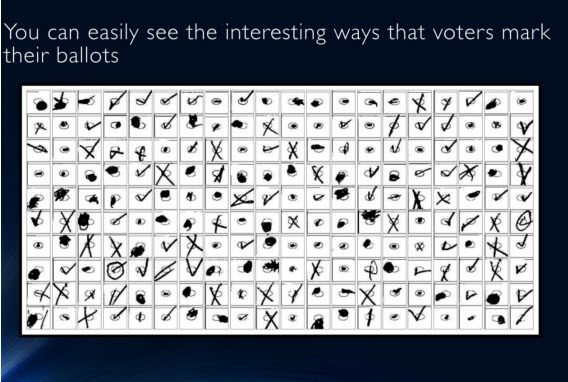
Real life is not a Hollywood script. The evidence is not decisive. We should put our accountants’ hat in the file drawer on election day and use our customary shortcuts. Some voters make one of two alternative choices. Out of disinterest or disgust, some don’t vote. In a presidential election, some undervote, choosing candidates down the ticket but leaving their choice for president blank. The Election Audit Commission (pdf here) notes that an election official may have to inspect a ballot in case automated software cannot read a voter’s mark. Here’s a picture showing the many different ways voters have marked their choices (p. 13).

In the 2012 election, 1% of voters left their presidential choice unmarked, according to a USA Today analysis. In 2016, it was almost double that percentage – 1.9%. Recent polls indicate a tight race between Trump and Harris. As happened in 2016, a small number of voters in several key states could decide the election. In the 2000 Presidential election, several hundred Floridian voters mistakenly marked Buchanan for president instead of Gore. Some realized their mistake, crossed out their initial mark and voted for Gore. This resulted in an overvote for two candidates on the same ballot. In many cases, this voided the voter’s choice entirely.

Over $14 billion was spent in the 2020 election campaign, according to Open Secrets. In a nation of millions of voters, it is irrational that a few thousand voters or less should decide an election. Last week, I referred to John Bates Clark, a 19th century economist, who asked why a small surplus of wheat in the northwest should determine the price of the entire wheat harvest. In a “winner-take-all” fashion, 48 states award all their electoral votes to the candidate who gets the most votes. A few thousand votes may decide all the electoral votes in a state. Why should a person make a rational choice when an idiotic election system neutralizes their careful deliberation?

//////////////////////

Photo by Giorgio Trovato on Unsplash

Pindyck, R. S., & Rubinfeld, D. L. (2017). Microeconomics. Pearson Education Limited.

What is Value?

September 22, 2024

By Stephen Stofka

This week’s letter is about value. Is there a true value and how is it determined? Does the value of something depend on its usefulness or is it an unchanging abstract quality? What is the difference between true or intrinsic value and exchange value? What is the diamond-water paradox? Is there a true price P* of exchangeable goods, or a true price of money, the interest rate r*? Is there such a thing as a fair wage? Whenever government sets a price for something, it does so to correct a perceived distortion in the market price for that good. Governments pass rent control policies to set the price of housing, or establish a minimum wage. A central bank sets a benchmark interest rate that determines the price of borrowed money. Is there an intrinsic value to tradeable goods?

In Chapter 4 of The Wealth of Nations, published in 1776, Adam Smith (1723 – 1790) discussed the two different meanings of the word value: value in use, and value in exchange. Like others of his time, Smith limited his concern to the value and price of commodities, not the scarce artisanal goods that only the wealthy could afford. “Nothing is more useful than water: but it  will purchase scarce anything…A diamond, on the contrary, has scarce any value in use; but a very great quantity of other goods may frequently be had in exchange for it.” Smith sought the “real measure of this exchangeable value” as well as the components of this real measure that he called the “natural price.” Lastly, how did circumstances affect the market price so that it differed from the natural price? This investigation, he warned the reader, would require three chapters of the book to fully explore. “I am always willing to run some hazard of being tedious in order to be sure that I am perspicuous,” he wrote, begging the reader’s patience.

Smith determined that the exchange value of a commodity is the “toil and trouble of acquiring it.” If Mary wants to exchange commodity A for commodity B, then the exchange value of A is the toil and trouble it will save Mary to get or make B. When Smith concluded that “Labour is the real measure of the exchangeable value of all commodities,” he is referring to the labor saved by the buyers of a commodity. The natural price of a good, Smith later concluded, was the average of many different individual valuations within a region, varying by both region and country.

Smith’s theory of value differed from an earlier writer, Richard Cantillon (1680 – 1734) whose Essay on the Nature of Commerce was not published until 1754, a decade before the publication of Smith’s Wealth of Nations. “Land is the source … from whence all wealth is produced,” Cantillon wrote, voicing a view held by a prominent school of philosophers, the Physiocrats, although he was not a member of that school. The basis of wealth was agricultural, the difference between what was produced and the sum of the inputs. The fertility of the land provided that difference in value. Cantillon believed that “there is never a variation in intrinsic values” but that a mismatch between supply and demand can cause market prices to differ from their intrinsic value. In well-organized societies where production and consumption are more constant, Cantillon observed that there were only small variations between the market price and the intrinsic value.

David Ricardo, John B. Say and Karl Marx promoted economic theories where goods had both an intrinsic and market value, based on the labor needed to produce the goods. The debate over intrinsic value was an arbitrary set of definitions that could not be resolved. Finally, the Marginalist school of economists in the late 19th century rejected the idea of an intrinsic value as an economic concept. It was a speculative concept of philosophers and political scientists, not economists. There was no intrinsic value to a worker’s wage other than the marginal product of that labor. To an employer, the value of that labor input is only as much as the change in the output.

In The Distribution of Wealth published in 1899, John Bates Clark challenged the idea of marginal productivity as the basis for a worker’s wage. The problem was that the surplus supply of goods and labor played a key part in determining the value of the entire supply of that good. In Chapter 7 Clark noted that the price of all the wheat grown by farmers in the northwest United States was determined by the price of whatever surplus wheat there might be when all the wheat reached the marketplace. Why should the marginal surplus determine the price of an entire crop? In Chapter 8, he wrote that a worker’s wage was not based on a worker’s marginal productivity but the marginal loss to the employer if an employee left or wasn’t there. Clark called it a zone of indifference and within that zone were expendable workers. Should the wages of expendable workers become the standard for the wages of other workers, he asked.

The Marginalist economists separated Political Economy into two fields of study, describing transactional relations with mathematics to bring greater precision, clarity and scientific discipline to the study of economics. They disregarded what are called allocational inefficiencies,  flaws in the pricing system that distorted the distribution of goods and services. History, past policy, demographics and the local environment form a less flexible landscape that does not adjust to price signals in some markets. Governments try to correct those flaws, only to introduce other distortions into the pricing system that can be worse than those of a free market.

The real estate market in New York City is an example. In a free market, developers would respond to market demand, buying up single family homes, and “scraping” them to build two-plex and four-plex residences. Zoning regulations championed by local politicians and supported by existing homeowners interfere with that free market dynamic. Next week I will review the distortions that such zoning regulations and rent control introduce to the housing market.

////////////////

Photo by Evergreens & Dandelions on Unsplash

Clark, J. B. (1965). The distribution of wealth: A theory of wages, interest and profit. Augustus M. Kelley. There are several Kindle versions of this work for about $1 at Amazon.

Keywords: marginalist, Labor Theory of Value, fair wage, rent control

The Average

September 15, 2024

by Stephen Stofka

This week’s letter is about two different investing styles, active and passive, and how they are affected by the average. The active vs passive debate in investing began several decades ago when John Bogle founded Vanguard as a way for individual investors to invest in a market basket of stocks. The active investor is like a miner panning for gold in a mountain stream. He (mostly male, I think) carefully studies the residue in the bottom of the pan, looking for the glint of gold in the sunlight. Some miners strike it rich while most barely cover the costs of their tools and time. The index investor, on the other hand, buys a share of the company that buys gold from the individual miners.

The core issue in that debate stretches back to the classical period in ancient Greece and the role of our powers of reason. In the following sections, I will rely on some points my wife, Dr. Beth Davies, made to her class this week. For some background, Aristotle was a Greek philosopher who lived and wrote in the 4th century B.C. Thomas Aquinas was a 13th century Christian theologian who tried to unite the secular reasoning of Aristotle with the Catholic tenets of faith.

Davies writes “Aristotle places all of his confidence in our faculty of reason. No matter the shifts that our fortunes face in life, we can always apply practical reason and therefore pursue our desired end, which is to flourish (be happy).” The active investor believes that research and reasoning can generate what is known as alpha, the extra return that an investing strategy has over an average that serves as a benchmark.

Davies writes “Aquinas loved Aristotle’s philosophy … but the worldview of his time was saturated with the belief that human nature is inherently sinful,” implying that our sinful desires interfere with our reasoning process. How did Aquinas resolve this dilemma? Davies continues, “He did it by adapting the Islamic idea that human intellect is a natural process. Since God created nature, natural processes are not corrupted by sin. Medieval theologians grouped intellect into this category of ‘natural process.’ Medieval theologians, Christian and Islamic, needed a way to preserve some part of the mind from sin, and since reason can be corrupted by appetite, they settled on intellect.” Having less confidence in their intellectual expertise at investing, the passive investor accepts an average market return and saves both the expense of higher trading fees and their own time.

In Thinking Fast and Slow, Daniel Kahneman noted the many cognitive biases that introduce flaws in our reasoning when we make choices. In recognition of these biases, investment managers have developed algorithmic trading models intended to reduce human error and bias. The execution of those strategies can be tainted by faulty reasoning as well, so investment managers are turning toward machine learning. Criteria like minimum returns and acceptable risk ratios are input into programs which run thousands of simulations on trading data and research to find optimal trading strategies (Hansen, 2020). In a medieval interpretation, these programs are the embodiment of the distinction between intellect, created by God, and corruptible human reasoning.

Most individual investors do not have the time, resources or background to develop or maintain such strategies. In the future, investment managers may offer funds or ETFs that employ such strategies but will charge higher fees for the promise of higher risk-adjusted returns. In an analysis of eight years of market data from 2009 -2017, Prondzinski and Miller (2018) wrote “evidence suggests that active funds underperform index funds by approximately the difference in their costs.” If these strategies do deliver higher returns, more investment firms will use them, raising the average market return and reducing alpha to near zero. Even if short-term returns are higher, a passive strategy should produce returns at least as good as many active strategies.

Indexes rely on the power of the mean. There are several ways to compute an average, or mean, but the most common is the arithmetic mean, determined by the sum of the data divided by the number of data points. Few if any data points match the average, yet it is a benchmark concept in statistics, forming the basis for many calculations like variance and standard deviations. Index funds rely on the Law of Large Numbers, creating a sample of a large dataset filtered by some criteria like market capitalization. Unlike machine learning, the filter criteria is not a dynamic optimizing strategy but a characteristic of the market. It is less dynamic but a “good enough” strategy that minimizes costs.

To Aristotle, the virtuous mean was a behavioral phenomenon where an individual used their reason to compromise between extremes of action. On a highway, some drivers are weavers, changing lanes frequently in the belief that an optimizing strategy will get them to their destination sooner. Some drivers keep to one lane, going with the flow and making few changes until they approach their exit. At the exit, they experience a sense of satisfaction upon finding that they are only a few cars behind a weaver. That is index investing.

//////////////////

Photo by StellrWeb on Unsplash

Keywords: passive investing, active investing, alpha

Hansen, K. B. (2020). The virtue of simplicity: On machine learning models in algorithmic trading. Big Data & Society, 7(1), 205395172092655. doi:10.1177/2053951720926558. Available from: https://journals.sagepub.com/doi/full/10.1177/2053951720926558

Prondzinski, D., & Miller, M. (2018). Active Versus Passive Investing: Evidence From The 2009-2017 Market. Journal of Accounting and Finance18(8). https://doi.org/10.33423/jaf.v18i8.114

An Economic Nexus

September 8, 2024

by Stephen Stofka

This week’s letter is about the labor market, part of a series on investing. Friday’s monthly labor report indicated a job market that is cooling but still growing. Although the market reacted negatively to the news, the Fed will begin reducing interest rates at its meeting next week. The S&P 500 index, the most widely held basket of stocks, is up 15% for the year but the index has twice risen above 5500 before falling back. An index of business activity in the services sectors continues to expand but manufacturing activity is still contracting slightly. When investors get conflicting economic signals, they are responsive to negative data points more than positive ones. The approach of what may be a contentious election creates an environment where investors are more likely to protect their portfolio value and exit short-term positions. Let’s now turn to long-term trends in the labor market.

Economists at the Bureau of Labor Statistics (BLS) refer to workers aged 25 -54 as the core work force. To save some typing, I will refer to this age demographic as the “core.” During those thirty years we accumulate stuff while we build our careers. We buy cars, furniture, homes and vacations. We build retirement savings for ourselves and college funds for our kids. The core is the nexus of a growing economy.

This coming Wednesday we will remember 9-11 and the 3,000 civilian lives lost in the attack on the World Trade Center in lower Manhattan. Since that time, there has been little investment in those workers who form the core of the labor market. From August 2001 to August 2024, the economy has added less than seven million jobs in that age demographic, an annual growth rate of just 0.28% (See FRED Series LNS12000060).

As you can see in the chart above, most of the growth in the core has occurred during the Biden administration. The surge in employment in this age group led to growing incomes and greater purchasing power in an age group that is in the accumulation phase of its lifetime. That rapid growth in employment, coupled with pandemic recovery payments from the government were strong contributors to the rise in inflation in the 2021 – 2023 period. Voter sentiment in this age group focused on the inflation, not the job growth, demonstrating again that we pay more attention to negative rather than positive news.

Several factors contributed to the plateauing of job growth in the core. Demographics played some part. Population analysts have assigned a span of about 18 years to each generation so that the thirty-year span of the core labor force encompasses two and sometimes three generations. The first of the large post-war Boomer generation turned 54 in 2000. As the Boomers aged out of the core, a smaller Generation X, born 1964 to 1982, became the dominant component of this age group. In 2013, the first Millennials, a generation larger than the Boomers, joined the core, and in 2016, the last of the Boomers aged out of the core.

A few months after 9-11, China was admitted to the World Trade Organization, and within a decade became the world’s factory. Investors poured capital into China, taking advantage of low labor rates and a currency whose exchange rate was maintained at a low level by the Chinese central bank. Investors from outside China got more bank for their buck. As investment moved to China, many production facilities in the U.S. shuttered their doors. In the seven-year span between China’s admittance to the WTO and the start of the financial crisis in September 2008, manufacturing employment (see FRED Series MANEMP) fell by a fifth. By January 2010, employment in the manufacturing sector had declined by a third.

During the 2000s, low interest rates fed a frenzy in home financing and produced a bubble in the U.S. real estate market that imploded in 2008. The resulting financial crisis affected assets and financial institutions around the world. Millions of Americans lost their jobs. From the start of 2008 until the end of 2009, the core work force fell by 6%, about six million jobs. In 2018, an interval of ten years, the level of employment in this age group finally rose above its 2008 level.

Instead of vigorously promoting policies that encouraged job growth, the Obama administration offered policies to support families suffering from the lack of job growth. Democratic politicians eagerly passed ambitious social programs but faltered when implementing policy solutions that embodied their legislative goals. In Recoding America, Jennifer Pahlka (p. 125) recounts the efforts to fix healthcare.gov, the bungled rollout of the health exchanges created under the Affordable Care Act known as Obamacare. In The Rise and Fall of the Neoliberal Order, Gary Gerstle (p. 226) notes that the Obama administration focused more effort and political capital on providing healthcare insurance for poor people rather than supporting the 9 million households in danger of losing their homes to foreclosure.

A sense of betrayal soured voter sentiment and helped to support the emergence of the Tea Party in the 2010 election and the MAGA voters who supported Donald Trump’s candidacy in the 2016 election. In 1976, voters punished President Gerald Ford for pardoning Richard Nixon. In the 2016 election, voters punished Hillary Clinton as a symbol of a set of values disloyal to many Americans. Donald Trump promised to bring manufacturing jobs back to America by taxing Chinese imports and cutting corporate taxes. In the first three years after the 2008-2009 recession, manufacturing employment under Obama grew by more than it did in the first three years of the Trump presidency (see notes for details). No amount of political rhetoric can overcome the power of a supply chain now firmly anchored in Asia.

Biden’s infrastructure policies have actively promoted job growth in the core. Can the economy sustain such growth in this acquisitive age group while keeping inflation at a reasonable level? Should the Fed raises its target interest rate from 2% to 3% to accommodate job growth that supports people when they are raising families and building careers? I think so. Should Harris win November’s election, she should adopt Biden’s pro-growth policies. Should Trump regain office in the coming year, he will try to use tariffs to shift the nexus of the global supply network from Asia back to the U.S. That policy will only increase prices and help maintain a higher level of inflation without promoting the economic growth that supports households in their middle years.

 ///////////////

Photo by Tim Mossholder on Unsplash

Manufacturing employment notes: From January 2010 to December 2012 manufacturing gained 500,000 jobs, an increase of 4.4%. From January 2017 to December 2019, the manufacturing sector gained 432,000 jobs, an increase of 3.5%. In January 2010, manufacturing employment was near a low, continuing to fall after the official end of the recession in July 2009.

Keywords: Obamacare, inflation, labor, financial crisis, China, manufacturing, infrastructure

A Generation of Homes

September 1, 2024

by Stephen Stofka

This week’s letter is about real estate, part of a series on investing. In the past weeks, I have taken an informal inventory of a half-dozen dumpsters parked in front of vacant houses in the metro Denver area. They are full of earth-toned kitchen and bath cabinets, paneling and other home appointments popular during the 1970s. In that decade, younger Boomers threw out the metal kitchen cabinets of 1950s post-war starter homes and the craftsmen cabinets of pre-war homes. Now the Boomers are aging out of the homes they bought forty years ago, and a new generation takes their place.

Many older homes built in post-war America had smaller rooms to accommodate growing families. Newly remodeled homes for sale often feature open floor plans where a wall has been removed between a kitchen and dining room or living room and dining room to connect kitchens with the primary living space. Removing a bedroom wall to create a bigger living room or family room can have the unfavorable effect of reducing the number of bedrooms a house features.

White, pale gray and dark brown cabinets are  popular color schemes now. In the 1970s, white and dark mahogany were typical of cabinets in apartments. Honey oak cabinets in a house conferred a modest upgrade in status. Now it means old and outdated unless there are glass panel insets in the cabinet doors. Formica is so like last century. When investor groups remodel a home for sale, they install quartz countertops, which are more expensive but less maintenance than Corian or granite countertops. Kitchen and baths get the most attention from potential home buyers, so those rooms receive more investment.

LVP plank flooring can simulate the look of real wood or stone and is a popular choice in newly remodeled homes for sale. In some homes the same style and color LVP is used throughout the home, including the kitchen, baths, laundry, living room and bedrooms. Area rugs in each room could be used to give each room a distinctive theme, I suppose, but the uniformity of that look is not to my taste, particularly when the color is dark mahogany.

There are many steps to buying a home, but the first step is familiar territory. What does my family want? A house is a home in a neighborhood. What amenities does the neighborhood offer and which are important? These include schools, public transportation, housing density, crime statistics and environmental risks like fire, wind, and temperature extremes.

There are several types of homes and ownership. In a single-family home, the owner is responsible for the exterior of the structure and the plot of land where the house sits. A townhome is a residence attached to another residence so there is a shared responsibility for the exterior of the structure. Typically, a homeowner’s association (HOA) manages this communal responsibility and each association spells out common and individual responsibilities in their covenants. These include regular maintenance of the grounds like lawn mowing, tree trimming, repairing or resurfacing paved areas within a townhome development. An HOA might be responsible for siding, brick and roof repairs but hold the townhome owner responsible for damage to the rear concrete patio of their home. A townhome owner is usually responsible for repairs to equipment that services only their unit. Examples include a forced air furnace, an AC unit or a hot water heater.

The owner of a condo is responsible only for the space between the four walls of their home. The inside of an outside wall is the owner’s responsibility. The outside of that wall is a communal responsibility. Equipment systems often serve more than one owner and repairs to these systems are the responsibility of the HOA. The responsibilities are spelled out in the covenant, or CCR (covenant, conditions and restrictions).

Today there are several real estate companies that provide free access to the Multiple Listing Service (MLS) of homes for sale. They offer the ability to filter by location, price, the type of house and the number of bedrooms and bathrooms. A real estate agent can usually provide additional filtering criteria that include the quality of schools, zip codes and square footage. However, the filtered results may not pass additional criteria that a family has. Taking notes in a Word document or other software helps to sort out and remember key details about a property so that the homes do not merge into a blur of pictures and facts. Here is a list of features that you can build on.

Address: the street address first, theninclude a nearby major intersection, for example. The price and whether there has been a price increase or decrease. The square footage, the number of BRs and baths and whether the home is subject to a monthly HOA fee. Natural light is important to me, so I use Google Maps to help me identify which direction the front of the house faces.

Status: Initially leave this blank. If you discard, state that and one or two reasons. Don’t delete the property, but cut and paste it at the end of the document in case you want to revisit it later. This will help you identify “gotta haves.” Low rated primary school might be one or the year the house was built. The master BR is not big enough or there is not enough light.

Financial Metrics: the dollars per square foot (psf) calculated by dividing the list price by the square footage. For no charge, propwire.com will allow you to view median selling prices for homes in that area. Enter the address of the home, then click the Market tab in the results.

Exterior: the listing will have a street view, but these often distort distances from the curb to the house itself. Enter the address in Google maps to see what the property looked like in the past. On a computer, Google maps will display the month and year the photo was taken by their truck camera. In the compilation of photos for the listing, note any features like a recently installed roof, siding, or garage door. The fence may need repair or there is a tree growing close to the foundation of the house. There may be a cozy porch leading up to the front door. Taking notes can help train us to notice and categorize details.

Equipment: the text of the listing will list details like a new roof, hot water heater, furnace or AC. Note them here. Recently installed equipment should reduce your expenses in the first decade of owning the home.

Neighborhood: On Google maps you can see features that might be important to you. A grade school is nearby but on the other side of a major intersection. Is that a problem? Note any nearby parks or other green spaces if those are important to you. Later on, if you do an initial drive through the community, note the general condition of the neighborhood. Single family homes governed by an HOA will usually present a more consistent appearance and maintain their landscaping. In a neighborhood without an HOA, that consistency is lacking.

Shopping, etc: note any commercial or government agencies nearby that are important to you. These might include grocery, drug and hardware stores, restaurants, a movie theater or a library. There is a lot of easily accessible information on your computer screen.

As you browse the photos in the home listing, note any details, positive and negative that catch your attention. Later, these short notes will help jog your memory. An example is below:

Kitchen: gray cabs, pale gray wall color. Lots of cabinets. Swing door to rear deck.

Bedroom: Master is 15’ x 12’ OK. No closet doors in smaller BR?

LR: big window, faces south.

This inspection list can be done in front of a computer screen without any visit to the house itself. If there are several properties in a community, a visit to the neighborhood may help you refine your search further to reduce the number of homes that you physically inspect. There are many checklists when you do a physical inspection of the home. Here is a printable checklist from a blog writer at Orchard, a real estate company. I hope that these tips will make your house hunting a bit more organized and save you some time and effort.

/////////////////////

Photo by Phil Hearing on Unsplash

Keywords: house, homebuying

Stimulus and Response

August 25, 2024

by Stephen Stofka

This week’s letter continues my look at the dance of our responses to events. In a newsletter a few years ago, Kyla Scanlon coined the term vibecession to describe a general consumer sentiment that is contrary to positive economic data on unemployment, wages, and GDP. Why are consumers ignoring positive data and a rising stock market to direct their focus on rising inflation, interest rates and home prices? Analysts have identified a tangled string of factors that contributed to this negative consumer mood, but identifying a primary cause is difficult.

We assign importance weights to events as we experience them or learn of them. Adam Smith wrote how we can mourn the loss of a tip of our finger more than the deaths of a million Chinese people in an earthquake. Our reaction to even a small tax hike can be out of all proportion to the quantitative change in the tax. State legislators are reluctant to increase a gasoline tax by a few pennies a gallon because they fear the voter backlash. On a ten gallon fill up, the extra tax might be only thirty cents, an amount someone might leave in a tip jar at a coffee shop. To many consumers, that thirty cents is insult added to insult, an example of government sticking its greedy hands into consumer pockets.

The frequency of an event like a sales tax may lead us to consider the entirety, the sum of events, as we react to any one event. Within this perspective, an inappropriate response to a particular event may look entirely appropriate. This can help explain why a person of a minority group reacts in a particular manner in their encounters with police. Their reaction is not to the encounter itself, but a lifetime of more than average encounters because of their skin color.

Sometimes the response is entirely proportional. In Colorado, the growth of property taxes was held in check by a law called the Gallagher Amendment, which taxpayers repealed in 2020. In the past five years, property taxes in Denver have more than doubled. An analysis by the Common Sense Institute determined that many property owners saw an average increase of 27% in their 2023 property taxes. Responding to voter anger, the legislature passed a law in May 2024 that enacted tiny decrease in taxes, from 6.765% to 6.7%. Many voters perceived the paltry tax relief as an insult and have shown strong support for a ballot initiative this November that will curtail the growth of property taxes. Scared that voters will again take more control of state and local revenue growth, the governor has called for a special session this summer, hoping that legislators can craft a measure that will provide substantial tax relief and deflect voter anger this coming November.

Having insurance can lower our reaction to a damaging event like a car accident or a hail storm. By diversifying our portfolio, we act as our own insurance company. However, it is not practical to own multiple homes to diversify the risk of hail damage, so we reduce the impact of such an event by buying a policy from an insurance company. The insurance companies insulate themselves from the impact of large losses, particularly weather-related events, by buying insurance themselves from global reinsurance companies. Because reinsurance companies have a global portfolio, they are able to distribute the risk of local weather phenomenon across all regions.

Unlike animals, most of us monitor and modify our reaction to daily events. Here again, the frequency of an event helps us manage our reaction because we are better able to predict the effect of a particular event. When we first learn to drive, the flow of traffic on a city street can be disconcerting and confusing. Over time we learn to anticipate the movement of the vehicles around us and this expectation reduces our confusion. This reaction management can become a multi-level cognitive process where we modify our management of our reactions. Commercial drivers required to take defensive driving classes are taught not to over-anticipate the actions of others. “Lights do not stop cars. People stop cars.”  “Some drivers use their foot to drive. A safe driver uses their brain.” Per mile of city street, there are many drivers of machines capable of great damage but few lights and signs. We get where we are going because people follow rules both written and unwritten. We pay attention to signs posted and unposted.

In human affairs, event and reaction are not separable like the Newtonian model we are taught in grade school. They may be the two heads of that peculiar animal called a pushmi-pullyu in The Story of Dr. Doolittle by Hugh Lofting. Because of that symbiosis, there may be backward causation. Did x cause y or did y cause x? There may be a factor z that affects both x and y. Event and reaction are a symbiosis that we manage through expectations, diversification and informal rules. Institutions like insurance and laws help us coordinate our individual responses. Somehow we survive in this world of complex causality.

/////////////////

Photo by Kris-Mikael Krister on Unsplash

Keywords: taxes, event, reaction, quantitative, qualitative.

The Elasticity of Our Spirit

August 18, 2024

by Stephen Stofka

This week’s letter is about the effect of quantitative phenomena on our quality of life. Why do events impact people of the same socioeconomic circumstances differently? We are part of a group responding to the event, so we interact with the collective responses of the group around us. Our direct response to the event is a small part of the total impact on our quality of life. Imagine we are a rubber duckie in a group of rubber duckies on the ocean’s surface as a wave passes. As we rise with the water that displacement causes a lot of jostling by the duckies around us. Much of the effect we experience is not the wave but the reaction of the others around us to the wave. Yet we attribute the cause of our experience to the wave, not our fellow duckies.

One hundred years ago, Louis de Broglie introduced a wave theory of matter. A few years later Erwin Schrödinger proposed a wave equation of electron motion to explain the quantum world. Those two ideas are cornerstones of quantum mechanics, the most tested theory in physics and the foundation of our current electronic technology. As you read this on a computer or smart phone you are watching quantum mechanics at work. Not all wave are alike. Light and radio waves are electromagnetic waves that don’t need a medium to travel in. Even in the vacuum of space, the electromagnetic field they create acts as a type of medium. Some waves, called transverse waves, cause matter to move in a direction that is partly perpendicular to the force of a wave. A rubber duckie bobbing up and down in the water is an example.

We are hunters of cause. We are interested in the origin of phenomena, thinking that the origin of something will enhance our understanding of that thing. For that reason, some economists like to debate the origin of money. One morning a few weeks ago, our cat woke up, yawned and stretched out a paw on the bed. A claw caught in the quilt and slid it sideways so that it formed a tunnel. Like a wave through water, the direction of the paw was parallel to the quilt, but the quilt reacted in a direction perpendicular to that movement. Kitty pulled her paw back and the tunnel mostly collapsed. She then stretched out her paw again and the quilt rose up. Her hunter reasoning led her to believe that a mouse was the cause of the tunnel under the quilt, so she attacked. She pounced and pawed the quilt to find that imaginary mouse, then lost interest, jumped to the floor and left the room. How often do we search for the cause of a phenomena that is mostly a response to the collective action of a group?

When prices go up, we can look to our side for contributing factors, the decisions of many consumers and businesses. A quantitative change in prices affects the quality of our lives. Like a cat, we often judge quantitative phenomena with an instinctive appraisal. We notice the rise in prices more than we do the rise in our wages because we are more sensitive to loss than gains. The Bureau of Labor Statistics reports that the annual increase in average hourly wages and weekly earnings is now higher than inflation. A rise in the price of the goods we buy has a greater effect than a similar rise in our income because we perceive a rise in prices as a loss of our purchasing power. We are particularly loss averse, according to Daniel Kahneman, the author of Thinking Fast and Slow, who won a Nobel Prize for his research into the less than perfect reasoning we employ in our decision making. He and Amos Tversky proposed a concept called Prospect Theory to describe and model the mechanics of our decision making.

Elasticity is a term that economist John Marshall borrowed from physics to describe the reaction of consumers to changes in the prices of goods. The most common measure is called the Price Elasticity of Demand and businesses pay close attention to this metric. It is the change in the percentage of goods bought in response to a 1% change in price – a ratio of two percentage moves – the zig divided by the zag. If the price of butter goes up 1% and the amount of butter sold declines by 2%, then the ratio of percentages is 2 to 1 and butter is considered to be elastic. If the quantity of butter sold declines only 1%, then butter is said to be unit-elastic. If the quantity of butter barely changes, then it is inelastic. When businesses sense that consumer demand for their good or service is inelastic, they can charge higher prices with less effect on the quantity sold and make a higher profit. Businesses respond to consumer decisions and tastes.

The elasticity of economic goods is not constant because consumer demand responds to a changing economic environment, as well as tastes and culture. In some cases, consumer demand can change abruptly. Such was the case after the pandemic. The airline market is an example of two types of demand elasticities. Business travelers are much less sensitive to changes in price, with an elasticity far below 1, according to research done in the 2010s. Because of that airlines upcharge business customers. Leisure travelers, on the other hand,  have an elasticity of almost 2, meaning that they are sensitive to price hikes. The higher prices that airlines charge business customers effectively subsidizes leisure travelers. However, after the pandemic, the demand for leisure travel surged and airlines responded with higher prices. Average airline fares surged 20% annually in the summer of 2021 then rose sharply by 34% in the summer of 2022. In the first quarter of this year, prices stabilized to pre-pandemic levels. Vacation travel is a luxury good, but it can feel like a necessity when we feel stuck in a grind and stressed at work.

The effect is more frequent for necessities like food, lodging and utilities. That frequency affects the elasticity of our spirit the way a weight on a spring changes the spring’s elasticity over time. The relief checks sent during the pandemic helped some families build a small savings cushion, a relief from the burden of living paycheck to paycheck. In the past two years, families that have dipped into their savings to meet higher housing, grocery and childcare costs feel a sense of loss because their savings are smaller. Even if wage gains have kept up with inflation on average, wage gains are calculated based on gross income before taxes. We buy groceries and pay housing costs with after-tax dollars. The loss is real.

Like water, human society is the medium, transmitting and transmuting the force of thousands of decisions made by people we will never meet. Our circumstances and decisions affect the lives of strangers. There is no single cause because we are part of the cause. Even if we could identify a primary cause like rising prices and remove it with a magic wand, we cannot predict a satisfactory resolution. Yet politicians running for office hold out their magic policy wand and promise to end this or that problem, hoping that enough voters will buy what they are selling. “Here’s the problem,” they say. “I can do something about it.” We want to believe that complex processes have simple causes, and in the final months of this election year, candidates will tailor their message to our belief in that simplicity.

////////////// 

Photo by Joey Huang on Unsplash

Keywords: prices, inflation, cause, effect, wave