Tower of Babel

October 23, 2022

by Stephen Stofka

This week’s letter is about taxes and income. Each month, the Federal Reserve (2022) releases an estimate detailing how people spend their money and the sources of their income. I was surprised that 17% of personal income is from government transfers like Social Security and other programs. This is 2% more than the income people receive on their assets. A bit of history for context.

In the 1960s, 2/3 of income was from wages and salaries. Each decade, the wages and salaries component declined 5% until this past decade when wages and salaries were just 50 cents out of every dollar of income.

A greater portion of employee compensation shifted from discretionary income to dedicated non-taxable benefits like health care insurance and pensions. In the early 1960s employer benefits were 10% of wages and salaries. Now they are 21%. Despite the rise in the non-taxable share of compensation, workers give up more out of their paychecks to taxes.

A growing share of income goes to FICA taxes

In 1960, workers paid 6% of their paychecks to FICA taxes. The Medicare program, about 20% of our FICA taxes today, would not be enacted until 1965 when President Johnson ushered in his Great Society programs. Within five years analysts realized that lawmakers had wildly underestimated the costs of the program. By 1980, increases in Social Security and Medicare taxes increased the FICA portion to 12% of paychecks. Today, workers pay 15% of their paychecks in FICA taxes (see note).

In 1960, all other taxes were 11% of total income in 1960, had climbed to almost 13% in 1980 then to over 14% by the year 2000 and are now 15% of total income. In the past twenty years, the rich have paid a growing share of income taxes but their effective tax rate has changed little. Why? When lawmakers put a heavier burden on rich people, they lobby for legal income exclusions and Congress obliges.

Top 10% pay a growing share of income tax

In 2001, the top 1% paid 33% of income taxes. In 2019, they paid 39% (IRS, 2022). In 2001, the top 10% (the Tennies, I’ll call them) paid 64% of personal income taxes. In 2019, they paid 71%. Whether it is the super-rich or the rich, their share of income tax has grown by 6 -7%. That’s not the end of the story.

Growth in incomes of the top 10% is far higher

The Tennies have seen their share of gross income increase from 42.5% in 2001 to 47.3% in 2019, a gain of almost 5 percentage points. They have paid a rising share of the nation’s income taxes but the rise in taxes is less than the rise in personal income (BEA, 2022). In the 2001-2003 period the income tax paid by the Tennies averaged 5.6% of national personal income. In the 2017-2019 period, that tax share was 6.3%, a difference of just .7%. It is a cheap price to pay for a 5% gain in the nation’s total income.

Effective Tax Rate of the top 10% is steady despite rise in Income

In the 2001-3 period the Tennies averaged an effective tax rate of 13.5%. In the 2017-19 period, that effective rate had declined to 13.2% despite a 2% rise in the top marginal tax rate from 35% in 2001 to 37% in 2019. Raising the marginal tax rate on the highest income brackets has little net effect yet it was a campaign issue for Mr. Biden and many Democrats. Political scientists call it position-taking.

The party of no taxes produces higher deficits

Despite their rhetoric about reducing the deficit, Republicans have adopted a no new taxes on anyone pledge that ensures the deficit will get worse. True to form, the budget deficit has grown more under Republican administrations over the past four decades. The party also has a record of slower economic growth but that is mostly due to the two terms of the George Bush administration. Mr. Bush’s failures caused many Republicans to abandon more mainstream Republican values and adopt a mean spirited attitude of radical defiance exemplified by the Tea Party and the Republican Study Committee.

Action requires Compromise

The “Just Say No” Republican factions permit little compromise so the party cannot get significant legislation passed. In the first year of Mr. Trump’s Presidency, Republicans held all three legislative bodies but were stymied by their internal squabbles. In November of 2017, they hastily assembled the corporate tax reform package, TCJA, to show their constituents that they were capable of legislating and to give Mr. Trump some accomplishment that he could tweet  about.

A look ahead

If Republicans take control of the House after the upcoming elections, we can expect more of the same dysfunction under Speaker Kevin McCarthy. Libertarians in the Republican Party want a limited role for the federal government as specified in Article 1, Section 8 of the Constitution. They have little tolerance for national abortion laws and other bullying social legislation that Republicans have promised. The uncompromising factions within the Republican Party ensure that the party cannot govern. They are like drivers in a car with a manual transmission who don’t know how to clutch and shift. Democratic lawmakers, on the other hand, drive down the road, focused on staying perfectly centered between the white lane markers of equality and equity. The rich benefit when party leaders cannot assemble a cohesive coalition of interest groups and voters. The economic interests of the top 10% are protected when voters remain fragmented. Party elites and partisan interest groups speak in languages that are understandable only to a narrow constituency. By promoting dissension, social media has helped create a Tower of Babel.

/////////////////////

Photo by Osman Rana on Unsplash

BEA: U.S. Bureau of Economic Analysis, Personal Income [PI], retrieved from FRED, Federal Reserve Bank of St. Louis; https://fred.stlouisfed.org/series/PI, October 19, 2022.

Federal Reserve. (2022). Personal income and its disposition. FRED. Retrieved October 19, 2022, from https://fred.stlouisfed.org/release/tables?rid=54&eid=155443&od=#. The FICA tax percentage includes the employer and employee portion of the tax. The employee effectively bears the burden of the entire tax.

IRS. (2022). SOI tax stats – individual income tax rates and tax shares. Internal Revenue Service. Retrieved October 19, 2022, from https://www.irs.gov/statistics/soi-tax-stats-individual-income-tax-rates-and-tax-shares#Early%20Release. Table 4.2, Selected Descending Cumulative Percentiles of Returns Based on Income Size Using the Definition of AGI for Each Year.

A Global Wave

October 16, 2022

by Stephen Stofka

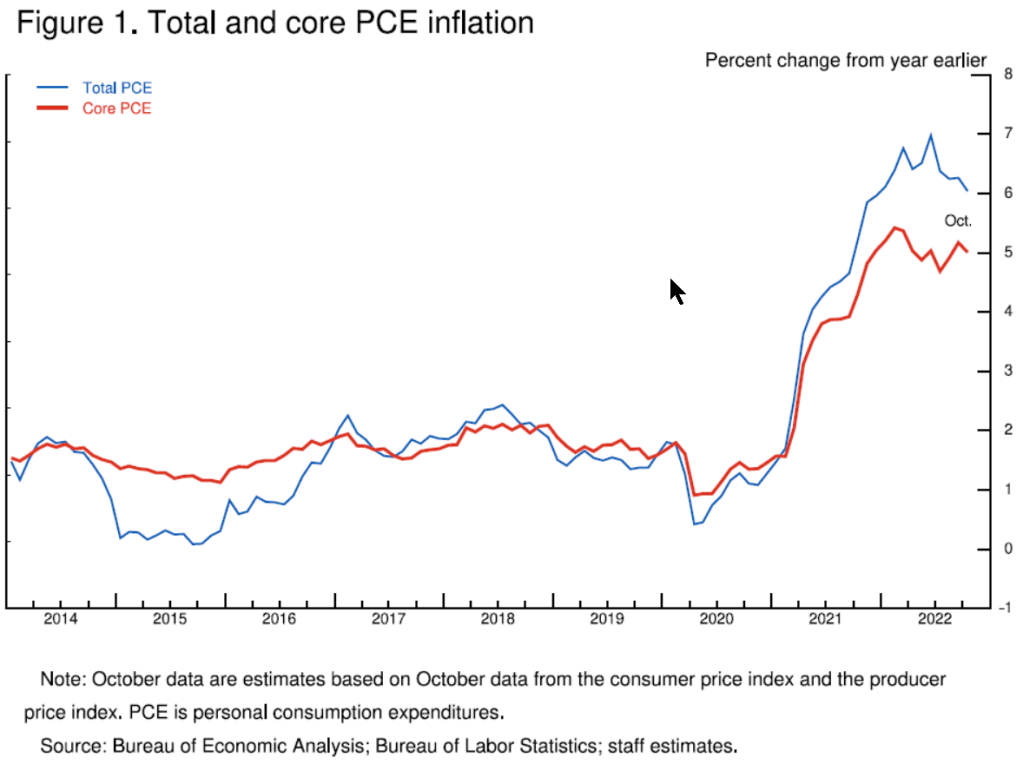
On Thursday, September’s CPI came out, showing an annual price increase of 8.2%. A quarter of that increase was housing costs – rent and owner equivalent rent. Price increases have decelerated this quarter. Remember that inflation is the change in prices. Acceleration (+) or deceleration (-) is the change of that change. Inflation is like the speed in a car. Acceleration is the change in speed. The graph below shows the acceleration for the past five years.

Notice the regular up and down in small increments before the pandemic. When we drive down the highway without cruise control, we experience the same minor variations in speed. After the pandemic, price acceleration became more erratic. Why?

Usually, we do not synchronize our spending and saving. During the pandemic in 2020, we began to coordinate our buying habits. The first round of stimulus checks went out in April 2020, shortly after the economy was locked down. We bought workout equipment, computers and peripherals, appliances for the home. The second round of stimulus went out in December 2020 and January 2021. President Biden was sworn into office in January 2021 and immediately began discussions of a third stimulus payment, part of the American Rescue Plan.

Critics say the third stimulus payment was too much, that it was the impetus to the recent inflationary surge. That is an ex-post or hindsight criticism. On December 18, 2020, Moderna was granted emergency approval by the FDA (2020) for its MRNA vaccine, a relatively new vaccine manufacturing technology. The Pfizer vaccine was the first to get such approval but its vaccine required a temperature of -94F. Moderna’s vaccine required a temperature of only -4F, about the same level as the freezer temperature in a home refrigerator. The vaccine was deemed safe but the drug makers did not know how long the vaccines would last. Secondly, they needed a booster shot as well. Moderna promised 100 million doses by March of 2021. What if the vaccines lasted only a few months and development of a better formulation was delayed another year? The third stimulus would have been entirely appropriate. Policymakers must make ex-ante decisions – before all the evidence is known or evaluated.

In 2021, some economists predicted higher inflation in 2022. They turned out to be right. Ten years ago, those same economists predicted higher inflation after the 2009 ARRA stimulus. They were wrong. Economists, like traders, are right sometimes and wrong sometimes. Like traders, the winning prediction rate is closer to 50-50 or pure chance. Others are likening this to the inflation of the 1970s. However, there is a big difference. In the 1970s, price acceleration kept rising like a car which is speeding up. Currently it is falling, like a car slowing down. Here’s a look price acceleration in the 1970s.

As I mentioned last week the Social Security Administration announces the yearly COLA for Social Security recipients after the September CPI figure is reported. The 2023 COLA adjustment will be 8.7%, adding $146 to the average $1673 monthly payment for retirees. As I discussed last week, worker’s wages have not kept up with inflation. They are more on a fixed income than retirees at this point.

The inflation is global – a first in economic history. Global market research company Ipsos (2022) survey people in 29 countries. Inflation has become the top concern for 40% of respondents. Here’s the chart I downloaded from their page. Look at the surge in inflation as a concern over the past year. Unemployment and Covid-19 were the top concerns in 2020. Stimulus assistance and monetary policy in the Eurozone countries helped relieve job concerns. Covid-19 became less worrying as more people got vaccinated and hospital admissions decreased. After Russia’s invasion of Ukraine, rising oil prices lifted inflation worries in many countries.

As the world becomes more integrated financially and economically, will we reach a self-destructive resonance? Our economic systems could become less stable as they synchronize. I hope not.

////////////////

Photo by Providence Doucet on Unsplash

FDA. (2020, December 18). FDA takes additional action in fight against COVID-19 by issuing emergency use authorization for second COVID-19 vaccine. U.S. Food and Drug Administration. Retrieved October 15, 2022, from https://www.fda.gov/news-events/press-announcements/fda-takes-additional-action-fight-against-covid-19-issuing-emergency-use-authorization-second-covid

Ipsos. (2022, September 22). What worries the world – September 2022 . Ipsos. Retrieved October 14, 2022, from https://www.ipsos.com/en-uk/what-worries-world-september-2022

The Old, Young and Middle

October 9, 2022

by Stephen Stofka

This week I’ll compare inflation-adjusted or real spending on Social Security and K-12 education with wage growth. I was surprised to learn that the number of people in both programs are the same. I’ll begin with Friday’s employment report because the market’s reaction to it indicates the erratic – but rational – thinking that higher inflation can trigger. Job gains of 263,000 were in line with expectations, but the unemployment rate went down by .1% because people stopped looking for jobs. Three years ago a .1% move would be discarded as a survey error. The unemployment rate is derived from a survey of households, not businesses, and often exaggerates any move up or down. In today’s volatile market, traders are skittish, employing algorithms that don’t care about the extent of a move, only whether it is up or down. Short term options trading leverages both money and time and they are now almost half of the options market. A minus sign might trigger a sell, a plus sign a buy. The number after that plus or minus is less important. A trader might have taken a position forecasting a slight uptick in the unemployment rate. No increase or a decrease = sell and minimize losses. This is reactive trading, not economic evaluation.

This week’s ADP report of private job gains showed a decline of 7,000. Averaged together job gains were only 116,000 in September and has shown a distinct downward response to the Fed’s raising of interest rates. The historical average of the two surveys has been the more accurate after revisions. More disappointing for workers is that wage growth has been more than 3% below the inflation rate.

While workers’ wages are not keeping up with inflation, social security recipients will likely get a COLA (cost-of-living-adjustment) raise of about 8.6% this year. By law, the COLA calculation compares this year’s average third quarter CPI to last year’s third quarter average. September’s CPI report will be released Thursday, October 13th, finalizing this year’s 3rd quarter and the final adjustment percentage. It will be the largest increase since 1981’s adjustment of 11.3%, according to the Social Security Administration (2022).

An eternal theme in the Republican platform is the privatization of Social Security before it goes broke. A few weeks before the election, some Republicans will undoubtedly use the COLA adjustment to call for Social Security privatization. They will claim that higher payments will inevitably lead to the insolvency of the fund. Retirees will get partial payments or no payments.

Former House Speaker and Republican Vice-Presidential candidate, Paul Ryan once asked Alan Greenspan, then Chairman of the Fed and a fellow conservative, a leading question meant to demonstrate the insolvency of Social Security. Wouldn’t personal retirement accounts (privatized Social Security accounts) make the retirement system more financially secure? In his dry tone, Greenspan answered that “there is nothing to prevent the Federal Government from creating as much money as it wants and paying it to somebody” (C-Span, 2005). Ryan, a champion of privatization, was disappointed in the answer.

Why then do we have the trust funds? The Social Security system is “Pay-Go.” The taxes of current workers pay for the benefits to retired workers. When the program was created almost 90 years ago, President Roosevelt (FDR) thought that Republicans – and some conservative southern Democrats – would be more hesitant to cancel the program if funds were – on paper at least – dedicated to the program and called “insurance.” Republicans challenged the program up to the Supreme Court on the basis that the Federal government had no Constitutional right to force people to pay into a retirement program. The Court ruled that, even if the program was called “insurance,” it was a tax and the government had the right to tax incomes. Read the 16th Amendment. The unfairness in the system was that the first generation of recipients paid little into the system for the benefits they received when they retired. Today, the average retiree receives $1673 a month, or $20K per year (SSA, 2022). Let’s compare that to spending on K-12 education.

The U.S. has about the same number of K-12 students as it does retirees who are collecting Social Security – a bit more than 50 million. Social Security is a federal program. K-12 education is funded at the state and local level with only 8% federal funding. The federal government has deep pockets. State and local governments have shallow pockets with many demands from their constituents. In 2019, federal, state and local governments spent $765B, or $15,120 per pupil in 2019 (Hanson, 2022). That’s 75% of what we spend on retirees. Have we shifted too many resources to seniors from children?

Retirees have paid Social Security taxes for their entire working lives and feel that those funds have been set aside for them. The federal government doesn’t have to provide goods and services to retirees. Even the task of computing and remitting Social Security taxes is done by businesses – by law and for free. The accounting is a business expense. State and local governments must provide real resources. These include schools and facilities, teachers and lunches, school nurses and security guards.

Education competes with other essential services. The 2008 financial crisis and the slow recovery “put a hurt” in most state and local budgets. Since 2008, the national average of real per pupil funding has increased only 6% (Hanson, 2022). For most of that time, inflation has been low. Imagine what a sustained period of high inflation might do. Let’s look back at the last period – the 1970s and early 1980s.

Higher inflation wakes us up. Even when inflation is low, workers are squeezed, having to support children and retirees. Inflation increases the budget squeeze so workers pay closer attention to personal budgets and public policies. In the high inflation decade of the 1970s the public discovered that income and real estate taxes were not indexed to inflation. Rising wages caused people to go into higher tax brackets even when their real wages had barely moved. Tax laws were changed in the 1980s.

Ever rising real estate taxes in California made it difficult for retired homeowners on fixed incomes to stay in their homes. A growing taxpayer revolt rose up in many states. In 1978, California voters approved Proposition 13 which limited annual increases in taxes. Real estate taxes are the largest source of funding for schools so today California spends 10% less than the national average on K-12 students. Will today’s higher inflation provoke some sweeping policy changes?

Knowing past history, the Fed can’t let high inflation get entrenched in the economy for long. People will demand policy and institutional changes. Next week I’ll look at consumer psychology during high inflation periods.

////////////////////////

Photo by CDC on Unsplash

C-Span. (2005, March 3). User Clip: Alan Greenspan answers Paul Ryan. C-Span. Retrieved October 7, 2022, from https://www.c-span.org/video/?c4923562%2Fuser-clip-alan-greenspan-answers-paul-ryan

Hanson, Melanie. “U.S. Public Education Spending Statistics” EducationData.org, June 15, 2022, https://educationdata.org/public-education-spending-statistics

Social Security Administration. (2022). Cost of Living Adjustments. Cost-Of-Living Adjustments. Retrieved October 7, 2022, from https://www.ssa.gov/oact/cola/colaseries.html

SSA: Social Security Administration. (2022, August). Monthly Statistical Snapshot, August 2022. Research, Statistics & Policy Analysis. Retrieved October 7, 2022, from https://www.ssa.gov/policy/docs/quickfacts/stat_snapshot/

////////////////////////

50595238

The Fed’s Toll Booth

October 2, 2022

by Stephen Stofka

The dollar is the world’s reserve currency and its strength – its price relative to other currencies – is straining both the economies and the financial expectations of other countries. Businesses in developing countries with an unreliable currency regime often have to borrow in dollars – what is called “dollar denominated debt.” Businesses must make their loan payments in dollars so they must trade in ever more of their local currency to get the dollars to make the payment. European nations stocking up on liquified natural gas (LNG) from the U.S. are feeling the pinch as well. Why is the dollar strengthening?

In international finance there are two equations that model the relationship between expected inflation, exchange rates and interest rates. Currency traders are expecting inflation to moderate more quickly in the U.S. than in other countries. Because the U.S. has a better supply of natural gas, its energy prices will be less affected by the war in Ukraine. Secondly, the Fed has been increasing interest rates, enticing investors in other countries to invest their money in U.S. debt. The dollar-euro exchange rate has not been this low since 1999 when the Eurozone countries began using a common currency, the euro.

When the dollar gets stronger, exports decrease because American goods are more expensive to buyers in foreign countries. Imports become cheaper so Americans buy more stuff from other countries. However, if the U.S. is sliding into a recession, Americans are less likely to buy enough European imports to offset the LNG that European countries will buy from the U.S.  This will increase the demand for dollars relative to the euro, further driving up the price of dollars in other currencies.

The dollar has been strengthening against other forms of currency like gold and digital exchange mechanisms like Bitcoin. Priced in dollars, gold has lost about 16% of its value in the past six months. Bitcoin has lost 60% since March. Gold is both a commodity and a currency. Gold holds a store of work that it can do in the future. It has cosmetic and industrial uses.

Bitcoin is the product of past work only – a “proof of work” done in the past. It stores no capability of future work. It takes a lot of electricity and computing power to mine Bitcoin but it cannot store electricity for future use. If it could do so, the price of Bitcoin would go up when electricity prices went up.

In the graph below I’ve illustrated a key difference between the dollar and Bitcoin. On the right is Bitcoin. Its algorithm incorporates a “diseconomies of scale.” As more Bitcoin is mined, it takes more effort to mine Bitcoin. Bitcoin focuses on the difficulty of supply.

On the left is the fiat dollar. There is no difficulty in supplying it. The Fed focuses on the demand for the dollar by adjusting the interest rate, the bend in the curve. It is currently tightening that bend – the dotted green curve – and increasing the difficulty of getting more dollars. The dollar can respond to changing demand more easily than gold or Bitcoin because it targets demand.

Like Bitcoin, the dollar stores no future work. In an article earlier this year (2022), I wrote that America’s store of wealth was both a proof-of-work, proof-of-stability and proof-of-trust. The dollar itself is only a sign of trust in American institutions. The checks and balances of our system of government ensures that most policymaking is incremental. While that frustrates Americans, the relative predictability of U.S. policy is reassuring to foreign investors. Americans often run around like crazy monkeys on the deck of a cruise boat but the ship is unlikely to make a large course correction.  

Think of the bend in the curve as a toll for using the highway to the future. Bitcoin’s curve is rigid. The toll remains the same. Bitcoin enthusiasts would maintain that this rigidity should shift the curve to the right over time, increasing the buying power supplied by Bitcoin.

Let’s look at three approaches.
1) Bitcoin limits the length of highway that will be built. Enthusiasts claim that this will make each “mile” of the bitcoin highway more valuable.

2) MMT advocates offer a different solution. As long as there are resources – both labor and material – available, build more highway. By targeting the supply available, congestion will ease.

3) The Fed offers an approach that targets demand, not supply. The Fed raises and lowers the interest rate – the toll – to get onto the highway to the future. Raising interest rates is a form of congestion pricing. High inflation means that there are too many people using the available length of highway. The Fed has promised that it will keep raising the toll until fewer people are using the highway. As demand declines, some of those working on the highway may lose their jobs. Unemployment will increase but historically it is very low.

The strength of the dollar against other currencies, including Bitcoin and gold, indicates increasing demand for the Fed’s approach. What is the morality of an international floating rate regime where businesses in a developing country have to work even harder to pay their dollar-denominated loans? Bitcoin advocates claim that global adoption of Bitcoin will make a more even playing field, reducing the advantage that developed countries have over developing countries. That can be the subject of another article.

////////////

Photo by kyler trautner on Unsplash

Stofka, S. (2022, April 16). Fortress of Trust. Innocent Investor. Retrieved October 1, 2022, from https://innocentinvestor.com/2022/04/17/fortress-of-trust/

Find the Hidden Value

September 25, 2022

by Stephen Stofka

This week the SP500 index closed down more than 20% from its closing price at the beginning of the year. Where did the value go? When stocks were rising where did the value come from? Trained in neoclassical economics, the economist John Maynard Keynes asked the same question. He criticized the conventional economic analysis because it focused only on the present, disregarding the flow of money and goods into and out of the marketplace. Let’s explore that flow this week.

Let’s imagine that there is a car company called Drive whose stock symbol is DRV. When its stock price goes down on Monday, there were more sellers than buyers. The quantity of shares has not changed but the market value has declined. Where did that value go?

Let’s say that Sally bought 100 shares of DRV for $40,000 cash, or simply $40. I’ll leave off the 1000s in this story. She could have spent the money on a new SUV – satisfying her current needs – but buys a stock which she hopes will someday be used to satisfy her future needs. A car dealer did not make a sale. Let’s assume that the dealer has $36,000 cost invested in the vehicle.

What did the stock seller do with the proceeds? We might trace the money through many transactions in the stock market but eventually we come to Sam who took the proceeds from the sale of his 100 shares of DRV and bought a Drive SUV for $40. Sam’s net cash position is $0. A measure of economic activity, Final Sales of Domestic Product (BEA, 2022), has increased by $40,000 .

To recap the beginning positions: Sally = $40 cash, Sam = $40 stock, Drive dealer = $36 invested in car. Total = $116K. Let’s leave out income taxes, sales taxes and brokerage fees to keep the story simple.

A month later, the price of DRV goes down so that the market value of a 100 shares of stock is $36. The value of Sam’s SUV is not affected – or is it? If Sally were to sell her newly acquired shares at the lower price, she could buy a less expensive car but not that brand of SUV. Thus, there is less demand and the market for SUVs is softer because of the decline in DRV’s stock price.

Let’s imagine that Sally and Sam meet at the grocery store. Sally likes the SUV and offers to sell her DRV stock to Sam for $36, the market value. Sam thinks that is a good deal. He now has the same quantity of shares that he had before. If he had held onto the stock, the market price of the stock would have gone down anyway. He has driven the SUV for 1000 miles for free except for the gasoline. The dealer has $36 cash, covering the cost of the SUV, and $4 in cash profit.

Let’s recap: Sally = $36 car, Sam = $36 stock, Drive dealer = $40 cash. Total = $112K.

Sam and Sally each have $4,000 less than they started with for a total of $8,000 less. The dealer has $4,000 more than they started with. Where is the other $4000? Is it in the SUV’s depreciation or the stock’s lower market value?

/////////////////////

Photo by HAMZA YOUNAS on Unsplash

BEA: U.S. Bureau of Economic Analysis, Final Sales of Domestic Product [FINSAL], retrieved from FRED, Federal Reserve Bank of St. Louis; https://fred.stlouisfed.org/series/FINSAL, September 22, 2022.

Inflation and Profit Flow

September 18, 2022

by Stephen Stofka

Price records circumstances, not value or utility. Our buying power is like a bar of soap. As water shrinks soap, high inflation shrinks our buying power. Economists offer several explanations for the persistent inflation but the one that I buy is that constrained supply and fairly steady demand are driving prices higher. Rising prices are a symptom of a shortage of goods – a quantity issue. Retailers inventory to sales ratio has increased slightly from the historic low in May 2021 but the ratio is still far below the range of 1.4 – 1.5 that was the benchmark before the pandemic.

This past Thursday, I picked up three jars of my favorite crunchy peanut butter. Some stores have been out of stock on the crunchy variety so I bought extra to be sure. I was not concerned about rising prices. I was responding to a quantity shortage, or the fear of a shortage. The difference is important. In Econ 101, students are shown the standard supply and demand diagram.

Left out of this stylized relationship is that supply is on a slower time scale than demand. It takes time, planning, investment and risk to produce all that supply. To cope with that reality, businesses must keep an inventory on hand to meet changes in demand which happen on a shorter time scale. Shift the red supply line to the left and the intersection of supply and demand occurs at a higher price. The Fed and the market thought that the supply constraints would fully resolve by this year but they have not. As stores and restaurants reopened, customers put away the electric panini sandwich makers, bread machines and gym equipment they had bought during the pandemic. They began purchasing consumables and were willing to pay higher prices for clothes, airline and movie tickets, and restaurant meals. In the face of ongoing supply constraints, the Fed has had to keep raising interest rates to try to curb demand, shifting the blue demand line to the left as well.

The higher prices helped businesses recover profits lost during the pandemic. Businesses have taken advantage of the supply disruptions to juice their profits by 33% (BEA, 2022).

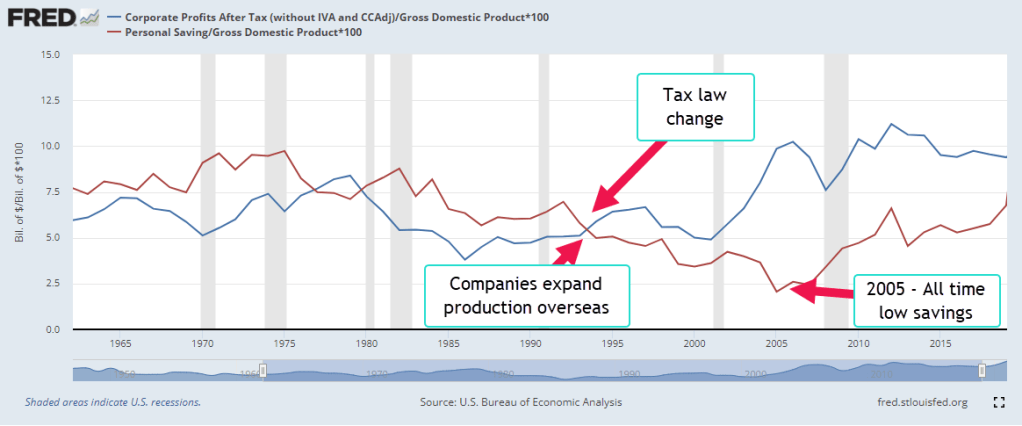
When the Republicans took control of both chambers of Congress and the Presidency, they lowered corporate taxes. Those on the left often blame the economic elite for society’s problems and wasted no opportunity in criticizing Republicans for gifting the corporate elite. Mr. Trump boasted on his business prowess, promising to get the economy revving up again. Despite his rhetoric, corporate profits remained at the same level as during Mr. Obama’s second term.

A Presidential veto can block legislation but it is Congress that passes the laws that affect the economy. As I wrote last week Congress sometimes buys voter approval, creating bubbles that finally implode. The State Historical Society of Iowa (2019) has an image of a 1928 campaign ad for Herbert Hoover. It is a resume of economic progress under total Republican control during the 1920s. The Congress had won the public’s approval with easy credit and lax regulation. The following year the onset of the Great Depression brought down the house of cards. 25% of workers lost their jobs. Many lost their homes and farms.

Corporations exist to turn money flows into profits. Whatever money Congress spends winds up in corporate coffers. After 9-11, the federal public debt rose by $3 trillion (U.S. Treasury Dept, 2019) while corporate profits more than doubled, all thanks to Congress. Democrats and Republicans supported higher military spending and a building boom supported by easy credit policies.

In response to the pandemic, a bipartisan effort in Congress passed relief packages of more than $3 trillion. Today the public debt is $7 trillion above the pre-pandemic level. Much of that money became corporate profit because that’s what good companies do – turn cash flows into profits. Some of those profits were then used to buy the Treasury bills generated when the government increased their debt. This completed the cycle of debt and profits.

On average voters re-elect 90% of House members and 80% of Senate members. Midterm elections are less than two months away. Both parties take advantage of the public’s tendency to pin responsibility – good or bad – on the President, both the current and the past President, Mr. Trump. “Inflation is Biden’s fault,” Republicans will say and hope it sticks with some voters. Democrats hope that Trump will announce a 2024 run for President before the coming midterm election. They hope that independent voters, particularly suburban women, will vote for Democrats to voice their disaffection with Mr. Trump.

The election spending will juice the profits of media companies who depend on the craziness of our democratic politics. People in western European countries look in dismay at our frenzied politics that makes us vulnerable to a populist like Trump. Some Americans long for authoritarian measures that might curb the craziness of our politics and promote more cooperation. They are tired of the demolition derby of American democracy and wish they could go to sleep for a few months until it is over.

////////////////////

Photo by Anvesh Uppunuthula on Unsplash

State Historical Society of Iowa. (2019, January 14). “A chicken for every pot” political ad, October 30, 1928. IDCA. Retrieved September 16, 2022, from https://iowaculture.gov/history/education/educator-resources/primary-source-sets/great-depression-and-herbert-hoover/chicken If you have a moment, do check this out!

BEA: U.S. Bureau of Economic Analysis, Corporate Profits After Tax (without IVA and CCAdj) [CP], retrieved from FRED, Federal Reserve Bank of St. Louis; https://fred.stlouisfed.org/series/CP, September 16, 2022.

U.S. Department of the Treasury. Fiscal Service, Federal Debt: Total Public Debt [GFDEBTN], retrieved from FRED, Federal Reserve Bank of St. Louis; https://fred.stlouisfed.org/series/GFDEBTN, September 16, 2022.

America 4.0

September 11, 2022

by Stephen Stofka

I hope that those in the UK can find some common ground in their grief over the Queen’s death this week. Britain was still recovering from World War 2 when the crown was laid on her young head in 1952. Seventy years later, the political culture has fractured over Brexit and the repercussions of leaving the EU. There is much needed investment in a nation that has barely managed 2% growth in the past decade. In three years, three Prime Ministers have led the Parliament. The long reach of the Queen’s lifetime can help us lift our heads and take a longer view of events. When we mark history in lifetimes, not years, the beginning of our nation was about three lifetimes ago.

For most of mankind’s history, production harnessed human or animal energy, the thermal energy stored in wood and coal, and the kinetic energy of falling water turning a mill. In a world with only gradual change, there was little need for rapid communications technology. The men – yes, all men of property and standing – who crafted and voted on the U.S. Constitution lived in a world limited by crude animal and chemical power for energy, transportation and communication. John Adams, one of the Constitution’s signers, spent weeks traveling from his wife, family and farm in Braintree, Massachusetts to Philadelphia, Pennsylvania. Today, a person on a bicycle can make the journey in three 10-hour days.

The discovery and refinement of oil as an energy source changed our society and our politics. The 13th, 14th and 15th amendments of the Reconstruction Era were ratified at the dawn of a new age of energy and communications. The telegraph had only just come into use just prior to the Civil War. Edwin Drake drilled the first oil well in Pennsylvania in 1859, two years before the start of the Civil War. Those who passed the initial ten amendments and made the amendment process so difficult lived in an era where transformations of society occurred over decades or centuries. The amendments meant to protect people from the yoke of a regal government now shackle us to a historical reality that no longer exists.

America was built on a lack of consensus between regions, between a newly emerging urban population in the north and a rural population harnessed to the land in the south. In 1776, the colonies had first cohered as a mutual defense pact against the  British and the encroachment of the Spanish and French on colonial territory. The seven year war of Independence liberated the colonies from British rule in 1783 but left the colonies with a large debt. Their mutual defense pact gave a lot of autonomy to each of the thirteen states but the central government had little power or authority to tax the individual states. By 1787, that confederacy was on the brink of failure, unable to pay its debts and largely isolated from international capital markets. Under those dire circumstances, the colonies ed anew, drafting an entirely different pact that initiated America 2.0.

The American Constitution embodied the divisions of regional interests and the differing ideological principles of its founders. The proceedings were so combative that the deliberations were sealed from the press for fear that exposing the rancor between delegates would doom the  process. Three lifetimes later, we exhibit the same level of discord as our founders. Our Senate has become an insipid institution, crippled by parliamentary rules that make any Senator the ruler of his own nation, the King of Negation that stops most legislation from reaching a vote in the chamber. For 25 years, the House has passed Continuing Resolutions (CR) because they cannot pass a budget on time (Wezerek, 2018). Some years the budget is never passed and the government operates under a year-long CR.

On this 21st anniversary of 9-11, we still live in its shadow. The precautions at the airport, the fastidious matching of our names, letter for letter, hyphen for hyphen in our identification. Our nation grieved together, our Congress stood together and passed the Patriot Act. That was the end of togetherness. A common grieving does not knit a nation for long. Our media speaks a common language but the discourse – the assumptions and values that form the bedrock of our perceptions – are so different. Why? Because our Constitution has died.

Distrustful of each other, the Constitutional delegates forged a pact that was difficult to amend. They bound it so tightly that it could not expand and breathe. It is like a dead Pharoah mummified in tightly wrapped cloth and buried deep within a pyramid of time. Each year, the justices of the Supreme Court venture into the tomb to ask questions of the dead Pharoah. When they emerge into the sunlight, the people gather round to hear what the dead Pharoah has revealed. The justices speak in tongues – discourses that are intelligible to some people and babble to others. The Civil War was America 3.0. Let us grieve that our Constitution has died and adopt a new pact to celebrate America 4.0.

/////////////////////
Photo by Jeremy Bezanger on Unsplash

Wezerek, G. (2018, February 7). 20 years of Congress’s budget procrastination, in one chart. FiveThirtyEight. Retrieved September 9, 2022, from https://fivethirtyeight.com/features/20-years-of-congresss-budget-procrastination-in-one-chart/

Labor Trends

September 4, 2022

by Stephen Stofka

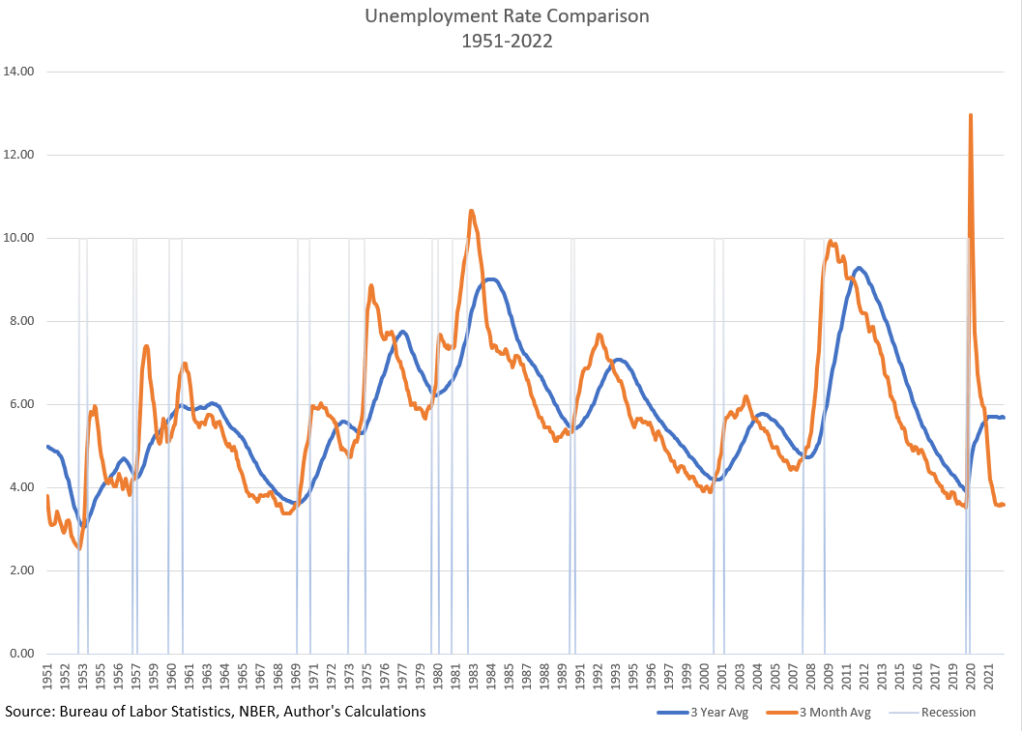
On this Labor Day Weekend I’ll review some current employment numbers and look at a historic trend whose results surprised me. The August employment report released this past Friday buoyed the stock market. Job gains remained strong but moderated from the half million jobs gained in July. The slowing gains indicated a predicted response to rising interest rates. Had the number of job gains risen to 600,000 for example, the market might have sold off. Why? Currently the market is predicting a rise in rates to a range of 3.5 – 4.0% in the next year. A labor market resistant to rising rates would have implied that the Fed would have to set rates even higher to cool inflation. Secondly, the unemployment rate rose .2% to 3.7%, another indication that rising rates are having a modest effect on employment. Modest is the key word.

The participation rate – the percentage of working age people who are working or looking for work – rose slightly to 62.4%, still 1% below pre-pandemic levels. Reopening classrooms and the further relaxing of pandemic restrictions are contributing factors. Additional family members may be joining the workforce to cope with rising household expenses. The number of marginally attached workers – those who want a job but haven’t actively looked for a job in the past month – declined to 5.5 million, still a half million above pre-pandemic levels. These “discouraged” workers remain below 1% of the labor force, a level indicating a strong labor market. President Obama inherited an economy in crisis and the percent of discouraged workers declined to nearly 1% but not below. As the rate fell below 1% in the first months of the Trump presidency, Mr. Trump cheerfully took credit. A politician and his followers blow their horns to encourage others others to join their coalition.

Surprises

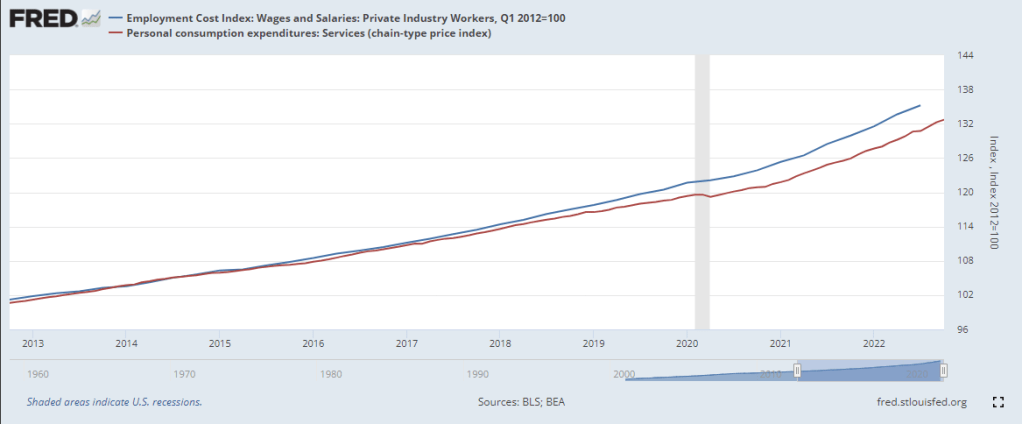
A 17,000 employment gain in financial jobs surprised me. Rising interest rates have lowered mortgage applications and I thought the employment numbers for the financial industry would decline. Lastly, weekly earnings are up over 5.6% but have not kept up with inflation. Unemployment numbers are low, job openings are high. Why don’t workers have more pricing power?

A Historic View

Earlier this week I was looking at labor slumps since World War 2. These slumps are periods at least six months long. They start when the number of workers first declines. They end when employment finally surpasses its previous high. Employment first declines about two months after the start of a recession, as the NBER later determines it*, so it is a lagging indicator.

I split the period 1950-2022 into two 36 year periods. The first period lasted from 1950-1986; the second period from 1986-2022. In the first period there were 7 recessions and employment slumps. In the second period there were 4 recessions and slumps. Even though there were more recessions in the first period, the number of months of sagging employment was far less than the second period, 131 vs 168. No doubt that was due to the 75 month long slump of the Great Recession. That’s an extra three years of a lackluster job market which affected demand for workers and the pay they could command. In the chart below I have sketched the labor slumps. Economic recessions have a lasting impact on the labor market.

In the first period, the longest slump lasted 26 months during the early 1980s recession when the unemployment rate rose above 10% and inflation was in the teens. That began in September 1981 and lasted until November 1983. In the second period, the job market sagged during the Great Recession for 75 months, from February 2008 until May 2014. The least severe slump was this last one, beginning in April 2020 and ending in April 2022. The recession in 2001 lasted only 6 months but the labor slump lasted 40 months, from June 2001 until October 2004, just before the 2004 election.

Wages

More prolonged slumps affect wages. In the chart below the BLS compares nominal and inflation-adjusted median weekly earnings over the past twenty years. The real earnings of workers have barely risen because they are not sharing in the productivity gains of the past decades. The earnings gap between men and women has varied little during that time.

Contributing Factors

Why are labor slumps lasting longer during this later period? There are many contributing factors. When there was a larger manufacturing base recessions were more frequent but workers were brought back to work more quickly. The two recessions of the 2000s made that decade the hardest on workers. The two labor slumps totaled more than five years during the decade.

The 1970s gets a bad rap but it was the 1950s which had the second largest number of months when employment sagged – a total of 3.5 years. Standing five decades apart, the 2000s and 1950s had very different economic and family structures. Fewer women worked in that post war decade. The waiting period for unemployment insurance was twice as long and benefits lasted less than four months. These were inducements for workers to find any kind of work to support their families. Union membership was much higher in the 1950s so workers could rely on those benefits while unemployed. They would not have wanted to lose their union membership so they might have worked off the books for cash while they waited for hiring to pick up at the same company or the same industry. Like so many economic trends, the interaction between factors is complex and not readily identifiable.

Conclusion

Reckless speculation was the main contributor to the two recessions in the 2000s. Financial shenanigans played a smaller role in the slump of the early 1990s. The increased length of these slumps in the last four decades supports an argument that our economy has lost too much of its manufacturing base and is out of balance. There is too much financial speculation and not enough actual production. The federal deficit has increased so much in the past two decades because the private economy cannot generate enough growth on its own.

//////////////

Photo by Patrick Schneider on Unsplash

*The NBER marks only the decline portion of a general economic slump so the gray shaded areas will be shorter than the labor slump. However, the chart illustrates the prolonged effect that an economic decline has on the labor market.

BLS. (2022). Median usual weekly earnings of full-time wage and salary workers by sex. U.S. Bureau of Labor Statistics. Retrieved September 2, 2022, from https://www.bls.gov/charts/usual-weekly-earnings/usual-weekly-earnings-over-time-total-men-women.htm

Price, D. N. (1985, October). Unemployment insurance, then and now, 1935–85. Social Security Administration. Retrieved September 3, 2022, from https://www.ssa.gov/policy/docs/ssb/v48n10/v48n10p22.pdf

The Water That Connects Us

August 28, 2022

by Stephen Stofka

Several events this week share a common theme. President Biden announced a partial student loan forgiveness program.  Fed chair Jerome Powell announced the central bank’s firm commitment to tame inflation. The justice department is pursuing tens of thousands of fraudulent claims related to the pandemic federal relief programs. California Governor Gavin Newsome announced that the state will completely phase out gas fueled cars by 2035. What do these four events have in common? Government officials taking action to shield or relieve individuals from some oppressive force – a debt burden, rising prices, a pandemic, and a contributing cause to climate change. Government is a raft, an anchor of safety that we must share if we are to keep our heads above the water that connects us.

The physical world does not care whether human beings acknowledge or deny climate change. In 2013 the IPCC released their fifth assessment of the global climate. They were careful to note that they could not project individual small weather events like thunderstorms but that there would be more extreme weather events. Tree ring data indicates that this two decade drought in the west last occurred 1200 years ago. Agriculture uses 80% of the total amount of water humans use and have been severely impacted by water rationing. The federal government and states have spent billions fighting fires throughout the west. In recent days several southern states have experienced “1000 year” floods. They have declared emergencies to trigger federal assistance for cleanup and rebuilding.

The sun pours a flow of energy on the earth. Greenhouse gases like carbon dixoide retard the escape of the heat from that energy. California’s initiative is a key declaration of an aspirational agenda to lessen the release of greenhouse gases.  Building an infrastructure for thousands of electric vehicles is a Herculean task. So was the journey from Independence Missouri on the Oregon Trail in the 19th century. More of us are realizing that things have gotten to a point that we have to make some changes whether we like it or not. California has declared its intention to start the journey. Let’s hope more states will follow.

Inflation is oppressive. In a Jackson Hole summit speech this Friday Fed Chairman Jerome Powell stressed the Fed’s  commitment to taming inflation. “Inflation feeds on itself,” he said. As people come to expect higher inflation they may buy more now, making choices that actually accelerate inflation. When inflation is low, businesses and people no longer need to factor in rising prices as they make future plans. Former Fed Chairman Allan Greenspan called it “rational inattention.” The Fed has a twin policy mandate from Congress – full employment and stable prices. Because unemployment is so low the Fed feels that they can focus their policy tools on curbing inflation. Powell warned that rising interest rates would have a negative impact on both economic growth and employment. The stock market fell more than 3% in response to the Fed’s determination to keep raising rates until inflation has returned closer to their target.

David Farenthold (2022) reports that the Justice Department is pursuing tens of thousands of fraudulent claims under the CARES act. Three relief programs totaled $5 trillion, $3.1 trillion in the spring of 2020 and $1.9 trillion under the new Biden administration in the spring of 2021. Because there are so many cases, those who stole $10,000 will probably escape prosecution as investigators tackle claims with larger amounts. The Labor Department has 39,000 cases of fraudulent unemployment claims pending. The Small Business Administration has over two million fraudulent claims to investigate and verify. So far, the Justice Department has charged 1500 and secured 500 convictions. During the pandemic, Congress reached out. Many took advantage.

President Biden announced a student loan forgiveness program of $10,000 for each student with outstanding student debt and an income below $125K. The debt relief does not apply to those pursuing advanced medical and law degrees. A surge of college enrollment before and after the Great Recession drove student loan debt much higher. For-profit colleges overpromised well-paying careers to attract lower income students who qualified for federal grants and loans. Those low-income students who qualified for Pell grants will be eligible for up to $20,000 of student loan forgiveness. This will help minority students and women who typically earn less even after earning a BA degree. Most of those who graduate from 4-year schools come from the top 50% of incomes, and are endowed with more financial and educational resources prior to entering college. Whether a president has the power to forgive student loan debt is a matter for the courts. Mr. Biden’s executive action will surely be challenged.

Former President Ronald Reagan once quipped “The nine most terrifying words in the English language are: I’m from the Government, and I’m here to help.” Despite his rhetoric, Reagan headed a big spending government that helped certain groups of people. Communities near military bases appreciated his military buildup in the fight against the Soviet Union. Investment and savings banks appreciated the 1984 and 1986 bailouts from his administration. High interest rates during the early 1980s drove the economy into a deep recession and curbed inflation but crippled debt-burdened farmers. Many family farms were sold to large agricultural holding companies. Military contractors and finance companies got relief. Farmers did not.

The founders of our country thought that the business of government was to protect people from oppressive burdens. Then as now we argue about whose burdens, who pays and how they should be relieved. We are all interconnected, swimming in the same pool. Government is a big raft, a temporary rest from a lifetime of staying afloat. At times we appreciate the hand up when someone says, “I’m from the government and I’m here to help.”

////////////////
Photo by Jong Marshes on Unsplash

Fahrenthold, D. A. (2022, August 16). Prosecutors struggle to catch up to a tidal wave of pandemic fraud. The New York Times. Retrieved August 25, 2022, from https://www.nytimes.com/2022/08/16/business/economy/covid-pandemic-fraud.html

United Nations. (n.d.). United Nations Charter. United Nations. Retrieved August 26, 2022, from https://www.un.org/en/about-us/un-charter/full-text

Community Consensus

August 21, 2022

by Stephen Stofka

Over a century ago, the passage of the 16th Amendment allowed the federal government to tax earnings from labor, giving the central government entry into the lives of every American. Fifty years earlier, Congress had passed an income tax to pay the debts incurred during the Civil War. In 1895, the Supreme Court ruled that taxes on income were a direct tax that must be apportioned in accordance with Article 1, Section 8 of the Constitution. The 16th Amendment bypassed that uniformity requirement to tax incomes at different rates. The target of the income tax was the top 1% but within two decades the tax affected low and middle income groups. The stated goal of current income taxation is income distribution and a leveling of outcomes. A century after the passage of the income tax, income distribution has reached record levels of inequality (FED, 2021). As a leveling device, the income tax has failed.

As tax rates on income increase, incentives to evade the tax rise. Those with the highest rates lobby to have their income excluded or be taxed as a special class. As advocates of Modern Monetary Theory point out, a sovereign nation that issues its own currency does not need tax revenues to fund itself at the margin. Taxes act as a restraint on the purchasing power of private parties and the spending priorities of government. Because income taxes are not levied uniformly, they are especially subject to corruption and political influence by those most damaged by the tax. Billionaire investor Warren Buffett has noted that he pays a lower tax rate than his secretary. A tax law meant to curb inequality thus promotes inequality under the law.

Bitcoin* promised anonymous transactions between people at a low cost. It’s anonymity promoted the principle of uniformity, treating large and small transfers equally. The principle of peer-to-peer exchange without government oversight, taxes or exchange fees recalls an earlier time in our history when there was a quasi-boundary between society and the federal government. Society is built on agreement. The foundation of government is forced compliance with the law. An example is our courts and police forces. Political economy is the marriage of these two institutions, force and agreement. Economics is the study of exchange in the search to satisfy our needs. Politics is the study of the division of rights and power. Needs and rights must ever be in conflict.

In conventional exchange, rights are recognized and protected by a government body. Enforcement involves sanctioned force that is concentrated in a small proportion of our society and that concentration of power makes government subject to corruption. The deluge of lobbyists on Capitol Hill is a testament to the dominant power of the federal government. Bitcoin distributes the recognition of rights across a vast public ledger but it lacks an enforcement mechanism to protect those rights. Bitcoin’s principle of distributed consensus offers the promise that the sanctioning of force could be more equitably distributed among majority and minority groups in our society.

Minority groups are often victimized by selective policing that keeps them penned into socio-economic spaces on the fringes of political power. An unpaid parking ticket rapidly accumulates interest and late fees, then becomes a bench warrant and makes someone subject to arrest. The owner of a delivery truck fleet in New York City with multiple double parking violations is rarely arrested. Institutions of enforcement were designed by the majority for the benefit of the majority.

Fear of the police and those institutions is felt deep within everyone in a minority neighborhood. Power tends to concentrate and leads inevitably to autocracy. A distributed ledger principle acts as a curb on that tendency. A community with digital control of police weapons might be able to disable the weapons of an abusive officer, forcing that officer onto desk duty or patrolling parking meters while an incident is investigated. What is science fiction today becomes science fact tomorrow. Fifty years ago a flip phone communicator like the one used on Star Trek was a figment of an author’s imagination. The public ledger technology that forms the foundation of Bitcoin exchange is still in its infancy but it is a vison of distributed community constraint as opposed to the autocratic constraints imposed by government.

In principle, the law is meant to be a uniform constraint. In practice, the law is a constraint warped by those with the money to buy influence and political power. Those who currently have power fight hard to keep it. If public ledger technology could be adapted to a community constraint on the use of force, those with resources would likely develop a way to modify that constraint for their own benefit. Should society abandon the pursuit of a distributed community constraint? No. The internet is younger than the oldest millennial and is pockmarked with scams and illegal activities but the benefits outweigh the dangers. Even if Bitcoin remains a private currency with limited adoption, its technology and principles point to a better world.

////////////////

Photo by Alexandre Van Thuan on Unsplash. A library is a distributed perspective.

*I’ve used Bitcoin as a substitute word for digital currencies in general.

Federal Reserve Bank of St. Louis. (2021, October 15). How has income inequality changed over the years? Saint Louis Fed Eagle. Retrieved August 20, 2022, from https://www.stlouisfed.org/on-the-economy/2016/june/how-has-income-inequality-changed-years