Poverty

This past week the Census Bureau released their annual estimate of median income and poverty.  For 2009, the poverty level increased from 13.2% to 14.3%.  Economists and policy makers have been debating the definition and calculation of poverty since the introduction of the social welfare programs of the Great Society  in the 1960s.  Since the mid-nineties, many have called for a revision of the calculations that gives weight to cost of living variances in the country.  To most people, that makes sense.  Because it makes sense, it is a political hot potato.  The thresholds of poverty are used to determine eligibility for a number of federal programs.  Adjusting  those thresholds would qualify many more people for assistance in some areas, particularly larger metropolitan areas, while disqualifying some in rural areas where the cost of living is less.

How does the Census Bureau measure poverty?  They include all cash income but non-cash items like Medicaid, food stamps and housing subsidies, like Section 8, don’t count as income. (Source)  To qualify for housing assistance, the family’s income may not exceed 50% of the median income for the county or metropolitan area in which the family chooses to live.  The rent subsidy is generally the lesser of the payment standard minus 30% of the family’s monthly adjusted income or the gross rent for the unit minus 30% of monthly adjusted income.

Let’s look at two “traditional” families of four in Denver, Colorado, where wages and cost of living are only slightly above the national average. (Source)

In Family A, Dad works a regular job as a laborer for $12 an hour for 35 hours a week, slightly more than the median hours worked per week, earning about $22000 per year.  Family A’s income is at the poverty level, qualifying them for housing assistance, Medicaid, food stamps and other assistance programs for meeting their monthly bills.  Family A’s adjusted income per HUD standards is gross income less about $500 per dependent, or $20K.  They would pay 30% of that for rent, $6000, for an apt renting for about $9600 annually, receiving about $3600 in tax free income.  In addition, they would get about $325 in food stamps  per month, or another $4000 in untaxed income.  In addition, Dad would get $34 per week in Earned Income Credits, paid by his employer, for an annual total of about $1800.  Since they qualify for Medicaid, this family would have no or minimal health insurance premiums. This family would pay no federal or state income taxes but they would be subject to the FICA payroll tax of about $1650 per year. This family’s net effective income is about $30K.

In Family B, Dad works for $22 per hour for 35 hours a week, earning an annual gross of $40,000, about 16% – 18% less than the median household income for Denver but about equal to the median wage.  This family’s income is in the 40th percentile of Denver area income, slightly above that percentile for the country as a whole.  This family does not qualify for either  housing assistance, Medicaid, food stamps, the energy assistance program LIHEAP or the Earned Income Credit. Dad pays 50% of a $1200 HMO family medical plan which his employer offers, an annual cost of $7200.   This family pays about $120 per year in federal and state income taxes and $2500 in FICA taxes.  This family’s net effective income is also $30K.

Two families – one at the poverty level of income, one slightly below the median income level – have approximately the same level of disposable income.  Either there are a number of families classified as poor who really aren’t poor or about 40% of the households in this country are effectively at or below the poverty level.
Income Disparity

Beth referred me to a Slate article by

This article has a decided “liberal” slant.  The graph showing disparities in income leaves out “transfers of income”.  In July 2010, the BEA reported that transfer payments were 1/6 of total personal income, or about 30% of what people got paid in wages and salaries.  Transfer payments include Social Security, unemployment insurance, back to work welfare programs, pell grants, etc, etc.  There is disparity of income but Paul Krugman and others who have a strong political agenda pick out the data that most strongly shows their case.  Income is income.  In the early part of the 20th century there were no social safety net programs and few transfer payments.  Now, they comprise a significant part of income for a growing part of the population and should be included for comparison.

A final note:  There will always be disparities in income, disparities in circumstance, disparities in ability.  James Madison, the primary architect of the Constitution, was well aware of this and wrote in Federalist #10:
 

The diversity in the faculties of men, from which the rights of property originate, is not less an insuperable obstacle to a uniformity of interests. The protection of these faculties is the first object of government. From the protection of different and unequal faculties of acquiring property, the possession of different degrees and kinds of property immediately results; and from the influence of these on the sentiments and views of the respective proprietors, ensues a division of the society into different interests and parties.

Those who hold and those who are without property have ever formed distinct interests in society. Those who are creditors, and those who are debtors, fall under a like discrimination. A landed interest, a manufacturing interest, a mercantile interest, a moneyed interest, with many lesser interests, grow up of necessity in civilized nations, and divide them into different classes, actuated by different sentiments and views. The regulation of these various and interfering interests forms the principal task of modern legislation, and involves the spirit of party and faction in the necessary and ordinary operations of the government.

The violence of factions had brought down previous republics like Greece and Rome.  What can remedy this natural tendency of people to form factions?

There are two methods of curing the mischiefs of faction: the one, by removing its causes; the other, by controlling its effects.
There are again two methods of removing the causes of faction: the one, by destroying the liberty which is essential to its existence; the other, by giving to every citizen the same opinions, the same passions, and the same interests.

Realizing that the cures for faction are worse than the disease of faction, Madison constructed a Constitution by which the different factions in this country would push and pull for power.  Unlike utopians who dream of a better world if only people weren’t so self-interested, Madison understood that self-interest was natural to people and developed a legislative structure that could hopefully balance those competing interests.
Today we have become a country of factions fighting for federal largesse:  farmers who want price supports, the unemployed who want benefit extensions, students wanting more generous student loan programs and grants, industrial towns wanting government support to bring businesses to their area, banks and car companies wanting bailouts, consumers wanting ever more protections, seniors wanting generous cost of living adjustments to their pensions, people wanting more regulations, people wanting less regulations, etc, etc.  We are turning into a country of supplicants raising our voices in a cacophony of “Gimme” and “It’s mine.” 
And we call ourselves a great nation.

Taxes and King Kong

As the wounded giant ape King Kong clung tenaciously to the spire of the Empire State Bldg, a cynic on the streets below remarked “If the planes don’t get him, they’ll tax him to death.”

Shortly after the invention of taxes in 492,000 B.C. came the invention of weary cynicism by those who had to pay the taxes.

Although income and social security taxes make up the majority of taxes we pay, it is the myriad little taxes that seems to get our goat. You have probably seen something similar to the following in an email or posted somewhere on the web:

Not one of these taxes existed 100 years ago:

Sales Tax, Hotel Tax, School Tax, Liquor Tax, Luxury Tax, Excise Taxes, Property Tax, Cigarette Tax, Medicare Tax, Inventory Tax,Car Rental Tax, Real Estate Tax, Well Permit Tax, Fuel Permit Tax, Inheritance Tax, Road Usage Tax, CDL license Tax, Dog License Tax, State Income Tax, Food License Tax, Vehicle Sales Tax, Gross Receipts Tax, Social Security Tax, Service Charge Tax, Fishing License Tax, Federal Income Tax, Building Permit Tax, IRS Interest Charges, Hunting License Tax,
Marriage License Tax, Corporate Income Tax, Personal Property Tax, Accounts Receivable Tax, Recreational Vehicle Tax, Workers Compensation Tax, Watercraft Registration Tax, Telephone Usage Charge Tax, Telephone Federal Excise Tax, Telephone State and Local Tax, IRS Penalties (tax on top of tax), State Unemployment Tax (SUTA), Federal Unemployment Tax (FUTA), Telephone Minimum Usage Surcharge Tax, Telephone Federal Universal Service FeeTax, Gasoline Tax (currently 44.75 cents per gallon), Utility Taxes Vehicle License Registration Tax, Telephone Recurring and Nonrecurring Charges Tax, etc, etc. 


I get as annoyed as the next person at paying many of these taxes but I would rather have the inventions that spurred some of these taxes.  Some of these taxes have been around for more than a hundred years.  Like so much information on the internet, the list is partly true. Property, hotel and lodging taxes have been with us for centuries.  School taxes began with the advent of public education.  In this country, school taxes began in the mid 19th century.  There were no cars or telephones so no taxes of what did not exist yet.  Someone not wanting to pay these taxes could simply not own a car or telephone.  The IRS was not invented till about 1913 – coming up on a 100 year anniversary for that most hated institution.  Get out the party hats!

The marriage license tax dates back to the 17th century according to this history of London.  In earlier centuries there was “aid” or scutulage, paid by peasants to their lord for the eldest son’s marriage.  For those who want to go back to the old days, have at it.  I will stay in the present, thanks.

Over a hundred years ago, you would pay a horse tax, a saddle tax, a buggy tax, a tax on the lodging of the animal, and in larger cities, a tax to clean up the streets after your horse did his thing.  Horses were the 19th century’s version of a stimulus program for anyone who could use a shovel.  There was no unemployment tax because there were no unemployment benefits.  If you lost your job, you moved your family in with friends or other family or lived on the street or in a vacant warehouse.  Those were the good old days.  If you want to experience those good old days, you can visit any number of countries where people still live like that even when they have jobs.

An episode of Star Trek that we will never see is the one about taxes in the 23rd century. Although they had – or will have? – replicators, replicators can’t materialize everything.  So a likely subspace email in the 23rd century would list: Replicator tax, Subspace Access tax, Quantum Fluctuation tax, Starship tax (someone’s got to pay for all those trips), Transporter tax, Atomic Anatomy Conversion tax, Peripheral Dispersion tax, Dilithium Crystal Tax, Dilithium Mining Tax, Dilithium Resource Replenishment Fund for Mining Planet’s Inhabitants Tax, Faster Than Light (FTL) Access Tax, Wormhole Endangerment Tax, Captain Kirk Acting Lesson Tax, Vulcan Ear Tax, Data Cosmetic Tax, Dr. McCoy Liquor Tax, Holodeck Tax, Holodeck Modeling and Engineering Tax, and the one tax that really griped people of the 23rd century – the Sulu Sword Tax.

The future looks – well, kinda like the present – with a few changes.

Reagan and Obama

As the 1982 elections approached, Ronald Reagan’s Presidency was unpopular. The unemployment rate was 9.7%, about the same as it is now. Interest rates were high: a 6 month CD paid about 13% interest, which was good for those who had savings but terrible for small business owners who had to work extra hard to pay the 20% interest rate banks were charging for business loans. The dead carcasses of 17,000 businesses littered the economic and social landscape, one of the highest failure rates since the 1930s depression. The stock market was in the doldrums – why bother investing in stocks when bonds and CDs paid such generous interest rates?  GDP had grown an anemic 2.2% the past year.  The national debt had gone up by 14% that year.  In short, the Reagan Presidency was promising to be one of the worst in American history. 

In 1982, the voters realized that they had traded in a bumbling governor from Georgia, Jimmy Carter, for a bumbling governor from California, Ronald Reagan. After the election, Democrats, already in control of the House of Representatives, were given another 25 seats and a commanding majority.  The Republicans continued to hold a slim majority in the Senate.

Shortly after the election, Reagan launched his “Star Wars” or Strategic Defense Initiative (SDI), long on imagination and his willingness to further bankrupt this nation, but rather short on any actual ability to employ such a grandiose scheme.  In the first year of Reagan’s reign, tax rates had been cut but the Social Security tax had been raised so, for most of us working for a living, it was pretty much of a wash.  Inflation was killing us.

If you are an older Republican, you may have forgotten those years.  They have been conveniently hidden under the party mattress by the Republican campaign machine and the retelling of the “Reagan legacy.”  In the seventies and early eighties, there was so much distrust in the judgment and morality of elected representatives that it was a strategy by some disaffected voters to pull alternate levers in the voting booth, voting Democrat on one row, then Republican on the next row, in order to gridlock the government.

Reagan kept on borrowing on the taxpayer’s credit card.  By the time he left office, the national debt had tripled. 

Midterm elections often are a vote on the Presidency and the dominant party. The Democrats may have to give up most of the 30+ Congressional seats they won in 2008, making it even more difficult for President Obama to get his agenda enacted.  In 30 years, how will the story of the Obama presidency be told?  Will it be altered or swept under the table by the Democratic campaign machine just as the Republican machine has retold the Reagan years?  Probably.

Both Reagan and Obama had monumental tasks in their first few years, burdens so great that neither of them could achieve their goals in a short two years.  However, voters focus on the present, throwing hindsight, history and perspective out the window as they drive down the rutted road of the present.  The political machines of both parties know this and play to that short attention span. Unemployment is high, just as it was in Reagan’s 2nd year.  Obama can only hope that, by 2012, the unemployment rate gets down to the 7.4% rate it was in 1984, when Reagan came up for re-election. 

Traditionally, the political campaigns get into gear after the Labor Day holiday.  There is one thing we know for certain:  we will be entertained by a lot of lies and half truths for the next few months.  If you listen to talk radio, both conservative and liberal, you are accustomed to this kind of entertainment year round.

(Side note 9/8) Here is a CNN  review of some of the tax policies and their effects during the Reagan administration.

Gimme Money

The U.S. Census Bureau released its annual Federal Funds report and the 24/7WallSt web site has done a pictorial analysis of the charts in the report that is a bit more illustrative of the distribution of government funds than the charts in the Census Bureau report.  This long holiday weekend, we can all have fun finding how much per capita our state gets from the Feds. 

David Walker, the former Comptroller under the Bush administration, criticized the accounting methods of the U.S. government, which uses a cash accounting system just like a small lawn mowing company does.  As such, the government shows Social Security taxes as income and Social Security payments as expenses.  This distorts the true fiscal health of this country – a benefit for elected politicians who would prefer that their constituents not know the true picture.

Romer Regrets

Jerry referred me to an article by Dana Milbank at the Washington Post, relating comments by the departing Christina Romer, Chairman of Obama’s Council of Economic Advisors.  According to Mr. Milbank, Ms. Romer said “she still doesn’t understand exactly why [the economic collapse] was so bad.”   Ms. Romer, well respected in her field, will probably share some of the blame for underestimating the deep structural weakness of an economy in which all the players had become over leveraged. In Ms. Romer’s defense, the cautious Federal Reserve, including the former chairman, Alan Greenspan, and the stock market underestimated the problem as well.  The Fed called for a recovery in the latter part of 2009.  The market’s rise from the March 2009 lows signalled the same outlook.  The stock and bond markets reflected the opinions of a majority of economists at investment houses, mutual funds, hedge funds.  How could so many educated people be wrong?

Ms. Romer is a proponent of Keynesian economics, a theory that government spending can offset the lack of demand in the private sector during recessions.  When John Maynard Keynes proposed his theory in 1930, his remedy of government spending was an antidote to smooth the regular ups and downs of business and economic cycles. In his theory, Keynes proposed that governments then run surpluses during good times to counteract the overly heated demand of the private sector.  As such, Keynes could not have imagined that governments would run up the large amounts of debt that they have in the past decades.  His theory was never designed for a recession or depression resulting from such a massive over-leveraging of both public and private debt.

Misjudging the scope and severity of the collapse of this asset and debt bubble led economists like Ms. Romer to think that Keynesian solutions like the stimulus bill passed in early 2009 would provide a substantial “kick” to the economy.  The stimulus bill has helped stopped the bleeding but the wound is deep.  Government tax credits for house and car purchases did little more than shift those purchases forward in time. Stimulus payments to states helped avoid state and local government employee layoffs – for a while.  They did nothing to fix the central problem:  businesses and consumers are paying down debt that they have spent almost a decade accumulating.  That de-leveraging is going to take time.

Economists who have a more classical view of the mechanics of commerce predicted that we might tip into a double dip recession, at worst, or a very slow “U” shaped recovery starting in 2010.  As a number of economic indicators turned positive in the early part of 2010, these same economists thought they might be wrong.  Some Keynesians felt vindicated as this economic data seemed to show that their model of government spending could shorten even a severe recession.

In February,  government deficits in Greece and several other European nations revealed the structural weakness of their economies and caused the stock and bond markets to question whether these smaller economies could withstand the relatively high ratio of government spending and debt as a percentage of each country’s GDP.  Germany, a paradigm of conservative fiscal policy, was forced to step in to help support these less fiscally responsible nations.  The European Central Bank, supported by the Federal Reserve, professed a firm support for the bonds of these weaker European nations.  With the magic that only central banks possess, the Federal Reserve pumped $1.2 trillion into U.S. government backed mortgage securities, signalling that it would not allow the newly recovering economy to fall back. In the spring of 2010, the market once again turned to the recovering economy.

Employment usually lags in any recovery and so many expected the unemployment rate to stay high going into the early part of 2010.  In April, after 8 or 9 months of expansion in the manufacturing sector and a recovering service sector, economists were expecting at least some reduction in the unemployment rate.  By late June and early July there appeared to be little increase in hiring.  Those who believed in a more traditional “V” shaped recovery began to have doubts and the market dropped to reflect these lowering expectations.

Week after week come conflicting economic reports, the Federal Reserve is running out of tools other than the rampant printing of money and the unemployment rate stubbornly hangs from the cliff of 10%.  Classical economic models seem to more accurately reflect the slow, tortuous climb out of the debt pit.

Decades from now, regardless of what happens, Keynesian economists will still profess that Keynes’ economic model was right – with perhaps a few modifications to their theory.  Classical economists who agree with the models of Hayek and Friedman will maintain that they are right – with a few modifications.  Fifty or a hundred years from now, our kids’ grandkids will get to do it all over again because too many policymakers would rather cling to their theories than learn from experience.

The Big Picture

Or maybe the title of this post should be “The Big Pitcher”.  No, it’s not about a tall baseball pitcher, but the glass pitchers that central banks around the world hold.  What comes out of the pitcher when the central banks start pouring?  Money.  How do they do that?  It’s magic.  Don’t you wish you had a money pitcher?

Jerry forwarded me an article by someone at Matterhorn Asset Management, a Swiss asset management company that invests primarily in metals as a wealth preservation model so they will have a predisposition to a gloomy outlook because investors’ fears will bring more business to the company.  That said, the article presents a 200 year review and outlook on the mechanics of inflation and rather dire long term predictions for the world economy.

Featuring a 150 year chart on the Consumer Price Index and another one of US Debt to GDP ratio, this 6 page article definitely takes a long view of events in the past in making prognostications of the future. 

A comparison of the 19th and early 20th century with the latter part of the 20th century has to be put in a bit more perspective than this article does.  Electricity is something we take for granted but its effect on our lives has been as profound as the discovery of fire and the invention of cooking.  It is an energy that is readily available to most people in developed countries.  This ready source of energy has radically transformed our society, our productive capacity and our demand for products that use this energy.

In the 1920s, the new industry of radio telecommunications kicked off a bubble in the stock market.  Some predicted that we would walk around with communication devices that we wore on our wrists.  Information would be readily available to all with these cheap and portable two way radios.  It would be another 70 years before this dream would become a reality with the internet and the dawning of the cell phone age.  That in turn prompted another stock bubble in the late nineties.

When countries around the world abandoned the gold standard in the past century, they did so because the supply of gold could not keep up with the rapid expansion of production and demand that accompanied the energy and communication age.  How profound has this expansion been?  Several historians have noted that a person living in Boston in 1780 would have felt familiar with most of what surrounded him in that same city in 1900.  Jump ahead another 50 years to 1950 and that same person would be totally disoriented in a city with electricity, flashing lights, automobiles, subways, TVs, radios and the sheer growth in the population of the city.

The gold standard simply could not accommodate this rapid expansion of economic activity.  However, the gold standard put brakes on the centuries old tendency of sovereign countries to print money or debase the currency.  After abandoning the automatic regulatory mechanism of the gold standard, we have found nothing comparable to provide some restraint on central bankers other than a trust in the wisdom and foresight of those like Ben Bernanke, Chairman of the Federal Reserve.  An entire world of billions of people depends on the wisdom of several hundred individuals making decisions at central banks around the world.  It is a daunting and vulnerable position we find ourselves in.

House of Fear

Today the National Association of Realtors (NAR) released their monthly estimate of existing home sales.  The market was expecting a decline but the decline of 27% was far below the expected 10% decline.  This, in turn, prompted another down day on Wall Street.

Fear has two parts:  the logical part – caution, and the illogical part – panic.  So what panicked Wall Street this morning?  In the  NAR Press release was this from NAR’s chief economist:

“Even with sales pausing for a few months, annual sales are expected to reach 5 million in 2010 because of healthy activity in the first half of the year. To place in perspective, annual sales averaged 4.9 million in the past 20 years, and 4.4 million over the past 30 years.”

Yes, you read that right.  NAR is projecting existing home sales this year to slightly exceed the 20 year annual average and to easily outpace the 30 year average.  In a down economy, above average is bad?  The report also noted an increase in housing prices.

Crude oil prices have fallen to a price near $70 but the price of a gallon of gas is 7 cents more than it was a year ago, showing that oil companies have seen a slight pickup in demand for gasoline.

The market is like a driver in a car with no rear view mirror.  Shoulders hunched, head thrust forward over the steering wheel, the market focuses only on the mountainous gravel road that is the near future. When the market is rising, it discounts bad news as a small speed bump in the road up the mountain of riches.  When the market is falling, it discounts good news as a small braking in the headlong rush into the valley of the poor.

The Drifters

Matt brought up some good questions and comments yesterday.  I’ll look at one aspect that he brought up – the stagnation of wages for the past 35 years.

Over the past 3 to 4 decades, the U.S. economy has been transitioning to an almost entirely service based economy.  In 1953, manufacturing was 28% of the economy, a post WW2 high.  By 1995, it was only 16% of the economy, and by 2007 it had sunk to 12%.  How has this decades long shift affected the nation’s GDP?

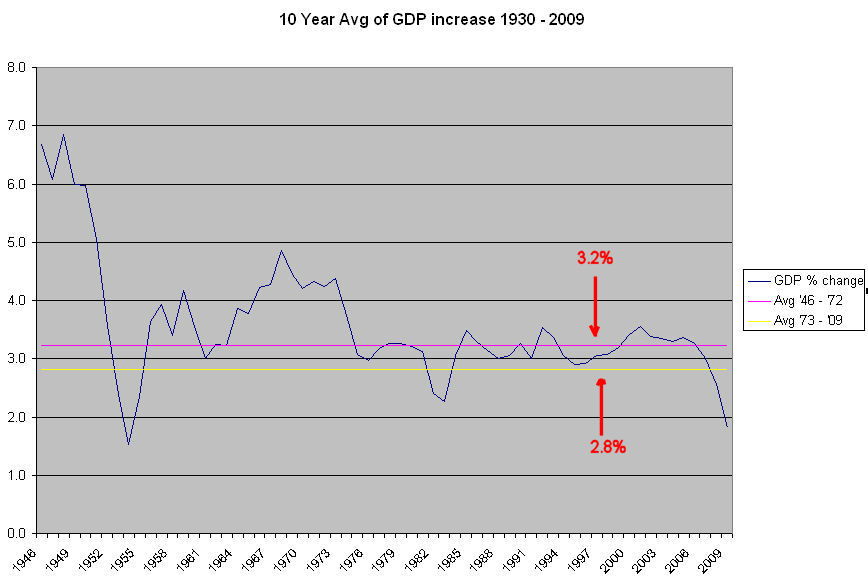
Below is a graph of U.S. GDP 10 year averages since WW2 and the averages for the periods 1946 – 1972 and 1973 to 2009.  (Click to enlarge)

Source:  Bureau of Economic Analysis

As you can see, average GDP growth has declined in the last 35 years by 12% from the 25 year period after WW2. I have heard Ben Bernanke, chairman of the Federal Reserve, say that they like to see an overall 3.0% average growth of GDP for a healthy economy – not too hot, not too cold. For the past 35 years, we have been just shy of that.

In this next chart, I combined data from the Bureau of Economic Analysis and the Census Bureau to show real GDP per capita growth  in 2009 dollars. 

In this next chart, I’ve drawn trend lines to show the various “speeds” of real GDP per capita growth over the past 60 years.  As you can see, the growth trend of the last 30 years or so has been below the growth trend of the 1960s.  The data also reveals that the 60s was an anomaly – a decade of robust growth that was partially fueled by military spending.  Yet it is this decade that some use as a baseline of comparison – a golden age of increased productivity and increased wages.

Although the growth of the past 3 decades might not be what it was during the 60s, it still averages 2.8%.  Have workers seen any of those gains in growth?  According to the BLS, the 1987 average hourly cost, including benefits, for workers in private business was $13.25, or $26.37 in 2009 dollars.  In March 2010, the BLS reports the average hourly cost at $29.71.  Over the past 24 years, companies have seen their real employee costs rise by only 13%, or about 1/2 percent a year.

During that same period, benefits have risen from 27% of total employee cost to 30%. Despite a 50% increase in inflation adjusted costs for health care in the past decade, businesses have managed to hold their labor costs down.  How have businesses managed this?  By reducing average wages.  In 1973, average hourly earnings for employees in private business was $4.14 ($20.00 in 2009 dollars).  In 2009, average hourly earnings were $18.62.   In real inflation adjusted dollars, workers have gained a tiny bit in benefits and lost about 5% in wages over the past 35 years.  Workers have simply not enjoyed either the gains in GDP growth or the gains in productivity over the past 3 decades or more.

But the pain felt by hourly and salaried workers is aggravated by the decline in work hours.  The BLS reports  that average weekly hours was 36.9 in 1973.  In 2009 weekly hours averaged only 33.1.  The reduced hours has affected the average worker’s weekly total.  In 1973 it was $152.77, or $738 in 2009 dollars.  In 2009, it was $617, a real drop of 16%.

How have business owners been able to keep a lid on worker wages for these past 35 years?  Supply and demand.  As I noted above, GDP growth has lessened over the past three decades, reducing demand.  During that period, the supply of labor has increased. In 1973, the BLS reports that there were 64 million in the civilian workforce, 40 million men and 24 million women.  The civilian workforce was 30% of the population of 212 million.  In 2008,  the total civilian workforce had almost doubled to 125 million, 67 million men and 58 million women.  This workforce was 41% of the total population of 304 million.  Look at the ratio of men to women in the workforce.  In 1973, there were almost two men for each woman.  By 2008, the ratio approached a one-to-one ratio. As more women entered the workforce, they put downward pressure on wages, which induced more women to enter the workforce to make up for lost household income.  This cycle will continue for the next two decades unless this country decides to implement policies that will return some of the lost manufacturing capacity to this country.

Productivity and You

In an article for the online magazine Slate, Daniel Gross presents the plight of the many employees who have jobs and are fed up with them.  I’ve been there, done that – a number of times in my life – so I can relate.  Now I’ll give you the other side of the picture.

Appearing before the House Joint Economic Committee on Aug. 6th, Keith Hall, the Commissioner of the Bureau of Labor Statistics, reported that about 98% of employees in this country work for a company with 50 employees or less.  He stated that there have been small increases in hiring by larger companies but hiring by small companies is flat or has decreased slightly.

Small companies are the economic engine of this country and they are not hiring.  Until small company owners starting hiring, workers will continue to endure almost record unemployment. This administration has only just begun to address this issue with talk about a loan program for small businesses.  For the past 1-1/2 years, they have been focused on the viability of big companies, those that produce 2% of the jobs in this country.  This administration thought that by helping the big guys, they would be helping the little guys – a kind of trickle down economics.  By the time the presidents and many vice-presidents at the big companies get done taking their share of the administration’s stimulus money, that’s about all that is left for the smaller companies – a trickle.  Little wonder that the real engine of this economy is sputtering.

The reluctance of small business owners to hire is due to several factors:  caution, fear, and uncertainty about future sales are top reasons.  Others are: a lack of readily available business loans, excessive employee regulations and the burden of employee payroll taxes and benefits.  Politicians like to make promises of a safety net for all employees, but who builds that safety net?  Small business owners.

Many small businesses have had to lay off employees in the past 2 – 3 years and those layoffs jack up the unemployment rate on each business.  In response to the rise in unemployment, many states also charge employers an additional tax surcharge.  My company’s unemployment insurance rate has quadrupled in the past two years. If a small business owner hires an employee and business drops off after six months, the owner will have to let the employee go, which will only increase the unemployment insurance rate again.  This self-defeating cycle of increasing taxes only makes small business owners more cautious about hiring.

In a downturn, small employers try to let those employees go who have the least productivity, leaving only the more productive workers to get the job done.  As a result, productivity goes up.  During downturns, the employees who have jobs are reluctant to push for raises and that, in turn, keeps a damper on labor costs, which helps increase productivity.  There are a number of other factors that have contributed to increased productivity in the past decade, but the chief one is investment in technology.  Better technology has enabled workers in a variety of industries to be more productive.  Daniel Gross, the writer of the Slate article, seems to think that it is because employees are working harder.  While that may be a minor contributing factor, people can only work so hard.  Better tools produces the biggest sustained gains in productivity.

The Bureau of Labor Statistics recently released their preliminary report of productivity for the quarter ending in June. For those readers who like graphs, the first page of the report has graphs of productivity for the past 5 years. For the first time since 2008, productivity declined about 1%.  In late 2007 and early 2008, labor costs increased dramatically, putting downward pressure on productivity.  Does Daniel Gross think that the downturn of productivity in 2008 meant that workers were goofing off that year?  When the economy gets strong or overheated, workers can demand higher pay for their work, which lowers productivity. 

There is an old saying “I never got a job from a poor person.”  While that may be true, it is also true that, for most of us, we get a job from a small business owner and most of those owners are not rich, just a bit better off than the people they hire.  Many smaller businesses are funded in part by the equity in the owner’s home.  The owner borrows against that equity to expand a small business or to fill in the cash flow gap that occurs frequently to many smaller business owners.  As the real estate market tanked, many small business owners saw their home equity decline or evaporate, making banks less willing to extend a business loan.

What answers does each of our political parties have to this small business funding crisis?  After 1-1/2 years of not thinking it was a problem, the Democrats will craft some complicated program that involves a lot of paperwork that small business owners will have to fill out.  What do the Republicans offer as a solution for the small business lending crisis?  Why it’s the one answer that Republicans give for all problems – lower taxes.  Neither party could fix a leaking drain.