Experimental Philosophy

March 21, 2021

by Steve Stofka

At a Senate Banking Committee hearing this week Senator Tim Kane presented a comparison of two philosophies of governing. Without any Democratic support, Republicans passed the Tax Cut and Jobs Act (TCJA) in December 2017. Prior to its passing, the non-partisan Congressional Budget Office estimated the loss of revenues at $1.5T over ten years. After two years of data, they revised their estimate of lost revenue to about $1.8T. The bulk of the benefits go to the top 20% of incomes. Without any Republican support, Democrats passed the American Rescue Plan (ARP) two weeks ago. Its estimated cost is $1.9T over ten years. This bill will benefit the bottom 60% of income earners. Two plans, two philosophies, similar costs.

Tim Kane suggested that we are having a real-world experiment. Both laws are projected to cost the same amount. Economists already have performance metrics on the Republican law from 2018-2019, the two years before Covid.  In 2023, economists can compare performance and benefits of ARP which exemplifies the Democratic philosophy.

The essence of the Republican philosophy is an assumption that income and benefits will “trickle down” from the top 20% of income earners, the wealthy in America. After three decades of Republican rhetoric that income should trickle down, many economists find the opposite trend. Those at the top get wealthier.

The Gini coefficient is a measure on equality/inequality. 0 represents perfect equality, 1 represents perfect inequality. In 1972, the Gini coefficient for household income in the U.S. was .4. In the fifty years since, that coefficient has risen to .48 (FRED Series GINIALLRH), near the mid-point of the equality/inequality range. An economic analysis can only confirm what many Americans sense intuitively; life is getting easier for the wealthy and harder for the middle and working classes.

The Republican philosophy espouses tax cuts and a strong defensive posture around the world which has led to a constant state of war. Former President Trump had to fight his own party to cut back troop commitments in Iraq and Syria. These twin goals – a larger military and tax cuts – are incompatible and have caused bigger deficits than Democratic administrations over the past forty years. Republican voters care about deficits so Republican politicians continue to pay homage to the idea despite their poor performance on that count. Republican politicians counter that it is the Democratic benefit plans that cause deficits, not Republican military spending and tax cuts.

Democrats champion more benefits and higher taxes on high income earners to pay for the benefits. Most of those high-income earners are in solidly Democratic states, not Republican political strongholds, so there is little advantage to Republican resistance to higher taxes. Republicans are opposed to higher taxes on principle, not politics. They believe that there are few legitimate functions of central government under Federalism: 1) provide a common defense and make treaties, what John Locke called a Federative power in his Second Treatise of Government, 2) resolve disputes between states, 3) preserve property and individual freedoms. The several other functions like coining money and post offices can be found in Article 1, Section 8 of the Constitution.

The heart of the dispute between Republican and Democratic voters lies in their different interpretations of the General Welfare clause of that section, i.e., that Congress shall have the power to “provide for the common Defence and general Welfare of the United States.” Democratic voters believe that phrase means Congress should provide for the welfare of the people in each state. Republican voters believe that it applies at the state level. In interpreting the Second Amendment, Democrats and Republicans switch; Democrats think gun rights apply to state militias while Republicans think those rights apply to individuals.

These are long standing arguments and opinions that resist change, despite the experimental data. I agree with Tim Kane that we have a chance to compare economic philosophies. I disagree that the results will change many minds. We don’t like to change our habits or opinions.

//////////////

Photo by Bermix Studio on Unsplash
Bennies From Heaven

May 19th, 2013

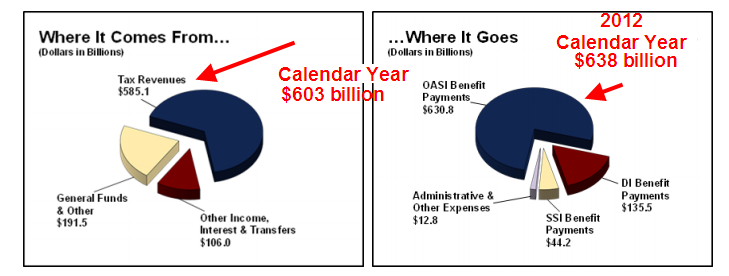
During the past several years, a demographic and economic shift crossed below the zero line.  For decades, Social Security taxes collected exceeded Social Security benefits paid.  The Federal Government “borrowed” this excess and used it for other programs.  Since 2010, there has been nothing to borrow.  The Social Security Administration (SSA) has several sources of revenue, but the bulk of its revenues is what we commonly call the Social Security tax, or FICA.  However, this tax has several components.  The largest portion of the tax – the Old Age and Survivors Insurance tax (OASI) – is to pay out social security benefits and it is this component I wanted to look at.  SSA gives a pie chart of its revenue and benefits paid.

I have shown the latest revisions to the pie chart but it gives you a sense of the revenue and expense components.  A table of SSA income and outgo shows only the total receipts and expenditures.  When we look at the OASI component, we can get a sense of the upcoming political debates and financial pressures.  SS benefits paid are already exceeding OASI tax receipts.  Below is a chart of SSA data showing the surplus and deficit for the past ten years.

On January 1st, the Congress let lapse the 2% reduction in payroll taxes.  In the first quarter of 2013, that has meant an additional $245 billion in revenue to the Treasury. (Source).  Since the money all goes into the same Federal pot, the additional revenue has forestalled the debt limit debate till this fall.

The SSA records other income, including income taxes on the SS benefits paid out.  This is a “pencil” income entry: the IRS keeps track of taxes paid on SS benefits and “transfers” them to the SSA.  For decades, this pencil entry has increased the SS surplus and Congress borrowed it.  The SSA charges interest income to the Federal government and records this pencil income as more money that the Federal government owes the SS trust funds.

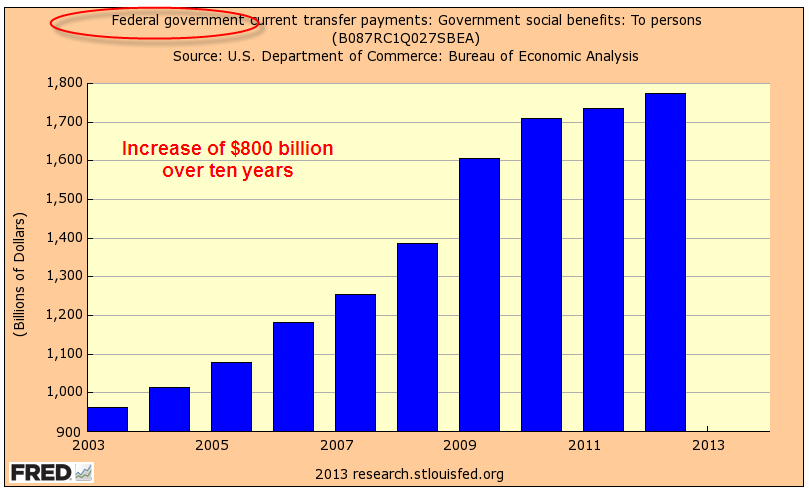
The bottom line is that SS is a “pay go” system.  Current taxes pay for current benefits.  When benefits exceed the taxes devoted to pay for those benefits, the money has to come from somewhere.  That “somewhere” is the Federal government, but it can only get those funds from you and I and the companies who pay corporate taxes.  More troubling is the ever increasing percentage of federal tax receipts devoted to paying social benefits of one form or another.  These include, SS, Disability, SSI, TANF, SNAP and a host of other programs.

As people become increasingly dependent on the government for their welfare, they will put increasing pressure on politicians to maintain or increase these benefits.  This political pressure only heats up the political debate over how to pay for these benefits.  At the federal level, benefits have increased by $800 billion over the last ten years.

Including the states and local governments, the increase is over $1 trillion.

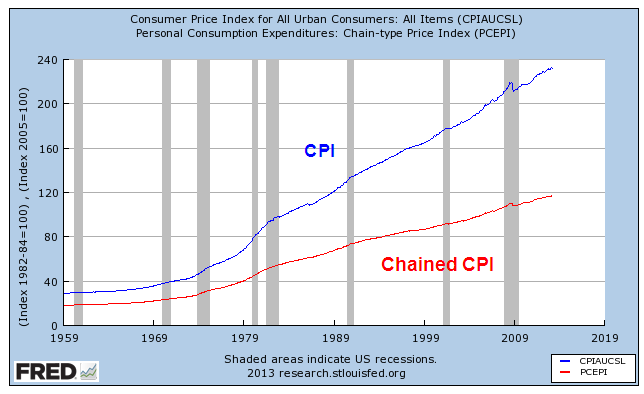
Any cuts in calculating benefits are met with a firestorm of protest from those who are, or will, collect those benefits.  Few care about the accuracy of calculating cost of living adjustments to these benefits.  Whatever calculation provides the best benefit becomes the most “accurate” calculation.  The current debate is whether to use the CPI or what is called a Chained CPI.  Over several decades, the CPI gives the most increase in benefits.

40% of the calculation of the CPI is housing cost and the calculation of that cost, called Owner’s Equivalent Rent, has almost tripled in the past thirty years, boosting the CPI.

Census data shows that 2/3rds of the 132 million households in this country own their homes.  Before the housing boom, a primary reason for owning a home was to lock in a monthly payment, avoiding rent increases.  Taxes, upkeep, and energy costs do go up, but the majority of a house expense, the mortage payment, is a fixed cost for many homeowners.  However, the Bureau of Labor Statistics, which compiles the CPI, calculates the housing component of the CPI as though a homeowner was renting from herself.

according to the National Association of Realtors, between 1983 and 2007 the monthly principal and interest payment required to purchase a median-priced existing home in the United States rose by 79 percent, much less than the rental equivalence increase of 140 percent over that same period.” (BLS Source)

We will continue to have a lively debate over the calculation of the CPI because it influences millions of Social Security checks each month.  We can anticipate that this debate will be at the forefront of the upcoming 2014 elections.  Why?  Because the debate stirs passions on both sides and that is what politicians need – passion.  Passion provokes people to vote.  Passion promotes donations.  Passion ignites political volunteer efforts.

The trend of worsening deficits between SS contributions and the benefits paid will only worsen as we get into the latter half of the decade.  Before the 2010 elections, we were treated to the spectacle of angry old people – without makeup – yelling at politicians to keep their stinkin’ government hands off their Medicare, itself a government program.  In the upcoming years, the debates over Social Security will make those earlier demonstrations seem rather mild.  Old people vote.  Angry old people vote a lot.