Money – the Shape Shifter

December 10, 2023

by Stephen Stofka

This week’s letter is about public goods and the characteristics of public goods. I’ll discuss whether money or a digital currency is a public good. I’ll explore the four types of goods as economists classify them. These properties can enrich our understanding of some contentious debates. Hop on board as we tour the safari park of economic ideas.

Economists use two criteria to classify goods: whether they are rival and whether they are excludable. Rival means that one person’s consumption of a good lessens another person’s consumption of the good. An excludable good means that there is a feasible mechanism to prevent someone from consuming a good. A private good is both rival and excludable. A public good is both non-rival and non-excludable. It helps to look at public goods from a cost perspective. The marginal cost of providing the good to one more person is practically zero. The marginal cost to prevent someone from consuming a public good is very high.

An example of a public good is the national defense. One person’s protection from attack has little if any effect on another person’s protection. A country cannot practically prevent someone from being protected. Another example is firework displays. Although we call the street out in front of our house a “public street,” it is a toll good or club good according to these characteristics. Once built and maintained, the cost for one more driver to use the road is zero so it is non-rival just like the national defense. But it can be made exclusive at a reasonable cost by restricting access. A toll road is an example. A city makes a street public by decree, not by any characteristic of the road. A decree can be undone as when a city converts a city street to a pedestrian mall.

Another type of good is rival but non-exclusive. These are called pooled goods. A classic example is fishing in the ocean. The fish that someone catches are no longer available to someone else so they are a rival good. However, it is difficult and costly to prevent someone from fishing in the ocean. Pooled goods typically include natural resources or game animals. A government manages the depletion of the resource by issuing licenses and imposing fines. Overfishing of the world’s oceans has been a contentious issue for decades.

Governments have managed the problem of pooled resources by selling a property or use right to a private owner. The manager restricts access to the resource and charges a fee to users of the resource, effectively turning a pooled good into a toll good. A use right might be in the form of a 99 year renewable lease or a public-private partnership where a private company manages a park or other natural resource. 

These characteristics can provoke some lively discussion. For instance, is money a public good? It might seem so. It costs almost nothing to make another $1 of currency. But providing the next $1 of currency requires billions of dollars of legislative and judicial debate because public spending is rival. If that $1 is spent on one cause, it cannot be spent for another project. If transferred to one person, that same $1 cannot be given to another person. Is it excludable? Social spending programs are based on criteria that exclude some while entitling others to the benefits of the program. We argue so much about “public” spending because the spending itself has characteristics of a private good. It is rival and excludable. Once built an air defense system might act as a public good, providing non-excludable protection. The spending itself is not a public good.

Let’s follow the path of a tax dollar. It went from a private party through a banking system that restricts access to money resources, then into a government pool where it became an indistinguishable unit of tax revenue, a pooled good, then became private again when the tax dollar was spent or transferred to someone. If spent, the use of the good or service became public in some sense. An air defense system or the building of a public library, for example. If transferred to a person, the money was spent in the private economy for goods and services like food and rent. The  transformation of private dollars to public pot and back to private dollars is accompanied by a lot of heated debate.

The money supply has characteristics of a pooled good although it is not a natural resource. In circulation it acquires the characteristics of a natural resource, a good that has many access points. A government manages the money supply like a pooled resource. It licenses out the ability to create money to member banks, imposing some regulations and trusting that the discipline of gain and loss will cause banks to act prudently when making loans that increase the money supply. However, banks don’t just loan money to individuals and businesses. They loan money to financial institutions who loan money, thus magnifying the power of the money-creation process.

Money in the economy acts like a magnetic field in a giant turbine. The turbine turns as long as the magnetic field keeps changing. Money has the characteristics of a private good in exchange, then a pooled good in taxation and a toll good in the banking system, and then a private good again. Money can buy public goods and services but can’t assume the characteristics of a public good. Like money, a digital currency like Bitcoin has an exchange power between private parties that relies on the seller’s willingness to accept payment in Bitcoin. But it cannot act as another type of good because the government refuses to accept Bitcoin as a payment for taxes. Doing so would interrupt its control of the money licensing process. Money then becomes an intermediary in a Bitcoin exchange, like the Universal Translator on the original Star Trek TV series. Money is adaptable to each type of good for which it is exchanged. That adaptability gives money power, a power that governments have abused in centuries past, giving people a cause for concern.

///////////////

Photo by Richard Horvath on Unsplash

Keywords: private goods, public goods, toll goods, club goods, private goods. Bitcoin, digital currency.

New Technology, New Laws

July 16, 2023

by Stephen Stofka

This week’s letter is about the impact of the internet and digital technologies on our laws. New technologies introduce new connections between people and institutions. What was once separate when a law was written becomes joined under the new technology. Advocacy groups emerge to pressure policymakers to shape new laws and regulations that incorporate a recent technology.

Over twenty years ago, the increasing volume of internet sales not subject to sales tax challenged the meaning of tax nexus. This was a retailer’s physical presence within a state that required it to collect sales tax on purchases and remit those collections to the state. The Sales Tax Institute has a nice explainer on the various types of nexus and the history of court decisions on the topic. Several characteristics of cryptocurrency have challenged policymakers and legal interpretations.

On Thursday, the stock of the Coinbase exchange shot up 25% on the hope that it will prevail in its attempt to operate outside SEC regulations, those that govern conventional market exchanges and securities brokers. A month ago the agency had charged Coinbase for operating as an unregistered securities exchange. On Thursday, a district court judge in a case involving another blockchain ruled that crypto assets were not securities in many cases. The judge cited the Howey test, a 1946 Supreme Court decision that set forth characteristics that defined a security. This past March an article at Coin Telegraph explained the history of the Howey test.  The key phrase in the Howey decision is that an investment contract is “an investment of money in a common enterprise with profits to come solely from the efforts of others.” Is crypto a “common enterprise” whose profits come “solely” from the efforts of others?

The judge’s ruling strengthens the argument by some that crypto has many characteristics of a collectible, which is not considered a security. Classifications rely on shared as well as distinguishing characteristics. Anomalies challenge classification the way that the platypus challenged biologists’ definition of a mammal. Advocates of crypto claim that it is a trustless system of exchange but let’s examine that claim.

A barter transaction between two people is the only exchange that does not involve a third party in some way. Trust is an implied intermediary in an exchange between two parties. Crypto or cash, there is some third party involved in a transaction. Our cash money may read “In God We Trust” but our trust is really in the Federal Reserve, an agency of the U.S. Government. Crypto exchanges have a fiduciary duty to the owners of the crypto coin the exchange holds. That fiduciary duty invites government regulation and it will be a battle of advocacy groups to shape the laws that create those regulations. This week Coinbase may be confident that it will prevail against SEC regulation but there will be an ongoing effort to impose some regulation to protect owners of crypto. As policy is shaped over the coming years, crypto owners can expect that crypto exchanges will experience similar abrupt reevaluations.  

/////////////////

Photo by Earl Wilcox on Unsplash

Honesty, Power and Crypto

July 2, 2023

by Stephen Stofka

This week’s letter is about lying and some types of lies, the key part they play in our society and the steps we take to uncover and counter lying. This week’s picture by David Clode on Unsplash is that of a butterfly wing, not an owl.

Like many animals, humans survive by signaling. A growl, the curl of a tail or a frown on a face are forms of signaling. Lying is a signaling tool that we use to get something we want. We may want protection from some threat so we lie. We may want approval from others so we lie. Lies come in several colors. Lies told for some social or public purpose are called white lies. In the 1969 Frazier v. Cupp decision, the Supreme Court ruled that the police could make false statements to gain a confession. These are known as blue lies. There are red lies told to hurt someone or their reputation. We tell green lies to gain some financial advantage.

People are so good at lying that public agencies and private companies spend billions per year to prevent fraudulent claims. As Jennifer Pahlka (2023) noted in her book Recoding America, policymakers will spend far more than a $1 to prevent paying out $1 of a fraudulent claim even if it means that legitimate claimants have to wait longer to receive their benefits. Policymakers are rarely as responsive to people’s needs as they were during the pandemic. In a rush to serve millions of people laid off during the pandemic, many fraudulent claims flooded state unemployment offices. According to an indictment filed in May, recently elected Congressman George Santos (R-NY) was one of those who made a fraudulent claim with New York State and received $24,000 while already employed.

Politicians like Santos attract news coverage but it is not clear that they are any more dishonest than the population in general. It is true that those who are uncomfortable with lying are cautioned not to run for office. Lying is an accepted tactic to confound the opposition, gain a policy foothold or some electoral advantage. Within a democracy, the electoral process is a competition of lies and boasts that political scientists call branding. There is no “truth in advertising” standard that politicians must adhere to when they run for office. It is the voters who must beware when they “buy” whatever ideological concoction a politician is selling. The voters are supposed to act as a giant sieve, straining out the fabrications, the incompetent and crackpots. It is not a perfect system.

The Bitcoin algorithm was designed to “crowd-source” property claims, spreading the verification process to the many nodes in a historical transaction chain. Yet the 15 year history of Bitcoin and other digital currencies has been punctuated with episodes of large scale fraud. According to a Justice Dept. investigation, in 2011, customers of Bitcoin exchange Mt. Gox learned that most of the bitcoin stored on the exchange had disappeared. Over a three year period, Russian hackers with unauthorized access to the exchange’s server had stolen most of the Bitcoin stored there. Dishonesty 1, digital security 0.

Forms of digital communication like email allowed scammers to send a lie for a fraction of a penny, far below the cost of bulk mailing. The Federal Trade Commission reported that consumers lost $8.8 billion to fraudsters in 2022. Money transfers, both legitimate and criminal, happen with the flip of some ones and zeroes. Digital currencies can be stolen at far less personal risk than holding up a physical bank so it is surprising that more crypto is not stolen each year. CNN reported an estimate that $3.8 billion worth of digital currency, most of it DeFi, not Bitcoin, was stolen in 2022. That’s just 0.45% of the $840 billion in the market cap of cryptocurrencies at the end of 2022, as tracked by Coin Gecko. The technology that underlies digital currencies could be adapted to verify other forms of transactions.

A century from now, we may put digital currencies in the same historical bucket with the worthless stock certificates of hundreds of railroads and mines issued in the 19th and early 20th century. History is littered with broken dreams destroyed by deceit. Dig down to the ideological foundations of digital currency, however, and there is an enduring idea that will outlast whatever the current form of digital currency trading and transfer. That idea is as old as the Constitution – checks and balances. Money is information and information is power. Unless that power is checked, it accrues into an autocratic regime or an economic monopoly. Digital currency represents a yearning for a check on the accumulation of economic and political power. That idea will not go out of fashion.

///////////////////

Show 20230702ButterflyWing.png

Photo by David Clode on Unsplash

Keywords: honesty, crypto, Bitcoin,

Pahlka, J. (2023). Recoding America: Why government is failing in the Digital age and how we can do better. Metropolitan Books, Henry Holt and Company.

The Money Information Network

June 25, 2023

by Stephen Stofka

This week’s letter is about money, both conventional and digital, prompted by the news that Argentina’s yearly inflation just passed 100%, 25 times the U.S. rate of inflation reported a week ago. Let’s not confuse money and the banking system. Money exists within a banking system. The regimes, or set of rules, that govern that system are fluid but the institutions that manage that regime have evolved over centuries. The pillars of international institutions rarely crumble suddenly.

On Monday June 19, Bitcoin’s 24 hour volume was $10B, almost 2% of its $513B market cap. M1, the measure of transactional money like cash and checking accounts, was $18.6 trillion, about 36 times the market cap of bitcoin. Bitcoin’s algorithm changed the nature of money hoping that the adoption of Bitcoin would bypass the hegemony and inequities in the global banking system.

Satoshi Nakamoto, the pseudonym of the developer of the Bitcoin algorithm, understood the informational nature of money. Let’s explore that informational model. Economics students learn the three roles that money plays: a unit of account, a medium of exchange, and a store of value. The banking system manages a network of information databases. That’s the store of value function. That information is denominated in various currencies, the unit of account function. As a medium of exchange, access to that information is mostly guarded by a banking system that manages permissions. Our credit or debit card number is a password into that exchange.

Within this database model, cash is a permission-less and anonymous public information source that can be exchanged freely and (usually) confers a property right with that exchange. However, the availability and flow of cash is managed by central banks.  Satoshi designed Bitcoin to take advantage of those two characteristics of cash and avoid the negative aspects of central management, including the risk of inflation. To avoid a central gatekeeper, Bitcoin’s algorithm introduced a lot of nodes as gatekeepers. Those nodes formed a path of past exchanges which verified the existence of the funding source for an exchange.

Some entity had to keep a digital record of those exchanges, however. That has become a vulnerability in digital currencies because the exchange is also a broker, facilitating trades within its own exchange. Conventional securities are traded in an environment where the exchange, like the New York Stock Exchange, and the broker, like Vanguard, are entirely separate. Not so with digital currencies and that presents an opportunity for mismanagement and fraud. The implosion of the FTX exchange owned by Sam Bankman-Fried is a recent example. Until digital currencies can separate their broker and exchange functions, they are vulnerable to these shenanigans. Yes, the banking system is subject to mismanagement and fraud but the gatekeeper, the government, provides some recourse.   

Bitcoin is like a set of Christmas lights with many bulbs. If one goes out, a circuit may not complete and a transaction between two parties be recognized on both ends of the exchange. The banking system is like a network of traffic lights in a city. Traffic lights are permissions. Should one go out, a policeman will likely show up to manage those permissions and direct traffic. There is no recourse when a node in a digital currency block goes out or an exchange produces tokens to cover its trading losses.

Nations are their own banks and their security and welfare depend on that status. Wikipedia lists more than 150 central banks among the 195 countries in the world. The adopters of bitcoin and other digital currencies dreamed big but cannot overcome the political advantages of such a system. The dream of one-world currency may be destined for the same graveyard where the one-world government envisioned in the 1990s went to die. The hope that digital currency embodies will live on.    

////////////////

[20230625Lights.png]

Photo by Aedrian on Unsplash

Keywords: bitcoin, money, banking

The Ghost of the Past

December 25, 2022

by Stephen Stofka

Merry Christmas and Happy Holidays! This last letter of the year will be about choices and wishes, about means and ends. Aristotle distinguished between choice as a means and a wish as an end. A wish can be an illusion of choice, but it is not a choice. A choice is a path toward a wish. A wish is the reason for making a choice. Understanding the role of choice and wish in our lives can help us become more prudent investors.

A principle of economics is that choice involves an opportunity cost, the giving up of one thing for another. A child who wishes to be a basketball star soon learns that this requires many hours of layups and passing drills, shooting foul shots and other exercises that are the means to achieve that wish. The time spent doing those activities cannot be spent on some other activity and is an opportunity cost. An opportunity cost is a sunk cost that should not factor into our next decision but people have a natural aversion to loss. Investors are cautioned not to “marry” their investments, meaning that we shouldn’t stick with an investment simply because we don’t like taking a loss.

A post hoc analysis of a series of events may yield little useful information that will guide us in future choices because the pattern of events and choices will likely not be repeated. A seasoned executive of a bankrupt company may make a post-mortem comment, “We expanded too fast for our target market.” When we spend time analyzing a chain of decisions within a unique set of circumstances we do not spend time doing something else. We are lured by the illusion that the ghosts of past events can communicate with the ghosts from our future, that we can learn from the past. Most of the time, we can’t.

“I should have sold this spring when it was near 50 and rates were low,” a guy in front of me in the checkout line remarked to his friend, then they stepped forward to one of the self-checkout machines. I guessed they were talking about Bitcoin and mortgage rates. We judge the quality or accuracy of our choices by the information or insight we gain later. We can drive ourselves crazy with this type of time travel.

During the past two decades, the median sales price of a home has increased 4.7% per year. Disposable (after tax) personal income has risen only 4.1% per year. House prices in relation to disposable income is near the height of the 2000s housing bubble, as shown in the chart below.

A 20% down payment on a conventional house mortgage is a wish that takes a long reach. Choices include an FHA loan with a smaller down payment, cutting back on expenses or working an extra job for additional income. To some, Bitcoin was another choice, an asset whose value would increase faster than the average 10% annual gain in stocks or the paltry interest paid by savings accounts during the past decade. A $10,000 purchase of Bitcoin might grow to the size of a conventional down payment in just a few years. Even though Bitcoin’s price has fallen dramatically from the heady levels of $65,000 in November 2021, the price is still double its $8,000 price in January 2020. That is an annualized gain of almost 20%, double the 9.45% average annual gain of the SP500 total return (2022).

Each year is an unfolding narrative with no dress rehearsals. To alleviate the uncertainty, we look to the past and extrapolate into a future guaranteed to be unlike the past in significant ways. We wish we could predict the future, but our choices help construct our future. We can only look in front of us.

/////////////////////////

Photo by Kalen Emsley on Unsplash

S&P 500 Total Return Index, [SP500TR], retrieved from https://finance.yahoo.com/quote/%5ESP500TR/history?period1=1041292800&period2=1671753600&interval=1mo&filter=history&frequency=1mo&includeAdjustedClose=true, December 23, 2022.

U.S. Census Bureau and U.S. Department of Housing and Urban Development, Median Sales Price of Houses Sold for the United States [MSPUS], retrieved from FRED, Federal Reserve Bank of St. Louis; https://fred.stlouisfed.org/series/MSPUS, December 24, 2022.

U.S. Bureau of Economic Analysis, Disposable household income [W388RC1A027NBEA], retrieved from FRED, Federal Reserve Bank of St. Louis; https://fred.stlouisfed.org/series/W388RC1A027NBEA, December 24, 2022.

U.S. Census Bureau, Household Estimates [TTLHHM156N], retrieved from FRED, Federal Reserve Bank of St. Louis; https://fred.stlouisfed.org/series/TTLHHM156N, December 24, 2022.

A Money Evolution

December 11, 2022

by Stephen Stofka

This week’s letter is about biological and monetary evolution. Darwin proposed that biological evolution is a process of adaptation to one’s environment. Herbert Spencer, a contemporary, coined the phrase “survival of the fittest” and Darwin adopted it but came to regret it. His theory argued that species survived not because they were the strongest or most able but because they fit the environment. Sean Carrol (2006) titled his book The Making of the Fittest but his book could have been more appropriately titled The Making of What Fits. The genetic process does not produce a series of super species because such a species would overwhelm or consume its environment. A species develops attributes that help it cope with its genetic defects and this adaptation helps it find a niche within its environment. 

As an example, the skin of dogs and cats cannot synthesize Vitamin D from sunlight. They must get it from their diet, from other creatures who can store Vitamin D (Zafalon et al., 2020). Dogs and cats partnered with a species who provides a steady diet of meat directly or indirectly. People store grain which attracts rodents and small mammals, a source of Vitamin D for cats and dogs. Cats and dogs have a far greater range and sensitivity of hearing and seeing, making them excellent sentries and hunters of small animals. Money is not a species, but a direct mechanism of exchange and an indirect property relationship. Still it has and continues to evolve.

Gold and other “hard” currencies have survived for centuries. Gold is durable yet malleable but so is iron which people have made into tools since the first cities and towns formed many millennia ago. Iron is a common element but in metal form, it oxidizes. Gold does not, but it is found in few places on earth, a characteristic defect that humans adopted as a money. However, the inflexible supply of gold produces deflation, a rise in its exchange value and a fall in the price of goods. Because of this, gold does not adapt well to growing economies. Investors are hesitant to support new ventures if the price of their produced goods are likely to fall. In Part 2, Chapter 2 of the Wealth of Nations Adam Smith noted the critical shortage of hard currency in the growing economies of the American colonies. In 1764 Parliament had passed a law making the issue of paper money illegal and this rightly angered the colonists. Because they were unrepresented in Britain’s Parliament, they had no say in policymaking.

Paper or fiat money solves the supply problem of hard currency. However, it’s characteristic defect is the opposite of hard currency – inflation brought on by the supply of too much money. That apparent ease of supply is deceptive. Fiat money requires a framework of financial institutions, a number of supervisory institutions to monitor the system and an enforcement force to punish counterfeiters. These institutional costs offset the relatively inexpensive cost of fiat money. To respond to inflation a central bank can increase the price of future money or credit. A sixty year regression of a key interest rate, the Federal Funds rate, and inflation shows that they respond to each other.

The model for Bitcoin (specifically, not just any digital currency) is more organic, exhibiting an S-curve growth path like rabbit populations and anything that is bounded by the resources of its environment. Bitcoin enthusiasts tout its strength as an exchange mechanism without the enabling framework of central bank and a network of financial institutions. It is democratic and trustless. Critics point out that the broader digital currency market is riddled with manipulators like Sam Bankman-Fried, the CEO of FTX and co-owner of Alameda Research, both of which owe billions to depositors. SBF has agreed to testify this coming Wednesday at both House and Senate committee hearings. Bitcoin advocates counterargue that crises unfold regularly in the current fractional reserve banking system because it is subject to fraud and poor risk management.

 Unlike fiat money, Bitcoin and gold share the characteristic defect of deflation. A rising exchange value of gold or Bitcoin attracts investors who support mining ventures for more gold or Bitcoin. When supply meets or exceeds demand, the exchange value falls and the miners may not be able to repay their loans.  Robert Stevens (2022) at Yahoo! Finance details the debt crisis of several Bitcoin miners who borrowed heavily to finance the purchase of mining machines during the crypto bull market but held onto what they mined. Clean Spark is a miner that sold more than two-thirds of what they mined. While the more aggressive firms may default on their loans, those like Clean Spark with cash can buy a mining machine for 10 cents on the dollar.

Like fiat money, Bitcoin exchange requires a global electronic and communications network. The mining of Bitcoin requires a vast network of suppliers of mining machines and a less expensive supply of electricity like hydropower or nuclear, both of which are in far greater supply than gold. Although Bitcoin is not physical, its shared location means that it is impervious to fire and easily portable. Like the U.S. Constitution, the rigidity of Bitcoin’s supply model gives it stability but makes it an inflexible instrument to address economic or social change.

Fiat money and gold have evolved together because they have opposite defects that complement each other. Fiat money depends on a trust in a government authority, is easily portable and tends toward inflation. Gold is physical and durable, does not rely on trust and tends toward deflation. Bitcoin is a mule, sharing characteristic defects with both fiat money and gold. Bitcoin shares gold’s tendency toward deflation, but is not physical. Bitcoin cannot replace gold until it can be made durable like gold. Bitcoin is more easily transported than fiat money but does not rely on trust in an authority. Bitcoin cannot replace fiat money unless it can be made to tend toward inflation. In the next century, fiat money, Bitcoin and gold may evolve together without replacing each other.

///////////////

Photo by Krista Mangulsone on Unsplash

Stevens, R. (2022, December 9). Bitcoin miners took on billions in debt to “pump their stock,” leading to a crypto catastrophe. Yahoo! Finance. Retrieved December 9, 2022, from https://finance.yahoo.com/news/bitcoin-miners-took-billions-debt-113000061.html

Zafalon, R. V., Ruberti, B., Rentas, M. F., Amaral, A. R., Vendramini, T. H., Chacar, F. C., Kogika, M. M., & Brunetto, M. A. (2020). The role of vitamin D in small animal bone metabolism. Metabolites, 10(12), 496. https://doi.org/10.3390/metabo10120496

The Fed’s Toll Booth

October 2, 2022

by Stephen Stofka

The dollar is the world’s reserve currency and its strength – its price relative to other currencies – is straining both the economies and the financial expectations of other countries. Businesses in developing countries with an unreliable currency regime often have to borrow in dollars – what is called “dollar denominated debt.” Businesses must make their loan payments in dollars so they must trade in ever more of their local currency to get the dollars to make the payment. European nations stocking up on liquified natural gas (LNG) from the U.S. are feeling the pinch as well. Why is the dollar strengthening?

In international finance there are two equations that model the relationship between expected inflation, exchange rates and interest rates. Currency traders are expecting inflation to moderate more quickly in the U.S. than in other countries. Because the U.S. has a better supply of natural gas, its energy prices will be less affected by the war in Ukraine. Secondly, the Fed has been increasing interest rates, enticing investors in other countries to invest their money in U.S. debt. The dollar-euro exchange rate has not been this low since 1999 when the Eurozone countries began using a common currency, the euro.

When the dollar gets stronger, exports decrease because American goods are more expensive to buyers in foreign countries. Imports become cheaper so Americans buy more stuff from other countries. However, if the U.S. is sliding into a recession, Americans are less likely to buy enough European imports to offset the LNG that European countries will buy from the U.S.  This will increase the demand for dollars relative to the euro, further driving up the price of dollars in other currencies.

The dollar has been strengthening against other forms of currency like gold and digital exchange mechanisms like Bitcoin. Priced in dollars, gold has lost about 16% of its value in the past six months. Bitcoin has lost 60% since March. Gold is both a commodity and a currency. Gold holds a store of work that it can do in the future. It has cosmetic and industrial uses.

Bitcoin is the product of past work only – a “proof of work” done in the past. It stores no capability of future work. It takes a lot of electricity and computing power to mine Bitcoin but it cannot store electricity for future use. If it could do so, the price of Bitcoin would go up when electricity prices went up.

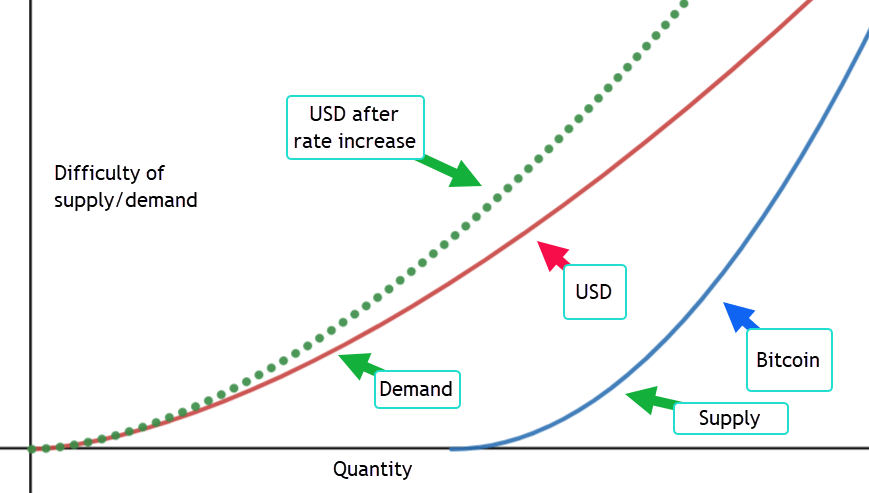
In the graph below I’ve illustrated a key difference between the dollar and Bitcoin. On the right is Bitcoin. Its algorithm incorporates a “diseconomies of scale.” As more Bitcoin is mined, it takes more effort to mine Bitcoin. Bitcoin focuses on the difficulty of supply.

On the left is the fiat dollar. There is no difficulty in supplying it. The Fed focuses on the demand for the dollar by adjusting the interest rate, the bend in the curve. It is currently tightening that bend – the dotted green curve – and increasing the difficulty of getting more dollars. The dollar can respond to changing demand more easily than gold or Bitcoin because it targets demand.

Like Bitcoin, the dollar stores no future work. In an article earlier this year (2022), I wrote that America’s store of wealth was both a proof-of-work, proof-of-stability and proof-of-trust. The dollar itself is only a sign of trust in American institutions. The checks and balances of our system of government ensures that most policymaking is incremental. While that frustrates Americans, the relative predictability of U.S. policy is reassuring to foreign investors. Americans often run around like crazy monkeys on the deck of a cruise boat but the ship is unlikely to make a large course correction.  

Think of the bend in the curve as a toll for using the highway to the future. Bitcoin’s curve is rigid. The toll remains the same. Bitcoin enthusiasts would maintain that this rigidity should shift the curve to the right over time, increasing the buying power supplied by Bitcoin.

Let’s look at three approaches.
1) Bitcoin limits the length of highway that will be built. Enthusiasts claim that this will make each “mile” of the bitcoin highway more valuable.

2) MMT advocates offer a different solution. As long as there are resources – both labor and material – available, build more highway. By targeting the supply available, congestion will ease.

3) The Fed offers an approach that targets demand, not supply. The Fed raises and lowers the interest rate – the toll – to get onto the highway to the future. Raising interest rates is a form of congestion pricing. High inflation means that there are too many people using the available length of highway. The Fed has promised that it will keep raising the toll until fewer people are using the highway. As demand declines, some of those working on the highway may lose their jobs. Unemployment will increase but historically it is very low.

The strength of the dollar against other currencies, including Bitcoin and gold, indicates increasing demand for the Fed’s approach. What is the morality of an international floating rate regime where businesses in a developing country have to work even harder to pay their dollar-denominated loans? Bitcoin advocates claim that global adoption of Bitcoin will make a more even playing field, reducing the advantage that developed countries have over developing countries. That can be the subject of another article.

////////////

Photo by kyler trautner on Unsplash

Stofka, S. (2022, April 16). Fortress of Trust. Innocent Investor. Retrieved October 1, 2022, from https://innocentinvestor.com/2022/04/17/fortress-of-trust/

Community Consensus

August 21, 2022

by Stephen Stofka

Over a century ago, the passage of the 16th Amendment allowed the federal government to tax earnings from labor, giving the central government entry into the lives of every American. Fifty years earlier, Congress had passed an income tax to pay the debts incurred during the Civil War. In 1895, the Supreme Court ruled that taxes on income were a direct tax that must be apportioned in accordance with Article 1, Section 8 of the Constitution. The 16th Amendment bypassed that uniformity requirement to tax incomes at different rates. The target of the income tax was the top 1% but within two decades the tax affected low and middle income groups. The stated goal of current income taxation is income distribution and a leveling of outcomes. A century after the passage of the income tax, income distribution has reached record levels of inequality (FED, 2021). As a leveling device, the income tax has failed.

As tax rates on income increase, incentives to evade the tax rise. Those with the highest rates lobby to have their income excluded or be taxed as a special class. As advocates of Modern Monetary Theory point out, a sovereign nation that issues its own currency does not need tax revenues to fund itself at the margin. Taxes act as a restraint on the purchasing power of private parties and the spending priorities of government. Because income taxes are not levied uniformly, they are especially subject to corruption and political influence by those most damaged by the tax. Billionaire investor Warren Buffett has noted that he pays a lower tax rate than his secretary. A tax law meant to curb inequality thus promotes inequality under the law.

Bitcoin* promised anonymous transactions between people at a low cost. It’s anonymity promoted the principle of uniformity, treating large and small transfers equally. The principle of peer-to-peer exchange without government oversight, taxes or exchange fees recalls an earlier time in our history when there was a quasi-boundary between society and the federal government. Society is built on agreement. The foundation of government is forced compliance with the law. An example is our courts and police forces. Political economy is the marriage of these two institutions, force and agreement. Economics is the study of exchange in the search to satisfy our needs. Politics is the study of the division of rights and power. Needs and rights must ever be in conflict.

In conventional exchange, rights are recognized and protected by a government body. Enforcement involves sanctioned force that is concentrated in a small proportion of our society and that concentration of power makes government subject to corruption. The deluge of lobbyists on Capitol Hill is a testament to the dominant power of the federal government. Bitcoin distributes the recognition of rights across a vast public ledger but it lacks an enforcement mechanism to protect those rights. Bitcoin’s principle of distributed consensus offers the promise that the sanctioning of force could be more equitably distributed among majority and minority groups in our society.

Minority groups are often victimized by selective policing that keeps them penned into socio-economic spaces on the fringes of political power. An unpaid parking ticket rapidly accumulates interest and late fees, then becomes a bench warrant and makes someone subject to arrest. The owner of a delivery truck fleet in New York City with multiple double parking violations is rarely arrested. Institutions of enforcement were designed by the majority for the benefit of the majority.

Fear of the police and those institutions is felt deep within everyone in a minority neighborhood. Power tends to concentrate and leads inevitably to autocracy. A distributed ledger principle acts as a curb on that tendency. A community with digital control of police weapons might be able to disable the weapons of an abusive officer, forcing that officer onto desk duty or patrolling parking meters while an incident is investigated. What is science fiction today becomes science fact tomorrow. Fifty years ago a flip phone communicator like the one used on Star Trek was a figment of an author’s imagination. The public ledger technology that forms the foundation of Bitcoin exchange is still in its infancy but it is a vison of distributed community constraint as opposed to the autocratic constraints imposed by government.

In principle, the law is meant to be a uniform constraint. In practice, the law is a constraint warped by those with the money to buy influence and political power. Those who currently have power fight hard to keep it. If public ledger technology could be adapted to a community constraint on the use of force, those with resources would likely develop a way to modify that constraint for their own benefit. Should society abandon the pursuit of a distributed community constraint? No. The internet is younger than the oldest millennial and is pockmarked with scams and illegal activities but the benefits outweigh the dangers. Even if Bitcoin remains a private currency with limited adoption, its technology and principles point to a better world.

////////////////

Photo by Alexandre Van Thuan on Unsplash. A library is a distributed perspective.

*I’ve used Bitcoin as a substitute word for digital currencies in general.

Federal Reserve Bank of St. Louis. (2021, October 15). How has income inequality changed over the years? Saint Louis Fed Eagle. Retrieved August 20, 2022, from https://www.stlouisfed.org/on-the-economy/2016/june/how-has-income-inequality-changed-years

Fortress of Trust

April 17, 2022

by Stephen Stofka

Adherents of the Bitcoin digital technology tout it as both a payment system and a store of value, two of the three functions of a form of money. In September 2021 El Salvador adopted Bitcoin as an official currency as a measure to reduce dependence on the dollar. After six months, customers and vendors, even those devoted hawkers of wares on Bitcoin Beach, have been disappointed in the results (Brigida & Schwartz, 2022). Gadi Schwartz, a reporter for NBC News (Video, 2022) related that few vendors take bitcoin anymore because it was not reliable. He and his film crew found a restaurant that did accept Bitcoin. They paid with Bitcoin but the transaction did not go through and, after ten minutes, they paid cash. Later they learned that the Bitcoin account had been deducted on their end but not at the restaurant’s end.

Bitcoin advocates point to recent inflation numbers as they make their case for a digital currency and against a fiat currency. Like gold, bitcoin does not grow enough to meet the growing needs of population and production technology. In the 18th century Adam Smith first noted the lack of gold available for the amount of economic activity in the American colonies. The use of gold as the dominant currency led to a number of crises and panics during America’s Gilded Age in the late 19th century.

Under a fiat currency regime, money can grow as needed. Price stability and prudent management of money and interest rates becomes the prime duty of a government and its central bank. To that end, the Fed sets a target of 2% annual inflation, which is the error term in calculating the change in prices and the comparison of utility we get from goods and services over time. We have all noticed the dramatic rise in prices at the grocery store and gas station but the 10 year average of annual inflation is right at the Fed’s target of 2% (FRED Series PCEPI). For years following the financial crisis in 2008, we became comfortable with disinflation, the slowing down of any price appreciation. Getting back to average inflation should not be so abrupt but the extraordinary slump in global production during the pandemic was abrupt.

Bitcoin boosters argue that a digital currency regime would curtail the government borrowing that fuels inflation, the borrowing that funds continual wars. That borrowing also funded the stimulus relief during the pandemic and kept millions safe in their homes and not hungry on the streets. The flexibility of fiat currencies can be good and bad. Currencies can be classified by time – the past and the future – and their flexibility in time. Gold and bitcoin are based on past effort and are proof of the work required to mine the currency, but both are inconvenient to use as such. The inhabitants on the island of Yap in the South Pacific mined limestone into round discs taller than a person. That proof-of-work, a highly immobile stone, became the island’s money. At the end of this post, check out the photo at the end of this Planet Money article (Goldstein & Kestenbaum, 2010).

From the earliest use of gold, people deposited their gold with a goldsmith who gave them a receipt for the gold. People then traded the receipts, not the gold (Cecchetti & Schoenholtz, 2021, 272). The gold was based on past effort but the receipts were based on the future – a promise by the goldsmith to redeem the receipt for gold. A fiat currency like the U.S. dollar is a receipt based on a promise as well. Few of us realize that the dollar in our pockets is a loan to the Federal Reserve as it appears on the Fed’s balance sheet. Want your loan paid back? Go to any bank, give them your dollar and they will give you a replacement dollar. The words on the back of a dollar bill may say In God We Trust but the dollar bill itself is a token of trust in the stability of the U.S. as a country.

As the NBC News crew learned in El Salvador, bitcoin may be proof-of-work in concept but it is not proof-of-trust in practice. The U.S. Fed stores the largest hoard of gold in the world. Like the large stones on the island of Yap, that accumulation of wealth is proof-of-work, proof-of-stability, and proof-of-trust. The proof-of-work is of the past. The proof-of-stability is the bridge from past to future. The proof-of-trust is a faith in the future.

/////////////

Photo by Donald Giannatti on Unsplash

Brigida, A.-C., & Schwartz, L. (2022, March 15). Six months in, El Salvador’s Bitcoin Gamble is crumbling. Rest of World. Retrieved April 16, 2022, from https://restofworld.org/2022/el-salvador-bitcoin/

Cecchetti, S. G., & Schoenholtz, K. L. (2021). Money, banking, and Financial Markets. McGraw-Hill.

Goldstein, J., & Kestenbaum, D. (2010, December 10). The island of Stone Money. NPR. Retrieved April 16, 2022, from https://www.npr.org/sections/money/2011/02/15/131934618/the-island-of-stone-money

NBC News. (2022, April 13). El Salvador adopted Bitcoin as a national currency. here’s how it’s going. NBCNews.com. Retrieved April 16, 2022, from https://www.nbcnews.com/nightly-news/video/el-salvador-adopted-bitcoin-as-a-national-currency-here-s-how-it-s-going-137673285897

A Coin of the Realm

December 20, 2020

by Steve Stofka

As bitcoin surged past $20,000 in value this past week, I wondered what the world would look like if bitcoin were the dominant medium of exchange on our planet. A little more than a decade ago the algorithm behind bitcoin was invented. From its inception, the supply of bitcoin was limited. Although it may function as a medium of exchange, its fixed quantity makes it ideal for buying – not being – currency.

When a currency is limited, the value of that currency increases, a matter of supply and demand. The goods and services that the currency buys fall in value, a process called deflation. It is the opposite of inflation or rising prices.

Limited currencies encourage saving, not spending. Bitcoin savers are called “hodlers” after a typo for advice to “hold” the currency on a message board in 2013 (Frankenfeld, 2020). In a deflationary environment, that is the best strategy because the currency will buy more next year. It pays to delay consumption. Businesses put off buying equipment that will make them more productive. People who own equipment are motivated to sell it before it loses even more value. These two impulses cause a deflationary spiral. At the bottom of that spiral, everything sells for dirt cheap.

A version of this happened during the Great Depression eighty years ago. In the years after the 1929 stock market crash, the central bank was, believe it or not, worried about inflation and limited the supply of money (Friedman, 1968). The central bank turned a sharp correction into a severe depression. Knowing that perverse history, former Fed chief, Ben Bernanke, assured Congress that the central bank would not make the same mistake in response to the 2008 financial crisis.

Let’s imagine a world where bitcoin is the medium of exchange. Because your car is eight years old, you anticipate more repairs. Is now the time to buy? The local dealership is offering a reliable car for 1 bitcoin, but you remember that just a few years ago, that same car sold for 1.5 bitcoin. If you wait until next year, you can probably get it for maybe ¾ bitcoin. You decide to drive your old car for another year.

A lot of people make that same decision and hold off buying new cars. Auto repair shops see an increase in business because people are repairing their cars instead of buying new. Car dealers, anxious to move cars off their lot because they owe the bank for those cars, lower prices even more. This induces some people to buy new cars, but it convinces even more people that their prediction was true; it is better to wait.

Car dealers start slowing their purchases from the factories, cause some factories to close. Those workers lose their jobs; why don’t all those workers just become car mechanics? First, car factories employ a concentrated workforce; auto repair shops are dispersed across a wide area. Second, building new cars and repairing old cars take two different sets of skills. Some workers will make the transition, but many won’t.

Because there are fewer cars being made, the price for new cars doesn’t fall as fast. People who had expected the price for a particular model car to fall to ½ bitcoin are disappointed. Some decide to buy now because car repair rates have gone up faster than new car prices are going down. But some people look around at the people losing their jobs and decide to play it safe. The buying power of the bitcoin currency holds steady for a while.

Uncertain about the growth of auto sales, auto manufacturers close more factories. The reasoning is simple. Although bitcoin as steadied in buying power, they anticipate that the currency will continue to grow faster than profits from making cars. As more auto factory workers lose their jobs, people become more cautious and hold off buying. The anticipation of future deflation contributes to further deflation.

For those who remember the hyperinflation of the 1970s, inflation does the same thing. That is why central banks are wary of a strong tendency toward inflation or deflation. They are self-reinforcing phenomena.

Let’s step out of the world where bitcoin is the global medium of exchange and back into the present world. What is bitcoin? Its limited quantity makes it like a collectible – a fine painting, or an old coin, but is not a collectible because there needs to be an agreement of the blockchain before anyone can buy a bitcoin. You can buy a painting without that consensus.

Its ability to act as a medium of exchange makes it like a currency, but it is not a currency because it doesn’t have a critical feature of a sustainable currency. As a unit of account, it behaves like an asset or commodity itself, not a ledger of account for a commodity. A stable and sustainable currency is an asset of the larger community, not just a store of value for an individual.  

So, what is bitcoin? It is a hybrid animal like the platypus, part bird and part mammal. Like the platypus, bitcoin is a species best suited to an island ecology. Bitcoin advocates point to the number of asset and hedge funds buying bitcoin as a demonstration of its growing acceptance as a global currency. Some funds have added bitcoin to their portfolios because it is a specialty, part of a broad asset mix. Like the platypus, it will only survive in a protected environment. Protected by? A stable currency like the dollar.

////////////

Photo by Bermix Studio on Unsplash

Frankenfield, J. (2020, August 29). HODL. Retrieved December 18, 2020, from https://www.investopedia.com/terms/h/hodl.asp

Friedman, M. (1968). The Role of Monetary Policy. American Economic Review, 58(1). https://www.aeaweb.org/aer/top20/58.1.1-17.pdf. p.3.