The Rusting of Trust

December 7, 2025

By Stephen Stofka

In Genesis 22 of the Old Testament, God commands Abraham to sacrifice his son Isaac. As Abraham is about to make the sacrifice, an angel interrupts. Many commentators, among them the 19th century Danish philosopher Søren Kierkegaard, have discussed the ethics of Abraham’s actions (Source). This week I want to explore several aspects of asymmetrical relationships like that between God and Abraham, or between leaders and the people they govern. The first avenue is the question of honesty. God lied to Abraham as a test of his fealty. In making a sincere effort to comply with God’s request, Abraham was honest. In an asymmetric relationship, what are the ethics of those who hold more power in the relationship? Do public leaders owe any obligation of honesty to those they govern?

Related to the issue of honesty is the distinction between public and private. I want to explore the intersection of honesty and privacy. In our public relationships, when do we have an obligation to tell the truth? Is that obligation grounded in any ethics or does it simply reflect an imbalance in a power relationship? For instance, a witness in a criminal trial is subject to imprisonment and fines for lying under oath. It is the government who imposes that punishment because the government has more power in a relationship with each individual it governs. However, in such a case where a witness might implicate themselves in a crime, the Fifth Amendment to the Constitution provides an escape clause. An individual can remain silent instead of lying.

The founders recognized that each of us has a private space, a private interest that must be balanced with the public interest. In a tribal society with strict rules of hierarchy and fealty, the Biblical tradition placed a higher value on obedience than to an individual’s self-interest. The Constitution was the product of Enlightenment thinking which placed greater emphasis on the individual.

Do we judge the actions of others by their intent or by the outcome of their action? Our system of justice considers the motivations of people in the commission of a crime and at sentencing for those who have been found guilty of a crime. Most of us do not hold the executioner responsible for the death of a prisoner legally condemned to death. They are simply acting in their official capacity as an agent of the government.

At the inauguration ceremony, a newly elected President takes an oath to “protect and defend the Constitution” (Source). Unlike a witness, a President’s oath does not include telling the truth. Believing that he was keeping the American people safe from further terrorist attack, former President George Bush ordered an invasion into Iraq that led to the death of many hundreds of thousands (Source). He acted on authorization from Congress (Source) but without the sanction of the U.N. Security Council (Source). Many leaders honestly believe they are protecting their community, or furthering the interests of the community when they act.

In 2006, a Gallup poll found that Americans were almost evenly split on whether the war was morally justified. A majority of 60% thought the war was not worth the cost. A slight majority held the Bush administration responsible for misleading the public about the presence of WMDs, the primary pretext for the war (Source). Are leaders responsible for the consequences of their actions if those decisions were based on an honest belief that they were necessary? In January 2003, Gallup polls found that a large majority of Americans thought that Iraq might be hiding nuclear weapons (Source).

Does an honest belief in something excuse any action, no matter how heinous the consequences? Early 19th century Americans believed that God ordained the dominion of the continent by white Christian settlers, a policy called Manifest Destiny (Source). Did that belief justify the taking of many Indian tribal lands and the killing of many unarmed civilian Indians?

In a democracy, a duly elected leader is believed to be the voice of the people, which gives him legitimacy to act for the people as a whole. Many European monarchs based the legitimacy of their office on primogeniture, the belief that a ruler was divinely ordained by birth. Does either belief system convey more legitimacy? In the 18th century, the 13 colonies declared their separation in the Declaration of Independence. The document challenged the legitimacy of the English monarch’s rule because of his actions, which were listed in the declaration (Source). As Jay Winik notes in his book The Great Upheaval the founders were at the forefront of an Enlightenment movement that overturned the belief in divinely ordained rulers (Source).

Do honestly held beliefs justify the actions of our leaders? The Cold War between the U.S. and the U.S.S.R. was an apocalyptic battle between two political ideologies, democracy and communism. In 1954, President Eisenhower introduced an idea labeled the Domino Theory (Source). This was a belief that, if one country fell to communist rule, its neighbors would soon follow, as though a political ideology were contagious. Based on that belief, President Johnson ordered an escalation of the war in Vietnam, a small country with no geopolitical effect on the United States. That escalation led to the deaths of more than 58,000 American soldiers and many hundreds of thousands of civilians (Source).

While newspapers champion the truth, they feed on controversy, on opposing beliefs and opinions. If we all have the same opinion on an issue, its not newsworthy. In pursuit of controversy, they may give attention to those with marginal opinions or colorful characters. In 2015, many newspapers treated Donald Trump as a rich eccentric who attracted an audience. When he declared his candidacy, the press gave him a lot of airtime because his interviews boosted their ratings. Trump espoused marginal conspiracy theories but did he really believe that Barack Obama had not been born in the U.S. or that all immigrants were criminals? Rather than delegitimizing the beliefs underlying the conspiracy theories, the media helped promote them. Beliefs are contagious, after all.

Mass media companies are part of private industry but many Americans regard them as public utilities. They think the network and cable channels have a public responsibility to expose corruption, state the facts without political spin and act as a watchdog on public institutions and other private companies. That is a tall order for a private company whose first responsibility is to its shareholders. Given such high expectations, it is understandable that a recent Gallup poll found that only 28% of Americans express any trust in mass media. In 1976, after the Watergate scandal, 72% of the public had a “great deal or fair amount” of trust in mass media (Source). Have public expectations exceeded the capacity of the private media industry? Is the media less objective today than it was fifty years ago?

Americans have even less trust in Congress with only 15% approving the job they are doing (Source). A lack of belief in an institution often leads to the demise of that institution. For the past decade, the influence and profits of mass media has declined. The industry has shrunk and consolidated. Private industry may respond to the changing beliefs of the public, but public institutions like Congress are resistant to public sentiment. The members of Congress may change, but only a civil war can abolish the institution itself.

Because government institutions are resistant to change, libertarians prefer a minimum of such institutions. At their founding, the legitimacy of political institutions is grounded in the public will or welfare. Their capacity to have an influence on individual lives, however, is based on the police power of the government. They no longer express the will of the people, but enforce the will of a small minority within the people. While professing to serve the public interest, they  often serve the interests of its leaders. Members of Congress have little accountability outside of Congress until election time. Of the many who have served in the past few decades, only have a few have been convicted and served time (Source).

Company leaders, on the other hand, are held responsible by tax, accounting and fraud laws. That sense of accountability leads to greater public trust in private industry. An annual poll by Bentley University and Gallup finds that 65% of Americans believe that businesses have a positive impact on people’s lives (Source). When Americans have so little trust in our political institutions, their expectations diminish. They become callous to the ineffectiveness of Congress to enact any meaningful change in their lives.

Instead, they came to rely on a Presidential candidate who was a private businessman like Donald Trump, an outsider to the political arena. When he promised to lower grocery and oil prices, a majority of voters believed him. Now that voters see out false those claims were, they have become disillusioned. They have realized that Trump is almost as ineffective as Congress. Lots of hot air, no results.

Like belief, trust is private to each individual. Like belief, trust is contagious. The public trust is the sum of private trust. As trust decreases, everyone looks only to their advantage. Strategy, not ethics or convention, rules. The public will is subordinated to private ambition. How do we reinvigorate that trust?

///////////////

Photo by NADER AYMAN on Unsplash

Changing the Rules

February 18, 2024

by Stephen Stofka

This week’s letter continues to take a historical look at survey data. Every July the polling organization Gallup publishes a mid-year assessment of sentiment toward political institutions like Congress and the President, and the civic institutions that help bind our society together. These include our schools, the medical system and organized religion. Institutions are a set of rules and relationships, of rights and responsibilities. The company provides historical tables of these surveys that show a declining trust in our institutions.

Graphing the positive responses against a background of seminal events like 9-11 and the start of the Iraq war reveals the volatility of the public’s confidence in the president. Over 50% of respondents to Gallup’s survey  expressed a “great deal” or “quite a lot” of confidence in George Bush before and after 9-11.  His ratings fell  sharply after the invasion of Iraq. The justification for the war collapsed when the public learned that there were no WMD, or weapons of mass destruction, in Iraq. By the end of 2006, positive sentiment was just 25%, less than half the results at the start of the Iraq war. In 2007, the Bush administration committed troops to ensure security in the capital city of Baghdad and this helped turn the momentum of the war. The success of this strategy called the surge helped lift confidence in the president. Notice that confidence in Biden’s presidency is about the same as the confidence in the Bush presidency in 2006.

According to Ballotpedia, 94% of Congressional members are re-elected yet survey respondents have a low confidence in Congress as an institution. On a bipartisan vote 22 years ago, Congress authorized the Iraq war. Within a year, confidence ratings sank and have never recovered. Today positive sentiment is less than 10%. The rules of both the House and Senate are designed to let a few key people in either body control the flow of legislation to the floor of each chamber. Party leaders are more concerned about their own power and reputation than the voices of the people who elected the members of the House and Senate. Almost 250 years after fighting the British over taxation without representation we have lots of taxation and little effective representation.

Medical

The Affordable Care Act (ACA) was supposed to restore public confidence in our very expensive and bloated medical system. Judging by the responses to this Gallup survey question, the creation of this bureaucracy in 2010 has had little effect on the public’s confidence in the system as a whole. Many of the provisions in the act known as Obamacare rolled out slowly and the marketplace for insurance did not open until the beginning of 2014. When the online public exchange opened, its inability to handle the surge of applicants was a humiliation for the Obama administration. Despite the improving functionality of the public exchange and the greater access to health insurance, there was little effect on public confidence. In the initial months after the Covid-19 shutdown, confidence spiked but fell again to its former level the following year.  

Schools

Gallup’s 2020 survey of confidence in schools also saw of surge of support that declined to a pre-pandemic average the following year. The decline in confidence began after the onset of the Iraq war and continues to this day. At 26%, positive sentiment is only two-thirds of the level at the start of the Iraq war and matches a low set during Obama’s second term.

Banks

At the height of the housing bubble in 2006, almost 50% of survey respondents expressed strong confidence in banks. In the following two years, confidence plummeted and has barely recovered in the 15 years since.  This lack of confidence may explain the growing support for a digital currency alternative like Bitcoin.

What is the takeaway? A declining confidence in institutions can spark a revolution just as it did in the Progressive era a century ago. As people become discontent with the rules that govern their daily lives, they look to change the institutions that embody those rules. The people within those institutions are regarded as corrupt. Groups turn to violence in an attempt to restore the integrity of those institutions as they perceive it. In the years leading up to World War I, there were hundreds of bombings of prominent buildings and frequent riots to protest working conditions for adults and children, as well as living conditions within America’s growing cities. People were beaten and jailed for wanting freedoms that we now take for granted. Sixty years ago Bob Dylan wrote The Times They Are A-Changin’, heralding an era of protest and reform in the 1960s. This may be another seminal moment when people will demand a change in the rules because the old rules are serving so few.

/////////////////

Photo by Sean Pollock on Unsplash

Keywords: Congress, President, schools, banks, medical, healthcare

Inflation and Profit Flow

September 18, 2022

by Stephen Stofka

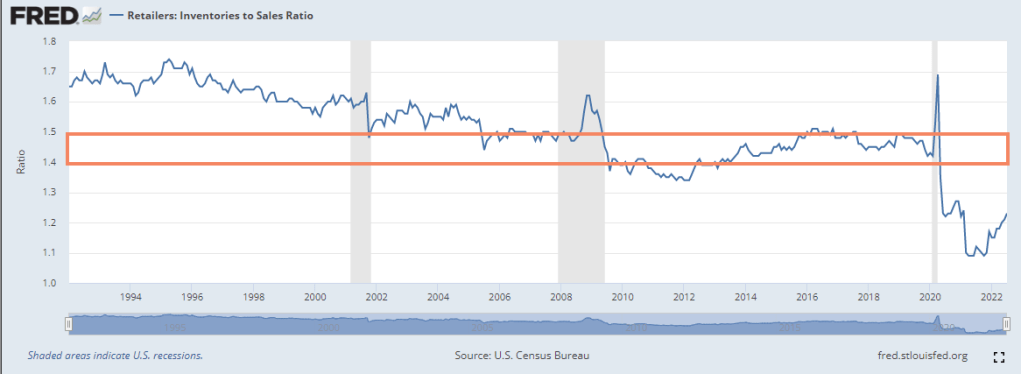
Price records circumstances, not value or utility. Our buying power is like a bar of soap. As water shrinks soap, high inflation shrinks our buying power. Economists offer several explanations for the persistent inflation but the one that I buy is that constrained supply and fairly steady demand are driving prices higher. Rising prices are a symptom of a shortage of goods – a quantity issue. Retailers inventory to sales ratio has increased slightly from the historic low in May 2021 but the ratio is still far below the range of 1.4 – 1.5 that was the benchmark before the pandemic.

This past Thursday, I picked up three jars of my favorite crunchy peanut butter. Some stores have been out of stock on the crunchy variety so I bought extra to be sure. I was not concerned about rising prices. I was responding to a quantity shortage, or the fear of a shortage. The difference is important. In Econ 101, students are shown the standard supply and demand diagram.

Left out of this stylized relationship is that supply is on a slower time scale than demand. It takes time, planning, investment and risk to produce all that supply. To cope with that reality, businesses must keep an inventory on hand to meet changes in demand which happen on a shorter time scale. Shift the red supply line to the left and the intersection of supply and demand occurs at a higher price. The Fed and the market thought that the supply constraints would fully resolve by this year but they have not. As stores and restaurants reopened, customers put away the electric panini sandwich makers, bread machines and gym equipment they had bought during the pandemic. They began purchasing consumables and were willing to pay higher prices for clothes, airline and movie tickets, and restaurant meals. In the face of ongoing supply constraints, the Fed has had to keep raising interest rates to try to curb demand, shifting the blue demand line to the left as well.

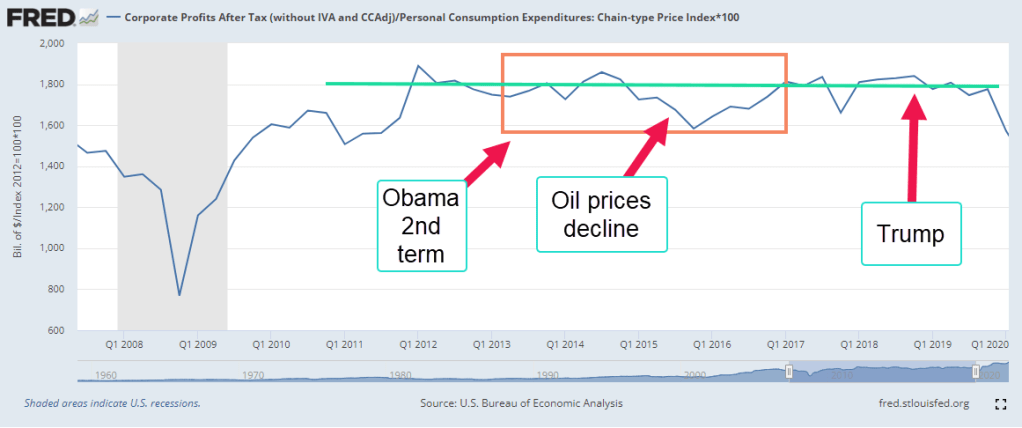
The higher prices helped businesses recover profits lost during the pandemic. Businesses have taken advantage of the supply disruptions to juice their profits by 33% (BEA, 2022).

When the Republicans took control of both chambers of Congress and the Presidency, they lowered corporate taxes. Those on the left often blame the economic elite for society’s problems and wasted no opportunity in criticizing Republicans for gifting the corporate elite. Mr. Trump boasted on his business prowess, promising to get the economy revving up again. Despite his rhetoric, corporate profits remained at the same level as during Mr. Obama’s second term.

A Presidential veto can block legislation but it is Congress that passes the laws that affect the economy. As I wrote last week Congress sometimes buys voter approval, creating bubbles that finally implode. The State Historical Society of Iowa (2019) has an image of a 1928 campaign ad for Herbert Hoover. It is a resume of economic progress under total Republican control during the 1920s. The Congress had won the public’s approval with easy credit and lax regulation. The following year the onset of the Great Depression brought down the house of cards. 25% of workers lost their jobs. Many lost their homes and farms.

Corporations exist to turn money flows into profits. Whatever money Congress spends winds up in corporate coffers. After 9-11, the federal public debt rose by $3 trillion (U.S. Treasury Dept, 2019) while corporate profits more than doubled, all thanks to Congress. Democrats and Republicans supported higher military spending and a building boom supported by easy credit policies.

In response to the pandemic, a bipartisan effort in Congress passed relief packages of more than $3 trillion. Today the public debt is $7 trillion above the pre-pandemic level. Much of that money became corporate profit because that’s what good companies do – turn cash flows into profits. Some of those profits were then used to buy the Treasury bills generated when the government increased their debt. This completed the cycle of debt and profits.

On average voters re-elect 90% of House members and 80% of Senate members. Midterm elections are less than two months away. Both parties take advantage of the public’s tendency to pin responsibility – good or bad – on the President, both the current and the past President, Mr. Trump. “Inflation is Biden’s fault,” Republicans will say and hope it sticks with some voters. Democrats hope that Trump will announce a 2024 run for President before the coming midterm election. They hope that independent voters, particularly suburban women, will vote for Democrats to voice their disaffection with Mr. Trump.

The election spending will juice the profits of media companies who depend on the craziness of our democratic politics. People in western European countries look in dismay at our frenzied politics that makes us vulnerable to a populist like Trump. Some Americans long for authoritarian measures that might curb the craziness of our politics and promote more cooperation. They are tired of the demolition derby of American democracy and wish they could go to sleep for a few months until it is over.

////////////////////

Photo by Anvesh Uppunuthula on Unsplash

State Historical Society of Iowa. (2019, January 14). “A chicken for every pot” political ad, October 30, 1928. IDCA. Retrieved September 16, 2022, from https://iowaculture.gov/history/education/educator-resources/primary-source-sets/great-depression-and-herbert-hoover/chicken If you have a moment, do check this out!

BEA: U.S. Bureau of Economic Analysis, Corporate Profits After Tax (without IVA and CCAdj) [CP], retrieved from FRED, Federal Reserve Bank of St. Louis; https://fred.stlouisfed.org/series/CP, September 16, 2022.

U.S. Department of the Treasury. Fiscal Service, Federal Debt: Total Public Debt [GFDEBTN], retrieved from FRED, Federal Reserve Bank of St. Louis; https://fred.stlouisfed.org/series/GFDEBTN, September 16, 2022.

America 4.0

September 11, 2022

by Stephen Stofka

I hope that those in the UK can find some common ground in their grief over the Queen’s death this week. Britain was still recovering from World War 2 when the crown was laid on her young head in 1952. Seventy years later, the political culture has fractured over Brexit and the repercussions of leaving the EU. There is much needed investment in a nation that has barely managed 2% growth in the past decade. In three years, three Prime Ministers have led the Parliament. The long reach of the Queen’s lifetime can help us lift our heads and take a longer view of events. When we mark history in lifetimes, not years, the beginning of our nation was about three lifetimes ago.

For most of mankind’s history, production harnessed human or animal energy, the thermal energy stored in wood and coal, and the kinetic energy of falling water turning a mill. In a world with only gradual change, there was little need for rapid communications technology. The men – yes, all men of property and standing – who crafted and voted on the U.S. Constitution lived in a world limited by crude animal and chemical power for energy, transportation and communication. John Adams, one of the Constitution’s signers, spent weeks traveling from his wife, family and farm in Braintree, Massachusetts to Philadelphia, Pennsylvania. Today, a person on a bicycle can make the journey in three 10-hour days.

The discovery and refinement of oil as an energy source changed our society and our politics. The 13th, 14th and 15th amendments of the Reconstruction Era were ratified at the dawn of a new age of energy and communications. The telegraph had only just come into use just prior to the Civil War. Edwin Drake drilled the first oil well in Pennsylvania in 1859, two years before the start of the Civil War. Those who passed the initial ten amendments and made the amendment process so difficult lived in an era where transformations of society occurred over decades or centuries. The amendments meant to protect people from the yoke of a regal government now shackle us to a historical reality that no longer exists.

America was built on a lack of consensus between regions, between a newly emerging urban population in the north and a rural population harnessed to the land in the south. In 1776, the colonies had first cohered as a mutual defense pact against the  British and the encroachment of the Spanish and French on colonial territory. The seven year war of Independence liberated the colonies from British rule in 1783 but left the colonies with a large debt. Their mutual defense pact gave a lot of autonomy to each of the thirteen states but the central government had little power or authority to tax the individual states. By 1787, that confederacy was on the brink of failure, unable to pay its debts and largely isolated from international capital markets. Under those dire circumstances, the colonies ed anew, drafting an entirely different pact that initiated America 2.0.

The American Constitution embodied the divisions of regional interests and the differing ideological principles of its founders. The proceedings were so combative that the deliberations were sealed from the press for fear that exposing the rancor between delegates would doom the  process. Three lifetimes later, we exhibit the same level of discord as our founders. Our Senate has become an insipid institution, crippled by parliamentary rules that make any Senator the ruler of his own nation, the King of Negation that stops most legislation from reaching a vote in the chamber. For 25 years, the House has passed Continuing Resolutions (CR) because they cannot pass a budget on time (Wezerek, 2018). Some years the budget is never passed and the government operates under a year-long CR.

On this 21st anniversary of 9-11, we still live in its shadow. The precautions at the airport, the fastidious matching of our names, letter for letter, hyphen for hyphen in our identification. Our nation grieved together, our Congress stood together and passed the Patriot Act. That was the end of togetherness. A common grieving does not knit a nation for long. Our media speaks a common language but the discourse – the assumptions and values that form the bedrock of our perceptions – are so different. Why? Because our Constitution has died.

Distrustful of each other, the Constitutional delegates forged a pact that was difficult to amend. They bound it so tightly that it could not expand and breathe. It is like a dead Pharoah mummified in tightly wrapped cloth and buried deep within a pyramid of time. Each year, the justices of the Supreme Court venture into the tomb to ask questions of the dead Pharoah. When they emerge into the sunlight, the people gather round to hear what the dead Pharoah has revealed. The justices speak in tongues – discourses that are intelligible to some people and babble to others. The Civil War was America 3.0. Let us grieve that our Constitution has died and adopt a new pact to celebrate America 4.0.

/////////////////////

Photo by Jeremy Bezanger on Unsplash

Wezerek, G. (2018, February 7). 20 years of Congress’s budget procrastination, in one chart. FiveThirtyEight. Retrieved September 9, 2022, from https://fivethirtyeight.com/features/20-years-of-congresss-budget-procrastination-in-one-chart/

Calibrating the Narrative

October 27, 2019

by Steve Stofka

Mr. Z, the man himself, head of Facebook, showed up in Washington this week to testify before a House committee about privacy and money (C-Span, 2019). Congress is worried about Mark Zuckerberg’s desire to create a digital currency. Several committee members expressed their concern that a private company with a large global influence might wrest control of the world’s currency away from the American government.

Article 1, Section 8 of the Constitution – the enumerated powers section – gave Congress the power “to coin Money, regulate the Value thereof, and of foreign Coin.” The United States has a powerful influence on the international payments system because 52% of transfers are in U.S. dollars (SWIFT, n.d.). The U.S. does not want to give up that global control to Facebook.

As I listened to the exchange between members of Congress and Mr. Zuckerberg, I was reminded that money itself is a narrative. Who gets to dominate that narrative? China and other countries would prefer that U.S. politics did not control the global financial market. When the British controlled the world’s dominant currency, the pound, more than a century ago, the U.S. didn’t like the influence that British leaders had on American lives. The sun never set on the British empire. Now its the U.S. that operates the world’s merry-go-round and the tickets are priced in dollars.

In the digital age Google and Facebook control many of the social and financial exchanges between people around the world. The U.S. government is the 800-pound gorilla in the room and doesn’t like challenges of its dominance. As Facebook and Google get larger and more influential, they become the 600-pound gorillas, but with one important difference. They don’t have an army and a court system like the U.S. does. When Presidential candidate Elizabeth Warren campaigns on breaking up the digital giants because of their monopoly power, those giants pay attention. There is a mood change in Washington that reminds me of the attacks on Microsoft in the 1990s.

We can expect that Facebook and Google will continue their heavy lobbying campaigns and trust in the paralysis of our system of government. The strength of that system lies in the checks and balances built into the Constitution. However, the past decade has shown that those same checks and balances stymie a lot of policy making in Washington. During the worst financial crisis since the Great Depression, it was difficult to enact fiscal policy because that requires legislation which requires consensus, compromise and maturity. Not much of that left in Congress these days.

The chief response to the crisis was handled by a small group of central bankers at the Federal Reserve whose reach is limited by law. Its monetary tools are designed to work with and for banks. Because of that, Wall Street got bailed out during the crisis but not Main Street. Mr. Trump got elected partially on a promise to remedy that situation, particularly in rural America. He was the rainmaker, a billionaire who could get things done that no politician could. No person – even the President of the U.S. – has that much power. Despite the low employment numbers, many communities throughout America have not fully recovered. Mr. Trump’s performance has been theatrical, to say the least. His popular twitter barrage dominates the Washington narrative every day.

And that brings us back to that august body where Mr. Zuckerberg appeared this week. His motives are good, he assured the House committee. A third of the world’s population is unbanked, he noted. Facebook’s promotion of the digital currency Libra and its integration within the Facebook app can help. Calibra is not live yet but the web site will give you a taste of the future (Calibra, n.d.). Concerned about the attention from Congress, large financial institutions like PayPal, Visa and Mastercard have dropped out of the Calibra consortium. Or did Mr. Zuckerberg call it a partnership?

Every criminal organization around the globe is hoping that Mr. Zuckerberg will succeed. Moving $100 bills around is so inconvenient. Mr. Zuckerberg has a solution to help government track down criminal transactions and prevent the digital currency from being used for illegal activities. Law abiding citizens can stay anonymous. How will he accomplish this? It’s a secret. He will tell us soon – very soon.

Even though Calibra will be headquartered in Switzerland, Mr. Zuckerberg promised several times that Facebook will not go through with these digital currency plans until it meets all the concerns of U.S. regulators. There are a lot of regulatory agencies in the U.S. and that very plethora of regulatory bodies contributed to the financial crisis. Investment firms played off one agency against another until they found an agency they liked. Will Mr. Zuckerberg do the same?

Who will control this narrative? The big guns of the U.S. government or the billions of dollars of profit to be had by Facebook if it can scrape just a few pennies per transaction off the trillions of dollars traded around the world each year? My bet is on Mr. Zuckerberg. He is sometimes inartful, but he stumbled on a way into the lives of a few billion people around the world and he has quite artfully capitalized on that.

//////////////////////

Notes:

C-Span. (2019, October 23). Facebook CEO Testimony before House Financial Services Committee. [Web page, Video]. Retrieved from https://www.c-span.org/video/?465293-1/facebook-ceo-testimony-house-financial-services-committee

Calibra. (n.d.). A connected wallet for a connected world. [Web page]. Retrieved from https://calibra.com/

Public Domain. (n.d.) Obverse of United States one dollar bill, series 2009. [Image]. Retrieved from https://commons.wikimedia.org/w/index.php?curid=23332139

SWIFT. (2015, December). Worldwide Currency Usage and Trends. [PDF]. Retrieved from https://www.swift.com/node/19186

Minority Control

October 13, 2019

by Steve Stofka

On September 15, 2008 the trading firm Lehman Brothers declared bankruptcy. A small number of outstanding shares traded on the stock market that day. The SP500 lost almost 5% of its value. New Yorkers gathered in Times Square to watch the ticker tape display. A small number of people controlled the direction of the market and constructed a reality that they sold to the rest of us.

In politics, a few key people control the direction and fate of legislation. In the Senate, the Majority Leader decides whether to bring legislation up for a vote. Even if a bill makes it out of a Senate committee, the Majority Leader can stop it from reaching the full Senate.  Unlike the Majority Leader in the House, his position is practically impregnable. Legislation vetoed by the President can be overridden by Congress. There is no recourse to a veto by the Senate Majority Leader.

The current holder of the position is Sen. Mitch McConnell from Kentucky. He is up again for re-election next year. When Democrats held the Senate, Sen. Harry Reid ruled with a similar disregard for others in his own party as well as the minority.

In 2014, 800,000 voters chose McConnell. In effect, less than 1% of the country’s voters control the course of legislation in the U.S. Did the founders of this country intend that one person should control Congress? James Madison, the chief crafter of the Constitution, worried that a majority would overwhelm and take advantage of a minority (Feldman, 2017). Accordingly, the Constitution is structured so that a minority controls power. However, one person is a very small minority. What would the founders think of the current arrangement in Congress? If Americans wanted a king with veto-proof power, America would still be a colony of Britain.

Our method of electing a President is a 230-year-old compromise between republicanism and democracy. An electoral college composed of men not subject to the passions of the crowd would elect the leader of the country. It was an Enlightenment model of dispassionate rationality.

Even if they had Fox News and CNN on Election night at the time of the founding, all the thirteen states were in the same Eastern time zone. At a recent symposium on our election, former RNC chair Michael Steele pointed out the west coast states are mostly taken out of the Presidential election (C-Span.org, 2019). By 5 P.M. Pacific time, they are discouraged from voting because much of the action has already been called. The founders did not design a system for four time zones.

We have 50 states but the election for President takes place in eight to twelve battleground states. Most polling is done at the national level, not in the battleground states. Many polls do not accurately survey the sentiments of the critical minority of voters in the states that will decide the election.

A minority of people own and control much of the wealth of the world. They now pay a lower percentage of their income than the bottom 50%. That includes federal, state and local taxes. In the Triumph of Injustice, due to be released next week, authors Saez and Zucman (2019) tally up the tax bills for the rich and ultra-rich. The book is #1 bestseller at Amazon and it hasn’t been published yet.

In 1980, the top 1% paid 47% of their income in total taxes at all levels. Now they are down to 23% and below the rate paid by the bottom half of incomes. Two sets of rules – one set for the peasants and one for the castle royalty. The Constitution prohibits the granting of titles so the rich granted themselves the titles. This book is sure to get a lot of media attention. Like we need more controversy.

Notes:

Feldman, N. (2017). Three Lives of James Madison: genius, partisan, president. [Print]. New York: Random House.

C-Span.org. (2019, October 7). National Popular Vote Election, Part 2. [Video]. Retrieved from https://www.c-span.org/video/?464997-2/national-popular-vote-election-part-2

Saez, E. & Zucman, G. (2019) Triumph of Injustice: How the Rich Dodge Taxes and How to Make Them Pay. [Print]. Available for pre-order at https://www.amazon.com/Triumph-Injustice-Rich-Dodge-Taxes/dp/1324002727

Effective tax rates: If you make $100,000 and you pay $25,000 in federal, social security, state, sales and property tax, then your total effective tax rate is 25%.

Photo: WyrdLight.com [CC BY-SA 3.0 (https://creativecommons.org/licenses/by-sa/3.0)%5D Page URL: https://commons.wikimedia.org/wiki/File:Bodiam-castle-10My8-1197.jpg

Optimism Reigns

Dec. 11, 2016

For the second week since the election the SP500 index rose more than 3%, reversing a slight loss the previous week.  The SP500 has added 160 points, or 7.6%, in total since the election.  Barring some surprise, the market looks like it will end the year with a 10+% annual gain, all of it in the 6 – 7 weeks after the election. Small cap stocks have risen 17% in the past five weeks.  Buoyed by hopes of looser domestic regulations, and that international capital requirements will be relaxed, financial stocks are up a whopping 20% in the same time.

Having held their Senate majority, Republicans now control both branches of Congress and the Presidency but lack a filibuster proof dominance in the Senate.  They are expected to pass many measures in the Senate using a budget reconciliation process that requires only a simple majority. The promise of tax cuts and fewer regulations has led investment giants Goldman Sachs and Morgan Stanley to increase their estimate of next year’s earnings by $8 – $10.  Multiply that increase in profits by 16x and voila!  – the 160 points that the SP500 has risen since the election.  The forward Price Earnings ratio is now 16-17x.

Speculation is about what will happen.   History is about what has happened. The Shiller CAPE10 PE ratio is calculated by pricing the past ten years of earnings in current year’s dollars, then dividing the average of those inflation adjusted earnings into today’s SP500 index.  The current ratio is 26x, a historically optimistic value.  The Federal Reserve is expected to raise interest rates at their December meeting this coming week.

As buyers have rotated from defensive stocks and bonds to growth equities, prices have declined.  A broad bond index ETF, BND, has lost 3% of its value since the election.  A composite of long term Treasury bonds, TLT, has lost 10% in 5 weeks.  For several years advisors have recommended that investors lighten up on longer dated bonds in anticipation of rising interest rates which cause the price of bond funds to decline.  For 6 years fiscal policy remedies have been thwarted by a lack of cooperation between a Democratic President and a Republican House that must answer to a Tea Party coalition that makes up about a third of Republican House members.  The Federal Reserve has had to carry the load with monetary policy alone.  Both former Chairman Bernanke and curent Chairwoman Yellen have expressed their frustration to Congress.  If Congress can enact some policy changes that stimulate the economy, the Federal Reserve will have room to raise interest rates to a more normal range.

//////////////////////////////

Purchasing Manager’s Index

The latest Purchasing Manager’s Index (PMI) was very upbeat, particularly the service sectors, where employment expanded by 5 points, or 10%, in November.  There hasn’t been a large jump like this since July and February of 2015.  For several months, the combined index of the manufacturing and service sector surveys has languished, still growing but at a lackluster level.  For the first time this year, the Constant Weighted Purchasing Index of both surveys has broken above 60, indicating strong expansion.

The surge upward is welcome, especially after October’s survey of small businesses showed a historically high level of uncertainty among business owners.  This coming Tuesday the National Federation of Independent Businesses (NFIB) will release the results of November’s survey.  How much uncertainty was attributable to the coming (at the time of the October survey) election?  Small businesses account for the majority of new hiring in the U.S. so analysts will be watching the November survey for clues to small business owner sentiment.  Unless there is some improvement in small business sentiment in the coming months, employment gains will be under pressure.

////////////////////////////

Productivity

Occasionally productivity growth, or the output per worker, falters and falls negative for a quarter.  Once every ten or twenty years, growth turns negative for two consecutive quarters as it has this year. Let’s look at the causes.  Productivity may fall briefly if businesses hire additional workers in anticipation of future growth.   Or employers may think that weak sales growth is a temporary situtation and keep employees on the payroll.  In either case, there is a mismatch between output and the number of workers.

During the Great Recession productivity growth did NOT turn negative for two quarters because employers quickly shed workers in response to falling sales.  The last time this double negative occurred was in 1994, when employment struggled to recover from a rather weak recession a few years earlier.  For most of 1994, the market remained flat.  In Congressional elections in November of that year, Republicans took control of the House after 40 years of Democratic majorities.  The market began to rise on the hopes of a Congress more friendly to business.  Previous occurrences were in the midst of the two severe recessions of 1974 and 1982.   As I said, these double negatives are infrequent.


////////////////////////////

The Next Crisis?

The economies of the United States and China are so large that each country naturally exports its problems to the rest of the world.  The causes of the 2008 Financial Crisis were many but one cause was the extremely high capital leverage used by U.S. Banks.  A prudent ratio of reserves to loans is 1-8 or about 12% reserves for the amount of outstanding loans.  Large banks that ran into trouble in 2008 had reserve ratios of 1-30, or about 3%.

Now it is China’s turn.  Many Chinese banks have reported far less loans outstanding to avoid capital reserve requirements.  How did they do this?  By calling loans “investment receivables.”  It sounds absurd, doesn’t it?  Like something that kids would do, as though calling something by another name changes the substance of the thing.  70 years ago George Orwell warned us of this “doublespeak,” as he called it.  Reluctant to toughen up banking standards for fear of creating an economic crisis, the Chinese central bank is planning a gradual move to more prudent standards that will take several years.  However, it is a crisis waiting for a spark.  Here’s a Wall St. Journal article on the topic for those who have access.

/////////////////////////

GDP and Elections

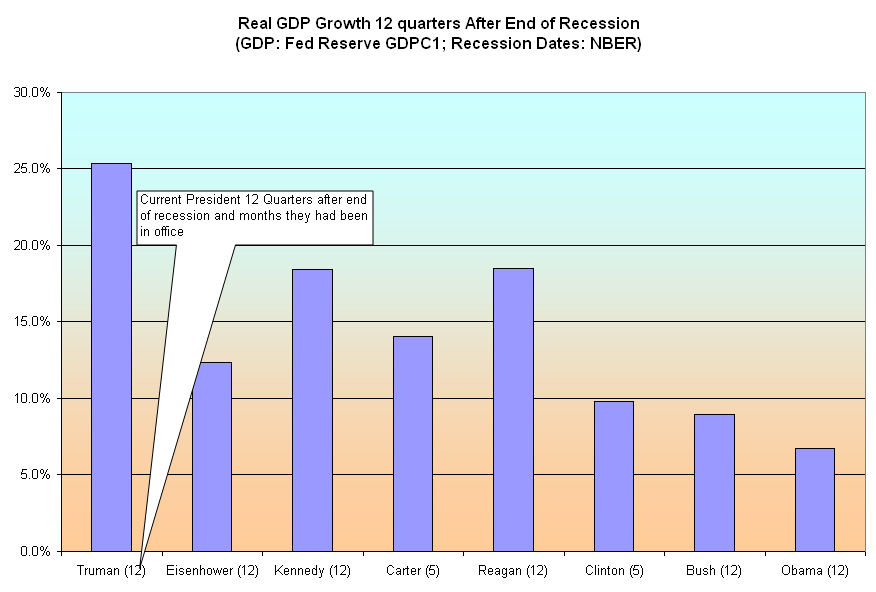
“Bummer, dude!” may be what President Obama’s election campaign manager thought when the quarterly GDP figures were released this past Friday.  Second quarter growth clocked an anemic 1.5% annualized growth rate – a tepid pace – but one which was slightly above the market consensus of 1.2%.   This first estimate of quarterly GDP growth is often revised up or down 1/2% as more data comes in (BEA Source).  Second and third revisions to the GDP growth rate will follow in August and September, but pose a challenge for any re-election campaign.  What is the pace of this recovery?  It has been three years, or 12 quarters, since the official end of the recession in the 2nd quarter of 2009.  In that time, real or inflation adjusted GDP has grown 6.7%.  What has the been the real GDP growth rate of past recoveries?  Below is a comparison of the total GDP growth of past recoveries and the Administrations in office at the 3 year mark after a recession (Click to enlarge in separate tab)

At the 3 year milestone after the 1960-61 recession, President Johnson had been in office for just two months after the assassination of Kennedy in November 1963.    At mid recovery after the long recession of 1973 – 75, Carter took over the reins from President Ford, who had taken office after Nixon resigned over the Watergate scandal.  Likewise, President Clinton took office from the first President Bush near the middle of an ongoing recovery from the recession of 1990 – 91.  In addition to the disgrace of resignation, President Nixon never enjoyed three years without a recession and so does not make it on this chart.  President Johnson has the distinction of never having a recession during his tenure in office.

Although the media and the public like to pin the economic tail on the President, the House and Senate have much more to do with the economy than the President.  Bills originate in the House (primarily) and Senate. Presidents do not initiate legislation.  Below is that same chart showing the mix of House and Senate during each recovery since WW2.

We can’t say that the strongest recoveries are when the House and Senate are the same party as the President.  We might be able to say that recoveries are strongest when Democrats are in the House, but Democrats ruled the house, except for four years in the late forties and early fifties, from 1933 through 1994 – a period of almost sixty years! (Metric Mash)  This doesn’t leave much for comparison.  We can’t say that a mixed Congress of Democrats and Republicans produces a weak recovery.  What makes this recovery unique is that, for the first time since at least 1900, the House switched parties during an economic recovery (Congressional Research Service, NBER and Metric Mash).  In the 2010 elections, anger over the health care act helped fuel a newly established Tea Party which worked within, not outside, the Republican Party and helped that party gain a large number of seats to take the majority in the house.  If history is any guide, the American public can change direction in the House during a recession, after a recovery, but not during a recovery.  The recovery plans set in place by either party need a chance to work themselves out.  To interrupt those plans in midstream produces a stalling effect.

Do the weak economic figures doom Obama’s re-election?  Not so, according to 538.  Whoa!  What’s 538?  The answer is who’s 538. And the answer to that who? is Nate Silver, a statistician who developed a system for predicting the performance of baseball players.  His methods for analyzing baseball proved to be suprisingly accurate in predicting the 2008 and 2010 elections.  After his almost perfect predictions for the 2008 electoral races and the recipient of a few awards, the NY Times licensed Mr. Silver’s blog in 2010. 

You can find Mr. Silver’s take on what the latest GDP figures mean for the election here.  Mr. Silver also has an interesting article on the primary economic indicators he thinks have the most influence on voter’s choices.  You can bookmark his blog here.