A Clearer Vision?

August 31, 2025

By Stephen Stofka

Sunday morning and another breakfast with the boys. This week Abel and Cain discuss several  political theories as they try to make sense of current events. The conversations are voiced by Abel, a Wilsonian with a faith that government can ameliorate social and economic injustices to improve society’s welfare, and Cain, who believes that individual autonomy, the free market and the price system promote the greatest good.

Abel said, “I was reading this week that there are now more GenXers than Boomers in the House. The Boomers still control the Senate by a good margin, though (Source).”

Cain poured a bit of syrup on his French toast. “Next year, the first Boomers are going to turn 80. I mean, don’t they have anything else to do? Are they all going to die in their seats like Diane Feinstein?”

Abel shrugged. “I think they get into politics because they want to make a difference and they get addicted to that sense of importance. The office comes to define them. They can’t let go.”

Cain nodded. “Ok, I can understand that, but why do voters keep putting them back in office? Feinstein served about thirty years. Most states have term limits for governors (Source). We have term limits for the President, but none for the House and Senate? Come on, we need a better system.”

Abel replied, “Congress rewards seniority. The oldest members get key assignments. They chair legislative committees that control what legislation gets to the floor of either chamber. Let’s say someone challenges a sitting Senator who chairs the committee on Energy and Natural Resources. Right now, that’s Mike Lee from Utah, a Republican. Through him Utah voters can steer policy. If the challenger wins, he doesn’t get to chair the committee. Utah voters lose that power. Why would they want that?”

Cain stabbed at his French toast. “The problem with that system is that it allows special interests to ‘capture’ a Senator or House member. What do they call it? An Iron Triangle. Special interests, key committee members and some executive agency all work together to steer policy to the benefit of the special interests (Source). For example, ranchers band together as a group to lobby for below market grazing fees for their cattle.”

Abel smirked. “What are you going to do? Stop people from being people? Sure, Senators and House members are supposed to represent a broad constituency but there are a lot of interests within that constituency. Interest groups have to compete with each other for representation. That’s just politics.”

Cain replied, “There’s a guy called David Pinsof who developed what he calls Alliance Theory. Political beliefs are not based on principles or moral maxims but are simply arguments that a coalition uses to cement alliances. His theory helps explain a lot of contradictions.”

Abel asked, “Like what?”

Cain looked up at the ceiling as he searched his memory. “Conservatives say they respect authority but they can disregard authority if they think a regulation is unfair (Source). They champion the free market but actively lobby for subsidies.”

Abel laughed. “Subsidies are in the best interest of their stockholders. Regulations are not.”

Cain smiled. “Exactly. Another example Pinsof gave was a distrust of foreigners but conservatives should trust Putin when he said that he did not interfere in the 2016 election.”

Abel laughed, asking, “Any contradictions on the liberal side?”

Cain thought a second. “Oh, yeah, here’s one. CEOs should not make so much more than their workers but it’s OK for stars in Hollywood to make way more than most working actors. What else? Liberals criticize those who stereotype Mexican immigrants as criminals but hold onto the stereotype that a lot of voters in southern states are racist.”

Abel nodded. “Like I said, it’s what people do. So what’s Pinsof’s theory?”

Cain replied, “Don’t waste time trying to find inconsistencies in political arguments. It’s just spin. The opposition points out those inconsistencies as a way of signaling to their own coalition. No one expects that the other side will change their mind when someone points out a contradiction in their argument.”

Abel frowned. “Trump instinctively knows that its all about alliances. That’s why he will say anything, do anything. He asks, ‘does it strengthen my alliances and weaken those on the other side of the political aisle?’ It’s just so, so…”

Cain asked, “Nihilistic? Is that the word you looking for? Cynical, transactional?”

Abel replied, “Yeah, nihilistic, unanchored to any moral principles.”

Cain nodded. “It’s the morality of me, me, me. I think Pinsof borrows some elements from Skepticism as well as Pragmatism, a philosophy that understands ideas by looking at the effect of those ideas in the world (Source).”

Abel interrupted, “Reminds me of Milton Friedman’s paper saying that an economic model was valid if it made good predictions, not whether it was realistic or consistent (Source).”

Cain raised his eyebrows. “Talking about economics, Trump said that he had fired Lisa Cook, one of the Fed governors.”

Abel frowned. “Yeah, he’s attacking the independence of the central bank. When I read that, I thought, ‘How much has the stock market gone down on that news?’ I glanced at the SP500 index. Nothing. No reaction. What the heck?”

Cain shook his head. “Hard to figure. Traders are betting that there will be a standoff. Trump is pushing. Cook and her lawyer are pushing back.”

Abel asked, “Yeah, but I read that she is off the job for now. The Fed meets again in mid-September to decide interest rates. Has Powell said anything about Cook’s firing?”

Cain replied, “I don’t think so. Anyone that Trump wants to put in her place will need to be approved by the Senate.”

Abel asked, “Has the Supreme Court said anything?”

Cain said, “Cook’s lawyers would need to file something with a district court. If the judge rules against Trump, the lawyers with the Department of Justice would need to file an emergency application with the Supreme Court asking for immediate relief. It’s called the Shadow Docket (Source).”

Abel shook his head. “I think of Trump in control of interest rates. Tariffs are already driving up prices. He said he wants interest rates to be like three percent less. Such a huge drop in rates would increase inflation, a tax on everyone. This guy’s got more ways to tax ordinary people while giving the rich big tax breaks.”

Cain sighed. “Well, the key interest rate, it’s called the Federal Funds Effective Rate, is set by a committee called the FOMC. They have 12 members. There are seven Fed governors, the president of the New York Fed bank, and a rotating panel of four presidents from the regional Fed banks. Even if the Supreme Court said that Trump could fire one of the Fed governors, he can’t fire any of the presidents of the regional banks because they are employees of their banks, not the Federal government (Source).”

Abel asked, “So let’s say Trump gets five governors to do his bidding. You’re saying there are still seven governors who could vote against policies Trump wants.”

Cain nodded. “One of those governors is the Chair, Jerome Powell. Earlier this year, the Court indicated that Trump could not fire the Chair (Source).”

Abel frowned. “Trump pushes boundaries. That’s his brand.”

Cain shook his head. “Trump wants what he wants. He doesn’t recognize the validity of boundaries. That’s his brand.”

Abel sighed. “He is going to provoke a final crisis. I was re-reading Generations by William Strauss and Neil Howe. They wrote that book back in 1991 and predicted a major crisis during this decade.”

Cain squinted. “Didn’t we talk about this a few weeks ago?”

Abel nodded. “Oh yeah. I think I was talking about their second book, The Fourth Turning. This first book goes into the history of the generational cycle. They trace the pattern in America starting in the 17th century.”

Cain interrupted, “I’m skeptical about these grand cyclic theories. There are some stock traders who claim that the stock market works on Fibonacci cycles (Source).”

Abel argued, “Like Friedman said, does the theory make good predictions? If not, it’s not a good theory. Strauss and Howe predicted an inciting event sometime around 2005 that starts this two decade period called the fourth turning. It shakes the foundations of society before a final breaking point.”

Cain asked, “So, 9-11 or the financial crisis might have been those events? I don’t know. Seems like that would be fitting history to the theory.”

Abel replied, “Let me finish. Strauss and Howe thought the breaking point would come this decade. The last three turning points have been the Great Depression, the Civil War and the founding of the United States.”

Cain replied, “Ok, maybe it’s not just fitting data to a theory. A few weeks ago, we talked about legal turning points. I think I mentioned Richard Epstein’s book The Classical Liberal Constitution. He wrote about those turning points in Constitutional interpretation, or jurisprudence, I guess you could call it. Under the Fourteenth Amendment the Bill of Rights protections now applied to the states as well as the federal government.”

Abel interrupted, “Fat good it did down in the south. Jim Crow laws persecuted blacks.”

Cain sighed. “Yeah, these Constitutional protections don’t enforce themselves.”

Abel argued, “It was a failure of the Supreme Court, I think.”

Cain nodded. “Anyway, then there as a turning point Supreme Court decision in 1937 that set a precedent for big government. Helvering v. Davis upheld the constitutionality of the Social Security Act under the General Welfare clause of the Constitution (Source). A major expansion of the power and scope of the federal government.”

Abel said, “FDR was threatening to ‘pack’ the court. Increase the number of justices and put his own people in there.”

Cain agreed. “Yeah, FDR was a strongman, just like Trump. Unlike Trump, FDR had a clear electoral mandate from the 1936 election. He whupped the Republican candidate, taking all but a few votes in the electoral college (Source). He had a supermajority in the Senate so he would have been able to get his nominees for the court confirmed (Source).”

Abel asked, “Wasn’t the court all FDR nominees by the time he died?”

Cain nodded. “Yeah. No one should have that much power.”

Abel interrupted, “Trump is trying to expand his personal power under some Unitary Executive theory. The scary part is that some of the conservatives on the court support that theory (Source).”

Cain shook his head. “Hey, I’m all about checks and balances. This administration is all about consolidating power and I’m against that.  In 1945, F.A. Hayek wrote a landmark essay The Use of Knowledge in Society that explained why central planning would fail. Those in control cannot get or process enough information to make successful decisions (Source).”

Abel smirked. “DOGE is a great example of that. Even with sophisticated computers and data tools, they made a mess of things.”

Cain sighed. “The question is how much damage will Trump do. So, why do these turning points come every eighty years or so? Something to do with the human life span?”

Abel replied, “Strauss and Howe separate out four generations within that life span. Each has different characteristics as they move through their life cycle from youth, to rising adult, to middle age and then the final stage as elders. It’s the combination, the sequence of generations that causes the turning point, I think is what they say. There is an idealist generation that precipitates the crisis. This generation has a historical impact late in life.”

Cain shook his head. “What are some examples? It’s hard to follow.”

Abel nodded. “Lincoln, FDR, and Trump were all part of an idealist generation. Strauss and Howe identify several tendencies within each generation. Idealists think their principles are transcendent and they have unyielding opinions (page 11).”

Cain looked skeptical. “I don’t think of Trump as an idealist.”

Abel argued, “Well, he’s been saying the same crazy things for decades about criminals and immigrants.”

Cain interrupted, “Unyielding opinions? The guy changes his mind from day to day. He exaggerates most of the time and doesn’t care. And yes, don’t say it. I voted for him. It wasn’t my idea to have two old-timers run against each other in the 2020 election or the 2024 election. That’s why I want to change the system. The bosses in both parties are hurting the American people.”

Abel nodded. “Yeah, I agree. Most voters get herded into one of two corrals when they would prefer more alternatives. The whole election process is designed to suit the party bosses and the fundraising effort. It’s not about empowering voters.”

Cain laid his napkin on the table and stood up. “We said earlier that no law enforces itself. Principles of governance don’t just happen. The question is how does a system change without a civil war or an absolute economic catastrophe like the 1930s? It’s not a question I like to think too much about.”

Abel looked up. “See you next week.”

Cain turned. “Till then.”

//////////////////

Photo by Josh Calabrese on Unsplash
A Test of Democracy

December 27, 2020

by Steve Stofka

In 2008, Barack Obama won almost 25% of counties, a high percentage for a Democratic candidate. In 2016 and 2020, a sixth of counties voted for a Democratic President. Though a small percentage, those counties represented more than 2/3rds of the nation’s GDP. The most productive part of our economy votes Democratic, but a county electoral map looks mostly red. How can that be?

More than half of the U.S. population lives in less than 5% of counties (Census Bureau, 2019). A county electoral map gives the same weight to a county in Colorado with a few hundred people as it does to L.A. county which has 10,000,000 inhabitants. A person looking at that map gets the impression that “most of the country” votes Republican but land doesn’t vote – people do.

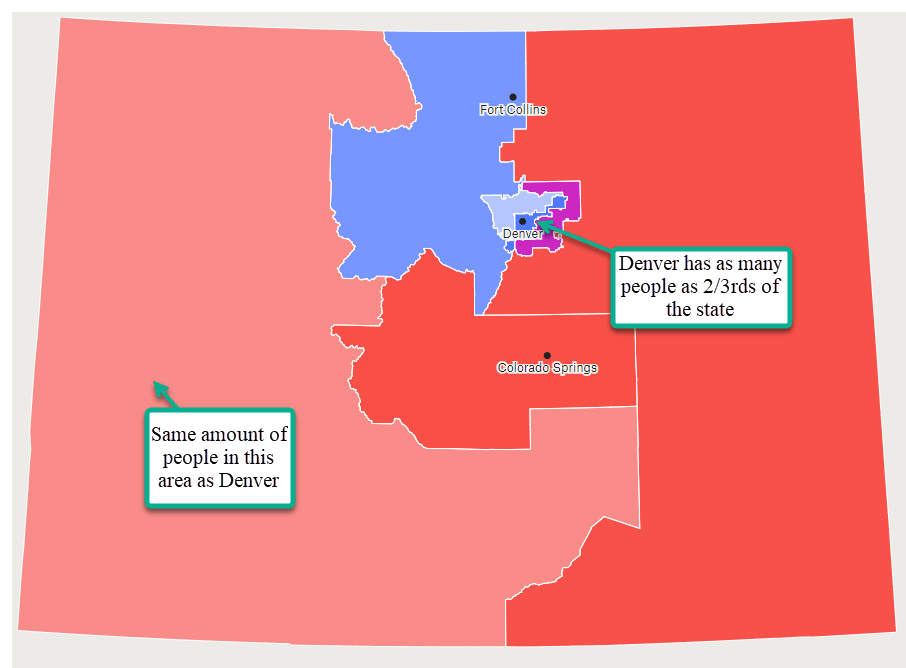
A more accurate electoral map is by congressional district like this one at FiveThirtyEight (2018). Voting districts are assigned by population, not land area. I’ll copy their Colorado map to illustrate the point. There are as many people living in a few square miles in Denver as there are in more than half the state.

As the population concentrates close to urban areas, a county-by-county analysis reveals some long-term trends. Historian David Kennedy recently noted a shift in sentiment over the past four decades (2020). In 1980, 13% of counties were dubbed “landslide” counties in which the Presidential candidate won by 20% or more of the vote. By 2000, 19% of counties voted that way. In the 2020 election, more than 50% of counties were landslide.

Kennedy referred to Bill Bishop’s 2009 book The Big Sort which described how Americans were moving to places where they lived with others whose political sentiments were like their own (2009). For more than a century, we have been moving from the country to the city. After World War 2, the automobile gave us the freedom to move further away from where we work. We like living with people who resemble us.

A trend that has been going on for a century is likely to continue. Those hoping that election tensions will ease in the future will be disappointed. Although social media helps spread election conspiracy theories, Americans are fond of such theories. Those on the left side of the aisle were convinced that the governor of Ohio stole the 2004 election for George Bush (Weiss, 2020). That was on the heels of the 2000 election which Florida governor Jeb Bush stole for his brother George.

Each election begins in earnest on inauguration day. Immediately after President Obama’s inauguration in 2009, Mitch McConnell succinctly summed up his job as the Senate’s Minority Leader – his job was to make sure Obama was a one-term President. With the nation deep in a financial crisis and millions of people out of work, Democrats condemned McConnell’s remark.

From the first day of President Bush’s presidency in 2001, Democrats rallied and protested the boy made king by an activist Supreme Court. In a 5-4 decision, five supposedly conservative justices tossed aside conservative jurisprudence and voted to overthrow the decision of Florida’s Supreme Court. Henry Monaghan argued against the hundreds of legal scholars who condemned the court’s jurisprudence. The first few pages summarize the circumstances of that election and the many criticisms of the court’s decision (2003).

Eighty years ago, FDR wielded his executive pen like a sword to cut through any Congressional opposition from those on either side of the Congressional aisle. In his 3-1/2 terms, he signed more than 3000 orders, a record that will likely never be broken. Today, our Presidents rule by executive order. Each President spends his first year undoing the executive orders of the last President if that President was from the other party. Without the consistency of law, the American people lose respect for the law, regarding it as little more than personal whim.

The Constitution gives the President the power to grant pardons for Federal crimes. Each President’s use of the pardon power demonstrates that personal sentiment and political alliances matter more than justice. After President H.W. Bush pardoned all the co-conspirators in the Iran-Contra scandal, the American people began to lose faith in the law.

The Supreme Court’s 2000 Bush v. Gore decision reinforced the notion that America was like the old European nations, a country of patronage and favor, not one of law. Mr. Bush disregarded good judgment, the law, and his own intelligence services to justify an attack on Iraq in response to the 9-11 tragedy. Business scandals punctuated the first four years of his administration. His re-election in 2004 convinced many Americans that corruption, not competence, was the American way. Mr. Bush’s second term reinforced that impression.

President Obama’s political rhetoric was strong and even-tempered, but his policy response to the financial crisis was weak and un-tempered. Within two years the American people chose political paralysis, wresting control of state governments from Democrats and handing the House to the Republicans. Like Mr. Bush before him, Mr. Obama found fault with others, not himself.

After electing an unseasoned backbench Senator Obama to office, the American people elected a TV star to the Presidency. Why not? America, the competent, has become a country of fools. Why would we not elect New York City’s leading buffoon?

Each day more people die of Covid than lost their lives in 9-11. The country now turns from the Jester to a seasoned former Senator, Mr. Biden, to lead the country. Unlike Mr. Obama and Mr. Trump, Mr. Biden is not in love with his own rhetoric or his judgment. Can he restore competence to the White House? Perhaps.

What he can’t do is restore the competence of the voters, who love their opinions more than their interests. Regardless of his success or his policies, half the country will condemn him because we have sorted ourselves into them and us. James Madison, the chief architect of the Constitution, worried most about the rise of factions because that is what brought down the Roman empire. We fought a Civil War and have not been a United States since then. We are transforming ourselves into a type of European confederation, divided into regional, rural, and urban interests, clutching our contempt for our fellow Americans to our hearts. Is this the century when we finally abandon the experiment of the United States?

/////////////////

Photo by Den on Unsplash

Bishop, B. (2009). The big sort: Why the clustering of like-minded America is tearing us apart. Boston: Mariner Books. [Kindle price $1.81 from https://www.amazon.com/Big-Sort-Clustering-Like-Minded-America/dp/0547237723/ref=sr_1_1

FiveThirtyEight. (2018, January 25). The Atlas Of Redistricting. Retrieved December 25, 2020, from https://projects.fivethirtyeight.com/redistricting-maps/

Kennedy, D. (2020, December 9). David Kennedy: The Future of Democracy in America. Retrieved December 25, 2020, from https://www.commonwealthclub.org/events/archive/podcast/david-kennedy-future-democracy-america

Henry P. Monaghan, Supreme Court Review of State-Court Determinations of State Law in Constitutional Cases, 103 COLUM. L. REV. 1919 (2003). Available at: https://scholarship.law.columbia.edu/faculty_scholarship/164

US Census Bureau. (2019, May 23). Big and Small America. Retrieved December 25, 2020, from https://www.census.gov/library/stories/2017/10/big-and-small-counties.html

Weiss, J. (2020, December 21). What Happened to the Democrats Who Never Accepted Bush’s Election. Retrieved December 25, 2020, from https://www.politico.com/news/magazine/2020/12/19/2004-kerry-election-fraud-2020-448604

You Don’t Count

April 12, 2020

by Steve Stofka

Wisconsin voters held their state’s primary this past week. At stake was an important state Supreme Court seat. The long lines at the few polling places open in urban areas highlighted the distinction in voting power between urban and rural communities. Voters in urban areas that are largely Democratic must wait for hours to vote while those in rural Republican leaning districts experience short wait times when they vote (NCSL, 2014).

Democratic House Leader Nancy Pelosi advocates a federal law requiring states to have a mail in ballot as an option in federal elections. Republicans from low population states want to protect the enormous power that their rural communities have over those in urban areas. They continue to resist mail in ballots.

The map below from the Census Bureau shows the population density per county (US Census Bureau, 2018). The light green and yellow areas have populations below the U.S. average, which is only 88 people per square mile. Western European countries have an average of 468 people per square mile, more than 5 times the density of the U.S.

I have numbered the 7 states that had not implemented stay at home orders as of April 6th (Silverstein, 2020). Each state is one of 21 states that have less than 1% of the nation’s population (List, 2020).

Twelve of those states have majority rural populations (HAC, 2011).  25 states have only 20% of the country’s population but each state gets two Senators, regardless of population. The Senate does not have proportional representation.  20% of voters control half of the Senate.

This outrageous discrepancy in voting power grew out of – stop reading and guess. Did you guess slavery? That’s right. At this country’s founding, the slave states in the south did not want the more populous states in the north to make slavery illegal in the southern states. In an age when most people grew their own food, the northern states guessed that the population of the southern states would grow more quickly because of the longer growing season. The Senate and the Electoral College were a compromise between slave and free states at the country’s founding.

Many of the plains and Rocky Mountain states have little population but have the same power in the Senate as states with twenty times their population. Why are there so many states with so few people? Stop reading and guess again. Did you guess slavery? Right again. There were 37 states in 1870, five years after the Civil War, but the western territories had already been formed during or just prior to the Civil War. So how did slavery lead to the formation of states?

Let’s look at the example of Colorado. The discovery of gold near Pikes Peak attracted a large influx of people into the region in 1859. In December 1860, a month after Lincoln was elected President, South Carolina seceded from the Union. In February 1861, two months before the formal secession of the other states, an act was introduced into the Congress to make Colorado a territory. Why? To secure mineral rights for the coming war. 15 years later, Colorado finally became a state.

In January 1862, Jefferson Davis, President of the Confederacy, recognized Arizona as a Territory. The population was sympathetic to slavery and Davis hoped to use Arizona as a launching point to capture California and it’s gold. Imagine the Confederate Army camped out on the Colorado River, in present day Lake Havasu, prepared to invade – yes, hundreds of miles of godforsaken desert. This was not a well thought out plan by Mr. Davis.

Tit for tat. A month later, the U.S. Congress, composed of only delegates from Union states, recognized Arizona as a territory along different borders to block the recognition of the Territory under the borders established by the Confederacy.  Because of its low population, the territories of Arizona and neighboring New Mexico did not become states until 1912, when progressives of both parties overcame persistent opposition in the Senate to pass the 17th Amendment (NCC, n.d.). That amendment gave voters in each state the power to elect their state’s two Senators.

 Wyoming used to have more sheep than people (USDA, 2018). People in the state now outnumber sheep almost 2-to-1. It was part of the Nebraska Territory that was created along with the Kansas Territory prior to the Civil War as part of the Kansas-Nebraska act. A month after S. Carolina’s secession in response to Lincoln’s election, Kansas entered the union as a free state in 1861. Both the Union and the Confederacy engaged in a concerted effort to secure territory and its resources in anticipation of war.  Nebraska became a state after the Civil War. The Union states wanted power in the Senate to secure the Civil War Amendments and other legislation passed after the war. Nebraska voters get 20 times more clout in the Senate than voters in New York. Why? Don’t pause. The answer is slavery again.

As part of the effort to secure the Civil War Amendments, Nevada was made a state a month after the 13th Amendment passed out of the Senate on its way to the states in 1864. As it is today, there were few people living in the territory. Congress wanted access to the silver mines in the territory and it mandated that Nevada outlaw slavery as a precondition to statehood.

The territories of Utah and New Mexico were created as part of the Compromise of 1850 to keep a balance between the slave holding states and the free states. Antipathy to Mormons delayed admission of the Utah Territory into the Union until 1896.

Will the Civil War continue to influence our everyday lives? During the Yugoslav Wars in the 1990s we would read about animosities between Albanians and Serbs that dated back to the 14th Century (Geldenhuys, 2014). Shi’a and Sunni Muslims are still killing each other over a controversy about Mohammed’s successor following his death in the 7th century (McLean, n.d.). If America lasts a few more centuries, the Civil War’s legacy of injustice and bitterness will infect our descendants because it is baked into our institutions.

For a hundred years after the Civil War, Democrats fought to limit access to the vote and punished or killed those who fought for the rights of black voters in southern states. For the past fifty years, the baton of injustice has passed to the Republicans who deny people this fundamental right. Voting is a blood sport. Those who want greater access to voting will have to fight for it.

////////////////

Notes:

Photo by Element5 Digital on Unsplash

Geldenhuys, D. (2014). Contested States In World Politics. New York. Palgrave MacMillan. (p. 107-8)

Housing Assistance Council (HAC). (2011, November). Rurality in the United States. [PDF]. Retrieved from http://www.ruralhome.org/storage/research_notes/Rural_Research_Note_Rurality_web.pdf (p.4).

List of U.S. states by population (List). (2020, April 2). Retrieved from https://simple.wikipedia.org/wiki/List_of_U.S._states_by_population

McLean, J. (n.d.). World Civilization. Retrieved from https://courses.lumenlearning.com/suny-hccc-worldcivilization/chapter/muhammads-successors/

National Constitution Center (NCC). (n.d.). The Seventeenth Amendment. Retrieved from https://constitutioncenter.org/interactive-constitution/interpretation/amendment-xvii/interps/147

NCSL. (2014, October). States and Election Reform. The Canvass (Issue 52). [PDF]. Retrieved from https://www.ncsl.org/Documents/legismgt/elect/Canvass_Oct_2014_No_52.pdf

Silverstein, J. (2020, April 6). 43 states now have stay-at-home orders for coronavirus. These are the 7 that don’t. [Web page]. Retrieved from https://www.cbsnews.com/news/stay-at-home-orders-states/

US Census Bureau. (2018, May 7). Population Density by County: 2010. Retrieved from https://www.census.gov/library/visualizations/2010/geo/population-density-county-2010.html

Future Fun Facts

In 1950, life expectancy at birth was about 67 years. In 2003, it was 80 years. That dramatic increase in life expectancy over a span of 50 years is less dramatic when we look at a comparison of life expectancy for a 65 year old. During that same 50 years, it had gone up only 3 years, from almost 78 years of age to 81 years of age.

Although less impressive in years, those three extra years of life equals 36 additional months of collecting Social Security and that’s one problem: old people getting older and continuing to collect Social Security.

The way to fix that problem is to have more workers contributing to Social Security. That’s the second problem. Not enough young people and we can blame parents for that. People are just having fewer kids, leaving fewer workers to pay for the old people continuing to collect Social Security.

How to fix that problem? Immigration. Relaxed immigration standards will allow more workers to come into the country and contribute to Social Security. That’s the third problem. Immigrants may require more social services than what they contribute in taxes and Social Security and eventually those immigrants will get old and start collecting Social Security themselves.

A 2006 Congressional Research Service (CRS) report projected that, by 2075, an average life expectancy for a 65 year old to be about 86.5 years of age. That’s an additional 66 months of Social Security payments.

The solutions to the relentless march of these demographic numbers are politically unpalatable so we can expect that our elected representatives will do everything else before finally adopting them.

First, expect retirement ages to increase. Older workers will not like that. Second, expect the Social Security contribution rate to increase. Workers of all ages will not like that. To avoid their anger, politicians will “soak the rich” by increasing the amount of income that is subject to Social Security tax. Those in the upper income brackets get far less in return for what they contribute and they can expect to pay more and get less. Third, expect Social Security payments to decrease or to increase at a slower rate. Retired people vote and they will not like that.

These are the fun facts of the future. Maybe the “Future Fairy” will take away these problems and leave us a quarter.