Packaging Principles

July 27, 2025

By Stephen Stofka

Sunday morning and another breakfast with the boys. This week they discuss how to improve the favorability ratings of both political parties. The conversations are voiced by Abel, a Wilsonian with a faith that government can ameliorate social and economic injustices to improve society’s welfare, and Cain, who believes that individual autonomy, the free market and the price system promote the greatest good.

Abel dribbled a bit of syrup on his pancake. “A guy at the Liberal Patriot on Substack pointed to a recent survey by SSRS on party favorability (Source). They’ve been conducting these surveys for two decades for CNN and they posted the previous survey results for comparison.”

Cain poured more coffee from the pitcher into his coffee cup.“What questions do they ask?”

Abel replied, “It’s broad. ‘Do you have a favorable or unfavorable opinion of these people or groups who are in the news?’ That kind of thing. They randomly mix the questions about the two political parties in there. The historical context helped me understand the change in political sentiment over the past two decades.”

Cain asked, “When was the survey taken?”

Abel replied, “Just this month, mid-July. Only 28% of people in the survey rated the Democratic Party favorable. The Republicans didn’t do much better at 33%.”

Cain said, “That helps explain the polarization in this country. Most people are voting against the other party rather than for their own party. It’s still weird that House members get reelected more than 90% of the time (Source). People are voting for House members like they choose their salad dressing. It’s habit, not analytical.”

Abel frowned. “It’s also weird that House members would care if Trump threatens to primary them. There are only a few instances of candidates who unseat an incumbent.”

Cain wiped his lips with his napkin. “And some of those upsets get a lot of attention. Eric Cantor in 2014. He was the Majority Leader, #2, in the House (Source). And then AOC in 2018 took out Joe Crowley, a long time member of the House (Source). So plane crashes are rare but people worry more about the dangers of flying than getting in a car accident, which is far more likely.”

Abel said, “The historical context of these surveys was even more interesting. So they have been asking this question for several decades. The high favorability rating for Democrats was 58% in the early part of 2009, in the depths of the financial crisis. Republicans, on the other hand, have never had a favorable rating higher than 48%, and that was in the fall of 2008.”

Cain frowned. “Republicans run on a law and order platform and being tough. That probably hurts their popularity rating.”

Abel looked astonished. “Come on, Trump flouts rules. McConnell, the former Senate Leader, flouted the rules for Supreme Court vacancies. Republicans don’t give a crap about rules.”

Cain replied, “Laws, not rules. Democrats blew it when they stopped enforcing immigration laws. If they had followed Obama’s stricter enforcement policies, Trump probably would not have won a second term. Democrats have only themselves to blame.”

Abel argued, “They were following the law. People are entitled to asylum if they have a credible threat. That’s the law that Congress passed in 1980. The Senate voted unanimously for the bill, something that rarely happens. Ninety percent of the House voted for the bill, another rarity (Source). That is the law, whether Republicans like it or not. When Republicans and Democrats agreed to revise the law last year, Trump told Republicans to kill it. That’s a fact.”

Cain nodded. “That was unfortunate. Pure political posturing. But it’s also a fact that the cartels have turned refugee status into a lucrative business. They tell economic migrants what lies to tell. Fear of gang violence or fleeing poverty is not a valid claim for asylum, according to the law (Source and Source). Most of these asylum claims are denied but only after many years because of the backlog in the immigration courts. People voted for better immigration enforcement.”

Abel argued, “So Trump gets better enforcement by breaking the law and acting tough. In fact, acting tough is all that the Republican Party has. Anyway, let’s move on. So both parties have fallen out of favor in the past decade but the Democratic Party’s fall is more noticeable because they had further to fall.”

Cain said, “That’s a long way down, from 58% to 28% in like fifteen years. I think the Nazi Liberals have taken over the party.”

Abel laughed. “The Nazi Liberals? What about the Nazi Christians on the right?”

Cain smiled. “That’s why both parties are out of public favor. They’re Nazis. People want freedom. They don’t want to be told what pronouns to use.”

Abel nodded. “Or women be told what choices they can make with their own bodies. Hey, I agree. The Democrats could raise their favorability with the public if they would embrace personal freedom.”

Cain smirked. “Yeah, Dems want personal freedom with abortion but not with pronouns.”

Abel smiled. “You’ve been saving that one up, I bet. I’m serious. Both parties could go in that direction. Both Christians and the liberal left want to impose their beliefs and practices on the rest of us. It’s about time they sit down and shut up.”

Cain asked, “Ok, let’s see how expansive your tolerance of personal freedom is. There’s a group in northern Arkansas that calls itself Return to the Land (RTTL). They advocate “whites-only” communities. They say that people should be free to choose whether to live in multi-racial communities or not.”

Abel frowned. “That’s against the Fair Housing Act passed in 1968 (Source). Like apartment buildings can’t discriminate against people with children unless it’s a senior community.”

Cain shook his head. “But claims of race discrimination are the majority of housing complaints to the Justice Department (Source). People and businesses are doing it indirectly, saying that housing is not available or making it a bit tougher to get a mortgage.”

Abel argued, “During a century of Jim Crow laws in the south, stores like Woolworth said they should be able to discriminate against blacks if they wanted to (Source). Congress passed the Civil Rights Act in 1964 which outlawed such discrimination. If a business is open to the public, it can’t exclude someone because of some inherent trait like race or color.”

Cain argued, “It’s not only inherent traits. A business can’t discriminate because of religion. That’s a practice, a behavior. It’s not inherent like color, race or national origin. So, a business in Paris, France can prohibit a customer wearing a burka but a business in New York can’t. To some people that infringes on the freedom of the store owner. It’s like I said last week. Governments can only give to someone by taking from someone else. Only private enterprise can create.”

Abel frowned. “Well, to a lot of people who have been raised with a set of religious beliefs, that religion feels like an inherent trait.”

Cain asked, “So you wouldn’t go that far with personal freedom? Where would you stop? All this DEI stuff. As an institution serving the public, a university has an obligation to accommodate people of different religious beliefs. What should the university do when those beliefs clash like with the pro-Palestinian protests?”

Abel sighed. “I see what you’re getting at. There’s a conflict between the First Amendment’s right to free speech and the responsibility of an institution to provide a safe space for students. That’s the ‘life, liberty, and property’ part of the Fifth and Fourteenth Amendments. So, how to resolve those contradictions?”

Cain nodded. “As much as I criticize the Supreme Court, they have a tough job to do. The Constitution itself is contradictory and Congress adds to the confusion when they pass laws that contradict each other. The court has to balance all these opposing principles.”

Abel looked thoughtful. “I would start with the simple stuff. Like pronouns.”

Cain shrugged. “Not so easy. What if a woman says that the use of male pronouns in the employee manual threatens her? It’s exclusive and implies that there is less chance for advancement in the company. The rules were written by men and for men.”

Abel frowned and asked, “You’ve experienced that?”

Cain sighed. “Yeah, it was a while ago and I kicked it over to the legal department. But people resent that kind of thing. Businesses are vulnerable to multi-million dollar lawsuits because of someone’s perceived discrimination. Despite the cooperative language from a company’s PR department, business managers feel an inner sense of combativeness, or resentment.”

Abel laughed. “Oh, come on, stop with the sob stories for multi-billion dollar companies. They take advantage of employees. Personal freedom should include the right to form a union without going through a bunch of legal hoops. A corporation is a union of capital that gives it more power in the marketplace. Labor should have the same freedom.”

Cain argued, “In principle, I agree. I disagree with the tactics that labor unions use to bargain. Strikes that shut down businesses, for instance.”

Abel smirked. “It’s the main bargaining tool they have. One person quitting a job has little impact on a business unless it only has a few employees. Capital in isolation is not enough to start a business. Both labor and capital are more effective when they are allowed to combine.”

Cain sighed. “We are getting no closer to a compromise on personal freedom. If I’m a restaurant owner, I can hang a sign that says ‘No shoes, no shirt, no service’ but I can’t refuse to serve someone with a burka? Maybe I don’t want them in my restaurant because I am worried about a political fight that does damage to both my customers and my restaurant. I can’t act on my prudent judgment? People left Europe and came to America because they wanted more freedom, not less.”

Abel nodded. “I agree with you in principle. Unfortunately, the practice in this country has been just blatant prejudice. Stores that had a policy of not serving blacks, for instance. Elite universities like Princeton that limited admission for Jews (Source). Acting with prejudice attacks the personal freedom of others. Police manage the frictions between people living together.”

Cain argued, “Agreed, but the police can’t be the only ones responsible for keeping order. There is an element of self-policing in a society. The closer that people live together, the more likely their interests will clash. People and businesses have navigated those conflicts by excluding some people. It’s like an informal form of policing. Is it fair? Maybe not, but it helps to keep the peace. Which principle is more important? Freedom or fairness? More of one can mean less of another.”

Abel looked into the distance as he thought. “Democrats have run on a platform of fairness and its not popular. Why is that?”

Cain interrupted, “Fair is like beauty. It’s in the eye of the beholder. Anyway, governments cannot be fair to someone without being unfair to someone else. It’s a principle of government.”

Abel shrugged. “It’s your principle of government. I don’t agree with that. I’m just wondering how Democrats can improve the public’s perception of the party’s goals.”

Cain replied, “Maybe it’s not the goals but the practices. The party leaders weren’t fair to Bernie in 2016 primary race. They covered up for Biden, which wasn’t fair to other presidential hopefuls in the party. All their grand policies have done little to improve the lot of many Americans in the public’s eye. Maybe people just don’t trust them. I mean, Dems have had the presidency for 12 years out of the past 16. Eight with Obama, four with Biden. Why did Trump freak out the Dems so bad?”

Abel thought a moment, then said, “If Jeb Bush, Ted Cruz or Marco Rubio been the candidate in 2016, the loss would have hurt, for sure, but the Dems would have taken it as part of the political game. Trump was a newcomer and a figurehead, the erratic leader of what was now a reactionary party. Republicans mouthed platitudes about tax cuts improving economic growth without any evidence (Source). Tax cuts were little more than a branding mechanism to distinguish Republicans from Democrats. The 2017 tax cut package was traditional pork barrel politics where the pork goes to the rich. They were against Obamacare because the Dems proposed it. They’re an opposition party with few ideas of their own and that’s why the party has never had majority support in these surveys.”

Cain argued, “Surveys may capture idle sentiments but elections are the real surveys. Since 2008, the Republicans have controlled the House far more than Democrats, ten years to six years. In the Senate, the Dems have had control for ten of those sixteen years.”

Abel interrupted, “Barely had control.”

Cain nodded. “Ok, barely, but it has allowed Chuck Schumer, the Democratic Leader, to control the agenda of the Senate, what issues got voted on (Source).”

Abel sighed. “It seemed like most of the time, the House Republicans controlled the Senate’s agenda. They voted to repeal Obamacare more than fifty times but could never get it through the Democratic controlled Senate. When Republicans took back the Senate and passed a repeal, they didn’t have enough votes to override Obama’s veto (Source).”

Cain frowned. “In their quest for fairness, the lefties in the Democratic Party are too bossy,  telling everyone how to talk and behave. They’ve become a party of scolds. Elizabeth Warren, for one. AOC and the other members of the House Squad, for another. Adults don’t want to be scolded.”

Abel argued, “Republicans were the party of scolds during the Jim Crow era when it was Democrats who engaged in reprehensible behavior. People need to be called out when they commit heinous acts.”

Cain smirked. “So Republicans heaped moral outrage on Democrats back in those days. Did that stop the lynching of blacks in the southern states? No. In the 1930s, Democrats in the North joined with Republicans in the House to pass anti-lynching legislation. Democratic Senators filibustered the legislation (Source). Moral outrage is rarely effective. When Hilary Clinton called Republican voters a ‘basket of deplorables,’ that hurt her campaign (Source). Moral outrage inspires resentment and opposition, not a desire to be more fair.”

Abel pushed his plate to the side. “Ok, good point. So, you’re saying that Democratic messaging has been equally reactionary.”

Cain nodded. “Neither party has been able to package one principle and sell it to the American public. That’s why neither party is popular. All that’s left is electoral and political strategies.”

Abel slid out of his seat and stood up. “Fairness is a difficult principle to package. You’re helping me realize that. I think economic fairness is more important to people than social fairness.”

Cain made a gun with his forefinger and thumb. “You hit the target, pardner. Dems need to turn down the dial on the identity politics and stay focused on pocketbook issues.”

Abel nodded. “Like James Carville said during Clinton’s 1992 campaign. ‘It’s the economy, stupid.’ Hey, I will see you next week.”

/////////////////////

Image by ChatGPT

Unintended Laws

June 8, 2025

By Stephen Stofka

This is part of a series on persistent problems. The conversations are voiced by Abel, a Wilsonian with a faith that government can ameliorate social and economic injustices to improve society’s welfare, and Cain, who believes that individual autonomy, the free market and the price system promote the greatest good.

Abel asked, “No milk in your coffee?”

Cain replied, “I’ve been trying to go without the past few days.”

Abel asked, “Health concerns?”

Cain shook his head. “More a matter of simplicity, I think. Anyway, something caught my eye on Friday when the Supreme Court issued several rulings.”

Abel asked, “All in one day?”

Cain nodded. “Yeah, June is a big month when the court releases many of its rulings for the past nine months.”

Abel said, “I heard something about an employment discrimination case on the news, I think.”

Cain replied, “That was interesting, but no. It was actually a non-decision. The court decided not to rule on the Lab Corp case (Source).”

Abel asked, “What’s Lab Corp?”

Cain paused as their food arrived. “They process gazillions of lab tests, like blood tests and so on. Several years ago, they put self-service kiosks at their appointment centers. It was a convenience thing for some customers. I guess it also relieved the wait times for customers who needed or wanted help from a customer service rep or technician at the appointment center.”

Abel nodded. “They have those at the HMO I go to. It saves standing in line for a clerk. What’s the big deal?”

Cain lifted his eyebrows. “Lab Corp got sued by advocates for blind people. They claimed that the kiosk did not accommodate them (Source).”

Abel frowned. “Blind people couldn’t use the ones at the HMO I go to. It’s a touch screen. Blind people can walk ten feet and stand in line for a clerk. This makes no sense. There are a lot of companies that use these and the demand is growing (Source). What are they going to do? Sue all the fast food chains?”

Cain nodded. “Right. Some courts rule that if a clerk is nearby, that satisfies compliance with the ADA, the Americans with Disabilities act (Source). Other courts rule that the kiosks should offer some kind of audio assistance for blind people.”

Abel lifted the syrup dispenser above his pancake stack, then paused and set it back down. “I doubt if the lawmakers who passed the ADA in 1990 intended it to prevent the rollout of customer conveniences. I mean, the legislation got almost unanimous support in both the Senate and House. How often does that happen?”

Cain smiled. “1990. That was Bush, a Republican President. It doesn’t support the left’s portrayal of Republicans as mean, exclusionist white guys and the Democrats as the party of inclusiveness. ”

Abel returned the smile. “Good point. But people in both parties stereotype those in the other party. I’ve been reading a newer edition of Gary Gerstle’s book American Crucible. It’s a history of race, religious and cultural movements in America. In the first decades of last century Republicans painted Progressive Democrats as Communists. Why? Because they supported unions and worker protection laws like the 8-hour day and prohibitions against children working in factories. It helped swing political power to the Republicans after WW1.”

Cain nodded. “I never thought of that. Promoting stereotypes is an election strategy, for sure. So, a political marketing strategy becomes an ideological trope. It gets integrated into people’s brains like some kind of ad jingle.”

Abel asked, “A mechanical model of our brains? What, like rats in a maze?”

Cain shook his head. “A computer model, I guess. Our brains are a gazillion circuits connected together. Some are feedback loops, cycling over and over. Ad agencies and social media try to plant ideas into those loops and create repetitive behavior. So what’s up with this book?”

Abel replied, “Right. This newer edition was published in 2017 and Gerstle added a chapter to cover what he calls the ‘Age of Obama.’ He portrays twentieth century American history in broad movements. For fifty years after World War I, there was a movement toward a civic nationalism, a melting pot model that emphasized shared liberal values.”

Cain asked, “What was before World War I?”

Abel said, “A collection of immigrant groups that identified with others of like ethnicity, or language or European nationality. So anyway, in the post-Watergate period, a multiculturalism emerged. Instead of stressing assimilation, the new culture emphasized the diversity of race and ethnicity in this country. After forty years or so, the country elected Obama, a multi-racial man who appealed to a broad coalition.”

Cain smiled. “That’s a good insight. I wonder if Gerstle would say that Trump’s election is a return to that model of civic nationalism. Woodrow Wilson’s policies were pretty coercive.”

Abel asked, “A clash of two movements that dominated the twentieth century? Could be. Trump is going after DEI programs and any institutions that promotes that kind of sympathy or ideology.”

Cain frowned. “I thought it was a fight between the New Deal and the Great Society on the left, and individual freedom on the right. Maybe Gerstle’s onto something though. Multi-culturalism on the left and what? Assimilation into a dominant culture? That hopey, changey thing with Obama sure disappointed a lot of folks who voted for him. Not much hope for those who lost their homes. Not much change in Washington. As Trump said in 2016, the system is rigged to favor the fat cats. He knew because he was one of them (Source).”

Abel smirked. “Another campaign tactic. He was trying to appeal to Bernie Sanders voters.”

Cain interrupted, “Bernie might have been the Democratic candidate if the DNC hadn’t rigged the process for Hillary.”

Abel tilted his head. “I don’t know about that. But that helps to confirm Gerstle’s perspective. After forty years of a growing multiculturalism, people elected a multiracial or black candidate. Eight years later, one party nominated a woman. That couldn’t have happened in the ‘80s or ‘90s.”

Cain nodded. “Yeah, remember Geraldine Ferraro? She was Mondale’s VP pick in the 1984 race, and they got their butts kicked. People weren’t ready for even a woman VP at that time. So, big changes in public attitudes in forty years. That emphasis on diversity went overboard, if you ask me. Too much identity politics on the left. Gender identity, racial identity, ancestry, religion, and so on.”

Abel interrupted, “But most movements do that, I think. Gerstle talks about the struggle between hard and soft multiculturalists. We see the same thing on the right.”

Cain said, “Yeah, good point. So, is this multicultural movement coming to an end?”

Abel nodded. “Well, people voted for the promise that we could be something better, but it was 2008. The financial crisis blew up before the election. Graft and greed run amok. Then a huge number of minority homeowners lost their homes. High unemployment caused many young people in black communities to turn to drug dealing as a way to make money. The videos of black men being killed by police. The riots at Ferguson. The Black Lives Matter movement. The promise of something better stumbled over what one author called The New Jim Crow.

Cain asked, “Was all of that during the Obama years? The left-wing media framed those events as a struggle between the dominant white establishment and the black community. It was law and order protecting the community against anarchy.”

Abel argued, “That’s another discussion. Anyway, the white culture is not going to be so dominant when whites are no longer a majority in this country. Pew Research estimated that will happen before 2050 (Source). That’s what’s behind the anti-immigration fervor and the laws that are supposed to ensure ‘election integrity.’ It’s a fight for political dominance.”

Cain frowned. “Right. The whole idea of a democracy is to wage war with words, not on the battlefield. What I don’t like is when universities spread those ideas that focus on people’s differences instead of shared classical liberal values. You know, like individual freedom, respect for the law and private property. Even the private universities receive a lot of indirect funding from public taxes. They should be promoting shared values, not some professor’s pet Marxist ideology.”

Abel’s tone was impatient. “Oh, come on. Universities are supposed to expose students to a range of ideas, not some carefully curated set of values and ideas.”

Cain nodded. “Ok, I get your point, but there should be more emphasis on America’s strengths, not its faults. These colleges promote an ideology that focuses on people’s differences, their grievances with American culture. What do we have now? A nation that has all these cultural silos, racial and ethnic silos. There’s an element of exclusion in that kind of thinking. Like the ramshackle clubhouses we built when we were kids. ‘This is our clubhouse, and you can’t come in,’ we said. No wonder Americans are feeling so isolated.”

Abel looked into the distance for a moment, then looked at Cain. “Multi-culturalism was more a celebration of differences, don’t you think? Gerstle says the movement tried to build community around race and ethnicity. Community is not isolating. The internet has been more responsible for social isolation, I think.”

Cain replied, “Oh, there are a lot of causes. The internet, for sure. Celebration of differences? That’s what we do at a Mardi Gras parade. That happens once a year. It’s not supposed to be a continual celebration of diversity like the left-wing media does. Then it becomes indoctrination.”

Abel argued, “The right-wing media is just as guilty. They appeal to people’s desire for moral superiority. It’s BS. Reagan was not all that religious but faked it to win Evangelical support. Same with Trump. Biden has a strong religious faith and practiced it too. Still, Christians on the right criticized his policies as ‘non-Christian’ (Source). It’s the typical playbook for Republicans. Democrats are godless. Democrats are Communists.”

Cain nodded. “The left is just as guilty for appealing to moral superiority. Ok, they are political tropes designed to win an election. The problem is that people come to believe these tropes.”

Abel said, “We can’t ban campaign tactics, especially not after the Citizens United decision. I do wish there were a ‘Responsibility in Campaigning’ law that did not violate the First Amendment.”

Cain laughed. “Even if our irresponsible Congress could pass such an act, I can’t imagine any campaign manager paying attention to it. They would run the ads anyway and pay whatever fines had to be paid out of campaign funds.”

Abel shook his head. “Man, you are so skeptical!”

Cain smiled. “I’m a realist. People act in their self-interest. A successful election campaign sells soap suds that evaporate within a year after a Presidential election.”

Abel interrupted, “If it takes that long.”

Cain nodded. “So, you do agree with me. An election campaign is not about honor. It’s about winning. George Bush, the dad, was repulsed by the tactics that his own campaign wanted to use in the 1988 race. Still, he approved them after some polls showed he was slipping in the race.”

Abel asked, “Was Lee Atwater his campaign manager?”

Cain replied, “Yeah, a master of hardball tactics. They convinced voters that Bush’s opponent, Dukakis, was responsible for the release of a murderer who killed and raped a couple.”

Abel interrupted, “Willie Horton. Yeah, all over the news. He was out on furlough, I think (Source).”

Cain nodded. “Very effective. Democrats soft on crime. The same thing could happen to your family with Democrats in charge. That kind of thing. After Atwater got brain cancer, he was sorry for all the personal damage that aggressive campaign tactics had caused.”

Abel argued, “Well, not everyone is like that. Maybe it’s just Republican contenders who hire ruthless managers. Karl Rove managed George Bush’s campaign in 2000. The son, not the dad. His critics said he was pretty ruthless. I thought Obama’s campaign managers were pretty good.”

Cain said, “So we’re off on yet another tangent. What did we start talking about?”

Abel replied, “ADA regulations. Multi-culturalism. Gerstle’s book. Why did the Supreme Court not make a decision in the ADA case?”

Cain made a brushing motion with his hand. “Some technical point on class certification. Not important. The thing is that Congress passes some law. Then the enforcement of it and the interpretation of it by the courts distorts the law. There’s more harm than the good the law was intended to do. That’s why the courts need to look at the original intention of the law.”

Abel asked, “So the implementation of the ADA has gone too far? What else?”

Cain replied, “Affirmative action. In fact, the court ruled on Friday that an agency can’t discriminate against a person simply because they are part of a majority. Well, kind of like that. A person who is part of a majority does not have an extra burden of proof to bring a claim of employment discrimination (Source).”

Abel nodded. “Boy, you are the court watcher.”

Cain smiled. “In June, when all the opinions come out. I mostly read the first page or two of some decisions and gloss over the references to the sections in the law.”

Abel laughed. “So that ruling seems like a fair rule. Why did this case make it to the Supreme Court?”

Cain arched his eyebrows. “Until now, the rule has been that people who belonged to some majority class had to show more proof of discrimination. The woman who brought the case was heterosexual and had lots of experience at the agency. They gave the job to a lesbian woman.”

Abel interrupted, “Wait. Was the woman who didn’t get the job in the majority because she wasn’t lesbian? That’s nuts.”

Cain waved a hand. “Welcome to America. What were you calling it? Multi-cultural America. It’s become a legal advantage to be identified as some minority. It’s easier to win a discrimination suit. It’s easier to get hired for a competitive position. Lawyers try to create minority classifications so they can get some court to grant class certification. They spend a lot of money to get a class-action case before a court, but they make millions in fees if they win.”

Abel nodded. “This is another case where the lawsuits go far outside the bounds of the lawmakers’ intentions when they wrote the law.”

Cain sighed. “I think there has to be a way to stop the expansion of the effect and meaning of these laws. Like the touch screen thing. Should companies just remove their touch screens, so they don’t get sued by blind people? That has an impact on most of the people in this country who are not blind. The sum of that inconvenience is far more than the slight inconvenience that some blind people have who wait in line to talk to a clerk.”

Abel nodded. “So that’s one way to look at it. That’s a sum of utility thing. A few weeks ago, we discussed John Rawl’s idea that society should aim to lift the fortunes of the least among us.”

Cain shook his head. “Yeah, I remember. I disagree with Rawls. Look, the ADA mandated things like Braille on elevator keys. That did not inconvenience sighted people. Sloping curbs at street corners helped people in wheelchairs move about. That does not inconvenience those who can walk. But when the government says a company can’t put touch screens in their lobby unless it has audio capabilities, that is a huge inconvenience to sighted people. It’s a step too far.”

Abel replied, “Technology has changed since the ADA. So Congress can re-write the law. They haven’t so far.”

Cain settled back in his chair. “This country has gone in the wrong direction. It’s not just me. A lot of people feel it.”

Abel pushed his plate aside. “Those sentiments are mostly driven by politics. Pollsters find that Democrats are miserable when a Republican is in the White House. Same for Republicans when a Democrat is President. The latest Gallup poll shows that 80% of Republicans are satisfied with the way the country is going.”

Cain laughed. “Maybe I am hanging out with too many Democrats. I’ve been infected with pessimism.”

Abel stood up. “Yeah, those are four year cycles in sentiment. Gerstle made me aware of a longer term cycle that’s going on in this country. I’ll send you a link to the book. The last two chapters covers the past fifty years and it’s maybe fifty pages.”

Cain asked, “It’s not one of those expensive textbooks, is it?”

Abel shook his head. “No. Maybe the price of a lunch. Talking about that, I’ll pick up the tab. I think it’s my turn. See you next week.”

Cain nodded as he set pushed his plate aside. “Never a dull moment. See you next week and thanks.”

////////////////

Image by ChatGPT

Public and Private Law

July 11, 2020

by Steve Stofka

A recent Tik-Tok video shows a woman berating some unseen worker at a dental office. The problem? The woman is not wearing a mask and is not allowed past the reception desk for her appointment. She claims to know the law and is going to sue them. She does have intimate knowledge of a private law that she carries around in her head. She is Queen of her own private island. Public law and the courts disagree with her, but many of us live by two laws – the public and the private.

This is a good jumping off point for a discussion on the freedoms of private businesses. In 1960, in Greensboro North Carolina, four black university students staged a sit-in at a Woolworth’s 5&10c store which would not serve them at the lunch counter. Woolworth was well within their rights at this time. It was the southern way.

Over the next few weeks, the number of people grew and attracted national attention, including President Eisenhower. White residents staged a counter protest which turned violent. Boycotts of other stores began and caused substantial sales losses to Woolworth. A few months later, Woolworth desegregated their lunch counters. Discrimination in places that served the public was made illegal with the passage of the Civil Rights Act four years later.

Generally, a business has the freedom to screen their customers based on a criteria that applies to everyone. Restaurants often post “No shoes, no shirt, no service,” and may add “no mask” to that list. Inebriated customers at beach communities sometimes protest about the “no shirt” provision. This is America, man. I have my rights! The bouncer ushers the customer out the door or the proprietor calls the police.

We understand that religious communities have a set of laws different from civil law. People who object to a woman’s right to an abortion may do so based on a 19th century papal proclamation that life began at conception (McGarry, 2013). That papal bull overturned centuries of Catholic teaching.

At a campsite near Lake City, Florida, I was first introduced to an alternate interpretation of civil law, but one based on a historical, not religious, foundation. Following the Civil War, the 13th, 14th and 15th amendments were passed over the objections of many southerners who felt that the North was an occupier in their land (Foner, 2020). These amendments had been forced on the southern states. Within a decade, southern states passed Jim Crow laws that undid much of the three amendments.

Under this interpretation, I was informed, Supreme Court decisions based on these coercive amendments were “illegal and void” under the exclusionary rule. This included the court’s 1954 ruling that desegregated public schools and the Roe v. Wade decision that invalidated state laws that prohibited abortion. Crazy talk? The exclusionary rule relates to the admissibility of evidence, not the validity of court decisions (Web Solutions, n.d.). That private interpretation of the law certainly guides the actions and attitudes of too many.

The 1968 Fair Housing Act hoped to end many decades of housing discrimination in state and federal law. Instead, it pushed the discrimination underground (McGhee, 2018). A real estate agent might be hesitant to show a house to a black couple in a white neighborhood. She wants to get referrals from neighbors or other agents, who might wonder: Can she not navigate the subtle dynamics of filtering out less optimum clients? Keep silent. Two laws – public and private.

As discussed last week, all states require people to wear seat belts. The NHTSA reports that almost half of those killed a few years ago were not wearing seat belts (NHTSA, n.d.). But what about the law of personal freedom? It is written in the Constitution, man! I have my rights! Life, liberty and the pursuit of happiness. The phrase is a declaration of intent and sentiment found in the Declaration of Independence, not the Constitution. It has no force of public law but is the cornerstone of private law.

There are laws against dumping but many contractors will dispose of remodel trash in dumpsters to save the time and expense of driving to the city dump. According to a contractor’s private interpretation of the law, it’s not really dumping because the debris is going into a container. Private law vs. public law.

Let’s now revisit the woman in the video who yelled at the worker in the dentist’s office. Under contract law or maybe it is appointment law, she made an appointment with the dentist and she showed up on time so the dentist has to see her. Those are the only facts that matter. Aren’t we all angry when other people do not recognize the same private laws that we carry around in our heads? Does someone else have the same personal freedom that I do – to form a private interpretation of the Constitution? Well, of course. But if they are wrong, then no they don’t, man. That’s in my private Constitution.

////////////

Notes:

Photo by Thomas Kelley on Unsplash

Foner, E. (2020, April 03). Reconstruction. Retrieved July 11, 2020, from https://www.britannica.com/event/Reconstruction-United-States-history

McGarry, P. (2013, July 01). Catholic Church teaching on abortion dates from 1869. Irish Times. Retrieved July 11, 2020, from https://www.irishtimes.com/news/social-affairs/religion-and-beliefs/catholic-church-teaching-on-abortion-dates-from-1869-1.1449517

McGhee, F. (2018, December 04). The Most Important Housing Law Passed in 1968 Wasn’t the Fair Housing Act. Retrieved July 11, 2020, from https://shelterforce.org/2018/09/05/the-most-important-housing-law-passed-in-1968-wasnt-the-fair-housing-act/

NHTSA. (2020, January 15). Seat Belts. Retrieved July 11, 2020, from https://www.nhtsa.gov/risky-driving/seat-belts

Web Solutions. (n.d.). Search and Seizure – The Exclusionary Rule And The Fruit Of The Poisonous Tree Doctrine. Retrieved July 11, 2020, from https://law.jrank.org/pages/10054/Search-Seizure-Exclusionary-Rule-Fruit-Poisonous-Tree-Doctrine.html.

Wikipedia. (2020, June 15). Greensboro sit-ins. Retrieved July 12, 2020, from https://en.wikipedia.org/wiki/Greensboro_sit-ins

Green Goals

March 3, 2019

by Steve Stofka

Last week I reviewed the infrastructure goals of the Green New Deal (Note #1). In Part Two this week, let’s look at the resolution’s re-commitment to justice and education, time honored themes of American life. Next week, I’ll review the income and health care proposals of the Green New Deal.

“Promote justice for all people.”
What Lincoln and the Reconstruction Republicans began in the 19th Century, President Lyndon Johnson (LBJ) hoped to fulfill in the 20th Century. President and Mrs. Johnson started the LBJ foundation in 1971, three years after he left office. In an ongoing commitment to the goal of justice for all, the foundation honors individuals who have demonstrated a dedicated pursuit of those values. Last year’s recipient of the foundation’s Liberty and Justice For All award was former Arizona Senator John McCain. (Note #2).

During his life growing up in Texas, LBJ witnessed the class/race warfare that many white Southerners took for granted. The un-Christian racism apparent for all to see in the southern states was almost as prevalent in northern states but cleverly disguised by implicit understandings among white Northerners. Urban housing maps were “redlined” to confine blacks to small sections of a city where they could purchase or rent housing. During his presidency, LBJ signed the Fair Housing Act to outlaw, if not stop, the practice (Note #3). Many Northerners who had adopted the moral high ground in their criticism of white Southerners continued to flee toward the suburbs (Note #4).

LBJ had to overcome opposition in his own Democratic Party to pass the Civil Rights Act of 1964 (Note #5). The Act struck down employment, credit and some housing discrimination prevalent throughout the country at the time. This point in the resolution is a reaffirmation of last century’s aspirations and legislation.

“Providing resources training and high-quality education to all people of the United States.”
This goal, first stated in the middle of the 19th century, led to the adoption of public education by all states shortly after the Civil War. By the end of World War 1 in 1918, all states had adopted compulsory education laws. During the first half of the 20th century, the country began Ed 2.0 as many states built secondary schools. When America declared war on Japan after Pearl Harbor in 1941, half of all young people had high school diplomas (Note #6).

After the war, the Federal government’s G.I. bill expanded access to college for veterans. This marked a new phase Ed 3.0 in American education, in which the Federal government took a greater role. During the post-war thirty-year period, the federal government and states expanded funding to traditional four-year colleges and universities.

In the last forty years, Ed 4.0 has been marked by the growth of community colleges within the states. This allowed more students affordable entry to a college education and promoted two-year degrees in applied training.

In Germany, where the government provides low cost or free higher learning, one third of high school students attend college. In Britain, the rate is one-half (Note #7). In the U.S., 2/3rds of high school students attend college (Note #8).

This goal in the Green New Deal marks a new phase in American Education: Ed 5.0. In the first two stages, the states were responsible for the development and funding of K-12 schools. The growing role of the Federal government in phases Ed 3.0 and 4. 0 worry those who have a well-grounded suspicion of the Federal government. In most areas, it is inefficient, slow to respond to a changing environment and dismissive of local concerns and standards.

These concerns should inform, not impede, this new phase of American education. Most states do not have the resources to build and maintain educational institutions that are global leaders. The Federal government must take the lead because the need is urgent. Mechanical Automation has replaced many blue-collar jobs but many of these jobs are still not cost effective to automate. Artificial Intelligence, or Intellectual Automation, is the greater threat and it affects low to medium skilled white-collar jobs.

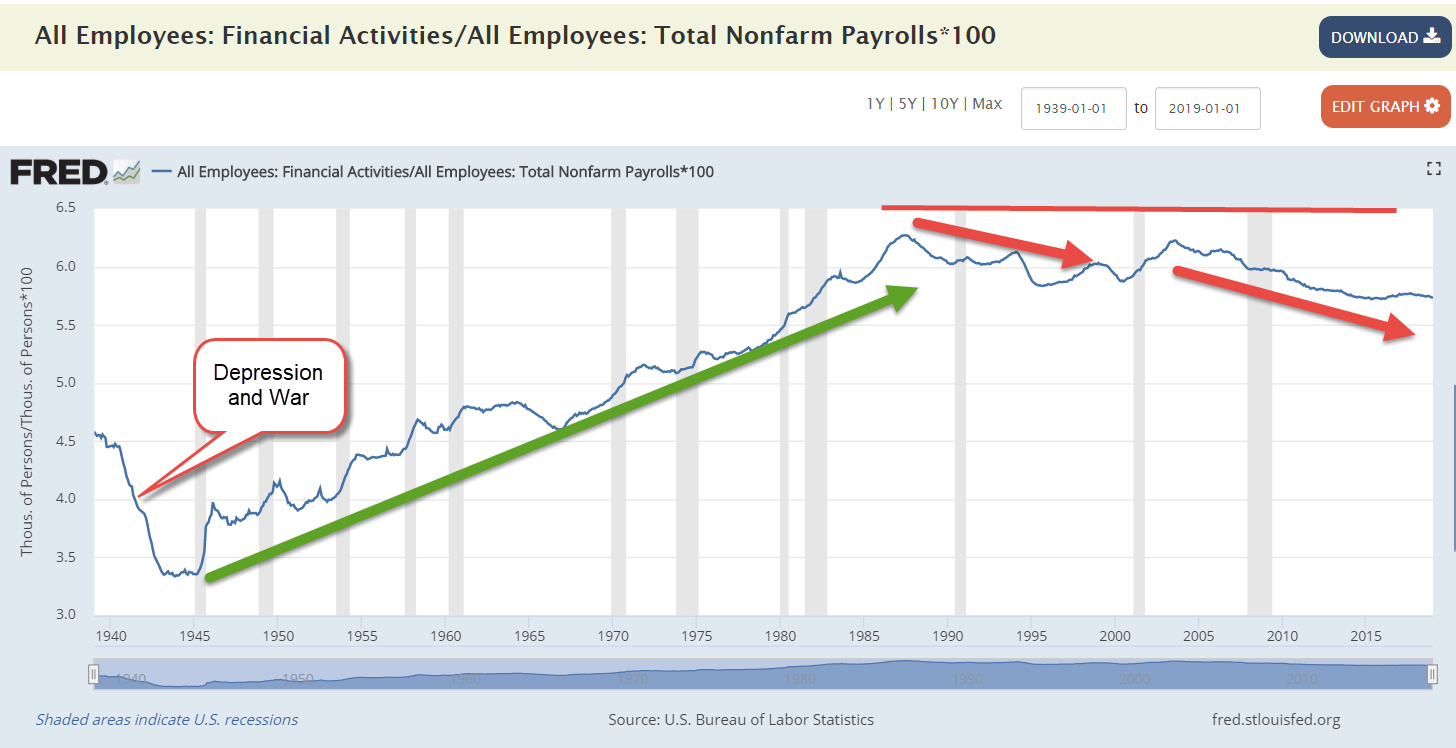
Trends in Financial Sector employment illustrate the growing threat. A steady increase in employment from the end of World War 2 through the middle of the 1980s hit a ceiling as affordable computing became more available. Since that time, the percent of jobs in the financial sector has declined.

FinEmpPctTotEmp

A sharp mind, attention to detail and a knack for customer service are no longer a path into this sector. Programming jobs that paid the equivalent of $70,000 twenty years ago have been replaced by jobs paying $50,000. Common programming tasks have been automated. White collar employees will compete against AI systems that can be situated in any country. To compete against other industrialized nations, the white-collar workers of tomorrow will need to develop the magical talents of the human brain that are difficult to automate. That will require a large national re-commitment to education.

The high unemployment that characterized the Great Recession and Financial Crisis of 2007-2009 made it apparent to many job seekers that they needed some post-secondary education. Millions signed up for classes in community colleges, private colleges and public universities. Many took advantage of federally insured loans. Since 2006, student loan debt has almost quadrupled to its current level of approximately $1.6 trillion (Note #9). More than 11% of loans are delinquent (Note #10). Current law prevents the discharge of student debt in bankruptcy. Payments in default can be withheld from federal benefits like Social Security.

As the nation enters Ed 5.0, there will be much discussion and dissension over student loan forgiveness. Is it right that one person should receive an advantage over another person in the job market at taxpayer expense? These involve questions of moral hazard and fairness that provoke instinctual reactions in all of us. Compromises may include a debtor paying an additional percentage in taxes on wages above a certain threshold. We must not sacrifice the pragmatic concerns of a nation competing in the global workforce on the altar of our righteousness toward the actions of others.

By re-committing to traditional American values and ideals, this resolution can engage the public in a lively debate. What are our values? How do we attain our ideals in a practical and equitable manner? Do Americans need the passage of a resolution to spark argument? Heck no. This country was founded on argument and a consensus over how we should argue. The Civil War was our one horrible failure to argue with words. Thousands died in an argument using guns and cannons, not debate. Let’s hope that was our last failure to debate.

////////////////////////////

Notes:

1. Politifact article on Green New Deal
2. Liberty and Justice For All award
3. Fair Housing Act 
4. White Flight to the suburbs
5. Civil Rights Act of 1964 
6. Education in the U.S.
7. 49% of British high school students attend college – Guardian article
8. 2/3rds of American high school students attend college – BLS data
9. Student loan debt series at FRED database
10. Student debt delinquency – Minneapolis Fed Reserve article

The Tug of History

February 3, 2019

by Steve Stofka

As we receive our income tax forms, we can be reminded of the reach of history into our daily lives. Over a hundred years ago, the 16th Amendment was passed as a way of paying Civil War debts and pensions. We are paying income taxes because of a horrific war that occurred 150 years ago (Note #1).

Since the recession, politicians on both sides of the political aisle have proposed some version of a universal basic income (UBI) that would replace many individual federal assistance programs. New idea? No. Fifty years ago, President Nixon and more than a thousand economists proposed an income plan to replace the existing welfare plan (Note #2). Democrats opposed the idea because they feared that the proposal would divert some aid from black families in the North, who were Democratic constituents, to white families in the South. Many southern Democrats switched parties in reaction to the “imposition” of civil rights legislation passed by northern Democrats in the 1960s (Note #3). The North and South have traded political parties since the Civil War but the animosities of that war guide current legislation and the fortunes of American families.

The recent government shutdown halted paychecks for many thousands of federal employees. The legislation that enables Congress or the President to shut down government was a budget act passed in 1974 by a Democratic Congress. Following President Nixon’s refusal to spend money allocated by a Democratic Congress, Democrats wanted more control of the budget process. Nixon was afraid that the additional spending would further fuel inflation (Note #4).

Two years later, Jimmy Carter was elected President and had to fight with his own Democratic party for budget control. The government was shut down five times during Carter’s four-year tenure, the most of any President. The legislation that emerged from a battle between a Republican President and a Democratic Congress 45 years ago laid the groundwork for today’s battle between a Republican President and a Democratic House. As the families of some Federal workers waited in line at food pantries last month, they might not have appreciated being victims of a historical political feud.

Prompted by the prejudices, concerns and animosities of past generations, we walk through our lives with a legal leash tied around our necks. According to the utopian rhetoric of the Declaration of Independence, our leashes should all be same length. Political and economic realities contradict those sentiments, and underlie the long history of housing, job, voting and regulatory discrimination in this country.

If my family or group enjoys a longer leash, another group must endure a shorter leash. Any equality we reach is a temporary balance in the tug of war for a longer leash. Equality is a happenstance, not a permanent right we have. “But it shouldn’t be that way!” an idealist might protest. It is that way. That’s history.

/////////////////////

Notes:
1. A history of 19th century income tax legislation following the Civil War, and the court decisions which nullified them.
2. Family Assistance Program proposed by Nixon. He and other economists like Milton Friedman called it a “negative income tax”
3. A timeline of the Presidential electoral map
4. A short account of the political impetus behind the act . A summary of the 1974 Budget Act.

Age Discrimination

In a 3/11/09 WSJ article, Jennifer Levitz and Philip Shishkin reported on an Equal Employment Opportunity Commission release showing that “age-discrimination allegations by employees are at a record high, jumping 29%” from year ending Sept 2007 to year ending Sept. 2008.

To avoid these lawsuits, companies have been adopting a tactic they don’t like, one which unions have long endorsed – layoffs by seniority. Last one hired is the first one fired.

In a 5/19/09 WSJ article, Dana Mattioli reports on this new age discrimination against younger workers, who often have little recourse under the law. Seniority based layoffs are easier to defend against age discrimination allegations.

Younger workers usually cost a company less money and can help their case by losing any “high maintenance attitudes typical of younger workers.” Make yourself more valuable to the company by expressing a willingness to crosstrain in another department.