The Haves and Have-Nots

June 29, 2025

By Stephen Stofka

Sunday morning and another breakfast with the boys as they discuss world events and persistent problems. The conversations are voiced by Abel, a Wilsonian with a faith that government can ameliorate social and economic injustices to improve society’s welfare, and Cain, who believes that individual autonomy, the free market and the price system promote the greatest good.

Cain smiled as he asked Abel, “You used to live in New York. So, are they getting ready to elect their first socialist mayor?”

Abel chuckled as he spread the linen napkin across his lap. “Mamdani is the Trump of the left. Knows how to work social media and promises he’ll make food and housing affordable again. Just like Trump. Neither one of them has a workable plan. Maybe that’s the age we live in. The age of blowhards on social media. Anyway, I wanted to ask you what you thought about the court’s decision this week. Can lower level courts issue nationwide injunctions? What’s the verdict, Mr. Court Watcher?”

Cain stared into his coffee cup then looked at Abel. “Well, I liked that part. Last year, Reuters did a study (Source). There have been almost 130 injunctions issued in the past sixty years. So, during the 1960s and 1970s, there were two injunctions. Two! Then it got political. Sixty injunctions during Trump’s first term. California judges were a go-to for Democrats.  Maybe twenty injunctions during Biden’s term. Republicans running to Texas judges. Now the Democrats have started again in Trump’s second term. It’s abusive tit-for-tat.”

Abel asked, “So you like the decision? How did it stand up to the famous Cain consequentialist rule?”

Cain held up his right hand, thumb down. “Failed. It confuses more issues than it clarifies. The court stayed Trump’s executive order for thirty days. Not a whole lot of time to get a class certification and a whole bunch of procedures (Source). A district judge can issue an injunction on the likelihood of class certification, but it only applies to the parties named in the suit (Source). Meanwhile there will be confusion everywhere. Confusion equals bad court decision in my book.”

Abel lifted his eyebrows. “A ‘Keep It Simple, Stupid’ approach. But this decision permits the White House to keep drafting unconstitutional orders then enforce them wherever there is no applicable injunction. I mean, this is a case where you can’t separate legal rules and procedures from the merits of the case, the Constitutional right to citizenship at birth.”

Cain frowned, then settled back as their food arrived. “Justice Sotomayor basically made that point in her dissent. The consequence of the court’s ruling is that the burden of protecting our constitutional rights falls on ‘we, the people.’”

Abel pursed his lips. “That’s expensive.”

Cain sighed. “It’s also depressing. Anyway, change of subject. We were talking last week about the One Big Beautiful Bill, the cuts to Medicaid.”

Able interrupted, “Oh yeah, why people vote against their best interests. What was that book?  What’s the Matter With Kansas? Thomas Frank.”

Cain nodded. “So you said you didn’t understand how Republican representatives could propose cuts to Medicaid that would hurt their constituents. I said that it was the principle of the thing and the huge costs to the states even after the cost-sharing with the federal government.. So, I was reading this week that some of the Republican members are concerned about the blowback from voters in the midterms (Source). “

Abel glanced at his phone. “Boy, I love this thing. My personal librarian. Last week, you made me aware of how much the states were spending on Medicaid. I did some digging this past week and I was surprised at how dependent we all are on Medicaid. It’s red states, blue states. Did you know that Medicaid finances 42% of all births (Source)?”

Cain shook his head. “Wow, I didn’t know it was that much. Now I’m remembering Romney’s remark about the 47% dependent on federal programs. He might have lost the 2012 election over that but maybe that’s what he was talking about.”

Abel frowned. “You know, when I think of poor rural states, Louisiana, Mississippi and Alabama come to mind. They have high percentages of  children who are covered by Medicaid. Like more than 60% in some cases. North Dakota is up there at 63%. Kansas and Iowa are above 50%. But there’s also blue states in that category. In Minnesota, it’s more than 60% and in Colorado it’s more than 50% (Source).”

Cain asked, “Colorado is a blue state? I thought it was purple.”

Abel shook his head. “Nah, they have a trifecta now. Governor, state House and Senate. All Democrat. In fact, most of the states have trifectas now, like almost 40 states (Source). Shows how polarized we are in this country. Forget about what happened to Kansas. What happened to divided government?”

Cain smiled. “For many years, that’s how I voted. I was against the Democrat, Republican duopoly. If Republicans held a lot of seats, I voted Democrat just to keep a balance of power. Groups get crazy when they have all the power. What did you call it? The monster in us. We start to uncage the monster. We want to enact revenge. We want what we want just to enjoy the power of getting what we want.”

Abel raised his eyebrows. “Wow, talk about dark. Well, you weren’t alone. I was reading that, in the 1970s, voters split their ticket like 30% of the time. That started to decline in the 1980s. Now, it’s less than 5% (Source).

Cain nodded. “Like I said last week, we’re in our silos. We got our political clubhouses with big signs that say, ‘Keep Out!’ That’s why I believe in the price system, supply and demand. Keeps people from getting their own way.”

Abel frowned. “You’ve talked about that before. I mean, how does a price system work in a democracy?”

Cain smiled. “I’ll talk about it another time. It’s simple. Most of us have social security numbers. Everybody living in a state votes, whether they cast a vote or not.”

Abel looked puzzled. “How would that work?”

Cain gave a Cheshire grin. “Not this week. Anyhow, back to Medicaid. So, I said last week that a lot of Republicans don’t respect dependency. It’s a bad word. That’s why they are against these big federal programs.”

Abel interrupted, “That’s  you.”

Cain nodded. “Yeah, but I’m not against dependency as such. We’re all dependent on each other in a lot of ways that we take for granted. That was Adam Smith’s point. My eggs here. Someone had to grow them, spread feed, and muck out the chicken coops. I appreciate that when I eat eggs. I’m connected to those farmers.”

Abel interrupted, “An illegal immigrant probably mucked out those chicken coops.”

Cain nodded. “Yeah, or the farmer’s kids before they went to school that morning. People who work hard. Eggs are under $3 a dozen now after the industry has recovered from the mass killing of chickens to stop the virus (Source). So, it’s like 25 cents an egg. That’s less than a minute of someone’s hourly wage, let’s say. So the farmer, the kids, or the illegal immigrant, as you point out, work their butts off and I get to buy an egg for less than a minute of work. A great deal.”

Abel set his water glass down on the table. “You put it like that, and I can understand the two different worlds perspective.”

Cain mopped up some egg yoke with his toast. “What were the two groups in the Time Machine story? The Eloi and I forget the name of the other group. In Wells’ book, they represented the working class of England (Source).”

Abel smiled. “The Morlocks. So, you’re saying that the Eloi are urban dwellers and rural people are Morlocks? That’s kind of stretching an analogy.”

Cain laughed. “No, not exactly. The Eloi are the ‘haves’ and the Morlocks are the ‘have-nots.’ That’s what I’m thinking. In any society, there are those two groups. That was Machiavelli’s point in the Republic. He thought the haves were the more dangerous group because they fought harder to keep what they had.”

Abel whistled softly. “Whoa. From Medicaid to political philosophy. Let me buckle my seat belt. Although, now that I think about it, that was a big cause of the Civil War. The plantation owners in the South wanted to keep on expanding. I was reading Alan Taylor’s book American Civil Wars and I was shocked to learn that Lincoln agreed to let the southern states keep slavery legal. This was even before the war started. His red line was no more expansion into federal territories or any new states. If the slave owners had agreed to that, would we have avoided a civil war? Anyway, the slave owners needed to expand to keep up the value of their slaves. New markets, new demand.”

Cain smirked. “A rich man’s war, for sure. Can you imagine paying a substitute to fight instead of your own son? (Source)”

Abel shrugged. “Reading that book, I could understand why we don’t learn a lot of that stuff in grade school. Too dark for grade school kids.”

Cain interrupted, “It’s the monster inside. So, you think the Republicans who vote for Trump’s big, beautiful bill are heartless?”

Abel replied, “No, I think that Trump is gambling that he won’t lose that much support from blue-collar workers even if those voters lose some or all of their Medicaid. These rural states showed strong support for Trump in the 2024 election (Source). They elect far more Republicans than Democrats to Congress (Source). It’s a political gamble. He’ll blame Democrats if he’s wrong.”

Cain frowned. “Yeah, but if that gives Democrats enough support to flip the House, they will try and block his agenda in the last two years.”

Abel shook his head. “He’s a gambler. He ran for President in 2016 to boost his brand. His businesses were failing, and he had trouble getting financing (Source). He didn’t think he had a chance to win the Presidency (Source). He admitted he didn’t know what he was doing his first term in office. He’s rolling the dice this term.”

Cain sighed. “Talk about the Time Machine. I wish I could get in a time machine and go to four years from now. Trump, Trump, Trump all the time. I kind of miss the days when we talked about who shot J.R. on the TV show Dallas, or something like that.”

Abel laughed. “I think there will be someone like Trump after Trump. Someone who knows how to maximize social media. Kyla Scanlon on Substack used the word ‘virality’ (Source). Someone who knows how to go viral. We talked about Mamdani earlier. He’s the same. Maybe that’s the new vanguard in the political arena. We will only elect people who get and keep our attention.”

Cain shook his head. “God, I hope not. So, we were talking about two groups, the haves and have-nots. I accept the fact that there will always be inequality in society. Life is multi-dimensional so it’s impossible to have equality. Each of us is like a soap bubble on an ocean wave. We’re all at different locations and elevations, different times in our lives.”

Abel raised his eyebrows. “That’s a good point, but I think a lot of us would like to reduce the growing economic inequality in this country. You think that these big government programs just aren’t very effective. That’s what you said last week.”

Cain nodded. “I think the data backs me up. The best way to reduce inequality is more economic growth. More jobs, more opportunities, more income. Democrats just focus on redistributing the profits. It’s like someone who spends all their time adjusting the heat vents in a home so that everyone feels comfortable. The problem is that Democrats don’t do maintenance on the furnace itself. Then the furnace breaks and no one has any heat.”

Abel chuckled. “Yet, economic growth is stronger under Democratic administrations. More job growth, lower unemployment, higher GDP growth (Source). Using your analogy, it’s the Republicans who don’t maintain the furnace. They make sure the gas valve is wide open. Low taxes, big investment. Republicans expect that the furnace will just keep running. Adam Smith’s Invisible Hand. The will of God, or something.”

Cain laughed. “Ok, you ran away with my analogy. You are watching too much Democratic propaganda. Under eight years of Obama, real per capita economic growth increased 11%. In Trump’s four years, it increased almost 7%. On an annualized basis, that’s better than Obama. Under Biden’s four years, it increased 8%. The big winners were Reagan and Clinton with 20% growth during their two terms (Source).”

Abel tapped notes in his phone. “You’re using per capita growth?”

Cain nodded. “Sure, that’s what people care about. If there is a bigger population, there will be higher overall growth. You have to divide by the population to get a sense of what people are experiencing in their daily lives.”

Abel nodded. “Ok, makes sense. The thing is, there was a lot illegal immigration during the Reagan administration. That’s why he agreed to grant amnesty in 1986 (Source). There was still high growth.”

Cain smirked. “And high deficits, don’t forget. Reagan had to work with a big spending Democratic Congress. And he needed to rebuild the military after the Carter administration.”

Abel laughed. “Sure, it was all the Democrats fault. For the first six years Reagan had a Republican Senate, don’t forget. Clinton raised taxes and there were actual budget surpluses and big growth. So Republicans are against illegal immigration and taxes but neither of those interfered with economic growth during the Reagan and Clinton administrations. So, what’s the secret sauce, professor?”

Cain grunted. “I’m just saying that Democrats need to focus on economic growth more than income inequality.”

Abel sighed. “You’re using per capita economic growth but that doesn’t capture the real effect of inequality on households since the start of Reagan’s first term.”

Cain shook his head. “No, remember we talked a little bit about this. The official measure of inequality doesn’t capture a lot of the income and benefits that lower households receive. In 2016, a Congressional Budget Office found a much lower GINI coefficient than the Census Bureau reported (Source). That lower figure was after taxes and government transfers were accounted for. The World Bank also computes a GINI coefficient that is closer to the CBO estimate (Source).”

Abel asked, “Does that include Medicaid or food stamps?”

Cain shook his head. “No. There is a lot of what’s called ‘in-kind’ support for lower income households that is not included in these inequality measures. Section 8 housing vouchers. The Census Bureau lists all the different types of income streams and which are counted (Source). Yet Democrats just throw these inequality figures around without acknowledging the subtleties.”

Abel interrupted, “Ok, I’ll admit that housing support can be sizeable. I had customers who paid maybe $300 for an apartment that normally rented for like $1500. Ok, go on.”

Glancing at this phone, Cain continued,  “Yeah, so that’s like almost $15,000 in after-tax income and it’s not counted. Food stamps or SNAP, they call it now, are not included and neither are school lunches. Medicaid, Medicare and employer health insurance are not counted (Source).”

Abel said, “So, I’ve been reading about all the horrible things Americans did to each other during the Civil War, and you’ve been digging up data. Ok, so how much was it before and after all these in-kind transfers?”

Cain replied, “Well, the GINI coefficient before those was .42. Lower numbers mean more equality of incomes.”

Abel interrupted, “What’s Mexico and Canada?”

Cain looked up at the ceiling, searching his memory. “Mexico is about the same as the U.S. Canada is low. Like 30 or so.”

Abel nodded. “Ok, so what was the GINI coefficient after including in-kind transfers?”

Cain shook his head. “I couldn’t find a GINI number for that. I mean, there are so many income measures. Before tax, after tax, with transfers, without, with capital gains and without. Survey data like the Census Bureau or figures from IRS tax records.”

Abel smiled. “Like you said, it’s complicated.”

Cain sighed. “Yeah. Some researchers have developed an ‘augmented’ income measure that adjusts a conventional measure called the ’90/10 ratio.’  You know, they compare the top 10% to the bottom 10%. One paper estimated a 30% reduction in that ratio in 2012 (Source).”

Abel smiled. “That sounds like a Bernie Sanders measure, comparing the very top and very bottom. What was the top compared to the middle? I’ve read that top incomes have been growing a lot faster than median household incomes.”

Cain squinted at his phone. “Geez, I need new glasses, I think. Hold on. Ok, that 90/10 ratio grew by a third between 1980 and 2018 (Source).”

Abel interrupted, “No taxes figured in?”

Cain shook his head. “No, just cash income. They do subtract capital gains. You know, they are trying to measure current year income (Source).”

Abel asked, “Ok, so do they compare the top and the middle?”

Cain expanded his screen with a flick of two fingers. “Yeah, it’s called a 90/50 ratio. So the top 10% has grown a lot. From 1979 to 2012, their incomes grew like 30%. The middle only grew by 7% (Source).

Abel nodded. “So that shows what I was talking about. The top has grown four times as fast as the middle in the past few decades. They are doing way better than the middle and yet the Republicans want to keep cutting taxes on the top. You’re saying that these inequality measures don’t include food stamps and housing vouchers and stuff like that. Well, the middle is mostly not getting those, so there’s no confusion. I mean, you can see the inequality in the data.”

Cain argued, “It’s a lot more complicated than that because the top 1% skew the comparison so much. If you dig into the income data for 2012, you find that the top 1% had 40% of the income in the top 10%. An income measure used by the Congressional Budget Office shows that the top 1% now have almost 14% of total income. That’s almost tripled (Note).”

Abel argued, “Ok, so what’s the 99/50 ratio, I guess it would be called. What’s that?”

Cain sighed. “The BEA didn’t have that.”

Abel sighed. “You seem skeptical about the accuracy of the measures themselves.”

Cain replied, “I am. The GINI coefficient jumped up like 6% in two years during a slight recession in 1990 and 1991. That tells me there was some change in the categorization of incomes, some anomaly in those years. During the Great Recession, that coefficient only dropped 2%. Like I said, there’s something doesn’t make sense about that jump in 1990.”

Abel said, “I want to do some research on poverty, but I suspect I’m going to run into the same problem. A lot of different income streams and measures of poverty?”

Cain nodded. “Exactly. The Census Bureau uses self-reported income, and several studies have found that lower income households underreport their income. One study compared self-reported income to actual Social Security checks sent to the people in the study and found that their reported income was lower than what they actually received (Source).”

Abel asked, “How much lower?”

Cain shrugged. “Well, it wasn’t a lot, like 7-8%.”

Abel replied, “So, slight underreporting of lower incomes. That’s not going to change the picture all that much. Income inequality is still a problem. Maybe a little bit less, but not a whole lot.”

Cain smiled. “I can see that I haven’t convinced you to focus on economic growth.”

Abel argued, “I think you are taking some slight imperfections in measurement and using that to cast doubt on the whole idea that inequality is a big problem in this country. During the Clinton years, taxes were raised on higher income families and that basically stopped the growth of inequality under Reagan and H.W. Bush (Source). Republicans just keep fighting any Democratic effort to reduce inequality through higher taxation.”

Cain shook his head. “Clinton was an anomaly. A lot of investment poured into the tech sector and stock prices tripled during Clinton’s eight years (Source). The result of that was a lot of capital gains taxes. It was an anomaly. Normally, higher taxes hurt economic growth. End of story.”

Abel let his head fall. “If we can’t resolve the disagreements in this country with the available data, what hope is there? I think of the story of the blind men touching different parts of an elephant and trying to identify it. If one person is convinced it’s a snake they will just keep searching the animal for a trunk then reason that the snake ate a big meal and is lying on a table with four stout legs.”

Cain laughed. “It’s like our brains are tuned to specific types of information. You know, the way our eyes see the world differently than birds or dogs.”

Abel said, “Well, nice data hunt this week. I just wish you would look at things the correct way. You bought last week. I’ll pick it up this week.”

Cain smiled. “Well, if you are buying, then I totally agree with you. See you next week.”

///////////////

Image by ChatGPT

Note: Clarke, C., & Kopczuk, W. (2025). Measuring Income and Income Inequality. https://doi.org/10.3386/w33678

Key Expectations

June 9, 2024

by Stephen Stofka

This week’s letter continues my exploration of the role of expectations. They coordinate the supply, demand and price relationships that form the web of our economic and financial lives. They shape our voting patterns, and alter our behavior in interactions with others. If we expect a police officer to be hostile, we are defensive. That reaction will affect the behavior of the officer, increasing the chance that the encounter will be hostile. Expectations cause us to behave in ways that confirm and amplify our expectations, aggravating undesirable circumstances.

Expectations and yearnings act symbiotically within us but there is a distinction between the two. Expectations are a calculation; yearnings are a desire. “I think that” is an expectation. “I hope that” is a yearning. A woman may yearn to have a child, but she expects to have a child within a period of time. A yearning knows no time or logic. We expect a certain range of compensation for the type of work we do, our skill level and experience. Business coaches encourage people to visualize and enhance their good attributes to raise those expectations. Business owners expect their capital to earn a certain percentage of profit as compensation for the risk, planning and skill that a successful business requires.

Consumers expect a certain range of prices for many frequently bought goods and services. The price of meat may be more or less than average in a week, but the price will not be $100 a pound for ground beef. We may have no price anchor for infrequent purchases like replacing a hot water heater. A few hundred dollars or a few thousand? A search in a browser can help with an average price of approximately $2100 to help a homeowner evaluate quotes from a plumbing contractor.

In the U.S., the pricing of medical care is treated as a catastrophic event like a house fire. The connection between price and medical care has been cut so that patients may not know beforehand the price of a procedure. A browser search for the cost of a colonoscopy indicates an average cost of $2200, close to that of a hot water heater, coincidentally, but medical providers do not quote a price. Prices are negotiated between health insurance companies and a network of medical providers. The negotiated price may be a fifth of the stated list price. If patients have health insurance, the only price visible to them is a co-pay. The prospect of higher medical costs next year does not incentivize us to seek care now at a lower price. Colonoscopy prices going up soon? Let me book one now! However, as costs increase, workers negotiate for better benefit packages that cover the anticipated higher costs.

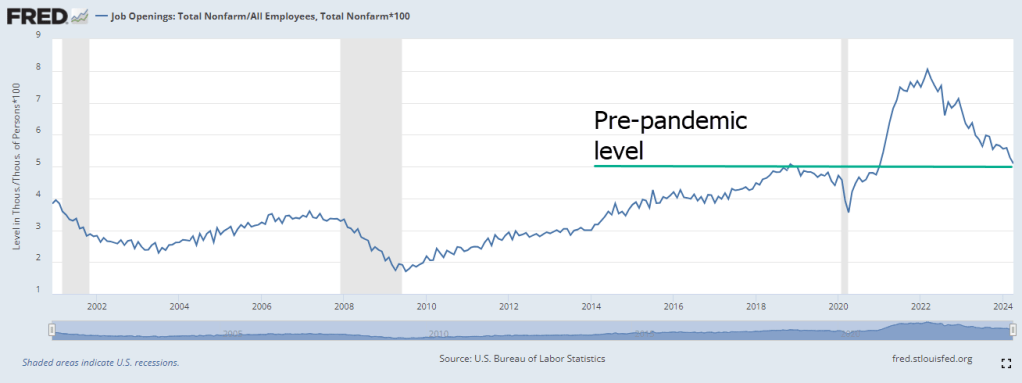
In our economy, workers play a dual role of producer and consumer. The monthly labor report and retail sales report captures the importance of these roles, and the release of these reports move markets. In the core labor force age range of 25 to 54, four out of five people are working or looking for work, according to the latest labor report. The largest generation in this demographic are the Millennials, born between 1981 and 1996. They produce the most and buy the most so their expectations steer the economy. Job openings as a percent of total employment indicate a historically robust labor market. Recent reports indicate that openings are returning to pre-pandemic levels.

Job openings as a percent of total non-farm employment

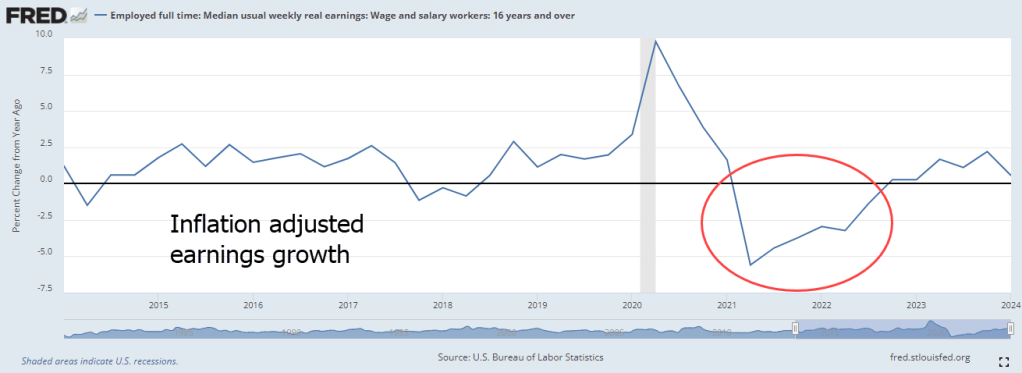
Despite the strong demand for labor, post-pandemic inflation has taken a bite out of gains in median earnings. Biden assumed office as earnings gains turned negative. Despite legislation meant to promote investment and support the labor market – the Inflation Reduction Act – the decline in real earnings did not turn positive until 2023.

Real earnings equals real purchasing power. Late Millennials reaching their early thirties expected to be able to settle down and buy a house. Older Millennials in their forties who expected to trade up to a different home are frustrated by high home prices and interest rates. Political power in our system is captured by the interests of older voters, particularly the Boomers. Less than one out of four in this generation is working (FRED series here). They want to reduce their tax costs, and preserve or enhance the government benefits they feel they have earned after a lifetime of working.

This week, David Leonhardt, editor of the N.Y. Times Morning Newsletter, pointed out a poll indicating strong support for many policies initiated by the Biden administration. Most of the public’s attention is directed to controversial issues like immigration, the war in Gaza and American support for Ukraine in their continuing war against Russia’s invasion. The pandemic focused the public’s attention on Trump’s chaotic governing style. His behavior defied expectations and his supporters became accustomed to excusing or rationalizing his actions. A majority voted for Biden as a return to normalcy in the recovery from the pandemic.

People vote their expectations, and those expectations strongly influence voters’ assessments of the economy even before a candidate has taken office. A candidate needs to offer a clear set of new expectations that manifest the yearnings of a majority of voters. Has either candidate made the connection between voter expectations and yearnings? Next week I will look more closely at the political aspect of expectations.

////////////////

Photo by Jan Tinneberg on Unsplash

Keywords: prices, growth, earnings, inflation

An Extinct Proposal

October 31, 2021

By Steve Stofka

In the past 70 years, America has escalated its health care spending from 5% of GDP to 18% of GDP. Stack up all the money Americans spend on housing, cars, fuel, utilities and food and its less than what we spend on health care. Despite all this spending we have the worst rates of infant mortality and preventable death among developed countries. If we exclude the growth of health care spending in the past few decades, the U.S. economy has been stuck in the same rut that has trapped Japan. In that time, China’s economy has erupted from $.5T to $15T and is now the second largest economy, just $7T less than the U.S. We have averaged 2.4% annual real growth in the past three decades, less than the 3% growth of the post WW2 period. How do we get out of the rut?

Thirty years ago, William Clinton emerged the winner of a three man race for the Presidency. Responding to public concern over rising health care costs, he proposed a universal health care plan that received a hostile reception. Republican groups mounted an effective advertising campaign against a “takeover” of health care by government. Republicans rode that momentum to win control of the House in 1994, ending forty years of continuous Democratic control.

In the fall of that year, two economists proposed a Major Risk Insurance Plan that they estimated would lower health care spending by 20% (Feldstein & Gruber, 1994). However, the market continued to adopt HMOs as the dominant model to reduce costs. Today, the US spends far more than other developed countries and has worse health outcomes. Martin Feldstein was President of the NBER, the nation’s premier economic research institute. Jonathan Gruber was a former researcher with the NBER, an MIT professor with a lot of expertise in the economics of health care. Both had a lot of influence, but their proposal did not win converts.

Their study was based on earlier work by Feldstein and a data sample of six thousand respondents collected in 1987 that provided insight into the choices and value that people place on health care. Feldstein and Gruber concluded that the government could insure people under 65 against major health risks for a mere $150 per person, about $300 in current dollars.

Under their proposal people would be insured for half of their annual medical expenses until they spent 10% of their after-tax income, their maximum OOP, or out-of-pocket expense. This would eliminate or reduce the wastefulness of people being over-insured. Those with small copayments or “first dollar coverage” use more health care because it costs them little to nothing except their time. Many younger workers with employer provided health insurance have far more insurance than they use. Thinking that insurance is a “free” benefit, workers don’t realize that they are paying the insurance premium in the form of lower wages.

The proposal aimed for greater efficiency, more patient involvement and wider coverage. Jonathan Gruber would become instrumental in developing Romneycare and Obamacare, nursing both plans through the political butchery and swollen egos that all major legislation endures. The 10% OOP is a progressive feature that empowers and enables the poorest people to access the full benefits of the health care system after spending a small amount. Those with higher incomes pay more into the system. Because everyone has some skin in the game, they use the system more judiciously. However, sensible proposals are not sensational. They don’t dance and sparkle.

The health care and insurance industry relies on misinformation and the inefficiency in the American system for its profits. The burden of that inefficiency has become a ball and chain on the American economy.  Each generation comes to maturity thinking that it will solve the persistent problems that have bedeviled earlier generations. Those who efficiently rake in the profits protect those inefficiencies. Any system that favors the powerful few resists change. In a sense of frustration, people turn to a populist leader who claims that they can fix it because they know how the system really works. We are drawn to our myth builders like moths to the light of a flame.

////////////////

Photo by Derek Finch on Unsplash

Feldstein, M., & Gruber, J. (1994, September 01). A Major Risk Approach to Health Insurance Reform. Retrieved October 31, 2021, from https://www.nber.org/papers/w4852. A bio of Martin Feldstein https://scholar.harvard.edu/feldstein/biocv.

Obligate Growth

This week Goldman Sachs announced that they were raising the starting salaries for entry level analysts to $110,000 from $85,000. When I heard that on the radio, I remembered the bailout of Goldman Sachs a dozen years ago. I thought of the many hospital workers who have risked their lives during the Covid crisis. Most were not making that kind of money. Under capitalism, market transactions direct resources but do they signal a society’s values?

In Sustainable Capitalism, John Ikerd (2005, 4) calls for a balance of our self-interest with our common-interests, citing the classical economists like Adam Smith who recognized that a market system must work within the ethical bounds of society (2005, 4). There is no point to capitalism if the wealth that the system can generate does not improve the general well-being of a society. Capitalism directs resources but only for goods where two parties can agree on a value. It’s hard to find common agreement on the value of many public or common goods. The infrastructure bill being negotiated in Congress this year bears witness to that reality. What is the value of a well-lit street, improved cable systems, safer electrical generation and the many public goods that we take for granted?

Capitalism evolved to assemble and deploy investment for shipping ventures, and to diffuse the extreme risk of shipping goods across oceans. In the 18th century as many as half of all ships returning to England laden with goods from India were lost at sea. Most ventures were launched without insurance. In the 17th century, insurers often went insolvent and could not cover a great loss (Johns 1958, 126). Many did not know how to price risk. In 1720, Lloyds of London and the Royal Exchange were formed to spread the risk. During the American Revolution the British government contracted out the shipping of armaments and British troops to the colonies. In 1780, a series of sea battles between the British, Spanish and French fleets severely damaged the West Indian fleet and caused great losses to underwriters (Johns 1958, 126). Loss is a good teacher of better risk management.

The underlying principle of capitalism is constant growth. In these early centuries the destruction of capital provided a natural constraint. In the 19th century, inflation from government money printing was another natural constraint (Formaini, n.d.). The capital grew but it bought less. The growth of most populations hits the bounds of their environment. Rabbits run out of food and the population periodically crashes. In the last century following World War 2, economists thought that countries who adopted democracy and capitalism would develop into thriving markets for capital. After key losses, capital managers became reluctant to deploy investment into poor countries without infrastructure, institutions and respect for private property.

Decades later, economists and political scientists now question that growth hypothesis. According to that theory, India and some former African colonies should be thriving. They are not. Given the global constraints of growth, the competition between capitals produces a concentration of capital in fewer multi-national corporations. Countries become segregated into two groups: those whose people are still very much engaged in agriculture and those whose people are engaged in services and to a lesser degree industrialization.

Agriculture is an economic trap because it is seasonal. Farmers harvest a particular crop at the same time and their competition drives the prices down. That is good for everyone except the farmers. Weather events can affect an entire region whose economy is dependent on crop production. As more farmers give up or lose their farms, large corporations take over the land. Their size and dispersal across several regions diffuses risk just as the insurance pools brokered through Lloyds of London in the 18th century.

As capital flows become more concentrated, the pool of those who benefit becomes smaller and smaller. Adam Smith’s “invisible hand” no longer spreads a general sense of well-being to the greater community. A few industries, like finance, prosper while many struggle and scrabble for the remains.

Those on Wall Street make a lot of money, but it is highly competitive and stressful. When Goldman Sachs did an internal survey of entry-level analysts at their firm, those analysts reported working an average of 95 hours a week to meet the upswell of client demand as the Covid vaccine led to a lifting of restrictions (McCaffrey 2021). Many reported physical side-effects from the long hours and stress. That $110,000 a year works out to $23 an hour. The median pay for a plumber is $28 an hour. Those entry level analysts suddenly don’t look like titans of industry. Many have student debt. They live in New York City with its high cost of living. Many probably thought that, if they could hang on for a year or two, their load would lighten and all their study and hard work would pay off. They are on capitalism’s hamster wheel. How long can the wheel keep turning?

///////////////

Photo by dylan nolte on Unsplash

Bureau of Labor Statistics (2021). U.S. Department of Labor, Occupational Outlook Handbook, Plumbers, Pipefitters, and Steamfitters. Available from https://www.bls.gov/ooh/construction-and-extraction/plumbers-pipefitters-and-steamfitters.htm (visited July 17, 2021).

Formaini, R. L. (n.d.). David Ricardo Theory of Free International Trade (2nd ed., Vol. 9) (Federal Reserve Bank of Dallas). Dallas, TX: Federal Reserve.

Ikerd, J. (2005). Sustainable Capitalism [Scholarly project]. In University of Missouri. Retrieved August 06, 2021, from https://faculty.missouri.edu/ikerdj/papers/WIMadisonSustainCapitalism.pdf

John, A. H. (1958). The London Assurance company and the marine insurance market of the eighteenth century. Economica, 25(98), 126. doi:10.2307/2551021

McCaffrey, O. (2021, August 02). Goldman Sachs Is Giving Entry-Level Bankers a Nearly 30% Raise. Retrieved August 07, 2021, from https://www.wsj.com/articles/goldman-sachs-is-giving-entry-level-bankers-a-nearly-30-raise-11627930285

Bridge the Gap?

Photo by Ragnar Vorel on Unsplash

September 6, 2020

by Steve Stofka

What issues are your priorities this election? For more than thirty years Pew Research has surveyed people about their priorities. For the first time in 2019 a majority of 765 respondents answered that there is a “great deal” of difference in where each party stands, up from 25% in 1987 (Pew Research, 2020). I’ve included the full list at the end.

In January 2019, soon after the midterm elections Pew surveyed 1500 adults (Jones, 2020). I don’t know why the abortion/free choice debate is not on the issue list since that single issue may decide some voters. I’m particularly interested in the large gaps in those priorities among those who lean Democrat or Republican. I’ll start with gaps of 25%. For instance, terrorism is a concern for 80% of Republicans but only 55% of Democrats. Other Republican priorities are Immigration, the Military and Crime.

As you can see, these are fear issues. Should a person in a town of 2000 be more concerned about terrorism than a resident of NYC? Of course not, but it is what it is. People vote out of fear and hope, but fear probably wins the wrestling match, especially among Republican voters who are not hopey, changey voters, as former VP candidate Sarah Palin noted (Gonyea, 2010).

The issue of crime illustrates the conflicting complexities of these issues. It is a 60% priority for Republicans, who are in suburban and rural areas where there is less crime, and a 40% priority for Democrats, who are in dense urban areas where there is a higher incidence of crime. Because crime is much lower than in past decades, this issue has slipped as a priority for Democrats (FBI, n.d.).  

Two of the highest Democrat priorites – Cimate Change and the Environment – have a huge gap of 50% with Republican voters. Democrat politicians have not been able to make these two fear issues personal for Republicans. If they could, they would draw more voters to their side on this issue. 25% gaps exist on issues of the Poor and Needy, Health Care, Education and Race Relations. Rural Republican voters are more likely to be poor and needy, but this is not a fear issue for them (USDA, n.d.).

What strategy would a politician or political consultant advise? Run toward the base? If so, one would emphasize these issues where there are large gaps between the two primary factions in this country. The President has largely adopted this strategy. Republican voters are more inclined to fall in line and the President is relying on this party loyalty even if they don’t like him personally.

Some issues where there is a smaller gap between factions are the economy, the budget deficit, jobs, global trade, drug addiction, transportation, Social Security and Medicare.

A politician reaching out to voters on the fence in this election would focus on these issues. Joe Biden hits the jobs theme, the budget deficit, and protecting Social Security and Medicare to appeal to voters who have had their fill of the President’s divisiveness.

In the coming two months, candidates may adjust their strategies. In the 2016 election, Hillary Clinton may not have addressed these shared concerns as well and it cost her the election.  Governing comes after winning an election. In politics, winning is packaging the concerns and identities of voters into an appealing, if not attractive, box that will get them to come out and vote.

What are your priorities this election season? Are you a multi-issue voter, a single issue voter, a party voter regardless of the issues? Here’s the Pew survey list of 18 issues: terrorism, immigration, military, crime, climate change, environment, poor and needy, race relations, health care, education, economy, Social Security, Medicare, jobs, drug addiction, transportation, global trade, and the budget deficit.

///////////////

Notes:

FBI. (n.d.). Crime rates in the United States, 2008 – 2018. Retrieved September 05, 2020, from https://crime-data-explorer.fr.cloud.gov/explorer/national/united-states/crime

Gonyea, D. (2010, February 07). ‘How’s That Hopey, Changey Stuff?’ Palin Asks. Retrieved September 05, 2020, from https://www.npr.org/templates/story/story.php?storyId=123462728

Jones, B. (2020, August 26). Republicans and Democrats have grown further apart on what the nation’s top priorities should be. Retrieved September 05, 2020, from https://www.pewresearch.org/fact-tank/2019/02/05/republicans-and-democrats-have-grown-further-apart-on-what-the-nations-top-priorities-should-be/

Pew Research Center. (2020, August 21). Public’s 2019 Priorities: Economy, Health Care, Education and Security All Near Top of List. Retrieved September 05, 2020, from https://www.pewresearch.org/politics/2019/01/24/publics-2019-priorities-economy-health-care-education-and-security-all-near-top-of-list/

U.S.D.A. (n.d.). Rural Poverty & Well-Being. Retrieved September 05, 2020, from https://www.ers.usda.gov/topics/rural-economy-population/rural-poverty-well-being/

Marching Forward

April 28, 2019

by Steve Stofka

When former President Obama took the oath of office, the economy was in the worst shape since the Great Depression 75 years earlier. Tax receipts plunged and benefit claims soared. Millions of homes and thousands of businesses fell into the black hole created by the Financial Crisis. In sixteen years of the Bush and Obama presidencies, the country added $16 trillion to the public federal debt, more than tripling the sum at the time Clinton left office in early 2001.

Although growth has remained slow since the financial crisis (see my blog last week), the economy has not gone into recession. Despite the fears of some, a recession in the next year does not look likely. The chart below charts the annual percent change in real GDP (green) against a ratio called the M1 money multiplier, the red line (Note #1). Notice that when the change in GDP dips below the money multiplier for two quarters we have been in recession.

The money multiplier seems to act like a growth boundary. While some economy watchers have warned of an impending recession, GDP growth has been above 2.5% for more than a year and is rising. In 2018, real disposable personal income grew nearly 3%. This is not the weak economic growth of 2011 or the winter of 2015/16 when concerns of recession were well founded.

The number of people voluntarily quitting their job is near the 1999 and 2006 highs. Employees are either transferring to other jobs or they feel confident that they can quickly get another job. An even more important sign is that this metric has shown no decline since the low point in August 2009.

In 2013, the Social Security disability fund was in crisis and predicted to run out of money within a decade. As the economy has improved, disability claims have plunged to all-time lows and the Social Security administration recently extended the life of the fund until 2052 (Note #2).

Approximately 1 in 6 (62 million) Americans receive Social Security benefits and that number is expected to grow to 78 million in a decade. However, the ratio of workers to the entire population is near all time highs. The number of Millennials (1982-1996) has surpassed the number of Boomers. This year the population of iGen, those born after 1996, will surpass the Millennial generation (Note #3). Just as a lot of seniors are leaving the work force, a lot of younger workers are entering. The ratio of worker to non-worker may reach 1 to 1. 45 years ago, one worker supported two non-workers.

As the presidential cycle gets into gear, we will hear claims that there are not enough workers to pay promised benefits. Those claims are based on the Civilian Employment Participation Rate, which is the ratio of workers to adults. While the number of seniors is growing, the number of children has been declining. To grasp the total public burden on each worker, we want to look at the ratio of workers to the total population. As I noted before, that is at an all time high and that is a positive.

Raising a child is expensive. The average cost of public education per child is almost $12K (Note #4).  Public costs for housing, food and medical care can push average per child public cost to over $20K annually.

Let’s compare to public costs for seniors. The average person on Social Security receives $15,600 in benefits (Note #5). In 2018, the Medicare program cost an average of $10,000 per retiree (Note #6). The public cost for seniors is not a great deal more than those for children.

As a society, we can do this.

/////////////////

Notes:

  1. The M1 money multiplier is the ratio of cash and checking accounts to the amount of reserves held at the Federal Reserve.
  2. SSDI solvency now extended to 2052. Here’s a highlight presentation of the trustee’s report.
  3. Generation Z will surpass the numbers of Millennials in 2019. Report
  4. Public education costs per pupil
  5. Social Security costs
  6. Medicare program cost $583 billion. There are approximately 60 million on the program. CMS

Obama’s GDP Problem

In these home stretch months before the election, President Obama and Republican nominee Mitt Romney will be repeatedly challenging each other’s economic performance; Obama as President and Romney as Governor of Massachusetts.  Already the initial attack ads of both campaigns are running and each has plenty of factual ammo they can aim at the other.  Contrary to all common sense, we continue to measure Presidents by the health of the economy.  Although Congress is largely responsible for the laws that govern the economic dynamo of a country, we look to the President to set priorities for Congress – or at least that’s what we tell ourselves.  In truth, we are rather simple minded and prefer to hold one man responsible rather than a group of 535 Congress people and Senators. 

For some background, let’s take a look at a chart showing the real GDP, that is GDP in constant 2010 dollars, per capita over the past five decades.

Then zoom in on the last ten years, showing the severe decline of per capita GDP during this recent recession.

Now let’s look at the total per capita GDP growth by President.  If real GDP per capita was $100 when a President took office and $120 when he left office, then total real GDP growth was 20% during that President’s watch.  We’re not going to look at the annual percentage of growth, only the total.  For the most recent GDP data I have used BEA estimates of $15,454 trillion as of the first quarter of 2012. I have used Census Bureau estimates of a total population of 313 million and a BLS inflation factor of 2.186 since 2010.

Almost by instinct, the voters do not re-elect Presidents who are at the helm of a low growth country.  Below is a chart of the first term total real GDP growth of Presidents who were re-elected.  I have not included Johnson because he only served for a year before he was re-elected.

As you can see, GW Bush was the only President re-elected with a total growth gain less than 10% and Bush won re-election by winning Ohio by two percentage points or 118,775 votes.  Had 60,000 voters cast their ballot for Kerry, GW Bush would have lost Ohio’s 20 electoral votes and the election.  As the first Presidential election after 9/11, the election focused more on national defense and foreign policy, not the economy.  A barrage of attack ads, the Swift Boat campaign, against Kerry in the last weeks leading up to the election proved to be a decisive factor in Bush’s re-election.  Had the election concentrated more on the economy, Bush probably would have lost the election.

I have listened to several conservative pundits who criticize Obama for continuing to run against Bush’s economic policies, contending that it has been 3-1/2 years since Obama took office.  Many conservatives are devotional acolytes of the Ronald Reagan legacy and their devotion often clouds their memory.  Obama is using the same strategy that Reagan did in 1984, who ran against Carter’s former Vice President, Walter Mondale.  I will paraphrase a common refrain of Reagan during his re-election bid: “Do you want someone (Mondale) who helped get us in this mess in the first place?” Reagan asked.  The voters answered a resounding “No” and sent Mondale down to a crushing defeat.  Reagan employed this tactic of running against a former President despite the relatively strong growth during his first term. 

Although Obama’s total GDP growth is better than GW Bush’s total, it is less than former President Carter, a guy who lost his job over relatively weak growth and Obama’s 1st term growth numbers are less than Bush’s first term growth. A strong 1st quarter of economic growth in 2012 has helped pull up the President’s economic growth numbers but the first reading of 2nd quarter GDP growth that comes in July may further weaken his chances just before the election.  By the time 3rd quarter GDP numbers come out in October, many voters will have already made up their minds.

For his part, Romney’s tenure as governor of Massachusetts was hardly exemplary.  We will have two contenders for the Presidency running on an economic platform and neither one of them has a strong record of economic growth while in office.  Both campaigns will have plenty of arrows in their quivers and each candidate presents an inviting target.  Enjoy the show!