The Intersection of Politics and Philosophy

September 21, 2025

By Stephen Stofka

Last November, I first introduced Abel and Cain as a narrative device to explore two sides of an issue (Substack, Innocent Investor). I hope readers have enjoyed some of the arguments, whether you agreed with them or not. I often found it difficult to adhere to the discipline of reaching for arguments and reasoning that I did not agree with. Could it be that there was a bias in my thinking? Perish the thought! The boys are going fishing for a while as I analyze opposing perspectives in a more traditional format.

In politics, we contrast progressive and conservative ideologies. In philosophy, we contrast subjective and objective viewpoints. Let’s combine these two axes of comparison and look at some intersections. What does it mean to be conservative and subjective? Someone like Adam Smith might fit that description. The free market was an emerging consensus of individuals and businesses trying to satisfy their needs. He believed that this exchange, despite its flaws, would improve the general welfare of society.

What about progressive and subjective? Progressives want to manage the agenda in schools to instill the “correct” social attitudes in children, to steer their subjective experience along a progressive ideology. In his recently published book The Progress Trap, Ben Cobley (2025) writes that schools manage their reading lists and curricula to ‘decolonize’ the subject matter students are exposed to. Books that tell a historical narrative from the viewpoint of the colonizing nations are removed from the curricula. Is this a version of Fahrenheit 451?

Conservatives act to implant their ideology in the subjective experience of the population. In 2022, Florida passed the “Florida Parental Rights in Education Act.” After amendments in 2023, the policy required the removal of books with any gay character in them from K-12 school libraries (Source). Like the progressives, conservatives want to instill the “correct” attitudes in children.

Can conservative and progressives agree on what are the “correct” attitudes? It seems unlikely. In the preface to his book, Cobley identifies one cause of the policy failures and disagreements we have. We assume “that we are right and good and can only cause good to occur in the world, while our opponents can only cause bad” (p. vii). He notes that progressives rely on social science as their authority. They see the world in a mechanistic way of cause and effect, oppressors and victims. Arnold Kling (2017) has written about the three languages of politics and echoes the same point. Conservatives rely on cultural and religious traditions as an objective authority. In Kling’s typology conservatives view the world as a struggle between civilization and barbarism.

Is there a middle ground, an alternative authority that might resolve their differences? People form groups based on an allegiance to an authority, and group allegiances are not easily changed. There are several methods to effect change, some directed toward the subjective, others employing a more objective approach.

Subjective methods use persuasion to get others to change their authority allegiance. These include essays, videos, and debates that appeal to rationale as well as emotion. A more negative type of persuasion is ridicule, often used to silence opposition rather than convert opinion. Activist groups on both the right and left organize ridicule campaigns on social media to attack unwanted behavior and opinions.

In an objective approach, interest groups win control of civil institutions to exert change by legislation or policy. The Florida law mentioned above is an example of civil force by conservative groups. On the left we see mandates of diversity, equity and inclusion training in college curriculums. Copley writes that progressives have a “comforting illusion that things will inevitably get better so long as they and their allies are in control of things” (p. vii). Conservatives have a similar illusion but a different goal, the preservation of civil and moral order.

Critical to any human society are its resources. Progressives promote policies and investments that preserve the environment. The costs, both in terms of money and convenience, are a small price to pay for the benefits of a healthy ecosystem. The resources that conservatives care about are cultural and religious. These are the glue, the connections that evolve between members of a society. If preserving the environment means the sacrifice of these community connections, then conservatives would rather preserve those connections rather than the environment.

In a large multicultural democracy like ours, groups compete to design or control those institutions which shape the subjective experience of people in society. Since children are so impressionable, school curricula can become a battleground for ideologies.

Beginning in the 19th century, schools in states and local districts have struggled to control the religious traditions of students in their charge. A Wikipedia article has a history of the conflict over school prayer (Source). Since the 16th century, Protestants and Catholics have quarreled over Christian text and doctrine. Today, the Catholics include the Apocrypha, early Christian writings, in their Biblical canon. Most Protestants do not. Catholic doctrine holds that God inspired the authors of the Bible. Some Protestant sects believe that the Bible is the literal word of God.

Naturally, these two religious denominations brought their disputes into the schoolroom. Ending the practice of prayer in schools came not from a Christian denomination but a Jewish family disturbed that their son was forced to pray in a Christian manner. In Engel v Vitale (1962), the Supreme Court ruled that publicly funded schools must not promote any particular religion. They based their decision on the Establishment Clause of the First Amendment that prohibited the federal government from favoring a particular religion (Source). The Fourteenth Amendment extended those prohibitions to the state governments as well. The Legal Information Institute at Cornell University writes that it is “one of the most unpopular decisions in Supreme Court history” (Source). Numerous attempts to amend the constitution have failed to reach the required two-thirds majorities in Congress. Lastly could the current conservative court overturn that decision? In Kennedy v. Bremerton School District (2022), it allowed private prayer in public places, but it has reaffirmed that 1962 precedent prohibiting state-sponsored religious practice.

Is this the familiar battle between science and religion or between secularists and religiously affiliated? According to Pew Research, 70% of Americans are religiously affiliated and 90% of those affiliated are Christian (Source). In the battle between Christian sects for control of the classroom, Christians have lost the battle to secularists. Could the many Christian sects join together, agree on some central canon, then pass an amendment to the Constitution? Agreement over religious doctrine is a tall hurdle and amending the Constitution is particularly difficult.

In addition to persuasion, ridicule and civil regulations, governments can enforce ideologies through police force. In the former Soviet Union, the KGB suppressed unwanted thought by arrest and exile to the Gulag. In Nazi Germany, neighbors were encouraged to “rat” on their neighbors if they suspected any anti-Nazi opinion or behavior. In the three decades following World War 2, Red Guards in Maoist China punished their citizens for incorrect thinking by beatings and re-education in labor camps. Today, the citizens of North Korea are brutally tortured for expressing disloyalty to the Kim family who rules the nation.

What drives human beings to replicate their ideologies? While they may lack substance, they promote social cohesion among the followers, and endow the leaders with economic benefits. In his book The Social Conquest of Earth, E.O. Wilson (2012) described a critical aspect of human societies, their eusociality. First coined in the 1960s to describe bee colonies, Wilson expanded the term to describe the ability of human beings to build multigenerational societies and cultures. Biological organisms evolve through discrete or sporadic genetic mutations that provide an adaptive advantage. The evolution of ideologies is not discrete, but a continuous adaptation to social, cultural and political pressures.

In E. O. Wilson’s analysis, human societies evolve through the conflict between group cooperation and individual competition. Individuals struggle within each group to define the group’s shared values and outlook. As I’ve shown above, there is also individual cooperation within each group to win the competition between groups for control of a society’s institutions. The tension between the individual and the collective, the subjective experience and the objective shared environment, drives change in any human society.

////////////////////

Photo by Dimmis Vart on Unsplash

Cobley, B. (2025). The progress trap: The modern left and the false authority of history. Polity Press. Available from Amazon

Kling, A. (2017). The three languages of politics: Talking across the political divides (Rev. ed.). Cato Institute. Available from https://www.cato.org/three-languages-of-politics

Wilson, E. O. (2012). The social conquest of earth. Liveright Publishing.

Conflicting Principles

May 11, 2025

By Stephen Stofka

This is part of a series on persistent problems. The conversations are voiced by Abel, a Wilsonian with a faith that government can ameliorate social and economic injustices to improve society’s welfare, and Cain, who believes that individual autonomy, the free market and the price system promote the greatest good.

Abel looked across the restaurant at a family seated around several tables. “I wonder why the kid is dressed in white.”

Cain turned to look. “Oh, yeah. First Communion, maybe? I think it’s that time of year.”

Abel spread some honey on his toast. “Last week, we were talking about charter schools. A few days later, I was listening to a Supreme Court case about a charter school in Oklahoma” (Source).

Cain asked, “What do you mean listen to?”

Abel replied, “Lawyers for both sides argue their case in front of the Supreme Court and the justices ask them questions. ‘Oral arguments,’ it’s called (Source).”

Cain nodded. “I know about oral arguments. I didn’t know they were broadcast.”

Abel finished chewing. “They started that in the pandemic, I think. If you subscribe to the Oyez podcast, you can listen to it a day or two after the argument. Their web site has a lot on past court cases (Source). There’s also a link on the Supreme Court’s web site where we can listen to them live (Source).”

Cain asked, “So what was the case about?”

Abel said, “Oklahoma has a state charter board that approves or denies applications to become charter schools. A few years ago, the state board approved an application for a Catholic charter school named St. Isidore, allowing them to freely follow their religious beliefs.”

Cain interrupted, “Wait. I thought charter schools were publicly funded by taxpayer dollars. What about separation of church and state?’

Abel nodded. “That’s what the state attorney general wondered.”

Cain asked, “A Democrat? I thought Oklahoma was fairly red.”

Abel shook his head. “No, a Republican. The AG’s office brought the case to the state’s Supreme Court, arguing that the charter should be nullified. The court agreed. Both the school and the state’s chartering board brought the case before the federal Supreme Court, where the two cases got joined together.”

Cain raised his eyebrows in mock drama. “So one state agency, the AG, is pitted against another state agency, the charter board.”

Abel laughed. “And there’s some political machinations on the court.”

Cain twirled an imaginary moustache. “Politics on the Supreme Court? Surely, you jest, my man!”

Abel smiled. “Justice Barrett, one of the conservative justices, recused herself from the case so there are just eight justices, a five to three split between conservatives and liberals. If the three liberal justices can bring Chief Justice Roberts to their side, the decision would result in a 4-4 tie, which would let the Oklahoma Supreme Court decision stand.”

Cain asked, “So what are the issues both sides are fighting over?”

Abel put his coffee cup down. “Before I get to that, let me get back to the politics. So the justices direct their questions to the lawyers for either side, but the questions are designed to bring up points that the conservatives and liberals think are important to their argument.”

Cain replied, “Indirectly steering the debate as the justices hope to sway Roberts.”

Abel smiled. “Yeah. So the liberals focus on the establishment clause in the First Amendment that prevents the government from favoring one religion over another.”

Cain looked puzzled. “I thought charter schools were private.”

Abel replied, “They are, but they are publicly funded, and they have to follow the same rules as other public schools. They can’t choose which students they admit.”

Cain interrupted, “We talked about that last week. The schools are not supposed to do that. Some states are rather lax in how they enforce that rule.”

Abel nodded. “Good reminder. The school has to get approval for their curriculum, and the state closely monitors the school to make sure that it meets the state’s requirements. The state may even have a representative on the charter school’s board. Plus, the state can close the school down. Even though the school is private, the state has a lot of control.”

Cain said, “Reminds me of the debate over independent contractor status. If XYZ company hires someone to do a job, and XYZ has substantial direction and control of how that person performs the work, then that person is an employee, not an independent contractor. XYZ company has to pay employer taxes for whatever money they pay that person.”

Abel nodded. “That’s a good point. It’s the familiar ‘if it quacks like a duck’ argument. So the plaintiffs for the state chartering board and St. Isidore, the charter school, stressed the private ownership of the school, religious freedom and free expression. The respondents, the AG’s office, focused on the control that the state has over St. Isidore and that control makes them an extension of state legitimacy and power.”

Cain looked surprised. “I agree with the AG’s office.”

Abel replied, “I think it’s a case of which precedent do you think should carry the most weight. The conservative justices focused on the equal protection clause of the 14th Amendment (Source). A charter school must meet minimum curriculum requirements. One of the lawyers said the state even specifies that dangling participles must be taught in English class. But the school can have a focus like science, the arts, or on Chinese language skills, offering some language immersion classes.

Cain interrupted, “That shows how much control the state has. So what was the counter argument from the conservative justices?

Abel replied, “I think it was Kavanaugh who expressed concern about equal treatment. Each charter school can have a different focus, but if a school has a religious focus, that’s unconstitutional?”

Cain tilted his head slightly. “Ok, good point. An American history teacher at St. Isidore could stress Christian principles as fundamental ideas to the founders who wrote the Constitution. If that teacher cited some Bible verses to illustrate those principles, is that legal? The teacher is paid with public taxpayer dollars. Is the government promoting one religion over another?”

Abel argued, “Michael Klarman wrote a book on the founding called Framer’s Coup. At the beginning of the introduction, he cites Madison and Benjamin Rush referring to an ‘Almighty hand’ or the ‘hand of God’ (Source).”

Cain looked skeptical. “Yeah, but they weren’t referring to a specific religion, or even a broad category like Christianity.”

Abel said, “Should a school teacher in a publicly funded institution cite any religion? If the Supreme Court decides that the state can charter religious schools, where does it stop? What if a teacher cited the Koran as embodying the founding principles of the American Constitution?”

Cain smirked. “Not a lot of Muslims in Oklahoma. I could see where Catholics and Protestants would get into a war over this issue. Catholic teaching would stress the Federalist view of government at the founding. More centralized and authoritarian, the one championed by Hamilton. Protestant teaching would stress the anti-Federalist view associated with Jefferson. Decentralized power, more autonomy at the local level.”

Abel argued, “But both of those views could be taught without referencing back to the Bible or the Koran. Religious traditions provoke too much dissent and violence. The founders wanted to stress constitutional principles that bound the thirteen colonies together, not tore them apart. The European powers were already trying to do that. In Federalist #10, Madison noted the conflict of political factions with differing regional interests (Source). He hoped that the Constitution would balance the tension between national and local interests.”

Cain nodded. “Getting back to the issues involved, you’re saying it’s the First against the Fourteenth? The conservative justices and the Catholic charter school use the 14th Amendment to justify their opinion. Liberal justices and the state’s AG office base their arguments on the 1st Amendment.”

Abel smiled. “It’s more complicated. The conservative justices also focused on the free exercise clause in the First Amendment. The Supreme Court has long struggled with the balance between the establishment clause and the free exercise clause (Source). An individual’s free exercise cannot conflict with state interests like public safety and health. As long as a school meets the curriculum requirements, it has satisfied other state interests. Is it not entitled to express its views? If other charter schools can focus on climate change and environmental science, why can’t a school express its religious views?”

Cain sighed. “So the First and the Fourteenth Amendments are bound together in a way.”

Abel nodded. “Remember that in 2015’s Obergefell case, a conservative court decided that same sex couples had a right to marry (Source). Equal protection. That decision angered some conservative religious groups. The conservative justices seem to favor that combination of equal protection and free exercise over a state’s interest in remaining religiously neutral. I think Alito mentioned the Masterpiece Cake Shop case.”

Cain replied, “Yeah, the owner of the shop didn’t want to make a custom cake for a gay couple’s wedding. Against his religious beliefs, he said. The state said he had to serve the public and couldn’t discriminate against a customer because of his religious beliefs. The Colorado Supreme Court agreed. The federal Supreme Court overruled and said that a custom made cake was a form of expression protected under the First Amendment (Source).”

Abel argued, “Yeah, but the state did not fund the cake shop with taxpayer dollars. Alito sees only the context that will support his judicial instincts. He wrote the Dobbs decision overturning Roe, reasoning that the Constitution did not give a woman a right to an abortion because it was not deeply rooted in American tradition (Source). His ‘reasoning’ conveniently left out the fact that the Constitution as written in the 18th and 19th centuries gave women few rights. They were subservient to men. That’s the bubble of reason that Alito lives in.”

Cain sighed. “Well, remember that he’s writing the majority opinion, so its not just his reasoning.”

Abel shook his head. “Basing decisions on ‘history and tradition’ is flawed. It invites the justices to pick and choose only the history and tradition that supports their biases.”

Cain laughed. “Boy, we could spend a few days on that topic. I do think that the conservative justices are opening a can of worms on this one. If they are going to allow states to charter publicly funded religious schools, some state charter board is going to discriminate against a particular religion. The board will cover their tracks for sure, claiming that the applicant did not meet the state’s curriculum requirements. The applicant will file a lawsuit, claiming religious discrimination. This is an activist court issuing decisions based on unclear reasoning.”

Abel interrupted, “Unclear reasoning. You are being generous.”

Cain shrugged. “The lower courts don’t know how to apply that reasoning. Inevitably, more cases will come to the court, and it will clarify its reasoning.”

Abel smirked. “This court will be dominated by this kind of thinking for decades to come. Anyway, let’s move on from court stuff. Last week, we were talking about problems in education. One of the problems we didn’t discuss is the expectations of parents. Mom and dad might expect school instruction for their child to have the same elements as when they went to school. Like multiplication tables in grammar school or some in high school who had to memorize a poem by Shakespeare.”

Cain nodded. “Well, I thought it was reassuring that they are still teaching dangling participles. There was much more focus on rote learning when we were going to school.”

Abel continued, “That rote learning helped kids learn some basic job skills, like how to make change. Today, some might argue that kids rely on the cash register or the computer to do the math for them so why should kids learn basic math skills? I’d argue that, without those basic skills like percentages and such, kids will become easy prey when they grow up. People can dazzle them with fancy figures that they can’t follow and sell them financial products that hurt rather than help them.”

Cain laughed. “They will ask ChatGPT for financial advice, I suppose. They’ll become like the society in the movie ‘Wall-E’ where they are totally reliant on machines for everything. But what kid thinks about investments? That’s far in the future.”

Abel argued, “Maybe at a very young age, you’re right. A month from now is a long time in a young kid’s mind. But there have been good experiments with high schoolers managing stock portfolios.”

Cain replied, “Goes to show that incentives matter. In the search for YouTube subscribers, a kid will rip a favorite album and upload it to YouTube, complete with notes and navigation to each track in the album. The kid will see little money for all that effort because the recording artist will monetize any ad revenue, but just the prospect of getting more subscribers gets the kid to spend that time and effort. We need to apply those lessons to school learning.”

Abel looked doubtful. “Look, there’s stages in brain development. At the risk of herding kids to learn the same thing at the same time, we can’t be teaching calculus to sixth graders.”

Cain argued, “We had our daughter in Montessori school for a few years. She was in a classroom with kids of different ages. She was about seven and heard about fractions, told the teacher she wanted to learn about them and the teacher had one of the older girls show her fractions. We need more innovative teaching methods, not rigid curriculum.”

Abel shook his head. “Some kids really struggle with fractions and decimals and need to be taught by someone with more experience. You know, someone who knows different approaches to help them understand. The fault of ‘new math’ when it was taught in the 1970s and 80s was trying to teach kids about rules and how they affect relationships between numbers. It was too abstract for a lot of kids.”

Cain was equivocal. “Well, there were also kids who were good at memorizing. They had memorized that three-eighths was less than a half without really understanding the concept. I remember one kid in fourth grade, I think. To add two fractions, he cross multiplied them even when they had the same base.”

Abel cocked his head. “What do you mean?”

Cain replied, “Like two-fourths plus one-fourth. He didn’t need to find a common denominator and cross multiply because the two fractions already have the same base, which is four. The kid had found that the cross-multiplication procedure got the right answer, so he used that all the time.”

Abel looked puzzled. “What if the problem involved adding a whole number and a fraction, like four plus a half.”

Cain smiled. “He would convert the whole number to a fraction, like make four into a fraction of four over 1, then go through his procedure. He was so resistant when I tried to show him any method that was quicker. ‘I might get the wrong answer,’ he told me.”

Abel lifted an eyebrow. “You know, I’ll bet a lot of people carry that approach into their adulthood. They resist change, new methods of doing things, or new arguments. If we looked closely, we’d probably see that same rigid approach at parent-teacher conferences and city council meetings.”

Cain laughed. “Or on the Supreme Court. Using the same kind of reasoning in two cases that have critical differences. Some justices ignore the different principles involved, brushing the differences aside as unimportant.”

Abel smiled. “Different species of animal tend to follow a well-worn path in the forest, even if there has been some change to the landscape and there is an easier path down to the river, for instance. Do they take the easier path? No. They use the same rule.”

Cain asked, “How do we teach kids that different rules apply in different circumstances? That’s what English and math are all about. That’s the importance of learning a foreign language. We become aware that other languages have different rules than our native language. It makes us more aware of the rules that structure our native language.”

Abel asked, “So what about a public school teaching comparative religions? The kids would learn that each religion has different beliefs, customs and rules for interpreting our relationship with the infinite, our own mortality, and the society around us. Could a public school teach both Islam and Catholicism?”

Cain looked puzzled. “What about the Jewish faith? Or Evangelical beliefs? A good background in comparative religions is a lot to ask of a 4th grade teacher. I still think that the state needs to steer clear of funding religious instruction.”

Abel sighed. “I think this decision will be important. Last week, you mentioned that a third of Rochester’s public schools are charter. One of the lawyers arguing at the Supreme Court mentioned that all of New Orleans public schools are charter (Source). The state, as a whole, has only 11% charter schools, but it’s a growing constituency (Source).”

Cain laid his napkin on the table next to his plate. “Sometimes I think that these problems persist because we hold onto conflicting principles. We want schools to be like a Swiss army knife, a multi-tool that addresses several problems and we can’t agree on priorities. We want people to be housed but we want to preserve the character of our neighborhoods and that makes it difficult to build affordable housing. We want the state to stay out of religion, but we want to preserve free speech and religious freedom.”

Abel nodded. “Maybe that’s the most persistent problem of all. It’s like we’re sitting on a wagon being pulled by two horses and we have no reins to guide the horses. Hey, I see you’re ready to go. Maybe we could talk about that next week.”

Cain laughed as he stood. “I like that horse analogy. My treat this week. See you next week.”

//////////////////////////

Image by ChatGPT in response to the prompt: “draw an image of two ghosts styled like Casper the Ghost getting ready to have a boxing match.”

It’s Complicated

May 4, 2025

By Stephen Stofka

This is part of a series on persistent problems. The conversations are voiced by Abel, a Wilsonian with a faith that government can ameliorate social and economic injustices to improve society’s welfare, and Cain, who believes that individual autonomy, the free market and the price system promote the greatest good.

Cain said, “A little thing I appreciate about this place is they serve melted butter, not frozen butter packets.”

Abel nodded. “A little extra time and care.”

Cain asked, “You need to wash up before you eat?”

Abel turned his right hand over. “Oh, that’s just dirt under my fingernails. Getting the flower beds ready and weeding. What about you? Anything interesting this week?”

Cain spread a small amount of butter on his waffle. “We were talking about common problems like homelessness, and I thought we could talk about education this week. K-12, primarily.”

Abel put his coffee cup down. “Oops. That reminds me. Last week I mentioned that the Feds had helped fund the capital portion of Denver’s homeless program. This past week the city council learned that FEMA has canceled a $32 million grant because Denver is a sanctuary city (Source). The agency had already received $8 million of that grant.”

Cain frowned. “Can the Feds take the money back?”

Abel shook his head. “I don’t know. I don’t think the City Council knows. There’s no rules. The Trump administration is just doing stuff. Anyway, education is even more complicated than homelessness. What got you interested in education this week?”

Cain sighed. “An argument with my daughter.”

Abel frowned. “She teaches sixth grade, right?”

Cain replied, “Fifth. She says that kids are still kids at that age. Then they turn into discipline problems.”

Abel smiled. “The stages of child development. The terrible twos, the argumentative fours and then middle school.”

Cain laughed. “Then teenager. I used to think, ‘Was I like this when I was growing up?’ It gave me a new appreciation for my parents.”

Abel said, “So, go on. What was the argument about?”

Cain pursed his lips. “Oh, we got into one of those equity, equality discussions. I should know better. I said that a kid who can barely read is not going to do as well in life. Society should accept that and devote more of their resources to the more gifted kids. They are the ones who will do the most for society.”

Abel nodded. “A Pareto improvement in the long run. It would benefit the more gifted without materially harming outcomes for those with learning disabilities (Source).”

Cain replied, “I actually called it that. She said that such a shift in resources would harm struggling students. I said that the current condition already harms the more gifted and her perspective was too myopic. I might have characterized her position as Marxist.”

Abel gave a skeptical look as he lifted his coffee cup. “Rawlsian, maybe. The Difference Principle. The whole idea that we should reduce inequality so that the least of us benefit the most (Source). But, Marxist?”

Cain sighed. “Not my best moment. Anyway, she accused me of being uncharitable and I took offense. After helping her out so many times, she calls me uncharitable?”

Abel frowned. “Sorry that happened. I hate when arguments turn from an exploration of different claims to throwing word darts at each other.”

Cain raised his eyebrows. “Then she said I didn’t know what I was talking about. All opinion and little evidence.”

Abel winced. “Ouch. This is a topic you two should not discuss.”

Cain smiled. “Usually we don’t and this is why. Anyway, she started describing some education metrics that, I’ll admit, I was unfamiliar with. We didn’t have all this stuff when she was a kid in school. She mentioned all the pressure that teachers are under, and I didn’t appreciate her contribution or her sacrifice.”

Abel interrupted, “She took it personal. You were a stand-in for society as a whole.”

Cain bit his lip. “Looking back, yeah, I guess you’re right. I reassured her that I respected her choice of career and apologized for hurting her feelings.”

Abel clapped softly. “Smart dad.”

Cain smirked. “I’m either getting soft or wiser in my old age. Anyway, I went to look up some data.”

Abel leaned forward. “So her evidence comment had some effect on you. What are some of these new metrics?”

Cain said, “My daughter mentioned an iReady score so I watched a video on iReady tests (Source). Their scores indicate whether a child is performing at or below grade level. I think that would be easier for parents to understand than a percentile rank. When they summarize an entire school district, educators, politicians and parents can get a simple but clear picture of academic progress across several grades (Example). In the spring of 2024, only a quarter of students in the Rochester School District were performing at or above grade level. A third were three or more grades behind (Source).”

Abel frowned. “Oomph. I’ll bet that stirs up a lot of political disagreements and accusations.”

Cain nodded. “You bet. They are spending like $30,000 per student (Source), but that’s below the state average of $36,000 (Source). New York has some of the highest spending in the nation.”

Abel shrugged. “Childcare alone can run $20,000. We expect a lot more from schools. What’s the poverty level in Rochester? Do you know?”

Cain stared at his coffee cup as though it held the answer. “It was about 25% (Source). Yeah, a huge problem. That city is a cautionary tale in the benefits of economic diversification.”

Abel asked, “What got you interested in Rochester?”

Cain smiled. “I was looking up information on test scores and somehow wound up reading some article about Rochester. I’ve been through there a few times. It’s just north of the Finger Lakes in New York State. Beautiful in the spring. Brutal in the winter because it’s on Lake Ontario.”

Abel said, “I thought it was a booming city in the 1950s. Wasn’t Eastman Kodak headquartered there?”

Cain raised his eyebrows. “Yeah, that whole corridor along I-90 was booming in the post-war period. Kodak was a big employer. So was Xerox, the copier company. Bausch and Lomb, the eyeglass manufacturer. Less than two hours away to the east was Syracuse, another prosperous town at that time. General Electric had a plant there. So did Carrier, the air conditioner company. To the west was Buffalo. Bethlehem Steel was near there and some other manufacturers as well.”

Abel replied, “So this was the industrial Promised Land that Trump talks about. Like Moses, he will lead the MAGA tribe to that Golden Age.”

Cain smiled. “Yeah. There were similar industrial corridors like that in other states. Relatively high unionization rates. During that time, more than a third of workers in New York State were unionized. Workers earned middle-class incomes.”

Abel interrupted, “Mostly white?”

Cain’s eyes widened. “Yeah, almost 100% until the late 1950s (Source). As the workforce expanded, blacks moved to the area to take lower skilled jobs (Source).”

Abel interrupted again, “Companies were importing workers to cut costs. Eventually, those companies would export those jobs to other countries. So, what’s the unionization rate now?”

Cain put his coffee cup down. “New York still has a relatively high unionization rate, but it’s now just under 25%. In Rochester, it’s half that rate (Source).”

Abel asked, “A lot of homeless, I imagine.”

Cain nodded. “After the pandemic moratoriums on evictions ended, the number of unsheltered homeless almost doubled in Rochester (Source). I was surprised to find that Oregon and New York State have the highest rates of homelessness in the country, but New York finds shelter for most of their homeless. Oregon doesn’t (Source).”

Abel frowned. “That surprises me. I think of Oregon as a rather progressive state. They have voted for the Democratic candidate in past presidential elections.”

Cain raised his eyebrows. “California and Oregon have higher rates of unsheltered homeless than some warm southern states like Florida, Alabama and Georgia (Source).”

 Abel looked puzzled. “We started talking about problems in education, which took us to issues with poverty and now we are at the homeless problem that we discussed the past few weeks. In 2002, Stephen Wolfram published a book called ‘A New Kind of Science.’ In it he showed how a simple rule could produce complex visual patterns or a bland uniformity of color.”

Cain interrupted, “And this is leading to…?”

Abel gave a short laugh. “I’m thinking out loud. So, we recognize a problem in education, for instance. It’s related to poverty. That’s related to an industrial downturn over several decades. That’s related to too much reliance on related industries, you said. Maybe that’s related to Rochester’s role in industrial production during World War 2.  I think we long to discover that one simple rule that produced such a complex set of problems. Someone like Trump comes along and claims to know the rule and how to fix it. ‘Vote for me,’ they say. People do.”

Cain smiled. “You know I like simple rules.”

Abel grinned. “I know you do. Republican voters in general like simple answers. Tax cuts, for instance. Republican politicians promise, ‘Tax cuts will increase investment and boost jobs, and the benefits will trickle down to the larger population.’ In theory, it sounds plausible. We’ve had tax cuts in 2001, 2003, 2009, 2010, 2012 and 2017. There’s no evidence that they increased investment and boosted job growth.”

Cain argued, “Democrats are guilty of the same simplistic thinking. They say, ‘give government more money by taxing the rich. Government experts will fix it.’ Do those experts fix it? No. Experts are good at research and crafting a lot of rules. Not so good at implementing solutions.”

Abel nodded. “Proves my point. We like to believe in simple rules. Although, when given a simple rule, we don’t like to follow it. Jesus had just two rules. ‘Love thy neighbor as thyself’ was the second.”

Cain smirked. “That’s a simple rule to state, and a deceptively hard rule to follow. We could spend hours on the contradictions that such a rule generates.”

Abel snapped his fingers. “Eureka! Let’s call it ‘Cain’s Theorem.’ Simple rules can generate complex contradictions.”

Cain laughed. “When simple rules involve public policy. Maybe that’s what Wolfram’s complex visual patterns described. An intricate set of contradictions.”

Abel replied, “That’s good. Getting back to education, I think one of the problems is that the task of public education has gradually expanded. Their stated role is to educate our kids, but they are also babysitters. They provide at least some structured time and a place for kids to develop companionship.”

Cain interrupted, “For some kids, school is a food pantry and a security blanket. Special needs kids might need medical assistance.”

Abel nodded. “Good point. Then we fault the schools when the kids get low test scores. We give the schools all these tasks but measure only the test scores.”

Cain smirked. “What, like a babysitter score?”

Abel replied, “Well they could measure the diameter of each kid’s arm to test for malnutrition (Source). What about gains in productivity? While the school is babysitting children, the parents are more productive. That benefits society but who counts that?”

Cain frowned. “Hard to measure, but ok, I’ll give you that. So, your point is that school scores should reflect all the roles that society imposes on them? What, a composite score?”

Abel nodded. “Yeah, call it an iSchool score like that iReady score for students that you talked about.”

Cain shook his head. “Schools in middle-class and higher income neighborhoods would score well on those other measures with little effort. Schools in low-income districts would struggle.”

Abel argued, “But at least their efforts would be recognized.”

Cain shrugged. “What benefit is a good nutrition score if that doesn’t lead to higher test scores? The schools may have multiple responsibilities, but their main purpose is education.”

Abel frowned. “I don’t like the way the system treats kids like machines. Inputs and outputs.”

Cain replied, “Incentives are the key.”

Abel sighed. “Your answer to everything.”

Cain laughed. “Gimme a break. Look, test scores are important to some kids. Others, not so much. Social media apps like TikTok have been very successful at getting kids to spend a lot of time on their phones.”

Abel scoffed. “That’s not learning like school.”

Cain argued, “It’s engagement. Learning is an outcome of engagement. Look at those computer games where kids work their butts off to acquire some magical power token in the game.”

Abel agreed, “Kids are magical thinkers. What are you suggesting? There are no magical tokens in real life.”

Cain shook his head. “Sure, there are. Kids don’t recognize them. Language and math skills. Develop their memory, visualization and analytical skills. Hand-eye coordination. Manual skills. We give these kids numerical scores for their accomplishments, maybe a trophy or two. That’s not enough incentive for many students. They cry out for recognition and status.”

Abel said, “I worked with a guy who grew up in Detroit. A lot of kids planned on working the assembly line in an auto plant. School accomplishments weren’t all that important.”

Cain nodded. “Same thing in a mining town or any town where a single industry dominates the local economy. Like in West Virginia, dad works in a mine. The sons follow in his footsteps. Not much else to do in an economy like that. No policy solution can fit every circumstance.”

Abel replied, “Minority kids can get discouraged if they think that being a minority is a handicap in the job market. Resentment will interfere with any motivation they have to develop job skills. How many black students in Rochester public schools? Do you know?”

Cain replied, “Almost half. Less than 10% of students are white (Source).”

Abel whistled softly. “White flight. Another complication. Remember all the controversy in the 1970s over busing students to integrate schools after the Supreme Court decision? (Source)”

Cain nodded. “Yeah, and that reduces property values and property tax collections. That makes Rochester dependent on the state for a lot of it’s school funding (Source).”

Abel replied, “Reinforces my point. A simple solution like ‘incentives’ won’t work. Elements of the problem are interwoven throughout the society and the economy. As far as incentives go, what matters to kids changes as they grow up. That’s a relatively short time. We try to teach them what’s important when they become adults.”

Cain sighed. “In twenty years, what’s important in the job market can change. Kids need to be adaptable.”

Abel interrupted, “That supports my argument that school is about more than job skills. Developing values, a sense of history and past conflicts and learning about the society that kids were born into. I’ll grant you, these are not all marketable skills, but they help children become more complete human beings.”

Cain asked, “Is that the role of schools? Too many kids graduate high school and are little more than functional readers. How is a kid going to fully develop if they can barely read?”

Abel argued, “The answer is not to force all the marginal students on public schools, and allow charter schools to discourage children with learning disabilities. Anyway, how do these new metrics help students?”

Cain replied, “They indicate where the student is weak, particularly in math and reading skills. That helps the parents and student focus on those key areas. Teachers can form groups within a classroom, matching students who have similar areas that they need to focus on.”

Abel nodded. “A lot more work for the teachers. That’s what your daughter was talking about.”

Cain sighed. “Yeah. More work for the same pay.”

Abel asked, “How does a card carrying libertarian have a daughter teaching public school?”

Cain smirked. “Classical liberal, not libertarian. Don’t ask me. She has wanted to be a teacher since she was eight, I think. She would make tests for her mother and me.”

Abel gave a silent whistle. “She made you take tests?”

Cain laughed. “Yep. We had to keep our eyes on our own test paper. Very serious. I’ve come to believe that teaching is a passion. It’s like people who have to play music. It’s who they are.”

Abel nodded. “For a lot of musicians and teachers, it’s certainly not about the money. Have you suggested she teach at a charter school?”

Cain replied, “I did. She said she couldn’t afford to. A few years ago, teachers at charter schools in Denver were making about 60% of what public school teachers make (Source). I was shocked to learn that the average salary of about $44,000 is a little bit more than what a retail clerk earns (Source).”

Abel frowned. “That’s for nine or ten months of work, though.”

Cain’s jaw tightened. “My daughter informed me in a firm tone of voice that a lot of teachers squeeze a full year’s time working during that period.”

Abel raised his eyebrows. “School boards respond to shifts in cultural values, then impose those burdens on teachers. Why would a teacher work for that kind of money? It doesn’t exactly fit your favorite theory about how prices allocate resources.”

Cain replied, “Like I said, it’s a passion. But I still think that prices allocate resources. Just because there are black holes in space, we don’t say that the theory of gravity is wrong. There are limits to any theory.”

Abel set his fork down. “Is there a big move to charter schools in Rochester? An effort to cut costs?”

Cain replied, “More than a third of students in Rochester are in charter schools already (Source). For New York State as a whole, less than 10% of students are in charter school (Source). In Colorado, it’s 15% (Source).”

Abel frowned. “I thought the charter school movement was primarily about autonomy. It’s as much about costs.”

Cain looked up at the clock above Abel’s head. “I’m a firm believer in adaptability, a variety of solutions. That’s what the private marketplace is all about. Government institutions ignore varying circumstances when they impose a rigid standard on all communities.”

Abel interrupted, “There have to be some basic rules, civil rights and liberties that apply to all individuals. That spirit is at the heart of the Constitution.”

Cain nodded and stood, laying his napkin on the table. “You’re right, but I think the Feds should leave it to the states to craft solutions that protect those liberties. I grant you it’s not easy.”

Abel looked up. “I’ll talk to you next week.”

Cain turned to go. “Yeah. The time got away from me. I’ll see you next week.”

/////////////////////////

Image by ChatGPT in response to the prompt “draw an image of a cat’s cradle.”

Delmont, M., & Theoharis, J. (2017). Introduction: Rethinking the Boston “Busing Crisis”. Journal of Urban History, 43(2), 191-203. https://doi.org/10.1177/0096144216688276

The Chopping Block

March 23, 2025

by Stephen Stofka

This is part of a series on centralized power. The debates are voiced by Abel, a Wilsonian with a faith that government can ameliorate social and economic injustices to improve society’s welfare, and Cain, who believes that individual autonomy, the free market and the price system promote the greatest good.

Abel put his coffee cup down on the table. “I don’t know where to start. Shortly after Trump was inaugurated, I said that the EPA would get cut (Source). Now Trump has announced that his recently confirmed head of the EPA will be cutting agency staff by 65%. This week Trump is signing an executive order to end the Department of Education (Source). He’s cutting staff by 50%. He fired the two Democrats on the Federal Trade Commission, an independent agency (Source). That violates a Supreme Court decision. He shut down three watchdog agencies in the Department of Homeland Security who monitor his immigration crackdown (Source). The Federal Reserve will be next. This reminds me of the guillotine during the French Revolution. That didn’t end well.”

Cain swallowed a bite of pancake. “He’s not going to fire governors on the Fed. He can’t, I don’t think.”

Abel scoffed. “Trump shoots first and leaves the details to others. The governors are appointed by the president and confirmed by the Senate just like the commissioners at the FTC that he just fired.”

Cain frowned. “The market would implode.”

Abel replied, “In his first term, Trump sought the market’s approval of his policies. In this second term, Trump has shown that he no longer cares what the market thinks.”

Cain shrugged. “On the campaign trail, he said he would clean up the swamp in Washington. He’s keeping a campaign promise. The majority of voters wanted this.”

Abel laughed. “Cutting staff by 50%? You think half of any government agency is ‘waste, fraud and abuse?’ Nah, this is the same radical disorder that marked the French Revolution.”

Cain shook his head. “Well, only Congress can end the Department of Education. Trump’s executive order simply outlines steps toward the end of the department.”

Abel raised his eyebrows. “You’re trying to normalize this? Nothing about this is normal or gradual.”

Cain sighed. “Look, the federal government is like a ship locked in ice. Nothing gets done in Washington any longer. There needed to be some drastic action to break free. You know, the department’s functions should never have been carved out of HEW, the Department of Health, Education and Welfare. In his run for President in 1976, Jimmy Carter promised the teacher’s union that he would make education a cabinet level agency in return for their endorsement. Even after he was elected, Carter slow walked the process for three years (Source). So, Carter signed the bill in October 1979. Ronald Reagan was running for President and promised to end the department if he became President (Source). Reagan and others thought it was unconstitutional, but he was never successful in ending it because the Democrats controlled the House during his two terms in office.”

Abel put his fork down. “So, you’re saying that Republicans have always challenged the legitimacy of the department.”

Cain nodded. “Yeah. There are three departments that have long been on the Republican hit list because they are outside the constitutional scope of the federal government. Education, Energy, and the EPA, the three ‘E’s. In 1977, Carter signed into law the creation of the Department of Energy to combine and coordinate several dozen programs in various agencies (Source). These are departments, as in cabinet level positions. Unlike Education and Energy, the EPA was not created by law, but by executive order. Not Johnson. Not Carter, or some big government-loving Democratic President. Nixon created the EPA shortly after signing an update to the Clean Air Act in 1970 (Source). Like Carter, Nixon wanted to combine a lot of programs into a single agency reporting to the President.”

Abel replied, “I often think of the 1930s as the era of big government. FDR created what was called an alphabet soup of agencies. You’re saying that Trump’s first target, though, is the second wave of federal government expansion in the 1960s and 1970s.”

Cain nodded. “That’s why I don’t think he will go after the Federal Reserve, which was created before FDR and the first expansion of government.”

Abel shook his head. “He’s trying to gut the IRS and that was created before FDR as well. I think you underestimate the anarchical instinct that motivates Trump and his cohorts.”

Cain shrugged. “Anarchy? Nah. Principled objection and longstanding grievance is not anarchy. Anyway, that second expansion was made possible by some key decisions by the Supreme Court during the first wave of federal expansion. The Tenth Amendment restricts the scope of the federal government and promotes federalism, the idea that a lot of power should be decentralized and under state control.”

Abel interrupted, “State governments are more responsive to the people. That kind of idea.”

Cain nodded. “Yeah, and the founders were suspicious of concentrated power. So, the FDR administration didn’t like the variety of worker protections in the states. No consistency. In 1938, FDR signed into law the Fair Labor Standards Act to make labor policy uniform throughout the nation. The law established a standard work week, a minimum wage, and overtime pay (Source).”

Abel interjected, “It’s good to have the same rules. Otherwise, it’s a race to the bottom as states try to get a competitive advantage by lowering standards.”

Cain smiled. “That’s some teleological reasoning you’re doing there. The ends justify the means.”

Abel argued, “The Constitution gives the federal government power to fix standards of money, weights and measures. A unit of labor is affected by the rules governing labor contracts. Setting uniform rules of commerce is like setting uniform measures used in commerce. Achieving uniformity in commerce is an implicit federal power granted by the Constitution.”

Cain rolled his eyes. “That’s stretching the definition of weights and measures, if you ask me. Anyway, some states complained that the act was an unconstitutional federal intrusion on state power. The government claimed that all labor policy had some effect on interstate commerce. The Constitution grants the federal government authority to control interstate commerce. That same year, a federal district court ruled that the act was unconstitutional in a case involving Darby Lumber Company. The case made it up to the Supreme Court which overturned the lower court’s  decision. Since Darby Lumber shipped some of their lumber out of state, that meant the company was involved in interstate commerce (Source).”

Abel replied, “Seems hard to argue with that. One state could lower their standards and give their manufacturers a competitive advantage offering lower prices.”

Cain nodded. “Yeah, sounds reasonable. But, consider a situation where a company exports less than 1% of its products out of state. The federal government was claiming authority over labor policy for a company’s entire operation because of any amount of interstate commerce, no matter how small.”

Abel frowned. “Ok, I see how that could be an intrusion on the state’s domain of legal authority.”

Cain replied, “And it got worse. In a 1942 decision Wickard v. Filburn, the Supreme Court decided that a farmer growing wheat for his own use was also involved in interstate commerce (Source). Yeah, you look puzzled. The court reasoned that the farmer’s consumption of his own wheat affected the interstate market for wheat.”

Abel laughed. “So, growing tomatoes in my backyard affects interstate commerce?”

Cain scoffed. “Apparently. That was the opinion of the Supreme Court.”

Abel nodded. “Ok, so the federal government expanded its scope under the Commerce Clause of the Constitution.”

Cain replied, “Way beyond the intentions of the framers. The whole idea of the Commerce Clause was to settle disputes over issues like water and road transportation, and anti-trade policies between the states. Instead, FDR wanted to undercut the legitimacy of state governments. He wanted to control everything.”

Abel asked, “Ok, so what is the beef against the Department of Energy? Natural gas lines cross state lines. Oil gets shipped from one state to a refinery in another state, then distributed out to states within a region. Plainly, it is interstate commerce.”

Cain shook his head. “The department was created in 1977 when the whole country was concerned about the price and supply of oil. Back then, a lot of policymakers and scientists believed in peak oil theory, first proposed in 1956 by geologist M. King Hubbert (Source). This was the idea that oil production would peak in the late 1960s and begin to decline thereafter. The crises of the 1970s seemed to confirm that prediction.”

Abel interrupted with a question. “What about fracking?”

Cain replied, “It had not been invented yet. At least, not an economical way. When the price of oil was high in the 1970s, the industry experimented with extracting oil from oil sands. When the price of oil started declining in the early 1980s, these developments were no longer profitable.”

Abel nodded. “Ok, back to what’s the beef with the Department of Energy?”

Cain sighed. “The purpose of the department was to develop nuclear energy to solve the problem of declining oil supplies (Source). Instead, the oil industry developed new drilling and exploration techniques, and America is now the leading producer of oil (Source). Anyway, a few years after the creation of the DOE came the nuclear accident at Three Mile Island (Source). Public sentiment turned against nuclear.”

Abel interrupted, “France gets over 70% of their electricity from nuclear (Source).”

Cain replied, “Yeah, but they have only a small amount of oil reserves compared to the U.S. That affects public sentiment. Anyway, the DOE has completely changed its mission in the past decades. Now they focus on developing green energy sources like wind and solar (Source). If there is no longer a shortage of oil reserves, there is no justification for the Department of Energy.”

Abel said, “Look, an energy crisis might have prompted the creation of the department, but it’s mission was always to develop a coordinated national energy policy. Initially, its focus was on nuclear energy. The department’s mission is broad. The oil industry just wants to get rid of a federal agency that supports the development of competing energy sources like solar and wind. Despite all its abundances, the federal government still gives over $20 billion a year in subsidies to the oil industry (Source). No matter how much they get, the industry wants more for them and less for their competition.”

Cain replied, “The federal government needs to get out of the energy business, including subsidies for the oil and gas industry.”

Abel frowned. “Fat chance. What about pollution, oil clean ups and nuclear waste disposal? If there is no longer an EPA, who takes care of oil spills like the 2010 Horizon accident?”

Cain replied, “FEMA would be the natural choice for emergencies of that sort. There are a lot of redundancies in the federal government.”

Abel shook his head. “Shifting responsibilities to another department may gain some slight efficiencies in the long run. In the short run, there is going to be a lot of knowledge lost, leaving us vulnerable to the next disaster. Each week, we learn of another stupid mistake that DOGE has made in their efforts to remake government. They are causing more harm and saving little money.”

Cain protested, “The federal government has become so bloated that it is crippling our ability to get anything done. The federal response to Hurricane Katrina was an embarrassment. Same with the Horizon oil spill, the delays and ineffectiveness of Obama’s Build America plan, the botched rollout of the Obamacare exchanges. Let’s not forget the high-speed rail line in California. Billions spent and no rail. Biden’s infrastructure bill that spent billions to get just a few electric charging stations built. This country used to be able to get stuff done. Now, everything gets snarled in red tape. Compared to China, we look like a declining empire. Turning that around will not be easy.”

Abel set his coffee cup on his plate. “Well, firing a bunch of government employees with vital expertise, and closing a few departments is not going to solve the problem. This administration will flail around when the next crisis comes. In the 2026 midterms, a small number of voters on the fence will cast their vote with the ‘other guys,’ the Democratic Party, and power will shift again. We have become a country of short-term thinkers. That’s why China will eventually gain the upper hand.”

Cain laid his napkin on the table and stood up. “This will take time, I grant you.”

Abel interrupted, “Yeah, Rome wasn’t built in a day, and I need to have faith and blah, blah, blah.”

Cain laughed. “No, I won’t give you that lecture again.”

Abel sighed. “I’ll see you next week. Maybe there will be another department on the chopping block.”

/////////////////

Image by ChatGPT in response to the prompt “draw an image of a butcher block with a carving knife beside it”

A Debate on Education

December 15, 2024

by Stephen Stofka

This is fifth in a series of debates on various issues. The debates are voiced by Abel, a Wilsonian with a faith that government can ameliorate social and economic injustices to improve society’s welfare, and Cain, who believes that individual autonomy, the free market and the price system promote the greatest good.

Cain said, “Last week, after our discussion on healthcare, you asked what kind of public good our group likes. Education is a proper role for government.”

Abel asked, “Our group thinks both healthcare and education are public goods. Why do you agree on one and not the other?”

Cain replied, “What’s a public good? Something that benefits an entire group of people but the market undersupplies.”

Abel interrupted, “Like healthcare.”

Cain disagreed, “Education is different than healthcare because learned skills are portable and transferable.”

Abel countered, “Our group would argue that healthy people are more productive. Good health is a transferable skill as well.”

Cain shrugged, “I’ll grant you that. But there’s a difference. Education transforms human beings. Healthcare is restorative. Education can be traced to a source that bears the expense of training. Good health has multiple sources.”

Abel interjected, “Wait. Let me get these distinctions you’re making. Transformative versus restorative. Single source versus multiple source. Ok, got it.”

Cain continued, “There’s a cost benefit paradox. Let’s say a company trains some people at their own expense. In the middle ages and Renaissance, a trade or craft guild trained their apprentices. They controlled advancement to the ranks of journeyman and master and where their guild members worked.”

Abel said, “In the 15th century, London public schools taught students basic reading and math skills so they could be admitted to a trade or craft guild. Even then, education was understood as a role of government.”

Cain replied, “Ok, but even under the guild system, the masters paid their apprentices less to recover the costs of training. Let’s imagine a more modern system where guilds do not dictate where a person can work. An employee learns that they can earn more at a competing company whose business model is hiring trained employees from other companies. The training benefits the employees and the competitor but not the company that does the training. No company wants to train their employees unless everyone does it. That’s an ideal role for government.”

Abel replied, “Ok, so your group acknowledges the role of government in providing education. How much education? Who pays for that expense? Those are policy decisions that are outside the price system.”

Cain nodded. “How much meaning how many years? Grade school, high school, college?”

Abel replied, “Yes. I would include trade schools.”

Cain said, “Our group advocates for school choice, a voucher system that allows parents to decide what school is best for their children. Our K-12 system was designed in the 19th century when many parents had little formal education and could not evaluate a school’s practices. That is no longer true.”

Abel argued, “That approach can lower standards. Schools would learn to cater to parents. For instance, a high school might offer a diploma without the need to take geometry or algebra class. A parent whose child was not good in math would be attracted to such a school.”

Cain replied, “There would have to be some standards, of course.”

Abel responded, “But setting standards requires a governing body to set those standards. How are those people appointed? Are they elected? Again, the price system cannot achieve a desired allocation of resources.”

Cain shook his head. “Sure, there will be parents who game the system, but they will be a small minority. Don’t use those few to invalidate an entire framework.”

Abel said, “It’s not just a few. During the 1980s, some online colleges became ‘diploma mills’, enabling students to acquire diplomas with little effort. In some fields like the law, a diploma is a credential that enables a person to get a license to practice the law. That diploma is a direct factor of production. In the humanities, a diploma can be more of a signaling device. In markets like that, the price system invites abuse.”

Cain nodded. “I’ll grant you there is a need for standards.”

Abel continued, “Many of the products we consume are subject to standards that were set by some governing body over a century ago. In the 19th and 20th century, groups like yours with libertarian sentiments opposed such standards.”

Cain said, “OK, I get your point. Our point is that such intervention, which is subject to political ideologies and alliances, should be kept to a minimum.”

Abel replied, “A college certification or degree is not an electrical appliance that can be easily tested. Some trade certifications are only awarded after a hands-on or clinical test. But some disciplines like sociology have no testable application. In that case, only the rigor of the curriculum can be evaluated. A school must submit its curriculum to an accrediting body.”

Cain said, “An who evaluates the accrediting body? The Department of Education. Some advocacy organizations like Veterans Education Success have questioned the legitimacy of an accrediting agency.”

Abel nodded. “Agreed. There will always be a political element in any market. Your group wants to look at the price system in isolation. It is skeptical of government institutions. Our group sees those institutions as vital to functioning markets as umpires are to the game of baseball. The price system cannot survive without strong government institutions that people respect or at least tolerate. When those institutions seem to be biased to a particular group, they lose credibility, and the price system invites abuse.”

Cain replied, “Let’s agree that a market is like a game. It needs some governing body to set the rules, and it needs umpires or referees to make sure players abide by the rules. Our group opposes government agencies setting rules to force a particular outcome. Baseball fans are used to it. The dimensions of the strike zone are changed to advantage batters and promote higher scoring games. That’s fine for an entertainment sport like baseball. It’s not fine for the private economy. Regulators might change the rules to promote a more equal distribution of income. The people who are attracted to government are attracted to power. A rule change is like pulling a big lever on the economic machine.”

Abel shook his head. “There you go again. Your group assumes that people in the market have benign self-serving intentions. You assume that people in government, on the other hand, have suspicious motives. They are villains twirling their long moustaches and plotting the end of a free republic.”

Cain laughed. “There are few adaptable constraints on their behavior. We are not saying that people in the private market are saints. Adam Smith’s point about the invisible hand was that the sum of individual self-serving action promoted an overall good. Each of us serving our own needs acts as a constraint on others.”

Abel interjected, “Adam Smith also pointed out that businessmen were constantly colluding to subvert the price system and the public good.”

Cain nodded. “Fair enough. My point is that politics is a dangerous game because there are so few players. The Constitution specifically gives the House and Senate the ability to set their own rules. State and federal legislatures regularly change those rules to promote their own party power. Gerrymandering congressional districts is an example of changing the dimensions of the strike zone. They change the rules to achieve a specific outcome.”

Abel said, “In the cause of promoting higher education for everyone, policymakers want to change the rules to give everyone a chance at a higher education. That includes funding for school and guidelines that promote more diversity on campus.”

Cain argued, “Like everything else government touches, they make the process of getting financial aid complicated. Many parents and students need help with the labyrinth of information and regulation that the financial aid form – FAFSA – requires.”

Abel replied, “The Department of Education needs to assess the financial need of each student. They want to make sure that a student from a high-income family is not tapping the pool of funds that could be helping a student from a low-income family.”

Cain said, “That’s the problem with needs-based frameworks. Some government agency has to assess a student’s need. Imagine if a restaurant owner charged different prices for a meal based on their customers’ incomes.”

Abel shook his head. “An education is not a restaurant meal. At any rate, colleges and universities usually publish the same price per semester. Based on ability and financial need, a student gets scholarships or grants. If you want to use the restaurant meal analogy, those grants are like having a discount coupon off a meal. The complicated part is figuring out who gets the coupons and how much the coupons are worth. Your group doesn’t like complications.”

Cain replied, “In our economic system, students are aspiring suppliers of skills and knowledge to the marketplace. They attend college to acquire those skills and knowledge. The schools should supply them with those skills and relevant knowledge. I emphasize the word ‘relevant’. The government’s role is not to fund teachers spreading their Marxist ideologies or to be an advocate for gay issues.”

Abel argued, “Students in a sociology class might be interested in a career as a law enforcement officer, public administration or the practice of law. The treatment of gay people in different cultural backgrounds would provide helpful background in their jobs. Remember the 80-20 rule. We use only 20% of what we learn in school to do our job. The other 80% enables us to understand that 20% we do use.”

Cain nodded. “Professors are there to present information, not their normative perspective. They take advantage of students who are at an impressionable age. Too many professors treat the classroom as their personal pulpit. The taxpayers shouldn’t be funding some professor’s personal political religion.”

Abel shook his head. “Taxpayers help fund Christian Colleges and Bible Colleges. Are you suggesting that the government should support some perspectives and censor others?”

Cain said, “Our group believes that states and local communities should have more of a say in how their taxes are spent.”

Abel replied, “Alaska and Rhode Island receive the most in federal grants on a per-capita basis. Residents of New York and California pay the most in taxes. Should taxpayers in New York City have a say in how Alaska spends its federal grants? We are a republic of fifty states. Our finances are interconnected and that creates conflicts in our common and individual interests. Governing those diverse interests makes it difficult to apply a cohesive set of principles.”

Cain argued, “Transparent principles are essential to good governance. Discretionary public policy invites abuse and corruption.”

Abel nodded, “James Madison, the primary architect of the Constitution, thought that conflicts in regional interests would cause the nation to fracture and fail. As rigid as the Constitution is, we keep patching the contracts and alliances that form our union.”

Cain threw up his hands. “We seem no closer to an agreement on education policy.”

Abel replied, “The path to compromise is paved with disagreements.”

Cain nodded. “We’ll talk next week.”

Abel said, “See you then.”

/////////////////////

Photo by The Oregon State University Collections and Archives on Unsplash

A comparison of training done in medieval guilds with the current university system. https://onlinelibrary.wiley.com/doi/full/10.1111/hequ.12305

In 15th century London, public schools taught basic reading and arithmetic skills which were necessary for admittance to the guilds. https://www.thoughtco.com/medieval-child-the-learning-years-1789122

A history of “diploma mills” https://en.wikipedia.org/wiki/Diploma_mills_in_the_United_States. Veterans Education Success advocates for veterans in higher education. Here is a complaint they filed with the Department of Education https://vetsedsuccess.org/our-letter-to-the-department-of-education-on-hlc/

A Labor-Output Ratio

February 19, 2023

by Stephen Stofka

When analyzing the economies of some developing countries, economists refer to a “resource curse,” a commodity like oil or minerals that a country can sell on the global market. In a developing country, that commodity may become the main source of foreign currency, used to pay for imports of other goods. The extraction of that resource requires capital investment which usually comes from outside the country. If the production of that resource is not nationalized, most of the profits leave the country.

There are a few big winners and a lot of losers. This uneven ratio promotes economic and social inequality. Political instability arises as people within the country want to get a hold on those resources. Some politicians promise to use the profits from the resource to benefit everyone but those who seize power benefit the most. Political priorities determine economic decisions and the production of that resource becomes inefficient.

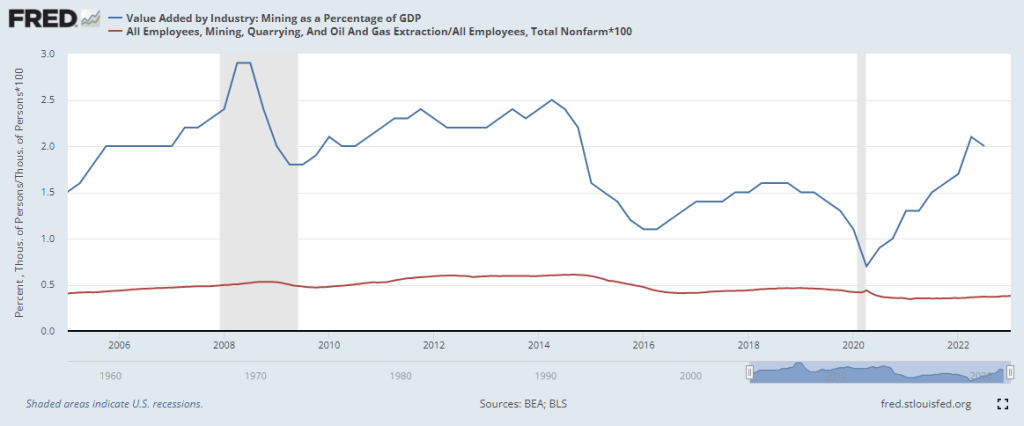
A key factor in the “resource curse” is that its contribution to GDP is usually far above its contribution to employment. If a mining sector accounts for 2% of employment but contributes 10% to GDP, the ratio of employment / GDP % equals 2%/10%, or 0.2. Ratios that are far below 1 do not promote a healthy economy. Industries that are closer to a 1-1 ratio will produce a more well rounded and vibrant economy because employed people spend their earnings in other sectors of the economy – a diffusion effect. Some economists might say that a low ratio means that capital is being used more efficiently and attracts capital investment. However, that efficiency comes at an undesirable social and economic cost.

 Let’s look at some examples in the U.S. The construction industry contributes 3.9% to GDP (blue line in the graph below) but accounts for 5.1% of employment (red line). Notice that this is the opposite of the example I gave above. The 1.31 ratio of employment/GDP is above 1, meaning that the industry employs more people for the direct value that it adds to the economy.  Construction spending includes remodels and building additions but does not include maintenance and repair (Census Bureau, n.d.). In the chart below, look at how closely GDP and employment move together. The divergence in the two series since the pandemic indicates the distortions in the housing market because of rising interest rates. Builders have put projects on hold but employment in the sector is still rising because of the tight labor market.

The finance sector’s share of the economy has grown since the financial crisis yet employment has remained steady – or stuck, depending on one’s perspective. The great financial crisis put stress on banks, big and small, but the government bailed out only the “systemically important” banks, leaving smaller regional banks to fend for themselves. The larger banks absorbed many smaller banks, leading to a consolidation in the industry. That consolidation and investments in technology helped the sector become more efficient. The ratio is about 0.75, above the 0.2 ratio in the example I gave earlier. I labeled the lines because the colors are reversed.

Retail employs a lot of people relative to its contribution to GDP. The ratio is about 1.65. Does that mean retail is an inefficient use of capital? Retail sales taxes pay for many of the city services we enjoy and take for granted. Retail is the glue that holds our communities together.

The manufacturing sector employs fewer people in relation to its GDP contribution. It’s ratio is 0.77, about the same as finance.

As I noted earlier, the mining sector is capital intensive with a high ratio of GDP to employment. This sector includes gas and oil extraction. In the U.S. that ratio averages about 0.33 but it is erratic global demand. Look at the effect during the pandemic. In our diversified economy, the mining sector contributes only a small amount, like 2%. In a developing country like Namibia in southern Africa, mining accounts for 10% of GDP. In the pandemic year, the demand for minerals declined and Namibia’s economy fell 8%.

Lastly, I will include the contribution of health care, education and social services, which contribute 7.5% to GDP but employ almost a quarter of all workers. Since the financial crisis and the passage of Obamacare, this composite sector contributes an additional 1% to GDP. These sectors include many public goods and services that form the backbone of our society. The 3.0 ratio is the inverse of the mining sector.

To summarize, the construction, retail, health care and education sectors have a ratio above 1. They employ more people for each percentage unit of output. The finance, manufacturing, mining, oil and gas sectors have ratios less than 1, employing fewer people per percentage unit of output. For readers interested in the GDP contribution of other industries, the Federal Reserve maintains a list of charts, linked here [https://fred.stlouisfed.org/release?rid=331].

//////////////////

Photo by Camylla Battani on Unsplash

Census Bureau. (2019, April 15). Construction spending – definitions. United States Census Bureau. Retrieved February 16, 2023, from https://www.census.gov/construction/c30/definitions.html

U.S. Bureau of Economic Analysis, Value Added by Industry: Construction as a Percentage of GDP [VAPGDPC], retrieved from FRED, Federal Reserve Bank of St. Louis; https://fred.stlouisfed.org/series/VAPGDPC, February 12, 2023.

U.S. Bureau of Labor Statistics, All Employees, Construction [USCONS], retrieved from FRED, Federal Reserve Bank of St. Louis; https://fred.stlouisfed.org/series/USCONS, February 12, 2023.

U.S. Bureau of Labor Statistics, All Employees, Total Nonfarm [PAYEMS], retrieved from FRED, Federal Reserve Bank of St. Louis; https://fred.stlouisfed.org/series/PAYEMS, February 12, 2023.

I will not do a complete reference for each series. Here’s the identifiers for each series: Finance Value Added – VAPGDPFI. Employment in finance – USFIRE. Construction employees – USCONS. Retail Value Added – VAPGDPR. Retail Employees – USTRADE. Manufacturing Value Added – VAPGDPMA. Manufacturing Employees – MANEMP. Education, Health Care, Social Services Value Added – VAPGDPHCSA. Employment is a composite of 4 series. Mining Value Added – VAPGDPM. Mining Employment – CES1021000001

The Change Changed

November 13, 2022

by Stephen Stofka

October’s CPI report released this week indicated an annual inflation of 7.7%, down from the previous month. Investors took that as a sign that the economy is responding to higher interest rates. In the hope that the Fed can ease up on future rate increases, the market jumped 5.5% on Thursday. Last week I wrote about the change in the inflation rate. This week I’ll look at periods when the inflation rate of several key items abruptly reverses.

Food and energy purchases are fairly resistant to price changes. Economists at the Bureau of Labor Statistics (BLS) construct a separate “core” CPI index that includes only those spending categories that do respond to changing prices. It is odd that a core price index should exclude two categories, food and energy, that are core items of household budgets.

Ed Bennion and other researchers (2022) at the BLS just published an analysis of inflationary trends over several decades. Below is a chart of the annual change in energy prices. Except for the 1973-74 oil shock, a large change in energy prices led to a recession which caused a big negative change in energy prices.

We spend less of our income on food than we did decades ago so higher food prices have a more gradual effect, squeezing budgets tight. Lower income families really feel the bite because they spend a higher proportion of their income on food. In the graph below a series of high food price inflation often precedes a recession. Unlike energy prices, there is rarely a fall in food prices. Following the 2008 financial crisis, food prices fell ½% in 2009. It is an indication of the economic shock of that time.

Let me put up a chart of the headline CPI (blue line) that includes food and energy and the core inflation index (red line) which does not. Just once in 75 years, during the high inflation of the 1970s, the two indexes closely matched each other. Following the 1982-83 recession, the core CPI has outrun the headline CPI.

A big component of both measures of inflation is housing. The Federal Reserve (2022) publishes a series of home listing prices calculated per square foot using Realtor.com data. You can click on the name of a city and see its graph of square foot prices for the past year. You can select several cities, then click the “Add to Graph” button below the page title and FRED will load the graph for you. Here’s a comparison of Denver and Portland. They have similar costs.

The pandemic touched off a sharp rise in house prices in both cities. Denver residents have attributed the big change to an influx of people from other areas. However, Census Bureau data shows that the Denver metro area lost a few thousand people from July 2020 to July 2021 (Denver Gazette, 2022). In the decade after the financial crisis, there simply wasn’t enough housing built for the adults that were already here.

The surge in home buying has not been in population but in demographics. As people approach the age of 30, they become more interested in and capable of buying a home. The pandemic helped boost home buying because interest rates plunged from 5% in 2018 to 2.6% in 2021.

Record low interest rates enabled Millennials in their 20s and 30s to buy a lot more home with their mortgage payment. That leverage caused housing prices to rise. A 30-year mortgage of $320K has a monthly mortgage payment of $1349 at 3%. At 5%, it is $1718 and at 7% it rises to $2129. Ouch!

Rising rental costs and home prices drive lower income families to less expensive areas in a metro area or entirely out of an area. Declining public school enrollment has forced two Denver area counties to announce the closing of 26 schools and transfer them to other schools (Seaman, 2022). As the number of students decreases, the schools infrastructure costs do not change, increasing the per student costs. Buses have to be maintained, drivers paid, schools staffed with guards, cafeteria staff, janitors and administrative personnel. Once schools are shuttered, the building may be sold and converted to other uses, either residential or commercial. The public schooling system is like a large ship that takes some time to change course.

During our lifetimes we experience many changes. They can happen quickly or emerge over time. The effects may be short lived or last decades. Families are still living with the consequences of the financial crisis fourteen years ago. Carelessly planned urban development isolates the residents of a community. The social and economic effects can last several generations. As we grow older, we learn to appreciate William Faulkner’s line, “The past is never dead. It’s not even past.”

/////////////////////

Photo by Davies Designs Studio on Unsplash

Bennion, E., Bergqvist, T., Camp, K. M., Kowal, J., & Mead, D. (2022, October). Why inflation matters. U.S. Bureau of Labor Statistics. Retrieved November 11, 2022, from https://www.bls.gov/opub/btn/volume-11/exploring-price-increases-in-2021-and-previous-periods-of-inflation.htm

Denver Gazette. (2022, March 25). Denver joins big city trend with pandemic population slip. Denver Gazette. Retrieved November 11, 2022, from https://denvergazette.com/news/local/denver-joins-big-city-trend-with-pandemic-population-slip/article_65c6393d-2a4d-5b91-837c-f8c3efce3778.html

Federal Reserve. (2022). Median listing price per square feet:Metropolitan Areas. FRED. Retrieved November 11, 2022, from https://fred.stlouisfed.org/release/tables?eid=1138280&rid=462

Seaman, J. (2022, November 10). Schools targeted for closure in Denver, Jeffco have disproportionately high numbers of students of color, data shows. The Denver Post. Retrieved November 11, 2022, from https://www.denverpost.com/2022/11/10/dps-jeffco-school-closures-students-of-color/

////////////////////

A Public Sense of Duty

Each New Year we renew our hope in the future, but have we lost our sense of duty to the future? Following World War 2, the U.S. and Russia engaged in a protracted Cold War of competing ideologies. We fought proxy wars in Vietnam and Indochina, South and Central America. Instrumental to the battle against Communism, America invested in our children’s education.

In 1978, the homeowners of California revolted against the rising property taxes that funded public schools. Since then, our per capita spending on children and young adults has steadily declined.

China’s spending on education has risen dramatically in the past two decades but it still lags the U.S. in spending as a percent of GDP. For how long? Do Americans have the “fire in the belly,” that focused desire to best the enemy, that we did seventy years ago?

In our technological society, the level of education of one’s parents has become a class distinction. The National Center for Children in Poverty (NCCP) reports that 80% of low-income families are headed by parents without a high school diploma. With a high school diploma, kids still have a 60% probability of being born into a low-income family (NCCP, 2021).

A child born in a middle-class suburb will receive a better education than one born in a poor neighborhood, where many residents are renters. Property taxes fund public schools, but landlords don’t live in those neighborhoods and want low property taxes. They have an influential voice in local politics.

Two years ago, I wrote about the post-war surge in college degrees (Stofka, 2018). Before WW2, only 5% of children earned college degrees; more than a third of children now earn college degrees (NCES, 1993). Is our society paying for that learning and experience? Despite their educational skills, teachers in charter schools make the same $53K average as all employees in private industry (NCES, 2020, Table 5). The pay in charter schools is 15% less than public schools (Table 5); that may explain the much higher ratio of black and Hispanic teachers in charter schools (Table 1).

An NCES survey in 2003-4 showed a national student teacher ratio of almost 15. The ratio in a 2018 survey was 21 students per teacher (NCES, 2020). Our educational system is asking our teachers to do more, to have a bigger and more expensive skill set, but does not pay them for their talent and hard work.

Construction workers average $63K per year, higher than public school teachers (BLS Series CES2000000011). 50% of teachers in traditional public schools have a master’s degree, in charter schools it is 39% (Table 4). Do half of all construction workers have a master’s degree? No, of course not. Why does our society value a painter or a carpenter more than a public-school teacher?

Construction workers provide mostly private goods, where private parties benefit from their work. Teachers provide public goods; the immediate benefit is only to the parents of the children in school. The provisioning of public goods and the caretaking of natural resources are only possible when a community has a sense of public duty. Has it declined in the past few decades?

Americans once built a sense of community in opposition to the common enemy of Communism. Covid-19 might have been that common enemy; it has highlighted just how fractured our society is. The common enemy is us, our neighbors, our professionals, and institutions.

The erosion of trust began in the 1960s but culminated in the financial crisis a decade ago. We learned that our institutions were run by pirates, whose duty was chiefly to other pirates, the elites who knew how to work the system. Under President Obama, Attorney-General Eric Holder did not want to waste public money on prosecuting financial crimes when there was a small chance of conviction. Neither he nor Mr. Obama understood the damage of that policy. The American people watched as the pirates were let off with a slap on the hand. Washington was awash with scoundrels.

In 2016, Americans elected an outsider, a pirate in the real estate industry who pledged to rid Washington of pirates. The Trump administration proved to be little more than a carousel of pirates. The Senate, in a shambles under the leadership of Mitch McConnell, held few confirmation hearings for department chiefs. Why bother? Most had temporary titles as acting heads of departments and agencies for a few months before another Twitter outrage from the pirate in chief tossed them overboard.

President-elect Joe Biden can avoid the policies of the Trump administration that so undermined the trust of the American people, but can he avoid those policies of the Obama administration which caused many Americans to abandon any hope for fairness in Federal policy? When public trust and public duty are so greatly diminished, the country declines – its spirit, its institutions and its infrastructure. Will we – can we – recapture that sense of public duty?

////////

Photo by Dan Russo on Unsplash

NCCP. (2021). United States Demographics of Low-Income Children. Retrieved January 02, 2021, from https://www.nccp.org/demographic/?state=US

NCES. (1993, January). 120 Years of American Education: A Statistical Portrait. Retrieved January 02, 2021, from https://nces.ed.gov/pubs93/93442.pdf#page=17

NCES. (2020, September). Characteristics of Public and Private Elementary and Secondary School Teachers in the United States. Retrieved January 02, 2021, from https://nces.ed.gov/pubs2020/2020142rev.pdf

Stofka, S. (2018, June 12). Study Dollars. Retrieved January 02, 2021, from https://innocentinvestor.com/2018/06/10/study-dollars/

Bridge the Gap?

Photo by Ragnar Vorel on Unsplash

September 6, 2020

by Steve Stofka

What issues are your priorities this election? For more than thirty years Pew Research has surveyed people about their priorities. For the first time in 2019 a majority of 765 respondents answered that there is a “great deal” of difference in where each party stands, up from 25% in 1987 (Pew Research, 2020). I’ve included the full list at the end.

In January 2019, soon after the midterm elections Pew surveyed 1500 adults (Jones, 2020). I don’t know why the abortion/free choice debate is not on the issue list since that single issue may decide some voters. I’m particularly interested in the large gaps in those priorities among those who lean Democrat or Republican. I’ll start with gaps of 25%. For instance, terrorism is a concern for 80% of Republicans but only 55% of Democrats. Other Republican priorities are Immigration, the Military and Crime.

As you can see, these are fear issues. Should a person in a town of 2000 be more concerned about terrorism than a resident of NYC? Of course not, but it is what it is. People vote out of fear and hope, but fear probably wins the wrestling match, especially among Republican voters who are not hopey, changey voters, as former VP candidate Sarah Palin noted (Gonyea, 2010).

The issue of crime illustrates the conflicting complexities of these issues. It is a 60% priority for Republicans, who are in suburban and rural areas where there is less crime, and a 40% priority for Democrats, who are in dense urban areas where there is a higher incidence of crime. Because crime is much lower than in past decades, this issue has slipped as a priority for Democrats (FBI, n.d.).  

Two of the highest Democrat priorites – Cimate Change and the Environment – have a huge gap of 50% with Republican voters. Democrat politicians have not been able to make these two fear issues personal for Republicans. If they could, they would draw more voters to their side on this issue. 25% gaps exist on issues of the Poor and Needy, Health Care, Education and Race Relations. Rural Republican voters are more likely to be poor and needy, but this is not a fear issue for them (USDA, n.d.).

What strategy would a politician or political consultant advise? Run toward the base? If so, one would emphasize these issues where there are large gaps between the two primary factions in this country. The President has largely adopted this strategy. Republican voters are more inclined to fall in line and the President is relying on this party loyalty even if they don’t like him personally.

Some issues where there is a smaller gap between factions are the economy, the budget deficit, jobs, global trade, drug addiction, transportation, Social Security and Medicare.

A politician reaching out to voters on the fence in this election would focus on these issues. Joe Biden hits the jobs theme, the budget deficit, and protecting Social Security and Medicare to appeal to voters who have had their fill of the President’s divisiveness.

In the coming two months, candidates may adjust their strategies. In the 2016 election, Hillary Clinton may not have addressed these shared concerns as well and it cost her the election.  Governing comes after winning an election. In politics, winning is packaging the concerns and identities of voters into an appealing, if not attractive, box that will get them to come out and vote.

What are your priorities this election season? Are you a multi-issue voter, a single issue voter, a party voter regardless of the issues? Here’s the Pew survey list of 18 issues: terrorism, immigration, military, crime, climate change, environment, poor and needy, race relations, health care, education, economy, Social Security, Medicare, jobs, drug addiction, transportation, global trade, and the budget deficit.

///////////////

Notes:

FBI. (n.d.). Crime rates in the United States, 2008 – 2018. Retrieved September 05, 2020, from https://crime-data-explorer.fr.cloud.gov/explorer/national/united-states/crime

Gonyea, D. (2010, February 07). ‘How’s That Hopey, Changey Stuff?’ Palin Asks. Retrieved September 05, 2020, from https://www.npr.org/templates/story/story.php?storyId=123462728

Jones, B. (2020, August 26). Republicans and Democrats have grown further apart on what the nation’s top priorities should be. Retrieved September 05, 2020, from https://www.pewresearch.org/fact-tank/2019/02/05/republicans-and-democrats-have-grown-further-apart-on-what-the-nations-top-priorities-should-be/

Pew Research Center. (2020, August 21). Public’s 2019 Priorities: Economy, Health Care, Education and Security All Near Top of List. Retrieved September 05, 2020, from https://www.pewresearch.org/politics/2019/01/24/publics-2019-priorities-economy-health-care-education-and-security-all-near-top-of-list/

U.S.D.A. (n.d.). Rural Poverty & Well-Being. Retrieved September 05, 2020, from https://www.ers.usda.gov/topics/rural-economy-population/rural-poverty-well-being/

A Nation of Farm Kids

June 30, 2019

by Steve Stofka

This week the Supreme Court ruled that the administration had not provided an adequate reason to include a proposed citizenship question on the 1920 census. Here’s a snapshot of that section of the census form (Note #1).

This week I’ll look at past census questions through the lens of personal family history – completed copies of census pages. In 1850, the Census first asked people their place of birth and naturalization status. For a hundred years, the census asked the question until the topic was dropped for the 1960 census (Note #2).

In 1860, just before the Civil War, some of my family ancestors were farmers in Mississippi. All forty people listed on that census page had been born in a southern state, most from Mississippi or Alabama.  The Education section of the census did not yet ask whether a person could read and write; only whether each person had attended school in the past year. Fourteen out of forty people listed on that census page had gone to school. There was only one child of school age who had not attended school. A rural farming community in the deep south with limited resources made sure that their children could read and write. That was an essential part of the American project.

In drafting the 14th and 15th Amendments after the Civil War, there was some discussion about adding an English language requirement for voting. At that time, German was the second language of America and was the most taught foreign language in schools. Considering the industriousness and good character of German men, lawmakers decided against such an exclusion. Fifty years later, in the midst of the WW1, Americans would excoriate the hated “Hun” and demean the character of many German immigrants. War changes attitudes.

Let’s skip ahead to the 1900 census taken in a Texas county east of Dallas. The question can you read and write had been added to the census. In a rural farming community, only four out of fifty people listed on that census page could not read and write. All were adults. One was over fifty. All the children aged eight and above were literate.

Let’s travel in time and space to an environment that couldn’t be more unlike rural Texas – the lower east side of Manhattan for the 1930 census. Of the fifty people listed, all adults were immigrants, most of them from eastern Europe. The earliest on that page had arrived in 1890; the latest was just a year earlier, in 1929. All except four people from Russia could read and write. The census asked the language spoken in the home before they came to America. Most people on that page answered Yiddish, except my grandparents, who spoke Slovak. My grandmother, a woman from a rural farming community, could read three languages. It was all part of growing up in the Austro-Hungarian Empire. By the time she died, she had added English to that list. I imagine that the Yiddish speakers had some familiarity with German and Hebrew. How many of us today can read several languages?

The farmers from western Europe had spilled out into the farms of America during the 19th century. In a second wave near the turn of the century, many farmers from eastern and southern Europe found work in the rural communities of the northern states. Many, like my grandparents, crowded into the dense streets of New York City when they first arrived. They worked hard because farm kids learn about hard work as they grow up.

A new generation of farm kids is arriving, but not by ship. They are coming from areas to the south that have been hit hard with drought, violence and political corruption. They come from hard work for little pay (Note #3). They have not waited in line for years to come into this country. Instead, they are showing up at the southern border just as many of our ancestors showed up at Ellis Island and other eastern ports.

Most of us in this country are the descendants of farmers who made sure their kids could read and write. That is the heart of the American spirit: character, hard work and education. Maybe the Congress needs to rewrite the laws so that they conform with the rules that we carry in our hearts and our guts from our parents and their parents and their parents…

//////////////

Notes:

  1. Some background on the 2020 census question from Pew Research
  2. Short history of census questions and index of past census questions
  3. See the six part series “Borderland” ( https://www.imdb.com/title/tt3300988/ for info). Six Americans follow the routes of migrants from Central America. An Idaho farmer experiences grueling work for little pay and understands the attraction of his farm to these migrants where they can make 5x as much or more harvesting crops.