The Chopping Block

March 23, 2025

by Stephen Stofka

This is part of a series on centralized power. The debates are voiced by Abel, a Wilsonian with a faith that government can ameliorate social and economic injustices to improve society’s welfare, and Cain, who believes that individual autonomy, the free market and the price system promote the greatest good.

Abel put his coffee cup down on the table. “I don’t know where to start. Shortly after Trump was inaugurated, I said that the EPA would get cut (Source). Now Trump has announced that his recently confirmed head of the EPA will be cutting agency staff by 65%. This week Trump is signing an executive order to end the Department of Education (Source). He’s cutting staff by 50%. He fired the two Democrats on the Federal Trade Commission, an independent agency (Source). That violates a Supreme Court decision. He shut down three watchdog agencies in the Department of Homeland Security who monitor his immigration crackdown (Source). The Federal Reserve will be next. This reminds me of the guillotine during the French Revolution. That didn’t end well.”

Cain swallowed a bite of pancake. “He’s not going to fire governors on the Fed. He can’t, I don’t think.”

Abel scoffed. “Trump shoots first and leaves the details to others. The governors are appointed by the president and confirmed by the Senate just like the commissioners at the FTC that he just fired.”

Cain frowned. “The market would implode.”

Abel replied, “In his first term, Trump sought the market’s approval of his policies. In this second term, Trump has shown that he no longer cares what the market thinks.”

Cain shrugged. “On the campaign trail, he said he would clean up the swamp in Washington. He’s keeping a campaign promise. The majority of voters wanted this.”

Abel laughed. “Cutting staff by 50%? You think half of any government agency is ‘waste, fraud and abuse?’ Nah, this is the same radical disorder that marked the French Revolution.”

Cain shook his head. “Well, only Congress can end the Department of Education. Trump’s executive order simply outlines steps toward the end of the department.”

Abel raised his eyebrows. “You’re trying to normalize this? Nothing about this is normal or gradual.”

Cain sighed. “Look, the federal government is like a ship locked in ice. Nothing gets done in Washington any longer. There needed to be some drastic action to break free. You know, the department’s functions should never have been carved out of HEW, the Department of Health, Education and Welfare. In his run for President in 1976, Jimmy Carter promised the teacher’s union that he would make education a cabinet level agency in return for their endorsement. Even after he was elected, Carter slow walked the process for three years (Source). So, Carter signed the bill in October 1979. Ronald Reagan was running for President and promised to end the department if he became President (Source). Reagan and others thought it was unconstitutional, but he was never successful in ending it because the Democrats controlled the House during his two terms in office.”

Abel put his fork down. “So, you’re saying that Republicans have always challenged the legitimacy of the department.”

Cain nodded. “Yeah. There are three departments that have long been on the Republican hit list because they are outside the constitutional scope of the federal government. Education, Energy, and the EPA, the three ‘E’s. In 1977, Carter signed into law the creation of the Department of Energy to combine and coordinate several dozen programs in various agencies (Source). These are departments, as in cabinet level positions. Unlike Education and Energy, the EPA was not created by law, but by executive order. Not Johnson. Not Carter, or some big government-loving Democratic President. Nixon created the EPA shortly after signing an update to the Clean Air Act in 1970 (Source). Like Carter, Nixon wanted to combine a lot of programs into a single agency reporting to the President.”

Abel replied, “I often think of the 1930s as the era of big government. FDR created what was called an alphabet soup of agencies. You’re saying that Trump’s first target, though, is the second wave of federal government expansion in the 1960s and 1970s.”

Cain nodded. “That’s why I don’t think he will go after the Federal Reserve, which was created before FDR and the first expansion of government.”

Abel shook his head. “He’s trying to gut the IRS and that was created before FDR as well. I think you underestimate the anarchical instinct that motivates Trump and his cohorts.”

Cain shrugged. “Anarchy? Nah. Principled objection and longstanding grievance is not anarchy. Anyway, that second expansion was made possible by some key decisions by the Supreme Court during the first wave of federal expansion. The Tenth Amendment restricts the scope of the federal government and promotes federalism, the idea that a lot of power should be decentralized and under state control.”

Abel interrupted, “State governments are more responsive to the people. That kind of idea.”

Cain nodded. “Yeah, and the founders were suspicious of concentrated power. So, the FDR administration didn’t like the variety of worker protections in the states. No consistency. In 1938, FDR signed into law the Fair Labor Standards Act to make labor policy uniform throughout the nation. The law established a standard work week, a minimum wage, and overtime pay (Source).”

Abel interjected, “It’s good to have the same rules. Otherwise, it’s a race to the bottom as states try to get a competitive advantage by lowering standards.”

Cain smiled. “That’s some teleological reasoning you’re doing there. The ends justify the means.”

Abel argued, “The Constitution gives the federal government power to fix standards of money, weights and measures. A unit of labor is affected by the rules governing labor contracts. Setting uniform rules of commerce is like setting uniform measures used in commerce. Achieving uniformity in commerce is an implicit federal power granted by the Constitution.”

Cain rolled his eyes. “That’s stretching the definition of weights and measures, if you ask me. Anyway, some states complained that the act was an unconstitutional federal intrusion on state power. The government claimed that all labor policy had some effect on interstate commerce. The Constitution grants the federal government authority to control interstate commerce. That same year, a federal district court ruled that the act was unconstitutional in a case involving Darby Lumber Company. The case made it up to the Supreme Court which overturned the lower court’s  decision. Since Darby Lumber shipped some of their lumber out of state, that meant the company was involved in interstate commerce (Source).”

Abel replied, “Seems hard to argue with that. One state could lower their standards and give their manufacturers a competitive advantage offering lower prices.”

Cain nodded. “Yeah, sounds reasonable. But, consider a situation where a company exports less than 1% of its products out of state. The federal government was claiming authority over labor policy for a company’s entire operation because of any amount of interstate commerce, no matter how small.”

Abel frowned. “Ok, I see how that could be an intrusion on the state’s domain of legal authority.”

Cain replied, “And it got worse. In a 1942 decision Wickard v. Filburn, the Supreme Court decided that a farmer growing wheat for his own use was also involved in interstate commerce (Source). Yeah, you look puzzled. The court reasoned that the farmer’s consumption of his own wheat affected the interstate market for wheat.”

Abel laughed. “So, growing tomatoes in my backyard affects interstate commerce?”

Cain scoffed. “Apparently. That was the opinion of the Supreme Court.”

Abel nodded. “Ok, so the federal government expanded its scope under the Commerce Clause of the Constitution.”

Cain replied, “Way beyond the intentions of the framers. The whole idea of the Commerce Clause was to settle disputes over issues like water and road transportation, and anti-trade policies between the states. Instead, FDR wanted to undercut the legitimacy of state governments. He wanted to control everything.”

Abel asked, “Ok, so what is the beef against the Department of Energy? Natural gas lines cross state lines. Oil gets shipped from one state to a refinery in another state, then distributed out to states within a region. Plainly, it is interstate commerce.”

Cain shook his head. “The department was created in 1977 when the whole country was concerned about the price and supply of oil. Back then, a lot of policymakers and scientists believed in peak oil theory, first proposed in 1956 by geologist M. King Hubbert (Source). This was the idea that oil production would peak in the late 1960s and begin to decline thereafter. The crises of the 1970s seemed to confirm that prediction.”

Abel interrupted with a question. “What about fracking?”

Cain replied, “It had not been invented yet. At least, not an economical way. When the price of oil was high in the 1970s, the industry experimented with extracting oil from oil sands. When the price of oil started declining in the early 1980s, these developments were no longer profitable.”

Abel nodded. “Ok, back to what’s the beef with the Department of Energy?”

Cain sighed. “The purpose of the department was to develop nuclear energy to solve the problem of declining oil supplies (Source). Instead, the oil industry developed new drilling and exploration techniques, and America is now the leading producer of oil (Source). Anyway, a few years after the creation of the DOE came the nuclear accident at Three Mile Island (Source). Public sentiment turned against nuclear.”

Abel interrupted, “France gets over 70% of their electricity from nuclear (Source).”

Cain replied, “Yeah, but they have only a small amount of oil reserves compared to the U.S. That affects public sentiment. Anyway, the DOE has completely changed its mission in the past decades. Now they focus on developing green energy sources like wind and solar (Source). If there is no longer a shortage of oil reserves, there is no justification for the Department of Energy.”

Abel said, “Look, an energy crisis might have prompted the creation of the department, but it’s mission was always to develop a coordinated national energy policy. Initially, its focus was on nuclear energy. The department’s mission is broad. The oil industry just wants to get rid of a federal agency that supports the development of competing energy sources like solar and wind. Despite all its abundances, the federal government still gives over $20 billion a year in subsidies to the oil industry (Source). No matter how much they get, the industry wants more for them and less for their competition.”

Cain replied, “The federal government needs to get out of the energy business, including subsidies for the oil and gas industry.”

Abel frowned. “Fat chance. What about pollution, oil clean ups and nuclear waste disposal? If there is no longer an EPA, who takes care of oil spills like the 2010 Horizon accident?”

Cain replied, “FEMA would be the natural choice for emergencies of that sort. There are a lot of redundancies in the federal government.”

Abel shook his head. “Shifting responsibilities to another department may gain some slight efficiencies in the long run. In the short run, there is going to be a lot of knowledge lost, leaving us vulnerable to the next disaster. Each week, we learn of another stupid mistake that DOGE has made in their efforts to remake government. They are causing more harm and saving little money.”

Cain protested, “The federal government has become so bloated that it is crippling our ability to get anything done. The federal response to Hurricane Katrina was an embarrassment. Same with the Horizon oil spill, the delays and ineffectiveness of Obama’s Build America plan, the botched rollout of the Obamacare exchanges. Let’s not forget the high-speed rail line in California. Billions spent and no rail. Biden’s infrastructure bill that spent billions to get just a few electric charging stations built. This country used to be able to get stuff done. Now, everything gets snarled in red tape. Compared to China, we look like a declining empire. Turning that around will not be easy.”

Abel set his coffee cup on his plate. “Well, firing a bunch of government employees with vital expertise, and closing a few departments is not going to solve the problem. This administration will flail around when the next crisis comes. In the 2026 midterms, a small number of voters on the fence will cast their vote with the ‘other guys,’ the Democratic Party, and power will shift again. We have become a country of short-term thinkers. That’s why China will eventually gain the upper hand.”

Cain laid his napkin on the table and stood up. “This will take time, I grant you.”

Abel interrupted, “Yeah, Rome wasn’t built in a day, and I need to have faith and blah, blah, blah.”

Cain laughed. “No, I won’t give you that lecture again.”

Abel sighed. “I’ll see you next week. Maybe there will be another department on the chopping block.”

/////////////////

Image by ChatGPT in response to the prompt “draw an image of a butcher block with a carving knife beside it”

Cycle of  Expectations

January 28, 2024

by Stephen Stofka

This week’s letter is about the decisions people make in connection with their compensation. Guided by the strength of the job market and expectations of inflation, employees seek higher compensation by switching jobs or by wage and benefit demands. Like fish in the sea, these individual decisions form schools that follow and shape the currents of economic growth and inflation.

There are two main components to employee compensation. The first category includes wages or salary, some of which is reduced by income and FICA taxes. The amount left over is called disposable income. The second component of compensation is loosely categorized as benefits that are already dedicated to a single purpose and are non-disposable. These include paid time off, pension plan contributions and health care. They also include government mandated taxes that the employer pays for the employee. These include workers’ compensation, unemployment insurance and the employer’s half of FICA taxes. Except for paid time off, employees do not pay income taxes on benefits.

As I noted last week, the Bureau of Labor Statistics calculates an Employment Cost Index (ECI) that includes both wages and benefits. This composite can give us different insights than tracking the growth of wages alone. Comparing the ratio of the wages portion to the total index allows us to spot trends when wages grow more than benefits or benefits grow faster than wages. I’ll call this the Wage Ratio.

In the chart below, we can see three distinct periods: 2001 through 2007, 2008 through 2015, and 2016 through 2023. In the first and third periods, wages grew faster than benefits but their growth patterns are distinct. In the first period growth was coming into balance with benefit growth. In the third period, wage growth was accelerating. In both periods there was a strong correlation between the wage ratio and an inflation measure that the Fed uses called PCE inflation (see notes).

When inflation is low, employees may desire more of their compensation in benefits. Most of these are tax-free so employees get more “bang” for each dollar of benefit. In the second period, there was a rebalancing of wages and benefits. As the nation recovered from the housing and financial crisis, low inflation reduced the pressure to seek higher wages. During the last year of Obama’s second term in 2016, that inflation rate began to rise from near zero to 2%. The Fed raised its key interest slightly above zero, happy to finally see inflation nearing the 2% target rate that the Fed considers healthy for moderate growth.

The Fed also has a target for its key interest rate that is 2% or above. For eight years it had kept that interest rate near zero to help the economy recover after the financial crisis. The Fed knows that such a low rate has two disadvantages. It gives the Fed less room to respond to economic crises because they cannot adjust rates lower than the Zero Lower Bound (ZLB). Secondly, sustained near-zero rates lead to high asset valuations, or bubbles, which are disruptive when they pop. The housing crisis was a recent example of this.

During the first three years of the Trump presidency, inflation leveled out near that 2% target rate as the Fed continued to raise rates in small increments, finally ending near 2.5%. In 2018, Trump went on a tirade against the Fed, accusing it of sabotaging his Presidency. Low interest rates had fueled an annual rise in housing prices from 5% at the end of Obama’s term to 6.4% in the first quarter of 2018. Trump was not the first President who wanted a subservient Fed willing to enact policy that enhanced the Presidential political agenda. Because a President wins a general election, they may convince themselves that their desires reflect the general will. They do not. Congress gave the Fed a twin mandate of full employment and stable prices to separate Fed policy from Presidential control. It did so after several episodes where Fed policy served the desires of the President rather than the public welfare.

In 1977, Biden was in the Senate when Congress enacted the legislation that gave the Fed a twin mandate. Unlike Trump, Biden has not pounded his chest like a belligerent gorilla as the Fed raised rates by five percentage points within a year. The results of the Republican primaries in Iowa and New Hampshire make it likely that this year’s election will be a repeat contest between Biden and Trump. The Fed has hinted that they might lower rates this year if inflation indicators remain stable and the unemployment rate remains low. That would be the proper response and in accordance with the Fed’s mandate.

Should the Fed lower rates even a small amount, Trump will certainly complain that the Fed is helping Biden win re-election. He will protest that “the system” is opposed to him and his MAGA supporters. If Republicans can gain control of both houses of Congress and the Presidency this November, Trump will likely pressure McConnell to change the cloture rule so that Senate Republicans will need only a majority to pass a bill making the Fed an agency subject to Trump’s control. In 2022, seven Republican Senators introduced a bill to condense the number of Federal Reserve banks and make their presidents subject to Senate approval. Should the Fed lose its independence from political control, we can expect the high inflation that has afflicted Venezuela and Argentina, countries where a political leader has used monetary policy to win political support. Workers will demand higher wages to cope with rising prices and those demands will help fuel the inflationary cycle. We actualize our expectations.

/////////////////

Photo by Erlend Ekseth on Unsplash

Keywords: inflation, wage growth, housing prices, Fed policy, monetary policy

Correlation: In the eight year period from 2001thru 2008 when wage growth was high but declining, the correlation between inflation and wages was -.63. From 2016 through 2023, as the wage ratio was rising, the correlation was .85.

Home Prices and Monetary Policy

July 30, 2023

by Stephen Stofka

This week’s letter is a proposal for an alternative measure to guide the Fed’s monetary policy. In 1978, Congress passed the Full Employment and Balanced Growth Act which gave the Fed a dual mandate – giving equal importance to price stability and full employment. The Canadian central bank has a hierarchical mandate with price stability as a priority. As with most Congressional mandates, the legislation left it up to the agency, the Fed, to determine what price stability and full employment meant. The Fed eventually settled on a 2% inflation target. Full employment varies between 95-97% and is hinged on inflation.

For its measure of inflation, the Fed relies on the Bureau of Labor Statistics (BLS) who conducts monthly surveys of consumer expenditures.  The BLS compiles a CPI based on the its price surveys of hundreds of items. The Fed prefers an alternative measure based on the Consumer Expenditure Survey, but the weakness in both measures is the complexity of the methodology and the inherent inaccuracy of important data points.

According to the BLS, housing costs account for more than a third of the CPI calculation. Twenty-five percent of the CPI is based on an estimate of the imputed rental income that homeowners receive from their home. This estimate is based on a homeowner’s response to the following question:   “If someone were to rent your home today, how much do you think it would rent for monthly, unfurnished and without utilities?” How many owners pay close attention to the rental prices in their area?  The BLS also surveys rental prices but tenants have six to 12 month leases so these rental estimates are lagging data points. The BLS tries to reconcile its survey of rents with homeowners’ estimates of rents using what it admits is a complex adjustment algorithm. 

The BLS regards the purchase of a home as an investment, not an expenditure so it must make these convoluted estimates of housing expense. There is a simpler way. Buyers and sellers capitalize income and expense flows into the price of an asset like a house. The annual growth in home prices would be a more reliable and less complex measure of inflation. Federal agencies already publish monthly price indexes based on mortgage data, not homeowner estimates and complex methodology. An all-transactions index includes refinancing as well as purchases. Bank loan officers have a vested interest in monitoring local real estate prices so their knowledge is an input to the calculation of a home’s value when an owner refinances.

The Federal Housing Finance Agency (FHFA) publishes the All-Transactions House Price Index based on the millions of mortgages that Fannie Mae and Freddie Mac underwrite. From 1990 – 2020, home prices rose by an average of 3.5% per year. A purchase only index that does not include refinances rose almost 3.9% during that period. As an aside, disposable personal income rose an average of 4.6% during that period.

The Fed does not need authorization from the Congress to adopt an alternative measure of inflation to guide monetary policy. As its strategy for price stability, the Fed could set a benchmark of 4% – 5% home price growth, near the 30 year average. If house prices are rising faster than that benchmark, monetary policy is too accommodating and the Fed should raise rates. Since the onset of the pandemic, home prices have risen 11% per year, three times the 40 year average. This same growth marked the peak of the housing boom in 2005-2006 before the financial crisis. The Fed did not begin raising interest rates until the spring of 2022. Had it used a home price index, it would have reacted sooner.

The annual growth in home prices first rose above 4% in the second quarter of 2013. The Fed kept interest rates at near zero until 2016, helping to fuel a boom in both the stock market and housing market. Since 2013, house prices have stayed above 4% annual growth, helping to fuel a surge in homelessness. Let’s look at several earlier periods when using home prices as a target would have indicated a different policy to monetary policymakers at the Fed.

In 1997, the annual growth of home prices rose above 4% and remained elevated until the beginning of 2007 when the housing boom began to unravel. In 2001, home prices had risen almost 8% in the past four quarters but the Fed began lowering its benchmark Federal Funds rate from 5.5% to just 1% at the start of 2004. The Fed was responding to increasing unemployment and a short recession following the dot-com bust. Near the end of that recession came 9-11. By lowering rates the Fed was pushing asset capital that had left the stock market into the housing market where investors took advantage of the spread between low mortgage rates and high home price growth.

In 2004, home price growth was over 8% and accelerating. Had the Fed been targeting home prices, it would have acted sooner. However, the Fed waited until the general price level began rising above its target of 2%. In the 2004-2006 period, the Fed raised rates by 4%, but it was too late to tame the growing bubble in the housing market. In 2005, home prices grew by 12% but began responding to rising interest rates. By the first quarter of 2007, home price growth had declined to just 3.3%.

The Fed models itself as an independent agency crafting a monetary policy that is less subject to political whims. However, the variance in their policy reactions indicates that the Fed is subject to the same faults as fiscal policy. If the Congress is crippled, then the Fed feels a greater pressure to react and is helping to fuel the boom and bust in asset markets. Let’s turn to the issue of full employment.

The condition of the labor market is guided by two surveys. The employer survey measures the change in employment but does not capture a lot of self-employment. The household survey captures demographic trends in employment and measures the unemployment rate. The BLS makes a number of adjustments to reconcile the two series. The collection of large datasets and the complex adjustments needed to reconcile separate surveys naturally introduces error.

The labor market has experienced large structural changes in the past several decades. Despite that, construction employment remains about 4.5 – 5.5% of all employment so it is a descriptive sample of the condition of the overall market. Declines in construction employment coincide with or precede a rise in the unemployment rate. In the past 70 years, the construction market has averaged 1.5% annual growth. During the historic baby boom years of the 1950s and 1960s, the growth rate averaged 2%. The Fed might set a target window of 1.5% – 2.5% annual growth in construction employment. Anything below that would warrant accommodative monetary policy. Anything above that would indicate monetary tightening. In 1999, the growth rate was 7%, confirming the home price indicator and strongly suggesting that fiscal or monetary policy was promoting an unsustainable housing sector boom.  

If the Fed had adopted these targets, what would be its current policy? The FHFA releases their home price data quarterly. The growth in home prices has declined in the past year but was still 8.1% in the first quarter of 2023. However, the S&P National Home Price index tracks the FHFA index closely and it indicates a slight decline in the past 4 quarters. Growth in construction employment has leveled at 2.5%, within the Fed’s hypothetical target range. The combination of these two indicators would signal a pause in interest rate hikes. This week, the Fed continued to compound its policy mistakes and raised interest rates another ¼ percent.  

////////////

Photo by Rowan Heuvel on Unsplash

The Fed’s Toll Booth

October 2, 2022

by Stephen Stofka

The dollar is the world’s reserve currency and its strength – its price relative to other currencies – is straining both the economies and the financial expectations of other countries. Businesses in developing countries with an unreliable currency regime often have to borrow in dollars – what is called “dollar denominated debt.” Businesses must make their loan payments in dollars so they must trade in ever more of their local currency to get the dollars to make the payment. European nations stocking up on liquified natural gas (LNG) from the U.S. are feeling the pinch as well. Why is the dollar strengthening?

In international finance there are two equations that model the relationship between expected inflation, exchange rates and interest rates. Currency traders are expecting inflation to moderate more quickly in the U.S. than in other countries. Because the U.S. has a better supply of natural gas, its energy prices will be less affected by the war in Ukraine. Secondly, the Fed has been increasing interest rates, enticing investors in other countries to invest their money in U.S. debt. The dollar-euro exchange rate has not been this low since 1999 when the Eurozone countries began using a common currency, the euro.

When the dollar gets stronger, exports decrease because American goods are more expensive to buyers in foreign countries. Imports become cheaper so Americans buy more stuff from other countries. However, if the U.S. is sliding into a recession, Americans are less likely to buy enough European imports to offset the LNG that European countries will buy from the U.S.  This will increase the demand for dollars relative to the euro, further driving up the price of dollars in other currencies.

The dollar has been strengthening against other forms of currency like gold and digital exchange mechanisms like Bitcoin. Priced in dollars, gold has lost about 16% of its value in the past six months. Bitcoin has lost 60% since March. Gold is both a commodity and a currency. Gold holds a store of work that it can do in the future. It has cosmetic and industrial uses.

Bitcoin is the product of past work only – a “proof of work” done in the past. It stores no capability of future work. It takes a lot of electricity and computing power to mine Bitcoin but it cannot store electricity for future use. If it could do so, the price of Bitcoin would go up when electricity prices went up.

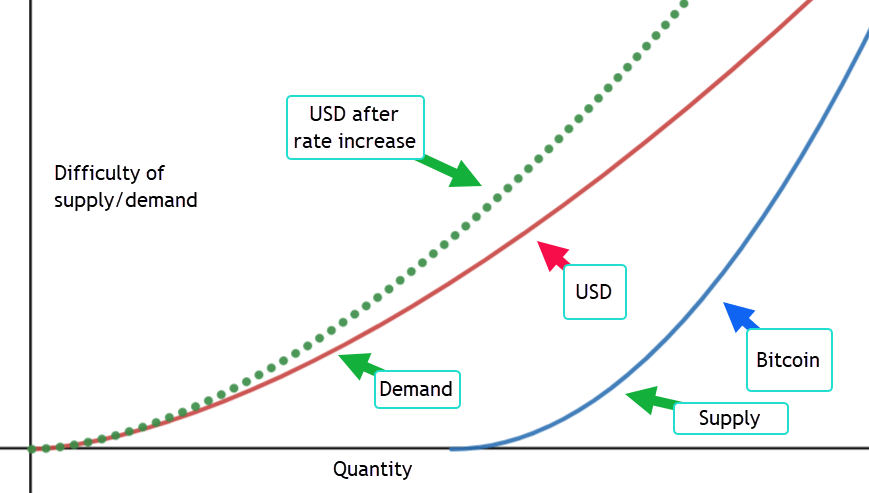
In the graph below I’ve illustrated a key difference between the dollar and Bitcoin. On the right is Bitcoin. Its algorithm incorporates a “diseconomies of scale.” As more Bitcoin is mined, it takes more effort to mine Bitcoin. Bitcoin focuses on the difficulty of supply.

On the left is the fiat dollar. There is no difficulty in supplying it. The Fed focuses on the demand for the dollar by adjusting the interest rate, the bend in the curve. It is currently tightening that bend – the dotted green curve – and increasing the difficulty of getting more dollars. The dollar can respond to changing demand more easily than gold or Bitcoin because it targets demand.

Like Bitcoin, the dollar stores no future work. In an article earlier this year (2022), I wrote that America’s store of wealth was both a proof-of-work, proof-of-stability and proof-of-trust. The dollar itself is only a sign of trust in American institutions. The checks and balances of our system of government ensures that most policymaking is incremental. While that frustrates Americans, the relative predictability of U.S. policy is reassuring to foreign investors. Americans often run around like crazy monkeys on the deck of a cruise boat but the ship is unlikely to make a large course correction.  

Think of the bend in the curve as a toll for using the highway to the future. Bitcoin’s curve is rigid. The toll remains the same. Bitcoin enthusiasts would maintain that this rigidity should shift the curve to the right over time, increasing the buying power supplied by Bitcoin.

Let’s look at three approaches.
1) Bitcoin limits the length of highway that will be built. Enthusiasts claim that this will make each “mile” of the bitcoin highway more valuable.

2) MMT advocates offer a different solution. As long as there are resources – both labor and material – available, build more highway. By targeting the supply available, congestion will ease.

3) The Fed offers an approach that targets demand, not supply. The Fed raises and lowers the interest rate – the toll – to get onto the highway to the future. Raising interest rates is a form of congestion pricing. High inflation means that there are too many people using the available length of highway. The Fed has promised that it will keep raising the toll until fewer people are using the highway. As demand declines, some of those working on the highway may lose their jobs. Unemployment will increase but historically it is very low.

The strength of the dollar against other currencies, including Bitcoin and gold, indicates increasing demand for the Fed’s approach. What is the morality of an international floating rate regime where businesses in a developing country have to work even harder to pay their dollar-denominated loans? Bitcoin advocates claim that global adoption of Bitcoin will make a more even playing field, reducing the advantage that developed countries have over developing countries. That can be the subject of another article.

////////////

Photo by kyler trautner on Unsplash

Stofka, S. (2022, April 16). Fortress of Trust. Innocent Investor. Retrieved October 1, 2022, from https://innocentinvestor.com/2022/04/17/fortress-of-trust/

A Hook or a Bend

May 16, 2021

by Steve Stofka

Eight-year-old Gwen shot out the back door, soccer ball in hand. “Dad!” she yelled. He released the safety handle on the mower as she ran across the yard to him. “Mom said she’ll take me to the game but you need to help me warm up.” When her dad bounced the ball to her, Gwen made a series of estimates of the ball’s trajectory, then corrected her estimates with the actual path of the ball as it bounced along the ground to her. As the ball neared her, she made a final OLS estimate of the ball’s destination, planted her feet and swung one foot at the ball. The side of her toe grazed the surface as it skittered past her and rolled toward the backyard fence. “Darn!” she said.

The Federal Reserve has had a lot of experience at estimating the trajectory of inflation. Just as everyone gets better with practice, so has the Fed. Gwen’s use of statistical methods is instinctive and unconscious; the Fed’s approach is quite deliberate and focused on the medium term. Unlike the Fed, the stock market acts with a short-term focus. Trading algorithms trained to react in milliseconds to key words in a data release make buy and sell orders. Human traders follow their lead, not wanting to be caught out in the open. If a trader makes a wrong turn but is among a crowd of traders that have made the same turn, they are less likely to come under scrutiny. While the market jogs along the beach, the Fed cruises offshore, watching for larger trends.

Because of the shutdown last April, economists estimated a strong uptick in prices as many states and localities began lifting sanctions and people spend money. Survey estimates of April’s inflation was high, about 3.6%, but the actual report showed an increase of 4.15%. By comparing the index this year to the index in April 2019, the rise over the two years was 4.3%, an average of 2.1% per year, exactly the average inflation since the year 2000. The rise was entirely due to “base effects,” a comparison of a data point with a previous data point that was abnormally low. On a vacation trip we slow down from 60 MPH to 30 MPH as we go through a town. When we speed up again on the other side of town, we have doubled our recent speed, but have returned to our average speed.

Our inflation expectations have stabilized over the past twenty years because we have been going the same 2.1% speed averaged over each quarter. For twenty years beginning in 1980, inflation began to decline .1% per quarter. It was like riding a bike on an almost level street with a barely noticeable decline. The pedaling lessens just a bit. Since 2000, the average quarterly change in inflation is a big fat zero. Any change becomes alarming.

Inflation has increased 3% over the past three months. A similar uptick occurred in the 4th quarter of 2009 as the economy emerged from a deep recession. The Fed computes a probability of inflation being greater than 2.5% and it rose to 60% this month, an increase from 20% last month (Series STLPPM). A similar jump occurred in April 2000 and April 2005.

A mainstream economic model depends on the assumption that workers estimate price changes and respond to their estimates with higher wage demands. Karl Marx, the 19th century economist, regarded this assumption as a fanciful notion. We pay attention to prices just as Gwen pays attention to the soccer ball, but the precision of our estimates degrade over longer periods of time. Every spring we remark on the increase in gas prices. Gas prices go up in the spring every year when refineries switch over to summer gas, which is more expensive to make. Really, we ask? Funny, I don’t remember that. Next year we will forget again. We lead busy lives and don’t have the mental storage to keep track of seasonal changes. It’s why we need multiple reminders about the tax filing deadline every year.

The Fed has a lot of data and a long memory. The Fed has adopted a wait and see approach to assess whether upward price pressures are due to base effects, supply bottlenecks and price surges typical in the initial recovery. Is this a jig and a jag of the coastline or a true bend in the land? Alan Greenspan, the second longest serving Fed chairman, reacted quickly – too quickly and too strongly – to inflationary pressures in 2004-2005 after the long slump of 2001-2003. He did not want to relive the slow recovery of a decade earlier after the 1990 recession. Those policy choices helped create the financial environment that led to the financial crisis. The Fed has more effective tools and data than it did then. Experience is a good teacher.

/////////////////

Photo by Jeremy Bishop on Unsplash. Coastline of O’ahu, U.S.

Commercial Mortgages

April 25, 2021

by Steve Stofka

They’re at it again. Thirteen years ago, the financial crisis originated in RMBS, residential mortgage-backed securities. Now banks and investment companies have been packaging CMBS, mortgage-backed loans on office and retail space, not residential, properties. Most of these loans are backed by or facilitated by the Small Business Administration and other government agencies. Who will pick up the tab when some of these loans default because of the pandemic? The same people who picked up the tab for the financial crisis – taxpayers. Even if the direct cost of bailouts is repaid, the loss of economic output and incomes is a crushing blow to many Americans.

Next month, the Federal Reserve will release its semiannual Financial Stability Report a comprehensive examination of the assets and lending of America’s financial institutions. Their last report in November 2020 was based on nine months of data, six months after Covid restrictions began. Concerning the Fed were several trends that were far above their long-term averages.

High yield bonds and investment grade quality bonds were almost double long-term trend averages (Fed, 2020, p. 17). High-yield bonds are issued by companies with low credit quality. Well established companies with good credit issue bonds rated investment grade. These are attractive to pension funds and life insurance companies who need stability to meet their future obligations to policy holders. Many companies took advantage of low interest rates during the Covid crisis. 60% of bank officers reported relaxing their lending standards; that same practice preceded the financial crisis in 2008. Will we eventually learn that commercial property evaluations were overvalued, just as house prices were generously valued before the financial crisis?

Many commercial mortgages are backed by commercial real estate (CRE) and packaged into CMBS, commercial mortgage-backed securities. The Fed noted that “highly rated securities can be produced from a pool of lower-rated underlying assets” (p. 51). This was the same problem with residential mortgages. CMBS are riskier than residential mortgages and delinquencies on these loans have spiked (p. 27). The Fed devoted most of their TALF (below) program in 2020 to CMBS (p. 16). 

Before the election last year, more than 70% of those surveyed by the Fed listed “political uncertainty” as their #1 concern (p. 68). 67% listed corporate defaults, particularly small to medium sized businesses. Respondents were from a wide range of America, from banking to academia. Only 18% of respondents were concerned about CMBS default. Simon Property Group (Ticker: SPG), the largest commercial real estate trust in the U.S. fell by almost 50% last spring. Although it has recovered since then, its stock price is still 20% below pre-pandemic levels.

Who thinks that the market for commercial space, retail and office, will return to pre-pandemic levels? Vacancy rates have improved, but even hot markets like Denver have a 17% direct vacancy rate (Ryan, 2021), near the 18% vacancy rate during the financial crisis, and far above the 14% during a healthy economy. 25% of space in Houston, Dallas and parts of the NY Metro area is vacant.

The stock market is convinced that the economy will come roaring back. In total, investors may be right but I think there will be some painful adjustments in the next year or two. The Covid crisis has diverted the habits of people and companies into new channels, and the market has not priced in that semi-permanent diversion. I would rather not wake up to another morning like that one in September 2008 when we learned that the global financial world was on the brink of disaster. I hope that the Fed report released in a few weeks will show a decrease in some of these troubled areas.

/////////////

Photo by John Macdonald on Unsplash

TALF – Term Asset Backed Securities Loan Facility

Federal Reserve System (Fed). (2020 November). Financial Stability Report. Retrieved from https://www.federalreserve.gov/publications/files/financial-stability-report-20201109.pdf. (Page numbers cited in the text are the PDF page numbering, six pages greater than the page numbers in the report).

Ryan, P. (2021, April 20). United States Office Outlook – Q1 2021, JLL Research. Retrieved April 24, 2021, from https://www.us.jll.com/en/trends-and-insights/research/office-market-statistics-trends

The Wrong Medicine

August 23, 2020

by Steve Stofka

During this pandemic, the Federal Reserve has been supportive of the asset markets and the government’s stimulus and relief programs. It’s immediate response was to lower interest rates, a boon for home buyers. This week we learned that home sales had rebounded 25% in July and are up 7% over last year at this time. Low interest rates have benefited homebuyers but penalized savers and pension funds who must generate a current income flow from their savings base.

During the 1930s Depression, the economist John Maynard Keynes argued that, because people want to hoard during a downturn, a central bank should maintain an interest level sufficient to induce people to deposit their money in banks (Keynes, 1936). Government-insured savings accounts helped solve that confidence problem. Keynes’ language and sentence construction are laborious, leading some people to think that Keynes argued for a policy of ultra-low rates during economic declines. He did not. Low interest rates are not a Keynesian solution.

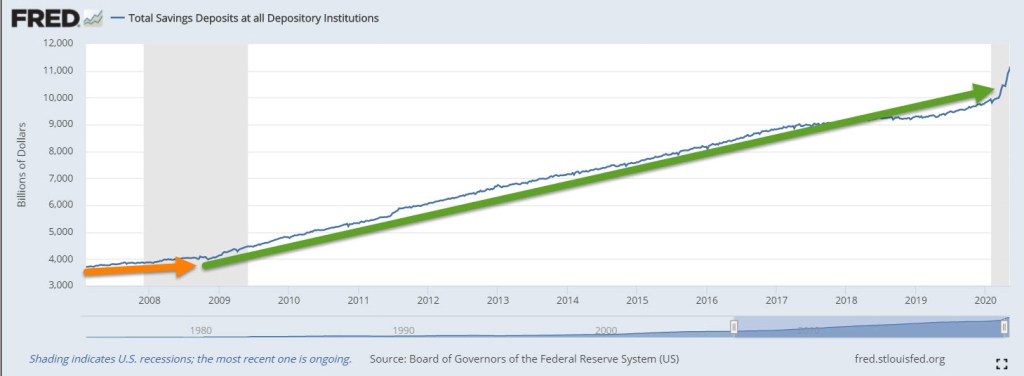
Despite the low rates, the amount of savings has doubled since the financial crisis in September 2008. There is a distinctive change in savings behavior at that important point.

With a savings base of $11 trillion, every 1% decrease in interest rates is a transfer of income of $110 billion from savers to borrowers. Who is the largest borrower? The government. Aren’t low interest rates good for businesses? No, Keynes argued rather unartfully in Chapter 15. Borrowing is a long-term decision, and subject to error. When interest rates are particularly low, like 2%, there is no wiggle room for error in the expectations of businesses who might borrow. For homebuyers, expectations of future business conditions are a small factor.

During an economic decline, people and businesses are guided more by short-term decisions. When interest rates are low like today, banks don’t want to lend because they aren’t confident in the flow of deposits to maintain their liquidity. Banks need that flow of deposits to meet the outflow of money when they make loans (Coppola, 2017). Entrepreneurs are reluctant to borrow for expansion because they are not confident in the accuracy of their long-term expectations. They borrow to pay back more predictable future obligations, particularly current and future stock grants to their key employees. Borrowing money to fund stock grants does not create jobs but helps inflate stock prices.

Keynes badly underestimated the political forces that guide a central bank’s decision making. As it did a decade ago, the Federal Reserve has lowered interest rates to near-zero, the opposite of Keynes’ prescription. Low interest rates do not benefit bank stocks, which have declined by 25% and more. A select group of technology stocks are booming as people consume more digital services at work and play. Borrowing by businesses jumped in response to the CARES act but many businesses kept those borrowed funds liquid to avoid insolvency during this crisis. We can expect slow growth as consumers and businesses continue to make short-term decisions, and asset markets are warped by central bank policy.

//////////////

Notes:

Photo by Christina Victoria Craft on Unsplash

Coppola, F. (2017, November 01). Bank Capital And Liquidity: Sorting Out The Muddle. Forbes Magazine. Retrieved August 15, 2020, from https://www.forbes.com/sites/francescoppola/2017/10/31/bank-capital-and-liquidity-sorting-out-the-muddle/

Keynes, J. M. (1936). The general theory of employment interest and money (p. 124). New York, NY: Harcourt, Brace & World.

The Long and Short Run

August 16, 2020

by Steve Stofka

Gold is at an all-time high. Like wheat and other commodities, it pays no interest. Gold’s price moves up or down based on expectations about the value of money used to buy gold. If inflation is expected to increase, the price of gold will go up. Eight years ago, after several rounds of quantitative easing by central banks, gold traders bet that inflation would rise. It didn’t, and the price of gold declined by a third.

Since mid-February, the U.S. central bank has pumped almost $3 trillion of liquidity into the economy (Federal Reserve, 2020). Numbers like that hardly seem real. Let’s look at it another way. The overnight interest rate is so low that it is essentially zero – like gold. People around the world regard U.S. money and Treasury debt as safe assets – like gold. Imagine that the central bank went to Fort Knox, loaded up 1.5 billion troy ounces of gold – about 103 million pounds – in gold coins and dropped them on everyone in the U.S. There are about 190,000 tonnes (2204 lbs./tonne) of gold in the world, a 70-year supply at current production. A helicopter drop of gold would be almost 47,000 tonnes, or 25% of the world supply. It would take five C-5 cargo planes to haul all that.

Milton Friedman was an economist who believed in the quantity theory of money. His model of money and inflation held “inflation is always and everywhere a monetary phenomenon.” If the growth of money was greater than the growth of the economy, inflation resulted. The data from the past decade has refuted this model. Former chairman of the Federal Reserve Ben Bernanke noted that the evidence suggests that economists do not fully understand the causes of inflation (C-Span, 2020, July). He was including himself in that group of economists because he had been an advocate of that model (Fiebiger & LaVoie, 2020).

What has the Federal Reserve and the government done to navigate the difficult path created by this pandemic? Helicopter Money for businesses and consumers. Lots of toilet tissue, so to speak. No reason to hoard, folks. There’s plenty. They have followed the first of John Maynard Keynes’ prescriptions for a downturn. The government should spend money. Why? It is the only economic actor that can make long-term decisions. Everyone else is focused on the short term.  Keynes badly mis-estimated the short-term thinking of politicians, particularly in an election year.

Will the flood of money cause inflation as gold bugs assert? Some point to the recent rise in food prices as evidence of inflationary forces. However, the July Consumer report indicates only a 1% annual rise in prices, half of the Fed’s 2% inflation target. The rise in food prices this spring was probably a temporary phenomenon. It suggests that the Fed is fighting deflation, as Ben Bernanke noted this past April (C-Span, 2020 April).

Since March, government spending has helped millions of American families stay afloat during this pandemic. Congress has gone home without extending unemployment relief and other programs. Many families are being used as election year hostages by both sides. House Democrats put their cards on the table three months ago. Republicans in the Senate and White House have dawdled and delayed. Faced with a chaotic consensus in his own coalition, Senate Majority Leader McConnell has largely abdicated control of the Senate to the White House and the wishy-washy whims of the President.

We return to where we began – gold. It is neither debt, equity nor land. As a commodity, only a small part is used each year. It has been used as a medium of exchange and a store of value. Except for a few years during and after the Civil War, gold held the same price from 1850 until the 1929 Depression – $20.67. In the long run, longer than a person’s retirement, gold is good store of value. In the ninety years since the Great Depression began, the price of gold has grown 100 times. Yet it is still lower than its price in 1980. The U.S. dollar does not hold its value over several decades, but it is predictable in the near-term. In a tumultuous world, predictability is valuable. The dollar has become the new gold.

//////////////////////

Photo by Lucas Benjamin on Unsplash

C-Span. (2020, April 7). Firefighting. Retrieved August 12, 2020, from https://www.c-span.org/video/?471049-1%2Ffirefighting (00:21:15).

C-Span. (2020, July 18). Ben Bernanke and Janet Yellen Testify on COVID-19 Economic Inequities. Retrieved August 12, 2020, from https://www.c-span.org/video/?473950-1%2Fben-bernanke-janet-yellen-testify-covid-19-economic-inequities (01:35:20)

Federal Reserve. (2020, July 29). Recent Balance Sheet Trends. Retrieved August 12, 2020, from https://www.federalreserve.gov/monetarypolicy/bst_recenttrends.htm

Fiebiger, B., & LaVoie, M. (2020, March 4). Helicopter Ben, Monetarism, The New Keynesian Credit View and Loanable Funds. Retrieved August 12, 2020, from https://www.tandfonline.com/doi/abs/10.1080/00213624.2020.1720567?journalCode=mjei20

The Two 10%

August 9, 2020

by Steve Stofka

In the past three months the stock market has been on a tear. The last time we’ve seen such a rise? 1938. People are day trading on the Robinhood platform. Hop aboard the gravy train and party like it’s 1999, near the height of the dot-com bubble.

According to the Federal Reserve, the top half of households in this country own 99% of the stock market. The top 10% own a whopping 87% of the market. So why do many news outlets broadcast updates on the stock market  every hour?

Share of Equity Ownership by Wealth Percentile

A second group of 10% is unemployed, according to the unemployment report released Friday. House Democrats passed a $3 trillion bill in May. Republicans and the White House have been worried that too many Americans are going to get fat and lazy if the federal government continues to support the unemployed with extra benefits. They have fought among themselves about a stimulus package, and 15 Republican Senators – half their caucus – don’t want to do anything more for the American people. The Senators who are up for election this year do want to pass something but want to appear frugal at the same time – a difficult task.  

The richest 10% are doing fine. This week the NY State’s Attorney General announced a suit to terminate the non-profit status of the NRA and dissolve the organization. Their investigation has been going on for more than a year. In September 2019, House Ways and Means Committee member Brad Schneider revealed several allegations against NRA executives (2019). Whether the IRS had already begun an investigation at that time is unclear.  The NRA has paid exorbitant expenses for their executives, including Wayne LaPierre, the public spokesman and VP of the organization. These include homes, yachts, and private jets for them and their families. The executives billed the “expenses” to the NRA’s ad agency, Ackerman McQueen, who then submitted bills with little detail to the NRA, which paid the ad agency.

Dues to the organization have been declining since Donald Trump was elected president. Gun manufacturers have relied on scare tactics to sell their products and have been big supporters of the NRA. Since the election of Trump, sales have declined. Two years ago, the oldest gun manufacturer, Remington, declared bankruptcy. As NRA revenues fell, the abuses came to light when the organization fell behind on payments to the ad agency. Influential members devoted to the mission of the organization have been appalled at the corruption.

Mr. Trump has signaled his support for the organization. Like all Presidential hopefuls, his financial affairs came under scrutiny. The Trump Foundation was later dissolved because of the same self-dealing practices.

The top 10% are always doing fine because they pay an army of lawyers and accountants to legally dodge the rules. Every week, Mr. Trump’s comments indicate how little he knows about any of the laws of this country because the laws don’t apply to him. He is part of the 10% that owns the stock market. When those markets came under stress a few months ago, the Federal Reserve stepped in with massive infusions of liquidity to preserve the assets of that 10%. They are the fire department for the rich.

Who will come to rescue the homes and families in the unfortunate 10% whose extra UI benefits have ended?  

/////////////////////

Notes:

Photo by Fritz Benning on Unsplash

Schneider, B. (2019, October 09). NRA’s Actions “Absolutely” Raise Questions on Tax-Exempt Status Testifies Non-Profit Tax Expert. Retrieved August 08, 2020, from https://schneider.house.gov/media/press-releases/nra-s-actions-absolutely-raise-questions-tax-exempt-status-testifies-non-profit

Event and Response

March 15, 2020

by Steve Stofka

The response to an event is part of the event. While driving on the highway this week, I listened to an NPR report on the relatively few deaths from the COVID-19 virus. I passed under a sign telling me that almost 600 people died in my state last year in auto accidents. The number of deaths nationally was almost 39,000. In 2019, we had almost 20% fewer fatalities than 2002 even though we drove 20% more miles during the year (CDOT, 2020). Cars are safer now because the government set safety standards for car manufacturers. Our institutions are strong. We tackle thorny problems and fix them. Was the reaction to this virus a bit too strong?

On Friday, the death toll from the virus climbed to 50. During the winter flu season of 2017-18, the CDC estimated 70,000 deaths (CDC,2020). That’s over 1300 per week. 50 didn’t seem so bad. One person on Twitter thought this panic buying of toilet paper was all silly. Then he went into his grocery store and the shelves were empty of Twix, his comfort chocolate. A bit of black humor. We may need more humor in the weeks to come.

Despite the mortality from flu each season, the world community has built a collective herd immunity to the disease over the past two thousand years. What’s herd immunity? If I have antibodies against a virus, I won’t be a carrier of the virus to someone else. This reduces transmission of the disease. COVID-19 is a new type of coronavirus. No one has built an immunity, so it travels fast.

Six months ago a friend asked me what I thought about the stock market. I told him I thought it was overpriced. Should I sell some of the stocks in my 401K, he asked? I shrugged. What if stocks went down 50% like in 2001 and 2008, I asked? Would you panic? He didn’t really need the money for five years, so probably not, he said. I’d be anxious, he said. Would you be anxious if you had no money in the stock market, I asked? Yeah, he said. I hear about the stock market on the radio, get news about it on my phone. I’d worry there was another crisis like the financial crisis coming. Do you think stocks are going to go down 50%, he asked? I said I have no idea. If I knew the future, I would have to hide away in a cave somewhere because people would want to kidnap me and make me tell them what the future was going to be. The past has already happened and very often we don’t understand what happened. Even if we knew what the future was, we would have trouble understanding it.

The long bull market in stocks ended this week and the SP500 index officially entered a bear market 20% below its recent high. The bull market almost ended in 2018 when the index fell 19% from a recent high but that didn’t count. 19% is not 20%. What about 2011 when the 20% decline occurred during a trading day but recovered enough by the end of the day to be a decline of less than 20%? That didn’t count either because the “official” declaration of a bear market is based on the day’s closing price. If the 20% decline benchmark were based on the yearly closing of the SP500, we still are not in a bear market (only 16.1% down) and didn’t come close in 2018 or 2011.  But that’s not newsworthy, is it?

The financial crisis came about because of a contagion in our financial markets. That led to a contagion of distrust in our institutions in this country and around the world. The current crisis started with a contagion between people that is spreading to our financial markets. This week the Federal Reserve stepped in to stabilize the bond market (Cox, 2020).

U.S. Treasuries are the benchmark for safety around the world. Companies around the world with long term obligations – banks, insurance companies and pension funds – hold U.S. government debt. The key word in that last sentence is “hold.” As fear gripped the market in Monday’s open this week, long term Treasuries surged 10% in price. A lot of buyers wanted safety. In response, companies that would normally hold their Treasury bonds wanted to take advantage of the price increase, so they put some of their bonds on the market. The bond dealers were not equipped to handle this much previously issued long term debt coming to the market. They are accustomed to trading newly issued Treasury debt. They had trouble matching buyers and sellers. Even as the stock market fell 10% on Thursday, the price of long-term Treasury bonds fell 4% in the last few hours of that afternoon. They are supposed to move in opposite directions. Something was wrong. If there were problems in the U.S. Treasury market, it could spread another kind of contagion throughout the bond market. The stock market is like a toy boat floating on the big pond of the bond market. On Friday morning, the Fed announced that they would start buying Treasuries, starting with long-term bonds.

The financial crisis of a decade ago demonstrated that the response to a crisis becomes part of the crisis – for good or bad. A crisis creates a bottleneck which causes unexpected consequences which may need unexpected policy responses. I tell myself that our institutions are strong, that we fix problems. I’m starting to worry more about the people who stock up on a year’s supply of toilet paper. It will not save them from the zombie apocalypse. The zombies eat people, not toilet paper. I thought everyone knew that by now.

///////////////

Notes:

CDC. (2020, January 10). Disease Burden of Influenza. Retrieved from https://www.cdc.gov/flu/about/burden/index.html

Colorado Department of Transportation (CDOT). (2020, February 25). Colorado Fatalities since 2002. [PDF]. Retrieved from https://www.codot.gov/library/traffic/safety-crash-data/fatal-crash-data-city-county/Colorado_Historical_Fatalities_Graphs.pdf/view

Cox, J. (2020, March 14). The Fed to start buying Treasuries Friday across all durations, starting with 30-year bond. CNBC. Retrieved from https://www.cnbc.com/2020/03/13/the-fed-details-moves-to-buy-treasurys-across-all-durations-starting-with-30-year-bond.html

Photo by Jay Heike on Unsplash