U.S.S. Obamacare Sails On

In March 2000, I cursed myself as I watched the SP500 cross the 1500 mark for the first time. Almost a year earlier, I had given in to my conservative instincts and paid off the mortgage with some savings. In 1999, my choice had been partially driven by a suspicion that the stock market was a bit overvalued. In 2000, I could see I was wrong; that I just didn’t understand the new economy. Had I invested the money in the stock market, I would have made 15% in less than a year.

When I set the time machine to election day 2016, I see that the index stood at about 2130, 40% higher than the 2000 benchmark. But wait. An asset is only worth what I can trade it for. Year by year, inflation erodes the real value of that asset. When I compare real values (BLS inflation calculator), the SP500 index on election day was almost exactly what it was in March 2000.

As the year 2000 passed into 2001 and the stock market fell from its heights, my decision to invest in real estate exemplified a golden word in investing: diversify.

Since the election, the SP500 has risen about 10%, as investors speculated that Republicans will usher in a new era of de-regulation and lower taxes. By mid-March, banking stocks had shot up over 25%. This past Monday, the 20th, the Freedom Caucus confirmed that they had the “no” votes necessary to block Thursday’s scheduled House vote on the Republican health care bill, AHCA. Banking and financial stocks, thought to be the biggest beneficiaries of less regulation, higher interest rates, and infrastructure spending, lost 5% over several days.

The Freedom Caucus is a group of 30-40 Republican House members who came to office in 2010 on the Tea Party wave. Led by North Carolina Representative Mark Meadows, the Caucus adheres strongly to conservative principles as they define them. They are chiefly responsible for driving out the former House Speaker, John Boehner. While strict adherence to principle – “my way or no way” – worked well as an opposition movement when Obama was President, the Caucus’ unwillingness to compromise is problematic under the current one-party rule. Can Republicans govern?

Paul Ryan, the current Speaker of the House, delayed the vote until Friday. House leadership and the White House tried to come to some compromise that would bring the Freedom Caucus on board without alienating the more moderate Republican members. With no support from Democrats, the additional no votes from the Freedom Caucus meant that Ryan could not muster the majority needed to pass the bill. Shortly before the scheduled vote at 4 PM on Friday, Ryan called off the vote.

The stock market is a herd attempt to predict and price what the world will be like in six months. As events catch up with forecasts, stock prices correct. Passage of the bill was supposed to be a key step toward tax reform if the Republicans want to pass a tax bill using Reconciliation rules, which require only a majority in the Senate.

With more than a half hour left in the trading day, the market had time to sell off 2 – 3%. And? Nothing. Did the bulls and bears cancel each other out in a flurry of trading? Nope. There was no unusual surge of volume in stocks. Either the market had already priced in the defeat of the AHCA, or buyers and sellers were left undecided.

Investors take a “risk off” approach during periods of uncertainty, moving toward gold (GLD) and long dated treasuries (TLT). Both have risen a few percent in the past two weeks but each is short of their January and February highs. Since mid-March, the SP500 (SPY) has lost a few percent. This tells me that investors had already adopted a more cautious stance.

President Trump has indicated that he wants to move on to tax reform and an infrastructure bill as well as the building of some type of defense perimeter on the border with Mexico. Perhaps investors hope that the lack of cohesion among Republicans on the health care bill will not sidetrack them from passage of these other bills.
The defeat of this bill is sure to empower the Freedom Caucus on further legislation. They were a thorn in John Boehner’s side and will no doubt frustrate Paul Ryan as well.

/////////////////////////////////

Existing Home Sales

We had a warm February in most of the country. Realtors reported good foot traffic but, but, but…a lack of affordable housing has turned away many first time home buyers. Home prices have been rising at double the growth in wages. While Feb’s numbers declined from a strong January, YTD existing home sales are more than 5% ahead of last year’s pace.

Regional declines varied: the northeast at -14% and the midwest at -7% led the list. The decline in the west was almost -4% but cities in California and Colorado report the fastest turnaround times from listing to sale. The San Jose region reported an average of 23 days.

Here’s February’s report from the National Assn of Realtors

Replace, Beta Version

This week Republicans released their preliminary version of the replacement for the Affordable Care Act, aka Obamacare. Preliminary is the key word. The debate has started. The bill still needs to be scored by the Congressional Budget Office, which will estimate the total cost over the next decade. If the CBO estimate is high, we can expect major revisions in an attempt to rein in the costs.

Democrats and conservative Republicans have both criticized the bill, which is emerging from two committees in the House of Representatives.  The bill will pass through several steps of bargaining before it is voted on in the House. The Senate will have a different version of the bill but will contain some of the same elements. The Republicans have only a three vote majority in the Senate so the bill is likely to undergo revisions if it is to make it through the higher body.

If it does pass the Senate, that po’ little bill will be exhausted, but it will then have to pass through a committee that will reconcile differences in the House and Senate versions. Finally, it will head to the White House for President Trump’s signature.

The Republican version is AHCA.  Obamacare was ACA. We’ll hear these abbreviations a lot in the coming weeks.   People with employer group insurance will see few changes.  About 11 million people pay for their own insurance under a non-group private plan. Lower income enrollees receive subsidies under Obamacare. Many complained of rapidly escalating premiums, and insurance companies have been dropping out of the market, particularly in rural areas. 14.5 million people with really low incomes were added to the insurance rolls via Medicaid expansion under Obamacare (Politifact).

Here is a brief synopsis of what is proposed so far.  Popular provisions of Obamacare will remain. Parents can keep a child on their health care policy till the child is 26. Insurers can not refuse a policy because of a pre-existing condition.

Gone are the penalties for not buying insurance. Gone is the employer mandate to provide insurance and the individual mandate to have insurance. Gone are the formulas that employers must use to determine the number of full-time employees.  Gone are the subsidies for lower income working people, gone is the tax on tanning beds and medical equipment.

Instead of government subsidies based primarily on income, tax credits will be based on age first, and will phase out slowly for individuals with incomes above $75K. The credits are refundable, so that they are available to everyone whether they pay any Federal tax or not. This is similar to the Earned Income Tax Credit (EITC) for low income working families. (This provision has raised objections from the Freedom Caucus, a coalition of conservative Republicans.)

The proposed bill blocks any federal funding for Planned Parenthood, whose revenues consists mostly of Medicaid claims for non-controversial medical procedures. This provision will generate a number of discrimination lawsuits should it remain in the bill.

Medicaid funding will be based on each state’s at risk population – the elderly, the poor, the disabled. Each state can decide how to administer the funds. Several governors, including Republicans, are concerned about this provision. Under the ACA’s Medicaid expansion, hundreds of thousands of people were added onto the program. Governors worry that they will be stuck with some hard decisions in the case of a recession, when many more people lose their jobs, including their employer insurance, and qualify for Medicaid. The federal government can legally borrow money to fund promises when tax revenues are insufficient. States must run balanced budgets.

We can be sure that there will be a flurry of unsubstantiated assertions from politicians and surrogates on both sides of the aisle. We will be bombarded with catch phrases. Each politician hopes that their pithy phrase will make it into the 24 hours news cycle.

Here are just two examples from the floor of the Senate this past Tuesday. Each Senator has some good points but they drown those points in partisan drivel.  Both of these Senators are regarded as moderate voices within their party.

From John Cornyn, Texas Senator and Majority Whip, comes a phrase that all Republicans are required to use to describe Obamacare: “unmitigated disaster.”  Republicans didn’t feel that invading Iraq was an unmitigated disaster. Only Obamacare qualifies for that epithet. Republicans have learned that repeating a phrase over and over and over and over again makes it so. Politics reduced to a slogan, like the Wendy’s commercial “Where’s the beef?” (Here are a few excerpts of the speech. Cornyn’s staff doesn’t provide a full transcript.)

How much of an unmitigated disaster is Obamacare?  The Republican version keeps a number of key features of Obamacare so we can be reasonably certain that this is radical rhetoric, typical of what we hear from either party.

Cornyn uses the phrase “broken promise” to describe Obamacare. Over on the other side of the aisle, Washington Senator Patty Murray uses the same phrase to describe the Republican replacement. Maybe they both share the same speech writers.

Murray declared that millions of people will lose health care under the proposed legislation, which returns control of health care to the states. Here’s what passes for math in the Democratic Party, whose estimates of Obamacare enrollment have been  way above actual enrollment. The big  increase in enrollees have come from the Medicaid expansion, not the appeal of private market Obamacare plans.  Democrats could have passed a 100 page Medicaid expansion Act and have achieved the same results.

So, how does Murray justify the statement that millions will lose health care?    It’s not current enrollees, but future enrollees who will lose health care.  Got that?  These are invisible millions. Based on wildly optimistic estimates of future enrollments if Obamacare was left in place, Democrats then estimated that those exuberant estimates will not be met under the new proposal.  In past years, when enrollment figures did not meet projections, Democrats did not lament the fact that “millions” lost health care.  Democratic politicians only use their special math on programs from the other side.  And yes, Republicans do this as well.  (Murray’s staff made a transcript of the whole speech available.)

Like Cornyn, Murray reaches into her box of assertions, pulls out a few and repeats them. Only Obamacare can protect women’s health. 62% of white women, and 42% of all women, voted for Trump and his promise to repeal Obamacare because they wanted to damage their health? Does Murray think those women are stupid, or suicidal?  Maybe a lot of these women are the deplorables, as Hillary Clinton called them.

Like most Democrats, Murray can not understand that people resent the dictates of the Washington crowd and want more local control of their lives, even if it is only an opportunity to make their own mistakes. Politicians in Washington, those of both parties, have made a lot of mistakes. Voters in many states think that their legislatures and governors can’t do any worse.

Whenever we talk health care reform in the U.S., the discussion inevitably turns toward the single payer option, similar to the Canadian and British systems. One of the arguments against single payer systems is that the government rations care with long waiting times for appointments, particularly those for specialists, operations and hospital beds. Proponents of the U.S. system argue that the U.S. is far more responsive to the needs of patients.

Is that true? Several researchers studied {PDF} the waiting time statistics provided by governments in developed countries and found that comparisons of wait times are largely invalid. Why? Because different countries use different start times. From the paper:

“Current national waiting time statistics are of limited use for comparing health care availability among the various countries due to the differences in measurements and data collection.”

In some countries, the wait time to see a specialist might not start till the specialist makes an appointment with the patient. In other countries, the clock starts when the primary care physician writes the referral order that the patient needs to see a specialist. Some start the clock when the specialist receives the referral. Some countries distinguish between ongoing and completed care, while others don’t. The lack of consistency explains the contradictory results when comparisons of wait times are taken at face value.

After six years of stamping their feet and saying “No, no, no, no, no” like a four year old, Republicans have finally put some ideas on the table. We hope for some rational discussion of principles and likely outcomes, but, as each party has drifted to the extremes in the last two to three decades, the voices of moderation have been drowned out by impassioned pleas and slogans.  Moderation is a difficult political position to defend because it requires more than a catch phrase and a belligerent tone.

In the 24 hour media circus, politicians must posture and polemicize for the camera, for their constituents, and most importantly, for their contributors. Have your shovels ready for we shall soon be buried in the muck of debate!

Heatlh Care

November 29, 2015

Obamacare

United Healthcare (UNH), the largest health insurance carrier in the U.S., announced that they may drop out of the state health care exchanges at the end of 2016.  The CEO indicated that it would review costs again in mid-2016 but was concerned that continuing losses on the state exchange plans would simply make it uneconomical for UNH to continue to offer these plans.

UNH says it has evidence of many individuals gaming the system by coming into and out of the health insurance system when they need medical services. {Bloomberg and Market Watch} It is not clear how patients would do this since the health care exchanges have enrollment rules similar to Medicare.  These restrictions are designed to make it difficult for individuals to game the system.  Are those rules being implemented consistently on the state level?  If the policy rules are in place, have the screening algorithms been reviewed?  Poor implementation and oversight have plagued some exchanges.

At the heart of Obamacare is the projection that costs for the newly insured stabilize after approximately two years, a metric derived from long experience with Medicare patients.  Individuals who have not had regular medical care often have chronic unattended conditions which need to be stabilized.  Medicare costs typically rise during this initial stage before leveling off.

Obamacare will certainly be an issue in the upcoming Presidential election.  The debate will intensify if other insurers express doubts about the economic feasibility of the system,

************************

Productivity and Policy

Economists and policy makers continue to debate the causes, and solutions, for the slowdown in labor productivity that has occurred over the past several decades.  Larry Summers served as Treasury Secretary under President Clinton, Director of the National Economic Council under President Obama, and Chief Economist at the World Bank.  In other words, the guy’s got some chops.

In a recent speech Summers noted several trends:

1)  Dis-employment of unskilled workers.  The participation rate of those aged 25 – 54 has declined from 95% in 1965 to 85% now. (p. 3)  While this is often attributed to technical improvements, Mr. Summers makes the case that labor productivity should go up, not down, due to technical change.  That is not the case.  Summers says he doesn’t have the answer either but the contradiction between theory and data indicates that economists still don’t understand the underlying processes. (p. 4)

2) Mismeasurement.  Productivity measures are based on the calculation of real GDP which is dependent on the measure of inflation.  Summers asks whether differences in quality, or what are called hedonic measures, are captured in CPI data.  He asks “Which would you rather have for you and your family, 1980 healthcare at 1980 prices or 2015 healthcare at 2015 prices?  How many people would prefer 2015 healthcare at 2015 prices?”  If people prefer the 2015 variety at 2015 prices then inflation has been negative in healthcare.  As a percent of GDP, healthcare spending has increased.  Mismeasuring inflation in healthcare may negate all or most of this increase. (p. 5)

3) As we have transitioned to an economy dominated by services, mismeasurement of inflation has probably increased.  A leading technocat in Democratic administrations, Summers casts doubts on a staple of liberal rhetoric – that median family income has not changed since 1973.  This idea is a central tenet of Bernie Sanders presidential campaign.  What if the measurement of median family income is flawed?  This doubt is more often raised by conservative economists and policy makers.  Summers’ remarks crossed the ideological and political divide and surely raised a few eyebrows. (p. 6)

4) Developing the theme of measurement as it pertains to different types of economies, Summers refers to several statistical terms like “unit root” stationarity that may challenge casual readers.

When a time series (data observations over time like GDP) has a unit root it exhibits more deterministic behavior; it is more likely to adopt an altered path or trendline when shocked off its previous path.

Series without a unit root are more likely to exhibit stochastic behavior when subjected to some shock; that is, they will tend to return to their former path or trendline, not form a new trendline.

At mid-century, when our economy was much more reliant on manufacturing, it behaved in a stochastic way when subjected to economic shocks.  It rebounded to a previous trendline.  Our economy is now overwhelmingly service oriented, about 88%.  Summers makes the case (p. 9) that unbalanced economies like ours behave differently than a more balanced economy.  The growth path of GDP changes permanently in response to an economic shock like the financial crisis of 2008.  If that is the case, policy changes will be ineffective in returning GDP and employment back to the former trendline. (For more info on testing the deterministic and stochastic components of time series processes, see this).

Summers adds to the number of voices calling for a more accurate – but also objective – measurement of inflation. Poor measurement leads to imprecise data leads to inaccurate conclusions leads to ineffective policy leads to more problems leads to…

Policy debates often involve complicated issues of identification, measurement, and methods of analysis that are not readily explainable in a campaign speech.  On our way home from work, a complicated system of algorithms based on traffic data determines whether the traffic lights continue to trip green as we maintain a constant speed.  Much of this is hidden from us and incomprehensible to most of us.  All of that complexity is boiled down to a simple heuristic: we go when it’s green, stop when it’s red.

Voters like simple.  The job of a politician is to convince voters and donors that if they are elected, they will implement the right policies, the correct algorithms that will move traffic, i.e. the economic fortunes of the families of America, faster.

Trends and Bubbles

November 17, 2013

This week the department store Macy’s reported sales growth that was above forecast.  Same store sales rose 3.5%, about 50% better growth than expected.  Macy’s attracts a higher income customer than Target, J.C. Penney or Wal-Mart.  On Thursday, Wal-Mart announced that their sales had declined for a third quarter in a row.  The holiday season depends on lower and middle working class folks, the kind who shop at Wal-Mart, to open their pockets.  Investment firm Morgan Stanley expects this retail season to be the worst since 2008 when the country was deep in recession. (Source)
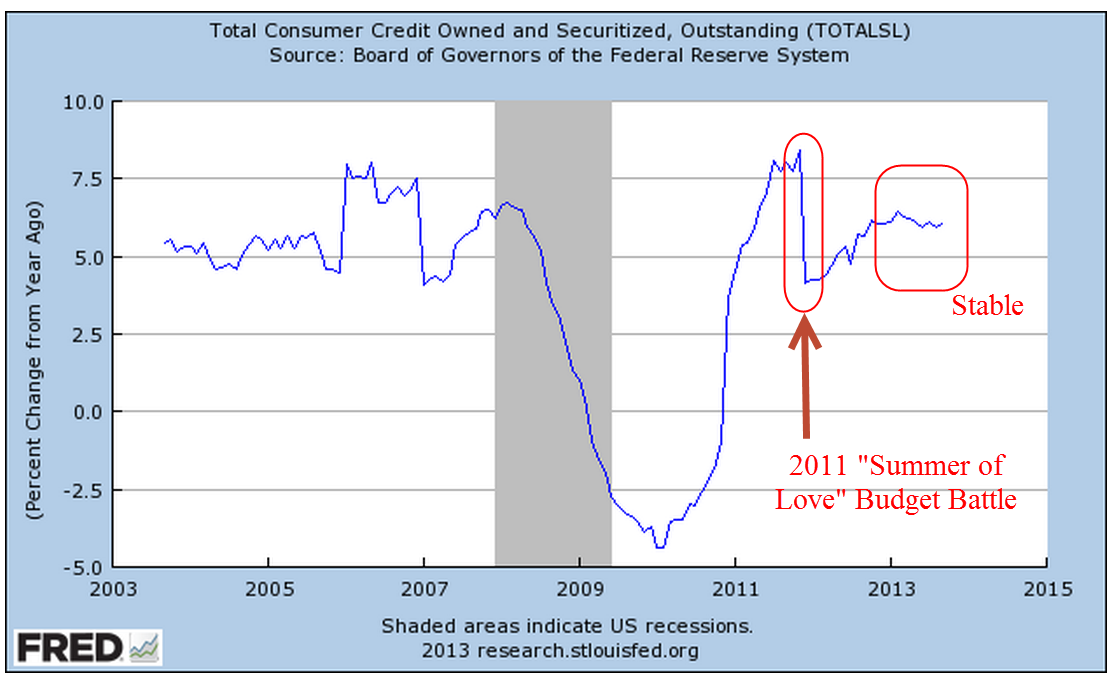
What can we learn from a bird’s eye view of the growth in consumer credit?  At 5.6% year over year, it is stable.

Note the response time lag in this series.  The growth in consumer credit did not decline below 5% till months after the recession started.  Despite the loss of hundreds of thousands of jobs in the beginning of 2008, this net job loss represented less than 1% of the work force in mid-2008.  The job loss would mount into the millions but jobs are “sticky,” meaning that a downturn in the economy has a minor effect on most people most of the time.  After the fact, it is easy for us to point at some chart, arch our eyebrows in a knowing glance, and say “We can see the breakdown of the economy beginning here.”

On a long term chart, we can see a reduction in growth swings over the past thirty years.  Relatively flat income growth for a majority of workers has dampened the swings.  While good for household balance sheets, it means that we can expect less economic volatility but also muted growth for the next decade.

Expectations for the holiday season are not reflected in the price of retail stocks.  A basket of retail companies has grown about 40% this year and is up about 70% over two years.  It may be time to take a bit off the table in this sector.

The Consumer Financial Protection Bureau (CFPB) was created a few years ago to act as a watchdog over the credit practices of the largest banks.  On Tuesday, Richard Cordray, Director of the agency appeared before a Senate committee.  He confirmed that the agency collects a lot of anonymized data on 900 million credit card accounts each month as part of its supervisory role.  Questions should be raised whenever any government agency collects data on us.  How is the data protected?  Who has access to the data?  What about my privacy?

Mr. Cordray noted that several other agencies as well as private industry collect this data.  Because the data is anonymized, we are little more than a number to  the agency, but there are several concerns.  Federal agencies have a great deal of legal power, enabling them to get a warrant to access  the data on anyone.  Cordray repeatedly assured the committee that no one at the agency is interested in our personal data but left off one adverb – “now.”  In the aftermath of 9-11, anti-war protestors found themselves turned away at airports or flagged for additional screening.  How did federal agencies know the travel plans of many protestors?  It does not take a team of FBI agents to trace the activities of any citizen when several federal agencies have our monthly financial activity at their fingertips.  Secondly, there is the matter of security.  How many parties does our data go through on its way to the agency?  Where and at what stage in the process of data aggregation is the anonymizing done?  Is our personal credit card info transmitted first to a separate third party anonymizer before being transmitted to the various agencies?  Is the raw data being transmitted to an agency which then anonymizes the data using a third party program or process?  In any case, it was clear that our monthly card transactions are making the rounds in both private industry and various government agencies.

The stock market continues to rise, prompting talk of a bubble.  If you have access, try to read “Is This A Bubble” by Joe Light in this weekend’s edition of the Wall St. Journal.   It is both informative and measured in its assessment.

 In February 2012, I mentioned the Golden Cross which had occurred in late January.  This long term indicator of market sentiment is a crossing of the 50 day moving average of stock market prices above the 200 day average.

Since then the market has risen about 40%.  Man, if I had only taken my own advice and moved all my investments and money into the stock market!  As the market continues to rise, more and more investors catch the “if only” disease and start moving money from safer investments into stocks.  This is why many of us tend to buy high and sell low.  Instead we should stay with the fundamentals of diversify, diversify, and lastly – diversify.  A long term indicator like the Golden Cross is not a signal to dump all of our savings into stocks – unless we are in our 30s and have lots of time before we need the money.  A more sensible approach is to adjust allocation upwards towards stocks and this depends on a person’s age, needs, and fears.  If a person has a 50% stock allocation, with the remaining 50% in bonds and cash (I’ll leave alternate investments out for right now), that indicates a moderate tolerance for risk.  They might shift the allocation to 55% stocks or 60% when they see a Golden Cross.   A person who has a 70% allocation to stocks, indicating a high tolerance for risk, might start adjusting to an 85% to 90% allocation.  Using this more moderate approach, a person would have lightened up their stock allocation in December 2007 when a reverse Golden Cross happened.

So what if someone has been very scared of the stock market and has only 10% of their savings in stocks?  Should they move some money into the market now?  That depends.  If the thought of making even a slight change leads a person to lose sleep, then no.  Should someone change their allocation of stocks from 10% to 50% now?  That is a major allocation change and should be done using dollar cost averaging.  This is a process where one takes money from one investment basket every month and puts it in another investment basket. There is also a psychological advantage to this approach.  As a person’s allocation percentage becomes a bit riskier, they can adjust to the additional risk in a measured way.

Tolerance for risk is a composite of several components:  psychological or emotional, future liquidity needs, age, and assets as well as income sources.  Too often, people think of tolerance for risk as an emotional response only.  While it is true that our emotions can cloud our measured response to risk, it is important to keep in mind that it is only one of the components.

**************

In answer to calls from his own party members, President Obama announced an administrative change to the Affordable Care Act (ACA) that allows those with policies in the individual health care market to retain their policies even if the policies don’t meet the minimum standards of the ACA.  Politicians, pronouncements and podiums – stir them together and voila!  The President’s pronouncement was little more than political cover at this late stage in the transition to Obamacare.  Only if the states allow it and companies decide to offer the plans will an individual policy holder be able to “keep their plan,”  as the President promised on numerous occasions in the past few years.

On Friday, the Energy and Commerce Committee released emails subpoenaed from CMS, the agency that administers Medicare and the ACA.   The emails contradict previous testimony by both CMS head administrator Marilyn Tavenner and HHS Secretary Kathleen Sibelius that only routine problems with the healthcare.gov web site were anticipated before the launch of the web site.  Ms. Tavenner testified that there were enough problems that they decided to delay the implementation of the small business plans on the web site but it appears that the problems went much further and top officials were alerted.

Henry Chao, the deputy CIO at CMS, was made aware of many major security, transactional and design problems with the web site during the summer but decided – or was pressured to decide – that the site would go live on October 1st regardless.  President Obama’s repeated selling point has been what he calls “smart” government. The rollout of the federal health care website has  revealed – once again – that the government in Washington has become too big and too top down to be smart, or effective.  To keep their campaign coffers filled, too many in Washington must placate those companies which fund those coffers, including special favors and bailouts for the elite on Wall Street.  To get the votes, they must placate the poor with programs and promises.

A conflict of interests and a clash of incentives makes most of the Washington crowd ineffective.  Turn on C-Span and watch the faces of the House and Senate Budget Conference (House and Senate).  These are intelligent, committed people who feel the pull of these different puppet masters, those political interests that keep them in their respective seats.   Each one of them earnestly wants to fix the problem – and that is the problem.  Much of the time, they are fixing the previous fixes they implemented.  This approach makes Congress feel important. I would suggest that they do little more than enact incentives and let their constituents craft the solutions.  Sure, the solutions will not be crafted with the superior technical expertise that Washington promises. Instead, they will emerge in a stumbling, hodge-podge way that will disenchant those who believe in the romantic notion of omniscient experts who engineer elegant solutions to social and economic problems.  I hope that one day the Washington elite will let Main St. try to figure out the solutions to some of these problems. We can do better.

HealthCare.gum

November 3rd, 2013

In this week’s title is the new government top level domain name: gum for gummint or gummed up.  But before I get into that, a few side notes on the economy.

On Friday, the Institute for Supply Mgmt released October’s ISM manufacturing report, which again showed that the manufacturing sector of the economy is humming along.  The monthly report on Factory Orders will be released this coming Monday, followed by the non-manufacturing ISM report on Tuesday.  The non-manufacturing sector has slowed from robust growth readings during the summer but are expected to still be a strong 54 to 56.  I’ll update the CWI that I have been charting since the spring.

On Wednesday, the payroll firm ADP released their estimate of job growth in the private sector during October.  The 130,000 net job gains came in under expectations and ADP noted a downward revision of about 12% for the previous months employment gains.  Normally, the BLS releases their monthly employment report on the first Friday of each month but because of the government shutdown that report will not be released till this coming Friday. The disappointing growth in the private sector shown in ADP’s report and fallout from the government shutdown in October has diminished expectations of job growth in the coming BLS report.  Previous estimates of 160-180,000 job gains have shrunk to 120-140,000.  The economy has been expanding yet employment gains have been moderate, a puzzlement to a lot of economic models.  The stagflation of the 1970s contradicted several prominent economic models at that time and the current persistent weakness in employment growth has got to be causing some head scratching by labor economists.

The continuing computer dysfunctions at healthcare.gov have commanded the spotlight these past two weeks.  There are about 15 million people, or 5% of the population, who purchase individual health insurance plans. About 50% of individual plans are not renewed each year, either by choice of the insurance company or the insured.  In the industry, this is referred to as the “churn rate.”

The Affordable Health Care Act, a/k/a Obamacare, enacted minimum standards for health insurance plans.  Existing plans were grandfathered in with a few caveats, one of them being that there was no change in rates since the act was signed into law in 2010.  Of course, most plans have annual rate revisions, voiding any grandfathering provisions.  Some estimate that as many as half of all individual policy holders have received cancellation notices from their insurance carriers.

Only 18 states have set up their own health care exchanges and these have functioned fairly well over the past month.  The “hub” portion of healthcare.gov acts in the background to connect these state exchanges to data from various government agencies.  A majority of states, including all states dominated by Republican legislatures, opted not to set up their own exchanges but to use the federal health care exchange at healthcare.gov.  This much more visible portion of the health care IT infrastructure has been a disaster since it opened on October 1st. Many individual plan policy holders in states without an exchange must access this web site to shop for insurance policies and apply for federal insurance subsidies.  For many the web site has been inaccessible or there were long delays in creating accounts on the site or they were constantly dropped off the site.

There was little to no support for Obamacare among Republicans and this dysfunctional web marketplace underscores a lack of faith in the big government that Democrats extol.  Note to Democrats:  a crippled web site is not the way to win friends and influence people.

In control of the House, Republicans control the agendas of the various committees and subcommittees.  Note to Democrats:  don’t screw up when the other party has control.  In congressional hearings, Republican reps presented numerous examples of constituents angry over the largely non-functioning federal health care site.  Democrats were angry as well – less so at agency officials appointed by a Democratic President and more so at Republicans, arguing for everyone to come together to solve these problems.

After failing to make their point by shutting down the government for a few weeks, House Republicans have taken a more moderate stance of letting the Democratic health care insurance apparatus implode.  Had the Republicans – and Democrats – not been posturing at their podiums during the shutdown, Republicans might have paid more attention to the healthcare.gov site problems during the first week of the government shutdown and adopted this more moderate stance sooner.   Note to Republicans: get out of the way when your opponent is falling on his sword.

In the political wrangling over the passage of the Affordable Care Act, President Obama famously repeated, “If you like your insurance, you can keep it.”  What he should have said was “Nothing in the new health care act will force you to change plans,” but that indicates some nuance.  Nuance is the first soldier to fall in political campaigns.  Words are daggers; as kids we learn that lesson well.  To pass the Politician Exam, candidates learn three things about the use of words:  how to conceal, cajole and cut with them.  In Politician School they learn “Keep It Simple, Stupid” and think that the Stupid are the voters.  In sales, the quip is aimed at the salesperson, a “memo to self” reminder that the more one becomes practiced in the art of selling a particular good or service, the more complicated and less effective one’s presentation can become.

Politicians tend to talk to voters at the level of the least intelligent among them, so it comes as no surprise that President Obama kept it beguilingly simple, to the point of an almost falsehood.  Yes, if an insurance company kept a policy exactly as it was three years ago, then it was grandfathered in.  An insurance carrier has little incentive to keep a person or family in the same risk pool when the carrier can cancel the policy, issue them a new policy at higher rates justified by the fact that the person or family is now in an unrated risk pool.  President Obama might have thought that the subject of risk pools was just too complicated for simple minded voters.  Several years ago, politicians in Colorado found that voters were very interested in and could comprehend risk pools when it involved changes to auto insurance.  In response to legislative changes, I have had at least two policy cancellations and reissues by my auto insurance carrier.  Because the market for auto insurance is very competitive, rate changes were small.  Not so in the market for individual health insurance.

My state, Colorado, has set up its own exchange.  In Estes Park, a husband and wife with a family of four kids will save almost $600 a month with a health insurance plan they purchased on the exchange.  Their deductible will drop from $12,500 a year to zero.

For each anecdote illustrating the benefits of Obamacare, there will be at least one example of financial hurt.  For 14 years as a self-employed person I carried an individual health policy, so I am well aware of the benefits and problems of these policies.  To get an initial policy, I answered a lot of questions about myself, my habits, my family’s medical history, and my family’s parent’s medical history.  I peed in a cup and had blood taken to get a policy renewal.  Applications are an average of 23 pages according to testimony in recent hearings.  Contrast that length with the typical two page application for an employer-sponsored health care plan. In short, there were and are a lot of very big and persistent problems in the individual health insurance market.

Many individual plans are sold to small business owners or self-employed professionals, an independent lot who do like being able to pick and choose an affordable plan that meets their needs. Despite the negatives, individual plans did not suffer the onerous burden of government regulation.  Media attention to the problems in individual plans has been scant because almost 90% of people with health insurance get their insurance through an employer or through Medicare or Medicaid.

A week ago, a Congressional oversight committee questioned CGI, the general contractor for the healthcare.gov web site, and OSSI, a contractor for the backbone of the system.  This past week, another Congressional committee questioned Marilyn Tavenner, the head administrator for CMS, the government agency that administers Medicare and Medicaid, and Katherine Sebelius, the Secretary of HHS.  Both have apologized for the fiasco and have promised a tireless effort to get it right, bringing in teams of experts from private industry, including Google and Facebook, to work on the problems.

Ms. Tavenner worked for 25 years in the big hospital chain HCA, then a four year stint in Virginia’s HHS, before becoming a Deputy Administrator, then the head Administrator at CMS.  Congresspeople on both sides of the aisle gave her a lot of respect.  During the hearing with Ms. Tavenner, there were several points raised.  While I took notes, I did not fact  check the claims.

CMS projects an enrollment of 7 million by March 2014.  Of these 7 million, approximately 2.3 million need to be younger to make the policies actuarially sound.
Before the web site launch on October 1st, the CMS conducted small scale tests of the site for two weeks in September that showed no major problems.  In testimony the week before, both CGI and OSSI said that a project this size requires several months of testing before launch.
CMS made the decision not to release initial application or enrollment numbers on healthcare.gov till mid-November, claiming that the numbers were unreliable.  Republican members of the committee claimed that this was a delaying tactic to hide the fact that the numbers of enrollees so far is very low.
Ms. Tavenner insisted that their goal was to have the site running smoothly by the end of November, giving those who have had policies cancelled effective on Jan. 1st ample time to sign up for new plans.
If a person is not concerned about the availability of subsidies, they do not have to sign up, i.e. create an account on the web site, simply to find out what plans are available and at what rates.
Health care costs and coverage over the next twenty-five years are the primary concerns of small businesses.  (Side note: for most of the 2000s, premiums in the Colorado small business market were increasing by 9 – 15% each year.)
In August, CMS decided to delay the “Shop and Browse” rollout of insurance plans for small businesses on healhcare.gov till later in the year.  They also decided to delay the Spanish version of the web site as well as the capability of Medicare and Medicaid transfers.  Even with the delayed implementation of some of these components of the web site, the site has been dysfunctional.
On October 24th, Mother Jones reported that it was possible that social security numbers could be hacked on the healthcare.gov web site.
Charley Rangel, a Democratic Congressman from New York, stressed the need for health care access for children, reminding Republicans that they need a stock of healthy children to fight their wars.  An example of the verbal tennis match that ensues at some Congressional hearings.
Under the medical loss ratio clause of Obamacare, $3.4 billion has been returned to policyholders by insurance carriers.
17 million children with pre-existing conditions can no longer be denied coverage.
Medicare patients have saved $8.3 billion by the closing of the “donut hole” in Part D prescription drug coverage.
Lloyd Doggett, a Democratic rep from Texas (Texas has everything, including Democrats), continues to ask for Navigator progress reports.  Navigators are licensed by CMS to help people sign up for Obamacare and it was not clear how much supervision CMS has over these Navigators.
Ms. Tavenner denied reports that Navigators are not required to undergo criminal background checks.
Current Medicare claims are 18% below CBO projections from a few years ago.  There has been a slowing of medical costs for the past few years.  If someone leans to the left, they attribute that to the enactment of the ACA.  If someone leans to the right, they attribute the reduction to the recession.

I noticed a pattern during the hearings and the distinction has been confirmed in some polling.  Democratic voters and their representatives focus on health care access, while Republicans focus on health care costs.  This difference in focus helps explain why each side often talked past the other during the hearings.

The longer that the web site is not functioning properly, the more that voters will punish Democratic reps in the 2014 elections.  Many districts are rigged – er, engineered – to be no contest for one party or the other.  Democratic reps in contested districts are hoping that the current problems are fixed asap and praying that no more problems emerge before the election.

And finally, a side note on food stamps.  The House reduced food stamp benefits by 5% this week.  Lest you think that Republicans are all about smaller government, think again.  Yahoo reported  that Republicans want to impose restrictions on what foods and drinks a person can buy with food stamps.  Whatever became of the Party of Personal Responsibility?  Although President Obama has said he would veto the plan, it indicates that Republicans as well as Democrats are parties of Big Gummint.  Put your money in the gumball machine and hope your flavor comes out.
Laboring But Not Delivering

January 6th, 2013

No change in employment picture.  Same old, same old.  Go back to sleep.

Although the main message of the latest BLS monthly employment survey is little or no change, there are some interesting trends we can look at.    First the ho-hum stuff – stay with me for a paragraph or two.  Job gains of 155,000 this past month was essentially the average of the past twelve months; it is enough just to keep up with population growth.  The unemployment rate, number of jobless, long term unemployed, participation rate, employment-population ratio and number of involuntary part-timers all were essentially unchanged.  Can’t get more sleepy than that – but stable.

Health care employment continues to zoom upwards, gaining 45,000 this month and averaging over 28,000 monthly in 2012.  Over 2/3rds of the gains this month were in ambulatory care and nursing homes.

We are eating and drinking out at about the same pace as we did in 2011.  Food services and drinking places added an average of 24,000 workers per month this year, same as the previous year.

20% of the job gains this month were in Construction but the industry is still flat.

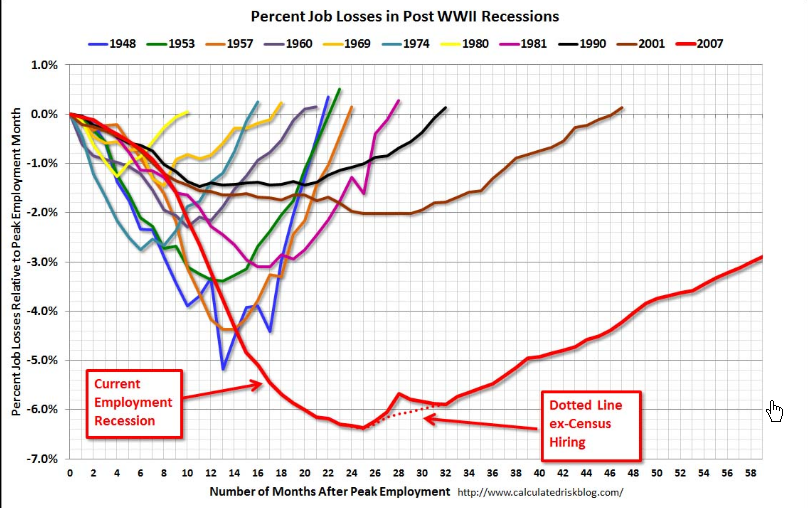
Now here comes the interesting stuff.  Bill McBride at his Calculated Risk blog for this past week has a chart of job recoveries after recessions.  This blog  is one I read regularly and is on my recommended blog list.  Check it out if you have not already done so.

The graph is measuring the job losses from a previous peak; in the past two recessions those employment peaks before the recession took hold were largely caused by bubbles in tech and real estate.  I wanted to get a more reasonable baseline to measure change.  Below is a 75 year graph of the rolling five year average of employment in this country.  It dramatically shows just how weak the job market has been – depression era weak.

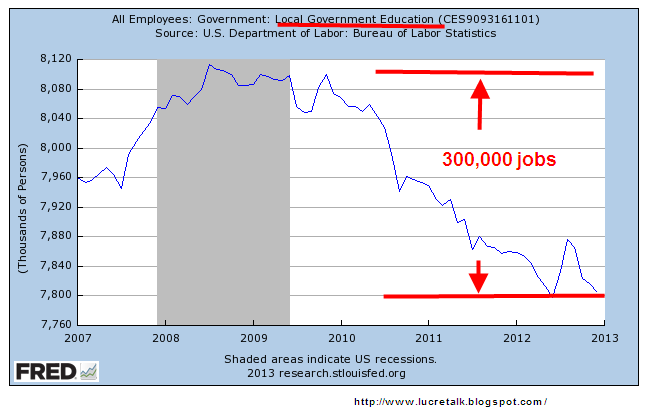
What surprised me in this past month’s report was the further loss of 13,000 jobs in the government sector.  I was expecting few job losses, even perhaps a small gain.  When we look a little closer, it gets interesting.  Since the beginning of 2010, 300,000 teachers, administrators and other workers in local government (these are primarily K-12 schools) have been laid off.

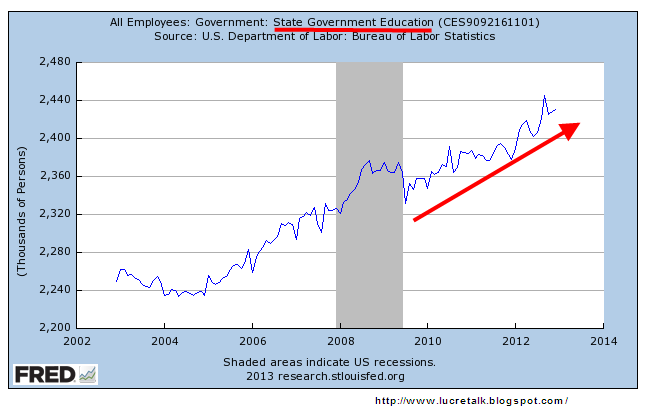
We would expect at least some layoffs at the state education level, which consist mostly of colleges, including community colleges, and universities.  Not so.  Employment has continued to rise.

As property valuations have decreased, so have the taxes based on those valuations.  The states have taken their share of the taxes and left local county, city and village authorities to wrestle with the budget challenges.  Many K-12 teachers have been laid off as a result.

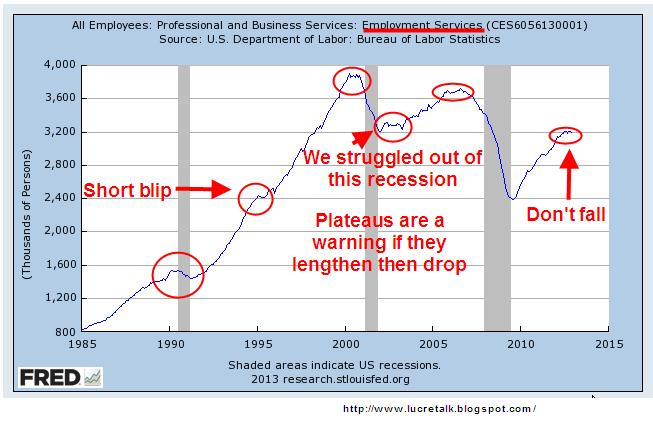
Now I’ll look at some cautionary signs.  Professional and Business Services has seen fairly strong employment gains and employment in this area has reached its prerecession peak.

There is one subcategory, Employment Services, that can often serve as a harbinger of weakness or downturn.  These are the guys whom companies hire to do the hiring.  When employment at these services weaken or fall, there may be something going bad in the fridge.

Another employment indicator is the maintenance and service of buildings.  When stores, industrial spaces and office buildings are vacant or slow, there is less to do.  Doing business takes some wear and tear on buildings.  Less business, less wear and tear.

This a truly historic downturn in both the economy and employment.  The lack of reliable, or at least comparable, data during the 1930s depression and earlier severe recessions make it difficult to do a proper assessment but we can say – to use a technical term – its a doozer.  When I hear someone comparing this recession to the 1980s and advocating, with the assertive crystal clarity that only the uninformed can summon up, that the same policies that got us out of the recession of the early 1980s will get us out of this extended recession, I know I am listening to a fool.  When I hear someone firmly pronounce that pumping vast amounts of federal money into the economy, the tactic tried with arguable success during the 1930s Depression, will solve the problem, that is the chatter of another fool.

Health Care and the Supremes, Part 1

Sorry, no pictures or graphs this week 😉

A few weeks ago, the Supreme Court ruled on the constitutionality of the health care act.  26 states brought suit against the government, asserting that the Government had no constitutional authority to impose a penalty on people for not buying health insurance.  Regardless of the arguments for and against, many of us have a gut level aversion to the Federal Government, or a State Government, for that matter, forcing us to do something.  While living in Brooklyn in the early 70s, I knew two people who had left good jobs to take sporadic cash only jobs because they did not want to be forced to have their taxes pay for the Vietnam War, a war they – and many others – believed was immoral.  In my state, Colorado, there have been many who think that the state government has no right to force drivers to wear seat belts.  For those of you in the more crowded coastal states with better public transportation systems, driving in the western states is as much a necessity of living as eating. 

The Government argued that Congress had the power to impose an individual mandate to buy health insurance under the following authorities: 1) the power to regulate Commerce as found in Article 1, Section 8, Clause 3 of the Constitution; 2) the Necessary and Proper Clause (clause 18 of the same section); and 3) the taxing power in the Constitution.

Writing for a 5-4 majority, Chief Justice Roberts rejected the first argument, writing “Congress has never attempted to rely on that power [the constitutional power to regulate Commerce] to compel individuals not engaged in commerce to purchase an unwanted product.” (pg. 18 majority opinion) He asserts that the Constitutional grant of power to the Congress to regulate Commerce does not imply that the Congress can create Commerce.  On page 20, he writes “The individual mandate … does not regulate existing commercial activity.”  On pg. 24, Roberts writes “The Framers [of the Constitution] gave Congress the power to regulate commerce, not to compel it, and for over 200 years both our decisions and Congress’s actions have reflected this understanding.”  In short, “regulate” does not mean “create” nor does it mean “compel.”

During oral arguments, Justices Roberts and Kennedy had repeatedly asked the government advocate for a limiting principle to Congress’ authority to regulate Commerce.  On page 21, Roberts makes an important distinction in the Wickard v Filburn case regarding a 1942 law that had the effect of regulating a farmer, Roscoe Filburn, growing wheat for his own consumption.  The Wickard decision, Roberts summarized,  upheld Congress’ authority to regulate the production of something, not the consumption of a product.  The individual mandate regulates the consumption of a product.  “Accepting the Government’s theory would give Congress the same license to regulate what we do not do, fundamentally changing the relation between the citizen and the Federal Government.” (pg. 23) 

On page 25, Roberts rejects the Government’s oft repeated argument that individuals are inherently “active in the market for health care,” writing that any inactivity can be said to be participating in some arbitrary market; without any limiting distinction, the phrase has no constitutional significance. He writes “Our precedents recognize Congress’s power to regulate ‘class[es] of activities’…not classes of individuals, apart from any activity in which they are engaged.”  He finds that the individual mandate breaks precedent: “The individual mandate’s regulation of the uninsured as a class is, in fact, particularly divorced from any link to existing commercial activity.”  Who can regulate individuals?  The states alone have that power: “Any police power to regulate individuals as such, as opposed to their activities, remains vested in the States.”

Roberts rejected the government’s second argument that Congress has the authority to impose the individual mandate under the Necessary and Proper Clause as a regulatory mechanism associated with the existing economic activity of healthcare.  The Government argued that the mandate is an “integral part of a comprehensive scheme of economic regulation.”  Roberts reasserts previous precedents that the intention of this clause of the Constitution is to unequivocally grant Congress power which is incidental or instrumental in enacting the powers enumerated in the previous clauses of that section of the Constitution.  It does not give Congress new powers or enable Congress the ability to expand its power.

The Government’s third argument, a fallback position, was that the mandate was not “ordering individuals to buy insurance, but rather as imposing a tax on those who do not buy that product.”  Roberts cites previous precedents that “if a statute has two possible meanings, one of which violates the Constitution, courts should adopt the means that does not do so.”  On page 31, Roberts writes that “The most straightforward reading of the mandate is that it commands individuals to purchase insurance.”  However, he acknowledges the merits of the Government’s contention that the mandate “can be regarded as establishing a condition – not owning health insurance – that triggers a tax” and that the mandate “makes going without insurance just another thing the Government taxes, like buying gasoline or earning income.” (pg. 32) Roberts acknowledges that this interpretation of the mandate is not the most natural one, but cites previous precedent that “The question is not whether that is the most natural interpretation of the mandate, but only whether it is a ‘fairly possible’ one.”

For the purposes of the Constitution, is the individual mandate a tax or an “assessable penalty?”  Roberts cites several previous laws in which Congress has shown that it regards a tax and a penalty as two separate entities. He quotes a previous decision, that of Drexel Furniture, which ruled that what distinguishes a penalty from a tax is whether an exaction or payment is punitive.  If so, then it is a penalty.  The tax imposed by the individual mandate is less than what it would cost someone to buy a policy, indicating that Congress had no intent to impose a punitive penalty. The individual mandate does not have a scienter requirement typically associated with a penalty; that an individual must have intent or knowledge that their action or inaction is against the law.  In addition, there is no criminal prosecution if someone does not pay the tax, another indication of Congress’ intention that the mandate is a tax.  In the law, there is no requirement to buy an insurance policy; there is only the imposition of a tax if you don’t buy a policy.  Roberts also cites an older precedent regarding the child labor law tax.  Even though the law called it a tax, the court held that, because it was very punitive, it was a penalty, regardless of what Congress called it.  Roberts is continuing to build on previous court decisions to reinforce the court’s policy that, although the court should regard the use of a particular word by Congress as intentional, Congress can not obfuscate the stated intentions of the entirety of a law by attaching a label to a piece of it.  On page 12 of the majority opinion, he writes “Congress cannot change whether an exaction is a tax or a penalty for constitutional purposes by describing it as one or the other.”

Did the Supreme Court even have the authority to hear this case at this time?  Did the 1867 Anti-Injunction Act prevent the court from hearing the case till someone actually paid the tax?  In finding that the individual mandate can be construed as a tax, Roberts distinguishes between a present tax and a future tax, justifying the Court’s authority to hear the case at this time. The Anti-Injunction Act was designed to prevent a state or any party from “restraining the assessment or collection of tax” (pg. 12 of majority opinion).  The tax will not go into effect for two years and no one will actually pay the tax for three years.  The suit that the 26 states have brought before the Supreme Court is not intended to delay the collection of this tax; therefore, Roberts rules that the Supreme Court can hear the case.

Although Justice Ginsburg was in the majority, she strongly dissented with Roberts arguments that the individual mandate was unconstitutional under the Commerce clause.  Hopefully, I’ll get some time to go into Ginsburg’s arguments as well as the dissenting opinions of Justices Scalia, Kennedy, Thomas and Alito.

Health Care Republican Style

This week the Supreme Court is scheduled to give their verdict on the constitutionality of 1) the individual mandate; 2) whether the Supreme Court can make a ruling at this time (are the penalties a tax or not a tax?); 3) if they rule against the individual mandate, is the mandate “separable” from the health care bill and can the Court let the rest of the bill stand; and 4) are changes to Medicaid eligibility rules an imposition on the states that effectively forces the states to accept the new rules or lose funding for their entire Medicaid program.

Jerry sent me a link to a 2009 set of Republican proposals  for health care reform.  here was my response:

Jer,

This is a Republican position paper from June 2009.  At that time Republicans were chiefly concerned about proposals for a single payer system.  If you read the paper, you will see that many of the Republican reforms were incorporated in the final health care bill.  So why the Republican push back against the health care law?

Dick Armey is a former Texas Congressman who was (and still is?) chairman of Freedom Works, which provided the financial and organizational resources for the formation of the Tea Party.  Armey fought against the individual mandate in 1993 under “Hilarycare” and prodded Tea Party members to protest against the individual mandate in “Obamacare” (why isn’t Medicare called “JohnsonCare”?).  While not a staunch conservative, he felt that the Republican Party had drifted too much to the left.  Armey retired after staunch conservatives continued to challenge him for his seat so he is not one of the wacko conservatives, despite what some Democratic pundits say.

The protest against Obamacare was a wedge issue used by Karl Rove and other Republican strategists as a way to take back the House in 2010 and it worked.

Republican reforms incorporated into the bill may not have been done exactly as Republicans wanted but they were included:

Affordable and accessible health care of all Americans with no refusal for pre-existing conditions.

Enable people to keep the current health care plan they have with their employer.

Give people a choice of health plans and allow small businesses access to affordable health plans (state insurance exchanges)

Prevention, wellness and disease management programs – emphasis on primary care (Bernie Sanders’ amendment that funded Community Health Clinics)

Tax fairness – credits for those buying individual plans so that they have the same tax benefits as people who have employer sponsored plans. (Republican Dan Issa’s committee now finds that this would help too many poor people)

Republican proposals that were not included in the health care bill:

Tort reform that some say causes doctors to order additional tests just to cover their liability.  Estimates of the savings under tort reform run from 1% – 10%.  My own personal experience with my parents’ doctors is that they order additional tests to confirm their diagnosis before starting a definitive treatment program.  The general idea of tort reform is good but the devil is in the details.  If your epileptic child becomes a vegetable after your doctor treats her for the epilepsy, do you want there to be a $100K cap on damages that you can get from the doctor?  Probably not.

Expansion of health savings accounts

I don’t know if these were included:

Additional oversight and authority to Medicare and Medicaid to stop waste and fraud.  One proposal was that Medicare should change its policy of paying bills received within 30 days.  Fraudulent clinics bill Medicare, take the money and have closed up shop by the time Medicare investigators discover the fraud (featured on 60 Minutes program).  The problem with this proposal is that this would also make it difficult for smaller clinics and individual physicians to manage their cash flows.

Financial help for family members who provide in-home care for a relative.

Republicans have successfully used the emotional issue of the individual mandate to decry the entire health care bill.  Should Republicans “repeal and replace”, many of the elements that are in the current health care bill will also be in the Republican bill.  But Republicans will claim that it is theirs and it is substantively different than the current bill.  That is how a party wins elections.  The health care debate is not primarily about health care – it is about elections and power.

Health Care Puzzle

Here is a WSJ guest opinion piece (article was accessible without an online subscription) by a finance professor with the Cato Institute who summarizes the many failings of the health care industry.  They include what amounts to racketeering by the AMA and Congress, an insurance system geared to raise costs in the health care industry, the lack of consistency in the tax treatment of insurance policies, and the lack of individual choice or portability – to name but a few.

Health care is one area where libertarians meet liberals in some agreement.  

Here is a 2007 thought piece by Brad DeLong on some rather simple solutions to the problem of catastrophic health care costs.  Can you imagine a world in which a person who makes $50K a year can rest secure that no matter what illness or accident happens to them, their out of pocket expense will be no more than $10K for that year?

Many years ago, I got a piece of metal in my eye and scored up my eyeball trying to get it out.  It was evening and my doctor’s office was closed so I went to the emergency room at a nearby hospital.  I had catastrophic health insurance with one of the largest insurance carriers in the country, but I had a deductible on the policy that wasn’t meant to cover the rather small cost of an ER visit for an eye injury. 

With my hand covering my painful eye, I presented my ID and insurance card to the ER admitting clerk.  “We don’t accept that insurance,” she said. 
“I’m not expecting this insurance policy to cover the cost of the ER visit,” I replied, “because of the deductible.” 
“No, we don’t have an agreement with this insurance company,” she replied. 
“What do you accept?” I asked.  She mentioned Blue Cross and one other. 
“Well, how do I get care?” I asked. 
“You pay [$560 in today’s dollars] and we will have a doctor see you as soon as possible,” she said.
“Do I get a discount for paying cash?” I asked.
“No, there are no discounts,” she said.
Having nowhere else to go for after hours care, I said “Ok, where do I sign?” 
“You have to pay first,” she said.
“What if it doesn’t cost this much?” I asked.
“The hospital will mail you a refund,” she said.
“What if it costs more?” I asked.
“The hospital will send you a bill,” she said.
“Just out of curiosity,” I asked, “what if I had a Blue Cross policy with a deductible like the one I have?”
“Then the hospital would bill you, she said.
“Would it be the same price?” I asked.
“It would be at the price set by the insurance company and the hospital,” she answered.

The care was excellent and done quickly with little waiting. I was out of there in less than an hour.  The hospital did bill me for a small amount in addition to what I had already paid. 

Over twenty years later, does a similar story still play out in emergency rooms around this country?

ObamaCare and the Supremes

This past week the Supreme Court (court) listened to oral arguments on the constitutionality of the individual mandate provision of the Affordable Care Act, the health care law often referred to as ObamaCare.  There were several aspects of the law that were argued in separate sessions. These arguments are available in written form  and oral form in mp3 format.  I have included links to the audio below and a link to one of the written transcripts but you can select the transcripts for any of the arguments using the topic list number for each argument.

The first question the court heard was whether the individual mandate was a tax (11-398 Monday Argument).  If the court rules that it is a tax then the 26 states that brought suit against the federal government, which I’ll refer to as the government, have no standing to sue at this time because no one can bring suit against the government before they pay the tax.  In that case, no one could bring suit until 2015 when someone actually pays the tax.  The court would not rule on the constitutional aspects of the mandate till that time.  Wanting a resolution to the constitutionality of the health care law, neither the government or the states wanted to argue that the individual mandate was a tax.  Since neither party wanted to argue the point, the court invited Michael Carvin as separate counsel to argue the case that the mandate is a tax.  The government argued that the mandate is a penalty under the taxing authority of Congress.  Understanding that the health care law is a contentious issue before a Presidential election, the court will probably side with the case that the mandate is not a tax so that they can take up the constitutional questions that the law raises.

The second session (oral or written ) consisted of oral arguments for and against the constitutionality of the individual mandate (11-398 Tuesday Argument).  The third session argued whether the court can strike down the individual mandate and let the rest of the law stand, referred to as the “severability” of the individual mandate, i.e. can the mandate be severed from the rest of the law (11-393 Argument).  The fourth session took up the question: can the federal government withdraw existing Medicaid funds it provides to the states if the states do not want to follow the new additional Medicaid guidelines that ObamaCare imposes (11-400 Argument)

Justice Scalia summarized the concerns of the court’s conservative justices: “An equally evident constitutional principle is the principle that the Federal Government is a government of enumerated powers and that the vast majority of powers remain in the States and do not belong to the Federal Government.”

Is the individual mandate within the scope of Congress’ power?  In Article 1, Section 8 of the Constitution, the Federal government is given a list of enumerated powers.  The Tenth Amendment asserts that “The powers not delegated to the United States by the Constitution, nor prohibited by it to the States, are reserved to the States respectively, or to the people.”  Amendments to the Constitution are the  definitive way to give the federal government an additional enumerated power; the Sixteenth Amendment to collect taxes on income is an example.  Since the federal government’s power is limited to what is allowed under the Constitution, it must argue for an expanded interpretation of the authority given to it by the Constitution.   It does this under the “Basket Clause” power enumerated in Article 1 which gives Congress the power “To make all Laws which shall be necessary and proper for carrying into Execution the foregoing Powers, and all other Powers vested by this Constitution in the Government of the United States, or in any Department or Officer thereof.”

One of those “foregoing powers” is the Commerce clause in Article 1: “To regulate Commerce with foreign Nations, and among the several States, and with the Indian Tribes.”

The intent of the Constitution regarding the federal government is to put limits on the power of that government.  In any case involving the authority of the federal government, the court often wants to hear a limiting provision so that their judicial decision does not open the floodgates for unlimited government authority.  The subject of limits was raised frequently by the conservative justices on the court.  Congress has enumerated powers; the states have plenary powers.  The states can force an individual to buy car insurance; the federal government does not have that authority.  In many areas, the states have coercive powers over the individual that the federal government does not have.

In this case the government argued that the individual mandate is within its power to regulate interstate commerce.  The individual mandate to buy insurance is needed in order to require insurance companies to write policies with community rating, i.e. risk is spread throughout a large community, and guaranteed issue, i.e. no denial because of medical history or condition.  The states argued that the law’s individual mandate to buy insurance is unconstitutionally forcing people to buy a product, thus creating an insurance market.

Justice Breyer cited a lower court opinion (Sutton) that an earlier precedent setting case, Wickard v. Filburn, effectively allowed the government to force a farmer to buy wheat. Other justices disagreed with this interpretation of the Wickard case. 

The government advocate, Donald Verrilli, made what is its primary point:  health care insurance is simply a financing mechanism for health care services which all but a few will consume at some point in their lives. Since all people are or will be in the market for health care services, the government has the authority to regulate the payment for those services.

Justice Alito asked Verrilli, the government advocate, whether the government could require people to buy burial insurance since everyone will need to be buried or cremated.  Verrilli made the argument that burial expenses do not involve cost shifting the way that paying for health care insurance does.  Justice Alito countered that the government does pick up the expense of burying or cremating someone who cannot pay but Verrilli argued that this comes out of general tax revenues and these costs are miniscule when compared to the unreimbursed costs of health care.  Justice Scalia asked the rhetorical question: why couldn’t Congress just pass a tax to cover the costs of unreimbursed care?  There would be no question of constitutional authority since Congress has the express power to levy such a tax.  Although many liberals disagree with much of Justice Scalia’s opinions, they have asked this same question.

Justice Kennedy noted that the court has an implied presumption that a law is constitutional but that the government has a burden to prove its case when enacting a law that requires an individual to buy something, a requirement that fundamentally changes the relationship between the government and the individual. Kennedy noted that the health care act requires an affirmative action from an individual, i.e. buy insurance.  Under existing tort law, the government can not require an individual to take an action to prevent a blind man from stepping in front of oncoming traffic, despite the grave moral concerns this raises.  The laws of this country delineate a clear boundary around the individual that the government can not cross.  Kennedy is concerned that the court may set a precedent in this case that erodes that boundary.  Often regarded as the swing vote on the court, Kennedy’s remarks show his concerns about the constitutional questions and limits on Congressional power that the law raises.

Mr. Verrilli argued that both sides agree that the government can regulate transactions affecting interstate commerce at the point of sale.  Paul Clement, the states’ advocate, later confirmed his agreement when questioned by Justice Sotomayor:  Yes, the government can regulate commerce at the point of sale.  Verrilli argued that insurance is the way that health care services are paid for at the time of delivery or point of sale; however, no one can buy insurance at the time of delivery since no insurance company will sell someone a policy at that time.  Given this rather unique feature of health care transactions, the government has the authority to ensure that people have insurance in advance of the point of sale.  Further on, I’ll cover Clement’s argument against this contention.

Given the government’s argument, Chief Justice Roberts asked if the government could require people to buy a cell phone so that they could call for emergency services, i.e. police, fire, ambulance and roadside service, which most people will need in their lifetime.  Verrilli argued that, unlike health care, there is no market for emergency services. Justice Breyer argued that the goverment could require someone to buy a cell phone or burial insurance.  As an example, Breyer challenged Paul Clement, the states’ advocate, couldn’t the government require people to get vaccinated to prevent the spread of a disease that would kill 60% or more of the population.  Clement answered that the government could not do so.  This argument between Breyer and Clement reflects the sharply differing interpretations of the General Welfare clause of Article 1.

Justice Kennedy questioned the government’s case that the health insurance market and the health services market are the same market.  The health care act requires people to buy insurance for services that they will never need; i.e. maternity care or pediatric care.  The government advocate, Donald Verrilli, argued that the government has a right to impose minimum coverage provisions as a regulatory detail.

Justice Ginsburg noted that the government’s brief makes the case that the health care market is one where there is direct cost shifting from one market participant to another, thereby constituting an existing market.  Insurance companies and hospitals charge additional to people with insurance to pay for those who have no health insurance.  Verrilli concurred, noting that this direct cost shifting distinguishes the health care market and justifies the government’s regulation of this cost shifting.  Justice Scalia argued that there is an implied cost shifting when someone decides not to buy a car.  To make a profit, car companies have to charge more to compensate for selling fewer cars.  Verrilli argued that, unlike cars, health care will be provided regardless of one’s ability to pay.  Although Scalia failed to make his point directly, he showed a skeptical wariness of  allowing the government to control and expand the definition of what is a market.  If given a wide latitude to define a market, the government could define almost any activity as a market in the future and its authority to regulate that newly defined market.

Justice Sotomayor asked the states’ advocate, Paul Clement, whether the government could enact a “health care responsibility payment” that would be waived on proof of insurance.  Mr. Clement answered that there might be some question whether Congress could do so under its taxing authority.  Such a payment could be construed as a direct tax that would presumably not be a uniform tax and unconstitutional under Article 1.

Justice Breyer argued that Congress has historically created commerce out of nothing, noting the creation of a national bank as a regulation of commerce which did not previously exist.  Breyer cited various court decisions that ruled the growing of wheat or marijuana as activities engaging in commerce and affirming Congress’ authority to regulate such activities under the Commerce clause.  Clement countered that the creation of a national bank was not done so under the Commerce clause, nor did the government require an affirmative action from individuals – that they deposit their money only in the national bank.  Clement returned again to this question of coercion, adding that the government does not require people to buy cars to support the car industry; rather, the government offered incentives such as the Cash for Clunkers program.  The government does not support wheat farmers by requiring everyone to buy so many loaves of wheat.  In short, the government has no authority or precedence for forcing individuals into a market.

In response to challenges by Justice Roberts and Kagan, Clement argued that everyone is not in the health care market; that through this insurance mandate, the government is trying to force everyone into the market. Justice Kagan responded that insurance is a way of funding a market that everyone will participate in during their lifetime. Clement countered that not everyone will use the health care services during the year that they have bought the policy for.  Clement consistently draws the distinction between the health care services market and the health care insurance market, an appeal to the conservative justices who are wary of Congress’ future desires to make connections between markets in order to extend the reach of Congressional authority under the Commerce clause.

Justice Kagan summed up what will lie at the heart of arguments both for and against the constitutionality of this law:  “who’s in commerce and when are they in commerce?”