Green Incomes


March 10, 2019

by Steve Stofka

Many Americans cross the street if they think a socialist program is walking toward them. We believe that the U.S.A. is the heart of capitalism, but recent history reveals that our financial and legal systems are based on socialism for the very, very rich.

In the past two weeks, I reviewed the infrastructure goals as well as the justice and education goals of the Green New Deal (Note #1). In Part Three this week, I’ll look at the income supports included in the resolution’s economic agenda.

“Guaranteeing a job with a family-sustaining wage.” This is yet another example of clumsy language used to state a goal that some might read as utopian. Some can group the first phrase as ” Guaranteeing a job with a family sustaining wage” meaning that all wages should have a certain minimum. That sounds like the language of Minimum Wage 2.0, but does that mean that each job should be able to support a family of four, or six, or eight?

Others might group the first phrase as “Guaranteeing a job blah, blah, blah” and read the intent as a platform point of a Socialist Manifesto. Is the government going to hand out jobs to everyone that wants one? Only if the government takes over some of the means of production and becomes the nation’s chief employer can it hand out jobs to anyone who wants one. That is the textbook definition of socialism. It is not enough to have good intentions. Clarity of language matters.

Why the clamor for more income redistribution? The real (after inflation) income of poor and working families has lost more than half since 1980. That might not surprise some readers. The trend is even broader and more insidious. Income data from the Congressional Budget Office (CBO) shows that even the top 5% of real incomes have dropped 30%. The real income of a ¼ million families – the very, very rich – have grown in that time. Here are some highlights from the data.

In 2015 and 1980, the number of poor households, or bottom 20%, equaled the number of rich households, or top 20%. In 2015, the government took money from each rich household and gave it to 5-1/4 poor households to raise their income by 65% (Note #2). In 1980, the government took money from each rich household and gave it to 10-1/4 households to raise their income by only 25% (Note #3).

Why did poor households need so much more support in 2015 than they did in 1980? Because their real incomes before transfers and taxes (BTT) lost more than 50% (Note #4). The real BTT incomes of the top 5%, the very rich, have lost more than 30% . It is only the very, very rich, the top 1%, that have fared well in this fight against inflation. Their BTT income has grown 15% in the past 35 years. The bulk of those gains have probably come from the top .1%, or less than ¼ million families.

Why? Where has the money gone? The high interest rates of the 1980s made the dollar so strong that manufacturers began to move their operations to lower cost markets in Asia. Japan kept the value of the yen low relative to the dollar and attracted much of this investment. The Japanese economy and real estate boomed. American exports of manufactured goods declined, and commodity prices crashed, destroying a lot of income producing wealth, particularly in rural areas (Note #5). Bankruptcies during this decade far exceeded those filed during the Financial Crisis ten years ago (Note #6). Older readers may remember the charity concerts to raise money for farmers (Note #7). Today, many commercial buildings in small towns throughout the country stand empty. As rural clinics and nursing homes close, people must move to urban areas where medical services are available (Note #8).

As real incomes declined in the late 1980s, households and governments borrowed to make up for the loss of income. Who did they borrow from? Financial institutions who managed the assets of the very, very rich. As the financial sector grew in proportion to the size of the entire economy, the top managers of financial firms became very, very rich themselves (Note #9).

In the past twenty years, lobbying by the financial sector has quadrupled (Note #10). It paid big dividends during the latest crisis. After the initial bailout by the Bush administration in the fall of 2008, the Obama administration brought in a team led by Robert Rubin, Larry Summers, and Timothy Geithner. The first two helped dismantle the safeguards between deposit banks and investment institutions during the Clinton administration. Geithner was a protégé of Rubin. All were deeply embedded in the interests of the banks, not the creditors and governments who had trusted the judgment of financial managers.

The lack of separation between deposit banks and investment banks helped spread a cancer from the investment banks to banking institutions throughout the world. As Obama’s Treasury Secretary, Geithner continued to protect the bonuses of top managers despite massive losses. To preserve the wealth of the very, very rich, the Federal Reserve loaded up their own balance sheet with toxic bonds bought at full value.

After a 35-year period of rising real incomes and wealth because of favorable fiscal and monetary policy in Washington –
after Washington protected their wealth and income during the financial crisis at the expense of middle-class families who lost their savings and houses –
it is time for the very, very rich to pay taxpayers back.
You have eaten well. Here is the check.

//////////////////

Notes:

1. Politifact article
2. In 2015, the bottom 20% of households (24.3 million) averaged $20,000 in income before taxes and transfer payments. The top 20% (25 million) earned almost $300,000. After taxes and transfer payments, the incomes of the bottom 20% rose 65% to $33,000. CBO report on household income in 2015, updated Nov. 2018
3. Number of households underlying CBO report is in Sheet “1. Demographics” of Supplemental Data spreadsheet linked on last page of report. Dollar amounts are in Sheet “3. Avg HH Income”, of same spreadsheet.
4. The impact of high interest rates on investment and commodities during the 1980s Secrets of the Temple pp.590-604
5. Using BLS calculator to compare CPI January 1980 to January 2016 prices, $1 in 1980 = $3.05 at the end of 2015. Average income amounts from Sheet 3. See Note #3 above.
6. Four decades of bankruptcies chart at Trading Economics
7. Farm aid timeline
8. Nursing centers in rural areas are closing NYT
9. The financial industry’s increasing share of GDP
10. Increase in financial lobbying since 1998
January Employment and Economic Production

February 9th, 2014

The ISM manufacturing report for January reported a severe decline from the robust readings of past months.  New orders suffered the most, dropping from a strong reading of almost 65 in December to just a bit above the neutral reading of 50.  Prices jumped significantly.  Manufacturing’s drop off in new orders comes on the heels of a similar decline in the service sector in December.  This is the third report in the past thirty days that came in below even low estimates, the other two being pending home sales and December’s employment gains.  At mid week, ISM released their January estimate of the health of the service sector which is the bulk of the economy.  Happily, this showed continued growth, helping to offset concerns about a broad slowdown in the economy.

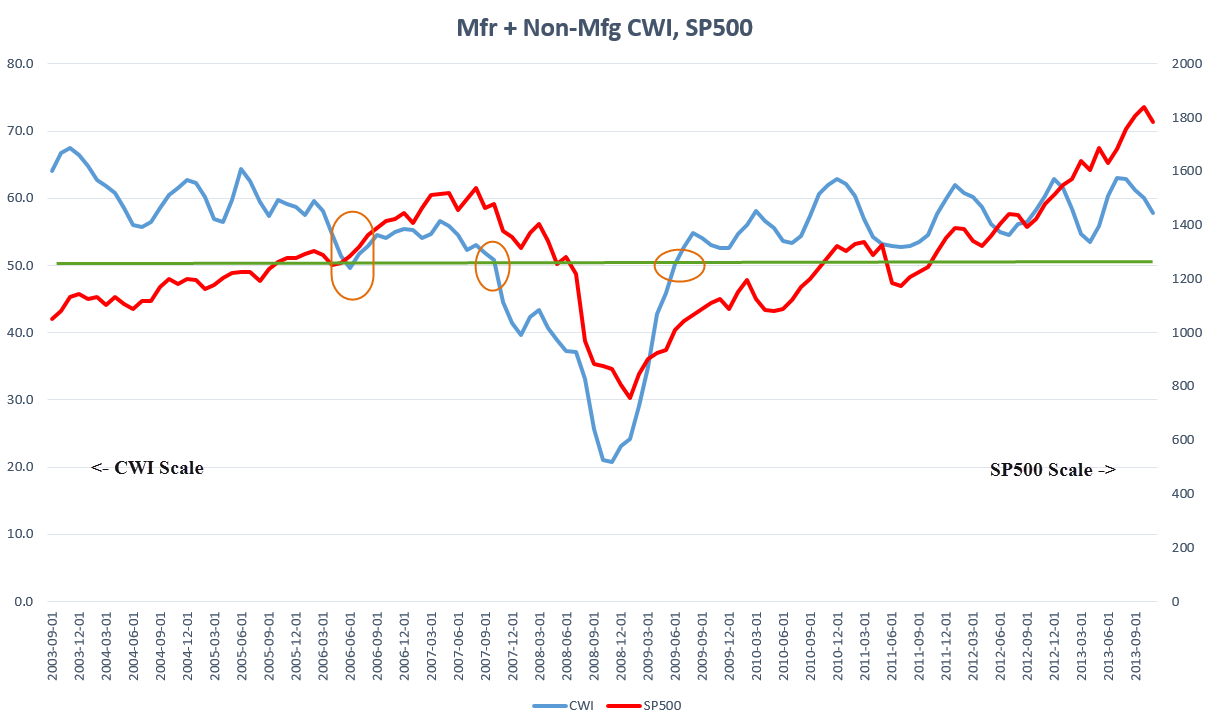
The CWI that I have been tracking continues to show an overall strength, declining slightly to 58 from the rather vigorous reading of 60 last month.  As I noted a few weeks, this index anticipated a winter lull before picking up energy again in early spring.

A reader had difficulty understanding the wave like graph of the CWI.  I indexed it to a starting base then indexed that to the SP500 average in 1997.  Perhaps this will help visualizing the long term response of the SP500 to underlying economic activity.

*******************************

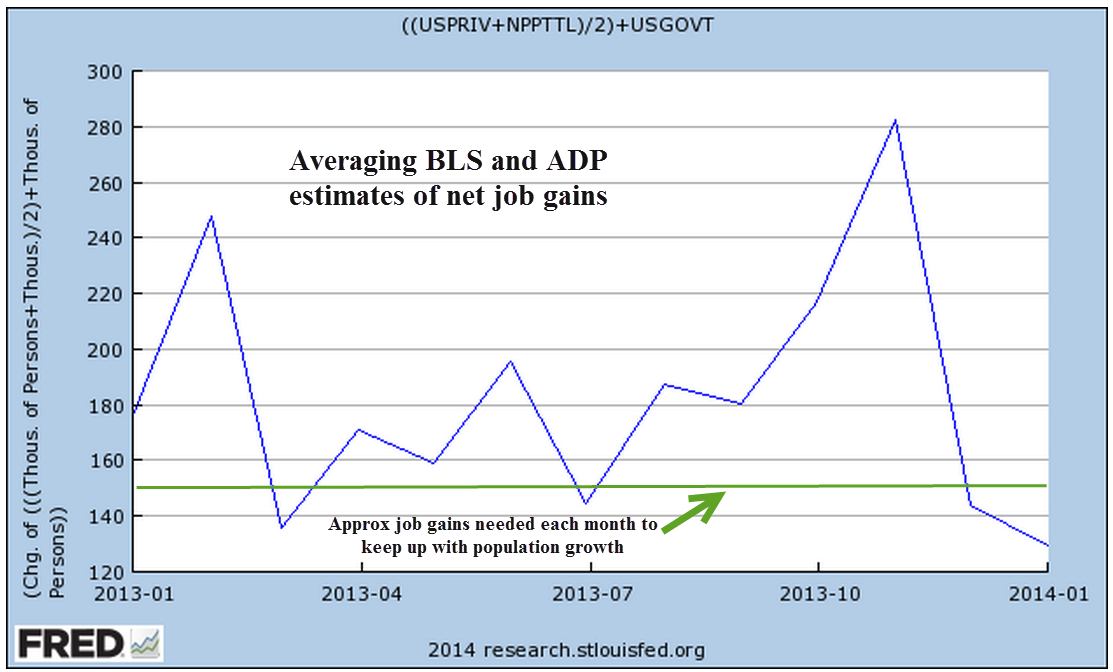
ADP reported a gain of 175,000 private jobs in January, below the strong 227,000 job gains of December.  There was only a slight revision to ADP’s previous report, confirming the suspicion of some that the greater flaw lies in the BLS figures for December.

On Friday, the Bureau of Labor Statistics (BLS) released their estimate of 113,000 job gains in January, far below the consensus of about 180,000.  Here’s a story from the Atlantic that captures some of the highlights.  Forgive some of the misspellings, if they are still there by the time you read it.

As I did last month, I’ll show the average of monthly job gains estimated by the BLS and ADP.  ADP does not report government jobs so I’ve just added those in from the BLS report.

The decline below the replacement level of 150,000 may be a temporary response to severe weather conditions in the populous east coast and Chicago region.

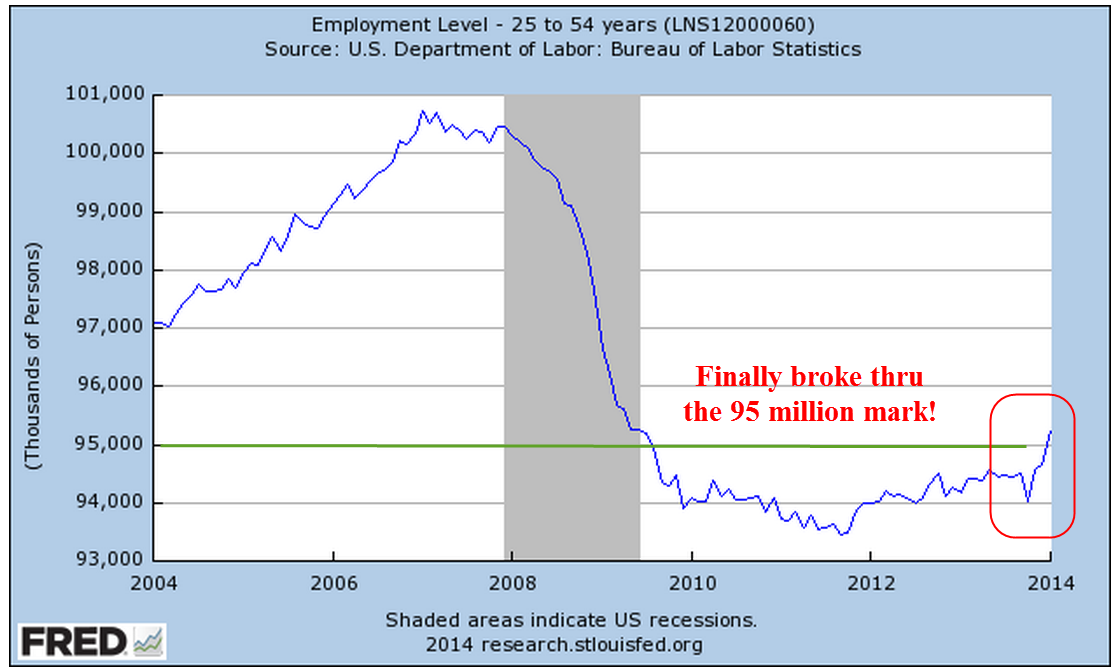
The market responded quite favorably to this labor report. A slackening labor market prompted hopes that the Federal Reserve will not accelerate their easing of bond buying.  A large revision of job gains in November was a big positive in the report.  Another positive was the half a million increase in the core work force, those aged 25 – 54.  Men accounted for most of this increase.

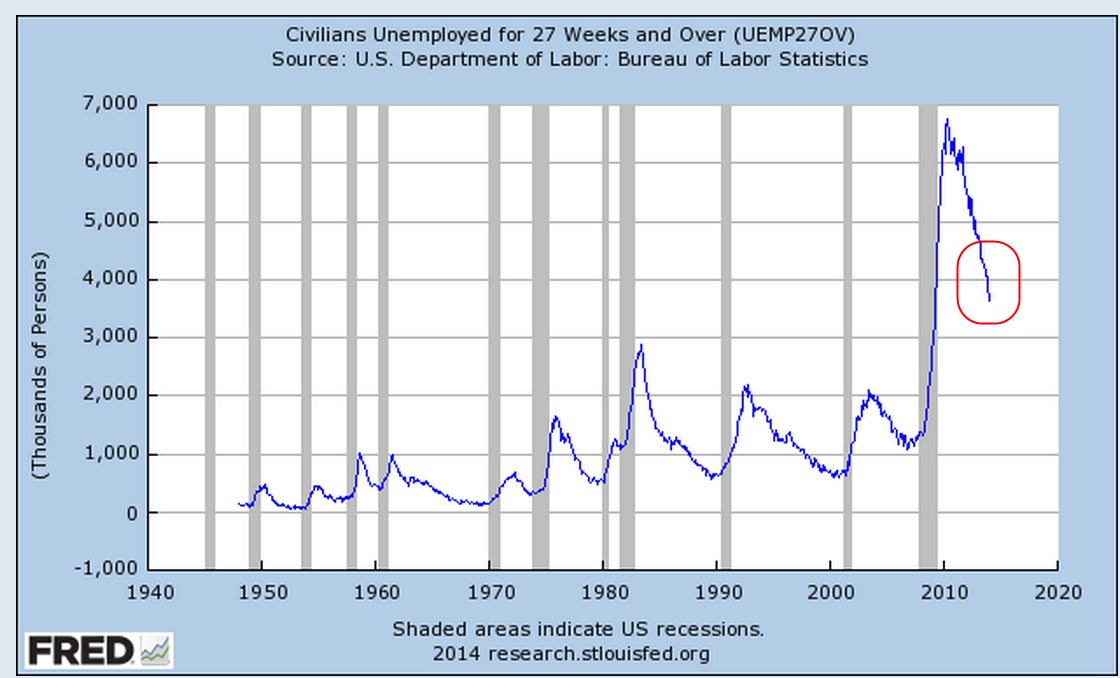
The number of people working part time because they can’t find a full time job dropped by a half million but there are still more than 7 million people in this situation.  A 232,000 decrease in the number of long term unemployed was heartening although many lost their unemployment benefits at the end of the year and may have had little choice but to take whatever job they could find.

*****************************

Doug Elmendorf is the head of the Congressional Budget Office (CBO) that advises the Congress in constructing the budget, making appropriations, and the anticipated or actual economic effects of policy.  In advance of his testimony before the House Budget Committee this past week, the CBO released the highlights of their report. Some talk show hosts and conservative media were trumpeting a loss of 2.3 million jobs due to Obamacare.  In his testimony, Mr. Elmendorf explained that the 2.3 million jobs mentioned in the CBO report are not lost jobs because the CBO does not estimate any reduction in the demand for employees because of Obamacare. The CBO estimated the number of hours that employees would voluntarily reduce their hours in order to meet qualifications for subsidies under Obamacare and divided those total hours by what a full time employee would work in a year.  Since there is a surplus of labor in this country, this voluntary reduction would help those who are either looking for a job or want to work more hours.  The CBO sees no impact on part time jobs that can be attributed to Obamacare.

*******************************
Republicans and some Independents have repeated the claim that the rich are paying most of the personal income taxes in this country. IRS 2010 data (Table 2 ) doesn’t seem to support that contention.  The top 5% of taxable returns with taxable incomes greater than $200K had taxable income of $1.9 trillion, or 36% of the total $5.3 trillion in taxable income.  On that income, the top 5% paid $513 billion in Federal income tax, 49% of the total.  In a flat tax system, the top 5% would have paid a bit more than $360 billion.

When Republicans use the code words “broaden the tax base” what they mean is that they want a flat tax so that rich people pay the same percentage of tax as poor people.  Several states have such a flat tax system.  To Democrats, a broadening of the tax base means making more of the income of rich taxpayers subject to progressive tax rates.

When Democrats use the code words “paying their fair share” they mean that the rich should pay proportionately more than the additional load of about 32% that they are currently paying.  To Republicans “fair share” means a flat tax.

What the IRS data shows is that the rich are not paying most of the income taxes in this country.  Often tax policy and social benefit programs are lumped together, confusing the issue in the minds of many.  The Tax Foundation did an analysis of the net benefit and expense of taxation and benefit programs.  They report that:

As a group, the bottom 60 percent of American families receive more back in total government spending than they pay in total taxes.

Government tax and spending policies combine to redistribute more than $2 trillion from the top 40 percent of families to the bottom 60 percent.

The methodology that the Tax Foundation uses presumes that everyone benefits equally from public spending like defense, police and the courts.  An alternative assumption that people benefit according to their income results in a $1.2 trillion redistribution, about 40% lower, according to the Tax Foundation.  (Kudos to the Tax Foundation for making both computations.)

What the report does not do – because it is just so hard to do – is calculate age and circumstance related movements of taxpayers from the top 40% to the bottom 60%.  Consider a taxpayer – I’ll call her Linda – making $100,000 who is in the top 40%.  She loses her job and starts collecting unemployment for several months.  Her income now puts her in the bottom 60%.  “Past Linda” was supporting the bottom 60% but “present Linda” is now part of the bottom 60%, according to the methodology used by the Tax Foundation.  Yet if we isolate this one taxpayer, we can say that “past Linda” was actually supporting “present Linda.”  When Linda was making $100K, she presumably paid a lot in income and other taxes, including unemployment taxes paid by her employer.  The Federal Government does not keep records that would allow this kind of inter-temporal analysis.  As a result, we get a distorted view of what is actually happening.

Let’s look at an older taxpayer – I’ll call him Sam – who retires.  Sam was making $80K before he retired and was in the top 40%.  With social Security income and income from savings, Sam now makes $36K in retirement, which puts him in the bottom 60%.  Is Sam being supported by the top 40%?  Statistically he is.  However, most of us would say that Sam is simply living off the benefits that he paid into during his working life.

I appreciate the exhaustive work that the Tax Foundation does but the problem is more complex than they present.  Furthermore, many people are not aware of the difficulties and complications of calculating who supports whom.  Some use this analysis to present the case that the majority of Americans are sucking on the teats of the few well off.  Presidential contender Mitt Romney’s unguarded comment about “the 47%” who are living off the efforts of others did not serve him well in the past election yet a sizeable percentage of voters believe this.

The 16th Amendment passed a century ago allowed the Federal government to tax the income of individuals directly and it was intended to be progressive.  Relatively few paid any income taxes in the first decades after the enactment of the income tax.  Whether one likes the progressivity of the tax code, one has to recognize that the law was intended to be that way when it was passed.

I would like to see the repeal of the 16th Amendment for two reasons: 1) protect individuals from the power of the Federal government; 2) slow the consolidation of money in Washington.  Money brings power and power begets patronage, if not downright graft.  We can never get rid of patronage, only retard the concentration of patronage. Studying 5000 years of history, we have learned that the concentration of power in any political institution ultimately leads to the downfall of that institution.  Only corporations can exist with such a concentration of power and even they sometimes fall when top leadership in a company becomes resistant to change.

Perhaps we could adopt a taxing system where the Federal government taxes the states based on the population in each state.  If a state has 10% of the country’s population, then they would owe 10% of any tax used to replace the current income tax.  Let the states determine how they will collect the money.  Racism has been a constant nemesis of this country and legal protections could be enacted which would prevent states from taxing citizens based on race or sex.  Head taxes have a tawdry reputation because they were often used to disenfranchise poorer voters.  If the population count of a state was simply used as an allotment mechanism and not applied directly to each citizen, I think that this could be a fairer and safer system of taxation.  Certainly, legislation could be passed preventing the denial of rights to a citizen based on a tax.

Could Doug Elmendorf and his cohorts at the CBO build a model based on such a system?

*******************************

Tidbit:

And we’re talking about nine million individuals who are eligible for both Medicare and Medicaid. They are responsible for a significant amount of spending in both programs — approximately 46% of Medicaid and close to a quarter of Medicare spending annually.  Estimates range that that is anywhere from 300 to $350 billion a year total that we’re [CMS] spending. 
Melanie Bella, Director of the Federal Healthcare Office at the Centers for Medicare and Medicaid Services, Federal Coordinated Healthcare Office Conference 11/1/2010

Social Security Myths

Previously, I took a closer look at the conservative “myth” that reducing tax rates raises tax revenue. This week I’ll look at a fiction frequently trotted out by those on the left: the rich get off easy on their contributions to Social Security.

A recent example is a Senate hearing (32 minutes into the tape) in which Tom Harkin, the Democratic Senator from Iowa, states that, because of the $106K cap on earnings subject to the Social Security tax, people making $400K paying Social Security tax on 25c out of every dollar while most people in this country pay Social Security tax on every dollar they make. This is true. But what Senator Harkin neglects to mention is that Social Security benefits are also capped.

Let’s look at 3 examples: Joe, making the median annual earnings of $40K; Sally, earning $100K and in the top 5% of earners; and Marilyn, making $150K. Each of them was born in 1950 and will retire at their full retirement age in 2016.

Using the Social Security Administration’s (SSA) benefits calculator , Joe will get a full retirement monthly benefit of $1184 when he retires. Using the default growth rates of income, the SSA estimates Joe’s lifetime income at $848K. Sally will get a monthly benefit of $2100 on estimated lifetime earnings of $2,119K. Sally has contributed 250% more than Joe but will receive less than double the benefit. Marilyn will receive a monthly benefit of $2434 based on a lifetime earnings estimate of $2,623K, triple Joe’s earnings.  Because of the social security contributions cap (currently about $106K), Marilyn has not contributed three times what Joe has contributed, but she has still contributed more than 2.5 times what Joe has contributed.  However, Marilyn gets only double the benefit that Joe receives.

In short, Social Security is both a safety net and an income redistribution scheme. An American Institute of CPAs (AICPA) report notes that Social Security was originally designed as a prepaid pension plan so that benefits received were dependent on contributions made by each person. That original design was amended a few years later to turn Social Security into a “pay-as-you-go” system where retiree benefits were paid for by the taxes of current workers. Although benefits were indexed to contributions, those who earned less received far more benefits in proportion to their contributions. Social Security thus became a hybrid income redistribution scheme for retirees. You can read a colorful history of pensions at the SSA web site.

Few conservative or liberal politicians readily acknowledge the income redistribution aspect of Social Security. The program has been “sold” to taxpayers as though it was an insurance product, similar to an annuity policy that anyone can buy from an insurance company. The only difference is that the federal government is the insurance company. Regardless of what one feels about the income redistribution part of Social Security, it has reduced “the poverty rate among the elderly from 35% in 1959 to 10% in 2003, the lowest of any adult group.” (Source) A recent report by the Census Bureau shows that poverty rates for seniors are 2/3 to 3/4 that of adults in general. Have we gone a bit too far in helping seniors? Poverty rates for children are at a shocking 20% plus, but few politicans dare to propose reducing benefits for the elderly to help children. Seniors vote. Children don’t. Because seniors have been convinced that Social Security is like an annuity insurance program, many seniors balk at any reduction in benefits. They are convinced that they paid in full measure for the benefits they receive.

As the examples above show, both Marilyn and Sally pay a portion of Joe’s benefits. Yet Joe probably thinks that he has earned every penny of his benefits because he “paid into the system.” This misconception is likely to make changes to Social Security benefits extremely difficult. Those who are well off know that they contribute far more into the system than they receive. Those who are less well off will prefer to “soak the rich” even more rather than give up benefit increases.

For those of you who like wrestling, you may be able to see in coming years the (cue up the loud music) “Social Security Smackdown” on a cable channel.

Income Redistribution

Dodge ball is a game where two teams on either side of center line throw a soccer ball at each other, trying to hit a member of the opposite team. In the playing field of political punditry, those on the left and right of the center line throw the epithet of “income redistribution” at the other team, accusing them of this heinous crime.

According to a June 27th, 2008 Gallup Poll “Americans’ lack of support for redistributing wealth to fix the economy spans political parties: Republicans (by 90% to 9%) prefer that the government focus on improving the economy, as do independents (by 85% to 13%) and Democrats (by 77% to 19%). This sentiment also extends across income groups: upper-income Americans prefer that the government focus on improving the economy and jobs by 88% to 10%, concurring with middle-income (83% to 16%) and lower-income (78% to 17%) Americans.”

In their “Currents” feature of 3/10/09, the WSJ reported that “In a recent WSJ/NBC News poll, the highest-ranked peeve, named by 35% of those polled, was bank executives taking large bonuses while receiving taxpayer funds.” This is income redistribution to the rich. However, IRS data shows that the top 25% of income earners paid 86.3% of income taxes, so it is more a case of redistribution of income from some well off people to other very well off people.

Some conservatives rail at Obama’s tax hikes, accusing him of Robin Hood economics and warning of a descent into European socialism. Under Obama’s plan, a person earning $300,000 would pay an additional $1200 in taxes than under the current system. It is a relatively paltry sum hardly deserving the degree of complaint from these conservative critics, but it is true that some of that money would go to lower income earners so this is income redistribution to the poor.

By nature, progressive tax systems are redistributive. A redistribution of a tax burden is a redistribution of income. An overwhelming majority of people do not favor redistributive schemes. It has been almost 100 years that the progressive income tax has been in effect.