A Debate on a VAT tax

January 26, 2025

by Stephen Stofka

This is 11th in a series of debates on various issues. The debates are voiced by Abel, a Wilsonian with a faith that government can ameliorate social and economic injustices to improve society’s welfare, and Cain, who believes that individual autonomy, the free market and the price system promote the greatest good.

The notes at the end give more context to the arguments.

Cain began this week’s conversation. “We left off last week discussing alternatives to the income tax. Before we entertain alternatives, can we agree that the income tax should be abolished at the same time the country adopts a new scheme of taxation?”

Abel cleared his throat. “I’m not so sure about that. Can an alternative tax scheme raise the same amount of revenue?”

Cain raised an eyebrow. “If it didn’t, that would be more money for private consumption and investment.”

Abel grimaced. “That’s playing with fire. The country is already running persistent deficits. If there was a significant difference in revenue, it could seriously weaken the dollar.”

Cain said, “Our group favors a consumption tax to replace the income tax. They were the main source of federal revenue until the passage of the 16th Amendment in 1913.”

Abel shook his head. “Consumption taxes didn’t raise enough money to pay off Civil War debts and the pensions promised to veterans and their families. In the early 20th century, society was becoming more complex. There was a greater role for government. The greatest improvements in health and life span came in those decades. Public sanitation measures and vaccines reduced water borne illnesses and contagious diseases.”

Cain argued, “I agree that there was a greater role for government. It’s just gone too far. Particularly the role of the federal government in our lives. A consumption tax broadens the tax base. Gives voters a stake in the government’s spending.”

Abel nodded. “There are several types of consumption tax. Many developed countries use a VAT or value added tax, but it is a supplemental to an income tax.”

Cain’s displeasure was obvious. “Our group would not support another tax. Also, with a VAT, politicians are tempted to fiddle with the type of items subject to the tax. It invites interest groups to lobby for exclusions from the tax. That’s what goes on in Britain and many European countries. We advocate a tax that reduces favoritism.”

Abel argued, “Any tax scheme invites favoritism. For instance, Colorado has a flat income tax but many exclusions from income that are not included in federal income. Pensions, social security and charitable contributions are just a few examples.”

Cain shook his head. “A credible alternative would have to make alteration as difficult as possible for Congress – just like the Constitution is.”

Abel sighed. “Specific language makes compromise difficult. The law is full of words that are open to interpretation like ‘reasonable’ and ‘appropriate.’ Section 8 of Article 1 of the Constitution stipulates that the Congress provide for the ‘common Defence and general Welfare.’ What does the word ‘general’ mean in that context? It’s clearly not the common welfare or the founders would not have agreed on the insertion of the word ‘general.’ To this day, our two groups have been arguing about the scope of powers authorized  by those two words.”

Cain tilted his head slightly. “Ok, granted it’s not easy. We are not striving for perfection, only clearly defined terms and transparency. No more backroom deals in Washington.”

Abel frowned. “Look, people and the institutions they create are too complicated for simple solutions. The only reason that the Constitution exists in a difficult to alter form is the small number of people who had a hand in its creation.”

Cain scoffed. “Each state had to ratify the Constitution and the Bill of Rights. In 1787, the Virginia legislature had 168 Senators and delegates. Today Virginia has only 140 members to represent a population that is sixteen times as large. Believe me, there was plenty of vociferous debate. The Constitution is a series of compromises hammered out in Philadelphia but reflecting the sentiments of those in the individual states.”

Abel interrupted, “The few who could vote. Men with property. The sentiments of the Declaration of Independence were noble and democratic, but this country’s Constitution was founded on governance by an aristocracy. After a bitterly fought Civil War, the passage of the 14th Amendment expressed the democratic sentiments that the founders could not embody in the original Constitution.”

Cain laughed. “Once again, we are getting off the topic. Our group wants specific, not broad, taxation powers that limit Congress and the President. It’s a principal-agent problem. We have to keep our elected representatives, our agents, on a short leash, or they will satisfy their own interests more than they do the people they represent. The text of the 16th Amendment was too broad and invited the corruption and complexity the tax code has become after more than a hundred years.”

Abel looked puzzled. “Your group wants an amendment with specific language?”

Cain nodded. “Yes, an amendment revoking the 16th Amendment and installing a consumption tax of some sort.”

Abel asked, “What about new home sales? They are included in GDP, but the consumption happens over years. The Bureau of Labor Statistics calculates an ‘imputed rent’ that a homeowner pays and collects each month. It’s based on market rents in that area.”

Cain shook his head. “It can be simple. The language of the amendment would target the revenue as a percentage of GDP. The means to get to that target would be left up to Congress.”

Abel looked interested. “Go on, tell me more about that.”

Cain continued, “Our group supports a national sales tax or VAT to replace the income tax. In 2023, the federal government collected $2.56 trillion in individual income taxes on a GDP of $27.2 trillion. That’s 9.2% of GDP. Let’s say a thirty-year average is 10% to make the math easy. A VAT or some other consumption tax rate could be adjusted each year based on quarterly GDP estimates that the government already does. That would not be cumbersome wording.”

Abel showed concern. “Your group strives for simplicity like it was the Holy Grail. In 2018, the Congressional Budget Office estimated the revenues from a VAT over a ten-year period. They noted that a broad tax base includes only 66% of personal consumption expenditures and those account for only 67% of GDP. Multiply those together and the tax base is only 44% of GDP. To collect the same revenue as individual income taxes, the tax rate would have to be 21% or so, not 10%.”

Cain counted on his fingers. “One, it would broaden the base so that more voters have skin in the game. Two, it would protect everyone’s privacy. Three, it would set clear and transparent limits on politicians in Washington. It’s well worth the price.”

Abel shook his head. “To abolish all tracking of income, all of the states would have to agree to a VAT to collect their taxes. What about Social Security taxes collected? For the past 15 years, those tax revenues have been 6.5% of GDP. The tax rate would have to be 36% to account for Social Security taxes. Add in state income taxes and the tax rate would be over 40%. Adding in state and local sales tax could bring the total tax bite to 50%.”

Cain argued, “Look at Britain. It has an income tax rate that starts at 20% and a VAT rate of 20%. A middle-income person could pay 60% total tax. The average effective tax rate in the U.S. is 15%. Add in 15% for the employer and employee contributions to FICA taxes. State and local taxes can add up to eight or ten percent. The total tax bite under our current system is close to 40%.”

Abel frowned. “An analysis of 2021 IRS data showed that the bottom 50% of taxpayers paid an average of only 3.3% of gross income, not 15%. Voters will not go for a tax scheme that will place a huge burden on most taxpayers to reduce the tax burden on Elon Musk and the other 1%.”

Cain interrupted. “That’s one of the problems. Half of the voters have so little skin in the game that they let politicians get away with anything. That’s how the budget became so bloated with ‘gimmes.’”

Abel replied, “Well, that’s a discussion for another day. I just don’t think a VAT is a practical alternative as a complete replacement for the individual income tax. Sure, we all like simple but the burden of common costs and the distribution of benefits is too complex for simple policies.”

Cain pursed his lip. “The more complex the policy, the less transparent. In a democracy, transparency is crucial.”

Abel raised an eyebrow. “I agree but I don’t think your group can sell a tax policy that would  increase the tax bite for the lower half of income earners by at least ten to fifteen percent. It might throw the economy into a recession within a year.”

Cain objected, “I think voters can be convinced. This last election has shown that voters are tired of progressive policies.”

Abel smirked. “Trump won the popular vote by 1.6%. The House has a slim majority. The Senate has a 53-seat majority only because Democrats had almost twice as many Senators up for re-election as Republicans. It’s the luck of the draw. It’s certainly not a mandate as Republicans are claiming.”

Cain shook his head. “A lot of traditionally Democratic voters went for Trump. Voter sentiment is shifting.”

Abel smiled. “That’s a discussion for another time.”

Cain turned to go. “See you next week.”

////////////////////

Photo by Mary Farrell on Unsplash

The Tax Foundation explains the difference between a value-added-tax (VAT) and a national sales tax. https://taxfoundation.org/taxedu/glossary/value-added-tax-vat/  The European Union has a quick explainer on how a VAT works https://taxation-customs.ec.europa.eu/taxation/vat/how-does-vat-work_en

This Investopedia article explains several types of consumption tax. https://www.investopedia.com/terms/c/consumption-tax.asp

Abel brought up Colorado’s exclusions from income as an example of the favoritism that exists even in simple flat tax schemes. https://tax.colorado.gov/individual-income-tax-guidance-publications.

The effective tax rate is the tax divided by the adjusted gross income. On form 1040, it is line 24 divided by line 11. Popular tax software programs usually note the effective tax rate on their summary page.

Cain stressed the many legislative debates that ensued during the ratification process. This is a two-book set that contains the Federalist papers and arguments in several state legislatures. https://www.amazon.com/Debate-Constitution-Federalist-Anti-Federalist-Ratification/dp/1598534114/ref=sr_1_1

In response to Abel’s argument that the Constitution was a product of elite sentiments, Cain noted that there was far more representation of each district within a state than there is today. In 1787, the population of Virginia was 420,000 with the caveat that Negro slaves were counted as 3/5ths of a person. The actual population was about 532,000. Today the population is 8.7 million, sixteen times larger, yet the legislature is smaller. Counting Negroes as 3/5 of a person in the Constitution was a compromise about the amount of tax each state had to pay for the nation’s common expenses. Northern states wanted to share common expenses according to the population of each state. Southern states insisted that Negro slaves were property and should not be counted. Counting Negroes as 3/5 of a person was a compromise about money and the burden of taxation. https://csac.history.wisc.edu/2022/08/01/population-and-constitution-making-1774-1792/

Abel argued that a 21% VAT would be needed to replace individual income tax revenue. In 2023, individuals paid $2.56 trillion in income taxes. The CBO estimated that a VAT on a broad base of items would tax only two-thirds of personal consumption expenditures (FRED Series PCE) which was $18.8 trillion in 2023. 66% of $18.8 trillion equals a $12.4 trillion tax base. $2.56 trillion collected divided by a $12.4 trillion tax base equals a 20.6% tax rate. Here is a link to the CBO’s summary https://www.cbo.gov/budget-options/54820  

Taxes collected on Social Security is FRED Series https://fred.stlouisfed.org/seriesBeta/W780RC1Q027SBEA.

Cain compared a 50% tax bite with combined income tax rates and VAT rates in Britain. Income tax rates in Britain start at 20%. https://www.taxesforexpats.com/country-guides/uk/uk-vs-us-taxes.html#part1 The VAT rate is 20% https://taxfoundation.org/data/all/eu/value-added-tax-2024-vat-rates-europe/


A Debate on Income Taxes

January 19, 2025

by Stephen Stofka

This is tenth in a series of debates on various issues. The debates are voiced by Abel, a Wilsonian with a faith that government can ameliorate social and economic injustices to improve society’s welfare, and Cain, who believes that individual autonomy, the free market and the price system promote the greatest good.

Unlike past weeks, Cain began the conversation. “Last week, we left off talking about taxes and the effect of taxes. First of all, I’d like to challenge your group’s support for the progressive income tax system.”

Abel interrupted, “Let me stop you there. If you want to talk about the progressive feature of the current tax system, fine. Neither you or I like the hodge-podge of policy goals and tax shelters that current tax law has become.”

Cain nodded. “That’s fair. Let’s keep our discussion confined to the progressive aspect where the more that a person earns, the higher the percentage of income tax the government takes.”

Abel sighed. “In principle, should every person pay the same percentage of federal income tax? Maybe. Fourteen states have a flat income tax rate. But practice and principle often conflict. Let’s use World War 2 is an example. Winning the war and defending the country was a benefit to every American. Who should pay the most? As a practical matter, the government needs to tap the pockets of the rich in greater proportion than the poor. That’s what the U.S. did for two decades after the end of that war.”

Cain tilted his head. “War is about the nation’s survival. That is the overriding principle that justifies some practical measures. Your group has used war funding as a justification for a progressive income tax since the 16th Amendment was ratified in 1913.”

Abel argued, “A nation’s sovereignty is even more important to rich people because they have more to protect, more to lose should the country be taken over by another nation. During peacetime, government institutions are devoted more to the haves than the have nots. The haves should pay proportionately more.”

Cain shook his head. “I don’t understand your reasoning. The majority of government agencies are dedicated to programs for the poor. In 2022, the federal government spent $592 billion on Medicaid. The states spent another $242 billion. That combined expense was 3% of our country’s entire output and almost as much as we spent on defense, the #1 priority of any country.”

Abel asked in an insistent voice, “Who benefits from all that spending? Investors in the stocks of the companies that supply products and services to the federal government. According to one analysis, investors in the stocks of defense contractors enjoy one of the highest risk adjusted returns of any industry. The government recycles tax dollars into the pockets of the better off. It’s only right that they should pay proportionately more taxes.”

Cain smiled. “The economist Paul Krugman recently posted a CBO graph showing that the effective tax rate on the top 1% is often more than 30%. An analysis of 2021 income tax data by the Tax Foundation showed that the top 1% paid almost half of all income taxes while the bottom half paid just 2.3%. That is nothing more than the government taking money from the most productive members of our country and giving it to the less productive.”

Abel scoffed. “During the Reagan revolution forty years ago, the top tax bracket was lowered from 70% to 28%. Since then, productivity growth has fallen by almost 20%. The data contradicts your favorite beliefs. Lower taxes on the rich does not promote increased investment. What are the rich doing with that extra tax money? Are they investing more in productivity enhancements? No. They are buying big mansions and more toys, spending that will promote stagnating economic growth and a more unequal society, a sick society.”

Cain shook his head. “You talk about ‘extra tax money’ as though the money belonged to the government. Income belongs to the people who earn it, not the government. If someone wants to buy a bigger yacht, that’s their business. Some politicians want to spend other people’s money on their favorite theory of social justice. In 1969, the poverty rate was 12.1%. In 2023, after trillions of dollars spent on means-tested social welfare programs, the poverty rate was 11.1%. The programs have benefitted bureaucrats more than the poor people they were meant to serve.”

Abel argued, “The percent of seniors in poverty is a third of what it was in 1969. The Medicare, Medicaid and other social welfare programs of the 1960s have dramatically improved the lives of the oldest generation.”

Cain replied, “Social Security has been the main contributor to the reduction in poverty among seniors. President Johnson’s Great Society programs to reduce poverty did have an effect in the first five to ten years. After that, the benefits have been negligible. Look, poverty has many causes. Cultural, economic, geographical, political, historical. Politicians can’t just throw money at a complex problem like poverty and expect sustained results.”

Abel nodded. “Understanding a complex problem requires a complex analysis. When economists consider the effect of tax, educational and social programs, they estimate a reduction in poverty of 33% .”

Cain sighed. “Let’s stay focused here on the progressivity of the income tax system. Before these programs were enacted into law in the mid 1960s, tax rates were extremely progressive. They were still strongly progressive for another twenty years. Minor changes in tax law had little effect on poverty during those years. The dramatic reductions in poverty during the 1960s can be attributed to those social programs and a change in the political and social culture. Those short-term benefits have been overwhelmed by the long-term ill effects on our families and our society.”

Abel asked, “Since that tax revolution in 1986, the government has had less revenue to pay for programs. Except for the Clinton years when taxes were raised on the rich, the deficits only get more persistent. Those with higher incomes have the money to support the programs and agencies that form a crucial financial support for many families.”

Cain interrupted, “Whatever those programs do, they don’t alleviate poverty. That’s what the Census Bureau data shows. A progressive income tax system mainly supports the huge political infrastructure in Washington. Congressional subcommittees and a plethora of executive agencies. The government takes more taxes from the rich and the rich fund think tanks and hire lobbyists to get some of that money back or construct the policies they favor.”

Abel shrugged. “So, what’s the answer? A flat percentage for rich and poor alike? That will have a much greater effect on consumption for families in the bottom half of incomes. Is that fair? What should be the measure? The percentage of the tax or the percentage of misery that the tax has on a family?”

Cain smiled. “What’s the alternative? That’s a discussion for another week, I think.”

Abel returned the smile and waved goodbye. “See you next week.”

/////////////////

Image generated by ChatGPT

The Peter G. Peterson Foundation has an analysis of the federal government’s budget here. https://www.pgpf.org/article/budget-explainer-medicaid/ . Combined state and federal expense was $834 billion, 3% of the $26,006 billion in GDP https://fred.stlouisfed.org/series/GDP Defense spending and investment was $930 billion https://fred.stlouisfed.org/series/FDEFX

FRED Chart on productivity https://fred.stlouisfed.org/series/OPHNFB In the period 1948 – 1984, productivity growth averaged 2.35% per year. Since 1985, it has averaged 1.93%, a reduction of 18%.

Census Bureau tables on poverty from 1959-2023. https://www.census.gov/data/tables/time-series/demo/income-poverty/historical-poverty-people.html Table 3 contains data on people by age. From 1969 to 2023, the poverty rate for seniors fell from 25% to less than 10%. For those aged 18 to 64, the poverty rate has actually risen from 8.7% to 10%.

This 2011 NBER article summarizes a paper by economists Gary Englehardt and Jonathan Gruber analyzing the reduction in poverty among seniors in the 20th century. https://www.nber.org/bah/2004number2/social-security-and-elderly-poverty

This Washington Post article examines the long-term effects of the Great Society programs. This section is the war on poverty. https://www.washingtonpost.com/wp-srv/special/national/great-society-at-50/#war-on-poverty A more conservative outlook on the social and moral effects of those programs can be found at https://hc.edu/news-and-events/2017/02/28/great-society-wrought-fifty-years-later-marriage-family-poverty/

Subsidies and Fairness

November 5, 2023

by Stephen Stofka

This week’s letter is about subsidies and fairness. The culture of Western civilization emphasizes individual effort and achievement while downplaying our reliance on others. In the past two weeks, I have questioned an economic assumption that workers are paid the value of their marginal product. This week I will extend that analysis toward other commodities in our lives. Our society is a network of cross-subsidies; we often don’t pay the marginal cost of what we buy or pay our fair share of taxes into the public pot because of tax subsidies we receive. We judge the fairness of a subsidy by the recipient of the subsidy and we tend to favor ourselves as deserving of the subsidies we receive.

This month oil refiners are selling unleaded gasoline near a breakeven cost to wholesalers at $2.20 per gallon, reported the Wall St. Journal. A week ago, the spot price of WTI crude was about $83.00, making the per gallon cost almost $2 per gallon (see oil notes at end). The public uses less gasoline during the winter months so the slack demand reduces pricing power at the wholesale and retail level. A 20 cent profit on a gallon of gasoline does not allow oil refiners to meet their “hurdle rate,” the expected return on investment. The users of diesel and jet fuel, business customer whose demand is less seasonal, make up the difference in profits. The heaviest users of these products are trucking companies, power plants and the airlines. The users of diesel and jet fuel are effectively subsidizing the lower gasoline prices for consumers.

Is it fair that women should spent double the amount of time caring for children that men do, according to the American Time Use Survey. Is it fair that tax revenues from some states are used to subsidize the incomes of people in other states? Vermont, W. Virginia and Alaska rely on federal grants for more than a third of their budget, according to a recent report from the Office of Management and Budget and the Census Bureau. Less than a sixth of Colorado’s budget relies on federal aid.

Many subsidies are indirectly awarded through the tax system. Three of the biggest items are employer contributions to pension plans, employer-paid health insurance premiums and imputed rental income, or owner’s equivalent rent. Employers write off their contribution to an employee’s pension plan but the employee does not report the income. The U.S. Treasury estimated the tax subsidy of the various types of pension plans and IRAs was $228 billion in 2022, a sixth of last year’s deficit of $1,378 billion. Employers write off health insurance premiums they pay for their employees but that expense is not included in personal income. In 2022, the tax loss was estimated at $221 billion. Homeowners make a capital investment in their homes but do not report the annual rental income – termed an imputed rental income – they receive from that investment. In 2022, the Treasury estimated that tax subsidy at $131 billion. We may complain about the deficit but no one lobbies to reduce these subsidies.

Long-term capital gains from investments are taxed at lower rates than ordinary income. That tax exclusion favors the top half of taxpayers and had an estimated cost of $108 billion in foregone tax revenue in 2022. Tax law allows beneficiaries to inherit stocks and other investments at current valuations so that heirs are not responsible for the capital gains accrued during the lifetime of the deceased. That method of valuation is called a step-up and cost the government an estimated $44 billion in 2022. Certain service providers like lawyers and accountants enjoy a 20% deduction on their business income. This pass-through income exclusion had an estimated cost of $56 billion in 2022, about the same amount as the deduction for charitable contributions. In contrast, federal agricultural subsidies were only $15 billion, about ¼% of total federal spending. Like foreign aid, people often overestimate how much the U.S. government subsidizes farmers.

Libertarians devoted to methodological individualism or an 18th century ideal of the yeoman farmer reject the notion of an income tax subsidy. The income belongs to the individual, not the government, and the government cannot rightfully extract a tax without the consent of the individual. A person can avoid or reduce the burden of a sales or excise tax by not buying something or buying a lower cost item. An income tax is levied on someone’s effort. Religious conservatives might reject the legitimacy of an income tax for that very reason. They argue that it was God who commanded that we work after ejecting Adam and Eve from the Garden of Eden. A tax on our effort then is an affront to God’s own commandment.

Some discredit the legitimacy of any tax if they don’t like how the tax money is spent. In 1964, the singer Joan Baez refused to pay 60% of her income tax because the government was using the money for the war in Vietnam. In 1967, writers and editors protested the “Vietnam war tax,” a 10% surcharge on telephone service each month. In response to Bush’s War on Terror, the Code Pink campaign and other tax protesters refused to pay a portion of their taxes. Some were jailed and others had their bank accounts and wages seized by the IRS.

We can’t always stipulate why we think something is fair or unfair but we know it when we see it. Each of us builds a personal framework of justifications for our beliefs and opinions, then finds others with similar frameworks. Our opinions of fairness don’t matter unless we can join with others who have the same criteria we do. Finding others who share our fairness preference validates our sense of justice and raises our personal preference closer to that of a universal law. The more people who share our outrage at an injustice confirms our convictions. However, our assessments of fairness are not universal or eternal. They can change with our circumstances – our age or income, our access to resources. This idea – that justice is a communal agreement about what is fair – disturbs those who prefer to believe that there are universal truths. There may be universal facts like gravity but there is only one universal truth – on average, people give greater consideration to whatever is closer to them.

////////////////////

Photo by Andrew Moca on Unsplash

Keywords: oil, subsidy, sales tax, income tax, tax protest, tax expenditures

Oil notes: A barrel of oil is 42 gallons is different than a drum, which typically has a 55 gallon capacity. The price of a barrel of oil divided by 42 is the spot price of a gallon of oil. WTI crude closed slightly lower at the end of this week at $80.51.

Profits and Savings Diverge

November 20, 2022

by Stephen Stofka

This week’s letter is about household savings and corporate profits. As a share of GDP, savings are near an all-time low while profits are at an all-time high. Elon Musk, the CEO of Tesla, appeared in court this week. No, this wasn’t about his acquisition of Twitter. It concerned a shareholder lawsuit against Tesla regarding the $50B stock option package the company awarded him in 2018. In 2019 the company’s total revenue – not profit – was less than $25B. In 2022, annual revenue was $75B. At a 15% profit margin, the company must continue growing its revenue at a blistering pace to afford Mr. Musk’s incentive pay package. Large compensation packages like this are only a few decades old. Let’s get in our time machine.

In 1994, Kurt Cobain, the 27 year old leader of the rock group Nirvana, died from an overdose of heroin. Something else was dying that year – corporations were breaking free of national boundaries and moving production to countries other than their home nation. This was the last stage in the evolution of multinational corporations, or MNCs. In earlier decades, companies had licensed or franchised their brand. Perhaps they had set up a sales office in a foreign country. Now they were becoming truly global. Fueling that expansion was an increase in equity ownership by large institutional investors. To accommodate these changes, their governance structures changed. Executives capable of leading this global growth were rewarded on a parallel with superstar sports talent. That was the conclusion of Hall and Liebman (2000, 3), two researchers at the National Bureau of Economic Research. 

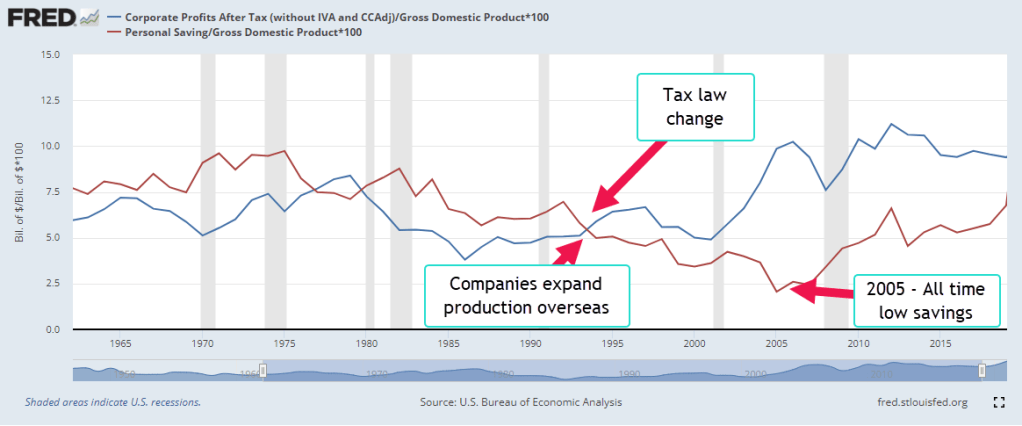
Let’s look at two series over the past sixty years – personal savings and corporate profits. If we think of a household as a small enterprise, personal savings is the residual left over from the household’s labor. Likewise, corporate profits are the residual left over from current production. In 1994, the two series diverged. Corporate profits (the blue line in the graph below) kept rising while personal savings plateaued for a decade. Each series is a percent of GDP to demonstrate the trend more easily.

Executive Compensation

In the mid-1990s, corporations began to issue a lot more stock options to their executives. Some think that a change in the tax code might have precipitated this shift in compensation.  In 1994, Section 162m of the IRS code limited the corporate deductibility of executive pay to $1 million (McLoughlin & Aizen, 2018). By awarding non-qualified stock options to their executives, companies could preserve the corporate tax deduction. However, the slight tax advantage did not account for the rapid increase in options awards. Hall and Liebman found that the median executive received no stock option package in 1985. By 1994, most did. The tax change was secondary – a distraction. Institutional investors wanted more growth and more profits and companies were willing to reward executives with compensation packages similar to sports stars (Hall & Liebman, 2000, 5). Some of these superstars included Jack Welch of General Electric,  Bill Gates of Microsoft, Michael Armstrong of AT&T.

Income Taxes – Less Savings

In 1993, Congress passed the Deficit Reduction Act that raised the top tax rate from 31% to almost 40%. Personal income tax receipts almost doubled from $545 billion in 1994 to almost $1 trillion in 2001. The booming stock market in the late 1990s produced big capital gains and taxes on those gains. For the first time in decades the federal government had a budget surplus. However, more taxes equals less personal savings so this contributed to the flatlining of personal savings during that period.

Household Debt Supports More Spending

During the 2000s, personal savings remained flat. On an inflation adjusted basis, they were falling. Too many people were tapping the rising equity in their home to pay expenses and economists warned that household debt to income ratios were too high. Savings as a percent of GDP fell to a post-WW2 low. As home prices faltered and job losses mounted in late 2007, people began to save more but their debt left them with little protection against the economic downturn. During 2008, personal savings began to increase for the first time in fifteen years. More savings meant less spending, furthering the economic malaise that began in late 2007.

Multi-National Corporate Profits

During those 15 years corporate profits rose steadily as companies increased their global presence. Beginning in 1994 U.S. companies began shifting production to Mexico where labor was cheaper. In 2001, China was admitted to the World Trade Organization (WTO) and production outsourcing continued to Asia. Despite the profit gains, companies kept their income taxes in check. In 2021, corporate income taxes were at about the same level as in 2004. That contributed to the rising budget deficit during the first two decades of this century.

Federal Deficit

The prolonged downturn in 2001-2003 and the financial crisis and recession of 2007-2009 put a lot of people out of work. This triggered what are called “automatic stabilizers,” unemployment insurance and social benefits like Medicaid, housing and food assistance. The federal government went into debt to pay for the Iraq War, pay benefits to people and help fill the budget gaps in state and local budgets. The tax cuts of 2003 enacted under a Republican trifecta* of government control reduced tax revenues, further increasing the deficit. During George Bush’s two terms, the debt almost doubled from $5.7 trillion to $11.1 trillion.

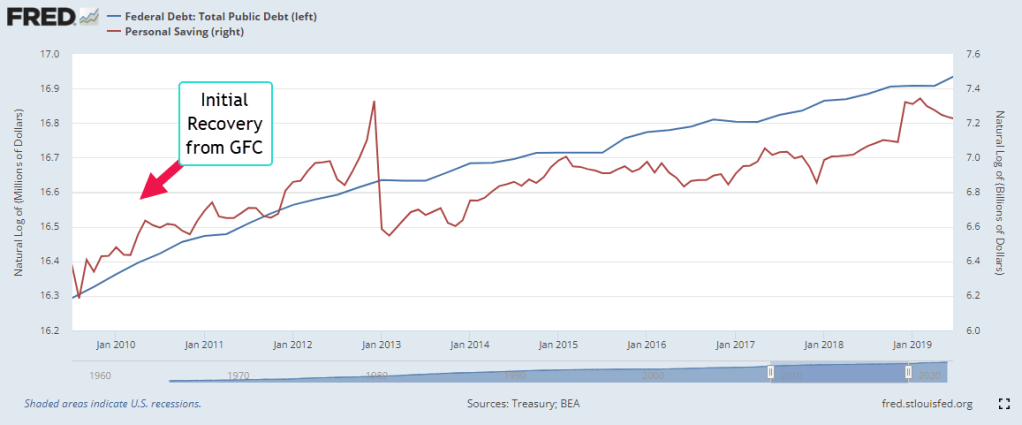
In coping with the recovery from the financial crisis, the government added another $8.7 trillion to the debt. That negative saving by the government helped add to the personal savings of households but too much was spent on just getting by. Following the Great Financial Crisis (GFC), the trend of the government’s rising debt (blue line below) matched the trend in personal savings (red). Sluggish growth and lower tax revenues caused the two to diverge. While the debt grew, personal savings lagged.  

Before and During the Pandemic

Following the 2017 tax cuts enacted under another Republican trifecta, personal saving rose, then spiked when the economy shut down during the pandemic and the federal government sent stimulus checks under the 2020 Cares Act. In the chart below, notice the spike in debt and savings. By the last quarter of 2020, personal savings had risen by $600 billion from their pre-pandemic level of $1.8 trillion. In late December, President Trump signed the $900 billion Consolidated Appropriations Act (Alpert, 2022) but that stimulus did not show up in personal savings until the first quarter of 2021. In March 2021 President Biden signed the $1.7 trillion American Rescue Plan. Personal savings rose $1.6 trillion in that first quarter, the result of both programs.

After the Pandemic

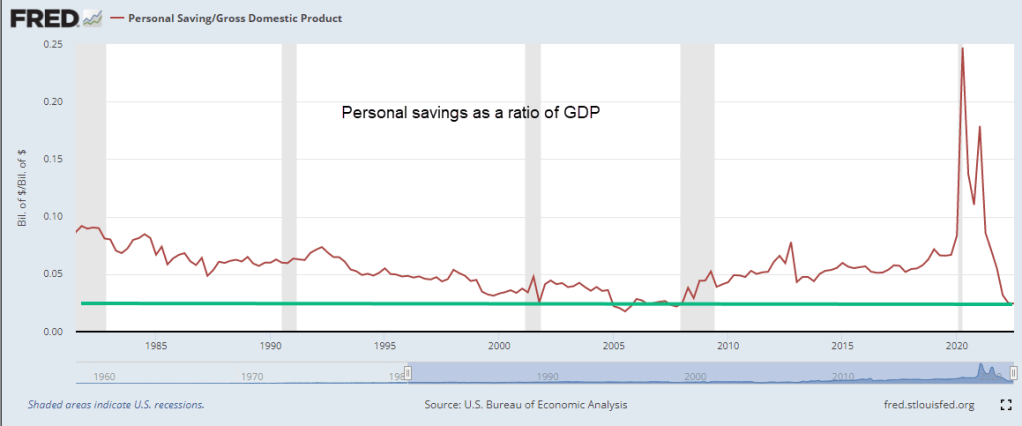
Some economists have said that the American Rescue Plan was too much. In hindsight, it may have been but we don’t make decisions in hindsight. As more schools and businesses opened up, households spent far more than any extra stimulus. They spent $1.2 trillion of savings they had accumulated before the pandemic and savings are now at the same level as the last quarter of 2008 when the financial crisis struck. Thirteen years of cautious savings behavior has vanished in a few years. On an inflation-adjusted basis, personal savings is at a crisis, almost as low as it was in 2005. In the chart below is personal savings as a ratio of GDP.

The Future

In the past year savings (red line) and corporate profits (blue line) have resumed the divergence that began almost three decades ago. Profits were 12% of GDP in the 2nd quarter of 2022. Savings is near that all time low of 2005. Rising profits benefit those of us who own stocks in our mutual funds and retirement plans. However, the divergence between the profit share and the savings share is a sign that the gap between the haves and the have-nots will grow larger.

////////////////////

Photo by Jens Lelie on Unsplash

  • A trifecta is when one party controls the Presidency and both chambers of Congress.

Alpert, G. (2022, September 15). U.S. covid-19 stimulus and relief. Investopedia. Retrieved November 19, 2022, from https://www.investopedia.com/government-stimulus-efforts-to-fight-the-covid-19-crisis-4799723. See Stimulus and Relief Package 4 for the December 2020 CAA stimulus. See Stimulus and Relief Package 5 for the American Rescue Plan in March 2021.

Hall, B. J., & Liebman, J. B. (2000, January). The Taxation of Executive Compensation – NBER. National Bureau of Economic Research. Retrieved November 19, 2022, from https://www.nber.org/system/files/chapters/c10845/c10845.pdf. Interested readers can see Moylan (2008) below for a short primer on the recording of options in the national accounts. Until 2005, these options were recorded as compensation for tax purposes but not recorded on financial statements so they did not initially affect stated company profits.

McLoughlin, J., & Aizen, R. (2018, September 26). IRS guidance on Section 162(M) tax reform. The Harvard Law School Forum on Corporate Governance. Retrieved November 18, 2022, from https://corpgov.law.harvard.edu/2018/09/26/irs-guidance-on-section-162m-tax-reform/

Moylan, C. E. (2008, February). Employee stock options and the National Economic Accounts. BEA Briefing. Retrieved November 19, 2022, from https://apps.bea.gov/scb/pdf/2008/02%20February/0208_stockoption.pdf

Tower of Babel

October 23, 2022

by Stephen Stofka

This week’s letter is about taxes and income. Each month, the Federal Reserve (2022) releases an estimate detailing how people spend their money and the sources of their income. I was surprised that 17% of personal income is from government transfers like Social Security and other programs. This is 2% more than the income people receive on their assets. A bit of history for context.

In the 1960s, 2/3 of income was from wages and salaries. Each decade, the wages and salaries component declined 5% until this past decade when wages and salaries were just 50 cents out of every dollar of income.

A greater portion of employee compensation shifted from discretionary income to dedicated non-taxable benefits like health care insurance and pensions. In the early 1960s employer benefits were 10% of wages and salaries. Now they are 21%. Despite the rise in the non-taxable share of compensation, workers give up more out of their paychecks to taxes.

A growing share of income goes to FICA taxes

In 1960, workers paid 6% of their paychecks to FICA taxes. The Medicare program, about 20% of our FICA taxes today, would not be enacted until 1965 when President Johnson ushered in his Great Society programs. Within five years analysts realized that lawmakers had wildly underestimated the costs of the program. By 1980, increases in Social Security and Medicare taxes increased the FICA portion to 12% of paychecks. Today, workers pay 15% of their paychecks in FICA taxes (see note).

In 1960, all other taxes were 11% of total income in 1960, had climbed to almost 13% in 1980 then to over 14% by the year 2000 and are now 15% of total income. In the past twenty years, the rich have paid a growing share of income taxes but their effective tax rate has changed little. Why? When lawmakers put a heavier burden on rich people, they lobby for legal income exclusions and Congress obliges.

Top 10% pay a growing share of income tax

In 2001, the top 1% paid 33% of income taxes. In 2019, they paid 39% (IRS, 2022). In 2001, the top 10% (the Tennies, I’ll call them) paid 64% of personal income taxes. In 2019, they paid 71%. Whether it is the super-rich or the rich, their share of income tax has grown by 6 -7%. That’s not the end of the story.

Growth in incomes of the top 10% is far higher

The Tennies have seen their share of gross income increase from 42.5% in 2001 to 47.3% in 2019, a gain of almost 5 percentage points. They have paid a rising share of the nation’s income taxes but the rise in taxes is less than the rise in personal income (BEA, 2022). In the 2001-2003 period the income tax paid by the Tennies averaged 5.6% of national personal income. In the 2017-2019 period, that tax share was 6.3%, a difference of just .7%. It is a cheap price to pay for a 5% gain in the nation’s total income.

Effective Tax Rate of the top 10% is steady despite rise in Income

In the 2001-3 period the Tennies averaged an effective tax rate of 13.5%. In the 2017-19 period, that effective rate had declined to 13.2% despite a 2% rise in the top marginal tax rate from 35% in 2001 to 37% in 2019. Raising the marginal tax rate on the highest income brackets has little net effect yet it was a campaign issue for Mr. Biden and many Democrats. Political scientists call it position-taking.

The party of no taxes produces higher deficits

Despite their rhetoric about reducing the deficit, Republicans have adopted a no new taxes on anyone pledge that ensures the deficit will get worse. True to form, the budget deficit has grown more under Republican administrations over the past four decades. The party also has a record of slower economic growth but that is mostly due to the two terms of the George Bush administration. Mr. Bush’s failures caused many Republicans to abandon more mainstream Republican values and adopt a mean spirited attitude of radical defiance exemplified by the Tea Party and the Republican Study Committee.

Action requires Compromise

The “Just Say No” Republican factions permit little compromise so the party cannot get significant legislation passed. In the first year of Mr. Trump’s Presidency, Republicans held all three legislative bodies but were stymied by their internal squabbles. In November of 2017, they hastily assembled the corporate tax reform package, TCJA, to show their constituents that they were capable of legislating and to give Mr. Trump some accomplishment that he could tweet  about.

A look ahead

If Republicans take control of the House after the upcoming elections, we can expect more of the same dysfunction under Speaker Kevin McCarthy. Libertarians in the Republican Party want a limited role for the federal government as specified in Article 1, Section 8 of the Constitution. They have little tolerance for national abortion laws and other bullying social legislation that Republicans have promised. The uncompromising factions within the Republican Party ensure that the party cannot govern. They are like drivers in a car with a manual transmission who don’t know how to clutch and shift. Democratic lawmakers, on the other hand, drive down the road, focused on staying perfectly centered between the white lane markers of equality and equity. The rich benefit when party leaders cannot assemble a cohesive coalition of interest groups and voters. The economic interests of the top 10% are protected when voters remain fragmented. Party elites and partisan interest groups speak in languages that are understandable only to a narrow constituency. By promoting dissension, social media has helped create a Tower of Babel.

/////////////////////

Photo by Osman Rana on Unsplash

BEA: U.S. Bureau of Economic Analysis, Personal Income [PI], retrieved from FRED, Federal Reserve Bank of St. Louis; https://fred.stlouisfed.org/series/PI, October 19, 2022.

Federal Reserve. (2022). Personal income and its disposition. FRED. Retrieved October 19, 2022, from https://fred.stlouisfed.org/release/tables?rid=54&eid=155443&od=#. The FICA tax percentage includes the employer and employee portion of the tax. The employee effectively bears the burden of the entire tax.

IRS. (2022). SOI tax stats – individual income tax rates and tax shares. Internal Revenue Service. Retrieved October 19, 2022, from https://www.irs.gov/statistics/soi-tax-stats-individual-income-tax-rates-and-tax-shares#Early%20Release. Table 4.2, Selected Descending Cumulative Percentiles of Returns Based on Income Size Using the Definition of AGI for Each Year.

Our Fair Share

January 19, 2020

by Steve Stofka

The holidays are over. This week our city picked up Christmas trees set by the curb. The sun set after 5 PM, the first time since the time change in the first week of November. The sun is returning to the Northern Hemisphere. Despite the variations in the amount of sunshine throughout the year, we all get the same amount of sunshine over the course of a year. Not so with our tax bills.

Estimated taxes were due this week. The self-employed, retired people and others who earn income with no taxes withheld must pay estimated taxes every quarter. This past year the IRS audited less than ½% of returns, a lifetime low. That sounds great because none of us wants to endure an audit. The very word strikes fear in the hearts of many taxpayers, but most of us have a small chance of being audited regardless. We don’t pay enough in taxes for the IRS to do much more than a paper audit, a request for supporting documentation.

The IRS is not a popular agency and became less popular when the agency discriminated against Tea Party and progressive groups during the 2010 election (Farhi, 2017). House Republicans repeatedly cut the agency’s budget, but that retribution has had serious budget consequences. The National Bureau of Economic Research estimated that the government could raise an additional $1 trillion in tax revenue – that’s about 20% of total revenue – with stricter enforcement of existing law (Heeb, 2019). In 2019, the Federal deficit, or budget shortfall, was $1.1 trillion (BPC, 2020). Stricter enforcement would have effectively erased that deficit.

The race for the Democratic Party’s nomination for President promises to center around several themes. The first is the horse race against President Trump, whose incumbency gives him a distinct advantage when running for re-election. The press often seems more concerned with the contest than the underlying issues of a campaign. Taxation is a recurring discussion in each election. More or less? What is a fair share? More, more, more social programs, taxation and regulation, or less, less, less social programs and taxation and more defense spending and power for large corporations?

What is fair? As children we have a keen sense of fairness – our “monkey brain.” We are social creatures who feel scorned at what we perceive as unequal treatment. Equal and fair are not the same thing. A fair share is not the same as an equal share. If I can afford to buy $50,000 worth of goods in a year, why should I have to pay more sales tax than someone who only buys $30,000? We make equal use of a city’s public services. Why should we be treated unequally? Well, we have become accustomed to paying an equal percentage of what we buy in the stores as a sales tax.

Why don’t we follow that same approach for income taxes? States like Colorado do charge the same rate of state income tax regardless of income. Is that fair? Some cities like Denver charge a head tax, a flat fee income tax for anyone who works within the district. Should we follow the same approach throughout the nation? Warren Buffett and I would pay the same amount in income taxes. Is that fair?

Should prices for public utilities be adjusted based on income? If my neighbor makes twice what I do, should they pay twice for the same amount of water? Currently, we are charged the same rate. The income and property taxes of those over 65 are often given a discount. In some districts, a person who reaches 65 finds that they can lower their property tax by 50%. Is that fair?

Elizabeth Warren, a candidate for the Democratic Party’s presidential nomination, proposed that all student debt be eliminated. Should students who went to more expensive private schools be rewarded more than students who borrowed less because they went to a state college? Should students who borrowed less because they worked part time while going to school be penalized? Is that fair?

In Matthew 20:1–16, Jesus tells a parable of the workers in the vineyard. Workers who came to work in the morning agreed to an amount of money for a day’s work. Workers who came to work later in the day were also promised the same amount of money for working the rest of the day. Jesus was making a point that each person will be rewarded equally in the kingdom of heaven no matter when in their lifetime they come to God’s love. No matter what your religious orientation, is that fair?

Each election we get to vote on what’s fair. Some people don’t vote because they say that their opinion doesn’t matter. It certainly doesn’t if they don’t vote so they have proved their case. If I vote and my neighbor doesn’t, my vote effectively counts double. In a few weeks, the Democratic primaries will start. The first two are in Iowa and New Hampshire, states with small populations and an even smaller number of people who participate in the caucus system. The votes of a few thousand people can make or break a candidate’s campaign. In a democratic nation of 320 million people, is that fair?

///////////////////////

Notes:

Bipartisan Policy Center (BPC). (2020, January 9). Deficit Tracker. [Web page]. Retrieved from https://bipartisanpolicy.org/report/deficit-tracker/

Farhi, P. (2017, October 5). Four years later, the IRS tea party scandal looks very different. It may not even be a scandal. Washington Post. [Web page]. https://www.washingtonpost.com/lifestyle/style/four-years-later-the-irs-tea-party-scandal-looks-very-different-it-may-not-even-be-a-scandal/2017/10/05/4e90c7ec-a9f7-11e7-850e-2bdd1236be5d_story.html

Heeb, G. (2019, November 19). The US could raise $1 trillion more in taxes through stricter IRS enforcement, according to a new study. Markets Insider. [Web page]. Retrieved from https://markets.businessinsider.com/news/stocks/us-could-raise-1-trillion-more-tighter-irs-enforcement-study-2019-11-1028700145

Photo by Maria Molinero on Unsplash

Pay Up

February 10, 2019

by Steve Stofka

When I was growing up in New York City, each kid’s name was shortened to one syllable, two at the most. New York is a busy town; people didn’t have time to pronounce long names. Guillermo became Will or Bill.  An exotic name like Anastasia was shortened to a rather pedestrian Ann. Melodic names like Florinda became Flo. In a sign of the changing times, N.Y. Representative Alexandria Ocasio-Cortez has became known as AOC. That’s a generous three syllables!

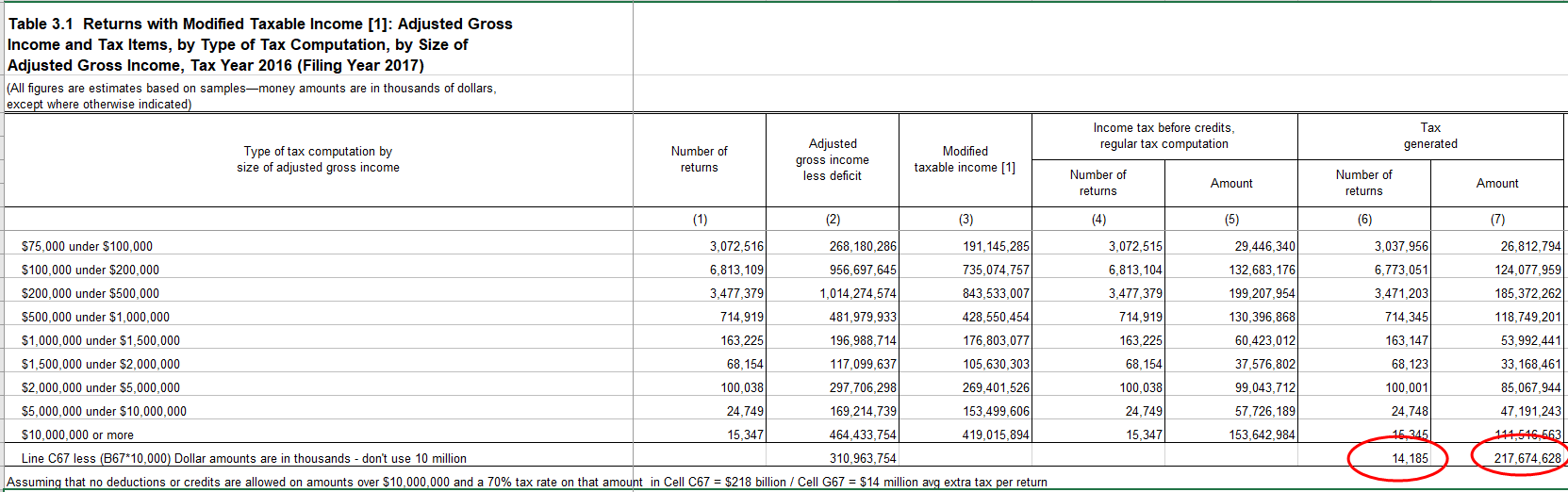
She has proposed a 70% Federal income tax on Adjusted Gross Income over $10 million. That’s a straight 70% haircut on only the income above that threshold. Deductions, credits and favorable tax treatment for capital gains could apply to income below $10 million but everything above that is a bada-bing-bada-boom 70%.

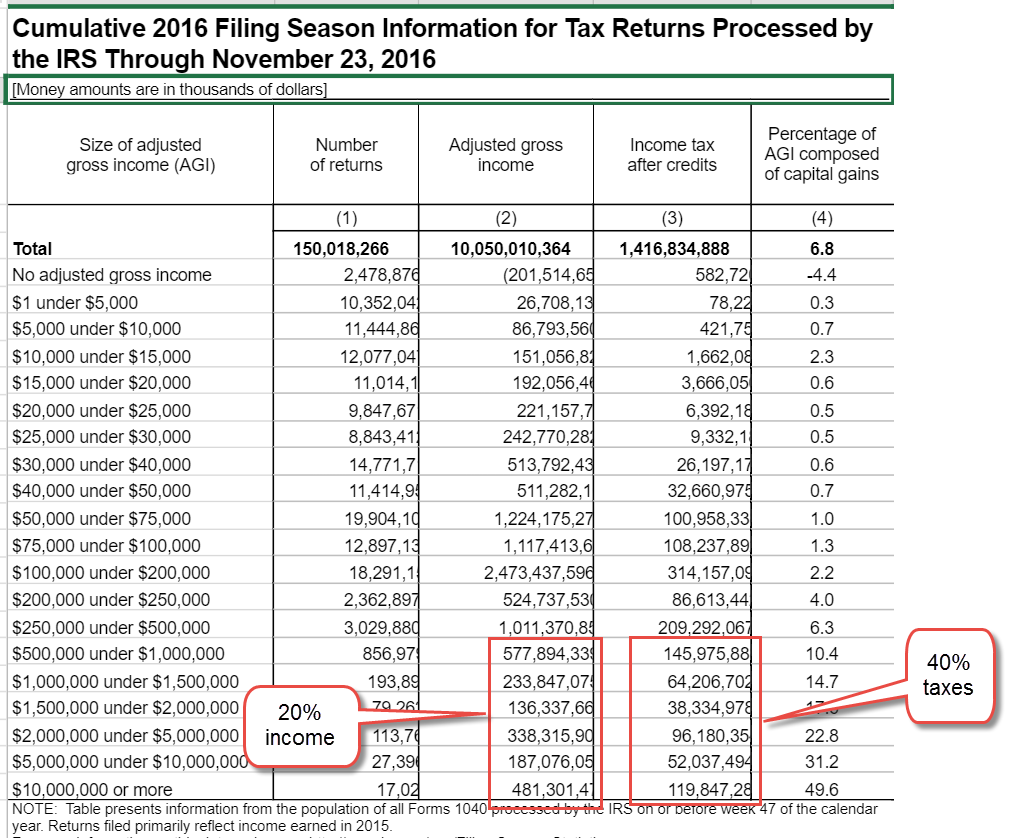
How much revenue would that generate? I used IRS sample data from 2016, the latest available (Note #1) and calculated an extra $218 billion collected on 15,000 returns for tax year 2016 (Note #2). This would have been an additional 14% over the $1550 billion collected in individual income taxes that year (Note #3). It would make up for the corporate taxes that are not being collected because of the 2017 Tax Act.

If AOC’s proposal were passed by the House, it would not make it out of the Senate Finance Committee, which is controlled by Republicans. If it did become law, it would incentivize the accountants and lawyers of the super-rich to craft clever solutions to avoid the tax. Most of them can buy citizenship in another country. They can put income in tax havens (Note #4). They can make hefty political campaign contributions to buy loyalty in Congress.

The rich complain about taxes. Yes, they do pay much of the income taxes collected. It should be all of the income taxes. The 16th Amendment was “sold” to the American people as a tax that would apply only to the rich, the top 1% of incomes. When the amendment was passed in 1913, half of the population worked in farming and thought that the tax would never impact their lives. It didn’t until a few months after the U.S. entered World War 2.

Under FDR, the tax base increased ten-fold and now affected 42% of the population. FDR called it the “greatest tax bill” (Note #5). The American people didn’t think so. Many were not paying their income taxes. As the fate of nations lay bloody on the altar of history, FDR regarded tax delinquency as a personal disloyalty. He turned to economist John Kenneth Galbraith who suggested that employers should be forced to become the tax collector for the government. In 1943, Congress passed legislation requiring that employers withdraw taxes from their employees’ paychecks. Employing more than 7% of the workforce, the Federal government was the largest employer (Note #6). Before employees could feed their families or pay their rent, the government had its taxes.

It’s time for Democrats and Progressives to undo what they did under FDR. World War 2 ended 75 years ago. Let’s return to the original intent of the 16th Amendment and impose most of the income tax burden on the rich.

/////////////////////////

Notes:
1. 2016 IRS tax data by adjusted gross income
2. A screenshot below of the IRS spreadsheet with my calculations of revenue collected.
3. A breakdown of 2016 federal revenue
4. The Rolling Stones, Bono, and Mark Knopfler of Dire Straits took advantage of tax havens to avoid paying hefty U.K. taxes on royalties
5. Highlights of IRS history
6. Federal Employees CES9091000001 series / PAYEMS (All employees) series in the FRED database

IncTaxbyAGI2016.xls

Tax Reform Is Calling

by Steve Stofka

December 17, 2016

On our journey on the sea of life, we sometimes hear the siren call of politicians who promise simple taxes. “File your taxes on a postcard” their voices echo across the waters as they invite us to their island. Our journey is long and treacherous, so we are drawn to the prospect of simple tax filing.

Some taxpayer boats weave through the sharp rocks that lay just off the sandy shores of the simple tax island. They are greeted by the politicians who give them postcards to celebrate their arrival. Many boats are caught in the turbulent waters and are swallowed up by the tax monsters lurking in the sea.  “Alas!” they wail as they curse themselves for their attraction to the politicians’ call.

So the story goes with the tax bill that Republicans hope to pass next week. I didn’t think that the bill would get this far.

Many paycheck employees will find the new tax rule simpler. Student loan interest will continue to be an “above the line” deduction from income. The child tax credit will be doubled to $2000. To satisfy Republican Sen. Marco Rubio’s demands, more of this credit will be refundable to those taxpayers who pay little or no income tax.

Those in high tax states will suffer under the new tax bill, which allows only $10,000 in combined deductions for state, local and property taxes (SALT). Deductible mortgage interest will be capped as well. Tax policy has long subsidized homeowners over renters and favored those in coastal states (NY Times article).

Many taxpayers will find it more advantageous to take the newly doubled standard deduction of $24,000.  Under the new law, 529-college funds can now be used for K-12 tuition and qualified expenses.

Caught in the rocks and turbulent waters are professionals and business owners, who have adopted “pass-through” ownership structures to legally minimize taxes under current law. This group accounts for 30% of all business income. As this Journal of Accountancy article notes, court rulings and IRS guidance can be complex and contradictory. The new tax bill only complicates the familiarity of the existing complexity.

These non-paycheck earners receive all or part of their business income through a Sub-S corporation, an LLC, or partnership. Unlike a conventional C-corporation, these businesses “pass through” their profits to the owner/partners who pay at a personal tax rate. Under the new tax bill, some of that income may be subject to a 20% exclusion from taxes.

Under the new tax bill, the tax rate for C-corps will be reduced to 21%. Depending on individual circumstances, some owner groups may find it advantageous to adopt a C-corp ownership structure.

25 million sole proprietors  account for 11% of non-farm business income. Many are low-profit or part-time businesses which will remain sole proprietors. Higher volume businesses may want to revisit their ownership strategies with their accountants.

Corporations will benefit from the reduced tax rate but the accountants for publicly held corporations are dreading the prospect that the new tax law will be signed before the new year. Under GAAP accounting rules, those corporations must estimate the effect of the tax changes and present those estimates at the next earnings announcement which are scheduled for late January or February. Number crunchers can cancel that Cabo vacation during Christmas week.

The rich benefit because they pay an outsize portion of income taxes. According to the IRS (2016 tax stats on this page) , taxpayers with adjusted gross incomes (AGI) above $500K were only .8% of the 150 million individual returns. Their AGI was 19.4% of the $10 trillion in income reported, but they paid 36.5% of the $1.4 trillion in Federal income taxes.

TaxSumByAGI2016

These high incomes will get a reduction in taxes from 39.6% to 37%. The very rich – those with an AGI above $10 million – get half of their income from capital gains, which are not affected by the new tax law. Despite promising to do so, lawmakers did not reduce or repeal the 3.8% Obamacare tax on investment income for high income taxpayers. Based on 2016 tax data, they probably could not forgo the tax revenue and keep the ten-year cost of the bill under $1.5 trillion.

In short, the new bill will create two classes of taxpayers – the postcard and non-postcard payers. Some tax preparers and accountants may worry that the new law will reduce their business. Rest assured – Congress does not know how to write tax laws that are not complex. Thank God for politics!

Rocky Tax Road

November 19, 2017

The House passed a tax cut bill this week as the Senate Finance Committee passed a separate version that must still go to the full Senate for a vote. There’s a hard road ahead for this bill to reach the President’s desk.

The Process…

The full Senate will take up the bill after Thanksgiving. If the Senate passes the bill, there are still more steps. Bills submitted by Congress must have identical language from both the House and Senate.

The House passed its tax bill first, so the Senate could adopt the House version and approve it. Highly unlikely. If the Senate passes a bill, both bills will likely go to a House-Senate conference committee to resolve differences in the two bills and produce a unified bill. The Republicans will hold a majority on that committee and do not need Democratic votes.

If the committee can produce a unified bill, it will be sent to the House and Senate for a vote. If either body rejects the bill, it can be sent back to the joint committee, but that rarely happens. The bill would be effectively dead.

Republican leaders regard passage of the bill as critical to the 2018 Senate races. After the Republican majority failed to pass a health care bill earlier this year, big dollar donors have advised party leaders that they are closing their wallets if the party cannot pass a tax bill. Fundraising for the 2018 campaigns kicks off in a month.

The Provisions…for business

Both bills cut the corporate income tax to 20%. Both bills will tax pass-through and passive income at 25% or 32%.

Pass-through income consists of profits earned by businesses that flow to the business owner as personal income. Half of all pass-through income goes to the top 1% of incomes.

Passive income can be the profits from rental property, or dividends paid by an REIT (Real Estate Investment Trust). Under current law, such income is taxed at personal rates as high as 40%.

Republican Senator Ron Johnson opposes the bill as it came out of the Finance Committee. The bill gives an estimated $1.3 trillion in tax cuts to corporations, more than three times the $362 billion in tax cuts to taxpayers with pass-through income. Each sector currently pays half of the taxes on business profits. Small businesses and farmers get 25 cents of the tax cut dollar, while big corporations get 75 cents.

With only a two-person majority, Senate Republicans cannot afford to lose more than two votes and pass this bill. Susan Collins from Maine, a state dominated by small businesses, has echoed Johnson’s objections. Rand Paul from Kentucky says he will not vote for a bill that increases the deficit, which this bill does. Unless there are some key changes made to the Senate bill during the Thanksgiving break, the bill is unlikely to pass.

Both bills keep the 1031 exchange clause which allows real estate owners to avoid capital gains taxes on the sale of a property when they reinvest the gains in a similar class property. Owners of equities do not enjoy this tax subsidy. An investor who sells a stock, mutual fund, or ETF must pay any capital gains even if the investor buys another equity with the gains.

The Provision…for individuals

The House bill promises to save a median income family $1182 in taxes. Not about $1200. $1182. The precision of that number indicates that it is more a selling tool than a reality. The Senate version will likely tout something similar.

Half of taxpayers will notice little change in either bill because they pay almost no income taxes. Both bills retain the Earned Income Tax Credit (EITC). Lower income taxpayers will see no relief from the bite of FICA taxes.

The standard deduction is doubled but personal exemptions are eliminated and the child tax credit is increased by $600 per child but only for five years. Have you got that? Paul Ryan, the House Majority Leader, assured us that the tax bill would be simpler. Sound simple to you?

The Senate bill includes a repeal of Obamacare penalties for not having health insurance. Oddly enough, this saves the government $332 billion over ten years. Wait, how does that happen? The Congressional Budget Office (CBO) estimates that many younger people who would be eligible for subsidies under Obamacare will simply forgo insurance if the penalty is eliminated. Republican leaders get two birds with one tax stone. Senators can register their disapproval of the most hated part of Obamacare and the savings enable the Senate bill to meet the deficit requirements under reconciliation rules.  These rules allow the Senate to pass legislation with a simple majority.

As I noted two weeks ago, both bills eliminate or reduce the current deduction for state and local taxes (SALT). High tax states like California, New York, New Jersey, Connecticut and Massachusetts have no Republican Senators. If Republican leaders lose the votes of Johnson, Collins and Paul, they would have to reinstate a full SALT deduction to have any hope of gaining one or two Democratic votes.

The Senate eliminates the SALT deduction entirely and uses the tax money to continue the deductions for medical expenses, student loans, mortgage interest and charitable donations. The House bill eliminated these deductions but allowed some SALT deduction in order to appease Republican House members from high tax states.

The House bill simplifies the tax brackets from the current seven to four. The Senate version has seven brackets.

The Conclusion…

Imagine a rough dirt road after a lot of rain. The tax bill has just turned off the paved highway and onto the dirt road. Expect a lot of muttered cursing, pushing and digging to move a tax bill to its final destination, the desk of President Trump.


A Proposal

May 28, 2017

The Republican led Congress has promised tax reform in the coming year.  This week I’ll introduce an income tax program that I think will clarify the debate.

Let me begin with those on the left side of the political aisle who talk about the rich paying their fair share.  The kernel of the Democratic social plan is a promise to take care of the poor by giving them benefits. Even if I don’t get any of those benefits, I like voting for politicians who help out the poor because I’m a good person.

If I ask House Minority Leader Nancy Pelosi or Senate Minority Leader Chuck Schumer “Where should the money come from?” they answer “People with too much money.” Nancy and Chuck know which people have enough money and which ones have too much.

BBLR has long been a rallying cry for those on the right. The acronym means “broaden the base, lower the rate.” As Majority Leader in the House and as Vice-Presidential candidate, Paul Ryan has espoused this philosophy. Here is a PolitiFact article on the issue during the 2012 presidential race. Tax reform champion Grover Norquist has advocated for the same principle.

The term “broaden the base” means to have more people paying at least some income tax so that they have skin in the game, so to speak. In a very progressive tax system, people who pay little or no taxes will vote for politicians who promise them benefits. After all, it is OPM, or other people’s money. In Democratic circles, BBLR stands for a mean tax system. Here’s the debate between Nancy and Chuck on the political left, and Paul and Grover on the right:

Paul and Grover: A minority of people are being forced to pay for federal programs that benefit other people who pay almost nothing into the system.  Those people will vote for more programs because it costs them nothing.

Nancy and Chuck: Republicans are bad people because they want to tax poor people. Poor people already pay Social Security and Medicare taxes so they are paying into the system.

Paul and Grover: Medicare and Social Security taxes are essentially forced saving programs that will return that money to the taxpayer in the future. Payroll taxes do not support the other functions and expenses of government like defense and the justice system.

Nancy and Chuck: Those taxes all go into the same pot.

Paul and Grover: Democrats have always been careful to separate Social Security and Medicare programs in their rhetoric. You champion the preservation of these programs as though they are separate. You can’t have it both ways. Either they are separate or they are not.

Nancy and Chuck: You Republicans are really mean and you are pawns of rich people.

These debates usually end in name calling, particularly during election season.  Some of the rhetoric is political branding but each side remains convinced that their way is the best way.

Let’s turn to recent history and take the chance that facts might get in our way. The non-partisan Congressional Budget Office (CBO) routinely analyzes proposed House and Senate laws for their estimated impact on the budget. In this report the CBO separated income, government transfers and taxes paid into income quintiles. (Click here if you want to know more about a quintile).

CBOIncTaxQuintile2013

In the table above, the lowest and highest quintiles received the least amount of money in government transfer payments like Social Security. The highest quintile had ten times more before-tax income than the lowest quintile but paid 87 times more tax than the lowest quintile. Notice that the CBO analysis includes all taxes paid to the federal government, including Social Security and Medicare.

Pretend you are a reporter. Ask House Minority leader Nancy Pelosi “How much more should the rich pay than the poor, Ms. Pelosi? If 87 times is not fair, what is fair? 100 times? 200 times?” Each of us is an expert on what “fair” means.

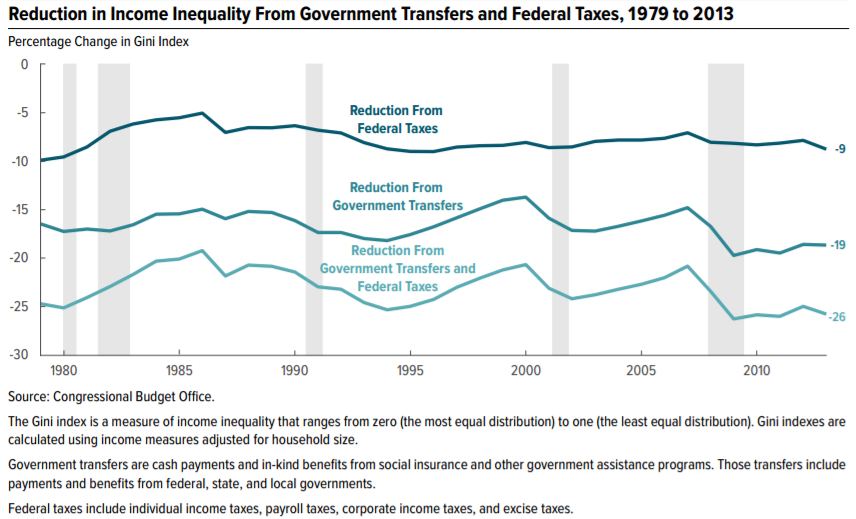
In the past 35 years, despite all the rhetoric, state and federal policies have had only a small effect on income inequality. The GINI index is a standardized measure of the inequality in a data set. The scale runs from zero, perfect equality, to one, or perfect inequality. The CBO report showed a 35 year history of the separate effects of benefit and tax policies on inequality. In 1980, tax policy reduced inequality by 10%. 35 years later, the reduction was 9%. Despite major tax reform in 1986, the tax increases of the early 1990s and the tax decreases of the early 2000s, tax policy has had little to no effect on inequality.

CBOGiniIndexChange

Changes in social policy that directs government transfer payments have helped ease inequality in the past 35 years, but the CBO analysis finds the combined change from tax and benefit policies negligible. They reduced inequality by 25% in 1979. 35 years later the total reduction was 26%. The difference could be a measuring error.

Tax reform is tough because it involves contentious issues. We argue about tax rates and the income brackets for those rates. We argue about deductions and tax credits. Like pornography, we may not be able to define “fair” but each of us knows it when we see it. We can agree on what “cat” means but not “fair.”

I propose something different, something that will give us less to argue about. Let’s recognize that there are socio-economic classes and assign a portion of federal tax revenues to each income quintile. Using the CBO’s analysis, the 1st and lowest quintile paid 8/10ths of 1% into the kitty. It is such an insignificant amount that we might has well make it zero. What this means is that poor people would pay no income tax and no payroll tax. Paul Ryan led the effort on last year’s Better Way tax proposal which included the same concept:  poor people should pay nothing.

If we can agree on that, we have four things left to argue about: the percentages that each of the remaining four quintiles would pay. Let’s begin the discussion by looking at the CBO analysis of the federal revenue “pie” in 2013.. The second lowest income quintile #2 paid 4% of total individual federal income and payroll taxes, the middle quintile paid 9%, quintile #4 paid 17-1/2%, and the top #5 quintile paid 69-1/2%. I rounded the percentages.

There will be a fight over these percentages but we will be fighting over four concrete numbers, not 100 million interpretations of what the word “fair” means as it relates to thousands of pages of tax code. Once that portioning is settled, a bipartisan committee representing each quintile can argue over the details of how they raise their portion of the anticipated revenue.

Taxpayers in the highest quintile may want tax breaks for angel investors who invest in early startup companies. Sounds like a worthy cause. The members of that quintile’s committee can argue amongst themselves as to whether they can afford to carve out tax breaks for that subgroup and still raise the required revenues. Should some of the income of hedge fund managers be taxed at a lower rate like capital gains? Under the current tax system, that is an emotional issue. Why should those guys get a special interest tax break? Under this proposal, I don’t care because I’m not in that quintile. A hot button issue turns into a yawner for most Americans.

A majority of taxpayers in the middle quintile might want the mortgage interest deduction. Those people can put political pressure on that quintile’s committee members to include that carve out. The majority in the next lower quintile might prefer tax breaks on child care. Should capital gains be taxed at a lower rate? This group has little in the way of capital gains so they might prefer that all income be taxed the same. Those in the lowest three quintiles who pay small tax percentages might be attracted to the simple grade school arithmetic used by some states to calculate their state income tax. Adjusted gross Income x 10% = $tax, as an example. Tax filing made simple.

Could this proposal make the tax code more complicated than it already is? Yes, but most of the complications won’t affect each person. Under the current system, my tax software asks me questions about tax credits and situations that have nothing to do with me or my family. Why? Because all of the tax code applies in theory to all of us. Under this proposal, my tax software would know what quintile I was in and the tax rules that applied to me and my family.

But what if people move from one quintile to another? How will they plan? Incomes do change. A person gets a raise, a better job, goes to school, loses a job or retires. A simple rule would help: a person’s quintile this tax year is based on their income the previous year.

The setting of the quintile brackets could be done by another simple rule. The IRS can not provide summaries and analysis of tax data for a particular tax year till about two years have passed. Each year we could adjust the income brackets of each quintile by the annual inflation rate based on the most recent tax year data available.  Families with fairly predictable income will know in advance what their tax expense will be in the coming year.

What about the Earned Income Tax Credit (EITC) program for poor people? This program largely offsets the payroll taxes that poor people pay with tax credits paid directly by a person’s employer. The program is fraught with abuse. Under this proposal, payroll taxes for the lowest income workers are eliminated so the offsetting tax credits aren’t needed.

Will those workers in the lowest quintile still be eligible for Social Security?  Sure.  There is still a record of their labor income, which is the basis for determining Social Security payment amounts.

Tax reform has come infrequently because the tax code tries to be all things to all people. The top 40% pay most of the individual income taxes so naturally they lobby for special interest tax breaks which are slipped quietly into the tax code.  Under this proposal, those special interests can lobby all they like, just as long as they meet their revenue targets.

Is it fair that someone making a half a million dollars gets a tax break on their vacation home on the Outer Banks in North Carolina? Of course not. Under the current system, I get angry about that. Under this proposal, I simply don’t care. If that person is getting a break, some other equally rich person is having to pay for that tax break. None of my business.

As it is now, we struggle to understand the various tax proposals. Politicians talk in non-specific terms about what is fair, or they speak in slogan tax talk like BBLR. Tax reform rhetoric has become a rallying cry to get out the vote.

This proposal will not stop the political fights. We will continue to debate the amount of  federal spending, the role of government and what tax revenues should be spent on. We will fight bitterly about the percentages of tax revenue expected from each quintile. But this proposal will direct the debate to specific percentages that most of us can understand. So let’s put on our debating gloves and get into it!