Piketty Pushes Back

June 1st, 2014

First a shout out to our friends in the southern hemisphere where the winter is beginning in earnest.  Hey, you had the sun for six months.  Now it’s our turn.  We all have to share.  I think that because there are more people in the northern hemisphere, the sun should stay up here for longer than six months.  It’s not fair.

Piketty Controversy

Talking about fair…..Last week I touched on some of the highlights in Thomas Piketty’s book, Capital in the 21st Century.  At the time of that writing, Chris Giles in the Financial Times had just reported that he found some data errors while using Piketty’s source material.  Giles’ criticisms were rather precise and included charts of the revised data which Giles claimed contradicted Piketty’s conclusions that wealth inequality had risen during the past thirty years.  This past Friday, the financial site Bloomberg reported that Piketty had rebutted criticisms of his methodology.  En garde!!! For those of you who are not interested in the minutiae of the disagreements, I will quote from Piketty’s response:

What is troubling about the FT methodological choices is that they use the estimates based upon estate tax statistics for the older decades (until the 1980s), and then they shift to the survey based estimates for the more recent period. This is problematic because we know that in every country wealth surveys tend to underestimate top wealth shares as compared to estimates based upon administrative fiscal data. Therefore such a methodological choice is bound to bias the results in the direction of declining inequality.

Piketty’s rebuttal is sound but the debate over data and methodology does underscore a problem. There were times when I have questioned Piketty’s data only to find that he addressed those concerns in either the footnotes to the book or in notes contained in his tables.   Fearing that I might put readers to sleep, I edited out of last week’s blog a concern I had with Piketty’s rate of inflation shown on page 448 when he presented a table – Table 12.2 – of historical returns by university endowments.  Piketty states a 2.4% inflation rate from 1980-2010, which struck me as too low (BLS figures are 3.3%).  In a note at the bottom of the Excel file TS12.2, he revealed that he used the GDP deflator, not the CPI, in order to keep data consistent with the GDP series.  He could have stated this simply at the bottom of the table in the book.  It’s not like the publishers were trying to save space in a 700 page book.

So, Open Letter to Professor Piketty and other Economists:  Please put your caveats and clarifications up front and center and repeat often. Last week, I gave several examples of Piketty’s clarifications which could be found in a referenced paper or on one of the spreadsheets that his team compiled.  James Joyce famously said of his book Finnegan’s Wake that he expected the reader to put as much time and effort in reading the book as Joyce did in writing the book.  Relatively few people have read Finnegan’s Wake.  Help us understand your point!!

For those of you who want more of the controversy, a reader sent me this, including  Simon Wren-Lewis’s comments on the matter at Mainly Macro, which I link to every week on the side of this blog. Economist Tyler Cowen comments echo my concerns with valuations of capital that vary widely because of asset pricing.  When an asset is difficult to price or varies widely in price, should one use the SNA international convention (System of National Accounts) and estimate a present value based on projected future flows?  The founder of Vanguard, John Bogle, recommends this common sense approach for our personal portfolios; that we should stop looking at our statements and look at the money flows that our portfolio mix will probably generate them when we need them.  That is the true worth of our portfolios, according to Bogle – not some temporary valuation based on the market prices on the last day of the month.

**************************

What is Income?

This week, as I listened to and read discussions of income in the U.S., it became apparent that there are understandable misconceptions of what is being counted when economists tally up the income of a household and the income of a nation.  Update:  Corrected. A 2011 report from the Census Bureau states that household income does include cash benefits before taxes.  EITC payments are not included because they are a reverse tax (Source).  Non-cash benefits like Medicaid, Food Stamps and housing assistance are not included.  These non-cash benefits can easily surpass $1000 per month.

Money income includes earnings, unemployment compensation, workers’ compensation, Social Security, Supplemental Security Income, public assistance, veterans’ payments, survivor benefits, pension or retirement income, interest, dividends, rents, royalties, income from estates and trusts, educational assistance, alimony, child support, cash assistance from outside the household, and other miscellaneous sources.

The national income figures that Thomas Piketty uses in his book do include government transfers.  The 2005 NIPA Guide summarizes what is included in personal income.   IVA and CCAdj are inventory and depreciation adjustments.

Personal income is the sum of compensation of em­ployees, received; 
proprietors’ income with IVA and CCAdj; 
rental income of persons with CCAdj; 
personal income receipts on assets; 
and personal current trans­fer receipts; 
less contributions for government social insurance

Measuring income to determine an aggregate level of well-being within the population is challenging and gives each side ample ammunition in the political debate.  The inclusion and exclusion of various types of benefit, cash and otherwise, leads one side to dismiss the conclusions of the other side and hinders a constructive dialog.

*************************

GDP Growth

Each month the BEA (Bureau of Economic Analysis) releases a new estimate of the previous quarter’s GDP.  This past week the BEA released the 2nd estimate of 1st Quarter GDP growth, showing an annualized 1% decline.  This was pretty much in line with consensus estimates and the market’s response was rather neutral on the day of the release.  Much of the downturn was ascribed to the particularly harsh winter weather and many economists are projecting a 4% annualized increase in this quarter, a rebound to offset the past quarter’s decline.

Peering under the hood of the GDP report:  under the category of Private Domestic Investment, residential housing dropped almost 8% (annual rate) in the fourth quarter and another 5% in the first quarter of 2014.  What is more surprising is the almost 2% drop in business investment.  Let me go back to a paper by Ed Leamer that I first wrote about in February.  Mr. Leamer’s thesis is that the sales of new homes first decreases, followed by a decrease in business investment. He found that this 1-2 punch precedes most recessions by about 3 – 4 quarters.  In two cases, it was a false positive.  Perhaps this latest 1-2 punch  is a false positive.  Perhaps it was just the winter weather.  This economy does not feel like a recession is at all imminent. Industrial activity, the labor market and auto sales are strong or expanding. More perplexing to a casual investor might be a summer lurch downward in the market if the economy does not show signs of a correcting rebound.

*********************

Fixed Capital Consumption

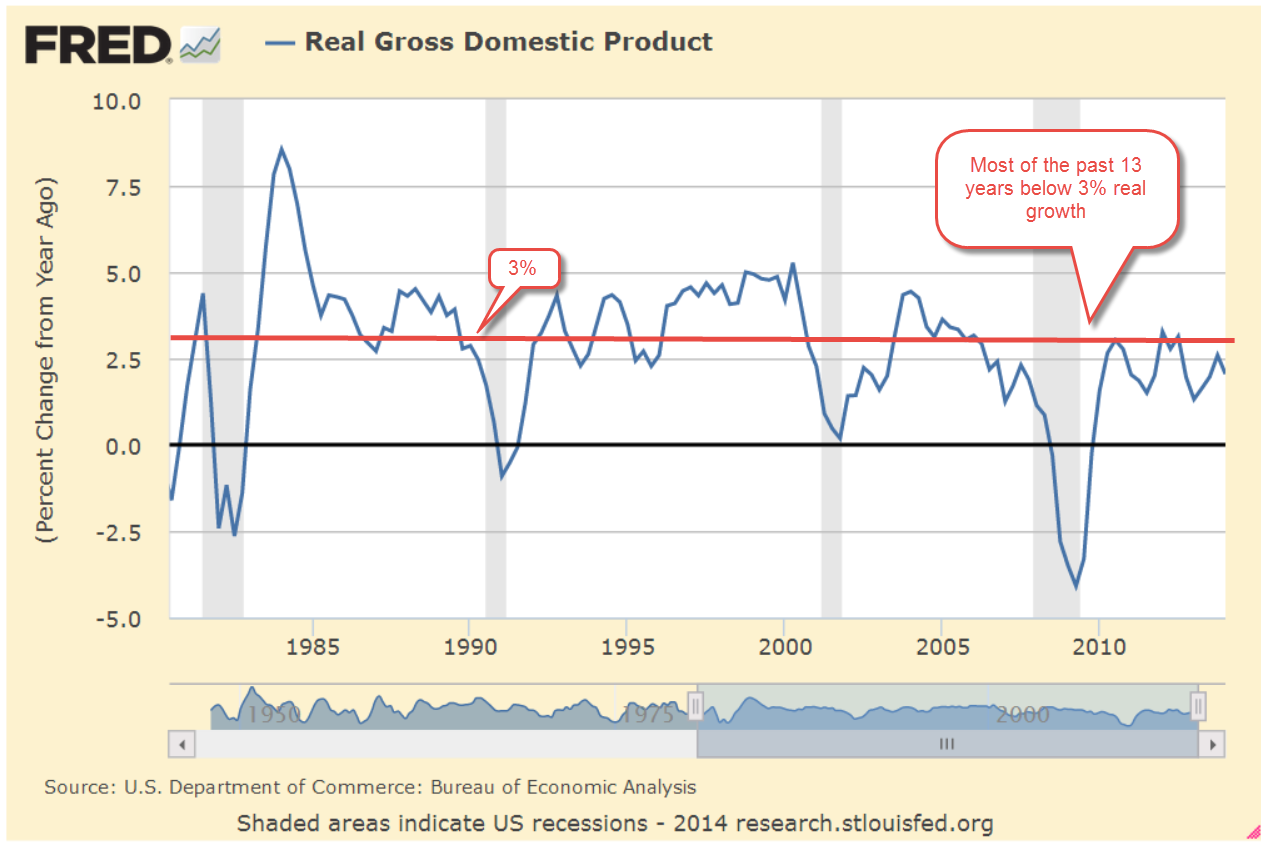
Since 2000, there has been a notable change in economic growth.  It is not often that we see growth above 3% as we did in the 20th century.
Helping that meager growth rate look – well, less meager – is an item that the BEA adds to GDP called Fixed Capital Consumption.  To the ordinary Joe, this is simply depreciation, but this is not the depreciation that your accountant might have mentioned if you own a small business or rent out part of your home. The depreciation that the BEA calculates is based on the current market price of a piece of equipment, for example, not the actual cost of the item.  As an example, let’s say that Billy and Betty Jones bought a new $20,000 truck for their business and their accountant depreciates it over a 5-year cycle.  To keep it simple, assume that the truck’s depreciation each year is 20%.  That depreciation is based on the cost of the vehicle.  Let’s do it the way the BEA does it (if only!  The IRS does not allow this!).  In year 3, the current market price of a similar vehicle is $24,000.  20% of $24,000 is $4800, higher than the $4000 depreciation based on the cost of the vehicle. In a given year, the amount of depreciation actually reported by companies might be $2 trillion.  The BEA figure will be higher and this is included in Gross Domestic Product.  As a percentage of GDP, depreciation has risen considerably since the early 2000s, driving up reported GDP growth just a smidge.  Below is a chart of the increasing percentage of GDP that is Fixed Capital Consumption.  Almost one of every six dollars of GDP is being allocated to depreciation, a third higher than 1960 rates.
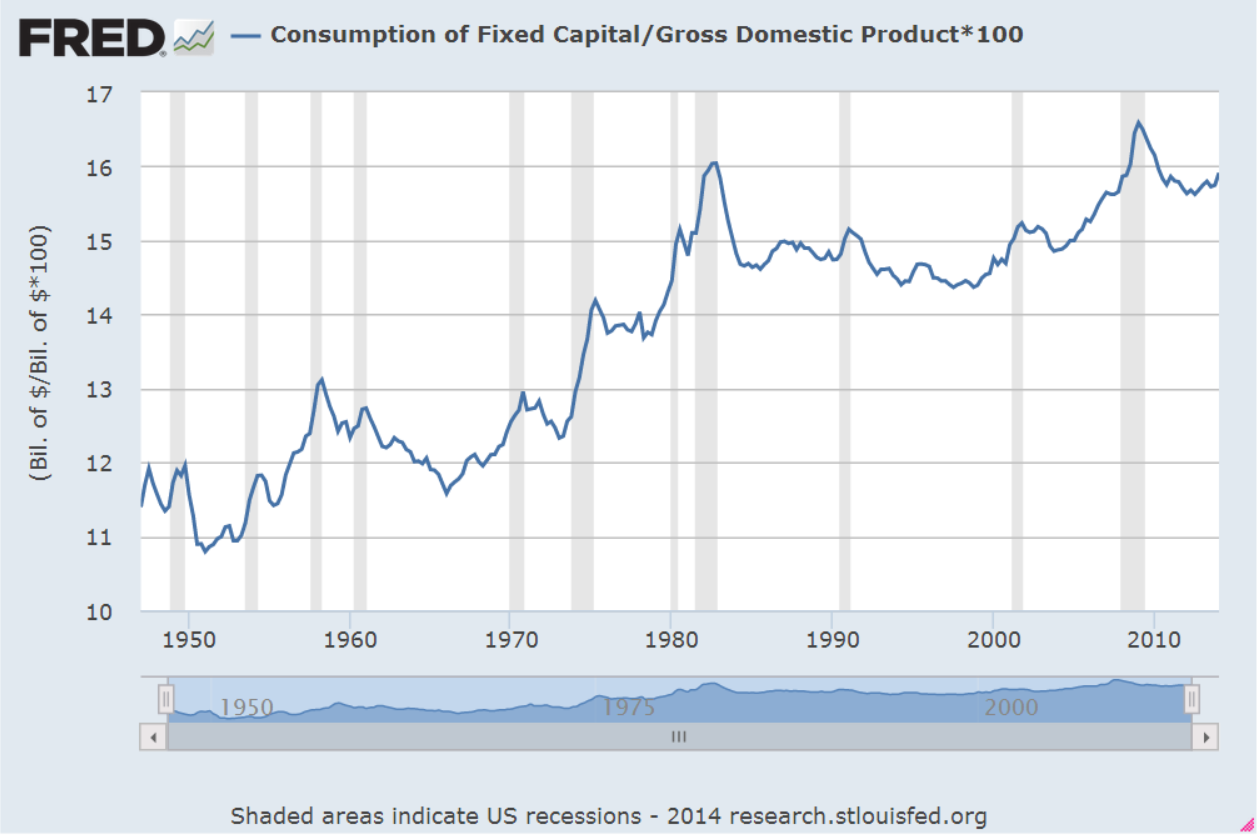
In a low inflation environment, the change in the market prices of equipment and land is muted.  Are capital expenditures becoming obsolete at a faster pace?  Over the past two decades, software and systems development has become an increasing share of non-residential investment.  Rapid changes in technology may be one driver of the acceleration in depreciation.  Wikipedia has a good article on the concept as it is reported in the national accounts.

*************************


Education

As I mentioned last week, I’ll look at a paper I read recently which had some rather startling conclusions. In a paper published in the World Economic Review earlier this year, economists James Galbraith and J. Travis Hale reviewed paycheck and IRS income data to identify state and national trends in income inequality during the past 40+ years.  It comes as no surprise that there is inequality between sectors in the economy, a fact which Galbraith and Hale acknowledge.  Their particular focus was the changes in inequality within and between sectors at the state and national levels.

There are two components to income inequality: 1) wage growth or the lack of it; and 2) employment growth or the lack of it within each sector.  If a particular sector experiences a period of high growth in earnings but jobs decline in that sector, then the gains become more concentrated and inequality between sectors grows.

What Galbraith and Hale found was that the changes in the 1990s and 2000s had one common characteristic: booming sectors of the economy vs. non-booming sectors accounted for most of the growth in income inequality.  Where each decade differed was the change in the sectors that experienced high growth.  The 1990s was marked by a growth spike in information technology, giving rise to out-sized gains to workers in the professional, scientific, and technical fields.   The 2000s was the decade of outsized growth in construction, defense and extractive technologies. Here is a troubling finding of their study: common to both periods is that the number of jobs declined in those sectors that experienced high wage growth.  Higher pay = less job growth. Also common to both decades, until the financial crisis in 2008, was the high growth in the finance and insurance industries.  Problem:  Rising  inequality.  Remedy: More education. The authors acknowledge this common response:

When public discourse admits inequality to be a problem, education is often given as the cure.  According to Treasury Secretary Henry Paulson (2006), for instance, the correct response to rising inequality is to “focus on helping people of all ages pursue first-rate education and retraining opportunities, so they can acquire the skills needed to advance in a competitive worldwide environment.”  This is a view with powerful support among economists. 

But their evidence casts this common conception into doubt:

As we’ve shown, the last two decades have seen significantly slower job growth in the high-earnings-growth sectors than in the economy at large. So even if large numbers of young people do “acquire the skills needed to advance” there is no evidence that the economy will provide them with jobs to suit.  Many will simply end up not using their skills.  Moreover, a strategy of investment in education presupposes advance knowledge of what the education should be for. Years of education in different fields are not perfect substitutes, and it does little good to train too many people for jobs that, in the short space of four or five years, may (and do) fall out of fashion. And experience shows clearly that the population does not know, in advance, what to train for. Rather, education and training have become a kind of lottery, whose winners and losers are determined, ex post, by the behavior of the economy.

Does this mean that parents and grandparents should cash in those college funds for the kids and take a long vacation with the money?  Hardly.  Bureau of Labor Statistics reveal that those with a college education have a significantly greater lifetime income than those without. The findings of this paper imply, however, that the economy and the job market change in ways which none of us can reliably predict.  The wiser course for students might be the same advice financial advisors give to investors: diversify.  If a student is majoring in philosophy, take some business, computer or science courses. Science majors could do with some literature and writing courses as well.

At the start of the 20th Century, 40% of the population was engaged in farming-related jobs.  A century later, less than 2% of jobs are in the agricultural sector.

When I was a teenager, an aunt told me that a reliable bookkeeper could always find a job. That was before the introduction of the computer and accounting programs for small businesses.

The number of librarians has declined about 10% in less than a decade.  In 1990, who could have predicted that?

Records Management, once a clerical job, has evolved into management of many interdependent mediums, complicated by laws and regulations that few could foresee just twenty years. A science major confident in the availability of work in a certain skilled profession might find that the introduction of a qubit computer in 2025 sharply reduces jobs in that profession.

*****************************

Takeaway

As investors, we often think that we can avoid the pain so many of us experienced in 2008 if we pay more attention to economic and corporate indicators.  In hindsight, the graphed data looks so obvious. We ignore now what we didn’t ignore then because we know now what to ignore, making hindsight a marvel of clarity.  The future enables us to filter out the noise of the past.

If China’s housing sector implodes and repercussions of that undermine the U.S. economy, we’ll criticize ourselves for not reading that article on page 24 that detailed the coming crisis.  There will be a graph of some spread in interest rates or some other indicator that we glossed over at the time.  If there is a recession 9 months from now (this is just an ‘if’), we will forget the harsh winter of 2014 that blinded us to the early warning signs.  We will see the decline in 1st quarter GDP together with the decline in disposable personal income as the clearest of warning signs and slap ourselves on the head for missing it.  Some guy will get on the telly and show us how he predicted it all along and we’ll think that we should get his newsletter because this guy knows.

As to our current disputes, the grandchildren of our grandchildren may be puzzled by our concerns with income and wealth inequality.  We remember the first two paragraphs of the Declaration of Independence, which the signers largely agreed to with a few revisions.  The majority of the Declaration is concerned with a list of grievances against the British Empire, which the signers debated vigorously, making numerous amendments to the text.

When did we last have a debate on which metal, gold or silver, should serve as a backing to the currency?  This burning topic of the late 19th Century is of little more than historic interest.

Over a fifty year period in the 19th Century, bankruptcy became less a criminal act and more a civil matter, culminating in the Nelson Act in 1898 which codified our more modern notion of bankruptcy.

With relatively little debate, 19th Century Americans bequeathed their heirs a country dominated by large corporations.  Less by design and more by default, the raising of private capital by corporations seemed to be a convenient solution to the persistent misuse of public funds by corrupt politicians in that century.

We no longer argue, as they did during the Civil War, whether the Federal Government has a responsibility to bury soldiers who have died on the battlefield.

We argue about guns and the meaning of the Second Amendment, which 19th Century Americans thought was non-controversial and not a universal individual right to gun ownership.

A hot topic of debate in the early part of the 20th Century was whether Irish, Italians and other Southern European immigrants were fully evolved humans and were capable of exercising the right to vote.

19th Century Americans argued about the moral validity of slavery.  We don’t.

What is the minimum working age for children?  Is it six or eight years of age?  What should be the legal maximum hours that they can work?  These burning questions of the early 20th Century are dead embers now.

The issues changes, our perspectives change, but we can be sure of one thing: in a hundred years, we will still be arguing as much as we do today and that is oddly reassuring.
Income and GDP

March 30th, 2014

Business Activity

The Institute for Supply Mgmt (ISM) and Markit Economics are two private companies that survey purchasing managers and release the results in the first week of each month. Toward the end of each month Markit releases what is called a “Flash PMI”, an early indication of activity for the month.  This month’s flash index of manufacturing activity declined slightly but is still showing strong growth.  New orders are showing strong growth at a reading of 58.  The Flash reading of the services sector rose to over 55 but this is a mixed report, with only tepid growth in employment and backlogs actually in a slight contraction.  The most remarkable feature of this report was the 78.1 index of business expectations, an outstandingly optimistic reading. This Flash index gives investors a glimpse of the full survey reports from ISM and Markit that will be released in the first week of next month.

******************************

On the other hand…

The monthly report of durable goods indicates a rather tepid 1-1/2% year over year growth.  This excludes planes, autos, and other transportation orders.  Including those components, there has been no yearly growth.

******************************

Stick with the plan, Stan…

Rising equity and real estate markets have been good for a lot of people. A Bankrate.com blog noted the number of people entering the ranks of millionaires in 2012.  Toward the end of this report was an important lesson: “60 percent of investors worth $5 million or more say they’ll invest in equities this year, while 31 percent of those worth $100,000 to $1 million plan to do the same.”  Hmmm…rich people are not buying into the prophecy prediction analysis that the market will crash this year.  Could they be sticking with a plan that  allocates investments across a variety of assets, including stocks?

*******************************

Personal Income

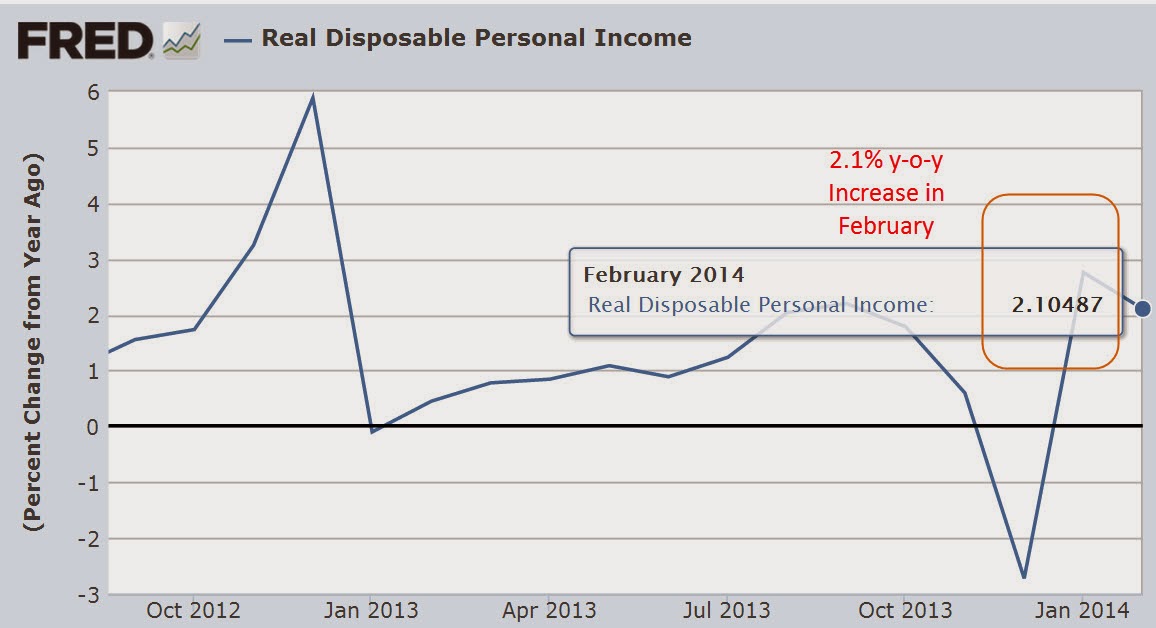
This week, the Bureau of Economic Analysis (BEA) released February’s estimate of personal income.  Real, or inflation adjusted, disposable personal income (DPI), rose 2.1%, a decline from January’s 2.75% increase but above the 1% that has historically led to recessions.

A few weeks ago I noted that annual DPI had dropped below 1% in 2013.  Contributing to the weak year over year comparison was the high spike in income in the fourth quarter of 2012 when many companies “paid forward” both dividends and bonuses in December in advance of tax increases scheduled for 2013.

While this may have been a contributing factor to the decline, it would be a  mistake to give it too much weight.  The growth in personal income has been relatively weak and it shows in the consumer spending index released this week.  The .1% year over year increase – essentially zero – indicates consumer demand that is too weak to put any upward pressure on prices.  Sensing this, businesses are less likely to invest in growth.  Less investment growth means that employment gains will be modest, which further reinforces modest economic growth.

The stock market trades on profit growth.  Standard and Poors reports that 4th quarter earnings for the companies in the SP500 rose 9.8%, accelerating from the 6.0% growth in the 3rd quarter of 2013.  A moderately improving economy and only modest growth in investment has helped boost profits.  Profits are expected to rise 11% in the second half of 2014.

******************************

GDP

The third estimate of GDP growth in the fourth quarter of last year was 2.6%, in line with consensus estimates.  In her testimony before Senate Finance Committee two weeks ago, Fed chairwoman Janet Yellen noted that we may be in for an extended period of slow growth below the fifty year average of 3%.

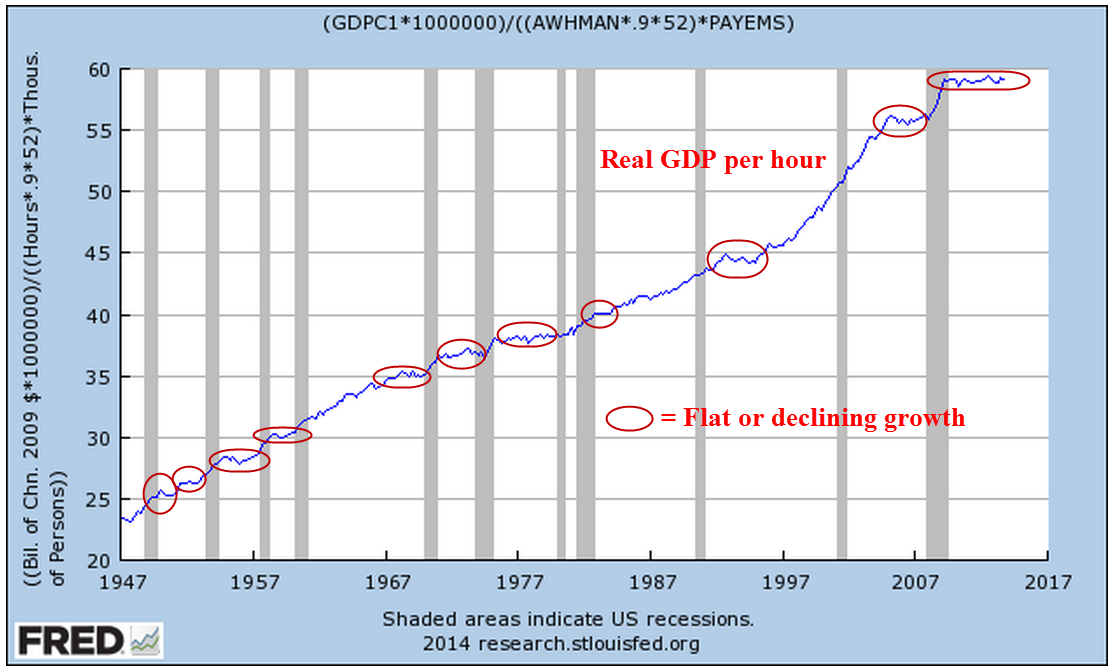
Three weeks ago I looked at GDP and the personal savings rate.  This week I’ll look at per hour GDP.  Readers should understand that this is what some economists would call a messy data set.  I have made some assumptions about the number of hours worked per employee.  The BLS publishes average hours worked for manufacturing employees and I made a guesstimate that the average for all workers is about 90% of that.  The number of part time employees who do not work this amount of hours offsets the unreported hours of the self-employed.  I am less concerned about the absolute accuracy of the GDP output per hour worked but that any inaccuracies be fairly consistent.  The trend is more important than the actual numbers.  What can we learn when output per hour flattens or declines?  Below is a graph of sixty five years.

We can see that flat growth tends to precede recessions but there is no definite pattern where we can say with any confidence that a flattening or decline in per hour GDP necessarily precludes a recession.  If we zoom in on the past thirty years, we do notice that the preceding decade has been marked by long periods of flat growth.  More importantly, the recovery from this past recession is marked by the longest period of flat growth in the history of the series.

The summer of 2009 marked the official end of this past recession.  For five years there has been no increase in real GDP per hour worked.  For a few years following a recession in the early 1990s, per hour GDP flattened before taking off in the late 1990s.

Does this flat growth represent a pruning of the economic tree before a surge of new growth? Or does it presage an even worse recession? Is the economy locked inside a limbo of limp growth for years to come, echoing the two decades of little growth in Japan’s economy?  Whatever happens, we can be certain of one thing – the trend and pattern will be so much more obvious in the future simply because we will disregard some past data based on what happens in the future.

As we make investment decisions, we should remember that the “obvious” patterns we see when we look back were much less clear at the time.  Sure there will be investment gurus who tell us that they saw it coming.  We forget that they also saw the depressions of 1994, 1998, 2000, 2004, 2006 and 2011 – the ones that didn’t happen.

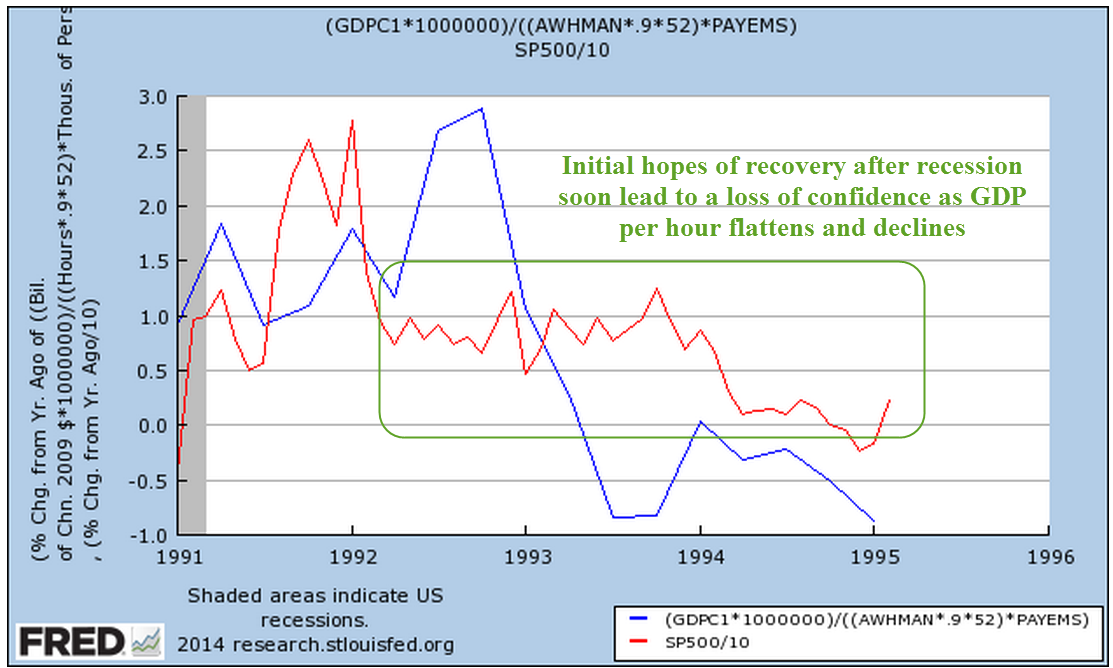
Let’s look a bit more closely at recent periods of flat growth.  The recovery from the recession of 1991 was marked by a painfully slow recovery in the job market.  After a 30% rise over three years, the market stumbled.

There’s a story to be told when we look at the growth in the market index and per hour GDP.  Whether it is by coincidence or not, there is a loose response of the market to changes in output.

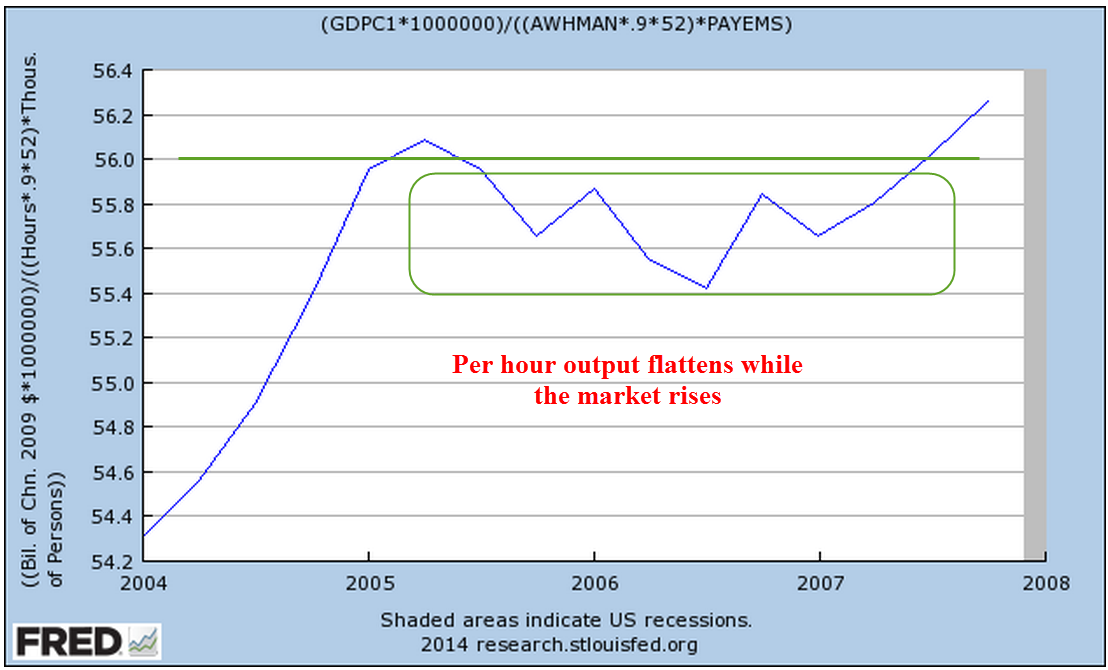
After another slow recovery from the recession of 2001, the market began to climb in 2004.

But this time the market was not responding to the flattening growth in per hour output.

In the past four years, there has been little growth in output per hour.

But the market has doubled over that time.

Part of that recovery can be attributed to the market simply reversing the decline of 2008 and early 2009, but a good 40% increase in market value can be attributed to the greater share of output that companies have been able to convert to profit. (See last week’s blog)  How long that trend can and will continue is anyone’s guess but we know that it can not go on forever.  Flat revenue growth makes growing profits an ever more difficult task.

The flat growth in per hour output gives us perhaps another insight into the so-so growth in employment.  Without a clear vision of a stimulus that will spur growth, companies are reluctant to commit to plans for an expansion of their work force.

The Outcome of Income

October 13th, 2013

“Use words not fists” a parent might say to a child.  For the second weekend during the government show down – I mean shut down, the children – er, representatives – in Washington have taken that to heart.  In a contest of dueling podiums, members of each party in both houses of Congress assure the public that their party is the reasonable one.  On Thursday, the market shot up on the news that – no, not a deal – but the likelihood that the two parties might talk to each other instead of mouthing platitudes and principles at their separate podiums.  About three weeks ago, speculative talk of a government shut down began to surface and where was the market after Friday’s close?  Back where it started three weeks ago and just 1.5% below the high on September 19th.

 In the Washington Irving tale, Rip Van Winkle fell asleep for twenty years only to wake up to a new United States of America.  In this version of the tale, an investor goes to sleep for three weeks, wakes up and there’s a whole new United States of Closed For Remodeling.  In a townhome association I belonged to many years ago, the tenants argued for several months over the choice of roofing contractor, color and style of roof for the townhomes.  A large Federal government may take a while longer.   In fact, it has been years since the Congress passed an actual budget.  The Treasury department used up the debt limit last May and has been running on fumes since then, grateful that the housing loan agencies Fannie Mae and Freddie Mac have been paying back some of the cash they “borrowed” from the taxpayers a few years back.

Because of the shut down there have been few government reports.  Commodities traders have been buying and selling in the dark,  guesstimating what the weekly and monthly government reports on the sales and production of corn and other commodities would have been if there had been an actual report.  We can only hope that traders have been fairly accurate.  If there are some notable surprises, duck.

There have been some private reports, one of them the monthly manufacturing and services reports from the Institute for Supply Management (ISM).  I updated the combined weighted index (CWI) that I have been showing the past few months.  Unlike the environment during the August 2011 budget negotiations, business activity shows strength this year and the resilience of the S&P500 index reflects that underlying strength.  Although 10 of 14 trading days were down, the index lost only about 4% from the recent high.

The CWI has been in expansion territory since the summer of 2009, which coincided with the NBER’s official call of the recession’s end.  You’ll notice that there is a rolling wave like movement to the index since then, an ebb and flow of strong and not so strong growth.  Since this is a coincident indicator of the fundamental strengths in the economy, it might not be a good predictor of short term market swings but has been a reliable predictor for the longer term investor.   Despite the recent highs in the market index, the market has been in a downtrend since the highs of thirteen years ago.  It is approaching the high set in 2007, a sign of renewed optimism.

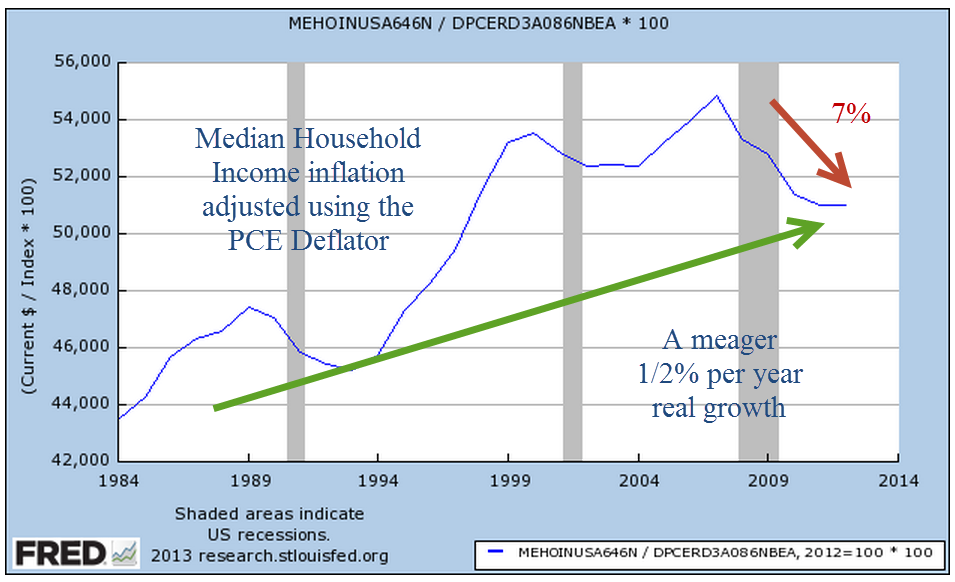
The Federal Reserve recently posted up Census Bureau median household – not individual – income figures for the past thirty years.  Continuing on our theme from last week – the story we tell depends on how we adjust for inflation.  In this case, neither story is particularly cheerful.  Median household income adjusted for inflation using the Personal Consumption Expenditure measure has fallen  to 1998 levels, declining 7% from 2007 levels.

In 1983, the Bureau of Labor Statistics changed their methodology for computing the cost of owning a home, or owner equivalent rent.  Over the years, some economists and financial writers have made the case that the official measure of inflation, the CPI, overstates inflation.  This tells an even bleaker story: a decline of almost 9% from 2007 levels, an annual growth rate over 28 years  of just 1/4% per year.

Now, let’s compare the two.  Does the CPI overstate income by 5% or does the PCE Deflator understate inflation by the same amount?

The methodology influences many people in this country, from seniors on Social Security to working people who rely on cost of living increases.  Yet there will be more debate about whether the manager of a baseball team should put in a fastball pitcher who sometimes struggles with accuracy or go with a pitcher who throws less hard but has good location and change up.  There are political consultants who spend late night hours trying to figure out how to present the problem to the public so that they can understand it and get passionate about it.

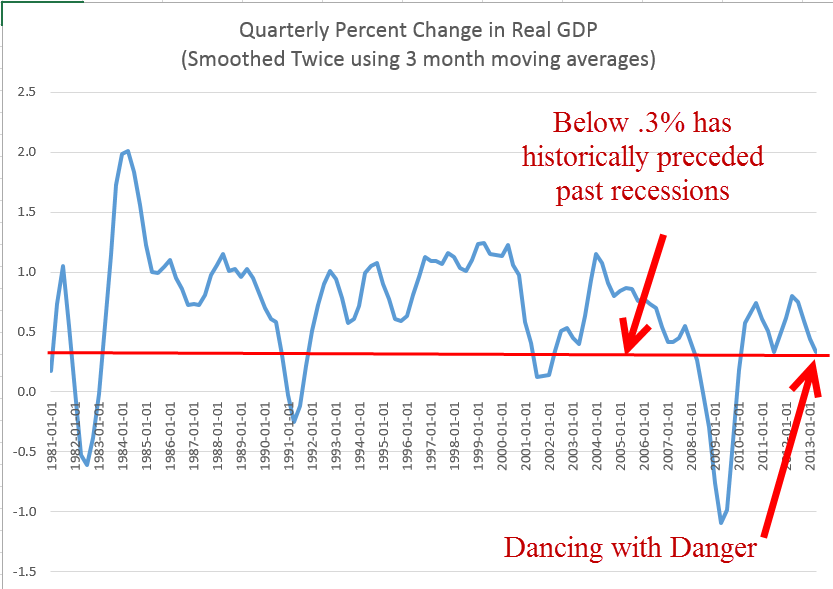
The slow growth in household incomes arises because there is a greater supply of people who want work than employers offering work that people can or want to do.  Slow growth in the economy means less demand for labor, which puts downward pressure on the wages that workers can demand.  Smoothing the quarterly percent change in GDP growth for the past thirty years gives a clear picture of this less than robust growth.

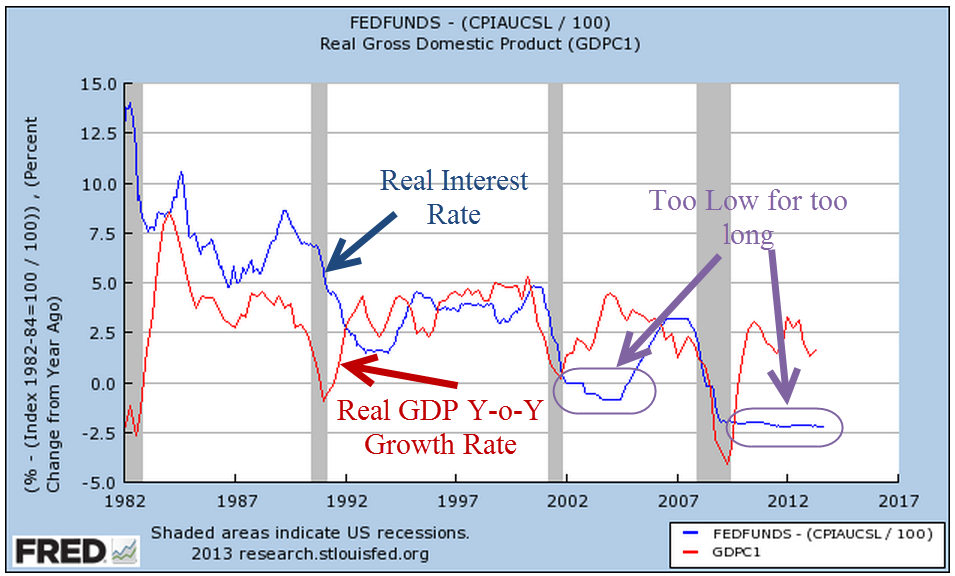
While that may be the chief reason for slow income growth, the negative real interest rate of the past five years has played some role, I think.  When the economy is in a recessionary funk,  the Federal Reserve keeps the interest rate low to spur growth.  In the past two recessions, the Fed kept interest rates low for a considerable period of time after GDP growth began to rise.  Now it is easy to look in the rear view mirror at GDP growth, which is revised several times and may be revised again a year later as more information becomes available.  The Federal Reserve has to guess what the growth is and lately they have been overestimating the growth in the economy.

As long as the Fed keeps interest rates low, banks can make easy, safe profits in the spread between buying Treasury bonds and borrowing from the Fed and other banks.  There is less incentive for banks to take the additional risk of investing in business loans.  Although climbing up from the trough of several years ago, business loans in real dollars are still below the levels of mid 2008.

During the past twenty-five years, the rise and fall of commercial loans has become more pronounced.  Have the banks become that much more cautious at each recession, are businesses circling the wagons at the first hint of a downturn, and what part do low interest rates play?

This past week President Obama confirmed his pick of Janet Yellen as the new chairwoman of the Federal Reserve.  Larry Summers had been Mr. Obama’s first choice but Summers withdrew after learning that he would have a difficult confirmation process.  Although very smart, Summers is not a concensus builder.  Many in Congress and the market preferred Yellen to Summers.  Ms. Yellen takes a dovish stance, meaning that she is likely to further the current policy of low interest rates for the near future.  A cautious investor might want to rethink rolling over that 5 year CD that comes up for renewal in the next few months.  Rates are currently 1.5 – 2%, so that after inflation an investor is losing a little money.

Poverty

This past week the Census Bureau released their annual estimate of median income and poverty.  For 2009, the poverty level increased from 13.2% to 14.3%.  Economists and policy makers have been debating the definition and calculation of poverty since the introduction of the social welfare programs of the Great Society  in the 1960s.  Since the mid-nineties, many have called for a revision of the calculations that gives weight to cost of living variances in the country.  To most people, that makes sense.  Because it makes sense, it is a political hot potato.  The thresholds of poverty are used to determine eligibility for a number of federal programs.  Adjusting  those thresholds would qualify many more people for assistance in some areas, particularly larger metropolitan areas, while disqualifying some in rural areas where the cost of living is less.

How does the Census Bureau measure poverty?  They include all cash income but non-cash items like Medicaid, food stamps and housing subsidies, like Section 8, don’t count as income. (Source)  To qualify for housing assistance, the family’s income may not exceed 50% of the median income for the county or metropolitan area in which the family chooses to live.  The rent subsidy is generally the lesser of the payment standard minus 30% of the family’s monthly adjusted income or the gross rent for the unit minus 30% of monthly adjusted income.

Let’s look at two “traditional” families of four in Denver, Colorado, where wages and cost of living are only slightly above the national average. (Source)

In Family A, Dad works a regular job as a laborer for $12 an hour for 35 hours a week, slightly more than the median hours worked per week, earning about $22000 per year.  Family A’s income is at the poverty level, qualifying them for housing assistance, Medicaid, food stamps and other assistance programs for meeting their monthly bills.  Family A’s adjusted income per HUD standards is gross income less about $500 per dependent, or $20K.  They would pay 30% of that for rent, $6000, for an apt renting for about $9600 annually, receiving about $3600 in tax free income.  In addition, they would get about $325 in food stamps  per month, or another $4000 in untaxed income.  In addition, Dad would get $34 per week in Earned Income Credits, paid by his employer, for an annual total of about $1800.  Since they qualify for Medicaid, this family would have no or minimal health insurance premiums. This family would pay no federal or state income taxes but they would be subject to the FICA payroll tax of about $1650 per year. This family’s net effective income is about $30K.

In Family B, Dad works for $22 per hour for 35 hours a week, earning an annual gross of $40,000, about 16% – 18% less than the median household income for Denver but about equal to the median wage.  This family’s income is in the 40th percentile of Denver area income, slightly above that percentile for the country as a whole.  This family does not qualify for either  housing assistance, Medicaid, food stamps, the energy assistance program LIHEAP or the Earned Income Credit. Dad pays 50% of a $1200 HMO family medical plan which his employer offers, an annual cost of $7200.   This family pays about $120 per year in federal and state income taxes and $2500 in FICA taxes.  This family’s net effective income is also $30K.

Two families – one at the poverty level of income, one slightly below the median income level – have approximately the same level of disposable income.  Either there are a number of families classified as poor who really aren’t poor or about 40% of the households in this country are effectively at or below the poverty level.