Our Perception of Risk

May 12, 2024

by Stephen Stofka

This week’s letter is about our perception of investment risk, and the subjective and objective aspects of risk evaluation. Our journey will take us several hundred years in the past and several decades into the future. The triennial survey of consumer finances indicated that less than half of people nearing retirement have $100,000 in liquid financial assets like savings accounts, stocks and bonds. Half of all working households have no savings, leaving them vulnerable to specific circumstances or a general economic shock. In our 20s, retirement looks remote with many years of work ahead of us. As we near retirement, we look in the other direction, to the past, and wish we had saved more. We confront the reality that we feel today’s needs more urgently than tomorrow’s possibilities. A $100 saving has a $100 impact on our current consumption but is only a faint light compared to the many thousands of dollars we will need in the future. We may not understand the underlying mechanism of saving.

We rely on what is visible to our senses to develop a flow of causality. We press on our car’s gas pedal and go faster, convinced that our action is adding more fuel to the engine. What the pedal controls is not fuel, but the air flow leading into the combustion chambers of the engine. The increased flow of fuel occurs in response to the change in air pressure. Prior to the 1980s cars used carburetors and mechanically employed this process called the Bernoulli principle, the idea that faster moving air induces a lower air pressure, a vacuum effect that sucks fuel toward the engine. Today’s fuel injection systems use air flow sensors that direct a computer to adjust the fuel flow. So, what does this have to do with risk?

Bernoulli’s principle is named after Daniel Bernoulli, the son of a noted Swiss mathematician and the nephew of Jacob Bernoulli, a 17th century mathematician who developed foundational concepts in probability like the Law of Large Numbers. Jacob maintained that people perceived risk in two ways. The first was an objective measure, an estimate of the probability of some event. The second was a subjective measure that depended on each person’s wealth, an inverse relationship. The first is visible, like the pressing of a gas pedal. The second is less visible, like the change in air pressure. Imagine that two people agree to flip a fair coin for a $100 bet. Person A has $1000 in her pocket; person B has $200. The loss or gain of $100 represents only 10% of A’s wealth, but 50% of B’s wealth. Even though the chance of winning or losing is the same for each person, they perceive the outcome differently. Peter Bernstein (1998) presents an engaging narrative of Jacob’s ideas in his book Against the Gods. His trilogy of books on the history of investing, risk and gold will inform and entertain interested lay readers.

Jacob may have identified one subjective element in each person’s evaluation of risk, but a person’s stock of wealth is not the only basis for a subjective estimate of risk. There are retired folks with accumulated savings of a million dollars who keep their money in savings accounts or CDs because they perceive the stock and bond markets as risky. A $10,000 loss in the stock market is only 1% of a million-dollar wealth yet some people perceive that loss in absolute dollars, magnifying the effect of a $10,000 loss. They regard the stock and bond markets as different versions of a casino. That same person might give $10,000 to a grandchild for college or to help buy a car, reasoning that there is an exchange of something that a person values for the $10,000. A person has no sense of receiving anything when their stock portfolio shows a $10,000 decrease. The stock market should have to pay an investor for using her investment, not the other way around. Such perceptions are confirmed during crises when the stock market loses 50% of its value.

Is an investment in the stock market like putting a quarter in a slot machine? Another perspective: an investor is like an investment company selling insurance to the stock market. A century of data shows that the probability of a loss in the stock market in any specific year is about 25%, according to an article in Forbes. In 70 years, the SP500 has doubled every seven years on average. An insurance company relies on Jacob Bernoulli’s Law of Large Numbers and diversification to manage risk. An investor, like any insurance company, will experience losses in some years. In last week’s letter (see note below) I wrote about surplus as a key dynamic factor in market transactions. In most years, an investor with a surplus of funds can “sell” those funds to the market and reap a gain.

Like risk, values in the stock market are based on both objective and subjective components. Sales, profits, dividends and efficiency help anchor a stock’s price movements as objective measures of value. Price responds to changes in these variables. Objective measures also include the variation in a company’s stock as a precise measure of uncertainty. There are various less precise but objective measures of economic and financial risk. Subjective measures include an investor’s need for liquidity, the ability to turn an investment into cash without impacting the price. An investor’s wealth can act as a cushion against fear of loss, a subjective measure discussed earlier.

Index funds have grown in popularity because they take advantage of Jacob Bernoulli’s Law of Large Numbers. By owning partial shares in many companies, an investor reduces the risk exposure to the variation in the fortunes of one company. The SEC might open an investigation into the ABC company, or the company loses an important overseas market, or the company reveals that the profit margins on some of its popular products are decreasing. To an index fund investor, a 10% decrease in that company’s stock price may be barely noticeable. The investor still has a risk of a change in general conditions, like a pandemic, but has dramatically reduced the risk of local conditions specific to one company.

Investors in Bitcoin do not act as an insurance fund for Bitcoin companies who mine Bitcoin. The miners have the surplus and are the sellers of Bitcoin. In the secondary market, the sellers of access to the digital currency market are the two dozen or so ETFs that allow investors to buy interest in a fund that owns bitcoin. Price movement is like a tailless kite flying in a breeze, responding mostly to price forecasts, a characteristic of some derivatives markets. The only objective measure of value and risk is the number of Bitcoin in circulation and the reward for mining new Bitcoin. Bitcoin’s price movement has a high volatility greater than 50% because there is little economic activity that anchors the variation in Bitcoin’s price. Despite the high volatility, an asset manager at an ETF fund makes the case for investing a few percent of a portfolio in a bitcoin ETF. As in our earlier example, the loss or gain depends on the current state of one’s savings.

Understanding the two aspects of risk perception, the objective and subjective, can help us manage our personal risk profile. Through research or the advice of a financial consultant we can understand the objective measures of portfolio risk but there are subjective elements unique to our personal history and disposition. The fear of having to be in a long-term care facility may influence our yearning for safety, regardless of our current health. A parent or relative may have had a similar experience and our primary concern is the protection of our portfolio value. We may feel fragile after the loss of our entire savings in a business venture. We can only become comfortable with our apprehensions by becoming familiar with them.

Next week I will look at our perceptions of other significant factors in our lives, particularly inflation.

/////////////

Photo by 𝓴𝓘𝓡𝓚 𝕝𝔸𝕀 on Unsplash

Keywords: stocks, bonds, risk, investment

Bernstein, P. L. (1998). Against the Gods: the Remarkable Story of Risk. John Wiley & Sons.

In last week’s letter I wrote about surplus as a key dynamic factor in market transactions. A seller of a good or service has a surplus which it values less than the buyer. However, the seller’s cost, including opportunity cost, is more than the cost to the buyer. These two ratios of benefit and cost find an equilibrium in the market that depends on the type of good or service and general conditions.

https://etfdb.com/themes/bitcoin-etfs/

https://www.vaneck.com/us/en/blogs/digital-assets/the-investment-case-for-bitcoin/
Taxes and Investment

March 17, 2024

by Stephen Stofka

This week’s letter is about the effect of tax revenues on government, on the economy and the role that taxes play in our lives. Tax revenues are the income of a government at all levels – federal, municipal and state. Those revenues fund the courts and prisons, the police, the roads and cultural institutions that connect people together, yet no one wants to pay them. The essence of a tax is a private payment for a public benefit. Few object to the opposite, a public payment for a private benefit when they are on the receiving end of such a subsidy.

Regardless of the amount that people pay in taxes, they feel that they have a right to complain about any good or service that a government provides. It’s in the Constitution. First Amendment – freedom of speech. For those who work in a democratic government, the unpopularity of taxes presents an existential conflict. Paul Samuelson (1947) pointed out the difficulty of designing a purely lump-sum tax or subsidy. A lump-sum tax is like a head tax, a fixed amount of tax regardless of a person’s circumstances. Under such a system, the wealthiest and poorest person pay the same amount of tax. This violates a sense of proportionality that is a guiding ethical principle.

A fixed single rate of tax answers concerns of proportionality. As an example, many districts enact a set rate for residential real estate. However, states have been reluctant to adopt a single or flat rate of income tax. In 1987, Colorado was the first state to adopt a single tax rate, according to the Tax Foundation. Other states were slow to follow Colorado’s lead and less than a quarter of the states have adopted a flat tax rate. Revenue and proportionality are not the only concerns. By its nature, a democratic government is not fair. People elect representatives who will maximize their benefits and minimize their taxes. Politicians naturally want to lighten the tax load of regular voters. In a flat tax system like the one in Colorado, politicians have amended the definition of taxable income to benefit some taxpayer groups at the expense of other groups. Pension income like Social Security and state retirement plans is not subject to state income tax.

The federal government and the majority of the states enact a graduated income tax that penalizes effort at the margin. An employee who works an occasional day of overtime may be surprised by the additional taxes taken out of that additional pay. Payroll software treats that extra amount as though the employee worked overtime every week, increasing the annual income used to calculate the tax rate on that additional income.

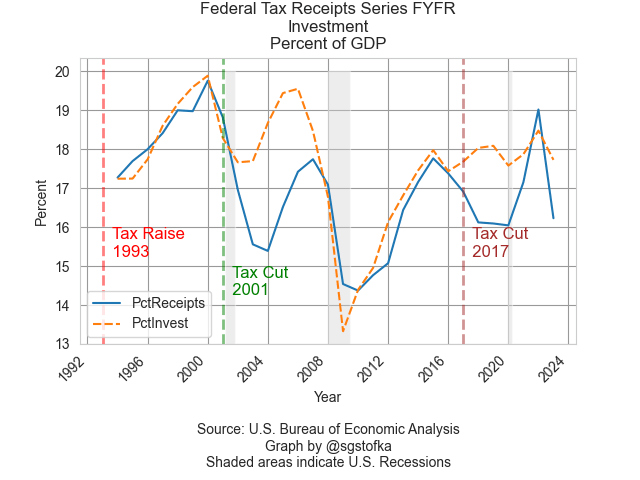
Republican politicians routinely champion their principle of low taxes. The justification for the tax cuts in the 1980s was based on an idea put forth in 1974 by the economist Arthur Laffer who drew an inverted curve on a napkin to illustrate the idea that higher tax rates might lead to lower tax revenues. Despite repeated evidence that lower tax rates lead to lower tax revenues, Republicans have clung to the idea. In the graph below, I have charted federal tax revenues as a percent of GDP. They do not include Social Security taxes.

According to the theory behind the Laffer Curve, lower taxes should spur more investment, more output, higher incomes and higher tax revenues. As we see in the graph above, tax raises led to higher revenues soon after they were enacted. Tax cuts did not. Believers in the theory claim that the cuts can take several years to work but this makes it hard to identify causality. In the graph below, I have added in investment as a percent of GDP.

The Bush tax cuts in 2001 certainly helped arrest the decline in investment following the “dot-com bust.” However, too much of that investment went into residential housing and led to the housing boom that preceded the financial crisis. Those tax cuts expired in 2010 and both investment and tax revenues improved. That raises the question: did higher taxes in 1993 and 2010 produce more investment? On principle, it seems unlikely. Following the 2017 tax cuts known by their acronym TCJA, investment again reversed a decline but had little effect on tax revenues. The rise in revenues as a percent of GDP was due to the fall in output as a result of the pandemic.

According to the neoclassical economist’s narrative, savings provide the source of investment. Taxes reduce savings and therefore reduce investment. Italian economist Pietro Sraffa (1932) reiterated a point made by Sir Dennis Robertson that savings were an inducement to more investment as well as a source of investment. Investment occurs in the period before consumption. People have money to save for two reasons. The first is that their incomes increase from new investment in production. Secondly, there are not enough goods in the marketplace to induce them to spend that extra income. The mismatch in supply and demand gives companies pricing power. Investors rush in to take advantage of the additional demand and the flow of new savings gives banks the confidence to make more loans.

For the past thirty years, federal revenues excluding social security taxes have averaged 17% of GDP. For that same period, the government spent 18.6% of GDP. The deficits have been persistent because the federal government consistently spends more than it taxes, an analysis confirmed by the Congressional Budget Office in a recent report. Republican lawmakers try to choke tax revenues to “Starve the Beast” – the beast being the size and reach of the federal government. To Democratic policymakers, our society needs constant remodeling, so they always have a plan for extra tax revenue. Neither party seems willing to resolve this political push-me-pull-you and the public has become used to deficits. There is always one more war to fight, one more wrong to right.

/////////////////

Photo by Kelly Sikkema on Unsplash

Keywords: tax cuts, investment, taxes

Samuelson, Paul Anthony. (1947). Foundations of Economic Analysis. Harvard University Press.

Sraffa, P. (1932). Dr. Hayek on money and Capital. The Economic Journal, 42(165), 42. https://doi.org/10.2307/2223735

The Conflict in Policy

March 10, 2024

by Stephen Stofka

This week’s letter continues my analysis of the many roles of the federal government, comparing spending, tax revenues and the federal debt that has accumulated since 9-11. Governments accumulate debt by spending more than they collect in tax revenues. Farmers, businesses and households appreciate the subsidies and support from government but resist paying the taxes to fund those programs. The private marketplace depends on government funding of nascent technologies that may take decades to commercialize. Examples include the internet, the development of semiconductors, lithium batteries and the funding of pharmaceutical research. Investment in military readiness has spurred advancements in aerospace and satellite technology, the GPS that connects our phones and the Kevlar clothing that protects our soldiers and police officers. Critics may ridicule a government investment in solar manufacturer Solyndra, but it was also heavy government funding that provided the cash flow for SpaceX and Tesla.

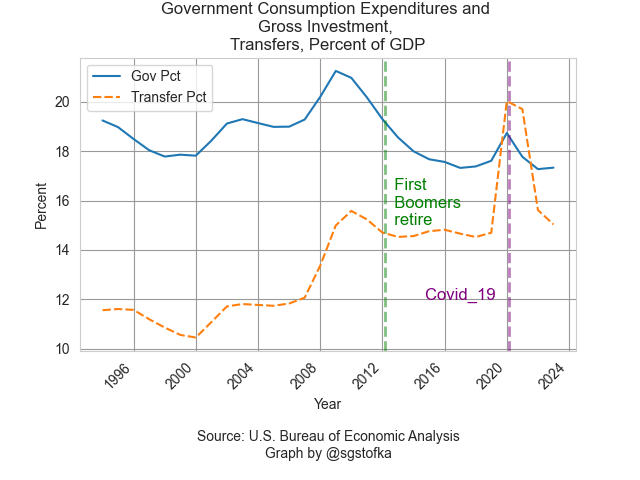
In last week’s letter I showed that private investment and government spending and investment both averaged about 18% of GDP over the past three decades. A closer look at those two series shows how they complement and compete with each other. In the graph below, private investment dipped from 19% of GDP in 2006 to below 14% in 2009. As a percent of GDP, government spending and investment took up some of the slack.

As many people lost their jobs, they became eligible for Medicaid or food stamps. Both of these programs are included in government spending because the programs directly or indirectly provide people with goods or services. The graph above does not include increased unemployment insurance payments during the recession. These are included in government transfers since this is money, not services, transferred from the government to individuals. Policymakers refer to this combination of support programs as automatic stabilizers, providing assistance to households during hard economic times.

A recent analysis by the Congressional Budget Office (CBO) found that these automatic stabilizers were not “key drivers of debt over the long-term.” The federal debt was growing because government spending was increasing at a faster pace than revenues. The chart below shows spending and revenues for the past thirty years in a natural log form to portray the trends of change more clearly.

For most of the past three decades, revenue growth, the orange dashed line in the graph above, lagged government spending, the blue line. Note that this revenue series (FRED Series FYFR) does not include Social Security taxes. The growth in government spending showed some moderation only during Obama’s term and that was the worst time to slow the growth of government spending and investment. The Great Recession of 2007-2009 was the worst economic downturn since the 1930s Depression, surpassing the pain of the back-to-back recessions of the early 1980s.

Biden was vice-President during that recovery and was determined not to repeat that mistake in the aftermath of the Covid-19 pandemic. Although the Democratic majorities in the House and Senate were slim, unified government helped the effort to pass the Inflation Reduction Act and the CHIPS Act. Both pieces of legislation committed government funds to support investment in clean energy development and semiconductor manufacturing. Such commitment spurred private investment in the energy industry. In 2023 field production of crude oil surpassed 2019 levels, according to the Energy Information Administration (EIA). They report that natural gas output was up 2% in the first year of Biden’s term, then accelerated to 5% growth in 2022 and 2023 following Russia’s attack on Ukraine.

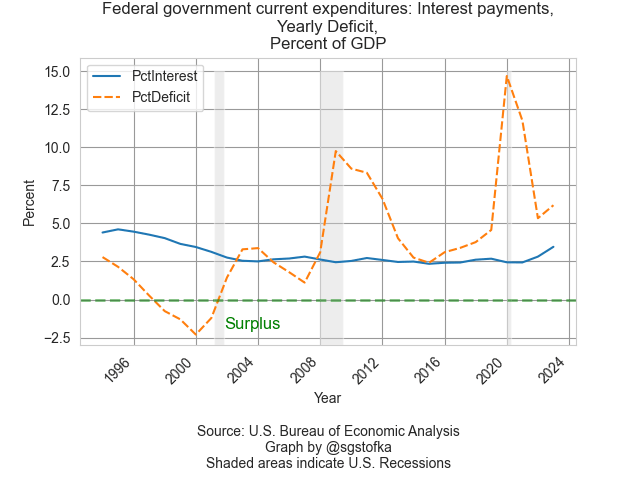
Despite big increases in the deficit after 9-11, and an accumulated debt of $22 trillion held by the public, the interest share of GDP has remained below the levels of the 1990s. In 2001, China was admitted into the World Trade Organization. As imports from China increased, we paid for them with U.S. Treasury debt, helping to keep interest rates low for most of the past two decades.

Unlike individuals and corporations, governments can buy their own debt. Unless a majority of that debt is sold in the private marketplace, there is no independent evaluation of the creditworthiness of that debt. At the end of last year, 65% of the total Federal debt was privately held, the highest percentage since 1997 (see notes). Including the Treasuries held by independent Federal Reserve banks, the percentage is close to 80%. A recent report from the Center for Strategic and International Studies (CSIS) calculates the percentage of debt held by two of our largest trading partners, China and Japan, at 5.8%. The wide ownership of U.S. debt validates it as a low-risk financial instrument.

The global financial system depends on tradeable sound securities. When the financial crisis undermined confidence in mortgage securities, private investment declined sharply, and it would do so again if investors doubted the soundness of Treasury securities. The recent CBO report points out a weakness in public policy that the Congress must resolve or risk damaging the credit of U.S. securities. 1997 was the last year when Congress submitted a budget by the deadline, according to the Congressional Research Service. When is the moment when the private debt market loses hope that Congress can match its spending and revenues? No one can forecast a stampede to safety but in hindsight many will claim to have seen the exit signs.

///////////

Photo by Manki Kim on Unsplash

Keywords: investment, debt, interest, Treasuries, government spending, taxes, automatic stabilizers

According the March 2024 Treasury bulletin, total Federal debt was $34 trillion. $21.7 trillion was privately held – about 65%. See Table OFS-2 of the March bulletin. Privately held debt plus $5.2 trillion of Treasuries held by independent Federal Reserve banks constitute Federal Debt Held by the Public (FRED Series FYGFDPUN) and is close to 80% of total federal debt. For a thirty-year series of the public’s portion of total debt, see https://fred.stlouisfed.org/graph/?g=1hYFV. Until the 2008 financial crisis Federal Reserve banks held less than 10% of total debt. During the pandemic, that share rose to 21%. At the end of 2023, the share was 15.4%.

The Role of Government

March 3, 2024

by Stephen Stofka

This week’s letter is about the federal government, its expenses and the role it plays in our lives. As originally designed in 1787, the federal government was to act as an arbiter between the states and provide for the common defense against both Indians and the colonial powers of England, France and Spain. James Madison and others considered a Bill of Rights unnecessary since the powers of Congress were clearly set forth in Article 1, Section 8 of the Constitution. However, they agreed to attach those first ten amendments to the ratification of the Constitution to soften objections to a more powerful central government (Klarman, 2016, p. 594). After the Civil War, the federal government was given a more expanded role to protect citizens from the authoritarianism of the states. The authority to do so came from the amendments, particularly the recently ratified 13th, 14th and 15th additions to the Constitution (Epstein, 2014, p. 15).

After the Civil War, the Congress awarded pensions to Union soldiers, their widows, children and dependent parents. In 2008, there were still three Civil War dependents receiving pensions! (link below). This program indebted future generations for the sacrifices of a past generation. Aging soldiers sometimes married young women who would help take care of them in return for a lifetime pension until they remarried. The provision of revenues for these pensions provoked debate in Congress. In the decades after the Civil War, the federal government’s primary source of revenue was customs duties on manufactured goods and excise taxes on products like whiskey. Farmers and advocates for working families complained that this tax burden fell heaviest on them, according to an account at the National Archives. There were several attempts to enact an income tax, but these efforts ran afoul of the taxing provision in the Constitution and courts ruled them invalid. Fed up with progressive efforts to attach an income tax to legislation, conservatives in Congress proposed a 16th amendment to the Constitution, betting that the amendment would not win ratification by three-quarters of the states. Surprisingly, the amendment passed the ratification hurdle in 1913. In its initial implementation, the burden of the tax fell to the top 1% so many disregarded the danger of extending federal power. Filling out our income tax forms is a reminder that our daily lives are impacted by events 150 years in the past.

In the decade after the stock market crash of 1929, the government extended its reach across the generations. Under the Franklin D. Roosevelt (FDR) administration, the newly enacted Social Security program bound successive generations into a “pay-go” compact where those of working age paid taxes to support the pensions of older Americans. The government assumed a larger role in the economy to correct the imbalance of a free-market system which could not find a satisfying equilibrium. This expanded role of government and the writing of John Maynard Keynes (1936) helped spawn a new branch of economics called macroeconomics. This new discipline studied the economy as a whole and a new bureaucracy was born to measure national output and income.

Students in macroeconomics learn that the four components of output, or GDP, are Consumption, Investment, Government Spending and Net Exports. In its simplest definitional form, GDP = C+I+G+NX. In the American economy each of these four components has a fixed portion of output. Net exports (FRED Series NETEXP) are a small share of the economy and are negative, meaning that America imports more goods and services than it exports. The largest share is consumption (PCE), averaging 67% over the past thirty years. Government spending and investment (GCE) and private investment (GPDI) have averaged an 18% share during that time. Because these two components have an equal share of the economy, more government spending and taxes will come at the expense of private investment. This helps explain the intense debates in Congress over federal spending and taxes. Federal investment includes the building of government facilities, military hardware, and scientific R&D. I have included a link to these series in the notes.

The Social Security program is as controversial as the pensions to Civil War veterans and their survivors. The long-term obligations of the Social Security program are underfunded so that the program cannot fully meet the promises made to future generations of seniors. The payments under this program are not counted as government spending because they are counted elsewhere, either in Consumption or Investment. They are treated as transfers because the federal government takes taxes from one taxpayer and gives them to another taxpayer. The taxpayer who pays the tax has less to spend on consumption or saving and the person who receives the tax has more to spend on consumption or saving. However, those transfer payments represent already committed tax revenues.

The chart below shows total transfer payments as a percent of GDP. Even though they are not counted in GDP, it gives a common divisor to measure the impact of those payments. The first boomers born in 1946 were entitled to full retirement benefits in 2012 at age 66. In the graph below those extra payments have raised the total amount of transfers to a new level. After the pandemic related relief transfers, total transfers are returning to this higher level of about 15% of GDP. I have again included government spending and investment on the chart to illustrate the impact that the federal government alone has on our daily lives. In one form or another, government policy at the federal level steers one-third of the money flows into the economy.

For decades, the large Boomer generation contributed more Social Security taxes than were paid out and the excess was put in a trust fund, allowing Congress to borrow from the fund and minimize the bond market distortions of government deficits. Outgoing payments first exceeded incoming taxes in 2021 and Congress has had to “pay back” the money it has borrowed these many years. To some it seems like a silly accounting exercise of the right pants pocket borrowing from the left pocket, but the accounting is true to the spirit of the Social Security program as an insurance program. Paul Fisher, undersecretary of the Treasury, quipped in 2002 that the US government had become “an insurance company with an army” but the quip underscores public expectations. Workers who have been paying Social Security taxes their entire working life expect the government to make good on its promises.

We are mortal beings who create long-lived governments that act as a compact between generations. We argue the terms and scope of that compact. What is the role of government? The founding generation debated the words to include in the Constitution and even after the words were on the page, they could not agree on what those words meant. The current generations are partners in that compact, still debating the meaning of the text of our laws and the role of government in our lives.

///////////////////

[20240303Government.jpg]

Photo by Samuel Schroth on Unsplash

Civil War pensions – a National Archives six page PDF https://www.archives.gov/files/calendar/genealogy-fair/2010/handouts/anatomy-pension-file.pdf

Data: a link to the four data series at FRED https://fred.stlouisfed.org/graph/?g=1hxIK. There is a small statistical discrepancy, and that series is SB0000081Q027SBEA.

Social Security: Notes on the adoption of a 75-year actuarial window used by the trustees of the Social Security funds to assess the ability of the program to meet its obligations. https://www.ssa.gov/history/reports/65council/65report.html. In 2021, the Congressional Research Service published a three-page PDF explainer for the choice of a 75-year term.

Epstein, Richard Allen. (2014). The classical liberal constitution: The uncertain quest for limited government. Harvard University Press.

Keynes, J. M. (1936). The general theory of employment interest and money. Harcourt, Brace & World.

Klarman, M. J. (2016). The Framers’ Coup: The Making of the United States Constitution. Oxford University Press.

The Pause in the Cycle

March 26, 2023

by Stephen Stofka

This week I’ll look at things that are hard to measure and their effect on our lives. Much of human activity is recursive, meaning that the outcome of one action becomes the input to the next iteration of that same action. When we get nervous we may breathe fast and shallow which changes our body chemistry increasing our anxiety and we continue breathing fast and shallow, amplifying the effect. Because of that cyclic process prominent thinkers like Aristotle, Adam Smith, David Ricardo, Karl Marx, and Joseph Schumpeter, among others, have proposed circular models of human behavior.

The 19th century economist David Ricardo modeled the industrial process as a profit cycle. Increasing or decreasing profits mark the division between two phases of the cycle. The first phase is a series of more and higher –

rising profits,
more investment,
leading to more output,
an increased demand for labor,
a rise in wages,
a rise in population and consumption,
an increasing use of less efficient inputs,
higher prices,
then higher interest rates,
and lower profits.

The decline in profits signals the end of the expansion and begins the downward phase, a cycle of less and lower of each of those elements – less investment, output, less demand for labor, lower wages in aggregate, etc. Ricardo assumed that workers received subsistence wages so an individual worker might not work for wages any lower. Like his friend Thomas Malthus, Ricardo assumed that higher incomes would lead to an increase in population. In the early 19th century, less efficient inputs meant less fertile land. As our economy has transitioned to become almost entirely service oriented, the less efficient inputs are labor. It is difficult for a hairdresser or therapist to become more productive.

Since the pandemic companies have been rewarded for raising prices, a strategy Samuel Rines, managing director of the research advisory firm Corbu, called “price over volume” on a March 9th Odd Lots podcast. With this strategy, companies like Wal-Mart keep pushing prices higher, willing to accept lower volume as long as total revenue and profits are higher. After-tax corporate profits (CP) have risen more than 40% from pre-pandemic levels, according to the Federal Reserve.

In Ricardo’s model of the profit cycle, higher prices lead to higher interest rates as investors increase their demand for money to take advantage of the higher prices. In our economy, the Fed controls the Federal Funds interest rate that other rates are based on. As prices continued to rise, the Fed began to lift rates and has raised them more than 4% in the past year. As the Fed raises rates, bank loan officers tighten lending standards, beginning with small firms (DRTSCIS) and credit card loans (DRTSCLCC). The FRED data series identifiers are in parentheses. In the past year, banks have increased their lending standards by more than 50% for small firms and 43% for credit card loans. However, all commercial loans have increased by 15% in the past year and delinquency rates have not changed since the Fed started raising rates. This is part of Ricardo’s model. Investment does not decrease until profits decline. Profits (CP) still grew at 2.25% in the 3rd quarter of 2022. We are not there yet.

In the 4th quarter of 2022, real GDP grew at less than 1% on an annual basis. We won’t have an estimate of 1st quarter numbers until the 3rd week of April but employment remains strong. Since 1980, the population adjusted percent change in employment goes negative or approaches zero just before recessions. In the chart below, notice how closely the employment (blue line) and output series move in tandem. The red line is the annual percent change in real GDP.

We may be approaching the pause point but the point of decline could be six months to a year away. Although the Fed let up on the “gas pedal,” raising rates by ¼% rather than ½%, they showed their commitment to curbing inflation as long as the employment market stays strong. If the Fed had not raised rates this past week, they would have set expectations that they were done raising rates. For now we can look for these signs that the expansion of the business cycle in Ricardo’s model is coming to a close.

///////////////////

Photo by Lukas Tennie on Unsplash

A Virtuous Cycle

August 7, 2022

by Stephen Stofka

July’s employment survey (BLS, 2022) reported a half-million job gains and marked a milestone – the recovery of all the jobs lost during the pandemic. In addition, earlier employment gains were revised higher by 28,000. The BLS survey indicated that only 7.1% of employees worked remotely, a surprising contrast to the amount of attention that the media gives teleworking. Last week, I discussed the dating of recessions. With this report, it is unlikely that the dating committee at the NBER will dub this a recession. Consumption, income, employment and investment are the pillars of this economy and they are doing well, contributing to the current inflationary trends.

Annual gains in private investment topped 18% in the second quarter, besting the 16% gain in 2012:Q1 a decade ago (series notes at end). Businesses invest in people, driving up employment gains. In the graph below, I multiplied the annual gain in employment by 4 to show the correlation between investment and employment.

Higher employment leads to higher incomes. Just as employment has returned to pre-pandemic levels, real (inflation-adjusted) disposable incomes are now at pre-pandemic levels. Disposable income includes government transfers like social security and pandemic stimulus checks. The last stimulus checks went out in March/April 2021, more than a year ago. It’s a good bet that these are sustainable income numbers produced by economic growth, not the result of special  transfer payments.

Higher incomes lead to higher spending. Real (inflation-adjusted) consumption spending marked an annual gain of 1.57% in June and is now up 4.5% over pre-pandemic levels. Consumers have made an abrupt shift from buying goods to buying services. Real sales at restaurants are now 10% above pre-pandemic levels.

To keep up with high demand for goods and clogged shipping ports during the pandemic, Target and Wal-Mart ordered extra and now have more inventory than they would like. Their loss is the travel and leisure industry’s gain. Marriott Hotels (2022) reported a surge in demand this year. In the U.S. and Canada, their leisure traffic is 15% above pre-pandemic levels and their revenue per room is about the same as in 2019.

Higher incomes usually lead to higher savings. In the decade before the pandemic, households saved 6-7% of disposable income. In 2020 and 2021, the savings rate averaged a whopping 20% and 12%. Most of that higher savings was done by households with higher incomes. Congress could have passed a CARES act that sent stimulus payments only to those with lower incomes, but they chose not to. Those additional savings became investment and that brings us full circle to the higher investment and employment – a virtuous cycle that Adam Smith wrote about more than two hundred years ago.

////////////////////

Photo by Markolf von Ketelhodt on Unsplash

BLS. (2022, August 5). Employment situation summary – 2022 M07 results. U.S. Bureau of Labor Statistics. Retrieved August 5, 2022, from https://www.bls.gov/news.release/empsit.nr0.htm

Marriott Internatonal. (2022, August 2). Marriott International Reports Outstanding Second Quarter 2022 results and resumes share repurchases. Marriott International Newscenter (US). Retrieved August 5, 2022, from https://news.marriott.com/news/2022/08/02/marriott-international-reports-outstanding-second-quarter-2022-results-and-resumes-share-repurchases

U.S. Bureau of Economic Analysis, Gross Private Domestic Investment [GPDI], retrieved from FRED, Federal Reserve Bank of St. Louis; https://fred.stlouisfed.org/series/GPDI, August 5, 2022.

U.S. Bureau of Economic Analysis, Real Personal Consumption Expenditures [PCEC96], retrieved from FRED, Federal Reserve Bank of St. Louis; https://fred.stlouisfed.org/series/PCEC96, August 4, 2022.

U.S. Bureau of Economic Analysis, Real Disposable Personal Income [DSPIC96], retrieved from FRED, Federal Reserve Bank of St. Louis; https://fred.stlouisfed.org/series/DSPIC96, August 4, 2022.

U.S. Bureau of Economic Analysis, Personal saving as a percentage of disposable personal income [A072RC1Q156SBEA], retrieved from FRED, Federal Reserve Bank of St. Louis; https://fred.stlouisfed.org/series/A072RC1Q156SBEA, August 4, 2022.

U.S. Census Bureau, Advance Retail Sales: Food Services and Drinking Places [RSFSDP], retrieved from FRED, Federal Reserve Bank of St. Louis; https://fred.stlouisfed.org/series/RSFSDP, August 5, 2022. Note: I adjusted for inflation using the CPI.

 U.S. Bureau of Labor Statistics, All Employees, Total Nonfarm [PAYEMS], retrieved from FRED, Federal Reserve Bank of St. Louis; https://fred.stlouisfed.org/series/PAYEMS, August 5, 2022.

When We Swarm

July 24, 2022

by Stephen Stofka

Economists study individual and group human behavior as we try to satisfy our needs. Sometimes the sum of the quests for individual satisfaction produces an outcome that is unexpected or contradictory to the aims of each individual’s choices. People may synchronize their behavior to a point that their accumulated actions overload a system, causing it to become dangerously unbalanced and lead to a collapse. Our modern communication systems may introduce more frequent panics, more opportunities for reactionary zeal and anger.

During the Great Depression, the economist John Maynard Keynes proposed a Paradox of Thrift. Saving money is a prudent choice for each person but if too many people decide to save money at the same time, economic activity declines. An extreme example is the 2008 financial crisis and recession when millions of people decided to curtail their current spending, the blue line in the graph below, and increase their savings. This is the power of uncoordinated expectations. We act sometimes as if our actions were being choreographed.

These paradoxes introduce contradictions that challenge our assumptions and ideologies and cause a lot of disagreement among economists and the public. In an EconTalk (2009) podcast, economist Steve Fazzari explained the immediate consequences of the Paradox of Thrift. In an effort to save money for college, a family foregoes their weekly meal out at a nearby restaurant. At the first occurrence, the family saves money which they deposit in a bank savings account. The next day the restaurant owner must withdraw that same amount from the restaurant’s savings to make up for the lost revenue. In that immediate time frame, there is no increase in savings/investment and this violates the ideologies of some listeners. As the pattern continues, the restaurant owner will adjust her expectations for revenue and lay off some workers. The podcast listeners interpreted Fazzari’s analogy in several different ways. They could not agree on what a short time frame is or the scope of the story.

We see and hear words and events differently yet sometimes respond in a seemingly coordinated fashion. Our panicked response may cause or amplify the very thing we fear. In September 2008, banks and investment firms lost trust in the soundness of each other’s assets. The loss of confidence caused the value of those assets to plummet, actualizing the fear. The Fed and central banks around the world struggled to contain the panic as the global financial system seized up like an engine without oil. In March 2020, central banks were better prepared, flooding the markets with liquidity at the onset of the Covid-19 pandemic. Still we swarmed onto the streets, emptying shelves of merchandise ahead of lockdowns.

Every culture has its account of the consequences of humankind’s hubris, a lesson in the perils of our own arrogance. The Bible accounted for the variety of languages with the story of the Tower of Babel. Our phones connect us to the information hive, instantly relaying breaking news in our language of choice. The internet brings us together and drives us apart. As our communications become more rapid and extensive, we increase the likelihood of global panics, an unplanned reaction to some event. Fringe groups become more adept at coordinating their anger and actions like they did at the Capitol on January 6th. Our culture evolves with our technology but our laws are slow to adapt. Our mechanism of lawmaking, adapted to a horse and buggy age of communication, will have to be redesigned before it breaks apart our society, our culture and our union.

///////////////

Photo by Ante Hamersmit on Unsplash

EconTalk. (2022, April 21). Fazzari on Keynesian economics. Econlib. Retrieved July 23, 2022, from https://www.econtalk.org/fazzari-on-keynesian-economics/#c57267

The Parade Goes Bye

Millennials have witnessed several market selloffs where investors put every kind of asset in their wheelbarrow and bring them to market. Stocks and bonds, equity and debt assets, are supposed to have different risk profiles that are uncorrelated. No matter. Into the wheelbarrow they go. What was valuable a few months ago has become infected with fear, a saleable surplus. The market is neither equitable nor smart, but it is efficient at distributing surplus. Investors sold their fear and bought cash. Cash represents certainty, the antidote to fear.

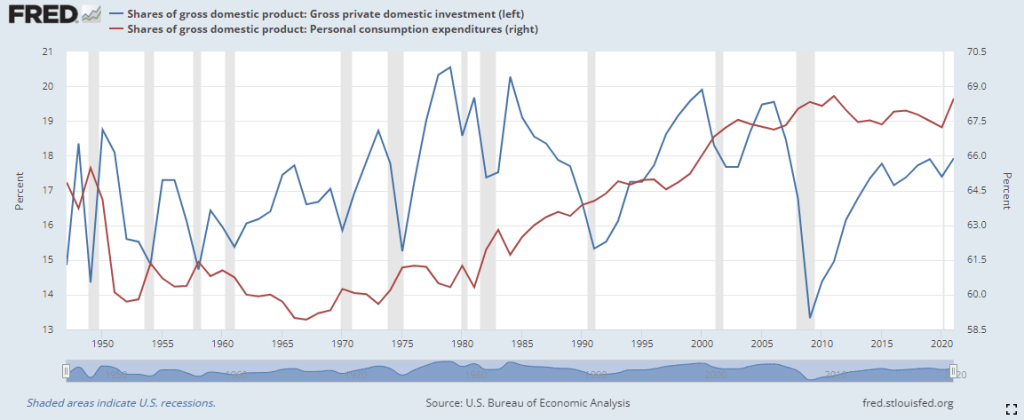
Last year private investment was 19% of the economy, near the top of the historical range of 15-20%. At that level, investment competes with consumption for real resources. The graph below compares consumption and investment as a percent of output. The blue line is investment, including residential housing, the red line household consumption.

Investment looks to the future and is more volatile because it rides on the bumpy road of expectations, a central component of human behavior. People respond not to their current environment but to a forecast of their environment, the uncertainty of further interest rate hikes to combat inflation. The expectation of rising interest rates reduces investment and that helps reduce inflation and the rationale for the Fed’s raising of interest rates – a case of simultaneous causality.

The rise and fall in inflation lags changes in investment by about three months. That does not indicate an “investment causes inflation” causality but signals that they are running around the economic racetrack together. Rising investment brings jobs and higher wages and more spending income. An interruption in the supply chain causes a divergence between supply and demand, between investment and consumer spending. That divergence causes inflation.

A surplus of misplaced investment needs to be redirected to other parts of the economy. Some investment cannot be redeployed and is lost. As the level of investment falls from 19% to 15%, the economy experiences negative growth – a recession. The market distributes saleable surpluses; it doesn’t correct the causes of the surpluses. People, institutions and policies produce surpluses and it is they who have to correct those surpluses. Why doesn’t the market distribute excess wealth? It does, but not where some people would like. People respond to shortages, inequalities of circumstances. The market responds only to surpluses.

In some cities there are a lot of homeless people crowding downtown streets. There is a surplus of little used backyard space to house the homeless. Is there a surplus of homeless people or a shortage of housing? At the heart of a persistent problem is a shortage.

A monetarist like Milton Friedman claimed that inflation was a surplus of money in the system. He argued the root cause of high and erratic inflation in the 1970s was the Fed feeding too much base money into the system. This is “high-powered” money that banks multiply when they make loans. In the peak of the oil shock and recession of 1973-75, the percentage of base money to GDP (bmg) was almost 7%. This level, far above the historical average of 5%, looked like a likely target as the cause for inflation. In the recovery after the financial crisis, bmg was nearly 23% in 2014, more than three times higher. Inflation was low – too low. Cautious bank management had parked that high-powered money at the Fed as excess reserves. The percent of deployed bmg never reached 8%. Today bmg is at 25% but the deployed level of base money has not reached 10%.

Although the Fed controls the money supply, over 4,000 banking institutions control the effect of changes in the money supply. They direct credit to where they think the losses will be the least and the gains the most. Total bank credit is up more than 9% this year and is at 68% of the economy, a historic high. Growth in businesses loans remains negative after the pandemic and at the level of loans outstanding at their historical norm of 10% of the economy. Consumers have a surplus of purchasing power that the credit market is distributing. Where does that money go? Consumers take the money they get from the banks and spend it at their local businesses. Those businesses do not have to go to the banks to get money as long as their customers have access to bank money and the businesses can attract the customers.  

By now Millennials feel like bystanders at a long parade, looking down the street for a empty space that signals the end. 9-11, housing crash, financial crisis, slow recovery with too much unemployment and not enough inflation, then an overheated housing market, a once-in-a-century pandemic and now a period with too much inflation. The oldest Millennials are just approaching middle age and might be wondering if the last half of their lives is going to be as eventful as the first half. No, of course not. Everything will be fine as long as you don’t answer the phone or open the door or say, “I’ll be right back.” It’s just a scary movie.

/////////////////

Photo by Norbu GYACHUNG on Unsplash

Base money is the FRED Series BOGMBASE. Bgm is BOGMBASE / GDP. Deployed bgm is bgm – excess reserves EXCSRESNS / GDP. That series was discontinued in 2020 at the start of the pandemic.

Gross Private Domestic Investment as a share of GDP is FRED Series A006RE1Q156NBEA. Consumption is DPCERE1Q156NBEA.

Total bank credit is TOTBKCR. Business loans is BUSLOANS.

Slow Growth

April 21, 2019

by Steve Stofka

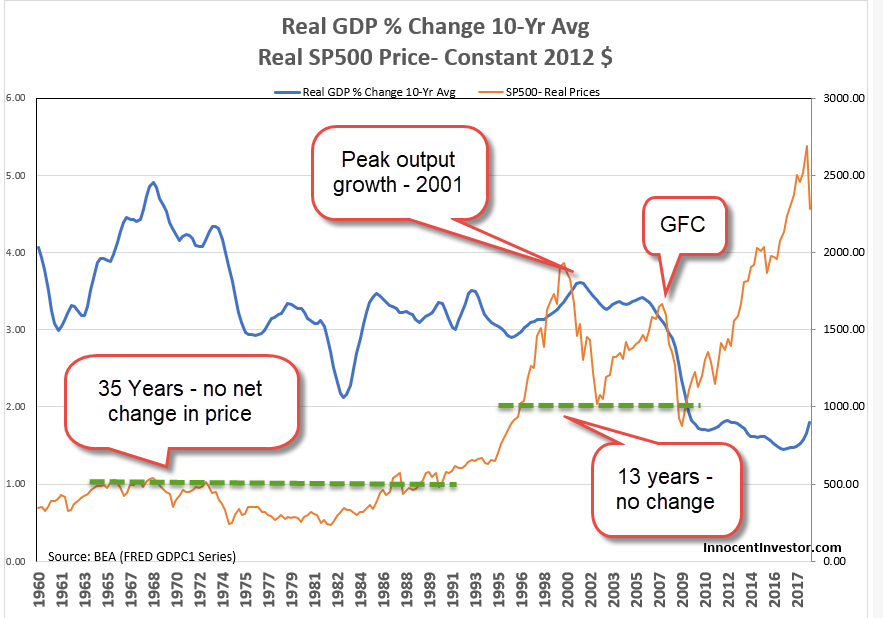
Happy Passover and Happy Easter. Now that tax day is past, let’s raise our heads and look at long-term growth trends of real, or inflation-adjusted, GDP. For the past seventy years real GDP has averaged about 3% annual growth. In the chart below, I’ve charted the annual percent change in a ten-year average of GDP (GDP10, I’ll call it). As you can see on the right side of the graph, growth has been below average for the past decade.

In 2008, growth in the GDP10 crossed below 3%. Was this due to the Financial Crisis (GFC) and the housing bust? No. The GFC barely figured into the computation of the ten-year average. The housing market had been running hot and heavy for four to five years, but this longer-term view now puts the housing boom in a new perspective: it was like lipstick on an ugly pig. Without the housing boom, the economy had been faltering at below average growth since the 1990s tech boom.

The stock market responds to trends – the past – of past output (GDP) and the estimation of future output. Let’s add a series of SP500 prices adjusted to 2012 dollars (Note #1).

For three decades, from the late 1950s to the mid-1980s, the real prices of the SP500 had no net change. The go-go years of the 1960s raised nominal, but not real, prices. Investors shied away from stocks, as high inflation in the 1970s hobbled the ability of companies to make real profit growth that rewarded an investor’s risk exposure. From the 2nd quarter of 1973 to the 2nd quarter of 1975, real private domestic investment lost 27% (Note #2). In less than a decade, investment fell again by a crushing 21% in the years 1979 through 1982.

In the mid-1980s, investors grew more confident that the Federal Reserve understood and could control inflation and interest rates. During the next decade, investors bid up real stock prices until they doubled. In 1996, then Fed chairman Alan Greenspan noted an “irrational exuberance” in stock prices (Note #3). The “land rush” of the dot-com boom was on and, within the next five years, prices would get a lot more exuberant.

The exuberance was well deserved. With the Fed’s steady hand on the tiller of money policy, the ten-year average of GDP growth rose steadily above its century-long average of 3%. A new age of prosperity had begun. In the 1920s, investment dollars flowed into the new radio and advertising industries. In the 1990s, money flowed into the internet industry. Construction workers quit their jobs to day trade stocks. Anything less than 25% revenue growth was the “old” economy. The fledgling Amazon was born in this age and has matured into the powerhouse of many an internet investor’s dream. Thousands of other companies flamed out. Billions of investment dollars were burned.

The peak of growth in the ten-year average of GDP output came in the 1st quarter of 2001. By that time, stock prices had already begun to ease. In the next two years, real stock prices fell almost 50%, but investment fell only 12% because it was shifting to another boom in residential housing. As new homes were built and house prices rose in the 2000s, long-term output growth began to climb again.

From the first quarter of 2006 to the 3rd quarter of 2009, investment fell by a third, the greatest loss of the post-war period. In the first quarter of 2008, growth in the GDP10 fell below 3%. In mid-2009, it fell below 2%. Ten years later, it is still below 2%.

The Federal Reserve has had difficulty hitting its target of 2% inflation with the limited tools of monetary policy. There simply isn’t enough long-term growth to put upward pressure on prices.  Despite the low growth, real stock prices are up 150% since the 2009 lows.  A prudent investor might ask – based on what?

The supply side believers in the Trump administration and Republican Party thought that tax cuts would spur growth. In the first term of the Obama administration, believers in Keynesian counter-cyclical stimulus thought government spending would kick growth into gear. Faced with continued slow growth, each side has doubled down on their position. We need more tax cuts and less regulation, say Republicans. No, we need more infrastructure spending, Democrats counter. Neither side will give up and, in a divided Congress, there is little likelihood of forging a compromise in the next two years. The stock market may be waiting for the cavalry to ride to the rescue but there is no sign of dust on the horizon.

Economists are just as dug in their ideological foxholes. The Phillips curve, the correlation between employment and inflation, has broken down. The correlation between the money supply and inflation has also broken down. High employment but slow output growth and low inflation. Larry Summers has called it secular stagnation, a nice label with only a vague understanding of the underlying mechanism. If an economist tells you they know what’s going on, shake their hand, congratulate them and move to the other side of the room. Economists are still arguing over the underlying causes of the stagflation of the 1970s.

A year ago, I suggested a cautious stance for older investors if they needed to tap their assets for income in the next five years. The Shiller CAPE ratio, a long-term evaluation of stock prices, is at the same level as 1929. At current prices in a low growth environment, stock returns may  struggle to average more than 5-6% annually over the next five years.

//////////////////////

Notes:

  1. Adjusted for inflation by the Federal Reserve’s preferred method, the Personal Consumption Expenditures Price Index (FRED series PCEPI). Prices do not include dividends
  2. Real Gross Private Domestic Investment – FRED Series GPDIC1.
  3. A video of the 1996 “irrational exuberance” speech

The Future is Past

June 21, 2015

Returning to our Heaven On Earth scenario: why can’t the government just print up a bunch of money and give it to people?  Centuries of historical data shows that inflation inevitably results when governments do this.  However, the Federal Reserve has pumped in almost $4 trillion dollars in the past seven years and no inflation has resulted.  We saw that the Federal Reserve has been offsetting the lack of private spending, particularly the lack of savings that is devoted to investment.

Whatever we don’t consume is called savings.  Savings can be put to two different uses:

1) Invest in Yesterday’s spending, or debt.  This can be either our own debt or the debt of others.  We might pay down a credit card balance we owe or a mortgage.  We might buy a corporate or government bond.  Savings, checking and money market accounts are an investment in debt.

Household and business non-financial credit market debt is more than $21 trillion.  Included in that amount is $9.3 trillion in home mortgages.  Most of us who buy a home don’t think of it as “yesterday” spending.  To us it is an investment in our future.  However, the purchase of a home consists of two components:
1) the transfer of the replacement cost of the dwelling – yesterday’s spending adjusted for the change in price of the labor and material to build the home.
2) Someone else’s profit, and this is the key component of these two types of spending, yesterday and tomorrow.  Whether buying a new home or existing home, we are buying the costs and profit of the builder or previous owner.

Below is a chart of household and business non-financial credit market debt as a percentage of GDP.  From 1980 through the end of 1994, the SP500 index quadrupled from 110 to 470, an annual gain of a bit over 9.5% per year.   In the mid-1990s, household and business debt started a steep climb to 140% of GDP by 2007 and this probably pulled in more savings to service that debt. In the next 15 years, the SP500 grew by only 233%.

But wait!  That’s not all! – as the late night commercials remind us.  Governments at all levels borrow savings from private households and businesses.  The current total is about $16 trillion.

Adding the $16 trillion government debt to the non-fianncial debt of the private sector totals $37 trillion of yesterday’s spending that needs to be fed with today’s savings..

2) The other option for savings is to invest in equities – Tomorrow spending – and the profits generated from that spending.  We might buy stocks, real estate or some other physical asset which will generate some production, a profit, or a capital gain from an appreciation in the value of that asset.  The World Bank estimated the total market capitalization in the U.S. in 2012 at $18.7 trillion.  Add on 33% or so since then to get an updated total of about $25 trillion.  We could debate the valuation but it is clear that debt – investment in yesterday’s spending – is clearly winning the race against investment in the profits of tomorrow’s spending.

If future growth looks modest it is because we are still in a defensive posture – weight on our back foot, so to speak. Low interest rates encourage investment in Tomorrow spending and the Federal Reserve has kept rates low to encourage us to lean in, to shift the weight, the energy of our investment from the past to the future.