The Long and Short Run

August 16, 2020

by Steve Stofka

Gold is at an all-time high. Like wheat and other commodities, it pays no interest. Gold’s price moves up or down based on expectations about the value of money used to buy gold. If inflation is expected to increase, the price of gold will go up. Eight years ago, after several rounds of quantitative easing by central banks, gold traders bet that inflation would rise. It didn’t, and the price of gold declined by a third.

Since mid-February, the U.S. central bank has pumped almost $3 trillion of liquidity into the economy (Federal Reserve, 2020). Numbers like that hardly seem real. Let’s look at it another way. The overnight interest rate is so low that it is essentially zero – like gold. People around the world regard U.S. money and Treasury debt as safe assets – like gold. Imagine that the central bank went to Fort Knox, loaded up 1.5 billion troy ounces of gold – about 103 million pounds – in gold coins and dropped them on everyone in the U.S. There are about 190,000 tonnes (2204 lbs./tonne) of gold in the world, a 70-year supply at current production. A helicopter drop of gold would be almost 47,000 tonnes, or 25% of the world supply. It would take five C-5 cargo planes to haul all that.

Milton Friedman was an economist who believed in the quantity theory of money. His model of money and inflation held “inflation is always and everywhere a monetary phenomenon.” If the growth of money was greater than the growth of the economy, inflation resulted. The data from the past decade has refuted this model. Former chairman of the Federal Reserve Ben Bernanke noted that the evidence suggests that economists do not fully understand the causes of inflation (C-Span, 2020, July). He was including himself in that group of economists because he had been an advocate of that model (Fiebiger & LaVoie, 2020).

What has the Federal Reserve and the government done to navigate the difficult path created by this pandemic? Helicopter Money for businesses and consumers. Lots of toilet tissue, so to speak. No reason to hoard, folks. There’s plenty. They have followed the first of John Maynard Keynes’ prescriptions for a downturn. The government should spend money. Why? It is the only economic actor that can make long-term decisions. Everyone else is focused on the short term.  Keynes badly mis-estimated the short-term thinking of politicians, particularly in an election year.

Will the flood of money cause inflation as gold bugs assert? Some point to the recent rise in food prices as evidence of inflationary forces. However, the July Consumer report indicates only a 1% annual rise in prices, half of the Fed’s 2% inflation target. The rise in food prices this spring was probably a temporary phenomenon. It suggests that the Fed is fighting deflation, as Ben Bernanke noted this past April (C-Span, 2020 April).

Since March, government spending has helped millions of American families stay afloat during this pandemic. Congress has gone home without extending unemployment relief and other programs. Many families are being used as election year hostages by both sides. House Democrats put their cards on the table three months ago. Republicans in the Senate and White House have dawdled and delayed. Faced with a chaotic consensus in his own coalition, Senate Majority Leader McConnell has largely abdicated control of the Senate to the White House and the wishy-washy whims of the President.

We return to where we began – gold. It is neither debt, equity nor land. As a commodity, only a small part is used each year. It has been used as a medium of exchange and a store of value. Except for a few years during and after the Civil War, gold held the same price from 1850 until the 1929 Depression – $20.67. In the long run, longer than a person’s retirement, gold is good store of value. In the ninety years since the Great Depression began, the price of gold has grown 100 times. Yet it is still lower than its price in 1980. The U.S. dollar does not hold its value over several decades, but it is predictable in the near-term. In a tumultuous world, predictability is valuable. The dollar has become the new gold.

//////////////////////

Photo by Lucas Benjamin on Unsplash

C-Span. (2020, April 7). Firefighting. Retrieved August 12, 2020, from https://www.c-span.org/video/?471049-1%2Ffirefighting (00:21:15).

C-Span. (2020, July 18). Ben Bernanke and Janet Yellen Testify on COVID-19 Economic Inequities. Retrieved August 12, 2020, from https://www.c-span.org/video/?473950-1%2Fben-bernanke-janet-yellen-testify-covid-19-economic-inequities (01:35:20)

Federal Reserve. (2020, July 29). Recent Balance Sheet Trends. Retrieved August 12, 2020, from https://www.federalreserve.gov/monetarypolicy/bst_recenttrends.htm

Fiebiger, B., & LaVoie, M. (2020, March 4). Helicopter Ben, Monetarism, The New Keynesian Credit View and Loanable Funds. Retrieved August 12, 2020, from https://www.tandfonline.com/doi/abs/10.1080/00213624.2020.1720567?journalCode=mjei20

The Nature of Money

March 31, 2019

by Steve Stofka

Modern Monetary Theory (MMT) helps us understand the funding flows between a sovereign government and a nation’s economy. I’ve included some resources in the notes below (Note #1). This analysis focuses on the private sector to help readers put the federal debt in perspective. In short, some annual deficits are to be expected as the cost of running a nation.

What is money? It is a collection of  government IOUs that represent the exchange of real assets, either now or in the past. Wealth is either real assets or the accumulation of IOUs, i.e. the past exchanges of real assets. When a sovereign government – I’ll call it SovGov, the ‘o’ pronounced like the ‘o’ in love – borrows from the private sector, it entices the holders of IOUs to give up their wealth in exchange for an annuity, i.e. a portion of their wealth returned to them with a small amount of interest. A loan is the temporal transfer of real assets from the past to the present and future. This is one way that SovGovs reabsorb IOUs out of the private economy. In effect, they distribute the historical exchange of real assets into the present.

What is a government purchase? When a SovGov buys a widget from the ABC company, it also borrows wealth, a real asset that was produced in the past, even if that good was produced only yesterday. The SovGov never pays back the loan. It issues money, an IOU, to the ABC company who then uses that IOU to pay employees and buy other goods. A SovGov pays back its IOUs with more IOUs. That is an important point. In capitalist economies, a SovGov exchanges real goods for an IOU only when the government acts like a private party, i.e. an entrance fee to a national park. Real goods are produced by the private economy and loaned to the SovGov.

What is inflation? When an economy does not produce enough real goods to match the money it loans to the SovGov, inflation results. Imagine an economy that builds ten chairs, a representation of real goods. If a SovGov pays for ten people to sit in those ten chairs, the economy stays in equilibrium. When a SovGov pays for eleven people to sit in those ten chairs, and the economy does not have enough unemployed carpenters or wood to build an eleventh chair, then a game of musical chairs begins. In the competition for chairs, the IOUs that the private economy holds lose value. Inflation is a game of musical chairs, i.e. too much money competing for too few real resources.

A key component of MMT framework is a Job Guarantee program, ensuring that there are not eleven people competing for ten jobs (Note #2). Labor is a real resource. When the private economy cannot provide full employment, the SovGov offers a job to anyone wanting one. By fully utilizing labor capacity, the SovGov keeps inflation in check. The  idea that the government should fill any employment slack was developed and promoted by economist John Maynard Keynes in his 1936 book The General Theory of Employment, Money and Interest.

The first way a SovGov vacuums up past IOUs is by borrowing, i.e. issuing new IOUs. I discussed this earlier. A SovGov also reduces the number of IOUs outstanding through taxation, by which the private sector returns most of those IOUs to the SovGov.

Let’s compare these two methods of reducing IOUs. In Chapter 3 of The Wealth of Nations, Adam Smith wrote that government borrowing “destroys more old capital … and hinders less the accumulation or acquisition of new capital” (Note #3). Borrowing draws from the pool of past IOUs; taxation draws more from the current year’s stock of IOUs. Further, Smith noted that there is a social welfare component to government borrowing. By drawing from stocks of old capital it allows current producers to repair the inequalities and waste that allowed those holders of old capital to accumulate wealth. He wrote, “Under the system of funding [government borrowing], the frugality and industry of private people can more easily repair the breaches which the waste and extravagance of government may occasionally make in the general capital of the society.”

Borrowing draws IOUs from past production, while taxation vacuums up IOUs from current production. Since World War 2, the private sector has returned almost $96 in taxes for every $100 of federal IOUs. Since January 1947, the private sector has loaned the federal government $371 trillion dollars of real goods, the total of federal expenditures (Note #4). What does the federal government still owe out of that $371 trillion? $15.5 trillion, or 4.17% (Note #5). If the private sector were indeed a commercial bank, it would expect operating expenses of 3%, or $11.1 trillion (Note #6). What real assets does the private sector have for the difference of $4.4 trillion in the past 70 years? A national highway system and the best equipped military in the world are just two prominent assets.

The federal government spends about 17-20% of GDP, far lower than the average of OECD countries (Note #7). That is important because the accumulated Federal debt of $15.5 trillion is only .9% of the $1.7 quadrillion of GDP produced by the private sector since January 1947. Our grandchildren have not inherited a crushing debt, as some have called it. In the next forty years, the U.S. economy will produce about $2 quadrillion of GDP (Note #8). If tomorrow’s generations are as frugal as past generations, they will generate another $18 trillion of debt.

Adam Smith called a nation’s debt “unemployed capital,” a more apt term. The obligation of a productive nation is to put unemployed capital to work for the community. Under the current international system of national accounting, there is no way to account for the accumulated net value of real assets, or the communal operating expenses of the private economy. Without a proper accounting of those items, we engage in noisy arguments about the size of the debt.

In next week’s blog, I’ll examine the inflation pressures of government debt. I’ll review the Federal Reserve’s QE programs and why it has struggled to hit its target inflation rate of 2%. We’ll revisit a proposal by John Maynard Keynes that was discarded by later economists.

////////////////////

Notes:
1. A video presentation of SovGov funding by Stephanie Kelton . For more in depth reading,  I suggest Modern Monetary Theory by L. Randall Wray, and Macroeconomics by William Mitchell, L. Randall Wray and Martin Watts.

2. L. Randall Wray wrote a short 7 page paper on the Job Guarantee program . A more comprehensive 56-page proposal can be found here 

3. Adam Smith’s The Wealth of Nations was published in 1776, the year that the U.S. declared independence from Britain. Smith invented the field of economics. The book runs 900 pages and is available on Kindle for $.99

4. Federal Expenditures FGEXPND series at FRED.

5. At the end of 1946, the Gross Federal Debt held by the public was $242 billion (FYGFDPUB series at FRED). Today, that debt total is $15,750 billion, or almost $16 trillion dollars. The difference is $15.5 trillion. The debt held by the public does not include debt that the Federal government owes itself for the Social Security and Medicare “funds.” Under these PayGo pension systems, those funds are nothing more than internal accounting entries.

6. In 2017, the Federal Reserve estimated interest and non-interest expenses for all commercial banks at 3% (Table 2, Column 3).

7. Germany’s government, the leading country in the European Union, spends 44% of its GDP Source

8. Assuming GDP growth averages 2.5% during the next forty years.

9. International Accounting Standards Board (IASB) sets standards for public sector accounting.


The Big Picture

May 19, 2018

by Steve Stofka

Here is a simple and elegant animation model of the economy in a thirty-minute video from Bridgewater Associates, the world’s largest hedge fund. The video illustrates the spending – income – credit cycle in easy to understand terms. The video includes an insight first noted eighty years ago by the economist John Maynard Keynes, who pointed out that one person’s spending is another person’s income. Sounds obvious, doesn’t it?  I spend money on a pizza which increases the income of the pizza store.

When Keynes explored this simple idea, he revealed a glitch in the traditional model of savings and investment. In a simplified version, money not spent is saved in a bank. The bank loans out those savings to a business.  A business invests that loan into production for future spending. When economists model the whole economy, Savings = Investment. It is an accounting identity like a mathematical definition. The financial industry transforms one into the other.

During the Depression, something was obviously broken, and economists debated various aspects of their models. Keynes asked a question: what happens to the merchant where the money was not spent? Let’s say the Jones family decides not to buy a new TV and puts the money in a savings account at the Acme Bank.  The local Bigg TV store sells one less TV and has a corresponding decline in its income. Because Bigg had less income, they must withdraw money from their Acme Bank savings account to meet payroll. The money that the family saves is withdrawn by the business. The money Saved never makes it to the Investment side of the equation.  There is no increase in investment.

Most of the time, those who are saving and those who are spending funds from saving balances out. But there were times, Keynes proposed, when everyone is saving. Keynes attributed the phenomenon to “animal spirits.” As incomes fall, people start using up their savings to make up for the lost income.

During a crisis like this, Keynes proposed that government increase its spending, even if it needed to borrow, to boost incomes and break the vicious cycle. When the crisis was over, the government could raise taxes to pay back the money it borrowed. In Keynes’ model, government spending acted as a balancing force to the animal spirits of the capitalist economy. In the real world, politicians win votes by spending money but find that raising taxes does not win them favor with voters. Without legislative debt controls, government borrowing to counterbalance declines in income only produces greater government debt.

Turning from government debt to personal debt, the average credit card rate has risen to 15.3%, an eighteen year record. As an economy continues to expand and credit is extended to those with marginal creditworthiness, the default rate grows. The percent of credit card balances that have been charged off in default has risen from 1.5% several years ago to 3.6% in the 4th quarter of 2017.

Mortgage rates have risen to about 4.9% on thirty-year loans, and about a half percent less on fifteen-year loans. That half percent difference is close to the average for the past twenty-five years and adds up to an extra $1.60 in interest paid during the life of the loan on every $100 of mortgage principal. The graph below shows the difference between the two rates.

MortRatesDiff

Because shorter-term mortgages require higher monthly payments, they are more feasible for those with stable financial situations and above average incomes. When the difference in rates is less than average, there is a smaller advantage to getting a short-term mortgage.  At such times, the mortgage industry is reaching out to expand home ownership to lower income homeowners. When the difference is more than average, as it has been since the recession, the finance industry is cautious and not actively reaching out to lower income families.

Mortgages are secured by a physical asset, the house. U.S. Treasury bonds are secured by an intangible asset, the full faith and credit of the country. Just like us, the Treasury usually pays a higher interest rate for a longer-term loan.

A benchmark is the difference between a 10-year Treasury bond and a 2-year bond. As this difference declines toward zero, economists call it a “flattening of the yield curve.” At zero, there is no reward for loaning the government money for a longer term. Knowing only that, a casual investor would sense that something is wrong, and they are right. Periods when this difference falls below zero usually occur about a year before a recession starts. In the graph below, I’ve shaded in pink those negative periods. In gray are the ensuing recessions.

10YRLess2Yr

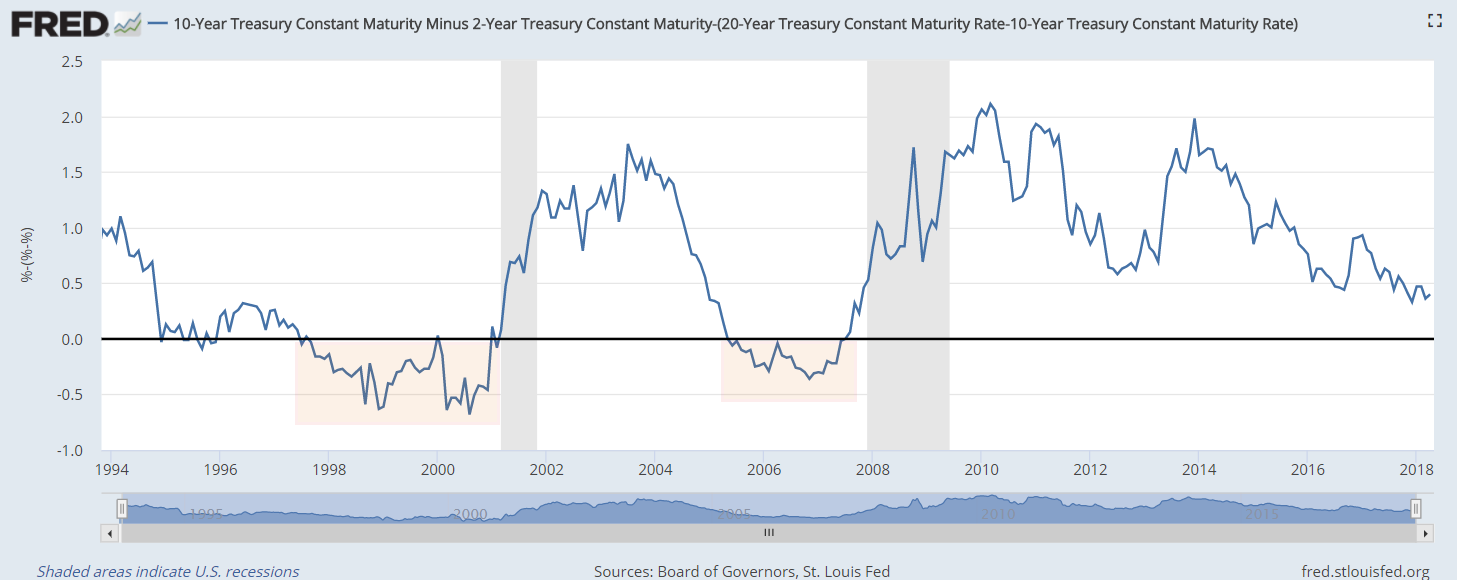
Before that negative pink period comes another phenomenon. Above was the 10 year – 2 year difference in interest rates. Let’s call that the medium difference. There’s also the difference between two long term periods, the 20-year minus 10-year difference. I’ll call that the long difference. When we subtract the medium difference from the long, we get a difference in long term outlook. In a healthy economy, that difference should be positive, meaning that investors are being paid for taking risks over a longer period. When that difference turns negative, it shows that there are underlying distortions in the risks and rewards of loaning money. That distortion will show first before the flattening of the yield curve.

DiffRates1995-2018

As you can see, the difference today is positive, a welcome sign that a recession is not likely within the year.

//////////////////////////

Tidbits

The actuaries for Social Security and Medicare use an assumption that our average life expectancy will increase .77% per year (Reuters article)  If you are expected to live till 85 this year, then that expectation will grow to 85 years and eight months next year. That’s a nice birthday present!

U.S. lumber mills can supply only two-thirds of the lumber needed by homebuilders. The other third comes from Canada. Recent import tariffs now add about $6300 to the price of a new home (Albuquerque Journal).

Rebound

October 25, 2015

Last week we looked at two components of GDP as simple money flows.  In an attempt to understand the severe economic under-performance during the 1930s Depression, John Maynard Keynes proposed a General Theory that studied the influences of monetary policy on the business cycle (History of macoeconomics).  In his study of money flows, Keynes had a fundamental but counterintuitive insight into an aspect of savings that is still debated by economists and policymakers.

Families curtail their spending, or current consumption, for a variety of reasons.  One group of reasons is planned future spending; today’s consumption is shifted into the future.  Saving for college, a new home, a new car, are just some examples of this kind of delayed spending.  The marketplace can not read minds.  All it knows is that a family has cut back their spending.  In “normal” times the number of families delaying spending balances out with those who have delayed spending in the past but are now spending their savings.  However, sometimes people spend far more than they save or save far more than they spend, producing an imbalance in the economy.

When too many people are saving, sales decline and inventories build till sellers and producers notice the lack of demand. To make up for the lack of sales income, businesses go to their bank and withdraw the extra money that families deposited in their savings accounts.  Note that there is no net savings under these circumstances.  Businesses withdraw their savings while families deposit their savings.  After a period of reduced sales, businesses begin laying off employees and ordering fewer goods to balance their inventories to the now reduced sales.  Now those laid off employees withdraw their savings to make up for the lost income and businesses replace their savings by selling inventory without ordering replacement goods.  As resources begin strained, families increasingly tap the several social insurance programs of state and federal governments which act as a communal savings bank,   Having reduced their employees, businesses contribute less to government coffers for social insurance programs.  Governments run deficits.  To fund its growing debt, the Federal government sells its very low risk debt to banks who can buy this AAA debt with few cash reserves, according to the rules set up by the Federal Reserve.  Money is being pumped into the economy.

As the economy continues to weaken, loans and bonds come under pressure.  The value of less credit worthy debt instruments weakens.  On the other side of the ledger are those assets which are claims to future profits – primarily stocks.  Anticipating lower profit growth, the prices of stocks fall.  Liquidity and concern for asset preservation rise as these other assets fall.  Gold and fiat currencies may rise or fall in value depending on the perception of their liquidity.

Until Keynes first proposed the idea of persistent imbalances in an economy, it was thought that imbalances were temporary.  Government intervention was not needed.  A capitalist economy would naturally generate counterbalancing motivations that would auto-correct the economic disparities and eventually reach an equilibrium.  Economists now debate how much government intervention. Few argue anymore for no intervention.  What we take for granted now was at one time a radical idea.

While some economists and policymakers continue to focus on the sovereign debt amount of the U.S. and other developed economies, the money flow from the store of debt, and investor confidence in that flow, is probably more important than the debt itself.  As long as investors trust a country’s ability to service its debt, they will continue to loan the country money at a reasonable interest rate.  While the idea of money flow was not new in the 1930s, Keynes was the first to propose that the aggregate of these flows could have an effect on real economic activity.

***********************

Stock market

A very good week for the market, up 2% for the week and over 8% for October.  A surprising earnings report from Microsoft lifted the stock -finally – above its year 2000 price.  China announced a lower interest rate to spur economic activity.  ECB chair Mario Draghi announced more QE to fight deflation in the Eurozone. Moderating home prices and low mortgage rate have boosted existing home sales.

The large cap market, the SP500, is in a re-evaluation phase.  The 10 month average, about 220 days of trading activity, peaked in July at 2067 and if it can hold onto this month’s gains, that average may climb above 2050 at month’s end.

The 10 month relative strength of the SP500 has declined to near zero.  Long term bonds (VBLTX) are slightly below zero, meaning that investors are not committing money to either asset class.  The last time there was a similar situation was in October 2000, as the market faltered after the dot-com run-up.  In the months following, investors swung toward bonds, sending stocks down a third over the next two years.  This time is different, of course, but we will be watching to see if investors indicate a commitment to one asset class or the other in the coming months.