The Magical Beast

February 23, 2025

by Stephen Stofka

This is second in a series on centralized power. I decided to use a more conventional narrative rather than the debate format of previous posts. Research on this topic upset my “apple cart” of preconceptions regarding spending, taxes, and Republican support for some social programs. I survived.

Proponents of smaller government aim to restrain the growth of government spending by reducing tax revenue. In a 1981 Address to the Nation shortly after taking office, President Ronald Reagan first proposed the idea. If Congress would not cut back spending, then reducing tax revenues would force them to cut spending. As many political leaders did, Reagan assumed that the public would not tolerate the nation running large fiscal deficits. For most of the eight years he was in office, government spending stayed fairly constant at about 22% of GDP and the federal deficit remained at the same percent of GDP as during Jimmy Carter’s term. After 9-11, the public’s tolerance for deficits grew. The feckless Bush administration promised that Iraqi oil production would pay for the costs of invading the country. In 2003, the Republican Congress passed tax cuts and Bush won reelection despite the many failures of the Iraqi invasion. This time, he did so without the help of the conservative justices on the Supreme Court. It was the last time a Republican would win the popular vote until the election of Donald Trump in 2024.

A 2006 analysis by Christina and David Romer found little support for the Starve the Beast hypothesis and suggested that lowering taxes may, in fact, increase spending. In a 2006 paper, William Niskanen, former head of the Cato Institute, found that spending and tax revenues moved in opposite directions. One of the pathways for this phenomenon may be that taxpayers come to disconnect the two forces, taxes and spending, and don’t hold politicians responsible. For a politician, cutting taxes is a popular brand but they keep their seats by “bringing home the bacon” for their constituents. A farming community does not want to see decreases in crop subsidies or favorable tax breaks. Voters magnify the burden of spending cuts, feeling as though they are shouldering more of the burden than other voter groups.

In his second term, Donald Trump has adopted a different approach – kill the beast. Readers of William Golding’s Lord of the Flies will remember the scene where a mob mentality overtakes a group of shipwrecked boys and they start a feverish chant after a hunt, “Kill the pig, spill its blood.” The cuts that Musk and his DOGE team are making on the federal work force resemble less the precision of a surgeon and more the frantic swinging of a knife in the dark. They have targeted recent hires with few job protections and paid little attention to what those workers do. In their zeal to kill or wound the bloated government – the beast – they have laid off nuclear safety and food safety workers,  infectious disease specialists and IRS workers near the height of tax filing season. Both Musk and Trump are among the wealthy elite. Neither is dependent on a tax refund.

In his recently published book Why Nothing Works: Who Killed Progress—and How to Bring It Back, Marc J. Dunkelman recounts the expansion of the federal government, starting with the Progressive movement that began under Theodore Roosevelt’s administration over a hundred years ago. The movement embodies two instincts that are in constant tension, a “progressive schism” whose roots began when the nation was founded (pg. 22). Alexander Hamilton favored a strong central government whose institutions could facilitate the commerce and defense of the new American republic. Thomas Jefferson believed that the integrity and character of the new nation depended on the yeoman farmer, who must be protected from the power of government. Jefferson was horrified by the abuses of a strong British government headed by a monarch.

Progressives want to expand the reach of government – the Hamiltonian instinct – but are fearful of the power of government – the Jeffersonian instinct. The struggle between these two sentiments frustrates the aims of the Progressive movement. Progressives’ “cultural aversion to power renders government incompetent, and incompetent government undermines progressivism’s political appeal” (pg. 15).

For more than a century conservatives in both political parties have tried to check the ambitions of the progressives and the expansion of the federal government. For almost a century following the civil war, southern Democrats fought to preserve their political dominance and cultural institutions from the imposition of reformist norms by “northern elites.” There is still a strong antipathy to federal power but most of us have adapted to and enjoy federal institutions created by progressive legislation. Millions of Americans enjoy our national parks and monuments but over a century ago, local groups protested federal interference in the management of lands within state boundaries like Yellowstone Park, Glacier National Park and Grand Canyon National Park.

We no longer argue over child labor laws introduced by progressives in the early 20th century. Though popular today, conservative groups fought against the Social Security program when it was first introduced in the 1930s. Congressional Republicans, however, were largely unopposed, according to this 1966 interview with George Bigge. Opposition to “socialized medicine” stymied proponents of a Medicare type system first proposed in 1942. In the 1950s, President Eisenhower initially supported a health plan financed through the Social Security system but dropped his endorsement over objections that the program was a slippery slope to socialized medicine (Source). Wilbur Mills, the powerful Chairman of the House Ways and Means Committee, overcame Republican opposition to the Medicare program by introducing a Part B system for physician payments that would be voluntary. Many of us make an uneasy truce with federal power when those policies produce a net gain for our well-being, or there are limits to federal mandates.

This week, Donald Trump completed the first month of his second presidential term with a whirlwind of federal job cuts and controversial remarks. The first ninety days of a presidential term are said to be the honeymoon period when public opinion is still forming but recent polls by Quinnipiac University and CNN indicate that initial favorable sentiment has soured. More respondents disapprove of Trump’s policies than approve. Trump has promised to downsize both spending and taxes but preserve the Social Security and Medicare programs. Both programs are popular, as many voters feel that people have earned the benefits after a lifetime of paying taxes. The taxes, or dues, come first; the benefits come later.

There are no dues for the Medicaid program which provides health care insurance for low-income households. The federal government and states share the costs of this program in varying degrees, with the federal government picking up the majority of the costs. The Republican majority in the House has proposed $880 billion in cuts to the Medicaid program and Trump has expressed support for the cuts, surprising some Republican lawmakers and Trump’s own staff.

Trump acts with the impulsiveness of a 14-year-old boy. In an earlier age, the public wanted a stable hand in control of a vast nuclear arsenal. Thirty years after the end of the Cold War, voters seemed less concerned with Trump’s erratic behavior. Some excuse it as a negotiating ploy; others see it as a tactical maneuver. In Washington, where everyone has a “loaded weapon,” so to speak, Trump presents a moving target. Others see the policy moves as sheer incompetence. Over a thousand employees at the National Park Service were laid off and seasonal hiring was frozen (Source). Oops. Seasonal employees fight forest fires and clean bathrooms at National Parks. The Trump administration did an about face and promised to hire even more seasonal employees than the Biden administration did (Source). The daily two-step is a boon for news organizations and pundits. Lots of copy. Not a dull moment in the 24-hour news cycle.

Advocates may clamor for the death of the beast – the government – but many of the functions that the beast provides are popular. In 1963, the folk group Peter, Paul and Mary released the song Puff, the Magic Dragon. Although Puff was an eternal creature, his friend Jackie Paper eventually lost interest in Puff as he grew up. After his friend abandoned him, Puff lost all his vigor and retreated into his cave by the sea. Some wish that the federal government would do the same. Lobbyist Grover Norquist wished that government would become so small that “we can drown it in a bathtub” (Source). Unlike Jackie Paper, the majority of the public has not outgrown its affection for government programs or its belief in the magic of government power.

//////////////////

Image by ChatGPT at the suggestion “draw a picture of a multi-colored dragon on the shore of the ocean with a cliff behind him.”

A Debate On Medicare

December 8, 2024

by Stephen Stofka

This is part 4 of a weekly series of debates on various issues, including climate change, pollution, rent control and market failures in general.

Abel said, “I’d like to pick up where we left off last week, talking about monopolies.”

Cain added, “And monopsonies, you said, where there is only one buyer in a specific market.”

Abel nodded. “There is no better example of both monopoly and monopsony than the health care industry. Your group wants to keep government interference in the market to a minimum. In the health care market, it’s just not possible.”

Cain said, “Private companies offer health insurance. Why do we need government?”

Abel replied, “A product might be labeled health insurance, but insurance companies stay in business by selling risk mitigation. Consumers buy an insurance policy to protect them from a large expense. A for-profit insurance company has an obligation to their shareholders first and they use every legal ruse to reduce the amount they pay on medical claims from their customers.”

Cain argued, “We agree that insurers sometimes deny or delay legitimate claims for care. Congress passed Medicare in 1965 to provide low-cost health care to seniors. The government uses less discretion in paying claims but pays below market rates. That system welcomes fraud and abuse. Health and Human Services estimated that the Medicare and Medicaid programs paid out $100 billion in improper payments in 2023.”

Abel nodded. “The price system doesn’t account for dishonesty by private providers. All the more reason why there has to be greater supervision by government agencies to ensure compliance. A frequent police presence incentivizes people to police themselves.”

Cain disagreed, “No, the government has become a monopsony in the healthcare market. Providers are attracted to Medicare because there is such a large pool of buying power. Providers and suppliers are eager – too – eager – to diagnose and treat older people. Those are resources that cannot be spent on younger people.”

Abel countered, “Younger adults in their prime working years use far less health care services than older people. Without government subsidies, an insurance company would need to charge a prohibitively high rate to insure 70-year-olds.”

Cain asserted, “When people or things get old, they require more service. Imagine if the government funded low-cost auto repairs on cars that were more than ten years old. Car makers would be reluctant to develop improvements in newer car models. Why bother? There is more profit in fixing up the old cars.”

Abel protested, “That’s a stupid analogy. People are not cars.”

Cain nodded. “Exactly. My point is that our society is currently spending a lot of money on old people and the diseases that affect old people. That money is not available to help young people, the newer models of people.”

Abel argued, “Your group sees every problem in dollars and cents. Health care is about human dignity and flourishing as well as the alleviation of suffering, especially for older people who have spent a lifetime working and contributing to their community. What is the price of human dignity? The price system is incapable of measuring the value of intangibles that are precious to us. Government’s role is to protect those qualities we hold dear and that takes regular intervention. Government can’t just step in, assign property rights and let the private market and the price system manage the problem.”

Cain shook his head. “As a share of GDP, healthcare spending in this country continues to grow larger. Per capita spending on healthcare has more than doubled since 2001. The Centers for Medicare and Medicaid Services says that the share was 17.3% in 2022. Out of every $6 of economic activity in this country, more than $1 is spent on healthcare.”

Abel explained, “But that’s because the Boomer generation is so large, and many are seniors. Naturally, healthcare spending will rise because older people use more healthcare services.”

Cain replied, “Yeah, but Medicare spending as a share of total healthcare costs was rising before any of the Boomers became eligible for Medicare. In 2001, Medicare spending was just $1 out of every $5 spent on healthcare. By 2011, that share was more than $1 out of every $4 and the first Boomers had just turned 65 and become eligible for Medicare. In 2021, Medicare spending accounted for almost $1 out of every $3 spent on healthcare (FRED chart and data here). Out of $20 spent in the entire economy, the government now spends $1 taking care of old people. And that doesn’t include Medicaid spending on low- income seniors. That is a burden on younger generations.”

Abel said, “Those costs went up in the 2000s after Republicans revised the Medicare Advantage, Part C, program and added a drug benefit, Part D. Obamacare expanded the program even further. The latest annual report to Congress from the  Medicare Payment Advisory Commission found that Medicare Advantage plans paid providers 122% of the amount paid for similar services to Fee-For-Service plans under traditional Medicare.”

Cain replied, “That illustrates my point. When politicians and government agencies try to improve any program, they don’t make the program more efficient. They spend more money. The people who work in government want to codify their principles, their ideals, their sense of fairness into law. Despite their rhetoric, they do not serve the cause of efficiency. They only make things more expensive and more complicated for the people they are supposed to serve.”

Abel countered, “I’ll repeat, your group looks only at the dollars and cents. In 1965, a 65-year-old male could expect to live another 13 years. In 2021, that same male could expect to live another 17 years. Women have had a similar increase of almost four years in life expectancy. The government is spending more on seniors because they are living longer and living better, thanks to the Medicare program. A 70-year-old Boomer today is far healthier and more active than a 70-year-old was in 1965. The price system can not value improvements in the quality or quantity of life.”

Cain argued, “When the government buys almost a third of the entire healthcare market, that’s effectively a monopsony, which distorts the price system. With a functioning market, seniors would pay more for those healthcare services which improved their quality of life. Instead, the government writes the checks, so seniors overconsume healthcare services. Why not? It’s effectively free. That distorts any measure of value that the price system can determine.”

Abel shook his head. “Seniors on fixed incomes have reduced options. There is too much danger that they will forego needed medical care simply because they can’t afford it. For most of their lifetime, they got over respiratory diseases like colds. After an initial visit, injuries like broken bones healed. It may be difficult for seniors to understand that the diseases of old age will not just go away on their own. High blood pressure and heart disease, Type 2 diabetes, arthritis and chronic respiratory problems need active management. Putting off care for a lack of funds only makes those conditions less manageable.”

Cain said, “Educating seniors is the key. Instead, the government treats old people like children. The Medicare program lacks the discipline that private insurance companies bring to the market.”

Abel objected, “A doctor specializing in breast cancer shouldn’t have to justify his recommended course of treatment to some clerk at an insurance company. That’s not a disciplined approach. That’s abuse by an insurance company and people die from that abuse.”

Cain said, “Some unfortunate cases get all the headlines. The government pays out $100 billion in improper payments. That is taxpayer abuse but there is no identifiable victim so that news story runs on page 6. Everyone is so accustomed to government inefficiency and abuse that another example of it causes little outcry. Politicians depend on a voting public that has become numb to the ineptness and unfairness of the political process. Congress has an approval rating of less than 20% but every two years, over 90% of House members are re-elected.  Voters act like they are wind up toys.

Abel sighed. “Your group has a deep skepticism of government. Is that likely to change? Probably not. What’s the point of debating these issues if you have a fundamental distrust of government?”

Cain replied, “Hope. Hope that together we can struggle toward some compromise that can curb the excesses of elected and unelected officials.”

Abel nodded. “Ok, we’ll try again next week. Try to think of a public goods program you like. I can see that Medicare is not one of them.”

Cain replied, “See you then.”

///////////////

Photo by Dominik Lange on Unsplash

Medicare Spending charted by Federal Reserve https://fred.stlouisfed.org/series/W824RC1

Per capita healthcare spending, FRED Series https://fred.stlouisfed.org/series/HLTHSCPCHCS

Medicare spending as a share of total health expenditures https://fred.stlouisfed.org/graph/?g=1BYRn

Period Life Expectancy 2004 – 2021 from the Social Security Administration https://www.ssa.gov/oact/STATS/table4c6.html

Period Life Expectancy 1940 – 2001 from the Social Security Administration https://www.ssa.gov/OACT/TR/TR02/lr5A3-h.html

Series of Gallup surveys rating Congress https://news.gallup.com/poll/1600/congress-public.aspx

Re-election rates for House members https://www.opensecrets.org/elections-overview/reelection-rates

A Kaiser Family Foundation brief on the annual report from the Medicare Payment Advisory Commission https://www.kff.org/medicare/issue-brief/medicare-advantage-in-2024-enrollment-update-and-key-trends/

A report on improper Medicare and Medicaid payments https://www.justice.gov/archives/jm/criminal-resource-manual-976-health-care-fraud-generally

//////////////////

No Man’s Land

March 24, 2024

by Stephen Stofka

This week’s letter continues a look at taxes. This week the House passed a series of six spending bills that will avert a partial government shutdown. A majority of Republicans voted against the measure and Marjorie Taylor Greene, the bombastic representative from Georgia, filed a motion to remove Mike Johnson, the current House Speaker. It is unlikely to come to a vote because Republicans have only a one-member majority in the house after Mike Gallagher (R-WI) announced his early departure from Congress. A vote for a new speaker risks the chance that Democrat Hakeem Jeffries (D-NY), the current Minority Leader, might win the vote and become Speaker.

Most Republicans in the House and Senate have taken a “no-new-taxes” pledge called the Taxpayer Protection Pledge. The Americans for Tax Reform (ATR) database lists 191 members of the House and 42 members of the Senate who have taken the pledge. They have committed to not raising income tax rates. Additional tax revenues that arise from eliminating a tax deduction or loophole must be dedicated to lower taxes, according to the ATR’s FAQ page. Republican representatives implicitly committed themselves to increasing deficits but that is an unpopular political stance. They pledged to reduce spending but not military spending, the largest discretionary category in the budget. They pledged to reform entitlement programs like Social Security,  Medicare and Medicaid, but rural Republican voters repeatedly rejected such reforms because they depend on those programs. Each time Republican members of Congress stepped away from the issue to save their political hide.

Many conservative members of Congress protest the social spending programs that crowd out other priorities. In 2010 defense spending was over 5% of GDP, more than twice the percentage of the state and federal spending on Medicaid. Defense spending has been reduced to 3.6% of GDP and Medicaid spending has grown to 3.2% of GDP. I will leave the series and chart links in the notes. As a share of GDP, Medicare has grown from 0.5% in 1967, two years after the program was enacted, to a current level of 3.6%.

The trustees are projecting a per capita growth rate of 5.4% and the program is now almost half funded by general tax revenues. Dedicated payroll taxes and cost sharing by Medicare recipients were supposed to fund the program entirely. Democrats want to raise taxes to shore up underfunded entitlement programs they instituted last century when they had filibuster proof majorities. Republicans view these higher taxes as a moral hazard, a reward for Democrats’ excessively optimistic promises and poor planning.

Voters in rural counties form a strong Republican base but depend on state spending and taxes from urban taxpayers to support the infrastructure central to their local economies. The growing of grains and vegetables, and the raising of animals requires natural resources that include land, water and food. Highways and utility lines in sparsely populated counties connect farmers and ranchers to their markets. Despite gains in efficiency, the farming and ranching industries are less efficient than industrial production. Crops and animals do not pay taxes. People do.

Elected officials must play a game with their constituents. Politicians in state legislatures could enact a head tax on dairy cows and beef cattle to cover the cost of those direct and indirect costs. Federal officials could enact a pollution tax on cattle and chickens whose concentrated effluent contaminates interstate waters. However, such taxes would raise the prices of milk and beef in grocery stores. Officials are hesitant to enact specific taxes like that because such taxes arouse voter anger and risk a politician’s career. Lawmakers prefer to fund such costs with general tax revenues. The costs appear as line items on a state or federal budget that is hundreds or thousands of pages long and disappear in the thicket of words.

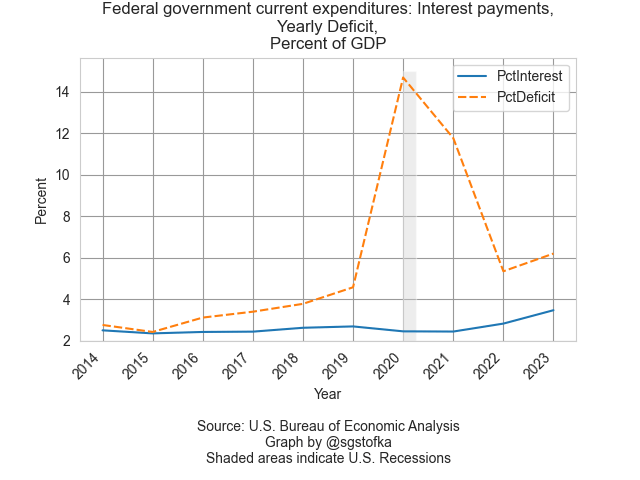
The private economy is not capable of supporting the current social and defense spending at this level of taxation. Neither political party wants to compromise on their priorities and the interest expense on the debt will grow, exacerbating the tensions between both political parties. That interest is now 3.5% of GDP, about the same as defense and Medicare spending. That interest is entirely funded by a deficit. We are borrowing to pay the interest on the debt we have accumulated.

The blue line will continue to rise, pushing the orange line upward as well. The political parties will stay entrenched in their ideological bunkers, creating a daily drama covered by mainstream and social media whose coverage incentivizes posturing rather than compromise. Just as Britain did in the inter-war period a century ago, we are steadily losing resilience, ready to falter at the next crisis.

////////////

Photo by British Library on Unsplash

Notes on social programs: Defense spending is series FDEFX at the FRED database. Medicaid is series W729RC1. Medicare is W824RC1. Each series link is a percentage of GDP.

The Interest Payment Load

November 26, 2023

by Stephen Stofka

This week’s letter is about the federal interest paid on the country’s debt. Why does the U.S. pay more on its debt than other advanced economies? In the second quarter of this year, federal government paid 20% of its revenue in interest, almost three times the average 7.34% percentage of similar countries. High interest payments crowd out spending in other areas. They spark even more debates about the debt itself which is now 120% of GDP. This added interest expense exacerbates animosities in a country that is already fractured by divided perspectives and priorities.

In the second quarter of 2022, before the Fed began to raise rates, the federal government paid 13.6% of its revenues in interest (I/R) to service the debt. That was 6% less than the percentage in 2023 and represented $280 billion, more than twice the $128 billion spent in 2022 for the SNAP (food stamp) program. The higher interest payments, however, were about the same as the 50-year average I/R of 19% (median = 17.8%). In 2021, the 27 countries of the Euro area reported to the World Bank that they paid 3.11% of their revenues in interest (see note below).

Over the past fifty years, the federal government has collected about 20% of GDP in taxes. In the chart below, I have added both averages to the chart of federal interest payments as a percentage of revenue. The average revenue is almost identical to the median so this average is representative of a variety of economic conditions and policy responses over the long term.

As an approximation, the interest expense is 20% of revenue and revenue is 20% of GDP so interest expense has averaged 4% of GDP. However, neither the public nor policymakers are accustomed to average. For two decades, the Fed has kept interest rates low to accommodate economic recovery after the dot-com bust, 9-11, the financial crisis, the slow recovery from that crisis and the Covid-19 pandemic.

The pandemic simulated several critical conditions of a large scale war and the inflation that followed was typical of those inflationary periods following wars. I will cover that in next week’s letter. To curb an accelerating inflation, the Fed began to systematically raise rates from zero in the spring of 2022. In six months it raised rates by 2%, a rapid change that was six times faster than the period from late 2015 to early 2019 when the Fed gradually raised rates by the same 2%. By early 2023, the Fed raised rates an additional 2% within six months.

As a consequence of the higher rates, the government has paid higher interest rates on its debt. (The reasons for that are complex). We have become so accustomed to “easy money” and lower interest rates that the sudden increase in interest payments has caught the attention of both the public and policymakers. Will this further fracture political sentiment ahead of the 2024 elections?

At the beginning of this letter I mentioned divided perspectives and priorities. What are they?  Some give priority to the social programs that promote individual citizen welfare as essential to a general welfare. Their opposition may deride them as socialists but they are more properly called institutionalists because they champion a lot of control and planning by a central government to achieve that welfare. Those who oppose institutionalist policies also care about individual welfare but think that well-intentioned bureaucrats in government can cause more damage to the general welfare than they repair. These might properly be called marketists who believe that the price system distributes resources in an efficient and sustainable manner.  They respond that a centrally planned economy creates moral hazard, rewarding individual needs instead of personal hard work, planning and integrity.

Institutionalists label marketists as capitalists or plutocrats and accuse them of being mean-spirited and driven only by profit and self-interest. Vulnerable communities do not have the resources to help themselves, the institutionalists argue. Marginalized communities need to draw from a central funding pool. They must overcome decades of legal policies that disenfranchised them to benefit other groups. Marketists respond that profits reward people for taking risks. The willingness to accept risk is a key component of technological innovation that benefits all of society.

Interest payments have nudged aside defense spending to become the third largest percentage of federal receipts. The top category is health insurance like Medicare, Medicaid, CHIP and payments under the ACA which take up 30% of federal receipts (see note below). Social Security comes in second. Cuts to either of these programs have been a “hot rail” for conservative politicians. Everyone in Congress talks about cuts to defense spending but not in their district because it supports the local economy. The issue of rising interest payments and the federal debt is a safe one for politicians of both parties to run on in the upcoming election. According to Open Secrets, $14.4 billion was spent on the 2020 election, double the spending of the 2016 election. As candidates complain about excess spending, voters might consider why the major parties will spend about $100 for each of the votes in this coming election (notes below). I would call that excess spending.

//////////////

Photo by Joshua Woroniecki on Unsplash

Keywords: health care, ACA, Social Security, Medicare, defense spending, interest payments

Health Care Note: The health care programs are 24% of the federal budget including deficits, according to an analysis by the Center on Budget and Policy Priorities.

Election Spending: $14,400 million / 160 million voters ≈ $86 per voter in the 2020 election.

World Bank data: https://data.worldbank.org/indicator/GC.XPN.INTP.RV.ZS?end=2021&start=1972&view=chart. You can download an Excel file at https://api.worldbank.org/v2/en/indicator/GC.XPN.INTP.RV.ZS?downloadformat=excel to view interest payments for countries and regions dating back several decades.

Bridge the Gap?

Photo by Ragnar Vorel on Unsplash

September 6, 2020

by Steve Stofka

What issues are your priorities this election? For more than thirty years Pew Research has surveyed people about their priorities. For the first time in 2019 a majority of 765 respondents answered that there is a “great deal” of difference in where each party stands, up from 25% in 1987 (Pew Research, 2020). I’ve included the full list at the end.

In January 2019, soon after the midterm elections Pew surveyed 1500 adults (Jones, 2020). I don’t know why the abortion/free choice debate is not on the issue list since that single issue may decide some voters. I’m particularly interested in the large gaps in those priorities among those who lean Democrat or Republican. I’ll start with gaps of 25%. For instance, terrorism is a concern for 80% of Republicans but only 55% of Democrats. Other Republican priorities are Immigration, the Military and Crime.

As you can see, these are fear issues. Should a person in a town of 2000 be more concerned about terrorism than a resident of NYC? Of course not, but it is what it is. People vote out of fear and hope, but fear probably wins the wrestling match, especially among Republican voters who are not hopey, changey voters, as former VP candidate Sarah Palin noted (Gonyea, 2010).

The issue of crime illustrates the conflicting complexities of these issues. It is a 60% priority for Republicans, who are in suburban and rural areas where there is less crime, and a 40% priority for Democrats, who are in dense urban areas where there is a higher incidence of crime. Because crime is much lower than in past decades, this issue has slipped as a priority for Democrats (FBI, n.d.).  

Two of the highest Democrat priorites – Cimate Change and the Environment – have a huge gap of 50% with Republican voters. Democrat politicians have not been able to make these two fear issues personal for Republicans. If they could, they would draw more voters to their side on this issue. 25% gaps exist on issues of the Poor and Needy, Health Care, Education and Race Relations. Rural Republican voters are more likely to be poor and needy, but this is not a fear issue for them (USDA, n.d.).

What strategy would a politician or political consultant advise? Run toward the base? If so, one would emphasize these issues where there are large gaps between the two primary factions in this country. The President has largely adopted this strategy. Republican voters are more inclined to fall in line and the President is relying on this party loyalty even if they don’t like him personally.

Some issues where there is a smaller gap between factions are the economy, the budget deficit, jobs, global trade, drug addiction, transportation, Social Security and Medicare.

A politician reaching out to voters on the fence in this election would focus on these issues. Joe Biden hits the jobs theme, the budget deficit, and protecting Social Security and Medicare to appeal to voters who have had their fill of the President’s divisiveness.

In the coming two months, candidates may adjust their strategies. In the 2016 election, Hillary Clinton may not have addressed these shared concerns as well and it cost her the election.  Governing comes after winning an election. In politics, winning is packaging the concerns and identities of voters into an appealing, if not attractive, box that will get them to come out and vote.

What are your priorities this election season? Are you a multi-issue voter, a single issue voter, a party voter regardless of the issues? Here’s the Pew survey list of 18 issues: terrorism, immigration, military, crime, climate change, environment, poor and needy, race relations, health care, education, economy, Social Security, Medicare, jobs, drug addiction, transportation, global trade, and the budget deficit.

///////////////

Notes:

FBI. (n.d.). Crime rates in the United States, 2008 – 2018. Retrieved September 05, 2020, from https://crime-data-explorer.fr.cloud.gov/explorer/national/united-states/crime

Gonyea, D. (2010, February 07). ‘How’s That Hopey, Changey Stuff?’ Palin Asks. Retrieved September 05, 2020, from https://www.npr.org/templates/story/story.php?storyId=123462728

Jones, B. (2020, August 26). Republicans and Democrats have grown further apart on what the nation’s top priorities should be. Retrieved September 05, 2020, from https://www.pewresearch.org/fact-tank/2019/02/05/republicans-and-democrats-have-grown-further-apart-on-what-the-nations-top-priorities-should-be/

Pew Research Center. (2020, August 21). Public’s 2019 Priorities: Economy, Health Care, Education and Security All Near Top of List. Retrieved September 05, 2020, from https://www.pewresearch.org/politics/2019/01/24/publics-2019-priorities-economy-health-care-education-and-security-all-near-top-of-list/

U.S.D.A. (n.d.). Rural Poverty & Well-Being. Retrieved September 05, 2020, from https://www.ers.usda.gov/topics/rural-economy-population/rural-poverty-well-being/

A Tug of War

June 7, 2020

by Steve Stofka

Is grandma your enemy? An uncomfortable thought. Different generations have different concerns. Funding a solution to one generation’s problem may take resources from other generations. Grandma wants to protect her Social Security and Medicare. Grandma votes her interests.

The introduction of Social Security eighty years ago marked an extraordinary shift in federal policy. For the first time in the history of this country the government took money from one set of people – those who were younger and working – and gave it to other people. This transfer was not a reward for military service – an old soldier pension – but a reward for getting old.  

During the Great Depression thousands of banks failed and millions of people lost their savings. That crisis called for a solution. Instead of addressing the problem, FDR and a super-majority of congressional Democrats created a permanent program that transferred money from people raising families to retired people. No military or community service required. The combined tax contribution to fund the program was 2%. It is now more than six times that.

In 1965, Democrats again enjoyed a super-majority in Congress and a Democratic President. Never waste a super-majority. There are no checks and balances. They passed the Medicare program, funded by a tax on working families who were ineligible for benefits under the program. In every election, old people vote to keep their benefits, and are the largest demographic of voters (Census Bureau, 2019). 

Younger voters change addresses more often. In dense urban areas with multiple voting districts, they are more likely to have out of date voter registration. Voters in rural districts remain in the same voting district when they move a few miles. Rural voters are predominantly older, white and conservative. In the first half of the 20th Century, rural populations migrated from the farm to the city. Rural voters controlled political power in many states because one rural vote counted far more than one urban vote. In two decisions in the 1960s, the Supreme Court interpreted the Constitution to mean one person, one vote (Mosvick, 2020).

As the children of farmers continued to move away in the last half of the century, rural voters adopted other strategies to control electoral power. Less funding for polling places in urban areas, claims of voter fraud, lifetime restrictions against voting by convicted felons, and locating prisons in rural areas where the prisoners are included in the county’s population, but the prisoners cannot vote. Groups like Judicial Watch initiate hundreds of lawsuits in Democratic leaning counties to invalidate the registrations of many voters (Lacy, 2020).

In 1965, a year after passage of the Civil Rights Act, President Johnson hoped that the newly instituted Medicare program would help stem the defection of Southern voters from the Democratic Party. It didn’t. The Party had successfully stifled the voting power of black people in the south for a century. The 13th, 14th and 15th Amendments which gave black people voting power and citizenship status had been forced on the Southern states after their defeat in the Civil War. Feeling that President Johnson and the party had betrayed them, voters sought a champion who could protect white voting power. 

Richard Nixon became their champion by default. In the 1968 race, the Republican candidate employed a “ southern strategy” that spoke to white voters worried that the recently passed Civil Rights Act would give blacks too much electoral power. In the spring, riots and demonstrations broke out after Martin Luther King’s assassination. At the Democratic Convention that summer, bloody conflicts broke out between Chicago police and anti-Vietnam War demonstrators. Nixon promised to be a law and order President, protecting the “old order,” older Americans and the white rural domination that had been the calling card of the Democratic Party in the South. When leading Democratic candidate Robert Kennedy was assassinated that summer, the party was too disorganized to mount a challenge to Nixon. He won by a convincing margin in the electoral college, but bested Hubert Humphrey by only ½% of the popular vote (Wikipedia, 2020). 9 million voters chose Independent Party candidate George Wallace, who appealed to disaffected conservative Democratic voters in the South (PBS, n.d.).

Some of us have supremacist attitudes, some of us condemn those attitudes. Some of us feel threatened at the sight of a black man and call the police. Some of us understand Black Lives Matter; others don’t. We all understand our point of view a lot better than our neighbor’s. We all want to be believed more than believe.

We grant police the sanctioned use of force but we require temperance in their use of it. Clearly, there are many officers who do not have a tempered behavior. The lie is that it is a few bad apples. Smart phones have become common only in the past decade and there are hundreds of videos of officers acting without restraint. In another ten years, there will be thousands.

 One person, one vote. This country has been engaged in a tug of war since its founding. Regional and generational interests pitted against each other. Rural against urban. Businesses vs workers. City governments vs. workers. States vs. citizens. Decide which end of the rope you are on and pull. Grandma grabs the rope. In every election, a lot of money and effort is spent to prevent people from voting. If you don’t vote you are doing those on the other end of the rope a favor and they thank you.

////////////////////////////

Notes:

Photo by Arnaud Jaegers on Unsplash

Census Bureau. (2019, July 16). Behind the 2018 U.S. Midterm Election Turnout. Retrieved from https://www.census.gov/library/stories/2019/04/behind-2018-united-states-midterm-election-turnout.html

Lacy, A. (2020, May 28). Right-Wing Groups Aims to Purge 800,000 Voters in Pennsylvania. Retrieved from https://theintercept.com/2020/05/28/pennsylvania-voter-rolls-purge-judicial-watch/

Mosvick, N. (2020, March 26). On this day, Supreme Court reviews redistricting. Retrieved from https://constitutioncenter.org/interactive-constitution/blog/on-this-day-supreme-court-reviews-redistricting.  Also, see Stahl, 2015.

PBS. (n.d.). Thematic Window: The Election of 1968. Retrieved from https://www.pbs.org/johngardner/chapters/5a.html

 Stahl, J. (2015, December 7). Baker v. Carr: The Supreme Court gets involved in redistricting. Retrieved from https://constitutioncenter.org/blog/baker-v-carr-the-supreme-court-gets-involved-in-redistricting

Wikipedia. (2020, June 06). 1968 United States presidential election. Retrieved from https://en.wikipedia.org/wiki/1968_United_States_presidential_election

Marching Forward

April 28, 2019

by Steve Stofka

When former President Obama took the oath of office, the economy was in the worst shape since the Great Depression 75 years earlier. Tax receipts plunged and benefit claims soared. Millions of homes and thousands of businesses fell into the black hole created by the Financial Crisis. In sixteen years of the Bush and Obama presidencies, the country added $16 trillion to the public federal debt, more than tripling the sum at the time Clinton left office in early 2001.

Although growth has remained slow since the financial crisis (see my blog last week), the economy has not gone into recession. Despite the fears of some, a recession in the next year does not look likely. The chart below charts the annual percent change in real GDP (green) against a ratio called the M1 money multiplier, the red line (Note #1). Notice that when the change in GDP dips below the money multiplier for two quarters we have been in recession.

The money multiplier seems to act like a growth boundary. While some economy watchers have warned of an impending recession, GDP growth has been above 2.5% for more than a year and is rising. In 2018, real disposable personal income grew nearly 3%. This is not the weak economic growth of 2011 or the winter of 2015/16 when concerns of recession were well founded.

The number of people voluntarily quitting their job is near the 1999 and 2006 highs. Employees are either transferring to other jobs or they feel confident that they can quickly get another job. An even more important sign is that this metric has shown no decline since the low point in August 2009.

In 2013, the Social Security disability fund was in crisis and predicted to run out of money within a decade. As the economy has improved, disability claims have plunged to all-time lows and the Social Security administration recently extended the life of the fund until 2052 (Note #2).

Approximately 1 in 6 (62 million) Americans receive Social Security benefits and that number is expected to grow to 78 million in a decade. However, the ratio of workers to the entire population is near all time highs. The number of Millennials (1982-1996) has surpassed the number of Boomers. This year the population of iGen, those born after 1996, will surpass the Millennial generation (Note #3). Just as a lot of seniors are leaving the work force, a lot of younger workers are entering. The ratio of worker to non-worker may reach 1 to 1. 45 years ago, one worker supported two non-workers.

As the presidential cycle gets into gear, we will hear claims that there are not enough workers to pay promised benefits. Those claims are based on the Civilian Employment Participation Rate, which is the ratio of workers to adults. While the number of seniors is growing, the number of children has been declining. To grasp the total public burden on each worker, we want to look at the ratio of workers to the total population. As I noted before, that is at an all time high and that is a positive.

Raising a child is expensive. The average cost of public education per child is almost $12K (Note #4).  Public costs for housing, food and medical care can push average per child public cost to over $20K annually.

Let’s compare to public costs for seniors. The average person on Social Security receives $15,600 in benefits (Note #5). In 2018, the Medicare program cost an average of $10,000 per retiree (Note #6). The public cost for seniors is not a great deal more than those for children.

As a society, we can do this.

/////////////////

Notes:

  1. The M1 money multiplier is the ratio of cash and checking accounts to the amount of reserves held at the Federal Reserve.
  2. SSDI solvency now extended to 2052. Here’s a highlight presentation of the trustee’s report.
  3. Generation Z will surpass the numbers of Millennials in 2019. Report
  4. Public education costs per pupil
  5. Social Security costs
  6. Medicare program cost $583 billion. There are approximately 60 million on the program. CMS

The Green Divide

March 24, 2019

by Steve Stofka

Half of the country’s voters live on 80% of the land, which the political analysts color red. Half of voters live on the remaining 20% of land, which is colored blue. The needs, values and outlooks of those in the red are not the same as those in the blue. As the country’s population continues to migrate from rural to metropolitan areas, the country becomes ever more divided. As economist Paul Krugman wrote this week, no one knows how to fix the continuing economic decline in rural areas (Note #1).

A person’s views on an issue may depend on the state they live in. In the past several decades, immigration has had much more impact on California and the southern states. In 1980, 15% of California’s population was foreign born, almost four times the national average of 4.3%. In 2015, that share had doubled for both California and the nation as a whole. However, the national average is only a third of California’s numbers (Note #2). How does the nation adopt a single policy toward immigration when there are such differences in circumstances?

Regardless of our different experiences and outlooks, we are dependent on each other. 20% of Americans are on the Social Security and Medicare programs (Note #3). 24% are on CHIP and Medicaid (Note #4). 40% of the two million farms in America receive subsidies (Note #5). The transfers of money between Americans has reached 14% of GDP.

TransfersPctGDP

In 1962, Ronald Reagan took a stridently conservative tone when he warned that the Medicare program being developed in the Democratic Congress would lead to socialism and the destruction of American democracy (Note #6). Having married into wealth, he could afford a dramatic interpretation of social policy. Few Americans hold such extreme views today (Note #7).

The reasonable arguments of today might look oppressive to future generations, and progressive ideas seem natural to our descendants. Our ancestors had different views toward slavery, racism, voting rights and social programs than we have today. What has not changed is our distrust of those we regard as “other,” and our desire to make our principles universal for our fellow Americans. We want everyone to play by our rules, or our interpretation of the rules.

In the debates on the ratification of the US Constitution, some asked what the terms “provide for the …general welfare” meant (Note #8). Was the new government to become a national charity? The Federalists argued for the inclusion of the term to give the government a degree of latitude in changing circumstances. The anti-Federalists argued that this new government would eventually become the home of beggars and lobbyists wanting to promote their own welfare as the “general welfare.” In the past century, the phrase has become a constitutional bedrock of Supreme Court precedent underlying social programs. A person could argue that the size of social welfare spending and the extraordinary power of lobbyists in Washington has proven the anti-Federalist’s case.

America is the land of debate because the Constitution was structured to promote debate. While Americans had a platform to argue with each other, it was hoped that there would be less bloodshed, rebellion, and dictatorship (Note #9). Some days we might be less sure of that premise. As the circumstances of urban and rural America diverge further, we will struggle ever more to reach consensus. Each side will feel the need to impose its will on the other.  As we debate these issues, we should be just as careful of our own instincts as we are about the instincts of those on the other side of the debate.

////////////////////////

Notes:

1. Krugman op-ed on lack of solutions for the economic decline in rural America
2. Four decades of immigration numbers – pdf page 6
3. 62 million Americans on Social Security and Medicare – numbers here
4. 74 million Americans on CHIP and Medicaid – numbers here
5. 39% of 2.1 million farms receive agricultural subsidies
6. Reagan warns against Medicare
7. During the debate before the passage of Obamacare, some Tea Party members advocated a return to the days when we just let old people die.
8. U.S. Constitution, Section 8.1 “provide for the common Defence [sic] and general Welfare of the United States” http://constitutionus.com/
9. Former colonies of Great Britain have struggled with free speech issues. South Africans has only had freedom of expression for twenty years . Canada still does not have complete freedom of speech


Grandma’s Kids

May 27, 2018

by Steve Stofka

The birth rate has touched a 30-year low, repeating a cycle of generational boom and bust since World War 2. The first boom was the Boomer generation born in the years 1946-1964 (approx). They were followed by the baby bust Generation X, born 1964-1982. The Millennials, sometimes called Generation Y and born 1982 – 2001, surpassed even the Boomers in numbers. Based on the latest census data, Generation Z, born 2002- 2020, will be another low birth rate cohort.

These numbers matter. They form the population tide that keeps the entitlement system afloat. Social Security and Medicare are “pay as you go” systems. Older generations who receive the benefits depend on taxes from younger generations for those benefits. As the population surge of Boomers draws benefits, the surge of Millennials is entering their peak earning years.

To maintain a steady population level, each woman needs to average 2.1 births. During the Great Recession, the birth rate for native-born Hispanic and Black women fell below that replacement level. White and Asian women fell below that level during the recession following the dot-com boom in the early 2000s. Foreign born Hispanic and Black women are averaging a bit more than 2-1/2 births. The average of foreign born White and Asian women is just about replacement rate.

Around the world, birth rates are falling. Social welfare programs depend on inter-generational transfers of income. When a smaller and younger generation must pay for a larger and older cohort, there is an inevitable stress.

I will distinguish between social welfare programs and socialist welfare programs with one rule: the former require that a person pay into the program before being entitled to the benefits from the program. In this regard, they are like insurance programs except that private insurance policies are funded by asset reserves held by an insurance company. Government “insurance” programs are “pay as you go” systems. Current taxes pay for current benefits. The Social Security “reserve” is an accounting fiction that the Federal government uses to track how much it has borrowed from itself.

Examples of social welfare programs that require the previous payment of dues are: Social Security, Medicare, Unemployment and Workmen’s Compensation Insurance. Although the latter two are paid directly by employers, they are effectively taken out of an employee’s pay by reducing the wage or salary that the employer pays the employee. Employers who fail to understand this go out of business early in the life of the business. I have known some.

Examples of socialist welfare programs that are based on income, or need: Medicaid, TANF (Welfare), WIC, Food Stamps, Housing and Education Subsidies. There is no requirement that a person pays “dues” into a specific program before receiving benefits.

Health care in America is primarily a social welfare program with socialist elements. The Federal government does subsidize all employer provided health insurance and most private insurance through the tax system or the Affordable Care Act. However, most beneficiaries must pay some kind of insurance to access benefits. Under the 1986 EMTALA act, emergency rooms are notable exceptions to this policy. They are required to treat, or medically stabilize, all patients insured or not.

As Grandma begins to draw benefits from Social Security and Medicare, she relies on the earnings of her kids who form the core work force aged 25 – 54. Grandma has paid a lifetime of dues into the social welfare programs and wants her benefits. Grandma votes.

Her grandkids want government subsidies for educational needs and job training. They depend on socialist welfare programs with no dues. The grandkids don’t vote.

The kids are caught in a generational squeeze.  Their taxes are paying for both their parent’s benefits and their kid’s benefits.

/////////////////////////

Housing Trends

In the spring of 2008, there was an eleven month supply of existing homes on the market.
2010 – 8-1/2 months
2012 – 6-1/2 months
2014 – 5-1/2 months
2016 – 4-1/2 months
2018 – 4 months

In some cities, a median priced home stays on the market less than 24 hours.

Here is another generational shift.  Grandma and Grandpa now own 40% percent of home equity, up from 24% in 2006. Their kids, the age cohort 45 – 60, own 45%. Those under 45 have only 14% of home equity, down from 24% in 2006.

//////////////////////

Brave New World

E-Commerce is now 9.5% of all retail sales, almost triple the percentage ten years ago. (Fed Reserve series ECOMPCTSA). In 2000, the percentage was less than 1%.

Our Legacies

April 29, 2018

by Steve Stofka

Each generation bequeaths the benefits and costs of legislative programs to the following generations.  In the past one hundred years, Democrats have secured a dominant majority in the Congress three times. A dominant majority is one where one party controls the Presidency and both houses of Congress with a filibuster proof majority of sixty in the Senate (History of Shifting Political Power).

Each time, the Democrats have created an entitlement program, a legacy structured so that it would be difficult to undo when Democrats were out of power.  Under FDR in the 1930s, the Democrats created Social Security. Like all entitlement programs, coverage and benefits were expanded in the first ten years after creation of the program.

In the 1960s, LBJ and the Democrats created Medicare and Medicaid. Before these programs, the Federal government paid 11 cents of every health care dollar. In 2013, that 11 cents had grown to 26 cents (CMS history PDF).  As with Social Security, coverage and benefits were greatly expanded the first decade after creation. In 1960, the U.S. spent 5.1 cents for every $1 of GDP. OECD countries spent only 3.7 cents. By 2013, Americans spent 16.4 cents of each $1 of GDP, twice as much as the 8.7 cents spent by OECD countries.

For fifty years, the annual growth of health care spending was 50% more than the growth rate of the economy.  With a dominant majority after 45 years, Obama and the Democrats tried to pass single payer health care in 2009. Democratic politicians in conservative leaning districts balked at the idea. Obamacare was a compromise solution that has been compared by opponents and advocates alike to a Frankenstein contraption of legislation that needs to be fixed. Expansion was embedded in the legislation from the start through the Medicaid program.

When the BLS and Census Bureau compute the Consumer Price Index (CPI), a measure of inflation, they consider the shifting patterns of consumer spending. Since 2000, the Medical spending component of the CPI has doubled its share of the index to about 17%. Increased medical spending is affecting most American families. Regardless of one’s opinion of the solution, Obamacare was a compromised attempt to deal with this trend.

The American health care system is like the 50-year old cars in Cuba that have been patched together with duct tape and ingenuity. The system runs on policy payoffs to stakeholder groups and it will fail most of us because it cannot adapt to the extraordinary advancements in medical care. As technological changes accelerate in the coming decades, this cobbled together system born of World War 2 wage and price controls will grow ever more unwieldy.

Entitlement programs invariably cost a lot more than the designers calculate. Program benefits are easier to sell to voters than raising the funds to pay for them. Following December’s tax reform bill, the non-partisan Congressional Budget Office revised their ten year budget and deficit estimates.

For the past fifty years, the Federal government has collected an average of $17.40 for every $100 of GDP.  The CBO projects Fed revenue will be over $18.00. Here’s the problem: the Federal government has been spending $20.30, almost $3 more than it collects. That’s how the country has run up a debt of $20 trillion. It’s about to get worse. Because of increased Medicare and Medicaid spending, the CBO projects spending will increase to $22.40 for every $100 of GDP. A $3 shortage will soon turn to a $4 shortage. The interest on that steadily increasing debt? By 2023, almost $3, a sixth of what the government collects and more than the defense budget.

Nations can not declare bankruptcy.  Instead, they become failed states and descend into anarchy.  Venezuela has become a failed state and its people are fleeing the country.  Most of the institutions have failed.  Most of the daily necessities of life are in short supply. The government claims that it doesn’t even have the paper to print exit Visas.  Under the Maduro government, truth was the first to abandon the country.

The economy is strong yet Chapter 11 bankruptcy filings have reached the same level as April 2011 when there was talk of another recession. That year, the unemployment rate was still above 9% and housing starts remained at all-time lows. Then-President Obama and Republican House Majority Leader John Boehner battled over a budget compromise and the stock market dropped nearly 20%. In a strong economy like today, we should have lower levels of bankruptcy.