A Home Is a Magic Wallet

April 7, 2024

by Stephen Stofka

In this week’s letter I will explore the various roles that housing plays in our lives. Last week I showed the divergence of household formation and housing supply during the financial crisis. Home builders responded to the downturn in household formation by building fewer homes. Because the recovery after the crisis was slow, the demand for housing did not pick up until 2014. It is then that a mismatch between housing demand and supply started to appear in the national and some local home price indices. This week I will examine the demographics of homebuyers and sellers in recent history and the secret life of every homeowner as a landlord. A home is a magic wallet where money flows come and go.

Data from the National Association of Realtors (NAR) indicates that the median age of home sellers has increased from 46 to 60 since 2009. I will leave NAR data sources in the notes. In the four decades between 1981 and 2019, the median age of home buyers rose by twenty years, from 36 in 1981 to 55 in 2019. The median age of first-time buyers, however, increased by only four years, from 29 to 33. In 1981, the difference in age and accumulated wealth between first-time buyers and all buyers was only seven years. Now that difference has grown to 22 years. First-timers typically buy a home that is 80% of the median selling price of all homes.

In the past four decades, there has been a divergence in wealth between older and younger households. The real wealth of younger households has declined by a third since 1983 while households headed by someone over 65 have enjoyed a near doubling of their real wealth in thirty years. Accompanying that imbalance in growth has been a shift in capital devoted to housing.

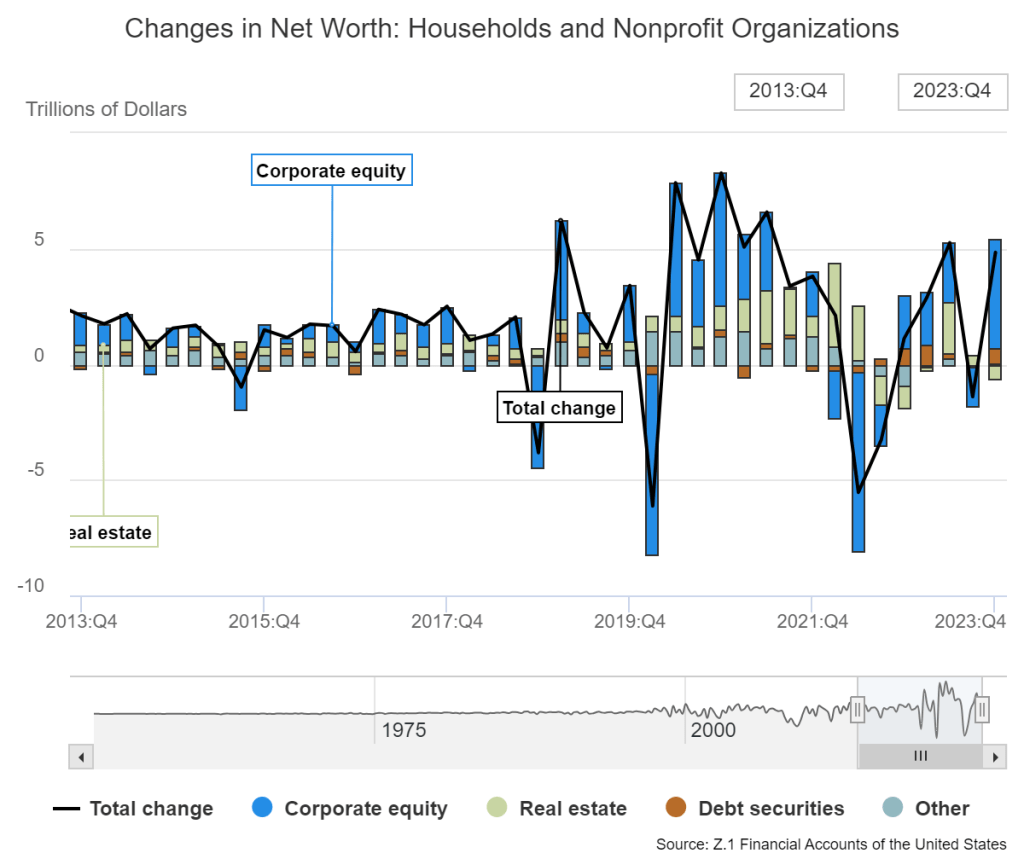
The Federal Reserve regularly updates their estimates of the changes in household net wealth. The link is an interactive tool that allows a user to modify the time period of the data portal. The chart below shows the most recent decade of changes in wealth. The lighter green bars are the changes in real estate wealth for households and non-profits and show the large gains in real estate valuations during the pandemic. The blue bars represent equity valuations and demonstrate the volatility of the stock market in response to any crisis, large or small.
The Fed’s data includes various types of debt as a percent of GDP. Twenty years ago, household mortgages were 11-12% of GDP. Today they are 19% of GDP, a huge shift in financial commitment to our homes and neighborhoods. A city average of owner equivalent rent (FRED Series CUSR0000SEHC) averaged an annual gain of 2% during Obama’s eight- year term, 2.8% during Trump’s term, and 6% during the first three years of Biden’s term. Biden has little influence on trends in housing costs, but the art of politics is to use correlation as a weapon against your opponent. People feel the change in trajectory as a burden on their households.

The Bureau of Labor Statistics calculates owner equivalent rent by treating a homeowner as both a landlord and renter. Property taxes, mortgage payments, interest, maintenance and improvements to a home are treated as investments just as though the owner were a landlord. The BLS uses housing surveys to determine the change in rental amounts for different types of units. A sample of homeowners are asked how much they would rent out their home but this guess is used only to establish a proportion of income dedicated to rent, not the actual changes in the rental amounts for that area, as the BLS explains in this FAQ sheet.

Let us suppose that a homeowner has a home that is fully paid for. If the house might rent for $2000 a month and monthly expenses are $500 a month, that would represent $1500 per month in implied net operating income for that homeowner, an annual return of $18,000. A cap rate is the amount of net operating income divided by the property’s net asset value. If similar homes are selling for $450,000 in that area, the homeowner is making 4% on their house’s asset value, slightly less than a 10-year Treasury bond (FRED Series DGS10, for example).

Long-term assets compete with each other for yield, relative to their risk. A property is a riskier investment than a Treasury bond, so investors expect to earn a higher yield from a property. Before the pandemic, 10-year bonds were yielding between 2-3%. Landlords could charge lower rents and still earn more than Treasury bonds. As yields rose for Treasury bonds, property investors must charge higher rents to earn a yield appropriate to the risk or sell the property and invest the money elsewhere.

When we own an asset that provides an income, it is as though the asset owes us. When a home declines in value, we feel a sense of loss. When the housing market turned down in 2007-2008, homeowners expected to get a similar price as the house their neighbor sold in 2006. They used that sale price to determine what their house owed them. In order to get the listing, a real estate agent would agree to list the home for that higher amount, but the property would get few offers. After a period of time, the seller would cancel the listing and wait for the “market to turn around.”

Earlier I noted the dramatic rise in mortgage debt as a percent of GDP. At one-fifth of the economy, that debt represents capital that is not being put to its most efficient use because most homeowners do not regularly evaluate the yield on their homes as professional investors. A higher percent of capital devoted to housing will help sustain higher housing costs and pressure household budgets. I worry that an inefficient use of capital will contribute to a pattern of lower economic growth in the future, stifling income growth. The combination of these two pressures will make it difficult for younger households to thrive. The generational gap will widen, adding more social and political discord to our national conversation.

/////////////////

Photo by Towfiqu barbhuiya on Unsplash

Keywords: mortgage, housing, owner equivalent rent

Notes on median age of sellers: 2009 data is from the NAR and cited in a WSJ article (paywall). Current data is from the NAR FAQs sheet. Jessica Lautz, an economist with NAR, reported the four-decade trend in home buyers. Median home prices of first-time buyers is from a 2017 analysis by the NAR. The comparison of older and younger households comes from a 2016 NAR analysis.

Notes on Federal Reserve data:  The change in mortgage debt as a percent of GDP is in the zip file component z1-nonfin-debt.xls, in the column marked “Noncorporate Mortgages; Percent of GDP.”

Commercial Mortgages

April 25, 2021

by Steve Stofka

They’re at it again. Thirteen years ago, the financial crisis originated in RMBS, residential mortgage-backed securities. Now banks and investment companies have been packaging CMBS, mortgage-backed loans on office and retail space, not residential, properties. Most of these loans are backed by or facilitated by the Small Business Administration and other government agencies. Who will pick up the tab when some of these loans default because of the pandemic? The same people who picked up the tab for the financial crisis – taxpayers. Even if the direct cost of bailouts is repaid, the loss of economic output and incomes is a crushing blow to many Americans.

Next month, the Federal Reserve will release its semiannual Financial Stability Report a comprehensive examination of the assets and lending of America’s financial institutions. Their last report in November 2020 was based on nine months of data, six months after Covid restrictions began. Concerning the Fed were several trends that were far above their long-term averages.

High yield bonds and investment grade quality bonds were almost double long-term trend averages (Fed, 2020, p. 17). High-yield bonds are issued by companies with low credit quality. Well established companies with good credit issue bonds rated investment grade. These are attractive to pension funds and life insurance companies who need stability to meet their future obligations to policy holders. Many companies took advantage of low interest rates during the Covid crisis. 60% of bank officers reported relaxing their lending standards; that same practice preceded the financial crisis in 2008. Will we eventually learn that commercial property evaluations were overvalued, just as house prices were generously valued before the financial crisis?

Many commercial mortgages are backed by commercial real estate (CRE) and packaged into CMBS, commercial mortgage-backed securities. The Fed noted that “highly rated securities can be produced from a pool of lower-rated underlying assets” (p. 51). This was the same problem with residential mortgages. CMBS are riskier than residential mortgages and delinquencies on these loans have spiked (p. 27). The Fed devoted most of their TALF (below) program in 2020 to CMBS (p. 16). 

Before the election last year, more than 70% of those surveyed by the Fed listed “political uncertainty” as their #1 concern (p. 68). 67% listed corporate defaults, particularly small to medium sized businesses. Respondents were from a wide range of America, from banking to academia. Only 18% of respondents were concerned about CMBS default. Simon Property Group (Ticker: SPG), the largest commercial real estate trust in the U.S. fell by almost 50% last spring. Although it has recovered since then, its stock price is still 20% below pre-pandemic levels.

Who thinks that the market for commercial space, retail and office, will return to pre-pandemic levels? Vacancy rates have improved, but even hot markets like Denver have a 17% direct vacancy rate (Ryan, 2021), near the 18% vacancy rate during the financial crisis, and far above the 14% during a healthy economy. 25% of space in Houston, Dallas and parts of the NY Metro area is vacant.

The stock market is convinced that the economy will come roaring back. In total, investors may be right but I think there will be some painful adjustments in the next year or two. The Covid crisis has diverted the habits of people and companies into new channels, and the market has not priced in that semi-permanent diversion. I would rather not wake up to another morning like that one in September 2008 when we learned that the global financial world was on the brink of disaster. I hope that the Fed report released in a few weeks will show a decrease in some of these troubled areas.

/////////////

Photo by John Macdonald on Unsplash

TALF – Term Asset Backed Securities Loan Facility

Federal Reserve System (Fed). (2020 November). Financial Stability Report. Retrieved from https://www.federalreserve.gov/publications/files/financial-stability-report-20201109.pdf. (Page numbers cited in the text are the PDF page numbering, six pages greater than the page numbers in the report).

Ryan, P. (2021, April 20). United States Office Outlook – Q1 2021, JLL Research. Retrieved April 24, 2021, from https://www.us.jll.com/en/trends-and-insights/research/office-market-statistics-trends

Personal Debt

April 15, 2018

by Steve Stofka

Until the financial crisis, I thought that other people’s debt was their problem. In 2008, debt became a nation’s problem and a national conversation with two aspects – the moral and the practical. Moral conversations are not confined to church; they drive our politics and policy. Many laws contain some language to contain moral hazard, which is the danger that language loopholes in a law or policy promote the opposite of the intended effect of the law. This is particularly true of many entitlement policies. Let’s leave the moral conversation for another day and turn to the practical aspects of current policy.

Bankers learned their lesson during the financial crisis, didn’t they? Maybe not. A decade of absurdly low interest rates has starved those who depend on the income earned by owning debt. Even a savings account is money loaned to a bank, a debt that the bank must pay to the account holder. In their hunger for income, investors have turned to less prudent debt products. So long as the economy remains strong, no worries.

A fifth of conventional mortgages are going to people whose total debt load, including the mortgage, is more than 45% of their pre-tax income. By comparison, at the market’s exuberant peak in late 2007, 35% of conventional mortgages were going to such households, who were especially vulnerable when monthly job gains turned negative in early 2008.

The real estate analytics firm Core Logic also reports that Fannie Mae has started backing mortgages to those with total debt loads up to 50%. FICA, federal, state and local income taxes can amount to 25% of a paycheck (Princeton Study). Add in 45% of that gross pay for mortgage and debt payments, and there is only 30% left for food, gas, home repairs and utilities, child care, etc.

I’ll convert these percentages to dollars to illustrate the point. A couple grossing $80,000 might have a take home pay of $60,000. The couple has $36,000 in mortgage and other debt payments (45% of $80,000). They have $24,000, or $2000 a month for everything else. This couple is vulnerable to a change in their circumstances: a layoff or a cut back in hours, some unexpected expense or injury.

For those who get a conventional loan despite their heavy debt load, where is the money coming from? Banks suffered huge losses during the financial crisis. The Federal Reserve tightened capital requirements for banks’ loan portfolios, forcing them to improve the overall quality of their debt. As a result, banks turned away from their most lucrative customers – subprime borrowers and those with heavy debt loads who must pay higher interest on their loans. Profits in the financial industry fell dramatically. A broad composite of financial stocks (XLF) has still not regained the price levels of 2007.

The banking industry employs some very smart people. What solution did they create? The big banks now loan money to non-financial companies who loan the money to subprime borrowers. After bundling the consumer loans into securities, the non-financial companies use the proceeds to pay the big banks back. In seven years this kind of borrowing has expanded seven times to $350 billion. Doesn’t this look like the kind of behavior that almost took down the financial system in 2008? The banks say that this system isolates them from exposure to subprime borrowers. If large scale job losses cause a lot of loan defaults, it is the investors who will bear the pain, not the banks. Same song, different lyrics.

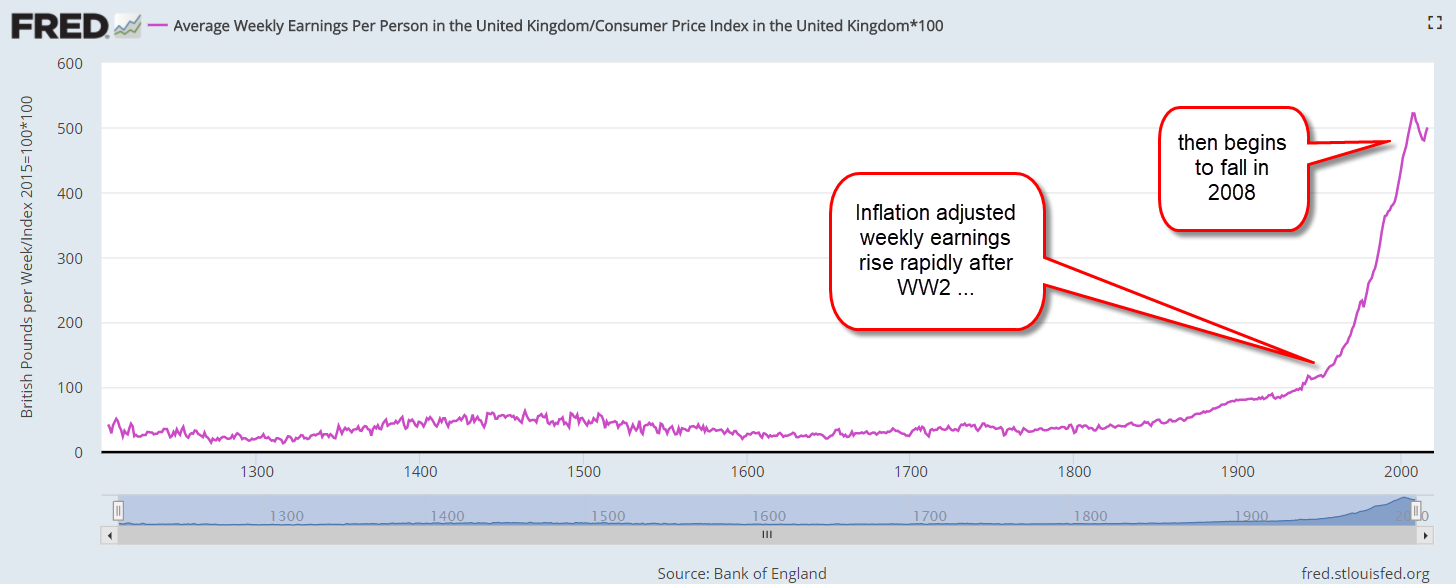
The 2008 financial crisis is best summed up with a chart from the Federal Reserve. In the post WW2 economy, the weekly earnings of British workers rose steadily. The growth is especially strong when compared to the earlier decades of the 19th and 20th centuries. In 2008, earnings peaked.
WeeklyEarnUK

Developed countries depend on the steady growth of tax receipts generated by weekly earnings. An assumption of 3% real GDP growth underlies the health and continuation of post-war social welfare policies. For more than a decade, the U.S. and U.K. have had less than 2% GDP growth.  Both governments have had to borrow heavily to fund their social support programs.  How long can they increase their debt at such a rapid pace?

I am reminded of a time more than 40 years ago when New York City held a regularly scheduled auction to sell  bonds to fund their already swollen debt load.  None of the banks showed up to bid for the bonds.  The city is the financial center of the world.  The lack of interest stunned city officials.  To avoid a messy bankruptcy, the city turned to the Federal government for a loan (NY Times).

The Federal government is not a city or state, of course. It has extraordinary legal and monetary power, and its bonds are a safe haven around the world.  But there could come a time when investors demand higher interest for those bonds and the rising annual interest on the debt squeezes spending on other domestic programs.

Debt causes stress.  Stress causes anxiety.  Anxiety weakens confidence in the future and causes investment to shrink. Falling investment leads to slower job growth. That causes profits and weekly earnings to fall which reduces tax receipts to the government.  That increases debt further, and the cycle continues.  Other people’s debt is everyone’s problem after all.

Then and Now

January 25, 2015

Valuation

Blogger Urban Carmel has written a thorough article on current market valuation, focusing on Tobin’s Q as a metric.  This is the market price of equities divided by the replacement cost of the companies themselves.  During the past 65 years, the median ratio is .7, meaning that the market price of all equities is about 70% of the replacement cost.  At the end of December, the Tobin’s Q ratio was more than 1.1.

Are stocks overvalued?  Valuing the replacement cost of a company might have been more accurate when the assets were primarily land, factories and other durable equipment.  Today’s valuations consist of networks, processes, branding, and other less easily measured assets.  The valuation discussion is not new.  In 1996, before the U.S. shed much of its manufacturing capacity, economists and heads of investing firms argued about valuation, including Tobin’s Q.  You can punch the way back button here and read a NY Times article that could have been written today if a few facts were changed.

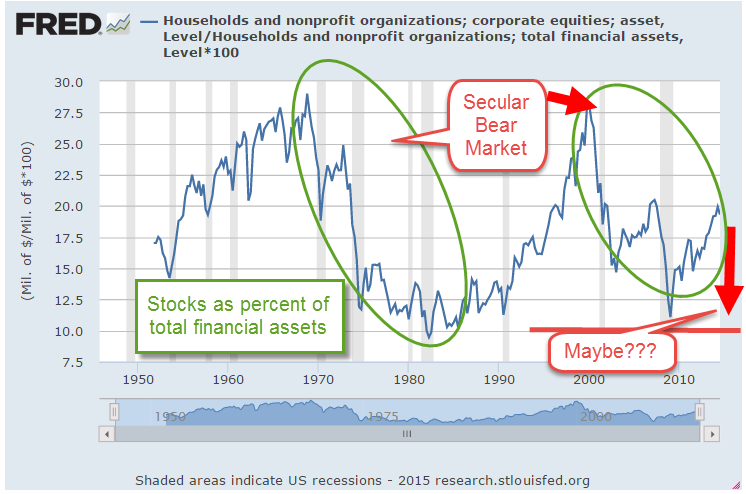
Currently, households have 20% of their financial assets in stocks, the same percentage as in 1996.  In December 1996, then Federal Reserve chairman made a comment about “irrational exuberance”  in market valuations.  Prices would continue to rise, then soar, before falling from their peaks in mid-2000.  At that peak, households held 30% of their financial assets in stocks.  At an earlier peak, 1968, households had the same high percentage of their assets in stocks.

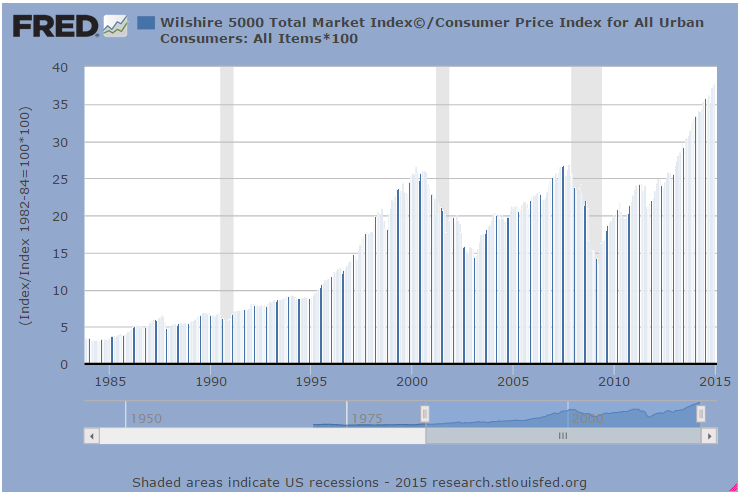
On an inflation adjusted basis, the SP500 has only recently closed above the all time high set in 2000 (Chart here).  The Wilshire 5000 is a market capitalization index like the SP500 but is broader, including 3700 publicly traded companies in its composite. On an inflation adjusted basis this wider index is 40% above the peaks of 2000 and 2007.

Long term periods of optimistic market sentiment are called secular bull markets. Negative periods are called secular bear markets. (See this Fidelity newsletter on the characteristics of secular bull and bear markets).   These long-term periods are easier to identify in hindsight.  Some say that we are nearing the end of a long-term bear market, and that there willl be a big market drop to close out this bearish period.  There have been so few long term market moves in 150 years of market data, that it is possible to tease out any pattern one wants to find.  The aggregate of investor behavior is not a symphony, a piece of music with defined structure and passages.

******************************

REIT

As Treasury yields decline, mortgage rates continue to fall.  The Mortgage Bankers Association reported  that their refinance application index had increased by 50% from the previous week.  The refinancing process involves the payoff of the previous higher interest mortgage.  Mortgage REITs make their money on the spread, or the difference, between the interest rate they pay for money and the interest on loaning that money on mortgages.  When a lot of homeowners prepay their higher interest mortgages, that lowers the profits of mortgage REITs like American Capital Agency (AGNC) and Annaly Capital Management (NLY).  Both of these companies have dividend yields above 10% and are trading below estimated book value.

*****************************

Housing

Back in ye olden days, around 1950, the world was a bit different.  The Bureau of Labor Statistics published a snapshot of incomes, housing, and other census data, including the data tidbit that people consumed fewer calories in 1950 than today, 3260 then vs. over 3700 today.

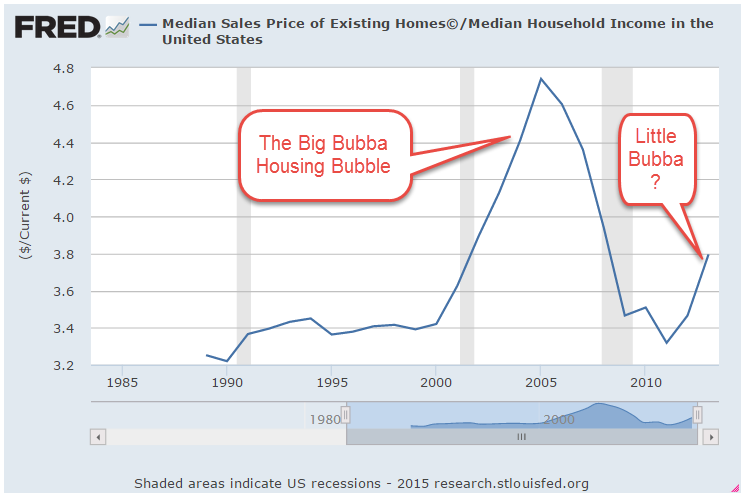
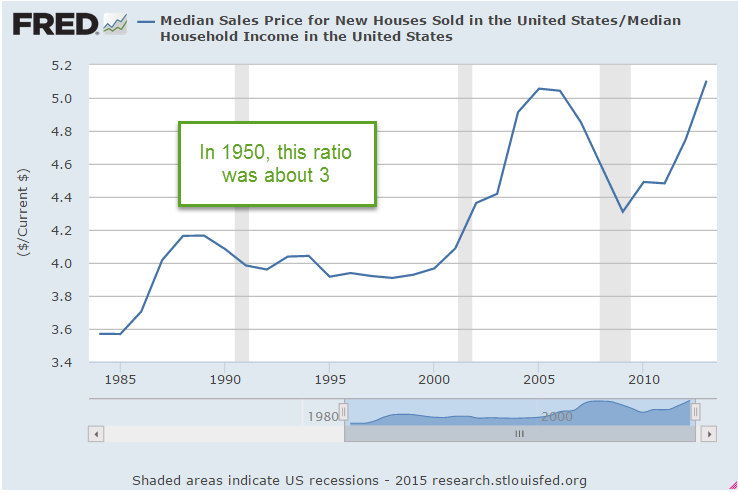
Housing and utilities averaged 27% of income in 1950 vs. 40% today.  Food costs were 33% then, 15% today.  The median house price of $9500 was about 3 times the median household income (MHI) of $3200.  For most of the 1990s, the prices of existing homes were slightly higher, about 3.4 times MHI.

The prices of existing homes rose 6% in 2014 – healthy but not bubbly.  However, the ratio of median price to median income is now at 3.8.  Historically low interest rates have enabled buyers to leverage their income to get more house for their bucks, but the lack of income growth will continue to rein in the housing market.

The ratio of median new home prices to MHI has now surpassed the peak of the housing bubble.

*******************************

Retirement Income

Wade Pfau is a CFA who has written many a paper on retirement strategies and occasionally blogs about retirement income.  Here is an excellent paper on the change in psychology, risk assessment and strategies of people before and after retirement.  Wade and his co-author summarize the critical issues, the two dominant withdrawal approaches, the development of the safe withdrawal rate, and the caveats of any long term planning.  The authors review the strategies of several authors, discuss variable spending rules, income buckets and income layering,  annuities, and bond ladders.  You’ll want to curl up in an armchair for this one.

The Great Moderation

June 30th, 2013

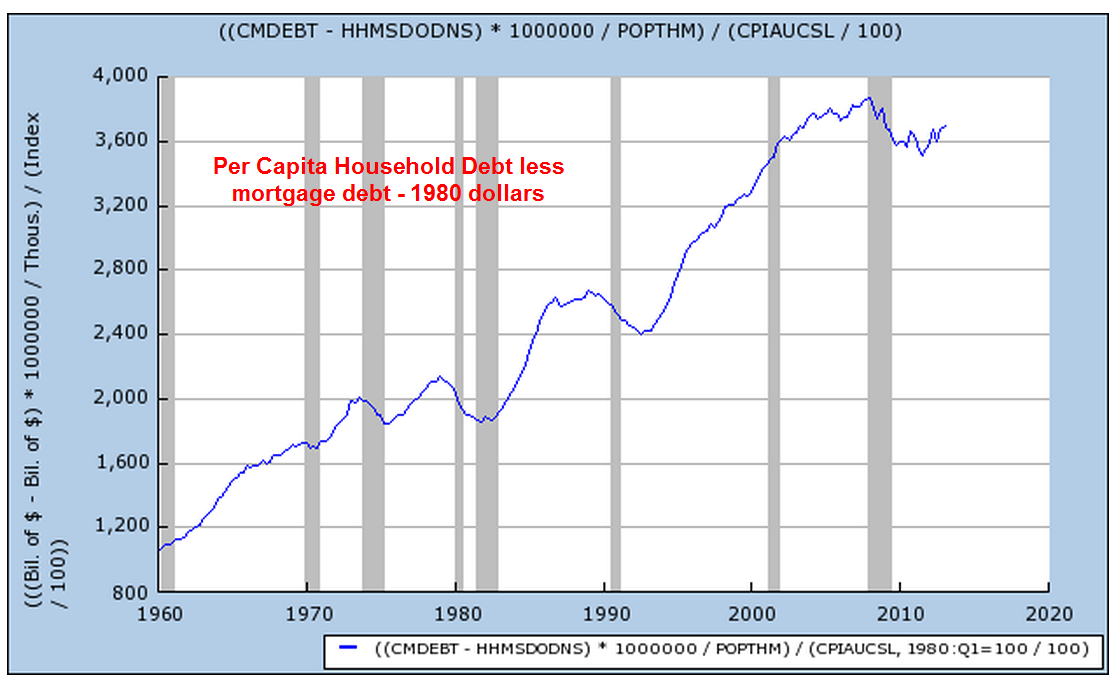
Economists cite a number of factors to account for the growth during the 1980s and 1990s, a period some call the “Great Moderation” because it is marked by more moderate policies by politicians and central bankers.  Causes or trends include less regulation, lower taxes, lower inflation than the 1970s, the rise of emerging economies,  and a more consistent rules based monetary policy by the Federal Reserve.  Often underappreciated, but significant, was the huge increase in consumer credit. Household spending accounts for 2/3rds of the economy.  A new generation, the boomers, emerging fully into adulthood in the early ’80s, welcomed the broader availability of credit.  Like their parents, the boomers took on the burden and responsibility of owning a home, the largest portion of a household’s debt load, but unlike the previous generation, the boomers sucked up as much credit as they could get for cars, clothes, vacations, home furnishings and the growing array of electronic devices.

When we look at the non-mortgage portion of household debt, the rate of growth is more restrained – a mere 80% increase in per capita real dollars.

The parents of the boomer generation, dubbed by newscaster Tom Brokaw as the “Greatest Generation”,  had been habitual savers.  By 1980, the personal savings rate was about 10% of disposable income.  By the middle of that decade, the Greatest Generation began retiring and withdrawing some of that savings.  Their children, the boomers, did not have a similar sense of frugality.

Rapid advances in technology led to the introduction of new electronic toys for adults.  Credit cards, once reserved for the well to do, became ubiquitous.  Consumers parted with their money more painlessly when charging purchases.  Financing terms for automobiles became more generous,  allowing more people to purchase new cars, which became increasingly expensive as regulators mandated more safety controls.

After thirty years of gorging on credit, households threw up.  The past six years could be called the “Great Diet” or the “Great Purge” to get over the three decade credit binge.

We can expect rather lackluster growth for several more years as households continue to shed those ungainly pounds debts.  Not only are households shedding debt but also certain kinds of assets. In 2009, the Federal Reserve reported that households and non-profit corporations owned $400 billion in mortgage securities like Fannie Mae and Freddie Mac.  In the first quarter of 2013, the total was $10 billion.  (Table of household assets and liabilities)

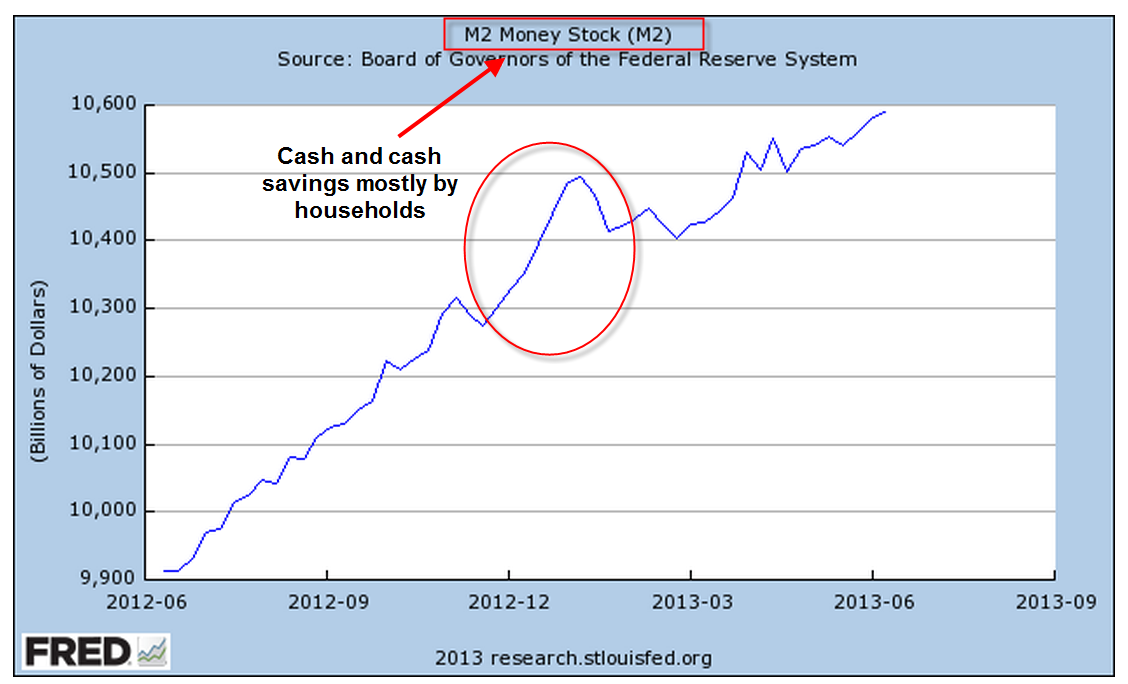
Households continue to keep ever higher balances in low yielding savings accounts and money market funds, indicating the high degree of caution. The big jump in deposits was probably due to higher dividends and bonuses paid in the last quarter of 2012 to avoid higher taxes in 2013.

For the past two weeks, global markets shuddered at the prospect of the Federal Reserve easing up on their quantitative easing program of buying government bonds.  Some have proclaimed that it is the end of the thirty year bull market in bonds, causing many retail investors to pull money out of bonds.  In several speeches this past week, Reserve Board members have reassured the public that quantitative easing will be here for several years.

As we have seen, households still shoulder a lot of debt weight, making it unlikely that either this economy or interest rates will experience a surge upward in the next several years.  An aging and more cautious population together with a declining participation rate in the work force indicates that another “Great Moderation” is upon us.  The previous moderation was one of political policy.  This moderation is led by consumers.  We can expect – yes, moderate, or lackluster – growth over the coming years.  The positive tradeoff for this subdued growth is the probability that the underlying business cycle of growth surges and corrective declines in economic activity will be subdued as well.

Bank Tax

The Obama administration is proposing a tax on the largest banks, based on the amount of leverage they employ. The estimated annual amount of the tax is $10 billion a year. Goldman Sachs estimates that the largest banks made $250 billion last year before taxes and loan-loss provisions. Based on those numbers, the tax amounts to a manageable 2/10th of 1 percent.

Some banks have protested. The 2008 TARP law did require the White House to come up with some system to pay for any losses under the program but a government estimate of $120 billion in losses consists largely of losses in the automotive industry. Jamie Dimon, the CEO of J.P.Morgan says that banks shouldn’t have to pay for another industry’s losses.

That does seem unfair but Dimon overlooks the long term liability of credit default swaps that the government has assumed in the AIG bailout. The Depository Trust and Clearing Corporation estimates the net value of these swaps at $82B. Also overlooked is the full price that AIG paid banks like Goldman Sachs and Societe General on credit default swaps (CDS) totalling $62.1B. In the late part of 2008, many of these swap contracts were selling for as little as 25 cents on the dollar. Let’s conservatively estimate that AIG paid these banks $30B above market price.

Additionally, the Federal Reserve bought $1.45T in Fannie Mae and Freddie Mac mortgage bonds, paying full price for bonds that had fallen 30 – 40% in value. Among these investors were the large investment banks, who took the money from the Fed and re-invested it in Treasury bonds. I have not been able to find estimates of this gift from the U.S. taxpayer but it must be at least $100B for the larger banks as a whole.

In short, the banks will be repaying taxpayers far less than they will have received from taxpayers.