Financial Obligations

February 22, 2015

Consumer Debt

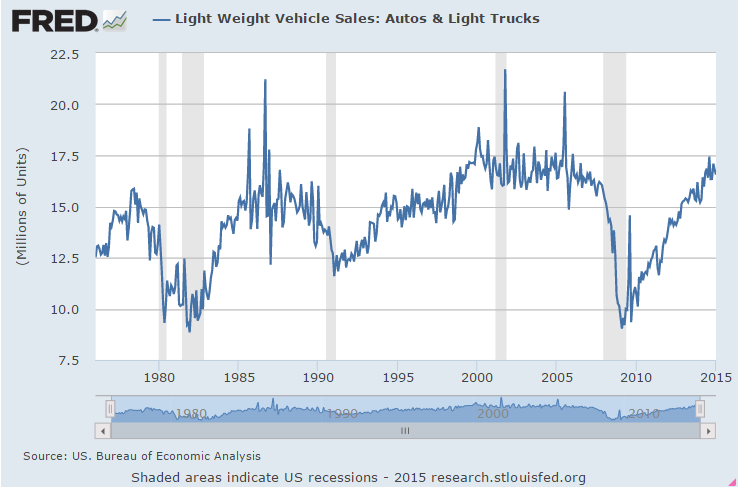
On the one hand, the economy continues to grow steadily and moderately.  Sales of cars and light trucks are strong.
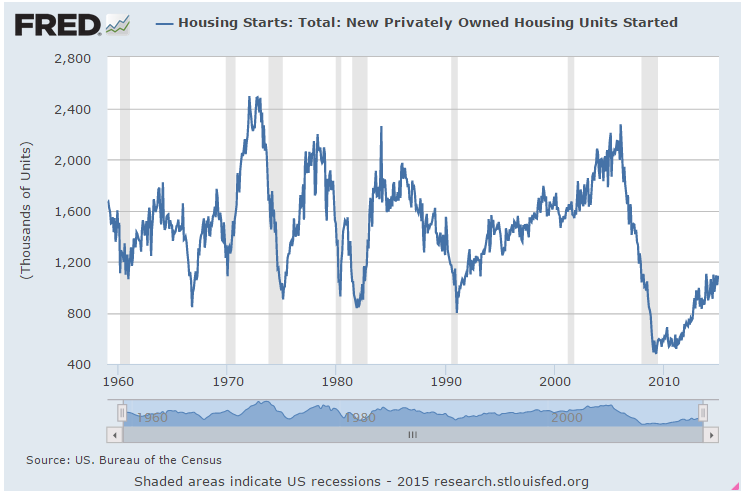
Housing Starts of new homes are slow.  While homebuilders remain confident, there is a noticeable decrease in traffic from first time home buyers.
The debt levels of American households have not reached the nosebleed levels of 2007 before the onset of the financial crisis.  However, they are more than a third higher than 2005 debt levels.

Historically low interest rates have enabled families to leverage their monthly payments into higher debt.  As a percent of disposable income, monthly morgage, credit card and loan payments are the lowest they have ever been since the Federal Reserve started tracking this in 1980. As long as the labor market grows at a moderate pace and interest rates remain low, families are unlikely to default on these higher debt loads.

In addition to household debt, the Federal Reserve includes other obligations – auto leases, rent payments, property taxes and insurance – to arrive at a total Financial Obligations Ratio (FOR), currently about 15%. (Explanation here)  The highest recorded FOR was 18% in 2007. The amount of income devoted to servicing the total of these obligations – 15.28% –  is near historic lows.  (Historical table ) In the past, when this rato has climbed above 17% there has been a recession, a stock market crash, or both.

So there are three components of a family’s monthly obligations: mortgage payments – currently less than 5%; credit card and loans, currently 5.25%; and other obligations, also about 5.25%.  Should interest rates rise in the next two years, credit card and loan payments will rise above the current 5.25% but are unlikely to cause a crisis in household finances.  The percentage of home mortgages which are adjustable have been rising in the past few years but the growing number of these mortgages have been so-called jumbo loans to households with larger incomes. (Daily News  and Wall St. Journal ).  Rising rates will put increasing pressure on homeowners with these types of mortgages but are unlikely to generate a crisis similar to 2008.

**********************

Currency Market

When someone says the dollar is strong, what does that mean?  Investopedia has a fairly concise explanation of the foreign exchange market (Forex) and the history of attempts to structure this market, the largest in the world.

**********************

Medicare Spending

Costs for Medicare and private insurance have grown at annual rates more than double inflation since 1969, as shown in a 2014 analysis of 35 years of Medicare (CMS) data by the Kaiser Family Foundation.  The only good news is that Medicare annual growth has been 2% less than private plans.

The majority of the benefits go to a small group of patients.  “Medicare spending per beneficiary is highly skewed, with the top 10% of beneficiaries in traditional Medicare accounting for 57% of total Medicare spending in 2009—on a per capita basis, more than five times greater than the average across all beneficiaries in traditional Medicare ($55,763 vs. $9,702).”

In its 2013 annual report (highlights) CMS noted that Medicare spending for the past five years had grown at a relatively tame 4% or less – almost double the inflation rate.  This is what passes for good news in federal programs – spending that is only slightly out of control.  Medicaid costs are growing at 6% per year.  Congress and CMS know that they have got to improve spending controls but the players in the health care industry spend a lot of money in Washington so elected and non-elected officials tread carefully when proposing any reforms.

Last month, Health and Human Services (HHS) announced that, by 2018, they would like to make half of Medicare payments to doctors based on the quality of care they provide, not the number of procedures they do.  Under the ACA, 20% of Medicare payments are based on outcomes, not fee for service.  Although HHS says it has saved $700 million over the past two years, few provider organizations meet the guidelines to share in the savings as originally designed.

When Medicare Advantage programs were introduced in 2003, Congress approved additional subsidies to health care providers to reimburse providers for promoting the new plans.  Like all “temporary” subsidies, no one wants to give them up. Because of the subsidies, the plans are relatively low cost and provide a good benefit for the dollar.  Uwe E. Reinhardt, a Princeton professor writing in the NY Times economics blog, referred to a 2010 report on the cost of the popular Medicare Advantage (MA) program: “In 2009, Medicare spent roughly $14 billion more for the beneficiaries enrolled in MA plans than it would have spent if they had stayed in FFS [Fee For Service, or regular] Medicare. To support the extra spending, Part B premiums were higher for all Medicare beneficiaries (including those in FFS).”
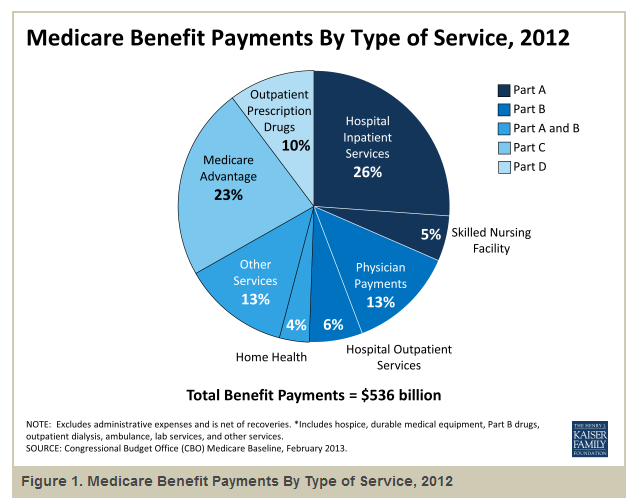
As the population ages, Medicare will consume an ever larger percentage of total health care spending.  CMS noted that Medicare’s portion of health care spending in 2013 has been relatively steady over the past few years. A pie chart from 2009 spending illustrates the cost breakdown.  In 2013, we spent 17.4% of GDP on health care, a figure that has remained stable for a few years.  In 2001, the U.S. spent a shocking (at the time) 13.7% of GDP on health care (CMS Source).

Investment Allocation and Housing

December 1st, 2013

While cleaning up some old files, I found a 1999 “Getting Going” column by Jonathan Clemens in the Wall St. Journal.  That year was rather turbulent, rocked by Y2K fears that the year 2000 might play havoc with older computers still using a two digit date,  and a intensifying debate about the valuation of stocks.  Looking away from the hot internet IPOs of that year,  Clemens interviewed several professors about the comparatively mundane subject of home ownership.

 “A house is not a conservative investment,” says Chris Mayer, a real-estate professor at the University of Pennsylvania’sWharton School. “Any market where prices can fall 40% in three years is not a safe investment.” 

Remember, this is 1999.  At that time, what 40% decline is he talking about?  It would not be till 2009 or 2010 that house prices tumbled down the hill.  In the past, declines of this magnitude were confined to particular areas of the country where a fundamental shift  in the economy occurred.  The Pittsburgh area of Pennsylvania, the Pueblo area of Colorado and the Detroit area of Michigan come to mind. In the first two examples the collapse of the steel industry had a profound effect on home prices as people moved to other areas to find work.  In case a homeowner thinks “it can’t happen here,” I’m sure many homeowners in Detroit felt the same way during the 1960s when the car industry was at its peak.

“William Reichenstein, an investments professor at Baylor University in Waco, Texas, suggests treating your mortgage as a negative position in bonds.”  

What does this mean?  Let’s say a person has $100K in stock mutual funds, $100K in bond mutual funds, owns a house valued at $200K with $100K still left on the mortgage.  Subtract the remaining balance of the mortgage from the amount in bonds and that leaves $0 invested in bonds.  Why do this?  When we buy a bond we are buying the debt of a company, or some government entity.  A mortgage is a debt we owe.  So, if a person were to pay off the mortgage, trading one debt for another, they would sell their bonds to pay off the mortgage.

Should the house be included in the investment mix?  There is some disagreement on this.  An investment portfolio should include only those assets which a person could access for some cash flow if there was a loss of income or some other need for cash.  An older couple with a 5 BR house who intend to downsize in five years might include a portion of the house in the portfolio mix.

For this example, let’s leave the house out of the investment portfolio to keep it simple. Using this analysis, this hypothetical person has 100% of their assets in stocks, not a 50/50 mix of stocks and bonds.

Now, let’s fast forward ten years from 1999 to 2009.  An index mutual fund of stocks has lost a bit more than 20%.

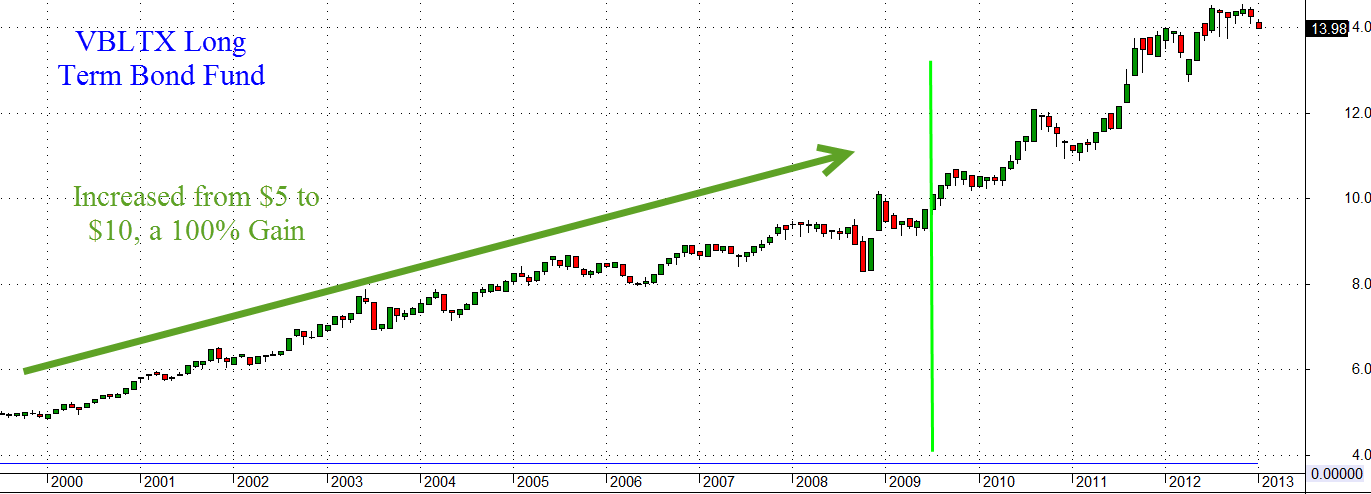
A long term bond fund has gained about 100%.

[The text below has been revised to reflect the above bond fund chart.  The original text presented numbers for a different bond fund.]

Let’s say the mortgage principal has been paid down $60K over those ten years.  Assuming that no new investments have been made in the ten year period, what is this person’s investment mix now?  The stock portion is worth $80K, the bonds $200K less $40K still owed on the mortgage for a total of $240K, with a net exposure in bonds of $160K.  The person now has 33% (80K / 240K) in stocks and 67% in bonds, a conservative mix.  If we didn’t account for the mortgage as a negative bond, the mix would appear to be 29% (80K / 280K) for stocks and 71% for bonds.  What is the net effect of treating a mortgage balance as a negative bond?  It reduces the appearance of safety in an investment portfolio.

Now let’s imagine that this person is going to retire and collect a monthly Social Security check of $1500.  To get a 15 year annuity paying that monthly amount with a 3% growth rate, a person would have to give an insurance company about $220K (Calculator)   There are a lot of annuity variations and riders but I’ll just keep this simple.  Throughout our working lives our Social Security taxes are essentially buying Treasury bonds that we start cashing out during retirement.

If we were to add $220K to our hypothetical investment mix,  we would have a total of $460K: $80K in stock mutual funds, $200K in bond funds, -$40K still owed on the mortgage, $220K effectively in Treasury bonds that we will withdraw as Social Security payments.  The $80K in stock mutual funds now represents only 17% of our investment portfolio, an extremely conservative risk stance.  If we have a private pension plan, the mix can get even more conservative.

The point of this article was that many people in their 50s and 60s may have too little exposure to stocks if they don’t account for mortgages, pensions and Social Security payments into their allocation calculations.

*****************************

In October 2005, the incoming Chairman of the Federal Reserve, Ben Bernanke, indicated to Congress that he did not think there was a bubble developing in the housing market. (Washington Post Source)

In September 2005 – a month before – the Federal Reserve Bank of New York published a report on the rapid housing price increases of the past decade:

Between 1975 and 1995, real [that is, inflation adjusted] single-family house prices in the United States increased an average of 0.5 percent per year, or 10 percent over the course of two decades. By contrast, from 1995 to 2004, national real house prices grew 3.6 percent per year, a more than seven-fold increase in the annual rate of real appreciation, and totaling nearly 40 percent in one decade. In some individual cities, such as San Francisco and Boston, real home prices grew about 75 percent from 1995 to 2004, almost double the national average. 

Remember, these are real, or inflation adjusted prices.  Now it is easy, in hindsight, to go “ah-ha!” but it should be a lesson to us all that we can not possibly hope to consume all the information needed to mitigate risk.  There is just too much information.  A professional risk manager, Riccardo Rebonato, discusses common flaws in risk assessment in his book “Plight of the Fortune Tellers” (Amazon). Written before the financial crisis, the book is surprisingly prescient.  The ideas are accessible and there is little if any math.

*************************************
On Monday, the National Assn of Realtors released their pending home sales index. These are signed contracts on single family homes, condos, and townhomes. The index has declined for five months but is still slightly above normal (100) at 102.1.  At the height of the housing bubble, this index reached almost 130.  At the trough in 2010, the index was below 80.

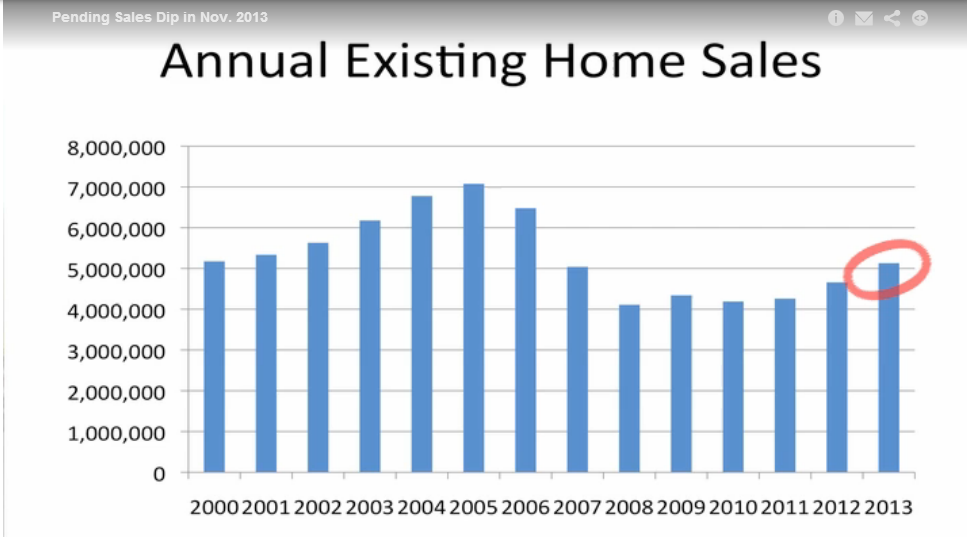
This chart was clipped from a video by an economist at NAR (Click on the video link on the right side of the page).  The clear and simple explanation of trends in housing and interest rates is well worth five minutes of your time.  Sales of existing homes have surpassed 2007 levels and are growing.

Demographia surveys housing in m ajor markets around the world and rates their affordability.  Their 2012 report found that major markets in the U.S. are just at the upper range of affordable.  As Canada’s housing valuations have climbed, their affordability has declined and are now less affordable than the U.S.  Britain’s housing is in the severely unaffordable range.

*****************************
Next Friday comes the release of the monthly employment report.  I’ll also cover a few long term trends in manufacturing and construction employment that may surprise you.

Tidbits

It’s the beginning of the year and I am cleaning up – not the house, but my notes – scribbles of factoids which I, and maybe you will as well, find interesting.  Those of you who like graphs will be disappointed this week.  😦

In 2009, 55% of income in the S&P500 companies was generated overseas.

The Eurozone is set up very similar to the Senate in the U.S.  Despite being 30% of the Euro economy, Germany only has one vote. 

It will cost an estimated $175B for the payroll tax cut in 2012.

A rule of thumb that the Congressional Budget Office (CBO) uses – 1/10% of GDP growth over 10 years = $300B in revenues over 10 years to the Federal Government.

One of the problems with the federal mortgage agencies FHA, Freddie Mac and Fannie Mae is that they buy mortgages which originate in states where there is little or no regulation.  If people want a government agency buying mortgages, why don’t the various states institute such agencies?

A CNN article about doctors going broke:
http://money.cnn.com/2012/01/05/smallbusiness/doctors_broke/index.htm?iid=Popular

This year, 2011, the USDA estimates that for the first time, this country will produce more corn for fuel than for food.

In 2009, total lending by U.S. banks fell 7.4%, the steepest drop since 1942. As of March 15, 2010, approximately half of Obama’s $787 billion stimulus program had been distributed but the flow of federal money into the economy could not keep up with the $700 billion that banks pulled out of the economy in the 6 months from mid-September 2008 to mid-March 2009.

Small companies, those with fewer than 100 employees, accounted for 45% of net jobs created from 1992 through the end of 2007, according to Labor Dept data.

In the U.S., diabetes costs about $174 billion annually in medical costs and lost production In the U.S., according to the American Heart Association.  That is a little more than a 1% impact in a $15 trillion economy, or about 25% of the defense budget.

This past week, Standard and Poors downgraded the credit ratings of nine countries in the Eurozone.  In assessing sovereign credit, Moody’s, another leading credit ratings firm, uses a metric called “debt reversibility margin.”  This measures a government’s ability and willingness to get their debt level under control over the next five to seven years.  Generally, it is the ratio of interest payments on a country’s debt to their revenues with a “benefit of the doubt” margin of 1 – 4% based on the resilience of the country’s economy, its politics and tax policies  When this metric rises above 10%, Moody’s considers a downgrade to the country’s credit rating. 

In 2008 New York spent $16K per student, top in the nation.  It’s student-teacher ratio of 13.1 was the eighth lowest among the 50 states.  From 2000 to 2009, the state added 15,000 teachers as student enrollment fell by 121,000 students.

Global warming is the latest in a series of hoaxes on the American people.  Earlier scams include: smoking can kill you, lead in gasoline and paint is bad for children’s brains, chemical discharges in rivers and lakes are bad for your health, cholesterol is bad for your heart, smog is bad for your lungs, and acid rain is bad for trees and plants. In my lifetime, all of the above have been dismissed by critics at some point as scams on the American public.

In 2010, a USA Today analysis of data from the federal Office of Personnel Management showed that a federal worker makes 77% more than a private sector worker when benefits are included.

In 2010, the Boston Consulting Group issued its Global Wealth Report which found that the top 0.5% of households (those with $5 million or more) owned 21%, or $23 trillion, of global wealth, up from 19%.

A Goldman Sachs analysis of mortgage refinancing found that homeowners took out $358 billion in home equity loans in 2005, the most of any year.

J.P. Morgan Chase and two other banks now hold more than 33% of all U.S. deposits.

Based on 2007 data, the Energy Information Administration reported the various U.S. government subsidies per megawatt hour for the different sources for generating electric power.  Coal got $.44, natural gas received $.25, nuclear enery $1.59 and the whoppers were solar at $24.34 and wind at $23.37 per MWH.  Over the course of a year, at an average consumption of 10,000 KWH per year, a 100 homes will consume a MWH.  In 2010, Google used the equivalent of 260 million homes of electricity.

When enacted in 1916, the income tax affected only the top 2% of incomes.  With the popularity of beards and other creative facial hair statements among younger men, it might be time to resurrect an old Russian revenue raiser – a beard tax.

New York bills Medicaid about $2 million per year for each mentally disabled patient.  The governor is reviewing the state’s billing procedures.

How much do all the tax breaks – or tax expenditures – cost the federal government?  Health Insurance premiums not taxed – $659 billion, mortgage interest deduction – $484 billion, capital gains and dividends taxed at lower rates – $403 billion, pensions – $303 billion, earned income tax credit – $269 billion, charitable donations – $241 billion, state tax deductions – $237 billion, 401K plans – $212 billion, capital gains basis adjustment at death – $194 billion, social security benefits not taxed – $173 billion.  The total is over $3 trillion, or almost the entire federal budget.  If tax breaks were eliminated, the federal debt would be gone in 5 years.

Lending Latitudes

The horse latitudes often refer to a section of the Atlantic ocean where there was little wind for a period of time, causing sailing ships to get “stuck” in the middle of the ocean.  There are two winds that drive a developed economy like that in the U.S – the demand for loans and the willingness of banks to make those loans.

Every 3 months the Federal Reserve Board (FRB) interviews a number of bank loan officers on their lending practices, risk management of and demand for commercial, industrial, mortgage and consumer loans.  The latest October 2010 survey  shows small increases in demand for commercial and industrial loans.

In questions 11 and 12 of the survey, loan officers were asked about residential mortgages. Demand for prime mortgages remains relatively unchanged.  34 loan officers responded that they do not originate non-traditional mortgages like interest-only or no income verification.  There were so few responses to questions about sub-prime mortgages that the FRB did not list the results.  If you anticipate being in the market for a mortgage in the coming years, you can conclude that it will be difficult to find a non-traditional or sub-prime mortgage.

Loan officers surveyed saw little overall change in demand for home equity lines of credit but a quarter of them said that they had tightened slightly their lending standards for these types of loans and 12% said that they had lowered existing lines of credit.

Consumer credit was largely unchanged but there was a hopeful sign for businesses.  Over 25% of smaller banks reported that they had increased business credit card limits.  The signs were not so hopeful for those in commercial construction as 20% of officers reported that they had decreased lines of credit for their existing customers and half of respondents anticipate that their lending standards for commercial construction will remain tighter for the foreseeable future. 

For consumers and homeowners the future does not look rosy.  The survey includes a category called the “foreseeable future”, not just the next two years, when asking loan officers about their anticipated lending standards.  40% of loan officers anticipate tighter standards for residential construction and 34% foresee tighter standards for prime mortgage homeowners (62% for sub-prime holders) wanting to borrow money against the equity in their house. Over half of loan officers see the same tightening for credit card and other consumer loans. 

Big box stores like Home Depot and Lowe’s that depend on remodeling and construction dollars have seen a 10%+ increase in their stock prices the past month.  Given the current lending environment, it may be difficult for these companies to maintain the sales growth that justifies the expectations implied by such a dramatic stock price increase.  The reluctance to lend will continue to suppress growth in the consumer market which accounts for over 2/3 of this country’s GDP. 

Debt Mountain

There has been a big rally in corporate bonds in the past few months. Decreasing fears of defaults has sparked a huge inflow of money into these bonds. The U.S. corporate bond market is large, with $9.8 trillion in outstanding debt – 1.5 times the amount of outstanding Treasuries, or about 70% of the nation’s GDP.

According to Federal Reserve data, the U.S. mortgage market is even bigger – $14.7 trillion at the end of 2008, of which $8.2 trillion is securitized. The three government agencies Fannie Mae, Freddie Mac and Ginnie Mae now back 90% of mortgages.

Financial Regulation

In 1966, Congress passed the Fair Packaging and Labelling Act, which required manufacturers of retail products to list the contents and weights of their products. The food industry fought hard against it. Breakfast cereal makers were accustomed to packing their cereal in big boxes to trick the consumer into thinking that they were getting more product.

In 1969, Congress tried to pass a law mandating unit pricing but the food industry lobbied hard against it and the bill died in the Senate. The reasoning was that consumers could figure out the unit price or the price per ounce of a product by themselves or bring recently introduced battery powered calculators with them when they went shopping. In 1970, some grocery stores began to offer unit pricing as a convenience feature to lure customers. Unit pricing in grocery stores is now commonplace.

Many years ago there was one mortgage product, a 30 year fixed loan, making it fairly easy to compare mortgages. Because easy comparison by a customer is not always good for the seller, mortgage companies competed by introducing a complexity of “points”, closing fees and prepayment penalty packages to distinguish their mortgage product from their competitors.

The 15 year mortgage arose a few decades ago, followed by a variety of mortgage products. This profusion of choices can be a boon to a consumer but it can also be confusing. This variety and confusion is an effective sales tool, making it more difficult for a customer to compare products and prices.

Just as the food industry fought packaging regulations, the financial industry will fight similar regulations on their products. Under proposed financial regulations, teaser rates of “0% interest for 6 months” will have to be followed by plain English of what that teaser rate will reset to in six months. No longer will credit card companies be able to bury the truth in impossibly small print referencing the greater of the LIBOR rate (what’s that?, you ask) or the Federal Reserve discount rate (what’s that?, you ask again). Mortgage companies would have to offer at least 2 – 3 standard products, like a 30 year fixed loan, that a consumer could compare pricing with a competing mortgage company. While this legislation works its tortuous way through Congress, the finance industry will be busy lobbying against it and figuring out how to outsmart it.

Underwater

In a 5/6/09 WSJ article, Ruth Simon and James Hagerty report on current housing values after the release of industry results for the first quarter of 2009.

Across the U.S. 19% of mortgage holders are “underwater” or “upside down” – they owe more than their house is worth in today’s market. This is more than a 50% increase in the number of underwater borrowers since the end of 2008. According to one company that tracks this data, “more than one in 10 borrowers … owed 110% or more of their home’s value at the the end of last year.” Las Vegas homeowners have been hit the worst. Zillow.com estimates that over 67% of mortgage holders there are upside down.

Why wouldn’t a bank holding a mortgage agree to write down some of the principal on the mortgage? Let’s say a homeowner with a job is struggling to stay current on a $300K mortage on a house that is now valued at $240K. If the bank forecloses, they will probably sell for closer to $200K and will have expenses for legal fees, maintenance, fix-up and taxes. Wouldn’t it make sense for the bank to at least write down half of the $60K principal difference if that would mean the bank could avoid foreclosure?

The answer is – wait, sit down first. The loss on a foreclosure is a long term loss on the bank’s loan portfolio that can be spread out over several years. A write down in principal on the mortgage is an immediate loss that affects the bank’s bottom line this year. John and Mary Homeowner may have lost their chance to avoid foreclosure because of an accounting rule.

Mortgage Mirage

In a 4/14/09 WSJ article, Ellen Schultz recounts several heartbreaking tales of seniors losing their homes. Many lived on meager fixed incomes. Some had paid off their mortgages before unscrupulous mortgage brokers presented them with a “solution” to cope with higher medical expenses, taxes and other living expenses.

The American Bar Association puts out a free booklet of legal advice for families. In Chapter 9
they present some sage cautions regarding contracts:
“Fill in all the blanks! A contract with your original signature but containing blank spaces can be like a blank check if altered unscrupulously.” Some homeowners in the above article were bitten by this scam.

A homeowner taking out a mortgage whose payments escalate at a later date may not examine the contract closely after signing it, when the payments are affordable. A closer scrutiny at a later date may be too late.

“A contract produced by fraud is not automatically void. People who are victimized by fraud have the option of asking a court to declare that contract void, or to reform (rewrite) it. On the other hand, if they went along with the contract for a substantial period of time, they could lose their right to get out of it. This is called ratification, and is based on the idea that they have, by their actions, made it clear that they are able to live with the terms.”

“A contract can be canceled by a court because of fraud when one person knowingly made a material misrepresentation that the other person reasonably relied on and that disadvantaged that other person. A material misrepresentation is an important untruth. In many states, it doesn’t have to be made on purpose to make the contract voidable.”

Even if you know you were lied to, can you prove fraud? “Fraud requires an outright lie, or a substantial failure to state a material fact about an important part of the contract.” “Actual fraud that will invalidate a contract is a lot less common than people think.”

A well worn phrase may be more than just a rule of thumb but a legal precedent. “‘Caveat emptor’–‘let the buyer beware’–is a strict rule placing the risk in a transaction with the buyer.”

If all else fails, you may still have a chance of some legal remedy. “Courts have a powerful weapon called unconscionability . . at their disposal. Unconscionability means that the bargaining process or the contract’s provisions ‘shock the conscience of the court.'” However, “the courts are reluctant to use this weapon, but consumers have a better chance with it than anyone else.”

In handling my elderly parents’ affairs the past two years, I was surprised at the amount of mail solicitation they received that was targeted specifically to retired people. These included a variety of fixed income solutions from annuities to reverse mortgages. Some were legitimate, some smelled fishy. There were investment opportunities of many forms – in real estate, in stocks and bonds, in gold and other commodities. There were many offers for supplemental medical insurance.

The majority played on two real fears that older people have: what if I run out of money, and what if something bad happens? The marketing departments at companies large and small know these fears and cast their mail campaigns like large trawler nets. It’s up to us to be smart little fishies.

Mortgage Refinance

It was a little after High Noon today in Colorado when CNBC interrupted their broadcast of House hearings on the $165 million AIG had paid out in bonuses. The voice sounded similar in quality to the one we hear when programs are interrupted for severe weather warnings. It was not a weather warning but an announcement from the monthly Federal Reserve meeting.

The Fed was keeping interest rates at 0%, as expected, but they announced that they intended to keep them there for the coming months. They announced a plan to increase their purchases of long term Treasury notes by $300B and extend another $750B to buy mortgages. That puts the total Fed commitment to mortgages at $1.25T.

Within 5 – 10 minutes after the announcement, both the stock market and Treasury notes shot up about 2%.

So what! It’s not as exciting as the video of Brittany Spears practicing her dance routine for her upcoming tour. It’s not as fantabulous as a preview of the upcoming Jonas Brothers concert movie. It’s well, adult exciting. No, not that kind of adult excitement, you perv. The other kind of exciting, the green kind.

Now is the time for mortgage holders to start talking to a mortgage lender near you about refinancing. Average 30 year fixed mortgage rates were just a scosh below 5%. The Fed’s announcement will probably cause the mortgage rate to drop to 4.5% or so.

A fairly close approximation of the monthly principal and interest payment (PI) on a 30 year fixed mortgage at 4.5% is to chop off the last two zeroes on the amount of the loan, then divide by 2. For example, take a $200,000 amount, chop off the last two zeroes, which results in $2000. Divide by 2 and the PI comes to $1000. The actual amount, using a mortgage calculator , is $1013.37. Close enough for government work.

For anyone who might have an existing 6.5% mortgage rate, which was approximately the norm a year ago, the monthly payment reduction on a $165,000 balance is over $200 a month.

B.J. made a comment a few weeks ago that the government should just reset all mortgages, by fiat, to 4%. That is a sweeping government intrusion into the private marketplace, more extensive than the government has already done.

B.J. must have spoken to Ben Bernanke, the Fed chief, who agreed with her target interest rate. He just went about it without issuing an emperor’s decree. Instead of picking the cats up and taking them where he wanted them to go, Bernanke simply put the food down where he wants the cats to be.