Optimism Reigns

Dec. 11, 2016

For the second week since the election the SP500 index rose more than 3%, reversing a slight loss the previous week.  The SP500 has added 160 points, or 7.6%, in total since the election.  Barring some surprise, the market looks like it will end the year with a 10+% annual gain, all of it in the 6 – 7 weeks after the election. Small cap stocks have risen 17% in the past five weeks.  Buoyed by hopes of looser domestic regulations, and that international capital requirements will be relaxed, financial stocks are up a whopping 20% in the same time.

Having held their Senate majority, Republicans now control both branches of Congress and the Presidency but lack a filibuster proof dominance in the Senate.  They are expected to pass many measures in the Senate using a budget reconciliation process that requires only a simple majority. The promise of tax cuts and fewer regulations has led investment giants Goldman Sachs and Morgan Stanley to increase their estimate of next year’s earnings by $8 – $10.  Multiply that increase in profits by 16x and voila!  – the 160 points that the SP500 has risen since the election.  The forward Price Earnings ratio is now 16-17x.

Speculation is about what will happen.   History is about what has happened. The Shiller CAPE10 PE ratio is calculated by pricing the past ten years of earnings in current year’s dollars, then dividing the average of those inflation adjusted earnings into today’s SP500 index.  The current ratio is 26x, a historically optimistic value.  The Federal Reserve is expected to raise interest rates at their December meeting this coming week.

As buyers have rotated from defensive stocks and bonds to growth equities, prices have declined.  A broad bond index ETF, BND, has lost 3% of its value since the election.  A composite of long term Treasury bonds, TLT, has lost 10% in 5 weeks.  For several years advisors have recommended that investors lighten up on longer dated bonds in anticipation of rising interest rates which cause the price of bond funds to decline.  For 6 years fiscal policy remedies have been thwarted by a lack of cooperation between a Democratic President and a Republican House that must answer to a Tea Party coalition that makes up about a third of Republican House members.  The Federal Reserve has had to carry the load with monetary policy alone.  Both former Chairman Bernanke and curent Chairwoman Yellen have expressed their frustration to Congress.  If Congress can enact some policy changes that stimulate the economy, the Federal Reserve will have room to raise interest rates to a more normal range.

//////////////////////////////

Purchasing Manager’s Index

The latest Purchasing Manager’s Index (PMI) was very upbeat, particularly the service sectors, where employment expanded by 5 points, or 10%, in November.  There hasn’t been a large jump like this since July and February of 2015.  For several months, the combined index of the manufacturing and service sector surveys has languished, still growing but at a lackluster level.  For the first time this year, the Constant Weighted Purchasing Index of both surveys has broken above 60, indicating strong expansion.

The surge upward is welcome, especially after October’s survey of small businesses showed a historically high level of uncertainty among business owners.  This coming Tuesday the National Federation of Independent Businesses (NFIB) will release the results of November’s survey.  How much uncertainty was attributable to the coming (at the time of the October survey) election?  Small businesses account for the majority of new hiring in the U.S. so analysts will be watching the November survey for clues to small business owner sentiment.  Unless there is some improvement in small business sentiment in the coming months, employment gains will be under pressure.

////////////////////////////

Productivity

Occasionally productivity growth, or the output per worker, falters and falls negative for a quarter.  Once every ten or twenty years, growth turns negative for two consecutive quarters as it has this year. Let’s look at the causes.  Productivity may fall briefly if businesses hire additional workers in anticipation of future growth.   Or employers may think that weak sales growth is a temporary situtation and keep employees on the payroll.  In either case, there is a mismatch between output and the number of workers.

During the Great Recession productivity growth did NOT turn negative for two quarters because employers quickly shed workers in response to falling sales.  The last time this double negative occurred was in 1994, when employment struggled to recover from a rather weak recession a few years earlier.  For most of 1994, the market remained flat.  In Congressional elections in November of that year, Republicans took control of the House after 40 years of Democratic majorities.  The market began to rise on the hopes of a Congress more friendly to business.  Previous occurrences were in the midst of the two severe recessions of 1974 and 1982.   As I said, these double negatives are infrequent.


////////////////////////////

The Next Crisis?

The economies of the United States and China are so large that each country naturally exports its problems to the rest of the world.  The causes of the 2008 Financial Crisis were many but one cause was the extremely high capital leverage used by U.S. Banks.  A prudent ratio of reserves to loans is 1-8 or about 12% reserves for the amount of outstanding loans.  Large banks that ran into trouble in 2008 had reserve ratios of 1-30, or about 3%.

Now it is China’s turn.  Many Chinese banks have reported far less loans outstanding to avoid capital reserve requirements.  How did they do this?  By calling loans “investment receivables.”  It sounds absurd, doesn’t it?  Like something that kids would do, as though calling something by another name changes the substance of the thing.  70 years ago George Orwell warned us of this “doublespeak,” as he called it.  Reluctant to toughen up banking standards for fear of creating an economic crisis, the Chinese central bank is planning a gradual move to more prudent standards that will take several years.  However, it is a crisis waiting for a spark.  Here’s a Wall St. Journal article on the topic for those who have access.

/////////////////////////

Small Business Uncertainty

November 6, 2016

Small Business Survey

The uncertainty index in the recent NFIB (National Federation of Independent Businesses) surveys has been at its highest in the past forty years.  Except for one high point in 2012, every high in this reading has been followed by a recession.

This index is compiled from responses of “I don’t know” to six questions about future sales, employment, economic conditions, and business expansion. Small businesses typically pause in the face of uncertainty, holding off on hiring and capital outlays. They must be alert to the underlying climate of their particular market or go out of business.

The previous highs in uncertainty were set in late 2006 and early 2007 as the housing bubble was cooling off.  A recession followed in late 2007 that lasted till June 2009. In the late part of 2000, near the end of the dot com bubble, a high in this uncertainty index preceded a recession in the early part of 2001, and a two year downturn in the market.

A high uncertainty reading in late 2012 was a combination of concerns about slow growth. Starting in September 2012, the Federal Reserve responded with QE3, a monthly program of bond buying to spur growth and avoid recession.

When the canary sings, pay attention.

////////////////////

Retail Sales

Weak sales growth underlies current business concerns.  September’s year over year (y-o-y) growth was 2.2%.  After adjusting for inflation and population growth, sales growth was negative and has been less than 1% for two years.  As I noted last week we are at the edge of a plateau.  We either fly or fall from here.

The chart below shows retail sales less food services like bars and restaurants, and is adjusted for inflation and population growth.  In 2015, analysts attributed the y-o-y growth to the decline in gasoline prices, which began in the middle of 2014. Economists were asking why people were not spending the money they were saving on gas. This year’s y-o-y growth rate has little influence from gas prices, which have been higher for part of this year.  People are not confident enough to increase their spending.

/////////////////////

Individual Stocks

Casual investors are encouraged to invest in broad categories of stocks rather than individual stocks, in order to minimize the effect, good or bad, of any one stock.  We are in the middle of earnings season for the 3rd quarter and I thought I would point to an example of the price volatility that an earnings announcement can generate.

We expect volatility from smaller companies so I will look at a “hyuge” (as Donald would say) company like Microsoft, the third largest company in the world.  During the past year or so, owners of Microsoft shares have seen some gut wrenching price moves on the day when Microsoft announces its quarterly results.  On April 24, 2015 the stock jumped 10% in reaction to first quarter results.  Disappointing second quarter results led to a price drop of almost 4% on July 22, 2015. Another 10% jump in response to third quarter results on October 23, 2015.  April 22, 2016 saw a 7% drop, July 20th a 5% gain, and a 4% gain on October 21st.

The tech sector can be more volatile than the Consumer Staples (Proctor and Gamble) sector, for example. An investor who owns shares in a company should be prepared for occasional volatility.  A good rule of thumb is that the value of one company’s stock should be no more than 5% of an investor’s portfolio. A safer rule might be 5% of one’s stock allotment.  If stocks were 50% of an investor’s portfolio, then 5% of that would be 2.5% of the total portfolio.

A broader view

Here’s an interesting viewpoint by someone who argues that the stock market has plenty of room to run.  However, the SP500 index has gained an average of 11% annually for the past seven years. This is far above the 6.5% annual price gains of the past twenty years, and the 7.4% yearly gains of the past thirty years.  Reaching back even further, a forty year time span shows 7.85% yearly gains. However, we should take into account the much higher inflation rates of those earlier decades.  Adjusted for inflation those annual gains would be much lower, making the comparison with the past seven years even more dramatic.

We like to think that “this time is different,” that the rules have changed.  After a sobering decline in equities, we resolve not to be fooled again and then…we forget once again.  We tell ourselves yet again that it really is different this time.  Shakespeare made his living reminding us of our follies.  We read his tragedies, his comedies and we think yes, but that was so long ago and so much has changed since then.  What hasn’t changed, what remains persistent is the nature of human beings and the eternal constant, the Law of Averages.

Constant Weighted Purchasing Average (CWPI)

October’s surveys of Purchasing Managers across the country, the PMI, edged down slightly from last September’s upward surge.  The CWPI composite of the manufacturing and non-manufacturing PMI surveys remains at the bottom end of healthy expansion and barely below the index’s five year average. This index has had a cyclic peak and trough pattern for most of the recovery, peaking at a strong growth level, then falling to a trough that was still above the neutral line between expansion and contraction.  Since February, the index had drifted in a plateau of healthy growth.  We wait and see.

Summer Signs

July 13, 2014

Small Business

Optimism has been on the rise among small business owners surveyed monthly by the National Federal of Independent Businesses (NFIB).  Anticipating a growing confidence, consensus estimates were for a reading of 97 to 98, topping May’s reading of 96.8.  Tuesday’s disappointing report of 95 dampened spirits.  The fallback was primarily in expectations for an improving economy.  Mitigating that reversal of sentiment was a mildly positive uptick in hiring plans. The majority of job growth comes from small and medium sized companies.

*******************************
Job Openings and Labor Turnover Survey (JOLTS)

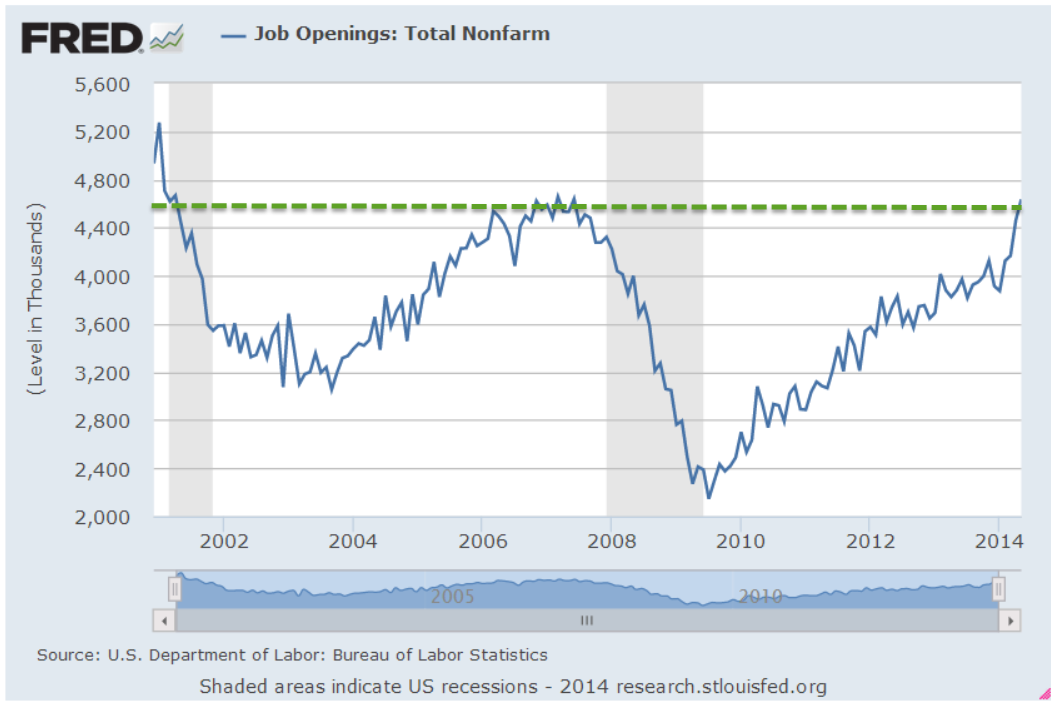
Speaking of job growth…There is a one month lag in the JOLTS report from the Bureau of Labor Statistics so this week’s report summarized May’s data.  The number of job openings continues to climb as does the number of people who feel confident enough to voluntarily quit their job.  Job openings have surpassed 2007 levels. If I were President, I would greet everyone with a hand shake and “Hi, job openings have surpassed 2007 levels.  Nice to meet you.”

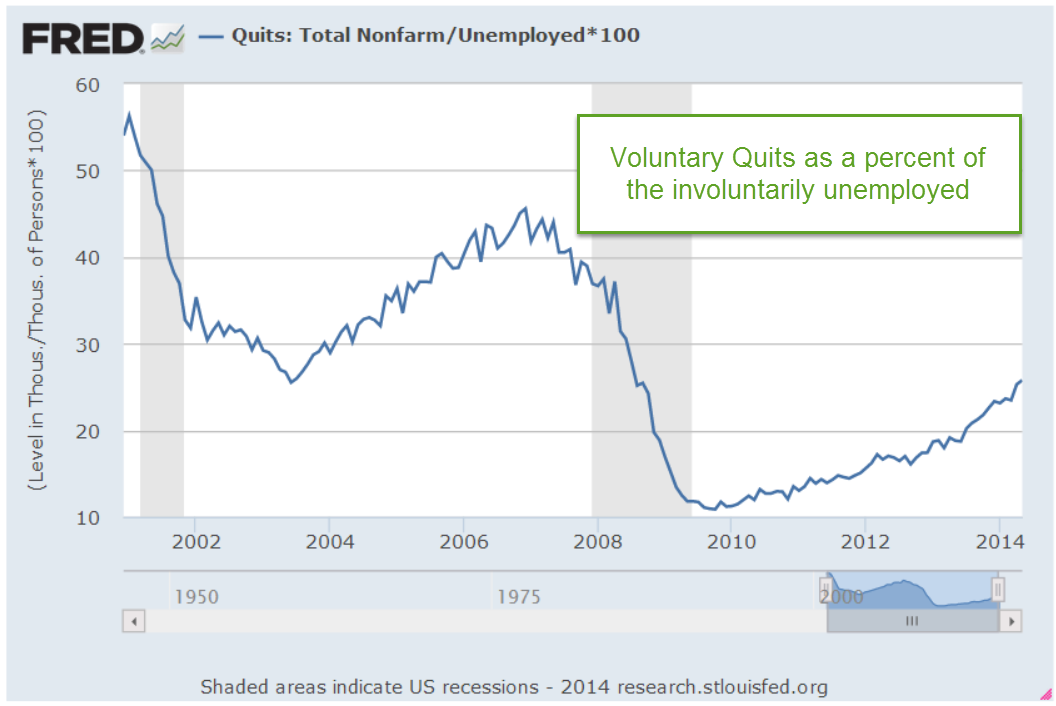
Still, the number of voluntary quits is barely above the low point of the early 2000s downturn.  Let’s not mention that.

We can look at the number of job quits to unemployment, or the ratio of voluntary to involuntary unemployment.  This metric reveals a certain level of confidence among workers as well as the availability of jobs.  That confidence among workers is relatively low.  The early 2000s look like a nirvana compared to the sentiment now.  The country looks positively depressed using this metric.

If I were President, if I were a Congressman or Senator, I would post this chart on the wall in my office and on the chambers of Congress where it would remind myself and every other person in that chamber that part of my job is to help that confidence level rise.  Instead, most of our elected representatives are voicing or crafting a position on immigration ahead of the midterm elections.  Washington is the site of the largest Punch and Judy show on earth.  Like the little train, I will keep repeating to myself “I think I can, I think I can…stay optimistic.”

*******************************

Government Programs

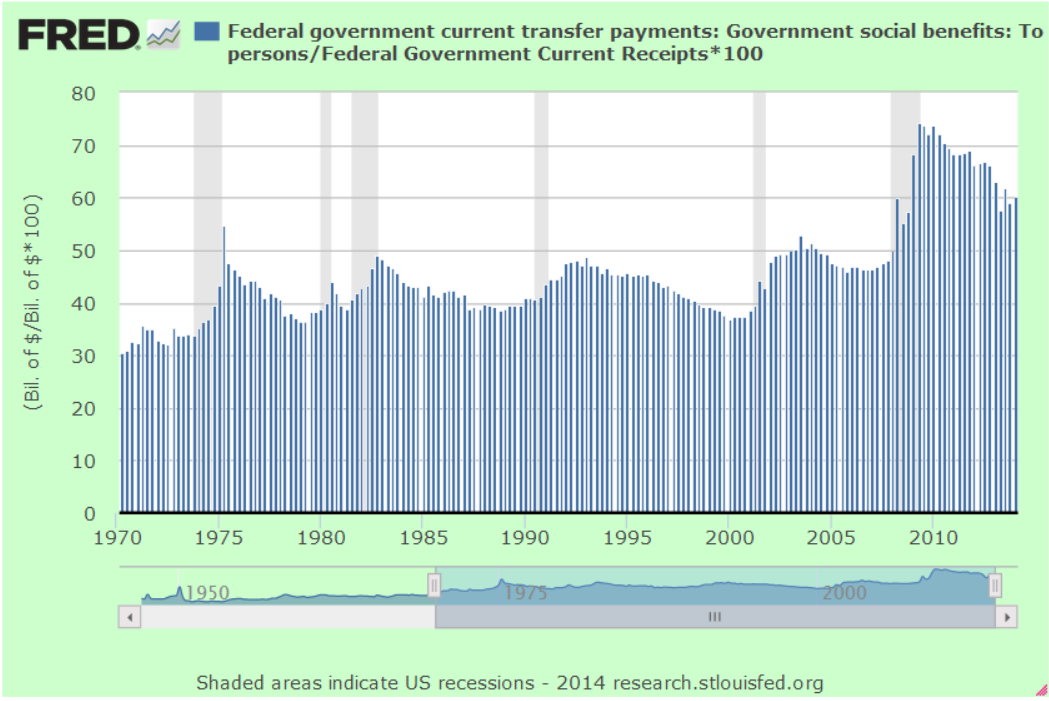
Most social benefit programs are on autopilot, leaving Congress with little discretion in determining the amount of money that flows out of the U.S. Treasury.  These programs include Social Security, Temporary Assistance to Needy Families, Food Stamps, Unemployment Benefits, etc.   Enacted over the past eighty years, the ghosts of Congresses past are ever present in the many Federal agencies that administer these programs.

During the recent recession, payments under social programs shot up, consuming more than 70% of all revenues to the government.  Political acrimony in this country switched into high gear as the U.S. government became the largest insurance agency in the world. As the economy improved, spending fell below the 60% threshold but has hovered around that level.

 That percentage will surely rise as the boomer generation retires, taking an ever increasing share of revenues to pay out Social Security, Medicare and Medicaid benefits.  As the percentage rises again toward the levels of the recession, we can expect that social benefit spending will take center stage in the 2016 Presidential election.

*******************************
Indicators

Back in ye olden days, soothsayers used chicken bones and tea leaves to foretell the future.  We now have powerful computers, sophisticated algorithms and statistical techniques to look through the foggy glass of our crystal ball.  Less sophisticated algorithms are called rules of thumb.  In the board game Monopoly, a good rule of thumb is that it is wiser to build hotels on St. James, Tennessee and New York Ave than on the marquee properties Park Place and Boardwalk.

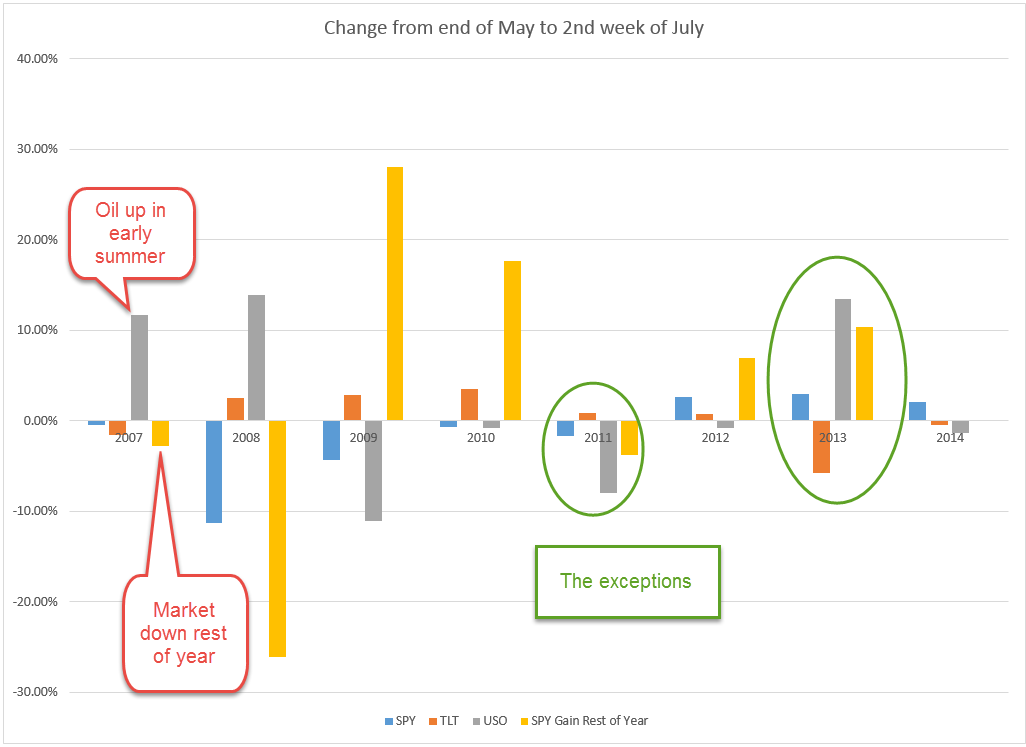
I heard a guy mention a negative correlation between early summer oil prices and stock market direction for the rest of the year. In other words, if one goes up the other goes down. I have a healthy skepticism of indicators but this one intrigued me since it made sense.  Oil is essentially a tax on our pocketbooks, on the economy.  If oil goes up, it is going to drive up supplier prices, hurt the profits of many companies, reduce discretionary income and drag down economic growth. The market will react to that upward or downward pressure in the next few quarters. But a correlation between six weeks of trading in summer and the market’s direction the rest of the year? Is that backed up by data, I wondered, or is that just an old saw?   I used the SP500 (SPY) as a proxy for the stock market, the U.S. Oil Fund (USO) as a proxy for the oil market and threw in Long Term Treasuries (TLT) into the mix.  I’ll explain why the treasuries in a minute.

A chart of recent history shows that there is some truth to that rule of thumb.  When oil (gray bars) has dropped in price in the first six weeks of summer trading, the stock market has gained (yellow bars) during the rest of the year in five out of the past seven years.   A flip of a coin will come up heads 50% of the time, tails 50% of the time. An investor who can beat those 50/50 chances by a margin of 5 wins to 2 losses will do very well.

Whether this negative correlation is anything but happenstance is anyone’s guess.  If you look at the chart again, you’ll see that there is also a negative correlation between long term Treasuries (TLT) and oil the the first half of summer trading. When one is up, the other is down.  The last year these two moved in tandem was – gulp! – in the summer of 2008.  Oh, and this year.  We know what happened in the fall of 2008.  So, is this the sign of an impending financial catastrophe?  Let me go throw some chicken bones and I’ll let you know.

*************************

Takeaways

Small business sentiment eased back from its recent optimism.  Spending on government social programs exacerbates political tensions and aging boomers will add fuel to the fire.  Job openings and confidence continue to rise from historically low levels.  Do summer oil prices signal market sentiment?

Follow The Money

June 14th, 2014

This week I’ll take a look at some near-term trends in small business, labor, oil and housing and a few long-term trends in income and debt.

***********************
Small Business

Huzzah, huzzah!  The monthly survey of small business owners by the National Federation of Independent Businesses (NFIB) broke through the 96 level after cracking the 95 level last month.  Sentiment has not been this good since mid-2007.  Hiring plans have been on the rise for the past several months and owners are reporting rising sales.

**********************

JOLTS (Job Openings and Labor Turnover Survey)

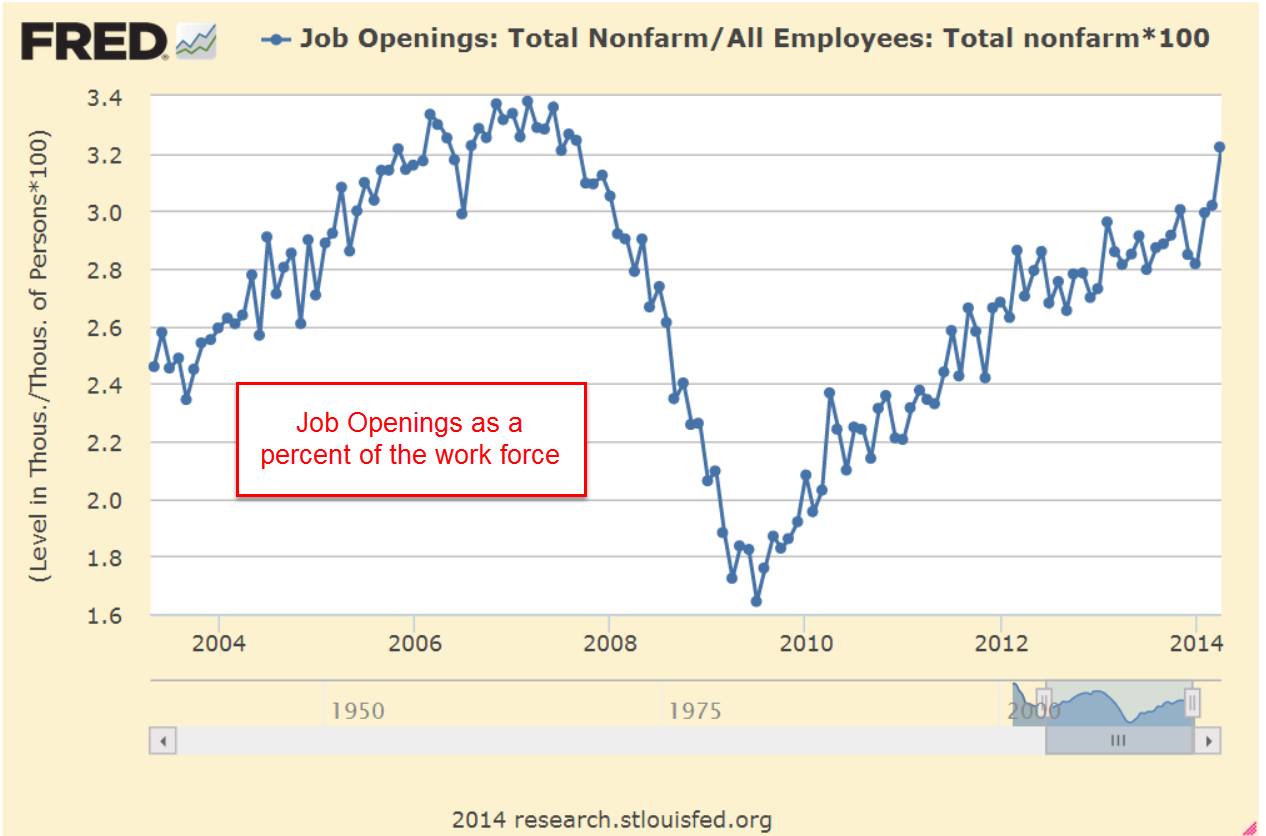
The Job Openings report from the Bureau of Labor Statistics (BLS) has a one month delay so the data released this past week was for April.  The number of job openings was 40,000 higher than expected, coming in close to 4.5 million.  As a percent of the workforce, job openings are approaching pre-recession highs.

The decline in construction job openings is a disappointment.  We are near the same level as 2003, a weak year of economic growth.  We should expect to see an uptick in job openings in next month’s report, confirming that projects put on hold during the severe winter in the eastern part of the country are again on track.  Further declines would indicate a spreading malaise.

************************

Gross Domestic Income

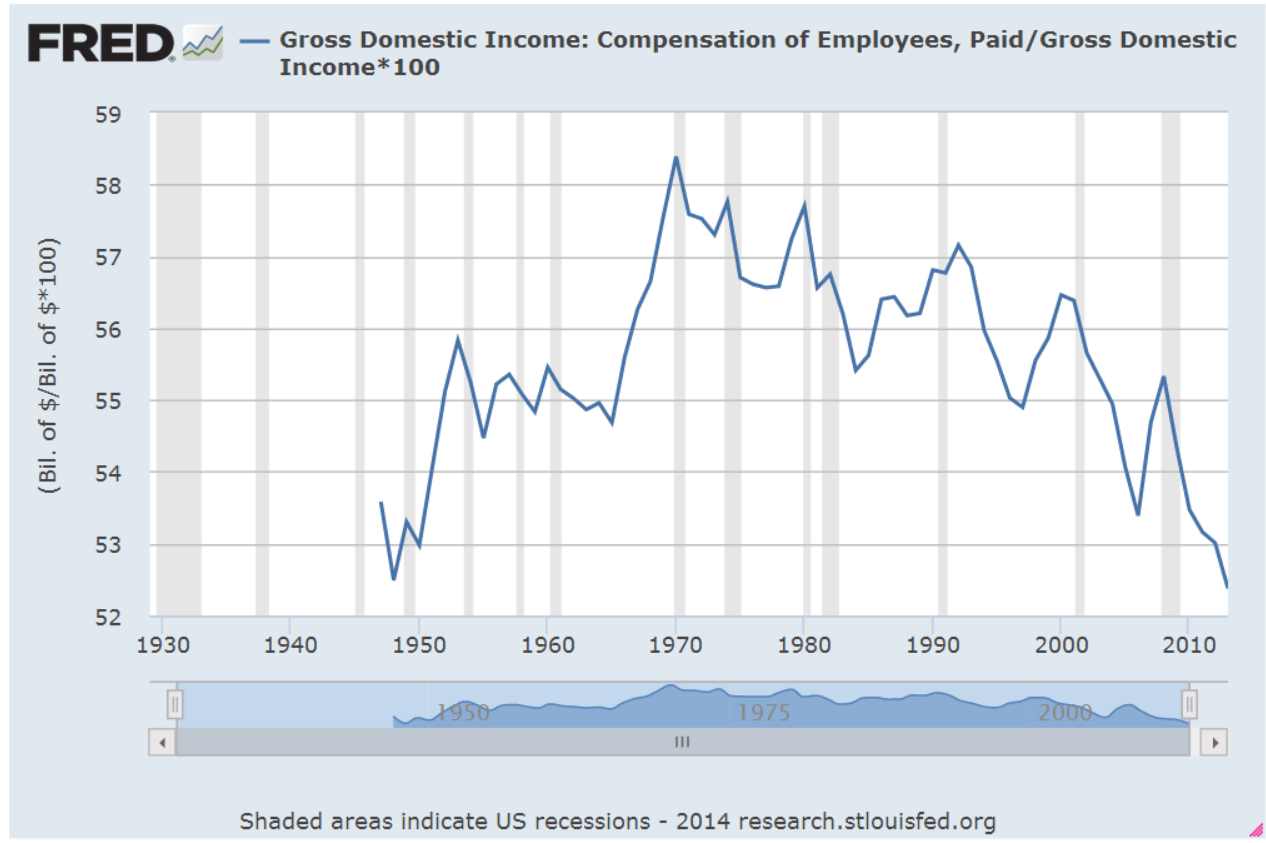
On a quarterly basis Gross Domestic Income, GDI, and Gross Domestic Product, GDP, differ somewhat but over the long run closely track each other.  Following up on two previous posts on Thomas Piketty’s book Capital in the 21st Century, I wondered what percent of GDI goes to pay employee compensation.  As we can see in the chart below, total compensation for human labor has been dwindling to post WW2 levels.

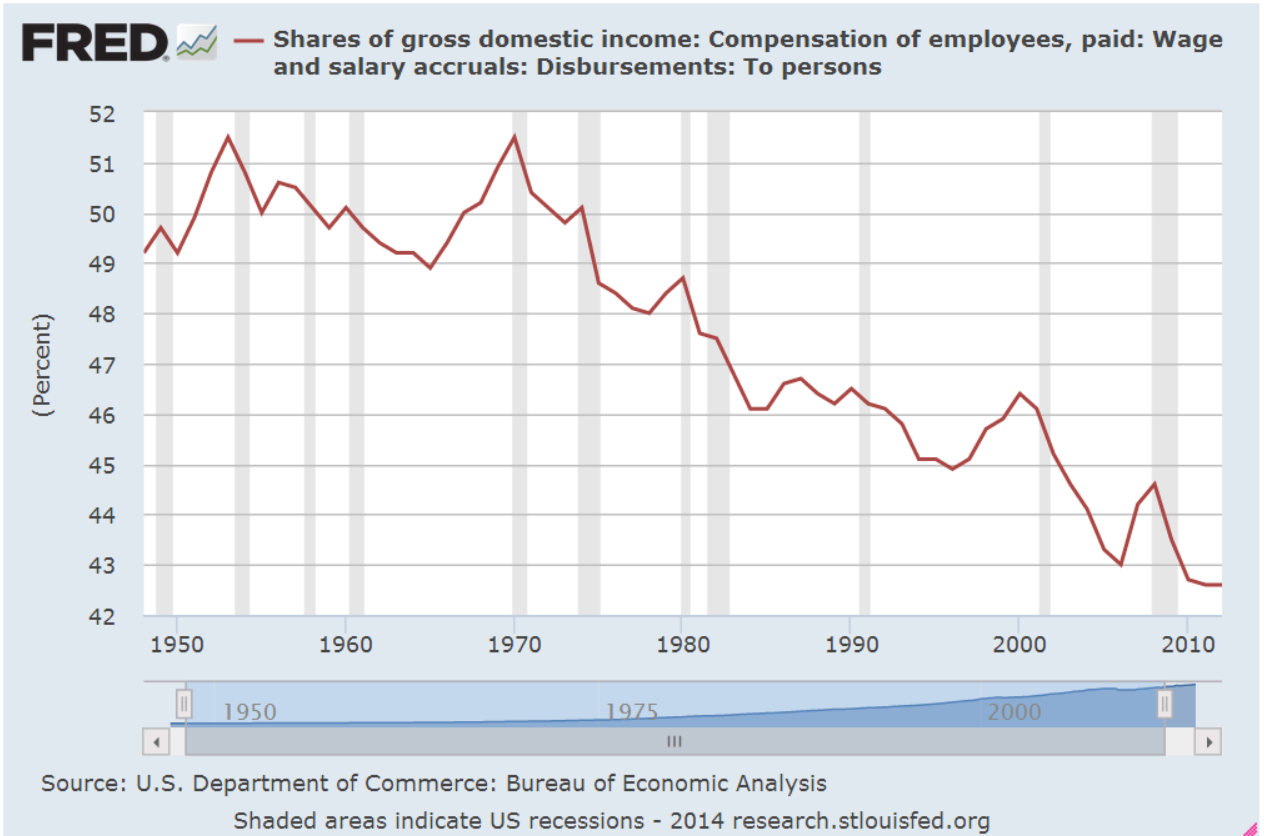
This is total compensation, including benefits.  Wage and salary income as a percent of total national income has declined steadily.

As a percent of total income, employee benefits have more than tripled since the end of World War 2 and now comprise more than 10% of the country’s income.

Demographic shifts have contributed to the decline of labor income.  The post war boomer generation, 80 million strong and 25% of the population, contributes to the trend as they save for retirement. As capital gains, interest and dividend income increase, this reduces the share of wage and salary income.

Economic changes have been a major factor in the decline of labor income.  Capital investments in technology, both in hardware and software, have reduced the need for labor for a given level of production.  Capital investment demands income to pay back the investment. For most of the 20th Century, machines replaced human muscle in farming, manufacturing and construction.  In the past two decades, machines are increasingly replacing mental muscle.

How we count labor income has changed.  Tax law changes in 1986 and 1993 reduced the amounts that are included as compensation but the overall effect of these changes is relatively minor.

If we divide the country’s total employee compensation by the number of employees, we might ask “What recession?”  Average annual compensation has climbed from $38-54K in a dozen years.  That’s almost a 50% raise for every employee!

Of course, everyone has not had a 50% increase in income over the past 12 years.  Human capital, the educational and technical training that an employee has to offer, has earned an increasing premium in the past three decades. Those with more of this capital have captured more benefit from the dwindling pool of labor needed for the nation’s production.

Average disposable income tells a more accurate story of the majority of people in this country.  Disposable income is what’s left over after taxes.  The trend is downward.

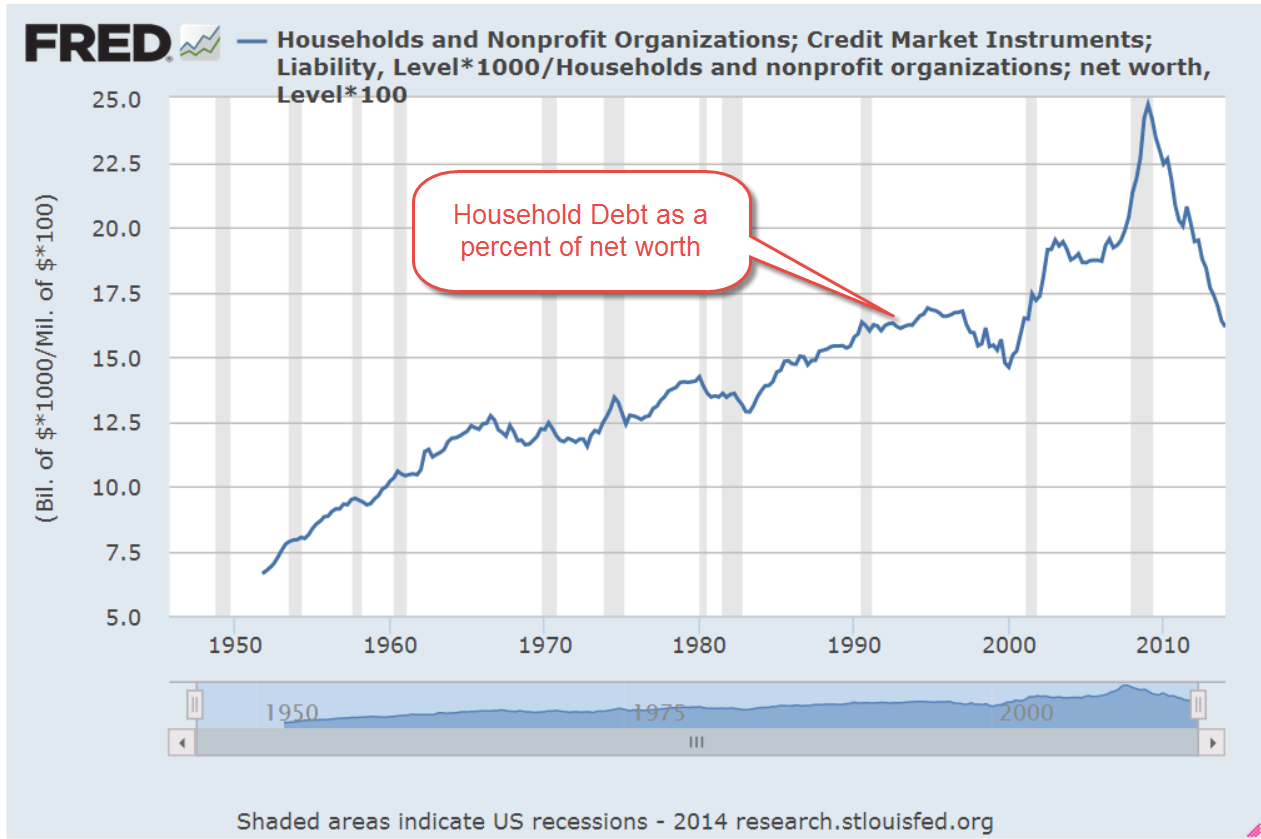
How do we cope with flat income growth?  Charge it!  It’s the Amurikin way! Per capita Household Debt has increased 75% in the past 13 years.  After a decline from the rather high levels before the recession began in late 2007, per capita debt has leveled off in the past two years.

Rising house prices and stock market values have increased net worth.  As a percent of net worth, household debt has declined to the more sustainable levels of the 1990s.

The percentage of disposable income needed to service that debt is at thirty year lows, meaning that there is room for growth.

In response to the hostilities in Iraq, oil prices have been on the rise.  Historically, a rise in oil prices leads to a rise in prices at the pump which takes an extra bite out of disposable income and puts a damper on consumer spending growth.

***********************

Oil Prices

A blog by Greg McIsaac at the Washington Monthly in May 2012 presents an interesting historical summary of oil prices and production.  The American love of simplicity leads many to credit one man, the President, for the rise and fall in gasoline prices, although the President has little, if any, influence on oil pricing. McIsaac notes The combination of lower energy prices and increased energy efficiency in the 1980s reduced US expenditures on energy by nearly 6 percent of GDP.  Deregulation of energy prices begun under the Carter Administration were largely credited to the Reagan administration.   He writes “crediting Reagan with falling energy prices of the 1980s exaggerates the roles of both Reagan and deregulation and obscures the larger influence of conservation and increased production outside the US.”  Production actually fell for several years after regulatory controls were lifted.

Further increases in oil prices will no doubt be blamed on this President.  The one thing that each outgoing President bequeaths to the newcomer before the inauguration is the Presidential donkey suit.

***********************

Housing

Redfin Research Center reports a sharp decline in the number of houses sold through May. After a 7.6% year-over-year decline in April, home sales slid 10% from May 2013 levels.  Real estate agents are reporting a shift from a seller’s market to a buyer’s market.

***********************

Takeaways

Small business accounts for approximately 60% of new jobs and optimistic sentiment among small business owners is growing.  The labor market continues to show continuing strength in the number of job openings and a decline in new unemployment claims.  Disposable income growth is flat but the portion of income needed to service debt is very low.  Rising oil prices and a slowing housing market will crimp economic growth.
Next week I’ll look at a complex topic – is the stock market fairly valued?  

Retail Sales, Autos, Sell in May

May 18, 2014

This week I’ll look at sentiment among small business owners, retail and auto sales, and revisit the “Sell in May” idea.

Small Business

Cue the trumpets, clouds part, sun rays stream down upon the green fields.  After almost seven years, sentiment among small business owners broke through the 95 level according to the monthly survey conducted by the National Federation of Independent Businesses (NFIB).  Despite the many positives in this latest survey, hiring plans remain muted.  This unfortunately confirms several other reports – the monthly employment report, JOLTS, disposable income, to mention a few – that indicate a befuddling lack of robust employment gains during this recovery.

********************

Retail Sales

The monthly reports on employment and retail sales probably have the most impact on short term investor sentiment.  Retail sales were flat in April but have rebounded well after the particularly harsh winter.  With a longer term perspective, year over year retail gains are not robust but are still in the healthy zone of 2-1/2%.

Per capita inflation adjusted retail and food service sales are strong.  Rising home prices in the early 2000s drove an upsurge in retail sales, followed by an offsetting plunge as home prices dropped and the financial crisis of 2008 hit consumers hard.  The landslide of employment losses undercut retail sales.

Motor Vehicles sales are particularly strong and are now back to the pre-recession trend line.

However, that recession dip represents millions of vehicles not sold and contributes mightily to the record average age of more than 11 years for vehicles in the U.S. (AutoNews)  As the article noted, better engineering has lengthened the serviceable life of many autos.  There are 247 million registered passenger vehicles and light trucks, more than one for each of the 240 million people in this country over the age of 18 (Census Bureau) According to the industry research firm Motor Intelligence (spreadsheet), April’s year to date passenger car sales have declined 1.8% while sales of light pickups have surged 8.3%.  The particularly harsh winter months probably reduced traffic at car dealerships around the country, but the year-over-year comparison in April was only a 3.6% gain.  The lack of a spring bounce indicates that household income gains are meager.  The rise in sales of light pickups is largely due to a 10% increase in construction spending in the past year.

On an annualized basis, auto sales are approaching 16 million, a level last seen in November 2007 and far above the 10 million vehicle sales in 2009.

The numbers look rather strong but annual sales per capita are at the recession levels of the early 1990s.   Clearly, something has changed.

Better engineering has increased serviceable vehicle life.  Demographic changes may be having an effect. The population is aging and older people who drive less may decide to hang on to their vehicles longer.  A population shift toward urban centers reduces demand for autos.  There is a greater availability of public transportation.  In some areas of the country, an electric scooter or bicycle meets many transportation needs.
Long term shifts in an industry prompt employers to look for opportunities to adjust some part of their strategy or cost structure to meet those changes.  Three weeks ago, Toyota announced that they will move their headquarters from Torrance, CA, in the South Bay area of metro L.A., to Plano, TX.  As the largest employer in Torrance, the city’s economy will surely take a hit. (Daily Breeze)  Toyota joins a list of large employers leaving or reducing their presence in California (article)

************************

Sell in May

The market has flatlined since early March.  Most of the companies in the S&P500 have reported earnings for the first quarter.  68% beat expectations but this has become a highly sophisticated game of managing expectations.  What is notable is that sales growth has slowed.  As I noted a few weeks earlier, labor productivity is poor.  Companies have done a remarkable job of cutting costs to boost profits but it is unclear how much more they can cut.  Last year’s 30% rise in the market has spurred the rise of mergers, or growing profits through economies of scale.

If the market were to decline 10 – 20% from here, some would point to the chart of the S&P500 and say they saw it all along.  “Classic case of a market top,” they would intone.  “Several failed attempts to break through resistance at the 1900 level indicated a major market correction.”  Oh, and they have a newsletter that you can subscribe to.

If the market goes up 10%, a different set of people will proclaim that they saw it all along.  “The market was forming a baseline of support,” they will sagely pronounce.  Each of these people also have a newsletter.

“Sell in May and go away” is an old quip of short term trading.  In 2011, I explored (here and here) the truths and myths behind this old saw. On a long term basis, one earns better returns by disciplined monthly, or quarterly, investing. Still, in a slight majority of the almost 20 years I reviewed, the Sell in May approach had some validity. Let’s look back at the last five years.  Typically an investor would sell the S&P500 and go into long Term Treasuries (TLT).  A more cautious investor might pick a less volatile intermediate bond fund.

In 2013, the SP500 went nowhere from May 1st to September 1st.  Great call by our intrepid investor who took some of her money out of the market and invested in Long Term Treasuries (TLT) in early May.  By early September, however, her investment would have depreciated 13%. Ooops!  Better to have stayed in stocks.

Likewise, in 2012, stocks went nowhere from early May to early September.  Unlike 2013, an investor buying long term Treasuries during that period had a 7% gain BUT if she had waited a week to sell in September, there was no gain.  The gains were a matter of luck.

2011 was the bing-bang year for the Sell in May crowd.  The stock market lost about 12% during the summer while long Treasuries gained 20%.

In 2010, stocks fell 7% during the summer while long Treasuries gained 10%.  During the summer of stocks gained almost 12% while Treasuries changed little.  In short, the strategy worked three summers out of the past five.

Now for a more fundamental approach – investing in companies that are more stable.  Horan Capital Advisors referred to a report from S&P Capital IQ that found that companies in the S&P500 with a low beta offset or reduced any summer market volatility.  Beta is a measure of a stock’s price volatility.  A value of 1 is the volatility of the entire index.  Betas less than 1 mean that a company’s stock price is less volatile than the index.  As volatility of the total market increases, investors tend to seek companies with a more reliable outlook and performance.  The screening criteria produced a mix of companies dominated by those in the consumer discretionary and health care sectors.  Worth a look for investors who buy individual stocks.

Employment, Obamacare and the Market

April 13, 2014

Nasdaq, Biotech and the Market

The recent declines in the market have come despite positive reports in employment and  manufacturing in the past few weeks.  Nasdaq market is off about 7% from its high on March 6th and some biotech indexes have lost 8% in the past few weeks. A bellwether in the tech industry is Apple whose stock is down about 9% since the beginning of the year, and 4% in the past few weeks.

The larger market, the SP500, has declined about 4% in the past six trading days, prompting the inevitable “the sky is falling” comments on CNBC.  The decline has not even reached the 5% level of what is considered a normal intermediate correction and already the sky is falling. It sells advertising.  The broader market is at about the same level as mid-January.  Ho-hum news like that does not sell advertising.

Both the tech-heavy Nasdaq and the smaller sub-sector of biotech are attractive to momentum investors who ride a wave of sentiment till the wave appears to be turning back out to sea.  In the broader market, expectations for earnings growth are focused on the second half of the year, not this quarter whose results are expected to be rather lackluster.  The 7-1/2% rise in February and early March might have been a bit frothy.

The aluminum company Alcoa kicks off each earnings season.  Because aluminum in used in so many products Alcoa has become a canary in the coal mine, signalling strength or weakness in the global economy.  On Tuesday, Alcoa reported slightly less revenues than forecast but way overshot profit expectations.  This helped stabilize a market that had lost 2.3% in the past two trading days.

On Thursday, the banking giant JPMorgan announced quarterly profit and revenues that were more than 8% below expectations.  Revenues from mortgages dropped a whopping 68% from last year, while interest income from consumer loans and banking fell 25%.  Investors had been expecting declines but not this severe.  JPMorgan’s stock has lost 5% in the past week, giving it a yield of 2.8% but it may need to come down a bit more to entice wary investors.  Johnson and Johnson, which actually makes tangible things that people need, want and buy every week, pays a yield of 2.7%.  Given the choice and assuming a bit of caution, what would you do?

The banking sector makes up about a sixth of the market value of the SP500, competing with the technology sector for first place (Bloomberg) The technology sector has enriched our lives immensely in the past two decades and deserves to have a significant portion of market value.  The financial sector – not so much.  They are like that one in the family that everyone wishes would just settle down and act responsibly.

****************************

Jolts and New Unemployment Claims 

February’s Job Openings report (JOLTS) recorded a milestone, passing the 4 million mark and – finally, after six years – surpassing the number of job openings at the start of the recession.  The number of Quits shows that there still is not much confidence among employees that they can find a better job if they leave their current employment.

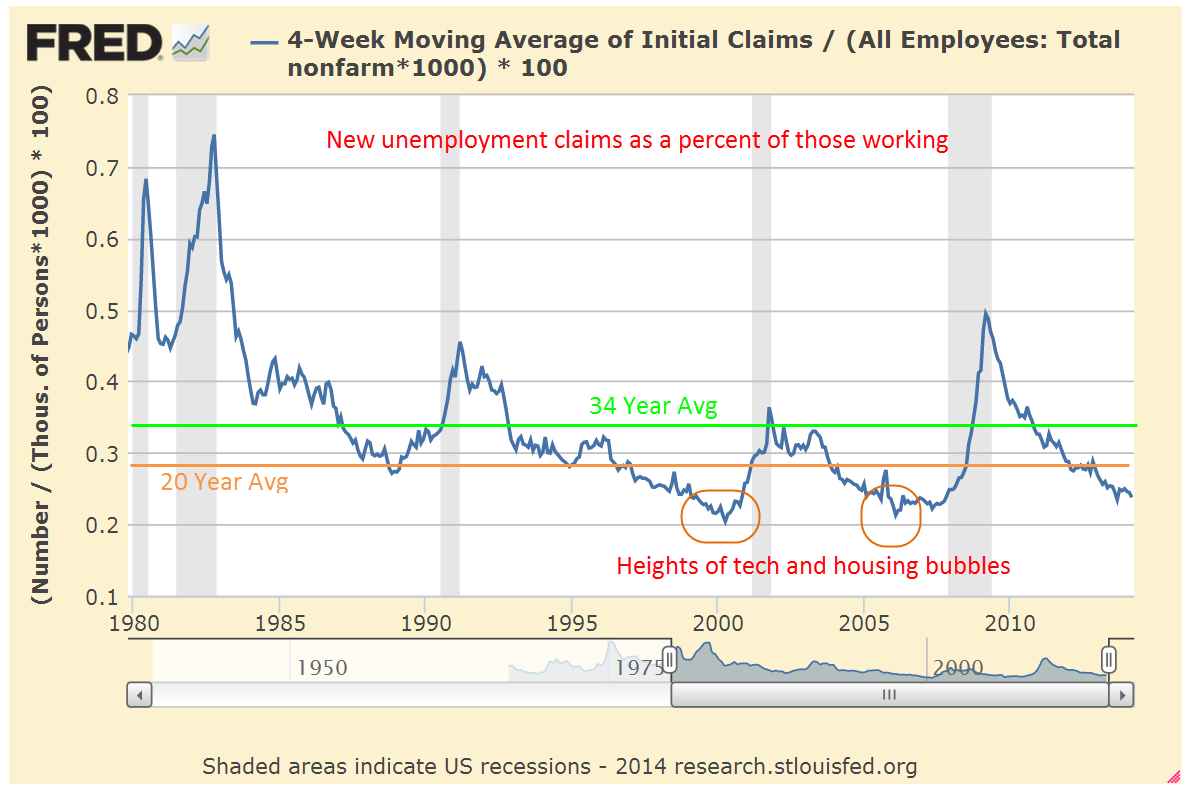
New unemployment claims dropped to 300,000 this week; the steadier 4 week average is at 316,000.  As a percent of the workforce, the number of new claims for unemployment is near historic lows, surpassed only by the tech and housing bubbles.

*******************************

Full-time Employee

A 1986 study of Current Population Survey (CPS) data by the Bureau of Labor Statistics (BLS) found that “well over half of employed Americans work the standard [40 hour] schedule.”  The median hours worked by full time employees changed little at just a bit over 40 hours. The average hours worked by full time employees was 42.5.  The study noted that between 1973 and 1985 the number of full time workers who worked 35 to 39 hours actually declined.

A paper published in 2000 by a BLS economist noted that the Current Population Survey (CPS) that the Census Bureau conducts is the more reliable data when compared to the average work week hours that the BLS publishes each month as part of their Establishment Survey of businesses.  The Establishment survey is taken from employment records but does not properly capture the data on people who work more than one job.  In that survey, a person working two part time jobs at 20 hours each is treated as though they were two people working two part time jobs. The CPS treats that person as one person working 40 hours a week.  Writing in 2000, the author noted that the work week had changed little from 1964 – 1999.

Fast forward to 2013 and the BLS reports that full time workers work an average of 42.5 hours, the same as the 1986 study.  More than 68% of workers reported working 40 or more hours a week.

The House recently passed H.R.2575, titled the “Save American Workers Act of 2014” – I’ll bet the people who write the titles for these bills love their jobs.  I always envision several twenty-somethings sitting in a conference room with pizza and some poetic lubricant and having a “Name That Bill” contest.  I digress.  This bill defines a full time employee as one who works on average 40 hours a week, not the 30 hours currently defined under the Affordable Care Act.

When I first started doing research on this I was biased toward a compromise of 35 hours as the definition of a full time employee.  My gut instinct was that fewer full time employees work a 40 hour week than they did 30 years ago.   The data from the BLS doesn’t support my gut instinct.

******************************

Obamacare

A monthly survey of small businesses by NFIB reported an upswing in confidence in March after a fairly severe decline in February.  That’s the good news.  The bad news is that optimism among small business owners can not seem to break the 95 index since 2007.  According to the U.S. Small Business Administration 2/3rds of new jobs come from small businesses. “Since 1990, as big business eliminated 4 million jobs, small businesses added 8 million new jobs.”

This is the first full year that all the provisions of the ACA, aka Obamacare, take effect.  Millions of small businesses around the country who provide health insurance for their employees are getting their annual business health insurance renewal packages.  For twelve years, my small business has provided health care for employees.  When I received the renewal package a few weeks ago, I was disappointed to find several changes that made comparisons with last year’s costs a bit more difficult.  As an aside, this health insurance carrier has always been the most competitive among five prominent health insurance carriers in the state.

Making the comparison difficult was a change in age banding.  What’s that, you ask?  In my state, business health plans were age banded in 5 year increments; e.g. a 50 year old and a 54 year old would pay the same rate for a particular policy.  Now the age banding is in one year increments.  If I compared the cost for a 45 year old employee last year with the rate for a 46 year old employee this year, the rate increase was a modest 5%.  Not bad.  But if I compare a 48 year old employee’s rate last year with a 49 year old employee this year, costs have risen 11%.   The provider for my company no longer offers the same high deductible ($3000) plan we had, offering a choice between an even higher deductible ($4500) plan or one with a much lower deductible ($1200).  Again, this makes the comparison more difficult.   Changes like this make cost planning more difficult and are less likely to encourage small businesses to bother offering health coverage to their employees.

Out of curiosity, I took a look at 2002 prices. The company long ago abandoned the no deductible plan we had in 2002 simply because it became unaffordable – this was while George Bush was President.  A plan similar to the HMO plan we had in 2002 – $20 copay, $50 specialist, $0 routine physical, no deductible, $2000 Max OOP –  now costs 270% what it did 12 years ago, an annual increase of more than 8%.  An HMO plan as generous as the one we had in 2002 is no longer available, so a more accurate comparison is that health insurance has tripled in twelve years.   It is no wonder that many small businesses either offer no health insurance or cap benefits at a certain amount that reduces the affordability and availability of insurance for many employees.

Until the unemployment rate decreases further, employees and job applicants are unlikely to exert much pressure for benefits from small business employers, a far different scenario than the heady days of the mid-2000s when unemployment was low and employers had to bargain to get decent employees.  There is no one single powerful voice for  many small businesses, other than the NFIB,  which makes it unlikely that Congress or state representatives will get their collective heads out of their butts and address the myriad regulatory and cost burdens that are far more onerous on small business owners.  Because of that we can expect incremental employment gains.

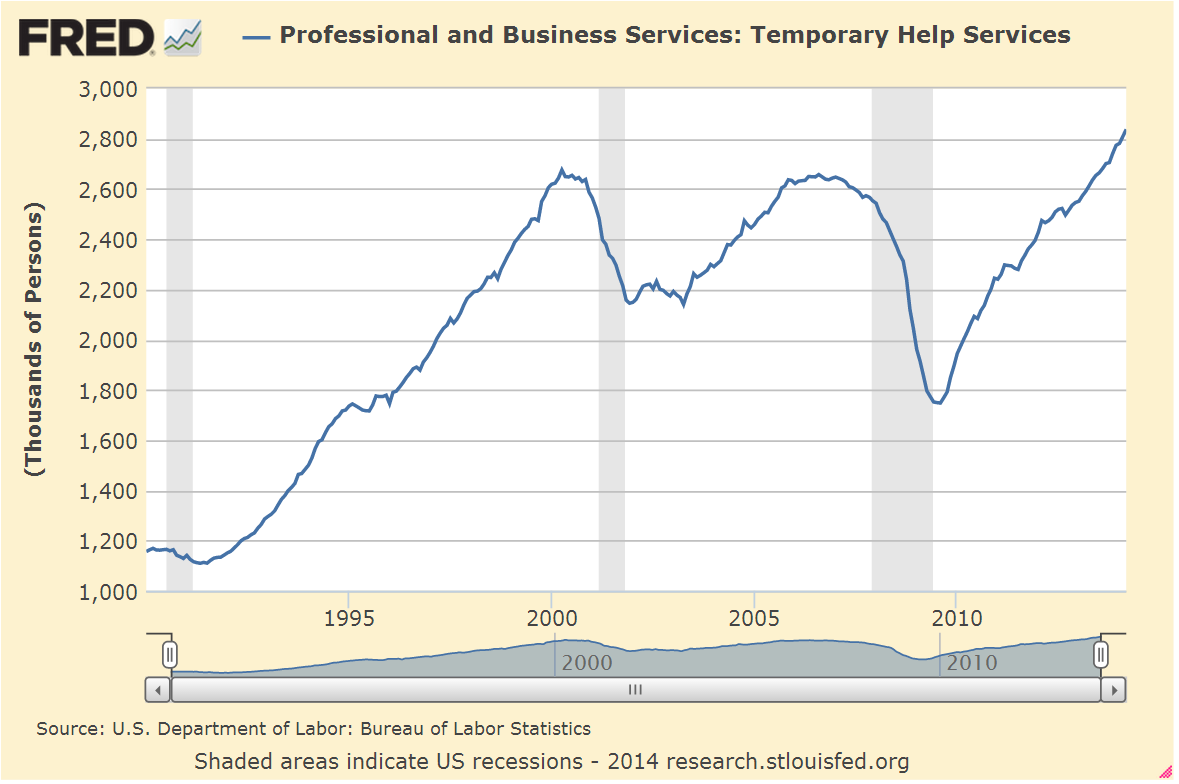
Betraying the lack of long term confidence in the economy and in response to employment burdens, employers increasingly turn to temporary workers, who make up less than 2% of the work force.

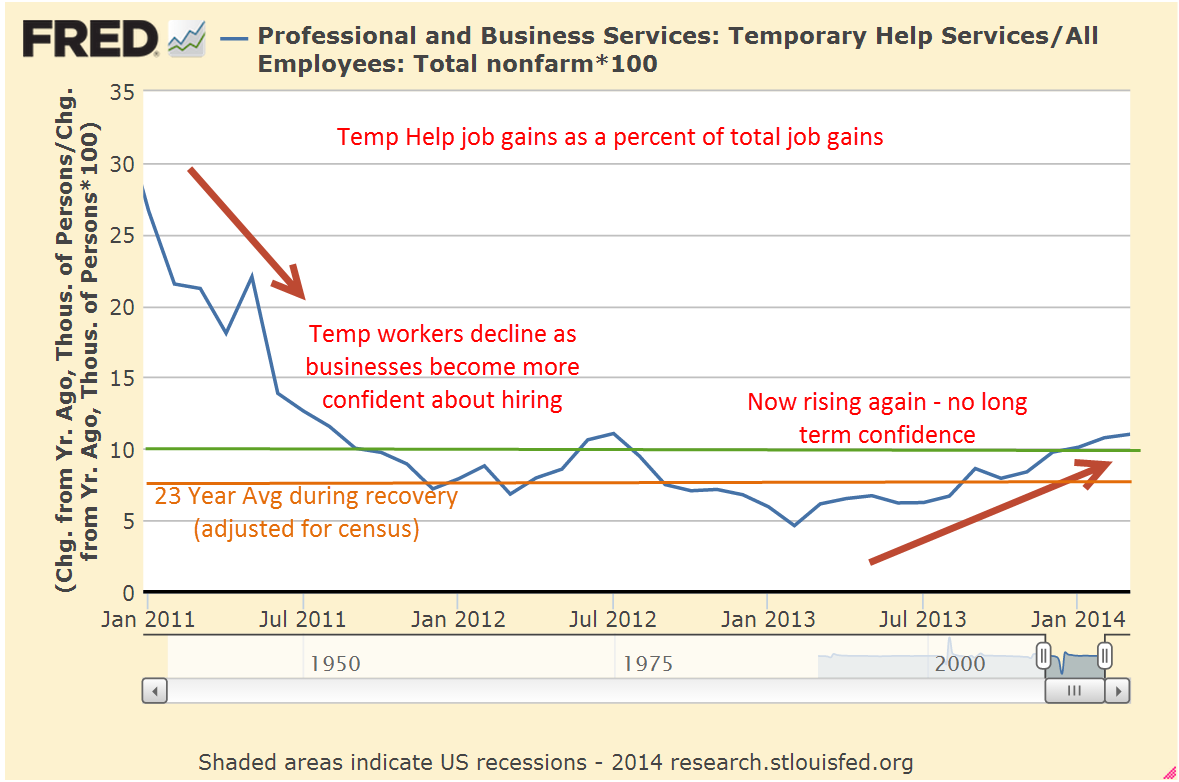
As an economy recovers from recession, it is normal for job gains to be distributed unevenly so that the increase in temporary workers is far above their share of the workforce.  Employers are understandably cautious and don’t want to make long term commitments.  Gains in temporary employment as a percent of total job gains should decline below 10%, indicating a stabilizing work force.

For the past two decades of recoveries and relatively healthy growth the average percentage is 7.4% (adjusted for census employment).  The percentage finally fell below this average in early 2012, rose back above it for a few months then stayed under the average till January 2013.  Since February of last year, that percentage has been rising again, crossing above the 10% mark in January, an inexorable evaporation of confidence.

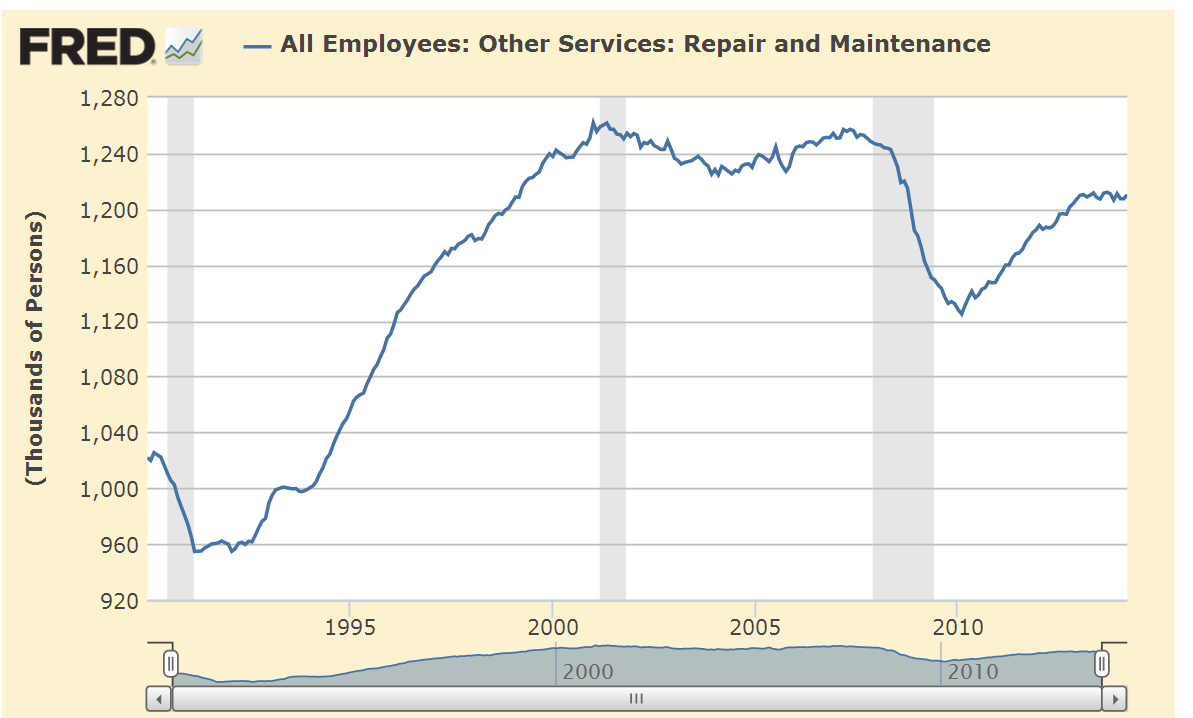
For the past year, repair and maintenance employment has flatlined at 1999 levels, indicating a lack of investment in commercial property and production equipment.

Specialty trade contractors in the construction industries are at 1998 levels despite an increase in population of 40 million.

While not alarming these trends indicate an underlying malaise in the workforce  that will continue to hamper solid growth.  Those ambitious and earnest folks in Washington, eager to make a difference and advance their political careers, continue to create more fixes which make the problem worse.  Imagine a car out of gas.  People out here on Main St. are pushing while the politicians keep hopping in the car to figure out what’s wrong, making the car that much more difficult to push.  At this rate, it is going to be slow going.