Merry Christmas

December 21, 2014

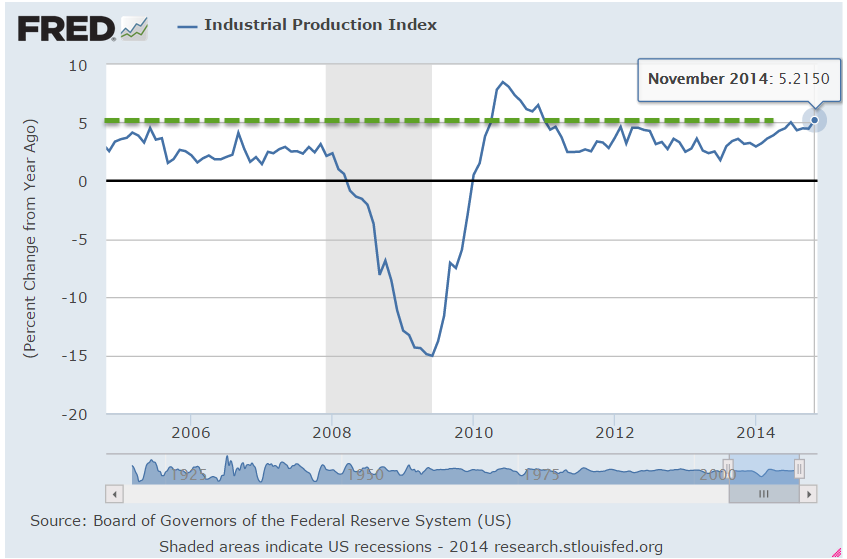
In preparation for today’s solstice, the market partied on in a week long saturnalia.  The week started off on a positive note.  Industrial production increased 1.3% in November, gaining more than 5% over November of 2013.

Capacity utilization of factories broke above 80%, a sign of strong production.  Production takes energy.  I’ll come to the energy part in a bit.

The Housing Market Index remained strong at 57, indicating that builders remain confident.  Tuesday’s report of Housing Starts was a bit of a head scratcher.  After a strong October, single family starts fell almost 6%.  Multi-family starts fell almost 10% in October, then rebounded almost 7% in November.  Combined housing starts fell 7% from November 2013.

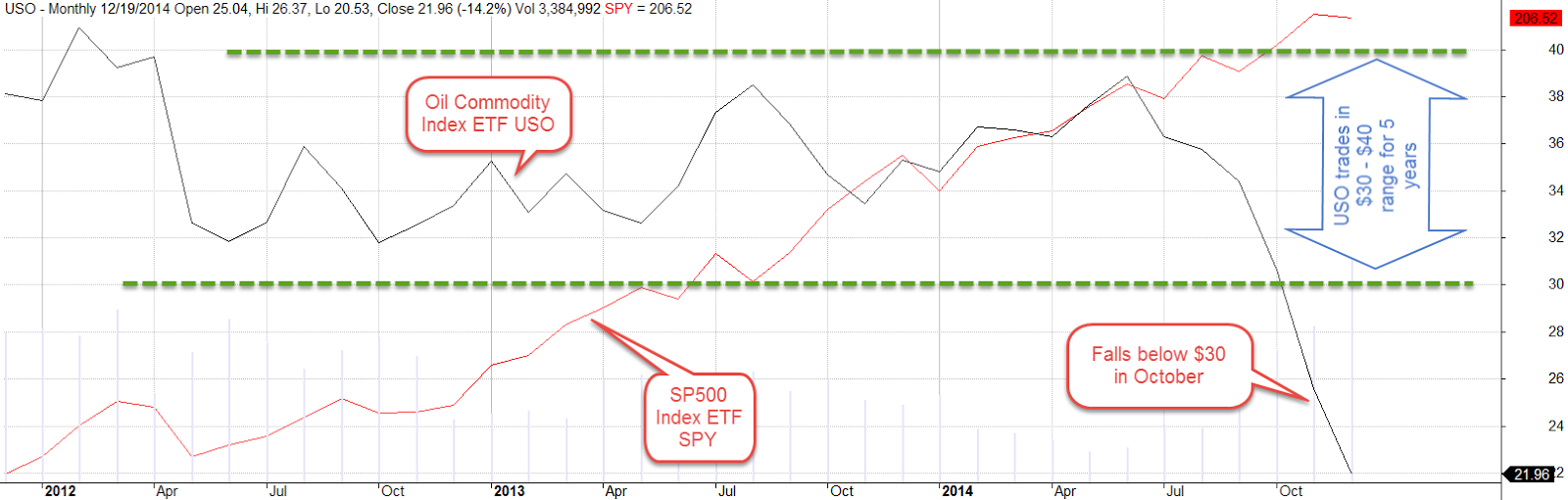
The market continued to react to the change in oil prices.  For the big picture, let’s go back a few years and compare the SP500 (SPY) to an oil commodity index (USO).  For the past five years, USO has traded in a range of $30 to $40, a cyclical pattern typical of a commodity.  In October, the oil index broke below the lower point of that trading range.

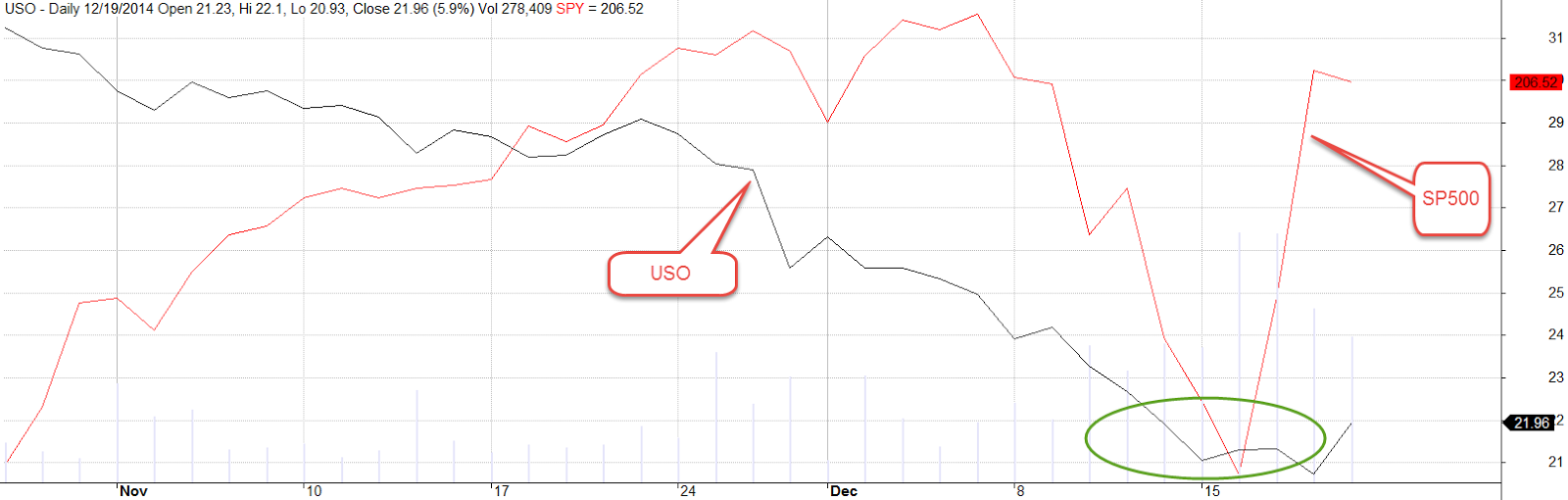
On Tuesday, oil seemed to have found a bottom in the high $50 range.  USO found a floor at $21, about a third below its five year trading range.  Beaten down for the past three weeks, energy stocks began to show some life (see note below).

Encouraging economic news helped lift investor sentiment on Tuesday morning. Some bearish investors who had shorted the market went long to close out their short positions. Growth in China was slowing down, Japan was in recession, much of Europe was at stall speed if not recession and the continued strength of the U.S. dollar was making emerging markets more frail.  While the rest of the world was going to hell in a hand basket, the U.S. economy was getting stronger.  Thee Open Market Committee at the Federal Reserve, FOMC, began its two day meeting and traders began to worry that the committee might react to the strengthening U.S. economy with the hint at an interest rate increase in the spring of 2015.  This helped sent the market down about 2% by Tuesday’s close.

Wednesday’s report on the Consumer Price Index (CPI) was heartening.  Falling gas prices were responsible for a .3% fall in the index in November, lowering inflation pressures on the Fed’s decision making about the timing of interest rate hikes.  The core CPI, which excludes the more volatile energy and food prices, had risen 1.7% over the past year, slightly below the Fed’s 2% target inflation rate.  Traders piled back into the market on Wednesday ahead of the Fed announcement Wednesday afternoon.  Back and forth, up and down, is the typical behavior when investors are uncertain about the short term direction of both interest rates and economic growth.

The Fed’s announcement that they would almost certainly leave interest rates alone till mid-2015 gave a further 1% boost upwards on Wednesday afternoon.  Twelve hours later, the German market opened  up at 3 A.M. New York time.  Early Thursday morning, the price of SP500 futures began to climb, indicating that European investors were reacting to the Fed’s decision by putting their money in the U.S. stock market.  Those of you living in the mountain and pacific time zones of the U.S. might have caught the news on Bloomberg TV before going to bed.  Maybe you got your buy orders in before brushing your teeth and putting your nightgown on. Very difficult for an individual to compete in a global market on a 24 hour time frame.  On Thursday, the market rose up as high as 5% above Wednesday’s close, before falling back to a 2.5% gain.

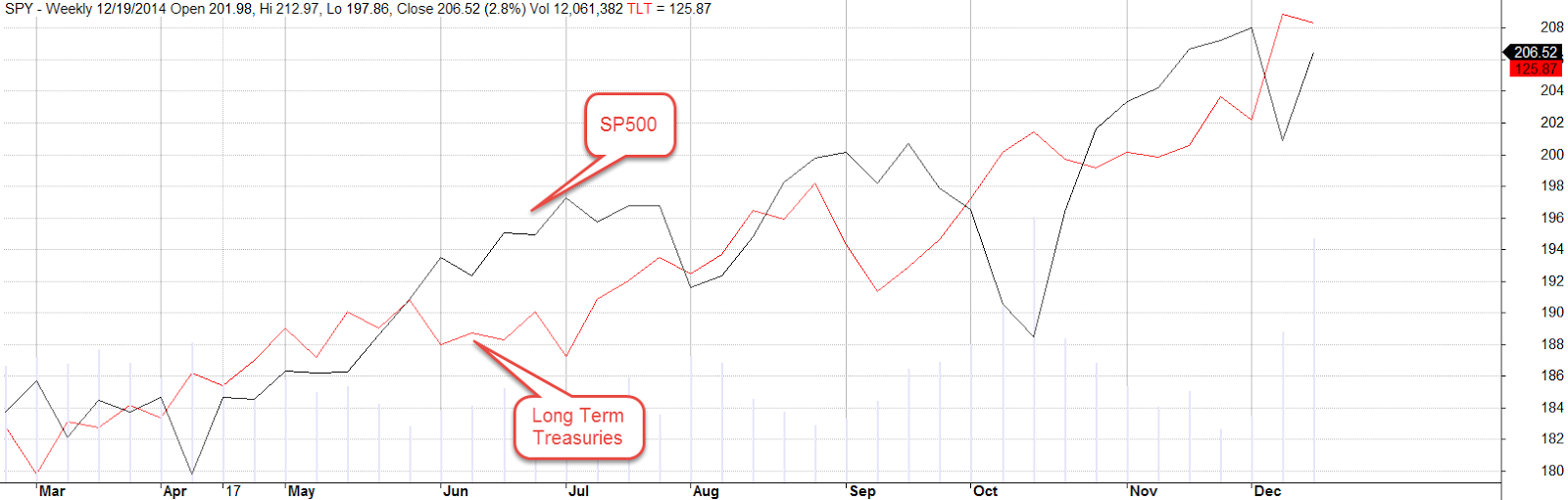
Still, a word of caution.  Both long term Treasuries, TLT, and the SP500, SPY, have been rising since October 2013.

As long as inflation remains low and the Fed continues its zero interest rate policy (ZIRP), long term Treasuries and stocks will remain attractive.   Something has to break eventually.  ZIRP  helps recovery from the aftermath of the last crisis but helps create the next crisis.  Abnormally low interest rates over an extended period are bad for the long term stability of both the markets and the economy.

**********************
Sale – Energy Stocks – Limited Time Only

(Note: this was sent out to a reader this past Tuesday.  Energy stocks popped up 4 – 5% the following day, a bit more of rebound than I expected. The week’s gain was almost 9% and the ETF closed above its 200 week average.)

As oil continues its downward slide, the prices of energy stocks sink.  XLE, a widely traded ETF that tracks energy stocks,  has dropped below the 200 week (four years!) average.  (A Vanguard ETF equivalent is VDE).  Historically, this has been a good buying opportunity. In the market meltdown of October 2008, this ETF crashed through the 200 week average.  A year later, the stock was up 38% and paid an additional 2% dividend to boot.  Let’s go further back in time to highlight the uncertainty in any strategy. The 2000 – 2003 downturn in the market was particularly notable because it took almost three years for the market to hit bottom before rising up again.  The 2007 – 2009 decline was more severe but took only 18 months. In June 2002, XLE sank below its 200 week average.  A year later, the stock had neither gained nor lost value. While this is not a sure fire strategy – nothing is – an investor  is more likely to enjoy some gains by buying at these lows.

****************************

Emerging Markets Stocks

Also selling below the 200 week average are emerging market (EM) stocks.  These include the BRICs (Brazil, Russia, India, China) as well as other countries like Mexico, Vietnam, Turkey, Indonesia and the Philipines. When a basket of stocks is trading below its four year average, there are usually a number of good reasons. Several money managers note the negatives  for EM.   Also included are a few voices of cautious optimism.  Sometimes the best time to buy is when everyone is pretty sure that this is not the right time to buy.  Another blog author recounts two strategies for emerging markets: a long term ten year horizon and a short term watchful stance.  The long term investor would take advantage of the low price and the prospect for higher growth rates in emerging economies.  The short term investor should be cognizant of the fickleness of capital flows into and out of these countries and be ready to pull the sell trigger if those flows reverse in the coming months.

******************************

Welfare

What are the characteristics of TANF families?  When the traditional welfare program was revised in the 1990s, lawmakers coined a new name, Temporary Assistance to Needy Families, to more accurately describe the program.  The old term carried a lot of negative connotations as well. Two years ago Health and Human Services (HHS) published their analysis of a sample of 300,000 recipients of TANF income in 2010.  Although the recession had officially ended in 2009, the unemployment rate in 2010 was still very high, above 9%.  It is less than 6% today.

There were 4.3 million recipients, three-quarters of them children, about 1.4% of the population. By household, the percentage was also the same 1.4% (1.8 million families out of 132 million households).  In 2013, the number of recipients had dropped to 4.0 million, the number of families to 1.7 million (Congressional Research Service)

In 2010, average non-TANF income was $720 per month, or about $170 a week.  To put this in perspective, this was about the average daily wage at that time The average monthly income from TANF averaged $392. Recipients were split evenly across race or ethnic background: 32% were white, 32% black, and 30% Hispanic. For adult recipients only, 37% were white, 33% black, and 24% Hispanic.

Rather surprising was how concentrated the recipients were. 31% of all TANF recipients in 2010 lived in California.  43.3% of all recipients lived in either New York, California or Ohio.  The three states have 22% of the U.S. population and almost 44% of TANF cases.

HHS data refutes the notion that welfare families are big.  50% of TANF families had only one child.  Less than 8% of TANF families had more than 3 children.  82% of TANF families also receive SNAP benefits averaging $378 per month.

In 2014, Federal and State spending on the TANF program was less than $30 billion, about 1/2% of the $6 trillion dollars in total government spending.  The Federal government spends a greater percentage on foreign aid (1%) than the TANF program. Yet people consistently overestimate the percentage of spending on both programs (Washington Post article).  The average estimate for foreign aid? A whopping 28%.  Cynical politicians take advantage of these public misperceptions.

**********************

Omnibus

Aiming to overhaul the health care insurance programs throughout the country, the Affordable Care Act (ACA) was a big bill.  No, it wasn’t 2700 pages as often quoted by those who didn’t like it.  The final, or Reconciled, version of the bill was “only” 900 pages.  The House and Senate versions were also about 900 pages each; hence, the 2700 pages.

At 1600 pages in its final form, the recently passed Omnibus Spending bill makes the ACA look like a pamphlet.  As  specified in the Constitution, all spending bills originate in the House.  Past procedure has been to pass a series of 12 spending bills.  Majority leader John Boehner has found it difficult to get his fractious members to agree on anything in this Congress so all 12 bills were crammed into this behemoth bill just in time to avoid a government shutdown.  Just as with the ACA, most members of the House and Senate did not have adequate time to digest the details of the bill.  The bill is sure to hold many surprises for those who signed it and we, the people, who must live under the farcical law-making of this Congress.  Here is a primer on the budget and spending process.

**********************

Home Appraisals

They’re back!  A review of 200,000 mortgages between 2011 and 2014 showed that 14% of homes had “generous” appraisals, inflating the value of the home by 20% or more.  Loan officers and real estate agents are putting increasing pressure on appraisers to adjust values upwards.

**********************

Personal Income

You may have read that household income has been rather stagnant for the past ten years or more.  In the past fifty years household formation has increased 78%, far more than the 50% increase in population.  The nation’s total income is thus divided by more households, skewing the per household figure lower.  During the past thirty years, per person income has actually grown 1.7% above inflation each year.  Inflation adjusted income is now 66% higher than what it was in 1985.

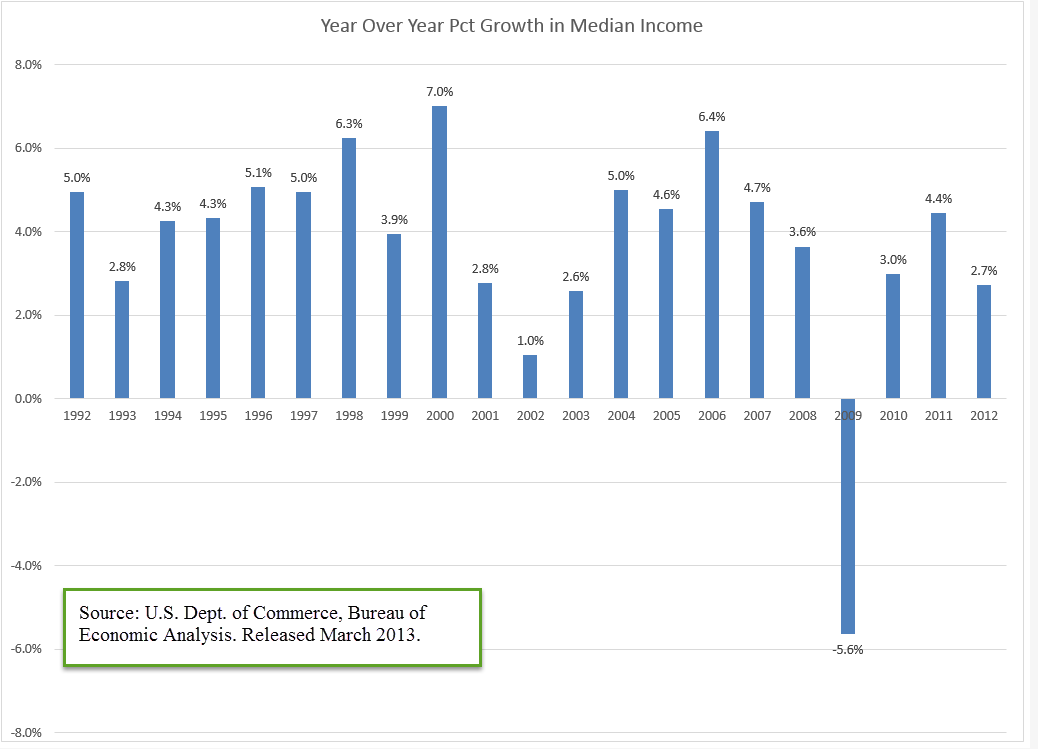
In 2013, the Bureau of Economic Analysis released median income data for the past two decades. Median is the middle; half were higher; half were lower.  This is the actual dollars not adjusted for inflation.  Except for the recession around the time of 9-11 and the great recession of 2008 – 2009, incomes have risen steadily.

The 3.7% yearly growth in median incomes has outpaced inflation by almost 25%.

Why then does household income get more attention?  A superficial review of household data paints a negative picture of the American economy. Negative news in general tugs at our eyeballs, gets our attention.  The majority of the evening news is devoted to negative news for a reason. News providers sell advertising in some form or another.  They are in the business of capturing our attention, not providing a balanced summary of the news.  In addition, a story of stagnating incomes helps promote the agenda of some political groups.

***********************

Merry Christmas and Happy Chanukah!

Oil, oil, retail, and oil

December 14, 2014

The market seemed to wake up Monday morning on the wrong side of the bed.  The Federal Reserve updated their Labor Market Conditions Index, scoring the month of November with a tepid 2.9, a sobering counter punch to the previous Friday’s report of 321,000 job gains in November.  Too many part time workers, too many long term unemployed, a rate of unemployment that was too high among minorities, those in their twenties and those without a college education.

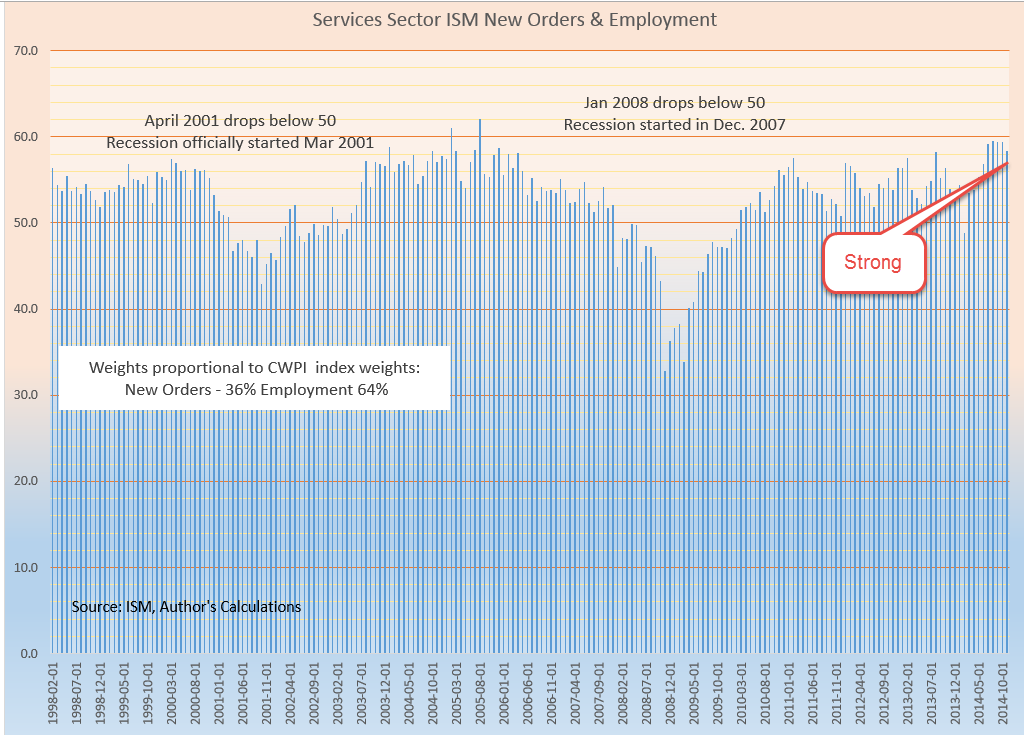
ISM’s monthly reports showed continued strength in both manufacturing and the services sector. The composite CWPI eased just a bit from the historic highs of the past two months.

The key components of the manufacturing index, new orders and employment, remained strong or robust.  The prices component showed a steep dive from expansion to contraction, 53.5 to 44.5.  George wondered if the falling price of oil had anything to do with this change.  New orders in the services sector grew even stronger while employment eased just a bit and was also continuing a strong expansion.

On his way to Home Depot on Tuesday morning, George filled up his SUV for just under $50.  When had that happened last he wondered.  2009, maybe?  George remembered the lead up to the 2012 elections. “Gas was $1.50 when Obama came into office,” he would hear on a conservative talk show, “and now it’s more than double that. Obama is hurting working families.”  As though Obama, or any President for that matter, had much to do with the price of gas.  Most talk show hosts counted on the fact that their audience was, well not stupid, as Jonathan Gruber had quipped when talking about Obamacare at a conference, but poorly informed.

The market had opened up that morning in a particularly foul mood after China tightened lending criteria so that Chinese investors could no longer use low-grade corporate debt as collateral for loans.  Overnight the Shanghai market lost more than 5% (WSJ ).

The EIA projected that U.S. oil production would rise in 2015 even as oil prices went lower.  Lower prices might curb new drilling but once the wells were drilled, the cost of production was fairly low.  The drop in gas prices put some extra money in most people’s pockets.  The EIA estimated that a gallon of gas would average about $2.60 in 2015, almost a $1 lower than the $3.51 average in 2013.

The continuing fall in oil prices contributed to another drop in the market on Wednesday, erasing the gains of the past month.  To sell or not to sell, that is the question, George thought as the volatility in the market continued to climb, rising more than 50% in the past week.  But he hemmed and hawed, then decided to replace the fence post in the back yard as the antidote to his indecision.

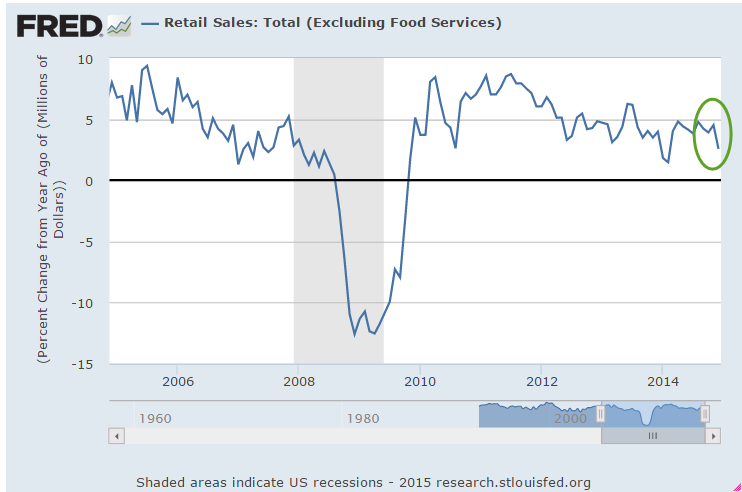
In an economy dominated by consumer spending, the monthly retail sales report and the employment report are probably the two most influential gauges of the strength of the economy.  Thursday’s report on retail sales was a huge positive, showing a rise of .7%.  On an annualized basis, that was an increase of more than 8%.  People were evidently spending the money they were saving at the pump.  The market opened higher and climbed up above Wednesday’s opening price.  Great stuff, George thought, then watched as the positive mood vanished and the market started sinking.  He must have made some sound because Mabel called out asking him if he was OK.  George realized that the early morning run up in prices was traders covering their short bets.  The underlying sentiment was still negative.  A strong employment report last Friday and now a strong retail sales report was having little effect on the mood of the market.  George decided to get out of the way of the darkening mood and sold the equity index he’d bought in mid-October.

The market continued to follow oil prices down on Friday.  George was pleased to find that the long term Treasuries that he had bought last week were up a few percent.  Glancing back at the beginning of the year, he saw that long term Treasuries (TLT) were up an unbelievable 20% so far this year.  Back in January many had projected higher interest rates toward the end of 2014, making long term Treasuries less attractive.  The equity market was up 10% for the year despite the recent change in mood.  Two types of investment that often moved opposite each other had moved in the same direction.  George smiled as he remembered something his  childhood baseball coach would say, “If it ain’t one thing, it’s the other, and sometimes it’s both.”  Which was just another way of saying not to put all your eggs in one basket.

Summer Signs

July 13, 2014

Small Business

Optimism has been on the rise among small business owners surveyed monthly by the National Federal of Independent Businesses (NFIB).  Anticipating a growing confidence, consensus estimates were for a reading of 97 to 98, topping May’s reading of 96.8.  Tuesday’s disappointing report of 95 dampened spirits.  The fallback was primarily in expectations for an improving economy.  Mitigating that reversal of sentiment was a mildly positive uptick in hiring plans. The majority of job growth comes from small and medium sized companies.

*******************************
Job Openings and Labor Turnover Survey (JOLTS)

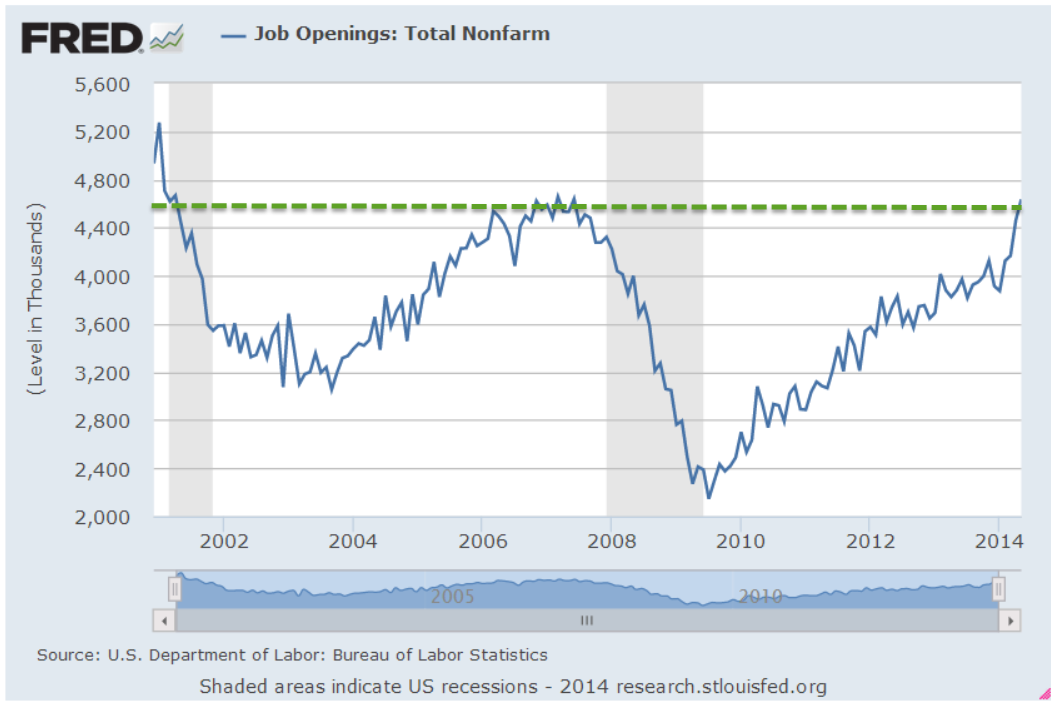
Speaking of job growth…There is a one month lag in the JOLTS report from the Bureau of Labor Statistics so this week’s report summarized May’s data.  The number of job openings continues to climb as does the number of people who feel confident enough to voluntarily quit their job.  Job openings have surpassed 2007 levels. If I were President, I would greet everyone with a hand shake and “Hi, job openings have surpassed 2007 levels.  Nice to meet you.”

Still, the number of voluntary quits is barely above the low point of the early 2000s downturn.  Let’s not mention that.

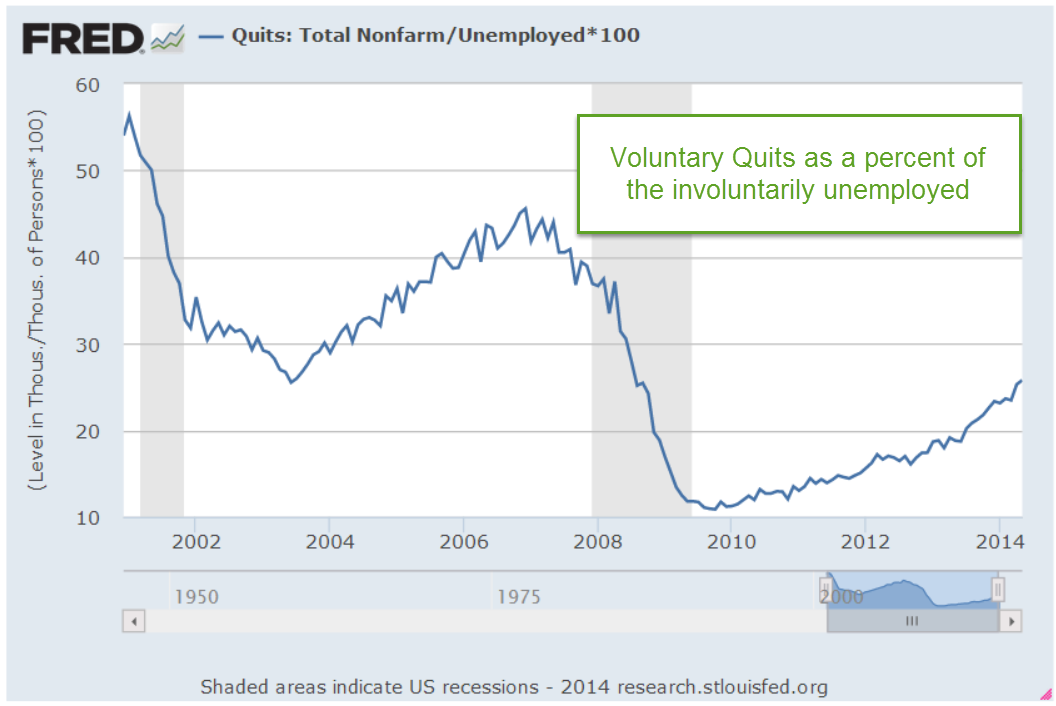
We can look at the number of job quits to unemployment, or the ratio of voluntary to involuntary unemployment.  This metric reveals a certain level of confidence among workers as well as the availability of jobs.  That confidence among workers is relatively low.  The early 2000s look like a nirvana compared to the sentiment now.  The country looks positively depressed using this metric.

If I were President, if I were a Congressman or Senator, I would post this chart on the wall in my office and on the chambers of Congress where it would remind myself and every other person in that chamber that part of my job is to help that confidence level rise.  Instead, most of our elected representatives are voicing or crafting a position on immigration ahead of the midterm elections.  Washington is the site of the largest Punch and Judy show on earth.  Like the little train, I will keep repeating to myself “I think I can, I think I can…stay optimistic.”

*******************************

Government Programs

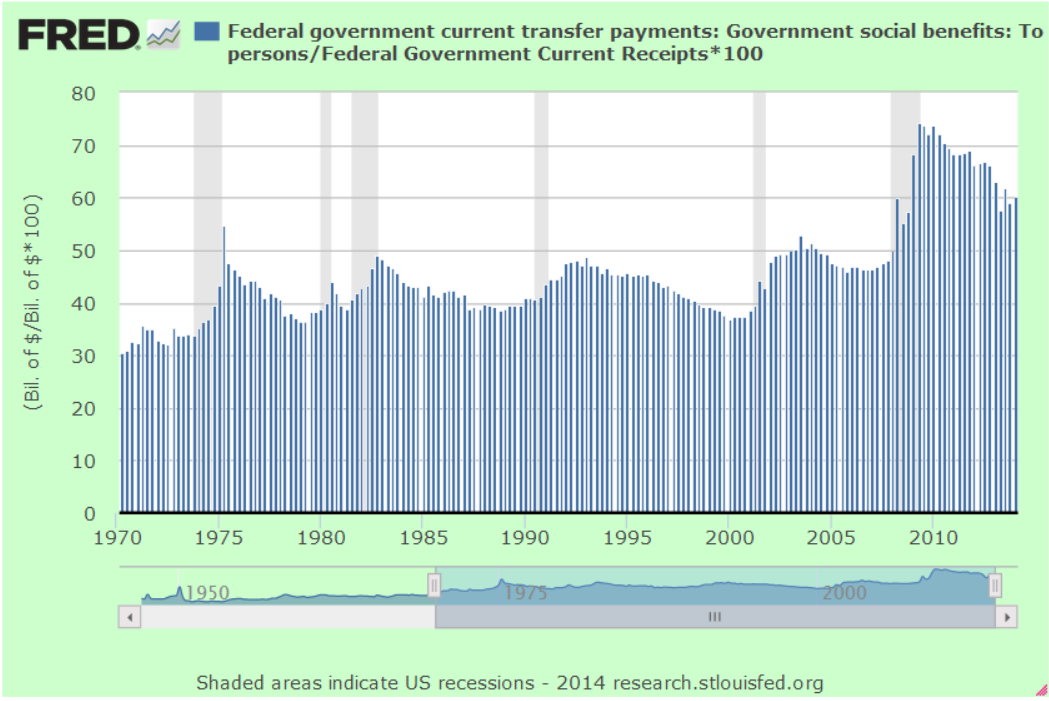
Most social benefit programs are on autopilot, leaving Congress with little discretion in determining the amount of money that flows out of the U.S. Treasury.  These programs include Social Security, Temporary Assistance to Needy Families, Food Stamps, Unemployment Benefits, etc.   Enacted over the past eighty years, the ghosts of Congresses past are ever present in the many Federal agencies that administer these programs.

During the recent recession, payments under social programs shot up, consuming more than 70% of all revenues to the government.  Political acrimony in this country switched into high gear as the U.S. government became the largest insurance agency in the world. As the economy improved, spending fell below the 60% threshold but has hovered around that level.

 That percentage will surely rise as the boomer generation retires, taking an ever increasing share of revenues to pay out Social Security, Medicare and Medicaid benefits.  As the percentage rises again toward the levels of the recession, we can expect that social benefit spending will take center stage in the 2016 Presidential election.

*******************************
Indicators

Back in ye olden days, soothsayers used chicken bones and tea leaves to foretell the future.  We now have powerful computers, sophisticated algorithms and statistical techniques to look through the foggy glass of our crystal ball.  Less sophisticated algorithms are called rules of thumb.  In the board game Monopoly, a good rule of thumb is that it is wiser to build hotels on St. James, Tennessee and New York Ave than on the marquee properties Park Place and Boardwalk.

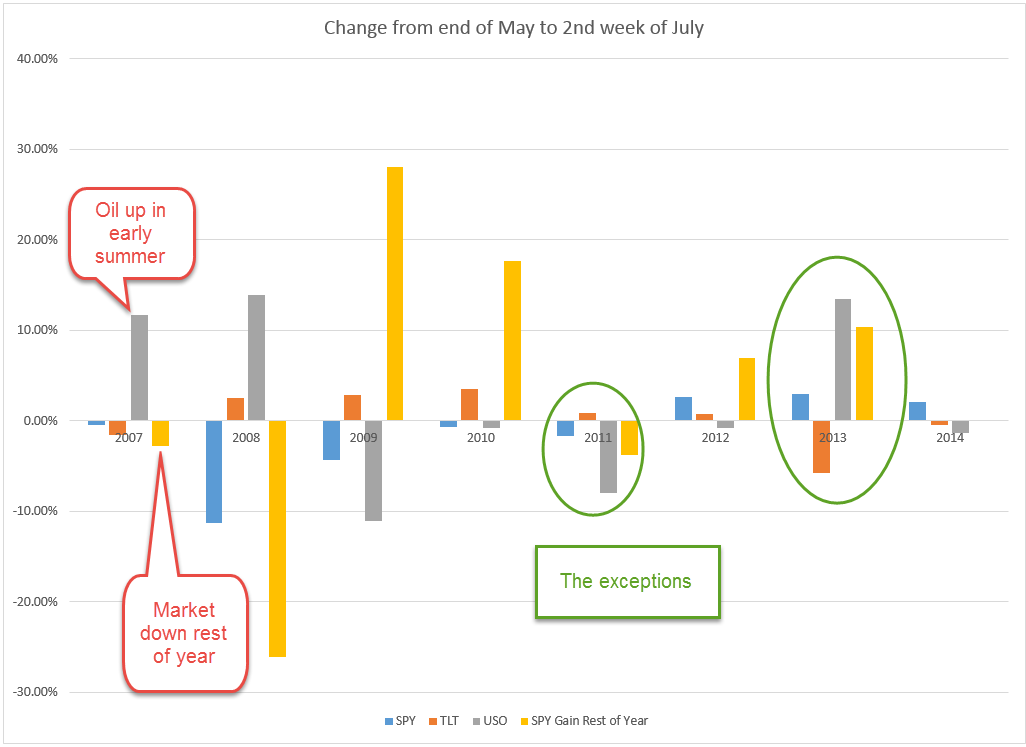
I heard a guy mention a negative correlation between early summer oil prices and stock market direction for the rest of the year. In other words, if one goes up the other goes down. I have a healthy skepticism of indicators but this one intrigued me since it made sense.  Oil is essentially a tax on our pocketbooks, on the economy.  If oil goes up, it is going to drive up supplier prices, hurt the profits of many companies, reduce discretionary income and drag down economic growth. The market will react to that upward or downward pressure in the next few quarters. But a correlation between six weeks of trading in summer and the market’s direction the rest of the year? Is that backed up by data, I wondered, or is that just an old saw?   I used the SP500 (SPY) as a proxy for the stock market, the U.S. Oil Fund (USO) as a proxy for the oil market and threw in Long Term Treasuries (TLT) into the mix.  I’ll explain why the treasuries in a minute.

A chart of recent history shows that there is some truth to that rule of thumb.  When oil (gray bars) has dropped in price in the first six weeks of summer trading, the stock market has gained (yellow bars) during the rest of the year in five out of the past seven years.   A flip of a coin will come up heads 50% of the time, tails 50% of the time. An investor who can beat those 50/50 chances by a margin of 5 wins to 2 losses will do very well.

Whether this negative correlation is anything but happenstance is anyone’s guess.  If you look at the chart again, you’ll see that there is also a negative correlation between long term Treasuries (TLT) and oil the the first half of summer trading. When one is up, the other is down.  The last year these two moved in tandem was – gulp! – in the summer of 2008.  Oh, and this year.  We know what happened in the fall of 2008.  So, is this the sign of an impending financial catastrophe?  Let me go throw some chicken bones and I’ll let you know.

*************************

Takeaways

Small business sentiment eased back from its recent optimism.  Spending on government social programs exacerbates political tensions and aging boomers will add fuel to the fire.  Job openings and confidence continue to rise from historically low levels.  Do summer oil prices signal market sentiment?

Fill ‘er up!

February 23, 2013

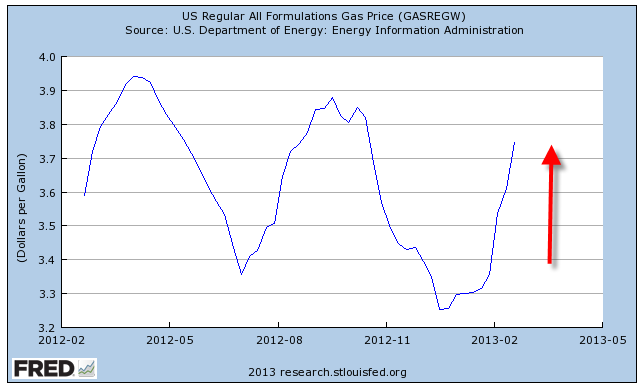
Most of us with cars have noticed the rather dramatic increase in gas prices since the beginning of the year.  I’ll use the all formulations series, which is about 8 – 10 cents cheaper than what a family might pay at the pump.

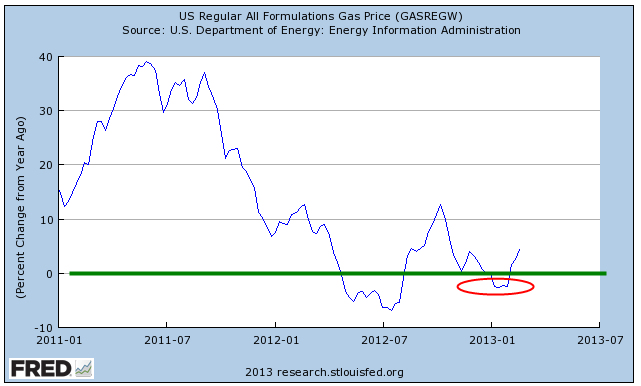
A reason given for the upsurge in prices is that this is a normal seasonal change as refineries shut down to make the change over from a winter gas formulation to a summer gas formulation.  Heavier volatile organic compounds are removed from gas during the summer months to reduce smog.  The resultant decrease in supply therefore leads to an increase in price.  It’s Econ 101.  If that were true, then the year-over-year percent change would be relatively minor at this time of year.  In one of those contradictory anomalies, this year is the only year that the refinery change-over explanation actually fits.  Price changes over the same months in 2012 have been minor.  Notice that in other years, price increases in the early months contradicted the theory.

The change has been particularly noticeable because gas prices decreased to near $3 a gallon toward the end of 2012.  In the Denver area, prices dropped below $3 a gallon, prompting comments in idle conversation.  The average driver uses about 10 gallons a week but out west, where driving distances are greater, that average gas consumption is probably closer to 15 – 17 gallons.  The difference between $3 gas and $4 gas can mean a weekly gas “tax” of $15 or more.  For those of us who use a vehicle for work, the difference can be $30 or more.

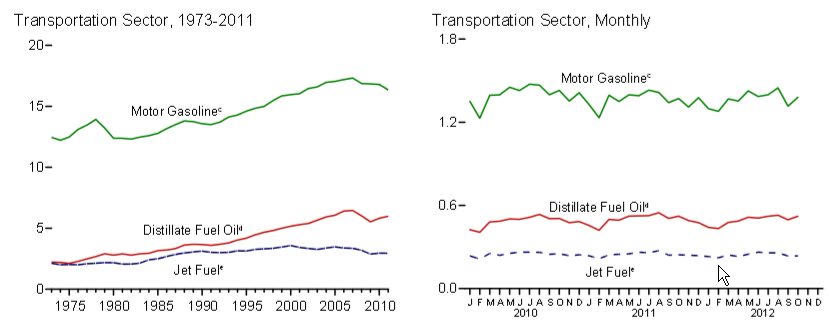
Since the recession began in 2007, our use of gasoline has decreased, ending a multi-decade rise in overall gasoline consumption (EIA Source)

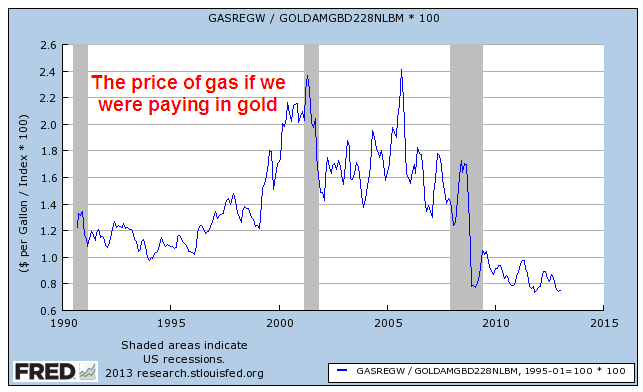
However, since the late nineties average gas prices are rising and have become quite volatile.  So why?  Our gasoline use was increasing during the nineties but prices were flat at a little over a $1 a gallon. Why the big increase in the past 10 – 15 years?  If one were buying gasoline with gold, the price has fallen over the past two decades.

If our consumption has levelled off in the past few years and we are producing more oil in this country, why has the price of gasoline stayed pretty consistently above $3 a gallon?

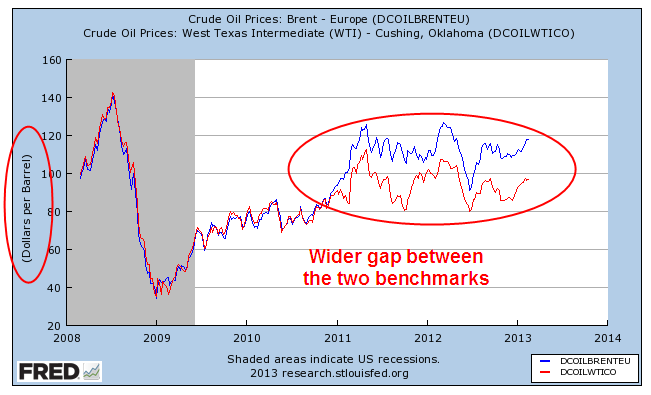
The three main variations of crude oil are heavy (Venezuela, for example), medium (North Sea and MidEast) and light (Texas). The benchmark for medium grade is Brent Crude; for light grade it is West Texas Intermediate (WTI). The two benchmarks have traditionally moved in tandem with Brent Crude trading about $2 above WTI.  Over the past few years, the difference in price between the two benchmarks has widened considerably.  “Fracking” has led to an upsurge in domestic production; production in the North Sea has been steadily declining; tensions in the MidEast and North Africa have contributed a risk premium to medium crude produced in the region.

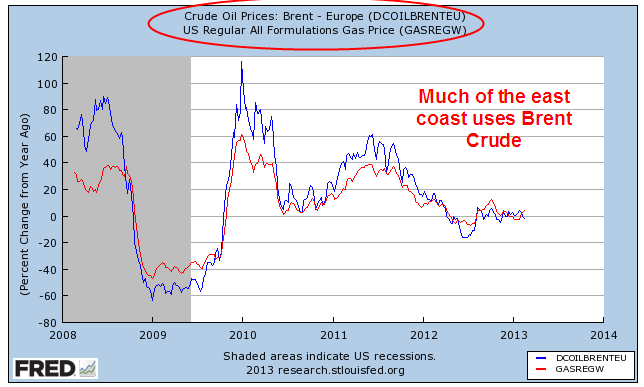
Refineries are set up to process a particular type. Most east coast refineries process Brent Crude; higher transportation costs of domestically produced crude oil over land made it more cost efficient for eastern refineries to import oil from overseas.  Since the majority of the U.S. population lives in the eastern U.S., the majority of the American people use imported gas.  Gas prices move in tandem with the spot price of Brent crude.

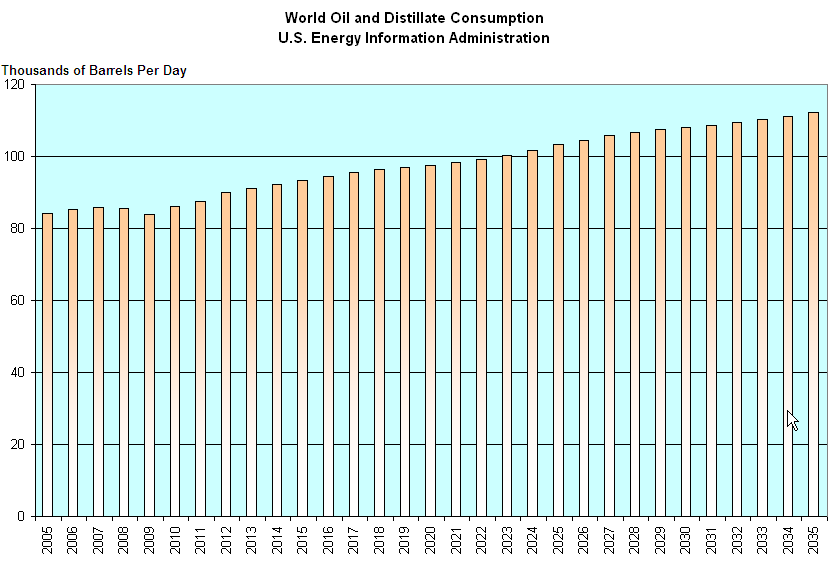
While U.S. oil consumption has declined, world consumption has been rising.

The U.S. Energy Information Administration projects  a slow, steady rise in oil consumption over the next two decades as the standard of living improves.

No magic wand will cause gas prices to decline.  Crude oil and its derivative products are a world commodity and can be shipped inexpensively in large tankers all around the world.

Last week I wrote about the long term trend in federal debt; that it was not a “New Normal” but a continuation of the same old normal of the past several decades.  The continued rise in oil prices is another trend that has become a fixture of our daily lives and will continue to eat at the dollars in our pocketbooks for the foreseeable future.

Oil Suck

After rising to almost $115 a barrel (42 gallons per barrel), oil slid to $98 a barrel in this past week.  Across the country prices at the pump approach and in some states exceed $4 per gallon.  When gas prices rise, presidents call for an investigation into speculative trading and market manipulators and this president is no different.  This past week President Obama called on his Attorney General, Eric Holder, to lead a “Fraud Squad” which will root out those nefarious speculators and bring them to justice. 

There’s only one problem – the speculators are state, local and private pension funds buying “paper oil”, Joe and Mary hoping to grow their college fund by buying a few hundred shares of an oil related ETF.  Frank hopes to pay off his student loans with a proven timing system on the Proshares Ultra Oil and Gas ETF (DIG).  Hedge fund managers include oil as part of a commodity exposure mathematically designed to mitigate inflation risks to their clients’ portfolios.  None of these speculators either produce or want delivery of any oil.  The companies – airlines, for example – that do use lots of oil and trade oil futures to lock in operating costs probably daydream that some administration or some Congress or the feeble Securities Exchange Commission or the Chicago Mercantile Exchange would keep those who buy and sell “paper oil” out of  the market.

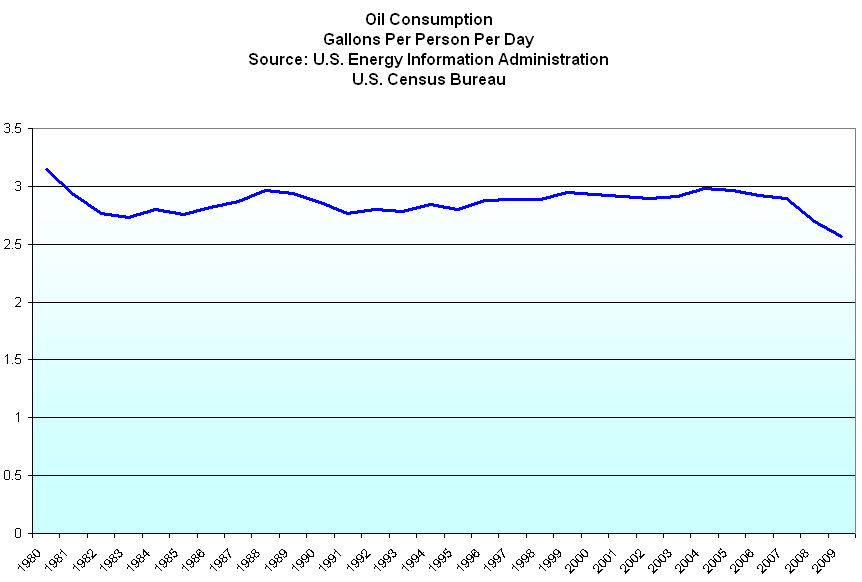
For the past half century this country has sucked on oil.  Below is the daily U.S. crude oil consumption during the past 30 years as reported by the U.S. Energy Informaton Administration (EIA) (Source) Consumption has declined slightly in the past two years, thanks to the recession.  Recent quarterly figures from the EIA, however, show that 2010 consumption was already up to 2008 levels.

Since 1980, we have introduced more fuel efficient cars and “cut” our gasoline with ethanol.  Our population has concentrated more in urban areas, and we have spent billions of taxpayer dollars on new and improving public transportation.  I combined data from the EIA and the Census Bureau to get a per person per day consumption rate.  All this hard work and we still suck up gas.

Each day all the people on the planet use about 85 million barrels of oil.  The U.S. uses almost 20 million barrels a day, a bit less than a quarter of the world total.  Ten years ago, we consumed a bit more than a quarter.  Growing prosperity in developing countries is increasing the demand for oil.

In the 1970s, President Nixon spoke about developing a comprehensive energy policy and every president since then has repeated the pledge.  Do we have such a policy?  Not a chance.  This country sits on top of vast reservoirs of natural gas yet there is no comprehensive plan to increase the use of this clean burning fuel.  In other countries, Ford and GM make cars that use Compressed Natural Gas (CNG) but the lack of any cohesive U.S. policy to promote this technology and delivery system has forced carmakers to abandon this country, the largest oil market in the world.  For more info on CNG vehicles.

Federal and state politicians will likely continue to twiddle their thumbs as they have done for the past 40 years. Exxon Mobil is the largest oil company in the world and will likely benefit from increasing global demand for its products.  When  President Nixon spoke about a comprehensive energy policy, Exxon’s stock traded at an adjusted closing price of less than $1.  Today the stock trades at $83 and they pay a dividend, currently about 2.3%. 

As shown above, our consumption has changed only slightly despite reduction measures.  Older people generally drive less and as the population ages, miles driven will likely decrease during the next 20 years.  But will our overall consumption decrease?  We like big in our cars.  We like trucks and SUVs.  We like to drive.