A Graduated System of Benefits

October 29, 2017

My kids will learn that they are the sons and daughters of charity parents.

Two weeks ago, I wrote about the measurement of the poverty rate in America. Why is our standard different than the one adopted by all other developed countries? What efforts have we made to alleviate poverty, and have those programs helped or hurt the poor?

Qualifications for benefits under various programs rely primarily on paid income. As a person exceeds certain thresholds of income, benefits are reduced or stopped entirely. Regardless of how we define a reduction in benefits, it feels like a tax to the recipients. Under these programs, the poor pay the highest tax – 100%. $1 earned above a certain threshold results in a $1 reduction in benefits. There is a very real incentive to hide reported income.

As I showed earlier, the poverty standard adopted by the U.S. undercounts the number of poor. On the other hand, income earned in the underground economy is not counted and results in an overcount of the poor.

We may associate “underground” with “illegal” but it includes both legal and illegal activities. A better synonym would be “unreported.” Workers in the unreported economy may include the kid down the block who mows our lawn, the guy who repaired our fence, the woman who walks our dog when we work late.

Almost all of us are part of the unreported economy whether we realize it or not. Recent estimates of the size of this shadow economy in the U.S. are from 7% to 11%. In dollar amounts, that’s $1.4 trillion to over $2 trillion. In less developed economies, it can be as much as 25%.

The tragedy of current programs is that they often discourage recipients from getting more work, or better paid work. The loss of Medicaid benefits dissuades a single mom with children from taking on employment unless she can find an employer who provides health insurance for her and her children. Many don’t.

Income above a certain threshold may disqualify someone from housing benefits. Under a Section 8 housing program, a low-income person pays 30% of their monthly income for housing (Section 8 FAQs). HUD, a Federal agency, and state agencies pay the rest of the rent. Section 8 housing is in short supply. The amount of paperwork and inspections required by HUD dissuades many real estate owners from enrolling their properties in the program.

These programs would improve by paying benefits on a graduated scale rather than using a qualifying threshold. Under the current system, a person making less than half the area’s median income, let’s say $24,000, gets housing assistance and other benefits. If they make above that, they may receive nothing under some Federal and state programs. That is the equivalent of a 100% – or higher – tax.

This graduated scale should apply to everyone. That includes the richest people on the planet like Bill Gates and Warren Buffett, who would also be eligible for housing vouchers, food stamps, for supplemental income and Medical benefits. As income increased, benefits would be gradually decreased. Bill Gates would be eligible for housing assistance, but his monthly benefit would be $0. For many of us, there would be no incentive to apply.

A graduated scale would help eliminate the quiet shame that some people experience when they receive public assistance. Like it or not, there is a stigma attached to being poor and receiving benefits.

A person with a disability can receive Social Security and Medicare. They can be quick to point out the fact. They are not on SSI, a program for low-income people. They are on Social Security. They paid into the insurance system. They got hurt. They are collecting on the insurance payments they made during a lifetime of work. Because they are disabled, they are on Medicare, not Medicaid. Medicaid is for poor people. If they are poor, it is only because they became disabled.

If I am a worker with a family to support and I make $11 per hour, or about $450 a week, my family is qualified to receive housing, food, medical and other assistance programs. I may be experienced in a few construction trades, but my tools were stolen last year. Perhaps I don’t have reliable transportation. I could make more money if I could get some tools or a more reliable car, but I can barely take care of my family. How can I get ahead?

A concrete contractor offers me a job paying $20 an hour for a project that will last the summer months for sure. However, the winter months may be a bit lean. The additional income will put me over the income threshold and my family will lose most of the benefits.

If I calculate the benefit my family currently receives in addition to my current $11 per hour wage as a janitor, I am receiving the equivalent of about $20 an hour. Even though I prefer to take the new job, I should continue to work at my current job for the sake of my family. Perhaps I can find a few jobs on the side, or “under the table,” but these are sporadic.

If I continue to stay out of the construction trades, my skills will atrophy. My self-confidence will erode. My kids will learn that they are the sons and daughters of charity parents.

The example above is all too common. If we had a gradual system of benefit awards, such a worker would be more inclined to take that better paying job. With a higher income, they might be able to get a loan for more reliable transportation. Their family might be able to afford more housing choices.

Who benefits under the current system? Whenever a poorly performing system stays in place, there is usually a small group of people who benefit under that system. They don’t want it to change.

Am I being a bit too cynical? No. It is Realpolitik. The practical benefits for one group of people outweigh any moral considerations by that group. In a later blog, I’ll look at who benefits from the current system.
The Poor and the Not Poor

October 15, 2017

No worries. Among the 25 OECD countries, Americans have historically had the lowest percentage of their financial assets in cash and savings deposits. After the financial crisis, we became the second lowest, just ahead of Chile. The percentage for the most recent available year (2015) was 13.5%.

In the heady optimism of the dot-com boom in 1999-2000, Americans had less than 10% of their assets in cash and savings. In the long downturn from 2000 – 2003, Americans bumped up their percentage in safe assets to almost 13%. As the economy recovered, that need for safety declined slightly but not to the levels of the 1990s. The financial crisis in 2008 caused Americans to reach for safety. Safe assets rose to 14.3% of total financial assets and we have still not recovered the level of confidence we once had.

You can click on this OECD link to see a comparison of current percentages. On the bottom right below the chart you can drag the year slider and look at some historical data.

Below the chart on the left is a category labeled “Perspectives.” Select “Total” to see total financial assets, which does not include home equity. Americans have the second highest total, just below Switzerland.

On the other hand, the U.S. has a comparatively high poverty rate of 17.5% using the OECD standard,  a simple measure that an economist would use.The poverty threshold is half the median income.

The U.S. publishes a poverty rate that is several percent lower because it uses a complex definition first set in 1963 when families spent an estimated 1/3 of their income on food. The complexity of the definition hints that politicians had a hand in crafting the definition but it is attributed to one person in the Social Security Administration, who based her standard on a combination of foods that the Department of Agriculture thought would meet minimum nutritional needs. The history of this standard and its many revisions is an interesting read.

The threshold is set at three times the cost of this 1960s era minimum food diet. Efficiencies in food production over the past 50 years have dramatically lowered food costs for U.S. families. In 1978, the BLS estimated that the average family spent only 18% of their income on food. In 2014, it was a bit more than 14% (BLS).

Using food costs as the basis for measuring poverty has enabled politicians in this country to claim success in lowering poverty over the past half century. In 1978, the calculation of the U.S. poverty threshold produced one that was slightly more than the OECD standard. Today, the U.S. threshold is 16% less than the OECD standard.

Let’s look at a family of four making $28K in 2016. They were above the official U.S. poverty threshold of $24,300 for a family of four. By the OECD definition, that American family was below half of the median $59K in income and would be counted as poor.

Housing costs are higher in urban areas, where half of the U.S. population lives. That family of four living in Chicago might pay $15000 per year for a 2 BR apartment in Chicago. Further south in the same state, Springfield, IL, they might pay $11,000. That $4000 difference in housing cost is not calculated into the poverty rate that the U.S. publishes. In effect, poverty is undercounted in urban areas and overcounted in rural areas.

The simplicity of the OECD standard better captures poverty among both urban and rural low-income families because it is based on median income. So why doesn’t the U.S. adopt this much clearer standard? We can turn to the last sentence of the previous paragraph for a clue. Politicians in rural areas want a standard that overcounts poverty in their districts. A higher headcount of poverty equals more subsidies for their constituents. When this standard was set, rural areas in the southern states were primarily Democratic and Democrats dominated the Congress under a Democratic President, Lyndon Johnson. Those politicians wanted the adoption of a food based standard that overcounted those voters.

Today, most rural areas are predominantly Republican and the standard works to the advantage of Republicans and the disadvantage of Democrats. As a rule of thumb, whenever we see excessive complexity in rule-making, there’s usually a very sound political reason for that obfuscation. Former President John Adams lamented this unfortunate characteristic of lawmaking in the crafting of the Constitution itself.

The intentional lack of clarity in lawmaking ensures that any nation’s population will be at odds with each other. A small and smart part of the population makes money from conflict and confusion. People argue on Facebook; Facebook makes money. Trump did what? There’s a video. Got to see that, right? Click bam boom, Google makes money by placing some ads next to the video.  Controversy is profitable. Politics as carnival show.

Crown Publishing, a division of Random House, publishes both the fringe right author Ann Coulter, and the way out on the left author and MSNBC host, Rachel Maddow. Worried that the liberals are taking over the country? Frightened that the conservatives will destroy the very institutions that have made America the greatest nation on earth?  Crown has something for you.

On the other hand, the record low volatility of the stock and bond markets in the past year have made it difficult for financial firms who depend on controversy to make a good profit.  Active fund managers have struggled to outperform their benchmark indexes.  The volume of derivatives and other products that insure against volatility have fallen.  People are not worried enough.  That’s the problem.  We need to worry about not being worried.

And those poor families?  If we lower the poverty threshold even more, we won’t have to worry about those poor people as much.

Income and Poverty

September 21, 2014

A steadily rising market supports our theory that we are astute investors.  Fed Chairwoman Janet Yellen reassured investors that the Fed intends to keep interest rates near zero till at least the middle of 2015. The stock market closed out the week at a new high, edging out the high set two weeks ago.  In an economy fueled largely by consumer spending, median household income is down 8% since 2007.  The Japanese yen broke below $90 this week, a seven year low.  At this week’s meeting in Australia, the financial heads of the G-20 countries are seeing increasing economic strains around the globe but particularly in Europe and Asia. (Bloomberg)  Housing starts and building permits are getting erratic, jumping up one month only to fall precipitously the next.  Using either idle cash or borrowing at historically low interest rates, companies are buying back their own stock at a steady clip to juice per share profits for stockholders.

In a candid moment, many researchers will admit the difficulty of overcoming their own biases.  Investors are subject to the same myopia that afflicts politics and compromises research.  Our biases lead us to ignore or discount some facts.  The most damaging bias most of us have is thinking we have made the right decision.  The justifications for our investment decisions are sound and logical – until later events reveal the folly underlying those decisions.  In the late 1990s, some envisioned the internet marketplace much like a chessboard.  The companies who dominated the center of the board, regardless of the cost, reaped hefty stock evaluations.  It made sense – until it didn’t. Costs matter.  Profits matter.

Soros Fund Management, founded in 1969 by George Soros, has a long track record of generating consistently high returns.  The secret to Soros’ success as an investor is not that he is right most of the time because he isn’t.  Several years ago, his firm estimated that his success ratio was only 53%.  George Soros’ success comes from the fact that he knows he is wrong about half of the time, recognizes when he is wrong, abandons his position and minimizes his losses.  While most of us are not active traders like Soros, we can pay a bit more attention to the balance in our portfolios.  Quarter ending statements will arrive in our mailbox or email inbox in the next few weeks.  It would be a good time to assess portfolio allocations and targets.  A composite bond index (BND as a proxy) is down a few percent since April 2013 while the stock market has risen 33%.  Have we adjusted the balances in our portfolios or is that one of the things that has been on the to-do list for several months?

********************

Census Report

The Census Bureau just released their annual estimate of household income and poverty in the U.S.  Measurements of household income must be taken with a grain of salt, so to speak.  Say that a married couple with $70K in household income split up.  The total income remains the same but the number of households is now two and household income is $35K.

Given those caveats, there are some real bummer stats in the report as well as some surprises.  Real or inflation adjusted median household income was little changed in 2013 and is 8% lower than in 2007.  Median income of white households was $58K in 2013 but for black households, the annual figure was $34K.  The ratio of incomes between these two groups has changed little over the past five decades.  Since the mid 1980s, the income of white households has lost ground when compared to Asian households. Since the mid-90s, the ratio of Hispanic to white household income has risen.

One of the strengths of American society has been the income mobility that our economy generates. The Census Bureau groups incomes by quintiles, like steps on a ladder.  Each step is in 20% increments so that households are ranked in the bottom 20%, top 20% or in between. From 2009 – 2011, 30% of those who were on the lowest rung of the income ladder moved up the ladder.  During that same period, 32% of those at the top of the ladder moved down the ladder.

The poverty rate declined slightly but one in seven households, about 45 million people, is below the poverty threshold.  A continuing complaint about the methodology used in computing the poverty level is that non-cash benefits like subsidized housing, medical care, child care and food stamps are not included in the calculations.  In the early 60s, before the introduction of social welfare programs, almost one in five households were below the threshold.   Remember, the 60s were a boom decade. Various estimates of those who were chronically poor at that time ranged from 10% to 16% of households. In 1969,  several years after the introduction of the Great Society programs, the poverty rate was close to 14% (Source), about the same as it now.

Conservative commentators will make the case that, over the past fifty years, the U.S. has spent some $22 trillion (2013 dollars) on social welfare programs with little progress in alleviating poverty. During the three year period from 2009 – 2011, years of severe economic stress and political games of “chicken,” the Census Bureau reports that almost 32% of households had a spell of poverty lasting two months or more.

The Census Bureau also reports that only 3.5% of households were chronically poor, living under the poverty threshold during the entire three year period.  The low percentage of chronically poor is often ignored by those who are antipathetic to social welfare programs.  In the aftermath of this past recession, one of the most severe economic downturns of the past century, social welfare programs have provided a temporary helping hand up, a shelter against the economic storm, and cut the long term poverty rate to a quarter of what it was during the booming 60s.

Liberals will ignore this success, of course.  Instead they will point to the higher figure of temporary poverty to make the case for more welfare spending. More programs and more spending is the liberal brand.  Conservative pundits should point at the rather low 3.5% figure of the chronically poor and make the point that we don’t need more welfare spending.   But they won’t.  Opposed to income transfers as a matter of principle, conservatives don’t want to acknowledge the success of social welfare programs.

For those readers who don’t have the time to read the full report, a NY Times article provides a summary.

***************************

Lasting longer

When the Social Security system was enacted in the mid thirties, life expectancy for a 60 year old worker was 72.  (Bureau of Labor Statistics Monthly Labor Review, pg. 4)  Many of us don’t realize that the largest gains in life expectancy came in the first decades of 20th century with safer sanitation, drinking water and public health facilities. In 2006, the Census Bureau estimated life expectancy for a 60 year old at 82, an additional ten years of life – and retirement benefits and expenses. A 75 year old male today can expect to live to about 87.

In their 2014 survey of the costs of elderly care, Genworth Financial found that a home health aide in Colorado averages about $50K. A private room in a nursing home costs $92K per year.  At a 4% growth rate, that same private room could cost more than $130K in 2025, when the first cohort of baby boomers reaches 75.  How many seniors will be able to afford such an expense?  Many will push for ever more programs to subsidize the costs of living longer.  Seniors vote so politicians listen.  In Japan, the elderly segment of the population has grown from 5% of the population in the 1950s to 25% of the population. (Wikipedia)  This aging cohort commands an ever larger share of the nation’s resources, contributing to the stagnation in the Japanese economy for the past 20 years.

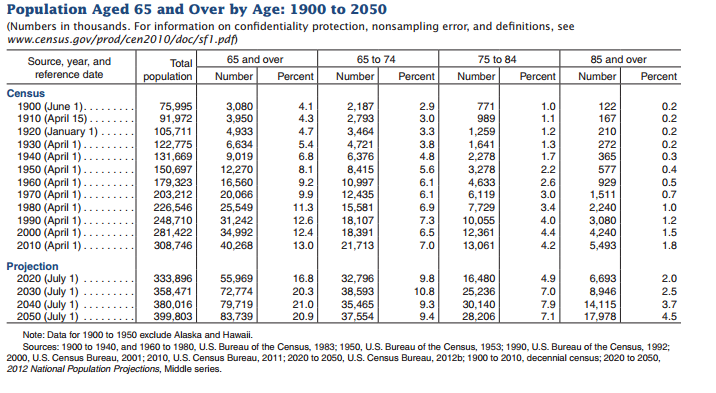
In the U.S. the growth of the elderly population has been less dramatic.  At 9% of the population in 1960, the elderly are expected to almost double to 17% of the population by 2020 (Census Bureau )

****************************
Takeaways

Pay attention to portfolio allocations.  Save money.  You’ll need it one of these days.