A Debate on Market Failures

December 1, 2024

by Stephen Stofka

This is part of a continuing series of debates on economic and political issues. Substack users can find the past two debates here and here. WordPress and other  users can visit my web site innocentinvestor.com here. Hope everyone had a good Thanksgiving.

This week’s letter focuses on market failures, continuing an ongoing series of debates on economic and political issues. Investopedia describes market failure as “the inefficient allocation of resources that occurs when individuals acting in rational self-interest produce a sub-optimal outcome.” In an idealized market, prices act as signals to consumers and producers, who alter their behavior in response. Those actions affect prices, producing a feedback loop that moves supply and demand toward an equilibrium that maximizes the benefits or minimizes the costs to both consumers and producers (Pindyck & Rubinfeld, 2017, p. 312).

Market failures occur when that equilibrium-seeking process is prevented. Failures occur in markets where:
1) a company has monopoly power,
2) buyers or sellers have incomplete information,
3) there are externalities where the effects of consumption do not fall entirely on the buyer of the product or service. Pollution is a common example,
4) public goods where a good or service benefits the group as a whole but the dynamics of the market result in an undersupply.

Abel began the conversation, “Last week we left off with the housing market in New York City being a prime example of a market failure.”

Cain replied, “That’s right. I said that behind every market failure is a policy failure. The idealized ‘free market’ conveniently excludes political alliances and policy. In that idealized framework, prices coordinate supply and demand. The reality is that policymakers nudge both the supply and demand curves, adopting laws that favor suppliers or consumers.”

Abel said, “So you admit that the unregulated free market model misrepresents reality. Why is your group such a champion of markets with as little regulation as possible?”

Cain responded, “In a representative democracy, policymakers try to maximize their power and influence within the political system. They want to get reelected so the choices they make benefit their constituents.”

Abel interjected, “Yes, but not all of their constituents. Just the most influential, the most powerful.”

Cain nodded. “True enough. Naturally, that interferes with the price system. The political ‘market’ is entirely different than the market for goods and services. The political system has an entirely different cost and benefit structure. Policymakers are rewarded when they conform to the strategies of party leaders, or they bear the cost of being marginalized in committees where policymaking happens.”

Abel countered, “Yes, but its not realistic to analyze the economic system without the influence of the political system. Policymakers grant patents and copyrights, enact bankruptcy laws and thousands of measures that affect property rights. Those rights are the foundation of the economic system.”

Cain argued, “I’ll grant you that. But any assignment of property rights should be done to minimize further political involvement. Let private agents working within the price system make adjustments to circumstances.”

Abel said, “In a 2012 interview Ronald Coase (1910 – 2013) pointed out the price system is expensive because buyers and sellers need to know a lot to reach a bargain. Your group says that policymakers should step in once, make a rule and let buyers and sellers take that rule into account as they negotiate transactions. Those ongoing transaction costs are more expensive than the ongoing cost of regulating the market.”

Cain shook his head. “Our group disagrees. Remember, people don’t obey the letter of the regulations. They are always trying to minimize their costs or maximize their gain within that regulatory framework. Our group favors a system with minimal ongoing political regulation. Let the individuals within the market police themselves.”

Abel asked, “How are people living next to a dry cleaners supposed to police the owners of the dry cleaners? The solvent they use is perchloroethylene, commonly called ‘perc,’ and it’s a toxic air pollutant. The neighbors don’t have the expertise to monitor the equipment at the dry cleaners, to make sure that there are no leaks, and that filtration is installed and adequately maintained.”

Cain responded, “Policymakers can assign responsibility. In a 2013 podcast, economist Don Boudreaux noted that lawmakers usually decide that the person responsible for a harm is the party that has the lowest cost in avoiding or preventing that harm. In this case, the owners of the dry cleaners have a much lower cost than the surrounding neighbors.”

Abel argued, “That establishes the dry cleaners as the responsible party. Some regulatory agency must regularly inspect the establishment to make sure they are in compliance with the law. The price system cannot reach some idealistic equilibrium of perc because the equilibrium point is zero. The supply and demand model is an appropriate tool to analyze a market for goods and services where there is some distribution of benefits and costs. In the case of the dry cleaners, the benefit of using perc is concentrated in the owners of the business. It is a critical component of the service they offer. The costs are widely distributed to the surrounding neighborhood.”

Cain countered, “The use of dry-cleaning chemicals benefits the customers who get their clothes dry-cleaned. The owners of the business are just a distribution point of those benefits. If the benefits were entirely concentrated in the business, there would be no dry-cleaning businesses. There would be no political support for those businesses and lawmakers would ban them. This only proves the point that market failures are a result of policy decisions. In this case it is zoning regulations. Dry cleaners serve a public demand and operate in the vicinity of their customers because the public wants the convenience.”

Abel interjected, “That convenience impacts the health of the people surrounding the dry cleaners whether they get their clothes dry-cleaned or not. Those health consequences are a negative externality that the customers don’t pay for. The price system can’t handle a situation like that.”

Cain objected, “There could be a ‘perc’ charge for every piece of clothing dry-cleaned. That would reduce the volume of business.”

Abel argued, “But there is no way for the business owners to recompense the neighbors for the extra risk of living close to a dry cleaners.”

Cain responded, “In a free market system, residents would pay lower rents and house prices as long as the risks were made public. That would be an indirect benefit.”

Abel replied, “Why must poorer people pay the price of pollution? Who gets the ‘perc’ charge that is added on? The city or state? Certainly not the people affected by it. The price system only accounts for the benefits and costs of the parties to a transaction. The price system simply doesn’t respond to externalities like pollution. What about monopolists? Unlike suppliers in a competitive market monopolists maximize their profits by selling fewer goods at a higher price.”

Cain’s voice was resolute. “That only proves the point that behind every market failure is a policy failure. Companies become monopolists through some set of policies that grants them some exclusive property right. If an industry is profitable, it will attract competitors.”

Abel scoffed. “That’s textbook economics – not the real world. A business may become a leader in an industry because it builds a better widget. Then it buys up its competitors and uses economies of scale to rule an industry. Google and Facebook are good examples.”

Cain argued, “They became monopolists because they bought political influence to systematically eliminate any threats to their dominance. Section 230 gave Google and Facebook immunity from liability for user posts. Lawmakers had good intentions. The internet was new,  and lawmakers wanted to encourage growth. By removing legal constraints, they inadvertently created the ideal environment for monopolists. It’s a recurrent pattern. I’ll adapt Milton Friedman’s remark on inflation and say, ‘Market failures are always and everywhere policy failures.’ Monopolists lobby for laws that enable then protect their market power. Unlike prices, laws are rigid and don’t respond to the changing circumstances of supply and demand.”

Abel said, “Let’s explore more of monopoly power next week. I’m thinking of Joan Robinson’s innovative thinking about monopsony, where there is one buyer and a lot of sellers.”

Cain responded, “And public goods. Let’s not forget those. See you next week.”

///////////////////

Photo by Elena Mozhvilo on Unsplash

Birch, S. (2018). Demand-based models and market failure in health care: Projecting shortages and surpluses in doctors and nurses. Health Economics, Policy and Law, 14(2), 291–294. https://doi.org/10.1017/s1744133118000336

Pindyck, R. S., & Rubinfeld, D. L. (2017). Microeconomics. New York, NY: Pearson Education Limited.

Stern, N., & Stiglitz, J. E. (2021). The social cost of carbon, risk, distribution, market failures: An alternative approach. SSRN Electronic Journal. https://doi.org/10.2139/ssrn.3785806

Friedman’s more repeated quote is “Inflation is always and everywhere a monetary phenomenon.” Less well-known is his remark that “Inflation is the one form of taxation that can be imposed without legislation.” https://en.wikiquote.org/wiki/Milton_Friedman

The Maze of Our Arguments

November 17, 2024

By Stephen Stofka

This is a bit longer than usual but in a conversational format. I will also leave copies of the in-text links in the notes at the end. The sources do not require a subscription.

This week’s letter is about our arguments. Some policies are implemented but the disagreements on the underlying issues are not resolved. The debate often detours through a maze of assumptions and perspectives, identities and loyalties before it can reach the main issue. Resistance and resentment simmer like the underground coal-seam fire in Centralia, PA that has been burning for six decades.

At the Constitutional Convention in 1787, delegates could not resolve the issue of slavery, and the southern states threatened to walk. The financial condition of the confederacy of thirteen colonies was desperate, making the new nation vulnerable to attack and encroachment by France and Spain. In a compromise, the delegates agreed to make the importation of slaves illegal after twenty years, but booted the issue down the road. For seventy years after the Constitution was ratified, the southern states periodically threatened to secede, and various compromises averted a crisis without resolving the issue. The 1820 Missouri Compromise was a key piece of legislation that kept the nation together. In 1857, the Supreme Court issued its Dred Scott decision which overturned the Missouri Compromise and public sentiment accepted the inevitability of civil war.

Climate change is not as emotional a topic as slavery or abortion, which I wrote about here. I will imagine a discussion between two groups of people who set policy for all the people in the country. Speaking for the first group is a person named Abel who claims that certain types of human activity are having a pronounced and growing effect on the climate. To counter these damaging effects, Abel’s group proposes regulating some activities and adopting different methods that will lower the impact of human activity on the climate. Cain, a spokesperson for the second group, is averse to most regulation of economic activity and argues that Abel’s claims and theories are a hoax. Any changes in climate are probably temporary and driven by natural physical variations that people can not influence.  

Abel offered to present the evidence for his claim, but Cain dismissed the offer. Cain turned to page 156 of Nassim Taleb’s Fooled by Randomness and handed the book to Abel, who read the highlighted passage, “I can use data to disprove a proposition, never to prove one. I can use history to refute a conjecture, never to affirm it.”

Abel responded, “In An Enquiry Concerning Human Understanding, the 18th century philosopher David Hume wrote that we could not state with absolute certainty that the sun would rise tomorrow or that it would not rise. Knowledge gained from experience can only move to greater certainty or uncertainty. Each year’s climate data moves us closer to certainty that  human activity is a significant contributor to climate change.”

Cain argued, “Our group requires incontrovertible proof, not just an increased certainty. Scientists were certain the climate was cooling in the late 1970s.”

Abel responded, “That is a myth that climate change deniers have used for decades to refute climate change. Peterson et al (2008) unraveled the making of that myth. J. M. Mitchell published his cooling hypothesis in 1963. When others checked his data, they found that his conclusions were based on weather station data in the northern hemisphere only. When researchers included data from the southern hemisphere, the conclusion was the opposite. The planet was warming.”

Cain interjected, “Scientists also claimed that world oil production had reached its peak in the 1960s, a theory known as Peak Oil.

Abel responded, “Let me finish the rest of the story. In the 1970s, popular magazines like Newsweek promoted both theories as “news peg” headlines to attract readers’ interest. Controversy sells. There was already a broad consensus in the scientific community that the warming effect of man-made greenhouse gases were dominating any cooling effect from aerosols and natural factors. Prominent scientists like Carl Sagan presented that conclusion to Congress in 1985. In 1990, when the IPCC issued it’s first assessment of the global climate changes, it had already found a measurable increase in temperatures.”  

Cain argued, “Look, technologies change and new data causes scientists to revise their opinions. The same could happen with climate change. There’s no sense in imposing regulations that disrupt economic activity as long as there is a chance that scientists could be wrong.”

Abel responded, “Your group casually dismisses sixty years of scientific data and increasingly accurate predictions. Hume pointed out that there is always a chance that any claim is wrong. We have to act on probabilities, not absolute certainty. Your group adopts the reasoning of jurors in a criminal trial who reach a conviction only if there is no reasonable doubt. Our claim is more like a civil trial where jurors reach a conclusion based on a preponderance of the evidence. Each year provides more evidence that human activity is having a significant effect on the global climate.”

Cain replied, “Well, some of your group’s proposals seem criminal to me so yes, we require evidence that is beyond a reasonable doubt. Our group is suspicious of policy proposals that affect our economic lives. We believe that the price system provides the best environment for voluntary cooperation. Prices emerge from the decisions and preferences of everyone.”

Abel nodded. “Science works like the price system, only slower. There’s a supply of research and data, and a demand for solutions and understanding. Scholars publish their research. They put their data and conclusions on the market, so to speak. The research community digests that data and methodology, points out flaws and presents alternative conclusions. Theories improve just like the products we buy.”

Cain objected, “Unlike the price system, there is no equilibrium point.”

Abel responded, “Yes, there is. Some consumers and suppliers of fossil fuels want research that concludes that there is little evidence for anthropogenic climate change. These groups fund organizations that hire researchers to publish position papers to that effect. Demand and supply meet, but the quality of the supply of research is lowered.”

Cain objected again. “These are reputable scientists presenting their conclusions. Look, even if there was some credible evidence that the use of fossil fuels was having an effect on the climate, our group favors price incentives, not regulations. Carrots, not whips.”

Abel countered, “The free market and price system doesn’t cope with negative externalities like pollution. Do you acknowledge that?”

Cain nodded. “Yes, but we think those externalities can be priced as well. The polluters can compensate others for the nuisance or trade among themselves for permits to pollute.”

Abel replied, “But that requires some government agency to set the prices or the allotment of permits.”

Cain nodded. “It’s not a perfect world. More regulations that affect economic outcomes only incentivize people and companies to find loopholes to avoid the regulations. Government agencies must not only regulate an economic activity like pollution from manufacturing, but they have to play watchdog to catch the actors trying to avoid the regulations. Regulatory agencies are not an efficient way to accomplish a goal.”

Abel asked, “What about social and economic justice issues? How can the price system cope with them? Let’s say some business owner thinks that all black people are inferior workers, so he offers black applicants half the wage he offers white workers. How does the price system handle discrimination?”

Cain shook his head. “Our group does not endorse discrimination of any type. We question whether it is the job of a government agency, particularly a federal agency, to try to correct those attitudes and behaviors. We support policies that encourage economic growth. More growth will promote employment which will create more bargaining power for workers. Employers will have to compete to hire workers. Black workers will have a greater choice of jobs and can refuse to work at a lower wage. Employers will end their discriminatory practices because it hurts their businesses.”

Able argued, “Using Taleb’s reasoning, any  instance where the price system does not end discrimination would be cause enough to invalidate your conjecture. If the price system coordinates human activity and resources so well, why are there subsidies for suppliers and price controls for consumers?”

Cain shrugged. “Politics corrupts the price system. In a perfect republic, there would be no subsidies or price controls.”

Abel said, “You speak of the price system as though it were a natural force like gravity.”

Cain nodded. “It is a natural force of human interaction. Einstein said that gravity was the curvature of spacetime. The phrase ‘matter tells spacetime how to curve, and curved spacetime tells matter how to move’ captures an important element of his theory of relativity. Without political interference, suppliers and consumers tell prices how to curve and that curvature affects the decisions and behavior of both suppliers and consumers.”

Abel replied, “The price system provides incentives for a limited number of transactions or exchanges between people. There are economic activities where one party inflicts damage on another party and may not be aware of it. Pollution can affect people far from the source of the pollution as happened with acid rain. Decades ago, the amount of sulfur emissions from smokestacks near New York City were affecting farmers and wildlife in upstate New York. Climate change contributes to a global problem, making it more difficult to regulate with any price system. Human industrial activity contributes to the carbon dioxide blanket surrounding the planet. That blanket inhibits the release of solar energy from the earth’s lower atmosphere, causing ocean and air temperatures to rise. Heat seeks an equilibrium so that warming affects the convection of energy around the planet.”

Cain scoffed. “Your group is saying that a family driving a car powered with gasoline is affecting some people living in remote Kamchatka. Come on, there are limits to responsibility.”

Abel replied, “The family driving the car is affecting their own climate as well. The power plant in Kamchatka is affecting U.S. families. Climate change surpasses national borders. It’s the butterfly effect, an idea that mathematician and meteorologist Ed Lorenz proposed. How the beating of a butterfly wing could contribute to an initial state that eventually produced a tornado.”     

Cain objected, “Butterfly effect or not, we can’t be regulating every little action that people do because it might contribute to some problem. In the Fable of the Bees, Bernard Mandeville imagined a society that collapsed after it prohibited all vices. We just have to accept that living bears some risks and unpleasant things. We can’t craft a perfect society. The price system promotes a natural system of checks and balances. Is it perfect? No, but it is better than a bunch of bureaucrats micromanaging our economic activities.”

Abel sighed. “Your group’s solution is to do nothing. If the world goes to hell, so be it?”

Cain replied, “We struggle to solve our own problems. Coordinating human behavior is difficult. The price system is a coordinating mechanism. Sure, it has flaws, but it is more democratic than any autocratic system of regulation. Even if human activity were causing the planet to warm up, how would we get other countries to comply? We can’t force everyone to think like we do.”

Abel asked, “There doesn’t seem to be any area of compromise on this, is there?”

Cain smiled. “A solution will emerge. Don’t worry. For two centuries at least, technological prowess has raised living standards and our life expectancy.”

Abel objected, “The cumulative effect of our technological prowess is causing the problem. How can it solve a problem that it is contributing to?”

Cain turned to leave. “You have no faith in human ingenuity and motivation. That is the real problem.”

Abel replied, “You put too much faith in the price system. That is an even bigger problem. Let’s discuss that next time.”

The debate may begin on climate change but often shifts towards each group’s assumptions and perspectives on an issue. Each group pays more attention to others in their group than arguments from the other side. The signers to the Declaration of Independence argued over the list of British offenses or usurpations included in the Declaration. They had only minor changes to the noble sentiments expressed in the opening paragraphs that we cherish today. The arguments against rebellion? Loyalist sentiments, as they were called, were stamped out. In the northern colonies, some of the Loyalists were driven out and their property confiscated. Force is the final arbiter of failed attempts to compromise.

/////////////////////

Photo by Susan Q Yin on Unsplash

A 16-minute excerpt of Carl Sagan’s presentation before a Republican led Senate committee in 1985.

Anti-Loyalist sentiment

Fable of the Bees

The butterfly effect

acid rain

curvature of spacetime

Peak Oil

natural physical variations that contribute to climate change.

The Dred Scott decision and the inevitability of civil war. Roger Taney, the Chief Justice and author of the court’s majority opinion, was initially nominated by President Andrew Jackson to be Secretary of the Treasury. Taney was the first cabinet nominee to be rejected by the Senate. Jackson then nominated Taney for the position of associate justice of the Supreme Court and met rejection again. Later, Jackson nominated Taney for Chief Justice, and the Senate confirmed him after much debate.

An underground coal-seam fire in Centralia, Pennsylvania burning since at least 1962.

Peterson, T. C., Connolley, W. M., & Fleck, J. (2008). The myth of the 1970s Global Cooling Scientific Consensus. Bulletin of the American Meteorological Society, 89(9), 1325–1338. https://doi.org/10.1175/2008bams2370.1

Two Natures

October 13, 2024

By Stephen Stofka

This week’s letter continues my look at the two types of Golden Age voters. Last week’s post was about those who look to the past as more – fill in the blank here. On the TV show All in the Family, Archie Bunker was a comic representation of this type of thinking. The lyrics of the show’s theme song Those Were the Days echoed a nostalgia for an earlier time in American history.

This week’s subject is the second type of voter, those who believe that people can construct a better society. In the extreme, that better society is a utopian Golden Age. Nineteenth century writers called this type of person perfectibilians, who believe that man’s imperfect or corrupt nature can be perfected. They believe that creating institutions and institutional rules which encourage sharing, equality and community can help perfect flawed human nature and improve society. Out with selfishness and exploitation. In with charitable spirit, equity and respect.

Hesiod, the 6th century BCE Greek poet, recounted the myth of the Isles of the Blessed, islands in the Atlantic where reincarnated people lived in an idyllic state. Thomas More placed his Utopia, published in 1516, on an island off the mainland in the New World. More detailed the institutional practices that sustained this utopian society: a society based on agriculture with small democratic urban areas. There existed a welfare state with no private property, but each household had one or two slaves. More’s acceptance of slavery in his vision of utopia distances a modern reader. And the excess population on this idyllic island? They were shipped off to the mainland. Who made those decisions? More’s utopian vision sounded more like a version of hell.

More’s work was fiction. Some hope and believe that human society can improve toward a utopia that lies in the future. Reformers in the 19th century, known as Ricardian Socialists, advocated for reforms that they hoped would correct the social ills that emerged or erupted during the Industrial Revolution. These included poorly paid and overworked people crowded into dense urban areas. Children worked long hours and suffered horrible injuries from dangerous machinery. The reformers sought a more equitable system that distributed the surplus of economic activity and trade to worker cooperatives, not capitalists.

John Stuart Mill (1806-1873) Mill favored the idea of worker’s coops and profit sharing rather than Communism, which he thought did not account for individual differences of talent and effort (Roncaglia, 2005, p. 240). More radical reformers known as Utopian Socialists sought the abolition of private property entirely. Robert Owen was a Scottish financier who set up the utopian community of New Harmony, Indiana in 1826 – 1828. It was a kibbutz style working community with no private property and the workers shared profits. Owen believed that if poor workers were productive, they might improve their habits (Heilbroner, 1997, p. 112). The experiment failed and Owens suffered severe financial losses.

Karl Marx (1818 – 1883) was the most prominent of these utopian reformers. Murray Rothbard, an Austrian economist, considered Marx primarily as a millennial Communist. Watch out, big revolution ahead and the purging of the old ways. Then, the new order and a flourishing of human society.  

Flourishing good. Everybody likes flourishing. Revolution and other cataclysms bad. Some voters are resistant to change or reform because existing arrangements suit them. Last November, I wrote about the many subsidies and tax expenditures that benefit some at the expense of others. Improved society? Check. I’m all for that. Lose my subsidy? Get your hand out of my pocket, comrade. In his 1965 book The logic of collective action public goods and the theory of groups, Mancur Olson (2012) argued that people cling to their benefits, especially when the benefits go to a small number of individuals or companies, but the costs are spread out among all taxpayers. Because the cost to each taxpayer is small, there is less incentive to advocate for reform.

In the United States, the reformers of the Progressive Era advocated more practical and less radical reforms that instituted conditions we take for granted today. These included women’s suffrage, more humane working conditions, laws against child labor, and a civil service system based on merit rather than cronyism and corruption. The Sherman Anti-Trust act and other business reforms curbed the power and growth of vertical monopolies (see notes below) like the Standard Oil Company. In 1914, the Federal Trade Commission was established to prevent price fixing and other forms of collusion between businesses that distorted the free market.

Can human nature be reformed? To those who believe that people are inherently corrupt, there is a flaw in the perfectibilian strategy. There will always need to be regulators to constantly monitor human behavior in the marketplace and our shared social spaces. That puts too much concentration of power in the hands of government regulators. Because regulators are people, they will by nature be corrupt, pursing their own self-interests, their inherent drive for control. Who will regulate the regulators? Who will reform the reformers?

The price system promotes a competition between individual self-interests. In a transaction between John and Mary, John’s corruptible nature is pitted against Mary’s corruptible nature. Out of that contest of self-interest, a benefit to both people emerges. This is the marvel of the price system. Unlike the price system, a regulatory system lacks natural checks and balances. Governments can pass a law that induces people to act more charitably, for instance, but government cannot mandate that people be more charitable. Some people have a more charitable spirit than others. On the other hand, the Greek philosopher Aristotle believed that acting in a virtuous manner would promote a more virtuous character. If a government forces people to act more charitably, will they develop a more charitable character?

Two types. Two visions. One looks to the past. One looks to the future. Simple, isn’t it? Unfortunately, many voters have a complicated set of perspectives and tendencies that defies simple analysis. We might be a blend of nostalgic and perfectibilian. Are people inherently corrupt, seeking to serve their own parochial interests rather than the greater good? What do you believe?

/////////////////////

Photo by Joel Filipe on Unsplash

Keywords: progressive, human nature, prices, regulation

Heilbroner, R. L. (1999). The Worldly Philosophers the Lives, Times, and Ideas of the Great Economic Thinkers (7th ed.). New York: Simon and Schuster.

Heilbroner, R. L. (1997). Teachings from the worldly philosophy. New York, NY: Norton & Company.

Olson, M. (2012). The logic of collective action public goods and the theory of groups. Harvard University Press.

Roncaglia, A. (2005). The wealth of ideas: A history of economic thought. Cambridge: Cambridge Univ. Press.

Vertical monopoly: one company owns or controls the various stages of extraction, refining and production, for instance.

The Elasticity of Our Spirit

August 18, 2024

by Stephen Stofka

This week’s letter is about the effect of quantitative phenomena on our quality of life. Why do events impact people of the same socioeconomic circumstances differently? We are part of a group responding to the event, so we interact with the collective responses of the group around us. Our direct response to the event is a small part of the total impact on our quality of life. Imagine we are a rubber duckie in a group of rubber duckies on the ocean’s surface as a wave passes. As we rise with the water that displacement causes a lot of jostling by the duckies around us. Much of the effect we experience is not the wave but the reaction of the others around us to the wave. Yet we attribute the cause of our experience to the wave, not our fellow duckies.

One hundred years ago, Louis de Broglie introduced a wave theory of matter. A few years later Erwin Schrödinger proposed a wave equation of electron motion to explain the quantum world. Those two ideas are cornerstones of quantum mechanics, the most tested theory in physics and the foundation of our current electronic technology. As you read this on a computer or smart phone you are watching quantum mechanics at work. Not all wave are alike. Light and radio waves are electromagnetic waves that don’t need a medium to travel in. Even in the vacuum of space, the electromagnetic field they create acts as a type of medium. Some waves, called transverse waves, cause matter to move in a direction that is partly perpendicular to the force of a wave. A rubber duckie bobbing up and down in the water is an example.

We are hunters of cause. We are interested in the origin of phenomena, thinking that the origin of something will enhance our understanding of that thing. For that reason, some economists like to debate the origin of money. One morning a few weeks ago, our cat woke up, yawned and stretched out a paw on the bed. A claw caught in the quilt and slid it sideways so that it formed a tunnel. Like a wave through water, the direction of the paw was parallel to the quilt, but the quilt reacted in a direction perpendicular to that movement. Kitty pulled her paw back and the tunnel mostly collapsed. She then stretched out her paw again and the quilt rose up. Her hunter reasoning led her to believe that a mouse was the cause of the tunnel under the quilt, so she attacked. She pounced and pawed the quilt to find that imaginary mouse, then lost interest, jumped to the floor and left the room. How often do we search for the cause of a phenomena that is mostly a response to the collective action of a group?

When prices go up, we can look to our side for contributing factors, the decisions of many consumers and businesses. A quantitative change in prices affects the quality of our lives. Like a cat, we often judge quantitative phenomena with an instinctive appraisal. We notice the rise in prices more than we do the rise in our wages because we are more sensitive to loss than gains. The Bureau of Labor Statistics reports that the annual increase in average hourly wages and weekly earnings is now higher than inflation. A rise in the price of the goods we buy has a greater effect than a similar rise in our income because we perceive a rise in prices as a loss of our purchasing power. We are particularly loss averse, according to Daniel Kahneman, the author of Thinking Fast and Slow, who won a Nobel Prize for his research into the less than perfect reasoning we employ in our decision making. He and Amos Tversky proposed a concept called Prospect Theory to describe and model the mechanics of our decision making.

Elasticity is a term that economist John Marshall borrowed from physics to describe the reaction of consumers to changes in the prices of goods. The most common measure is called the Price Elasticity of Demand and businesses pay close attention to this metric. It is the change in the percentage of goods bought in response to a 1% change in price – a ratio of two percentage moves – the zig divided by the zag. If the price of butter goes up 1% and the amount of butter sold declines by 2%, then the ratio of percentages is 2 to 1 and butter is considered to be elastic. If the quantity of butter sold declines only 1%, then butter is said to be unit-elastic. If the quantity of butter barely changes, then it is inelastic. When businesses sense that consumer demand for their good or service is inelastic, they can charge higher prices with less effect on the quantity sold and make a higher profit. Businesses respond to consumer decisions and tastes.

The elasticity of economic goods is not constant because consumer demand responds to a changing economic environment, as well as tastes and culture. In some cases, consumer demand can change abruptly. Such was the case after the pandemic. The airline market is an example of two types of demand elasticities. Business travelers are much less sensitive to changes in price, with an elasticity far below 1, according to research done in the 2010s. Because of that airlines upcharge business customers. Leisure travelers, on the other hand,  have an elasticity of almost 2, meaning that they are sensitive to price hikes. The higher prices that airlines charge business customers effectively subsidizes leisure travelers. However, after the pandemic, the demand for leisure travel surged and airlines responded with higher prices. Average airline fares surged 20% annually in the summer of 2021 then rose sharply by 34% in the summer of 2022. In the first quarter of this year, prices stabilized to pre-pandemic levels. Vacation travel is a luxury good, but it can feel like a necessity when we feel stuck in a grind and stressed at work.

The effect is more frequent for necessities like food, lodging and utilities. That frequency affects the elasticity of our spirit the way a weight on a spring changes the spring’s elasticity over time. The relief checks sent during the pandemic helped some families build a small savings cushion, a relief from the burden of living paycheck to paycheck. In the past two years, families that have dipped into their savings to meet higher housing, grocery and childcare costs feel a sense of loss because their savings are smaller. Even if wage gains have kept up with inflation on average, wage gains are calculated based on gross income before taxes. We buy groceries and pay housing costs with after-tax dollars. The loss is real.

Like water, human society is the medium, transmitting and transmuting the force of thousands of decisions made by people we will never meet. Our circumstances and decisions affect the lives of strangers. There is no single cause because we are part of the cause. Even if we could identify a primary cause like rising prices and remove it with a magic wand, we cannot predict a satisfactory resolution. Yet politicians running for office hold out their magic policy wand and promise to end this or that problem, hoping that enough voters will buy what they are selling. “Here’s the problem,” they say. “I can do something about it.” We want to believe that complex processes have simple causes, and in the final months of this election year, candidates will tailor their message to our belief in that simplicity.

////////////// 

Photo by Joey Huang on Unsplash

Keywords: prices, inflation, cause, effect, wave

Key Expectations

June 9, 2024

by Stephen Stofka

This week’s letter continues my exploration of the role of expectations. They coordinate the supply, demand and price relationships that form the web of our economic and financial lives. They shape our voting patterns, and alter our behavior in interactions with others. If we expect a police officer to be hostile, we are defensive. That reaction will affect the behavior of the officer, increasing the chance that the encounter will be hostile. Expectations cause us to behave in ways that confirm and amplify our expectations, aggravating undesirable circumstances.

Expectations and yearnings act symbiotically within us but there is a distinction between the two. Expectations are a calculation; yearnings are a desire. “I think that” is an expectation. “I hope that” is a yearning. A woman may yearn to have a child, but she expects to have a child within a period of time. A yearning knows no time or logic. We expect a certain range of compensation for the type of work we do, our skill level and experience. Business coaches encourage people to visualize and enhance their good attributes to raise those expectations. Business owners expect their capital to earn a certain percentage of profit as compensation for the risk, planning and skill that a successful business requires.

Consumers expect a certain range of prices for many frequently bought goods and services. The price of meat may be more or less than average in a week, but the price will not be $100 a pound for ground beef. We may have no price anchor for infrequent purchases like replacing a hot water heater. A few hundred dollars or a few thousand? A search in a browser can help with an average price of approximately $2100 to help a homeowner evaluate quotes from a plumbing contractor.

In the U.S., the pricing of medical care is treated as a catastrophic event like a house fire. The connection between price and medical care has been cut so that patients may not know beforehand the price of a procedure. A browser search for the cost of a colonoscopy indicates an average cost of $2200, close to that of a hot water heater, coincidentally, but medical providers do not quote a price. Prices are negotiated between health insurance companies and a network of medical providers. The negotiated price may be a fifth of the stated list price. If patients have health insurance, the only price visible to them is a co-pay. The prospect of higher medical costs next year does not incentivize us to seek care now at a lower price. Colonoscopy prices going up soon? Let me book one now! However, as costs increase, workers negotiate for better benefit packages that cover the anticipated higher costs.

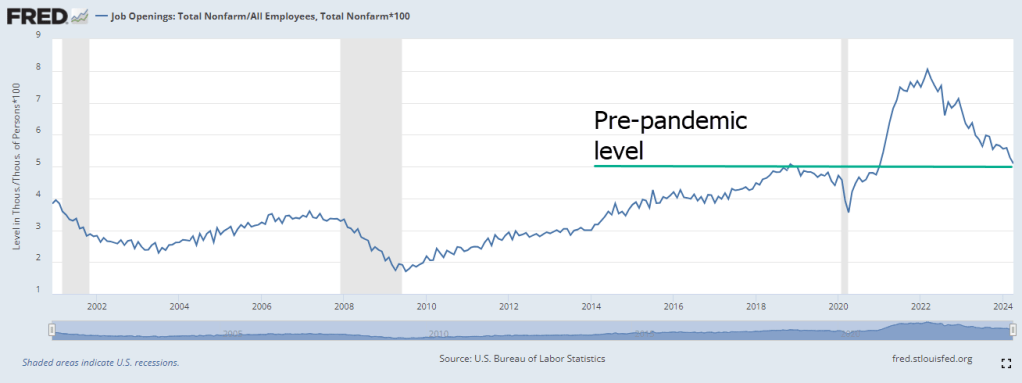
In our economy, workers play a dual role of producer and consumer. The monthly labor report and retail sales report captures the importance of these roles, and the release of these reports move markets. In the core labor force age range of 25 to 54, four out of five people are working or looking for work, according to the latest labor report. The largest generation in this demographic are the Millennials, born between 1981 and 1996. They produce the most and buy the most so their expectations steer the economy. Job openings as a percent of total employment indicate a historically robust labor market. Recent reports indicate that openings are returning to pre-pandemic levels.

Job openings as a percent of total non-farm employment

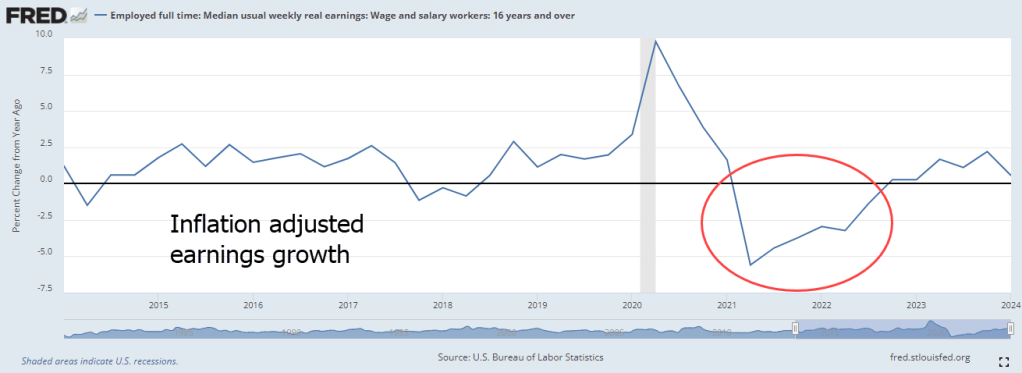
Despite the strong demand for labor, post-pandemic inflation has taken a bite out of gains in median earnings. Biden assumed office as earnings gains turned negative. Despite legislation meant to promote investment and support the labor market – the Inflation Reduction Act – the decline in real earnings did not turn positive until 2023.

Real earnings equals real purchasing power. Late Millennials reaching their early thirties expected to be able to settle down and buy a house. Older Millennials in their forties who expected to trade up to a different home are frustrated by high home prices and interest rates. Political power in our system is captured by the interests of older voters, particularly the Boomers. Less than one out of four in this generation is working (FRED series here). They want to reduce their tax costs, and preserve or enhance the government benefits they feel they have earned after a lifetime of working.

This week, David Leonhardt, editor of the N.Y. Times Morning Newsletter, pointed out a poll indicating strong support for many policies initiated by the Biden administration. Most of the public’s attention is directed to controversial issues like immigration, the war in Gaza and American support for Ukraine in their continuing war against Russia’s invasion. The pandemic focused the public’s attention on Trump’s chaotic governing style. His behavior defied expectations and his supporters became accustomed to excusing or rationalizing his actions. A majority voted for Biden as a return to normalcy in the recovery from the pandemic.

People vote their expectations, and those expectations strongly influence voters’ assessments of the economy even before a candidate has taken office. A candidate needs to offer a clear set of new expectations that manifest the yearnings of a majority of voters. Has either candidate made the connection between voter expectations and yearnings? Next week I will look more closely at the political aspect of expectations.

////////////////

Photo by Jan Tinneberg on Unsplash

Keywords: prices, growth, earnings, inflation

Prices and Values

July 23, 2023

by Stephen Stofka

This week’s letter is about prices and two dynamic values, a use value and an exchange value. These two values can help us compare assets if not goods. I’ll review a short history of thinking on price and value. How does the passage of time affect different types of assets? Lastly, how sensitive are some assets to investor temperament?

The insights of prominent thinkers in the past can inform our perspective. Richard Cantillon (1680-1734) was a financier whose keen understanding of human exuberance enabled him to make a fortune in the stock market bubbles of the South Sea and Mississippi System. He argued that there was an intrinsic value to a commodity that was the sum of the inputs, land and labor (capital was included in land). The ratio of supply and demand as well as “humors and fancies” explained the variance between market price and intrinsic price. In a well-organized society, the market price and the intrinsic price tracked each other closely.

Writing a few decades later, Adam Smith would refine the classification of prices further. A market price included the rent of the land, the worker’s wages and a capitalists’ profit. A natural price was the average of market prices and a price that a customer expected to pay when going to market. Finally, there was an exchange price, a measure of purchasing power. Writers of that time distinguished between commodities, or subsistence goods, and goods of an artisanal nature, affordable only to those in the middle and upper classes.

In Book 1, Chapter 4, Smith distinguished the two meanings of the word value. The first was a value in use, the “utility of some particular object,” whose value is consumed. Utility depends on the person, their circumstances and preferences and cannot be measured. The second is a value in exchange, the “power of purchasing other goods.” Commodities like a pound of corn have both a use value and an exchange value but Smith made it clear that the use value of a commodity does not anchor its exchange value. He noted that many goods which have a high use value like water have a low exchange value, and those with a high exchange value like diamonds have little or no use value. Smith spent the following three chapters exploring the connection between exchange value and price.

As he compared standards of living in different ages and countries, from neighboring France to the American colonies, Smith was looking for a yardstick, a standard of measure. Economic institutions today compile extensive price and income indexes to compare prices across time and countries. Smith had limited manpower – himself. He chose a laborer’s toil as “the only standard by which we can compare the values of different commodities at all times, and at all places.” He was careful to note several caveats. It was “difficult to ascertain the proportion between two different quantities of labor” and the “real price of labor is very different upon different occasions” and in more advanced societies. Regardless of prices or the value of gold and silver in England and the American colonies, he could compare the purchasing power of laborers in each country doing similar work.  

Smith’s grand thesis was that greater specialization of labor increased productivity and fostered economic progress. Within this framework, people would more frequently exchange their labor rather than consume the goods their labor produced. For Smith, labor was an “exchangeable value,” not some value inherent in a commodity. He used it to construct a measure of purchasing power. Almost a century later, Karl Marx would distort this yardstick of purchasing power into a qualitative claim that the labor input to a commodity was the intrinsic value of the commodity. Anything above that value was an exploitation of workers by capitalists, according to Marx.

Let’s extend this analysis to asset, which I will divide into two types: those that derive an exchange value based on ongoing operations and those that don’t. Ongoing operations can be likened to a use value because something is consumed in that operation, a depreciation. There is an explicit or imputed flow of income whose discounted value influences the market value of stocks and bonds. Time-sensitive financial instruments like stock options act like insurance and are very much anchored by ongoing activity and the expectations formed from those operations. The market value of real estate may rely on scarcity, like a collectible, but the scarcity aspect contributes to expectations of future income that the real estate can earn. Therefore, its market value is also anchored by operations.

Collectibles are an asset without any ongoing operation. They derive their market value from their scarcity or uniqueness. A painting may bring pleasure in the viewing but the enjoyment of that pleasure does not consume the painting. Time, yellowing and dust may introduce a depreciation expense but time usually increases the market value of the painting.  Money can be a collectible but only if it is rare. Digital currencies behave very much like collectibles but there is nothing to hang on a museum wall. For traders, the chief attraction of crypto is the possibility of future trading gains. Unlike stocks, crypto does not represent ownership in operating profits. Unlike bonds, crypto is not a purchase of someone’s debt. Unlike real estate, crypto does not generate any cash flows from its use value.

Some assets with little ongoing use value have volatile valuations because their chief use value is the hope of future trading profits to the holders of the asset. Their use and trading values can collapse suddenly as though they were a time-sensitive financial asset. Being alert to that imminent collapse helped Richard Cantillon make a fortune. Investors in such assets must remain nimble.

///////////////

Photo by Sean Stratton on Unsplash

The Formation of Expectations

May 7, 2023

by Stephen Stofka

This week’s letter is about expectations – how we form them and why they are essential to our survival. This is a broad topic that encompasses several disciplines, from psychology to neuroscience and economics. Each field of study informs those in associated fields so the debate in economics is enriched by discoveries and theories in these other fields. I can only touch on a few aspects as I introduce yet another complication that might resolve some of the contradictions between theory and data.

We gain the ability to form expectations at an early age. Infants less than one year old learn what is called object persistence. If a toy falls out of their crib, they look over the edge to the floor below to see where the toy went. But object persistence is a primitive form of expectation. True expectation is a weighting of possibilities based on some criteria.

Instinctual responses often involve a primary measure of threat or satisfaction. We see this if we walk by a squirrel near a tree. If we are across the street, the squirrel may pause, poised to flee. If we draw nearer, the squirrel runs to the safety of the trunk as we approach. How far up the tree the squirrel goes depends on the distance we are from the squirrel. It would like to keep us in sight but if we get uncomfortably close, the squirrel must choose. It can hide on the side of the trunk opposite to our approach but it loses sight of us. It can go further up the tree, keeping us in sight and staying out of reach. That is a short term expectation formed in response to an immediate threat or stimulus. It is an instinctual rather than a rational expectation, the kind that economists consider.

Rational expectations are formed about the environments that produce events, or data samples, more so than the events themselves. For more than sixty years economists have been debating whether consumers have enough data and patience to construct a rational expectation. Richard Curtin (2022) reviewed the history of this debate as he argued for a theory that embraces both reason and passion as inseparable components of human decision making. In 1959, Herbert Simon protested that inadequate data does not invalidate the idea that consumers are trying to make decisions that improve their satisfaction – that’s the rational part – within the bounds of the data available to them. Simon called this bounded rationality. A few decades later Daniel Kahneman and Amos Tversky explored the biases in our decision making and their work became the foundation of behavioral economics.

Survey data reveals that consumers’ expectations of inflation overestimate actual inflation, according to Henry et al. (2023), economists at the Richmond branch of the Federal Reserve. The basis for that assertion is the University of Michigan (2023) survey of inflation expectations. The inaccuracy is fairly consistent and persistent, meaning that consumers are slow to correct their expectations as new data is released. Richard Curtin (2022) notes that as many as 40% of consumers are not aware of recent government data releases on the inflation rate, the unemployment rate and the growth rate of GDP.

Consumers cannot survive if they consistently and persistently form inaccurate expectations. There is an alternative explanation: economists and consumers are measuring two different things. Economists form their inflation expectations by measuring changes in the prices of goods and services. Consumers form their expectations in part by estimating their loss of purchasing power, their ability to satisfy their wants and needs. If consumers feel that their income gains are not keeping up with the change in prices, they may raise their estimate of future inflation.   

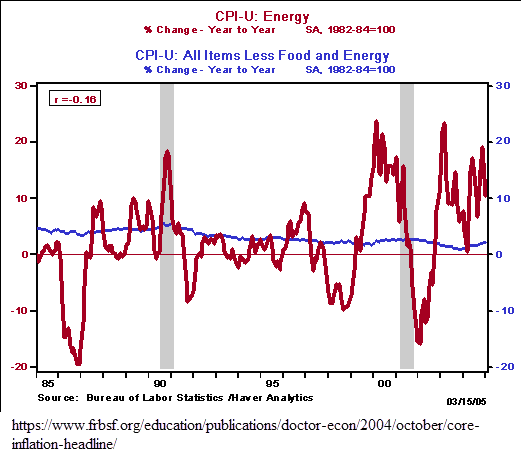
The prices of frequently purchased items like food and energy guide our expectations of changes to our purchasing power. Our purchases of food and energy don’t respond quickly to changes in our income. In economist speak, these items are price inelastic. We still need to drive to work and eat. Secondly, we buy food and gas frequently so our expectations of future prices depends on an averaging of the most recent prices and the last purchase we made. It is unlikely that we will form an expectation of next year’s gas prices based on a ten year average of gas prices. Thirdly, energy prices are quite volatile. I might buy gas as frequently as I go to the movies if I like movies but the price of a movie ticket does not vary as much as the price of gas. To summarize, our expectations of inflation are guided by frequency, recency and volatility.

Energy prices are particularly volatile. In this 2004 article the Federal Reserve graphed the annual changes in energy prices (red) and the broad CPI price index (blue). The difference is startling.

The wild swings in energy prices are noise. Because of that volatility, the Bureau of Labor Statistics excludes food and energy items when it computes an index of core inflation.  Core inflation is the inflation signal that economists use to predict next year’s prices.  

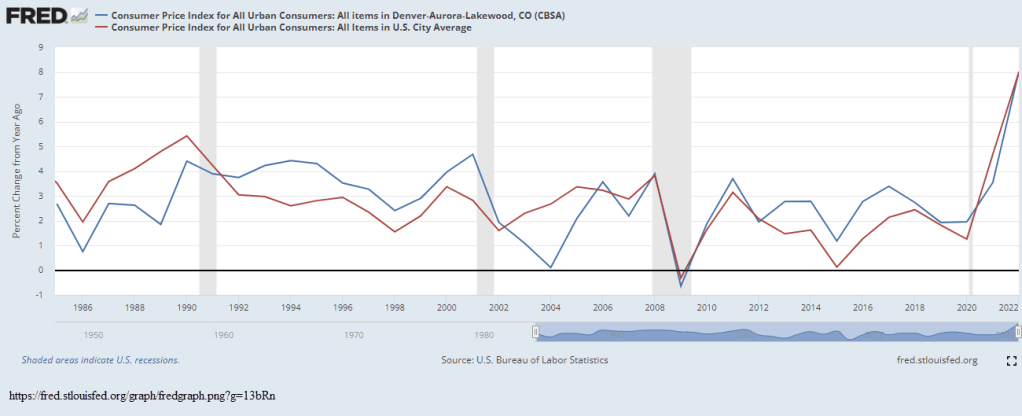
Consumer expectations of inflation include estimates of changes to their personal utility. As Richard Curtin (2022) has noted, it is not practical or possible to measure inflation at such a personalized level so economists average consumer expectations across the entire country. They collect price data at a broad metro area, or MSA. These urban areas can vary a lot from national inflation averages. In the chart below is a comparison of inflation in the Denver metro area and the nation as a whole. Rarely do the two series move together. When economists compile such a variety of consumer expectations into one national average, that average is less likely to accurately reflect individual or sub-regional expectations.

So economists are measuring changes in prices and consumers are estimating the change in their purchasing power. In his General Theory Keynes referred to the marginal efficiency of capital and the animal spirits of investor expectations of that efficiency that could be measured by the direction of market prices. Using that as a template, consumers’ purchasing power would be the marginal efficiency of income. We can gauge the animal spirits of consumers by the direction of total consumer purchases, which are continuing to outpace inflation. That is the best indicator of purchasing power expectations.   

/////////////////////

Photo by Rodion Kutsaiev on Unsplash

Curtin, R. T. (2022, September 5). A new theory of expectations – Journal of Business Cycle Research. SpringerLink. Retrieved May 5, 2023, from https://link.springer.com/article/10.1007/s41549-022-00074-w

Henry, E., Mulloy, C., & Sarte, P.-D. G. (2023, January). What survey measures of inflation Expectations Tell us. Federal Reserve Bank of Richmond. Retrieved May 5, 2023, from https://www.richmondfed.org/publications/research/economic_brief/2023/eb_23-03#:~:text=Conclusion,inflation%20every%20month%20since%202012  

University of Michigan, University of Michigan: Inflation Expectation [MICH], retrieved from FRED, Federal Reserve Bank of St. Louis; https://fred.stlouisfed.org/series/MICH, May 4, 2023.

The Pause in the Cycle

March 26, 2023

by Stephen Stofka

This week I’ll look at things that are hard to measure and their effect on our lives. Much of human activity is recursive, meaning that the outcome of one action becomes the input to the next iteration of that same action. When we get nervous we may breathe fast and shallow which changes our body chemistry increasing our anxiety and we continue breathing fast and shallow, amplifying the effect. Because of that cyclic process prominent thinkers like Aristotle, Adam Smith, David Ricardo, Karl Marx, and Joseph Schumpeter, among others, have proposed circular models of human behavior.

The 19th century economist David Ricardo modeled the industrial process as a profit cycle. Increasing or decreasing profits mark the division between two phases of the cycle. The first phase is a series of more and higher –

rising profits,
more investment,
leading to more output,
an increased demand for labor,
a rise in wages,
a rise in population and consumption,
an increasing use of less efficient inputs,
higher prices,
then higher interest rates,
and lower profits.

The decline in profits signals the end of the expansion and begins the downward phase, a cycle of less and lower of each of those elements – less investment, output, less demand for labor, lower wages in aggregate, etc. Ricardo assumed that workers received subsistence wages so an individual worker might not work for wages any lower. Like his friend Thomas Malthus, Ricardo assumed that higher incomes would lead to an increase in population. In the early 19th century, less efficient inputs meant less fertile land. As our economy has transitioned to become almost entirely service oriented, the less efficient inputs are labor. It is difficult for a hairdresser or therapist to become more productive.

Since the pandemic companies have been rewarded for raising prices, a strategy Samuel Rines, managing director of the research advisory firm Corbu, called “price over volume” on a March 9th Odd Lots podcast. With this strategy, companies like Wal-Mart keep pushing prices higher, willing to accept lower volume as long as total revenue and profits are higher. After-tax corporate profits (CP) have risen more than 40% from pre-pandemic levels, according to the Federal Reserve.

In Ricardo’s model of the profit cycle, higher prices lead to higher interest rates as investors increase their demand for money to take advantage of the higher prices. In our economy, the Fed controls the Federal Funds interest rate that other rates are based on. As prices continued to rise, the Fed began to lift rates and has raised them more than 4% in the past year. As the Fed raises rates, bank loan officers tighten lending standards, beginning with small firms (DRTSCIS) and credit card loans (DRTSCLCC). The FRED data series identifiers are in parentheses. In the past year, banks have increased their lending standards by more than 50% for small firms and 43% for credit card loans. However, all commercial loans have increased by 15% in the past year and delinquency rates have not changed since the Fed started raising rates. This is part of Ricardo’s model. Investment does not decrease until profits decline. Profits (CP) still grew at 2.25% in the 3rd quarter of 2022. We are not there yet.

In the 4th quarter of 2022, real GDP grew at less than 1% on an annual basis. We won’t have an estimate of 1st quarter numbers until the 3rd week of April but employment remains strong. Since 1980, the population adjusted percent change in employment goes negative or approaches zero just before recessions. In the chart below, notice how closely the employment (blue line) and output series move in tandem. The red line is the annual percent change in real GDP.

We may be approaching the pause point but the point of decline could be six months to a year away. Although the Fed let up on the “gas pedal,” raising rates by ¼% rather than ½%, they showed their commitment to curbing inflation as long as the employment market stays strong. If the Fed had not raised rates this past week, they would have set expectations that they were done raising rates. For now we can look for these signs that the expansion of the business cycle in Ricardo’s model is coming to a close.

///////////////////

Photo by Lukas Tennie on Unsplash

Money As Wave

February 5, 2023

by Stephen Stofka

This week’s letter is about money, a peculiar thing invented by people that has no intrinsic value unless exchanged between people. Unlike other goods, the consumption of money satisfies no human wants. Price is the thing on the left side of an equation. On the right side can be a physical quantity like a haircut or a quart of milk, or a less physical good like the satisfaction of a debt owed, or the title of ownership to a car. Money is the equal sign of that equation, the channel that connects the price information to real goods and services.

Many goods have two types of value – subjective and objective. A tomato’s subjective value depends on the needs, preferences, and resources – the circumstances – of the consumer. These circumstances vary with time. A consumer who is hungry and who likes the taste of tomatoes values a tomato more than a consumer who is not hungry or who doesn’t like tomatoes. The subjective value depends on a consumer’s resources. A consumer with a fridge can preserve a tomato longer and might value a tomato more than someone who has no cool place to store a tomato. A further element of subjective value is the intended use for the good. A consumer who wants to eat a fresh tomato might have different quality standards than someone who wants to puree the tomato for a soup or sauce.

The second type of value is objective, an intrinsic value of the good itself – the nutrients and calories a tomato provides, the chemical changes that it undergoes, the pests that the tomato harbors within its skin. Just as the circumstances of the consumer vary with time, the benefits or dangers of a good’s consumption can vary with time.  

Like the values of goods, the value of money has a subjective and objective component. The objective component is a decay in the exchange value of money on the left side of millions of exchange transactions. Economists measure thousands of prices each month and determine an average weighted price for a set of goods – a consumer price index. The annual, or year-over-year, percent change in that index is called inflation. It compares this month’s price index with the price index one year ago. Economists also measure the change in that percent change and the two sometimes get lumped together by the financial press. Inflation is like the odometer in a car. If I travel 50 miles in an hour, I have averaged 50 MPH but it is the speedometer that tells me my current speed, not the average over an hour. Too often the arguments on social media mix the two together. Imagine getting pulled over by a patrol car for speeding and explaining to the officer that your average speed for the past 15 minutes has been less than the speed limit. The officer cares only about your acceleration – the near instantaneous speed.

The value of money has a subjective component that depends on the user’s circumstances. Today-Money is that which is needed to satisfy current needs. Future-Money is savings. As prices go up, people tend to hold more money as a percent of their income to pay for living expenses. If a household spends 90% of their income on current needs, then much higher inflation rate might cause them to spend 100% of their income on expenses. A higher income household might spend only 60% of its income on expenses. The effect of inflation is lower for higher income households.

Savings is an exchange between two people in time, between a person today and that same person in the future. “You got to pay you,” we may be told when encouraged to save some of our paychecks. The first you is Today-You. The second you is Future-You, who will be grateful that Today-You was prudent. Future-You does no work yet enjoys all the sacrifices that Today-You makes, the extra work, the enjoyment of things not consumed in order to save. Future-You is truly the child of Today-You.

The financial system facilitates the exchange of money-value through time. In countries with a poor financial system, people place their savings in things, animals and children whose work or usefulness will provide for a person when they become less vigorous in their old age. A child may grow up with the moral and financial burden of having to care for their parents. In these pastoral societies, a child is considered a form of wealth.

Children in an area far from home or in a foreign country are expected to send a substantial part of their paychecks home to their parents or extended family. This moral burden drives young people to immigrate to another country where they can earn more money. Part of their earnings form the international flow of remittances which increased by almost 5%, according to the Migration Data Portal (2023). India, Mexico, and China were the top recipient countries in 2022, accounting for $310 billion of the $690 billion in remittances. This sum does not include informal or illegal transfers of goods and services between countries.

Money acts like a radio wave, conveying price information about the relative values of goods and services. It requires institutions to broadcast and relay that wave as it travels around the globe and through our lives.

////////////////////////

Photo by Pawel Czerwinski on Unsplash

Migration Data Portal. (2023, January 6). Remittances. Migration data portal. Retrieved February 3, 2023, from https://www.migrationdataportal.org/themes/remittances. The portal was established in 2016 as a data repository founded under the auspices of the United Nations. It collects central bank data through the World Bank and IMF.

Price Illusion

January 8, 2023

by Stephen Stofka

This week’s letter is about price illusions. The past two weeks I have written about the need to sort through past events to find the lessons. The past is a teacher, not a goal. Those who idealize and revere the past must eventually be swept down the drain of time. During this week’s struggle to elect Kevin McCarthy as House Speaker, the more conservative members of the Republican Party voiced their desire to return the country to the past of more than a hundred years ago when the population of 112,000,000 was a third the current size. Instead of learning from the past, we often use elements of history to tell a story. We discard events that do not fit our narrative. Historical analysis serves political interests. Asset analysis suffers from similar distorting strategies.

Technical analysis studies price movements with little regard for the circumstances that prompted the supply and demand, the buying and selling that underlie those movements. I will pick a few such variants at random. Elliott Wave theory bases its interpretation of price movement on the Fibonacci sequence of numbers. Beginning with 1, 1 this number series is constructed from the sum of the previous two numbers in the series. Thus 1 + 1 = 2, 2+1 = 3, and so on. This simple rule produces a sequence found in plant growth and the development of nautilus shells, for example.

Elliot Wave analysis claims that price movements come in waves. Understanding the current position within a wave can help an investor predict subsequent price action. The system is famously prolific in its prophecy, indicating several interpretations. It is better suited to a post hoc narrative. An investor can believe that if they just got better at interpreting the waves, they could time their buying and selling. As the physicist Richard Feynman said, “The first principle is that you must not fool yourself, and you are the easiest person to fool.”

Another technical system relies on the recognition of price trends, identifying those to follow and those that signal a likely reversal. These are visual and geometric, full of rising wedges, head and shoulders price patterns, double tops and bottoms. Much human behavior is repetitive, tempting an investor to perceive a pattern then extend it into the future. The repetition hides the recursive or evolutionary nature of human thinking. Inertia, Newton’s First Law of Motion, may apply to inanimate objects but not to human behavior. Biological systems have built-in dampeners that counteract a stimulus. Without repeated stimulus, the formation of any possible pattern decays.

Price behaves like a biological organism, not an inanimate object. We can see beautiful symmetries in graphical chart analysis but each pattern formation has a unique history. Price is the visible point of a response to events, needs and expectations. Price is a story of people. George Soros, a highly successful investor, constructs a predictive story, then watches price only as a confirmation or refutation of the story. If Soros thinks his story is not unfolding as he predicted, he exits his position.

In school we encountered various branches of mathematics where we were given formulas and plotted data points or intersections, the solutions to a set of equations. Statistics is the reverse of that process. We are given data sets and try to derive formulas to explain relationships within the data. A data set might be the test scores of students before and after the initiation of a certain curriculum. We may represent the test scores on a graph, but the scores reflect a complex set of individual behavior and circumstances, institutional policies, cultural background and economic resources. A statistical analysis tries to include some of these aspects in its findings. A student population is likely more homogenous than the companies in the SP500 stock index who represent a variety of industries. Just as test scores cannot fully explain the efficacy of a school policy or curriculum, asset prices do not reflect the complexity of a day’s events. In our longing for predictability and our fondness of patterns, we prefer analysis that explains price action as a rational sequence of responses to economic, political and financial events. Much financial reporting is happy to oblige.

//////////////////

Photo by FLY:D on Unsplash