Targets of Taxation

April 28, 2024

by Stephen Stofka

The subjects of this week’s letter are home prices, household income and property taxes. The policy of using property tax revenue to fund public education has provoked controversy since the 19th century. Like other social species we are watchful of threats like freeloading to our group’s cohesion, however we determine “our” group. Newcomers to an area are often regarded with suspicion as being freeloaders who get from the group before they have contributed to the common welfare. This suspicion often underlies the heated debates that erupt at local council meetings. I will begin with property valuations, the basis of property taxation.

As a young man I was taught not to buy a home that was priced more than four times my income. In 2022, families paid more than six times the median household income, as shown in the chart below. Despite the high prices, mortgage debt service is a tame 10% of the household disposable personal income. Almost 40% of homeowners have a fully paid mortgage, according to Axios. Many homeowners hold mortgages at the historically low rates of the last decade. If higher mortgage rates persist for several years, we may see greater delinquency rates as recent buyers cope with payments that stretch their budget.
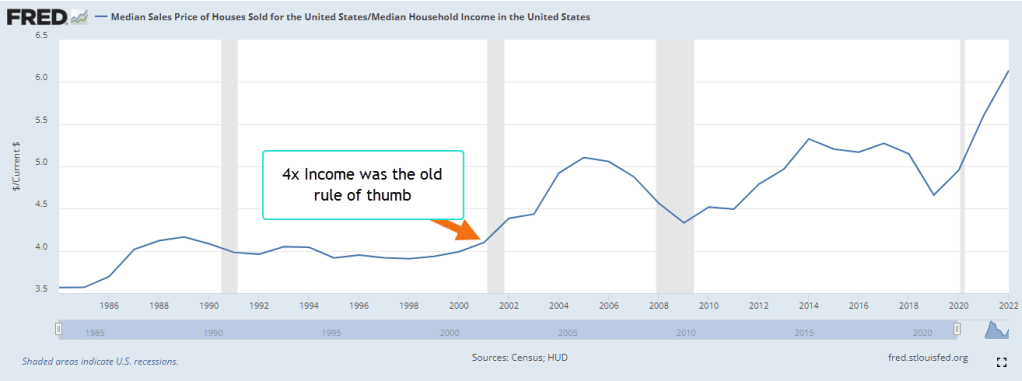
Graph shows an increasing ratio of home prices to median household income since 2000.

The Center for Microeconomic Data at the NY Federal Reserve has tracked household finances for more than twenty years. The highest percent of total household debt continues to be mortgage debt at 68% to 70%. Mortgage debt has grown at an annual rate of 3.9%, slightly more than the 3.7% annual increase in owner equivalent rent that I discussed last week. A low 3% of mortgages are more than 30 days delinquent, down from 11% to 12% during the 2008-2009 financial crisis. Only 40,000 people are in foreclosure, less than half the number in 2019. The numbers today are the lowest on record except for the pandemic years of 2020 and 2021 when many foreclosures were halted.

As I discussed last week, property prices reflect the anticipated cash flows from the house during a 30-year mortgage, a process called capitalization. The home buyer replaces the seller in the stream of cash flows from the house. Because property taxes are based on the appraisal values, the taxing authority implicitly bases property taxes on cash flows that a homeowner has not received yet. Each state sets an assessment rate that is a percent of the appraised value of the home. Each taxing authority within the state then charges a dollar amount – the mill value – per thousand of that assessed value. A home with an appraised value of $500,000 and an assessment rate of 8% would have an assessed valuation of $40,000. If the mill levy were $100 per $1000 of assessed value, then the homeowner’s property tax bill would be $4000. The effective property tax rate would be $4000 divided by $500,000, or 0.8%. Investopedia has a longer explanation for interested readers.

Each state taxes property at different rates. Colorado charges ½% of the appraised property value, one of the lowest in the nation. California averages ¾%. Texas averages a whopping 1.74% of home property values but has no income tax. Families earning the median household income and owning a house valued at the median house price in Texas and Colorado pay the same combined property and income tax of $5883 and $5669, respectively. Colorado has a cheaper tax burden despite having an income tax and far higher median house values. The same family living in California would pay $8256, largely because their property tax bill would be about the same as in Texas because the home values are more than double those in Texas. I will leave data sources in the notes.

Many districts give seniors a discount on their property taxes, effectively throwing a higher burden on working homeowners. Some argue that these exemptions should be means tested, effectively lessening or eliminating the discount for seniors with higher incomes. A wave of seniors may move to an inter-urban area that features lower home prices yet is within an hour of vital medical services like a hospital. The higher demand drives up home prices for others who have lived in the area for decades. Secondly, seniors consume more medical services and public accommodations. That requires more public spending, which is shared by the entire community and leads to resentments and contentious public meetings at the local town hall.

The majority of property taxes are used to fund public schools, and it is the largest line item on an individual homeowner’s property tax statement. This system of funding raises principled objections from childless couples and those who privately school their children, but are expected to share the burden of funding public schools. Homeowners have often resented having to fund the schooling of recently arrived immigrants. In the 19th century a wave of immigrants from Catholic Ireland, then Catholic Italy prompted many states with Protestant majorities to pass laws that excluded public funding for schools run by Catholics. Since the 16th century, the two main branches of Christianity had fought bloody civil wars in Europe and Britain. Those who colonized America brought those antagonisms with them.

During the 1970s, the number of encounters at the southern border increased almost ten times, according to the CBP. High inflation and migration of Amerians to western states caused a surge in property valuations and higher property taxes. In 1978, a taxpayer revolt in California led to the passage of Proposition 13 limiting property tax increases. In some school districts, undocumented parents had to pay a fee to enroll their children in public school.

In a 1982 case Plyler v. Doe, a slim 5-4 majority on the Supreme Court ruled that undocumented immigrant children did not have to pay a fee to go to school. The court reasoned that the equal protection clause of the 14th Amendment extended protection to “persons,” not “citizens.” Therefore, a state could not provide public benefits to one child in a school district and not another child because their parents were undocumented. The court interpreted “protection” to include public benefits, a construction that the Connecticut Constitution made explicit in 1818 with the phrase “exclusive public emoluments or privileges from the community.” The conservative majority on the Supreme Court overruled an interpretation of the due process clause in the 14th Amendment that justified the 1972 Roe v. Wade decision. This court might revisit this interpretation of the equal protection clause of the 14th Amendment as well.

Districts with lower property valuations struggle to raise adequate taxes to meet minimum educational standards. They may have to tax homeowners at a higher rate than a neighboring district, raising legal questions about uniformity and proportionality. The disparity in valuation was the subject of the 1997 Claremont decision by the New Hampshire Supreme Court. At the time, local districts provided 75% to 89% of funding for elementary and secondary education. The state’s general fund provided only 8% of school needs. The decision forced the state to distribute tax revenues among districts to meet adequate education standards for all children in the state. A 2017 analysis found that states now provide almost half of public education funding, relying on income tax revenue to smooth disparities in income among districts within each state.

People do not like paying taxes but grudgingly accept them. People elect local officials to decide on spending priorities yet some homeowners object to the way their taxes are spent. On my property tax bill are eleven items which include funding for schools, the city’s bonds, police, fire, libraries and flood control. Homeowners might prefer a questionnaire of thirty categories of spending which allowed them to allocate their tax dollars by percentage when they paid their property tax each year. In my district, a half-percent goes to affordable housing, three percent to social services. Some might prefer 5% or more. A homeowner paying online could elect to answer the questionnaire online. Would homeowners respond? Next week I will begin an exploration of various aspects of consumption, the chief component of our economy.

///////////////////////////

Photo by Museums Victoria on Unsplash

Keywords: housing, home prices, mortgage, property tax

Property taxes by zip code and state can be found at Smart Asset
Median home prices by state are at Bank Rate
Median Sales Price of Homes Sold in the U.S. is FRED Series MSPUS at https://fred.stlouisfed.org/ Median Household Income in the U.S. is series MEHOINUSA646N. The ratio of mortgage payments to disposable personal income can be found here. The home price to property tax ratio can be found here


The Womb Tax

December 5, 2021

by Stephen Stofka

This week the Supreme Court heard oral arguments (Oyez, 2021) in a case called Dobbs v. Jackson that involves a Mississippi law banning abortions after 15 weeks. Current practice is about 24 weeks, the point of viability when current medical technology can keep a fetus alive outside the womb. Two Constitutional lawyers discuss the issues on the National Constitution Center’s podcast We the People (2021). Also this week I was reading about an 18th century British property tax that was based on the number of windows in a home. The more windows the higher the tax. What similarities does the Mississippi law have with a tax?

In 1696, King William III enacted a progressive property tax. Poor people usually lived in homes with fewer windows so the tax was based on the number of windows. There was no tax on a house with up to 9 windows. In the 1750s, the tax on the 10th window was $7.47 per window for all the windows, $75 in current dollars (The National Archives, 2021). In the 1770s, Adam Smith (2009) noted that this was the approximate weekly wage for a mason. A house with 15 windows or more was charged $11.22 for each window so that the marginal increase in tax for the 15th window was $63.72. What did people do? They boarded up some of their windows to avoid some or all of the tax. In an age with indoor fires for cooking and heating, this reduced the flow of fresh air in a home and led to disease and death from asphyxiation. In 1851, the tax was repealed.

A tax is a compulsory payment for the support of  government. A state ban on abortion compels a woman to carry a baby to term. Any loss of work income is an economic cost that a woman must bear in support of the state’s interest, using that term in a general sense (Hudson, 2019). The state claims an interest but does not pay a woman for the rental of her womb to perform that service. Is that a violation of the takings clause (Epstein & Peñalver, n.d.) in the 5th Amendment or is a rental of a womb not a permanent taking? When a state leases a building from its owner, the state pays the owner for the use of the building. Is there an implied contract when the state leases a woman’s womb to carry out the state’s interest?

The tiered structure of the British window tax has some similarities to the Mississippi law. The state does not impose a tax on the first 15 weeks of pregnancy. At the 16th week, the marginal effect of the tax is substantial. A woman must leave the state to seek abortion services, seek other intervention or continue with the pregnancy. A woman bears a considerable expense in raising a child. Economists distinguish between the statutory incidence and economic incidence of a tax. The statutory language states which party remits the tax. The economic incidence is who bears the impact of the tax. A tax on cigarettes is remitted by the retailer to the state – that’s the statutory language – but the impact, the payment, of the tax is on the consumer.

Unlike the window tax, the womb tax is selectively applied only to wombs capable of bearing children. Owners of a home in 18th and 19th century Britain could board or brick up some windows to avoid or reduce their property tax. That action could be undone if the owner wanted to pay the tax. A woman can only have her womb removed if she does not want to make it available to the state. If several thousand women were to dump their wombs – or some symbolic semblance thereof – on the steps of the Mississippi statehouse, legislators might understand the impact of this womb tax.

//////////////////

Photo by chris robert on Unsplash

Epstein, R. A., & Peñalver, E. M. (n.d.). The Fifth Amendment Takings Clause. Retrieved December 04, 2021, from https://constitutioncenter.org/interactive-constitution/interpretation/amendment-v/clauses/634

Hudson, D. L. (2019). Substantial government interest. Retrieved December 04, 2021, from https://www.mtsu.edu/first-amendment/article/1615/substantial-government-interest. Constitutional lawyers distinguish three levels of state interests: legitimate, substantial and compelling.

National Constitution Center. (2021). National Constitution Center. Retrieved December 04, 2021, from https://constitutioncenter.org/

The National Archives. (2021, February 01). Window tax. Retrieved December 04, 2021, from https://www.nationalarchives.gov.uk/education/resources/georgian-britain-age-modernity/window-tax/. Note: the 6d per window tax is £.025. I used the Bank of England CPI calculator (https://www.bankofengland.co.uk/monetary-policy/inflation/inflation-calculator) to convert pounds in 1750 to 2020 pounds. A pound today is worth $1.32. Also, see this blog for some fun facts https://sashwindowspecialist.com/blog/history-of-window-glass/

Oyez. (2021, December 1). Dobbs v. Jackson. Retrieved December 04, 2021, from https://apps.oyez.org/player/#/roberts12/oral_argument_audio/25307

Smith, A. (2009). Wealth of Nations. New York: Classic House Books. Smith discusses wages in Part 1, Chapter 10.

California Landed Gentry

January 26, 2020

by Steve Stofka

What is a fair share of taxes? As I noted last week, different households pay a varying share of sales tax to the city but consume the same amount of public services. Income taxes and property taxes vary as well. In California’s booming real estate market, younger homeowners are furious that they must shoulder an inequitable share of a community’s property tax.

In the 1970s, the population of California swelled and created a large increase in demand for housing. The higher demand and runaway inflation during the period led to rapidly escalating home prices. Proposition 13, an amendment to the California constitution, was sold as a remedy for older homeowners on fixed incomes who could no longer afford the property taxes on the homes they had owned for years. Commercial properties were included in the amendment as a way to protect small businesses and the stability they brought to communities.

In 1978, California voters passed Prop 13, as it was called. Annual increases in residential and commercial property taxes were limited to 2% for existing property owners. These were years of high inflation. In 1979, the inflation rate was 14%, far higher than the current 2% rate (BLS, n.d.). In the two years following passage of the amendment, property tax collections collapsed by 50%. The resulting loss of revenue and high inflation caused a financial crisis in cities and counties throughout the state (BOE, 2018). Because taxes are based on acquisition cost, not current appraised value, the law has created large disparities in tax liability between neighbors in similar housing. In addition, the law has created inequalities between homeowners of different ages. The purchase of a home would normally step up the appraised value of the property to a current value but new homeowners over 55 were exempted. Older homeowners could also transfer their house to their children without triggering a step up in appraised value. Many homes are never sold. The homeowners and their heirs rent out the homes at current rental prices and pocket the profits. The law has created a class of landed gentry in the state (Dillon, Poston, 2018).

In 1992, the Supreme Court ruled that the law did not violate the 14th Amendment (Nordlinger v. Hahn, n.d.). In the past forty years, the law has severely reduced funding for California schools and helped to create notorious budget shortfalls. In the 1970s, California ranked in the top ten states in the quality of public education. This past year, Wallet Hub ranked the state #38 (McCann, 2019).

The fixing of one problem often creates a much larger inequity in the end and that requires an endless stream of fixes to the solutions to the problem. It’s good business for lawmakers. Adam Smith, the father of economics, documented the process in his book Wealth of Nations (Smith, 1776). Labor guilds and business interests often proposed regulations which gave them an advantage in a market. The public good was often compromised by laws that favored these interest groups. Smith proposed a free market approach as the only way to protect the public from the corruption and favoritism that inevitably marks a political state. California is a living example of the same problems that Smith described in 18th century England. Human nature has changed little in the past 200 years.

In 2020, California voters may have a chance to undo that part of the law that applies equally to commercial property, but homeowners will continue to enjoy incremental changes to their property taxes (Levin, 2018). The dream of homeownership will elude many families in the state. Taxes are inherently unfair but Californians have created their own brand of unfair taxes.

//////////////////////

Notes:

Bureau of Labor Statistics. (n.d.). Inflation Calculator. [Web page]. Retrieved from https://data.bls.gov/cgi-bin/cpicalc.pl?cost1=1&year1=197901&year2=198001.

California State Board of Equalization (BOE). (2018, December). California Property Tax: An Overview. [PDF]. Retrieved from https://www.boe.ca.gov/proptaxes/pdf/pub29.pdf#page=5

Dillon, L., Poston, B. (2018, August 17). Must Reads: California homeowners get to pass low property taxes to their kids. It’s proved highly profitable to an elite group. Los Angeles Times. [Web page]. Retrieved from https://www.latimes.com/politics/la-pol-ca-california-property-taxes-elites-201808-htmlstory.html

Levin, M. (2018, August 4). Prop. 13 could be partly undone in 2020—here’s what you should know. [Web page]. Retrieved from https://calmatters.org/economy/2018/08/prop-13-could-be-party-undone-in-2020-heres-what-you-should-know/

McCann, A. (2019, July 29). States with the Best & Worst School Systems. Wallet Hub. [Web page]. Retrieved from https://wallethub.com/edu/e/states-with-the-best-schools/5335/

Nordlinger v. Hahn. (n.d.). Oyez. [Web page]. Retrieved from https://www.oyez.org/cases/1991/90-1912

Photo by The Joy of Film on Unsplash

Smith, Adam. (1776). The Wealth of Nations (Kindle Edition). Digireads.com Publishing (2019). Available at https://www.amazon.com/Wealth-Nations-Adam-Smith-ebook-dp-B000FC1CVE/dp/B000FC1CVE/ref=mt_kindle?_encoding=UTF8&me=&qid=

Our Fair Share

January 19, 2020

by Steve Stofka

The holidays are over. This week our city picked up Christmas trees set by the curb. The sun set after 5 PM, the first time since the time change in the first week of November. The sun is returning to the Northern Hemisphere. Despite the variations in the amount of sunshine throughout the year, we all get the same amount of sunshine over the course of a year. Not so with our tax bills.

Estimated taxes were due this week. The self-employed, retired people and others who earn income with no taxes withheld must pay estimated taxes every quarter. This past year the IRS audited less than ½% of returns, a lifetime low. That sounds great because none of us wants to endure an audit. The very word strikes fear in the hearts of many taxpayers, but most of us have a small chance of being audited regardless. We don’t pay enough in taxes for the IRS to do much more than a paper audit, a request for supporting documentation.

The IRS is not a popular agency and became less popular when the agency discriminated against Tea Party and progressive groups during the 2010 election (Farhi, 2017). House Republicans repeatedly cut the agency’s budget, but that retribution has had serious budget consequences. The National Bureau of Economic Research estimated that the government could raise an additional $1 trillion in tax revenue – that’s about 20% of total revenue – with stricter enforcement of existing law (Heeb, 2019). In 2019, the Federal deficit, or budget shortfall, was $1.1 trillion (BPC, 2020). Stricter enforcement would have effectively erased that deficit.

The race for the Democratic Party’s nomination for President promises to center around several themes. The first is the horse race against President Trump, whose incumbency gives him a distinct advantage when running for re-election. The press often seems more concerned with the contest than the underlying issues of a campaign. Taxation is a recurring discussion in each election. More or less? What is a fair share? More, more, more social programs, taxation and regulation, or less, less, less social programs and taxation and more defense spending and power for large corporations?

What is fair? As children we have a keen sense of fairness – our “monkey brain.” We are social creatures who feel scorned at what we perceive as unequal treatment. Equal and fair are not the same thing. A fair share is not the same as an equal share. If I can afford to buy $50,000 worth of goods in a year, why should I have to pay more sales tax than someone who only buys $30,000? We make equal use of a city’s public services. Why should we be treated unequally? Well, we have become accustomed to paying an equal percentage of what we buy in the stores as a sales tax.

Why don’t we follow that same approach for income taxes? States like Colorado do charge the same rate of state income tax regardless of income. Is that fair? Some cities like Denver charge a head tax, a flat fee income tax for anyone who works within the district. Should we follow the same approach throughout the nation? Warren Buffett and I would pay the same amount in income taxes. Is that fair?

Should prices for public utilities be adjusted based on income? If my neighbor makes twice what I do, should they pay twice for the same amount of water? Currently, we are charged the same rate. The income and property taxes of those over 65 are often given a discount. In some districts, a person who reaches 65 finds that they can lower their property tax by 50%. Is that fair?

Elizabeth Warren, a candidate for the Democratic Party’s presidential nomination, proposed that all student debt be eliminated. Should students who went to more expensive private schools be rewarded more than students who borrowed less because they went to a state college? Should students who borrowed less because they worked part time while going to school be penalized? Is that fair?

In Matthew 20:1–16, Jesus tells a parable of the workers in the vineyard. Workers who came to work in the morning agreed to an amount of money for a day’s work. Workers who came to work later in the day were also promised the same amount of money for working the rest of the day. Jesus was making a point that each person will be rewarded equally in the kingdom of heaven no matter when in their lifetime they come to God’s love. No matter what your religious orientation, is that fair?

Each election we get to vote on what’s fair. Some people don’t vote because they say that their opinion doesn’t matter. It certainly doesn’t if they don’t vote so they have proved their case. If I vote and my neighbor doesn’t, my vote effectively counts double. In a few weeks, the Democratic primaries will start. The first two are in Iowa and New Hampshire, states with small populations and an even smaller number of people who participate in the caucus system. The votes of a few thousand people can make or break a candidate’s campaign. In a democratic nation of 320 million people, is that fair?

///////////////////////

Notes:

Bipartisan Policy Center (BPC). (2020, January 9). Deficit Tracker. [Web page]. Retrieved from https://bipartisanpolicy.org/report/deficit-tracker/

Farhi, P. (2017, October 5). Four years later, the IRS tea party scandal looks very different. It may not even be a scandal. Washington Post. [Web page]. https://www.washingtonpost.com/lifestyle/style/four-years-later-the-irs-tea-party-scandal-looks-very-different-it-may-not-even-be-a-scandal/2017/10/05/4e90c7ec-a9f7-11e7-850e-2bdd1236be5d_story.html

Heeb, G. (2019, November 19). The US could raise $1 trillion more in taxes through stricter IRS enforcement, according to a new study. Markets Insider. [Web page]. Retrieved from https://markets.businessinsider.com/news/stocks/us-could-raise-1-trillion-more-tighter-irs-enforcement-study-2019-11-1028700145

Photo by Maria Molinero on Unsplash

Tax Brawl

Taxation with representation ain’t so hot either – Gerald Barzan

August 26, 2018

by Steve Stofka

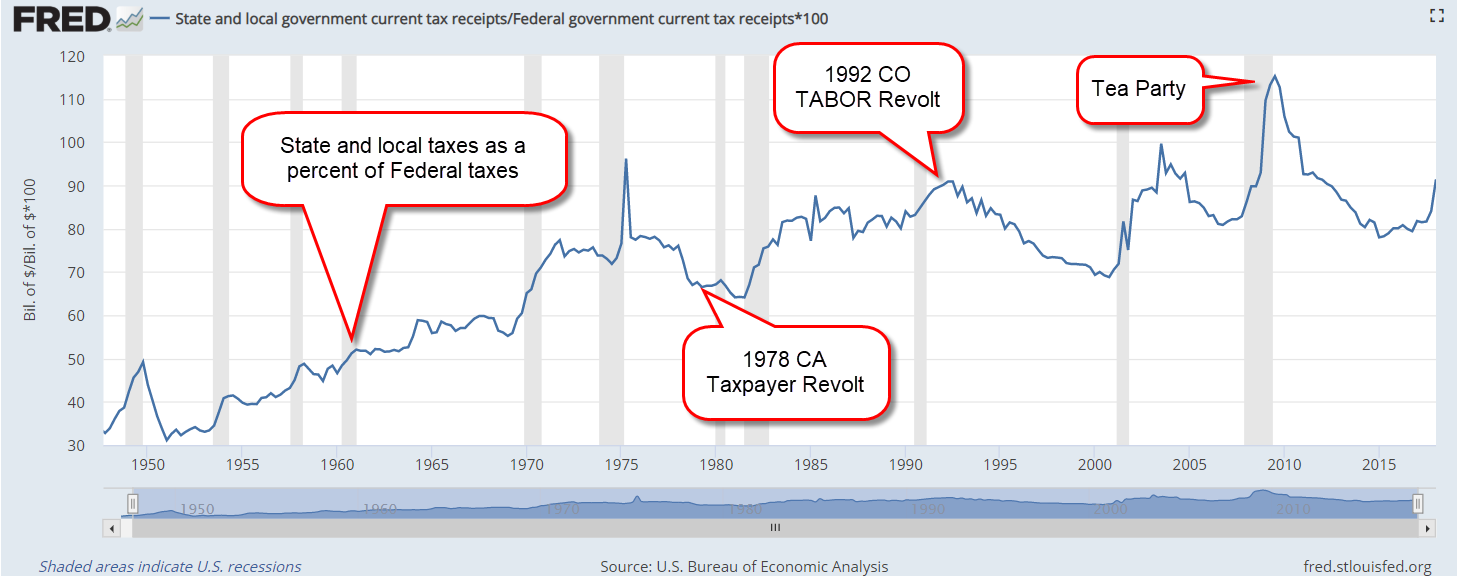
The debate over taxes focuses on the size of national programs, and the Federal taxes collected for those programs. In the past fifty years, state and local government (SLG) taxes have risen to equal the burden of Federal taxes. Despite this rise, SLGs must increase tax revenues to meet obligations and historic growth rates. Republicans control most states and will turn to property and sales tax for the additional revenue.

Fifty years ago, SLG tax receipts were half of all Federal tax receipts, including Social Security. For every tax dollar a worker sent to Washington, he sent fifty cents to his SLG. During the past decade, the SLG tax share has averaged ninety cents.

StatePctFed

In the engine model I first introduced in July, Federal taxes were drained from the economic engine. Because SLGs do not have super powers to create money, their taxes stay within the engine and grease the gears. 72% of SLG taxes are under the category of mandatory business production – they are levied on goods and services received by the taxpayers. These include property, sales and business taxes and a plethora of licensing fees. A family who cannot pay their property taxes loses their home. Sales taxes are mandatory at the time of purchase. When SLG taxes are high, households must work more hours or cut expenses to meet the burden. Unlike Federal taxes, higher SLG taxes can force families to work more and increase GDP (Note#1).

For the past thirty years, SLG taxes have grown 6.6% each year, 1-1/2% above the 5.2% annual growth in spending. In the past ten years, tax receipts have grown at half that rate – 3.2%, barely above the 3.0% growth in spending. SLGs have not saved enough to meet the pension benefits and medical care promised the Boomer generation. SLGs will need to raise revenues, cut spending or both.

23% of total SLG tax receipts are taxes collected on personal income. Taxes on business income make up an additional 5%. Sixty years ago, those personal and business shares of the SLG tax pie were 7% and 3%.

SLGIncPctSLGTotal

Republicans oppose raising taxes, especially income taxes, and they control the legislatures in 32 states. In 26 of those states, they control the governorship as well (Note #2).  Democrats have total control of only six states, one of them California, where income and sales tax make up a whopping 50% of state revenues (Note #3). Many SLGs will cut spending and raise additional revenue through higher property and sales taxes and licensing fees. This lowering of the income tax share will move the mix of income and production taxes to the model of sixty years ago when production taxes were 87% of total SLG tax receipts.

In 2017, single family homeowners averaged $3300 in property taxes. Some states like Colorado have low property taxes averaging only $2000 (Note #4). Personal property taxes have averaged almost 7% annual growth during the past thirty years. Expect 8 – 10% annual growth in the next decade and a population shift to those states which can curb the growth of their taxes. Angry homeowners and taxpayers are sure to kick up a ruckus at City Councils and State Legislatures around the country.

//////////////////////////////

  1. In 2007, Christina and David Romer analyzed the effect of tax changes on GDP. They found that a 1% exogenous tax increase resulted in a 2 – 3% reduction in real GDP. They classified tax changes implemented for long-term growth as exogenous. Here is a one page summary of the PDF.
  2. One of several sources on Republican dominance of state legislatures. The Hill.
  3. Income and sales tax make up 50% of California’s tax revenues (CA Research Bureau)
  4. Denver Post article on property taxes

//////////////////////////////////

Miscellaneous

NYT had an article on senior scams this week. Because those older than 50 own 70% of deposit balances, they are prime targets of fraud. This was novel: a retired IT pro who thought he was working from home as an employee gave his new “employer” his bank information so that his paycheck could be direct deposited. Common scams: Check fraud is still common, as are overpayments and other excuses to get you to give up your bank account information. Only you should be initiating such a transaction.

Vanguard’s projections of expected returns for various asset classes over the next ten years. Domestic stocks 3.9%. Bonds 3.3%


Lien On Me

Jerry sent me a link to a story of legal cruelty documented by the Huffington Post Investigative Fund.  Large banks, including JP Morgan Chase and Bank of America, are buying up blocks of tax liens for delinquent property taxes, adding on exorbitant legal and interest fees, which they collect when the homeowner is forced to sell.  In one example, JPMorgan collected $12,000+ for a delinquency of less than $1000 on a $67,000 house.

What can we do?  Some cities have passed laws that prevent the sale of tax liens which are less than a minimum – a $1000, for example.  Check with your city or county to see if it has such a law.  If not, write your reps to get such a law passed.

I’m too sickened to comment further.