House of Money

June 12, 2022

By Stephen Stofka

Economics students learn that money is a complex function, a multi-tool that plays three roles in our lives. Lawyers study the role of money in contracts. Psychologists study how our beliefs and personal history shape our distinct attitude to money. Our use of money embodies our expectations of the future and our perceptions of risk. The financial crisis demonstrated that money connects us and separates us. The struggle between cooperation and distrust is the foundation of our experiment in democracy.

Money is the Swiss army knife of most societies. As a medium of exchange, it saves us the cost of matching our needs. We can store our labor in a unit of money, then trade it for the things we want. The law regards an exchange of money as a “consideration” that distinguishes a contract from a gift. Current Supreme Court precedent has held that money is speech. Because we use money to store purchasing power, we want it to be a reliable container that doesn’t leak value. Money’s role as a unit of account requires legal institutions to administer the rules of that accounting.

We buy insurance to mitigate risk but to do so we are herded into risk pools based on age, sex or occupation. Those under age 25 pay higher car insurance premiums but lower health insurance premiums. Because they make less money as a group, they have a higher loan default rate and must pay higher borrowing costs. Roofers pay higher workmen’s compensation premiums than police. Heights are more dangerous than criminals. Before Obamacare, health insurance companies charged women of childbearing age higher premiums for individual policies (Pear, 2008). The premiums reflected the higher expected costs of pregnancy regardless of whether a woman had any intention of getting pregnant. We are Borg.

Companies may classify our risk profile but we have a unique relationship with money, a composite of personal experience and inclination. “Me” and “my” are appropriately contained in the word “money” because our attitude toward money is as unique as our fingerprints. In 1984, British psychologist Adrian Furman (1984) led a study to assess people’s attitudes toward money. The questionnaire included 150 questions grouped into five areas that probed the subjects’ beliefs, their political attitudes and affiliations, their sense of autonomy and personal power. An argument about money can be as complex as that questionnaire.

Many political debates involve money. Each party tries to gain control of the public purse to fund its priorities. After 9-11, the debate over money intensified. The hijackers had attacked a money center as a symbol of American hegemony. While Americans debated the justification for an invasion of Iraq, the budget surplus of the late Clinton years evaporated. For some voters, the choice was a stark one – spend money to blow up people in a foreign land or spend it to strengthen American communities. To calm his critics, Mr. Bush promised that Iraq would repay American war expenses with its oil revenues. This was one of several follies that turned voter sentiment toward Democrats in 2008.

The financial crisis showed us the complex nature of money and tested the values that we attach to money. In the last months of a flailing Bush Presidency, the crisis exposed the corruption, greed and stupidity of the country’s largest financial institutions. Billions of taxpayer money had created and fed a thicket of regulatory agencies that were either corrupt or incompetent. The crisis ignited a strong moral outrage that intensified when Democrats fought to pass Obamacare.

The debate may have ebbed during the decade that followed but the Republican tax cuts of 2017 reignited public disdain and distrust. While many American families struggled to recover from the crisis, the politicians and their rich patrons fattened their fortunes.

Money is the heart of the American experience. The American confederacy of colonies that had won independence from Britain could not pay its debts or borrow money. The writing of the Constitution was sparked by the urgent desire to resolve that crisis or risk becoming subjects again of a colonial power. To reach consensus, the colonies had to overcome their distrust of a central government with the power to levy taxes. The colonies distrusted each other and the regional coalitions that might take the reins of that central government. The founders built their distrust into the Constitution and its governing institutions. In grade school we learn them as “checks and balances,” a euphemistic phrase for distrust.

On social media we argue about the many aspects of money. Our experiment in democracy will be over when Americans stop having spirited discussions about money.

////////////////

Photo by Kostiantyn Li on Unsplash

Furnham, A. (1984). Many sides of the coin: The psychology of money usage. Personality and Individual Differences, 5(5), 501–509. https://doi.org/10.1016/0191-8869(84)90025-4

Pear, R. (2008, October 30). Women buying health policies pay a penalty. The New York Times. Retrieved June 7, 2022, from https://www.nytimes.com/2008/10/30/us/30insure.html

Risky Biz

December 13, 2015

How low can crude oil prices go?  Older readers may remember the Limbo, a party dance popular in the early 60s.  After breaking through the “limbo stick” of $40 per barrel, gas prices sank even lower when the IEA indicated that the supply glut will continue through 2016 (Story).

A popular energy ETF, XLE, has fallen 11% in nine trading days.  Yes, an entire sector of the economy has lost more than 1% per day this month. Some oil service companies lost more than 3% on Friday alone. The large integrated oil companies like Exxon (XOM) and Chevron (CVX) say they are committed to maintaining their dividends (Exxon now near 4%, Chevron near 5%) but investors are concerned that continuing price pressures will make that ever more difficult. This article provides a good overview of the structure, revenue and profit streams of large integrated oil companies.

So we lie around at night worried about our stock portfolio.  Why would we do that?  Because someone – who? – is going to pay us a little extra to worry about our stocks.  Or, at least, that’s the way it’s supposed to go, isn’t it? The extra return we are supposed to get for our worries is called a risk premium, or the plural – premia.  One measure of that premium is the total return on stocks minus the total return on a safe long term bond like a ten year Treasury bond.

In his book Expected Returns, An Investor’s Guide to Harvesting Market Reward,  Antti Ilmanen reviews the historical returns of several types of assets during the past century. He wrote a free summary of the book in 2012 (Kindle version  OR PDF version).  Mr Ilmanen presents an investing cube (pg. 3) as a visualization of the factors or choices that an investor must consider.   On one face are assets categorized into four types of investment.  On another face are four styles of investment.  On the third face of the cube are four types of risk.

A surprising find was that the risk premia of stocks over bonds was only 2.38% (p. 12) during the past fifty years.  Investors are not being paid much for their worry.  When the author compared the returns on stocks to longer term twenty year Treasury bonds (an ETF like TLT, for example), the risk premium has been negative for the past forty years.

The author emphasizes that “a key theme in this book is the crucial distinction between realized (ex post) average excess returns and expected (ex ante) risk premia.” (p. 15)  Historical averages of risk premia may be exaggerated by high inflation, which hurt the returns on bonds in the 1970s and part of the 1980s, and made returns on stocks that much better by comparison.  In a low inflation environment such as the one we have now the risk premia for owning stocks may be rather muted.

Ilmanen’s analysis of past returns reveals several historical trends that can help an investor’s portfolio.    Value investing tends to produce higher returns over time.  So-called Dividend stocks also generate additional return.

I was surprised at the relative stability of per capita GDP growth over 100 years.  We wring our hands in response to a crisis like the dot-com meltdown or the Great Recession but these horrific events barely show in the average aggregate output of the country over a person’s working years. Here is a table from the PDF summary.

A mutual fund QSPIX was formed last year based partly on the research in the book.  However, the minimum investment is $5,000,000.    The fund is currently 28% in cash.

*********************************

Social Security Strategies

A resource on the right side of this blog is Maximize My Social Security (MMSS), a personally tailored – and inexpensive – advisory service to guide older people to better informed Social Security choices.  The site does not use your social security number.  If you already have an online account with the Social Security Administration, you can complete the forms at MMSS and get some results in under twenty minutes.

Old people who used to talk about the latest Pink Floyd or Led Zep album when they were younger now talk about Social Security, Medicare and their aches and pains.  Always a popular topic:  hey, what do you think about waiting to file for Social Security?

Pros of waiting:

1.  Where else  can any of us earn a guaranteed 8% on our money each year?  Sign me up!  For each year we wait, our Social Security annual benefit increases by 8%.

2. Inflation adjusted:  On top of the additional 32% we get from SS when we start collecting SS at age 70, we are getting an inflation adjustment on that higher amount.

3.  If we need to borrow money to get by during the 4 years we wait, we may be able to borrow the money using our house as collateral.  Depending on our tax circumstances, the interest we pay on the borrowed money could be deductible, reducing the net cost of borrowing.

4.  If we are a guy, we will probably die before our spouse.  Wives who may have a lower benefit will get their benefit amount bumped up to what we were receiving.

Cons of waiting:

1.  We could die before the “payoff” age, between 79 and 82.  This is the age when the inflation adjusted benefits we receive by delaying our benefit matches the total we would have collected by claiming at an earlier age.  However, we often don’t factor in the advantage of the #4 Pro above in which our spouse collects a higher amount till her death.

2.  Congress could change SS payments and rules.  The institution does not have a good track record for keeping its promises.  The swelling ranks of the Boomer generation contributed far more than recipients of earlier generations took out in benefits. Congresses of the past few decades have spent all the extra money accumulated in the Social Security coffers.  After 2020 the system will come under greater cash flow pressure as the Boomers continue to retire and claim benefits.  If Congress does reduce benefits,  then those of us who waited to file for benefits will probably regret our decision.  By the way, MMSS allows users to estimate the long term impact of such a reduction.

3.  We may have to borrow to make ends meet while we wait to collect benefits.  Banks don’t usually loan money to retirees with no job income, necessitating some asset-backed mortgage. Older people may be averse to assuming any new debt.

4.  Withdrawing money from savings while we wait will reduce our savings for a time, which will lessen the “endowment” base of our lifetime wealth.  While the additional 8% per year from SS should more than offset that loss, we can never be certain.  As an example, let’s imagine a retiree at the beginning of 1995 who decided to draw down savings and wait four years to start collecting SS benefits.  The stock market had gone nowhere during 1994.  She sold some stocks and bought a 4 year CD “ladder” for the amount she would need to tide her over till she started collecting benefits.  During those next four years, the SP500 index rose from 459 to 1229, a 167% gain – more than 25% annually excluding dividends.  Even with the additional money our retiree was making each month in SS benefits because of her decision to delay, it was the worst time to get out of the stock market!

Credit Spreads

November 22, 2015

The behavior of bonds, their pricing and their yields (the interest or return on the bond), can seem like a mystery to many casual investors.  As this Money magazine writer notes, the language is backwards.  Yields rise but that’s bad because prices are falling.  Prices rise but that’s bad for new buyers who are getting a low yield on their investment.   The article mentions a little trick to help keep it straight – convert the yield to a P/E ratio, something more familiar to many investors.

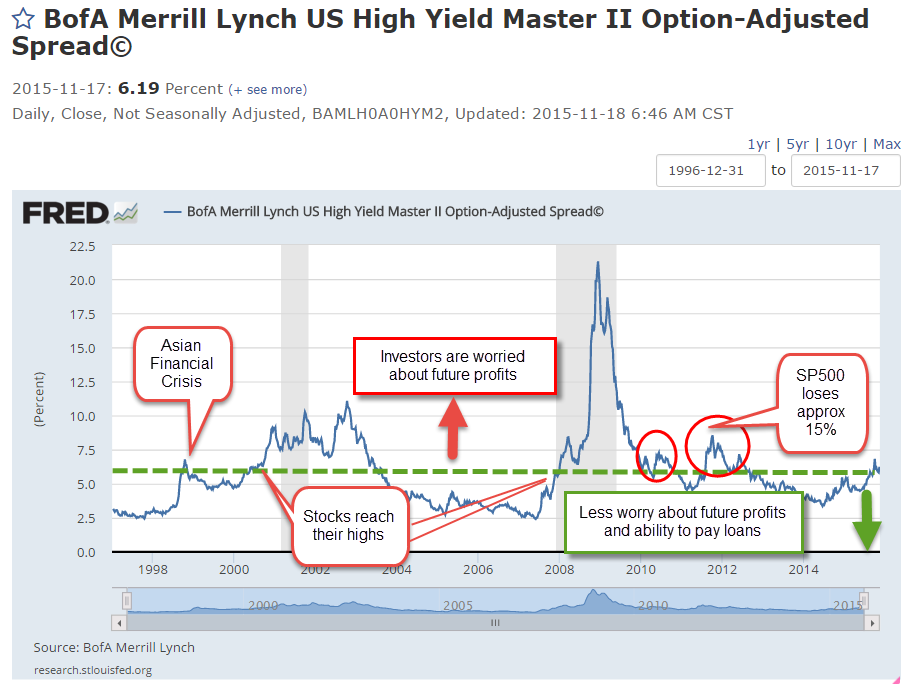
In Montana, a “spread” might be a large ranch but on Wall Street the term often refers to the difference in yield between a safe investment like a 10 year Treasury bond and an index of lower rated corporate bonds, or “junk” bonds. Investors want to be paid for the extra risk they are taking.  As investors get more worried about the economy and the growth of profits, they worry about the ability of some companies to pay their debts.  Debts are paid from profits.  Less profit or no profit increases the chance of default.

Some call the spread a “risk premium,” and when that premium is less than 5 – 6%, it indicates a relatively low to moderate sense of worry among investors.  Anything greater than 6% is a note of caution.  In the chart below a rising spread above 6% often signals the coming of stock market swoons.  When I pulled this chart earlier in the week, the rate was 6.19%.  On Friday, the rate was climbing toward 6.3%.

This 2004 paper from the research division of the Federal Reserve gives a bit more depth on credit spreads and their movements.

*********************************

Inventory-To-Sales Ratio

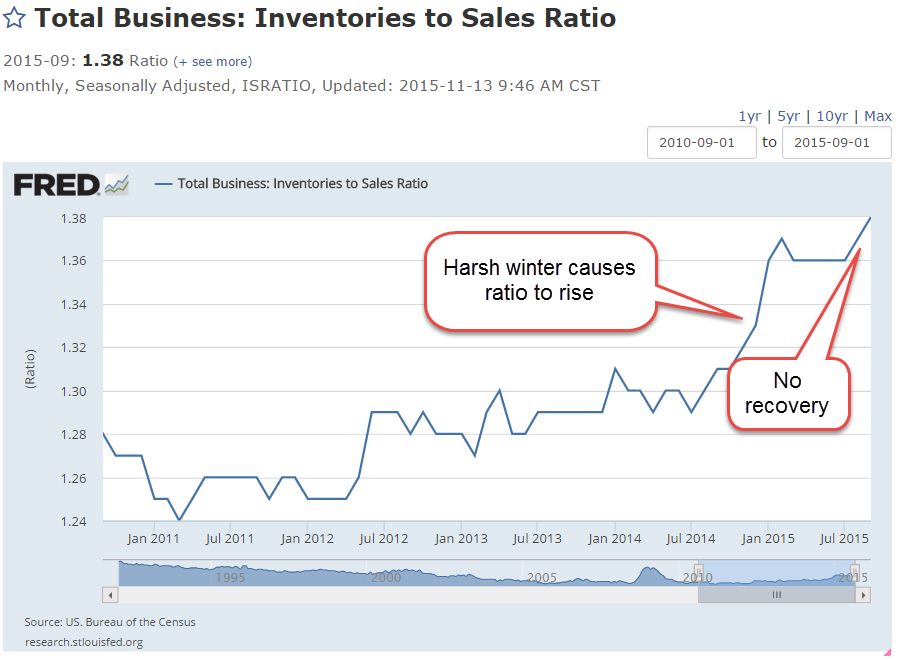
In a September blog post I noted the elevated inventory to sales ratio, meaning that manufacturers, merchants and wholesalers had too much product on hand relative to the amount of sales.  There is a bit of lag in this series; September’s figures were released only a week ago.  At 1.38, the ratio continues to climb.

*******************************

The Social Security Annuity

In the blog links to the right is an article by Wade Pfau comparing the “annuity” that Social Security provides with those available on the commercial market.  He also analyzes the extra return one can achieve by delaying Social Security until age 70.